• By Donald Zuhn

    USPTO Building FacadeLast Friday, the U.S. Patent and Trademark Office held a four-hour long forum to receive public feedback on the Myriad-Mayo Guidance, which was issued by the Office on March 4.  According to the Office's Guidance webpage, the forum was intended to provide an opportunity for stakeholders to present their interpretation of the impact of Supreme Court precedent on the complex legal and technical issues involved in subject matter eligibility analyses during patent examination.

    On Monday, we reported on the opening remarks provided by Drew Hirshfeld, Deputy Commissioner for Patent Examination Policy, and the overview of the Guidance provided by Raul Tamayo, Senior Legal Advisor for the Office of Patent Legal Administration.  Yesterday, we reported on the first of three groups of public presentations.  Today, we report on the second group of public presentations.  This group of presenters consisted of Courtenay C. Brinckerhoff of Foley & Lardner LLP; Dr. Leslie Fischer of Novartis Pharmaceuticals Corp.; and Dr. Warren D. Woessner of Schwegman Lundberg & Woessner, P.A.

    BrinckerhoffLike prior presenters Dr. Sauer and Dr. Sonnenfeld, Ms. Brinckerhoff (at left) began her presentation by contending that the Guidance "[e]xtends Myriad to subject matter that was not before the Court and/or that the Court expressly stated that it was not addressing," including for example, compositions of matter, methods of treatment, and methods of manufacture.  Noting that the Supreme Court in Myriad and Mayo "warned against overly-broad applications of the subject matter eligibility exceptions [because] too broad an interpretation of this exclusionary principle could eviscerate patent law," Ms. Brinckerhoff declared that the Guidance "threatens to do just that — eviscerate patent law and stifle investment and innovation."  In support of her argument, she cited a Managing Intellectual Property article by Sherry Knowles that relied on a Journal of Natural Products paper by Dr. David J. Newman and Dr. Gordon M. Cragg entitled "Natural Products as Sources of New Drugs over the 30 Years from 1981 to 2010," (see "Sherry Knowles 'Speaks Truth to Power' on the PTO's § 101 Guidelines").  As shown in a slide from Ms. Brinckerhoff's presentation, 71% of the 1,355 drugs approved between 1981 and 2010 would fall outside the scope of the Guidance.
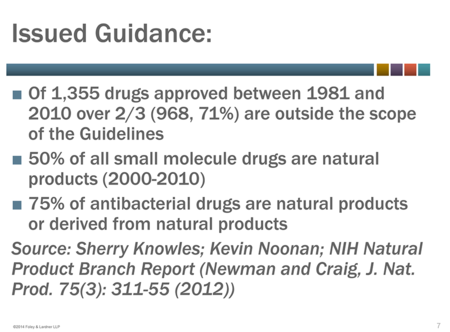
    Brinckerhoff_slide 7
    According to Ms. Brinckerhoff, the Office erred in two respects when crafting the Guidance.  In particular, she argued that the Office relied on an overly narrow interpretation of Funk Bros. that resulted in an overly broad application of that case, and the Office parsed claim elements rather than considering claims as a whole.  With respect to the Office's interpretation of Funk Bros., Ms. Brinckerhoff explained that the Guidance finds a composition comprising a combination of components to be non-eligible unless at least one of the components is not a natural product (as in the training slides example of pomelo juice) or unless the components have a specific physical interrelationship (as in the Guidance's firework example).

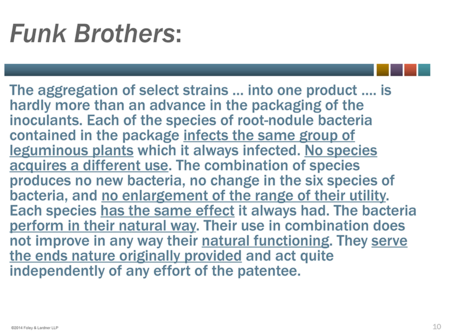
    Pointing to a passage from Funk Bros. (see slide below), Ms. Brinckerhoff remarked that while she sees "mention after mention of function and utility" in the citation, the Office instead "sees that same passage as requiring a markedly different structure."  Ms. Brinckerhoff also reminded the Office (as did a number of presenters) that Chakrabarty spoke of "markedly different characteristics," and not "markedly different structure."
    Brinckerhoff_slide 10
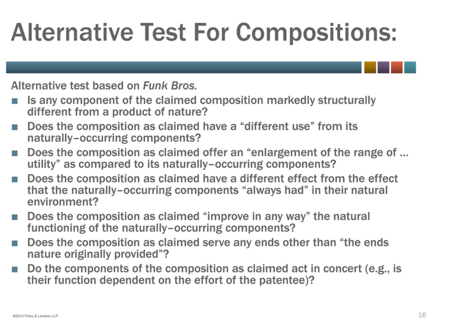
    Contending that the Supreme Court did not question the eligibility of pharmaceutical compositions in either Myriad or Mayo, Ms. Brinckerhoff suggested an alternative test for compositions based on a proper reading of Funk Bros. (as set forth in the following slide from her presentation).
    Brinckerhoff_slide 16
    Ms. Brinckerhoff next inquired as to why method of treatment claims were subject to eligibility scrutiny as neither Mayo nor Myriad undermined the eligibility of such claims, and she indicated that she didn't understand why these types of claims were being rejected by examiners.  She concluded her presentation by noting that applicants had few options for dealing with the Guidance.  She asked whether applicants would need to take every adverse case to the Patent Trial and Appeal Board, and because the appeal route could take 3-5 years, inquired as to whether the Office would offer an expedited route to get a PTAB decision.

    A copy of Ms. Brinckerhoff's presentation can be found here.
    FischerThe second presenter, Dr. Leslie Fischer (at right), argued that the problem with the Guidance was that no consideration is given to the function of claimed subject matter.  Instead, "subject matter comprising only natural products must have a marked structural difference from the corresponding natural product in order to be patent eligible" (emphasis in presentation).  According to Dr. Fischer, the solution would be to use the following test for patent eligibility:

    Whether the claimed subject matter, as a whole, has:
    (1) a physical difference (e.g., structure, form, purity, etc.) relative to the natural product(s); and
    (2) a different function or use relative to the natural product(s).

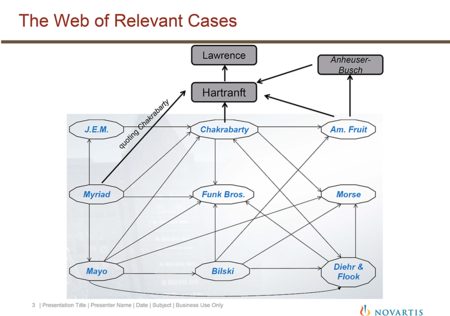
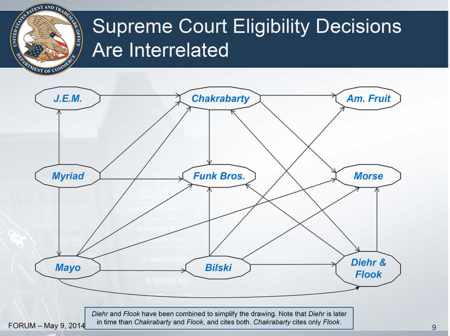
    Dr. Fischer also noted that the Office's "web" of relevant cases (as shown in a slide from Mr. Tamayo's presentation) overlooked a few important decisions (which she indicated in her revised web).  These additional cases "tell us that function is important."
    PTO_slide 9
    Fischer_slide 3
    According to Dr. Fischer, the tariff cases Hartranft v. Wiegmann, 121 U.S. 609 (1877), and Lawrence v. Allen, 48 U.S. 785 (1849), indicate that a manufacture requires a new or distinctive form, character, name, or use.  Noting that Chakrabarty cites Hartranft in finding that the claimed bacteria in that case constituted "a product of human ingenuity 'having a distinctive name, character [and] use,'" Dr. Fischer concluded that "[t]he consideration of functional changes as relevant to patent eligibility is in accordance with historical tar[]iff and patent cases, which consider whether products derived from nature have different functions and uses" (emphasis in presentation).  Dr. Fischer also noted that the Myriad Court discussed Chakrabarty (and that case's citation to Hartranft) and Funk Bros. in similar terms, and concluded that "Myriad's use of Chakrabarty and Funk is perfectly compatible with considering whether a functional change can convert an otherwise 'natural product' into patent eligible subject matter."  Thus, she declared that "Myriad does not tell us to throw away function."

    Dr. Fischer further suggested that Myriad's claims were not directed to discrete chemical compositions, but rather were directed to information.  She explained that the Myriad Court entwined DNA's functional aspect (i.e., information) with DNA's molecular structure (i.e., structure).  In her view, "Myriad addresses a product, that, according to the Court, does not have a different function or structure from that which is found in nature."  Dr. Fischer contended that the Myriad Court saw the characteristics of structure (sequence) and function (information) as inseparable, and argued that "Myriad has very limited applicability — [applying] only to subject matter in which molecular structure and function completely collapse, e.g., DNA."  Dr. Fischer concluded her presentation by asking why the Office had decided to use the most damaging interpretation of Myriad, when it did not have to, and by reminding the Office that "for natural products, function matters."

    A copy of Dr. Fischer's presentation can be found here.

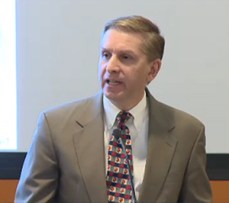
    WoessnerNoting that the Guidance "require[s] both that the claimed compound be 'non‐naturally occurring' and 'markedly different in structure from naturally occurring products' to be patent‐eligible," the final presenter in the second group, Dr. Woessner (at left), pointed out that "[n]either Myriad, Mayo nor Funk Bros. define 'natural product', much less a 'markedly structurally different, non‐naturally occurring product.'"  Dr. Woessner next reminded forum attendees that while the Supreme Court vacated In re Bergy, 596 F.2d 952 (CCPA 1979) (finding pure culture of bacterium producing antibiotic not to be a natural product) when it took up Chakrabarty, Bergy has nevertheless been extensively cited as precedent ever since.

    Woessner_slide 9
    Noting that Chakrabarty contains no language disparaging Bergy or requiring structural alterations, Dr. Woessner contended that the claimed subject matter of Bergy would satisfy the test in Chakrabarty.  Dr. Woessner concluded his presentation by declaring that neither Myriad nor Mayo provide a sufficient rationale for departing from about a century of practice that culminated in Bergy.  According to Dr. Woessner, the Guidance has been "disruptive, regressive and should be withdrawn."  He also reminded the Office that the first version of the written description guidelines were "taken back for a major overhaul after a public outcry just like this."

    A copy of Dr. Woessner's presentation can be found here.

    Before moving on to the third group of presentations, representatives from the Office fielded questions and received additional comments from attendees.  One attendee remarked that the Office had taken "a step backwards" and "gone way overboard" with the Guidance, and warned that "you will have your head handed to you" once the courts had a chance to consider the Guidance.  Mr. Hirshfeld noted that the Office was "exploring" the structural versus functional issue that had been raised by a number of presenters, but pointed out that the Office could not ignore Funk Bros., which he believed constrained what the Office could do.  Nevertheless, he asked attendees if there was "a way between Funk and Chakrabarty"?  June Cohan, a Legal Advisor with the USPTO's Office of Patent Legal Administration who presented on the Guidance at the biotechnology/chemical/pharmaceutical (BCP) customer partnership meeting and at the BIO's 2014 Spring Intellectual Property Counsels Committee (IPCC) Conference, stated that she was particularly concerned about discerning function that is inherent from function that was "added" to the claimed subject matter by the applicant.

    In the final post in this series, we will examine the comments made by the third group of public presenters as well as the open participation/question and answer session that concluded the forum.

    For additional information regarding this topic, please see:

    • "USPTO Holds Forum on Subject Matter Eligibility — Part II," May 14, 2014
    • "Guest Post: How to Patent Grapefruit Juice — The New USPTO Guidance for Patent Eligible Subject Matter Is Both Sticky and Sour," May 13, 2014
    • "USPTO Holds Forum on Subject Matter Eligibility — Part I," May 12, 2014
    • "USPTO Tries to Address Public Misunderstandings Regarding Myriad-Mayo Guidance," April 16, 2014
    • "USPTO Issues Guidance for Analyzing Subject Matter Eligibility of Claims Reciting Laws of Nature/Natural Principles, Natural Phenomena or Natural Products," March 4, 2014

  • By Donald Zuhn

    USPTO Building FacadeLast Friday, the U.S. Patent and Trademark Office held a four-hour long forum to receive public feedback on the Myriad-Mayo Guidance, which was issued by the Office on March 4.  According to the Office's Guidance webpage, the forum was intended to provide an opportunity for stakeholders to present their interpretation of the impact of Supreme Court precedent on the complex legal and technical issues involved in subject matter eligibility analyses during patent examination.  On Monday, we reported on the opening remarks provided by Drew Hirshfeld, Deputy Commissioner for Patent Examination Policy, and the overview of the Guidance provided by Raul Tamayo, Senior Legal Advisor for the Office of Patent Legal Administration.  Today, we report on the comments provided by several of the public presenters.

    As we noted in Part I, the ten public presenters were divided into three groups, with each presenter being given 10 minutes to provide feedback on the Guidance.  The first group of presenters consisted of Dr. Hans Sauer, Deputy General Counsel for Intellectual Property for the Biotechnology Industry Organization; Suzannah K. Sundby of Smith, Gambrell & Russell, LLP; Dr. Anthony D. Sabatelli of Dilworth IP LLC; and Dr. Kenneth H. Sonnenfeld of King & Spalding LLP.

    SauerDr. Sauer (at left) began by noting that "BIO member companies operating in areas that have little or nothing to do with human genetics are beginning to receive 101 rejections of claims to pharmaceutical compositions, industrial enzymes, methods of treatment using medicinal molecules, and other inventions that were neither considered nor discussed in recent Supreme Court decisions."  He pointed out that BIO members believe that in crafting the Guidance, "the PTO has gone beyond interpretation of recent Supreme Court decisions, and has engaged in unwarranted extrapolation and expansion of law, in ways not prompted by the Myriad decision."  According to Dr. Sauer, notable examples of this expansion include "the application of a new 101 rationale to combination products," methods of drug administration or treatment, and "[t]he implicit but clear abandonment of cases like Parke‐Davis, In re Merz, In re Bergstrom, In re Kratz, and Merck v Olin Mathieson, which were briefed to the Supreme Court but neither discussed nor overruled."

    Because "[t]he PTO is merely interpreting court decisions interpreting prior court decisions interpreting judicially‐created exceptions from the statute," Dr. Sauer contended that "the PTO is no better positioned to establish an authoritative interpretation of the Supreme Court’s 101 jurisprudence than are the lower courts."  He added that:

    Expanding Myriad's holding to all claims to isolated or purified natural molecules like antibiotics and other medicinal substances, and combinations thereof, and fermentation or distillation products or bacterial enzymes, will not only prospectively block inventors from acquiring commercially meaningful protection for products that were never even mentioned by the Supreme Court [but will] also cast[] a shadow over thousands of issued patents that the PTO now says would never be issued if they were examined today and — implicitly — should never have been issued in the first place.

    Dr. Sauer also noted that "[t]he PTO's interpretation of the Supreme Court cases, as applied to biotech, is not the only permissible one," and then set forth a series of questions:

    So what policy choice did the PTO make when it picked its current interpretation from all the different reasonable interpretations of these cases?  Does the PTO believe the Supreme Court really meant to strike down claims to fungal antibiotics or industrial enzymes that go into laundry detergents?  Does the PTO believe it is implementing the intent of Congress when it last passed Section 101?  Or that a more draconian interpretation of Supreme Court pronouncements will advance the progress of the useful arts better than alternative readings?

    As for answers to these questions, Dr. Sauer responded that "[w]e're left to guess, because that's a discussion we never had."  He concluded his comments by declaring that:

    There is no unified reading of Funk, Benson, Flook, Diehr, Chakrabarty, Pioneer, Bilski, Mayo, and Myriad that is fully coherent, free of internal tension, and that operates harmonically with the other requirements of patentability.  We need the PTO to acknowledge that reality.  And we need a dialogue not only over how to best interpret the caselaw we've been given, but also whether that caselaw leads us to the right place.

    A copy of Dr. Sauer's written testimony can be found here.

    SundbyThe second presenter, Suzannah Sundby (at right), argued that there were three problems with the Guidance:  (1) the factor-based approach set forth in the Guidance is inappropriate for § 101 eligibility determinations, (2) process and product claims should be evaluated using separate tests, and (3) the Office's interpretations of Mayo and Myriad in the Guidance are too broad.  With respect to the first issue, Ms. Sundby indicated that "[a]n ineligible factor can negate an eligible factor," and as an example, pointed out that if the Guidance's weighing of factors approach was applied to the claims of Diehr, "the steps of installing the rubber in the press and the subsequent closing of the press would negate the fact that the process integrated the algorithm into a practical application, i.e., curing and molding rubber."

    As for the second issue, Ms. Sundby contended that the test for process claims should be the "significantly more" standard of Mayo, and the test for product claims should be the "markedly different characteristic" standard of Chakrabarty.  Moreover, as she pointed out "[n]owhere does the [Supreme] Court hold that a product must be both significantly more and markedly different."

    In a theme repeated by many of the presenters, Ms. Sundby reminded the Office that the standard set forth in Chakrabarty was whether a naturally occurring product recited in a claim exhibits markedly different characteristics, and not whether that product exhibits markedly different structure.  She argued that this markedly different characteristic could be either a structural difference or a functional one, and that this interpretation would be consistent with both Funk Bros. and Myriad, where the patent ineligible products at issue did not possess new, different, or changed characteristics.

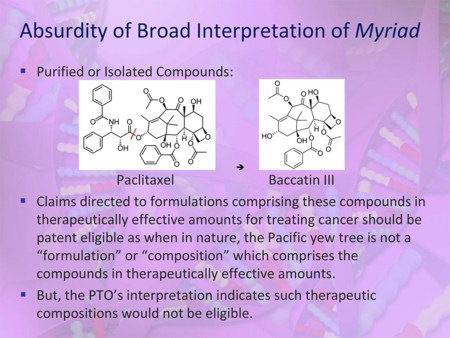
    With respect to the Office's interpretations of Mayo and Myriad in the Guidance, Ms. Sundby contended that "the PTO seems to interpret the 'apply it' discussion in Mayo as requiring unduly specific process steps," and that the Office "appears to interpret Myriad as applying to all things, isolated or synthesized, that can be derived from a product of nature."  According to Ms. Sundby, the Supreme Court in Myriad "reasoned that information in the isolated DNA molecule is the same as it is in nature, and hence, the chemical changes resulting from its isolation did not result in a markedly different characteristic, e.g., change to the information."  She concluded, therefore, that "Myriad does not stand for the rigid proposition that all compositions and molecules that originate from products of nature are patent ineligible" (emphasis in presentation).  As a result of the Office's interpretation of Myriad, many therapeutic compositions will be found to be patent ineligible (as outlined in a slide from her presentation):

    Sundby_slide 22
    In concluding her presentation, Ms. Sundby suggested, inter alia, that the Office allow applicants of pending applications to switch elected inventions, make actual examples of claims and 101 analyses available to the public, and establish a procedure for reviewing eligibility determinations to ensure consistency and compact prosecution.

    A copy of Ms. Sundby's presentation can be found here.

    SabaetelliThe next presenter in the group, Dr. Sabatelli (at left), began by focusing on the problems raised by the pomelo juice example in the Office's training slides and the Office's comments regarding the patent eligibility of gunpowder — a component of the claimed fountain-style firework of Example C in the Guidance.  While acknowledging that there was a need for the Guidance and conceding that the Guidance was "an initial step in the right direction," he asserted that the Guidance was too complex and set forth too many factors (and suggested that more factors were likely to be added by the Office or the courts).  He asked whether "we need[ed] a brighter, simpler line?"  As for changes to the Guidance, Dr. Sabatelli asked the Office to provide more examples.

    A copy of Dr. Sabatelli's presentation can be found here.

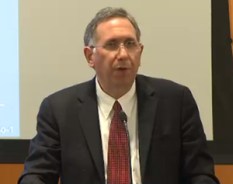
    SonnenfeldThe final presenter in the first group, Dr. Sonnenfeld (at right), began his presentation by a showing a slide listing the claims of Example B of the Guidance:

    Claim 1:  Purified amazonic acid.

    Claim 2:  Purified 5-methyl amazonic acid.

    Claim 3:  A method of treating colon cancer, comprising: administering a daily dose of purified amazonic acid to a patient suffering from colon cancer for a period of time from 10 days to 20 days, wherein said daily dose comprises about 0.75 to about 1.25 teaspoons of amazonic acid.

    He argued that Example B created gaps in the available protection for many biotech and pharmaceutical applicants.  He noted, for example, that pharmaceutical composition claims (for which no exemplary claim was set forth in the Guidance) may be too narrow if a pharmaceutically acceptable carrier must impart a "significant difference," and that method of treatment claims could be limited to single indications and require the inclusion of multiple limiting elements.  With respect to claim 1 of Example B, he asked whether the Office was analyzing the claim as a whole, and suggested that a claim to "amazonic acid" was different from a claim to "purified amazonic acid" (stating that purified amazonic acid does not exist in nature).  In support for the patent eligibility of purified natural product claims, Dr. Sonnenfeld pointed to the Office's utility guidelines (as shown in the slide from his presentation):

    Sonnenfeld_slide 6
    And provided a list of patented purified natural product therapeutics:

    Sonnenfeld_slide 7
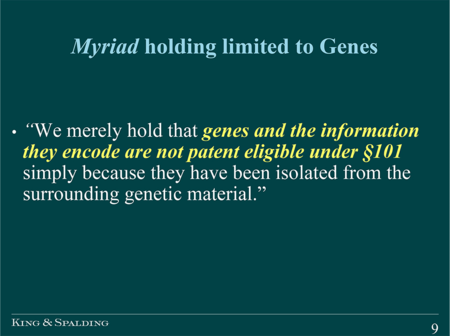
    Like Ms. Sundby, Dr. Sonnenfeld also argued that Myriad concerns genes and their information, and that the Myriad holding is limited to genes:

    Sonnenfeld_slide 9
    A copy of Dr. Sonnenfeld's presentation can be found here.

    Before moving on to the second group of presentations, representatives from the Office fielded questions and received additional comments from attendees.  One attendee remarked that the Guidance had been a "process failure" because the Office had neglected to include the community of practitioners sooner.  In response, Mr. Hirshfeld stated that it was not the Office's intention to exclude the public from the discussion, but that the Office, in crafting the Guidance, was merely doing what it always had done with respect to the creation of examination guidelines.  When Office representatives were asked by another attendee whether there was a Supreme Court case that said "markedly different" was the test for determining the eligibility of claims reciting natural products, Mr. Tamayo responded that the Office believed "Myriad focused us on that being the test."  The forum then moved on to the second group of presenters.

    In subsequent posts, we will examine the comments made by the remaining public presenters as well as the open participation/question and answer session that concluded the forum.

    For additional information regarding this topic, please see:

    • "Guest Post: How to Patent Grapefruit Juice — The New USPTO Guidance for Patent Eligible Subject Matter Is Both Sticky and Sour," May 13, 2014
    • "USPTO Holds Forum on Subject Matter Eligibility — Part I," May 12, 2014
    • "USPTO Tries to Address Public Misunderstandings Regarding Myriad-Mayo Guidance," April 16, 2014
    • "USPTO Issues Guidance for Analyzing Subject Matter Eligibility of Claims Reciting Laws of Nature/Natural Principles, Natural Phenomena or Natural Products," March 4, 2014

  • Sets Forth Clinical, Pharmacology Data Sufficient to Support Biosimilarity

    By Kevin E. Noonan

    FDAThe Food and Drug Administration has released the first new Guidance relating to its evolving standards for satisfying the biosimilarity requirements of the Biologics Price Competition and Innovation Act (BPCIA) since its release in February 2012 of three basic Guidances that left many if not most of the relevant details unclear.  This most recent Guidance is more specific, being directed particularly to the type and amount of clinical pharmacology data the Agency will require to demonstrate biosimilarity to a reference product but is expressly "being distributed for comment purposes only" and thus how the FDA will administer the BPCIA remains a work in progress.

    The provisionality of the Guidance is acknowledged from the Introduction (Section I), where it is described as being antecedent to a Guidance "in its final form" that will be "one of a series" comprising how the Agency will implement the BPCIA.  This Guidance "discusses some of the overarching concepts related to clinical pharmacology testing for biosimilar products, approaches for developing the appropriate clinical pharmacology database, and the utility of modeling and simulation for designing clinical trials."

    The Guidance establishes (in Section II) the relevance of clinical pharmacological data to the question of biosimilarity, stating that "[c]linical pharmacology studies are normally a critical part of demonstrating biosimilarity by supporting a demonstration that there are no clinically meaningful differences between the proposed biosimilar and the reference product."  These data are related to the "degree of similarity in drug exposure" between the reference drug product and the putative biosimilar.  The Guidance also notes that such data typically include pharmacodynamics endpoints and pharmacometric analyses that can reveal "clinically meaningful differences," and thus "can add to the totality of the evidence, reduce residual uncertainty, and thus guide the need for and design of subsequent clinical testing to successfully support a demonstration of no clinically meaningful differences in the overall demonstration of biosimilarity."  Which types of such studies are meaningful in any particular reference biologic product/biosimilar comparison will depend, inter alia, on the "residual uncertainties" remaining when all other types of comparison evidence are considered (e.g., structural, mechanistic and other physicochemical comparisons).

    The Guidance sets forth "three key concepts" as being "especially relevant" to their assessment of the similarity of biosimilar products:

    • Exposure and response assessment (Section III.A)
    • Evaluation of residual uncertainty (Section III.B)
    • Assumptions about analytical quality and similarity (Section III.C)

    With regard to exposure and response assessment, the Guidance asserts that these data are "important for the determination of safety, purity, and potency of any biological product, as well as for the determination of any potential clinically meaningful difference between two products."  But this assessment is "particularly challenging" in the biosimilar context, because what is being assessed is not a comparison between an active product that is a single molecule and its breakdown products but "a mixture of closely related, complex biological substances."  The Guidance defines "exposure" to related to pharmacokinetic parameter, including dose, drug concentrations in blood, plasma and other biological fluids, and related variable including Cmax, Cmin , Ctrough,ss, and area under the curve (AUC).  Response, on the other hand, is defined in the Guidance as pharmacodynamics, "a direct measure of the pharmacological or toxicological effect of a drug," the assessment of which includes single or multiple biomarkers (where using "broader" biomarker panels are preferred if they "capture multiple pharmacological effects of the [biosimilar] product."  In this regard, the Guidance cites "time of onset" of the marker relative to the combination of the time of onset, the "dynamic range" of the marker, how sensitive the marker is to differences between the reference drug and the biosimilar, relationships between changes in the marker and clinical outcomes, and the relevance of the marker on the mechanisms of action of the molecule.

    The Guidance on evaluating residual uncertainty is less expansive, merely setting forth the FDA standard of assessing the "totality of the circumstances" on the evidence and suggesting that this evidence be collected and submitted "in a stepwise manner," including the PK and PD data "obtained in conjunction with clinical pharmacology studies."

    Assumptions regarding analytical quality and similarity are defined in the context of such a "stepwise assessment of biosimilarity," wherein "extensive and robust comparative structural and functional studies (e.g. bioassays, binding assays, and studies of enzyme kinetics) should be performed to evaluate whether the proposed biosimilar product and the reference product are highly similar."  This in turn depends on the state of the art regarding analytical assays, including those related to measuring molecular weight, post-translational modifications, heterogeneity, impurity and degradation profiles and functional properties of the biosimilar.

    The differences between the reference drug product and biosimilar and the "type, nature, and extent" of those differences need to be supported by relevant information and experimental data, and if necessary additional data, and the Guidance explicitly notes that "certain differences in the results of the analytical characterization may preclude a determination by FDA that the proposed biosimilar product is highly similar to the reference product" and that, as a result the Agency will not approve the biosimilar application.

    The Guidance also sets forth four different assessments decisions along a "developmental phase continuum":

    • Not similar: Certain differences in the results of the analytical characterization may lead to an assessment of "not similar" and further development through the 351(k) regulatory pathway is not recommended unless, for example, modifications are made to the manufacturing process for the proposed biosimilar product that is likely to lead to a highly similar biological product.

    • Similar: Further information is needed to determine if the product is highly similar to the reference product.  Additional analytical data or other studies are necessary to determine if observed differences are within an acceptable range to consider the proposed biosimilar product to be highly similar to the reference product.  As an example, glycosylation plays an important role in the PK of certain protein products.  Manufacturing process conditions may impact glycosylation.  Comparative PK and PD studies of the proposed biosimilar product and the reference product help resolve that some differences in glycosylation identified in the analytical studies would be within an acceptable range to consider the proposed biosimilar product to be highly similar to the reference product.

    • Highly similar: The proposed biosimilar product meets the statutory standard for analytical similarity.  The results of the comparative analytical characterization permit high confidence in the analytical similarity of the proposed biosimilar and the reference product, and it would be appropriate for the sponsor to conduct targeted and selective animal and/or clinical studies to resolve residual uncertainty and support a demonstration of biosimilarity.

    • Highly similar with fingerprint-like similarity: The proposed biosimilar product meets the statutory standard for analytical similarity based on integrated, multi-parameter approaches that are extremely sensitive in identifying analytical differences.  The results of these fingerprint-like analyses permit a very high level of confidence in the analytical similarity of the proposed biosimilar and the reference product, and it would be appropriate for the sponsor to use a more targeted and selective approach to conducting animal and/or clinical studies to resolve residual uncertainty and support a demonstration of biosimilarity.

    The Guidance then sets forth a section (Section III.D) describing the "integrity" of the methods used in PK and PD studies (not surprisingly noting that these "should be accurate, precise, specific, sensitive, and reproducible").  These include (for PK studies) that the analytical method(s) used should be able to detect the active product and not just the total product in the formulation, and (for both PK and PD studies) that the assays chosen should be capable of providing the Agency with data that "are meaningful and reflective of drug exposure, the biological activity, and/or the PD effect of the proposed biosimilar product and the reference product."  A rationale for the choice of assay and its relevance should also be provided.  The Guidance then sets forth considerations regarding a number of specific assays, including:

    • Ligand binding assays (differentiating between receptor/ligand and antibody/antigen binding assays);
    • Concentration and activity assays (particularly with regard to enzyme replacement); and
    • PD assays (noting that the measured activity "should be relevant to the clinical outcome").

    With regard to safety and immunogenicity (Section III.E), the Guidance reiterates the caution from the earlier Guidances with regard to immune-mediated toxicity and the extent to which clinical pharmacologic data may be important to indicate differences requiring additional studies and appropriate study types, and that in certain circumstances the results of these studies may indicate that additional studies should not be pursued (because the differences are sufficient for the Agency to deny the biosimilar application).  And the Guidance further cautions that, should the publicly available information on the reference drug product indicate a propensity for immune-mediated toxicity the biosimilar applicant should include assays "capable of detecting binding antibodies (and their neutralizing potential) [] in advance to analyze samples obtained from PK and PD studies, so that immunogenicity may be evaluated in real time" (the Guidance further references its prior FDA guidance for industry Bioanalytical Method Validation).

    As it has in earlier Guidances, the Agency urges stakeholders to consult, especially with "critical study design issues," including crossover and parallel designs, which are of "particular relevance" (Section IV.A).  The "preferred design" for PK similarity assessments, according to the Guidance, is a single-dose, randomized, crossover study, particularly with products having a "short" half-life (less than 5 days), "rapid" PD response ("onset, maximal effect, and disappearance in conjunction with drug exposure"), and multiple dosing regimes where "the PD effect is delayed or otherwise not parallel to the single-dose drug PK profile."  Parallel study designs are recommended for biologic drugs having a long half-life and that elicit immunogenic responses.  Regarding the reference drug product used in these studies (set forth in Section IV.B), the Agency states that "a sponsor may use a non-U.S. licensed comparator product in certain studies to support a demonstration that the proposed biological product is biosimilar to the U.S.-licensed reference product" but also should provide "adequate data or information to scientifically justify the relevance of these comparative data to an assessment of biosimilarity and to establish an acceptable bridge to the U.S.-licensed reference product."  The type of "bridging data" the Agency will likely require can include structural and functional analytical data, and PK and PD study data comparing all three products (US reference drug product, non-US reference drug product, and biosimilar).

    With regard to appropriate study populations (Section IV.C), the Guidance sets forth the pros and cons for each alternative (healthy volunteers vs. patients affected by the relevant disease or disorder) and the considerations that can be dispositive for the choice of population (generally, those that would provide data that is "the most informative for detecting and evaluating differences in PK and PD profiles between the proposed biosimilar product and the reference product").  Safety (with regard to healthy volunteers) and the possibility for immunogenicity or "known toxicity" (for affected patients) are noted as relevant considerations, and the Guidance also mentions the possible importance of demographics in instances where a particular patient demographic group would be "most likely to provide a sensitive measure of differences between the proposed biosimilar product and the reference product" (while requiring a biosimilar applicant to justify these choices).  In other parts of the Guidance the Agency sets forth relevant considerations for dosing, which include (not surprisingly) a dose that is "most likely to provide clinically meaningful and interpretable data" (wherein the approved dose for the reference product being perhaps the right dose for studies involving affected patients).  Alternative dose choices are also provided  (see Section IV.D).

    Other aspects of clinical pharmacologic studies set forth in the Guidance include route of administration (the same as the reference drug product; Section IV.E) and the types of pharmacokinetic (Section IV.F) and pharmacodynamics (Section IV.G) measurements that should be considered, as well as the "appropriate pharmacodynamics time profile" (Section IV.H) and statistics used for comparing PK and PD results from the biosimilar and reference drug product (Section IV.I).

    The Guidance also contains a section (Section V) relating to "simulation tools" as part of study design and data analysis. The Guidance asserts that these tools can be useful in making many study choices set forth in earlier portions of the Guidance, and particularly notes the importance of making comparisons on the steep portion of a dose-response curve (which will more readily show differences between the biosimilar and the reference drug product) rather than in the "plateau" potion (which will not).  The Guidance also suggests that a biosimilar applicant who does not have access to exposure-response data on the reference drug product can use such tools to produce a "small study to determine an optimally informative dose" or other alternatives.

    The Guidance concludes with a reminder that the Agency has decided that it will assess biosimilarity between a putative biosimilar product and a reference drug product based on the totality of the evidence" (as set forth extensively in earlier Guidances).

    One aspect of this Guidance, in addition to its (somewhat) greater specificity, is that what may constitute evidence that the biosimilar should not be approved is more explicitly recited (or at least that non-approval is an outcome dependent on evidence of differences between the reference drug product and the biosimilar).  Generally, however, this Guidance provides an relatively small, specific, incremental advance in setting forth the Agency's course in providing a biosimilar approval pathway under the statute.

    As set forth on the first page of the Guidance:

    Comments and suggestions regarding this draft document should be submitted within 90 days of publication in the Federal Register of the notice announcing the availability of the draft guidance.  Submit comments to the Division of Dockets Management (HFA-305), Food and Drug Administration, 5630 Fishers Lane, rm. 1061, Rockville, MD 20852.  All comments should be identified with the docket number listed in the notice of availability that publishes in the Federal Register.

    For questions regarding this draft document contact (CDER) Sandra Benton at 301-796-2500, or (CBER) Office of Communication, Outreach and Development at 1-800-835-4709 or 301-827-1800.

    Copies of the Guidance can be found here.

    Interested readers should take the Agency up on this offer; unlike other governmental Guidances, the FDA appears genuinely interested in working with its stakeholders to address their legitimate concerns regardinh how the Agency will administer the law.

  • By Anthony D. Sabatelli* —

    PomeloWhat does grapefruit juice, or more specifically pomelo juice, have to do with all this?  I will get to that connection in just a bit.  For those of you not in the know, a pomelo is a large, grapefruit-like citrus fruit with a mild, sweet flavor, but without the characteristic bitterness of a grapefruit.  Now, on to the bitterness of the present situation.

    On March 4th, the U.S. Patent and Trademark Office issued guidelines to its examining corps for assessing patent eligible subject matter under 35 USC § 101.  The guidelines were issued in light of the Supreme Court's decisions in Myriad, Prometheus, and related cases.  See, "Guidance For Determining Subject Matter Eligibility Of Claims Reciting Or Involving Laws of Nature, Natural Phenomena, & Natural Products."  The Guidance is intended to help examiners determine whether the subject matter of a patent claim is significantly different from what exists in nature.

    The Guidance sets forth a three-question inquiry with a complex twelve-factor analysis for determining whether a claim meets the criteria for patent eligibility under § 101.  The first question is whether the claim is directed to one of the four statutory categories of patentable subject matter, i.e., a process, machine, manufacture or composition of matter.  If the answer is "no", end of inquiry, and the claim is not patentable.  If "yes", one proceeds to the second question, which is whether the claim recites a judicial exception to patentability.  These exceptions are laws of nature (e.g., gravity), natural phenomena (e.g., wind), or abstract ideas (ideas in the abstract are not patentable — only applications of the ideas are).  If the answer to this second question is "no", the claim meets the eligibility requirements under § 101.  If "yes", the next inquiry is whether the claim "as a whole" recites something "significantly different" than these judicial exceptions.  This determination is made by analyzing the claim against the twelve factors — six of which weigh toward patent eligibility and six of which weigh against.

    If you think this analysis is complicated, even the USPTO thinks likewise.  The Guidance actually states "[t]he determination of eligibility is not a single, simple determination, but is a conclusion reached by weighing the relevant factors, keeping in mind that the weight accorded each factor will vary based upon the facts of the application."  Perhaps even more concerning is that the Guidance goes on to state "[t]hese factors are not intended to be exclusive or exhaustive as the developing case law may generate additional factors over time."  Need I say more?

    So what does all this have to do with grapefruit juice — um, I mean pomelo juice?  The pomelo comes into play, because the USPTO used pomelo juice in a recent training slideshow presentation to its examiners.

    The following three pomelo juice claims were analyzed under the Guidance.

    Claim 1: A beverage composition comprising:
    a) pomelo juice; and
    b) a preservative.

    Claim 2: A beverage composition comprising pasteurized pomelo juice.

    Claim 3: A beverage composition comprising:
    a) pomelo juice; and
    b) preservative X.

    Without going into excruciating detail — I will leave that for when you accidentally squirt the pomelo juice in your eye — the USPTO found the following.

    Claim 1 is not patent eligible because it recites two components both found in nature, namely pomelo juice and a preservative (which in its "broadest, reasonable interpretation" would encompass vitamin E, which is another product of nature).  The USPTO likened this claim to the mixture of naturally occurring bacteria at issue in Funk Brothers, a pre-biotech era Supreme Court case that said the mixture was not patent eligible, because the bacteria themselves were not structurally altered by being mixed together.  In the present example, if instead the pomelo juice claim had specifically recited an artificial preservative, the USPTO would likely have come down in favor of patent eligibility.

    Regarding Claim 2, the USPTO said this claim is patent eligible, because pasteurized pomelo juice is significantly different from what is found in nature.

    As for Claim 3, the USPTO also determined this claim to be patent eligible.  Assuming that preservative X is non-naturally occurring (the USPTO didn't state this upfront in the presentation), then this composition is also significantly different from what is found in nature.

    Keep in mind that even though Claims 2 and 3 would be patent eligible under the Guidance, they still need to be further analyzed for patentability under § 101 (for utility and double patenting), under § 102 (for novelty), under § 103 (for obviousness), and also under § 112 (for written description, enablement, and best mode).

    It will indeed be very interesting to see how the Guidance is applied as applicants begin to receive office actions on their biotechnology patent applications.

    * Dr. Sabatelli is a Partner with Dilworth IP.

    Image of Citrus grandis 'Honey White Brand' or 'Khao Nam Phueng' grown in Nakhon Chai Si, Nakhon Pathom province in Thailand (above) from the Wikipedia Commons under the Creative Commons Attribution-Share Alike 3.0 Unported license.

  • By Donald Zuhn

    USPTO Building FacadeLast Friday, the U.S. Patent and Trademark Office held a four-hour long forum to receive public feedback on the Myriad-Mayo Guidance, which was issued by the Office on March 4.  According to the Office's Guidance webpage, the forum was intended to provide an opportunity for stakeholders to present their interpretation of the impact of Supreme Court precedent on the complex legal and technical issues involved in subject matter eligibility analyses during patent examination.

    After USPTO Deputy Director Michelle Lee welcomed attendees and viewers to the forum, Drew Hirshfeld, Deputy Commissioner for Patent Examination Policy, provided opening remarks on the Guidance, and then Raul Tamayo, Senior Legal Advisor for the Office of Patent Legal Administration, provided an overview of the Guidance.  Following Mr. Hirshfeld and Mr. Tamayo were several public presenters, who were divided into three groups, with each presenter being given 10 minutes to provide feedback on the Guidance.  The first group of presenters consisted of Dr. Hans Sauer, Deputy General Counsel for Intellectual Property for the Biotechnology Industry Organization; Suzannah K. Sundby of Smith, Gambrell & Russell, LLP; Dr. Anthony D. Sabatelli of Dilworth IP LLC; and Dr. Kenneth H. Sonnenfeld of King & Spalding LLP.  The second group of presenters consisted of Courtenay C. Brinckerhoff of Foley & Lardner LLP; Dr. Leslie Fischer of Novartis Pharmaceuticals Corp.; and Dr. Warren D. Woessner of Schwegman Lundberg & Woessner, P.A.  The final group of presenters consisted of Barbara Fiacco of Foley Hoag, representing the American Intellectual Property Law Association (AIPLA); Duane C. Marks of Roche Diagnostics Operations, Inc.; and Gregory A. Cox of Eli Lilly and Company, representing the American Bar Association Section of Intellectual Property Law (ABA-IPL).  Following the public presentations, the forum concluded with a hour of open participation, where USTO representatives answered questions from attendees and viewers and accepted public statements from those in attendance.

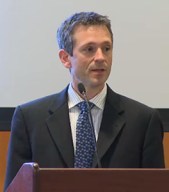
    HirshfeldIn his opening remarks, Mr. Hirshfeld (at left) noted that the process of crafting examination guidance is an iterative one in which the Office responds to significant decisions (such as Myriad) by moving as quickly as possible to get guidance to examiners, and then going back and developing further guidance, if needed, following public input and feedback.  Anticipating a question that he sensed was on the minds of most attendees, Mr. Hirshfeld indicated that he did not know what (if anything) would change in the Guidance as a result of public input and feedback, but suggested that "everything is on the table."  However, Mr. Hirshfeld declared that the Office strongly believes that the Guidance is based on principles mandated by case law (although he acknowledged that the challenge was in applying these principles).

    TamayoFor those who had attended the April 16 biotechnology/chemical/pharmaceutical (BCP) customer partnership meeting, Mr. Tamayo's (at right) overview of the Guidance was probably quite familiar.  In addition to reviewing the new examination procedure set forth in the Guidance for determining the subject matter eligibility of claims under 35 U.S.C. § 101, Mr. Tamayo also raised and answered several questions regarding the Guidance.

    With respect to the question of why, in view of Myriad, the Guidance concerns anything more than DNA, Mr. Tamayo noted that the Guidance is not limited to Myriad, but considers a number of other Supreme Court decisions dealing with subject matter eligibility.  Mr. Tamayo also explained that the Guidance was so comprehensive because the relevant case law was so woven (as shown in the slide below).

    PTO_slide 9
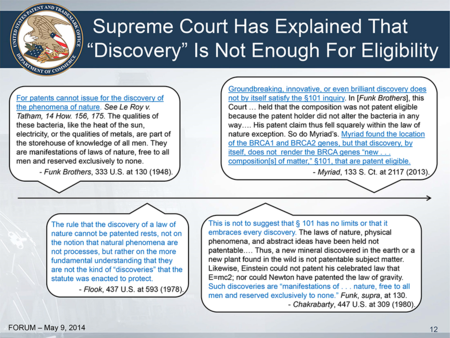
    In response to the query about why the Guidance gives short shrift to the word "discovery" in 35 U.S.C. § 101 ("Whoever invents or discovers any new and useful process, machine, manufacture, or composition of matter . . . ."), Mr. Tamayo noted in his presentation that "[o]ver the last 65 years, the Supreme Court has repeatedly explained that a mere discovery of nature’s handiwork is not eligible" (emphasis in original).  In support of the proposition that "discovery" is not enough for eligibility, he cited to four of the Court's decisions:

    PTO_slide 12
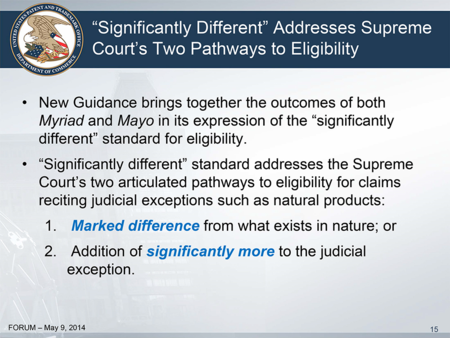
    Mr. Tamayo next addressed the origin of the Guidance's "significantly different" standard, indicating that the phrase is meant to capture the two pathways to eligibility described in Association for Molecular Pathology v. Myriad Genetics, Inc. (2013), and Mayo Collaborative Services v. Prometheus Laboratories, Inc. (2012).

    PTO_slide 15
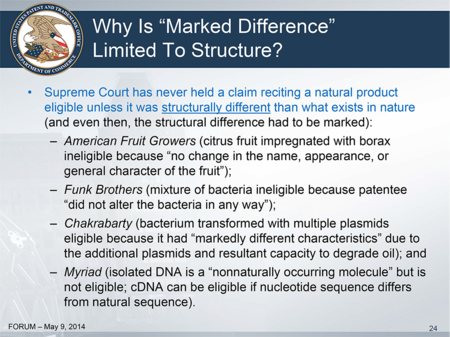
    Noting that the Court's decision in Myriad had changed the Office's understanding of the law, he explained that isolation or purification of an otherwise unchanged naturally occurring product could no longer be viewed as eligible subject matter.  According to Mr. Tamayo, the Federal Circuit's recent decision in In re Roslin added another data point that the proper test for all natural products — and not just DNA — was the "markedly different" standard of Chakrabarty.  With respect to the question of why the Office limited the marked difference analysis to structure, he explained in his presentation that the "Supreme Court has never held a claim reciting a natural product eligible unless it was structurally different than what exists in nature," citing to four of the Court's decisions (as shown in the slide below).

    PTO_slide 24
    As to whether a functional difference could be used to establish a marked difference, Mr. Tamayo stated that the Office's response was "no."  In support of the Office's conclusion, he noted that while briefs submitted in the Myriad case had argued that the claimed DNA at issue in that case performed functions that native DNA could not, such arguments "did not alter the Court’s decision that eligibility hinged on a markedly different structural change."  That being said, Mr. Tamayo indicated that the Office was "open to hearing alternative interpretations and considering examples."

    In lieu of convincing the Office to consider functional differences, and in the event that an applicant's claims recite molecules that are identical to naturally-occurring products, Mr. Tamayo suggested two ways to make such claims eligible:  (1) by excluding embodiments from the claim that do not possess markedly different characteristics, or (2) by combining the natural product with something that adds significantly more to the natural product (as shown in slide below).

    PTO_slide 26
    Mr. Tamayo next addressed what he called the Guidance's most "explosive" example, Example C.

    PTO_slide 32
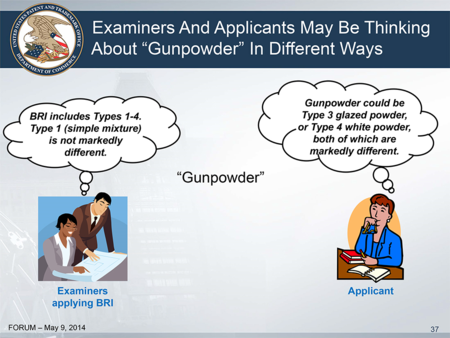
    He explained that the example was intended to emphasize the important role of using the broadest reasonable interpretation (BRI) when analyzing claims for subject matter eligibility.  Mr. Tamayo noted that the Office's assertion in the Guidance that "calcium chloride and gunpowder as recited in the claim are not markedly different from what exists in nature" had drawn feedback in the patent community ranging from "disagreement to vociferous disagreement (with more of the latter)."  As in the Office's BCP presentation, Mr. Tamayo described the four types of gunpowder (simple mixture, corned gunpowder, glazed powder, and white powder) and explained that the simple mixture is not markedly different because none of the components (potassium nitrate, sulfur and charcoal) have been structurally changed.  He then explained that as a result of BRI, examiners and applicants might look at gunpowder differently (as shown in the slide below).

    PTO_slide 37
    Mr. Tamayo concluded his presentation by answering one last question:  whether gunpowder was per se ineligible.  His response was "no," but only because, as he reminded everyone, the new examination procedure did not establish bright line rules.  He pointed out, for example, that an applicant might expressly disclaim a broad interpretation of gunpowder in the specification or use claim language that demonstrates that the particular claimed gunpowder is markedly different.

    A copy of Mr. Tamayo's presentation can be found here.

    In a subsequent post, we will examine the response of public presenters.

    For additional information regarding this topic, please see:

    • "USPTO Tries to Address Public Misunderstandings Regarding Myriad-Mayo Guidance," April 16, 2014
    • "USPTO Issues Guidance for Analyzing Subject Matter Eligibility of Claims Reciting Laws of Nature/Natural Principles, Natural Phenomena or Natural Products," March 4, 2014
  •         By Sherri Oslick

    Gavel About Court Report:  Each week we will report briefly on recently filed biotech and pharma cases.

    Kowa Co. et al. v. Orient Pharma Co.
    1:14-cv-03336; filed May 7, 2014 in the Northern District of Illinois

    • Plaintiffs:  Kowa Co.; Kowa Pharmaceuticals America, Inc.; Nissan Chemical Industries, Ltd.
    • Defendant:  Orient Pharma Co.

    Infringement of U.S. Patent Nos. 5,856,336 ("Quinoline Type Mevalonolactones," issued January 5, 1999), 6,465,477 ("Stable Pharmaceutical Composition," issued October 15, 2002), and 8,557,993 ("Crystalline Forms of Pitavastatin Calcium," issued October 15, 2013) following a Paragraph IV certification as part of defendants' filing of an ANDA to manufacture a generic version of Kowa's Livalo® (pitavastatin, used as an adjunctive therapy to diet to reduce elevated total cholesterol, lowdensity lipoprotein cholesterol, apolipoprotein B, triglycerides, and to increase high-density lipoprotein cholesterol).  View the Mylan complaint here.

    Genmark Diagnostics, Inc. v. Vironovative BV
    3:14-cv-01140; filed May 6, 2014 in the Southern District of California

    Declaratory judgment of non-infringement and invalidity of U.S. Patent Nos. 7,449,324 ("Metapneumovirus Strains and Their Use in Vaccine Formulations and as Vectors for Expression of Antigenic Sequences," issued November 11, 2008), 7,531,342 (same title, issued May 12, 2009), 7,704,720 ("Metapneumovirus Strains and Their Use in Vaccine Formulations and as Vectors for Expression of Antigenic Sequences and Methods for Propagating Virus," issued April 27, 2010) and 8,715,922 ("Virus Causing Respiratory Tract Illness in Susceptible Mammals," issued May 6, 2014) based on Genmark's manufacture and sale of its Respiratory Viral Panel (RVP) assay.  View the complaint here.

    Monsanto Co. et al. v. Omega Farm Supply, Inc.
    4:14-cv-00870; filed May 6, 2014 in the Eastern District of Missouri

    • Plaintiffs:  Monsanto Co.; Monsanto Technology, LLC
    • Defendant:  Omega Farm Supply, Inc.

    Infringement of U.S. Patent Nos. 6,949,696 ("Chimeric Figwort Mosaic Virus-Elongation Factor 1 α Promoters and Methods of Using Them," issued September 27, 2005) and 7,064,249 ("Plants Transformed to Express CRY2A δ-Endotoxins," issued June 20, 2006) based on defendant's use of cotton seed produced from earlier planted Roundup Ready® Flex, Bollgard II®, and/or Roundup Ready® Flex with Bollgard II® cotton seed, or combinations thereof.  View the complaint here.

    Senju Pharmaceutical Co. et al. v. Aurobindo Pharma Ltd. et al.
    1:14-cv-00579; filed May 2, 2014 in the District Court of Delaware

    • Plaintiffs:  Senju Pharmaceutical Co.; Kyorin Pharmaceutical Co.; Allergan Inc.
    • Defendants:  Aurobindo Pharma Ltd.; Aurobindo Pharma USA Inc.

    Infringement of U.S. Patent No. 6,333,045 ("Aqueous Liquid Pharmaceutical Composition Comprised of Gatifloxacin," issued December 25, 2001) following a Paragraph IV certifications as part of Aurobindo's filing of an ANDA to manufacture a generic version of Allergan's Zymar® (0.3 w/v % gatifloxacin ophthalmic solution, used for the treatment of bacterial conjunctivitis) and of Allergan's Zymaxid® (0.5 w/v % gatifloxacin ophthalmic solution, used to treat bacterial conjunctivitis).  View the complaint here.

    Cephalon, Inc. v. Uman Pharma Inc.
    1:14-cv-03114; filed May 1, 2014 in the Southern District of New York

    Infringement of U.S. Patent Nos. 8,445,524 ("Solid Forms of Bendamustine Hydrochloride," issued May 21, 2013) and 8,436,190 ("Bendamustine Pharmaceutical Compositions," issued May 7, 2013) following a Paragraph IV certification as part of Uman's filing of an ANDA to manufacture a generic version of Cephalon's Treanda® (bendamustine hydrochloride, used to treat chronic lymphocytic leukemia and non-Hodgkin's lymphoma).  View the complaint here.

    Roxane Laboratories, Inc. v. Lee et al.
    3:14-cv-00313; filed April 29, 2014 in the Eastern District of Virginia

    • Plaintiff:  Roxane Laboratories, Inc.
    • Defendants:  Michelle K. Lee; U.S. Patent and Trademark Office

    Declaratory judgment to vacate the USPTO's decision to revive U.S. Patent Application No. 09/709,829, which later issued as U.S. Patent No. 7,364,752 ("Solid Dispersion Pharmaceutical Formulations," issued April 29, 2008), assigned to AbbVie and currently asserted against Roxane in its ANDA litigation relating to AbbVie's Norvir® (ritonavir, used to treat human immunodeficiency virus (HIV) infection).  View the complaint here.

  • CalendarMay 13-15, 2014 – Fundamentals of Patent Prosecution 2014: A Boot Camp for Claim Drafting & Amendment Writing (Practising Law Institute) – Chicago, IL

    May 14-15, 2014 – EU Pharmaceutical Law Forum*** (Informa Life Sciences) – Brussels, Belgium

    May 15, 2014 – "Patent Subject Matter Eligibility: Navigating the New 'Myriad' Guidelines — Analyzing Subject Matter and Avoiding Rejection Under the USPTO's Detailed Framework" (Strafford) – 1:00 to 2:30 pm (EDT)

    May 15, 2014 – "Attorney Fees: Patent Litigation Strategy after Octane and Highmark" (Intellectual Property Owners Association) – 2:00 to 3:00 pm (ET).

    May 22, 2014 – "Patent Infringement: Structuring Opinions of Counsel: Leveraging Opinion Letters to Reduce the Risks of Liability and Enhanced Damages" (Strafford) – 1:00 to 2:30 pm (EDT)

    June 4, 2014 – "Patent Due Diligence Post-AIA: Avoiding Dangers of Inadequate Investigation — Evaluating Validity of Key Patents, Identifying Enforceability Issues, Addressing New Considerations Under the AIA" (Strafford) – 1:00 to 2:30 pm (EDT)

    June 4-6, 2014 – Biosimilars*** (American Conference Institute) – New York, NY

    June 9-10, 2014 – Hatch-Waxman Boot Camp*** (American Conference Institute) – Chicago, IL

    June 10, 2014 – "'Standing Out' — The Supreme Court's Redefined Standard for Fee Shifting in Patent Litigation, and How It Might Impact 'Patent Troll' Litigation" (McDonnell Boehnen Hulbert & Berghoff LLP) – 10:00 am to 11:15 am (CT)

    June 10, 2014 – "Patent Dispute Resolution at the ITC and PTAB: Alternatives to District Court Litigation" (American Bar Association (ABA) Center for Professional Development, Section of Intellectual Property Law, and Young Lawyers Division) – 1:00 to 2:30 pm (ET)

    June 11-13, 2014 – Fundamentals of Patent Prosecution 2014: A Boot Camp for Claim Drafting & Amendment Writing (Practising Law Institute) – New York, NY

    June 23-26, 2014 – BIO International Convention (Biotechnology Industry Organization) – San Diego, CA.

    July 9-11, 2014 – Fundamentals of Patent Prosecution 2014: A Boot Camp for Claim Drafting & Amendment Writing (Practising Law Institute) – San Francisco, CA

    August 13-15, 2014 – Advanced Patent Law Seminars (Chisum Patent Academy) - Seattle, WA

    August 18-20, 2014 – Advanced Patent Law Seminars (Chisum Patent Academy) - Seattle, WA

    ***Patent Docs is a media partner of this conference or CLE

  • IPO #2The Intellectual Property Owners Association (IPO) will offer a one-hour webinar on "Attorney Fees: Patent Litigation Strategy after Octane and Highmark" on May 15, 2014 beginning at 2:00 pm (ET).  A panel consisting of Tom Brown of EMC Corp.; Richard Megley of Niro, Haller & Niro, Ltd.; and Steven Moore of Kilpatrick Townsend & Stockton LLP will discuss:

    • What will district courts establish as a standard for cases that "stand out"?
    • Will that standard be uniform among courts?
    • Will there be a marked effect on plaintiff venue selection?
    • Will these decisions reduce the number of infringement suits filed?  Or just settlement dynamics?
    • What evidence will parties muster to prove or rebut the contention that a case is exceptional?
    • How will findings of the PTAB in post-grant proceedings figure into that calculus?
    • Will there actually be a significant increase in fee-shifting?
    • These decisions are seen as pro-defendant, but will victorious plaintiffs also benefit?

    The registration fee for the webinar is $130 (government and academic rates are available upon request).  Those interested in registering for the webinar can do so here.

  • BIO International ConventionThe Biotechnology Industry Organization (BIO) will be holding its annual BIO International Convention June 23-26, 2014 in San Diego, CA.  Founded in 1993, BIO is a nonprofit association seeking supportive biotechnology policies on behalf of more than 1,100 biotechnology companies, academic institutions, state biotechnology centers, and related organizations across the United States and in more than 30 other nations.  The BIO International Convention serves to educate the public and policymakers about biotechnology, while fostering partnering meetings and other business development activities to keep the biotech industry growing.

    San DiegoDescriptions of the Convention's 125+ Breakout Sessions and six Super Sessions can be obtained here.  Among the sessions that may be of interest to Patent Docs readers are:

    Tuesday, June 24, 2014

    • Burrill State-of-the-Industry Report (Super Session) — 2:00 – 3:30 pm (Room 6AB)

    • View from Director General Francis Gurry, World Intellectual Property Organization — 2:15 – 2:45 pm (Room 23ABC)

    • Pursuing Biotechnology Patent Protection in the U.S. and Latin America — 3:00 – 4:00 pm (Room 23ABC)

    • Show Me the Data! Threshold Patent Application Disclosure Requirements and Post-Filing Evidence Admissibility in the U.S., Europe, Canada, and China — 4:15 –5:15 pm (Room 23ABC)

    Wednesday, June 25, 2014

    • View from the Bench-Chief Judge Randall R. Rader — 9:30 –10:00 am (Room 23ABC)

    • Navigating Patent Challenges Under the America Invents Act — 10:15 – 11:30 am (Room 23ABC)

    • As if AIA Hasn’t Brought Enough Change – Patent Litigation Reform is Looming in the US — 1:45 – 2:45 pm (Room 23ABC)

    • Patent Eligibility from the Trenches: Practical Implications of the Supreme Court’s Prometheus and Myriad Decisions — 3:00 – 4:00 pm (Room 23ABC)

    • "Chairman, That Patent Should be Revoked!" – Join the EPO Opposition Mock Workshop and Help Argue the Case — 4:15 – 5:15 pm (Room 23ABC) — panel moderated by Patent Docs author Donald Zuhn

    Thursday, June 26, 2014

    • Scientific American WorldView Super Session – Biotech: We are the World (Super Session) — 2:00 – 3:30 pm (Room 6AB)

    As part of the Convention, more than 1,700 biotech companies, organizations, and institutions will participate in the BIO Exhibition.  A searchable list of exhibitors can be found here.  Information regarding registration and pricing can be obtained herePatent Docs Donald Zuhn, Kevin Noonan, Andrew Williams, Sherri Oslick, Michael Greenfield, Josh Bosman, Josh Rich, James DeGiulio, and Nate Chongsiriwatana will be attending BIO as part of the MBHB contingent, and will be reporting on a few of the sessions listed above.  Patent Docs readers who may be attending BIO are encouraged to stop by the MBHB booth (#1337).

    BIO - Good Times on Tap 2011In addition, the Docs will be attending the MBHB reception at Dublin Square Irish Pub & Grill in San Diego's downtown Gaslamp Quarter on Tuesday, June 24 from 8:00 pm to 1:00 am.  Additional information about the reception, including invitations for the event, can be picked up at the MBHB booth on Monday or Tuesday.

  • ABAThe American Bar Association (ABA) Center for Professional Development, Section of Intellectual Property Law, and Young Lawyers Division will be offering a live webinar on "Patent Dispute Resolution at the ITC and PTAB: Alternatives to District Court Litigation" on June 10, 2014 from 1:00 to 2:30 pm (ET).  Joshua Kresh will moderate a panel consisting of Sreekar Gadde of Thomas William Davison and Kimberly A. Parker.  The panel will discuss the basics of the ITC and PTAB and how the forums differ from district court, how to determine if it is more beneficial to utilize the forums instead of — or concurrent with — district court litigation, and provide practical tips on ITC investigations and PTAB proceedings.

    The registration fee for the webcast is $150 for members and $195 for the general public.  Those interested in registering for the webinar, can do so here.