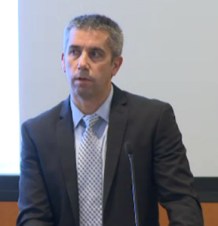
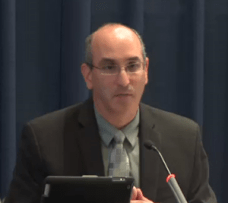
• Strafford #1Strafford will be offering a webinar/teleconference entitled "Leveraging Post-Grant Patent Proceedings Before the PTAB: Best Practices for Patentees and Third Parties in Inter Partes Review, Post-Grant Review and Covered Business Method Patent Challenges" on June 12, 2014 from 1:00 to 2:30 pm (EDT).  Greg H. Gardella and Scott A. McKeown of Oblon Spivak McClelland Maier & Neustadt will discuss post-grant patent practice and offer best practices for counsel to either patentees or third parties in inter partes review, post-grant review, and covered business method challenges.  The webinar will review the following questions:

    • How has post-grant practice developed since the PTAB started?
    • How is the PTAB adapting to the increased workflow and what rule changes are anticipated in the months ahead?
    • What are the best practices for these proceedings together with concurrent litigation?
    • How are patentees adapting to the treat of PTAB challenges and what concurrent office proceedings are available to hedge against such attacks?

    The registration fee for the webinar is $297 ($362 for registration and CLE processing).  Those interested in registering for the webinar, can do so here.

  • By Donald Zuhn

    USPTO SealOn May 15, the U.S. Patent and Trademark Office published a Federal Register notice (79 Fed. Reg. 27755) to adopt as final changes to the rules of practice implementing the patent term adjustment (PTA) provisions of section 1(h) of the Leahy-Smith America Invents Act (AIA) Technical Corrections Act.  The changes were originally set forth in an interim final rule issued by the Office in April 2013 (see "USPTO Issues Rules to Implement AIA Technical Corrections").

    Section 1(h) of the AIA Technical Corrections Act specifies that the fourteen-month period within which the Office must issue a notice of rejection under 35 U.S.C. § 132 or notice of allowance under 35 U.S.C. § 151 (see 35 U.S.C. § 154(b)(1)(A)(i)(II)) and the three-year application pendency period provided by 35 U.S.C. § 154(b)(1)(B) are to be measured from the same date, i.e., the date of commencement of national stage under 35 U.S.C. § 371.  The final rule adopts as final changes to the rules specifying that the fourteen-month period of 35 U.S.C. § 154(b)(1)(A)(i) is to be measured from the date of commencement of the national stage under 35 U.S.C. 371 in an international application.

    Section 1(h) also revises the provisions for notifying applicants of PTA determinations and for requesting reconsideration and judicial review of the Office's PTA determinations.  With regard to notifying applicants of PTA determinations, § 1(h) eliminates the need for the Office to provide an initial PTA determination with the notice of allowance, before the PTA under 35 U.S.C. §§ 154(b)(1)(A)(iv) (for not issuing a patent within four months following payment of the issue fee) and 154(b)(1)(B) (for not issuing a patent within three years after the actual filing date) can be determined.  With regard to requesting reconsideration of the Office's PTA determinations, the final rule adopts changes to the rules that allow applicants to extend the two-month period for filing a request for reconsideration of the PTA indicated on a patent by an additional five months after the date that the patent was granted under the provisions of 37 C.F.R. § 1.136(a).

    The final rule also lays out the Office's procedures for handling requests for reconsideration of PTA.  The notice explains that the PTA determination indicated on a patent is calculated using a computer program, and that the Office performs a manual redetermination of PTA in response to a request for reconsideration.  If the manual redetermination results in no change in PTA, the Office issues a decision denying the request for reconsideration, which is the Director's decision on the applicant's request for reconsideration within the meaning of 35 U.S.C. § 154(b)(4) (starting the 180-day clock for the patentee to file a civil action against the Director in the U.S. District Court for the Eastern District of Virginia).  If the manual redetermination results in a different amount of PTA than that indicated on the patent (and in the applicant's request for reconsideration), the applicant will have two-months (extendable by an additional five months) to file a renewed request for reconsideration (but cannot yet file a civil action against the Director).

    The final rule also provides an optional procedure for requesting PTA recalculation without filing a petition and paying the fee that would be otherwise required under the rules.  The optional procedure, however, only applies to patents that issued between January 14, 2013 (when the AIA Technical Corrections Act was enacted) and May 20, 2014, and that resulted directly from international applications.  The final rule notes that the optional procedure is being provided because the Office experienced a significant delay in modifying its PTA software to implement the rules changes resulting from the AIA Technical Corrections Act.  According to the final rule, the software modifications were completed last month, and therefore PTA determinations for patents issued on or after May 20, 2014 are expected to be consistent with changes to the PTA provisions in the AIA Technical Corrections Act.

    Under the optional procedure, requests for recalculation of PTA for the particular patents described above can be made by submitting a Request for Recalculation of Patent Term Adjustment form (PTO/SB/132).  The final rule notes that all requests made under the optional procedure must be filed no later than July 31, 2014.  The final rule also notes that if a petition fee and an extension fee (if required) were already paid for a patent qualifying for the optional procedure, neither fee would be refundable (because neither fee was "a fee paid by mistake or in excess of that required, and the Office may only refund fees paid by mistake or in excess of that required").  In addition, an applicant dissatisfied with a PTA recalculation made under the optional procedure must file a request for reconsideration no later than two months (extendable by an additional five months) from the date of the recalculation (and cannot yet file a civil action against the Director).

  • By Andrew Mullane, Craig Humphris, Todd Shand

    Australia Coat of ArmsDue to the complexity of Australian patent litigation, it can take more than 18 months for a patent dispute to be finally determined by a judge.  This is more than enough time for an infringing competitor to irreversibly damage the patentee and its exclusive market.  Interlocutory injunctions (also known as preliminary injunctions) are designed to prevent competitors from marketing their products before the court finally determines whether they infringe (or the patent is invalid).

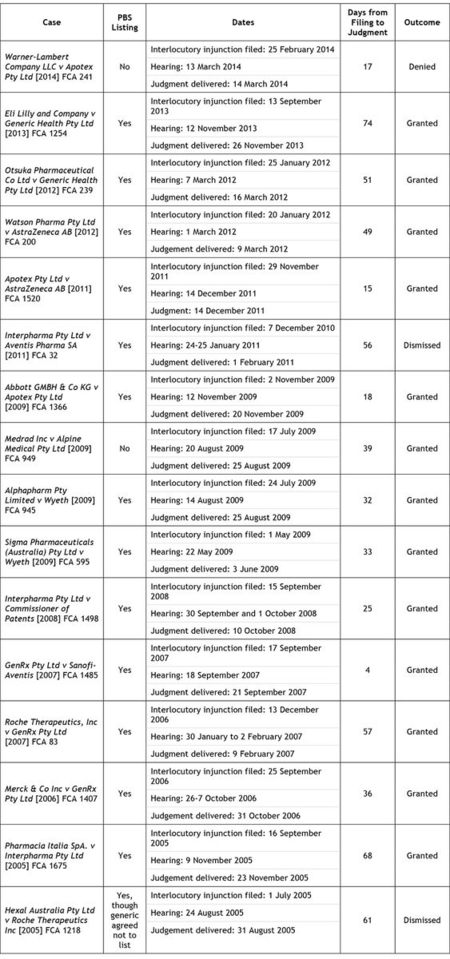
    Australian courts appear strongly inclined to grant interlocutory injunctions, and within a very short period of time, in pharmaceutical patent disputes.  Annexure 1 (below), which outlines 16 interlocutory injunction applications filed by pharmaceutical patentees since 2005, shows that only three of those applications were rejected.  Annexure 1 also demonstrates that, if necessary, the courts will hear an interlocutory injunction application and deliver its judgment very quickly (in as little as four days) to protect the patentee's market.  This article provides a brief introduction to interlocutory injunctions in Australia and explains why innovator pharmaceutical companies are likely to be granted interlocutory injunctions in Australian patent disputes.

    BACKGROUND TO INTERLOCUTORY INJUNCTIONS IN AUSTRALIA

    Determination of the Application

    Applications for interlocutory injunctions are heard at first instance by a single judge of the Federal Court of Australia.  The court will grant an interlocutory injunction against an alleged infringer (such as a generic) if it is satisfied that:

    (a)  the patentee has a prima facie case; and

    (b)  the balance of convenience lies with granting the injunction.

    Prima Facie Case

    A patentee has a prima facie case if there is a probability that they will succeed at final trial (i.e., it is arguable that (a) infringement has occurred and (b) the patent is valid).  An invalidity case must verge on the irresistible to defeat a prima facie infringement case.

    When deciding whether the patentee has a prima facie case, courts are usually reluctant to consider legal or factual disputes in any detail because:

    (a)  the court is only required to consider whether the patentee's case is arguable, rather than reach a final conclusion; and

    (b)  while both sides will make submissions and put on evidence, they are seldom as comprehensive as would be adduced for a final trial, and witnesses are rarely cross-examined, limiting the court's ability to choose between them.

    Instead, the court will typically simply acknowledge that both positions are arguable, and find that the patentee has established a prima facie case.  Accordingly, this element is usually quite easy to satisfy.

    Balance of Convenience

    When considering whether the balance of convenience favours granting the interlocutory injunction, the court will weigh up all of the surrounding factors.

    First, the court will consider the harm that the patentee may suffer if an interlocutory injunction is refused and a final injunction is subsequently granted, and whether that harm can be compensated by way of damages.  The greater the patentee's potential loss, the more likely the court is to grant the injunction, particularly if it cannot be adequately compensated by damages (such as reputational damage).  Patentees often argue that allowing the generic onto the market will:

    (a)  reduce the patentee's sales and force it to lower its prices to compete with the generic, affecting profit;

    (b)  cause flow-on losses to other areas of the patentee's business, including reputational damage, reduced opportunities to promote other products and the forced reduction in expenditure on research and development and marketing, damaging future revenue streams; and

    (c)  encourage other generics to enter the market, causing further damage to the patentee and significantly complicating the assessment of how damages should be apportioned between the generics.

    The patentee's potential harm is a particularly strong factor if the generic intends to list their product on the Schedule of Pharmaceutical Benefits (Schedule) under the Pharmaceutical Benefits Scheme (PBS).

    By way of background to Australian drug regulation and subsidisation, pharmaceutical products cannot be marketed in Australia unless they are registered on the Australian Register of Therapeutic Goods (ARTG).  If a prescription medicine is registered on the ARTG, the sponsor may also apply to list it on the Schedule.  The PBS is administered by the Australian government and seeks to subsidise the cost of medicines to the public.  The Australian government sets the price of all products listed on the Schedule (PBS Price).  Patients who purchase a listed prescription medicine from a pharmacy are required to pay a set proportion of the PBS Price, with the Australian government reimbursing the pharmacy with the balance of the PBS Price.  If a generic version of an innovator product is listed on the Schedule, the PBS Price paid by the government for that product (and therefore the amount that pharmacies will pay the innovator for its product) is automatically reduced by 16%.  If the generic offers its product at a discount to the innovator product, as is often the case, the PBS Price may be decreased even further.  Importantly, a decrease in the PBS Price is virtually always irreversible.

    Accordingly, if a generic is permitted to list their product on the Schedule, the innovator will be paid a reduced PBS Price over the life of the patent, irrespective of whether they are successful in obtaining a final injunction, causing the patentee significant and continuing loss.  This potential loss will often persuade a court to award an interlocutory injunction because:

    (a)  it is likely to be very significant; and

    (b)  assessing the patentee's continuing loss caused by the reduced PBS Price is difficult because it involves estimating future sales.

    The court will consider whether the generic will suffer any loss if the interlocutory injunction is granted and the patentee's infringement argument is rejected at the final trial.  Generics often refer to:

    (a)  the advantage of being the first competitor to market, both in terms of market share for that product and flow-on effects to other products; and

    (b)  the difficulty of estimating what would have been the generic's market share, and therefore calculating their profit, had the interlocutory injunction been refused.

    As generics tend to significantly discount their products, their potential loss is typically much less than that of a patentee.  Further, it is often argued that a generic who elects not to revoke a patent before entering the market knowingly takes the risk of having an interlocutory injunction awarded against them, such that their loss is self-inflicted.  Courts regularly use this argument to reduce the weight given to a generic's loss.

    The strength of the patentee's infringement case, compared with the strength of the generic's invalidity case, is also relevant.  If the patentee has a strong case, the court will be more likely to award the interlocutory injunction.  Conversely, there is less inclination to award an interlocutory injunction if the patentee appears unlikely to succeed at the final trial.

    Any unreasonable delay from the patentee in bringing the interlocutory injunction action will also weigh against its grant.

    Prospects of Success

    For the reasons given above, particularly:

    (a)  the low standard of proof required to establish a prima facie case;

    (b)  the patentee's perceived greater extent loss (especially if the product is listed on the Schedule);

    (c)  the common discounting of a generic's loss as being self-inflicted; and

    (d)  the possibility of other generics entering the market;

    Australian courts are strongly inclined to grant interlocutory injunctions.

    This tendency is highlighted by the table at Annexure 1, which lists 16 interlocutory injunction applications filed by pharmaceutical patentees since 2005 and shows that only three applications were rejected.  An analysis of those rejected applications shows that two were the result of the application of a different (more generic-friendly) law to that which currently stands in Australia (in combination with the atypical circumstances of the patentee's unreasonable delay or the generic's undertaking not to list on the PBS), while the third was a result of the patentee having a weak infringement case.

    (a)  The court in Hexal v Roche held that, for an interlocutory injunction to be awarded, Roche (the patentee) must show that it would suffer irreparable harm.  As discussed above, potential irreparable harm now forms part of the assessment of the balance of convenience, rather than its own separate prerequisite.  It was found that Roche could be adequately compensated by damages, partly because Hexal undertook not to apply to list its product on the Schedule.  Notably, the rejection of the application was accompanied by a warning from the court that the parties should prepare for the final trial as quickly as possible to minimise Roche's potential harm, and that a failure to do so "might well justify reviewing the decision".

    (b)  Like Hexal v Roche, the court in Interpharma v Aventis required Aventis (the patentee) to show that it would suffer irreparable harm.  Damages were found to adequately compensate Aventis because the patent would expire within 18 months and the relevant market (chemotherapy medication) was not overly competitive.  The court's decision was also swayed by Aventis' unreasonable eight month delay in filing its interlocutory injunction application.

    (c)  In Warner-Lambert v Apotex, the court refused the interlocutory injunction application because Warner-Lambert did not establish a prima facie case.  Its patent was directed to the use of pregabalin for treating pain.  Apotex did not infringe because (i) its ARTG registration only indicated the use of pregabalin as an adjunctive therapy for preventing seizures and (ii) its promotional material clearly stated that pharmacies could not dispense its product without a prescription explicitly stating that it was required for treating seizures.

    Timing of the Interlocutory Injunction

    Annexure 1 also demonstrates that, if necessary, the courts will hear an interlocutory injunction application and deliver its judgment very quickly (in as little as four days in the case of GenRx v Sanofi-Aventis).  While there is no indication in the GenRx v Sanofi-Aventis judgment as to why a decision was required so quickly, such reasons are given in other cases.

    (a)  In Abbott v Apotex, judgment was delivered on 20 November 2009, 18 days after the interlocutory injunction application was filed, because Apotex had threatened to bring product onto the market on 21 November 2009.

    (b)  An interlocutory injunction was granted in Apotex v AstraZeneca within 15 days because Apotex had already commenced its marketing campaign and was ready to launch its generic product onto the market.

    (c)  In Warner-Lambert v Apotex, Apotex advised Warner-Lambert on 14 February 2014 that it would bring its generic product to market on 14 March 2014.  Warner-Lambert commenced proceedings on 25 February 2014, meaning the court was required to (and did) decide the interlocutory injunction application within just 17 days.

    Pressure-Testing a Case

    An interlocutory injunction application in Australia also provides an excellent opportunity for a patentee to test the strength of their case.  The generic is required to reveal (at least part of) its non-infringement and invalidity evidence and arguments, and the judge may provide some preliminary comments in relation to both parties' cases.  Furthermore, an interlocutory injunction application is much less expensive than a final trial, and can be decided very quickly if required.  It can accordingly provide an indication of the patentee's likelihood of ultimate success (both in Australia and internationally) quite quickly and relatively inexpensively.  Even if the patentee discovers that their case has significant weaknesses, for the reasons discussed above they would nonetheless have good prospects of succeeding with respect to the interlocutory injunction, strengthening their position during any settlement negotiations with the generic.

    Conclusion

    The combination of high success rates and fast judgments means that Australia is currently a jurisdiction that favours pharmaceutical patentees seeking interlocutory injunctions.  Further, the insight gained into the strength of the patentee's case can be invaluable, allowing a more productive consideration of whether to enforce a patent in Australia and abroad.

    Annexure 1 (click on table to enlrage)

    Annexure
    Mr. Mullane is a Lawyer with Wrays; Mr. Humphris is a Principal with Wrays and Senior Member of Wray's Adelaide Chemical and Biological team; and Mr. Shand is a Principal with Wrays.

  • By Kevin E. Noonan

    USPTO SealRepresentatives from the U.S. Patent and Trademark Office, led by Janet Gongola, Senior Advisor to the Deputy Director of the PTO, spent the better part of last month traversing the U.S. presenting a Roundtable on the activities and preferred modes of practice before the Patent Trial and Appeal Board, the successor under the Leahy-Smith America Invents Act for the Board of Patent Appeals and Interferences.  The presentation included a talk by Chief Judge James Smith on the state of practice before the Board (including a wealth of statistics and goals) and panel discussion between members of the local bar and members of the Board (see "PTAB AIA Trial Roundtables" webpage).

    While concerned generally with the Board's activities, a substantial portion of the program related to inter partes review (IPR), the successor under the AIA of inter partes reexamination.  35 U.S.C. §§ 311-319.  The Board members discussed with members of the local bar best practices and the bar's experiences with IPR, and included one or more role-playing sessions.  One of these, on how a patentee party can best present a motion to amend the claims incited insightful comment from the audience wherever the Roundtables were held.  In Chicago, the issue was presented to the Board members by Edward Manzo, a partner at Husch Blackwell (and editor of Claim Construction and the Federal Circuit, a yearly tome on how the Court has decided claim construction issues).  Mr. Manzo presented his question thusly (paraphrased here):

    Because the PTAB has determined that it will apply the broadest reasonable interpretation (BRI) to the claims under inter partes review, and further has decided that it will not make an independent determination of patentability (unlike in the former inter partes reexamination); and further because the patentee does not have the right to amend the claims but must get leave to amend from the Board by motion, doesn't this refusal to freely permit amendment abolish the justification usually proffered for applying BRI, specifically, that the Office uses this standard because the applicant/patentee has the ability to amend to overcome rejection based on BRI?

    (The question is particularly germane because at the time Mr. Manzo asked it the Board had not granted a single motion for leave to amend.)  The answer given by the Board had much to do with the statutory time limitation for bringing IPR to a conclusion (one year from granting the petition for IPR, with an ability to extend that time for an additional six months "for good cause," a provision the Board clearly does not want to invoke routinely); and the burden on PTAB resources if the Board decided patentability issues; and the ability of the patentee to respond to the petition with counter-arguments; and the ability of the parties to settle (while conceding that once the Board established that the public interest was implicated it might decide, and had the statutory capacity to decide, the substantive patentability questions raised by the IPR even if the parties decided to settle).

    One intriguing aspect of the Board's response to Mr. Manzo was a comment by the Chief Judge, to the effect that we should all "stay tuned."  The basis for this comment became evident on Tuesday, May 20th when the Board issued its first grant of a motion for leave to amend, in International Flavors and Fragrances v. U.S. (Final Written Decision).  The patent at issue, U.S. Patent No. 7,579,016, is entitled "Methods for repelling arthropods using isolongifolenone analogs."  The PTAB granted the petition for inter partes review on June 27, 2013 as to claims 1, 4, 5, 7, 8, and 14-26; independent claim 1 reads as follows:

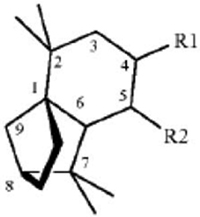
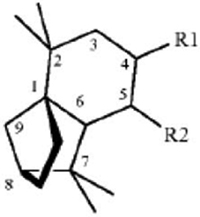
    1.  A method for repelling arthropods, said method comprising treating an object or area with an arthropod repelling effective amount of at least one isolongifolenone analog and optionally a carrier or carrier material; wherein said at least one isolongifolenone analog has the following formula:

    Formula_claim 1
    wherein R1 is hydrogen, an oxygen, a C1-10 alcohol, aldehyde, alkyl, ether, or esters of said alcohol with a C1-10 saturated or unsaturated, straight or branched acid and R2 is hydrogen, an oxygen, a C1-10 alcohol, aldehyde, alkyl, ether, or esters of said alcohol with a C1-10 saturated or unsaturated, straight or branched acid; optionally there is a double bond between carbons 5 and 6 and R2.

    The Motion to Amend cancelled all claims in the patent (claims 1-26) and to substitute new claims 27-45.  The Petitioner, International Flavors and Fragrances, did not oppose, and the Board granted the motion in part and issued its final decision in the opinion handed down on May 20th.

    The Board granted the Petition based on the Behan reference, PCT International Publication Number WO 00/19822, published April 13, 2000, which despite failing to demonstrate operability disclosed the use of isolongifolanone (a compound related to the claimed isolongifolenone) to repel arthropods and thus anticipated claims 1, 4, 5, 7, 8, 14, 19-21, and 23.  The Board also granted the Petition with regard to claims 1, 4, 5, 7, 8, 14-21, and 23 as being obvious over the combination of the Behan reference and the Grieco reference (A Novel High-Throughput Screening System to Evaluate the Behavioral Response of Adult Mosquitoes to Chemicals, 21 J. AM. MOSQUITO CONTROL ASS'N 404-411 (2005)), which provided disclosure relating to the expressly recited amounts and concentrations of isolongifolenone, and for obviousness as to claims 1, 4, 5, 7, 8, 14, and 19-26 over the combination of the Behan reference and the Carroll reference (Repellency of Deet and SS220 applied to skin involves olfactory sensing by two species of ticks, 19 MEDICAL AND VETERINARY ENTOMOLOGY 101-106 (2006)), which supplies disclosure regarding the expectation that compounds effective against mosquitoes would be effective against other arthropods, such as ticks.

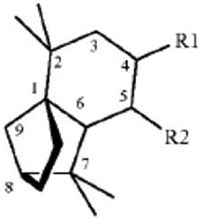
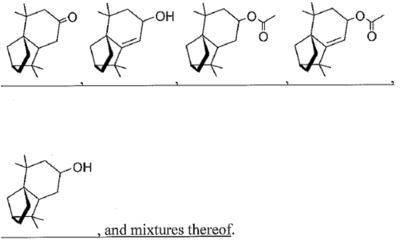
    The substitute claims proposed by patentee limited independent claim 27 (corresponding to original claim 1) to five of the compounds recited in the Markush group found in original claim 8 of the '016 patent, and proposed claim 45 to be limited to mites and ticks but otherwise identical to original claim 1.  These amendments and differences are set forth below:

    27.  A method for repelling arthropods, said method comprising treating an object or area with an arthropod repelling effective amount of at least one isolongifolenone analog and optionally a carrier or carrier material; wherein said at least one isolongifolenone analog has the following formula:

    Formula_claim 27
    wherein R1 is hydrogen, an oxygen, a C1-10 alcohol, aldehyde, alkyl, ether, or esters of said alcohol with a C1-10 saturated or unsaturated, straight or branched acid and R2 is hydrogen, an oxygen, a C1-10 alcohol, aldehyde, alkyl, ether, or esters of said alcohol with a C1-10 saturated or unsaturated, straight or branched acid; optionally there is a double bond between carbons 5 and 6 and R2; wherein said at least one isolongifolenone analog is selected from the group consisting of

    Formulae
    45.  A method for repelling arthropods, said method comprising treating an object or area with an arthropod repelling effective amount of at least one isolongifolenone analog and optionally a carrier or carrier material; wherein said at least one isolongifolenone analog has the following formula:

    Formula_claim 45
    wherein R1 is hydrogen, an oxygen, a C1-10 alcohol, aldehyde, alkyl, ether, or esters of said alcohol with a C1-10 saturated or unsaturated, straight or branched acid and R2 is hydrogen, an oxygen, a C1-10 alcohol, aldehyde, alkyl, ether, or esters of said alcohol with a C1-10 saturated or unsaturated, straight or branched acid; optionally there is a double bond between carbons 5 and 6 and R2; wherein said arthropods are ticks or mites.

    The Board set forth the standards it applies to Motions for Leave to Amend during inter partes review:

    As the moving party, Patent Owner bears the burden of proof to establish that it is entitled to the relief requested.  37 C.F.R. § 42.20(c).  The proposed amendment is not entered automatically, but only upon Patent Owner having demonstrated, by a preponderance of the evidence, the patentability of the proposed claims.  See, e.g., 37 C.F.R. § 42.1(d) (noting that the "default evidentiary standard [in proceedings before the Board] is a preponderance of the evidence.").

    In addition, the Decision notes that any amendment cannot enlarge or broaden the scope of the patented claims, citing 35 U.S.C. § 316(d)(3); 37 C.F.R. § 42.121(a)(2)(ii).  The proposed amendments do not run afoul of this proscription, because they limit the scope of patented claim 1.

    The Board also noted that each proposed amended or substitute claims must have support under 35 U.S.C. § 112 throughout its scope.  37 C.F.R. § 42.121(b)(1).  The proposed substitute claims satisfy this requirement, the Board concluded, based on citation to express disclosure in the specification.

    Finally, the Board addressed the patentability of the proposed substitute claims over the cited art.  However:

    Distinguishing the proposed claims only from the prior art references applied to the original patent claims is insufficient to demonstrate patentability over prior art.  As the moving party, a patent owner bears the burden to show entitlement to the relief requested. 37 C.F.R. § 42.20(c).

    Support for this proposition is drawn from the Board's earlier decision in Free Sys., Inc. v. Bergstrom, Inc., IPR2012-00027, slip op. at 33 (PTAB January 7, 2014 (Paper 66)), which specified that "the patent owner bears the burden of proof to demonstrate patentability of the proposed claims over the prior art in general, and thus entitlement to the proposed claims."  In practice, this imposes the burden that "the patent owner should discuss, as well as present evidence, if appropriate, as to the level of ordinary skill in the art, and what was known regarding the features being relied upon to demonstrate patentability of the proposed claims."

    Here, the Board set forth in its decision a synopsis of the evidence presented by the patent owner regarding the unpredictable effects in function that even small changes in chemical structure can have, and concluded that '"[b]ecause the prior art does not provide a reason to modify isolongifolanone to arrive at the modified isolongifolanone compounds of proposed claim 27, nor does it provide a reasonable expectation that such modifications would result in a compound having the desired insect repellent activity, we conclude that the preponderance of the evidence supports the patentability of claim 27.  As to dependent claims 28-44, because those claims incorporate all of the limitations of claim 27, they would be patentable for the same reasons."

    The Board did not reach the same conclusion of patentability of proposed claim 45 over the prior art.  For this claim, the recited structure encompasses the structure disclosed in the Behan reference, which teaches the use of isolongifolanone against mosquitoes.  Illustrating the burden the Board imposes on patent owners, the decision states that "Patent Owner provides no evidence that ticks and mites would not be present on the same objects or areas where mosquitoes and cockroaches are found, which are the insects addressed by Behan.  Thus, by applying the isolongifolanone taught by Behan to an object or airspace for the purpose of repelling mosquitoes or cockroaches, one would also inherently repel ticks and mites."  From this, the Board applies the black-letter principle of the law that "'[i]t is a general rule that merely discovering and claiming a new benefit of an old process cannot render the process again patentable," citing In re Woodruff, 919 F.2d 1575, 1578 (Fed. Cir. 1990); Perricone v. Medicis Pharm. Corp., 432 F.3d 1368, 1377-78 (Fed. Cir. 2005) and Bristol-Myers Squibb Co. v. Ben Venue Laboratories, Inc., 246 F.3d 1368, 1376 (Fed. Cir. 2001) in support.  Accordingly, the Board "conclude[d] that the preponderance of the evidence does not support the patentability of proposed claim 45."

    Because grant of the Motion, and the reasons therefore were dispositive of all issues before the Board, the decision was made final and the Board cited 37 C.F.R. § 90.2 for the parties' responsibilities for notice and service of judicial review.

    A few rubrics can be drawn from this decision.  The substitute claims were not challenged by the Petitioner (no doubt because the Petitioner was not at risk of being sued for infringement of the proposed substitute claims); this situation is not likely to be the norm.  In addition, the patentee was the U.S. government, which may take a different view of how best to protect its intellectual property than commercial concerns.  Petitioner supported its petition using a prior art reference that anticipated the claims, which may or may not be or become routine but certainly provides strong support for satisfying Petitioner's burden of making a showing that at least one claim is unpatentable.  Finally it cannot escape the patent community's notice that the Office is exquisitely sensitive to criticism (for example, from the Supreme Court as evidenced by the recently issued subject matter eligibility Guidelines); the Board has been roundly criticized, by the bar and influential members of the judiciary including recent Chief Judge Rader (who called the PTAB a "death squad" for patent claims) as being inimical to patents and patentees based on its high rate of granting IPR petitions and the percentage of those claims that survived (indeed, the Office recently trumpeted the statistic that 41% of patents in IPR survived with the patentability of at least "some" claims being affirmed).  Grant of patent owner's Motion for Leave to Amend proves that the Board can permit a patentee under appropriate circumstances to propose claim-saving amendments; the question remaining is whether this becomes routine or remains the black swan of PTAB proceedings.

  •         By Sherri Oslick

    Gavel About Court Report:  Each week we will report briefly on recently filed biotech and pharma cases.

    Otsuka Pharmaceutical Co. v. Aurobindo Pharma Ltd. et al.
    1:14-cv-03306; filed May 23, 2014 in the District Court of New Jersey

    • Plaintiff:  Otsuka Pharmaceutical Co.
    • Defendants:  Aurobindo Pharma Ltd.; Aurobindo Pharma USA, Inc.; Aurolife Pharma LLC

    Infringement of U.S. Patent Nos. 8,017,615 ("Low Hygroscopic Aripiprazole Drug Substance and Process for the Preparation Thereof," issued September 13, 2011), 8,580,796 (same title, issued November 12, 2013), and 8,642,760 (same title, issued February 4, 2014) following a Paragraph IV certification as part of Aurobindo's filing of an ANDA to manufacture a generic version of Otsuka's Abilify® (aripiprazole, used to treat bipolar disorder and schizophrenia).  View the complaint here.

    Allergan, Inc. v. Actavis plc et al.
    2:14-cv-00638; filed May 22, 2014 in the Eastern District of Texas

    • Plaintiff:  Allergan, Inc.
    • Defendants:  Actavis plc; Actavis, Inc.; Watson Laboratories, Inc.; Actavis Pharma, Inc.

    Declaratory judgment of false Paragraph IV notification (because Actavis did not have an accepted ANDA application) or in the alternative infringement of U.S Patent Nos. 8,633,162 ("Methods of Providing Therapeutic Effects Using Cyclosporine Components," issued January 21, 2014), 8,642,556 (same title, issued February 4, 2014), 8,648,048 (same title, issued February 11, 2014), and 8,685,930 (same title, issued April 1, 2014) following a Paragraph IV certification as part of Actavis' filing of an ANDA to manufacture a generic version of Allergan's Restasis® (cyclosporine ophthalmic emulsion, 0.05%, used to treat dry eye).  View the complaint here.

    Amarin Pharma, Inc. et al. v. Watson Laboratories, Inc. et al.
    3:14-cv-03259; filed May 21, 2014 in the District Court of New Jersey

    • Plaintiffs:  Amarin Pharma, Inc.; Amarin Pharmaceuticals Ireland Ltd.
    • Defendants:  Watson Laboratories, Inc.; Actavis, Inc.

    Infringement of U.S. Patent Nos. 8,293,728 ("Methods of Treating Hypertriglyceridemia," issued October 23, 2012), 8,318,715 (same title, issued November 27, 2012), 8,357,677 (same title, issued January 22, 2013), 8,367,652 (same title, issued February 5, 2013), 8,377,920 (same title, issued February 19, 2013), 8,399,446 (same title, issued March 19, 2013), 8,415,335 (same title, issued April 9, 2013), 8,426,399 (same title, issued April 23, 2013), 8,431,560 (same title, issued April 30, 2013), 8,440,650 (same title, issued May 14, 2013), 8,501,225 ("Stable Pharmaceutical Composition and Methods of Using Same," issued August 6, 2013), 8,518,929 ("Methods of Treating Hypertriglyceridemia," issued August 27, 2013), 8,524,698 (same title, issued September 3, 2013), 8,546,372 (same title, issued October 1, 2013), 8,551,521 ("Stable Pharmaceutical Composition and Methods of Using Same," issued October 8, 2013), and 8,617,594 (same title, issued December 31, 2013) following a Paragraph IV certification as part of Watson's filing of an ANDA to manufacture a generic version of Amarin's Vascepa® (icosapent ethyl, used as an adjunct to diet to reduce triglyceride levels in adult patients with severe hypertriglyceridemia).  View the complaint here.

    Alcon Research Ltd. v. Watson Laboratories Inc. et al.
    1:14-cv-00647; filed May 20, 2014 in the District Court of Delaware

    • Plaintiff:  Alcon Research Ltd.
    • Defendants:  Watson Laboratories Inc.; Actavis Inc.; Actavis Pharma Inc.

    Infringement of U.S. Patent Nos. 8,268,299 ("Self Preserved Aqueous Pharmaceutical Compositions," issued September 18, 2012), 8,323,630 (same title, issued December 4, 2012), and 8,388,941 (same title, issued March 5, 2013) following a Paragraph IV certification as part of Watson's filing of an ANDA to manufacture a generic version of Alcon's Travatan Z® (travoprost ophthalmic solution, used to reduce elevated intraocular pressure in patients with open-angle glaucoma or ocular hypertention).  View the complaint here.

    Jazz Pharmaceuticals, Inc. v. Amneal Pharmaceuticals, LLC
    2:14-cv-03235; filed May 20, 2014 in the District Court of New Jersey

    Infringement of U.S. Patent No. 8,589,182 (same title, issued November 19, 2013) following a Paragraph IV certification as part of Amneal's filing of an ANDA to manufacture a generic version of Jazz's Xyrem® (sodium oxybate, used to treat narcolepsy).  View the complaint here.

    Dr. Reddy's Laboratories, Inc. et al. v. Purdue Pharmaceutical Products L.P. et al.
    2:14-cv-03230; filed May 20, 2014 in the District Court of New Jersey

    • Plaintiffs:  Dr. Reddy's Laboratories, Inc.; Dr. Reddy's Laboratories, Ltd.
    • Defendants:  Purdue Pharmaceutical Products L.P.; Purdue Pharma L.P.; Transcept Pharmaceuticals, Inc.

    Declaratory judgment of non-infringement of U.S. Patent No. 7,658,945 ("Compositions for Delivering Hypnotic Agents Across the Oral Mucosa and Methods of Use Thereof," issued February 9, 2010) in conjunction with Dr. Reddy's Paragraph IV certification as part of its filing of an ANDA to manufacture a generic version of Purdue's Intermezzo® (sublingual zolpidem tartrate, used to treat insomnia when middle-of-the-night awakening is followed by difficulty returning to sleep).  View the complaint here.


    Otsuka Pharmaceutical Co. v. Zydus Pharmaceuticals USA Inc. et al.
    1:14-cv-03168; filed May 16, 2014 in the District Court of New Jersey

    • Plaintiff:  Otsuka Pharmaceutical Co.
    • Defendants:  Zydus Pharmaceuticals USA Inc.; Cadila Healthcare Ltd.

    Infringement of U.S. Patent Nos. 8,017,615 ("Low Hygroscopic Aripiprazole Drug Substance and Process for the Preparation Thereof," issued September 13, 2011), 8,580,796 (same title, issued November 12, 2013), 8,642,760 (same title, issued February 4, 2014), and 8,518,421 ("Flashmelt Oral Dosage Formulation," issued August 27, 2013) following a Paragraph IV certification as part of Zydus' filing of an ANDA to manufacture a generic version of Otsuka's Abilify® (aripiprazole, used to treat bipolar disorder and schizophrenia).  View the complaint here.

    Celgene Corp. v. Natco Pharma Ltd. et al.
    2:14-cv-03126; filed May 14, 2015 in the District Court of New Jersey

    • Plaintiff:  Celgene Corp.
    • Defendants:  Natco Pharma Ltd.; Arrow International Ltd.; Actavis, Inc.; Watson Laboratories, Inc.; Watson Pharma, Inc.; Anda, Inc.

    Infringement of U.S. Patent Nos. 8,530,498 ("Methods For Treating Multiple Myeloma With 3-(4-amino-1-oxo-1,3-dihydroisoindol-2-yl) Piperidine-2,6-Dione," issued September 10, 2013), 8,589,188 ("Methods for Delivering a Drug to a Patient While Preventing the Exposure of a Foetus or Other Contraindicated Individual to the Drug," issued November 19, 2013), 8,626,531 ("Methods for Delivering a Drug to a Patient While Restricting Access to the Drug By Patients For Whom the Drug May Be Contraindicated," issued January 7, 2014), and 8,648,095 ("Methods For Treating Multiple Myeloma Using 3-(4-amino-1-oxo-1,3-dihydroisoindol-2-yl) piperidine-2,6-Dione In Combination With Proteasome Inhibitor," issued February 11, 2014) following a Paragraph IV certification as part of Natco's filing of an ANDA to manufacture a generic version of Celgene's Revlimid® (lenalidomide, used in the treatment of multiple myeloma patients who have received at least one prior therapy, and in the treatment of patients with transfusion-dependent anemia due to Low- or Intermediate-1–risk myelodysplastic syndromes (MDS) associated with a deletion 5q cytogenetic abnormality).  View the complaint here.

  • CalendarMay 28, 2014 – "Double Patenting After Gilead: Prosecution and Litigation" (Intellectual Property Owners Association) – 2:00 to 3:00 pm (ET)

    June 4, 2014 – "Patent Due Diligence Post-AIA: Avoiding Dangers of Inadequate Investigation — Evaluating Validity of Key Patents, Identifying Enforceability Issues, Addressing New Considerations Under the AIA" (Strafford) – 1:00 to 2:30 pm (EDT)

    June 4-6, 2014 – Biosimilars*** (American Conference Institute) – New York, NY

    June 5, 2014 – "Secondary Use Pharmaceutical Patents: Litigation and Trade Policy Briefing" (Public Citizen and the American University Washington College of Law) – Washington, DC

    June 9-10, 2014 – Hatch-Waxman Boot Camp*** (American Conference Institute) – Chicago, IL

    June 10, 2014 – "'Standing Out' — The Supreme Court's Redefined Standard for Fee Shifting in Patent Litigation, and How It Might Impact 'Patent Troll' Litigation" (McDonnell Boehnen Hulbert & Berghoff LLP) – 10:00 am to 11:15 am (CT)

    June 10, 2014 – "Patent Dispute Resolution at the ITC and PTAB: Alternatives to District Court Litigation" (American Bar Association (ABA) Center for Professional Development, Section of Intellectual Property Law, and Young Lawyers Division) – 1:00 to 2:30 pm (ET)

    June 11-13, 2014 – Fundamentals of Patent Prosecution 2014: A Boot Camp for Claim Drafting & Amendment Writing (Practising Law Institute) – New York, NY

    June 19, 2014 – "Double Patenting: Defeating Double Patenting Rejections and Avoiding Terminal Disclaimer" (Strafford) – 1:00 to 2:30 pm (EDT)

    June 23-26, 2014 – BIO International Convention (Biotechnology Industry Organization) – San Diego, CA

    June 25-26, 2014 – International Forum on Pharma Patent Extensions*** (C5) – London, England

    June 30, 2014 – "Drafting Patent Claims After In re Packard: Navigating the New PTO Regime for Evaluating Indefiniteness" (Strafford) – 1:00 to 2:30 pm (EDT)

    July 9-11, 2014 – Fundamentals of Patent Prosecution 2014: A Boot Camp for Claim Drafting & Amendment Writing (Practising Law Institute) – San Francisco, CA

    July 20-22, 2014 – 2014 Annual Meeting & Conference (National Association of Patent Practitioners) – Alexandria, Virginia.

    August 13-15, 2014 – Advanced Patent Law Seminars (Chisum Patent Academy) - Seattle, WA

    August 18-20, 2014 – Advanced Patent Law Seminars (Chisum Patent Academy) - Seattle, WA

    ***Patent Docs is a media partner of this conference or CLE

  • Public CitizenPublic Citizen and the American University Washington College of Law are sponsoring a program entitled "Secondary Use Pharmaceutical Patents: Litigation and Trade Policy Briefing" from 9:00 am to 1:30 pm (Eastern) on June 5, 2014 at the offices of Sterne, Kessler, Goldstein & Fox, 1100 New York Avenue, NW, Washington, DC.  The program will consist of two panels:

    • Panel 1:  Eli Lilly and the Canadian NAFTA Challenge — panel includes Patent Docs author Andrew Williams of McDonnell Boehnen Hulbert & Berghoff LLP

    • Panel 2:  Secondary Use Patents: A Comparative View

    American University Washington College of Law #1Additional information about the program, including registration/CLE information and a complete list of the panelists, can be found here.

  • IPO #2The Intellectual Property Owners Association (IPO) will offer a one-hour webinar on "Double Patenting After Gilead: Prosecution and Litigation" on May 28, 2014 beginning at 2:00 pm (ET).  A panel consisting of Robert Armitage, Eli Lilly and Co. (retired); Annemarie Hassett of Goodwin Procter, LLP; and Jane Love of Wilmer Cutler Pickering Hale and Dorr, LLP will discuss the implications of Gilead for patent litigation, including the battleground of just how similar subject matter has to be to serve as a double patenting reference; provide practice tips for innovator companies regarding issued patents, pending applications, and the ongoing prosecution of new inventions; and discuss Chief Judge Rader's dissent and its impact on policy; In re Hubbell; and what issues in double patenting remain unresolved.

    The registration fee for the webinar is $130 (government and academic rates are available upon request).  Those interested in registering for the webinar can do so here.

  • Strafford #1Strafford will be offering a webinar/teleconference entitled "Drafting Patent Claims After In re Packard: Navigating the New PTO Regime for Evaluating Indefiniteness" on June 30, 2014 from 1:00 to 2:30 pm (EDT).  Erika H. Arner of Finnegan Henderson Farabow Garrett & Dunner; John J. Cheek, Senior Corporate Counsel for Caterpillar; and Thomas L. Irving, Partner of Finnegan Henderson Farabow Garrett & Dunner will provide patent counsel with an examination of the In re Packard majority decision, which concluded that the standard for indefiniteness in pre-issuance claims at the PTO does not have to be as stringent as that for issued patents; discuss the decision, the concurrence, and the new regime for evaluating indefiniteness; and analyze the impact of the decision on patent claim drafting and challenging claims, and offer best practices for patent counsel going forward.  The webinar will review the following questions:
    • How does the Federal Circuit distinguish the USPTO's standard and the court's standard for indefiniteness?
    • What are the implications of the Packard ruling for patent counsel in drafting applications?
    • What is the proper 112 analysis in PTAB patent challenges?

    The registration fee for the webinar is $297 ($362 for registration and CLE processing).  Those registering by June 6, 2014 will receive a $50 discount.  Those interested in registering for the webinar, can do so here.

  • By Donald Zuhn

    USPTO Building FacadeOn May 9, the U.S. Patent and Trademark Office held a four-hour long forum to receive public feedback on the Myriad-Mayo Guidance, which was issued by the Office on March 4.  According to the Office's Guidance webpage, the forum was intended to provide an opportunity for stakeholders to present their interpretation of the impact of Supreme Court precedent on the complex legal and technical issues involved in subject matter eligibility analyses during patent examination.

    Last week, we reported on the opening remarks provided by Drew Hirshfeld, Deputy Commissioner for Patent Examination Policy, the overview of the Guidance provided by Raul Tamayo, Senior Legal Advisor for the Office of Patent Legal Administration (Part I), and the first two groups of public presentations (Part II and Part III).  Today, we conclude the series by reporting on the third group of public presenters as well as the open participation/question and answer session that concluded the forum.  The third group of presenters consisted of Barbara Fiacco of Foley Hoag, representing the American Intellectual Property Law Association (AIPLA); Duane C. Marks of Roche Diagnostics Operations, Inc.; and Gregory A. Cox of Eli Lilly and Company, representing the American Bar Association Section of Intellectual Property Law (ABA-IPL).

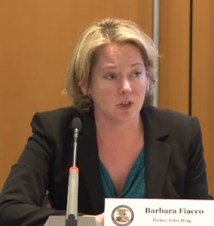
    FiaccoMs. Fiacco (at left) began her presentation by noting, as a number of presenters before her had, that the standard set forth in Chakrabarty was whether a naturally occurring product recited in a claim exhibits markedly different characteristics.  She also contended that the Guidance "ignored Chakrabarty" with respect to the analysis of combinations of naturally occurring products.  Ms. Fiacco further asserted that the Guidance conflicted with Diehr because it does not focus on the claim as a whole, and in support pointed to the Guidance's firework example.

    The second presenter, Mr. Marks used his allotted time to propose a framework for analyzing diagnostic method claims.  Before discussing that framework, however, he explained that the impact of the Guidance on diagnostic method claims was important because 70% of all medical decisions made by physicians rely on diagnostic assay results, and noted that the use of companion diagnostics leads to decreased health care spending by reducing the use of pharmaceuticals that might be ineffective.  With respect to his proposed framework, Mr. Marks contended that "[t]he Supreme Court's decision in Mayo [v. Prometheus] must be analyzed in view of the specific claims at issue" (emphasis in presentation), and cited the Mayo opinion in support of this assertion ("Our conclusion rests upon an examination of the particular claims before us in light of the Court's precedents [which] warn us against upholding patents that claim processes that too broadly preempt the use of a natural law.").

    MarksTurning to the claim at issue in that case, Mr. Marks (at right) reviewed the Court's statements regarding the administering and determining steps and the wherein clause, as well as the Court's comments regarding the claim as a whole.  He next discussed the "useful clues" that can be found in the Mayo decision, noting first that the Court's decision relies on "established general legal rules," and "[s]pecifically, the judicial rule that prevents too broadly preempting the use of a law of nature" (emphasis in presentation).  Mr. Marks emphasized that in Mayo, the Court "does not recite a new rule for biotech or diagnostic patents," and that changes to the MPEP were not needed to address diagnostic claims (emphasis in presentation).  He also noted that the Mayo Court did not change the machine or transformation test, but rather the Court pointed out that the Federal Circuit's analysis and application of the test was wrong.  In particular, Mr. Marks explained that neither the administering step nor the determining step requires a transformation.  According to Mr. Marks, Justice Breyer's "big, blinking roadmap" for understanding Mayo is his contrasting of Prometheus' claims with a new way of using an existing drug:

    Unlike, say, a typical patent on . . . a new way of using an existing drug, the patent claims [at issue in Mayo] do not confine their reach to particular applications of those laws [of nature].  . . .  [T]hese patents tie up too much future use of laws of nature.

    Mr. Marks next suggested ways in which the Prometheus claims could be fixed.  With respect to the administering step, the claim could be amended to recite the specific drug being administered (i.e., a specific compound and not just any 6-­thioguanine producing drug), the specific dosage of the drug (e.g., dosage range), the specific time points for administration (e.g., once daily for a full week), or the specific form of administration (e.g., I.V. or oral).  According to Mr. Marks, such amendments would "[i]mpose[] meaningful limits/actual boundaries" on the administering step, which would then "[c]ompl[y] with precedent which Mayo was based on that 'warns against too broadly preempting a use of a law of nature'!"

    With respect to the determining step, Mr. Marks suggested that the claim could be amended to recite specific analytic methods for "determining" (e.g., ELISA, PCR, HPLC, flow cytometry, Mass spectrometry), or specific compositions used in these analytic methods (e.g., antibodies or primers).  As with the proposed amendments to the administering step, Mr. Marks argued that such amendments would "[i]mpose[] meaningful limits on the execution of the claimed steps, and "[c]ompl[y] with precedent which Mayo was based on that 'warns against too broadly preempting a use of a law of nature'!"

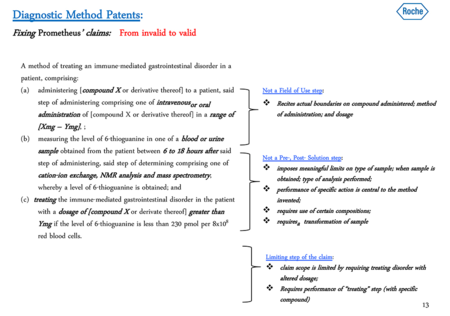
    Finally, for the wherein clause, Mr. Marks suggested that the claim could be amended to introduce active steps such that the overall claim encompasses, for example, a method of treatment, in which the dosage of drug is actively altered based on the metabolite level, or a method of diagnosis, in which a diagnosis is provided based on the metabolite level.  He contended that by amending the wherein clause in such a way, "[c]laim scope is limited by altering dosage or by reciting positively [the] providing [of] a diagnosis," and that the claim would recite "steps that require steps to be performed."  Putting all of the proposed amendments together, Mr. Marks presented a version of the claim that he asserted was "fixed":

    Marks_slide 13
    After briefly touching on claim 20 from U.S. Patent No. 5,747,282 (a claim involved in AMP v. Myriad), Mr. Marks presented a table of areas in which he believed the Office got it right in the Guidance and areas in which he believed the Office got it wrong (at least with respect to diagnostic method claims):

    Marks_slide 16
    A copy of Mr. Marks' presentation can be found here.

    CoxThe final presenter of the group (and the forum), Mr. Cox (at left), indicated that "[t]he ABA‐IPL is reviewing the newly issued guidelines carefully and will provide written comments to the Office."  Despite the ABA-IPL's ongoing analysis of the Guidance, Mr. Cox did outline the ABA's current policy position on subject matter eligibility.  He noted first that the ABA "supports the principle that laws of nature, physical phenomena, and abstract ideas are not eligible for patenting under 35 U.S.C § 101, even if they had been previously unknown or unrecognized."  Next, he indicated that in analyzing process claims for subject matter eligibility, the claim must be read as a whole and be "limited to a specific application of a law of nature, natural phenomenon, or abstract idea" or "require[] or involve[] a transformation of matter."  Finally, Mr. Cox pointed out that the ABA opposed the importing of §§ 102, 103, or 112 criteria into a patent eligibility analysis, and instead:

    [S]upports the principle that the inquiry into subject matter eligibility for patenting under 35 U.S.C. § 101 is a separate and distinct requirement for patent eligibility which should be resolved independently from the conditions of patentability under Sections 102 and 103, and the requirements for obtaining a valid patent under Section 112.

    (emphasis in presentation).

    A copy of Mr. Cox's presentation can be found here.

    CohanThe forum concluded with an hour-long open participation/question and answer session.  In response to a question regarding the patent eligibility of fusion proteins, June Cohan (at right), a Legal Advisor with the USPTO's Office of Patent Legal Administration (who readers may recall presented on the Guidance at the most recent biotechnology/chemical/pharmaceutical (BCP) customer partnership meeting) indicated that fusion proteins were analogous to the cDNA molecules addressed in Myriad in that the former consists of separate proteins fused together and the latter consists of exons joined together.

    Another commenter argued that correlations should be patent eligible, asking "did nature create the correlation between a marker and a disease," and then responding "no."  Following up on that assertion, the next commenter asked the USPTO representatives how they would amend Prometheus' claim to make it patent eligible.  Ms. Cohan responded that the Office could not get into specifics because there were pending applications in the family.  However, she did suggest that the commenter "should come back with a claim that is more like [the claim in] Diehr."  When another commenter suggested that a diagnostic method claim could be fixed by adding a treatment step, Ms. Cohan stated that "I don't think you need to transform a diagnostic claim to a treatment claim" to make the claim patent eligible, and pointed to Examples F and G in the Guidance.  She did concede that the Office was "considering another example" as a way to clarify the issue.

    HirshfeldWhen one commenter asked whether the Office had the "right or responsibility to harmonize conflicting Supreme Court jurisprudence on patent eligibility," Mr. Hirshfeld (at left) responded that "we have the responsibility."

    In response to another commenter's assertion that the Guidance lacked a clear test for assessing whether the claim as a whole recites something significantly different, Mr. Hirshfeld pointed out that the Office "realize[s] that we have said structural differences [can establish that something is significantly different], but you can also have functional differences."  Mr. Hirshfeld conceded, however, that "whether we have adequately conveyed this is another question."

    Stating that she was "not optimistic" that examiners could be convinced to withdraw rejections made under the Guidance, Ms. Brinckerhoff asked the Office representatives how applicants could respond to such rejections, especially for composition claims.  She noted that "we'll have to take that [rejection] to the Board," and argued that "clients are going to give up" and "investors are going to go elsewhere."  She asked the panel "what can we do in the short term, noting that "we can't wait this out."  One Office representative suggested that applicants seek telephonic or video interviews with examiners (with the latter apparently gaining popularity at the Office).

    Another commenter declared that the Guidance is "damaging to our clients," and implored the Office to withdraw the Guidance.  Mr. Hirshfeld responded that it was "highly unlikely" that the Guidance would be withdrawn, but indicated that "there may be iterative changes."  Mr. Hirshfeld concluded the forum by reminding attendees that "we very much value your feedback," and noting that the Office was seeking additional written comments from the public.  While no firm deadline has been set for submitting such comments, he asked attendees to try to submit their comments by the end of June.

    For additional information regarding this topic, please see:

    • "USPTO Holds Forum on Subject Matter Eligibility — Part III," May 15, 2014
    • "USPTO Holds Forum on Subject Matter Eligibility — Part II," May 14, 2014
    • "Guest Post: How to Patent Grapefruit Juice — The New USPTO Guidance for Patent Eligible Subject Matter Is Both Sticky and Sour," May 13, 2014
    • "USPTO Holds Forum on Subject Matter Eligibility — Part I," May 12, 2014
    • "USPTO Tries to Address Public Misunderstandings Regarding Myriad-Mayo Guidance," April 16, 2014
    • "USPTO Issues Guidance for Analyzing Subject Matter Eligibility of Claims Reciting Laws of Nature/Natural Principles, Natural Phenomena or Natural Products," March 4, 2014