• By Andrew Williams

    USPTO SealIn a post from yesterday entitled "Help Improve our AIA Trial Proceedings," Michelle Lee, Deputy Under Secretary of Commerce for Intellectual Property and Deputy Director of the U.S. Patent and Trademark Office, announced on the Director's Forum blog that the USPTO is seeking feedback on Patent Trial and Appeal Board (PTAB) trial proceedings established by the Leahy-Smith America Invents Act (AIA).  This request follows on the heels of the AIA Trial Roundtables that were conducted earlier this year, as reported here.  One of the stated goals of these roundtables was to obtain feedback on how the trial proceedings might be improved.  Now, Ms. Lee explained, the USPTO would like to receive formal comments from the public on a variety of topics related to the PTAB, "including claim construction, amendment practice, and management of concurrent proceedings before the office."  In addition to requesting constructive criticism, the USPTO would like to know what it is doing right.  "We have a world class patent system," Ms. Lee explained, "and this is a golden opportunity to make it even better."  The deadline for submission of comments is September 16, 2014, the two-year anniversary of the PTAB.

    Ms. Lee's announcement referenced a Federal Register Notice from June 27, 2014 (79 Fed. Reg. 36474), which is entitled "Request for Comments on Trial Proceedings Under the America Invents Act Before the Patent Trial and Appeal Board."  In this notice, the USPTO outlined 17 issues, or questions, for which the Office is most interested in receiving public comments.  Not surprising, the first two questions relate to the standard for claim construction and the ability to amend claims in PTAB trial proceedings.  Specifically, the Notice identified these two issues as:

    1.  Under what circumstances, if any, should the Board decline to construe a claim in an unexpired patent in accordance with its broadest reasonable construction in light of the specification of the patent in which it appears?

    and:

    2.  What modifications, if any, should be made to the Board's practice regarding motions to amend?

    The "broadest reasonable interpretation," or BRI, claim construction standard has been sharply criticized as giving a patent challenger an unfair advantage in front of the PTAB.  Often these challengers are defendants in on-going litigations, and Federal courts use a narrower claim construction standard as articulated in Phillips v. AWH Corp., 415 F.3d 1303 (Fed. Cir. 2005) (en banc).  In fact, the Innovation Act, which last December passed the House of Representatives, contained a provision requiring the USPTO to follow this same civil-litigation standard in its trial proceedings.  The Office has defended the BRI standard as necessary because patent holders have the ability to amend claims during the process.  Or do they?  So far, the PTAB has granted only one motion to amend claims — a fact that has also drawn criticism from the patent community.  The PTAB has used a strict standard because the claim amendments would occur in the absence of a search of the prior art (at least on the part of the Office).  Therefore, patent holders have been advised to disclose as much about the art as they are aware.  However, either this message has not been well received, or such advice is not practicable in reality.  Therefore, this might be one of the most useful issues on which the Office is soliciting comments.

    The remaining identified issues fall within eight categories:  patent owner preliminary response; obviousness; real party in interest; additional discovery; multiple proceedings; extension of 1 year period to issue final determination, oral hearing, and general.  This last category is a catch-all, and includes such topics as whether the Board should change its approach to instituting petitions, page limits, and requests for rehearing.  In addition to the two questions mentioned above, the only additional issue that Ms. Lee highlighted on her blog was related to multiple proceedings:

    7.  How should multiple proceedings before the USPTO involving the same patent be coordinated?  Multiple proceedings before the USPTO include, for example:  (i) two or more separate AIA trials; (ii) an AIA trial and a reexamination proceeding; or (iii) an AIA trial and a reissue proceeding.

    Ms. Lee indicated that the Office will review the submitted written comments, in addition to the feedback from the roundtables, and will consider changes (if any) to the PTAB trial proceedings that will "help improve the speed and effectiveness of the proceedings."  We will monitor on the comments received by the Office, and will report on any changes instituted by it in response.

  • By Michael Borella

    Federal Circuit SealLess than four weeks after the Supreme Court handed down its opinion in Alice Corp. v. CLS Bank International, the Federal Circuit has used the holding of that case to strike down a patentee's claims under 35 U.S.C. § 101.

    Digitech sued Electronics For Imaging and a host of co-defendants for allegedly infringing its U.S. Patent No. 6,128,415.  The '415 patent relates to "the generation and use of an improved device profile that describes spatial and color properties of a device within a digital image processing system."  By creating a number of such device profiles for input and output devices (e.g., digital cameras, monitors, televisions, etc.), the patent purports to be able to more accurately translate color representations between these devices.

    In July 2013, several defendants filed summary judgment motions, contending that Digitech's asserted claims were directed to patent-ineligible subject matter.  The presiding United States District Court for the Central District of California granted the motion.  Digitech appealed.

    Digitech's claim 1 recites:

        A device profile for describing properties of a device in a digital image reproduction system to capture, transform or render an image, said device profile comprising:
        first data for describing a device de-pendent transformation of color information content of the image to a device independent color space; and
        second data for describing a device de-pendent transformation of spatial in-formation content of the image in said device independent color space.

    The Federal Circuit observed that claim 1 is "comprised of two sets of data that describe a device dependent transformation" and that "[t]he asserted claims are not directed to any tangible embodiment of this information (i.e., in physical memory or other medium) or claim any tangible part of the digital processing system."

    The Court invoked 1863's, Burr v. Duryee, for the notion that "[t]o qualify as a machine under section 101, the claimed invention must be a concrete thing, consisting of parts, or of certain devices and combination of devices."  Claim 1 does not meet this standard because it recites an intangible arrangement of information, and therefore does not fall into any of the categories of § 101.

    The Court further found that claim 1 was even broader than the patent-ineligible claims of In re Nuijten, where an applicant attempted to obtain patent protection on a signal.  Particularly, the claims of Nuijten required the physical, yet transitory, embodiment of a signal, whereas claim 1 required no physical embodiment at all.

    As an aside, this is not the first time that the Federal Circuit has held that a data structure falls outside the ambit of § 101.  In re Warmerdam, decided in 1994, stands for the same principle.  However, In re Lowry, decided in the same year, suggests that claiming such a data structure as being incorporated in "a memory" would be enough for the claim to fall within the statutory category of article of manufacture.

    Digitech's claim 10 recites:

        A method of generating a device profile that describes properties of a device in a digital image reproduction system for capturing, transforming or rendering an image, said method comprising:
        generating first data for describing a device dependent transformation of color information content of the image to a device independent color space through use of measured chromatic stimuli and device response characteristic functions;
        generating second data for describing a device dependent transformation of spatial information content of the image in said device independent color space through use of spatial stimuli and de-vice response characteristic functions; and
        combining said first and second data into the device profile.

    The Court found that this claim merely "recites a process of taking two data sets and combining them into a single data set, the device profile."  As such, it was directed to an abstract idea.  Citing to Parker v. Flook (which has a new life after CLS Bank and Mayo Collaborative Services v. Prometheus Laboratories, Inc.), the Court stated that "[w]ithout additional limitations, a process that employs mathematical algorithms to manipulate existing information to generate additional information is not patent eligible."  Despite the claim including reference to "a digital image reproduction system," there is no tie of the claimed method to a physical, tangible device.  Thus, the Court found the claim lacking any additional inventive features that would restrict its scope to less than that of the abstract idea itself.

    Image processing a hot technology right now.  Look no further than your smartphone to see image processing innovation at work in the real world.  Does this case result in such innovations being unprotectable?  No, probably not.  Not unlike the claims in CLS Bank and Bilski v. Kappos, Digitech's claims encompass disembodied methods and structures.  While it is hard to fault the Federal Circuit for affirming the invalidity of the claims in the case, one has to wonder if the addition of a few well-placed hardware limitations to claims 1 and 10 would have resulted in a different outcome.

    Digitech Image Technologies, LLC v. Electronics For Imaging, Inc. (Fed. Cir. 2014)
    Panel: Circuit Judges Moore, Reyna, and Hughes
    Opinion by Circuit Judge Reyna

  • By Paul Cole* —

    USPTO SealAs readers will be aware, members of the public have been invited to submit written comments to the U.S. Patent and Trademakr Office that present their interpretation of the impact of relevant Supreme Court precedent on the legal and technical issues involved in subject matter eligibility analyses during examination of claims reciting or involving laws of nature, natural phenomena, and natural products.  The Office invited members of the public who believe that the Supreme Court decisions could be implemented in an alternative manner from the approach taken in the Guidance to:

    • present their alternative approach and the legal rationale for the alternative;
    • suggest additional examples for use by the Office to create a more complete picture of the impact of Supreme Court precedent on subject matter eligibility;
    • provide comments on the subject matter eligibility of particular claims;
    • including the sample claims discussed at the 2014 BIO International Convention (see "USPTO Provides Update on Myriad-Mayo Guidance").

    The first group of comments has now been published on the USPTO website and can be viewed here.

    The present paper provides a brief overview of some early submissions.

    Few of the published comments filed deal systematically with the four topics on which the Office has requested information.  It is believed that the comments that I filed follow the pattern desired by the Office (save for the BIO claims which had not been published at the time when the comments were submitted), and readers are invited to note the format adopted in the second part of those comments and piggyback on the approach adopted.  In particular, amendments suggested page by page and line by line to the existing Guidance and detailed examples and claims analysed using the model contained in the Guidance (with suggested amendments) are more likely to be influential than generalised comments and complaints.

    Benjamin Borson argues that the Guidance goes well beyond the Supreme Court's standards under § 101 and might represent "substantive rulemaking" by the Office in contravention of the Administrative Procedures Act (APA).  The interpretation of Supreme Court decisions that underlies the Guidance represents policy-driven results that change the way in which patent claims are analysed but without sufficient consideration of legal precedent.  In particular he points to the Supreme Court's use in Chakrabarty of the word "characteristics" which he argues is significantly broader than the words "substantially different structure" in the Guidance.  If implemented, the standards in the Guidance will significantly and adversely affect the biotechnology, pharmaceutical, and diagnostics industries and will stifle the major purposes of the patent system.

    The Japan Patent Attorney Association objects that the content of the Guidance broadens the meaning of the Supreme Court decision in the Myriad case from the field of genes in the human genome to a wide range of natural products.  They consider that the Guidance should not apply Myriad so broadly.  They point out that the so-called "substance patent system" has been adopted in major jurisdictions including Japan.  A substance isolated from a natural environment, for example, a microorganism, antibiotic or a protein with a sugar chain is eligible as a product invention these major jurisdictions.  On the other hand, substances isolated from natural products are not eligible in the U.S. according to this guidance.  The Guidance therefore goes against efforts to internationally harmonize patent system requirements.

    Powerful arguments in favour of the patent-eligibility of natural products are set out in the comments of Thomas DesRosier of Cubist:

    Over the coming years, the number of drug compositions derived from naturally occurring small molecules is likely to increase.  The development of combinatorial chemistry through the 1990s and 2000s led many pharmaceutical companies to move away from natural products, but that trend is reversing as synthetic small molecule pipelines are drying up.  New tools are also emerging to allow scientists to access and study natural products.  Scientists have estimated that less than 1% of all microorganisms that have been seen under a microscope have been cultivated.  Improved culture procedures are making it possible to grow microorganisms that were previously unavailable, and to study the molecules that they produce.  Advances in oceanography and environmental science also are making it possible to collect samples from previously inaccessible areas.  Furthermore, recent findings suggest that organisms produce a host of novel products when grown together instead of separately providing new products for researchers to study.  Molecular biologists have also discovered silent genes that code for products hidden in bacterial and fungal genomes and they are working to find ways to express and isolate these previously unknown drug candidates.

    Researchers must now build upon these discoveries to develop new therapeutic compositions and methods of making and using them.  Significant inventive efforts will be required to realize the potential of such naturally-occurring molecules for providing new pharmaceutical treatments.  These advances have the potential to produce important new drugs, but only if the economy and the patent system provide appropriate incentives for natural products-related research.  Cubist, for example, has invested over $1 billion to bring important life-saving antibiotics to the market, including CUBICIN® and DIFICID®.  Unlike diagnostic methods, which were at issue in several of the recent patentable subject matter cases, antibiotics require extensive clinical trials, with substantially more time and resources invested to bring a product to market.  If the USPTO now goes beyond the Supreme Court's requirements in refusing to grant patents on inventions derived from or relating to natural products, Cubist and other companies like it will not be able to protect their research and development investments.  Therefore, the Guidance should not extend recent Supreme Court decisions to unduly restrict patentable subject matter with respect to natural products-related inventions.

    Leslie Fischer of Novartis advocates a "kind"/"degree" test that is in compliance with Hartranft v. Wiegmann, 121 U.S. 609 (1877), which asks whether an object has attained a distinct "name, character, or use" relative to the corresponding raw material.  This standard, she argues, has been endorsed, at least implicitly, in patent subject matter eligibility contexts by the Supreme Court in American Fruit, Chakrabarty, and Myriad.

    As mentioned, my full submission is available on the website and includes the text previously published here on 4th June under the title:  Myriad – An Obvious and Patent-Friendly Interpretation, where it was suggested based on the Hartranft opinion that the Myriad holding should be interpreted in terms of reasons rather than differences, so that isolation accompanied by the additional reason of new utility suffice for eligibility.

    My comments also argued that amendment of the Guidance is needed to further clarify that if a claim appears to recite or involve a judicial exception then exclusion is not automatic.  For example, materials derived from natural sources do not inevitably fall within the prohibition, and whether or not they do so depends on the form in which they are claimed.

    In relation to questions (a) and (g) of the "significantly different" analysis, it is argued that these are unduly restrictive because the only type of difference that is acknowledged is a structural difference.  The proposition is repeated in the paragraph following question (l) and in Examples A and E.

    Structural difference is neither a necessary nor a sufficient condition for eligibility.  If it were a necessary condition, then purified natural products of pharmaceutical use, conceded as being eligible in oral argument in Myriad, would become non-eligible.  A fundamental legal change of this kind, affecting the pharmaceutical industry which is one of the most significant classes of user of the patent system, requires explicit language.  It should not be imposed by mere assumption of what is implicit in a decision affecting sequences isolated for genetic testing, which is a field of endeavor distant from small molecule natural products or even from isolated plasmids and other sequences useful in genetic engineering e.g. to make products of industrial importance.  It is submitted that it was not the intention of the Supreme Court to invalidate protection for natural product inventions such as adrenaline and other compounds set out above.  If structural difference were a sufficient condition then the copper plates of the Hartranft example would be eligible because of their raised edges, whereas they were not classified as manufactured articles because insufficient new utility had been demonstrated, the plates being sold by weight and the change in physical form contributing nothing to their value.

    As previously explained, the dividing line is therefore a difference leading to new utility.  Such differences need not be based on structure but could arise from any human activity leading to new utility including selection, isolation, multiplication, concentration and purification.  Questions (a) and (g) therefore require expansion to cover the full range of relevant human activities that could be relevant to eligibility.

    Leslie Fischer's approach to example B (Amazonic acid) starts from the tariff cases in the Supreme Court which she argued were not decided based on the potential of the object at issue, but whether the object had, in fact, been changed in such a way that something a new function arose:

    Amazonic acid, found in a tree leaf, has the property of being able to inhibit receptor X if administered to humans.  Inhibition of receptor X, at a certain level, would be useful to treat the common cold.

    Imagine that a human must consume 10,000 pounds of tree leaf to treat the common cold.  If one were to administer Amazonic acid in its natural leaf state to a human, Amazonic acid would indeed have the property of inhibiting receptor X, but it would not treat the common cold due to the inordinate (and impossible) amount of leaf that must be consumed.  Thus, while one might argue that "function" is inherent, the ultimate "use" is not necessarily so.  The use is merely a potential of the natural product.  Perhaps the distinction between "use" and "function" is semantic, as the words "use", "function", "quality", "character" and the like are blurred in the English language.  Nevertheless, the fact is that purification, isolation, concentration, etc. of Amazonic acid from the leaf is what gives this object the use that is sought, and it is what gives this object value.  Indeed, Mr. Hansen, attorney for Petitioner, at oral arguments in front of the Supreme Court in Myriad admitted exactly this, when he conceded that Amazonic acid, isolated from a leaf, could be patent eligible if, in concentrated form, it had a new function.

    The suggestion in my comments was to abandon example B entirely and replace it by an example directed to rapamycin (U.S. Patent Nos. 3,929,992 and 3,993,749; for litigation concerning derivatives see the Federal Circuit opinion in Wyeth v Abbott (Fed. Cir. 2013)).  It is explained that the naturally-occurring organism Streptomyces hygroscopicus NRRL 5491 was isolated from a sample of soil from Easter Island.  It can be cultivated by natural fermentation and produces a triene antibiotic called rapamycin.  The antibiotic can be harvested by extraction of the fermentation medium with a water-immiscible solvent such as methylene chloride which can be evaporated to give crude rapamycin as an oily residue.  Two stages of preparative column chromatography and precipitation followed by recrystallization give a purified product which was initially of interest for its antifungal properties.  A dimethylphosphate derivative of rapamycin has anti-cancer activity.  Claims to rapamycin as a colourless crystalline compound, a pharmaceutical composition containing it, and its use for inhibiting the growth of pathogenic fungi are argued as patent-eligible.  A real example, it is believed, is more compelling and more difficult to treat dismissively than an over-simplified fictitious example.

    A further example of a manufacture relating to a single natural product included in my comments is based on the fact pattern in U.S. Patent No. 4,506,014.  Giuseppe Brotzu isolated a library of bacteria from a sewage outfall off the Sardinian coast a fungus called Cephalosporium acremonium, which when cultured, provided crude filtrates having antibacterial activity.  Those filtrates were subsequently found to contain cephalosporin antibiotics.  Amongst the naturally occurring fungi that he isolated was a strain called Acremonium chrysogenum ATCC 14553.  Producing fungal strains with increased productivity for cephalosporin was an unsolved problem.  Although genetic engineering using plasmids had become known, success could only be achieved when a plasmid was available which was not immediately eliminated from the host cell which was to be genetically improved, as happens in microorganisms that are unrelated.  No such plasmid had been found either in Acremonium or in other closely related strains of fungi.  The invention was based on the unexpected discovery of a plasmid in the 14533 strain which had been given the name pAC 1.  It was particularly suitable for forming a hybrid vector by cleaving at restriction sites and for inserting a gene for promoting the synthesis of β-lactam antibiotics.

    A claim to the plasmid was assessed as being patent-eligible.  In contrast to the BRCA1 sequence considered in Myriad, the plasmid was isolated in vitro and not simply reconstructed in silico and is capable of chemical manipulation using restriction enzymes.  Its novelty and utility falls to be judged by a biochemist from the standpoint of practical manipulation to produce hybrid vectors and not simply by a geneticist from the standpoint of its informational content.  The plasmid has the new name pAC1.  It has new characteristics because in pure form it can be manipulated at defined sites by restriction enzymes, whereas that is not possible with the plasmid as it occurs in nature.  It has new utility because it can be used in genetic engineering to form hybrid vectors that can be reintroduced into Acremonium species to promote antibiotic synthesis.  It therefore satisfies the Hartranft test approved in Chakrabarty and subsequently approved in Myriad.  The use to which the plasmid can be put is a new use and not the mere consequence of its possession (see the dissent of Judge Bryson in Myriad, subsequently approved by Justice Thomas).  Selection and isolation has therefore created a new product whose utility goes beyond simple isolation from the surrounding cellular material.

    Laurence Shumway and Anne Collins are concerned with personalised medicine and argue for the eligibility of the following process claim:

    A method of determining the diagnosis/prognosis of a human patient for disease X, comprising the steps of:
        obtaining an isolated biological sample from the patient;
        artificially and detectably labelling the isolated biological sample for measuring the level of analyte(s) Y;
        measuring the level of the analyte(s) Y using the artificially and detectably labelled biological sample; and
        comparing the level of the analyte(s) Y to one or more suitable controls and assigning the patient a diagnosis/prognosis for disease X on the basis of the comparison.

    They argued that the proffered claim is more analogous to those in Diehr than to those in Benson, Flook, and Bilski.  The proffered claim arguably provides an even stronger case for patent eligibility than did those in Diehr, since, unlike in Diehr, where the equation (analogous to the alleged natural law) was well-known, the "natural principle" (the association of the analyte levels to a diagnosis/prognosis) was not known.  The proffered claim also arguably provides that the biological sample is artificially and detectably labelled, which gives an alternative basis to establish patent eligibility.

    Although there were 80 attendees at the USPTO Forum on 9 May and it was watched by some 400 people, there have so far been submissions from only two companies or research institutions, two law firms, three IP associations all based in Japan, and 18 individuals.  In our profession we tend to file documents just in time before a deadline, which in this case ends at the end of July.  Where individuals agree with comments already made, there is, as has been said, an opportunity to piggyback on those comments rather than starting from first principles.  However, given the comment at BIO that the Office still considers that its Guidance is fundamentally correct, substantial effort is needed if significant alterations are to be achieved.

    * Mr. Cole is a European Patent Attorney and Partner with Lucas & Co. in Warlingham, Surrey, UK and Visiting Professor at Bournemouth University.

  • CalendarJuly 15, 2014 – "Alice v. CLS Bank: How Far Has the Needle Moved?" (Intellectual Property Owners Association) – 2:00 to 3:00 pm (ET)

    July 16, 2014 – European Biotech Patent Law Webinar (D Young & Co) – 4:00 am, 7:00 am, and 12:00 pm (ET)

    July 17-18, 2014 - Advanced Patent Prosecution Workshop 2014: Claim Drafting & Amendment Writing (Practising Law Institute) – New York, NY

    July 20-22, 2014 – 2014 Annual Meeting & Conference (National Association of Patent Practitioners) – Alexandria, Virginia

    July 22, 2014 – "America Invents Act: Patent Strategies and Reforms Counsel Needs to Know" (Commercial Law WebAdvisor) – 1:00 to 2:30 pm (Eastern)

    July 24, 2014 – "Protecting IP Rights After Limelight Networks v. Akamai: Implications for Divided Patent Infringement and Inducement — Prosecuting and Litigating Patent Claims Following the New Supreme Court Decision" (Strafford) – 1:00 to 2:30 pm (EDT)

    July 30, 2014 – "Ask the Office: New Guidance on Functional Claiming" (American Bar Association Section of Intellectual Property Law) – 1:00 to 2:30 pm (ET)

    July 30, 2014 – "Alice Corp. v. CLS Bank: Patent Eligibility of Software-Related Inventions" (Strafford) – 1:00 to 2:30 pm (EDT)

    August 13-15, 2014 – Advanced Patent Law Seminars (Chisum Patent Academy) - Seattle, WA

    August 18-19, 2014 - Advanced Patent Prosecution Workshop 2014: Claim Drafting & Amendment Writing (Practising Law Institute) – San Francisco, CA

    August 18-20, 2014 – Advanced Patent Law Seminars (Chisum Patent Academy) - Seattle, WA

    August 19, 2014 – "Alice Corp. v. CLS Bank International: General Purpose Computers Cannot Save Inventions Directed to Abstract Ideas" (McDonnell Boehnen Hulbert & Berghoff LLP) – 10:00 to 11:15 am (CT)

    September 11-12, 2014 - Advanced Patent Prosecution Workshop 2014: Claim Drafting & Amendment Writing (Practising Law Institute) – Chicago, IL

    September 18-19, 2014 – FDA Boot Camp (American Conference Institute) – Boston, MA

    ***Patent Docs is a media partner of this conference or CLE

  • D Young & CoD Young & Co will be offering its next European biotech patent law update on July 16, 2014.  The 45-minute webinar will be offered at three times: 4:00 am, 7:00 am, and 12:00 pm (ET).  D Young & Co European Patent Attorneys Simon O'Brien and Connor McConchie will provide an essential update and live Q&A on EPO biotechnology case law.

    While there is no fee to participate, attendees must register in advance.  Those wishing to register can do so here.

    In addition, to thank more than 2,000 attendees and celebrate almost 40 hours of online broadcasting since July 2011 D Young & Co will be giving away an iPad mini.  For a chance to listen to future webinars on a new iPad mini, simply register and attend one of the July 16 biotech patent case law webinars to be entered into the prize draw.  The draw will take place shortly after the last webinar and the winner will be notified by July 18.

  • PLI #1Practising Law Institute (PLI) will be holding a two-day seminar entitled: "Advanced Patent Prosecution Workshop 2014: Claim Drafting & Amendment Writing" on July 17-18, 2014 in New York, NY, on August 18-19, 2014 in San Francisco, CA, and on September 11-12, 2014 in Chicago, IL.  Patent Docs authors Donald Zuhn and Kevin Noonan will be presenting at the Chicago seminar.

    At the New York and Chicago seminars, PLI's faculty will offer presentations on the following topics:

    • Ethics in the PTO
    • Concurrent Sessions I:  Advanced Specification Drafting Issues — all concurrent sessions and workshops will provide lectures specific to four different technologies:  biotechnology, chemical/pharmaceutical, electromechanical, and electronics/computers
    • Concurrent Sessions II:  Advanced Claim Drafting Issues
    • Concurrent Workshops I:  Advanced Claim Drafting
    • How to Work with Patent Examiners Toward Allowance
    • Prior Art Under the America Invents Act: How the America Invents Act and Patent Law Treaty Affect Patent Prosecution
    • Concurrent Sessions III:  Advanced Patent Prosecution Issues
    • Concurrent Workshops II:  Advanced Amendment Drafting
    • Roundtable Discussions and Wrap Up

    At the San Francisco seminar, presentations will be offered on the following topics:

    • Ethics for Patent Prosecutors
    • The New 35 USC §102
    • Advanced Claim Drafting Issues — class to split into technology groups, including Electromechanical/Mechanical, Electronics/Computers, and Life Sciences (Biotechnology, Chemical/Pharmaceutical)
    • Patentable Subject Matter — class to split into technology groups
    • Claim Drafting Workshops — class to split into technology groups
    • Advanced Issues for Written Description — class to split into technology groups
    • Countering the Obviousness Rejection
    • Post Final Practice
    • Supplemental Examination and Derivation Proceedings
    • Amendment Workshops — class to split into technology groups

    A complete program schedule, including descriptions of the presentations and a list of speakers for each seminar can be found here.

    The registration fee for each conference is $1,795.  Those interested in registering for the conference can do so here.

  • Boston SkylineAmerican Conference Institute (ACI) will be holding the next session of its FDA Boot Camp conference on September 18-19, 2014 in Boston, MA.  ACI faculty will help attendees:

    • Master the basics of the application and approval processes for drugs, biologics, and devices;
    • Comprehend the structure of the FDA and the roles of the three major agency centers:  CDER, CBER, and CDHR;
    • Develop a practical working knowledge of clinical trials for drugs and biologics and the clearance process for devices;
    • Learn how devices are classified, monitored, and regulated;
    • Appreciate the complexities of pharmaceutical IP and the regulatory balance between brand name and generic products;
    • Recognize the pivotal role of labeling in the drug and biologics approval process;
    • See the importance of cGMPs to the post-approval regulatory process; and
    • Navigate the protocols of adverse events monitoring, signal detection, product withdrawals, and recalls.

    CoverIn particular, ACI's faculty will offer presentations on the following topics:

    • Brief Overview of FDA Practice
    • The Nature of the Approval Process
    • Understanding the Clinical Trial Process for Drugs and Biologics
    • Drugs and Biologics: Labeling
    • Patent and IP Overview for Drugs and Biologics: Understanding The Connection Between FDA Regulation and IP and Related Mechanisms Under Hatch-Waxman and BPCIA
    • Part 1 — Patents, Trademarks and Other IP Protections and Mechanisms
    • Part 2 — Hatch-Waxman and BPCIA Overview
    • The Drug Supply Chain Security Act — Summarizing the Act and Its Effect on FDA Practice
    • cGMPs: Drugs and Biologics (Current Good Manufacturing Practices)
    • Adverse Events Monitoring, Pharmacovigilance and Risk Management
    • Medical Devices: Classifications, the Essentials of the Premarket Review Process, and Post-Market Requirements and Concerns
    • Recall Guidance for Drugs, Biologics, and Medical Devices: What You Need to Know

    A pre-conference workshop on the "Fundamentals of FDA Regulatory Law" and "Resolving Ethical Challenges Encountered During the Drug Approval Process" will be offered on September 17, 2014 from 1:00 to 5:00 pm.  The first part of the workshop will provide a basic overview of FDA regulations and will prepare attendees for the in-depth discussions that will take place throughout the conference, and explore ethical issues that may arise in the context of communications with FDA on behalf of clients.  The second part of the workshop will explore ethical issues that may arise in the context of communications with FDA on behalf of clients.

    Two post-conference master classes will be offered on September 19, 2014.  The first master class, entitled "Hatch-Waxman and BPCIA: Overview of Biosimilars and Life Cycle Planning for Drugs and Biologics," will provide an in-depth overview of biosimilars as well as analyses of bioequivalence and exclusivities and their role in patent and product life cycle management.  The second master class, entitled "Post-Approval Marketing Guidance and Preemption Protocols," will address issues that arise post-approval, including advertising, promotion, and off-label promotion and enforcement, as well as preemption fundamentals.

    An agenda for the conference can be found here, and additional information regarding the workshop and master classes can be found here.  A complete brochure for this conference, including an agenda, detailed descriptions of conference sessions, list of speakers, and registration form can be obtained here.

    ACI - American Conference InstituteThe registration fee is $2,295 (conference alone), $2,895 (conference and workshop or conference or one master class), or $3,295 (conference, workshop, and one master class).  Those registering by July 18, 2014 will receive a $300 discount, and those registering by August 22, 2014 will receive a $200 discount.  Those interested in registering for the conference can do so here, by e-mailing CustomerService@AmericanConference.com, by calling 1-888-224-2480, or by faxing a registration form to 1-877-927-1563.

    Patent Docs is a media partner of ACI's FDA Boot Camp conference.

  • MBHB Logo 2McDonnell Boehnen Hulbert & Berghoff LLP will be offering a live webinar entitled "Alice Corp. v. CLS Bank International: General Purpose Computers Cannot Save Inventions Directed to Abstract Ideas" on August 19, 2014 from 10:00 am to 11:15 am (CT).  MBHB attorney Rory P. Shea and Patent Docs contributor and MBHB attorney Michael S. Borella, Ph.D. will cover the potential implications of the Alice decision on patents directed to computer-implemented inventions.  Topics to be discussed during the webinar will include:

    • A review of the Alice decision
    • A review of the additional guidance that the Alice decision may provide on the two-part test for determining patent-eligibility
    • A discussion of how the Alice decision may impact the prosecution and litigation of claims directed to computer-implemented inventions going forward

    While there is no fee to participate, attendees must register in advance.  Those wishing to register can do so here.  CLE credit is pending for the states of California, Illinois, New Jersey, New York, North Carolina, and Virginia.

  • IPO #2The Intellectual Property Owners Association (IPO) will offer a one-hour webinar entitled "Alice v. CLS Bank: How Far Has the Needle Moved?" on July 15, 2014 beginning at 2:00 pm (ET).  A panel consisting of Scott Bornstein of Greenberg Traurig LLP, Michael Chernoff of MDB Capital Group LLC, and Robert Sachs of Fenwick & West LLP will address the following questions:

    • How much will Alice impact patent applications at the USPTO, Covered Business Method post-grant proceedings at the PTAB, and invalidity arguments in district court?
    • What kinds of applications and patents are most vulnerable?
    • What will the USPTO, district courts, and the Federal Circuit do with the vague tests articulated by Alice regarding "abstract ideas" and "inventive concept"?
    • What can patent owners and applicants who are at risk do to shore up their IP protection?

    The registration fee for the webinar is $130 (government and academic rates are available upon request).  Those interested in registering for the webinar can do so here.

  • Absent Description of Representative Species to Support Entire Genus, Functionally Defined Genus Claim Lacked Adequate Written Description

    By Donald Zuhn —

    AbbvieLast week, in AbbVie Deutschland GmbH v. Janssen Biotech, Inc., the Federal Circuit affirmed judgments by the District Court for the District of Massachusetts in infringement and interference actions involving AbbVie Deutschland GmbH & Co., KG; AbbVie Bioresearch Center, Inc.; and AbbVie Biotechnology Ltd. ("AbbVie") and Janssen Biotech, Inc. and Centocor Biologics, LLC ("Centocor").

    In the infringement action, AbbVie had filed suit against Centocor in the District of Massachusetts for infringement of claims 29, 30, 32, and 64 of U.S. Patent 6,914,128 and claim 11 of U.S. Patent 7,504,485.  Following a trial on validity, a jury determined that the asserted claims were invalid for lack of written description, lack of enablement, and for obviousness.  The District Court denied AbbVie's post-trial motions for judgment as a matter of law and a new trial.

    CentocorIn the inference action, Centocor had sought review under 35 U.S.C. § 146 of a determination by the Board of Patent Appeals and Interferences in an interference between Centocor's U.S. Patent Application 10/912,994 and AbbVie's '128 patent.  The Board awarded priority to AbbVie and determined that the contested claims of the '128 patent were not invalid for obviousness.

    In an opinion by Judge Lourie, joined by Judge Chen with Judge O'Malley concurring in the judgment, the Federal Circuit determined that the Board's decision in the interference proceeding lacked finality for purposes of collateral estoppel, the evidence supported the jury verdict that the claims lacked adequate written description, and there was no reversible error in the District Court's evidentiary rulings or jury instructions relating to written description that warranted a new trial.  The Federal Circuit therefore affirmed the District Court's judgments of invalidity in both the infringement and interference actions.

    The '128 and '485 patents are directed to fully human antibodies that bind to and neutralize the activity of human interleukin 12 (IL-12).  The patents, which share the same written description, disclose the amino acid sequences of nearly 300 antibodies having a range of IL-12 binding affinities.  The antibodies described in the patents were developed using phage display, with AbbVie initially identifying an antibody, Joe-9, that had low affinity for IL-12.  To improve the IL-12 affinity of Joe-9, AbbVie introduced mutations into the CDR sequences of that antibody, identifying an improved antibody, Y61.  Site directed mutagenesis was then employed to generate additional antibodies from Y61, with one antibody, J695, showing a significant increase in IL-12 binding and neutralizing activity.  Because all of the antibodies described in the patents were derived from Joe-9, all of the antibodies have VH3 heavy chains and Lambda light chains like Joe-9.  The antibodies described in the '128 and '485 patents also share at least 90% amino acid sequence similarity in their variable regions; with more than 200 of the described antibodies differing from Y61 at a single amino acid residue and sharing 99.5% similarity in the variable regions.

    The claims of the '128 and '485 patents that were at issue in the appeals define the claimed antibodies by their function — i.e., IL-12 binding and neutralizing characteristics — rather than by structure.  Representative claim 29 of the '128 patent recites:

    29.  A neutralizing isolated human antibody, or antigen-binding portion thereof that binds to human IL-12 and disassociates from human IL-12 with a koff rate constant of 1×10⁻² s-1 or less, as determined by surface plasmon resonance.

    Centocor markets a human IL-12 neutralizing antibody under the brand name Stelara®.  Centocor's IL-12 antibody, which was developed using transgenic mice technology, has VH5 type heavy chains and Kappa type light chains, and shares about 50% sequence similarity in the variable regions as compared to Joe-9.

    After filing the '994 application, which is directed to IL-12 antibodies, Centocor provoked an interference with AbbVie's '128 patent.  During the interference, Centocor filed motions on the issues of obviousness and priority.  Following the Board's decision to award priority to AbbVie and finding the '128 patent not invalid for obviousness, AbbVie filed suit against Centocor for infringement of the '128 and '458 patents, and Centocor filed two actions in the District Court for the District of Colombia seeking judicial review of the Board's interference decisions under § 146, as well as a declaratory judgment of noninfringement and invalidity of the '128 and '485 patents.  Those actions were transferred to Massachusetts and consolidated with AbbVie's infringement action.

    At trial, the District Court denied AbbVie's motion of summary judgment that Centocor was collaterally estopped from challenging the validity of the '128 patent because it had failed to invalidate the patent during the interference proceeding.  After construing the claims, the District Court entered summary judgment that Centocor had infringed the asserted claims of the '128 and '458 patents, and the issue of validity was tried before a jury.  Centocor challenged the validity of the '128 and '458 patents on the basis of written description, enablement, obviousness, and anticipation, arguing that the antibodies described in the patents were not representative of other members of the functionally claimed genus, which included Centocor's antibody.  The differences between AbbVie's Joe-9 and J685 antibodies and Centocor's Sterlara-brand antibody were presented in Federal Circuit opinion as follows:
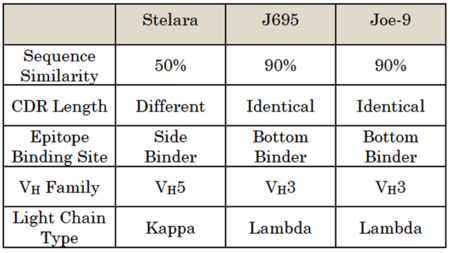
    Table
    The jury determined that the asserted claims of the '128 and '458 patents were invalid for lack of adequate written description, lack of enablement, and obviousness.  AbbVie then moved for JMOL on the grounds on which it lost, or for a new trial alleging that the District Court erred with respect to its evidentiary rulings and jury instructions.  The District Court denied both motions and entered final judgment, and AbbVie appealed.  On appeal, AbbVie challenged the District Court's denial of (1) AbbVie's motion for summary judgment that Centocor was collaterally estopped from raising invalidity defenses in the infringement action after the interference proceeding, (2) AbbVie's motion for JMOL on the issues of written description and enablement, and (3) AbbVie's motion for a new trial based on alleged errors in the District Court's evidentiary rulings and jury instructions.

    With respect to the collateral estoppel issue, the Federal Circuit determined that Centocor was not estopped from raising invalidity defenses in the infringement action because the Board's priority and nonobviousness decisions lacked finality for purposes of collateral estoppel.  The Court explained that because "a party seeking review of a decision of the Board under § 146 may 'shor[e] up evidentiary gaps' in the agency record by presenting live testimony, which could not be presented to the PTO," Board decisions reviewed under § 146 are not binding final judgments precluding a losing party from litigating the same or related issues in a parallel proceeding.  In particular:

    [Centocor was] entitled to present new evidence at least with respect to the issues of priority and obviousness in the underlying interference action.  The factual record in the interference action was therefore open as to those issues, subject to a de novo determination by the district court.  Consequently, the Board's priority and nonobviousness decisions lacked the requisite finality for purposes of collateral estoppel.

    With respect to AbbVie's motion for a new trial, the Federal Circuit determined that the District Court did not abuse its discretion in excluding additional testimony from AbbVie's expert regarding the USPTO's reasoning for concluding that the '128 and '458 patents satisfied the written description requirement.  The Court noted that "[i]n view of the record as a whole, including the substantial evidence of structural differences between Stelara and the Joe-9 antibodies and the fact that the jury considered the number of structurally similar antibodies disclosed in AbbVie's patents," the District Court did not abuse its discretion in excluding the additional testimony of AbbVie's expert.  As for the District Court's jury instructions, the opinion refers to AbbVie's argument that the instructions were prejudicial "as a last ditch argument," concluding that "[t]aken as a whole, the jury instruction reasonably apprised the jury on weighing evidence relevant to the written description issue."

    Finally, with respect to AbbVie's motion for JMOL on the issues of written description and enablement, the Federal Circuit determined that substantial evidence supported the jury's verdict of invalidity for lack of adequate written description of the claimed genus and affirmed the District Court's denial of JMOL on that issue.  The opinion began its analysis of the issue by noting that "the requirement for an adequate written description serves a different purpose from that of the claims," citing Ariad Pharm., Inc. v. Eli Lilly & Co., 598 F.3d 1336, 1347 (Fed. Cir. 2010), for the proposition that "[c]laims define and circumscribe, the written description discloses and teaches."  The Court explains that:

    When a patent claims a genus using functional language to define a desired result, "the specification must demonstrate that the applicant has made a generic invention that achieves the claimed result and do so by showing that the applicant has invented species sufficient to support a claim to the functionally-defined genus."  We have held that "a sufficient description of a genus . . . requires the disclosure of either a representative number of species falling within the scope of the genus or structural features common to the members of the genus so that one of skill in the art can 'visualize or recognize' the members of the genus" [citations omitted].

    According to the opinion, in the instant appeals "[t]he question . . . is whether the ['128 and '458] patents sufficiently otherwise describe representative species to support the entire genus."  In answering this question, the opinion analogizes the claimed genus to a plot of land, stating that:

    [I]f the disclosed species only abide in a corner of the genus, one has not described the genus sufficiently to show that the inventor invented, or had possession of, the genus.  He only described a portion of it.  That is the case here.

    While cautioning against "tak[ing] the analogy of a plot of land too far in thinking of written description issues because, even if one builds a house only in one corner of the plot, one may still own the whole plot," the opinion continues by explaining that:

    One describes a plot of land by its furthest coordinates, in effect drawing a perimeter fence around it.  That may be akin to the function of patent claims to particularly point out and distinctly circumscribe the outer boundaries of a claimed invention.  With the written description of a genus, however, merely drawing a fence around a perceived genus is not a description of the genus.

    Returning to the appeals at hand (and IL-12 antibodies), the opinion states that "[h]ere, the jury heard ample evidence that AbbVie's patents only describe one type of structurally similar antibodies and that those antibodies are not representative of the full variety or scope of the genus," noting that all of the antibodies described in the patents were derived from Joe-9, have VH3 heavy chains and Lambda light chains like Joe-9, and share at least 90% amino acid sequence similarity in their variable regions, and that more than 200 of the antibodies differ from Y61 at a single amino acid residue.  In contrast, Centocor's antibody, which is encompassed by the scope of the claimed genus, has VH5 type heavy chains and Kappa type light chains, and shares about 50% sequence similarity in the variable regions as compared to Joe-9.

    While acknowledging that "[i]t is true that AbbVie's patents need not describe the allegedly infringing Stelara in exact terms," the opinion states that "the patents must at least describe some species representative of antibodies that are structurally similar to Stelara."  Suggesting that "[f]unctionally defined genus claims can be inherently vulnerable to invalidity challenge for lack of written description support, especially in technology fields that are highly unpredictable, where it is difficult to establish a correlation between structure and function for the whole genus or to predict what would be covered by the functionally claimed genus," the opinion also indicates that "[i]t is true that functionally defined claims can meet the written description requirement if a reasonable structure-function correlation is established, whether by the inventor as described in the specification or known in the art at the time of the filing date." However:

    [T]he record here does not indicate such an established correlation.  Instead, AbbVie used a trial and error approach to modify individual amino acids in order to improve the IL-12 binding affinity.  Moreover, the '128 and '485 patents do not describe any common structural features of the claimed antibodies.  The asserted claims attempt to claim every fully human IL-12 antibody that would achieve a desired result, i.e., high binding affinity and neutralizing activity, and cover an antibody as different as Stelara, whereas the patents do not describe representative examples to support the full scope of the claims.

    Judge Lourie therefore concluded that substantial evidence supported the jury verdict of invalidity for lack of an adequate written description of the claimed genus, and affirmed the District Court's denial of JMOL on that issue.

    In an opinion concurring in judgment, Judge O'Malley noted that she would have affirmed the District Court's judgment invalidating the asserted claims in the '128 and '485 patents for obviousness, pointing out that this was "a finding from which AbbVie does not appeal."  Judge O'Malley explained that:

    [B]ecause AbbVie did not appeal the district court's finding of obviousness, our decision on the jury instruction issue controls the outcome of this case.  If we find no prejudicial error in the challenged jury instruction, the finding of obviousness stands and the patent is invalid.  Alternatively, if we hold that the jury instruction is erroneous, AbbVie is entitled to a new trial on all validity issues.

    With respect to the jury instruction, Judge O'Malley writes (quoting Judge Lourie) that "'[t]aken as a whole, the jury instruction reasonably apprised the jury on weighing evidence relevant to' both the written description and obviousness findings."  As for Judge Lourie's discussion of the written description issue, Judge O'Malley "express[es] no opinion regarding the thoughtful written description analysis in the majority opinion," adding that "I simply do not think it necessary or dispositive to the outcome of this case."

    In summary, the Federal Circuit found that Centocor was not collaterally estopped from raising invalidity defenses in the infringement action, that substantial evidence supported the jury verdict that the asserted claims were invalid for lack of an adequate written description, and that the District Court did not abuse its discretion in denying AbbVie's motion for a new trial with respect to the jury's written description verdict.  The Federal Circuit therefore affirmed the District Court's judgments in both the infringement and interference actions.

    AbbVie Deutschland GmbH v. Janssen Biotech, Inc. (Fed. Cir. 2014)
    Panel: Circuit Judges Lourie, O'Malley, and Chen
    Opinion by Circuit Judge Lourie; concurring opinion by Circuit Judge O'Malley