• By Kevin E. Noonan

    The Intellectual Property Owners (IPO) recently published a list of the top 100 universities worldwide granted U.S. patents in 2013.  As reported in the IP Record, these universities are:

    Top 100 University Patentees
    (foreign universities in bold)

    IPO #262% of these universities are U.S. universities, with China (18%) being the foreign country with the largest number of patent-owning universities.  U.S. universities having the largest number of patents are both public (the University of California system, Texas, Wisconsin, Michigan, and Illinois) and private (MIT, Stanford, Columbia and CalTech) and represent universities large and small.  Undisclosed in this Report is any correlation between the number of patents and the amount of grant monies obtained by each of these universities; these results support the sentiment, voiced at the Tech Transfer Summit/North America earlier this week by many tech transfer officials that universities should concentrate on patenting fulfilling the statutory mandate to facilitate technology transfer and commercialization and less on university tech transfer offices being a profit center for their universities.

  • By Michael Borella

    Stewart TitleOn April 12, 2013, Segin Software sued Stewart Title and several other parties for infringement of U.S. Patent No. 8,165,939.  The defendants filed a petition with the U.S. Patent and Trademark Office requesting post-grant review of claims 1-10 of the '939 patent under the Office's transitional program for covered business method patents.  Among other deficiencies, Stewart Title alleged that the '939 patent failed to meet the patentable subject matter requirements of 35 U.S.C. § 101.

    This is the Patent Trial and Appeal Board's first application of the Supreme Court's recent Alice Corp. v. CLS Bank Int'l decision.  The posture of this decision is important — the Board is not making a ruling about the validity of the '939 patent.  Instead, the Board is determining whether the '939 patent qualifies for post-grant review under the covered business method program.  Still, this decision provides a window into the Board's thinking about the CLS Bank case and its application.

    Claim 1 of the '939 patent, the sole independent claim at issue, recites:

    1.  A method of tracking and verifying in real time financial transactions defined at a real estate settlement, the steps comprising:
        a) storing, in a database of a settlement financial tracking and verifying computer system, data that includes at least data enumerated on a completed HUD-1 (Housing and Urban Development-1) form associated with a closing upon a piece of real property, wherein said settlement financial tracking and verifying computer system operates automatically and in real time;
        b) selecting from said database, by said settlement financial tracking and verifying computer system, data defining at least one anticipated financial transaction enumerated on said completed HUD-1 form, whereby said anticipated financial transaction represents a transfer of funds to be made;
        c) automatically initiating in real time a fund transferring action defined by said at least one anticipated transaction selected from the group: disbursing funds, and expecting payments;
        d) storing data representative of said initiated fund transferring action in said database as an initiated fund transferring action;
        e) automatically tracking in real time each of said initiated fund transferring actions;
        f) detecting, by said settlement financial tracking and verifying computer system, completion of each of said initiated fund transferring actions whereby a tracked result is generated;
        g) storing in said database, each of said tracked results;
        h) automatically comparing in real time said tracked result with said data representative of an associated one of said at least one anticipated transaction stored in said database; and
        i) automatically alerting in real time a user of said settlement financial tracking and verifying computer system selected from the group comprising a bank, a settlement agent, an attorney, and an auditor when said tracked result differs from said data representative of an associated one of said at least one anticipated transaction.

    In order for a covered business method post-grant review to take place, the Office must determine that "the information presented in the petition . . . if such information is not rebutted, would demonstrate that it is more likely than not that at least 1 of the claims challenged in the petition is unpatentable."  Further, the patent being challenged in the post-grant review (i) must have been asserted against the petitioner in an infringement action, (ii) must be directed to a business method, and (iii) must not be directed to a technological innovation.

    Clearly, the first prong of this test is met.

    In considering the second prong, the Board looked to the definition of a business method patent in the America Invents Act — "a patent that claims a method or corresponding apparatus for performing data processing or other operations used in the practice, administration, or management of a financial product or service."  The Board quickly concluded that the '939 patent, as recited in the preamble of claim 1, was expressly directed to "a method of tracking and verifying in real time financial transactions defined at a real estate settlement."  Along with other references to financial transactions in the body of claim 1, this was enough to convince the Board that the second prong was met.

    With respect to the third prong, the Board considered "whether the claimed subject matter as a whole recites a technological feature that is novel and unobvious over the prior art; and solves a technical problem using a technical solution."  In doing so, the Board noted that "mere recitation of known technologies, such as computer hardware, communication or computer networks, software, memory, computer-readable storage medium," "reciting the use of known prior art technology to accomplish a process or method, even if that process or method is novel and nonobvious," and "combining prior art structures to achieve the normal, expected, or predictable result of that combination" was not enough to avoid covered business method classification.

    The hardware that claim 1 recites is limited to a "settlement financial tracking and verifying computer system" and a "database."  These, according to the Board were known technologies, and the invention itself was a financial product or service.  Thus, the Board concluded that the goals of the claimed invention were not technical in nature and recitation of the general-purpose hardware was insufficient to characterize the invention as a technical solution to a technical problem.

    Once the propriety of the covered business method program was established for the '939 patent, the Board moved on to determine whether it is more likely than not that at least one of claims 1-10 is unpatentable.  In doing so, the Board focused on claim 1, and considered Stewart Title's challenges under 35 U.S.C. §§ 101 and 112.

    For the § 101 challenge, the Board applied the two-step patent-eligibility test from Mayo Collaborative Servs. v. Prometheus Labs., Inc. as reiterated in CLS Bank.  This test instructs one to (i) determine whether the claims at issue are directed to a patent-ineligible abstract idea, natural phenomena, or law of nature, and (ii) if this is the case, then consider the elements of the claims individually and as an ordered combination to determine whether there are additional elements that transform the nature of the claim into a patent-eligible application.

    For the first step, the Board found the claim directed to "the concept of tracking and verifying the progress of financial transactions between parties to a real estate settlement," and that there was no meaningful distinction this concept and the intermediated settlement that was deemed abstract in CLS Bank.

    To justify this conclusion, the Board looked to several statements made in the specification of the '939 patent, including:

    • "real property settlement involves many manual steps";
    • "tools (including software or other computer based tools) exist to help perform individual settlement steps, [but] many manual operations such as data entry leave numerous possibilities for innocent error";
    • "provid[ing] an integrated method . . . for processing all financial details of a real estate settlement or other similar transactions [without] the need for multiple, stand-alone software tools or systems to accomplish most tasks associated with real estate settlement."

    Based on these statements, the Board was "persuaded that the concept of tracking and verifying the progress of financial transactions between parties to a real estate settlement . . . is a fundamental economic practice long prevalent in our system of commerce."

    Having settled that, the Board turned to the second step in the analysis, which it characterized as determining "whether the claims include an inventive concept, i.e., an element or combination of elements sufficient to ensure that the patent in practice amounts to significantly more than a patent on the abstract idea itself."

    Taking guidance from CLS Bank, the Board noted that "that the mere recitation of a generic computer" is insufficient to achieve this goal.  In contrast, the Board also noted that in Diamond v. Diehr, the use of a mathematical relationship or algorithm to improve an industrial or technological process could transform an abstract idea into an inventive application.

    Segin Software contended that the recitation of the computer in claim 1 was "integral to the claims" and served to "meaningfully limit the scope of the claims."  The Board, however, was not convinced.  Instead, it looked to substantively the same statements in the specification quoted above to conclude that "software and other computer-based tools were available to help perform" aspects of the claim, and that these functions were "well-understood, routine, conventional activities."

    Further, in order for the computer to be "integral to the claimed invention, it must facilitate the process in a way that a person making calculations or computations could not."  The Board acknowledged that implementing the claimed steps on a computer "allows them to be performed faster and more efficiently, with fewer opportunities for fraud or innocent error, than if the steps were performed manually or piecemeal."  But, it was still possible for a person to perform the claimed steps without error, and "simply implementing an abstract concept faster and more efficiently on a computer is not sufficient to transform a patent-ineligible claim into a patent-eligible one."

    Finding no limitations that narrowed the claimed invention to sufficiently less than that of the abstract idea incorporated therein, the Board concluded that Stewart Title had established "that it is more likely than not that the claims challenged in the petition are unpatentable under 35 U.S.C. § 101."

  • By Andrew Williams

    GnosisLate last month, while many of us were getting ready to attend the BIO International Convention in San Diego, the Patent Trial and Appeal Board ("Board") issued four related inter partes review opinions, marking what many have called the first set of opinions related to the Pharmaceutical industry.  These cases, which were issued on June 20, 2014, were IPR2013-00116IPR2013-00117IPR2013-00118, and IPR2013-00119, and the parties were Gnosis S.P.A., Gnosis Bioresearch S.A., and Gnosis U.S.A., Inc. ("Gnosis") (Petitioner) and either Merck & Cie ("Merck") (Patent Owner in IPR2013-00117) or South Alabama Medical Science Foundation ("SAMSF") (Patent Owner in the remaining three IPRs).  This post will address the Final Written Decisions related to the SAMSF patents.

    USAEven though these cases were heralded as the first Pharma IPR Final Written Decisions, it is important to note a couple of things.  First, even though these parties were also involved in Federal court litigation, which has been stayed pending the outcome of these cases, the accused infringer/petitioner did not file an ANDA.  In fact, these cases involved compositions of natural folate used in the treatment of vitamin deficiencies.  As such, these compositions are not drugs that require approval by the Food and Drug Administration.  In addition, these are not composition-of-matter patents, but rather patents with claims drawn to compositions or methods of treatment.  Nevertheless, these cases did center on the particular chemistry involved, and the pharmaceutical community would be remiss to ignore these decisions and the reasoning espoused by the Board.

    The Technology

    The technology at issue in these IPRs generally related to compositions containing reduced folates and methods of using such compositions to overcome folate deficiency.  As the Board's decisions explained, the background section of the SAMSF patents explained that folate deficiency has been linked to peripheral vascular disease, various birth defects, and other disorders.  These disorders can result in abnormally high blood levels of homocysteine, which is normally converted to methionine in a folate-dependent step.  To overcome these conditions, folic acid can be added to commercial preparations, sometimes in combination with other vitamins.  The problem is that some individuals do not adsorb folic acid readily from the intestine after oral administration.  As a solution, reduced folates can be used, which are found in nature as, for example, tetrahydrofolic acid ("THFA" or "THF"), 5-methyl-tetrahydrofolic acid ("5-methyl-THFA"), and 5-formyl-tetrahydrofolic acid ("5-formyl-THFA").  The stereoisomer of 5-methyl-THFA that has the L configuration at carbon-6 was shown in the SAMSF patents as:
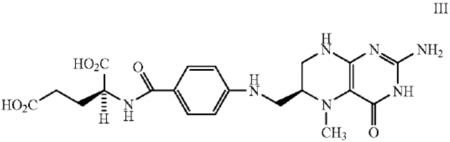
    Formula III
    In contrast to these useful "6S isomers" found in nature, the "unnatural isomer component" can lead to adverse effects.  Therefore, chirally-pure 5-formyl-(6S)-THFA has been commercially produced for use in disease therapy.

    The Patents

    The three patents involved in the IPRS of the three SAMSF patents were all related via continuation applications, and therefore share a specification.  These patents described the use of natural isomers of reduced folates in dietary vitamin preparations, in particular 5-methyl-THFA.  Claim 37 of U.S. Patent No. 5,997,915, subject of IPR2013-00116, is representative for those reviewed in that patent:

    37.  A method of increasing a human subject's dietary intake of folate comprising administering to the human subject a composition for human consumption comprising:
        one or more natural isomers of reduced folate selected from the group consisting of (6S)-tetrahydrofolic acid, 5-methyl-(6S)-tetrahydrofolic acid, 5-formyl-(6S)-tetrahydrofolic acid, 10-formyl-(6R)-tetrahydrofolic acid, 5,10-methylene-(6R)-tetrahydrofolic acid, 5,10-methenyl-(6R)-tetrahydrofolic acid, 5-formimino-(6S)-tetrahydrofolic acid, and polyglutamyl derivatives thereof; and
        a nutritional substance for human consumption being an essential nutrient preparation, the essential nutrient preparation comprising a vitamin other than ascorbic acid, wherein the vitamin is present in an amount equal to or greater than 25% of the daily requirement for the vitamin per customarily consumed quantity of said essential nutrient preparation.

    All of the remaining claims under consideration required that the one or more natural isomers of reduced folate be "substantially chirally pure 5-methyl-(6S)-tetrahydrofolic acid or a polyglutamyl derivative thereof."  After a Motion to Amend was granted, cancelling all but one claim of U.S. Patent No. 6,673,381 (subject of IPR2013-00118), the only remaining claim of that patent was claim 32, dependent from claim 22:

    22.  A method for treating and/or preventing vascular disease in a subject, said method comprising administering, to the subject, a composition which comprises:
        one or more natural isomers of reduced folate selected from the group consisting of (6S)-tetrahydrofolic acid, 5-methyl-(6S)-tetrahydrofolic acid, 5-formyl-(6S)-tetrahydrofolic acid, 10-formyl-(6R)-tetrahydrofolic acid, 5,10-methylene-(6R)-tetrahydrofolic acid, 5,10-methenyl-(6R)-tetrahydrofolic acid, 5-formimino-(6S)-tetrahydrofolic acid, and polyglutamyl derivatives thereof; and
        a nutritional substance selected from the group consisting of a food preparation, an essential nutrient preparation, and combinations thereof;
        wherein, when the nutritional substance is a food preparation, the food preparation comprises two or more food components and each gram of said food preparation has a natural molar amount, N, of said one or more natural isomers of reduced folate, wherein N is greater or equal to zero and wherein each gram of said composition has a total molar amount, T, of said one or more natural isomers of reduced folate greater than N; wherein, when the nutritional substance is an essential nutrient preparation, the essential nutrient preparation comprises a vitamin other than ascorbic acid.

    32.  A method according to claim 22, wherein each of the one or more natural isomers of reduced folate is substantially chirally pure.

    Similarly, after a Motion to Amend canceled all but one claim of U.S. Patent No. 7,172,778 (subject of IPR2013-0011), the only remaining claim of that patent was claims 15, dependent from claim 1:

    1.  A composition comprising:
        one or more natural isomers of reduced folate in an amount effective for the treatment and/or prevention of vascular disease and/or in an amount effective for reducing a female's risk of having a miscarriage and/or of having a fetus with a neural tube defect, a cleft lip defect, and/or a cleft palate defect, wherein said one or more natural isomers of reduced folate is selected from the group consisting of (6S)-tetrahydrofolic acid, 5-methyl-(6S)-tetrahydrofolic acid, 5-formyl-(6S)-tetrahydrofolic acid, 10-formyl-(6R)-tetrahydrofolic acid, 5,10-methylene-(6R)-tetrahydrofolic acid, 5,10-methenyl-(6R)-tetrahydrofolic acid, 5-formimino-(6S)-tetrahydrofolic acid, and polyglutamyl derivatives thereof; and
        a nutritional substance selected from the group consisting of a food preparation, an essential nutrient preparation, and combinations thereof;
        wherein, when the nutritional substance is a food preparation, the food preparation comprises two or more food components and each gram of said food preparation has a natural molar amount, N, of said one or more natural isomers of reduced folate, wherein N is greater or equal to zero and wherein each gram of said composition has a total molar amount, T, of said one or more natural isomers of reduced folate greater than N; wherein, when the nutritional substance is an essential nutrient preparation, the essential nutrient preparation comprises a vitamin other than ascorbic acid.

    15.  A composition according to claim 1, wherein each of the one or more natural isomers of reduced folate is substantially chirally pure.

    Obviousness

    All of the reviewed claims of SAMSF's patents were invalidated as obvious in view of two or three cited references.  The first of these references was Serfontein, European Patent Application EP 0 595 005 A1, which disclosed "a pharmaceutical preparation for lowering levels of homocysteine," which included "folate or a suitable active metabolite of folate or a substance which releases folate in vivo."  The only difference between Serfontein and the claims at issue, according to the Board, was that the cited reference did not explain what "a suitable active metabolite of folate" was, nor did it provide any examples other than folate or folic acid.  The second reference cited to overcome this deficiency was Marazza, U.S. Patent No. 5,194,611.  Marazza was described as teaching methods for the chiral resolution of 5-methyl-THF into its (6R) and (6S) diastereomers.  The final reference, Ueland (Ueland et al., Plasma Homocysteine, a Risk Factor for Vascular Disease: Plasma Levels in Health, Disease, and Drug Therapy, J. Lab. Clin. Med. 114:474-501 (1989)), was only cited against claim 15 of the '778 patent in combination with the other two references.  Ueland is described as teaching homocysteine metabolism.

    The sole argument made by the petitioner against all of the claims at issue was that Marazza identified chirally-pure 5-methyl-(6S)-THFA as being a naturally occurring metabolite of folate that one of skill in the art would have had reason to use as the "suitable active metabolite of folate" described in the Serfontein reference.  Ueland was merely cited in the one case as identifying increased 5-methyl-THFA intracellular pools as the mechanism for reducing homocysteine.  Instead of rejecting Gnosis's arguments for failing to establish why one skilled in the art would combine these two (or three) references, the Board invalidated the claims as obvious because SAMSF was unable to provide evidence why one skilled in the art would not find this combination obvious.  In other words, not only was there no presumption of validity in this IPR proceedings (as expected), but the patent holder appeared to have the increased burden of proving the validity of its own patent.

    SAMSF did make several arguments that the Board rejected.  First, in order to explain why these references would not have been combined, SAMSF argued that one skilled in the art would not have been motivated to look to other forms of folate because of the widespread acceptance of folic acid to treat folate deficiencies.  The Board responding by pointing out that a person of ordinary skill in the art would not "have avoided alternatives simply because a standard is known to be suitable and to work well."  Second, SAMSF argued that folinic acid (5-formyl-THFA) was indicated for use in cancer treatment, no folic acid deficiency.  In response, the Board pointed out that just because "folinic acid is not indicated for treating folate deficiency," it "does not follow  . . . that folinic acid is not suitable for treating deficiency."  Finally, SAMSF pointed out that the prior art taught that reduced folates were inferior to folic acid in several properties, such as bioavailability, substrate activity, disruption of folate metabolism, stability, and commercial availability.  In all cases, the Board found SAMSF's arguments unpersuasive because SAMSF did not provide credible evidence why such inferior properties would have discouraged skilled artisans from using these reduced folates for dietary purposes.

    SAMSF also provided evidence of objective indicia of non-obviousness, or so-called secondary considerations, based on the sales of five products: Néevo prescription prenatal vitamins, NéevoDHA® prescription prenatal vitamins, Mentanx® medical food, Cerefolin® medical food, and CerefolinNAC® medical food.  The sale of these products demonstrated, according to SAMSF, commercial success, licensing, copying, long-felt but unmet need, discovering and solving an unrecognized problem, unexpected results, skepticism, and praise.  The Board did not challenge these allegations, but instead found that there was no nexus between the evidence and the claimed invention.  SAMSF's inventors had identified that chirally-pure 5-methyl-(6S)-THFA could be used in combination with other vitamins in dietary preparations to treat disorders related to folate deficiencies.  It was the opinion of the Board that SAMSF did not identify the novel elements in the reviewed claims that would anchor them to the objective evidence.  Instead, the claims were doomed because SAMSF apparently relied on the administration of 5-methyl-(6S)-THFA for its nexus, and this aspect, according to the Board, was taught by Marazza (even though Marazza did not anticipate the claims).  The lesson to be learned in attempting to establish a nexus in an IPR proceeding is to not appear as though your argument rests on only part of a combination claim (even if the combination is novel).

    In total, the Board found that all of the reviewed claims of these three patents invalid as obvious in view of the cited art.  The fourth IPR, in which Merck was the patent holder, had a similar outcome with similar cited art.  Nevertheless, because that patent was unrelated to SAMSF patents, there were some unique issues in that case that we will address at a later date.  In addition, we will continue to monitor these pharma and biotech cases and provide periodic updates.

  • By Donald Zuhn

    USPTO SealEarlier this month, the U.S. Patent and Trademark Office published a notice in the Federal Register (79 Fed. Reg. 38854) requesting comments from the public regarding optimal patent first action and total pendency target levels.  The Office noted that the current targets for first action and total pendency, which were established with stakeholder input in the USPTO 2010–2015 Strategic Plan, were ten months and twenty months, respectively.

    The Office defines average first action pendency (or average first office action pendency) as the average number of months from the patent application filing date until the date a first office action is mailed by the USPTO.  Average total pendency is defined by the Office as the average number of months from the patent application filing date until the date the application either issues as a patent or goes abandoned.

    The Office has achieved significant reductions in pendency since the current pendency targets were set.  In particular, average first action pendency has been reduced from 25.7 months in FY 2010 to the current average first action pendency of 18.1 months (a 30% reduction), and average total pendency has been reduced from 35.3 months in FY 2010 to the current average total pendency of 28.1 months (a 20% reduction).

    On page 38855 of the notice, the Office sets forth seven issues related to patent application pendency on which the public is invited to submit comments.  Briefly, the Office seeks public input regarding:

    1.  Whether the current pendency targets are "the right agency strategic targets for the USPTO, stakeholders, and the public at large";

    2.  Whether the Office should measure the percentage of applications that satisfy pendency targets rather than determine the average pendency for all applications;

    3.  Whether the Office should consider using technology-specific patent pendency targets;

    4.  Whether pendency targets should be tied to PTA provisions (such as the requirement under 35 U.S.C. § 154(b)(1)(A)(i) that a first action be issued within 14 months of the application filing date or national stage commencement date);

    5.  Whether the benefits of a prompt first Office action might outweigh the potential concerns of the Office action being issued too quickly;

    6.  Whether recent significant case law decisions, adjusted fee levels, and "activity in the global IP arena" might impact pendency; and

    7.  Whether there are other activities where pendency or timeliness should be measured and reported (e.g., regarding RCEs).

    More complete descriptions of the issues above can be found in the notice.

    Written comments regarding optimal pendency targets can be submitted by e-mail to patent_pendency2014@uspto.gov.  The deadline for submitting comments is September 8, 2014.

  • By Donald Zuhn

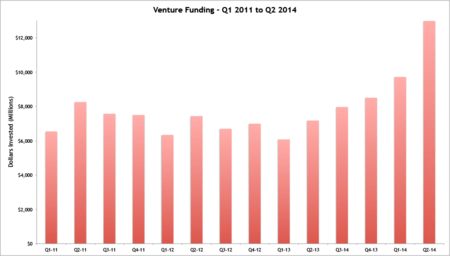
    NVCALast week, the National Venture Capital Association (NVCA), a trade association representing the U.S. venture capital industry, released the results of its MoneyTree Report on venture funding for the second quarter of 2014.  The report, which is prepared by the NVCA and PriceWaterhouseCoopers LLP using data from Thomson Reuters, indicates that venture capitalists invested $12.968 billion in 1,114 deals in the second quarter, which constituted a 34% increase in dollars and a 13% decrease in deals as compared with the first quarter of 2014, when $9.710 billion was invested in 985 deals (see chart below, which shows total venture funding from the first quarter of 2011 through the second quarter of 2014; data from MoneyTree Reports; click on chart to expand).  The nearly $13 billion invested in the second quarter was the highest quarterly total since the fourth quarter of 2000, and comes on the heels of a first quarter which saw funding at its highest levels in thirteen years.

    Total Funding Q1-2011 to Q2-2014
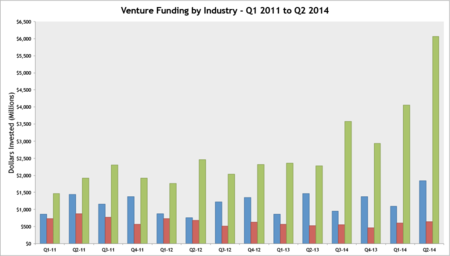
    PricewaterhouseCoopers (PWC)Venture funding in the biotechnology sector rose from $1.090 billion in the second quarter of 2014 to $1.840 billion in the second quarter of 2014 (see chart below, which shows venture funding for the biotech (blue), medical devices (red), and software (green) sectors since the first quarter of 2011; data from MoneyTree Reports; click on chart to expand).  In addition to experiencing a 69% increase in dollars, the biotech sector also saw a 7% increase in deals, with 122 deals in the second quarter of 2014.  Funding in the biotech sector was also up from the second quarter of 2013, when $1.469 million was invested.

    Industry Funding Q1-2011 to Q4-2014
    While the biotech sector secured enough funding to place second among the seventeen sectors tracked by the NVCA, the biotech sector received only 30% of the $6.060 billion in funding that was poured into the software sector in the second quarter — only the fourth time since 1995 that the software sector broke the $6 billion mark in a single quarter.  The software sector has now captured the top spot for nineteen straight quarters, with the biotech sector finishing second in all but two of those quarters (the industrial/energy sector knocked the biotech sector to third in the second quarter of 2010 and first quarter of 2011), and the software sector has received more than $2 billion in funding for nine consecutive quarters.

    Medical device and equipment investment increased by 8% with respect to dollars and deals in the second quarter, with $649 million being invested in 73 deals.  However, in contrast with the three sectors above, nine of the seventeen sectors tracked by the NVCA saw decreases in dollars invested in the second quarter.

    NVCA President and CEO Bobby Franklin noted that "[n]ot since the early 2000s have we witnessed this level of quarterly investment activity," adding that "[b]efore alarmists declare a repeat of the dot-com bubble, it's important to keep in mind that a lot of this activity was driven by a handful of eye-popping investment rounds, including a record-setting funding round of $1.2 billion."

    For additional information regarding this and other related topics, please see:

    • "Software Sector Leads First Quarter Venture Funding to Thirteen Year High; Biotech Sector Finishes Second (Again)," April 30, 2014
    • "Biotech Venture Funding Rebounded in 2013 After Strong Fourth Quarter," January 26, 2014
    • "Biotech Venture Funding Sees Second Quarter Rebound," July 22, 2013
    • "Biotech Venture Funding Down 33% in First Quarter," April 30, 2013
    • "Annual Venture Funding Drops for First Time in Three Years," February 4, 2013
    • "Biotech Venture Funding Up 64% in Third Quarter," October 29, 2012
    • "Venture Funding in Life Sciences Sector Drops 9% in Second Quarter," July 22, 2012
    • "Biotech Venture Funding Drops 43% in First Quarter," May 3, 2012
    • "Venture Funding Increased 22% in 2011," February 2, 2012
    • "Life Sciences Venture Funding Drops in Third Quarter," October 27, 2011
    • "Life Sciences Venture Funding up 37% in Second Quarter," August 1, 2011
    • "VentureSource Reports 35% Increase in 1Q Venture Funding," April 26, 2011
    • "NVCA Reports Modest Gains in First Quarter Venture Funding," April 19, 2011

    • "NVCA Reports 31% Drop in Venture Funding for Third Quarter," October 17, 2010

    • "NVCA Reports 34% Increase in Venture Funding for Second Quarter," July 22, 2010

    • "NVCA Report Shows First Quarter Drop in Venture Funding," April 20, 2010

    • "Biotech/Pharma Financing Improving, R&D Spending Up," August 31, 2009
    • "NVCA Study Shows Increase in Third Quarter Venture Funding," October 23, 2009

    • "First Quarter Venture Capital Funding at 12-Year Low," April 23, 2009

    • "NVCA Study Shows Decline in 2008 Investment; BIO Study Predicts Biotech Rebound in 2009," February 16, 2009

  • CalendarJuly 20-22, 2014 – 2014 Annual Meeting & Conference (National Association of Patent Practitioners) – Alexandria, Virginia

    July 22, 2014 – "America Invents Act: Patent Strategies and Reforms Counsel Needs to Know" (Commercial Law WebAdvisor) – 1:00 to 2:30 pm (Eastern)

    July 23, 2014 – "Inter Partes Reviews of Pharmaceutical Patents: Understanding How IPRs are Changing the Landscape of Innovator/Generic Litigation" (Intellectual Property Owners Association) – 2:00 to 3:00 pm (ET).

    July 24, 2014 – "Protecting IP Rights After Limelight Networks v. Akamai: Implications for Divided Patent Infringement and Inducement — Prosecuting and Litigating Patent Claims Following the New Supreme Court Decision" (Strafford) – 1:00 to 2:30 pm (EDT)

    July 30, 2014 – "Ask the Office: New Guidance on Functional Claiming" (American Bar Association Section of Intellectual Property Law) – 1:00 to 2:30 pm (ET)

    July 30, 2014 – "Alice Corp. v. CLS Bank: Patent Eligibility of Software-Related Inventions" (Strafford) – 1:00 to 2:30 pm (EDT)

    August 13-15, 2014 – Advanced Patent Law Seminars (Chisum Patent Academy) - Seattle, WA

    August 18-19, 2014 - Advanced Patent Prosecution Workshop 2014: Claim Drafting & Amendment Writing (Practising Law Institute) – San Francisco, CA

    August 18-20, 2014 – Advanced Patent Law Seminars (Chisum Patent Academy) - Seattle, WA

    August 19, 2014 – "Alice Corp. v. CLS Bank International: General Purpose Computers Cannot Save Inventions Directed to Abstract Ideas" (McDonnell Boehnen Hulbert & Berghoff LLP) – 10:00 to 11:15 am (CT)

    September 7-9, 2014 – 42nd Annual Meeting (Intellectual Property Owners Association) – Vancouver, Canada.

    September 11-12, 2014 - Advanced Patent Prosecution Workshop 2014: Claim Drafting & Amendment Writing (Practising Law Institute) – Chicago, IL

    September 18-19, 2014 – FDA Boot Camp (American Conference Institute) – Boston, MA

    ***Patent Docs is a media partner of this conference or CLE

  • IPO #2The Intellectual Property Owners Association (IPO) will offer a one-hour webinar entitled "Inter Partes Reviews of Pharmaceutical Patents: Understanding How IPRs are Changing the Landscape of Innovator/Generic Litigation" on July 23, 2014 beginning at 2:00 pm (ET).  Paul Golian of Bristol-Myers Squibb Co. will moderate a panel consisting of Aaron Barkoff of McAndrews, Held & Malloy, Ltd.; Grantland Drutchas of McDonnell Boehnen Hulbert & Berghoff LLP; and Michael Fuller of Knobbe, Martens, Olson and Bear, L.L.P, which will focus on the rapidly increasing use of IPRs to invalidate pharmaceutical patents in ANDA litigation.  The panel will give an overview of the IPR process and timelines, discuss the outcomes of recent IPR challenges in the pharmaceutical space, and present tips and strategies for both challenging pharmaceutical patents and defending against such challenges.

    The registration fee for the webinar is $130 (government and academic rates are available upon request).  Those interested in registering for the webinar can do so here.

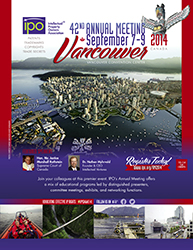
  • Brochure coverThe Intellectual Property Owners Association (IPO) will be holding its 42nd Annual Meeting on September 7-9, 2014 in Vancouver, Canada.  Among the presentations being offered at the annual meeting are:

    • Recent U.S. Supreme Court Patent Case Law Update
    • America Invents Act (AIA) Trial Proceedings
    • Intellectual Property Valuation — A Case Study
    • Implementation of Section 101: Alice v. CLS Bank, Myriad, Mayo and More
    • Patent Pro's Ideal Patent — Or, Why We Can Never Be Happy
    • Corporate IP Management
    • Views from the Bench at the Canada-U.S. Border
    • How to Effectively Protect and Enforce Your Company's Trade Secrets
    • Cost Management Issues
    • Professionalism in the Digital/Millennial Age (ethics)

    In addition, Nathan Myhrvold, Founder & CEO of Intellectual Ventures, will present the luncheon address on September 8, and the Hon. Mr. Justice Marshall Rothstein of the Supreme Court of Canada will present the luncheon address on September 9.

    A program for the meeting, including an agenda, descriptions of the scheduled sessions, and list of speakers, can be obtained here.

    The registration fee for the meeting is $500 (government employees & academics), $975 (IPO members), or $1,475 (non-members).  Those interested in registering for the meeting can do so here.

  • By Andrew Williams

    Terry, LeeU.S. Representative Lee Terry (R-NE) opened a recent subcommittee meeting by quoting Thomas Edison:  "The most certain way to succeed is to try one more time."  The occasion was the meeting of the House's Energy and Commerce Committee's Subcommittee on Commerce, Manufacturing and Trade, for which Rep. Terry is the Chair.  Specifically, the subcommittee was marking-up Rep. Terry's discussion draft of the Targeting Rogue and Opaque Letters Act of 2014, more affectionately known as the TROL Act.  Indeed, Rep. Terry is attempting "one more time" to pass patent reform legislation this year.  However, this time, his bill has received letters of support from such organizations as the Biotechnology Industry Organization ("BIO"), the Intellectual Property Owners Association ("IPO"), the American Intellectual Property Law Association ("AIPLA"), and the Innovation Alliance.  (These letters can be found on the committee's website.  This wide support is likely due to the narrow focus of the draft legislation — the sending of abusive demand letters.

    The text of the TROL Act is not dissimilar to a comparable bill pending in the Senate, introduced by Sen. Claire McCaskill (D-MO).  However, that bill appears to have stalled, so the House may again be the first to pass this version of patent reform legislation.  In addition, various state legislative bodies have either introduced or passed similar bills at the state level, and, of course, the attorneys general of some states have been going after the so-called patent troll practice of sending abusive demand letters.  The TROL Act specifically preempts these state initiatives.  In section 4(a)(1), the "Act preempts any law, rule, regulation, standard, or other provision . . . relating to the transmission or contents of communications relating to the assertion of patent rights."  However, the Act does not "preempt of limit" any other provision "relating to acts of fraud or deception, and any State trespass, contract, or tort law."  TROL Act, section 4(a)(2).  And, with regard to the state attorneys general, the Act provides the authority for them to bring civil actions pursuant to the TROL Act in U.S. district courts, although the provision allows the Federal Trade Commission ("FTC") to intervene if it wishes.

    So what specifically does this bill require?  It would make it "an unfair or deceptive act or practice" to "engage in a pattern or practice of sending written communications that" allege patent infringement if certain conditions apply.  First, if the sender states or represents, in bad faith, that the sender has rights in the patent or is the exclusive licensee, that a civil action has been filed (either against the recipient or other persons), that legal action will be taken, that persons other than the recipient have purchased a license, that an investigation of the alleged infringing activity has occurred, or that a lawsuit had previously been filed when in reality the accused activity had been found not to infringe.  Second, it will be "an unfair or deceptive act or practice" if the patent holder, in bad faith, seeks compensation for a patent claim that has been held unenforceable, for activities that occurred after the expiration of a patent, or for activity that was in fact authorized under the patent.  Finally, the Act would make it "an unfair or deceptive act or practice" to fail to include the following information, in bad faith:  the identity of the person asserting the patent right, including any parent entity unless a public company; at least one patent; at least one product or service that infringes; a description of the infringement; and a name and contact information.

    In all of the above-referenced cases, bad faith is required.  The Act defines bad faith as (A) making "knowingly false or knowingly misleading statements, representations, or omissions"; (B) making statements with reckless indifference; or (C) making statements with the high probability that they will deceive.  Several subcommittee members complained that this provision sets too high a standard by requiring proof of knowledge or reckless indifference.  However, defenders of the Act pointed out that nothing has changed with regard to the FTC's Section 5 authority to seek injunctive relief.  It was also pointed out that this section allows for civil penalties to be levied directly against corporate officers, and therefore actual knowledge or reckless indifference should be required.

    There were additional criticisms levied against the Act during the mark-up, which occurred on June 9-10, 2014.  For example, Rep. Jan Schakowsky (D-IL), ranking member of the subcommittee, complained about the preemption of state laws aimed at preventing abusive enforcement.  There was the sentiment expressed by several people present that the states are taking active steps to curb the problem, and Congress shouldn't squash these efforts.  Another concern was that the Act does not go far enough.  While recognizing that an omnibus bill is unlikely from the Senate in the near future, Rep. Peter Welch (D-VT) expressed concern that "the passage [of the TROL Act] is going to become an excuse for the Senate not to act on what is a comprehensive Bill that was a bipartisan-strong vote passed by the House of Representatives."  Nevertheless, after the bill was amended to clarify the "Affirmative Defense" section, the bill passed out of the subcommittee with a vote of 13 to 6.  A video of the mark-up can be found here, along with other supporting documentation.  This bill should now be taken up by the Committee on Energy and Commerce sometime in the near future.  We will continue to monitor and report on the progress of the TROL Act.

  • By Donald Zuhn

    USPTO SealLast month, the U.S. Patent and Trademark Office published a notice of proposed rulemaking in the Federal Register (79 Fed. Reg. 34681) discussing changes to the rules of practice to implement the Federal Circuit's decision in Novartis AG v. Lee.  In Novartis, the Federal Circuit agreed with the USPTO that "no [patent term] adjustment time is available for any time in continued examination, even if the continued examination was initiated more than three calendar years after the application's filing" (i.e., the filing of an RCE tolls the B Delay clock even if the RCE was filed more than three years after the application was filed).  However, the Federal Circuit agreed with Novartis "that the 'time consumed by continued examination' should be limited to the time before allowance, as long as no later examination actually occurs."

    In view of the Novartis decision, the Office notes that the rules changes "provide that the time consumed by continued examination does not include the time after a notice of allowance, unless the Office actually resumes examination of the application after allowance."  In addition, the notice states that the rules changes "provide that the submission of a request for continued examination after a notice of allowance has been mailed will constitute a failure of an applicant to engage in reasonable efforts to conclude processing or examination of an application and thus result in a reduction of any period of patent term adjustment."  With respect to the first change, the Office explains that the change "simply implements the Federal Circuit's ruling on the provisions of 35 U.S.C. 154(b)(1)(B)(i) in Novartis," and therefore the change "is simply a procedural and/or interpretive rule" that does not require prior notice and opportunity for public comment.  Although the Office acknowledges that the same does not hold true for second proposed change, the notice indicates that "[t]he Office . . . is publishing all of these proposed changes (rather than only the proposed change to 37 CFR 1.704) for comment as it seeks the benefit of the public's views on the Office's proposed implementation of the Federal Circuit's interpretation of the provisions of 35 U.S.C. 154(b)(1)(B)(i) in Novartis."

    As with its implementation of certain provisions of the AIA Technical Corrections Act, where the modification of the Office's program for calculating PTA lagged behind the issuance of patents impacted by the changes to the rules (see "USPTO Issues Final Rule to Implement PTA Provisions of AIA Technical Corrections Act and Provide Optional Procedure for Requesting PTA Recalculation"), the Office notes that its modification of the PTA program has not yet been completed.  The notice does not indicate whether an optional procedure and special form will be needed to address the lag in this case as well.

    Regarding the designation of another "failure . . . to engage in reasonable efforts to conclude processing or examination of an application," the Office explains that rules change is being proposed "to ensure that an applicant does not obtain multiple periods of patent term adjustment under 35 U.S.C. 154(b)(1)(B) for the time after a notice of allowance under 35 U.S.C. 151 as a consequence of delaying issuance of the application by filing request for continued examination under 35 U.S.C. 132(b) after a notice of allowance under 35 U.S.C. 151."

    Comments regarding the proposed rules changes can be submitted by e-mail to:  AC96.comments@uspto.gov; by regular mail to:  Mail Stop Comments — Patents, Commissioner for Patents, P.O. Box 1450, Alexandria, VA, 22313–1450, marked to the attention of Kery Fries, Senior Legal Advisor, Office of Patent Legal Administration, Office of the Deputy Commissioner for Patent Examination Policy; or via the Federal eRulemaking Portal. See the Federal eRulemaking Portal Web site.  The deadline for submitting comments is August 18, 2014.