• CalendarAugust 27-28, 2014 – "Global Patent Prosecution: Comparing Europe, China, and U.S. Law & Practice" (Intellectual Property Owners Association) – 12:00 to 1:00 pm (ET)

    August 28, 2014 – "Alice Corp. vs. CLS Bank: What’s Eligible, What’s Not, and What’s Still to be Determined?" (Technology Transfer Tactics) – 1:00 to 2:00 pm (ET)

    September 4, 2014 – "Patents and Export Control Compliance: Managing Risk and Avoiding Unintentional Violations — Minimizing Export Control Liability in Patent Application Preparation, Development and Analysis of Innovation, and Licensing" (Strafford) – 1:00 to 2:30 pm (EDT)

    September 7-9, 2014 – 42nd Annual Meeting (Intellectual Property Owners Association) – Vancouver, Canada

    September 11, 2014 – "Post-AIA Section 102 and Prior Art: Navigating the Expanded Scope of Prior Art and AIA Exceptions" (Strafford) – 1:00 to 2:30 pm (EDT)

    September 11-12, 2014 - Advanced Patent Prosecution Workshop 2014: Claim Drafting & Amendment Writing (Practising Law Institute) – Chicago, IL

    September 16, 2014 – "Section 103 and Obviousness: Capitalizing on CCPA and Early Federal Circuit Precedent — Strategies for Withstanding Obviousness Rejections and Attacks on Patent Validity and Patentability" (Strafford) – 1:00 to 2:30 pm (EDT)

    September 18-19, 2014 – FDA Boot Camp (American Conference Institute) – Boston, MA

    September 30, 2014 – 2014 Intellectual Property Continuing Legal Education Seminar (DuPont and Widener University School of Law) – Wilmington, DE

    September 30 – October 1, 2014 – Paragraph IV Disputes Master Symposium (American Conference Institute) – Chicago, IL

    October 2, 2014 – "USPTO Guidance for Determining Subject Matter Eligibility In View of U.S. Supreme Court's Mayo and Myriad Decisions" (McDonnell Boehnen Hulbert & Berghoff LLP) – 10:00 to 11:15 am (CT)

    October 2, 2014 – "Conflicts in Patent Prosecution: Minimizing Risks of Malpractice Liability and Ethics Sanctions" (Strafford) – 1:00 to 2:30 pm (EDT)

    October 29-30, 2014 - Congress on PIV Litigation (Momentum) – Philadelphia, PA

    ***Patent Docs is a media partner of this conference or CLE

  • IPO #2The Intellectual Property Owners Association (IPO) will offer two one-hour webinars on "Global Patent Prosecution: Comparing Europe, China, and U.S. Law & Practice" on August 27 & 28, 2014 beginning at 12:00 pm (ET) each day.  The first day will feature Philip L. Cupitt, Ph.D of Finnegan, Henderson, Farabow, Garrett & Dunner, LLP; Samson Helfgott of Katten Munchin Rosenman LLP; and Deshan Li, Ph.D. of Unitalen, and the second day will feature Ji Liu of CCPIT Patent and Trademark Law Office; Martin D. Hyden of Finnegan, Henderson, Farabow, Garrett & Dunner, LLP; and Samson Helfgott of Katten Munchin Rosenman LLP.  Panelists will compare and contrast patent prosecution law and practice in the three jurisdictions with regard to the key criteria of Obviousness and Written Description.

    The registration fee for the webinar is $130 per webinar (government and academic rates are available upon request).  Those interested in registering for the webinar can do so here.

  • Strafford #1Strafford will be offering a webinar/teleconference entitled "Conflicts in Patent Prosecution: Minimizing Risks of Malpractice Liability and Ethics Sanctions" on October 2, 2014 from 1:00 to 2:30 pm (EDT).  The webinar will provide guidance to IP counsel on the conflicts issues that often arise in patent prosecutions, and outline best practices to identify and address the risks — and to minimize conflicts that can lead to malpractice liability and ethical violations.  The webinar will review the following questions:

    • What policies and practices should counsel have in place to identify potential conflicts in patent prosecutions?
    • What steps can patent prosecutors take to minimize the risk of subject matter conflicts?
    • How should patent counsel respond after identifying conflicts?

    The registration fee for the webinar is $297 ($362 for registration and CLE processing).  Those registering by September 5, 2014 will receive a $50 discount.  Those interested in registering for the webinar, can do so here.

  • Independence HallMomentum will be holding its 2nd Congress on PIV Litigation on October 29-30, 2014 in Philadelphia, PA.  The conference will offer presentations on the following topics:

    • Key Takeaways for Brand and Generic Drug Manufacturers from Recent Case Law

    • Are Your Ducks in a Row? — Examining the Top 3 Pre-Suit Due Diligence Issues Counsel on Both Sides Should Be Evaluating In Anticipation of a Paragraph IV Suit

    • The Expansion of the Hatch Waxman Safe Harbor — Addressing HOW Recent Developments in the Evolution of Case Law Are Impacting Litigation Approaches to Paragraph IV Disputes

    • PTO v. Federal District Court — Evaluating the Emerging Impact of Parallel PTO Proceedings on the Procedural Dynamics of Hatch Waxman Litigation

    • Patent Reform — What You Don't Know is In There — A True Examination of Proposed Patent Legislation and the Impact Each Bill Could Have on the Pharmaceutical Industry and Related IP Litigation

    • Insider Tips for Obtaining Successful Results When Engaged in a Paragraph IV Dispute in the District of Delaware — Proven Strategies for Effectively Engaging with the Bench and Working with Local Counsel

    • Insider Tips from the Bench on How to Most Effectively Present Experts and Witness during Paragraph IV Litigation

    • Forfeiture and Multiple Filers — Forfeiture and Multiple Filers: Insights for Avoiding or Triggering Forfeiture Events in Hatch-Waxman Litigation Involving Multiple ANDA Filers

    • Spotlight Address — Perspectives from the FTC on Pay-for-Delay Settlements

    • Paragraph IV Settlements Post-Actavis — Can They Be Done and If So, How? — Live Mock Negotiation

    • Communication with Key Stakeholders — Litigation Communication Strategies for In-House Counsel When Actively Engaged in a Paragraph IV Dispute

    • When Prior Settlements Come Back To Haunt You — What Brand Name and Generic Drug Manufacturers Can Learn from Recent Third Party Payor Suits Challenging the Implications of Hatch Waxman Litigation on Drug Competition

    In addition, two interactive working group sessions will be offered during the conference.  The first workshop is entitled "PTEs, Combination Products and 'Product Hopping': Life Cycle Management Insights for Brand Name Drug Manufacturers Engaged in Paragraph IV Litigation," and the second is entitled "At Risk Launches: An Examination of the Business Benefits and Legal Risks of Launching at Risk — How to Determine If It’s Truly Worth It . . . or Not Making the decision to launch a product 'at risk' is one that can bring with it great financial."

    MomentumThe agenda for the International Congress on Paragraph IV Litigation can be found here.

    The registration fee for the conference is $1,395 (in-house/corporate), $1,795 (private practice), or $1,95 (all other companies).  Those interested in registering for the conference can do so here.

    Patent Docs is a media partner of Momentum's Congress on PIV Litigation.

    Photograph of Independence Hall (above) by Dan Smith, from the  Wikipedia Commons under the Creative Commons license.

  • Strafford #1Strafford will be offering a webinar/teleconference entitled "Patents and Export Control Compliance: Managing Risk and Avoiding Unintentional Violations — Minimizing Export Control Liability in Patent Application Preparation, Development and Analysis of Innovation, and Licensing" on September 4, 2014 from 1:00 to 2:30 pm (EDT).  The webinar will provide guidance for patent counsel on navigating the intersection of patents and export control laws, examine the challenges facing patent owners, when and where export control issues arise, and licensing issues, and offer best practices for complying with export control laws.  The webinar will review the following questions:

    • What export control compliance challenges do patent owners and applicants face?
    • When do export violations arise in the patent context?
    • What are the best practices for counsel to patent owners for compliance with ITAR and EAR requirements?

    The registration fee for the webinar is $297 ($362 for registration and CLE processing).  Those interested in registering for the webinar, can do so here.

  • By Donald Zuhn

    On March 4, the U.S. Patent and Trademark Office issued a guidance memorandum, entitled "Guidance For Determining Subject Matter Eligibility Of Claims Reciting Or Involving Laws of Nature, Natural Phenomena, & Natural Products" (or "Myriad-Mayo Guidance"), to implement a new procedure for determining the subject matter eligibility of claims under 35 U.S.C. § 101 in view of the Supreme Court's decisions in Association for Molecular Pathology v. Myriad Genetics, Inc. (2013), and Mayo Collaborative Services v. Prometheus Laboratories, Inc. (2012).  At a biotechnology/chemical/pharmaceutical (BCP) customer partnership meeting in April, the Office announced that it would be hosting a public forum on the Guidance in May to receive public feedback on the Guidance, and at that forum encouraged shareholders to submit written comments on the Guidance.  The original "end of June" deadline for submitting comments on the Guidance was subsequently extended to July 31.  With that extended deadline now passed, Patent Docs has summarizing selected comments in a series of posts.

    AUTMThe Office has posted the comments that were submitted on the USPTO website.  The comments are divided into five groups (with the number of submissions in each group also provided):  Intellectual property organizations and other associations (18), academic and research institutions (7), law firms (6), companies (9), and individuals (42).  Today, we examine the comments submitted by the Association of University Technology Managers (AUTM), Council on Governmental Relations (COGR), Association of American Universities (AAU), and Association of Public and Land-Grant Universities (APLU).

    COGRThe comments letter submitted by the four academic groups begins by noting that AUTM is a nonprofit organization with more than 3,000 members from more than 300 universities, research institutions, and teaching hospitals as well as numerous businesses and government organizations; COGR is an association of 190 U.S. research universities and their affiliated academic medical centers and research institutes; AAU is an association of 60 U.S. and two Canadian research universities; and APLU is a research, policy, and advocacy organization representing 234 public research universities, land-grant institutions, state university systems, and affiliated organizations.  The comments letter indicates that "[t]he majority of AUTM members and the entire COGR, AAU and APLU memberships represent nonprofit research institutions that do not directly commercialize their discoveries and intellectual property but are dependent on the private sector to invest in, develop and market products and services based on university-created technology."  According to the four academic organizations, "[w]ith over $36 billion in net sales of products based on inventions made at institutions represented by our associations, it has been estimated that academic technology transfer generates $80 billion dollars in economic activity annually in the U.S."

    AAUAfter describing the contribution of the organizations' members to the economy and innovation in the U.S., the groups state that they are "deeply concerned about the PTO Guidance Memorandum and its unwarranted, as well as legally inconsistent broad changes in examination practice."  In particular, the letter asserts that "[t]he Guidance adversely and unnecessarily impacts our ability not only to license and commercialize future discoveries and inventions, but also the validity of many existing patents for products, particularly in life science areas which make up the majority of university patents."

    APLUThe academic organizations identify one primary concern and two major flaws with the Guidance.  With respect to the former, the groups suggest that "the Guidance is overly broad and contravenes the Supreme Court's own warning in Mayo against over-interpreting its holdings in a way that might stifle innovation, the very kinds of innovation to which U.S. universities contribute," and support opponents of the Guidance "who have criticized the emphasis on structure rather than the functional characteristics of a product."  As for the major flaws, the groups argue that the Guidance provides "[a]n inappropriate and legally questionable interpretation of Myriad," and as a result "[t]o patent a product (e.g., a drug) purified from a natural source under the new Guidance, the claimed product must be both structurally and functionally different from its natural state, a position not supported by case law."  The letter contends that "earlier cases emphasized functionality rather than the need for a significant modification from their natural form."

    The letter indicates that the second flaw is the Guidance's "[m]isinterpretation of Mayo [that] could seriously harm the diagnostics industry and patients relying on its products."  According to the academic organizations, "[t]he examples provided in the Guidance [relating to diagnostic methods] are unclear, ambiguous, and raise more questions than they answer."

    The letter argues that "[b]y drafting and releasing this Guidance, the PTO is assuming a judicial authority that is not properly PTO's to assume by erroneously re-interpreting Supreme Court case law, with no opportunity for public comment."  The comments letter concludes by stating that:

    Numerous AUTM, COGR, AAU, and APLU members . . . find the Guidance unsettling because it could improperly prevent universities from patenting valuable and potentially life-saving technology and effectively block these technologies from ever reaching the public.  It could also create grave uncertainty about pending and issued university patents and remove the incentive for companies to license them and create innovative products and services that will benefit society.

    The groups urge the USPTO revise the Guidance, arguing that "[f]ailing to do so will eviscerate the benefits of that research by unnecessarily denying patent protection to promising technologies, stifle innovation in academia, seriously harm the ability of companies to develop products that will help the American public, and significantly, adversely impact job growth in America."

    Patent Docs will examine other Guidance comments in subsequent posts.

    For additional information regarding this topic, please see:

    • "Examination of Myriad-Mayo Guidance Comments — International Bioindustry Associations," August 11, 2014
    • "Examination of Myriad-Mayo Guidance Comments — ACLU," August 5, 2014
    • "Guest Post: Overview of First Published Comments on Myriad-Mayo Patent Eligibility Guidance," July 13, 2014
    • "Guest Post: USPTO Public Forum on Patent Guidance: My Thoughts as a Speaker and Attendee," June 11, 2014
    • "USPTO Holds Forum on Subject Matter Eligibility — Part IV," May 22, 2014
    • "USPTO Holds Forum on Subject Matter Eligibility — Part III," May 15, 2014
    • "USPTO Holds Forum on Subject Matter Eligibility — Part II," May 14, 2014
    • "Guest Post: How to Patent Grapefruit Juice — The New USPTO Guidance for Patent Eligible Subject Matter Is Both Sticky and Sour," May 13, 2014
    • "USPTO Holds Forum on Subject Matter Eligibility — Part I," May 12, 2014
    • "USPTO Tries to Address Public Misunderstandings Regarding Myriad-Mayo Guidance," April 16, 2014
    • "USPTO Issues Guidance for Analyzing Subject Matter Eligibility of Claims Reciting Laws of Nature/Natural Principles, Natural Phenomena or Natural Products," March 4, 2014

  • By Kevin E. Noonan

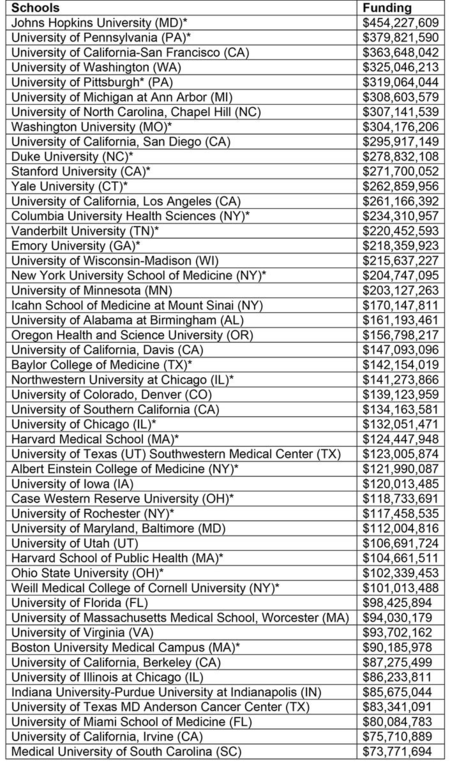
    NIHOn Monday, Genetic Engineering and Biotechnology News (GEN) published a list of the Top 50 NIH-funded U.S. universities in fiscal year October 1st – September 30th.  Geographically, California leads the list of most Federal research monies going to schools in the state.  The list, set forth below, shows that private universities represent 22 of the 50 universities and garner about 24% of the funding (disproportionately, with Johns Hopkins University, Duke, Yale, Stanford, Washington and the Universities of Pittsburgh and Pennsylvania getting more thanm 50% of the total of almost $19 billion in NIH funding).

    Table*Private universities

    The top 50 get about 80% of the total awarded, representing "almost 50,000 competitive grants given to more than 2,500 universities, medical schools and other research institutions" at home and abroad according to GEN.  The leader, Johns Hopkins, received almost one thousand awards in 2014, while the majority of the rest of the schools received between 300-500 awards.

    Source (according to GEN): Source: NIH Awards by Location and Organization, database contained within NIH Research Portfolio Online Reporting Tools (RePORT) website, Fiscal Year 2014, last updated by NIH on August 11

  • By Kevin E. Noonan

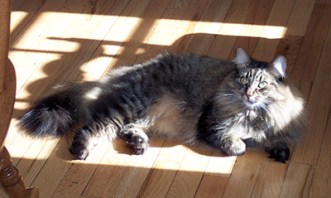
    000_0149 2Earlier this month, an international effort* led by Stephen J. O'Brien at the Oceanographic Center, Nova Southeastern University, Ft. Lauderdale, Florida reported the complete genomic sequencing of the domestic cat, Felix catus.  The report, entitled "Annotated features of domestic cat – Felis catus genome," was published in GigaScience 2014, 3:13 (August 5, 2014).

    The study reports sequencing of a female Abyssinian cat named Cinnamon, a mixed-breed cat from Russian named Boris, and Sylvester, a wildcat ancestor of domestic cats.  Most significantly, the report showed that domestic cats have retained "a highly conserved ancestral mammal genome organization" in comparison with ancestral cats (see Driscoll et al., 2007, "The near eastern origin of cat domestication," Science 317: 519–23).  Both species, F. catus and Felix silvestris silvestris, have 38 chromosomes, 18 pairs of autosomes, and two pairs of dimorphic gender-determining chromosomes.

    The report is replete with arcane details of the cat genome, including the discovery of:

    • 217 loci of endogenous retrovirus-like elements (amounting to 55.7% of the entire genome, comprised of long interspersed elements (LINEs), short interspersed elements (SINEs), satellite DNA, retroviral long terminal repeats (LTRs) and "others");

    • 21,865 protein coding genes (open reading frames or ORFs), detected by comparison with eight mammalian genomes (from human, chimpanzee, macaque, dog, cow, horse, rat, and mouse);

    • 99,494 "new" single nucleotide polymorphisms (SNPs), in addition to 3,078,438 previously identified SNPs;

    • 8,355 new insertion/deletion events (indels);

    • 743,326 evolutionarily constrained elements (ECEs);

    • 3,182 microRNA homologues;

    • 25 novel families of complex tandem repeat elements;

    • 53,710 short terminal repeat (STR) loci;

    as well as 176 kb of mitochondrially derived DNA and 125 kb of partial feline retrovirus-derived DNA.  In addition, 10.5% of cytosine residues are methylated in the cat genome.

    There was also extensive evidence of regions of "recent" autosomal segmental duplications.  Specifically:

    Among all variants 24.6% (693,428 SNVs and 122,333 indels) were heterozygous in Felis silvestris.  Between the genomes of Felis catus and Felis silvestris some 2.9 million (2,847,548) single nucleotide variants and ∼1.9 Mbp of insertions and deletions were detected.  Observed differences were significantly fewer compared to difference between human and chimpanzee genomes (~35 million SNV and ~90 Mbp of indels).

    The report also contains extensive comparison between domestic cats and other species ("reference genomes") in terms of gene numbers, using genes with the longest the longest mRNA and corresponding coding sequences (click on table to expand).

    Table
    The intriguing finding that modern domestic cats are more similar to their wildcat forebears than are dogs to wolves (or humans and chimpanzees, for all the touted 98% similarity between simian and human genomes) is not explained in the report.  Regarding dogs, comparison of breed types provides some hints:  while there are about 41 breeds of domestic cat, there are 339 breeds of dogs, sorted into 10 groups (terriers, retrievers, pointer/setters, hounds, companion or "toy" dogs, "herding" dogs like sheepdogs, mastiffs, non-sporting dogs like Dalmatians and bulldogs, sporting dogs like spaniels, and working dogs like the Akita and Alaskan Husky).  These dogs vary in overall size, leg length, muzzle shape, fur length and density, muscularity, and temperament, among other attributes.  Many of the features of these dog breeds have been selected by human breeding practices for traits and features having at least some genetic component.  In addition, the process of domesticating a dog from its wolf ancestors involved changing its personality from human predator to human companion and allowed the dog to permit humans to take the "alpha" role of pack leader.

    Cats, on the other hand do not vary that much in size and in fact show most of their variation in coat and eye color and coat pattern.  There also have been many fewer behavioral changes in domestic cats than in dogs, as evidenced by cats' (in)famous independence.  While these are merely speculations, it seems likely that the domestication process required far fewer genetic adaptations in cats than it seems were required in dogs, and thus their modern genomes retain much closer similarity to the ancestral European wild cat than do dogs to their wolfish ancestors.

    Finally, for the cognoscenti (and those with a low sense of humor), the authors also report their development of a cat genome browser, designated Genome Annotation Resource Field or GARField (groan).

    * Other members of the team included scientists from the Theodius Dobzhansky Center for Genomic Bioinformatics, St. Petersburg State University, St. Petersburg RU (Gaik Tamazian, Serguei Simonov, Pavel Dobrynin, Alexey Makunin, Anton Logachev, Aleksey Komissarov, Andrey Shevchenko, Vladimir Brukhin, Nikolay Cherkasoy, Anton Svitin, Klaus-Peter Koepfli, and Joan Pontius); Laboratory of Neurogenetics, NIAAA, Rockville, MD USA (Carlos A Driscoll, Kevin Blackstone, Cristina Barr and David Goldman); CIIMAR – Interdisciplinary Center of Marine and Environmental Research, University of Porto, Porto PT (Agostinho Antunes); Department of Animal and Food Science, Veterinary Molecular Genetics Service, Universitat Autonoma de Barcelona, Barcelona ES (Javier Quilez);  IBE, Institute of Evolutionary Biology, Universitat Pompeu Fabra-CSIS, PRBB, Barcelona ES (Belen Lorente-Galdos and Tomas Marques-Bonet); Department of Computer Engineering, Bilkent Univesity, Ankara TK (Can Alkan); Laboratory of Genomic Diversity, Frederick National Laboratory for Cancer Research, Frederick MD USA (Marylin Menotti-Raymond and Victor David); and the Department of Veterinary Medicine and Surgery, College of Veterinary Medicine, University of Missouri, Columbia MO (Krsitina Narfstrom).

    For additional information regarding this and other related topics, please see:

    • "Leg Length Variation in Dogs and its Relevance to Human Mutations," August 31, 2009
    • "The Genetic Basis of Coat Variation in Dogs," August 30, 2009
    • "From Toy Poodle to Rottweiler: Why Is Fido So Small (or Large)?" April 9, 2007

  • By Kevin E. Noonan

    Apotex #1Last week, the Federal Circuit affirmed a finding of inequitable conduct in Apotex v. USB, a relatively rare occurrence in the years after the Federal Circuit's decision in Therasense v. Becton, Dickenson.  In the Therasense case, the Federal Circuit sitting en banc clarified the standards for finding inequitable conduct, in a frank effort to remedy the "plague" on the patent system that the Court believed the inequitable conduct defense had become.  (The historically minded will recall that this isn't the first time that members of the Court identified this particular plague.)  In its decision, the majority decided that the traditional materiality prong of the test for inequitable conduct needed to amount to "but for" materiality, i.e., that the U.S. Patent and Trademark Office would not have granted the patent if the Examiner had been aware of the undisclosed or misrepresented art or information.  For "intent to deceive," the Court held that intent needed to be the "single most reasonable inference" to be drawn from the applicant's behavior, recognizing that finding an express "smoking gun" of intent would be rare.  The most significant change in the law was that the Court prohibited the common practice of using evidence regarding one prong to bolster evidence of the other prong (e.g., if the materiality of the undisclosed art or information was extremely high, courts would accept lesser evidence of intent, with the justification that the applicant would know or should have known that art of such materiality should be disclosed and failure to disclose was evidence of intent).  The Court left open the possibility that, even in the absence of sufficient evidence for either prong there could be evidence of such egregious misconduct that a court, exercising its equitable powers, could find a patent unenforceable for inequitable conduct.

    The matter at issue in Apotex was moexipril magnesium, an angiotensin converting enzyme (ACE) inhibitor used to treat hypertension, which was known in the art to be "susceptible to degradation and instability."  The patent-in-suit, U.S. Patent No. 6,767,556, claimed formulation methods, as exemplified in claim 1:

    1.    A process of making a solid pharmaceutical composition comprising moexipril magnesium, said process comprising the step of reacting moexipril or an acid addition salt thereof with an alkaline magnesium compound in a controlled manner in the presence of a sufficient amount of solvent for a predetermined amount of time so as to convert greater than 80% of the moexipril or moexipril acid addition salt to moexipril magnesium.

    The formulation was prepared by reacting moexipril with (preferably) magnesium hydroxide or magnesium carbonate and formulated by wet granulation.  The accused infringing articles, the drugs Univasc® and Uniretic, were also magnesium-stabilized formulations of moexipril.

    During prosecution the Office asserted three references, including U.S. Patent No. 4,743,450, which was listed in the Orange Book and disclosed methods for stabilizing ACE inhibitors using alkaline magnesium compounds; and the Gu scientific journal article, which compared wet granulation and dry powder mixing for formulating moexipril with "alkaline stabilizers and concluding only wet granulation capable of stabilizing moexipril."  These references were disclosed in the specification of the '556 patent, which distinguished the claimed methods and formulations by asserting that "the moexipril hydrochloride and alkaline magnesium compound are capable of an acid-base reaction that is difficult to control and results in uncertainty regarding the final composition of the product."  Moreover, the '556 patent asserted that the Gu article teaches that "only a portion (if any) of the drug may be converted to moexipril magnesium and that stabilization therefore occurs not because of conversion, but because of the presence of the alkaline stabilizing compound in the final product."

    During prosecution, the applicant and inventor, Dr. Bernard Charles Sherman (who was also Apotex CEO) addressed three obviousness rejections based on varying combinations of the art by maintaining that there was no evidence that the art-recognized methods taught that moexipril and alkaline magnesium were reacted, instead arguing that these compounds were merely mixed together.

    In addition to these arguments, Apotex (at the direction of Dr. Sherman) submitted an expert declaration from Dr. Michael Lipp who testified that the alkaline magnesium stabilizer acts to prevent reactions, and that the stabilizer must remain unreacted to do this, so that a person of ordinary skill would not expect there to be a reaction between moexipril and the magnesium compound:

    An additional example particularly relevant to the matter at hand is the UNVASC® [sic] moexipril hydrochloride formulation . . . .  The product monograph for the UNVASC [sic] moexipril hydrochloride formulation lists moexipril hydrochloride as being present in the final formulation in addition to magnesium oxide as an alkaline stabilizer, as per the teachings of the '450 patent which is listed on the FDA Orange Book for this formulation.  As a result, in my opinion, a skilled formulator reading Harris et al. would not expect a reaction to occur between an alkaline or saccharide stabilizer and an ACE inhibitor drug in the formulations disclosed therein.

    The claims were granted after Apotex's counsel agreed to include the "greater than 80% conversion" limitation into the claim as allowed, with the reasons for allowance showing (according to the District Court) the materiality of the representations made during prosecution:

    The primary reason for allowance is that the prior art does not disclose nor fairly suggest a process of making a pharmaceutical composition comprising moexipril magnesium, comprising the step of reacting moexipril or an acid addition salt thereof with an alkaline magnesium compound so as to convert greater than 80% of the moexipril or moexipril acid addition salt to moexipril magnesium.  Rather, the prior art teaches that only a portion of drug (if any) may be converted to the alkaline salt and that the stable product results entirely or primarily not from conversion to alkaline salts, but from stabilization of the moexipril hydrochloride by the presence of the alkaline stabilizing compound in the final product.

    UCBThe District Court found that the '556 patent had been obtained through inequitable conduct, based on the following evidence of materiality and intent to deceive.  The District Court found that Dr. Sherman, the named inventor, Apotex CEO and person in charge of prosecution and litigation knew that the prior art accused product was made using the claimed process and thus the process was known in the prior art, but concealed this information from the Office and misrepresented the facts through his counsel and expert witness.  The following evidence supported these findings regarding materiality:

    1.    Dr. Sherman conceded during trial that, before filing the '556 patent application, he had a "strong suspicion" and a "belief" that Univasc® was made according to his claimed process.

    2.    "[O]n the same day the application was filed, Dr. Sherman conducted tests comparing Univasc to an Apotex moexipril product with no alkaline stabilizer.  In his handwritten notes, Dr. Sherman concluded that the Apotex product was 'much less stable than the magnesium salt,' implying at least a suspicion that Univasc consisted of moexipril magnesium."

    3.    "About a month [thereafter], Dr. Sherman's suspicion was confirmed by two Apotex scientists who produced a detailed mass spectrometry report on Univasc and concluded that moexipril in Univasc is 'mainly present' as moexipril magnesium."

    As explained in the Federal Circuit's opinion:

    The district court also found that Dr. Sherman made several misrepresentations to the PTO regarding the prior art.  In particular, Dr. Sherman misrepresented the nature of Univasc and the '450 patent by asserting that the moexipril hydrochloride in Univasc was not reacted but merely combined with an alkaline magnesium compound.  The district court also found that Dr. Sherman, in the specification and through Dr. Lipp's declaration, mischaracterized the Gu article by asserting that only a minor portion of the drug, if any, is converted to moexipril magnesium.  Lastly, the district court found that Dr. Sherman lied in the '556 patent application by including certain examples of experiments that were never conducted.  The court noted that each example is written in the past tense as if it had occurred, but Dr. Sherman admitted at trial that the experiments were made up in his head.

    The court found that Dr. Sherman failed to inform Dr. Lipp of the true facts about Univasc and shielded him from the truth, which resulted in a declaration that Dr. Sherman knowingly submitted to the PTO to perpetuate his mischaracterizations of the prior art.  Dr. Lipp testified that he was specifically asked to limit his discussions to only the documents provided by Apotex, which did not include any information regarding the tests conducted on Univasc or Dr. Sherman's knowledge of the product.

    These misrepresentations satisfied the Therasense "but for" materiality standard, according to the District Court, because "the Examiner adopted Dr. Sherman's repeated misrepresentations verbatim and would not have allowed the claims had he been aware that Univasc contained moexipril magnesium."

    The District Court also found that, even if the evidence did not satisfy the "but for" test for materiality, Dr. Sherman's conduct during prosecution amounted to "egregious misconduct" under the Therasense standard.  The District Court further "observed that Dr. Sherman abused the patent system by targeting a competitor's existing and widely available product and seeking to obtain a patent on it through lies and deception for the purpose of suing that competitor."

    With regard to intent to deceive, the District Court found that the "single most reasonable inference" to be drawn from the evidence, including Dr. Sherman's "overall pattern of misconduct and his poor credibility at trial" and "demeanor and evasive testimony at trial" established by clear and convincing evidence the intent to deceive required under Therasense.

    The Federal Circuit affirmed, finding that the District Court's determination on materiality and intent to deceive not clearly erroneous and its ultimate decision not an abuse of discretion.  In an opinion by Judge Reyna, joined by Judges Wallach and Hughes, the Court agreed that the evidence from the Examiner's "Reasons for Allowance" established that there were "affirmative misrepresentations of material facts" because Dr. Sherman knew the statements made during prosecution were not true.  The opinion did draw an important distinction, however:

    To be clear, we agree with Apotex that Dr. Sherman had no duty to disclose his own suspicions or beliefs regarding the prior art.  There is nothing wrong with advocating, in good faith, a reasonable interpretation of the teachings of the prior art.  The misconduct at issue, however, goes beyond failing to disclose a personal belief or alternative interpretations of the prior art; here, Dr. Sherman affirmatively and knowingly misrepresented material facts regarding the prior art.

    As to intent, the Federal Circuit stated that "[Dr. Sherman] knew enough to recognize that he was crossing the line from legitimate advocacy to genuine misrepresentation of material facts."

    Finally, the Federal Circuit did not reach the "egregious misconduct" determination because the evidence of materiality and intent were sufficient and thus the District Court's inequitable conduct determination was not an abuse of discretion.  However, the opinion did note that Dr. Sherman's actions "come close" to that standard, stating that "[w]e find particularly significant and inexcusable the fact that Dr. Sherman arranged for the preparation and submission of an expert declaration containing false statements instrumental to issuance of the patent."

    Apotex Inc. v. UCB, Inc. (Fed. Cir. 2014)
    Panel: Circuit Judges Reyna, Wallach, and Hughes
    Opinion by Circuit Judge Reyna

  • By Michael Borella

    AOLEver since the 2010 Supreme Court opinion in Bilski v. Kappos was handed down, the debate over the scope of patent-eligibility under 35 U.S.C. § 101 has been at times stimulating, complex, comical, and frustrating.  Now it has taken a turn for the disturbing.

    I/P Engine sued AOL and several other parties in the United States District Court for the Eastern District of Virginia, alleging infringement of U.S. Patent Nos. 6,314,420 and 6,775,664.  As an example, claim 26 of the '664 patent recites:

    A method for obtaining information relevant to a first user comprising:
        searching for information relevant to a query associated with a first user in a plurality of users;
        receiving information found to be relevant to the query by other users;
    combining the information found to be relevant to the query by other users with the searched information; and
        content-based filtering the combined information for relevance to at least one of the query and the first user.

    After a trial, the verdict was that both patents were infringed, not anticipated, and not obvious.  On appeal, the Federal Circuit panel of Judges Wallach, Mayer, and Chen reversed the District Court on the grounds that the claims were obvious.  Judge Chen dissented from this non-precedential decision.

    Where this case gets interesting, however, is Judge Mayer's concurrence.  Neither the majority opinion nor Judge Chen's dissent invoke § 101, but Judge Mayer has a lot to say about that part of the statute.

    In Judge Mayer's view, the recent high court Alice v. CLS Bank opinion "made clear that abstract ideas untethered to any significant advance in science and technology are ineligible for patent protection."  He referred to the two-prong CLS Bank test as a "technological arts test for patent-eligibility."  In applying this test, Judge Mayer believes that "advances in non-technological disciplines, such as business, are irrelevant."  Further, he writes that the Supreme Court did not address the "issue of whether [Alice's] claimed intermediated settlement technique represented an innovative method for improving commercial transactions" because these claims were non-technical in nature.

    It worthwhile to note at this point that the Supreme Court did not close the door on business method patents.  While three of the nine justices are of the mind that "any claim that merely describes a method of doing business does not qualify as a 'process' under §101," this was not the majority holding.  Instead, as reflected in the USPTO's June 25, 2014 Preliminary Examination Instructions, Alice v. CLS Bank "neither creates a per se excluded category of subject matter, such as software or business methods, nor imposes any special requirements for eligibility of software or business methods."  Also, Congress has explicitly acknowledged the existence of business method patents in the AIA's Covered Business Method review program.

    The Supreme Court has adopted the Mayo v. Prometheus patent-eligibility test for all claim types that contains any of the judicial exclusions to § 101.  This test, no doubt, makes it more difficult to obtain some types of business method patents, but falls short of the extreme position that Judge Mayer is taking.

    Regardless, Judge Mayer continued to stake out this shaky ground by asserting that "if claims are drawn to the application of principles outside of the scientific realm — such as principles related to commercial or social interaction — no amount of specificity can save them from patent ineligibility."  While he acknowledged that in some cases it can be difficult to determine "whether claims are sufficiently 'technological' to warrant patent protection," Judge Mayer's view is that claims can fail the Mayo / CLS Bank test because they are "overly broad."

    One would think that it is meaningless to state that claims are too broad without a reference point — the prior art.  On one hand, Judge Mayer seems to agree, and states that there is "'overlap' between the eligibility analysis under section 101 and the obviousness inquiry under 35 U.S.C. § 103" but "the section 101 inquiry is broader and more essential: it asks whether the claimed subject matter, stripped of any conventional elements, is the kind of 'discovery that the patent laws were intended to protect."  On the other hand, he appears to suggest that the breadth of claims should be "in proportion to the technological dividends they yield."  But how to quantify "breadth" and the extent of these "technological dividends" is left unsaid.

    Applying this reasoning to I/P Engine's claims, Judge Mayer found they failed the Mayo / CLS Bank test.  He wrote that "[t]he asserted claims simply describe the well-known and widely-applied concept that it is often helpful to have both content-based and collaborative information about a specific area of interest."  Their alleged use of the Internet to do so is "well-understood and routine."

    Judge Mayer concludes his concurrence by opining that the § 101 analysis should precede novelty, non-obviousness, and written description analyses because "[p]atent eligibility issues can often be resolved without lengthy claim construction, and an early determination that the subject matter of asserted claims is patent ineligible can spare both litigants and courts years of needless litigation."

    So we have three of nine Supreme Court justices, and at least one Federal Circuit judge, ready to bar business method patents completely.  The math is simple — patentees are one Federal Circuit judge away from a panel that will likely find any business method claim patent-ineligible, regardless of whether its contribution is novel and non-obvious.  Further, the evidentiary standard for invalidating a patent under § 101 appears to be quite low as well as subjective — just throw around the words "routine," "conventional," "generic," and "too broad" rather than compare the language of the claims to relevant prior art.

    If claims are to be analyzed, as Judge Mayer suggests, under § 101 first, patent-eligibly will take a few more steps toward being a conclusory "I know it when I see it" test.  The well-understood § 103 analysis asks whether the differences between the claimed invention and the prior art would have been obvious to one of ordinary skill in the art.  The Mayo / CLS Bank test, for a claim that incorporates a preexisting algorithm or a longstanding practice, inquires if the claim adds "significantly more" to that algorithm or practice.  The substantive difference between the two is that the § 103 test is grounded using prior art as a reference point for what is known, while the Mayo / CLS Bank test is not.

    I/P Engine, Inc. v. AOL Inc. (Fed. Cir. 2014)
    Nonprecedential disposition
    Panel: Circuit Judges Wallach, Mayer, and Chen
    Per curiam opinion; concurring opinion by Circuit Judge Mayer; dissenting opinion by Circuit Judge Chen