• By Andrew Williams —

    AntiCancerAnyone that has been monitoring the outcome of district court cases recently will be aware of the perils of not including sufficient information, or not timely supplementing, preliminary infringement or invalidity contentions required by many local patent rules.  The purpose of these contentions, which are often exchanged very early in a case, is to help identify potentially dispositive issues and to provide a framework for discovery.  Therefore, the parties are required to articulate their theories of the case early in order to avoid the "shifting sands" approach to litigation.  And, even though a party is not required to prove infringement at this stage, Courts have been reluctant to allow a party to shift their contentions, especially as the case moves closer to trial.

    It is with this backdrop that the Federal Circuit decided the Anticancer, Inc. v. Pfizer, Inc. case on Monday, October 20, 2014.  The Court held that a district court abused its discretion by imposing a fee-shifting sanction on AntiCancer as a requirement to amend its contentions (which the lower court found to be deficient).  One problem was that, at the time, AntiCancer had not yet had the opportunity to take any discovery from Pfizer or its co-defendant.  Nevertheless, the Federal Circuit's opinion rested almost entirely on the impropriety of the particular sanction as a condition for supplementation as a matter of Ninth Circuit jurisprudence.  It is therefore unclear whether this opinion will have an impact beyond this Circuit.  It is also unclear whether this case will be of help to all of the parties that have been barred from raising a theory of infringement or invalidity later in litigation due to the fact that it was not included in the preliminary contentions.  A take away lesson might be that, even though a party might get bailed out because a sanction is beyond the inherent powers of the court, it is still a best practice to be as explicit as possible in the contentions.

    PfizerThe case had an interesting procedural history.  AntiCancer filed a lawsuit against Pfizer in the United States District Court for the Southern District of California for breach of a license agreement, breach of the duty of good faith and fair dealing, and unjust enrichment.  After that complaint was filed, AntiCancer discovered that scientists at Pfizer and Crown Bioscience, Inc. authored publications that allegedly infringed AntiCancer's patents.  The court granted a motion to amend the complaint to add patent infringement counts and to add Crown Bioscience as a party.  The problem was that according to the Case Management Conference Order, the preliminary infringement contentions were due 5 days later.  AntiCancer's contentions were 22 pages, 18 of which were claim charts which drew primarily from the defendant's scientific publications.  Pfizer ultimately filed a summary judgment motion on the infringement counts because it believed that the claim charts were defective.  According to Pfizer, the charts were missing claim elements for every asserted claim.  The lower court agreed as to three elements, but permitted AntiCancer to supplement under the condition that it pay defendants' attorney fees.  Because AntiCancer objected to this condition, the summary judgment motion was granted.  The parties resolved the other counts, and the case was dismissed with prejudice.  AntiCancer appealed.

    The Federal Circuit noted that even though summary judgment is reviewed without deference, the application of a local rule is reviewed for the abuse of discretion.  The Court was also required to consider whether Federal Circuit or regional law applied.  Even though the question whether contentions are deficient involves substantive patent law, the imposition of fee-shifting sanctions is a matter of discipline under the court's inherent authority, thereby implicating regional law.  Under Ninth Circuit precedent, such sanctions are only permissible if the court makes an explicit finding that counsel's conduct "constituted or was tantamount to bad faith."  Therefore, the Court concluded, the fee-shifting sanction would only have been proper if AntiCancer's actions were in bad faith.

    To make this determination, the Court looked to what was required to be included in the preliminary infringement contentions by the local patent rules.  Interestingly, many of the requirements are similar to those found in the new heightened pleading requirements found in the pending patent reform legislation.  Important to this case, the local rules require "a chart identifying specifically where each element of each asserted claim is found within the Accused Instrumentality . . . ."  The lower court found this identification to be deficient with respect to three claim elements, "promoter monitoring," "delivering cells," and "metastasis to a second site," even though AntiCancer argued that one skilled in the art would have understood that these elements were present, even if the identification didn't contain these specific words per se.

    Therein is the problem for many patents in general, and those in the life sciences in particular.  The ultimate audience for these contentions (the Judge) might not have the requisite understanding of the technology.  Therefore, even if the attorneys involved believe that the identification of a claim limitation is clear in a reference, without an explanation to "connect the dots," the court might find the claim limitation to be missing.  That was the case here.  The technology involved was the use of green fluorescent protein linked to a gene promoter.  Specifically, two representative claim were (1) a method of monitoring the ability a promoter to promote expression of a gene by delivering cells to an animal that contain a fluorophore operatively linked to a promoter and subsequently observing the fluorophore, and (2) a nude mouse model for progression of human neoplastic disease that, among other things, "has sufficient immune-deficiency to allow a transplanted neoplastic tissue to grow at said primary site and metastasize to said secondary tumor site . . . ."

    For each of the three "missing" elements, AntiCancer alleged that they were present in the publications (and therefore by extension, in the contentions), and provided a detailed explanation of why and where they could be found.  In addition, AntiCancer submitted a declaration from Dr. Robert M. Hoffman explaining the science involved.  The district court noted that if AntiCancer had provided in its contentions this level of detail and explantion, there would have been no deficiencies.  In fact, the court used AntiCancer's ability to explain the location of each limitation as evidence that discovery from defendants was unnecessary to satisfy AntiCancer's obligation at the time.  AntiCancer took the position that such explication was not required by the local rules, and that it had identified each limitation on its claim charts.

    As already noted, the Federal Circuit did not focus on whether the district court was correct in finding the contentions deficient.  Indeed, it concluded that the Court "need not intrude upon the district court's authority to require supplementation of the Preliminary Infringement Contentions when such supplementation may assist the procedures at trial."  Instead, the Court focused on whether the sanctions were appropriate.  And, because Ninth Circuit law requires a finding of bad faith, and the lower court did not make such a finding, the Court vacated and remanded.  Instead, the lower court found that the contentions were "woefully insufficient" and "vague," and that AntiCancer acted "unreasonable" and "disingenuous."  These findings, according to the Federal Circuit, do not amount to "bad faith."

    Another observation that can be discerned from this case is the mischief that could be caused by the heightened pleading standards found in the pending patent reform legislation.  In this case, the Federal Circuit noted that AntiCancer's complaint complied with the Federal Rule of Civil Procedure.  Instead, the defendants focused on the information required for the preliminary contentions by the local rules, alleging that they were deficient.  If such information were required to be included in a complaint, defendants would routinely file motions to dismiss based on the sufficiency of the pleading.  This would cause cases to be decided, and potentially dismissed, on procedural grounds (were all of the requirements met) before any substantive analysis of the allegations are made.  Whereas requiring more detail than that found in Form 18 is probably a good idea, instituting the level of heightened pleading standards as can be found in the current proposed legislation is probably a bad idea.  For all of the supporters of the legislation that argue that such concerns are unfounded, one need only look at Pfizer's summary judgment motion on the contentions as evidence that accused infringers will use any means to get a case dismissed.

    AntiCancer, Inc. v. Pfizer, Inc. (Fed. Cir. 2014)
    Panel: Circuit Judges Newman, Reyna, and Taranto
    Opinion by Circuit Judge Newman

     

  • By Kevin E. Noonan —

    Supreme Court Building #2Castigating the Supreme Court, at least in patent circles, has become as prevalent as the Court's forays into patent law have been to overrule the Federal Circuit.  While even those who give the Court the benefit of the doubt and appreciate the parsimony with which many of its decisions are written, the cultural and institutional differences between the way the Court addresses issues, and the higher certainty that those who rely on intellectual property protection need to justify the investment that turns innovation into commercialization, frustrate both.

    These differences are illustrated in the standards the Court enunciated in its Mayo v. Prometheus regarding diagnostic method claims.  In particular, the Court's reliance on what is "routine, conventional and well-understood" in deciding that the claims at issue were not patent eligible provide a focus for this analysis.  In the Mayo case, the Supreme Court reversed the Federal Circuit's determination that the following claim recited patent-eligible subject matter:

    1.  A method of optimizing therapeutic efficacy for treatment of an immune-mediated gastrointestinal disorder, comprising:

        (a)  administering a drug providing 6-thioguanine to a subject having said immune-mediated gastrointestinal disorder; and


        (b)  determining the level of 6-thioguanine in said subject having said immune-mediated gastrointestinal disorder,


        wherein the level of 6-thioguanine less than about 230 pmol per 8×10⁸ red blood cells indicates a need to increase the amount of said drug subsequently administered to said subject and


        wherein the level of 6-thioguanine greater than about 400 pmol per 8×10⁸ red blood cells indicates a need to decrease the amount of said drug subsequently administered to said subject.

    (U.S. Patent No. 6,355,623).  In Justice Breyer's opinion for a unanimous Court, the "administering" step "simply refer[s] to the relevant [preexisting] audience, namely doctors who treat patients" with thiopurine drugs.  The "determining" step provided non-limiting disclosure, encompassing all methods for determining drug or metabolite levels, and according to the Court the step embodied "well-understood, routine, conventional activity previously engaged in by scientists who work in the field."  All that was left for these claims was the "wherein" clauses, which merely recite a law of nature regarding how a drug is metabolized (with it being unknown, of course, whether a new drug would lead to a different conclusion.)

    Having set forth the general principles contained in its Mayo opinion, the Court as is its wont left it to lower courts to explicate the scope of the instances where a claim is not patent eligible.  And this is where the mischief begins; while there are few instances where what is claimed includes administration of a new drug, in several instances district courts (and perhaps the Federal Circuit) have interpreted what is "routine, conventional and well-understood" far beyond the circumstances that gave rise to the Court's invalidation of the claims in Mayo.

    The first instance is the Federal Circuit's decision in Perkin Elmer Inc. v. Intema Ltd. (Fed. Cir. 2012).  The claims of the patent-at-issue, U.S. Patent No. 6,573,103 were directed to prenatal diagnostic testing for Down's syndrome, intended to avoid the need for invasive testing like chorionic villus sampling that incurs the risk of miscarriage:

    1.  A method of determining whether a pregnant woman is at an increased risk of having a fetus with Down's syndrome, the method comprising the steps of:
        measuring the level of at least one screening marker from a first trimester of pregnancy by:
            (i) assaying a sample . . . ; and/or
            (ii) measuring at least one first ultrasound screening marker from an ultrasound scan . . . ;
        measuring the level of at least one second screening marker from a second trimester of pregnancy, the at least one second screening marker from the second trimester of pregnancy being different from the at least one first screening marker from the first trimester of pregnancy, by:
            (i) assaying a sample . . . ; and/or
            (ii) measuring at least one second ultrasound screening marker from an ultrasound scan . . . ;
        and determining the risk of Down's syndrome by comparing the measured levels of both the at least one first screening marker from the first trimester of pregnancy and the at least one second screening marker from the second trimester of pregnancy with observed relative frequency distributions of marker levels in Down's syndrome pregnancies and in unaffected pregnancies.

    In reversing the District Court, the Federal Circuit opined that In its view, the claimed methods do not contain an "inventive concept" (defined as in Mayo as "other elements or a combination of elements [] sufficient to ensure that the patent in practice amounts to significantly more than a patent upon the natural law itself") because these claims "contain[] nothing more than 'well-understood, routine, conventional activity previously engaged in by researchers in the field.'"  The opinion states that the "measuring" steps are insufficient to supply the ineffable "something more" required by the Supreme Court, because (as in Mayo) the method steps encompass any and all methods for measuring the markers.  The panel stated that "'[t]he individual measurements are obtained through known methods. . . ." and thus the panel characterized the measuring steps as encompassing "well-understood, routine, conventional activity previously engaged in by scientists who work in the field."

    A similar result (albeit using a more logically strained and expansive analysis) was obtained in Ariosa v. Sequenom (N.D. Cal. 2013) over claims for identifying and characterizing paternal DNA in blood from a pregnant woman (and making diagnoses therefrom); claim 1 of U.S. Patent No. 6,258,540 is illustrative:

    A method for detecting a paternally inherited nucleic acid of fetal origin performed on a maternal serum or plasma sample from a pregnant female, which method comprises
        amplifying a paternally inherited nucleic acid from the serum or plasma sample and
        detecting the presence of a paternally inherited nucleic acid of fetal origin in the sample.

    Here, the District Court's opinion frankly relied on the proposition that amplifying and detecting DNA from plasma or serum was well known at the time the invention was made and thus these were "routine, well-understood and conventional" methods that disqualified them from positively affecting the patent eligibility analysis under Mayo.  The court further stated that:

    Because the claimed processes at issue — apart from the natural phenomenon of paternally inherited cffDNA — involve no more than well-understood, routine, conventional activity, previously engaged in by those in the field, they are not drawn to patent eligible subject matter and are invalid under § 101.

    (Of course, "the claimed process at issue" here differed in a major way from the processes in the claims at issue in Mayo: the process recited by the claim as a whole was not "routine, conventional and well-understood"; unlike in Mayo, the prior art did not teach detecting paternal DNA in maternal blood for any purpose.)

    The Ariosa District Court also extended the requirements for what would not be "routine, well-understood and conventional" steps to be only those for which there were commercially available alternatives for practicing the invention at the time it was made:

    In support of [the] argument [that the claims do not impermissibly preempt all methods for detecting paternal DNA (cffDNA) in maternal blood], Sequenom has presented the Court with scientific articles describing methods for detecting cffDNA.  Ariosa argues that even if these articles disclose alternative methods of detecting cffDNA, Sequenom has failed to present any evidence showing that any of these alternative methods are practical and commercially viable.  In response, Sequenom argues that it is only relevant that the alternative methods can be practiced, not that they are commercially viable alternatives.  The Court disagrees.  If the alternative methods are not commercially viable, then the effect of the patent in practice would be to preempt all uses of the natural phenomenon.  It is important to note that the '540 patent does not merely claim uses or applications of cffDNA, it claims methods for detecting the natural phenomenon.  Because generally one must be able to find a natural phenomenon to use it and apply it, claims covering the only commercially viable way of detecting that phenomenon do carry a substantial risk of preempting all practical uses of it.  It is also important to note the age of the patent.  The '540 patent was issued in July 2001.  That twelve years have passed since the issuance of the patent but Sequenom does not present the Court with any evidence of a commercially viable alternative method of detecting cffDNA reflects the broad scope of the '540 patent's claims and the great risk that the patent could preempt the use of cffDNA.  Indeed, Sequenom itself has acknowledged the preemptive effect of its patent.  (albeit supported by some improvident statements by Sequenom in the record).

    Thus, in addition to not being "routine, well-understood and conventional" the only method claims patent eligible in the District Court's opinion would be those that could be practiced without infringement on the day the patent application was filed.

    Finally, in Genetic Technologies Ltd. v. LabCorp. (D. Del. 2014), the District Court adopted a magistrate judge's recommendation that the claims in U.S. Patent No. 7,615,342 were patent ineligible; claim 1 is representative:

    1.  A method to predict potential sprinting, strength, or power performance in a human comprising:
        a) analyzing a sample obtained from the human for the presence of one or more genetic variations in α-actinin-3 (ACTN3) gene;
        b) detecting the presence of two 577R alleles at the loci encoding amino acid number 577 of the α-actinin-3 (ACTN3) protein; and
        c) predicting the potential sprinting, strength, or power performance of the human, wherein the presence of two copies of the 577R allele is positively associated with potential sprinting, strength, or power performance.

    The magistrate judge's reasoning was consistent with (and relied upon) the California District Court's Ariosa decision; what was unique in this case is that it was decided on the pleadings under Fed. R. Civ. Pro. 12(b)(6), denying the patentee of any opportunity to present the Court with evidence contrary to its prejudices and defendant's arguments.

    Finally, similar sentiments were voiced by the panel at oral argument in Myriad Genetics v. Ambry Genetics (heard on October 6, 2014; discussed more fully in a later post).

    There are several reasons that these decisions are a cause for deep concern.  Despite occasional appearances to the contrary, it is unlikely that the Supreme Court has intended to do serious violence to well-established principles of patent law in Mayo, AMP v. Myriad Genetics, or any of the other cases decided in recent years.  However, by making the decisions it has made, using "less than pellucid" language and by failing to recite examples of what the Court does not intend to do, the Court has permitted lower courts to do such violence (perhaps because these lower courts are no more versed in the minutiae of patent law than the Court itself).  One example is the ease with which courts have ignored or eluded the principle that claims must be interpreted as a whole.  (It is clear that the Supreme Court understands, or has come to understand this principle:  the Court, albeit in a footnote, made this clear in its Alice v. CLS Bank opinion.)  Perhaps lower courts will take this cue to address claims as a whole in performing their patent eligibility assessment.

    Another reason that the current methods for determining patent ineligibility are disquieting is that it has always been the case that a new use for an old (or otherwise unpatentable) compound can be patentable (and thus patent eligible).  In re Hack, 245 F.2d 246 (CCPA 1957).  This is a qualified statement, because the mere recognition of a property or principle of an old compound, see, In re May, 574 F.2d 1082 (CCPA 1978), or the realization that the practice of a method has a particular effect, see, In re Tomlinson, 363 F.2d 928 (CCPA 1966), can defeat patentability (and eligibility) on principles of inherency.  As the Federal Circuit stated in In Re William J. King, 801 F.2d 1324 (Fed. Cir 1986):

    [T]he law is, and long has been, that "if a previously patented device, in its normal and usual operation, will perform the function which an appellant claims in a subsequent application for process patent, then such application for process patent will be considered to have been anticipated by the former patented device."  In re Ackenbach, 45 F.2d 437, 439, 7 USPQ 268, 270 (CCPA 1930) (citing with approval Claude Neon Lights v. E. Machlett & Son, 27 F.2d 702, 707-08 (2d Cir.1928)).  Accord In re Watson, 44 F.2d 868, 870, 7 USPQ 113, 115 (CCPA 1930); In re Ernst, 150 F.2d 133, 135, 66 USPQ 71, 73 (CCPA 1945) (citing with approval In re Ackenbach, supra).  See generally Carnegie Steel Co. v. Cambria Iron Co., 185 U.S. 403, 22 S.Ct. 698, 46 L.Ed. 968 (1902) (prior art device anticipates later process if device carries out process in normal operation).  Cf. In re Tarczy-Hornoch, 397 F.2d 856, 158 USPQ 141 (CCPA 1968) (a process claim, otherwise patentable, should not be rejected merely because the application of which it is part discloses apparatus which will inherently carry out the recited steps).

    But that is not the situation in any of the cases discussed here.  In each case, the claim as a whole was (undisputedly) novel, and the putative "routine, well-understood and conventional" methods were used in new, inventive ways.  Only by taking a categorical approach for the individual steps recited in these claims are "routine, well-understood and conventional" have courts been able to come to the conclusion that the claims are not patent eligible.

    It is the categorical approach, sanctioned generally by the Supreme Court in its preference for the "well settled" law of Section 101 of the Patent Statute (rather than the more objective and specific portions of the law such as Sections 102, 103 and 112), that encourages if not mandates the conclusions of the courts discussed above.  Permitted to apply merely their subjective views of whether a claim recited "something more" than a judicial exception to patent eligibility (laws of nature, natural phenomena and abstract ideas) and detached from art or other reality-based considerations available in the §§ 102/103 analysis, it should not be surprising that courts have exercised their authority to strike down claims that they have been convinced should not be patent eligible.  This subjectivity is of course the basis for the Court's apparent belief that its views on patent law should be superior to the Federal Circuit's, a view the Court did not espouse when the appellate court's opinions were penned by Judges Rich or Markey.  And such subjectivity is perhaps required for a Court that believes that courts in general need to play Goldilocks for the patent system, making sure the amount of patents is "just right" to avoid the purported evils of too much or too little patenting.  But as the cases discussed herein illustrate, what these subjective measures are certain to do is make the patent grant less reliable and patent protection less predictable, and this outcome will harm the economy, innovation, and American's quality of life, as investors leave the less predictable arts like medicine, pharma, and biotechnology to invest in the latest "iSomething."  It is hard to believe that this is the outcome desired by the Court, but if its members are paying attention perhaps they will take the likelihood of these outcomes into consideration when next they deign to opine on patent law.

  •         By Sherri Oslick —

    Gavel About Court Report:  Each week we will report briefly on recently filed biotech and pharma cases.

    Tris Pharma Inc. v. Actavis Laboratories FL Inc. et al.
    1:14-cv-01309; filed October 15, 2014 in the District Court of Delaware

    • Plaintiff:  Tris Pharma Inc.
    • Defendants:  Actavis Laboratories FL Inc.; Andrx Corp.; Actavis Inc.; Actavis Pharma Inc.

    Infringement of U.S. Patent Nos. 8,465,765 ("Orally Effective Methylphenidate Extended Release Powder and Aqueous Suspension Product," issued June 18, 2013), 8,653,033 (same title, issued October 22, 2013), and 8,778,390 (same title, issued July 15, 2014) following a Paragraph IV certification as part of Actavis' filing of an ANDA to manufacture a generic version of Tris' Quillivant XR® (methylphenidate hydrochloride oral solution, used to treat attention deficit hyperactivity disorder, distributed by Pfizer).  View the complaint here.

    Helsinn Healthcare, S.A. et al. v. Teva Pharmaceuticals USA, Inc. et al.
    3:14-cv-06341; filed October 13, 2014 in the District Court of New Jersey

    • Plaintiffs:  Helsinn Healthcare, S.A.; Roche Palo Alto LLC
    • Defendants:  Teva Pharmaceuticals USA, Inc.; Teva Pharmaceutical Industries, Ltd.

    Infringement of U.S. Patent No. 8,729,094 ("Liquid Pharmaceutical Formulations of Palonosetron," issued May 20, 2014) following a Paragraph IV certification as part of Teva's filing of an ANDA to manufacture a generic version of Helsinn's Aloxi® (palonosetron hydrochloride intravenous solution, used to prevent chemotherapy induced nausea and vomiting).  View the complaint here.

    Novartis Pharmaceuticals Corp. et al. v. Par Pharmaceutical Inc.
    1:14-cv-01289; filed October 10, 2014 in the District Court of Delaware

    • Plaintiffs:  Novartis Pharmaceuticals Corp.; Novartis AG
    • Defendant:  Par Pharmaceutical Inc.

    Infringement of U.S. Patent Nos. 5,665,772 ("O-alkylated Rapamycin Derivatives and Their Use, Particularly as Immunosuppressants," issued September 9, 1997), 6,004,973 ("Pharmaceutical Compositions Comprising Rafamycin Coprecipitates," issued December 21, 1999), and 6,455,518 ("Pharmaceutical Compositions for the Treatment of Transplant Rejection, Autoimmune or Inflammatory Conditions Comprising Cyclosporin A and 40-O-(2-hydroxyethyl)-rapamycin," issued September 24, 2002) following a Paragraph IV certification as part of Par's filing of an ANDA to manufacture a generic version of Novartis' Zortress® (everolimus, used for the prophylaxis of organ rejection in adult patients at low-moderate immunologic risk receiving a kidney transplant, and for the prophylaxis of allograft rejection in adult patients receiving a liver transplant).  View the complaint here.

    Otsuka Pharmaceutical Co., Ltd. v. Amneal Pharmaceuticals, LLC et al.
    3:14-cv-06340; filed October 10, 2014 in the District Court of New Jersey

    • Plaintiff:  Otsuka Pharmaceutical Co., Ltd.
    • Defendants:  Amneal Pharmaceuticals, LLC; Amneal Pharmaceuticals of New York, LLC; Amneal Pharmaceuticals Co. India Private Ltd.

    Otsuka Pharmaceutical Co., Ltd. v. Sun Pharmaceutical Industries Ltd. et al.
    1:14-cv-06397; filed October 6, 2014 in the District Court of New Jersey

    • Plaintiff: Otsuka Pharmaceutical Co., Ltd.
    • Defendants: Sun Pharmaceutical Industries Ltd.; Sun Pharma Global Inc.; Sun Pharma Global FZE; Sun Pharma USA; Sun Pharmaceuticals Industries, Inc.; Caraco Pharmaceutical Laboratories, Ltd.

    The complaints in these cases are substantially identical.  Infringement of U.S. Patent No. 8,759,350 ("Carbostyril Derivatives and Serotonin Reuptake Inhibitors for Treatment of Mood Disorders," issued June 24, 2014) following a Paragraph IV certification as part of defendants' filing of an ANDA to manufacture a generic version of Otsuka's Abilify® (aripiprazole, used to treat bipolar disorder and schizophrenia).  View the Sun complaint here.

    AbbVie Inc. v. Mylan Pharmaceuticals Inc.
    1:14-cv-01288; filed October 9, 2014 in the District Court of Delaware

    • Plaintiffs:  AbbVie Inc.; Abbvie Deutschland GmbH & Co. KG
    • Defendant:  Mylan Pharmaceuticals Inc.

    Infringement of U.S. Patent Nos. 7,148,359 ("Polymorph of a Pharmaceutical," issued December 12, 2006) and 7,364,752 ("Solid Dispersion Pharmaceutical Formulations," issued April 29, 2008) following a Paragraph IV certification as part of Mylan's filing of an ANDA to manufacture a generic version of AbbVie's Norvir® (ritonavir, used to treat human immunodeficiency virus (HIV) infection).  View the complaint here.

    Novartis Pharmaceuticals Corp. et al. v. Dr. Reddy's Laboratories, Ltd. et al.
    2:14-cv-06280; filed October 9, 2014 in the District Court of New Jersey

    • Plaintiffs:  Novartis Pharmaceuticals Corp.; Novartis AG
    • Defendants:  Dr. Reddy's Laboratories, Ltd.; Dr. Reddy's Laboratories, Inc.

    Novartis Pharmaceuticals Corp. et al. v. Dr. Reddy's Laboratories Ltd. et al.
    1:14-cv-01283; filed October 8, 2014 in the District Court of Delaware

    • Plaintiffs: Novartis Pharmaceuticals Corp.; Novartis AG
    • Defendants: Dr. Reddy's Laboratories Ltd.; Dr. Reddy's Laboratories Inc.

    The complaints in these cases are substantially identical.  Infringement of U.S. Patent Nos. 6,894,051 ("Crystal Modification of a N-phenyl-2-pyrimidineamine Derivative, Processes for Its Manufacture and Its Use," issued May 17, 2005) and RE43,932 ("Crystal Modification of a N-phenyl-2-pyrimidineamine Derivative, Processes for Its Manufacture and Its Use," issued January 15, 2013) following a Paragraph IV certification as part of Dr. Reddy's filing of an ANDA to manufacture a generic version of Novartis' Gleevec® (imatinib mesylate, used for various indications, including treatment of myeloid leukemia).  View the Delaware complaint here.

    Eli Lilly and Company et al. v. Nang Kuang Pharmaceutical Co., Ltd. et al.
    1:14-cv-01647; filed October 8, 2014 in the Southern District of Indiana

    • Plaintiffs:  Eli Lilly and Company; The Trustees of Princeton University
    • Defendants:  Nang Kuang Pharmaceutical Co., Ltd.; Canda NX-2, LLC

    Infringement of U.S. Patent Nos. 5,344,932 ("N-(pyrrolo(2,3-d)pyrimidin-3-ylacyl)-Glutamic Acid Derivatives," issued September 6, 1994) and 7,772,209 ("Novel Antifolate Combination Therapies," issued August 10, 2010) following a Paragraph IV certification as part of Nang Kuang's filing of an ANDA to manufacture a generic version of Lilly's Alimta® (pemetrexed for injection, used to treat malignant pleural mesothelioma and locally advanced or metastatic non-small cell lung cancer).  View the complaint here.

  • CalendarOctober 21, 2014 – "Recent Judicial Decisions Impacting Technology Licensing" (McDonnell Boehnen Hulbert & Berghoff LLP) – 10:00 to 11:15 am (CT)

    October 21, 2014 – "Patent Reissue: Strategic Use for Pre- and Post-AIA — Correcting Errors in Patents, Determining Whether and When to Pursue a Reissue Application, and Mastering the Recapture Rule" (Strafford) – 1:00 to 2:30 pm (EDT)

    October 21, 2014 – "America Invents Act: Patent Strategies and Reforms Counsel Needs to Know" (Commercial Law WebAdvisor) – 1:00 to 2:30 pm (Eastern)

    October 20-22, 2014 – Business of Biosimilars (Institute for International Research) – Boston, MA

    October 23, 2014 – "Making Sense of New Patent Litigation Alternatives" (ShareVault) – 11:00 am to 12:00 pm (Pacific Daylight Time)

    October 29, 2014 – "Demonstrating Patent Eligibility Post-Alice Corp. Decision — Navigating the Nuances and Leveraging Guidance From Federal Circuit and PTAB Opinions" (Strafford) – 1:00 to 2:30 pm (EDT)

    October 29-30, 2014 - Congress on PIV Litigation (Momentum) – Philadelphia, PA

    November 10-12, 2014 – 2014 Fall Intellectual Property Counsels Committee (IPCC) Conference (Biotechnology Industry Organization) – Nashville, TN

    November 20, 2014 – "PTAB Invalidity Proceedings — Lessons Learned in the First Two Years" (McDonnell Boehnen Hulbert & Berghoff LLP) – 10:00 am to 11:15 am (CT)

    ***Patent Docs is a media partner of this conference or CLE

  • MBHB Logo 2McDonnell Boehnen Hulbert & Berghoff LLP will be offering a live webinar entitled "PTAB Invalidity Proceedings — Lessons Learned in the First Two Years" on November 20, 2014 from 10:00 am to 11:15 am (CT).  MBHB attorneys Alison Baldwin and Rory Shea will look at the rise of PTAB invalidity proceedings since their introduction and the lessons we have learned along the way, and address the following topics:

    • An overview of PTAB invalidity proceedings and how they are being used;
    • A discussion of the lessons we have learned over the PTAB's first two years relating to initiating a PTAB proceeding, defending against a PTAB petition, conducting discovery during a PTAB proceeding, and putting on a PTAB trial; and
    • A look at the future of PTAB invalidity proceedings and their role in the landscape of patent litigation.

    While there is no fee to participate, attendees must register in advance.  Those wishing to register can do so here.  CLE credit is pending for the states of California, Illinois, New Jersey, New York, North Carolina, and Virginia.

  • By Michael Borella —

    USPTO SealAs the fallout of the Supreme Court's Alice Corp. v. CLS Bank decision propagates through the USPTO and lower courts, many patent applications and patents directed to business methods are being rejected or struck down for failing to meet the patentable subject matter requirements of 35 U.S.C. § 101.  The USPTO's Patent Trial and Appeal Board (PTAB), in particular, has been frequently applying the high court's two prong patent-eligibility test in Institution of Covered Business Method (CBM) Patent Review proceedings.  These proceedings allow a petitioner to challenge the validity of one or more claims of an issued patent that are alleged to encompass a business method.  If the PTAB finds that the challenged claims are more likely than not unpatentable (under § 101 or other grounds), a full CBM Patent Review will be ordered.

    While many of the Institution of CBM Patent Review opinions that address patentable subject matter find the challenged claims more likely than not fail the § 101 test, some such opinions do not.  These latter opinions provide valuable data points regarding how the PTAB is applying the Alice Corp. ruling, especially when compared and contrasted with opinions that authorize full review.  In particular, when the PTAB finds a business method patent that is subject matter eligible, it effectively provides claiming and argumentation strategies for applicants and patentees seeking to protect inventions that could be deemed ineligible under Alice Corp.

    Nevertheless, the two CBM challenges discussed below demonstrate just how nuanced a § 101 analysis can be in practice.

    In the first case, petitioner Cambridge challenged the validity of U.S. Patent No. 7,698,196, owned by Capital Dynamics, under § 101 and § 103.  We will focus on the § 101 analysis.

    Claim 1 of the '196 patent recites:

    A method for benchmarking relative to an index a performance of a financial product having an irregular cash flow, said being method implemented with a computer system comprising one or more computer processors, the method comprising the steps of:
        receiving using at least one of said computer processors first cash flow data for the financial product over a period of time, the data including at least one input event and at least one output event;
        receiving using at least one of said computer processors values for the index over the period of time;
        determining using at least one of said computer processors a performance characteristic of the financial product;
        determining using at least one of said computer processors a value of a scaling function, wherein a performance characteristic of an investment of a second cash flow in shares valued relative to the index during the period of time has a specified relationship to the performance characteristic of the financial product, the second cash flow corresponding to the first cash flow modified by the scaling function;
        the determined value of the scaling function providing a measure of the performance of the financial product relative to the index.

    The PTAB panel described the claimed invention as:

    [A] method for analyzing a performance of a financial product or asset having an irregular cash flow by benchmarking the performance of the asset relative to a public or other index.  An example of a financial product having an irregular cash flow is a private equity investment where funds are invested into an asset (referred to as draw downs) and funds are returned to the investor (referred to as disbursements).  An example of a public index is exchange traded securities.  A direct comparison between these two types of assets is said to be difficult because the former is measured in terms of an internal rate of return while the latter is measured by time weighted returns.  Therefore the method of the invention uses the traditional asset class as a benchmark or standard in a way that will determine, predict, or model how the non-traditional asset, which has a limited performance history would perform under various market scenarios for which actual performance data for the private equity is not available.  The method of the '196 Patent is said to permit more accurate analysis of the performance of private equity assets relative to the performance of a public index, and also permit the simulation of private equity asset behavior.

    Under the Alice Corp. patent-eligibility test, one must apply a two prong analysis.  The first prong is to determine whether the claims are directed to a patent-ineligible law of nature, natural phenomenon, or abstract idea.  If so, the second prong is to determine whether any additional claim elements transform the nature of the claim into a patent-eligible application that amounts to significantly more than the ineligible concept itself.

    Cambridge attacked the '196 patent as being "directed to a mathematical computation which is an abstract idea."  Cambridge further alleged that the claims "use computers and processors as nothing more than calculators to expedite a purely mathematical analysis," which "can be performed by a human without a computer."

    Capital Dynamics countered by arguing that "because there are different ways to benchmark and analyze financial products with irregular cash flows . . . the '196 Patent claims have meaningful limitations, rather than limitations that completely cover an alleged abstract idea."  Capital Dynamics also contended that the claims "being tied to a computer system comprising one or more processors [is] an indication of patent eligibility."

    The panel looked to the Background, Summary of the Invention, and Specification portions of the '196 patent to conclude that "the individual steps of the independent claims were known to analyze the performance of private equity assets relative to the performance of a public index, that sophisticated data analysis tools exist, and that the scaling factor or function is determined using a mathematical function and derived from a set of market data."  The panel found additional evidence in Specification that the claimed scaling function was merely a mathematical operation performed by a computer.  Consequently, the panel concluded that "the individual functions performed by the computer appear to be well-understood, routine, conventional activities previously known to the industry, and previously performed, at least in part, by computer."

    Capital Dynamics contended that the presence of the one or more computer processors in the claim meant that the claim passed the machine or transformation test.  The panel quickly disposed of this argument, however, noting that "[i]n order for a machine to impose a meaningful limitation on the scope of a method claim, it must play a significant part in permitting the claimed method to be performed, rather than function solely as an obvious mechanism for permitting a solution to be achieved more quickly."

    The panel also considered the other independent claims of the '196 patent, as well as its dependent claims.  But, these claims provided no significant limitations that would lift them over the § 101 bar.  As a result, the panel ordered a full CBM Patent Review proceeding.

    In the second case, PNC Bank, along with two other petitioners in the financial services industry, challenged the validity of U.S. Patent No. 7,631,191 under § 101, § 103, and § 112.  Again, we will focus on the § 101 analysis.

    The PTAB panel selected independent claims 1 and 29 as representative claims for purposes of § 101 scrutiny.  These claims read as follows:

    1.  A method comprising:
        transforming, at an authentication host computer, received data by inserting an authenticity key to create formatted data; and
        returning, from the authentication host computer, the formatted data to enable the authenticity key to be retrieved from the formatted data and to locate a preferences file,
        wherein an authenticity stamp is retrieved from the preferences file.

    29.  An authentication system comprising:
        an authentication processor configured to send formatted data having an authenticity key to a client, wherein the authenticity key enables location of a preferences file, and wherein an authenticity stamp is retrieved from the preferences file.

    The panel described the invention as being directed to "authenticating a web page, [where] customers can be deceived by web pages that appear to be authentic, but are not."  Further, "[a] web page that has been authenticated according to the techniques described by the '191 patent includes all of the information in the same format as the non-authenticated page [but] also includes an authenticity stamp."

    PNC Bank contended that the claims were directed to the abstract idea of "computerizing a purported centuries old practice of placing a trusted stamp or seal on a document to indicate the authenticity of the document."  The panel disagreed, however, observing that to determine "whether a method or process claim recites an abstract idea, we must examine the claim as a whole."  The panel found that, as a whole, claim 1 "relates to a computer-implemented method to transform data in a particular manner – by inserting an authenticity key to create formatted data, enabling a particular type of computer file to be located and from which an authenticity stamp is retrieved."  The panel also criticized PNC Bank for failing to find a nexus between "the claim language [and] the purported abstract concept of placing a trusted stamp or seal on a document."  Notably, in the panel's view, the claimed authentication of computerized information content, involving the retrieval of an authentication stamp, was clearly distinguishable over the purported longstanding practice of placing an authentication stamp on a paper document.

    Further, the panel wrote that "the challenged claims specifically recite 'transforming . . . received data by inserting an authenticity key to create formatted data,' thereby authenticating a web page with an authenticity stamp . . . [t]hus, the claims require a fundamental change to the data; a change that cannot be performed in the human mind."  In other words, the computer implementation recited by the claims is necessary for carrying out the invention, rather than being used to automate a well-known manual process.

    Based on this reasoning, the panel concluded that the claims were not directed to an abstract idea, and therefore did not address the second prong of the Alice Corp. test.

    PNC Bank also argued that the claims failed to pass either prong of the machine or transformation test, contending that they were merely a patent-ineligible "manipulation or reorganization of data."  The panel made short work of this position, stating (perhaps with a hint of judicial sarcasm) that "[w]e are not persuaded that transforming received data . . . fails to satisfy the transformation prong."  Finding that the claims passed the transformation prong, the panel declined to consider the machine prong.

    Therefore, the panel denied CBM Patent Review of the claims on the grounds of § 101.

    At first blush, it may seem difficult to distinguish these cases.  Both involve claims directed to a product or service implemented on a computer, and both sets of claims were categorized as business methods.  But, upon further consideration, some differences become apparent.

    Capital Dynamics may have inadvertently shot itself in the foot by providing evidence in the Specification of the '196 patent that the claimed invention was a combination of known steps, at least some of which had previously been computerized.  Consequently, the Cambridge panel was able to observe the similarities between the claims of this patent and those found ineligible in Alice Corp. and Bilski v. Kappos — similarities that are missing from the claims of the '191 patent.

    But more importantly, the '196 patent does not use its computer implementation for anything more than speeding up these known steps that could be performed manually (and arguably making their execution more convenient and more accurate).  In contrast, the claims of '191 patent recite an improvement to the functioning of a computer, and this improvement could only be performed by a computer.  Arguably, even if the PNC Bank panel had concluded that these claims were directed to an abstract idea, it still could have found that, as an improvement to the functioning of a computer itself or an improvement in another technology or technical field, they meet the requirements of the second prong of the Alice Corp. test.

    Cambridge Assoc., LLC v. Capital Dynamics, Case No. CBM2014-00079, 2014 WL 4468530 (PTAB Sep. 8, 2014)

    PNC Bank v. Secure Axcess, LLC, Case No. CBM2014-00100, 2014 WL 4537440 (PTAB Sep. 9, 2014)

  • By Donald Zuhn —

    Biotechnology Industry Organization (BIO)Last month, at the Biotechnology Industry Organization (BIO) IP & Diagnostics Symposium in Alexandria, VA, Sherry Knowles of Knowles IP Strategies addressed the impact of the U.S. Patent and Trademark Office's Myriad-Mayo Guidance.  The Guidance, which was issued on March 4, implements a new procedure for determining the subject matter eligibility of claims under 35 U.S.C. § 101 in view of the Supreme Court's decisions in Association for Molecular Pathology v. Myriad Genetics, Inc. (2013), and Mayo Collaborative Services v. Prometheus Laboratories, Inc. (2012).  Ms. Knowles, who as former Senior Vice President and Chief Patent Counsel at GlaxoSmithKline played a leading role in challenging the USPTO's continuation and claims rules in Tafas v. Dudas, appeared on a panel with June Cohan, Legal Advisor with the USPTO's Office of Patent Legal Administration, and Patent Docs author Kevin Noonan to discuss the Guidance.  A summary of Ms. Cohan's presentation can be found here.

    Knowles, SherryMs. Knowles' presentation focused on the implications of the Guidance.  She began by examining the Supreme Court's decisions in both Myriad and Mayo, on which the Guidance was based.  Ms. Knowles argued that it was not a coincidence that the 1952 Patent Act followed closely after the Supreme Court's 1948 decision in Funk Brothers Seed Co. v. Kalo Inoculant Co., and pointed to commentary that Congress' intent was to overrule Funk and remove the judicial subjectivity of a 101 analysis, substituting an objective test for patentability based on obviousness.  She pointed out that "[c]learly, Congress did not like Funk."  Ms. Knowles suggested, however, that the Supreme Court has repeatedly and consistently ignored both the statutory language of § 101 and the Congressional intent behind the 1952 Patent Act.  Instead, it has morphed patent law to its own liking with a subjective § 101 test, which now after Mayo and Alice incorporates a subjective inventiveness evaluation, and narrows statutory allowable patentable subject matter through improper doctrines of judicial exceptions.  According to Ms. Knowles, the Court's subjective test, which does not require a rigorous analysis of prior advances nor comprehensive consideration of the perspective of one of ordinary sill in the art, has now become the main gating item for patent validity, as opposed to the Congressionally mandated tests under §§ 102, 103, and 112.  Later, Ms. Knowles commented that the adopted subjective test has eviscerated the metes and bounds of what Congress has decided is patentable — that being "any new and useful process, machine, manufacture, or composition of matter, or any new and useful improvement thereof," a decision which is the exclusive purview of Congress and not the Court.

    Noting that the Mayo Court "decline[d] the Government's invitation to substitute §§102, 103, and 112 inquir­ies for, in the Court's view "the better established inquiry under §101," Ms. Knowles countered that compliance with the U.S. Constitution is "not an invitation" and is "not optional."  In Ms. Knowles' view, the Court is required to carry out a rigorous statutory construction and Congressional intent analysis, and must stop there.  For this reason, she called the Mayo decision "among the worst decided cases in the history of the Supreme Court" because the Court ignored its Constitutional duty and limitation.  Likewise, in the Myriad decision, Ms. Knowles stated that only Congress is authorized and equipped (with hearings, subpoenas, and evidence gathering authority) to make policy decisions on which patent law must be based.  The Court was not authorized by the Constitution to make economic decisions for the country.  Ms. Knowles suggested, however, that the Myriad Court did precisely that by stating that without the judicial exceptions to § 101 "there would be considerable danger that the grant of patents would 'tie up' the use of [basic] tools [of scientific and technological work] and thereby 'inhibit future innovation premised upon them.'"  As for the USPTO, she criticized the Office for implementing the Guidance and thereby "follow[ing] another co-equal branch of the government that [was] acting outside of the Constitution, which is superior to all three branches."

    The remainder of Ms. Knowles' presentation addressed the real world impact of the Guidance on patent litigation, pharmaceutical and biotech industry decisions, and on everyone personally.  With respect to patent litigation, she noted that courts have begun to rule on cases involving § 101 issues via Fed. R. Civ. Proc. 12(b)(6) motions (i.e., on the pleadings).  As examples of such cases, Ms. Knowles reviewed the recent decision in Genetic Technologies, Ltd. v. Laboratory Corp. of America Holdings (D. Del. 2014), and Ariosa Diagnostics, Inc. v. Sequenom, Inc. (N.D. Cal. 2013).  Ms. Knowles pointed out that both patent eligibility and obviousness are questions of law based on factual underpinnings, however, it appears that Courts are more willing to dispose of patent eligibility without getting to a jury trial.  In Ms. Knowles view, this is another ramification of the Supreme Court implementing a § 101 "you know if when you see it" threshold inventiveness determination.  In Ariosa, Ms. Knowles suggested that the District Court "strained to decide facts in summary judgment instead of going to the jury," and that if the issue had been obviousness rather than patent eligibility, the case may well have gone to a jury.

    Turning to the impact of the Guidance on corporate decisions, Ms. Knowles pointed out that industry requires well-settled expectations of what the law will be long into the future.  Pharmaceutical and biotech companies make evaluations of the length of proprietary protection for a target product based on current patent law which are used to make long term financial projections.  Ms. Knowles wondered how IP attorneys could continue to provide information on which critical corporate decisions were being made "if you are working on a moving slate?"  She also contended that changes to the law resulting from court decisions were worse than those resulting from statutory changes, because the former are retroactive.

    Finally, she noted that the Guidance also adversely impacted the corporate decisions of multinational pharmaceutical and biotech companies by moving further away from the harmonization of patent law.  Noting that the USPTO website describes the America Invents Act as "enable[ing] the USPTO to lead on a vision of an IP world in which national and regional patent systems are harmonized in pursuit of creating an optimal environment for technological innovation and diffusion," she asserted that the recent Court decisions and the Guidance do the opposite.  In particular, Ms. Knowles argued that because of the morphing § 101 law, the U.S. was now segregated from the European Union, China, Russia, Australia, South Korea, and Japan on the issue of subject matter eligibility.

    Effect of Guidelines on Us Personally

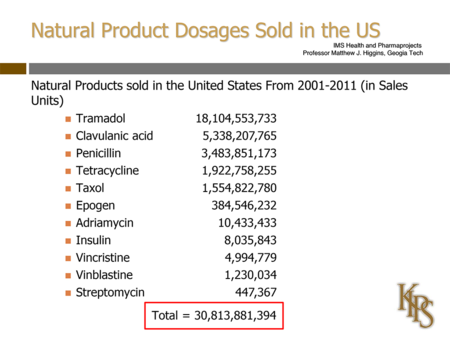
    Ms. Knowles saved the most passionate and persuasive portion of her presentation for last by addressing the impact of the Myriad and Mayo decisions and the Guidance on all of us.  She began by noting that she is working with Georgia Tech Professor Matthew J. Higgins through the IMS Heath and Pharmaprojects program to determine the number of natural product dosages that were sold in the United States between 2001 and 2011 for a range of drugs.  She shared for the first time data on eleven top-selling natural product therapeutics which indicated that patients have benefited by taking almost 31 billion doses of drugs that arguably would not be patentable under the Guidelines, and thus not commercialized, using the assumption that corporations act rationally and would not develop drugs without market protection.  She asked the attendees to raise their hands if friends or family members had been treated with these drugs, to a strong response.  Of course, this leads to the question of what drugs we will not get the benefit of in the future if commercialization is stalled by the new 101 interpretation.

    Slide 20
    Effect of Guidelines and Myriad/Mayo on Women with Breast Cancer

    In the final portion of her talk, Ms. Knowles noted that as of January 1, 2012, 2.9 million women alive now have experienced breast cancer.  For the first time in a public forum, Ms. Knowles said that she is one of these 2.9 million women and a breast cancer survivor.  She said that if the Guidelines and Mayo/Myriad had been the law years ago, she would probably not be at the podium because she likely would have died.  Ms. Knowles told attendees that her life was saved by Adriamycin, an antibiotic fermentation product of bacteria (and cousin of daunorubicin) and "Amazonic Acid" (Taxol).

    Pertinent to October as Breast Cancer Awareness Month, Ms. Knowles shared a chart from the Susan G. Komen for the Cure Foundation which indicates that of the six front line treatments for breast cancer, Adriamycin is a component of four.

    Table
    Find-the-CureMs. Knowles also noted that in 2013, 232,340 women were diagnosed with invasive breast cancer and 39,620 deaths were attributed to breast cancer.  She then held up two patents that she had identified which were related to the natural product drugs administered to her:  U.S. Patent Nos. 3,590,028 and 5,641,803.  Ms. Knowles stated that without corporate support for those drugs based on an expectation of patent protection, she may not have become a breast cancer survivor.  After the conference, Ms. Knowles told me that she was motivated "to make this unusual personal statement to support all of the brave friends she met in infusion wards fighting for their lives with the only hope coming from news that their doctors will tell them there is a new clinical trial they can try or a new diagnostic that can tell them more about the monster growing inside them."  She also indicated that because of the Myriad and Mayo decisions and the Guidance, and the uncertainty introduced by the decisions and Guidance, pharmaceutical and biotech companies might not be driven to identify new natural product drugs that could be used to save lives in the future.  If her assessment turns out to be correct, this would be the worst impact of all.

    Postscript:  Ms. Knowles asked me to add the following message to the above report:

    If you have been touched by cancer personally or through a family member or friend, please post a message and tell your story.  It wasn't easy for me to make a public statement, but maybe it will make it a little easier for you.  Have you seen a natural product or it's derivative save a life?  Or have you lost a friend or relative to cancer and want to support innovation for additional drugs, including natural products?  Please make some noise.

  • By Andrew Williams —

    Supreme Court Building #3On Wednesday, the Supreme Court will hear oral arguments in the Teva Pharmaceuticals USA, Inc. v. Sandoz Inc. case to determine whether appellate courts should afford any deference to a trial court's claim construction determination.  We have been previewing this case, including the case law backdrop (see "Supreme Court Preview — Teva Pharmaceuticals USA, Inc. v. Sandoz Inc. — The End of Cybor Corp.?") and the positions of the parties as presented in their briefing to the Court (see "Teva v. Sandoz — Supreme Court Preview").  And, for a more detailed explanation of the science underlying the case, we provided a summary of the Federal Circuit decision at the time (see "Teva Pharmaceuticals USA, Inc. v. Sandoz, Inc. (Fed. Cir. 2013)").  Of course, unlike the Lighting Ballast en banc case, very little was said at the Federal Circuit regarding the standard of claim construction review in the appellate court's decision.  In fact, even though the Court explicitly noted that it was using the de novo standard, it was framed as a determination of indefiniteness.  Teva Pharmaceuticals USA, Inc. v. Sandoz Inc., 723 F.3d 1363, 1369 (Fed. Cir. 2013) ("On de novo review of the district court's indefiniteness holding, we conclude that Dr. Grant's testimony does not save Group I claims from indefiniteness.").

    The outcome of this case will certainly impact patent litigants going forward.  However, what policy concerns does this case represent to operating companies in the abstract?  Interestingly, of the three amicus briefs submitted by operating companies themselves (representing 20 companies in total), all supported maintaining the de novo standard of review.  One of these briefs, filed by Fresenius Kabi USA, LLC, argued that adoption of deferential review would disproportionately impact medical technology patents, considering that 35 U.S.C. § 112 issues arise more often in such patents.  This problem, according to Fresenius, is caused by the interplay between the canon of construction to preserve validity and the invalidity issues related to § 112, and will necessitate related factual findings for these medical technology patents.

    The remaining 19 amici were self-described as "high-technology" or "technology" companies.  Both sets pointed out why the Supreme Court's Markman decision actually favored de novo review.  They both also outlined several public policy concerns raised by the possibility of a more deferential standard.  And, one of these policy concerns raised by both briefs was that a change to a more deferential standard would serve to benefit the companies that have been labeled as "patent trolls" — non-practicing entities ("NPEs") and patent assertion entities ("PAEs").

    Intel, EMC, Facebook, Red Hat, and Verizon

    Intel, et al. ("Intel") alleged that NPEs will be more likely to forum shop if a more deferential standard of claim construction is adopted.  In general, Intel believed that forum shopping will likely increase because parties will be secure in the knowledge that the selected jurisdiction's decisions will likely be upheld upon review.  These five companies pointed out that they have all had personal experience with the significant costs of NPE litigation tactics.  They cited a piece authored by Judge Moore before becoming a Federal Circuit judge, which pointed out that forum shopping erodes public confidence, wastes resources, and decreases innovation.  The Federal Circuit was created to remedy the problem of forum shopping, and Intel suggested this will be eroded with a deferential standard of claim construction review.

    With regard to other public policy considerations, Intel argued that de novo review was preferable to a more deferential standard because it ensures consistent, accurate constructions of claim language.  The alternative will instead result in the possibility of contradictory interpretations of the same patent claims in different cases.  In fact, the Supreme Court in Markman noted that because the Federal Circuit was the only court hearing patent appeals, it would ensure the uniformity and certainty of claim constructions.  This is because any final decisions would apply to future cases as a matter of stare decisis.  And, as Intel pointed out, application of stare decisis cannot occur if the appellate court is required to follow deferential review.

    Intel also pointed out that the threat of inconsistent rulings is not imaginary.  In the case of the American Piledriving, seven different courts construed three terms from the same patent, and no two courts construed all three terms the same.  This possibility is likely to increase because of the provisions of the America Invents Act requiring plaintiffs to pursue separate litigations against individual defendants.  In response to the argument that res judicata eliminates any concern about deferential review, Intel pointed out that issue preclusion would not apply to new and independent litigants.  In fact, an alleged infringer would only need to offer evidence supporting a different construction to be allowed a chance to litigate a different construction.

    More importantly, according to Intel, deferential review of claim constructions would likely increase the cost of patent litigation.  A deferential standard would prevent expeditious resolution in district court.  Unlike the current practice in many jurisdictions of holding early claim construction hearings, courts are likely to require intensive discovery before entertaining such motions.  It will, therefore, be harder to obtain early summary judgment, dismissal, or other resolution.  Moreover, delaying claim construction until the end of a case, which is likely to happen with deferential review, will force the parties to litigate for years without the benefit of knowing how the claims will be interpreted.  This will also have the effect of reducing incentives to settle early.

    Google, Dell, Hewlett-Packard, Salesforce.com, Twitter, Yahoo!, Acushnet, Ebay, Kaspersky Lab, Limelight Networks, Newegg, QVC, SAS, and Xilinx

    Google et al. ("Google") focused on the serious problems caused by vague patent claims, unpredictable constructions, and costly litigation.  In fact, according to Google, the cost of litigations involving overbroad and vague claims, such as used by PAEs, would only increase under deferential review of claim construction.  Google also pointed out that classifying claim construction as partly factual would encourage lower courts to defer claim construction.  This would virtually eliminate early dispositive motions and/or early informed settlement discussions.  The uncertainty caused by delayed construction "plays into the hands of" PAEs.  Reiterating that claim construction is a question of law would, according to Google, save millions of dollars in litigation costs, and would deter nuisance suits.  Of course, this begs the question whether such nuisance suits are deterred now.

    Google was also not convinced that decreasing the number of reversals on appeal was a good idea.  In any event, the reversal rates might be overstated because of selection bias (only the hardest cases are appealed), and studies have shown that the reversal rate has actually been decreasing in the past decade.  Of course, a lower reversal rate is not preferable if it results in maintaining a wrong construction.

    Part of the problem, according to Google, is the Federal Circuit's seemingly contradictory canons of claim construction.  For example, it is axiomatic that courts interpret claims in light of the specification, but it is also black letter that courts must not import limitations from the specification into the claims.  It is this inconsistent claim construction methodology, along with vaguely drafted claims, that are the "root causes of the uncertainty plaguing this area."  Deference is not the answer, according to Google, and will likely make problems worse.

    It will be interesting to see if any of the Justices will focus on the impact claim construction review will have on patent troll litigation.  With any luck, we will have a better idea of the position the Court is likely to adopt based on the questioning at the hearing.  Of course, we will review the transcript and will provide a summary shortly after the hearing on Wednesday.

  •         By Sherri Oslick —

    Gavel About Court Report:  Each week we will report briefly on recently filed biotech and pharma cases.

    Teva Pharmaceuticals USA, Inc. et al. v. Mylan Pharmaceuticals Inc. et al.
    1:14-cv-00167; filed October 7, 2014 in the Northern District of West Virginia

    • Plaintiffs:  Teva Pharmaceuticals USA, Inc.; Teva Pharmaceutical Industries, Ltd.; Teva Neuroscience, Inc.; Yeda Research and Development Co., Ltd.
    • Defendants:  Mylan Pharmaceuticals Inc.; Mylan Inc.; Natco Pharma Ltd.

    Teva Pharmaceuticals USA Inc. et al. v. Mylan Pharmaceuticals Inc. et al.
    1:14-cv-01278; filed October 6, 2014 in the District Court of Delaware

    • Plaintiffs:  Teva Pharmaceuticals USA Inc.; Teva Pharmaceuticals Industries Ltd.; Teva Neuroscience Inc; Yeda Research and Development Co., Ltd.
    • Defendants:  Mylan Pharmaceuticals Inc.; Mylan Inc.; Natco Pharma Ltd.

    The complaints in these cases are substantially identical.  Infringement of U.S. Patent Nos. 8,232,250 ("Low Frequency Glatiramer AcetateTherapy," issued July 31, 2012) and 8,399,413 (same title, issued March 19, 2013) following a Paragraph IV certification as part of Mylan's filing of an ANDA to manufacture a generic version of Teva's Copaxone® (glatiramer acetate injection, used for the reduction or frequency of relapses in patients with relapsing-remitting multiple sclerosis).  View the Delaware complaint here.

    Takeda Pharmaceuticals U.S.A., Inc. v. West-Ward Pharmaceutical Corp. et al.
    1:14-cv-01268; filed October 3, 2014 in the District Court of Delaware

    • Plaintiff:  Takeda Pharmaceuticals U.S.A., Inc.
    • Defendants:  West-Ward Pharmaceutical Corp.; Hikma Americas Inc.; Hikma Pharmaceuticals PLC

    Infringement of U.S. Patent Nos. 7,964,647 ("Colchicine Compositions and Methods," issued June 21, 2011), 7,964,648 ("Methods for Concomitant Administration of Colchicine and a Second Active Agent," issued June 21, 2011), 7,981,938 ("Colchicine Compositions and Methods," issued July 19, 2011), 8,097,655 ("Methods for Concomitant Administration of Colchicine and Macrolide Antibiotics," issued January 17, 2012), and 8,440,722 ("Methods for Concomitant Administration of Colchicine and a Second Active Agent," issued May 14, 2013) based on Hikma's anticipated manufacture, sale, and offer for sale (following the FDA's approval of Himka's NDA) of its Mitigare product (colchicine, used for the prophylaxis of gout flares).  View the complaint here.

    Forest Laboratories et al. v. Amerigen Pharmaceuticals Inc. et al.
    1:14-cv-01271; filed October 3, 2014 in the District Court of Delaware

    • Plaintiffs:  Forest Laboratories LLC; Forest Laboratories Holdings Ltd.; Adamas Pharmaceuticals Inc.
    • Defendants:  Amerigen Pharmaceuticals Inc.; Amerigen Pharmaceuticals Ltd.

    Infringement of U.S. Patent Nos. 8,039,009 ("Modified Release Formulations of Memantine Oral dosage Forms," issued October 18, 2011), 8,168,209 ("Method and Composition for Administering an NMDA Receptor Antagonist to a Subject," issued May 1, 2012), 8,173,708 (same title, issued May 8, 2012), 8,283,379 ("Method and Compositions for the Treatment of CNS-Related Conditions," issued October 9, 2012), 8,329,752 ("Composition for Administering an NMDA Receptor Antagonist to a Subject," issued December 11, 2012), 8,362,085 ("Method for Administering an NMDA Receptor Antagonist to a Subject," issued January 29, 2013), and 8,598,233 (same title, issued December 3, 2013) following a Paragraph IV certification as part of Amerigen's filing of an ANDA to manufacture a generic version of Forest's Namenda XR® (memantine hydrochloride extended release, used for the treatment of moderate to severe dementia of the Alzheimer's type).  View the complaint here.


    Forest Laboratories, LLC et al. v. Hikma Pharmaceuticals LLC et al.
    1:14-cv-01266; filed October 2, 2014 in the District Court of Delaware

    • Plaintiffs:  Forest Laboratories, LLC; Forest Laboratories Holdings Ltd.
    • Defendants:  Hikma Pharmaceuticals LLC; Hikma Pharmaceuticals PLC; West-Ward Pharmaceutical Corp.

    Infringement of U.S. Patent Nos. 7,741,358 ("Crystal Form of Asenapine Maleate," issued June 22, 2010) and 8,022,228 (same title, issued September 20, 2011) following a Paragraph IV certification as part of Hikma's filing of an ANDA to manufacture a generic version of Forest's Saphris® (asenapine maleate, sublingual, used to treat schizophrenia and manic or mixed episodes associated with bipolar I disorder).  View the complaint here.


    Jazz Pharmaceuticals, Inc. et al. v. Par Pharmaceutical, Inc.
    2:14-cv-06150; filed October 2, 2014 in the District Court of New Jersey

    • Plaintiffs:  Jazz Pharmaceuticals, Inc.; Jazz Pharmaceuticals Ireland Ltd.
    • Defendant:  Par Pharmaceutical, Inc.

    Jazz Pharmaceuticals, Inc. et al. v. Ranbaxy Laboratories Ltd. et al.
    2:14-cv-06151; filed October 2, 2014 in the District Court of New Jersey

    • Plaintiffs:  Jazz Pharmaceuticals, Inc.; Jazz Pharmaceuticals Ireland Ltd.
    • Defendants:  Ranbaxy Laboratories Ltd.; Ranbaxy Inc.

    The complaints in these cases are substantially identical.  Infringement of U.S. Patent No. 8,772,306 ("Method of Administration of Gamma Hydroxybutyrate with Monocarboxylate Transporters," issued July 8, 2014) following a Paragraph IV certification as part of defendants' filing of an ANDA to manufacture a generic version of Jazz's Xyrem® (sodium oxybate, used to treat narcolepsy).  View the Par complaint here.

    Otsuka Pharmaceutical Co., Ltd. v. Intas Pharmaceuticals Ltd. et al.
    1:14-cv-06158; filed October 2, 2014 in the District Court of New Jersey

    • Plaintiff:  Otsuka Pharmaceutical Co., Ltd.
    • Defendants:  Intas Pharmaceuticals Ltd.; Accord Healthcare, Inc.; Accord Healthcare Ltd.; Astron Research Ltd.; Hetero Labs Ltd.

    Infringement of U.S. Patent No. 8,759,350 ("Carbostyril Derivatives and Serotonin Reuptake Inhibitors for Treatment of Mood Disorders," issued June 24, 2014) following a Paragraph IV certification as part of Intas' filing of an ANDA to manufacture a generic version of Otsuka's Abilify® (aripiprazole, used to treat bipolar disorder and schizophrenia).  View the complaint here.

  •     By Paul Cole* —

    MyriadIs there a chain of reasoning that leads to the outcome in Myriad more shortly and directly than that outlined by Justice Thomas and without invoking judicial exceptions?  It is strongly arguable that this is indeed the case and that, applying Occam's razor, the shorter chain of reasoning is to be preferred.

    Doubts about the Myriad reasoning become apparent on studying a book by Justice Antonin Scalia and Bryan Gardner, Reading Law, the Interpretation of Legal Texts, Thompson/West, 2012.  A reader hoping to find a chapter explaining judicial exceptions will come away disappointed:  they are not indexed and there is no specific discussion of them.  The Omitted-Case Canon at pp. 93-109 represents the closest approach, but begins with a quote from Justice Frankfurter:  "Whatever temptations the statesmanship of policymaking might wisely suggest, construction must eschew interpolation and evisceration.  [The judge] must not read in by way of creation."  The expected result of applying an unwise law as written, leading to a serious defect, is that the legislature will cure it.  "The statute books will become more complete, and improvised judge-made exceptions that cannot be found in the text of enacted laws will become less numerous."  A theme of the book is that non-textual interpretation of the Constitution, statutes and other legal documents such as contracts should be avoided because judicial over-reaching is autocratic rather than democratic.

    The above doubts become reinforced on re-reading the introduction to the opinion of Chief Justice Berger in Chakrabarty which is in agreement with Scalia and Gardner:

    In cases of statutory construction we begin, of course, with the language of the statute.  Southeastern Community College v. Davis, 442 U.S. 397, 405 (1979).  And "unless otherwise defined, words will be interpreted as taking their ordinary, contemporary, common meaning." Perrin v. United States, 444 U.S. 37, 42  (1979).  We have also cautioned that courts "should not read into the patent laws limitations and conditions which the legislature has not expressed."  United States v. Dubilier Condenser Corp., 289 U.S. 178, 199 (1933).

    It will be recalled that the questions before the Court were firstly whether a naturally occurring segment of deoxyribonucleic acid (DNA) is patent eligible under 35 U.S C. § 101 by virtue of its isolation from the rest of the human genome and secondly whether synthetically created DNA known as complementary DNA (cDNA), which contains the same protein-coding information found in a segment of natural DNA but omits portions within the DNA segment that do not code for proteins, is eligible.

    Following Justice Scalia, the Court's first task was to interpret 35 U.S.C. § 101 and determine whether the questions before the Court could be resolved using the express wording of the statute:  only if that task was impossible was it necessary to reach the judicial exceptions.

    One basis by which a naturally occurring segment could qualify under § 101 is if it could be regarded as a new and useful composition of matter.  A definition of that term was adopted by Chief Justice Berger in Chakrabarty:

    "[C]omposition of matter" has been construed consistent with its common usage to include "all compositions of two or more substances and . . . all composite articles, whether they be the results of chemical union, or of mechanical mixture, or whether they be gases, fluids, powders or solids."  Shell Development Co. v. Watson, 149 F. Supp. 279, 280 (DC 1957) (citing 1 A. Deller, Walker on Patents 14, p. 55 (1st ed. 1937)).

    However, an isolated naturally-occurring DNA segment does not fall within the above definition because it is a single substance and not a mixture of substances and because it is not the result of chemical union (i.e., synthesis by the hand of man) but instead is merely an otherwise unchanged fragment of a larger naturally-occurring molecule.  Insofar as Myriad treated the claims in issue as composition claims it arguably gave the statutory language a meaning broader than its plain meaning and conflicted with Chakrabarty and Shell Development.

    The alternative and more plausible basis on which the isolated naturally-occurring DNA segment could have been eligible under § 101 is as a new and useful manufacture.  Again in Chakrabarty a definition is provided:

    [T]his Court has read the term "manufacture" in 101 in accordance with its dictionary definition to mean "the production of articles for use from raw or prepared materials by giving to these materials new forms, qualities, properties, or combinations, whether by hand-labor or by machinery."  American Fruit Growers, Inc. v. Brogdex Co., 283 U.S. 1, 11  (1931).

    The standard set out in American Fruit Growers was that there must be a transformation:  a new and different article must emerge having a distinctive name, character, or use, as explained in Hartranft.  In order to qualify as a new manufacture relevant new utility for the isolated naturally-occurring segment had to be demonstrated.  As explained in the dissenting opinion of Judge Bryson in the Federal Circuit the analysis should be from the standpoint of a geneticist rather than a chemist, and the isolated wild-type BRCA1 gene had no relevant new utility for the following reasons:

    The structural differences between the claimed "isolated" genes and the corresponding portion of the native genes are irrelevant to the claim limitations, to the functioning of the genes, and to their utility in their isolated form.  The use to which the genetic material can be put, i.e., determining its sequence in a clinical setting, is not a new use; it is only a consequence of possession.  In order to sequence an isolated gene, each gene must function in the same manner in the laboratory as it does in the human body.  Indeed, that identity of function in the isolated gene is the key to its value.  The naturally occurring genetic material thus has not been altered in a way that would matter under the standard set forth in Chakrabarty.  For that reason, the isolation of the naturally occurring genetic material does not make the claims to the isolated BRCA genes patent-eligible.

    It follows that the claimed isolated naturally-occurring DNA segment was not covered by § 101 either as a composition of matter or as a manufacture, and that invoking judicial exceptions to reach that result was unnecessary.

    The status of the cDNA was equally easy to resolve using the express language of the statute.  It differed from the naturally-occurring segment insofar as that it comprised the exons of the naturally occurring sequence joined directly one-to another and without intervening introns.  It was a new chemical substance resulting from a chemical union brought about by the hand of man, and as such was plainly an eligible composition of matter.

    Do these points matter, insofar as a decision has already been handed down and no different outcome is suggested?  It is suggested that they do because they emphasize the wide and relevant applicability of the language of the statute, and provide a basis for reconsideration of the appropriate balance between the express provisions of the statute and less-certain judge-made exceptions.  It is possible that straightforward interpretation of the statutory language concerning new and useful processes and machines and avoidance of unnecessary reliance on judicial exceptions could simplify and illuminate the discussion of computer and business-method inventions as in Alice.

    * Mr. Cole is a European Patent Attorney and Partner with Lucas & Co. in Warlingham, Surrey, UK and Visiting Professor at Bournemouth University.