• By Kevin E. Noonan –

    Federal Circuit SealAs the dodo of patent practice, the number of interferences has been steadily dwindling since enactment of the Leahy-Smith America Invents Act in 2012 abolished the practice in favor of a "first inventor to file" regime and a derivation proceeding for instances where a patentee is found to have taken the invention from the true inventor (35 U.S.C. § 135).  And while the various CRISPR interferences between The Broad Institute and the University of California (Nos. 105,048 and 105,115) and those parties and ToolGen (Nos. 106,126 and 106,127) and Sigma-Aldrich (Nos. 106,132 and 106,133) have garnered more attention than other interferences combined, there remain a few other remaining interferences and in one of them, Dionex Softron GmbH v. Agilent Technologies, Inc., the Federal Circuit affirmed a determination by the Patent Trial and Appeal Board in favor of the Junior Party.

    This interference was in an interesting procedural posture, wherein both parties copied each other's claims to provoke an interference.  Agilent made the first attempt and failed, copying claims to Dionex's U.S. Application No. 15/596,738, now U.S. Patent No. 10,031,112.  After Agilent amended its claims in U.S. Application No. 15/965,402, Dionex copied those claims in its U.S. Application No. 16/016,866, and the interference was declared.  The Count in Interference No. 106,109 was Claim 1 of Agilent's application:

    A method of operating a liquid chromatography system, the liquid chromatography system comprising a liquid chromatography column and an injection valve, the method comprising:
        isolating a sample loop of the liquid chromatography system from a high-pressure fluidic path in fluid communication with the liquid chromatography column, wherein the high-pressure fluidic path is at a pump pressure, wherein the sample loop is in fluid communication with the injection valve and the sample loop comprises a metering device for loading a sample on the sample loop, and isolating the sample loop comprises placing the injection valve in a PRESSURE COMPENSATION position, wherein a volume of the metering device is defined by a chamber in which a piston is reciprocatingly mounted;
        determining a movement amount of the piston within the chamber from a first position to a second position to increase a pressure in the sample loop from an essentially atmospheric pressure to the pump pressure, based on the pump pressure; and
        while the sample loop is isolated from the high pressure fluidic path, decreasing the volume of the metering device to increase the pressure in the sample loop from the essentially atmospheric pressure to essentially correspond to the pump pressure of the high-pressure fluidic path;
        wherein decreasing the volume includes forwarding the piston within the chamber by the determined movement amount from the first position to the second position;
        wherein the metering device and the sample loop are in fluid communication in each position of the injection valve.

    (wherein the italicized limitations were relevant to the issues before the Federal Circuit on appeal).

    The PTAB denied Dionex's motion that Agilent's claims were not supported by an adequate written description under 35 U.S.C. § 112, first paragraph, finding that the specification whose adequacy was required was Agilent's '402 application because that was the application from which the claim was copied.  The issue, regarding the italicized limitation above was whether "determining a movement amount" needed to occur before "forwarding the piston" based on the disclosure of Dionex's '116 application (although Dionex conceded that certain terms, like "determining," should be construed under Agilent's '402 specification).  The Board held that Agilent's '402 specification provided an adequate written description under § 112, first paragraph, because using the "broadest reasonable interpretation" standard there was no basis for Dionex's asserted temporal limitation (i.e., that there was a movement determination prior to piston movement).  Under the Board's construction, there could be such a determination while the piston was moving and the limitation under this interpretation was adequately described by the '402 specification.

    On the priority merits, the Board held for Agilent on corroborated evidence that its inventor had reduced the invention to practice (June 1, 2007) prior to Dionex's earliest asserted conception date (December 4, 2007).  The evidence was provided by testimony of one of two co-inventors, Kretz, corroborated by two co-workers, Berndt and Bäuerle.  Their corroborating testimony was that Kretz had successfully tested a prototype of the claimed invention by his asserted June 1, 2007 reduction to practice date.  This testimony was consistent with documentary evidence initially created on April 4, 2006 and having modifications as late as November 11, 2008, which document was attested by Agilent's expert to describe a functional apparatus falling within the interference Count.  The Board rejected Dionex's argument that the described apparatus did not have a pressure sensor needed to provide equalized pressure as recited in the Count, based on testimony by Bäuerle that the pump used in the prototype had an internal pressure sensor.  Finally, the Board refused to draw an adverse inference against Agilent from the failure of the second named inventor, Glatz, to testify or from the absence of contemporaneous technical drawings, schematics, and other documentary evidence in light of the adequacy of the testimony introduced by Agilent.  This appeal followed.

    The Federal Circuit affirmed, in an opinion by Judge Stark joined by Judges Reyna and Chen.  Regarding the § 112, first paragraph, issue, the Federal Circuit agreed with the PTAB that the '402 application was the proper source of an adequate written description, as the "originating specification" under Agilent Techs., Inc v. Affymetrix, Inc., 567 F.3d 1366, 1374 (Fed. Cir. 2009); Rowe v. Dror, 112 F.3d 473 (Fed. Cir. 1997); and In re Spina, 975 F.2d 854 (Fed. Cir. 1992).  Agilent's earlier failure to provoke an interference by coping Dionex's claims did not change this result according to the panel.  The Federal Circuit also agreed with the PTAB's claim construction regarding whether there was a temporal component in the claim language, i.e., whether the "determining" activity must antecede "forwarding" of the piston.  While conceding the general rule that a method claim does not necessarily require steps to be performed in the order they are recited in the claim, the opinion notes that there are instances where "logic or grammar" requires a particular order, citing Mformation Techs, Inc v. Rsch. in Motion, Ltd., 764 F3d 1392 (Fed. Cir. 2014).  This was not such a case, the panel concluded, and thus the Board's determination was supported by substantial evidence (including expert testimony) as a question of fact.

    The Federal Circuit also affirmed the Board's priority determination, based on actual reduction to practice having been achieved prior to Dionex's conception date and being supported by sufficient corroborating evidence.  The panel affirmed the Board's application of the "rule of reason" regarding corroborating testimony under Cooper v. Goldfarb, 154 F.3d 1321 (Fed. Cir. 1998), where there is "sufficient circumstantial evidence of an independent nature" to support inventor Kretz's testimony concerning his actual reduction to practice.  The opinion characterizes Dionex's arguments on these issues to be "mistaken" insofar as the Board properly credited testimony of contemporary witnesses of inventor Kretz's work and actual reduction-to-practice of an apparatus within the scope of the interference Count.  While the witnesses, particularly Bäuerle, may not have known every detail of the apparatus the Court held that "omniscience is unnecessary under the rule of reason" in Cooper and that any inadequacy in witness Berndt's understanding that was the basis of his testimony was not disqualifying because it was independent of inventor Kretz's testimony and the Board could find "some collaborative value" in it.  Regarding the exhibit, the panel rejected Dionex's challenge, saying it was "without merit" because the Board relied on the exhibit "as it existed at the relevant date" (emphasis in opinion), as corroborated by witness Bäuerle.  Finally, the Court rejected Dionex's argument that the Board should have drawn an adverse inference from second inventor Glatz's failure to provide testimony, saying there is no per se requirement to infer that an inventor's failure to testify should be considered harmful to her co-inventor, citing Borror v. Herz, 666 F.2d 574 (C.C.PA. 1981), and that the Board had discretion that it had not abused on this record regarding inventor Glatz's failure to testify.  In the absence of such a mandate that the Board draw the adverse inference, the Court held there was no error by the Board in not doing so and thus affirmed the Board's priority determination in favor of Agilent.

    Dionex Softron GmbH v. Agilent Technologies, Inc. (Fed. Cir. 2023)
    Panel: Circuit Judges Reyna, Chen, and Stark
    Opinion by Circuit Judge Stark

  • IPO #2The Intellectual Property Owners Association (IPO) will offer a one-hour webinar entitled "2022 Case Law Year in Review" on January 11, 2023 from 12:00 pm to 1:00 pm (ET).  Paul Berghoff of McDonnell Boehnen Hulbert & Berghoff LLP, Gregory Castanias of Jones Day, and Wendy Larson of Pirkey Barber will review the most significant decisions as of 2022 and give a sneak peek at coming attractions.

    The registration fee for the webinar is $150 for non-members or free for IPO members (government and academic rates are available upon request).  Those interested in attending the webinar should register here.

  • By Michael Borella

    In Liu Cixin's novel The Three Body Problem, the characters create a "computer" from human labor.  Millions of people serve as "bits" and hold up flags to indicate whether they represent 0s or 1s.  These individuals are given instructions to behave like various types of logic gates that would appear in actual digital circuitry.  In combination, these gates are formed into a processor, memory, and other components that would be found on a real computer's motherboard.  Instructions for a human "operating system" are also provided, as well as for a human "application" to execute a solution to the titular problem of Newtonian physics.  The calculations take 16 months.

    Liu's novel is speculative but — in theory — such a human computer could exist (for a small-scale, real-world experiment of simulating neural processing with a group of 300 people, see The Stilwell Brain episode of Mind Field).  In reality, though, one might question why anyone would want to undertake such a project.  Even relatively simple calculations, such as evaluating the length of a right triangle's hypotenuse using the Pythagorean Theorem, would likely take several minutes.  We have actual digital computers that can perform such calculations in microseconds.

    But the notion of the human computer can be simplified even further.  As anyone who has studied microprocessor design can attest to, everything (and I mean everything) that a computer does involves the reading, manipulation, and storing of 0s or 1s.  Such a processor contains a number of registers and stored microcode that can perform a limited number of arithmetic and logical operations on these bits.  An addition operation might involve, for example, reading one set of bits from memory representing a first number into a first register, reading another set of bits from memory representing a second number into a second register, performing microcode-specified addition of these numbers, and storing the result in a third register.  The result may also be written back to memory.  Even when the processor controls the actions of peripheral components, such as a display screen or network interface unit, it does so by moving bits around.

    Thus, a single human can simulate anything a computer can do as a mental exercise or preferably with pen and paper.  Indeed, many undergraduates are subjected to these exercises in order to better understand how computers actually work.  In other words, if you give me a general purpose computer architecture and a problem to solve, I can simulate how that architecture would solve the problem using no more than pen and paper, no matter how complex either the architecture or the problem may be . . . with the caveat that I might not live long enough to provide you with an answer.  Indeed, I might be able to perform a handful of processor instructions per minute as opposed to the trillions of instructions per second that a modern, massively parallel multicore processor can carry out.  If you replace me with another person when I expire, replace that person when they expire, and so on, the sun will likely consume the Earth before many complex calculations can be completed.

    Simply put, any software program, algorithm, technique, application, etc. can be — in theory — performed by a human with no more than pen and paper.  And a lot of time.  So much time that mental performance would often be impossible or impractical.  Thus, the contention that there is a meaningful analogy between computer-performance of a task and human performance of a task is just plain silly.

    But then comes patent law.

    One of the exceptions to patentability is when a claimed invention can be carried out in the human mind – the so-called mental process doctrine.  At first blush, this might not seem like a problem.  If a claim is no more than instructions for a person to think of two relatively small numbers then add them together, or some other task that the vast majority of human beings can perform in their heads, one can understand why such a claim might be excluded from patentability.  After all, how would you go about detecting infringement?

    But the mental process doctrine is much more than that.  It incorporates "steps can be performed in the human mind, or by a human using a pen and paper."  CyberSource Corp. v. Retail Decisions, Inc.  Indeed, the USPTO states in M.P.E.P. § 2106 that "courts do not distinguish between mental processes that are performed entirely in the human mind and mental processes that require a human to use a physical aid (e.g., pen and paper or a slide rule) to perform the claim limitation."  Moreover, claims that could be performed in the human mind but are recited as being performed by computer are still "mental processes."  See Mortgage Grader, Inc. v. First Choice Loan Servs. Inc. and Intellectual Ventures I LLC v. Symantec Corp. among many others.

    This means that patent law views "mental processes" as encompassing tasks performed by or with the assistance of devices or machines — a legal fiction if there ever was one.

    The expansion of mental process doctrine from pure mental processes to processes that are actually performed by or with the assistance of tools or machines was long and slow.  In Gottschalk v. Benson, claims to a method for converting between binary and BCD representations of numbers were found to be ineligible for patenting.  The Supreme Court justified its decision by contending that "mental processes[] and abstract intellectual concepts are not patentable, as they are the basic tools of scientific and technological work" even though one of the claims at issue required a special piece of hardware.  The Court implied that mental processes, even if novel, are analogous to newly discovered laws of nature and thus not patentable in and of themselves.[1]

    The claims in Benson were relatively simple to understand and for a human to perform.  If the mental process doctrine stopped there, so would have the controversy.  But a few years later in Parker v. Flook, the Court held a far narrower claim to a more complicated process for calculating alarm thresholds to be ineligible.  In doing so, it recognized but discounted that "the abstract of disclosure makes it clear that the formula is primarily useful for computerized calculations producing automatic adjustments in alarm settings" (emphasis added).

    Things were quiet for over three decades until the Court once again opened the door for a more expansive view of mental processes in Bilski v. Kappos and Alice v. CLS Bank.  The Federal Circuit followed this legislating from the bench with a line of cases that led to the current, rather absurd, state of the law.  These include, but certainly are not limited to, claims found ineligible for detecting fraud and/or misuse in a computer environment (FairWarning IP, LLC v. Iatric Sys., Inc.), computerized parsing and comparing of data (Berkheimer v. HP, Inc.), scanning hardcopy documents into a computer program (Content Extraction & Transmission LLC v. Wells Fargo Bank, N.A.), monitoring a power grid (Electric Power Group v. Alstom, S.A.), and translating a description of a logic circuit into a hardware component representation of the logic circuit (Synopsys, Inc. v. Mentor Graphics Corp.).

    These cases appear to establish that a claim to a novel and non-obvious computer-implemented algorithm that requires computer implementation to be of any use at all can still be a "mental process."  The Supreme Court's holding in Alice further establishes that computer implementation can often be completely discounted for purposes of patent eligibility.

    But software inventions as actually claimed are the combination of the algorithm and the computer implementation, thus requiring the computer hardware.  Courts and USPTO representatives often miss this point or ignore it altogether.  To make things even more confusing, there is another (albeit much shorter) line of cases from the Federal Circuit holding that it is improper to bifurcate a claim in this manner in the eligibility inquiry.  See Gree, Inc. v. Supercell Oy as a recent example.  The Federal Circuit wrote, in relation to a PTAB decision, "[t]o the extent that the Board meant that a proper § 101 analysis may consider some claim limitations only at Alice step one and others only at Alice step two, we do not agree with its reading of Supreme Court precedent."  So on one hand, the Federal Circuit embraces the separation of claim elements in the eligibility analysis, and on the other tells us that doing so is improper.

    So where do we stand today?  The Federal Circuit continues to apply mental process doctrine to invalidate patents.  Recently, that Court wrote a small treatise on the viability of mental process doctrine in In re Killian.  The PTAB has been making heavy use of the doctrine to affirm examiner's patent eligibility rejections.  Just in November and December of 2022, 63% of such affirmances relied on the doctrine.

    Why are contentions of ineligibility based on alleged mental processes so prevalent?  Perhaps it goes back to what we discussed above.  Any software program, at its core, is driven by sequences of arithmetic and logical operations that could be performed with pen and paper, if not mentally.  Indeed, if the mental process doctrine were applied consistently, either very few software claims would pass muster or all would be eligible.

    Despite this bad news for patentees, some software claims are surviving eligibility challenges.  This begs the question of what is so fundamentally different between these claims and their ineligible brethren?

    In M.P.E.P. § 2106, the USPTO has attempted to draw a line between claims with limitations that can practically be performed in the human mind with or without the use of physical aids and those that cannot.  The USPTO provides several examples of claims falling into each category.

    Those that can be practically performed in the human mind include "collecting information, analyzing it, and displaying certain results of the collection and analysis, where the data analysis steps are recited at a high level of generality," "comparing BRCA sequences and determining the existence of alterations, where the claims cover any way of comparing BRCA sequences," "collecting and comparing known information," and "identifying head shape and applying hair designs."  Contrasting examples of claims that cannot be practically performed in the human mind (according to the USPTO) include "calculating an absolute position of a GPS receiver and an absolute time of reception of satellite signals [using pseudoranges]," "detecting suspicious activity by using network monitors and analyzing network packets," "a specific data encryption method for computer communication involving a several-step manipulation of data," and "a method for rendering a halftone image of a digital image by comparing, pixel by pixel, the digital image against a blue noise mask."

    The USPTO provides very little reasoning to support these categorizations, and the reasoning that it does provide is largely conclusory.  Looking to the Supreme Court and Federal Circuit cases on which these examples are based provides scant further insight.

    For instance, the USPTO, quoting the Federal Circuit, writes that "the human mind is not equipped to detect suspicious activity by using network monitors and analyzing network packets as recited by the claims."  However, as argued above, a human could perform any computer-implemented task with pen and paper.  And in this case, one could certainly examine the bits of network packets (most such packets have at most 1500 bytes of header and payload) in search of pre-defined patterns that indicate suspicious activity.  Of course, doing so would be slow, cumbersome, and impractical.  But then again, so would "comparing BRCA sequences and determining the existence of alterations."  The BRCA1 gene consists of 81,188 base pairs and the BRCA2 gene contains 10,254 base pairs.  Therefore, performing such comparison of these DNA segments manually would likely be of a similar scale to that of the network packet analysis, resulting in a similarly slow, cumbersome, and impractical procedure.  If the courts or USPTO are trying to draw a line between these cases, they have not done so in a clear or convincing fashion.

    This is just one example of how mental process doctrine is inconsistently applied.  A technology area in which we are seeing an uptick in eligibility rejections from the USPTO of late is machine learning.  Despite the USPTO's subject matter eligibility Example 39, which purports to provide a machine learning claim that cannot be practically performed in the human mind, similarly situated claims are often rejected as mental processes.  As they are computer-implemented, the vast majority of these claims can — in theory — be performed with pen and paper, but involve so much complexity that there would be no reason to do so.

    In re-reading many of these cases and the M.P.E.P., our conclusion is that the courts and the USPTO are struggling with the doctrine.  As a consequence, decisions and policies are based on a false equivalence between computers and human minds, are riddled with post-hoc rationalizations, and rely too heavily on claim specificity to influence the use of doctrine.[2]  In the USPTO, eligibility rejections for software claims appear to rely at least as heavily on the examiner or art unit assigned as it does on claim language and the underlying invention.[3]

    In short, the law as it is currently applied makes little to no sense, is disconnected from real-world concerns, and the deck is unjustly stacked against patentees.

    It would be beneficial if the courts and/or the USPTO could develop a reasonable, cogent, and technically sound version of the mental process doctrine — for example, limiting it to claimed inventions that are intended to actually be performed in the human mind.  That way, patentees would have a better idea of what is or is not patent-eligible before investing in preparing and prosecuting applications to these technologies.

    [1] The Court's reasoning here does not stand the test of time.  For instance, machine learning algorithms involving artificial neural networks are often viewed as mental processes even though they do not appear in nature.  While loosely modeled on biological structures appearing in brain tissue, artificial neural networks are quite different

    [2] This should not be surprising given our previous work on analyzing how Federal Circuit eligibility decisions are largely based on whether claims recite a specific, technical improvement over the prior art.

    [3] Different examiners and different art units are given a great deal of latitude on how to interpret the eligibility case law and M.P.E.P. § 2106. 

  • By Donald Zuhn –-

    USPTO SealLast week, the U.S. Patent and Trademark Office issued a Notice advising Applicants to review filing receipts issued between March 2022 and mid-October 2022 to confirm that the granted foreign filing license notification has been included and that the publication information is accurate.

    The Notice explains that the Office recently transitioned to a new pre-examination system to generate notices, including application filing receipts, as part of its "ongoing efforts to automate and enhance patent examination practices to support robust and reliable patent rights and speed the issuance of patents," but that the Office discovered that with this transition, filing receipts issued for certain patent applications processed between March 2022 and mid-October 2022 did not include foreign filing license information.  The Office notes that upon discovering the problem,  it took corrective steps, which consisted of updating the pre-examination system so that it generated appropriate filing receipts beginning on October 18, 2022, and issuing corrected or replacement filing receipts in October 2022 for applications for which a foreign filing license had been granted.

    The Notice also indicates that a "small number" of filing receipts for provisional applications and design applications incorrectly showed a projected publication date, even though provisional and design applications are not subject to publication under the 18-month application publication provisions.  The Office noted that this issue had also been rectified, adding that "regardless of the indication of publication, no provisional or design applications have been or will be published as a patent application publication under 37 CFR 1.215."  Nevertheless, the Office also noted that Applicants could request a corrected filing receipt if a projected publication date for a provisional or design application is listed on the filing receipt.

    In the Notice, the Office advises Applicants to review filing receipts issued for new patent applications between March 2022 and mid-October 2022 to confirm that those filing receipts include a granted foreign filing license notification and accurate publication information, and to request a corrected filing receipt if they believe the application should have cleared the security review process, and the USPTO has not yet issued a corrected or replacement receipt with a granted foreign filing license notification.  Noting that 37 C.F.R. § 1.183 permits the Office to waive any requirement of its regulations that is not a requirement of the patent statutes, the Notice also indicates that "if an applicant files a petition for a retroactive foreign filing license due to the issuance of a filing receipt without such a license between March 2022 and mid-October 2022, the petition filing fee will be waived sua sponte if requested in the petition."

  • USPTO SealThe U.S. Patent and Trademark Office is offering a Stakeholder Application Readiness Training (StART) virtual three-day workshop on the fundamentals of the patent application process from 9:00 am to 4:00 pm ET on January 10 to January 13, 2023.  The StART program is intended for independent inventors, entrepreneurs, and those working for or with a small business who want to file patent applications without the assistance of a registered patent agent or attorney.

    Participants in the StART three-day workshop will receive training on the following subjects:

    • Types of patent applications
    • Prior art searches
    • Scope of claims
    • Formality requirements
    • Claim writing and claim drafting
    • Proper application forms (provisional, design, and non-provisional)
    • Application data sheet
    • Patent Center
    • DOCX files

    Participants may also choose to participate in one-on-one assistance breakout room discussions.

    Those interested in registering for the workshop can do so here.

  • University of MinnesotaThe U.S. Patent and Trademark Office and University of Minnesota Law School will be hosting a discussion about how to promote a culture of diversity, equity, inclusion, and accessibility (DEIA) in the workplace and in inventorship on January 10, 2023 from 2:30 pm to 4:00 pm (CT) at the University of Minnesota Law School in Minneapolis, MN.  Hope Shimabuku, Regional Director of the USPTO Texas Regional Office, will moderate the event, which will cover the following topics:

    • Recent USPTO studies on:
        – Women inventor rate
        – Ties between the economy and IP ownership
    • Highlights of Santa Clara University’s white paper on Diversity in Innovation Best Practices Guide

    Those interested in registering for the webinar can do so here.

  • By Michael Borella

    USPTO SealOn December 29, 2022, to the relief of many practitioners and applicants, the U.S. Patent and Trademark Office delayed the effective date of its controversial incentivized transition to DOCX format for patent application filing.  A new final rule establishes that the $400 fee for filing patent specifications, claims, and abstracts (not including design, plant, or provisional applications) in a format other than DOCX will not be required until April 3, 2023.

    The USPTO has supported filing in DOCX format for over 5 years.  However, uptake was initially slow.  In August 2020, the USPTO published a final rule setting the effective date of the fee to be January 1, 2022, and then published another final rule delaying the fee until January 1, 2023.  Just a few days prior to the fee being put in force, which in practice would compel most applicants to file in DOCX format, it has been pushed back another three months.

    The USPTO's DOCX rollout has been problematic from its beginning.  The issues are not in the format itself, which has a number of advantages over the current standard of filing in PDF.  Instead, many practitioners have experienced problems with the USPTO's DOCX intake engine.  Carl Oppedahl pointed out instances where the USPTO had corrupted or changed equations in specifications.  Our own experience with trying to upload DOCX via the USPTO's electronic filing system in early 2020 produced significant problems, including bogus errors relating to fonts and section headings.  To its credit, the USPTO responded promptly when we raised these issues and has contended that it has fixed the bugs in its software that caused what we came up against.

    But reports of various DOCX issues continued.  Numerous letters were sent by groups of practitioners to the USPTO regarding these issues, including one on the need for protective PDF filings to accompany DOCX filings at no additional cost.  Protective PDF versions of specifications contain the applicant's intended disclosure to which the inventors legally declare inventorship.  They serve as an authoritative version of the application in cases where the USPTO mangles the corresponding DOCX submission.

    On December 20, 2022, the USPTO published a notice that protective PDF filings would be permitted until June 30, 2023, but the DOCX fee would still go into effect on January 1, 2023.  In response, 117 patent professionals signed an open letter to USPTO Director Vidal providing several example files that result in the USPTO rewriting parts of specifications submitted in DOCX format.  The letter also accuses the USPTO of violating the Paperwork Reduction Act by improperly shifting its costs and burdens to the public.  Other organizations, such as the AIPLA and IPO may have also contacted the USPTO about DOCX issues.  It is likely that a combination of these efforts caused the USPTO to reverse course on the January 1, 2023 deadline.

    Faith in the USPTO's IT systems are at a low point.  Public PAIR and Patent Center were giving intermittent errors during routine activities for at least part of December 2022.  For about one week before and/or during the holidays, image file wrappers for some applications could not be viewed.  These defects have been seen off and on for months, but became endemic right as practitioners were working on their year-end filings before (hopefully) heading out on vacation.

    The USPTO's DOCX transition has been and continues to be fraught with legal and technical glitches.  Protective PDFs should be permitted at no additional cost and on an indefinite basis.  The USPTO's portal software needs to be more reliable.  Based on our experience with DOCX two years ago, the USPTO has a proclivity to launch new systems without adequate testing.  The current delay of the $400 fee for another three months is a good start, but only an ill-fitting band-aid on these fundamental problems. 

  • Strafford #1Strafford will be offering a webinar entitled "Biologics Price Competition and Innovation Act: Purple Book, Dispute Resolution, Exclusivities, and Court Treatment" on January 5, 2023 from 1:00 to 2:30 pm (EST).  Mark J. Feldstein, Alissa K. Lipton, Amanda K. Murphy, William B. Raich, and Yieyie Yang of Finnegan Henderson Farabow Garrett & Dunner will guide attendees on the Biologics Price Competition and Innovation Act (BPCIA), discuss the Purple Book and issues related to exclusivities and the retroactivity of the BPCIA, address the ongoing debate over whether the BPCIA's patent dispute resolution procedures are allowed or required and the litigation that has followed, and look back at the 12 years of the BPCIA and discuss where things are going.  The webinar will review the following issues:

    • What the Purple Book and the new transparency requirements mean for biologics companies
    • How the courts are treating BPCIA issues
    • Implications of the potential unavailability of IPR and PGR for biosimilars

    The registration fee for the webcast is $347.  Those interested in registering for the webinar, can do so here.

  • By Kevin E. Noonan –

    Federal Circuit SealThe Federal Circuit recently affirmed a district court judgment of invalidity for obviousness and for noninfringement for a series of patents challenged in ANDA litigation, in Genentech Inc. v. Sandoz Inc.  In doing so, a majority of the panel illustrated perhaps unintentionally how initial impressions regarding the issues before the Court can influence the final outcome in circumstances where the Federal Circuit is compelled to give deference to the lower court.

    These issues arose in ANDA litigation brought by Genentech and InterMune against ANDA filer Sandoz and its supplier LEK Pharmaceuticals.  The drug at issue was pirfenidone used to treat idiopathic pulmonary fibrosis (IPF), an incurable, chronic, irreversible disease whose patients have a 2- to 5-year average survival length.  There is one other drug, nintedanib that has been approved for treating IPF and the two drugs split the marker evenly (approximately).  Pirfenidone had a long development time (more than 30 years) before obtaining orphan drug approval in 2004 and was approved for IPF treatment in 2014 as Esbriet®, the drug sold by Genentech and the proximal subject of this lawsuit.

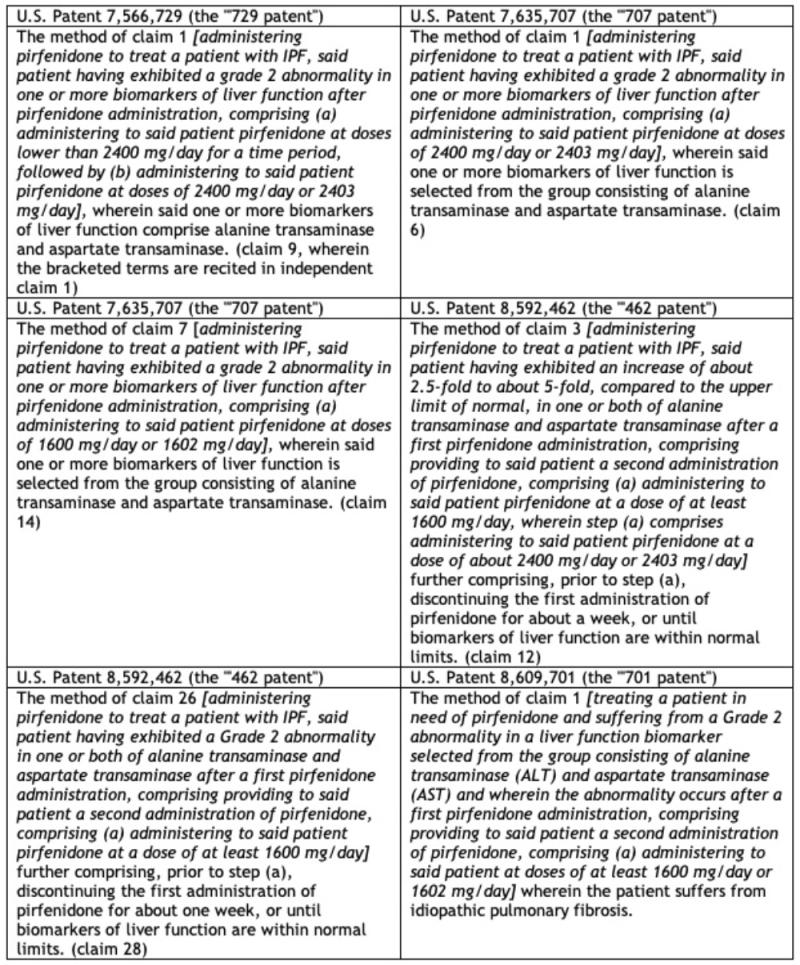
    Unlike most ANDA suits, the patents at issue here were not directed at the drug, formulations thereof, or methods of treatment, but rather towards administration methods for ameliorating or avoiding certain drug side effects.  There were two categories of patents at issue in the ANDA litigation and this appeal.  The first, termed the "LFT patents," were directed at administration methods for patients having liver abnormalities as detected by biomarker alterations.  These patents were U.S. Patent Nos. 7,566,729 (the "'729 patent"), 7,635,707 (the "'707 patent"), 8,592,462 (the "'462 patent"), and 8,609,701 (the "'701 patent") and the claims at issue are set forth in this table:

    The asserted LFT patent claims:

    2022-12-27 Image 1
    The opinion summarizes the claimed subject matter into five categories:  administration methods that (1) temporarily reduce the administered dose followed by return to the "full" therapeutic dose; (2) maintain the full administered dose; (3) reduce the dose (and maintain the reduced dose); (4) discontinue administration for a week and then return to the full therapeutic dose; and (5) discontinue administration for a week and then administer a reduced dose.

    Infringement was assessed as to these claims based on Sandoz's proposed label, which recited how the drug should be administered to patients showing sufficiently severe liver abnormalities:

    Dosage modifications or interruptions may also be necessary when liver enzyme and bilirubin elevations are exhibited.  For liver enzyme elevations, modify the dosage as follows:

    If a patient exhibits >3 but ≤5 x the upper limit of normal (ULN) ALT and/or AST without symptoms or hyperbilirubinemia after starting pirfenidone tablets therapy:

    • Discontinue confounding medications, exclude other causes, and monitor the patient closely.
    • Repeat liver chemistry tests as clinically indicated.
    The full daily dosage may be maintained, if clinically appropriate, or reduced or interrupted (e.g., until liver chemistry tests are within normal limits) with subsequent re-titration to the full dosage as tolerated.

    wherein the italicized language was particularly relevant to Genentech's allegations sounding in inducement of infringement under 35 U.S.C. § 271(b).

    Sandoz asserted invalidity for obviousness over three references:  a scientific journal article by Azuma related to a clinical trial of pirfenidone; a label for Shionogi's pirfenidone product approved in Japan, Pirespa®; and "known, standard medical practices."  The Federal Circuit's opinion characterized the teachings of the Azuma reference to specify a "stepwise" reduction in pirfenidone administration up to and including discontinuing the drug in response to severity of liver-associated side effects, and that the Pirespa® label specified discontinuing the drug.  The District Court had found that four of the five liver-associated side-effect induced alterations in pirfenidone administration were disclosed in the Pirespa® label, and furthermore found that Genentech's asserted claims in the LFT patents were invalid for obviousness in light of the references relied upon by Sandoz.

    Sandoz also argued that there was no specific intent to induce infringement and thus its label did not induce infringement.

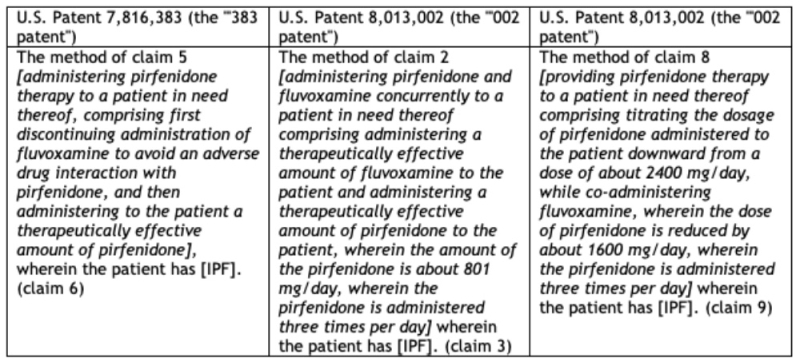
    The other category of patents asserted by Genentech were directed to adverse interactions with another drug, fluvoxamine (termed "the DDI patents").  Fluvoxamine inhibits an enzyme, CYP1A2, that is involved in liver detoxification and metabolism of drugs including pirfenidone, where administration of pirfenidone to a patient taking fluvoxamine would result in what the opinion calls "supertherapeutic" drug levels in the patient's body.  The claims at issue for these patents were as follows:

    2022-12-27 Image 2
    The opinion summarizes the instructions in Sandoz's label (which forms the basis for Genentech's direct (literal) infringement allegations) as directing that fluvoxamine administration be discontinued prior to administering pirfenidone or reducing the amount of pirfenidone administered to a specified dose (267mg/3 time per day).  The District Court found this label to be insufficient to support Genentech's direct infringement allegations by a preponderance of the evidence because, despite Genentech showing that the label "encourages, recommends, or promotes an infringing use" Genentech failed to show that "such an infringement will in fact occur" (which seems at least odd in view of the function of the label as enshrining FDA determinations regarding how an approved drug can be safely and effectively used).  The basis for the District Court's decision was that Genentech failed to show that any patient would be prescribed both drugs to be administered together or at the same time, a prohibition that if it deemed necessary, the FDA would be capable of requiring, particularly insofar as the label expressly stated that:

    The concomitant administration of pirfenidone and fluvoxamine or other strong CYP1A2 inhibitors (e.g., enoxacin) is not recommended because it significantly increases exposure to pirfenidone.  . . .   Use of fluvoxamine or other strong CYP1A2 inhibitors should be discontinued prior to administration of pirfenidone and avoided during pirfenidone treatment.  In the event that fluvoxamine or other strong CYP1A2 inhibitors are the only drug of choice, dosage reductions are recommended.  Monitor for adverse reactions and consider discontinuation of pirfenidone as needed [emphasis added].

    The Federal Circuit affirmed, in an opinion by Judge Lourie who was joined by Judge Prost; Judge Newman dissented without an opinion (perhaps getting to the point where the Judge is not willing to waste her judicial breath in cases where her opinion has proven to be unavailing).  With regard to the District Court's finding that the asserted claims of the LFT patents were obvious, the majority displayed the mindset brought to the question by stating that "it is worth noting our initial perception that, as the district court noted, varying doses in response to the occurrence of side effects would seem to be a well-established, hence obvious, practice.  Thus, claiming it as an invention would appear to be at best a long shot" before stating that, like the District Court, the Federal Circuit would give the matter "careful scrutiny."  Perhaps not surprisingly in view of the majority's preconceptions, the Court agreed with Sandoz that these claims were obvious, despite Genentech's objections regarding what Azuma and the Pirespa® label taught to the skilled artisan (which as questions of fact the District Court's findings were due "clear error" deference by the Federal Circuit).  The District Court's findings as to the teachings of the asserted prior art were supported in the majority's view by "record evidence" and expert testimony.  Finally, the majority relied upon the Federal Circuit's rubric following KSR v. Teleflex that "weak secondary considerations [as the District Court and the majority considered Genentech's secondary considerations arguments to be] generally do not overcome a strong prima facie case of obviousness," citing W. Union Co. v. MoneyGram Payment Sys., Inc., 626 F.3d 1361, 1371 (Fed. Cir. 2010).  These arguments included skepticism in the art and long-felt but unmet need; none of these were sufficiently established by Genentech in the majority's view nor had Genentech established that the District Court clearly erred in arriving at its conclusions in this regard.

    Having affirmed the District Court's obviousness determination, the panel did not reach the District Court's non-infringement decision.

    With regard to the DDI patents, despite citing precedent that "a patentee does not need to prove an actual past instance of direct infringement by a physician to establish infringement in an ANDA case," Vanda Pharms. Inc. v. W.-Ward Pharms. Int'l Ltd., 887 F.3d 1117, 1129–30 (Fed. Cir. 2018), the majority nevertheless opined that the question of direct infringement requires "'consideration of all the relevant evidence,' including the proposed label's instructions and physician practice," citing Ferring v. Watson Lab'ys, 764 F.3d 1401, 1408 (Fed. Cir. 2014), because "past conduct is relevant to what will happen in the future" (a position the opinion acknowledges Sandoz argued).  The majority's affirmance relied upon expert witness testimony that the two drugs (pirfenidone and fluvoxamine) would not be administered together or at the same time based on "decades of treating IPF patients" (which testimony is at least curious in view of the 2014 approval date of Genentech's Esbriet® product) and that there was an alternative product on the market (nintedanib) that the physicians would prescribe instead.  The majority characterized as speculation without evidentiary support Genentech's argument that instructions regarding co-administration were important enough that the FDA included them on Sandoz's label, and in any event were not enough to sufficiently support Genentech's direct infringement arguments according to the majority.  (And in what appears to be something of a "Hail Mary" argument, the majority rejected Genentech's assertion that fluvoxamine can be used to treat COVID-19 infection in an IPF patient as speculation.)

    Based on the totality of the evidence relied upon by the District Court, the Federal Circuit majority affirmed the District Court's finding that Sandoz would not necessarily directly infringe the claims of Genentech's DDI patents.

    Genentech, Inc. v. Sandoz Inc. (Fed. Cir. 2022)
    Panel: Circui9t Judges Newman, Lourie, and Prost
    Opinion by Circuit Judge Lourie; dissent without opinion by Circuit Judge Newman

  • Strafford #1Strafford will be offering a webinar entitled "Patenting Pharmaceutical Drug Formulations: Withstanding Litigation and PTAB Challenges" on December 29, 2022 from 1:00 to 2:30 pm (EST).  Adriana L. Burgy, Justin J. Hasford, and Thomas L. Irving of Finnegan Henderson Farabow Garrett & Dunner, and Angela Sebor of Tolmar will guide attendees on patenting drug formulations from drafting through patent prosecution and enforcement, examine lessons learned from the case law, and offer strategies to overcome the potential challenges.  The webinar will review the following issues:

    • What steps can counsel for patentees take during drafting to avoid written description and enablement problems and withstand invalidity/unpatentability challenges based on written description and enablement?
    • What steps should patent counsel take to balance showing unpredictability for non-obviousness to fulfill the enablement and written description requirements?
    • How to use means-plus-function claims for pharmaceutical formulations against ANDA filers and/or 505(b)(2) filers; and
    • What factors does counsel need to keep in mind when litigating formulation claims?

    The registration fee for the webcast is $347.  Those interested in registering for the webinar, can do so here.