• By Kevin E. Noonan

    Goodlatte, BobAs expected by almost everyone (and anticipated by several groups who urged him not to do so; see "Pro-Patent Coalition Writes Letter to the House and Senate Judiciary Committees" and "Big Ten Lobbies Congress to Tread Lightly on "Patent Reform""), Rep. Bob Goodlatte (R, VA-6th), joined by Rep. Peter DeFazio (D, OR-4th), Rep. Darrell Issa (R, CA-49th), Rep. Jerrold Nadler (D, NY-10th), Rep. Lamar Smith (R, TX-21st), Rep. Zoe Lofgren (D, CA-19th),  Rep. Steve Chabot (R, OH-1st), Rep. Anna Eshoo (D, CA-18th), Rep. Randy Forbes (R, VA-4th), Mr. Pedro Pierluisi (D, Representative for Puerto Rico), Rep. Jason Chaffetz (R, UT-3rd), Rep. Hakeem Jeffries (D, NY-8th), Rep. Tom Marino (R, PA-10th), Rep. Blake Farenthold (R, TX-27th), Rep. George Holding (R, NC-13th), Rep. Bill Johnson (R, OH-6th), Rep. Jared Huffman (D, CA-2nd), Rep. Mike Honda (D, CA-17th), and Rep. Rick Johnson (D, WA-2nd) (in other words, a true bipartisan bill) today introduced his "Innovation Act" bill in substantially the same form as in the last Congress (H.R. 3309).  The bill is "bipartisan" for the same reason the Smith-Leahy America Invents Act (the AIA) was bipartisan — it is a bill whose provisions can be spun as being "a jobs bill" or one that "protects American innovation" by members on both sides of the aisle, and is sufficiently arcane that most members of the public will not be overly concerned about it.  Which is too bad, because the evidence is mounting that most of the provisions are unnecessary or could be accomplished by a much more limited bill directed at actual abuses of the patent system.  But if the same lineup of lobbying groups representing industries who need not rely on patents spends about as much money and is opposed by a fractured coterie of industries that actually do depend on patents, then passage is certain in the House, and likely also in the Republican-controlled Senate.  It is also a certainty that the President will sign such a bill; Mr. Obama has shown neither any understanding nor any affection for the patent system that would make him inclined to wield his veto pen.

    The bill addresses two broad areas of the law:  patent litigation and "prosecution," that is some aspects of how the Patent Office has implemented certain provisions of the AIA.  The bill is set out in ten sections:

    Sec. 1. Short title; table of contents.
    Sec. 2. Definitions.
    Sec. 3. Patent infringement actions.
    Sec. 4. Transparency of patent ownership.
    Sec. 5. Customer-suit exception.
    Sec. 6. Procedures and practices to implement recommendations of the Judicial Conference.
    Sec. 7. Small business education, outreach, and information access.
    Sec. 8. Studies on patent transactions, quality, and examination.
    Sec. 9. Improvements and technical corrections to the Leahy-Smith America Invents Act.
    Sec. 10. Effective date.

    Five of these sections are substantive, and the bill also contains mandates for several "studies" on the patent system (similar to the "study" on second opinion genetic diagnostic testing in the AIA that still has not seen the light of day, almost three years after it was due).

    The patent litigation provisions once again focus on the "burden" on (presumably) innocent infringers imposed by being named as a defendant in an infringement suit.  These include heightened pleadings requirements set forth in Sec. 3(A)(1)(a), including that in any infringement action the plaintiff must identify:

    ''(1) An identification of each patent allegedly infringed.
    ''(2) An identification of each claim of each patent identified under paragraph (1) that is allegedly infringed.
    '(3) For each claim identified under paragraph (2), an identification of each accused process, machine, manufacture, or composition of matter (referred to in this section as an 'accused instrumentality') alleged to infringe the claim.
    ''(4) For each accused instrumentality identified under paragraph (3), an identification with particularity, if known, of—
        ''(A) the name or model number of each accused instrumentality; or
        ''(B) if there is no name or model number, a description of each accused instrumentality.
    ''(5) For each accused instrumentality identified under paragraph (3), a clear and concise statement of—
        ''(A) where each element of each claim identified under paragraph (2) is found within the accused instrumentality; and
        ''(B) with detailed specificity, how each limitation of each claim identified under paragraph (2) is met by the accused instrumentality.
    ''(6) For each claim of indirect infringement, a description of the acts of the alleged indirect infringer that contribute to or are inducing the direct infringement.
    ''(7) A description of the authority of the party alleging infringement to assert each patent identified under paragraph (1) and of the grounds for the court's jurisdiction.
    ''(8) A clear and concise description of the principal business, if any, of the party alleging infringement.
    ''(9) A list of each complaint filed, of which the party alleging infringement has knowledge, that asserts or asserted any of the patents identified under paragraph (1).
    ''(10) For each patent identified under paragraph (1), whether a standard-setting body has specifically declared such patent to be essential, potentially essential, or having potential to become essential to that standard-setting body, and whether the United States Government or a foreign government has imposed specific licensing requirements with respect to such patent.

    It will be appreciated that some or much of the facts necessary to fulfill these requirements may not be available prior to discovery, and for at least some of these instances the bill provides (in Sec. 3(A)(1)(b)) that a plaintiff can describe the information generally, with an explanation of why more specific information could not be adduced ("was not readily accessible") despite efforts to do so (wherein the substance of these efforts must also be plead).  Complaints containing confidential information can be filed under seal upon motion, which if denied entitle the party to "seek to file" an amended complaint (Sec. 3(A)(1)(c)).  And, as in the last version of the Innovation Act, ANDA litigation brought under 35 U.S.C. § 271(e)(2) are not subject to these requirements.

    Another litigation-specific part of the bill (Sec. 3(b)(1)(a) et seq.), and the section that was responsible for Sen. Harry Reid (D-NV) refusing to bring the bill to the Senate floor, involves fee-shifting against a "non-prevailing party" "unless the court finds that the position and conduct of the nonprevailing party or parties were reasonably justified in law and fact or that special circumstances (such as severe economic hardship to a named inventor) make an award unjust."  While couched in seemingly innocuous language, Sen. Reid appreciated (purportedly spurred on by the trial lawyers lobby) that these provisions constitute a sea change in the presumptions under U.S. law (this section begins with the phrase "The court shall award [such fees and "other expenses"]. . . ) that parties bear their own costs unless there is evidence that one party acted fraudulently or recklessly in bringing or defending against a lawsuit.  In addition, the bill contains indemnification provisions that may make one co-plaintiff (or, more rarely, co-defendant) liable for such an award in the event that one or more of the parties cannot satisfy the award (Sec. 3(b)(1)(b)).  The bill also discourages a patentee from offering a covenant not to sue as a means to settle infringement litigation, making such an offer an admission that the patentee is the "non-prevailing party" and thus a risk for an award of fees and costs to the accused infringer (Sec. 3(b)(1)(c)).

    Curiously, this section of the bill also contains a provision that Sec. 273 of the Code be amended by striking sections (f) and (g); while this is seemingly not related to the other provisions, it does materially affect the effects of this section on the assertion of the "prior user rights" defense:

    (a) In General.— A person shall be entitled to a defense under section 282 (b) with respect to subject matter consisting of a process, or consisting of a machine, manufacture, or composition of matter used in a manufacturing or other commercial process, that would otherwise infringe a claimed invention being asserted against the person if—
        (1) such person, acting in good faith, commercially used the subject matter in the United States, either in connection with an internal commercial use or an actual arm's length sale or other arm's length commercial transfer of a useful end result of such commercial use; and
        (2) such commercial use occurred at least 1 year before the earlier of either—
            (A) the effective filing date of the claimed invention; or
            (B) the date on which the claimed invention was disclosed to the public in a manner that qualified for the exception from prior art under section 102 (b).

    * * *

    (f) Unreasonable Assertion of Defense.— If the defense under this section is pleaded by a person who is found to infringe the patent and who subsequently fails to demonstrate a reasonable basis for asserting the defense, the court shall find the case exceptional for the purpose of awarding attorney fees under section 285.
    (g) Invalidity.— A patent shall not be deemed to be invalid under section
    102 or 103 solely because a defense is raised or established under this section.

    (in other words, "unreasonable" assertion of the defense is no longer a per se violation that would invoke the "special case" provisions of the statute, and a patent could be deemed invalid under Sec. 102 or Sec. 103 of the statute "solely" because the defense had been plead).

    These provisions are immediately effective upon enactment and apply to any complaint filed "on or after the first day of the 6-month period ending on that effective date."

    This section also contains provisions (Sec. 3(c)) for retroactive joinder, in cases where the non-prevailing party cannot satisfy the fees and expenses award, that would permit a prevailing party to join "an interested party" upon a showing that the non-prevailing party "has no substantial interest in the subject matter at issue other than asserting such patent claim in litigation"; these provisions are clearly directed at patent aggregation entities and other non-practicing entities, although it might be difficult to make the required showing against some NPEs (like universities, for example).  Such joinder has an actual notice requirement and a "get out of jail free" provision, wherein the party to be joined can escape liability by "renounce[ing], in writing and with notice to the court and the parties to the action, any ownership, right, or direct financial interest (as described in paragraph (4)) that the interested party has in the patent or patents at issue."  "Interested parties" are defined in this section of the statute to include assignees, licensees with the right to enforce the patent in suit, or anyone else having a direct financial interest in the patent, but not counsel "if the sole basis for the financial interest of the attorney or law firm in the patent or patents at issue arises from the attorney or law firm's receipt of compensation reasonably related to the provision of the legal representation" (which, while good news does enable a party to argue that the compensation is not reasonable and thus that there is sufficient "financial interest" to justify a court imposing liability on counsel).

    The limits on discovery (Sec. 3(d) et seq.) contained in H.R. 3309 are also contained in this bill, including limitations until after the court has performed claim construction (with provisions for a court to exercise discretion regarding expanding the scope of discovery if necessary for claim construction and under "special circumstances"); this section also exempts from the discovery limitations discovery directed to a motion for a preliminary injunction to avoid "competitive harm" (Sec. 3(d)(1)(b)(4)) or if at least one plaintiff and one defendant stipulate that they wish to be exempt from these limitations.

    The next portion of Section 3 sets forth a "sense of the Congress" that "it is an abuse of the patent system and against public policy for a party to send out purposely evasive demand letters to end users alleging patent infringement" (Sec. 3(e)).  Accordingly, the following part of Section 3 provides that willful infringement cannot be established merely by sending a demand letter, but must include the type of information required in the earlier portions of Section 3 for filing a complaint. (Sec. 3(f) et seq.)

    Section 4 of the bill contains the requirements for "transparency" in patent ownership, wherein a plaintiff must disclose to all adverse parties, the court and the Patent and Trademark Office the assignee(s) of the patents in suit, any licensee empowered to sublicense or enforce the patents, any other entity having a "financial interest" in the patents, and the "ultimate parent entity" of any of the aforesaid parties; this provision seemingly is intended to prevent litigation by proxy, and also contains the exemption for ANDA litigation under 35 U.S.C. § 271(e)(2) found in Section 3 of the bill.  These requirements are on-going (Sec. 4(d)) and "failure to comply" will prevent a successor from recovering fees and expenses under 35 U.S.C. § 285 or increased damages under 35 U.S.C. §284.  These provisions are effective "upon the expiration of the 6-month period beginning on the date of the enactment."

    The bill also contains provisions (in Sec. 5) that permit an infringement action against a "covered customer" to be stayed in favor of an action against the manufacturer of the article sold to the customer upon motion consented to by both customer and manufacturer.

    The remaining Sections of the bill will be discussed in a separate post.

  • Federal Circuit Sides with Patent Office in First IPR Final Written Decision Review

    By Andrew Williams

    Federal Circuit SealEarlier today, the Federal Circuit decided the first appeal from the Patent Trial and Appeal Board ("PTAB" or "Board") related to an inter partes review ("IPR") Final Written Decision.  As we have previously reported, the In re Cuozzo Speed Technologies, LLC. case was the first appeal of the first IPR Final Written Decision for the first IPR ever filed.  As such, the significance of this case rested not only on the how the Court would address the substance of the present case, but on what the Federal Circuit would say regarding some of the more contentious rules promulgated by the Patent Office for these proceedings.  Specifically, the 2-1 decision, which was written by Judge Dyk and joined by Judge Clevenger, affirmed the Board's use of the Broadest Reasonable Interpretation (BRI) standard for claim construction, and agreed with the Office that any aspect of the decision to institute the IPR is not reviewable.  With regard to the substance of the case, the Federal Circuit also affirmed the Board's cancellation of the claims at issue as obvious over the cited art (although not necessarily as specifically cited in the petition).  Judge Newman dissented, in part, because she believed that several rulings of the Court were contrary to the legislative intent behind the creation of the PTAB and IPR proceedings.

    We described the technology at issue in this case in a previous post (see "The First IPR Decision — A Win for the Patent Challenger").  Put simply, the claimed technology is directed to indicating speed limits at particular locations on GPS units.  A GPS receiver is used to track the location of a vehicle, and the speed limit indicator correlates the vehicle's position with a database containing the speed limit for that location.  As the database is accessed, the colored filter adjusts so that speeds above the legal speed are displayed in red, and legal speeds are displayed in white.  Claim 10 reads as follows:

    10.    A speed limit indicator comprising:
        a global positioning system receiver;
        a display controller connected to said global positioning system receiver, wherein said display controller adjusts a colored display in response to signals from said global positioning system receiver to continuously update the delineation of which speed readings are in violation of the speed limit at a vehicle's present location; and
        a speedometer integrally attached to said colored display.

    USPTO SealOne of the first issues resolved by the Court was whether it could even review the Board's decision to institute an IPR proceeding in the first place.  Importantly, the Federal Circuit held that the statute barred such a review, even when the institution is contrary to the requirements outlined by the statute.  In this case, the Board instituted the review on grounds not specifically identified in the petition, even though all of the art the Board cited could found therein.  The Federal Circuit's decision, however, was not so nuanced.  Instead, it went on to state that even if the Board went beyond the statute and instituted an IPR based on a prior public use (which is not permitted by the statute), such an action would not be appealable.  The Court did suggest that mandamus might be available when the Board exceeds its authority, but even that was not certain.  A petitioner would first need to establish that mandamus relief was not barred by the statute, and then it would need to demonstrate a clear and indisputable right to the issuance of a writ, and that the writ was appropriate under the circumstances.  The Court indicated that none of these had been demonstrated in this case.

    The problem with the Court's analysis, however, is that the cited case law related to other Patent Office procedures in which examination of an application takes place.  For example, it cites In re Hiniker Co., 150 F.3d 1362, 1367 (Fed. Cir. 1998), approvingly, even though that case was directed to a reexamination proceeding.  The Court had found that a defect in the decision to institute was cured by the final decision.  Basically, the defective petition was irrelevant because "a proper petition could have been drafted."  First, the petition was only cured in that case because the examiner searched the prior art — something the Board continually reminds stakeholders it will not do in an IPR proceeding.  Judge Newman even pointed out that the Board has consistently claimed that an IPR is not a patent examination, but rather "a trial, adjudicatory in nature [which] constitutes litigation," citing Google Inc. v. Jongerius Panoramic Techs, LLC, IPR2013-00191, Paper No. 50 at 4 (PTAB Feb. 13, 2014).  Moreover, the Court's rationale does not fit the hypothetical of a review instituted on prior public use.  In such a case, a proper petition could not have been drafted — and yet such decision would not have been appealable.

    Of course, the issue that has probably been the most closely watched from this case was whether the adoption of the "broadest reasonable interpretation" by the PTAB was proper.  The Federal Circuit believed that it was.  Nevertheless, as readers of this blog are aware, the use of this standard has been strongly criticized and is generally disfavored by the patent community.  As Judge Newman pointed out in dissent, IPR proceedings before the PTAB were meant to be a surrogate for district court litigations on validity.  She complained that this goal has not been realized because of the use of these two different standards of claim construction.  One of the justifications for the adoption of this standard by the Patent Office has been that a patentee can amend its claims in an IPR proceeding.  As Judge Newman noted, however, the ability to amend claims has been almost entirely illusory.  In over two years, only two sets of claim amendment motions have been granted by Board (see "PTAB Update — The Board Grants Its Second Motion to Amend (At Least in Part)").

    In any event, the Court held that adoption of this standard was consistent with the legislative history, even though its strongest pronouncement was that it "can be inferred that Congress impliedly adopted the existing rule of adopting the broadest reasonable construction."  Judge Newman disagreed with this assessment.  Instead, she pointed to the difference in language used in the various part of the statute — reexaminations, interferences, and reissues refer to the "patentability" of claims, while the IPR statute uses the word "validity."  Certainly, the difference in wording cannot be ignored, because this distinction must be significant.  Finally, the Court also noted that adoption of this standard was within the rulemaking authority of the PTO as established by the statute, and a Chevron analysis dictates deference in this case.  Judge Newman argued that the intention of Congress was clear, albeit the exact opposite of how it was interpreted by the Patent Office and the majority.

    With regard to whether this case contained any significant comments about whether the PTAB is properly handling motions for claim amendments, the holding is fairly limited.  Both the statute and the rules prohibit claim amendments that broaden the scope of the claims.  The Federal Circuit cited cases in the reissue and reexamination context when it clarified that a claim is "broader in scope than the original claims if it contains within its scope any conceivable apparatus or process which would not have infringed the original patent."  Because the proposed claim amendment in this case would have encompassed a new embodiment, the Court affirmed the denial of the motion to amend.

    For anyone practicing before the PTAB looking for a take home lesson, it would probably be that you should not leave any of your cards on the proverbial table.  An unsuccessful challenger or defender of a patent before the PTAB should not look to the Federal Circuit for an easy reversal.  This case makes clear the Federal Circuit's willingness to defer to the PTAB on issues of both substance and procedure.  This result should not be surprising, however, and may be pragmatic, especially in view of the deluge of IPR appeals that the Court is anticipating in the very near future.

    In re Cuozzo Speed Technologies, LLC (Fed. Cir. 2015)
    Panel: Circuit Judges Newman, Clevenger, and Dyk
    Opinion by Circuit Judge Dyk; dissenting opinion by Circuit Judge Newman

  • By Donald Zuhn

    USPTO Building FacadeIn a forum held January 21 on the U.S. Patent and Trademark Office's Alexandria campus, Office representatives discussed the Interim Guidance on Patent Subject Matter Eligibility, which was released in December, and received additional input from the public regarding that guidance.  The forum, which ran almost four and a half hours, began with some opening remarks by Drew Hirshfeld, Deputy Commissioner for Patent Examination Policy at the USPTO, and then Raul Tamayo, Senior Legal Advisor in the Office of Patent Legal Administration at the USPTO, followed Mr. Hirshfeld's presentation with an overview of the Interim Guidance.  The remainder of the forum was devoted to two groups of public presentations — in which the presenters were essentially divided into those on the life sciences side (group one) and those on the hi-tech side (group two) — and an "open participation/question/answer" session, in which attendees were allowed to give statements or ask questions of USPTO representatives participating in the forum.

    Leading off the forum, Mr. Hirshfeld provided a few highlights regarding changes to the Interim Guidance relative to the Myriad/Mayo guidance that was released by the Office in March.  First, he noted that the Interim Guidance "narrows the funnel" in that the new guidance applies only to claims that are directed to (or recite) a judicial exception, as opposed to claims that involve a judicial exception.  Mr. Hirshfeld also noted that the Interim Guidance permits applicants to establish subject matter eligibility using markedly different characteristics other than just structure.  He suggested that by removing the 12-factor test from the Myriad/Mayo guidance, the Office had made the Interim Guidance less complex than the Office's earlier guidance.  Finally, he pointed out that the Office had responded to public feedback, and would be providing more examples, including examples that were not based on actual claims discussed in the case law.  Before turning the lectern over to Mr. Tamayo, Mr. Hirshfeld reminded attendees that the development of the guidance was an iterative process, and that the Office would continue to collect and evaluate comments from the public, and make changes to the guidance where necessary.

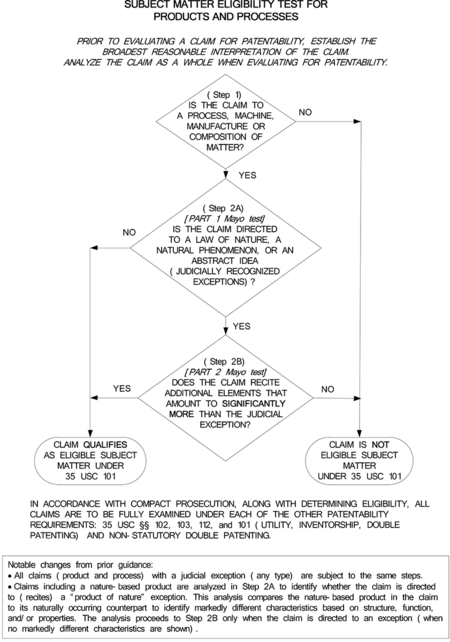
    Mr. Tamayo's overview of the Interim Guidance also focused on the changes the Office had made to the subject matter eligibility analyses set forth in the Myriad/Mayo guidance and the Preliminary Examination Instructions released by the Office in June (a copy of Mr. Tamayo's presentation can be obtained here).  By presenting a "comprehensive view" of subject matter eligibility, combining the previously separate analyses for claims reciting abstract ideas (Alice/Bilski) and claims reciting natural products (Myriad/Mayo), Mr. Tamayo suggested that this represented a change in itself.  According to Mr. Tamayo, the best overview of the Interim Guidance was provided by the flowchart in the guidance (click on flowchart to expand):

    2014-12-16 Flowchart
    He noted that the examination procedure set forth in the flowchart relied on the two-step test set forth in Mayo, which the Court then applied in Alice.  Mr. Tamayo explained that there was "nothing new" about the first step in the flowchart (i.e., whether the claim is directed to a statutory class of subject matter), which had "been around for a while."  The second step of the Interim Guidance test, divided on the flowchart into Steps 2A and 2B, set forth the two-step framework of Mayo/Alice.  Mr. Tamayo noted that the examination procedure outlined in the Interim Guidance's flowchart also constituted a change from the Office's prior guidance.

    As Mr. Hirshfeld had discussed earlier, Mr. Tamayo indicated that a further change to the Interim Guidance could be found in Step 2A, which requires an analysis of whether the claim is directed to a judicial exception, as opposed to the Myriad/Mayo guidance which applied to claims that recited or involved a judicial exception.  Mr. Tamayo also indicated that by "directed to," the Office means "sets forth" or "describes."  The Interim Guidance itself states that "[a] claim is directed to a judicial exception when a law of nature, a natural phenomenon, or an abstract idea is recited (i.e., set forth or described) in the claim" (emphasis added), so it would appear that claims involving a judicial exception will be exempt from consideration under the new guidance.  How the Office will distinguish in practice between claims that are directed to, recite, set forth, or describe a judicial exception and those that "merely" involve a judicial exception is not entirely clear.

    With respect to claims directed to nature-based products, Mr. Tamayo noted that such claims "require closer scrutiny," and that in another change in the new guidance, this scrutiny would take place during Step 2A.  In yet another change, Mr. Tamayo noted that nature-based products would be scrutinized using markedly different characteristics other than just structure, which had been the sole focus of the Myriad/Mayo guidance.  He also explained that the Office had looked to Federal Circuit and Supreme Court decisions to compile a non-exhaustive list of the types of characteristics that could be considered in assessing whether there is a marked difference, including biological or pharmacological functions or activities, chemical and physical properties, phenotype, and structure and form (see slide 12 below from Mr. Tamayo's presentation).

    Slide12
    Moving on to Step 2B, Mr. Tamayo indicated that this step addressed the question of whether any limitation (or limitations) in the claim ensured that the claim as a whole amounts to something that is significantly more than the judicial exception itself.  Mr. Tamayo then provided a list of examples of limitations that either qualified or did not qualify as amounting to something that is significantly more than the judicial exception (see slides 15 and 16 below from Mr. Tamayo's presentation).

    Slide15

    Slide16
    Mr. Tamayo concluded his presentation by noting one last change in the new guidance:  a streamlined eligibility analysis, which the Interim Guidance explains "can be used for a claim that may or may not recite a judicial exception but, when viewed as a whole, clearly does not seek to tie up any judicial exception such that others cannot practice it" (see slide 19 below from Mr. Tamayo's presentation).  Whether the streamlined eligibility analysis will play a role in the Office's eligibility analyses, however, remains to be seen.

    Slide19
    Highlights from the public presentations will be provided in subsequent posts.

    For additional information regarding this topic, please see:

    • "USPTO Issues Post-Alice Abstract Idea Examples," January 28, 2015
    • "Impact of Interim Guidance on Business Method and Software Claims," December 17, 2014
    • "USPTO Issues Interim Guidance on Subject Matter Eligibility," December 16, 2014
    • "USPTO to Release Revised Subject Matter Eligibility Guidance," December 15, 2014

  • It seems that Orwell was right: all pigs are equal, but some are more equal than others.

    By Kevin E. Noonan

    The question of how diverse different breeds of domesticated animals may be has begun to be addressed with the completion of many "genome projects" directed towards household animals like dogs and cats.  Pigs are animals that are extremely important economically both historically and today, and that come in many different breeds throughout the world.  This species (Sus scrofu) arose from the common ancestor with wild boars about 1.2 million year ago, and then diverged into European pigs and Chinese pigs.  This was not a speciation event but a population one (similar in its way with the divergence between human races), which in pigs occurred sometime in the Pleistocene and possibly related to the last large glaciation event in the Northern Hemisphere (about 130,000 years ago).  These events were complete long before pigs were domesticated by humans, in both China and the Middle East, about 10,000 years ago.  China has almost one-third of the breeds of pigs in the world (~100 breeds), with there being a recognized difference in phenotype between pigs in the north and south of the country, inter alia, differences in thermoregulatory mechanisms that have adapted these pigs to their different environments.

    Nature GeneticsNow a group led by researchers from Jiangxi Agricultural College* has sequenced genomes of 69 pigs (Sus scrofa) from different parts of China, specifically 15 geographically distinct regions, as reported in Nature Genetics ("Adaptation and possible ancient interspecies introgression in pigs identified by whole-genome sequencing," Nature Genetics (2015) (Published online 26 January 2015)).  These pigs were members of eleven "geographically diverse" breed plus three populations of wild boar, which included the breeds Bamaxiang, Wuzhishan, and Luchuan and southern Chinese wild boars (comprising the southern population); and Erhualian, Hetao, Laiwu, Min, Tibetan (Gansu), Tibetan (Sichuan) Tibetan (Tibet), and Tibetan (Yunnan) breeds and the northern Chinese wild boar (comprising the northern population; although the Tibetan pigs are at similar latitudes as the southern populations their elevation is closer in climate to the northern pigs).

    The types of studies reported by the Jiangxi group have been used (on pigs and other species) to identify "genomic signature of selection" indicative of domestication (wherein both natural selection and artificial (human) selection has been at work).  This work extends that to individuals in distinct populations within a species to identify such signatures related to geographic condition-related adaptations.

    While there were a variety of interesting results to this study, one broad conclusion these authors made is that pigs have adapted to a hot and wet vs. a cold and dry climate that is unique to China in view of its geographic range.

    The statistics of the genomic DNA sequencing from these 69 pigs is as follows:

    • Greater than 25-fold coverage of the pig genomes, 95% genome coverage;
    • About 41 million (40,820,483) SNPs were detected, with 21 million of these that are not in the reference pig genomic database;
    • 26.6 million of these SNPs were intergenic;
    • 188,664 SNPs were exonic;
    • About 500,000 SNPs were intronic (the authors interpret the non-exonic SNPs as indicating that regulatory variants were involved in the observed genetic adaptations);
    • An average of 13.3 million SNPs were detected per individual, with Chinese wild boar showing the highest average (14.5 million); wild boars also had the highest number of population-specific SNPs (767,770);
    • An average of 794 "loss-of-function" mutations in each pig breed but only 3 breed-specific LOF variants, including "a nonsense mutation in the PKD1L3 gene in Laiwu pigs, a splice-site mutation in the IFLTD1 gene in Luchuan pigs and a splice-site mutation in the SKIL gene in Min pigs";
    • 5,663,829 indels (insertion/deletion events) and 44,170 structural variations;
    • 2,000,000 copies of tRNA-derived short interspersed repeat (SINEs) distributed in the chromosomes in such a way that suggested these elements were "an important source of genetic diversity in pigs."

    Pig genes associated with geographically relevant diversity (i.e., differences between "northern" breeds and "southern" breeds) included genes involved in blood coagulation and circulation (TBC1D8, KIF2B, VPS13A, and GNA14); vasculature development (FZD10), neural tube closure (SUFU), cellular chloride ion homeostasis (ABCC2), and hair development (DCAF17).

    Locus-specific branch-length analyses revealed 774 "sweep" regions implicating 219 genes with population-related reductions in heterozygosity and recombination.  These regions comprised on average 51kb on pig autosomes and one large ~14 Mb sweep in the X chromosome.  On the autosomes, the strongest sweep signal from chromosome 15 spanning 300 kb, comprising the locus for the DCAF17 gene.  This region was found to be "nearly devoid of genetic variability" and the hair development gene DCAF17 showed "clear allelic imbalance" between the two pig populations.  This was consistent with the authors' hypothesis that the pig population genomes had adapted to the climate in which the different pig breeds were found in China, and with the observed phenotypes of sparse hair in southern pigs and dense, insulating hair in northern pigs.

    These studies also implicated 219 genes in these sweep regions, and the authors reported finding missense mutations in 10 of these 219 genes.  One particular gene, the VPS13A gene that encodes chorein, was found to have two nonsynonymous substitutions; the significance of this finding is that chorein was recently characterized as a key regulator of the secretion and aggregation of blood platelet and showed "marked" allelic differences between the two populations, with the authors "hypothesiz[ing] that the VPS13A missense mutations might contribute to reducing the risk of thrombosis by modulating platelet counts and blood viscosity in southern Chinese pigs in hot environments."

    Gene Ontology (GO) analysis identified a significant over-representation in these 219 genes of genes involved in biological processes that contribute to the maintenance of thermostatic status during heat or cold stress.  These processes were related to hair cell differentiation (ATOH1, JAG1 and RAC1) and hair follicle maturation (BARX2 and TBC1D); forebrain neuron differentiation (DLX1, DLX2, RAC1, ROBO1 and SALL1); kidney development (BMP4, BMP7, MYC, SALL1, SPRY1 and KLHL3); energy metabolism and blood circulation, including artery development (BMP4, CITED2 and JAG1) and embryonic heart tube development (CITED2, INVS, RYR2, SUFU and TBC1D8), among others.

    Also of interest was the large sweep region (~14 Mb) detected on the X chromosome identified by LSBL analyses as having suppressed heterozygosity/low recombination rate and complete linkage disequilibrium.  This region was found to contain a total of 84,373 LSBL outlier SNPs over the 14 Mb span, with 74,515 SNPs with "extreme differences in allele frequencies" between the northern and southern pig populations.  Interestingly, all northern pigs had the northern pig haplotype, including ones that were otherwise phenotypically diverse.  This sweep region was embedded in a larger region of the X chromosome (48 Mb) that was found to have a low recombination rate.  There was no evidence detected of structural variation (such as one or more inversions that would make meiotic pairing unlikely or impossible and thus suppress recombination frequency) in this region.  The region comprises the X chromosome centromere and reduced GC content, both of which had been associated with reduced recombination in other species.  Unique to the pigs in this study was a greater extent of repeat sequences in this region, specifically enriched for 6 kb poly(T) sequences.  Haplotype analysis showed "three major groups of haplotypes in the 48-Mb region:  one in European pigs (domestic breeds and wild boars) and northern Chinese wild boars; a highly differentiated one in southern Chinese pigs (domestic breeds and wild boars) and a third haplogroup  in northern Chinese domestic pigs, which appeared to be a recombinant between the other two haplogroups."

    The authors concluded that this sweep was caused by natural selection, in part because there was a strong reduction in heterozygosity (10-15 fold reduction in nucleotide variability, compared with two-fold reductions between different Sus species) in this region in both northern and southern pigs, despite the fact that the two groups were themselves highly divergent.  The age of this sweep was determined by these authors to be ~0.13 million years, around the time of the last glaciation event, perhaps reflecting population bottlenecks at that time.

    Another unique finding in this study was evidence for ancient interspecies introgression being involved in the establishment of the sweep, with divergence between the two populations happening ~8.5 million years ago (alternatively the authors hypothesized that two different haplotypes arose in two subpopulations of a species ancestral to S. scrofa).  As explained in the report:

    "To explore the introgression hypothesis, we further analyzed whole-genome sequence data for one  Phacochoerus species (African warthog; P. africanus) and four Sus species, including bearded pig (Sus barbatus), Celebes warty pig (Sus celebensis), Java warty pig (Sus verrucosus) and Visayan warty pig (Sus cebifrons)," finding the northern haplotype to be distinct from all other Sus haplotypes, and that further analysis suggested that "the northern haplotype was likely introgressed from a (possibly) extinct Sus species and may have spread through the northern Chinese population as well as the European pig population, before the split with wild boars ~1.2 million years ago."

    Alternatively this haplotype:

    [M]ight have been caused by gene flow between wild boars of northern China and Europe during the Pleistocene era after their divergence, a hypothesis supported by an excess of derived similarity between European and northern Chinese wild boars on the autosomes as reported previously.

    The authors assert that this is the first report showing genetic adaptation to local climate conditions, and that "the adaptive haplotype in the northern Chinese populations was likely introduced from another divergent Sus species, providing the first evidence, to our knowledge, that inter-species introgression has driven adaptation in a mammal."  They also acknowledged their good fortune by noting that "[i]f the introgressed segment had not fallen in a region with such a strong reduction in recombination rate, we would likely never have detected the signal of introgression as introgression fragments in other systems degenerate quickly, owing to recombination."

    * The researchers were from Key Laboratory for Animal Biotechnology of Jiangxi Province and the Ministry of Agriculture of China, Jiangxi Agricultural University, Nanchang, China; GI-Tech, BGI-Shenzhen, Shenzhen, China; Department of Integrative Biology, University of California, Berkeley, Berkeley, California, USA.

  •         By Sherri Oslick

    Gavel About Court Report:  Each week we will report briefly on recently filed biotech and pharma cases.

    Otsuka Pharmaceutical Co. Ltd. v. Apotex Inc. et al.
    1:15-cv-00109; filed January 29, 2015 in the District Court of Delaware

    • Plaintiff:  Otsuka Pharmaceutical Co. Ltd.
    • Defendants:  Apotex Inc.; Apotex Corp.

    Infringement of U.S. Patent Nos. 5,753,677 ("Benzoheterocyclic Compounds," issued May 19, 1998) and 8,501,730 ("Process for Preparing Bezazepine Compounds or Salts Thereof," issued August 6, 2013) following a Paragraph IV certification as part of Apotex's filing of an ANDA to manufacture a generic version of Otsuka's Samsca® (tolvaptan, used to treat hyponatremia).  View the complaint here.


    Pfizer Inc. et al. v. Mylan Pharmaceuticals Inc.
    1:15-cv-00013; filed January 27, 2015 in the Northern District of West Virginia

    • Plaintiffs:  Pfizer Inc.; UCB Pharma GmbH
    • Defendant:  Mylan Pharmaceuticals Inc.

    Pfizer Inc. et al. v. Mylan Pharmaceuticals Inc.
    1:15-cv-00079; filed January 23, 2015 in the District Court of Delaware

    • Plaintiffs:  Pfizer Inc.; UCB Pharma GmbH
    • Defendant:  Mylan Pharmaceuticals Inc.

    The complaints in these cases are substantially identical.  Infringement of U.S. Patent Nos. 6,858,650 ("Stable Salts of Novel Derivatives of 3,3-Diphenylpropylamines," issued February 22, 2005), 7,384,980 ("Derivatives of 3,3-Diphenylpropylamines," issued June 10, 2008), 7,855,230 (same title, issued December 21, 2010), 7,985,772 (same title, issued July 26, 2011), and 8,338,478 (same title, issued December 25, 2012) following a Paragraph IV certification as part of Mylan's filing of an ANDA to manufacture a generic version of Pfizer's Toviaz® (fesoterodine fumarate, used to treat the symptoms of overactive bladder).  View the Delaware complaint here.

    Senju Pharmaceutical Co. Ltd. et al. v. Paddock Laboratories LLC et al.
    1:15-cv-00087; filed January 26, 2015 in the District Court of Delaware

    • Plaintiffs:  Senju Pharmaceutical Co. Ltd.; Bausch & Lomb Inc.; Bausch & Lomb Pharma Holdings Corp.
    • Defendants:  Paddock Laboratories LLC; L Perrigo Company; Perrigo Co.

    Infringement of U.S. Patent Nos. 8,129,431 ("Aqueous Liquid Preparation Containing 2-amino-3-(4-bromobenzoyl)phenylacetic acid," issued March 6, 2012), 8,669,290 (same title, issued March 1, 2014), 8,754,131 (same title, issued June 17, 2014), 8,871,813 (same title, issued October 28, 2014), and 8,927,606 (same title, issued January 6, 2015) following a Paragraph IV certification as part of Paddock's filing of an ANDA to manufacture a generic version of B&L's Prolensa® (bromfenac ophthalmic solution, used to treat postoperative inflammation and reduction of ocular pain in patients who have undergone cataract surgery).  View the complaint here.

    AstraZeneca Pharmaceuticals LP et al. v. Glenmark Pharmaceuticals Ltd. et al.
    1:15-cv-00615; filed January 26, 2015 in the District Court of New Jersey

    • Plaintiffs:  AstraZeneca Pharmaceuticals LP; AstraZeneca UK Ltd.; AstraZeneca AB
    • Defendants:  Glenmark Pharmaceuticals Ltd.; Glenmark Generics Ltd.; Glenmark Generics Inc., USA

    Infringement of U.S. Patent Nos. 6,774,122 ("Formulation," issued August 10, 2004), 7,456,160 (same title, issued November 25, 2008), 8,329,680 (same title, issued December 11, 2012), and 8,466,139 (same title, issued June 18, 2013) following a Paragraph IV certification as part of Glenmark's filing of an ANDA to manufacture a generic version of AstraZeneca's Faslodex® (fulvestrant injection, used to treat hormone receptor positive metastatic breast cancer in postmenopausal women with disease progression following antiestrogen therapy).  View the complaint here.

    Acorda Therapeutics Inc. et al. v. Actavis Laboratories FL, Inc.
    1:15-cv-00077; filed January 23, 2015 in the District Court of Delaware

    • Plaintiffs:  Acorda Therapeutics Inc.; Alkermes Pharma Ireland Ltd.
    • Defendant:  Actavis Laboratories FL, Inc.

    Infringement of U.S. Patent No. 5,540,938 ("Formulations and Their Use in the Treatment of Neurological Diseases," issued July 30, 1996) following a Paragraph IV certification as part of Actavis' filing of an ANDA to manufacture a generic version of Acorda's Ampyra® (dalfampridine extended release, used to improve walking in patients with multiple sclerosis).  View the complaint here.

    Novartis Pharmaceuticals Corp. et al. v. Par Pharmaceutical Inc.
    1:15-cv-00078; filed January 23, 2015 in the District Court of Delaware

    • Plaintiffs:  Novartis Pharmaceuticals Corp.; Novartis AG
    • Defendant:  Par Pharmaceutical Inc.

    Infringement of U.S. Patent Nos. 5,665,772 ("O-alkylated Rapamycin Derivatives and Their Use, Particularly as Immunosuppressants," issued September 9, 1997), 7,297,703 ("Macrolides," issued November 20, 2007), and 7,741,338 (same title, issued June 22, 2010) following a Paragraph IV certification as part of Par's filing of an ANDA to manufacture a generic version of Novartis' Afinitor® (everolimus, used for the treatment of: postmenopausal women with advanced hormone receptor-positive, HER2-negative breast cancer in combination with exemestane after failure of treatment with letrozole or anastrozole; adults with progressive neuroendocrine tumors of pancreatic origin that are unresectable, locally advanced or metastatic; adults with advanced renal cell carcinoma after failure of treatment with sunitinib or sorafenib; adults with renal angiomyolipoma and tuberous sclerosis complex, not requiring immediate surgery; and pediatric and adult patients with tuberous sclerosis complex who have subependymal giant cell astrocytoma that requires therapeutic intervention but cannot be curatively resected).  View the complaint here.

    Astellas Pharma Inc. et al. v. Fresenius Kabi USA LLC
    1:15-cv-00080; filed January 23, 2015 in the District Court of Delaware

    • Plaintiffs:  Astellas Pharma Inc.; Astellas US LLC; Astellas Pharma US Inc.
    • Defendant:  Fresenius Kabi USA LLC

    Infringement of U.S. Patent Nos. 6,107,458 ("Cyclic Hexapeptides Having Antibiotic Activity," issued August 22, 2000) and 6,774,104 ("Stabilized Pharmaceutical Composition in Lyophilized Form," issued August 10, 2004) following a Paragraph IV certification as part of Fesenius' filing of an ANDA to manufacture a generic version of Astellas' Mycamine® (micafungin sodium, used for the treatment of candidemia, acute disseminated candidiasis, Candida peritonitis and abscesses; esophageal candidiasis; and prophylaxis of Candida infections in hematopoietic stem cell transplant recipients).  View the complaint here.

    Eli Lilly and Company v. Fresenius Kabi USA, LLC
    1:15-cv-00096; filed January 23, 2015 in the Southern District of Indiana

    Infringement of U.S. Patent No. 7,772,209 ("Novel Antifolate Combination Therapies," issued August 10, 2010) following a Paragraph IV certification as part of Fesenius' filing of an ANDA to manufacture a generic version of Lilly's Alimta® (pemetrexed for injection, used to treat malignant pleural mesothelioma and locally advanced or metastatic non-small cell lung cancer).  View the complaint here.

    Spectrum Pharmaceuticals, Inc. et al. v. Amneal Pharmaceuticals LLC
    2:15-cv-00139; filed January 23, 2015 in the District Court of Nevada

    • Plaintiffs:  Spectrum Pharmaceuticals, Inc.; University of Strathclyde
    • Defendant:  Amneal Pharmaceuticals LLC

    Infringement of U.S. Patent No. 6,500,829 ("Substantially Pure Diastereoisomers of Tetrahydrofolate Derivatives," issued December 31, 2002) following a Paragraph IV certification as part of Amneal's filing of an ANDA to manufacture a generic version of Spectrum's Fusilev® (levoleucovorin, used to treat advanced metastatic colorectal cancer).  View the complaint here.


    Teva Pharmaceuticals USA, Inc. et al. v. Dr. Reddys Laboratories, Ltd. et al.
    2:15-cv-00471; filed January 22, 2015 in the District Court of New Jersey

    • Plaintiffs:  Teva Pharmaceuticals USA, Inc.; Teva Pharmaceutical Industries Ltd.; Teva Neuroscience, Inc.; Yeda Research and Development Co., Ltd.
    • Defendants:  Dr. Reddys Laboratories, Ltd.; Dr. Reddys Laboratories, Inc.

    Teva Pharmaceuticals USA, Inc. et al. v. Synthon Pharmaceuticals, Inc. et al.
    2:15-cv-00472; filed January 22, 2015 in the District Court of New Jersey

    • Plaintiffs:  Teva Pharmaceuticals USA, Inc.; Teva Pharmaceutical Industries Ltd.; Teva Neuroscience, Inc.; Yeda Research and Development Co., Ltd.
    • Defendants:  Synthon Pharmaceuticals, Inc.; Synthon B.V.; Synthon S.R.O. Blansko

    The complaints in these cases are substantially identical.  Infringement of U.S. Patent No. 5,800,808 ("Copolymer-1 Improvements on Compositions of Copolymers," issued September 1, 1998) based on defendants' filing of an ANDA to manufacture a generic version of Teva's Copaxone® (glatiramer acetate injection, used for the reduction or frequency of relapses in patients with relapsing-remitting multiple sclerosis).  View the Dr. Reddys complaint here.

  • CalendarFebruary 5, 2015 – "On Sale and Public Use Bars to Patentability After AIA — Minimizing the Risk of Patent Ineligibility or Invalidation" (Strafford) – 1:00 to 2:30 pm (EST)

    February 5, 2015 – "After Teva: How Will Patent Litigation Change?" (Intellectual Property Owners Association) – 2:00 to 3:00 pm (ET)

    February 12, 2015 – "USPTO Section 101 Guidelines:  Part 1" (American Intellectual Property Law Association) – 12:30 – 2:15 pm (Eastern)

    February 12, 2015 – "Overcoming Sect. 101 Rejections Post-Alice Corp. — Leveraging USPTO Guidance and Recent Decisions to Meet Sect. 101 Patent Eligibility Requirements" (Strafford) – 1:00 to 2:30 pm (EST)

    February 19, 2015 - "Readjusting the USPTO 101 Guidance for Life Science Inventions to Alice and Public Input: Are We There Yet?" (American Intellectual Property Law Association) – 12:30 – 2:00 pm (Eastern)

    February 25, 2015 – "Prevailing Before the PTAB 'Death Squad': Practical Considerations for Petitioners and Patent Holders" (McDonnell Boehnen Hulbert & Berghoff LLP) – 10:00 am to 11:15 am (CT)

    February 26, 2015 – "Coordinating Post-Grant Patent Opposition in Europe and the U.S. — Navigating Timing, Grounds for Opposition, Discovery, and Amendments to Maximize Protection in Both Jurisdictions" (Strafford) – 1:00 to 2:30 pm (EST)

    March 4-5, 2015 – Medical Device Patents (American Conference Institute) – Chicago, IL

    March 5-6, 2015 – Advanced Patent Law Seminar (Chisum Patent Academy) – Cincinnati, OH

    ***Patent Docs is a media partner of this conference or CLE

  • IPO #2The Intellectual Property Owners Association (IPO) will offer a one-hour webinar entitled "After Teva: How Will Patent Litigation Change?" on February 5, 2015 beginning at 2:00 pm (ET).  Paul Berghoff of McDonnell Boehnen Hulbert & Berghoff LLP, Andrei Iancu of Irell & Manella LLP, and Kevin Rhodes of 3M Innovative Properties Co. will untangle the predictions and give their own best analysis regarding the impact of the Supreme Court's decision in Teva v. Sandoz on patent litigation.

    The registration fee for the webinar is $130 (government and academic rates are available upon request).  Those interested in registering for the webinar can do so here.

  • Strafford #1Strafford will be offering a webinar/teleconference entitled "Overcoming Sect. 101 Rejections Post-Alice Corp. — Leveraging USPTO Guidance and Recent Decisions to Meet Sect. 101 Patent Eligibility Requirements" on February 12, 2015 from 1:00 to 2:30 pm (EST).  Charles Bieneman of Bejin Bieneman; Denise M. Kettelberger, Ph.D., of Sunstein Kann Murphy & Timbers; and Katherine M. Kowalchyk, Ph.D., of Merchant & Gould will provide guidance for patent counsel for overcoming §101 rejections, and review recent case law and USPTO guidance on §101 patent eligibility and offer strategies to address §101 rejections.  The webinar will review the following questions:

    • What impact has the Alice Corp. decision had on §101 rejections?
    • What guidance does the USPTO’s memorandum on Preliminary Examination Instructions in light of Alice Corp. provide?
    • What other strategies should patent counsel implement to overcome §101 rejections?
    • How can patent counsel guide applicants in reducing the likelihood of rejection?

    The registration fee for the webinar is $297 ($362 for registration and CLE processing).  Those interested in registering for the webinar, can do so here.

  • By Kevin E. Noonan

    Washington - Capitol #6Last week, what is described as "a broad coalition" representing patent holders and inventors sent a letter to Representatives Bob Goodlatte (VA, 6th) and John Conyers (MI, 13th), Chairman and Ranking Member, respectively, of the House Judiciary Committee; and Senators Chuck Grassley (R-IA) and Patrick Leahy (D-VT), Chairman and Ranking Member, respectively, of the Senate Judiciary Committee, regarding the potential for "patent reform" legislation in this Congress.

    The letter begins with the groups bona fides, that the signatories "represent the majority of the nation's patent holders and inventors," and a reminder that they represent "thousands of organizations that employ millions of workers in the United States."  The letter then gets right to the point:  first, that "the future of the U.S. economy, including domestic job growth and our competitive advantage in the global economy" requires a strong patent system that not only provides incentives for inventors to inventor but "protects their inventions from unfair copying by others."

    De reguerre, the letter expresses appreciation for the hard work of the committee and a desire to work together.  But the letter also promises that the coalition "will continue to strongly oppose legislation that would weaken the overall patent system and thereby diminish innovation and job creation in the U.S."  The letter also points out that the legal landscape has changed since Rep. Goodlatte introduced his whimsically named "Innovation Act" (H.R. 3309) in the last Congress.  These changes include the five patent cases decided by the Supreme Court in 2014 (Alice, Nautilis, Limelight, Octane Fitness and Highmark), which "are already making it easier to defeat patents, including the kind of patents that often are asserted in abusive litigation, and disincentivizing the bringing of meritless claims."  Also noted are the IPR and CBM provisions of the Leahy-Smith America Invents Act, which "increase patent quality and reduce abusive practices"; the effects of these provisions (which "allow anyone to challenge patents in a fast, relatively inexpensive proceeding before the [] PTAB") "are only now beginning to take hold."  The availability of these provisions have affected litigation, wherein district court judges "are now granting 80% of all motions to stay patent litigation" for patents involved in such proceedings.  Evidence for the effectiveness of IPR and CBM proceedings before the PTAB as illustrated by the statistics that "more than 2,300 patents" have been challenged in the two years since the PTO began implementation, and "fully 75% of the involved claims have been found unpatentable and only about 20% of all patents have survived the proceedings with no changes."

    The letter also cites the changes adopted by the Judicial Conference of the United States raising the pleadings standards for patent cases and limiting discovery to what is "proportional to the needs of the case," which the letter asserts will "reduc[e] the ability of patent plaintiffs to use unnecessary discovery requests to drive up [litigation] costs for defendants in an effort to force unwarranted settlements."  These changes are expressly directed to provisions of H.R. 3309 intended to have just those effects.

    Finally, the letter notes the efforts of the Federal Trade Commission and states attorneys general to "combat abusive patent demand letters and protect small businesses and consumers from unscrupulous practices" and the settlements imposed on MPHJ Technology investments by the FTC and N.Y. State attorney general.

    The letter concludes that "[t]aken together, these judicial and administrative developments, and the plunge in the patent litigation rate, have fundamentally changed the landscape under which patent legislation should be considered."  These developments should be considered "[a]s Congress considers potential changes to the patent system that threaten the constitutionally-guaranteed property rights of innovators."  While again pledging their support "to make improvements to patent law that protect small business, consumers, and the general public from abusive patent litigation," the letter promises that its signatories will "zealously guard[] the United States' competitive edge as the dominant global leader in innovation."

    This letter is a refreshing, robust and impassioned defense of the U.S. patent system, which has become the whipping boy for every politician, editor, and putative technology pundit (as well as not a few misguided Supreme Court Justices) over the past ten years.  It's about time.

    * These include companies such as Amgen, Dolby Laboratories, Qualcomm, Tessera Technolgies, Alexion Pharmaceuticals, AstraZeneca Pharmaceuticals, DuPont, Biogen Idec, Genzyme, Sunovion Pharmaceuticals, Monsanto, Bayer Crop Science, Celgene, DSM North America, and Merck & Co.; industry groups including BIO, Arizona BioIndustry Association, BioFlorida, San Diego Inventors Forum, Colorado Bioscience Association, CURE – Connecticut United for Research Excellence, BayBio,  SoCalBio, IEEE-USA, Medical Device Manufacturers Association, National Small Business Association, National Venture Capital Association, PhRMA, Small Business Technology Council, Indiana Manufacturers Association, Massachusetts Biotechnology Council, and the North Carolina Biosciences Organization; universities and university groups, including Association of American Universities,  Association of Public Land Grant Universities, Cedar Sinai Medical Center,  Colorado School of Mines, and WARF.

  • By Kevin E. Noonan

    Big TenOne of the frustrations for participants in the patent wars of the early 21st Century has been the failure of many of the most vulnerable stakeholders to take a stand against overreaching proposals by proponents of a crisis atmosphere in patent enforcement (such as the Goodlatte bill, H.R. 3309, ironically entitled "The Innovation Act" passed by the House of Representatives in the last Congress).  Having been spared passage of this bill in the Senate (purportedly by the trial lawyers, who pointedly told the Democratic leadership that they would lose the lawyers support in the midterm elections should the bill pass), at least members of the Big Ten conference of universities have gotten the message.  In a letter to Rep. Sean Duffy (WI 7th) sent January 20th, the presidents and chancellors of all thirteen of the conference's universities* argued against a repeat in this Congress of the provisions in the Goodlatte bill.

    Washington - Capitol #5After pledging to wish to work with Congress, the letter notes that technology transfer from universities "has brought about hundreds of billions of dollars in economic activity and over three million jobs in the past thirty years nationwide" and that the only way to reap those benefits is to have "a strong defensible patent" to protect the investment needed for commercializing university inventions.  Enacting a bill like the Goodlatte bill "would [make] using the courts to enforce any patent much more difficult," according to the letter, specifically calling out the "loser pays" and joinder provisions as being particularly problematical.  These provisions "would have the effect of making patent licensing negotiations more complex and likely discourage at least some of [the conference's] members from licensing their inventions at all."  Litigation would be restricted to those "legitimate patent owners" with "deep pockets" because of the attorneys' fees risk.

    The letter reassures the Representative that the Big Ten does not approve of those "who abuse the patent system," and pledges support for "narrow legislation that targets those individuals."  But "[u]nless patent holders are able to defend and assert their patents," the letter warns that the value of the patent system [will be] eroded and fewer businesses will be willing to license and develop these patents into the new products, new drugs and medical devices that will improve the quality of life and increase economic growth" in America.

    This is a good beginning, but clearly much more must be done to counter those lobbying groups whose masters would like nothing less than to inhibit small patent owners and universities from being able to enforce them against those who would rather just expropriate the technology (as was done before passage of the Bayh-Dole Act in 1980).

    * These include Phyllis M. Wise, Chancellor, University of Illinois at Urbana-Champagne; Mark Schlissel, President, University of Michigan; Michael V. Drake, President, The Ohio State University; Michael A McRobbie, President, Indiana University; Eric W. Kaler, President, University of Minnesota; Eric J. Barron, President, Pennsylvania State University; Sally Mason, President, University of Iowa; Harvey Perlman, Chancellor, University of Nebraska-Lincoln; Walla D. Loh, President, University of Maryland; Lo Anna K. Simon, Michigan State University; Morton O. Schapiro, President, Northwestern University; Robert L. Barchi, President, Rutgers University; and Rebecca M. Blank, Chancellor, University of Wisconsin-Madison.