• By Kevin E. Noonan —

    U.S. Trade RepresentativeOn April 30th, Ambassador Michael B.G. Froman, U.S. Trade Representative (USTR) issued the 2015 Special 301 Report.  According to the USTR website, "[m]ade-in-America exports are an essential source of economic growth and well-paying, Middle Class jobs in the United States."  Further, "American innovation and creativity are a cornerstone of our economic strength and competitiveness.  U.S. companies and workers generate many of the innovative breakthroughs that have saved and enriched lives in the United States and abroad. The content produced by America's creative industries is enjoyed worldwide, and U.S. brands are among the most valued and trusted internationally."

    The Report notes that "[s]trong and balanced protection and enforcement of intellectual property are critical for promoting exports of U.S. innovative and creative goods and services, and sustaining those jobs here at home" because "[t]ens of millions of Americans owe their jobs to intellectual property-intensive industries."  The Special 301 Report is an "important tool" in these efforts and also is "a demonstration of this Administration's resolve – to ensure that Americans can bring their inventions and creations to people all over the world without their work being infringed or misappropriated."
    2015-Special-301-ReportThe Report highlights China as a country that, although still on the Priority Watch List has made a "wide-ranging intellectual property law reform effort" as well as "certain positive enforcement initiatives" but notes that there are both "new and longstanding concerns about IPR protection and enforcement," especially with regard to trade secret protection and "technology localization."   The USTR also cites what he calls "increased bilateral engagement" between the U.S. and India, and while India remains on the Priority Watch List there is "the full expectation that the new channels for engagement created in the past year will bring about substantive and measurable improvements in India's IPR regime for the benefit of a broad range of innovative and creative industries."  On a less positive note USTR cautions that there are "serious and ongoing concerns with respect to the environment for IPR protection and enforcement in Turkey, Indonesia, Russia, [and] Argentina" as well as in other markets.  The USTR also announced plans to perform "Out-of-Cycle" reviews of Honduras (which warrants scrutiny due to "widespread cable and satellite signal piracy" from that nation), Ecuador, Paraguay, Spain, Tajikistan, and Turkmenistan; the Report specifically called out Tajikstan and Turkmenistan as countries willing to cooperate with the U.S. to improve their IPR regimes and enforcement capabilities.  Finally, the Report highlights "progress" in IPR protection in Italy (copyright piracy), the Philippines (increased seizures of pirated and counterfeit goods, among other things), Denmark (which developed a "unit" within their Patent and Trademark Office to help rights holders to enforce patent, design and trademark rights), and both Paraguay and the Philippines for taking a "whole government approach" to IPR protection and enforcement.

    The Report is promulgated pursuant to Section 182 of the Trade Act of 1974, as amended by the Omnibus Trade and Competitiveness Act of 1988 and the Uruguay Round Agreements Act (enacted in 1994).  The Trade Representative is required under the Act to "identify those countries that deny adequate and effective protection for IPR or deny fair and equitable market access for persons that rely on intellectual property protection."  The Trade Representative has implemented these provisions by creating a "Priority Watch List" and "Watch List."  Placing a country on the Priority Watch List or Watch List is used to indicate that the country exhibits "particular problems . . . with respect to IPR protection, enforcement, or market access for persons relying on intellectual property."  These watch lists are reserved for countries having "the most onerous or egregious acts, policies, or practices and whose acts, policies, or practices have the greatest adverse impact (actual or potential) on the relevant U.S. products."

    The USTR reviewed 72 of this country's trading partners and identified thirteen countries on a "Priority Watch List" (up from ten last year)) and another 24 countries on the "Watch List" (down from 26 last year), all relating to deficiencies in intellectual property protection in these countries.  The Priority Watch List in the 2014 Report cites Algeria, Argentina, Chile, China, India, Indonesia, Pakistan, Russia, Thailand, and Venezuela, countries that were also on the list last year, as well as newcomers Ukraine and Kuwait.  Countries on this list "do not provide an adequate level of IPR protection or enforcement, or market access to persons relying on intellectual property protection."  On the Watch List this year are Barbados, Belarus (back on the Report this year), Bolivia, Brazil (back on the Report this year), Bulgaria, Canada, Columbia, Costa Rica, Dominican Republic, Egypt, Greece, Guatemala, Jamaica, Lebanon, Mexico, Paraguay, Peru, Romania, Tajikstan, Trinidad and Tobago, Turkey, Turkmenistan, Uzbekistan, and Vietnam; Ecuador, Finland, and Kuwait have left the list compared to last year.  The Report lists a "wide range of concerns, including (a) the deterioration in IPR protection, enforcement, and market access for persons relying on IPR in a number of trading partners; (b) reported inadequacies in trade secret protection in China, India, and elsewhere, as well as an increasing incidence of trade secret misappropriation; (c) troubling "indigenous innovation" policies that may unfairly disadvantage U.S. rights holders in China; (d) the continuing challenges of online copyright piracy in countries such as Brazil, China, India, and Russia and trademark counterfeiting in China and elsewhere; (e) market access barriers, including nontransparent and discriminatory measures, that appear to impede access to products embodying IPR and measures that impede market access for U.S. entities that rely upon IPR protection; and (f) other ongoing, systemic IPR enforcement issues in many trading partners around the world."

    The Report notes the USTR's continued efforts to enhance public engagement.  In addition to written comments ("from over 55 interested parties, including 21 trading partner governments"), there was a public hearing on February 24, 2015 that heard testimony from "representatives of foreign governments, industry, and non-governmental organizations" (where the comments, video, and transcript of the hearing are available on the USTR website). The Report also accentuates coordination between "all relevant agencies within the [Federal] government, informed by extensive consultation with" stakeholders, foreign governments, the Congress and "other interested parties."  The assessment of compliance from the countries listed in the Report were conducted on a "case-by-case" basis that "tak[es] into account diverse factors such as a trading partner's level of development, its international obligations and commitments, the concerns of rights holders and other interested parties, and the trade and investment policies of the United States."  The Special 301 Subcommittee received input from stakeholders and close to 100 trading partners, selecting the 13 Priority Watch List and 24 Watch List countries from this group.

    The Report contains two Sections (on "Developments in Intellectual Property Rights Protection and Enforcement" and "Country Reports") and several Annexes on particular issues (the statutory bases of the Report, government technical assistance an capacity building efforts and WIPO Internet treaties issues). In Section I, the Report notes some "positive developments" in the past year, including "[h]igh-level planning documents" from the PRC "articulat[ing] a commitment to protect and enforce IPR; "administration enforcement reforms in the Philippines; efforts in Italy by its Communications Regulatory Authority (AGCOM) to combat Internet piracy; new guidelines on IPR in Latvia; and efforts in Denmark to assist "consumers and businesses" whose IPR have been infringed.  The Report also cited the WIPO Performances and Phonograms Treaty (94 member states) and the WIPO Copyright Treaty (93 member states), and that Korea, Japan and the U.S. have recently acceded to the Hague Agreement Concerning the International Registration of Industrial Design.

    The Report contains once again this year a subsection on "best practices" among U.S. trading partners, including "predictability, transparency, and meaningful engagement between governments and stakeholders" in developing IPR law, regulations and practices (emphasis in the Report).  These characteristics are important not because the USTR thinks so, but the Report states that "[s]takeholders report that such transparency and participation allow governments to avoid unintended consequences and facilitate stakeholder compliance with legislative and regulatory changes," citing the contrast between India, where stakeholder concerns were taken into account in forming IPR policy, with Thailand where the Report identifies "missed opportunities" in revising its IPR regime that "fail[ed] to address concerns identified by the United States, other foreign governments, and stakeholders."  A second point highlighted in the Report is cooperation among various government agencies having an interest in IPR, which the Report states the U.S. has implemented and it encourages our trading partners to join in those efforts.

    As in last year's Report, this Report highlights the development and participation in "innovative mechanisms that enable government and private sector rights holders to donate or license pharmaceutical patents voluntarily and on mutually-agreed terms and conditions."  Some of the benefits of such programs cited in the Report are "to facilitate the diffusion of technology in support of public policy goals," citing the U.S. government's inaugural participation in the Medicines Patent Pool under the auspices of the World Health Organization and participation of the U.S., Brazil and South Africa in the WIPO Re:Search Consortium, which the Report characterized as "a voluntary mechanism for making IPR and know-how available on mutually-agreed terms and conditions to the global health research community to find cures or treatments for neglected tropical diseases, malaria, and tuberculosis." These are interesting programs that might help reduce the tension between the developed and developing worlds with regard to access to patented pharmaceuticals as evidenced by the provisions of the Doha Declaration and various governments' behaviors justified by that document.

    Several multilateral and "plurilateral" initiatives were also mentioned in the Report.  As in the Reports from the last several years, these included the Trans-Pacific Partnership (TPP) Agreement, between the U.S. and Australia, Brunei Darussalam, Canada, Chile, Japan, Malaysia, Mexico, New Zealand, Peru, Singapore, and Vietnam; the Transatlantic Trade and Investment Partnership (T-TIP) between the U.S. and the EU; actions by the World Trade Organization in support of IP rights; the Anti-Counterfeiting Trade Agreement (ACTA) between the U.S. and Australia, Canada, Japan, South Korea, Mexico, Morocco, New Zealand, Singapore; that has been signed by Australia, Canada, Japan, Mexico, Morocco, New Zealand, Singapore, South Korea, and the United States (and was signed by the EU but not ratified by the European Parliament); bilateral and regional initiatives, including the U.S.-China Joint Commission on Commerce and Trade (JCCT) and the U.S.-China Strategic and Economic Dialogue (S&ED) and free trade agreements and Trade and Investment Framework Agreements (TIFAs); endorsement by the Asia-Pacific Economic Cooperation (APEC) Intellectual Property Experts Group (IPEG) of a U.S. proposal to "enhanced improved protection and enforcement of trade secrets"; and the USTR Trade Preference Program Reviews such as the Generalized System of Preferences (GSP) program and "regional programs, including the African Growth and Opportunity Act (AGOA), Caribbean Basin Economic Recovery Act (CBERA), and Caribbean Basin Trade Partnership Act (CBTPA)."

    The Report then examines trends in Trademark Counterfeiting and Copyright Piracy, which continue to be a problem having "global scale" comprising counterfeit goods that include "semiconductors and other electronics, chemicals, automotive and aircraft parts, medicines, food and beverages, household consumer products, personal care products, apparel and footwear, toys, and sporting goods."  The Report asserts that "consumers, legitimate producers, and governments are harmed by trademark counterfeiting and copyright piracy," accentuating harm to the public "by fraudulent and potentially dangerous counterfeit products, including medicines, auto and airplane parts, and semiconductors."  Circumstances in India are used again this year to provide an example of "the extent of economic harm" that can result from trademark counterfeiting.  The Report cites a report from the International Chamber of Commerce and the Federation of Indian Chambers of Commerce and Industry "analyzing seven key industry sectors vulnerable to counterfeiting, piracy, and smuggling, e.g., automotive parts, alcohol, computer hardware, mobile phones, packaged foods, personal goods, and tobacco products."  This study showed losses in India alone of $11.9 billion and a loss to the Indian government of $4.26 billion.  The Report also sets forth the following specific trends:

    • Many countries provide penalties that fail to deter criminal enterprises engaged in global copyright piracy and trademark counterfeiting operations. Even when such enterprises are investigated and prosecuted, the penalties imposed on them in many countries are low, and therefore, rather than deter further infringements, such penalties only add to the cost of doing business.

    • Online sales of pirated and counterfeit goods have the potential to surpass the volume of sales through traditional channels such as street vendors and other physical markets. Enforcement authorities, unfortunately, face difficulties in responding to this trend. Online advertisements for the sale of illicit physical goods are ubiquitous.

    • The continued increase in the use of legitimate express mail, international courier, and postal services to deliver counterfeit and pirated goods in small consignments, makes it more challenging for enforcement officials to interdict these goods.

    • The practice of shipping products separately from counterfeit labels and packaging to evade enforcement efforts that target the completed counterfeit item continues.

    • Media box-based piracy, whereby storage devices, often with capability to play high definition content, are loaded with large quantities of pirated works or are configured to facilitate the user's access to websites featuring unlicensed content, is growing in popularity, reportedly in China, Hong Kong, Indonesia, Malaysia, Taiwan, Thailand, and Vietnam. In 2014, Hong Kong Customs conducted a raid against a syndicate selling preloaded media boxes, arresting nine people and seizing 41 boxes, but greater action and coordination will be needed in this region.

    The Report states that the U.S. "continues to urge trading partners to undertake more effective criminal and border enforcement against the manufacture, import, export, transit, and distribution of pirated and counterfeited goods," inter alia, by the USTR "engag[ing] with its trading partners through bilateral consultations, trade agreements, and international organizations to help ensure that penalties, such as significant monetary fines and meaningful sentences of imprisonment, are available and applied so as to have a deterrent effect on counterfeiting and piracy." Equally importantly, the USTR encourages U.S. trading partners to seize and destroy confiscated counterfeit goods and the implements for their manufacture, because "[p]ermitting counterfeit and pirated goods and enabling materials to reenter the channels of commerce after an enforcement action wastes resources and compromises the global enforcement effort." These actions should be taken by the appropriate government officials in each country without requiring a rights holder to lodge a formal complaint, according to the Report.

    Counterfeit pharmaceuticals are expressly called out as having negative consequences for public health and safety.  The U.S. has "particular concerns" about counterfeiting in Brazil, China, India, Indonesia, Lebanon, Peru, and Russia, with China and India being cited as the sources of most of the counterfeit pharmaceuticals entering the United States. Also cited are efforts by the USAID to support programs in sub-Saharan Africa (SSA) and Asia to protect their citizens against counterfeit and "substandard" medicines (reminding readers that it is frequently the disadvantaged who are the most at risk and the most harmed by counterfeit pharmaceuticals).  (The Report contains a section specifically directed towards trademark counterfeiting in Sub-Saharan Africa.)  Counterfeits are not limited to finished drug product but also to API (which are thus harder to recognize), being "unlikely to [be] subject[ed] . . . to regulatory oversight or [be made in compliance] with good manufacturing practices."  China is specifically identified as a source of such counterfeit API, which escape detection simply by not being identified as being manufactured for use in pharmaceutical products.  These counterfeit drugs are said to enter SSA through ports in Kenya, Nigeria and South Africa and then to spread throughout the continent.  "These counterfeit goods can endanger lives, displace legitimate products, and adversely affect opportunities for legitimate economic growth," according to the USTR.

    Trademark issues and Internet domain name disputes are also mentioned in the Report, due to the importance of these IPRs in distinguishing the source of products and services.  Mexico and Russia, and Panama in one particular instance, are named as countries having a lack of opposition procedures or ways to prevent squatters from expropriating "legitimate brand owners" trademarks. Restricted trademark rights and unauthorized uses under "country code top level domain names (ccTLDs)" in some countries are also recited as negatively affecting IPR in some countries.

    Turning to software and digital piracy, the Report notes that governments can be the biggest "bad actors" in unauthorized use of software programs.  U.S. efforts under Executive Order 13103, issued in September 1998, are cited and "certain trading partners, such as Algeria, China, Costa Rica, Morocco, Pakistan, Paraguay, Tajikistan, Thailand, Ukraine, and Vietnam" are identified as being problematic in this regard.  For piracy based on broadband access, the Report cited Brazil, Canada, China, Russia, Switzerland, and Ukraine as countries having "commercial-scale IPR counterfeiting and piracy," and China, India, Paraguay, and Vietnam for optical disk piracy.  China, Latin America, the Caribbean and the Middle East are sources of pirated retransmission of sports programming, while somewhat incongruously Switzerland is cited as being a source of increased U.S. concern over online copyright protection, focused on illicit sites that were formerly located in Eastern Europe that have migrated to Switzerland.  The Report also contains a section specifically directed to "copyright-related challenges" in the Caribbean, with uncompensated performances of copyrighted music reported in Antigua and Barbuda, Barbados, Belize, Dominica, Grenada, Guyana, Jamaica, St. Lucia, and St. Vincent and the Grenadines, some by government-controlled radio broadcasters.   Cable and satellite piracy is reported in Antigua and Barbuda, Barbados, Belize, Dominica, Grenada, Jamaica, St. Kitts and Nevis, Saint Lucia, and St. Vincent and the Grenadines despite there being "strong statutory licensing regimes" simply by the license fees not being paid.

    Once again this year the Report contains a subsection on trade secrets and forced technology transfer.  Trade secret theft (the Report eschewing the more genteel "misappropriation" moniker) "appears to be escalating" and affect "a wide variety of industry sectors" that include "information and communication technologies, services, biopharmaceuticals, manufacturing, and environmental technologies."  Trade secret theft make it "extremely difficult, if not impossible, to recoup past investments in R&D" and compromise future innovation.  This can diminish U.S. competitiveness globally, putting American jobs "at risk."  It can also threaten U.S. national security interests. Particularly noted in the Report in this regard is China, with trade secret theft being reported by "various sources," including in a publication entitled Foreign Spies Stealing U.S. Economic Secrets in Cyberspace, by the Office of the National Counterintelligence Executive (ONCIX) which stated that "Chinese actors are the world's most active and persistent perpetrators of economic espionage."  Theft was cited as involving "departing employees, failed joint ventures, cyber intrusion and hacking, and misuse of information submitted to government entities for purposes of complying with regulatory obligations," with remedies in China being "difficult to obtain."  The Report cited a publication by the U.S. Intellectual Property Enforcement Coordinator on February 20, 2013 of "Administration Strategy on Mitigating the Theft of U.S. Trade Secrets," which "highlights U.S. efforts to combat the theft of trade secrets that could be used by foreign governments or companies to gain an unfair economic advantage by harming U.S. innovation and creativity."  These include:

    • "Focusing diplomatic efforts to protect trade secrets overseas;


    • Promoting voluntary best practices by private industry to protect trade secrets, including information security, physical security, and human resources policies;


    • Enhancing domestic law enforcement operations, especially through the activities of the Department of Justice, Federal Bureau of Investigations, Department of Defense, and the National IPR Coordination Center;

    • Improving domestic legislation to protect against trade secret theft, [and]


    • Conducting public awareness campaigns and stakeholder outreach to encourage all stakeholders to be aware of the dangers of trade secret theft."

    The Report also notes that "[t]rade secret theft can be viewed as a form of forced technology transfer that foreign actors may use to undermine U.S. competitive advantage."  Certain foreign governments, under the guise of promoting "indigenous innovation" can adopt "trade-distortive policies," the Report citing as examples:

    • Requiring the transfer of technology as a condition for allowing access to a market, or for allowing a company to continue to do business in the market;

    • Directing state-owned enterprises in innovative sectors to seek non-commercial terms from their foreign business partners, including with respect to the acquisition and licensing of IPR;


    • Failing to effectively enforce IPR, including patents, trademarks, trade secrets, and copyrights, thereby allowing firms to gain competitive advantages from their misappropriation or infringement of another's IPR;


    • Failing to take meaningful measures to prevent or deter cyber intrusions;


    • Requiring use of, or providing preferences to, products or services in which IPR is either developed or owned locally, including with respect to government procurement;


    • Manipulating the standards development process to create unfair advantages for domestic firms, including with respect to the terms on which IPR is licensed;
 [and]

    • Requiring unnecessary disclosure of confidential business information for regulatory approval, or failing to protect such information.

    China, India, Indonesia and Nigeria are specifically identified as countries having policies that amount to such enforced technology transfer.

    Next the Report contains sections on "Challenges affecting the Copyright and the Information and Communications Technology Sectors" and "Market Access and Pharmaceutical and Medical Device Innovation."  Algeria, India and Indonesia are noted as being of particular concern regarding the latter category of IPR, as well as Algeria, Austria, Belgium, China, Colombia, Czech Republic, Ecuador, Hungary, Italy, Korea, Lithuania, New Zealand, Portugal, Romania, Spain, Taiwan, and Turkey as countries having "issues" related to "pharmaceutical innovation and market access," with specific examples set forth in the Report for several countries.

    Once again the Report contains a subsection on IPR and the environment, the Report stating that "[s]trong IPR protection is vital for development, and is critical to responding to environmental challenges, including climate change."  Examples include generally promoting investment in "green" technologies and promoting jobs in the green sector, and that "businesses are reluctant to invest or enter into technology transfer arrangements in countries that lack effective IPR protection and enforcement."  Cited as examples of governmental actions and activities that "may have the unintended effect of undermining national and global efforts to address serious environmental challenges" are India's National Manufacturing Policy requiring compulsory licensing and its advocacy to "multilateralize" this approach through the UN Framework Convention on Climate Change which will "discourage rather than promote the investment in, and dissemination of, green technologies, including those technologies that contribute to climate change adaptation and mitigation."  The Report also reiterates the U.S. government's commitment to "ensure robust IP protection and enforcement [] as an environmental as well as economic imperative."

    As it has for the past few years, the Report contains a subsection on "Intellectual Property and Health Policy," again specifically mentioning the 2001 Doha Declaration on the TRIPS Agreement.  The Report states that the Declaration "recognized the gravity of the public health problems afflicting many developing and least-developed countries, especially those resulting from HIV/AIDS, tuberculosis, malaria, and other epidemics," and that the U.S. "respects a trading partner's right to protect public health and, in particular, to promote access to medicines for all, and supports the vital role of the patent system in promoting the development and creation of new and innovative lifesaving medicines."  Accordingly, the Report states that the U.S. "respects our trading partners' rights to grant compulsory licenses in a manner consistent with the provisions of the TRIPS Agreement, and encourages its trading partners to consider ways to address their public health challenges while maintaining intellectual property systems that promote investment, research, and innovation."  The U.S. "strongly supports" the WTO General Council Decision on the Implementation of Paragraph 6 of the Doha Declaration on the TRIPS Agreement and Public Health.

    Section I of the Report closes with a discussion of the WTO and particularly its dispute resolution provisions as ways to address issues raised in this and earlier Reports.  This portion of the Report contains a synopsis of U.S. efforts to address issues between its trading partners using these mechanisms.

    Section II of the Report is a detailed, country-by-country discussion for each country on the Priority Watch List and the Watch List, relating to the activities (or lack thereof) of each country that results in placement of that country on these lists.

    As it has for the past several years (and across otherwise very different Administrations), the U.S. Trade Representative Special 301 Report provides insights into both the concerns of U.S. IP rights holders and the Administration's intentions to work with, cajole, coerce, or threaten other countries to increase protection for IP rights of U.S. IP rights holders.  By including subsections on the importance of IPR for the environment, and the negative effects of piracy in the pharmaceutical and other areas, the Report seems less focused on mere threats of enforcement and more on developing a global consensus that protection of IPR is an important component of world economic progress for all.

    For additional information regarding this and other related topics, please see:

    • "U.S. Trade Representative Issues 2014 Special 301 Report," May 19, 2014
    • "U.S. Trade Representative Issues 2013 Special 301 Report," May 30, 2013
    • "U.S. Trade Representative Issues 2012 Special 301 Report," May 1, 2012
    • "U.S. Trade Representative Releases Special 301 Report on Global IPR," May 4, 2011
    • "U.S. Trade Representative Releases Special 301 Report on Global IPR," May 19, 2010
    • "New Administration, Same Result: U.S. Trade Representative's Section 301 Report," May 6, 2009
    • "Congressmen Criticize U.S. Trade Representative over Special 301 Report," July 1, 2008
    • "U.S. Continues Efforts to Protect Patent Rights Abroad," April 29, 2008

  • By Donald Zuhn —

    Quest DiagnosticsLast week, diagnostics services provider Quest Diagnostics and Inserm, the French National Institute of Health and Medical Research institution, announced the launch of BRCA Share, a new datashare initiative that will provide scientists and laboratory organizations with open access to BRCA1 and BRCA2 genetic data.  According to the initiative's co-founders, the program is intended to accelerate research on BRCA gene mutations, particularly variants of uncertain significance, in order to improve the ability of clinical diagnostics laboratories to predict which individuals are at risk of developing hereditary breast and ovarian cancers.  The initiative also announced that the program's first participant would be Laboratory Corporation of America® Holdings (LabCorp®).

    InsermAccording to the release on the datasharing initiative, BRCA Share builds on a BRCA gene data collection process developed by Inserm, which was developed over the past decade by sixteen laboratories in France that make up the Unicancer Genetic Group (UGG).  By pooling clinical laboratory patient data on BRCA1 and BRCA2, members of BRCA Share will help improve risk-assessment for certain cancers by providing greater insight into gene variants of uncertain significance (VUS).  The program will be funded by its members on a sliding scale in order to encourage laboratories of all sizes to participate.  Researchers and research entities focusing on BRCA will be permitted to participate at no charge.  Under BRCA Share, any commercial lab or academic party participating in the program will receive a sublicense provided that the sublicensee agrees to share BRCA data with the other members.

    The datashare initiative launched by Quest Diagnostics and Inserm is not the first such effort to collect BRCA data.  In June 2013, Genetic Alliance announced the Free the Data! initiative, which was founded to fill the public information gap caused by the lack of available genetic information for the BRCA1 and BRCA2 genes, and which included the University of California San Francisco (UCSF) and InVitae Corporation among its primary founders (see "Consortium Launches Public Database of BRCA Data").

    Additional information regarding the BRCA Share initiative can be found here.

  • By Andrew Williams —

    AmgenAmgen is once again seeking a preliminary injunction in the Amgen v. Sandoz case, this time at the Federal Circuit while that Court resolves the issues on appeal from the District Court.  Sandoz has only agreed to stay off the market until May 11, 2015.  Therefore, this may be Amgen's last opportunity to forestall the launch of the first biosimilar drug product in the U.S.

    As background, in 2014, Sandoz became the first company to file a BLA pursuant to the Biologics Price Competition and Innovation Act's ("BPCIA") abbreviated pathway found at 42 U.S.C. § 262(k).  This application was for approval to market a biosimilar version of Amgen's NEUPOGEN® (filgrastrim) drug.  However, despite availing itself of this pathway for FDA approval, Sandoz refused to participate in the patent resolution component (the disclosure and information exchange provisions, also known affectionately as the "patent dance"), alleging that it was not a mandatory component.  Amgen disagreed, but was disadvantaged without access to Sandoz's application and manufacturer information as contemplated by the BPCIA.  Amgen's material U.S. patents on filgrastim had already expired, but it was in possession of approximately 400 other patents that could cover the manufacturing of the biosimilar drug.  Nevertheless, without access to Sandoz's information, Amgen could not definitely identify which patents would be implicated.  Therefore, it filed suit on October 24, 2014, requesting in part an injunction to prevent Sandoz from marketing ZarxioTM.  Amgen followed this up with a preliminary injunction in District Court to prevent Sandoz from entering the market before the issues can be resolved by the Court.

    United States District Judge Seeborg of the Northern District of California denied Amgen's motion for a preliminary injunction, ruling that the disclosure and notice provisions of the BPCIA were not mandatory.  The Court entered final judgment on March 25, and two days later Amgen filed an appeal with the U.S. Court of Appeals for the Federal Circuit.  Amgen also sought another preliminary injunction from the District Court pending appeal, or in the alternative, an injunction lasting until the Federal Circuit can rule on the appeal of such an order.  Not surprisingly, the Court denied the motion on both grounds on April 15, 2015.

    Two days later, on April 17, 2015, Amgen filed an emergency motion for an injunction pending appeal pursuant to Fed. R. App. P. 8(a).  To grant this motion, the Federal Circuit will need to determine "(1) whether the movant has made a strong showing of likelihood of success on the merits; (2) whether the movant will be irreparably injured absent a stay; (3) whether issuance of the stay will substantially injure the other parties interested in the proceedings; and (4) where the public interest lies."  Amgen asserted that it will likely succeed on the merits because the District Court erred in its interpretation of the BPCIA.  Instead of balancing the interests of an applicant and a reference product sponsor ("RPS"), Amgen argued, the District Court's interpretation vitiates the benefits afforded to the RPS.  This balance includes that, on the one hand, the applicants and public will benefit from the use of the RPS's data, to which it previously had a permanent and exclusive right.  On the other hand, the RPS and the public benefit from the preservation of the patent system.  According to Amgen, by converting the provisions of the BPCIA from mandatory to optional, the District Court "toppled the statutory balance in favor of the Applicant and allowed Applicants to game the system."  Amgen also argued that the District Court erred in allowing Sandoz to give its 180-day notice of first commercial marketing before the FDA has licensed the biological product.

    Amgen also alleged that the District Court's finding that the evidence was highly speculative was in error.  The Court "based [its decision on the] as-yet unproven premise that Sandoz has infringed a valid patent belonging to Amgen."  Instead, Amgen pointed out that the harm "arises independently from Sandoz's product entering the market on a biological license it secured without have compiled with the Patents provision of the BPCIA."  Amgen also alleges that there will be price erosion absent an injunction, because (in part) it would be difficult to raise prices back to current levels because of the Medicare reimbursement rules.  Amgen also believed that there will be a loss of goodwill and harm to customer relationships.  Finally, Amgen asserted that, in balancing the equities, the Court should side with it, because any harm to Sandoz is its own doing.  And, there is a strong public interest in encouraging investment in drug development.

    Sandoz #1Sandoz filed its opposition on April 24, 2015.  Sandoz pointed out the unique nature of Amgen's request — an injunction motion pending appeal without a claim of patent infringement.  Instead, according to Sandoz, the motion is based solely on the supposed violation of the procedures of the BPCIA.  Sandoz also focused on the California state law claims found in Amgen's pleadings at the lower Court, even though Amgen did not highlight these claims in its motion.

    With regard to the required factors, it is not surprising that Sandoz disagreed that Amgen has shown a strong likelihood of success on appeal.  Sandoz has maintained throughout that the "shall" language of the BPCIA with regard to the requisite disclosures and patent dance is only mandatory to the extent that both parties wish to partake of the patent resolution provisions.  If one party does not so wish to do so, the statute provides the appropriate recourse — in this case, Amgen was allowed to file an immediate declaratory judgement action.  Also, Sandoz maintained that the 180-day notice of commercial marketing can occur at any time, and to hold differently would provide a RPS with a de facto extension of exclusivity.  The remaining factors are too speculative, according to Sandoz.  First, Amgen cannot show any purported harm, because any harm is "based on the as-yet unproven premise that Sandoz has infringed a valid patent belonging to Amgen."  In addition, Sandoz pointed out that any price erosion was "highly uncertain."  This also purportedly negates the goodwill harm asserted by Amgen.  Moreover, Sandoz questioned Amgen's assertion of harm, because of Amgen's own decision to delay suing Sandoz until October 2014.  Finally, the balance of hardships favors Sandoz, it argued, because any delay would cut into Sandoz's "head start" over two other biosimilar applicants who expect to receive approval in 2015 or early 2016, and besides, Amgen has already enjoyed a 24-year exclusivity period.

    The Federal Circuit put Amgen's appeal on its calendar for June 3, 2015.  Obviously, the Court will need to decide the present motion before that date to prevent Sandoz from launching in mid-May.  The briefing for the appeal should be complete in the next week.  We will continue to monitor the situation and provide any updates as warranted.

  • By Kevin E. Noonan —

    Federal Circuit SealThe Federal Circuit considered the question of indefiniteness on remand from the Supreme Court's reversal in Nautilus v. Biosig and, perhaps not surprisingly, found again that the Biosig's claims were not indefinite.

    To recap, this case involves claims to heart rate monitors on exercise equipment that determine heart rate by detecting electrocardiograph ("ECG") and subtracting the confounding electromyogram ("EMG") signals.  Claim 1 of U.S. Patent No. 5,337,753 is illustrative:

    1.  A heart rate monitor for use by a user in association with exercise apparatus and/or exercise procedures, comprising:
        an elongate member;
        electronic circuitry including a difference amplifier having a first input terminal of a first polarity and a second input terminal of a second polarity opposite to said first polarity;
        said elongate member comprising a first half and a second half;
        a first live electrode and a first common electrode mounted on said first half in spaced relationship with each other;
        a second live electrode and a second common electrode mounted on said second half in spaced relationship with each other;
        said first and second common electrodes being connected to each other and to a point of common potential . . .  
        whereby, a first electromyogram signal will be detected between said first live electrode and said first common electrode, and a second electromyogram signal, of substantially equal magnitude and phase to said first electromyogram signal will be detected between said second live electrode and said second common electrode; so that, when said first electromyogram signal is applied to said first terminal and said second electromyogram signal is applied to said second terminal, the first and second electromyogram signals will be subtracted from each other to produce a substantially zero electromyogram signal at the output of said difference amplifier.

    (where the italicized term "in spaced relationship" was at issue in the indefiniteness determination).

    In the earlier proceedings in this litigation, the District Court had found the term "in spaced relationship" indefinite as a matter of law.  The Federal Circuit reversed, using its "insolubly ambiguous" test enunciated in Datamize, LLC v. Plumtree Software, Inc., 417 F.3d 1342, 1347 (Fed. Cir. 2005), to hold that the claim was amenable to construction and thus not indefinite.  Relevant to its decision on remand, the Court held that "[c]onsidering the 'intrinsic evidence,' we found that it provided 'certain inherent parameters of the claimed apparatus, which to a skilled artisan may be sufficient to understand the metes and bounds of 'spaced relationship.'"  But the Supreme Court rejected this standard, holding that "a patent is invalid for indefiniteness if its claims, read in light of the specification delineating the patent, and the prosecution history, fail to inform, with reasonable certainty those skilled in the art about the scope of the invention," according to the Court, and reversed and remanded for reconsideration by the Federal Circuit under this standard.

    On remand the Federal Circuit again reversed the District Court's indefiniteness determination, in an opinion by Judge Wallach joined by Judges Newman and Schall.  The opinion noted that its review is plenary on questions of law, such as indefiniteness, but that its review is based on how the claims are construed.  For claim construction, the Federal Circuit's review falls within the framework set forth by the Supreme Court in Teva Pharm. USA, Inc. v. Sandoz, Inc., 135 S. Ct. 831, 842 (2015), where conclusions of law are reviewed de novo but findings of fact ("based on extrinsic evidence") are reviewed using a "clear error" standard.  However, the opinion also stated that, provided that the District Court's construction as based solely on the intrinsic evidence there are no "facts" to be found and, thus, the Federal Circuit can apply de novo review.

    Regarding the question of indefiniteness, the opinion cited precedent that "words of degree" used in a claim are not per se indefinite but depends on "whether the patent provides 'some standard for measuring that degree.'"  Enzo Biochem, Inc. v. Applera Corp., 599 F.3d 1325, 1332 (Fed. Cir. 2010); Seattle Box Co., Inc. v. Indus. Crating & Packing, Inc., 731 F.2d 818, 826 (Fed. Cir. 1984).  Nor did the panel believe that the Supreme Court's Nautilus decision was to the contrary, as the Court stated in Interval Licensing LLC v. AOL, Inc., 766 F.3d 1364, 1370 (Fed. Cir. 2014) ("Claim language employing terms of degree has long been found definite where it provided enough certainty to one of skill in the art when read in the context of the invention.")  Moreover, the opinion asserted that whether a claim limitation recited in functional language was indefinite was "highly dependent on context," i.e., the disclosure in the specification and the knowledge of those skilled in the art, citing Halliburton Energy Servs., Inc. v. M-I LLC, 514 F.3d 1244, 1255 (Fed. Cir. 2008).

    The panel acknowledged that the Supreme Court had changed the standard in Nautilus, but also referenced the Court's recognition of "competing interests" (i.e., the inherent ambiguities in language and the need for sufficient certainty for the claims to satisfy their notice function), as well as the policy consideration that the definiteness requirement counters "powerful incentives to inject ambiguity into [patent] claims."  These considerations resulted, according to the panel, in the "reasonable certainty" standard that the Supreme Court mandated the Federal Circuit to apply in this case.

    Turning to the claims on appeal, the opinion sets forth the parties' reasoning, wherein Nautilus contended that the Supreme Court set out a "new, stricter standard" which requires the Federal Circuit to affirm the District Court's indefiniteness conclusion.  According to Nautilus, the intrinsic evidence "point[s] in two opposite directions" and thus the claims are indefinite.  Biosig, on the other hand, argued that "reasonable certainty" is not a new standard but rather requires a "degree of clarity" consistent with a century of precedent and that the Federal Circuit's enunciation of its insolubly ambiguous standard "could send the wrong message to district courts and the patent bar."

    With regard to the "reasonable certainty" standard, the panel cite (in footnotes) copious precedent for "reasonableness" in its own, Supreme Court, and other courts' cases far afield of patent law (including Palsgraf v. Long Island R.R. Co., 162 N.E. 99 (N.Y. 1928)), and then turned to how it had interpreted the "reasonable certainty" standard in DDR Holdings, LLC v. Hotels.com, 773 F.3d 1245, 1260–61 (Fed. Cir. 2014), and Interval Licensing in particular:

    We do not understand the Supreme Court to have implied in Nautilus [II], and we do not hold today, that terms of degree are inherently indefinite. . . .  Although absolute or mathematical precision is not required, it is not enough as some of the language in our prior cases may have suggested to identify "some standard for measuring the scope of the phrase."  . . .  The patents' "unobtrusive manner" phrase is highly subjective, and, on its face, provides little guidance to one of skill in the art. . . .  The patents contemplate a variety of stimuli that could impact different users in different ways.  As we have explained, a term of degree fails to provide sufficient notice of its scope if it depends on the unpredictable vagaries of any one person's opinion.

    With these precedents in mind, the panel concluded that Biosig's claims were not indefinite.  The opinion reminds that the Court did not express an opinion regarding whether Biosig's claims were indefinite (and thus, impliedly, that it was not constrained by that decision to come to a different conclusion under the Court's standard).  The opinion also asserts that the District Court had relied entirely on the intrinsic evidence in construing the claims related to rendering its indefiniteness determination, and thus that its review was entirely de novo.

    Returning to the grounds for its earlier decision reversing the District Court, the panel states that "[w]e noted an ordinarily skilled artisan would be able to determine this language requires the spaced relationship to be neither infinitesimally small nor greater than the width of a user's hands."  Further:

    [T]he district court is correct that the specification of the '753 patent does not specifically define "spaced relationship" with actual parameters, e.g., that the space between the live and common electrodes is one inch.  Nevertheless, the '753 patent's claim language, specification, and the figures illustrating the "spaced relationship" between the live and common electrodes are telling and provide sufficient clarity to skilled artisans as to the bounds of this disputed term.  For example, on the one hand, the distance between the live electrode and the common electrode cannot be greater than the width of a user's hands because claim 1 requires the live and common electrodes to independently detect electrical signals at two distinct points of a hand.  On the other hand, it is not feasible that the distance between the live and common electrodes be infinitesimally small, effectively merging the live and common electrodes into a single electrode with one detection point.  See '753 patent col. 3 ll. 26–31 (describing how each hand is placed over the live and common electrodes so that they are "in physical and electrical contact with both electrodes").

    The prosecution history was not to the contrary according to the opinion, particularly with regard to the whereby clause in claim 1 that was used during reexamination to over come rejection.  This clause "describes the function of substantially removing EMG signals that necessarily follows from the previously-recited structure consisting of the elongate member, the live electrode, and the common electrode" and:

    The EMG signal is detected between the live and common electrodes, which are in a "spaced relationship" with each other.  Even more significantly, the PTO examiner found this function to be "crucial" as a reason for overcoming the cited prior art and confirming the patentability of the asserted claims upon reexamination.  . . .  Thus, the recitation of this function in claim 1 is highly relevant to ascertaining the proper bounds of the "spaced relationship" between the live and common electrodes.

    The panel thus concluded:

    In this case, a skilled artisan would understand the inherent parameters of the invention as provided in the intrinsic evidence.  The term "spaced relationship" does not run afoul of "the innovation-discouraging 'zone of uncertainty' against which [the Supreme Court] has warned," and to the contrary, informs a skilled artisan with reasonable certainty of the scope of the claim [citing Interval Licensing, 766 F.3d at 1374 (quoting Nautilus II, 134 S. Ct. at 2130)].

    Biosig Instruments, Inc. v. Nautilus, Inc. (Fed. Cir. 2015)
    Panel: Circuit Judges Newman, Schall, and Wallach
    Opinion by Circuit Judge Wallach

  •         By Sherri Oslick —

    Gavel About Court Report:  Each week we will report briefly on recently filed biotech and pharma cases.

    Medicis Pharmaceutical Corp. v. Taro Pharmaceuticals U.S.A., Inc. et el.
    3:15-cv-02841; filed April 22, 2015 in the District Court of New Jersey

    • Plaintiff:  Medicis Pharmaceutical Corp.
    • Defendants:  Taro Pharmaceuticals U.S.A., Inc.; Taro Pharmaceutical Industries, Ltd.

    Infringement of U.S. Patent Nos. 8,236,816 ("2x2x2 Week Dosing Regimen for Treating Actinic Keratosis with Pharmaceutical Compositions Formulated with 3.75% Imiquimod," issued August 7, 2012), 8,299,109 ("Method of Treating Actinic Keratosis with 3.75% Imiquimod Cream," issued October 30, 2012), and 8,598,196 ("Methods of Treating Dermatological Disorders and Inducing Interferon Biosynthesis with Shorter Durations of Imiquimod Therapy," issued December 3, 2013) following a Paragraph IV certification as part of Taro's filing of an ANDA to manufacture a generic version of Medicis' Zyclara® Cream (3.75% imiquimod cream, used for the topical treatment of clinically typical, visible, or palpable actinic keratoses ("AK") of the full face or balding scalp in immunocompetent adults).  View the complaint here.

    Shire Pharmaceutical Development Inc. et el. v. Amneal Pharmaceuticals LLC et el.
    3:15-cv-02865; filed April 22, 2015 in the District Court of New Jersey

    • Plaintiffs:  Shire Pharmaceutical Development Inc.; Shire Development LLC; Cosmo Technologies Limited;  Nogra Pharma Ltd.
    • Defendants:  Amneal Pharmaceuticals LLC; Amneal Pharmaceuticals of New York, LLC; Amneal Pharmaceuticals Co. (I) PVT. Ltd.; Amneal Life Sciences PVT. Ltd.

    Infringement of U.S. Patent No. 6,773,720 ("Mesalazine Controlled Release Oral Pharmaceutical Compositions," issued August 10, 2004) following a Paragraph IV certification as part of Amneal's filing of an ANDA to manufacture a generic version of Shire's Lialda® (mesalamine, used to induce remission in patients with active, mild to moderate ulcerative colitis).  View the complaint here.

    Glycobiosciences, Inc. v. Fidia Farmaceutici S.P.A.
    1:15-cv-00592; filed April 20, 2015 in the District Court of the District of Columbus

    Infringement of U.S. Patent No. 6,387,407 ("Topical Drug Preparations," issued May 14, 2002) based on Fidia's manufacture and sale of its Bionect Gel (hyaluronic acid gel, used for various skin diseases and disorders).  View the complaint here.


    Vivus, Inc. v. Teva Pharmaceuticals USA, Inc. et el.
    2:15-cv-02693; filed April 15, 2015 in the District Court of New Jersey

    • Plaintiff:  Vivus, Inc.
    • Defendants:  Teva Pharmaceuticals USA, Inc.; Teva Pharmaceutical Industries Ltd.

    Infringement of U.S. Patent Nos. 7,056,890 ("Combination Therapy for Effecting Weight Loss and Treating Obesity, issued June 6, 2006), 7,553,818 (same title, issued June 30, 2009), 7,659,256 (same title, issued February 9, 2010), 7,674,776 (same title, issued March 9, 2010), 8,580,298 ("Low Dose Topiramate/Phentermine Composition and Methods of Use Thereof," issued November 12, 2013), 8,580,299 ("Escalating Dosing Regimen for Effecting Weight Loss and Treating Obesity," issued November 12, 2013), 8,895,057 (same title, issued November 25, 2014) and 8,895,058 ("Low Dose Topiramate/Phentermine Composition and Methods of Use Thereof," issued November 25, 2014) following a Paragraph IV certification as part of Teva's filing of an ANDA to manufacture a generic version of Vivus' Qsymia® (phentermine and topiramate extended-release capsules, used as an adjunct to a reduced-calorie diet and increased physical activity for chronic weight management).  View the complaint here.

  • CalendarApril 27-29, 2015 – M&A and Strategic Alliances in the Life Sciences Industries*** (American Conference Institute) – New York, NY

    April 27-28, 2015 – Paragraph IV Disputes conference*** (American Conference Institute) – New York, NY

    April 30, 2015 – "Interim Guidance on Patent Subject Matter Eligibility" (American Bar Association) – 1:00 to 2:30 pm (ET)

    May 12, 2015 – "Patent Prosecution: Leveraging Declarations to Strengthen Patents Against Post-Grant Proceedings" (Strafford) – 1:00 to 2:30 pm (EDT)

    May 12, 2015 – 31st Annual Joint Patent Practice Seminar (Connecticut, New Jersey, New York, and Philadelphia Intellectual Property Law Associations) – New York, NY

    May 19, 2015 – "Best Practices for Cost-Effective Filing of PCT and EPO Patent Applications" (Technology Transfer Tactics) – 1:00 to 2:00 pm (Eastern)

    May 19-21, 2015 – EU Pharmaceutical Law Forum (Informa Life Sciences) – Brussels, Belgium

    May 20, 2015 – "Never Been a Better Time (For IP) Than Right Now?" (Intellectual Property Owners Association (IPO) European Practice Committee) – London, UK

    June 9-10, 2015 – Due Diligence Summit for Life Sciences (ExL Events) – Boston, MA

    ***Patent Docs is a media partner of this conference or CLE

  • BostonExL Events will be holding its 2nd Due Diligence Summit for Life Sciences on June 9-10, 2015 in Boston, MA.  The conference will offer presentations on the following topics:

    • Organize and Support Due Diligence for Out-Licensing or Partnering (case study)
    • Explore How International Due Diligence Differs (case study)
    • Due Diligence and Integration Planning (case study)
    • Find Your Next "Blockbuster" Drug Through Comprehensive Portfolio Assessment and Measure the Market Potential of Products
    • Virtual Due Diligence and Leveraging Data Rooms
    • Compose and Run a Successful Gap Analysis to Determine Strengths and Weaknesses (keynote)
    • Tackle Internal Interdepartmental Pressures to Lead to Compromise and Successful Deal Execution
    • Animal Health Best Practices During the Mergers and Acquisitions Process (case study)
    • Strategic Use of Outside Counsel
    • Successful Due Diligence Across Functional Lines Through Cross-Functional Teams (case study)
    • Accurately Assessing the Patent State of the Product

    In addition, a pre-conference workshop, entitled "Transaction Process Management — Coordinating Due Diligence, Including Valuation and Financial Analysis from Inception Through Completion" will be offered from 9:00 am to 12:00 pm on June 9, 2015.

    An agenda for the conference can be found here.  A complete brochure for this conference, including an agenda, detailed descriptions of conference sessions, and list of speakers can be obtained here.

    ExL EventsThe registration fee for the conference is $1,995 (conference alone) or $2,295 (conference and workshop).  Those interested in registering for the conference can do so here.

    Patent Docs is a media partner of the Due Diligence Summit for Life Sciences.

  • BrochureInforma Life Sciences will be holding its 24th Annual EU Pharmaceutical Law Forum on May 19-21, 2015 in Brussels, Belgium.  The conference will offer presentations on the following topics:

    • Feedback from the EU Commission on competition law (keynote presentation) — to be presented by a representative from DG Competition, European Commission;
    • Reverse payment patent settlements;
    • Examining recent EU merger control cases in the pharmaceutical industry;
    • Assessing pricing: Discounts and rebates;
    • Review of high profile national cases/decisions in competition law;
    • Unified Patent Court: Feedback from the European Commission (keynote presentation) — to be presented by Michael Koenig, Deputy Head of Unit, European Commission;
    • Unified Patent Court: Feedback from private practice;
    • Cross-border relief for patent infringement – should the practice be encouraged? Lessons learned from pemetrexed;
    • Understanding European patent litigation and SPC's;
    • Lifecycle management with respect to IP, competition law and regulatory frameworks;
    • Second medical use claims (evening seminar);
    • 2015 – 50 years of EU pharmaceutical legislation — an area where law does not stand still;
    • Transparency of clinical trial data, regulatory data and prices plus a review of the clinical trials regulation;
    • Pricing and reimbursement and market access in the EU: Pharmaceutical and medical devices;
    • The EU Data Protection Regulation — Where do we stand?
    • Update on IP regulatory rights: What’s new?
    • Examining unlicensed use and off-label use;
    • Adaptive licensing and early access to medicines;
    • Transparency with regard to the relationship with healthcare professionals;
    • Innovative stakeholder (customer and patients) engagement;
    • Feedback from the EU Commission on the EU regulatory framework for medical devices (keynote presentation) — to be presented by Erik Hansson, Deputy Head of Unit, EU Commission;
    • IVDs and revisions to the regulation;
    • Biosimilars and the regulatory frameworks (evening seminar);
    • Detailing effective negotiation strategies;
    • Examining commercial intellectual property issues in collaboration and licensing agreements;
    • The importance of due diligence;
    • Obligations to exploit;
    • Assessing the financial aspects of licensing and collaboration agreements;
    • Dealing contractually with 3rd party IP rights;
    • The European Unified Patent from a transactional and property perspective;
    • Structuring the alliance management in licensing deals: A legal and commercial perspective;
    • Negotiating and drafting termination provisions; and
    • Asset centric corporate structures (evening seminar).

    A complete brochure for this conference, including an agenda, detailed descriptions of conference sessions, list of speakers, and registration form can be obtained here.

    Informa Life SciencesRegistration fee packages for the forum can be found here.  Those interested in registering for the conference can do so here, by e-mailing registrations@informa-ls.com, by calling +44(0) 20 7017 7481, or by faxing a registration form to +44(0) 20 7017 7823.

    Patent Docs is a media partner of the EU Pharmaceutical Law Forum.

  • By Kevin E. Noonan —

    One of the consequences of the explication of human genomic DNA by the Human Genome Project and related efforts has been a better understanding of anthropological history, i.e., how the human population has changed geographically over time.  This better understanding has been set forth in broad strokes based on mitochondrial DNA differences in historical and contemporary human populations (leading to the "African Eve" hypothesis of human ancestry) as well as analyses of Y-chromosome polymorphism (or lack of it; Genghis Khan has a frightfully large number of descendants).  References to this part of the human story are many and include Deep Ancestry by Spencer Wells (National Geographic: 2006), and The Seven Daughters of Eve: The Science that Reveals our Genetic Ancestry by Brian Sykes (Carrol & Graf: 2002).

    Recently a group of researchers from the U.S., U.K and Australia have conducted another type of study, looking at the fine structure of human population diversity in England.  These results were reported in Nature in an article entitled "The fine-scale genetic structure of the British Population," Nature 519: 304-314 (19 March 2015); doi:10.1038/nature14230.  These authors* showed what the authors termed "a rich and detailed pattern of genetic differentiation with remarkable concordance between genetic clusters and geography," based on genome-wide single nucleotide polymorphism (SNP) analyses of "a carefully chosen geographically diverse sample of 2,039 individuals."  The results include maps of where Anglo-Saxon influence is strongest (and where it is absent) and reveal evidence of migrations from the European continent that predate the Roman conquest.  The authors also report that the non-Saxon regions of Britain were populated by "genetically differentiated subgroups" of people of Celtic ancestry possessing greater genetic diversity than heretofore appreciated.

    The populations studied were from throughout Great Britain (as conventionally defined to include England, Scotland, Wales and Northern Ireland) and comprised a data set termed the People of the British Isles (PoBI).  By using samples from rural areas wherein all four grandparents of living study participants lived within 80 km of each other, the authors assert that they had "effectively sample[d] DNA from the grandparents" (who had an average date of birth in 1885).  The study also interrogated the same SNP patterns from 6,209 samples from ten continental European countries from 500,000 SNPs.

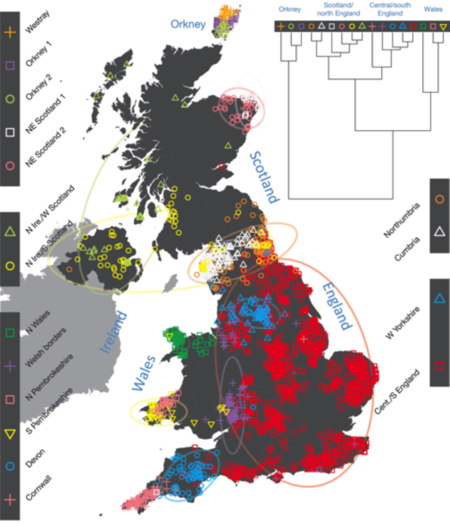
    The authors reported that "[t]he correspondence between the genetic clusters and geography [was] striking: most of the genetic clusters are highly localized, with many occupying non-overlapping regions." As set forth in the Figure, 17 clusters were chosen for convenience of the analysis.  The clustering and their integrity is shown for Cornwall and Devon, where the genetic clusters "closely match" existing county boundaries and (perhaps less surprisingly) in Orkney, the region off the northern coast of Scotland, reflecting the contributions of Norse Viking "settlers."

    Figure 1
    The article also supplies a "tree" reflecting the relationships between the clusters, which the authors describe as follows:

    The coarsest level of genetic differentiation (that is, the assignment into two clusters) separates the samples in Orkney from all others. Next the Welsh samples separate from the other non-Orkney samples. Subsequent splits reveal more subtle differentiation (reflected in the shorter distances between branches), including separation of north and south Wales, then separation of the north of England, Scotland and Northern Ireland from the rest of England, and separation of samples in Cornwall from the large English cluster. There is a single large cluster (red squares) that covers most of central and southern England and extends up the east coast. Notably, . . ., this cluster remain[ed] largely intact and contains almost half the individuals (1,006) in [the] study.

    The authors correctly point out that the genetic differentiation they detect is small and the differentiation between clusters is "subtle."  When compared with existing European populations the genetic results showed ancestry in all clusters from western Germany, Flemish Belgium, northwestern France, Denmark, southern France and Spain.  Norwegian ancestry was found disproportionately in the Orkney-derived clusters ("and to a lesser extent the clusters involving Scotland and Northern Ireland") and Swedish groups were found in the ancestry profiles of other British clusters.

    The authors conclude that:

    The clustering [shown inter alia in Fig. 1] is notable both for its exquisite differentiation over small distances and the stability of some clusters over very large distances. Genetic differentiation within the UK is not related in a simple way to geographical distance. Examples of fine-scale differentiation include the separation of: islands within Orkney; Devon from Cornwall; and the Welsh/English borders from surrounding areas. The edges between clusters follow natural geographical boundaries in some instances, for example, between Devon and Cornwall (boundaries the Tamar Estuary and Bodmin Moor), and Orkney is separated by sea from Scotland. However, in many instances clusters span geographic boundaries; for example, the clusters in Northern Ireland span the sea to Scotland.

    These conclusions support a reconstruction about how migrations produced the modern British distribution:

    Figure 2
    The authors were able to interpret these results to give a picture about how migrations of various groups has changed over time:

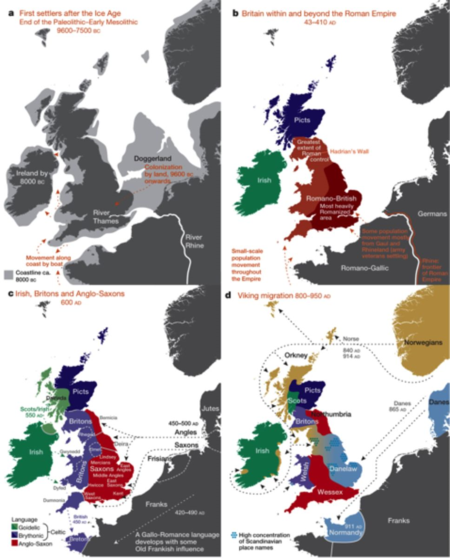
    [T]he earliest migrations whose descendants survive to make a substantial contribution to the present population are best captured by three groups in our European analyses, GER6 (western Germany), BEL11 (Belgium), and FRA14 (north-western France). These groups still contribute to current patterns of population differentiation []. Other European groups may reflect early migrations into the UK, but with smaller contribution, including SFS31 (southern France/Spain), at least part of DEN18 (Denmark), and possibly parts of Norway and Sweden. A subsequent migration, best captured by FRA17 (France), contributed a substantial amount of ancestry to the UK outside Wales. []Migrations represented by FRA12 essentially only affect Wales and Northern Ireland and/or Scotland. We also see clear signals of some of the known historical migrations and settlements, including the Saxons (GER3, northern Germany, and probably much of DEN18, Denmark) and the Norse Vikings (NOR53–NOR90).

    Finally, these researchers applied more sophisticated genetic analytical techniques (related to the rate of decay of shared haplotype segments) to assess population admixture, and found "strong evidence (P < 0.01) that the largest Orkney cluster (Orkney 1) was influenced by a recent (about 29 generations ago, or in 1100 A.D.) admixture event with an overall contribution of ~25% of the DNA from groups in Norway."

    The article also notes that the known historical migration events frequently have less of a genetic impact that might be presumed; for example, the authors reported seeing "no clear genetic evidence of the Danish Viking occupation and control of a large part of England" and "no evidence of a general 'Celtic' population in non-Saxon parts of the UK."  Rather, with regard to the Celtic populations in Britain the article reports "there were many distinct genetic clusters in these [non-Saxon] regions, and the Welsh clusters "represent populations that are more similar to the early post-Ice-Age settlers of Britain than those from elsewhere in the UK."

    The article closes by reminding readers that such genetic studies "can augment archaeological, linguistic and historical approaches to understanding population history" and also "complements them, in providing evidence relating to the bulk of ordinary people rather than the successful elite."

    * Stephen Leslie (Murdoch Childrens Research Institute, Royal Children's Hospital, University of Melbourne, Department of Mathematics and Statistics, Victoria, Australia and University of Oxford, Department of Oncology, Oxford UK), Bruce Winney (University of Oxford, Department of Oncology, Oxford UK), Garrett Hellenthal (University College London Genetics Institute, London UK), Dan Davison (Counsyl, South San Francisco, California), Abdelhamid Boumertit (University of Oxford, Department of Oncology, Oxford UK), Tammy Day (University of Oxford, Department of Oncology, Oxford UK), Katarzyna Hutnik (University of Oxford, Department of Oncology, Oxford UK), Ellen C. Royrvik (University of Oxford, Department of Oncology, Oxford UK), Barry Cunliffe (University of Oxford, Institute of Archaeology, Oxford), Wellcome Trust Case Control Consortium 2, International Multiple Sclerosis Genetics Consortium, Daniel J. Lawson (University of Bristol, Department of Mathematics, Bristol UK), Daniel Falush (College of Medicine, Swansea University, Swansea UK), Colin Freeman (The Wellcome Trust Centre for Human Genetics, Oxford UK), Matti Pirinen (University of Helsinki, Helsinki, Finland), Simon Myers (University of Oxford, Department of Statistics, Oxford UK), Mark Robinson (University of Oxford, University Museum of Natural History, Oxford UK), Peter Donnelly (University of Oxford, Department of Statistics, Oxford UK) & Walter Bodmer (University of Oxford, Department of Oncology, Oxford UK)

  • By Kevin E. Noonan —

    Supreme Court Courtroom_cAny observer of the interaction between the Federal Circuit and the Supreme Court over the past decade has recognized that the Court has become increasingly critical of the Federal Circuit's patent jurisprudence and of patents and patent law in general.  This attitude approaches disdain in many instances, for example when Justice Kagan declares that the U.S. Patent and Trademark Office is "patent happy," or when Justice Alito says in a published opinion that "[t]he Federal Circuit's analysis fundamentally misunderstands what it means to infringe a method patent," or when the Chief Justice states in open court "Well, [appellate courts] don't have a choice, right?  They can't say, I don't like the Supreme Court rule so I'm not going to apply it, other than the Federal Circuit"" (to chuckles all around).  (This situation must be particularly galling to the Federal Circuit, tasked as it is with trying to apply the Court's "less than pellucid" patent law opinions.)

    The consequence of this tussle between the courts is that 30 years of relative certainty has evaporated in seemingly an instant.  An honest assessment of the current level of certainty in patent law is that there is much more uncertainty concerning eligibility and enforceability of issued patents; eligibility and patentability of pending applications; and the value of patents for licensing, which negatively impacts, inter alia, technology transfer from universities and other research institutions by suppressing the bargaining power of innovators when negotiating with corporations better positioned to bring useful products to market for the benefit of the populace.  And thus the reason why the Founders gave Congress the power to grant patents ("to Promote . . . Progress of . . . the Useful Arts") is thwarted for apparently no good purpose.

    One strand of the Court's thinking is clear:  relying on legal academic theories having little empirical support (like the "Tragedy of the Anticommons"), the Court believes that patents are like the various items of furniture in "Goldilocks":  you can have too much patenting or too little patenting, as stated in the two most recent decisions related to biotech and pharma patent law:

    "As we have recognized before, patent protection strikes a delicate balance between creating 'incentives that lead to creation, invention, and discovery' and 'imped[ing] the flow of information that might permit, indeed spur, invention.'"

    Justice Thomas, Myriad

    "Patent protection is, after all, a two-edged sword.  On the one hand, the promise of exclusive rights provides monetary incentives that lead to creation, invention, and discovery.  On the other hand, that very exclusivity can impede the flow of information that might permit, indeed spur, invention . . ."

    Justice Breyer, Mayo v. Prometheus

    And, of course, the only people who know the correct balance are the members of the Court; this didn't work with regard to pornography and it certainly does not work for patent law precisely because it is certainty-destroying (besides being impractical).  Indeed, it only makes sense if the Court purposefully wishes to return to the days when Justice Jackson could correctly state that "the only valid patent is one which this Court has not been able to get its hands on."  Jungerson v. Ostby & Barton Co., 335 U.S. 560, 572 (1949) (Jackson, J., dissenting)

    The Court's antipathy to patents, patent law and the Federal Circuit ultimately extends (intentionally or not) to how Congress has exercised the patent power.  For example, the Court seems to think that "mere" discovery is not enough, despite the explicit recitation in the statute that "[w]hosoever invents or discovers any new and useful process, machine, manufacture, or composition of matter, or any new and useful improvement thereof, may obtain a patent therefor, subject to the conditions and requirements of this title."  35 U.S.C. § 101.  And unlike earlier embodiments of the Court, there is little acknowledgement of or compliance with Congress's intent that "anything under the sun made by man" should be patent-eligible.  This raises the question of why this is so; after all, the Court is perfectly aware of the limits of its Constitutional role, as set forth by the Chief Justice in his opinion affirming Congress's power to implement the various aspects of "Obamacare" (National Federation of Independent Business v. Sebelius, 567 U.S. ___ (2012)):

    Our permissive reading of these powers is explained in part by a general reticence to invalidate the acts of the Nation's elected leaders.  "Proper respect for a co-ordinate branch of the government" requires that we strike down an Act of Congress only if "the lack of constitutional authority to pass [the] act in question is clearly demonstrated."  United States v. Harris  . . . .  Members of this Court are vested with the authority to interpret the law; we possess neither the expertise nor the prerogative to make policy judgments.  Those decisions are entrusted to our Nation's elected leaders, who can be thrown out of office if the people disagree with them.  It is not our job to protect the people from the consequences of their political choices.

    Perhaps it is this simple:  in rendering decisions on Obamacare, or the "milk" cases familiar to any first year law student studying the Commerce Clause, the Court is determining whether Congress's actions fall within the scope of an enumerated power.  The right to grant patents, in contrast, is an enumerated power of Congress:

    The Congress shall have the power to promote the Progress of Science and useful Arts, by securing for limited times to Authors and Inventors the exclusive Rights to their respective writings and Discoveries.  U.S. Const. art. I, sec. 8, cl. 8.

    And maybe the Court feels it has a responsibility to scrutinize more carefully how Congress implements this power (including how the Patent Office exercises and the Federal Circuit interprets this power).  The plenary effect of this review has led us to the present state of the law; again as stated by Justice Jackson:

    Reversal by a higher court is not proof that justice is thereby better done.  There is no doubt that if there were a super-Supreme Court, a substantial proportion of our reversals of state courts would also be reversed.  We are not final because we are infallible, but we are infallible only because we are final.  Brown v. Allen, 344 U.S. 443, 540 (1953) (concurring)

    It is important to keep this finality in mind when thinking about how best to address the further reaches of the Court's recent patent jurisprudence, to try to reestablish some contact between the Constitution's mandate that the patent laws promote progress and the Court's assiduous efforts to the contrary.

    Taking a page from Hippocrates, it is certainly the case that whatever is done must not make the situation worse.  When thinking about actions that Congress could take, the wrong approach could lead precisely to this unwanted outcome, because nothing short of a Constitutional amendment could reverse a decision negating an Act of Congress that attempted to force the Court to overrule its recent precedent.  And that, of course, will never happen.

    History can in this instance be a guide, and one relevant historical fact is how P.J. Federico and Giles Rich wrote the portion of the 1952 Patent Act codified as Section 103, which introduced obviousness as a statutory requirement for patentability.  The concept of obviousness (stated in other terms) had been introduced into U.S. patent law by the Court in Hotchkiss v. Greenwood (1850), where the Court said:

    Unless more ingenuity and skill in applying the old method . . . were required in the application of it to [the new product of the method] than were possessed by an ordinary mechanic acquainted with the business, there was an absence of that degree of skill and ingenuity which constitute essential elements of every invention.  In other words, the improvement is the work of the skillful mechanic, not that of the inventor.

    This language is frighteningly reminiscent of language in the Court's recent Mayo and Myriad decisions, insofar as it renders patentability categorical:  if the basis for obtaining a patent is on the existence vel non of an inventor, this is not so far from the current Court's categorical decisions about the existence of an invention.

    Messrs. Rich and Federico avoided this outcome by directing the Court's attention to the underlying basis for their unease about "inventions" that were the product of efforts by a mere mechanic, by drafting a requirement that the claims not be obvious (a determination based on the content of the prior art, albeit still not providing the clearest basis for making a decision on patentability).  That Section 103's drafters were successful can be ascertained from the Court's first post-1952 decision on this new part of the statute:

    In [Section] 103 of the 1952 Patent Act Congress added the statutory nonobvious subject matter requirement, originally expounded in Hotchkiss, which merely codified judicial precedents requiring a comparison of the subject matter sought to be patented and the prior art, tying patentable inventions to advances in the art.  Although 103 places emphasis upon inquiries into obviousness, rather than into "invention," the general level of innovation necessary to sustain patentability remains unchanged under the 1952 Act.

    Graham v. John Deere, 383 U.S. 1 (1966).  With these precedents in mind there may be a way to find a middle course that can accommodate the Court's needs to cabin the patent right and innovators' needs for certainty in patent law.  The first area is in "natural products" patenting, where the Court (for the first time) extended a preclusion against patenting for compounds that were "merely" isolated.  Although the Court ostensibly rendered an extremely limited decision ("We merely hold that genes and the information they encode are not patent eligible under § 101 simply because they have been isolated from the surrounding genetic material") that hasn't been how it has been interpreted.  The Court's language "suggests" (or "mandates") interpretations putting the patent-eligibility of previously patent-eligible subject matter ("merely" isolated antibiotics, antibodies, vitamins, etc.) at risk.  This can be better appreciated by the effect of the PTO's decision on the patent-eligibility of 1355 (small molecule) drugs approved by the FDA between 1981-2010, wherein about 75% of antibacterial drugs and almost 80% of small molecule anticancer drugs were natural products or derivatives of natural products and would have been unpatentable under the Office's first guidance implementing the Court's decisions.  This cannot be what the Court intended, and it is up to the patent community to help remedy what the Court has recently wrought.

    One way to do so would be to include a new section 35 U.S.C. § 100(j):

    The term "composition of matter" as used herein encompasses a chemical or other product found or derived from nature provided that the composition has been changed from its natural state in its structure, function, purity, or use.

    This language might be sufficient to mollify the Court's concerns about patenting natural products, because it parallels the Court's own language in Chakrabarty, wherein the standard for patent-eligibility was that the invention is "a product of human ingenuity 'having a distinctive name, character [and] use,'"  Hartranft v. Wiegmann, 121 U.S. 609 (1887).  This is provided, of course, that this Court is as willing as the Court in 1966 to accept that Congress had within its enumerated power the right to make this determination.

    The other item of the Court's jurisprudence that has "disturbed the settled expectations" of the patent community is the Mayo v. Prometheus decision.  Containing an explanation of its reasoning less straightforward than the Court's decision in Myriad, the Court conflated Sections 101, 102 and 103 of the Patent Act in reaching its decision and seemingly reintroduced the inchoate concept of "inventiveness" into patent law.  More problematically, the Court's analysis seemed to contravene the holding in Diamond v. Diehr (1981) that claims must be considered "as a whole."  And failing to hold true to the Diehr standard has permitted district courts, and even the Federal Circuit to declare claims invalid under Section 101 based on a determination that a claim consists of a "natural law, physical phenomenon or abstract idea" plus nothing "more" than what are "routine, conventional and well-understood" applications of the natural laws or uses of the natural products.  See, e.g., PerkinElmer, Inc. v. Intema Ltd.; Ariosa v. Sequenom; Genetic Technologies Ltd. v. Labcorp; and Univ Utah Res. Found. v. Ambry Genetics (Myriad III).

    This situation leads to the second proposal, for a new section 35 U.S.C. § 282(d):

    When assessing a defense to infringement that a patent claim does not satisfy the requirements of §§ 101, 102 or 103 of this chapter, the invention must be considered "as a whole" and not by its individual limitations.  The conventionality of individual limitations shall not be the basis for a determination that a claim is invalid under said §§ 101, 102 or 103.

    Additional sections of the statute, or rules promulgated by the Office, may be needed to ensure the same standard is applied during patent prosecution.  But, like the proposal for Section 101, this change in the law finds support, at least, under Diehr and thus may pass muster at the Court should they be challenged.

    If the past decade has shown the patent community nothing else, it is that innovation cannot be held hostage to political or doctrinaire whims of any branch of government.  The idea in 1982 that U.S. patent law needed consistency was a good one; it failed only because it did not recognize that the biggest source of inconsistency would be the Supreme Court.  It is a lesson that needs to be well learned, accommodated and its outcome overcome if the U.S. is to retain its lead in global innovation and the economic benefits arising from this innovation.

    Note:  This post was adapted from a panel discussion at the Spring 2015 BIO IPCC meeting held on April 15-17 in St. Louis, MO.