• By Kevin E. Noonan –

    Supreme Court Building #1Facing what is likely to be something of an uphill battle in seeking to have the Federal Circuit's decision against it in Amgen v Sanofi overturned before a not always patent-friendly Supreme Court, Amgen in late December filed its opening brief addressing the Question Presented in the granted certiorari petition:

    Whether enablement is governed by the statutory requirement that the specification teach those skilled in the art to "make and use" the invention, 35 U.S.C. § 112, or whether it must instead enable those skilled in the art "to reach the full scope of claimed embodiments" without undue experimentation ― i.e., to cumulatively identify and make all or nearly all embodiments of the invention without substantial "time and effort," Pet. App. 14a [emphasis in Question].

    The brief begins by disparaging the decision based on the Federal Circuit "once again" "imposing limitations on the Patent Act that are inconsistent with the Act's text" as the Supreme Court asserted in Bilski v. Kappos, 561 U.S. 593, 612 (2010).  Amgen argues that the focus of the Court's consideration of the question before it should be on the statute and its text, which has not changed appreciably since the 1790 Patent Act enacted by the Founders.  An important consideration regarding this question is the "patent bargain," recognized by the Court in Universal Oil Prods. Co. v. Globe Oil & Refin. Co., 322 U.S. 471, 484 (1944), and Pfaff v. Wells Elecs., Inc., 525 U.S. 55, 63 (1998), and Amgen's assertion that the Federal Circuit's decision violates all three prongs — statutory text, precedent, and history — of enablement law in establishing its full scope" test (illustrating the incorrectness of the test in its view by asserting that patents protecting inventions like Watt's steam engine and the Wright Brothers' airplane would not pass muster under this test).  "[T]he law has never required that, for those inventions to be patentable, skilled artisans must be able to cumulatively identify and make every variation without substantial time and effort" (emphasis in brief), Amgen argues and characterizes the standard as "folly" based on treatises from Robinson (1890) to the late Dmitriy Karshtedt's paper entitled The Death of Genus Claims (Dmitry Karshtedt, Mark A. Lemley & Sean B. Seymore, The Death of the Genus Claim, 35 HARV. J. L. & TECH. 1, 23-35 (2021).  The basis for the full scope test — the need to describe a patented invention through its full scope to satisfy enablement — is contrary to Supreme Court precedent, Amgen argues, citing (amongst many other cases as its argument is developed) Smith v. Snow, 294 U.S. 1, 11 (1935), for the principle that it is "not necessary to . . . describe in the specification[] all possible forms in which the claimed principle may be reduced to practice."  Amgen asserts that the proper alternative to the Federal Circuit's test can be found in Consolidated Electric Light Co. v. McKeesport Light Co., 159 U.S. 465 (1895), "which applied the statutory standard to invalidate claims where there was proof that the patent's instructions were not enabling for large classes of claimed subject matter."

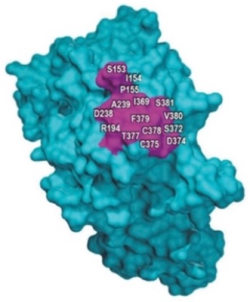
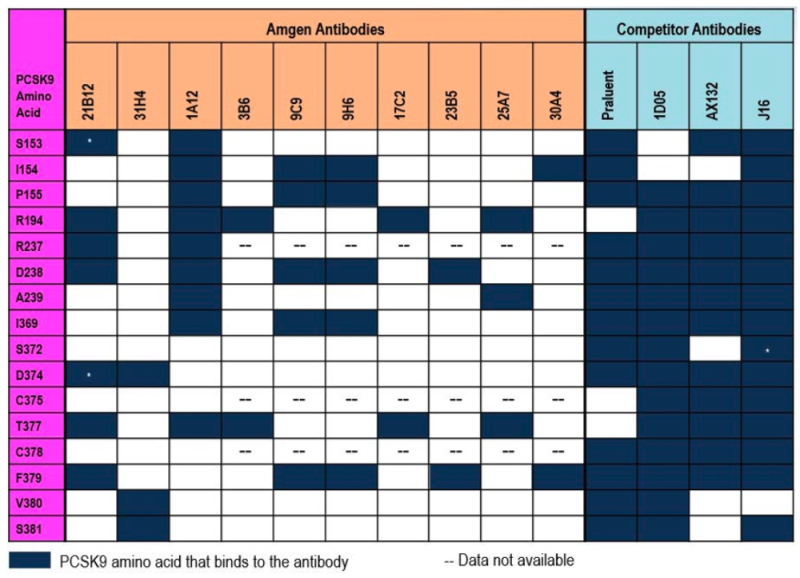
    And such an analysis is not needed in this case, according to the brief, because there is no evidence that the disclosure is actually deficient in any way regarding Amgen's "breakthrough" invention of monoclonal antibodies with real world benefits (reducing cholesterol).  While setting forth an explication of the technology is unnecessary here, the brief emphasizes the limited area of the PCSK9 protein involved in the antibody interaction that provides the therapeutic benefit and constrains the antibodies that can interact with it, shown in this drawing as the purple-colored section of the molecule:

    Image
    The brief emphasizes the extent of disclosure in the patent specifications instructing the skilled worker on how to make antibodies that recognize these limited portions of the protein, and the "roadmap" that teaches the skilled artisan how to make antibodies having the relevant therapeutic properties (many steps of which are "high throughput"), as well as the capacity to make "conservative" substitutions to provide alternative embodiments of antibodies having the requisite therapeutic function.  The disclosure satisfies the Wands test, the brief asserts, and that should be enough.

    In the face of this evidence from the specification (and the two juries' fact-finding supporting their verdict that the claims were not shown to be non-enabled), Amgen argues that the Federal Circuit's basis for invalidating for non-enablement was mere speculation, citing portions of the decision in support of these assertions stating that "there might be 'millions of candidates' that fall within the claims, each of which would have to be 'generate[d] and then screen[ed]' to determine whether it met the claims' requirements"; "'you could be immunizing mice for a hundred years,'" but "'[t]here might be kind of an antibody that you didn't come up with in that time period'"; and that those same conservative substitutions could produce (unpredictably) a non-functional antibody.  Amgen emphasizes the contrariness of the Federal Circuit's imposition of its invalidation on enablement grounds to the two juries' decisions that the claims were enabled as well as the clear and convincing evidence standard of proof Amgen contends the juries' decisions establish Respondent did not satisfy juxtaposed to what Amgen deems speculation by the Federal Circuit panel rendering the decision.

    With regard to the statute, Amgen argues that its purpose is "to require the patentee to describe his invention so that others may construct and use it after the expiration of the patent," citing Schriber-Schroth Co. v. Cleveland Tr. Co., 305 U.S. 47, 57 (1938), and that the full scope test has no basis in the statutory language.  The statutory standard is straightforward, Amgen maintains, and evidence of this straightforwardness is that the Court has applied it without necessary interpretation ("directly"), citing Wood v. Underhill, 46 U.S. (5 How.) 1, 5 (1846) (permitting unspecified variations in types of clay used to make bricks and tiles); Mowry v. Whitney, 81 U.S. (14 Wall.) 620, 644 (1872) (method for manufacturing railway wheels that avoided "strain" due to different wheel parts cooling at different rates without requiring all types of wheels and all temperatures to be expressly exemplified); Loom Co. v. Higgins, 105 U.S. 580, 586 (1882); The Telephone Cases, 126 U.S. 1, 536 (1888); Minerals Separation, Ltd. v. Hyde, 242 U.S. 261, 271 (1916) (wherein a method for concentrating mineral ores using mixture and hearing with oil was permitted a scope that encompasses unexemplified ores and variations on the method to adapt it to different ores); and Universal Oil Prods. Co. v. Globe Oil & Refin. Co., 322 U.S. 471, 484 (1944).  Amgen argues that the application of the standard in these cases is consistent with the plain meaning of the statute.  On the contrary, the Federal Circuit's "full scope" requirement deviates from the statutory text by requiring more than the statute does, by "focus[ing] on the "number of possible candidates within the scope of the claims"—the number of theoretical embodiments that might meet the claims' requirements" (emphasis in brief).  And this heightened requirement has not been applied to other genus claims Amgen argues, citing McRo inc. v. Bandai Namco Games Am. Inc., 959 F.3d 1091, 1100, as an example.  What the Federal Circuit has done with its heightened "full scope" requirement is to have turned enablement into a "numbers game" with regard to the 26 exemplified disclosed antibodies and the theoretical "millions of candidat[e]" antibodies which would then need to be generate[d] and screen[ed]" to satisfy the full scope test.  And this is an impossibility, Amgen states, as the Supreme Court has recognized in holding this was not the proper test, citing Mowry.

    Amgen's arguments harken back to the Framer's adoption of English patent law (citing several English cases in which Amgen argues the full scope standard would have "flunked"), codified in the 1790 Patent Act that has remained essentially unchanged to the present 1952 statute.  The consistency in the statute and its interpretation "tends to negate the existence of" the Federal Circuit's new "full scope" standard Amgen argues, citing Printz v. United States, 521 U.S. 898, 918 (1997).  19th and early 20th Century U.S. case law is consistent with Amgen's interpretation, the brief citing Carver v. Braintree Manufacturing Co., 5 F. Cas. 235 (C.C.D. Mass. 1843) (Justice Story) (cotton gins), as well as treatises (W. Phillips, The Law of Patents for Inventions 237 (1837); G. Curtis, A Treatise on the Law of Patents for Useful Inventions §124 (1849)) and regional Circuit Courts of Appeal decisions (Toledo Rex Spray Co. v. Cal. Spray Chem. Co., 268 F. 201, 204 (6th Cir. 1920); Donner v. Am. Sheet & Tin Plate Co., 165 F. 199, 206 (3d Cir. 1908); Philip A. Hunt Co. v. Mallinckrodt Chem. Works, 177 F.2d 583, 585 (2d Cir. 1949); Ill. Tool Works, Inc. v. Foster Grant Co., 547 F.2d 1300, 1309 (7th Cir. 1976)).  Amgen also cites several pre-Federal Circuit cases that would have invalidated the patents at issue under the full scope test, including Franc-Strohmenger & Cowan, Inc. v. Arthur Siegman, Inc., 27 F.2d 785, 785-786 (2d Cir. 1928) (neckties made with "resilient" linings); and Ansul Co. v. Uniroyal, Inc., 448 F.2d 872, 877878 (2d Cir. 1971) (methods to grow plants encompassing "the entire plant kingdom").  Finally, the brief cites decisions from the Federal Circuit's predecessor Court, the Court of Custom and Patent Appeals that (Amgen argues) support its "plain meaning" interpretation of the enablement requirements of Section 112, including In re Gay, 309 F.2d 769, 772 (C.C.P.A. 1962); In re Halleck, 422 F.2d 911, 912, 914 (C.C.P.A. 1970); and In re Angstadt, 537 F.2d 498 (C.C.P.A. 1976) (citing Minerals Separation).

    Amgen further argues that the statute provides a "reasonableness" standard dependent on the patented subject matter that can balance the scope of the claims and whether the "specific instructions" are "sufficiently robust to permit skilled artisans to reasonably make and use individual embodiments as needed" rather than requiring a skilled artisan to be able to make "all embodiments, seriatim with minimal time and effort."  Amgen asserts that the Federal Circuit's "full scope" standard "serves no valid patent-law policy and harms innovation[,] fundamentally alters the basic patent bargain[, and] discourages breakthrough innovations by cutting off patent protection for the most significant inventions simply because they have too many useful applications," which "threatens devastating consequences."  The brief argues that the Federal Circuit's full scope test is contrary to the constitutional mandate that the patent laws "promote progress" because "[o]nce an invention has been described sufficiently for skilled artisans to make and use it, disclosing thousands more examples of variations that achieve the same result contributes little to the store of human knowledge."  And worse, the brief argues, application of the test "destroys incentives for breakthrough inventions" like the case at bar, positing a correlation between "the more pioneering the innovation, the more likely it is to have a broad range of applications."  Perversely in Amgen's view, the Federal Circuit test creates a situation where "[i]t makes no sense to deny groundbreaking innovations patent protection because they somehow have too many useful implementations" (emphasis in brief).

    The brief also juxtaposes the practical application of the enablement test under well-established precedent under the statute with the "theoretical inquiry into hypothetical applications" engendered by the Federal Circuit's full scope test.  Defendants are not without means to challenge enablement under the conventional standard, Amgen asserts, as exemplified by instances where the skilled worker cannot practice a claimed invention at all, citing Beidler v. United States, 253 U.S. 447, 453 (1920), or that practicing the invention requires the public to achieve invention "in their own right" to obtain an operative embodiment, citing Consol. Elec. Light Co. v. McKeesport Light Co., 159 U.S. 465, 472-474 (1895), or reciting alternative embodiments in the claims where there is no teaching regarding one of them, citing Auto. Techs. Int'l, Inc. v. BMW of N. Am., Inc., 501 F.3d 1274, 1285 (Fed. Cir. 2007).  There are also the "needle in a haystack" forms of non-enablement according to Amgen, such as in Idenix Pharms. LLC v. Gilead Scis. Inc., 941 F.3d 1149, 1162 (Fed. Cir. 2019), cert. denied, 141 S. Ct. 1234 (2021); and Wyeth & Cordis Corp. v. Abbott Labs., 720 F.3d 1380, 1384-1385 (Fed. Cir. 2013), or circumstances where the number of inoperative embodiments is so large that the effort required to produce an operative embodiment "becomes significant" as in Atlas Powder Co. v. E.I. du Pont De Nemours & Co., 750 F.2d 1569, 1576 (Fed. Cir. 1984); in all these instances the claims are not enabled under the conventional enablement test without need for recourse to the Federal Circuit's full scope test.  These cases also illustrate that there is no overbroad claiming "problem" in need of the full scope test to remedy, Amgen states, because "[i]f the claim truly exceeds what the patent enables, challengers will always be able to show, through evidence, that skilled artisans cannot reasonably 'make and use' large areas of the claimed invention by following the patent's teaching" (emphasis in brief), as illustrated by the Court's decision in Consolidated Electric, and several other cases, including Béné v. Jeantet, 129 U.S. 683 (1889); and Holland Furniture Co. v. Perkins Glue Co., 277 U.S. 245 (1928).  Thus Amgen asserts the Federal Circuit's full scope test is unnecessary in attempting to solve a problem that does not exist, and in doing so in this case "allow[ed] clearly enabled claims to be invalidated based on speculation rather than proof" as evidenced by Respondents' failure "to identify even one actual antibody that could not be made following the patent's disclosures" (emphasis in brief).

    The brief takes the time (as it almost must) to set forth the deleterious consequences that are likely to arise if the full scope enablement test is affirmed.  These include harm to genus claims not limited to chemical, biotechnological, and pharmaceutical arts, exemplified by a recent Patent Trial and Appeals Board decision holding unpatentable genus claims to glass-making method based on this Federal Circuit precedent.  But the bulk of this portion of the argument is focused on the expected effects on claims in the biotechnology and pharmaceutical fields, based on the nature of these inventions, the complexities of the claimed subject matter, and the triviality of changes that can be made.  These vulnerabilities are exacerbated by the costs of bringing a patented product to market, the brief citing as an average almost $3 billion, where the possibilities of "free-rider" issues that are enhanced under the full scope enablement test undermine incentives to invest.  In addition to these negative effects on progress, Amgen argues the situation under the full scope test also delays effective disclosure if undue efforts must be undertaken for "rote identification of permutations within an invention"; the time and effort to do so will delay disclosure in patent applications until "sufficient" species within a genus have been identified to satisfy the full scope test.

    Finally, the brief applies the rubrics to the case at bar, which the brief argues establishes that the specification enabled preparation of the 26 exemplified antibodies as well as providing a roadmap to making other embodiments using routine methods known in the art, and that Respondents could not show any failure to make any antibody falling within the scope of the invalidated claims.  Amgen directly addresses Respondents' argument that their claims "preempt the future" (likely one of the more compelling arguments for Respondents' position) by ignoring the availability of further, later-arising improvements on the invention by others, citing Seymour v. Osborne, 78 U.S. (11 Wall.) 516, 548 (1871).  The two juries' verdicts that Amgen's claims had not been shown not to be enabled was supported by "[m]ountains of evidence" they argue, and this evidence was not countered by any evidence that the disclosed methods ever failed.  The brief enumerates the disclosures in the patents' specifications regarding the 26 exemplified antibodies, the "roadmap" teaching how to produce additional antibodies and reliance on well-established prior art methods for making monoclonal antibodies generally, and the ability to identify conservative amino acid substitutions to produce antibodies having variations in structure but retaining the functional properties of the claimed antibodies that gave them their therapeutic effectiveness.  While emphasizing the lack of factual evidence contrary to the juries' verdicts, the brief concludes by emphasizing the error of law Amgen asserts against the Federal Circuit's decision in its use of the full scope test in the face of a jury verdict supported by substantial evidence, in urging the Supreme Court to reverse the adverse decision below.

  • CalendarFebruary 8, 2023 – Artificial Intelligence (AI) and Emerging Technologies (ET) Partnership Series (U.S. Patent and Trademark Office, Dallas Bar Association Intellectual Property section, and State Bar of Texas IP section) – 11:00 am to 3:00 pm (CT), Dallas, TX

    February 8, 2023 – "Patent Strategies for Protecting Aftermarket Parts: Strengthening the Portfolio, Implementing Enforcement Program" (Strafford) – 1:00 to 2:30 pm (EST)

    February 8, 2023 – "Unified Patent Court (UPC): A New Forum for Patent Litigation in Europe" (Intellectual Property Owners Association) – 2:00 pm to 3:00 pm (ET)

    February 9, 2023 – "China IP: Quarterly Legislation and Case Law Update" (U.S. Patent and Trademark Office) – 10:00 am to 11:00 am (ET)

    February 10, 2023 – "Protecting Your IP" (U.S. Patent and Trademark Office) – 2:00 pm to 4:30 pm (ET), Baltimore, MD

  • USPTO SealThe U.S. Patent and Trademark Office, in collaboration with Dallas Bar Association (DBA) Intellectual Property (IP) section and State Bar of Texas IP section, will be holding its next meeting of the Artificial Intelligence (AI) and Emerging Technologies (ET) Partnership Series from 11:00 am to 3:00 pm (CT) on February 8, 2023 at the Arts District Mansion in Dallas, TX.  During the meeting, panelists from the USPTO and diverse stakeholders from academia, industry, and law firms will explore various IP policy issues with respect to AI-driven innovation.  The meeting will include discussions of the following topics:

    • Panel 1: AI-Driven Innovation – The Current State of Play
    • Panel 2: AI Inventorship
    • Panel 3:  Unanticipated IP Challenges from AI-Driven Innovation
    • Public listening session

    Additional information regarding the customer partnership meeting, including how to participate online, can be found here.

  • Strafford #1Strafford will be offering a webinar entitled "Patent Strategies for Protecting Aftermarket Parts: Strengthening the Portfolio, Implementing Enforcement Program" on February 8, 2023 from 1:00 to 2:30 pm (EST).  Jonathan H. Urbanek and Jacqueline L. Thompson of Fitch Even Tabin & Flannery will guide patent counsel on patent strategies for protecting aftermarket parts, discuss leveraging IP to protect aftermarket parts and create obstacles for will-fitters, and discuss claiming tactics to block will-fitters and offer guidance on detecting and stopping will-fitters once a portfolio is in place.  The webinar will review the following issues:

    • Preparing, filing, and prosecuting patent applications to develop a strong portfolio focused on aftermarket parts
    • Integrating business input into the patent life cycle
    • Identifying and stopping will-fitters
    • Creating non-patent challenges for will-fitters

    The registration fee for the webcast is $347.  Those interested in registering for the webinar, can do so here.

  • IPO #2The Intellectual Property Owners Association (IPO) will offer a one-hour webinar entitled "Unified Patent Court (UPC): A New Forum for Patent Litigation in Europe" on February 8, 2023 from 2:00 pm to 3:00 pm (ET).  Antje Brambrink of Finnegan, Henderson, Farabow, Garrett & Dunner, LLP; Jakob Kellenberger of Procter & Gamble; and Leo Steenbeek Koninklijke Philips N.V. will provide a high-level overview of the UPC system and shed some more light on the threats and opportunities of this new venue both from the perspective of industry and litigators.  The panel will discuss the following:

    • Structure of the Court and the proceedings
    • Litigation timelines
    • Strategic considerations on opting out European patents from the jurisdiction of the court also with a view on forum shopping and the UPC's long-arm jurisdiction.

    The registration fee for the webinar is $150 for non-members or free for IPO members (government and academic rates are available upon request).  Those interested in attending the webinar should register here.

  • China_webinar2023_featureAs part of its series of quarterly updates on IP developments in China, the U.S. Patent and Trademark Office will offer a webinar entitled "China IP: Quarterly Legislation and Case Law Update" on February 9, 2023 from 10:00 am to 11:00 am (ET).  The webinar will feature presentations by senior U.S. Patent and Trademark Office IP attorneys with extensive China IP experience regarding recently enacted IP policies, legislation, and regulations, and court decisions on key IP cases.

    Those interested in registering for the webinar can do so here

  • The U.S. Patent and Trademark Office will be hosting a Black Innovation and Entrepreneurship program, with part one of the program focusing on "Protecting Your IP," on February 10, 2023 from 2:00 pm to 4:30 pm (ET) at the Earl G. Graves School of Business & Management, Morgan Business Center in Baltimore, MD.  The program will include sessions on the following topics:

    • Fireside Conversation with Cornell "Chico" Conaway, CEO and Founder of Gainz Sportsgear
    • Learn the importance of IP protection to start a business
    • Resources and tools: Hear from community stakeholders about programs and resources
    • USPTO resources, presented by the Patent and Trademark Resource Centers (PTRC), Patents, and Patent Pro Bono

    Those interested in registering for the event, can do so here.

    Black_innovation_and_entrepreneurship_logo_1500px

  • By Michael Borella and Ashley Hatzenbihler

    USPTO SealThere is ample evidence that patent examiner allowance rates vary dramatically from examiner to examiner and art unit to art unit.[1]  This has resulted in the general understanding that there are "easy" examiners and "tough" examiners.

    Naturally, there is little complaining about "easy" examiners (until you are defending against a patent with very broad claims, at least).  But when patent attorneys stand around the coffee machine at work (or, more accurately, are on Zoom or Teams calls), there is a not small amount of eye rolling and wringing of hands over "tough" examiners.

    Over the last several years, a particular type of "tough" examiner has emerged — one that will reject just about any claim as ineligible under 35 U.S.C. § 101 . . . and never withdraw the rejection.[2]  In other words, if you get a 101 rejection from one of these examiners, prosecution is basically over.  Interviews don't help.  Arguments and amendments go nowhere, with the examiner engaging in vigorous goalpost-shifting.[3]  More often than not, the natural habitats of such examiners are the verdant plains of technology centers 1600 and 3600.

    The USPTO's Patent Trial and Appeal Board (PTAB) is often a last resort for patent applicants who cannot afford further appeals to the federal judiciary.  Therefore, should not the PTAB lay the judicial smack down on these errant plains-dwellers?  If only.

    Last year, we studied all substantive 101 decisions from the PTAB that came down in 2021.  The results were puzzling, striking, and, not in small part, abysmal.  The PTAB affirmed examiners' 101 rejections 87.1% of the time, whereas the overall affirmance rate across all grounds of rejection was 55.6%.  Why the discrepancy?  The data does not provide that information, though it could be due to the notorious vagueness of the test set forth in Alice Corp. v. CLS Bank Int'l, the Federal Circuit's conflicting case law, and/or the PTAB not following the USPTO's 101 guidance.

    Regardless of cause, the numbers do not lie.  The PTAB is a brutal tribunal for applicants attempting to argue that an examiner's 101 rejection is in error.

    But was 2021 an outlier or a blip on the radar?  Does the data from 2022 exhibit a similar affirmance rate or has there been a "regression to the mean" of sorts?

    To answer this question, we once again reviewed every substantive 101 appeal decided by the PTAB in 2022.  As was the case for the 2021 data, this required a particular search strategy as well as manually combing the text of each decision.

    From the PTAB's search interface, we specified the following criteria:  decision dates between January 1, 2022 and December 31, 2022, a proceeding type of "appeal", a decision type of "decision", and an issue type of "101".  Even so, the results were over-inclusive, returning decisions that just mentioned 101 in passing.  Thus, we further filtered these decisions to focus only on those in which the applicant appealed an examiner's Alice-based 101 rejection and the PTAB ruled on this grounds of appeal.  This took the 634 decisions returned by the search engine down to 482 — the substantive 101 decisions.[4]

    Of these, 426 were examiner affirmances, for an affirmance rate of 88.4%.  Yep, the PTAB got a little worse for applicants in 2022.  The month-by-month and total statistics are provided in the table below.

    2023-01-31 Table
    Not unlike 2021, the examiner affirmance rate fluctuated with no clear month-over-month trend.  For example, the lowest 101 affirmance rate was in May (77%) while the highest was in October (100%).[5]  Also like 2021, there is a slight downward trend in the number of appeals from Q1 to Q4.  The monthly average of appeals on 101 grounds was 49.5 for the first four months of the year and 34.25 for the last four months of the year (as compared to 78.25 and 49.25, respectively, for 2021).

    But one data point that sticks out is that the total number of appeals has dropped significantly year-over-year.  In 2021, 708 substantive 101 decisions were handed down, while in 2022 this number was — as noted above — just 482.  That is better than a 30% decline.  From our (admittedly anecdotal) experience, this is not because examiners are getting easier.  The opposite appears to be the case.  It seems more likely that applicants have determined that appealing 101 rejections to the PTAB has betting odds akin to those of the Cleveland Browns making it to the Super Bowl.

    Given that the PTAB does not provide much of a recourse for applicants stuck with a 101 rejection from an unrelenting examiner, we next wondered what grounds of rejection are popular with the PTAB.  For the abstract idea exception to patentable subject matter, the three main categories are mathematics, mental processes, and methods of organizing human activity.  In other words, a claim is deemed ineligible for patenting if it is directed to mathematics, a mental process,[6] or a method of organizing human activity[7] without significantly more.

    Of all substantive affirmances of 101 rejections by the PTAB, 14.1% were based on mathematics, 58.4% on mental processes, and 64.6% on methods of organizing human activity.  Use of the latter two categories is quite widespread among PTAB judges, with many decisions incorporating new grounds of rejection to accentuate the examiner's mental process rejection with a method of organizing human activity rejection or vice-versa.  Indeed, grounds of both mental processes and methods of organizing human activity were found in 31.9% of all affirmances.

    Another factor we looked into was whether certain PTAB panels or judges were making formulaic rejections — in other words cutting and pasting large sections of their reasoning for the 101 rejections from case to case and only changing the discussion of the facts.  It was not too difficult to identify a few instances of this.

    For example, Appeal 2021-002509 (decided January 31, 2022) and Appeal 2021-002913 (also decided January 31, 2022) involve two different applicants claiming two different technologies, but the decisions rely on reasoning that is largely word-for-word the same.  The deciding PTAB panels had two judges in common and both decisions were written by the same judge.  Another example of liberal cutting-and-pasting can be found in Appeals 2021-002840 and 2021-002807, also both decided on the same day by a panel with two judges in common.

    It is important to understand that this does not imply laziness or malfeasance on the part of anyone involved in these decisions.  Instead, this is more evidence that it is very easy to find virtually any invention ineligible by robotically deconstructing the claims into small enough parts and ignoring the advantage or improvements provided the claims as a whole.  Not convinced?  Try our rationale for invalidating the eligible claims of Diamond v. Diehr that is based on observed USPTO reasoning.

    There is a false narrative that has been floating around for the better part of two decades.  It implies that broad claims on obvious technological variants can be easily obtained from the USPTO.  There may have been some small truth to this notion in the 1990s, but today the pendulum has swung so far in the other direction that narrowly-scoped, complex, innovative technologies are often denied patentability just because they involve software.

    As a consequence, the irrational arbitrariness of Section 101 provides limited access to patenting for individual inventors as well as small and mid-sized companies.  Maybe someday the PTAB will lay the judicial smack down in a less one-sided fashion, but for now it appears that 101 appellants need to be wary against flying elbows of ineligiblity.

    [1] See the histogram of examiner grant rates compiled by Patent Bots, for example.

    [2] Okay, the word "never" is admittedly somewhat hyperbolic, but not far from the truth.

    [3] Again, we want to emphasize that most examiners are reasonable, even with their 101 rejections.  Some are quite clear in terms of what they deem to be sufficient to overcome a 101 rejection.  But there is a notable contingent who are not, and anecdotally it seems as if the size of this contingent has grown since early 2021.

    [4] Many of these decisions also reviewed rejections on other grounds (e.g., Sections 102 or 103).  We did not consider anything but the 101 determinations.  We also omitted rejections based on laws of nature or natural phenomena, which accounted for only 10 of the decisions and did not impact the results in any significant fashion.

    [5] Ouch.  Just ouch.  At least relatively few appeals were decided in October. 

    [6] We have previously detailed how illogically and broadly that this category is being construed.

    [7] This is another overly-broad category.  What isn't a method of organizing human activity at some level?

  • By Kevin E. Noonan –

    New York TimesIt's always good to have a villain, a "Snidely Whiplash" or other cartoon caricature to support an argument, especially if the issue is complex and fails the cocktail party test.*  The New York Times is (in)famous for these types of intellectually lazy arguments when it comes to patents (see "Top Stories of 2022: #8 to #10"; #9. New York Times Reopens Attack on U.S. Patent System), and they were at it again on Sunday in a front page piece on Humira, a drug used for a variety of ailments that has brought relief to millions of patients who otherwise suffered with earlier, less effective drugs.  (At least in the past the Times has had the good sense to relegate such articles to the Op-Ed pages.)

    The problem seems to be that Humira has made a pharma company a lot of money (purportedly $116 billion), that the drug is expensive (said to cost upwards of $50,000/year) and that the drug company has amassed a large number of patents to protect its intellectual property.  The bigger problem is that the article fails to recognize several important facts relating to the circumstances under which Humira's makers made this money and amassed its patent estate (or "thicket" as the anti-patent crowd likes to call it).

    The first of these is that until 2010 there was no pathway for "generic" (accurately, "biosimilar") competition for innovator biologic drugs (the class of drugs including Humira).  This has nothing to do with patents; the FDA could not approve a biosimilar competitor by law until the Biologic Price Competition and Innovation Act (BPCIA) was passed as part of Obamacare (see "Follow-on Biologics News Briefs – No. 11"; "House Passes Health Care Reform Bill — Biosimilar Regulatory Pathway Makes Cut, Pay-for-Delay Ban Does Not").  Thereafter, the FDA needed to develop guidelines (see "FDA Looks to Multiple Sources, Including EMA Guidelines, in Developing Biosimilar Approval Standards") and Guidances (see "FDA Publishes Draft Guidelines for Biosimilar Product Development"; "FDA Releases "Final" Guidances for Industry regarding the Biosimilar Approval Pathway") establishing the standards under which biosimilar drugs could be approved; while still on-going for certain types of biosimilars these efforts took about 5 years to be promulgated (the FDA engaging with stakeholders to ensure the efforts were fair and robust enough to minimize the possibility of approving drugs that were not "similar enough" to avoid safety, potency, or efficacy issues).

    The first approved biosimilar was Zarxio from Sandoz, which competes with Amgen's Neupogen, an adjuvant for cancer patients for treating side effects of chemotherapy (see "FDA Approves Sandoz Filgrastim Biosimilar").  Humira biosimilars have been pursued by several companies and FDA has approved seven (see, e.g., "FDA Approves Amjevita — Amgen's HUMIRA® Biosimilar") and this table:

    Table
    (With one of them, Cyltezo, being designated as an interchangeable biosimilar, see "FDA Approves Another Interchangeable Biosimilar Drug", which is highly sought after because it has advantages, see "FDA Issues Final Guidance Regarding Biosimilar Interchangeability", similar to what can be achieved for a small molecule drug.)

    Immediately it will be clear that a great deal of the $116 billion cited to raise the temperature of the debate (and the purported perfidy of Humira's producer) was made during the time that it was impossible to compete, and that once a pathway had been opened several companies took the steps to do so.  But although there was this large patent estate accumulated when litigation ensued, the number of patents asserted and claimed was but a minuscule portion of the estate.  As for types of patents accumulated, much is made in the article about the patent on the active pharmaceutical product (the drug) expired in 2016, as if that was the only patent upon which Humira was entitled to rely.  The first source of error in this assertion is that most of the current biologic drugs were approved so long ago that they similarly no longer have patent protection on the drug molecule itself.  But due to the complexity of producing these drugs commercially, they all have protection on those methods (without which the drugs could not be produced and regarding which each sponsor company invested money, time, and effort to develop).  Humira is not alone nor an outlier on such protection and these patents protecting how the drugs are made are no less worthy than the drug patent itself.

    The irony of ironies in this story printed this Sunday is that this Tuesday, January 31st, those seven Humira biosimilar-approved companies will be able to sell their biosimilar Humira free of all the patents in the patent estate, pursuant to a settlement agreement (see, e.g., "HUMIRA® Biosimilar Update — Settlement in AbbVie v. Amgen Case Announced and AbbVie v. Boehringer Ingelheim Litigation Begins"; "AbbVie Announces Global Resolution of HUMIRA® (adalimumab) Patent Disputes with Sandoz"), with others as yet not approved being licensed to go on the market on July 1st and September 30th of this year.  As mentioned above, the overwhelming number of the Humira patents were not asserted but could have been asserted to prevent these Humira biosimilars from being marketed for many more years.  Inconsistent with the bad guy caricature promulgated by the Times, the cases were settled, benefiting the public at the real-world expense of Humira's drug maker.

    Two other points bear mentioning.  First, the 7th Circuit Court of Appeals decided last year that the Humira patent estate was not an antitrust violation and thus fear of antitrust liability is not a factor in these settlements (see "Mayor and City Council of Baltimore v. AbbVie Inc. (7th Cir. 2022)").  The second point is that the FTC in a 2009 white paper (see "No One Seems Happy with Follow-on Biologics According to the FTC") predicted that the price reduction benefit of biosimilars would be about 30%, that is that the cost of a biosimilar equivalent to a patented biologic drug would be about 70% of the reference biologic drug price.  With admittedly few data points, that prediction has been borne out so far, meaning that instead of $116 billion the cost for an equivalent period of time an amount of Humira biosimilar sales can be expected to be $82 billion.  As Sen. Dirksen would say that is real money but hardly the type of windfall public benefit that small molecule drug generics represent (which sell for about 10% of the innovator price).

    The real issue is that the development cost of biologic drugs is much higher than traditional small molecule drugs as is the cost of producing them.  Everyone thinks "drugs cost too much" and want them to be cheaper but the reality (in a capitalist society) is that there needs to be sufficient prospect of return on investment to justify development.  The entire economic argument is TLDR (which is why articles like the one in Sunday's Times is both easy and incomplete); for a good and accurate explication of the patent side of this issue, Professor Adam Mossoff at George Mason University has published a report for the Hudson Institute (see "Unreliable Data Have Infected the Policy Debates Over Drug Patents"), which, while generating less heat than the Times article, does shed enormously more light (see "Faux-Populist Patent Fantasies from The New York Times").  Suffice it to say that while it may make the medically self-righteous feel better, it does little to advance the real debate about how to ensure that people who need drugs (and medical care generally) can get them.  That's too complicated for a lazy winter Sunday afternoon reading the Times, but the issue deserves more than this shallow level of analysis and rhetoric.

    * Where you are likely to be talking to yourself in under five minutes if you bring up the subject.

  • CalendarJanuary 31, 2023 – "Full Disclosure About Non-Disclosure Agreements" (Fitch Even) – 12:00 pm to 1:00 pm (ET)

    January 31, 2023 – "Patents and the Expectation of Success Doctrine — What is Reasonable, Tension With Enablement, Best Practices for Patent Drafting and Prosecution" (Strafford) – 1:00 to 2:30 pm (EST)

    January 31, 2023 – "Operationalizing DEI: A Solutions-Based Strategy" (Intellectual Property Owners Association) – 2:00 pm to 3:00 pm (ET)

    January 31, 2023 – "Patent Law Year in Review 2022" (Federal Circuit Bar Association Patent Litigation Committee) – 3:00 pm to 4:30 pm (ET)

    February 2, 2023 – "Navigating the New EU Unitary Patent System and Unified Patent Court: Are You Ready? — Strategic Considerations for U.S. Applicants and Patentees" (Strafford) – 1:00 to 2:30 pm (EST)