• Strafford #1Strafford will be offering a webinar entitled "Navigating the New EU Unitary Patent System and Unified Patent Court: Are You Ready? — Strategic Considerations for U.S. Applicants and Patentees" on February 2, 2023 from 1:00 to 2:30 pm (EST).  Hazel Ford of Mathys & Squire and Leythem A. Wall of Oxon IP will guide patent counsel on the new EU Unitary Patent System and the Unified Patent Court (UPC), covering the nuts and bolts of the systems and strategic considerations for U.S. applicants and patentees with European portfolios.  The webinar will review the following issues:

    • What are the advantages and disadvantages of the EU Unitary Patent System? How does it differ from the current system?
    • What are the benefits and risks of the UPC?
    • What key considerations should companies and their counsel keep in mind as they navigate the new systems?
    • What steps should patent counsel take now and in the future to prepare for the new systems?

    The registration fee for the webcast is $347.  Those interested in registering for the webinar, can do so here.

  • By Kevin E. Noonan –

    USPTO SealOn December 14th*, the Patent Trial and Appeal Board rendered its decision on Preliminary Motions in Interference No. 106,133 between Senior Party Sigma-Aldrich and Junior Party The Broad Institute, Harvard University, and MIT (collectively, "Broad").

    To recap, the Board granted leave for Junior Party Broad to file its proposed Substantive Preliminary Motion No. 1 to change the Count under 37 C.F.R. §§ 41.121(a)(1)(i) and 41.208(a)(2).  The justification here as in earlier interferences (Nos. 106,115 and 106,126) was to provide "a count broad enough to cover Broad's best proofs, which are directed to CRISPR-Cas9 systems using dual-molecule RNA but not including a donor polynucleotide sequence."  Broad argued in the alternative a proposed Substitute Count 3:

    A method comprising: introducing into, or expressing in, a eukaryotic cell having a DNA molecule,
        (I)    a Cas9 protein or one or more nucleotide sequences encoding the Cas9 protein;
        (II)   an RNA or one or more nucleotide sequences encoding the RNA, the RNA comprising: (a) a first RNA comprising a first ribonucleotide sequence and a second ribonucleotide sequence, and (b) a second RNA; and
        (III) a template polynucleotide;
        wherein the second RNA forms an RNA duplex with the second ribonucleotide sequence, and wherein, in the eukaryotic cell, the first ribonucleotide sequence directs the Cas9 protein to a target sequence of the DNA molecule, whereby the Cas9 cleaves both strands of the DNA molecule and the cleavage is repaired by integration of the template polynucleotide into the DNA molecule in the eukaryotic cell.

    or, as in this interference as declared, claim 31 of U.S. Application No. 15/456,204; the Board notes that the first alternative portion of proposed Substitute Count 3 corresponds to Broad Application No. 16/177,403 claim 52 which has not been deemed allowable in ex parte examination.

    The Board also granted Broad leave to file Contingent Preliminary Motion No. 2 to add claims in Broad applications not designated as corresponding to the Count as declared under 37 C.F.R. §§ 41.121(a)(1)(i) and 41.208(a)(2).  Specifically, these included claims 1, 40, and 41 of Application No. 15/160,710; claims 74, 94, and 95 of U.S. Application No. 15/430,260; and claims 52-56 of U.S Application No. 16/177,403.

    The Board also granted Broad leave to file Substantive Preliminary Motion No. 3 to designate various claims as not corresponding to Substitute Count 3 on a variety of grounds under 37 C.F.R. §§ 41.121(a)(1)(iii) and 41.208(a)(2).

    The Board denied or deferred to the priority phase all other motions Broad requested.

    For Senior Party Sigma-Aldrich, the Board granted leave to file Substantive Preliminary Motion No. 1 to challenge Broad's entitlement to be accorded benefit of its provisional applications for failure to provide a constructive reduction to practice of an embodiment falling within the scope of Count 1.

    The Board also granted leave to file Substantive Preliminary Motion No. 2 to have the Board designate Broad's application No. 15/330,876 as not corresponding to the Count.

    The Board denied or deferred to the priority phase all other motions requested by Sigma-Aldrich.

    After accepting the Parties' expert witnesses and assertions regarding the level of ordinary skill in the art, the Board rendered its decisions first on Junior Party Broad's Preliminary Motions and thereafter on Senior Party Sigma-Aldrich's motions.  No motions were granted; the Board denied Broad's Substantive Motions No. 1 and 3 and dismissed as moot Broad's Contingent Motion No. 2, denied Sigma-Aldrich's Substantive Motion No. 1.  In addition, the Board dismissed as moot Sigma-Aldrich's Miscellaneous Motion No. 2 and Broad's Miscellaneous Motion No. 4 to exclude evidence as moot in view of its denial of the parties' substantive motions.

    Regarding the Board's reasoning for denying Broad's Substantive Preliminary Motion No. 1, the Board agreed with Sigma-Aldrich that Broad failed to comply with the provisions of the Board's grant of leave to file the motion, and specifically that portion of the grant where the Board restricted the designation of one of Broad's claims as part of a McKelvey Count (a hybrid Count reciting in the alternative a representative claim of each party) to a claim that had been granted or allowed, which was not the case for the claim Broad designated (claim 52 of the Broad '403 application).  The basis for this decision was that the Examiner in the '403 prosecution expressly stated on the record that "no agreement had been reached" as to the patentability of this claim at the time Broad filed its Motion, inter alia, because prosecution had been suspended (although the claim was deemed allowable on March 7, 2022).  Broad filed its brief on December 3, 2021 and thus this claim had not been deemed allowable when the Motion as filed.  In addition to this procedural deficiency, the Board agreed with Sigma-Aldrich that proposed Count 3 was excessively broad and introduced changes in Count 1 as declared "without any apparent reason."  This flaw extended to the Count not being restricted to "Type II CRISPR-Cas9" (because this term was not recited) and recites "first RNA" and "second RNA" species rather than crRNA and tracrRNA as recited in Count 1 as declared.  The Board further denies Broad's request to substitute because "Broad fails to present persuasive arguments that Count 1 is not limited to a single patentable invention" as well as Broad citing Sigma-Aldrich arguments made with regard to applications for which the Board states "it is not clear that these arguments are specifically relevant to the issues Broad raises in this motion."  Finally, the Board denies Broad's Substantive Motion No. 1 because while Broad argues the Count as declared unfairly excludes Broad's best proofs because it includes a Broad claim that is not the broadest claim involved in the interference" Broad did not take advantage of the opportunity to propose a new count without these purported deficiencies by submitting a proposed Count No. 3 that did not correspond to a granted or at least allowed claim.

    Regarding Broad's Contingent Preliminary Motion No. 2, the Board dismissed this claim as moot based on its denial of Broad's Substantive Preliminary Motion No. 1.

    The Board considered Broad Substantive Preliminary Motion No. 3 in view of similar motions made in other interferences (for example Interference No. 106,115); there the Board held that disclosing two or more nucleus localization signal (NLS) sequenced rendered the claims as corresponding to the Count and on this basis denied Broad's motion to have claims designated as not corresponding to the Count as declared (despite Sigma-Aldrich providing no opposition to this Motion) based on issue preclusion.  Specifically, the Board held that these requirements of A.B. Dick Co. v. Burroughs Corp., 713 F.2d 700, 702 (Fed. Cir. 1983) were satisfied:

    (1) the issue is identical to one decided in the first action; (2) the issue was actually litigated in the first action; (3) resolution of the issue was essential to a final judgment in the first action; and (4) plaintiff had a full and fair opportunity to litigate the issue in the first action.

    The fact that Broad ultimately prevailed in the priority phase of the '115 interference did not rebut the Board's conclusion, the opinion stating that "we see no reason why Broad should continue to get additional bites of the apple merely because it ultimately prevailed in an earlier proceeding" and finding the status of this decision on appeal was also insufficient unless the Federal Circuit produces a basis (i.e., reversal) to do so.  And with regard to Broad's argument that claims reciting chimeric Cas9 proteins, including such proteins fused to heterologous protein domains should fall outside the scope of the Count the Board summarily held that they were unpersuaded (after setting forth Broad's arguments in detail and even Sigma's argument from Interference No 106,132 on this issue).

    Turning to Sigma-Aldrich Substantive Preliminary Motion No. 1, the Board rejected Sigma's argument that Broad Provisional Application No. 61/736,527 (designated "P1" and filed December 12, 2012) did not provide a constructive reduction to practice (i.e., lacked adequate written description and enabling disclosure) for one embodiment falling within the scope of Count 1 as declared.  Specifically, the Board disagreed with Sigma's assertion that a constructive reduction to practice required P1 to demonstrate differences in gene expression and not just double-stranded CRISPR cleavage of a target genomic DNA sequence recognized by the crRNA portion of the CRISPR-Cas9 complex introduced into a eukaryotic cell.  This decision is based in part on the Board's consideration of expert testimony from each Party's expert as well as portions of the P1 specification identified by each Party in support of their arguments.  And the Board rejects Sigma's argument that the term "altering" gene expression is limited to exclude cleaving a genomic DNA sequence per se and relies on Paragraph 38 of the P1 specification for a broader meaning of the phrase:

    [T]extbook discussion of the basic cellular processes involved in gene expression (e.g., transcription, translation, and splicing) [and] is unenlightening here because the claim limitation is directed to the cell's "express[ion]" of the gene product, not the DNA molecule's "encod[ing]" process (i.e., transcription, translation, or splicing).

    Based on this disclosure, the Board held that "the preponderance of the evidence supports a broader interpretation wherein the alteration of any aspect of gene expression meets the limitation in the Broad portion of Count 1 of "whereby express of the at least one gene product is altered."

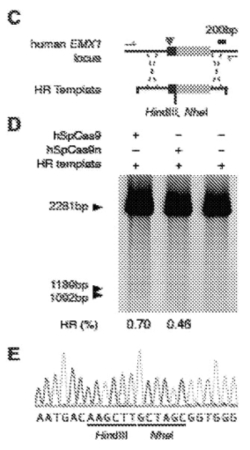
    The Board further cites Broad's assertion of disclosure of example of homology-directed recombinant to replace "a 2000-nucleotide section of the EMXI gene with a homologous template that includes a 12-base pair sequence changing the stop codon of the gene to sequences for two restriction enzymes (HindIII and NheI) and, thus, altering the expression of at least one gene product using a CRISPR-Cas9 system in a eukaryotic cell" in support of this construction (as illustrated by Figures 4C-4E of the P1 specification:

    ImageIllustrating how an expert witness can produce unpersuasive testimony, the Board states with regard to her support for Sigma's argument that this disclosure is insufficient to show alteration of gene expression that:

    Neither Sigma nor Dr. Cannon explains why sequence data showing the absence of a stop codon would not have indicated to one of ordinary skill in the art that the resulting protein would contain additional amino acids.

    and

    Dr. Cannon does not testify that one of ordinary skill in the art would not have understood that the sequencing information in Figure 4E would produce a protein longer than the unaltered emx1 gene would produce.

    On this argument, the Board was persuaded by Broad's expert that this disclosure satisfies the requirement that the CRISPR-Cas9 complex disclosed in Broad's P1 priority document demonstrates a system wherein expression of at least one gene product is altered" as required by Count 1.

    Finally, the Board easily rejects Sigma's argument that the P1 disclosure of Cas9 embodiments comprising an unspecified number of NLS sequences does not provide constructive reduction to practice of embodiments comprising one NLS sequence, saying "Because the Broad portion of Count 1 includes an embodiment without a limitation on the number of NLS or even if an NLS is present on the Cas9 protein, we are not persuaded that even if Broad P1 does not describe a CRISPR-Cas9 system with a Cas9 protein having only one linked NLS, as Sigma argues."

    On the basis of these Party arguments, the Board denied Sigma-Aldrich's Substantive Preliminary Motion No. 1.

    And as with the priority phase in co-pending Interference No. 106,126, No. 106,127, and No. 106,132 (see "PTAB Suspends ToolGen Interferences" and "PTAB Redeclares Interference No. 106,132 and Suspends Priority Phase Proceedings"), the Board suspended the priority phase of this interference until the appeal in Interference No. 106,115 has been decided by the Federal Circuit.

    *Our apologies for the delay in posting on these decisions.

  • CalendarJanuary 24, 2023 – "Legal Underpinnings of Patent Damage Calculations in Germany" (OxFirst Limited) – 15:00 (GMT)

    January 24, 2023 – "Top Patent Law Stories of 2022" (McDonnell Boehnen Hulbert & Berghoff LLP) – 10:00 am to 11:15 am (CT)

    January 24, 2023 – Stakeholder Offerings and Resources (SOaR) training session on how to appeal a patent application decision before the Patent Trial and Appeals Board (PTAB) (U.S. Patent and Trademark Office) – 2:00 pm to 4:00 pm (ET)


  • MBHB Logo 2McDonnell Boehnen Hulbert & Berghoff LLP will be offering a live webinar on the "Top Patent Law Stories of 2022" on January 24, 2023 from 10:00 am to 11:15 am (CT).  Since 2007, the Patent Docs weblog has presented an annual, end-of-the-year review of the top stories in patent law.  In this presentation, Patent Docs co-authors Donald Zuhn, Kevin Noonan, and Michael Borella will take a look back at the top patent stories of 2022, many of which will likely impact patent applicants and practitioners in the coming year.

    While there is no fee to participate, attendees must register in advance.  Those wishing to register can do so here.  CLE credit is pending for the states of California, Illinois, New Jersey, New York, North Carolina, and Virginia.

  • USPTO SealAs part of the U.S. Patent and Trademark Office's Stakeholder Offerings and Resources (SOaR) virtual training series, the Office will be offering a training session on how to appeal a patent application decision before the Patent Trial and Appeals Board (PTAB).  The training session will be offered on January 24, 2023 from 2:00 pm to 4:00 pm (ET).  The training session will cover basic information about the PTAB, provide an overview of the patent application appeal process, and highlight resources for inventors.  In addition, Hope Shimabuku, Director of the Texas Regional Office (TXRO) will discuss resources and programs TXRO offers to stakeholders in the region.

    Those interested in registering for the webinar can do so here.

  • OxFirstOxFirst Limited will be offering a webinar entitled "Legal Underpinnings of Patent Damage Calculations in Germany" on January 24, 2023 at 15:00 (GMT).  Dietrich Kamlah of Taylor Wessing will present an analysis of damages for patent infringement in Germany, including a discussion on whether the German damages approach is in line with European law, and addressing a more recent concern on whether damage awards under the UPC may be more attractive compared to awards by German courts.

    While there is no cost to participate in the program, those interested in attending the webinar should register here.

  • By Donald Zuhn –-

    FireworksAfter reflecting upon the events of the past twelve months, Patent Docs presents its 16th annual list of top patent stories.  For 2022, we identified ten stories that were covered on Patent Docs last year that we believe had (or are likely to have) a significant impact on patent practitioners and applicants.  On Monday and Tuesday, we counted down stories #10 to #8 and stories #7 to #5, and today we count down the top four stories of 2022.  As with our other lists (2021, 2020, 2019, 2018, 2017, 2016, 2015, 2014, 2013, 2012, 2011, 2010, 2009, 2008, and 2007), links to our coverage of these stories (as well as a few links to articles on related topics) have been provided in case you missed the articles the first time around or wish to go back and have another look.  As always, we love to hear from Patent Docs readers, so if you think we left something off the list or disagree with anything we included, please let us know.  In addition, we will be offering a live webinar on the "Top Patent Law Stories of 2022" on January 24, 2023 from 10:00 am to 11:15 am (CT).  Details regarding the webinar, which will focus on a few of the most important stories on this year's list, can be found here.


    4.  Supreme Court Refuses to Grant Certiorari in American Axle v. Neapco Holdings

    In May, there was a brief moment of hope in the patent community when the Solicitor General provided the government's views to the Supreme Court in an amicus brief in American Axle & Manufacturing, Inc., Petitioner v. Neapco Holdings LLC.  In the first sentences of the Discussion section of the brief, the Solicitor General writes:  "The court of appeals held that claim 22 of the '911 patent, which claims a method of manufacturing automobile driveshafts that uses specific mechanical structures and calibrates particular physical properties, is patent-ineligible under Section 101.  That holding is incorrect."  Thus, the Solicitor General expressed the government's view that the Supreme Court should grant certiorari with respect to Question 1 of the Questions Presented.  That moment of hope, however, was cut short by the Supreme Court in June, when the Court denied certiorari in American Axle, thereby refusing (once again) to address the morass in patent subject matter eligibility created by its decisions in Bilski v. Kappos; Mayo Collaborative Services v. Prometheus Laboratories; Alice Corp. v. CLS Bank International; and Association for Molecular Pathology v. Myriad Genetics, Inc.  For a Court whose political inclinations became more evident in 2022, the chorus of dissent regarding the state of subject matter eligibility law from the patent community, industry groups, the U.S. Patent and Trademark Office, members of Congress, half (at last count) of the judges on the Federal Circuit, and the Solicitor General has fallen on particularly deaf ears, the Court's refusal in American Axle being the latest.  To many, American Axle represented the Gordian Knot in patent-eligibility that had been unartfully tied by the Court with help from the Federal Circuit.  The case was possibly the best opportunity yet to clarify what was meant by the remarkably vague two-part test set forth in Alice.

    For information regarding this and other related topics, please see:

    • "In re Smith (Fed. Cir. 2022)," September 15, 2022
    • "Think Twice About Appealing a § 101 Rejection to the PTAB," September 13, 2022
    • "Realtime Adaptive Streaming LLC v. Netflix, Inc. (Fed. Cir. 2022)," July 31, 2022
    • "USPTO Director's Blog Post Extolling Certainty in § 101 Determinations Paradoxically Increases Uncertainty," July 26, 2022
    • "CareDx, Inc. v. Natera, Inc. (Fed. Cir. 2022)," July 19, 2022
    • "The Supreme Court Sidesteps America's Patent Eligibility Crisis," June 30, 2022
    • "Supreme Court Denies Cert in American Axle," June 30, 2022
    • "Solicitor General Provides Government Views in American Axle & Mfg. Inc. v. Neapco Holdings Co.," May 24, 2022
    • "Repifi Vendor Logistics, Inc. v. Intellicentrics, Inc. (Fed. Cir. 2022)," March 23, 2022
    • "Mentone Solutions LLC v. Digi International Inc. (Fed. Cir. 2021)," February 8, 2022


    3.  WTO Waiver Permits Use of COVID-19 Vaccine Patents — But WTO Declines to Extend Waiver (For Now) to COVID-19 Diagnostics and Therapeutics

    In March, it was reported that the United States, European Union, India, and South Africa had reached an agreement on a waiver with respect to patents for COVID-19 vaccines.  Progress on the compromise appeared to have been made during a meeting of the Council for Trade-Related Aspects of Intellectual Property Rights (TRIPS).  And then only a few months later, the World Trade Organization (WTO) Ministerial Conference issued a June 17 Ministerial Decision, which permits an eligible Member, defined as including all developing country Members, to "limit the rights provided for under Article 28.1 of the TRIPS Agreement . . . by authorizing the use of the subject matter of a patent required for the production and supply of COVID-19 vaccines without the consent of the right holder to the extent necessary to address the COVID-19 pandemic."  The "subject matter of a patent" is defined in the Decision as including the ingredients and processes necessary for the manufacture of COVID-19 vaccines.  Eligible Members can apply the provisions of the Decision until 5 years from the date of the Decision (i.e., June 17, 2027).  The Decision also included a provision that "[n]o later than six months from the date of this Decision, Members will decide on its extension to cover the production and supply of COVID-19 diagnostics and therapeutics."  Despite a December request from nine delegations (Argentina, Bangladesh, Bolivia, Egypt, India, Indonesia, Pakistan, South Africa, and Venezuela) calling on the WTO General Council to extend the June 17 Decision to COVID-19 therapeutics and diagnostics, the WTO instead further extended the deadline to decide whether to extend the June 17 Decision.

    For information regarding this and other related topics, please see:

    • "WTO TRIPS Council Recommends That General Council Extend Waiver Deadline," December 18, 2022
    • "Nine Countries Seek Extension of WTO Waiver to COVID-19 Therapeutics and Diagnostics," December 11, 2022
    • "Status of Proposed Extension of TRIPS Waiver in WTO," December 8, 2022
    • "C4IP Presents Webinar on COVID Waiver Extension," December 5, 2022
    • "Moderna Sues Pfizer and BioNTech over mRNA Vaccine Technology," August 31, 2022
    • "U.S. Trade Representative Releases 2022 Special 301 Report," April 28, 2022
    • "U.S. Chamber of Commerce Supports House and Senate Legislation Prohibiting Biden Administration from Negotiating Modifications to WTO TRIPS Agreement Without Congressional Authorization," April 24, 2022
    • "Senators Send Letter to Commerce Secretary Regarding WTO Waiver Compromise," March 28, 2022
    • "The Proposed WTO IP Waiver: Just What Good Can It Do? — An Analysis," March 24, 2022
    • "IP Associations "Concerned" by Reports of TRIPS Waiver Compromise," March 24, 2022
    • "More on Leaked WTO COVID-19 Vaccine Patent Waiver Compromise," March 21, 2022
    • "Compromise Reportedly Reached on COVID-19 Vaccine Patent Waiver," March 16, 2022


    2.  Supreme Court to Address Scope of Disclosure Necessary to Satisfy Enablement Requirement of 35 U.S.C. § 112(a)

    In November, the Supreme Court surprised the patent community by granting Amgen's petition for certiorari in Amgen v. Sanofi on the second of the Questions Presented in its petition:

    2.  Whether enablement is governed by the statutory requirement that the specification teach those skilled in the art to "make and use" the claimed invention, 35 U.S.C. §112, or whether it must instead enable those skilled in the art "to reach the full scope of claimed embodiments" without undue experimentation—i.e., to cumulatively identify and make all or nearly all embodiments of the invention without substantial "'time and effort,'" Pet.App. 14a [emphasis added].

    This Question, and how the Court has been petitioned to address it, directly concerns the scope of disclosure necessary to satisfy the statutory requirements of 35 U.S.C. § 112(a), a question of particular importance for genus claims in pharmaceutical and biotechnology patents.  As always, it is impossible to discern the Court's reasoning for granting certiorari.  Here the Court will wade into a question that involves balancing the scope of genus claims and their preclusive preemptive effect on future development of related but not expressly disclosed species, on the one hand, and the need for a patentee of an invention capable of a multiplicity of (relatively) minor structural changes to be able to protect an invention from trivial infringers, on the other hand.  How this issue is addressed will likely make our top stories list for 2023.

    For information regarding this and other related topics, please see:

    • "Supreme Court Grants Certiorari in Amgen v. Sanofi," November 6, 2022


    1.  Impact of Russian Invasion of Ukraine on Global Patent Systems

    On February 24, 2022, Russia invaded Ukraine in a major escalation of the Russo-Ukrainian War, which began in 2014.  The invasion has resulted in tens of thousands of deaths on both sides.  It has caused Europe's largest refugee crisis since World War II, with 8 million Ukrainians being displaced within their country by late May, and more than 7.9 million having fled the country as of the beginning of the year.  Many countries imposed sanctions on Russia, affecting the economies of Russia and the world, and provided humanitarian and military aid to Ukraine, totaling over $80 billion from 40 countries as of August 2022.

    The impact of the invasion was also felt by the global patent community.  In March, the U.S. Patent and Trademark Office announced that it had "terminated engagement with officials from Russia's agency in charge of intellectual property, the Federal Service for Intellectual Property (commonly known as Rospatent), and with the Eurasian Patent Organization [EAPO]," noting that the termination of engagement with Rospatent and EAPO was in keeping with guidance issued by the U.S. Department of State.  As part of that termination, the USPTO announced that it would no longer grant requests to participate in the Global Patent Prosecution Highway (GPPH) at the USPTO when such requests are based on work performed by Rospatent as an Office of Earlier Examination under the GPPH.  Russia responded to the actions of the USPTO and other patent offices by issuing a Resolution permitting uncompensated use of certain patents without patentee consent — the patents at issue being held by patent holders who are "associated with foreign states" that commit "unfriendly actions" in relation to Russian legal persons and individuals.

    In March, the Office of Foreign Assets Control (OFAC) of the U.S. Department of the Treasury issued a General License authorizing "U.S. persons . . . to pay taxes, fees, or import duties, and purchase or receive permits, licenses, registrations, or certifications" for a limited time when such activities relate to transactions involving the Central Bank of the Russian Federation ("Bank of Russia").  According to the General License, transactions that were "ordinarily incident and necessary to such persons' day-to-day operations in the Russian Federation" were authorized "through 12:01 a.m. eastern daylight time, June 24, 2022."  As a result of the General License, Applicants prosecuting applications before Rospatent or paying annuities on Russian patents would have had to make some difficult decisions regarding the prosecution of those applications and maintenance of those patents by June 24.  But in May, the U.S. Patent and Trademark Office announced that the OFAC's publication of General License No. 31 "authorize[d] certain intellectual property-related transactions in Russia, including the filing and prosecution of any application to obtain a patent, trademark, or copyright, as well as renewal and maintenance fees."  Shortly after the USPTO's announcement, the Intellectual Property Owners Association (IPO) noted that General License No. 31 "clarifies previously issued General License No. 13, which left unresolved whether such payments constituted permissible 'payments for registrations, certifications, and licenses to conduct day-to-day operations' or were prohibited by Russian Harmful Foreign Activities Sanctions Regulations."

    Shortly after Russia invaded Ukraine, the Ukrainian Institute of Intellectual Property (Ukrpatent) issued a statement declaring "that during this extremely difficult time for the country, during the military aggression of the Russian Federation against Ukraine, which became the reason for the imposition of martial law . . . the State Enterprise 'Ukrainian Institute of Intellectual Property' (Ukrpatent) continues to operate on a full-time basis providing all the necessary functions and continuous operation of the state system of legal protection of intellectual property."  Although the functions of the National Intellectual Property Authority from Ukrpatent were transferred to the Ukrainian National Office of Intellectual Property and Innovation (UANIPIO) in November (as part of Ukrainian IP reform begun in 2016; see announcement on UANIPIO website), patent protection in Ukraine has not ceased as a result of the conflict.

    For information regarding this and other related topics, please see:

    • "USPTO News Briefs," June 6, 2022 (Rospatent terminated as ISA/IPEA)
    • "Treasury Department Issues General License Authorizing Certain Transactions Related to Patents, Trademarks, and Copyrights," May 10, 2022
    • "U.S. Trade Representative Releases 2022 Special 301 Report," April 28, 2022
    • "Treasury Department Authorizes Transactions Involving Bank of Russia Until June 24, 2022," April 10, 2022
    • "USPTO News Briefs," April 4, 2022 (Rospatent PPH termination)
    • "USPTO Provides Advice Regarding Dealings with Rospatent," March 22, 2022
    • "Georgian and Estonian Patent Offices Join Other IP Offices in Expressing Support for Ukraine," March 13, 2022
    • "Several Law Firms Close Russian Offices," March 13, 2022
    • "Russia Permits Uncompensated Use of Certain Patents without Patentee Consent," Match 11, 2022
    • "Lithuanian Patent Office and EUIPO Join Other Patent Offices in Expressing Support for Ukraine," March 10, 2022
    • "USPTO Terminates PPH with Rospatent and Terminates Engagement with NCIP," March 10, 2022
    • "Life Sciences Business Leaders Call for Immediate and Complete Economic Disengagement from Russia," March 9, 2022
    • "PRH Joins Other Patent Offices in Expressing Support for Ukraine," March 9, 2022
    • "USPTO Terminates Engagement with Rospatent and EAPO," March 7, 2022
    • "Ukrpatent Continues Normal Operations Despite Russian Aggression," March 6, 2022

  • By Donald Zuhn –-

    FireworksAfter reflecting upon the events of the past twelve months, Patent Docs presents its 16th annual list of top patent stories.  For 2022, we identified ten stories that were covered on Patent Docs last year that we believe had (or are likely to have) a significant impact on patent practitioners and applicants.  On Monday, we counted down stories #10 to #8, and today we count down stories #7 to #5, as we work our way towards the top four stories of 2022.  As with our other lists (2021, 2020, 2019, 2018, 2017, 2016, 2015, 2014, 2013, 2012, 2011, 2010, 2009, 2008, and 2007), links to our coverage of these stories (as well as a few links to articles on related topics) have been provided in case you missed the articles the first time around or wish to go back and have another look.  As always, we love to hear from Patent Docs readers, so if you think we left something off the list or disagree with anything we included, please let us know.  In addition, we will be offering a live webinar on the "Top Patent Law Stories of 2022" on January 24, 2023 from 10:00 am to 11:15 am (CT).  Details regarding the webinar, which will focus on a few of the most important stories on this year's list, can be found here.


    7.  PTAB Issues Decisions in CRISPR Interferences and University of California/Berkeley Appeals to Federal Circuit

    Seven years ago, the journal Science picked the CRISPR (clustered regularly interspaced short palindromic repeats) technology as its "Breakthrough of the Year," declaring that the technology had "matured into a molecular marvel."  Not surprisingly, CRISPR's status as breakthrough molecular marvel has resulted in a battle over who has the best patent position with respect to this technology.  Interferences between the Broad Institute, Harvard University, and the Massachusetts Institute of Technology (as Senior Party) and the University of California/Berkeley, the University of Vienna, and Emmanuelle Charpentier (as Junior Party) (No. 106,115), between Toolgen as Senior Party and the parties in Interference No. 106,115 as Junior Parties, and between Sigma-Aldrich as Senior Party and the parties in Interference No. 106,115 as Junior Parties continued to move forward in 2022.

    In February, in Interference No. 106,115, the Patent Trial and Appeal Board granted priority for eukaryotic CRISPR to the Broad Institute, Harvard University, and MIT ("Broad") as Senior Party and against Junior Party the University of California/Berkeley, the University of Vienna, and Emmanuelle Charpentier ("CVC").  Accordingly, all of Broad's patents and applications in interference remain and CVC's applications having claims directed to eukaryotic CRISPR were finally rejected for lack of priority.  In November, CVC filed its brief on appeal to the Federal Circuit seeking to convince the Court that correction of the PTAB's decision is in order.

    CRISPR interferences have now made five of our last six top stories lists, and the dispute over the protection of this technology could very well be on next year's list as well.

    For information regarding this and other related topics, please see:

    • "PTAB Redeclares Interference No. 106,132 and Suspends Priority Phase Proceedings," December 26, 2022
    • "PTAB Decides Parties' Motions in CRISPR Interference," December 22, 2022
    • "A Better, CRISPR World Assayed in The New York Times," December 13, 2022
    • "Regeneron Files Amicus Brief in Support of CVC and Reversal in Interference No. 106,115*," November 16, 2022
    • "Oral Arguments Scheduled in CRISPR Interferences," November 13, 2022
    • "Scientists File Amicus Brief in Interference No. 106,115," November 8, 2022
    • "CVC Files Appeal Brief in Interference No. 106,115," November 2, 2022
    • "PTAB Renders Decisions in Interference No. 106,127," October 23, 2022
    • "PTAB Renders Decisions in Interference No. 106,126," October 18, 2022
    • "PTAB Suspends ToolGen Interferences," October 17, 2022
    • "Oral Hearing in Interference No. 106,127," September 21, 2022
    • "Oral Hearing in Interference No. 106,126," September 20, 2022
    • "Oral Arguments Rescheduled in CRISPR Interferences," August 28, 2022
    • "Oral Arguments Scheduled in CRISPR Interferences," August 4, 2022
    • "Tell Us What You Really Think: CVC Asserts Board Decision in '115 Interference Negates Jurisdiction in Interference Nos. 106,127 and 106,132," June 9, 2022
    • "Junior Party Broad Files Reply to Sigma-Aldrich Opposition to Broad Preliminary Motion No. 3 in Interference No. 106,133," June 1, 2022
    • "Junior Party Broad Files Reply to Sigma-Aldrich Opposition to Broad Contingent Motion No. 2," May 30, 2022
    • "Junior Party Broad Files Reply to Sigma-Aldrich Opposition to Substantive Preliminary Motion No. 1 in Interference No. 106,133," May 22, 2022
    • "Sigma-Aldrich Files Reply to Broad’s Opposition to Sigma's Substantive Preliminary Motion No. 1 to Deny Priority Benefit in Interference No. 106,133," May 19, 2022
    • "CVC Files Reply to Sigma-Aldrich Opposition to CVC's Responsive Motion No. 1," May 16, 2022
    • "Junior Party CVC Files Reply to Sigma-Aldrich's Opposition to Its Preliminary Motion No. 4," May 15, 2022
    • "CVC Files Reply to Senior Party Sigma-Aldrich's Opposition to CVC's Substantive Preliminary Motion No. 3 in Interference No. 106,132," May 11, 2022
    • "CVC Files Reply to Sigma-Aldrich Opposition to CVC Substantive Preliminary Motion No. 1 to be Accorded Priority Benefit," May 9, 2022
    • "Senior Party Sigma-Aldrich Files Reply to Junior Party CVC'S Opposition to Its Substantive Preliminary Motion No. 1 to Change Count in Interference No. 106,132," May 8, 2022
    • "Senior Party Sigma-Aldrich Files Opposition to Junior Party's Preliminary Motion No. 3 in Interference No. 106,133," May 4, 2022
    • "Senior Party Sigma-Aldrich Files Opposition to Broad Contingent Motion No. 2," April 21, 2022
    • "Senior Party Sigma-Aldrich Files Opposition to Junior Party Substantive Preliminary Motion No. 1 in Interference No. 106,133," April 18, 2022
    • "Junior Party Broad Files Opposition to Senior Party Sigma-Aldrich's Substantive Preliminary Motion No. 1 in Interference No. 106,133," April 11, 2022
    • "CVC Files Opposition to Senior Party Sigma-Aldrich's Substantive Preliminary Motion No. 1 to Change Count in Interference No. 106,132," March 27, 2022
    • "Senior Party Sigma-Aldrich's Opposition to CVC's Substantive Preliminary Motion No. 4 in Interference No. 106,132," March 22, 2022
    • "Senior Party Sigma-Aldrich's Opposition to CVC's Substantive Preliminary Motion No. 3 in Interference No. 106,132," March 20, 2022
    • "Sigma-Aldrich Files Opposition to CVC Substantive Preliminary Motion No. 1 to be Accorded Priority Benefit," March 15, 2022
    • "PTAB Holds for Broad in CRISPR Interference: The Reasoning," March 7, 2022
    • "PTAB Grants Priority for Eukaryotic CRISPR to Broad in Interference No. 106,115," February 28, 2022
    • "Sigma-Aldrich Files Substantive Preliminary Motion No. 2 to Remove Broad Application from Interference," February 20, 2022
    • "Sigma-Aldrich Files Substantive Preliminary Motion No. 1 to Deny Broad Priority Benefit to Its Earliest-filed Provisional Application," February 16, 2022
    • "Broad Files Substantive Preliminary Motion No. 3 to Designate Claims as not Corresponding to Count in Interference No. 106,133," February 13, 2022
    • "Broad Files Contingent Preliminary Motion No. 2 to Designate Claims Corresponding to Substitute Count 3," February 10, 2022
    • "PTAB Hears Oral Argument in Interference No. 106,115," February 7, 2022
    • "Broad Files Substantive Preliminary Motion No. 1 to Substitute the Count," February 2, 2022
    • "CVC Files Responsive Preliminary Motion No. 1 for Priority Benefit," January 31, 2022
    • "Patent Trial and Appeal Board Set Date for Oral Hearing in Interference No. 106,115," January 30, 2022
    • "Sigma-Aldrich Files Substantive Preliminary Motion 1 to Change the Count in Interference No. 106,133," January 19, 2022
    • "CVC Files Substantive Miscellaneous Motion No. 4 to Add Senior Party Patents and Designate Claims Corresponding to the Count," January 13, 2022
    • "CVC Files Substantive Preliminary Motion No. 3 to Substiture the Count," January 12, 2022
    • "CVC Substantive Preliminary Motion No. 1 for Priority Benefit," January 10, 2022


    6.  Federal Circuit Continues to Focus on Written Description

    In 2017, the Federal Circuit's decision in Amgen Inc. v. Sanofi brought clarity to how the Court (and U.S. Patent and Trademark Office) should apply the written description requirement in 35 U.S.C. § 112(a) to properly circumscribe the scope of claims to monoclonal antibodies, and that decision came in at #11 on our top stories list.  Last year, the Federal Circuit issued several decisions implicating the written description and enablement requirements, and the Federal Circuit's continuing development (and limitation of) § 112 made it to #5 on our top stories list.

    Last year, the Federal Circuit continued to focus on the written description requirement.  For example, in June, in Novartis Pharmaceuticals Corp. v. Accord Healthcare, Inc., the Federal Circuit granted a panel rehearing and vacated a panel decision between these parties that had been decided in January.  In the panel rehearing, Chief Judge Moore (who dissented in January) was joined by Judge Hughes (who replaced Judge O'Malley, who left the Court in May) in vacating the January decision (over a dissent by Judge Linn, who had joined Judge O'Malley in the majority in January).  The panel majority opinion tracks the Chief Judge's dissent in the Court's earlier decision, that negative limitations do bear a burden of disclosure different from affirmative ones.  According to the Chief Judge, this burden can be satisfied, for example, by including "a reason to exclude the relevant [element]," or by including "'statements in the specification expressly listing the disadvantages of using' that element," or by distinguishing among the excluded element and advantageous alternatives.  The opinion calls "the common denominator" of all these rubrics disclosure of the element to be excluded, repeating the Chief's aphorism from her earlier dissent that "silence is not disclosure."  While not disputing the principle that "a negative limitation need not be recited in the specification in haec verba," the majority opinion asserts the need for "something" to be disclosed in the specification "that conveys to a skilled artisan that the inventor intended the exclusion, such as a discussion of disadvantages or alternatives."

    For information regarding this and other related topics, please see:

    • "Novartis Pharmaceuticals Corp. v. Accord Healthcare, Inc. (Fed. Cir. 2022)," June 21, 2022
    • "Federal Circuit Denies Petition for Rehearing en Banc in Biogen Int'l GmbH v. Mylan Pharmaceuticals Inc.," March 17, 2022
    • "Novartis Pharmaceuticals Corp. v. Accord Healthcare, Inc. (Fed. Cir. 2022)," January 4, 2022


    5.  UPC Postpones Start of Sunrise Period

    Last month, the Unified Patent Court (UPC) announced that the start of Sunrise Period –- when patent owners can begin to remove European patents and European patent applications from the jurisdiction of the UPC, i.e., opt-out — was being postponed by two months from January 1, 2023 to March 1, 2023.  The UPC indicated that the initial plan called for the Sunrise Period to begin on January 1, 2023, with the Agreement on a Unified Patent Court (UPCA) coming into force on April 1, 2023.  However, following the UPC's adjustment, the Sunrise Period will begin on March 1, 2023, and the UPCA will come into force on June 1, 2023.  The UPC also noted that it "expect[s] no further delay of the start of the UPC beyond 1 June 2023."

    For information regarding this and other related topics, please see:

    • "UPC Postpones Start of Sunrise Period to March 1, 2023," December 12, 2022

  • By Donald Zuhn –-

    FireworksAfter reflecting upon the events of the past twelve months, Patent Docs presents its 16th annual list of top patent stories.  For 2022, we identified ten stories that were covered on Patent Docs last year that we believe had (or are likely to have) a significant impact on patent practitioners and applicants.  Today, we count down stories #10 to #8, and later this week we will count down the remaining top stories of 2022.  As with our other lists (2021, 2020, 2019, 2018, 2017, 2016, 2015, 2014, 2013, 2012, 2011, 2010, 2009, 2008, and 2007), links to our coverage of these stories (as well as a few links to articles on related topics) have been provided in case you missed the articles the first time around or wish to go back and have another look.  As always, we love to hear from Patent Docs readers, so if you think we left something off the list or disagree with anything we included, please let us know.  In addition, we will be offering a live webinar on the "Top Patent Law Stories of 2022" on January 24, 2023 from 10:00 am to 11:15 am (CT).  Details regarding the webinar, which will focus on a few of the most important stories on this year's list, can be found here.


    10.  Federal Circuit Denies En Banc Review in GlaxoSmithKline LLC v. Teva Pharmaceuticals USA

    The 2020 decision by a divided Federal Circuit panel in GlaxoSmithKline LLC v. Teva Pharmaceuticals USA regarding the extent to which an ANDA applicant who obtained regulatory approval under the carve-out provisions of 21 U.S.C. § 355(j)(2)(A)(viii) could be liable for inducement of infringement under 35 U.S.C. § 271(b) caused something of an uproar, leading to a panel rehearing on the matter but ultimately coming to the same conclusion.  Both decisions were issued in the face of a strong dissent by Judge Prost, in the first decision while she was Chief Judge.  In February, the Federal Circuit decided not to rehear the matter en banc, over the dissenting opinions of three of the judges (including Judge Prost).  The decision by the full Court was announced in a simple Order to that effect, noting that Judges Lourie and Cunningham did not participate in the decision.  The Order was accompanied by three written dissents:  one by Judge Prost, joined by Judges Dyk and Reyna; another by Judge Dyk writing alone, and the third by Judge Reyna.  The majority consisted of Chief Judge Moore and Judges Newman (who was the third member of the original panels), O'Malley, Taranto, Chen, and Stoll.  Provided that the panel decision does not significantly inhibit "skinny-label" practice, these issues are sure to recur and be the subject of additional Federal Circuit decisions which will make the consequences of this decision, and the Federal Circuit's decision not to review the panel opinion en banc, more evident.

    For information regarding this and other related topics, please see:

    • "GlaxoSmithKline LLC v. Teva Pharmaceuticals USA (Fed. Cir. 2022)," February 15, 2022


    9.  New York Times Reopens Attack on U.S. Patent System

    Over the years, this blog has found itself at odds with The New York Times on the issue of patenting.  See, e.g., "Anti-Patent ("Sullivan?") Malice by The New York Times," January 29, 2007; "Science Fiction in The New York Times," February 13, 2007; "The Anti-Patent Beat Goes on at The New York Times," July 1, 2007; "The Continuing Assault on Innovation at The New York Times," July 15, 2007; "New York Times to Innovation: Drop Dead," April 30, 2008; "New Attack on Patenting in The New York Times," September 7, 2008; "More Patent Nonsense from The New York Times," April 17, 2011.

    In April, The New York Times published an editorial opinion entitled "Save America's Patent System," in which the paper bemoaned the purported prevalence of "bad patents" — including "uninspiring tweaks" to existing products — that supposedly undermine innovation.  The Times Editorial Board decided that it was time to announce that the "United States Patent and Trademark Office is in dire need of reform."  Were that the case, the Times' rhetoric would deserve serious consideration; as it is, the paper continues a history of wrongheaded, faux populist rhetoric that comes to the entirely wrong conclusion.

    For information regarding this and other related topics, please see:

    • "Faux-Populist Patent Fantasies from The New York Times," April 17, 2022
    • "Before You Complain About So-Called Bad Patents, Read This," April 17, 2022


    8.  Senator Tillis Releases Proposal to Reform 35 U.S.C. § 101

    In August, Republican Senator Thom Tillis of North Carolina released a new proposal to reform the text of 35 U.S.C. § 101.  The Senator's last effort in doing so died on the vine in 2019, purportedly due to stakeholders being too far apart in their visions of what patent eligibility should be all about.  But there seems to be a renewed interest in addressing at least some of the ambiguities introduced by the Supreme Court in Alice Corp. v. CLS Bank Int'l and Mayo Collaborative Services v. Prometheus Laboratories, Inc.  Those decisions, which came down in 2014 and 2012, respectively, led to the current state of affairs in which diagnostic methods are effectively unpatentable and software patents can be invalidated based on fuzzy, conclusory reasoning.  Senator Tillis' proposed revisions to § 101 attempt to find a middle ground between varying stakeholder concerns by overruling some aspects of the Supreme Court's recent eligibility jurisprudence and codifying other aspects.  It is unlikely that any one stakeholder will be entirely satisfied with this proposal, but as a starting point the patent community could do much worse.

    For information regarding this and other related topics, please see:

    • "The EFF is Patently Wrong," August 24, 2022 (Tillis bill)
    • "More on Professor Sarnoff's Perspective on Tillis Patent Eligibility Bill," August 9, 2022
    • "Professor Sarnoff Provides His Perspective on Tillis Bill," August 8, 2022
    • "Senator Tillis' Patent Eligibility Reform Proposal: A Biopharma Perspective," August 3, 2022
    • "Senator Tillis Proposes Patent Eligibility Reform (Again)," August 3, 2022

  • CalendarJanuary 17, 2023 – Overview of Patent Public Search tool (U.S. Patent and Trademark Office) – 2:00 pm to 3:00 pm ET

    January 17, 2023 – "China IP Developments: A View from the Ground" (U.S. Patent and Trademark Office) – 7:00 pm to 8:00 pm (ET)

    January 18, 2023 – "Exploring the Future of Innovation-driven Growth & the Role of IP" (Intellectual Property Owners Association and World Intellectual Property Organization) – 9:00 am to 11:30 am (ET) / 3:00 pm to 5:30 pm (CET)

    January 18, 2023 – "The Unitary Patent (UP) and Unified Patent Court (UPC)" (Patent Information Users Group) – 10:00 am (EST)

    January 18, 2023 – Women's Entrepreneurship (WE) event (U.S. Patent and Trademark Office) – 12:00 pm to 1:00 pm (ET) – Naples, FL

    January 18, 2023 – Advanced Tips on Patent Public Search tool (U.S. Patent and Trademark Office) – 2:00 pm to 3:00 pm ET

    January 19, 2023 – Joint public listening session (U.S. Patent and Trademark Office and U.S. Food and Drug Administration) – 10:00 am to 5:00 pm (ET) – Alexandria, VA

    January 19, 2023 – "2022 PTAB Year in Review" (Intellectual Property Owners Association) – 12:00 pm to 1:00 pm (ET)

    January 19, 2023 – "Europe's New Unitary Patent & Unified Patent Court: Strategies for Canadian Applicants & Patent Holders" (Bereskin & Parr) – 12:30 pm (EST)