• CalendarDecember 17, 2015 – "Section 102 and Prior Art: Navigating the Expanded Scope of Prior Art and AIA Exceptions" (Strafford) – 1:00 to 2:30 pm (EST)

    January 6, 2016 – "Preparing for and Navigating PTAB Appeals Before the Federal Circuit — Conducting PTAB Trials With Eye to Appeal, Determining Errors for Appeal, Understanding PTO Practice and Federal Circuit Law" (Strafford) – 1:00 to 2:30 pm (EST)

    January 7, 2016 – "STRANGLEHOLD! Written Description and Functional Claiming in the Chemical and Biotech Arts" (American Intellectual Property Law Association) – 12:30 – 2:00 pm (Eastern)

    January 14, 2016 – "Strategic Use of Patent Reissue: Determining Whether and When to Pursue a Reissue Application — Correcting Errors, Responding to an IPR Challenge and Mastering the Recapture Rule" (Strafford) – 1:00 to 2:30 pm (EST)

    January 20, 2016 – "Patent Eligibility Post-Alice: Practical Advice for Navigating the Current 35 USC § 101 Regime" (American Intellectual Property Law Association) – 12:30 – 2:00 pm (Eastern)

    January 21, 2016 – "Top Patent Law Stories of 2015" (McDonnell Boehnen Hulbert & Berghoff LLP) – 10:00 am to 11:15 am (CT)

    January 21, 2016 – "Obviousness Standard After the AIA: Leveraging Latest PTO and Court Guidance — Overcoming Challenges of Obviousness and Attacks on Patent Validity" (Strafford) – 1:00 to 2:30 pm (EST)

    ***Patent Docs is a media partner of this conference or CLE

  • Strafford #1Strafford will be offering a webinar/teleconference entitled "Obviousness Standard After the AIA: Leveraging Latest PTO and Court Guidance — Overcoming Challenges of Obviousness and Attacks on Patent Validity" on January 21, 2016 from 1:00 to 2:30 pm (EST).  W. Todd Baker of Oblon McClelland Maier & Neustadt, and Jon L. Schuchardt of Dilworth IP will provide patent counsel with guidance on the evolving obviousness standard.  The webinar will review the following issues:

    • How have recent Federal Circuit decisions affected application of the obviousness standard?
    • What level of "unexpected results" is needed to demonstrate patentability in light of recent decisions?
    • What are the most effective strategies for both patentees and petitioners in prevailing on obviousness assertions in an IPR proceeding, and how will that strategy play out at the Federal Circuit?

    The registration fee for the webinar is $297.  Those registering by January 8, 2016 will receive a $100 discount.  Those interested in registering for the webinar, can do so here.

  • AIPLA #1The American Intellectual Property Law Association (AIPLA) will be offering a webinar entitled "Patent Eligibility Post-Alice: Practical Advice for Navigating the Current 35 USC § 101 Regime" on January 20, 2016 from 12:30 – 2:00 pm (Eastern).  Paul Kitch of Nixon Peabody will moderate a panel consisting of David Beck of Viavi Solutions, Inc., Valerie Calloway of Alltech, and Judy Yee of Microsoft.  The panel will provide an overview of significant Court rulings and trends since the Alice decision, a walkthrough of examples from the PTO's 2015 Interim Guidelines, as well as some additional real-life examples, and provide practical tips for patent prosecutors in drafting and prosecuting applications under the current 35 USC § 101 regime.

    The registration fee for the program is $95 (AIPLA member rate) or $150 (non-member rate).  Those interested in registering for the program, can do so here.

  • Strafford #1Strafford will be offering a webinar/teleconference entitled "Strategic Use of Patent Reissue: Determining Whether and When to Pursue a Reissue Application — Correcting Errors, Responding to an IPR Challenge and Mastering the Recapture Rule" on January 14, 2016 from 1:00 to 2:30 pm (EST).  Dr. Shing-Yi (Cindy) Cheng, Deborah M. Herzfeld, and Thomas L. Irving of Finnegan Henderson Farabow Garrett & Dunner, Washington, and Donna M. Meuth, Associate General Counsel, Eisai will provide patent counsel with an in-depth review of the pros and cons of using reissue to correct patent errors, whether before or after AIA, discuss the rule against recapture and the effect of reissue, and also offer their experiences, perspectives and best practices on the strategic use of patent reissue to correct errors.  The webinar will review the following issues:

    • When should counsel be considering the possibility of reissue?
    • How have the AIA changes impacted patent reissue?
    • What are the risks and limitations of using reissue proceedings to proactively resolve patent validity/unpatentability issues?

    The registration fee for the webinar is $297.  Those interested in registering for the webinar, can do so here.

  • By Kevin E. Noonan

    As she has done many times before (and so many times that she has been unfairly characterized as a scold on the Federal Circuit), Judge Pauline Newman dissented from the panel majority decision affirming an obviousness determination by the U.S. Patent and Trademark Office in an inter partes review by the Patent Trial and Appeal Board in Merck & Cie v. Gnosis S.P.A.  And as she has in several other cases, Judge Newman raises in her dissent important questions involving the proper role of the Federal Circuit in reviewing USPTO decisions and the interplay of the Patent Act and the Administrative Procedures Act in how the Court does so.

    MerckThe case involves U.S. Patent No. 6,011,040, which claims "methods of using folates to lower levels of homocysteine in the human body."  Specifically, the claims on appeal (a subset (claims 8, 9, 11, 12, 14, 15, and 19-22) of the challenged claims, following cancellation of several (claims 1-3, 5, 6 and 13) of the claims originally challenged) were directed at such methods using 5-methyl-tetrahydrofolic acid (5-MTHF) and in particular, one stereoisomer of this compound (the L-isomer, having biological activity), alone or in combination with one or a plurality of B vitamins.  The PTAB found these claims obvious, based on three principal references (European application EP0959005, U.S. Patent No. 5,194,611, and a scientific reference to Ubbink et al.).  The PTAB found that the deficiencies in the primary '005 application were overcome by combination with the '611 patent and/or the Ubbink reference, and that the desirability of this combination would have been appreciated by the skilled worker in view of additional prior art references considered by the Board raised by either party.  Further, the Board found that evidence of secondary considerations was not sufficient to overcome the evidence of obviousness adduced by the petitioner.  In this regard the Board relied upon evidence raised by Gnosis to counter Merck's argument of the prior art "teaching away" from the claimed invention to establish that the skilled worker would have had a reasonable expectation of success at achieving the claimed invention to support the Board's obviousness determination.

    The Federal Circuit affirmed, in an opinion by Judge Hughes joined by Judge Plager.  Importantly for the issues raised by Judge Newman in her dissent, the majority applied the "substantial evidence" standard for factual determinations made by the Board in arriving at the legal conclusion that the claims were obvious.  This standard, arising from the Administrative Procedures Act, was mandated by the Supreme Court for the Federal Circuit's review of PTO action in Dickinson v. Zurko, 527 U.S. 150 (1999), and first implemented in In re Gartside, 203 F.3d 1305, 1313 (Fed. Cir. 2000).  According to the majority, under this standard factual determinations by the PTO, including those of the PTAB, are entitled to deference if supported by substantial evidence, and while the resulting legal conclusions are reviewed de novo in practice deferring to the Board on the facts results in affirming the legal conclusions, as occurred here.

    Judge Newman's dissent challenges the application of these precedents to inter partes review decisions by the PTAB, based on her understanding of Congress's intent in establishing this mode of challenging granted patents.  She begins her analysis by recognizing that Congress intended to correct a trend by the PTO of granting patents "too easily" and that courts were not deciding patent issues "consistently" (which admission must have stung a bit).  She perceived that in establishing the PTAB and establishing "new procedures including changes in the burdens of proof, limiting the path of judicial review, and providing for finality and strict time limits" Congress intended to "restore an effective and balanced system of patents, whereby valid patents may reliably be confirmed and invalid patents efficiently invalidated."

    The majority's stance in deferring to the PTAB's factual determinations, for Judge Newman, "raises questions of implementation of the statutory plan," and with particular regard to the Federal Circuit's role cites the Supreme Court in N.L.R.B. v. Brown, 380 U.S. 278, 291–92 (1965):

    Reviewing courts are not obliged to stand aside and rubberstamp their affirmance of administrative decisions that they deem inconsistent with a statutory mandate or that frustrate the congressional policy underlying a statute.  Such review is always properly within the judicial province, and courts would abdicate their responsibility if they did not fully review such administrative decisions.

    Specifically, Judge Newman believes that the AIA imposed on the petitioner the burden of showing, by a preponderance of the evidence, that a patent was invalid.  35 U.S.C. § 316(e).  This standard is much lower than the "clear and convincing evidence" standard required by a district court, because inter alia claims in district court litigation are presumed to be valid.  35 U.S.C. § 283.  This created "a powerful incentive" for challenging patent validity before the PTAB in inter partes proceedings, Judge Newman writes, but "the correct law must be applied, and disputed facts found and reviewed on the entirety of the evidence, as the preponderance standard requires."

    Just as importantly for Judge Newman are the provisions of the AIA that make the Federal Circuit the only avenue for reviewing PTAB decisions, because Congress excluded inter partes review decisions from review by district courts or the International Trade Commission.  This raises the level of responsibility on the Court in performing its review, and in Judge Newman's view makes the kind of deferential standard applied by the majority to be error.  As she states, "[t]he substantial evidence standard determines whether the decision could reasonably have been made, not whether it was correctly made" and stems from appellate court decisions of jury verdicts, "in recognition of the role of credibility at trial."  Its use in the Administrative Procedures Act was sanctioned by a recognition of the particular expertise of specialized agencies in fulfilling their statutory mandate, according to Judge Newman's dissent, and that is the trouble:  by its very nature an inter partes review proceeding is predicated on an allegation by the petitioner that the agency (the PTO) failed to do its job properly and granted the patent improvidently.  Indeed, that problem was what Congress wanted to address by enacting the inter partes review provisions of the AIA in her view (supported by copious citation to the legislative history of the AIA).  Under these circumstances, "[d]eferential review by the Federal Circuit falls short of the legislative purpose of providing optimum determination of patent validity."

    In her view, "[o]n appeal to the Federal Circuit, our assignment is to determine whether the PTAB ruling is correct in law and supported by a preponderance of the evidence.  The panel majority errs in importing into these proceedings the Administrative Procedure Act standard that applies to initial patent examination decisions [as set forth in In re Gartside]."  And requiring a showing by an administrative agency of a preponderance of evidence, a much higher standard than the substantial evidence standard, is not unheard of and has been adopted in other instances cited by the Judge.  "Such close appellate scrutiny is critical to the legislative balance of the America Invents Act," according to the dissent, "whose purpose is to reach an expeditious and reliable determination on which inventors and industry innovators and competitors can rely."  The majority's use of the deferential "substantial evidence" standard "strays from this purpose" and is contrary to the standard set forth by Congress in the AIA.

    It perhaps goes without saying that Judge Newman disagrees with the majority on the merits, and some of her observations in this regard illuminate her broader point:  for example, with regard to the sufficiency vel non of the evidence regarding motivation to combine the cited references, she writes "[d]eferential review on a standard that looks at only one side of the evidence is less likely to uncover errors in the balance and burden of proof."  While her explication of why she reached the opposite conclusion is informative is it not what is significant about her dissent.  That significance lies in the questions she raises about the proper role of the PTAB, as an "adjudicative body" and the standards the Federal Circuit uses to review and supervise the PTAB in its invalidity determinations under the AIA.  She raises questions that only the Supreme Court can properly decide if they deign to do so.

    Merck & Cie v. Gnosis S.P.A. (Fed. Cir. 2015)
    Panel: Circuit Judges Newman, Plager, and Hughes
    Opinion by Circuit Judge Hughes; dissenting opinion by Circuit Judge Newman

  • By Donald Zuhn

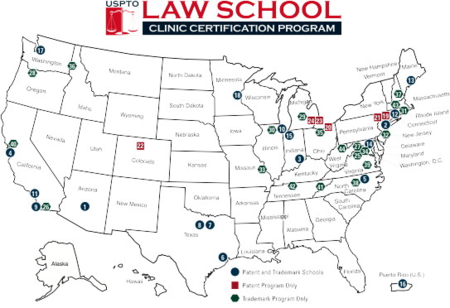
    USPTO SealThe U.S. Patent and Trademark Office issued a notice of proposed rulemaking in the Federal Register earlier today (80 Fed. Reg. 78155) to comply with Public Law 113-227, which was enacted by Congress on December 16, 2014, and which establishes the USPTO's Law School Clinic Certification Program.  The legislation, which requires the USPTO Director to establish regulations and procedures for application to and participation in the USPTO Law School Clinic Certification Program, removes the "pilot" status from the Office's existing law school clinic certification program.

    According to the Office's Federal Register notice, the Law School Clinic Certification Program allows students enrolled in a participating law school's clinic to practice patent and trademark law before the USPTO under the direct supervision of a faculty clinic supervisor by drafting, filing, and prosecuting patent or trademark applications, or both, on a pro bono basis for clients who qualify for assistance from the law school's clinic.  On pages 78157-59 of the notice, the Office sets forth changes to part 11 of the regulations (concerning representation of others before the USPTO) to amend the definition of "practitioner" and add § 11.16, which species the requirements for admission to the Program, and § 11.17, which specifies the requirements for participation in the Program.

    Additional information regarding the Law School Clinic Certification Program can be found on the Office's Program webpage.  The webpage also includes a list of the 44 currently participating law schools, of which eighteen schools have both patent and trademark programs, six have only patent programs, and twenty have only trademark programs.

    The Office also seeks comments in response to the proposed rules changes, which must be submitted by February 16, 2016 either by e-mail to LSCCPComments@uspto.gov; by regular mail addressed to:  Mail Stop OED—Law School Rules, United States Patent and Trademark Office, P.O. Box 1450, Alexandria, Virginia 22313–1450, marked to the attention of William R. Covey, Deputy General Counsel for Enrollment and Discipline and Director of the Office of Enrollment and Discipline; or via the Federal eRulemaking Portal.

    USPTO_Law_School_Clinical_Certification_Program_Participating_School_Map

  • By Kevin E. Noonan

    Bayer CropScienceInterferences, the U.S. Patent and Trademark Office's procedure for determining which of a plurality of inventive entities were the "first to invent," were eliminated by the Leahy-Smith America Invents Act, but they are not entirely gone:  patents and applications examined and granted under the "old" patent law can still become embroiled in them.  Accordingly, questions regarding the legal and procedural requirements remain relevant (at least until the last of the patents or applications from the old regime expire or are abandoned).  And, perhaps surprisingly, issues (even ones of first impression) can arise in an interference even now, as was the case decided by the Federal Circuit last month in In re Commonwealth Scientific & Industrial Research Organization, Bayer Cropscience NV.

    Before the Court was the proper interpretation of 35 U.S.C. § 135(b)(1), that portion of the statute relating to the timing for provoking an interference (for example, by copying claims in a granted patent or published application).  The limitations in this portion of the statute are important as a matter of repose, wherein a patentee (or applicant) can rest assured that their claims would not be subject to future challenge.  (Such provisions do not exist, for example, with regard to inter partes review under the AIA, where a patent can be challenged throughout its term.)

    The interference, between CSIRO and patents owned by Carnegie Institute of Washington and the University of Massachusetts ("Carnegie"), involved claims 52-62 and 69-106 of CSIRO's U.S. Patent Application No. 11/364,183 copied from  Carnegie's U.S. Patent Nos. 6,605,559, 7,622,633, and 7,538,095.  CSIRO had originally copied claims from one of Carnegie's patents before the "critical date" under the statute, but later cancelled those claims, only to reintroduce them five years later in the '183 application involved in the interference.

    Carnegie moved during the interference for judgment, on the grounds that these later-added claims were untimely under § 135(b)(1), which reads in pertinent part:

    A claim which is the same as, or for the same or substantially the same subject matter as, a claim of an issued patent may not be made in any application unless such a claim is made prior to one year from the date on which the patent was granted.

    Carnegie argued that permitting this type of intentional delay was contrary to the statutory intent and that it would "frustrate the purpose" of the law to allow such intentional delays.

    The Patent Trial and Appeal Board granted judgment in Carnegie's favor as a matter of first impression, despite acknowledging that this section of the statute had been interpreted to permit entry of "post-critical date" claims provided that they were not "materially different" from interfering, pre-critical date claims (and that such was the case here).  On the merits, the Board also found that Carnegie was not entitled to its priority date and entered judgment against Carnegie, cancelling the Carnegie claims in interference.  Despite having prevailed in the priority contest the Board refused entry of CSIRO's claims based on its interpretation of § 135(b)(1).

    CSIRO appealed with neither Carnegie nor the USPTO participating in the appeal.  The Federal Circuit reversed, in an opinion by Judge Stoll joined by Judges Mayer and Chen.  As it turned on a matter of statutory interpretation, the panel reviewed the Board's decision de novo and held that the PTO had erred in its interpretation, even assuming CSIRO's prosecution strategy delayed declaration of the interference.  The panel's reasoning was based on its interpretation that the statute did not require diligence in prosecution or any regard for an applicant's patent prosecution strategy either by its plain language or by precedent.  Citing the CCPA, in Cryns v. Musher, 161 F.2d 217 (CCPA 1947), and Corbett v. Chisholm, 568 F.2d 759 (CCPA 1977), and its own precedent following the CCPA, in Univ. of Cal. v. Univ. of Iowa Research Found., 455 F.3d 1371, 1376 (Fed. Cir. 2006), and Adair v. Carter, 668 F.3d 1334, 1339 (Fed. Cir. 2012), the panel held that "cancellation or amendment of a pre-critical date claim does not in itself result in a violation of § 135(b)(1) so long as the later added claims are immaterially different from the precritical date claim," citing specific instances and language from these cases inconsistent with the Board's decision.  In these cases "[w]e left no room for imposition of a requirement of diligent prosecution when the requisite relationship between post- and pre-critical date claims is otherwise established" according to the opinion.

    And thus did the Court reverse another PTAB opinion that, while grounded in what appears to be an attempt at equity and perhaps sound administration of the Board and the conduct of interferences, was fundamentally not based in either the statute or case law interpretation of the statute.  Even at this late date for interferences, the necessity and usefulness of the Federal Circuit's supervisory role over the Office is once again evident in this decision.

    In re Commonwealth Scientific & Industrial Research Organization, Bayer Cropscience NV (Fed. Cir. 2015)
    Panel: Circuit Judges Chen, Mayer, and Stoll
    Opinion by Circuit Judge Stoll

  • By Paul Cole* —

    Ariosa DiagnosticsThere is no point in crying over spilled milk.  The denial of an en banc hearing in the above case[1] is now history.  Apart from looking at the small print for pointers towards a more moderate approach, the focus now shifts to the expected petition for certiorari.

    Rule 10 of the Supreme Court Rules explains that grant of certiorari is discretionary, is given only for compelling reasons and is unlikely merely when the asserted error consists of erroneous factual findings or the misapplication of a properly stated rule of law.  However, certiorari may be granted where a US court of appeals has decided an important federal question in a way that conflicts with relevant Supreme Court decisions or other court of appeal decisions or where there is an important question of federal law that has not been, but should be, settled by the Court.

    It is strongly arguable that natural principle/product of nature exception to § 101 eligibility in the pharmaceutical, medical and biotechnology arts is an important and at present insufficiently settled question of federal law.  It will be recalled that those filing amicus briefs supporting en banc reconsideration included:

    • industry and professional organizations: The Intellectual Property Owners Association (IPO), The Biotechnology Industry Organization (BIO), The Pharmaceutical Research and Manufacturers of America, The Bioindustry Association (BIA), the New York Intellectual Property Law Association and  the Coalition for 21st Century Medicine (Coalition);

    • academic commentators: Adam Mossoff and other law professors (23 Professors) and a further brief from Professors Jeffrey Lefstin and Peter Menell;

    • research institutions: The Wisconsin Alumni Research Foundation, Amaranthus Bioscience Holdings, Population Diagnostics Inc. and Jyant Technologies; and

    • foreign commentators: Novartis AG (Switzerland) and Cole (UK).

    The weight of concern expressed by institutions, the academic community and industry and their collective willingness to expend time and effort in explaining their concerns provides compelling evidence that an important question of federal law is at stake, and this concern has been acknowledged in the opinions of the judges deciding the en banc petition.

    The abundance of conflicting authority identified in the petition and in the various amicus briefs also evidences the need for Supreme Court review.  No less than 23 earlier Supreme Court authorities were argued in the Petition and by the amici to be conflicting:  Alice v CLS Bank, Association for Molecular Pathology v Myriad, Bilski v Kappos, Carnegie Steel v Cambria Iron, Dann v Johnston, Diamond v Chakrabarty, Diamond v Diehr, Dolbear v American BellEibel Process v Minn & Ont. Paper, Funk Brothers v Kalo, Gottschalk v Benson, Graham v John Deere,  Hartranft v Wiegmann, KSR v Teleflex, LeRoy v Tatham, Macay Radio v Radio Corporation of America, O'Reilly v Morse, Parker v Flook, Tilghman v Proctor, United States v Adams, Washburn v Beat-'Em All Barbed Wire, Webster Loom v Higgins and Wisconsin v Pelican. A host of other authorities from inferior courts were also identified as conflicting, e.g. Cameron Septic Tank v Saratoga Springs, Kuehmsted v Farbenfabriken of Elderfeld, Merck v Olin Mathieson, Park-Davis v Mulford and Research Corporation v Microsoft.

    Rule 14 requires a petition to begin with the questions presented for review expressed concisely in relation to the circumstances of the case.

    It is arguable that the key question is defined most concisely and aptly at page 5 of the brief of Lefstin and Menell and is whether Mayo requires a new discovery to be applied by unconventional means[2].

    An affirmative answer to that question, as held in the panel opinion and the concurring opinions accompanying the en banc decision, cannot be reconciled with existing authority as explained in the 23 Professors brief and by Cole.  Indeed, as argued in an earlier article[3] such an approach was considered and rejected by the UK Court of Appeal and contradicts what is said elsewhere in the Mayo opinion which it is submitted should be considered and applied as a whole:

    In effect the Mayo rule corresponds to the "contribution approach" suggested at first instance in the UK in Merrill Lynch's Application [1988] R.P.C. 1 which was to consider whether the inventive contribution resided only in excluded matter.  That approach also has its difficulties and it was rejected by the UK Court of Appeal in Genentech's patent [1989] R.P.C. 147 where it was observed that: "Such a conclusion, when applied to a discovery, would seem to mean that the application of the discovery is only patentable if the application is itself novel and not obvious, altogether apart from the novelty of the discovery.  That would have a very drastic effect on the patenting of new drugs and medicinal or microbiological processes."

    The Supreme Court acknowledges that the rule ought not to be interpreted to cover newly discovered first or subsequent medical indications for a known substance (slip opinion at page 18):  "Unlike, say, a typical patent on a new drug or a new way of using an existing drug, the patent claims do not confine their reach to particular applications of those laws."

    It is, however, less than clear by what logic new drugs escape the rule in Mayo but the Prometheus test is caught by that rule.  For example, nitroglycerin was first synthesized in 1847 and was used as an explosive.  In 1878 it was introduced as a treatment for angina by Dr William Murrell.  Suppose Dr Murrell had claimed a pharmaceutical composition for the treatment of angina or other heart conditions comprising nitroglycerin and a pharmaceutically acceptable carrier or diluent.  The anti-angina activity of nitroglycerin could be regarded as a mere phenomenon of nature "though just discovered", the reference to treatment of cardiac disorder could be a mere limitation to a particular technological environment and formulation into tablets or other forms for convenient administration to the patient could be regarded as an insignificant post-solution activity since the incorporation of active ingredients into tablets or other dosage forms was well known long before 1878.  The pharmaceutical composition claim which is in standard form for a first medical indication would block research into further formulations and further medical indications for nitroglycerin.  Indeed, blocking further development was an objection raised in the 1790's to James Watt's patent for a steam engine.  It might be said that the hypothetical Murrell claim confines the reach of what has been discovered to the particular application of pharmaceuticals but it might equally be said that the Prometheus claim confines the reach of what has discovered to the particular application of a blood test for metabolites of drugs of a particular family.  If there is a distinction, arguably it is no more than pragmatism.

    It is clear on the face of the Mayo opinion that the appropriate reaction of the lower courts to the Mayo two-part test should have been flexibility and refinement, not literalism and over-extension.  Justice Breyer himself warned in Mayo that "too broad an interpretation of this exclusionary principle could eviscerate patent law.  For all inventions at some level embody, use, reflect, rest upon or apply laws of nature, natural phenomena or abstract ideas" and that "an application of a law of nature or mathematical formula to a known structure or process may well be deserving of patent protection."  A flexible rather than a rigid approach was recommended by the Supreme Court in KSR, and in Bilski the majority opinion, over a careful and considered dissent by Justice Stevens, rejected new categorical exclusion (23 Professors).

    Judges Lourie and Moore, concurring in denial of en banc rehearing in the present case, concluded that there was no principled basis to distinguish the present case from Mayo as regards the requirement for post-solution activity even though:  "it is unsound to have a rule that takes inventions of this nature out of the realm of patent-eligibility on grounds that they only claim a natural phenomenon plus conventional steps . . . ."  The concurring opinion of Judge Dyk also expressed concern about an unduly restrictive eligibility test and the need for further guidance from the Supreme Court as to the Mayo two-step framework, noting that:  "In my view, Mayo did not fully take into account the fact that an inventive concept can come not just from creative, unconventional application of a natural law, but also from the creativity and novelty of the discovery of the law itself", pointing to possible inconsistency between Mayo  and Myriad.  Judge Newman in her dissenting opinion pointed out that the new diagnostic method was novel, unforeseen, of profound public benefit, and represented a significant breakthrough in the medical field warranting standard legal analysis in accordance with O'Reilly v Morse.  Judge Linn, in his panel opinion, expressed regret that as a possibly unintended consequence of the broad language in Mayo a meritorious invention had been excluded from the protection that it deserved and should have been entitled to retain.

    Novartis questioned whether claimed subject matter can contain an inventive step for the purpose of § 103 but lack an inventive concept under § 101 pointing in particular to Diamond v Diehr, and similarly Cole questioned how relevant to the natural phenomenon exclusion of § 101 is a new and beneficial result never obtained before and evidencing inventive step under § 103, citing opinions from Webster Loom v Higgins to KSR.  Again this is a precedent-setting issue of exceptional importance, and the present case provides a paradigm example.  The equivalent European patent survived opposition challenge for lack of inventive step, see EPO appeal decision T 0146/07 Prenatal diagnosis/ISIS and the existence of inventive step was implicitly recognised both in the panel opinion and in the en banc concurring opinions.  It is submitted that this provides a second important question of federal law that deserves the attention of the Court.

    The panel opinion has been said to be internationally discordant rather than harmonious.  The BIA brief emphasized conflict with equivalent standards in other jurisdictions and frustration of long-term harmonization efforts, and Cole raised the same issue in the context of Article 27 of the TRIPS agreement.  Whether a treaty that the US sponsored should be an at least persuasive authority in US national jurisprudence is arguably a third question of exceptional importance notwithstanding the recent Australian decision in the BRCA1 case.

    As to whether the present case provides an appropriate vehicle for considering the three questions raised above, it is difficult to see how there could easily be a better one.  The invention was made at Oxford University which is one of the leading research universities of the world and it has received great academic acknowledgement.  The claimed subject matter has been held to be ineligible, but on the materials before the court there is little question that it is inventive.  A majority of the written opinions in the Federal Circuit either call for reconsideration of the most relevant Supreme Court authority or have concluded that it is inapplicable, citing other authority.  The field of arguably conflicting decisions, as explained above, is very wide.  Furthermore, the findings in the joint opinion of Lourie and Moore point strongly towards the claimed subject matter being a new and useful process covered by the clear wording of § 101, and it is difficult to see how the test in Mayo applied the breadth attributed to it by the Federal Circuit avoids reading limitations and conditions into patent law that the legislature has not expressed, contrary to principles of statutory construction recapitulated by Justice Rehnquist in Diamond v Diehr.

    It is to be hoped that a petition for certiorari will be both filed and granted, that the Court will be assisted by advocates with a depth of experience in and knowledge of patent law as opposed, for example, to the distant field of civil rights as in Myriad, that amici will provide knowledgeable and constructive viewpoints, that the oral argument will demonstrate a grasp of the relevant law and the underlying facts by both the Justices and the advocates, and that the outcome will be a fairer and more workable approach that will help restore international respect for the US jurisprudence in this field.

    [1] http://www.cafc.uscourts.gov/sites/default/files/opinions-orders/14-1139.Order.11-30-2015.1.PDF

    [2] See also the question at page 1 of the Petition, proviso 2, Cole's question 1 at page 2 and the IPO brief questioning the threshold for "sufficiently more than just patent-ineligible subject matter".

    [3] Paul Cole, Prometheus v Mayo – a European view, [2012] CIPA Journal, 270-273

    * Mr. Cole is a European Patent Attorney and Professor of IP Law at Bournemouth University.

  • By Joseph Herndon

    International Trade Commission (ITC)On December 1, 2015, the International Trade Commission (ITC) rendered an opinion In the Matter of Certain Vision-Based Driver Assistance System Cameras, Components Thereof, and Products Containing the Same, investigation no. 337-TA-907.  The Opinion covered ten separate questions; however, only two are discussed here.  Those two questions cover aspects of interpretation of functional claim language, and interpretation of claims that recite user-action.

    The Commission instituted this investigation on January 28, 2014, based on a complaint filed by Magna Electronics Inc. ("Magna") of Auburn Hills, Michigan.  The complaint alleged violations of section 337 by reason of infringement of certain claims of U.S. Patent Nos. 8,116,929 ("the '929 patent") and 8,593,521 ("the '521 patent") and that an industry in the United States exists or is in the process of being established as required by subsection (a)(2) of section 337.  The complaint names TRW Automotive U.S., LLC of Livonia, Michigan as the respondent.  The Office of Unfair Import Investigations was named as a party to the investigation.  Later, Magna filed a motion to amend the complaint and notice of investigation to add U.S. Patent Nos. 8,686,840 ("the '840 patent) and 8,692,659 ("the '659 patent").  Further motions were filed to terminate the investigation with respect to the '521 patent and the '929 patent.  The administrative law judge (ALJ) issued his final initial determination (ID) finding no violation of section 337 because he found that TRW did not indirectly infringe the '840 and '659 patents and that the '840 patent was invalid.

    Petitions for review were submitted for ten separate questions.  The only topics discussed here for this post include (i) whether the asserted claims of the '659 patent require a camera, and (2) whether the claims are invalid under the America Invents Act.

    Whether the asserted claims of the '659 patent require a camera

    Claim 1 of the '659 patent is reproduced below.

    1.    An accessory mounting system for a vehicle, said accessory mounting system comprising:
        an attachment element adhesively attached at an in-cabin surface of a vehicle windshield of a vehicle equipped with said accessory mounting system;
        said attachment element comprising a mirror mounting button;
        a plurality of attachment members adhesively attached at the in-cabin surface of the vehicle windshield local to said attachment element;
        an interior rearview mirror assembly comprising a mirror head and a mirror support;
        wherein said mirror head comprises a minor reflective element and a mirror casing;
        wherein said mirror support comprises a mirror mount that is configured to mount said interior rearview minor assembly to said mirror mounting button of said attachment element;
        a structure configured for mounting to said plurality of attachment members attached at the in-cabin surface of the vehicle windshield;
        said structure configured to receive and be supported by said plurality of attachment members that are adhesively attached at the in-cabin surface of the vehicle windshield;
        wherein said structure is configured to accommodate a forward facing camera; and
        wherein, with said structure received by and supported by said attachment members and when said structure is accommodating said forward facing camera, said forward facing camera has a field of view through the vehicle windshield.

    The Commission found that the asserted claims do not require a camera due to the functional claim language of "configured to".

    The claims at issue here are generally related to an "accessory mounting system," and this preamble language provides guidance that the focus of the claims is not on the camera but on an accessory mounting system.  Claim 1 (and other claims in the '659 patent) do not explicitly recite a camera as a component of the invention, but rather claim a structure that is "configured to accommodate a forward facing camera."  The focus of the '659 patent specification is similarly on an "accessory mounting system" and does not describe a camera as part of the invention.

    The Commission stated that to a skilled artisan reading the claims in light of the specification, these claims are understood to be directed to a structure mounted upon a vehicle windshield that is capable of accommodating certain accessories.

    The Federal Circuit, the Commission, and district court precedents support finding that the claim language "configured to" and "wherein . . . when" appearing in conjunction with the term camera in the asserted claims limit these claim limitations to the primary recited mounting structure and do not extend to the secondary structure for which the recited feature is configured.

    The Commission noted that Federal Circuit precedent is clear that when a first structure is "capable of" or "configured to" interact with a second component, the claim may be infringed even in the absence of the second component.  An example case noted was Revolution Eyewear, in which the claim term at issue was "said first magnetic members capable of engaging second magnetic members of an auxiliary spectacle frame so that lenses of an auxiliary spectacle frame are located in front of said primary lenses," and the Court determined that the primary lens satisfied the claim element and the auxiliary frames were not an infringing element.  Revolution Eyewear, Inc. v. Aspex Eyewear, Inc., 563 F.3d 1358, 1363 (Fed. Cir. 2009).

    The Commission also noted that district court decisions further support this position.  An example case noted was Flexhead Indus., Inc. v. Easyjlex, Inc., in which the court construed "configured to receive the fire protection sprinkler head" such that "[t]he invention must be set up in a particular manner to receive sprinkler heads, but this does not mean that it must actually receive the sprinkler head."  Flexhead Indus., Inc. v. Easyjlex, Inc., No. CIV. 06-11897-DPW and 06-11898-DPW, 2008 WL 4813797, at *7 (D. Mass. Nov. 3, 2008).

    The Commission also noted that, in contrast to the language of the asserted claims of the '659 patent, other related patents explicitly recite a camera as a claim limitation.  For example, the '840 patent and U.S Patent No. 7,460,007, which are related to the '659 patent, each claim an accessory system.  The claims from each of these patents, however, explicitly require a camera.  The Commission thus concluded that the inventors knew how to claim a camera and expressly did so in other related applications, but did not use such language in the asserted claims of the '659 patent.

    This result is favorable for those who prefer to draft claims using functional language.  In instances in which claims recite "configured to" or "capable of", such language often provides a broader claim term than reciting actual functions that are performed.

    Furthermore, if the Commission adopted the contention that the claims require a camera, the inclusion of that limitation would substantially read out the "configured to" limitations of the clause "wherein said structure is configured to accommodate a forward facing camera".  It's worth noting that "configured to" saved the claim from requiring a camera, because had the limitation been drafted as "wherein said structure accommodates a forward facing camera," this is likely to have been interpreted as a positive recitation that the structure actually houses a camera.

    Whether the claims are invalid under the America Invents Act

    TRW argues that the claims 91 and 92 of the '659 patent require the presence of a person and therefore, are directed to patent ineligible subject matter.  Specifically, TRW contends that claims 91 and 92 of the '659 patent claim "a viewer" and Magna's expert testified the claimed viewer is a person; therefore, under the America Invents Act ("AIA") § 33(a), claims 91 and 92 are invalid.

    Claims 91 and 92 of the '659 patent are reproduced below.

    91.    The accessory mounting system of claim 90, wherein a light absorbing layer disposed at the vehicle windshield at least partially masks the presence of said attachment element from view by a viewer who is viewing from outside the equipped vehicle through the vehicle windshield.

    92.    The accessory mounting system of claim 91, wherein said light absorbing layer disposed at the vehicle windshield further at least partially masks the presence of said structure from view by a viewer who is viewing from outside the equipped vehicle through the vehicle windshield.

    Section 33(a) of the AIA states "Notwithstanding any other provision of law, no patent may issue on a claim directed to or encompassing a human organism."

    The Commission found that a person is not a limitation of the claims, and therefore, the claims are not invalid on this basis.  The specification discloses "a substantially opaque black-out frit to mask the presence of such members when viewed from outside the vehicle through the front windshield."  The use of the word "when" illustrates that the patent does not require a person to actually be looking through the windshield from outside the automobile.

    This result is straight-forward considering that the claims are directed to a system, and claims 91 and 92 recite further components/structure of the system.  The additional language in claims 91 and 92 of "by a viewer who is viewing from outside the equipped vehicle through the vehicle windshield" simply provide context to the claim for how the light absorbing layer functions.  It is clear that "a viewer" is not being claimed as a component of the system.

    It may be better claim drafting, however, to have written the clause to recite "wherein a light absorbing layer disposed at the vehicle windshield at least partially masks the presence of said attachment element from view by a viewer who is viewing from outside the equipped vehicle through the vehicle windshield."  The point of the clause is to recite how the mask operates, and it is unimportant that a viewer is viewing from outside.  Of course, the mask operates in the same manner regardless of whether a viewer is present.

  • CalendarDecember 17, 2015 – "Section 102 and Prior Art: Navigating the Expanded Scope of Prior Art and AIA Exceptions" (Strafford) – 1:00 to 2:30 pm (EST)


    January 6, 2016 – "Preparing for and Navigating PTAB Appeals Before the Federal Circuit — Conducting PTAB Trials With Eye to Appeal, Determining Errors for Appeal, Understanding PTO Practice and Federal Circuit Law" (Strafford) – 1:00 to 2:30 pm (EST)

    January 7, 2016 – "STRANGLEHOLD! Written Description and Functional Claiming in the Chemical and Biotech Arts" (American Intellectual Property Law Association) – 12:30 – 2:00 pm (Eastern)

    January 21, 2016 – "Top Patent Law Stories of 2015" (McDonnell Boehnen Hulbert & Berghoff LLP) – 10:00 am to 11:15 am (CT)

    ***Patent Docs is a media partner of this conference or CLE