• Strafford #1Strafford will be offering a webinar/teleconference entitled "Overcoming 101 Rejections for Computer and Electronics Related Patents — Leveraging USPTO Guidance and Recent Decisions to Meet 101 Patent Eligibility Requirements" on February 11, 2016 from 1:00 to 2:30 pm (EST).  Charles Bieneman of Bejin Bieneman and Richard J. Holzer, Jr. of HolzerIPLaw will provide guidance for patent counsel for overcoming § 101 rejections for computer and electronics related patents, and review recent case law and USPTO guidance on § 101 patent eligibility and offer strategies to address §101 rejections.

    The registration fee for the webinar is $297.  Those interested in registering for the webinar, can do so here.

  • By Kevin E. Noonan

    Federal Circuit SealThe Federal Circuit affirmed a decision of obviousness, and that a patentee not be able to amend claims in an inter partes review proceeding, in an opinion handed down January 29th in Illumina Cambridge Ltd. v. Intelligent Bio-Systems, Inc.  The opinion (or rather the description of the Board's procedures and the history of how the Board arrived at its decision) once again illustrates the flaws in the IPR system established under the Leahy-Smith America Invents Act of 2012.

    The case was an appeal from a decision by the Patent Trial and Appeals Board (PTAB) that invalidated all challenged claims of US Patent Nos. 7,057,026 (directed towards nucleotide compositions of matter) and 8,158,346 (directed towards methods of using these compositions).  These reagents and methods were related to "sequencing by synthesis" methods that use non-natural nucleotides (exemplified by a nucleotide with a 3' hydroxyl protecting group) and labeled at the base (deazapurine) with a cleavable linker (a disulfide).  In the practice of these "SBS" methods, each nucleotide is incorporated into a growing nucleic acid in a stepwise fashion, wherein at each step the label is released and the 3' hydroxyl protecting group cleaved to permit extension of the nucleotide chain.

    A third party filed suit against Illumina, asserting patents owned by Intelligent Bio-Systems, who responded to Illumina's counterclaim of infringement by filing an IPR petition, the District Court staying the underlying litigation until the Office decided the IPR.

    IlluminaClaims 1–8 of the '026 patent and claims 1, 2, 4, 11, 12, 17, 18, and 19 of the '346 patent were challenged in the IPR.  Instead of rebutting the asserted grounds of invalidity (anticipation and obviousness), Illumina filed motions to amend (substitute) the challenged claims.  The Board granted Illumina's motion insofar as it requested cancellation of claims, and then refused to enter the amendments on the basis that Illumina had not established that these claims are patentable over the prior art.

    Replacement Claim 9 (for Claim 1) in the '026 patent is representative:

    9.  A nucleotide triphosphate or nucleoside molecule, having a 7-deazapurine base that is linked to a detectable label via a cleavable linker, wherein the cleavable linker is attached to the 7-position of the 7-deazapurine base and wherein the cleavable linker contains a disulfide linkage, and wherein the nucleotide triphosphate molecule has a ribose or deoxyribose sugar moiety comprising a protecting group attached via the 2′ or 3′ oxygen atom, and the disulfide linkage of the cleavable linker and the protecting group are cleavable under identical conditions.

    Despite the evidence of several changes in this claim, the Board found that the only "new" limitation was that the cleavable linker "contains a disulfide bridge."  The "main issue" to be decided (according to the Board) was whether the use of a disulfide bond was obvious, because all of the other limitations "were found in the prior art" (and used as the basis for instituting the IPR).  Unanswered questions raised by this synopsis of the Board's reasoning are whether these limitations were found in one or several references, and in the latter circumstance whether combination itself was disclosed or obvious.  Regarding the question the Board posed for the parties, the Office found that the disclosed cleavage efficiency (>90%) for both the protecting group and the label linkage could be achieved with a reasonable expectation of success and that the proposed amended claims for the '026 patent would be obvious.  The Board separately found that the proposed substitute claims in the '346 patent (reciting methods for using the compositions as claimed in the '026 patent) were also not patentable over the prior art.

    The Federal Circuit affirmed, in a decision by Judge Lourie, joined by Judges Bryson and Stoll.  This decision illustrated once again that the deference mandated by Dickenson v Zurko weighs heavily against the patentee wherever (as here) there is a factual determination involved in the Board's decisions.  The panel followed the Court's In re Gartside precedent, which established the standard of review of the Office's factual findings to be substantial evidence, a relatively lax standard.

    Illumina's argument was that the Board failed to consider the combination of limitations introduced in its proposed replacement claims, specifically the use of a disulfide bond and that the disulfide bond and the 3'-hydroxyl protecting group were capable of being cleaved under "a single set of chemical conditions."  Illumina argued that while methods for these different cleavages were known in the prior art, the Board improperly disregarded evidence that the combination was not known.  Intelligent Bio-Systems relied upon the Board's decision to institute that held that all the limitations in the claims were known in the prior art, and that as a result the only art the Board needed to consider was art relating to disulfide linkages.  (This seems improper, under the rubric that the claims and the prior art combination must be considered for all they teach but the Board nevertheless agreed with Intelligent Bio-System's logic.)

    Part of the basis for the panel's ease in affirming is that in an IPR it is the patentee that bears the burden of showing patentability, which is easily rendered into a burden to prove that the claims are not unpatentable (a different and higher burden, because of the differences in presumptions this formulation of the requirement imposes).  In this case, this burden shifting is evidenced by statements in the opinion that "the original claims provided a backdrop for the Board to find that one of skill in the art would have reasonably expected to succeed in using a linker with a disulfide linkage as claimed" and "[t]he heightened standard that Illumina decries is instead properly Illumina's burden to show nonobviousness, proof that one of skill in the art would not have a reasonable expectation of success in using a disulfide linkage."

    And fine distinctions of language are raised by the panel, which notes that "[t]he proposed substitute claims do not require that the linker and the protecting group be cleaved at the same efficiency rates, however, only that they are cleavable under the same conditions."  Regardless of the correctness of the panel's appreciation of the scope of the asserted claim limitations, using this basis for upholding an obviousness determination illustrates the extent to which a patentee is left to hope that it can discern the semantic limitations in its claims that will satisfy the burden imposed in order to be able to amend claims in an IPR.  This conclusion is only enhanced by the statement in the panel decision that "nonobviousness might have been supported by evidence that one of skill in the art would not have expected there to be any set of conditions in which a disulfide linkage has lower cleavage efficiency than a protecting group and is still suitable for SBS."

    The panel also opined that Illumina had not shown that the skilled worker would not have had a reasonable expectation of success at achieving the required cleavage efficiency.  In addition, the panel noted that the presence of some expert testimony to that effect provided "substantial evidence" for the Board's conclusion, disregarding the existence of contrary evidence in the record and making no mention of whether the Board properly considered the strength of this competing evidence in arriving at its conclusion.

    There are many anomalies that arise from the PTO's implementation of the IPR provisions of the AIA, some arising from the language of the statute and some from how the Office has implemented those provisions.  The Office's overriding concern is apparently those statutory provisions that mandate conclusion of IPR proceedings within one year of institution, which has led the Board to utilize the broadest reasonable construction of claim terms (thus expanding the scope of the relevant art) and refuse to permit patentees to amend claims (citing the lack of resources available to the Board to determine whether the amendments result in patentable claims).  The Board's solution to this problem has been to shift the burden of persuasion to the patentee, which is ironic:  in ex parte prosecution of claims not yet vetted by an Examiner, the burdens fall on the Office and the applicant's claims are presumed patentable unless the Examiner can make out a prima facie case.  In IPRs, the burdens are reversed, and patentees having claims already determined to be patentable are required to show that their claims are not unpatentable.  The Office may have arrived at procedures that maximize its efficiency in arriving at decisions within the 12-month time period, but it is an open question whether these procedures arrive at the correct decision.  That of course should be the principal aim of the Office's procedures, which the public has a right to expect but that cases like this one call into serious question.  While a legislative solution has been proposed, and the Supreme Court is considering the proper standard for claim construction in Cuozzo v. Lee, these must provide but cold comfort for Illumina and all the other patentees being deprived of their patent claims under the current PTO regime.

    Illumina Cambridge Ltd. v. Intelligent Bio-Systems, Inc. (Fed. Cir. 2016)
    Nonprecedential disposition
    Panel: Circuit Judges Lourie, Bryson, and Stoll
    Opinion by Circuit Judge Lourie

  • Coupon Patent Easily Found Invalid under § 101

    By Joseph Herndon

    District Court for the District of DelawareOn January 12, 2016, the District Court for the District of Delaware issued an opinion in a case captioned Motivation Innovations, LLC v. Petsmart, Inc.  Plaintiff, Motivation Innovations, LLC, filed a patent infringement action against defendant Petsmart Inc. alleging infringement of U.S. Patent No. 5,612,527, and defendant filed a motion for judgment on the pleadings asserting that the '527 is invalid under 35 U.S.C. § 101 as being directed to an abstract idea without significantly more.

    The District Court granted the Defendant's motion for judgment on the pleadings, and found the '527 patent invalid under 35 U.S.C. § 101.

    The '527 patent, titled "Discount Offer Redemption System and Method," was filed on March 31, 1995, and issued on March 18, 1997.  An ex parte reexamination of the '527 patent was completed on April 27, 2010 with original claims 1-16 confirmed, original claims 17-20 confirmed with amendment (or depending from an amended claim), and new claims 21-39 allowed.

    District Court's thoughts on § 101 Challenges

    The District Court followed the two-prong test for distinguishing patents that claim laws of nature, natural phenomena, and abstract ideas from those that claim patent-eligible applications of those concepts.  First, we determine whether the claims at issue are directed to one of those patent-ineligible concepts.  If so, we then ask, "[w]hat else is there in the claims before us?"  The second prong has become known as a search for an "inventive concept" — i.e., an element or combination of elements that is "sufficient to ensure that the patent in practice amounts to significantly more than a patent upon the [ineligible concept] itself."

    The District Court summarized many Federal Circuit cases covering § 101 law including DDR Holdings, Ultramercial, and the Intellectual Ventures cases.  The District Court expressed its confusion with the current state of the law, and stated that in reviewing post-Alice cases, "the court is struck by the evolution of the § 101 jurisprudence, from the complete rejection of patentability for computer programs to the almost complete acceptance of such, to the current (apparent) requirements that the patent claims in suit (1) disclose a problem 'necessarily rooted in computer technology,' and (2) claim a solution that (a) not only departs from the 'routine and conventional' use of the technology, but (b) is sufficiently specific so as to negate the risk of pre-emption."

    The District Court noted that even though most of the patent claims now being challenged under § 101 would have survived such challenges if mounted at the time of issuance, these claims are now in jeopardy under the heightened specificity required by the Federal Circuit post-Alice.

    The District Court offered a further opinion that "it is less than clear how a § 101 inquiry that is focused through the lens of specificity can be harmonized with the roles given to other aspects of the patent law (such as enablement under § 112 and non-obviousness under § 103), especially in light of the Federal Circuit's past characterization of § 101 eligibility as a 'coarse' gauge of the suitability of broad subject matter categories for patent protection."

    The District Court continued, complaining that:

    Given the evolving state of the law, the § 101 analysis should be, and is, a difficult exercise.  At their broadest, the various decisions of the Federal Circuit would likely ring the death-knell for patent protection of computer-implemented inventions, a result not clearly mandated (at least not yet).  On the other hand, to recognize and articulate the requisite degree of specificity — either in the equipment used or the steps claimed — that transforms an abstract idea into patent-eligible subject matter is a challenging task.  In trying to sort through the various iterations of the § 101 standard, the court looks to DDR as a benchmark; i.e., the claims (informed by the specification) must describe a problem and solution rooted in computer technology, and the solution must be (1) specific enough to preclude the risk of pre-emption, and (2) innovative enough to "override the routine and conventional" use of the computer.  DDR, 773 F.3d at 1258-59.  The pre-emption concern is generally amenable to review in the context of a motion to dismiss or for judgment on the pleadings.  The second requirement, which may well involve issues of fact relating to the state of the art in the technological environment involved, is more appropriately addressed after discovery in the context of a motion for summary judgment.

    I think a number of practitioners echo the sentiments of the District Court, and find the Federal Circuit's handling of § 101 challenges confusing and inconsistent, at best.

    The '527 patent

    The '527 patent discloses and claims methods for redeeming discount offers by associating a machine-readable identification code, such as a barcode, with data identifying items to be offered at a discount.  The data is stored in a database in memory, and the discount is provided for those items for which data is listed in the database.  Independent claim 1 recites:

    1.  A method for redeeming discount offers comprising:
        providing a circulation medium and providing said medium with indicia which includes a machine readable identification code;
        causing said medium to be distributed to potential users;
        associating said identification code with data identifying items which are to be offered at a discount provided as part of said medium and storing said data in memory in a data base so as to be addressable by said identification code;
        providing means for reading said identification code provided with said circulation medium;
        providing means associated with said code reading means for tabulating sales of items so that any discount corresponding to an item listed in said data is deducted from the price of the item in the tabulation; and
        using said reading means to identify said code provided with said medium and using said means for tabulating items to obtain a price for the involved item and to cause a discount to be debited against the purchased item if the involved item is listed as part of said data identifying an item as qualifying for a discount as called for by the data base data defined by the identification code of the medium.

    Independent claim 17 slightly differs from claim 1 and recites "A method of tracking customer purchasing habits," with the differing claim functions including:

        providing means for tabulating items and for recording the items purchased by the bearer of the circulation medium and providing means for calculating the at least one discount on the item offered at discount by said identification code means; and
        tabulating items purchased and storing a record of the tabulated items in said data file identified by the identification code means thereby enabling tracking of purchasing habits of individuals who receive and use the circulation medium.

    The '527 specification describes that a point of sale ("POS") machine uses the indicia on the flyers "to identify items which are offered at a discount and then apply an appropriate credit to the purchased items."  Moreover, each point of sale machine is linked to a main computer which includes a controller responsible for managing the data which is input to the system through the point of sale machines as part of the normal transactions of the store.  The point of sale machines are standard readily available machines each having a microcomputer unto themselves which is capable of communicating in real time with the main computer of the network.

    § 101 Analysis

    Applying the analytical framework of Alice, the District Court first determined that the claims at issue are directed to an abstract idea of using coupons to provide discounts.  Regardless of the extra limitations related to how the method is used or what it improves, the patent claims are simply directed to the "use and redemption" of coupons.

    Turning to step two of the Alice framework, the District Court found that the additional limitations of the asserted claims recite conventional or routine activity or computer technology.  For example, creating and distributing a circulation medium (e.g., brochure) having a UPC bar-code is conventional activity, and associating bar-codes with a data file and using a generic bar-code scanner to scan the bar-code as well as using a generic point-of-sale machine include use of generic/known computer devices.  In fact, the '527 specification explains that the POS machine is a "standard readily available machine," with a microcomputer capable of communicating in real time with the main computer of the network.  No special programming is disclosed.

    The Plaintiff describes the '527 patent as disclosing a particular and specific method and system for the use and redemption of "discount offers" (or coupons) that reduced the need for consumers and retailers to handle and process large quantities of coupons, reduced fraud, and allowed retailers to keep track of purchases made by individual consumers.  The Plaintiff's main argument was that the invention is novel because it had not been previously known to use a single coupon with one "indicia" to redeem offers on multiple products, or to create and use a database of individual customer's purchasing history while doing so.

    But, the District Court, following its understanding of the application of § 101 law, stated that the inventive concept of using a machine readable identification code to take discount offers and track customer purchasing habits, is not an internet (or computer) centric problem.  The District Court here placed its emphasis on the need for the invention to be necessarily rooted in computer technology so as to survive the § 101 challenge.

    Here, the '527 patent had problems from the beginning.  It is not advised to describe aspects or elements recited in the claims as "standard" or "well-known".  This will only lead to courts finding those items to be routine and conventional computer technology.  In addition, clearly by March 31, 1995 (the filing date of the '527 patent), coupons were in use.  The Plaintiff's only assertion of inventive concept was associating one coupon with discounts on multiple items.  This, though, is difficult to find as an inventive concept.  You can imagine prior art coupons offering discounts on multiple items (i.e., $1 off 2 or more boxes of cereal).  Because the "business method" aspects of the claim were not new, and because the computer elements in the claim only covered generic computer functionality, these claims were doomed by Alice.

  • Business Method Patent Survives PTAB Review

    By Joseph Herndon

    USPTO SealOn January 22, 2016, the U.S. Patent Trial and Appeal Board (PTAB) issued a decision denying institution of a covered business method (CBM) patent review in a case captioned NRT Technology Corp. and NRT Technologies, Inc. (Petitioner) v. Everi Payments, Inc. (Patent Owner) (Case CBM2015-00167; U.S. Patent No. 6,081,792).

    The PTAB determined that that Petitioner was less likely than not to prevail with respect to all of the challenged claims, and thus, the Petition to institute a CBM patent review was denied.  This is a good sign for business method patent owners to show that business method patents are not outright dead.  There is hope, if the claims are properly drafted.

    The PTAB first noted the requirements for instituting a CBM patent review in that the Director must determine "that the information presented in the petition . . . would demonstrate that it is more likely than not that at least 1 of the claims challenged in the petition is unpatentable."  35 U.S.C. § 324(a).  The threshold for instituting petitions for post grant reviews — codified at 35 U.S.C. § 324(a) — also applies to petitions for CBM patent reviews.  The difference, of course, for a CBM patent review is that the claims challenged must be directed to a financial product or service (and thus, excludes technological inventions), and the Petitioner must be charged with infringement of the patent in order to request a CBM patent review.  Prior to addressing the issue of standing, it is necessary to investigate the scope of the '792 patent.

    The '792 patent subject matter

    The '792 patent describes an interesting function for use of automated teller machines ("ATMs") to issue receipts for a "purchase" that can be cashed in at designated locations for cash of the purchase.

    The '792 patent relates to a modified ATM or terminal that allows a customer to obtain cash from an account via various processes such as an ATM process or a point-of-sale ("POS") process using both debit cards and credit cards.  In its "Description of the Prior Art," the '792 patent notes two so-called problems associated with obtaining cash from prior art ATMs (i.e., via an ATM network).  First, with respect to using a debit/ATM card, a bank typically imposes a daily limit on ATM cash withdrawals.  Second, with respect to using a credit card to obtain cash from an ATM, the '792 patent blames people for often not knowing the personal identification number ("PIN") that is required because they may not regularly use a credit card for that purpose.

    According to the '792 patent, neither of these problems is encountered when using the same cards to make purchases, which occur over a POS network, not an ATM network.  With respect to debit/ATM cards, "one can reach [his] ATM limit and not be able to obtain more cash that day from an ATM, but will still be able to purchase goods and services via a point-of sale transaction because of the distinct and separate limit for point-of-sale transactions."  With respect to credit cards, the '792 patent states that PINs are not typically required to make purchases. (However, while not described in the '792 patent, as credit cards change over to the Chip-enabled technology, many credit card companies are requiring use of PINs).

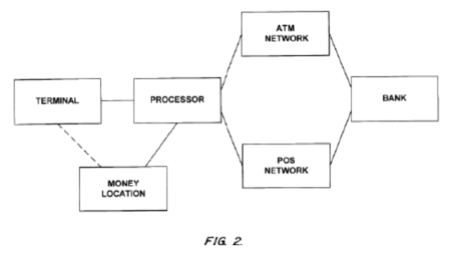
    The '792 patent describes and claims methods of using a modified ATM or terminal that can access a bank via both an ATM network and a POS network.  Figure 2 is reproduced below.

    FIG2
    The '792 patent describes a method of using a modified ATM such as the terminal depicted in Figure 2, in which a cardholder first attempts to obtain money via a first type of transaction (i.e., conducted over an ATM network) and fails because he has exceeded his ATM daily limit or he cannot remember the PIN for his credit card and subsequently and successfully obtains money via a second type of transaction (i.e., conducted via a POS network).

    But, the cardholder does not obtain cash (or other valuable item) directly from the terminal when using the POS network.  Instead, the terminal informs a nearby money location (such as "cash windows or 'cages' within casinos or racetracks, front desks or concierges of hotels, ticket booths, will-call windows or customer service windows at stadiums, coliseums, theaters, stores, or amusement parks") of the approved transaction.  The terminal may also issue a "script" or "pre-receipt" for the cardholder to take to the money location.  At the money location, the cardholder cashes in the receipt for the cash.  In the preferred embodiment, a check drawn against the cardholder's account is issued at the money location and made payable to the money location owner.

    The challenged claims

    Of the challenged claims, claim 1 is illustrative and reproduced below.

    1.  A method of providing money or an item of value to an account-holder, the method comprising:
        identifying an account to a terminal;
        entering a personal identification number into the terminal;
        requesting money or an item of value based upon the account via a first type of transaction;
        forwarding the first type of transaction to a processor;
        forwarding the first type of transaction from the processor to a first network;
        forwarding the first type of transaction from the first network to a bank;
        making a denial of the first type of transaction due to exceeded pre-set limit;
        forwarding the denial to the processor;
        notifying the account-holder at the terminal of the denial of the first type of transaction, and asking the account holder if they would like to request the money or item of value via a second type of transaction;
        requesting money or an item of value based upon the account via a second type of transaction;
        forwarding the second type of transaction to the processor;
        forwarding the second type of transaction from the processor to a second network;
        forwarding the second type of transaction from the second network to the bank;
        making an approval of the second type of transaction;
        forwarding the approval to the processor;
        and instructing a money location separate from the terminal to provide money or an item of value to the account-holder.

    In a CBM patent review, the PTAB noted that "[a] claim in an unexpired patent shall be given its broadest reasonable construction in light of the specification of the patent in which it appears."  While the Petitioner proposed express constructions, many of which would require, or at least encompass, human involvement in certain steps of the claimed methods, the PTAB agreed with the Patent Owner that the plain and ordinary meaning is readily apparent.

    Petitioner has standing

    The PTAB addressed the issue of standing, noting that Petitioner has shown that the (1) Petitioner has been sued for infringement of the patent and (2) the patent for which review is sought is a covered business method patent.

    With respect to item (2), a CBM patent is defined as "a patent that claims a method or corresponding apparatus for performing data processing or other operations used in the practice, administration, or management of a financial product or service, except that the term does not include patents for technological inventions."  This requirement has two prongs: (i) that all of the claims are directed to methods used in conducting financial transactions and (i) that the patent is not for a technological invention.

    To determine whether a patent is for a technological invention, the PTAB considers "whether the claimed subject matter as a whole": (1) "recites a technological feature that is novel and unobvious over the prior art"; and (2) "solves a technical problem using a technical solution."  37 C.F.R. § 42.301(b).

    The Petitioner argued that "all of the claimed features that could possibly be characterized as technological (i.e., terminal, processor, ATM network, POS network) were present in the prior art."  The Patent Owner disputed this position, and asserted that the software had a technological feature of "asking the account holder if they would like to request the money or item of value via a second type of transaction."  But, the PTAB found that displaying declaratory and interrogatory data on a display and soliciting a response thereto is not a technological feature that is novel.

    Further, the PTAB noted that the problem in the prior art which the '792 patent sets out to solve — "obtaining cash from one's account when their daily ATM limit has been reached" — is not a technical problem.  Thus, the PTAB found that the '792 patent is a covered business method patent that is eligible for CBM patent review.

    Patent-ineligibility

    The Petitioner challenged the claims as patent-ineligible under 35 U.S.C. § 101.  The PTAB noted the Supreme Court's framework for distinguishing patents that claim laws of nature, natural phenomena, and abstract ideas from those that claim patent-eligible applications of those concepts.  First, it is determined whether the claims at issue are directed to one of those patent-ineligible concepts.  If so, we then ask, "what else is there in the claims before us?"  This second step has become known as a search for an inventive concept — i.e., an element or combination of elements that is sufficient to ensure that the patent in practice amounts to significantly more than a patent upon the ineligible concept itself.

    The Petitioner did not identify directly "the abstract ideas" to which the claims are purportedly directed.  But, the Petitioner implicitly identified them as:  "providing money to an account holder" and "trial-and-error."

    The PTAB found that the Petitioner oversimplified the challenged claims because the challenged claims are not directed simply to the idea of providing money to an account holder or using trial-and-error until success is achieved.  Rather, the claims are directed to particular methods of providing money to an account holder using an ATM via a POS transaction after an ATM transaction has failed.

    Further, Petitioner's analysis omits any consideration of the elements of the claims as ordered combinations to determine whether the additional elements transform the nature of the claims into a patent-eligible application.  The PTAB found that it was Petitioner's burden to do so.  Failing to meet this burden, the Petitioner was unable to show that the claims are more likely than not patent-ineligible.

    Other grounds asserted in the Petition included prior art challenges, which also failed and are not discussed in detail here.  Because the information presented in the Petition did not demonstrate that it is more likely than not that any of the claims challenged is unpatentable, the Petition for instituting a CBM patent review was denied and no trial will be instituted.

    This decision represents a rare instance in which a patent found to be directed to a "business method" was also found to satisfy § 101, at least with respect to the basic challenges presented.  It may be the case that the Petitioner did not prepare a solid challenge, and likely did not do itself any favors by failing to directly identify "the abstract ideas" in the claims.  However, on their face, the claims appear to recite enough details to withstand a § 101 challenge.

    This case also shows, what is seeming to become the best way to counter a § 101 challenge, that when the elements of the claims are considered as ordered combinations, there is a better chance to show that the "additional elements" not identified as the abstract idea transform the nature of the claims into a patent-eligible application.  This idea of ordered combinations of the elements makes it clear that when the claim is drafted tying each element together or showing that a subsequent element depends upon outcomes of a prior element, it is more difficult to pick apart the claim in a piecemeal manner.  Following, it is more difficult to identify and remove a so-called "abstract idea" from the claim leaving only wreckage that is insubstantial generic computing components that are always found to fail the inventive concept test.  Thus, using proper claim drafting techniques, "ordered combinations" of elements are a great tool to have to combat a § 101 challenge.

  • By Michael Borella

    District Court for the Eastern District of TexasIn February 2015, Advanced Marketing Systems (AMS) sued a number of defendants, alleging infringement of various claims of U.S. Patent Nos. 8,219,445, 8,370,199, and 8,538,805.  The defendants filed a motion for judgment on the pleadings, arguing that the case should be dismissed because the asserted claims are directed to non-statutory subject matter under 35 U.S.C. § 101.

    Claim 1 of the '805 patent recites:

    A data processing system for tracking and processing a plurality of in-store discounts to potential purchasers of plural products during the checkout process, wherein said discounts are each associated with a specific one of said plural products, said system comprising:
        a discount vehicle, characterized by two or more of said discounts, including descriptive material to provide information at least identifying the products and their associated discounts;
        a customer account associated with a customer identification code, the customer account comprising two or more of said discounts of the discount vehicle selected by a customer to be associated with the customer account, the customer account being associated with a select code that permits tracking of said customer account during checkout, said select code uniquely identifying all the discounts for all of the plural products associated with the customer account;
        wherein the customer identification code is inputted by the customer to access the customer account;
        a checkout processing terminal including computer based tracking of individual purchasers' purchased products and the prices thereof, wherein said processing terminal includes a device for receiving the select code during checkout; and
        a data processor attached to said checkout terminal for receiving information regarding transactions associated with checkout, selected products and the discounts associated with the select code forming a part of the transactions, and processing said discounts in accord with said select code;
        wherein said data processor selectively deactivates the select code for only particular discounts, of the plurality of discounts, associated with the purchased products by redemption of the select code associated with the customer account such that the select code remains active for future use with yet unused ones of the plurality of discounts associated with said plural products, said data processor being further connected to memory for storing data associated with said transaction.

    Claim 28 of the '199 patent is similar in terms of structure and content.  Further, claim 9 of the '445 patent and claim 15 of the '199 are similar in content, but differ in structure.  Of note are the preambles of these latter two claims, which recite:

    A distributed discount vehicle for use with a data processing system for tracking and processing a plurality of in-store discounts to potential purchasers of plural products during the checkout process, wherein said discounts are each associated with a specific one of said plural products, said discount vehicle comprising . . .

    In order to rule on the motion, the Court applied the now-familiar patent-eligibility test from Alice Corp. v. CLS Bank Int'l.  First, one must determine whether the claim at hand is directed to a judicially-excluded law of nature, a natural phenomenon, or an abstract idea.  If so, then one must further determine whether any element, or combination of elements, in the claim is sufficient to ensure that the claim amounts to something more than the judicial exception.  Notably, generic computer implementation of an otherwise abstract process does not qualify as "something more."

    The defendants asserted that the claims were directed to the abstract idea of offering, tracking, and processing discounts, a "longstanding commercial practice."  According to the defendants, the claimed features "constitute nothing more than the idea of tracking discounts after they are offered to consumers and processing them once they have been redeemed."  The defendants further contended that "inclusion of elements such as a customer account, a customer identification code, a checkout processing terminal, a data processor, and memory in the claims does not change the basic character of the subject matter of the claims because each function performed by these components is purely conventional."  Thus, in the defendant's view, the claimed invention was merely a mental process that "can be performed by a human using pencil and paper."  To support these positions, defendants alleged that the claimed discount vehicle was "merely an insert in a newspaper or a magazine."

    AMS responded by arguing that the "underlying factual disputes concerning the scope of the claim language make a decision on the issue of patentable subject matter inappropriate at this stage in the case."  AMS disagreed that the discount vehicle was limited to printed information, and asserted that the data processor was "a non-generic, specifically programmed system that selectively deactivates certain e-coupons redeemed by a customer at checkout."  Finally, AMS took the position that selectively applying discounts as claimed was an inventive concept that satisfies the second prong of Alice.

    The Court considered whether it was appropriate to dismiss this case on the pleadings, and noted that "the issue of patentable subject matter requires a legal analysis that can — and often does — contain underlying factual issues."  Further, "where the parties dispute the scope and meaning of the asserted claims as they do here, application of the principles governing a § 101 analysis is not a straightforward exercise."  Ultimately, the Court found several reasons why the case should not be dismissed at this early stage.

    First, the defendants did not establish "an absence of fact and claim construction issues such that the only plausible reading of the asserted claims is one of patent ineligibility."   Instead, for two terms, "discount vehicle" and "selectively activated," there was a material factual dispute between the parties.  Particularly, the defendants' position that the claims were invalid required adopting the defendant's interpretation of these claim terms, which was at odds with the proposed construction offered by AMS.

    Second, the Court found that a reading of the claims did not clearly show that they recite a mere abstraction.  Instead, the Court wrote that "discount vehicle claims, for example, include physical structures such as a discount vehicle with information identifying products and their associated discounts, and a select code that can be selectively deactivated as to certain discounts, while remaining active for future use as to others."  Further, "[t]he data processing system claims recite, in part, a checkout processing terminal with computer based tracking of purchased products and a device for receiving the select code during checkout."  The presence of such physical structures resulted in the Court concluding that "it is impossible to make a final determination before claim construction that the claims are simply a drafting effort designed to monopolize an abstract idea, rather than a patent-eligible application of the idea."

    Third, the parties' dispute over whether the hardware recited by the claims was conventional and generic or specifically programmed, and whether the features associated with the claimed selective deactivation improved upon the prior art, also weighed against a decision on the pleadings.  As a result, the Court concluded that it would deny the defendants' motion without prejudice, thus leaving the defendants open to filing a similar motion after claim construction.

    Standing alone, this case is yet another illustration of how the Alice test could go either way for a given set of claims.  When viewed in light of claims found patent-ineligible by the Federal Circuit and other district courts, AMS's patents could have been easily invalidated on the pleadings.  Particularly, other courts have found financially-oriented transactions to incorporate abstract ideas, and hardware components similar to those at issue here to be merely generic.

    But, this decision takes on a special character when viewed along with Voxathon LLC v. Alpine Electronics of America, Inc., decided by the same judge just a few days earlier.  In Voxathon, the Court held that claim construction was unnecessary before dismissal on the pleadings.  The rub is that AMS's claims appear to be at least as abstract as those in Voxathon, and recite no more specialized hardware components.  Thus, one could argue that either this case, Voxathon, or both were wrongly decided.  At the very least, the outcomes appear to be inconsistent.

    Having said that, the rationale for this apparent discrepancy may be as simple as AMS's arguments being more compelling than those of Voxathon, or that in this case the judge adopted the recommendation of a magistrate, whereas in Voxathon the judge wrote the substantive opinion.  Nonetheless, when viewed on their faces, the two outcomes further illustrate the lack of predictability that pervades the patent system post-Alice.

  • By Andrew Williams

    Federal Circuit SealBack in January 2002, when this author was near the beginning of his patent law career, the Federal Circuit handed down the In re Sang-Su Lee case.  Among other things, this case provided patent practitioners with support for challenging examiners that failed to identify the evidence on which they were relying.  Before then, the Patent Office would occasionally use the "common knowledge and common sense" of a person of ordinary skill in the art to support obviousness rejections, especially with regard to combining prior art references.  Of course, without any actual evidence provided, it was very difficult to respond to any such rejection.  In re Sang-Su Lee provided the necessary relief:  "The Board cannot rely on conclusory statements when dealing with particular combinations of prior art and specific claims, but must set forth the rationale on which it relies."  Fourteen years later, in Cutsforth Inc. v. MotivePower, Inc., the Federal Circuit told the Patent Trial and Appeal Board that it had the same obligation to provide a thorough explanation of its reasoning when it issues Final Written Decisions.  "When the Board determines that modifications and combinations of the prior art render a claimed invention obvious, the Board must fully explain why a person of ordinary skill in the art would find such changes obvious."  Because the Board did not do so in this case, the decision was vacated and remanded.     

    The case stems from an inter partes review of U.S. Patent No. 7,990,018, owned by Cutsforth, Inc.  The technology at issue involved brush holder assemblies that allowed a current to pass from a stationary device to a moving contact.  The stationary device could be a brush made of conductive material, with a brush holder that would allow a continuous contact with the moving conductive surface to generate an electrical current.  The claimed assembly allowed for easier removal, allowing brush replacement during operation.  MotivePower filed five IPR petitions directed to the '018 patent and related patents, all of which were instituted.  Ultimately, no challenged claim survived (either through voluntary cancellation or a finding of unpatentability by the Board).  Three of the five decisions were appealed, and were consolidated for purposes of oral argument.  This opinion, however, only appears to address the IPR directed to the '018 patent.

    The challenged claims of the '018 patent were found to be obvious in view of three prior art references, Bissett, Ohmstedt, and Kartman.  The Board began its analysis of independent claim 1 by reiterating the assertions of the petitioner:

    Concerning independent claim 1, Petitioner contends that Bissett discloses a brush holder component (brush assembly 12) adapted for removably mounting to the mounting block (dovetails 18) by providing a channel for receiving a portion of the mounting block (dovetails 18). Pet. 16 (citing Ex. 1005, 1:61–2:1, Figs. 3–4). Furthermore, Petitioner argues that it would have been obvious to adapt the brush holder (brush assembly 12) of Bissett to include the brush catch of Ohmstedt, whereby divergent portion 23 of Ohmstedt would extend downward from the Bissett channel such that teeth 25 of Ohmstedt engage the Bissett brush 24. Pet. 10 (citing Ex. 1003, 1:14–18, 28–50; Ex. 1005, Fig. 4). Accordingly, Petitioner argues that the brush catch of Ohmstedt (divergent portion 23 and teeth 25) has a first position preventing sliding movement of a brush and a second position permitting sliding movement of a brush. Pet. 16 (Ex. 1003, 2:5–49, 3:8–12, Figs. 1, 2). Additionally, Petitioner argues that it would have been obvious to include the Ohmstedt brush release (ramps 59) in a position to engage the brush catch below the mounting structure (dovetails 18). Pet. 10–11, 17 (citing Ex. 1003, 2:15–17, 39–43, Fig. 2). The Petitioner also argues that it would have been obvious to adapt the mounting block of Bissett (dovetails 18) with the mounting block of Kartman. Pet. 11–12 (citing Ex. 1004, 4:19–22 and Ex. 1005, 1:63–64). More particularly, Petitioner proposes that the "T" shaped channel in Bissett may be modified to incorporate the elongated mounting block structure of Kartman (detachable connecting means 42), which also is configured to slidably engage a "T" shaped channel. Pet. 12–13 (citing Ex. 1004, 4:19–22, Fig. 3; Ex. 1005, 1:63–64, Fig. 4).

    IPR2013-00274, Final Written Decision at pp. 19-20.  After the Board explained how the patent owner responded, it rejected these arguments stating that it was "not persuaded by Patent Owner's argument[s]" or assertions.  But nowhere in the decision did the Board explain its reasoning why the claims were obviousness in the first place, nor did it explicitly adopt the Patent Owner's allegations as its own.        

    For claims 5 and 8, which ultimately depended from claim 1, the additional elements of a spring and a movable portion were recited.  The Board found that the prior art also recited such features, even if not necessarily on the mounting block.  Instead, the Board explained that the specific placement of the claimed spring and movable portion are matters of "design choice."  No other reasons were provided by the Board as to why these modifications were obvious, or why a person of ordinary skill in the art would have been motivated to make them.

    The Federal Circuit held, in much the same was as it did earlier in In re Sang-Su Lee, that the reasoning for the rejection/cancelation must be articulated.  Otherwise, the patent owner would be at a loss as to how to mount a competent appeal, and the Federal Circuit would be unable to conduct a meaningful review.  Especially for obviousness determinations, "the Board must explain why a person of ordinary skill in the art would modify the prior art references to create the claimed invention."  In the present case, the Court found that the Board merely restated the arguments of the petitioner without accepting them for itself.  The decision therefore read as though the Board assumed the combination was obvious, and that the Patent Owner had failed to establish the claims were non-obvious.  This, of course, essentially amounts to a burden shift, requiring the Patent Owner to show why it was entitled to a patent rather than requiring than requiring the petitioner to establish by a preponderance of the evidence why the claims were obvious.

    With regard to the "design choice" argument posited by the Board, the Federal Circuit explained that even if the particular placement of the element was a design choice, it did not necessarily render the placement obvious.  Instead, there must be some reason why a person of skill in the art would have made the particular design choice.  The Board did not provide this reason.

    This case might appear as a win for patent owners, and indeed the Board will certainly be more careful in articulating its reasoning in future final written decisions.  However, on remand, it is conceivable that the Board could merely modify the final written decision to add that it adopted all of the reasoning of the petitioner as its own.  And, realistically going forward, if the Board thinks that a particular claim is obvious, it will likely be able to provide some reasoning sufficient to satisfy the holding in this case.  Therefore, even if at first blush this case seems to be a panacea for patent owners, it is unlikely that it will have the same impact for practitioners that the In re Sang-Su Lee case did back in 2002.

    Cutsforth Inc. v. MotivePower, Inc. (Fed. Cir. 2016)
    Nonprecedential disposition
    Panel: Chief Judge prost and Circuit Judges Clevenger and Moore
    Opinion by Circuit Judge Clevenger

  •         By Sherri Oslick

    Gavel About Court Report:  Each week we will report briefly on recently filed biotech and pharma cases.

    Purdue Pharma L.P. et al. v. Amneal Pharmaceuticals LLC
    1:15-cv-00831; filed September 17, 2015 in the District Court of Delaware

    • Plaintiffs:  Purdue Pharma L.P.; P.F. Laboratories Inc.; Purdue Pharmaceuticals L.P.
    • Defendant:  Amneal Pharmaceuticals LLC

    Infringement of U.S. Patent Nos. 9,060,976 ("Pharmaceutical Formulation Containing Gelling Agent" issued June 23, 2015) and 9,034,376 (same title, issued May 19, 2015) following a Paragraph IV certification as part of Amneal's filing of an ANDA to manufacture a generic version of Purdue Pharma's OxyContin® (controlled release oxycodone hydrochloride, used to treat pain).  View the complaint here.


    Horizon Pharma Ireland Ltd. et al. v. Lupin Ltd. et al.
    1:15-cv-06935; filed September 17, 2015 in the District Court of New Jersey

    • Plaintiffs: Horizon Pharma Ireland Ltd.; HZNP Limited; Horizon Pharma USA, Inc.
    • Defendants: Lupin Ltd.; Lupin Pharmaceuticals, Inc.

    Horizon Pharma Ireland Ltd. et al. v. Actavis Laboratories UT, Inc. et al.
    1:15-cv-06989; filed September 17, 2015 in the District Court of New Jersey

    • Plaintiffs: Horizon Pharma Ireland Ltd.; HZNP Limited; Horizon Pharma USA, Inc.
    • Defendants: Actavis Laboratories UT, Inc.; Actavis, Inc.; Allergan PLC

    Horizon Pharma Ireland Ltd. et al. v. IGI Laboratories, Inc.
    1:15-cv-06991; filed September 17, 2015 in the District Court of New Jersey

    • Plaintiffs: Horizon Pharma Ireland Ltd.; HZNP Limited; Horizon Pharma USA, Inc.
    • Defendant: IGI Laboratories, Inc.

    Horizon Pharma Ireland Ltd. et al. v. Amneal Pharmaceuticals LLC
    1:15-cv-06990; filed September 17, 2015 in the District Court of New Jersey

    • Plaintiffs: Horizon Pharma Ireland Ltd.; HZNP Limited; Horizon Pharma USA, Inc.
    • Defendant: Amneal Pharmaceuticals LLC

    The complaints in these cases are substantially identical.  Infringement of U.S. Patent No. 9,132,110 ("Treatment of Pain with Topical Diclofenac," issued September 15, 2015) in conjunction with defendants' filing of an ANDA to manufacture a generic version of Horizon's Pennsaid® (diclofenac sodium topical solution, used for the treatment of signs and symptoms of osteoarthritis of the knee(s)).  View the Lupin complaint here.


    Impax Laboratories, Inc. v. Actavis Laboratories FL, Inc. et al.
    2:15-cv-06934; filed September 17, 2015 in the District Court of New Jersey

    • Plaintiff:  Impax Laboratories, Inc.
    • Defendants:  Actavis Laboratories FL, Inc.; Actavis Pharma Inc.

    Infringement of U.S. Patent Nos. 7,094,427 ("Combination Immediate Release Controlled Release Levodopa/Carbidopa Dosage Forms," issued August 22, 2006), 8,377,474 ("Controlled Release Formulations of Levodopa and Uses Thereof," issued February 19, 2013), 8,454,998 (same title, issued June 4, 2013), 8,557,283 (same title, issued October 15, 2013), 9,089,607 (same title, issued July 28, 2015), and 9,089,608 (same title, issued July 28, 2015) following a Paragraph IV certification as part of Actavis' filing of an ANDA to manufacture a generic version of Impax's Rytary® (levodopa and carbidopa, used to treat Parkinson's disease).  View the complaint here.


    Gilead Sciences, Inc. et al. v. Lupin Pharmaceuticals, Inc. et al.
    1:15-cv-02793; filed September 16, 2016 in the District Court of Maryland

    • Plaintiffs:  Gilead Sciences, Inc.; Hoffmann-LaRoche Inc.; F. Hoffmann-LaRoche LTD; Genentech, Inc.
    • Defendants:  Lupin Pharmaceuticals, Inc.; Lupin Atlantis Holdings S.A.; Lupin Ltd.

    Infringement of U.S. Patent No. 5,763,483 ("Carbocyclic Compounds," issued June 9, 1998) following a Paragraph IV certification as part of Lupin's filing of an ANDA to manufacture a generic version of Genentech's Tamiflu® (oseltamivir phosphate, used to treat uncomplicated acute illness due to influenza infection in patients one year or older who have been symptomatic for no more than two days and for the prophylaxis of influenza in patients one year or older).  View the complaint here.


    Otsuka Pharmaceutical Co. Ltd. v. Hetero USA Inc. et al.
    1:15-cv-00822; filed September 15, 2015 in the District Court of Delaware

    • Plaintiff:  Otsuka Pharmaceutical Co. Ltd.
    • Defendants:  Hetero USA Inc.; Hetero Labs Ltd.; Hetero Labs Ltd. Unit V

    Infringement of U.S. Patent No. 5,753,677 ("Benzoheterocyclic Compounds," issued May 19, 1998) following a Paragraph IV certification as part of Hetero's filing of an ANDA to manufacture a generic version of Otsuka's Samsca® (tolvaptan, used to treat hyponatremia).  View the complaint here.  [NB: This case has been dismissed.]


    Acorda Therapeutics Inc. v. Par Pharmaceutical Inc.
    1:15-cv-00824; filed September 15, 2015 in the District Court of Delaware

    Infringement of U.S. Patent Nos. 8,007,826 ("Sustained Release Aminopyridine Composition," issued August 30, 2011), 8,354,437 ("Method of Using Sustained Release Aminopyridine Compositions," issued January 15, 2013), 8,440,703 (same title, issued May 14, 2013), and 8,663,685 ("Sustained Release Aminopyridine Composition," issued March 4, 2014) following a Paragraph IV certification as part of Par's filing of an ANDA to manufacture a generic version of Acorda's Ampyra® (dalfampridine extended release, used to improve walking in patients with multiple sclerosis).  View the complaint here.


    Allergan, Inc. v. InnoPharma, Inc. et al.
    1:15-cv-00815; filed September 14, 2015 in the District Court of Delaware

    • Plaintiff:  Allergan, Inc.
    • Defendants:  InnoPharma, Inc.; Pfizer Inc.

    Infringement of U.S Patent Nos. 8,629,111 ("Methods of Providing Therapeutic Effects Using Cyclosporine Components," issued January 14, 2014), 8,633,162 (same title, issued January 21, 2014), 8,642,556 (same title, issued February 4, 2014), 8,648,048 (same title, issued February 11, 2014), and 8,685,930 (same title, issued April 1, 2014) following a Paragraph IV certification as part of InnoPharma's filing of an ANDA to manufacture a generic version of Allergan's Restasis® (cyclosporine ophthalmic emulsion, 0.05%, used to treat dry eye).  View the complaint here.  [NB: This case has been dismissed.]

  • By Kevin E. Noonan

    CRISPR (an acronym for Clustered Regularly lnterspaced Short Palindromic Repeats), which is part of a system for altering chromosomal sequences in situ in a cell in combination with a bacterially derived protein called Cas9, has been hailed as the "Breakthrough of the Year" for 2015, and rightfully so.  Just as the discovery of bacterial restriction enzymes by Cohen and Boyer in 1972 provided the ability to dissect DNA at specific sites in the DNA sequence, CRISPR provides a mechanism for inserting or deleting specific DNA sequences using CRISPR-associate targeting RNAs and the Cas9 RNA-guided DNA endonuclease enzyme.  It provides for the first time the type of specificity for altering DNA that the polymerase chain reaction (PCR) provided a generation ago for amplifying specific DNA, as illustrated by this schematic:

    Figure
    Given the commercial potential of this method, patenting is an obvious concern and, as it turns out, more than one group of inventors has filed patent applications on the reagents, methods, and cells produced or used to produce CRISPR modifications.  Because these applications were filed prior to March 16, 2013, the inventor(s) who first invented this invention have the right to patent it, and disputes regarding who was the first to invent are resolved using a procedure called an interference.

    In this case, on January 11, 2016, the U.S. Patent and Trademark declared Interference No. 106,048 under the provisions of 37 C.F.R. § 41.203(b), naming Feng Zhang and his colleagues, the named inventor of the Broad Institute/MIT's patents, as the Junior Party, and Jennifer Doudna and her colleagues at UC/Berkeley as Senior Party (see Declaration).  These designations stem from which party was the first to file a patent application and are important, because (without evidence to the contrary) the PTO considers the Senior Party to be the presumptive inventor (and thus the burden to establish prior right based on earlier invention is borne by the Junior Party).

    Paradoxically, the Broad Institute/MIT inventors have obtained a number of patents even though the Berkeley inventors have the earliest filing date and no issued patents (which is important because an interference cannot resolve the dispute between patents granted on the same invention).  This is because the Broad availed itself of priority examination ("fast track") provisions of the law.  In fact, the Broad attempted to provoke an interference with the Berkeley patents, albeit involving a fewer number of patents and claims than are involved in this interference.  The Broad patents (and their involved claims, which constitute all of the granted claims of all of the Broad patents) are:

    • Patent 8,697,359 – claims 1-20
    • Patent 8,771,945 – claims 1-29
    • Patent 8,795,965 – claims 1-30
    • Patent 8,865,406 – claims 1-30
    • Patent 8,871,445 – claims 1-30
    • Patent 8,889,356 – claims 1-30
    • Patent 8,895,308 – claims 1-30
    • Patent 8,906,616 – claims 1-30
    • Patent 8,932,814 – claims 1-30
    • Patent 8,945,839 – claims 1-28
    • Patent 8,993,233 – claims 1-43
    • Patent 8,999,641 – claims 1-28*,

    while only one pending application from the Berkeley group is involved in the interference:

    • US 2014-0068797 A1 – claims 165, 200, 202-218, 220-222 and 224-247.

    Representative claims of each party are as follows:

    The Broad/MIT:

    1.    An engineered, non-naturally occurring CRISPR-Cas system comprising one or more vectors comprising:
        a) a first regulatory element operable in a eukaryotic cell operably linked to at least one nucleotide sequence encoding a CRISPR-Cas system guide RNA that hybridizes with a target sequence of a DNA molecule in a eukaryotic cell that contains the DNA molecule, wherein the DNA molecule encodes and the eukaryotic cell expresses at least one gene product, and
        b) a second regulatory element operable in a eukaryotic cell operably linked to a nucleotide sequence encoding a Type-II Cas9 protein,
        wherein components (a) and (b) are located on same or different vectors of the system, whereby the guide RNA targets and hybridizes with the target sequence and the Cas9 protein cleaves the DNA molecule, whereby expression of the at least one gene product is altered; and, wherein the Cas9 protein and the guide RNA do not naturally occur together.

    5.    A method of altering expression of at least one gene product comprising introducing into a eukaryotic cell containing and expressing a DNA molecule having a target sequence and encoding the gene product an engineered, non-naturally occurring Clustered Regularly Interspaced Short Palindromic Repeats (CRISPR)–CRISPR associated (Cas) (CRISPR-Cas) system comprising one or more vectors comprising:
        a) a first regulatory element operable in a eukaryotic cell operably linked to at least one nucleotide sequence encoding a CRISPR-Cas system guide RNA that hybridizes with the target sequence, and
        b) a second regulatory element operable in a eukaryotic cell operably linked to a nucleotide sequence encoding a Type-II Cas9 protein,
        wherein components (a) and (b) are located on same or different vectors of the system, whereby the guide RNA targets the target sequence and the Cas9 protein cleaves the DNA molecule, whereby expression of the at least one gene product is altered; and, wherein the Cas9 protein and the guide RNA do not naturally occur together.

    6.    A CRISPR-Cas system-mediated genome editing method comprising introducing into a eukaryotic cell containing and expressing a DNA molecule having a target sequence and encoding at least one gene product an engineered, non-naturally occurring CRISPR-Cas system comprising one or more vectors comprising:
        a) a first regulatory element operable in a eukaryotic cell operably linked to at least one nucleotide sequence encoding a CRISPR-Cas system guide RNA that hybridizes with the target sequence, and
        b) a second regulatory element operable in a eukaryotic cell operably linked to a nucleotide sequence encoding a Type-II Cas9 protein,
        wherein components (a) and (b) are located on same or different vectors of the system, whereby expression of the at least one gene product is altered through the CRISPR-Cas system acting as to the DNA molecule comprising the guide RNA directing sequence-specific binding of the CRISPR-Cas system, whereby there is genome editing; and, wherein the Cas9 protein and the guide RNA do not naturally occur together.

    Berkeley:

    165.    A method of cleaving a nucleic acid comprising contacting a target DNA molecule having a target sequence with an engineered and/or non-naturally-occurring Type II Clustered Regularly Interspaced Short Palindromic Repeats (CRISPR)-CRISPR associated (Cas) (CRISPR-Cas) system comprising
        a) a Cas9 protein; and
        b) a single molecule DNA-targeting RNA comprising
            i) a targeter-RNA that hybridizes with the target sequence, and
            ii) an activator-RNA that hybridizes with the targeter-RNA to form a double-stranded RNA duplex of a protein-binding segment,
        wherein the activator-RNA and the targeter-RNA are covalently linked to one another with intervening nucleotides,
        wherein the single molecule DNA-targeting RNA forms a complex with the Cas9protein,
        whereby the single molecule DNA-targeting RNA targets the target sequence, and the Cas9 protein cleaves the target DNA molecule.

    203.    An engineered and/or non-naturally occurring Type II Clustered Regularly Interspaced Short Palindromic Repeats (CRISPR)-CRISPR associated (Cas) (CRISPR-Cas) system comprising
        a) a Cas9 protein, or a nucleic acid comprising a nucleotide sequence encoding said Cas9 protein; and
        b) a single molecule DNA-targeting RNA, or a nucleic acid comprising a nucleotide sequence encoding said single molecule DNA-targeting RNA;
        wherein the single molecule DNA-targeting RNA comprises:
        i) a targeter-RNA that is capable of hybridizing with a target sequence in a target DNA molecule, and
        ii) an activator-RNA that is capable of hybridizing with the targeter-RNA to form a double-stranded RNA duplex of a protein-binding segment,
        wherein the activator-RNA and the targeter-RNA are covalently linked to one another with intervening nucleotides; and
        wherein the single molecule DNA-targeting RNA is capable of forming a complex with the Cas9 protein, thereby targeting the Cas9 protein to the target DNA molecule,
        whereby said system is capable of cleaving or editing the target DNA molecule or modulating transcription of at least one gene encoded by the target DNA molecule.

    224.    A Type II Clustered Regularly Interspaced Short Palindromic Repeats (CRISPR)-CRISPR associated (Cas) (CRISPR-Cas) system comprising:
        a Cas9 protein; and
        a single molecule DNA-targeting RNA, or a nucleic acid comprising a nucleotide sequence encoding said single molecule DNA-targeting RNA,
        wherein the single molecule DNA-targeting RNA comprises:
            i) a targeter-RNA that is capable of hybridizing with a target sequence in a target DNA molecule, and
            ii) an activator-RNA that is capable of hybridizing with the targeter-RNA to form a double-stranded duplex of a protein-binding segment,
        wherein i) and ii) are arranged in a 5' to 3' orientation and are covalently linked to one another with intervening nucleotides;
        wherein the single molecule DNA-targeting RNA is capable of forming a complex with the Cas9 protein and hybridization of the targeter-RNA to the target sequence is capable of targeting the Cas9 protein to the target DNA molecule, and
        wherein the single molecule DNA-targeting RNA comprises one or more sequence modifications compared to a sequence of a corresponding wild type tracrRNA and/or crRNA.

    In an interference, the PTO establishes one or more "counts," which is a phantom claim that encompasses the interfering subject matter.  The parties provide evidence of conception of at least one embodiment falling within the scope of the count and reduction to practice (actual or constructive, i.e., by filing a patent application having an enabling disclosure of said one embodiment).  While there are several complicated scenarios that can arise in an interference, generally a party that conceived first and reduced to practice first, and did not abandon, suppress or conceal the invention, will prevail.  The sole Count in the CRISPR interference reads as follows:

    Count 1

    A method, in a eukaryotic cell, of cleaving or editing a target DNA molecule or modulating transcription of at least one gene encoded thereon, the method comprising:
        contacting, in a eukaryotic cell, a target DNA molecule having a target sequence with an engineered and/or non-naturally-occurring Type II Clustered Regularly lnterspaced Short Palindromic Repeats (CRISPR)-CRISPR associated (Cas) (CRISPR-Cas) system comprising:
        a) a DNA-targeting RNA comprising
            i) a targeter-RNA or guide sequence that hybridizes with the target sequence, and
            ii) an activator-RNA or tracr sequence that hybridizes with the targeter-RNA to form a double-stranded RNA duplex of a protein-binding segment, and
        b) a Cas9 protein,
        wherein the DNA-targeting RNA forms a complex with the Cas9 protein, thereby targeting the Cas9 protein to the target DNA molecule, whereby said target DNA molecule is cleaved or edited or transcription of at least one gene encoded by the target DNA molecule is modulated.

    The interference will proceed in two stages.  The first stage involves the parties presenting motions that can modify the count, have certain claims declared outside the scope of the count (or vice versa), and ask for a finding that the claims are invalid under any of the provisions of the patent statute.  If these motions are not decided in a way that would disqualify one or both parties, then the interference will move to a second stage, where the Junior Party (The Broad) will present its proofs of conception and reduction to practice and the Senior Party will be permitted to oppose.  The Senior Party is under no obligation to present proofs earlier than its earliest filing date unless the Junior Party evinces evidence of (at least) earlier conception.  In practice, the parties can both be expected to submit their evidence.

    The parties can also settle the inference privately, with the losing party filing a Concession of Priority and the prevailing party (usually) granting a license to the loser; such settlement agreements are kept confidential but must be filed.  Otherwise, everything else in an interference is public information and can be found under the Patent Trial and Appeal Board (PTAB) on the Office's PAIR website.  Office rules mandate the times for these two stages and an interference is usually concluded with a decision (if not earlier settled) within 36 months of the Declaration.

    * The Broad/MIT also have several pending applications, including US 2014-0186919 A1; US 2014-0179770 A1; US 2014-0242664 A1; US 2014-0310830 A1; US 2014-0189896 A1; US 2014-0242699 A1; US 2014-0357530 A1; US 2015-0020223 A1; and US 2015-0079681 A1.  Should allowable claims be presented in any of these applications such claims may become involved in this interference.

  • By Donald Zuhn

    House of Representatives SealIn a letter sent earlier this month to Secretary Sylvia Mathews Burwell of the U.S. Department of Health & Human Services and Director Francis S. Collins of the National Institutes of Health, fifty members of the U.S. House of Representatives urged Secretary Burwell and Director Collins to use their existing statutory authority to respond to the soaring cost of pharmaceuticals.

    The letter begins by noting that the Bayh-Dole Act authorizes federal agencies that fund private research to retain certain rights in patented inventions, including march-in rights under 35 U.S.C. § 203(a)(2) that can be used when the benefits of patented products are not available to the public on reasonable terms.  The letter then notes that the NIH "has not previously offered official guidance regarding the situations in which march-in rights would apply," asserts that "reasonable guidelines can discourage drug price gouging," and "urge[s] NIH to issue guidelines to accomplish this goal."  While acknowledging that the NIH has "appropriately referred to march-in rights as an 'extraordinary remedy'," the Representatives argue that "too many families and providers are facing an extraordinary challenge from unreasonably priced pharmaceuticals."

    The Representatives express confidence in the NIH's ability to craft reasonable guidance that would "address price gouging while ensuring that march-in rights are exercised with transparency and fairness."  The signatories also suggest that because such rights "would only be used when wrongdoing occurs, innovation should not be threatened," and argue that "[e]stablishing strong guidelines [would] protect[] consumers while reducing the need for having to actually exercise 'march-in' rights."

    The Representatives also take the NIH to task for declining to exercise march-in rights in the past while suggesting that controlling drug costs is a legislative duty.  Although the letter does not dispute the accuracy of such a suggestion, the Representatives counter that "Congress legislated long ago on a bipartisan basis in delegating authority to federal agencies such as NIH the responsibility to address one aspect of this problem," and declare that "[w]e call upon you to do that job."

    The Representatives also note that despite some estimates that a quarter of all priority-reviewed drugs might be impacted by the NIH exercising its march-in rights, "we believe that just the announcement of reasonable guidelines in response to price gouging would positively influence pricing across the pharmaceutical industry."  The Representatives conclude the letter by requesting the NIH's "prompt response in bringing relief for struggling patients and families."

  • By Donald Zuhn –-

    USPTO SealFor the second time in a little more than a month, the U.S. Patent and Trademark Office has experienced an unexpected closing.  Last month, the closing resulted from a major power outage at USPTO headquarters in Alexandria, VA that significantly damaged the Office's electronic systems and required the shutdown of its online and IT systems.  During the earlier shutdown, the Office considered each day from December 22-24 to be a "Federal holiday within the District of Columbia" under 35 U.S.C. § 21 and 37 C.F.R. §§ 1.6, 1.7, 1.9, 2.2(d), 2.195, and 2.196 (see "Major Power Outage Causes Shutdown of USPTO Online and IT Systems — USPTO to Consider December 22-24 to be 'Federal Holidays'").

    Following last weekend's winter storm, which dumped nearly 18 inches of snow on Washington, DC, and between 18 and 24 inches (or more) of snow in the immediate D.C. Metro area, Federal agencies in the Washington, DC area, including the USPTO, were closed on Monday, January 25, and Tuesday, January 26.  The USPTO posted notices on the Office's Operating Status webpage that as a result of the official closing of Federal Government offices in the Washington, D.C. metropolitan area on January 25-26, the Office would consider each day a "Federal holiday within the District of Columbia" under 35 U.S.C. § 21 and 37 C.F.R. §§ 1.6, 1.7, 1.9, 2.2(d), 2.195, and 2.196.  As a result, the Office will consider any action or fee due on January 25-26 as timely if the action is taken, or the fee is paid, on the next succeeding business day on which the USPTO is open (see 37 C.F.R. §§ 1.7(a) and 2.196).  According to the Office, actions that are taken or fees that are paid on the next succeeding business day on which the USPTO is open will be considered timely for the purposes of, for example, 15 U.S.C. §§ 1051(b), 1058, 1059, 1062(b), 1063, 1064, and 1126(d), or 35 U.S.C. §§ 119, 120, 133, and 151.

    Washington - Capitol & Snow #1With regard to the Office's operating status on Wednesday, the U.S. Office of Personnel Management (OPM) website has posted a notice that Federal agencies in the Washington, DC area will be open on January 27 — albeit under three hours delayed arrival status, in which Federal employees should plan to arrive for work no more than three hours later than they would be expected to arrive.  Federal employees will also be given the option for unscheduled leave or unscheduled telework.  For weather-related closings in the Washington, DC area, the USPTO follows OPM guidance.  Patent Docs will provide an update as soon as the USPTO determines its operating status for Wednesday.

    According to the WUSA website, Winter Storm Jonas tied for fourth on the Washington, DC list of top 10 snowfalls:

    1 – 28.0" (January 27-29, 1922)
    2 – 20.0" (February 12-14, 1899)
    3 – 18.7" (February 18-19, 1979)
    4 – 17.8" (January 22-23, 2016)
    4 – 17.8" (February 5-6, 2010)
    6 – 17.3" (January 7-9, 1996)
    7 – 16.6" (February 10-11, 1983)
    8 – 16.4" (December 18-19, 2009)
    9 – 16.4" (February 16-18, 2003)
    10 – 14.4" (February 15-16, 1958)

    Interestingly enough, the February 5-6, 2010 storm, which also dropped 17.8 inches of snow on the city, led to USPTO closings on Monday, February 8 through Thursday, February 11 (see "USPTO Closed on Monday and Tuesday, February 8-9, 2010"; "Patent Office Remains Closed for February 10, 2010"; and "USPTO Remains Closed For February 11, 2010").