• USPTO SealThe U.S. Patent and Trademark Office will be offering the next webinar in its Patent Quality Chat webinar series on March 8, 2016 from 12:00 to 1:00 pm (ET).  The latest webinar, which will address the latest on the Cooperative Patent Classification (CPC) System, will be hosted by USPTO CPC experts Derris Banks, Director of Technology Center 2600, Christopher Kim, Acting Director of Classification Quality and International Coordination, and Emily Le, Supervisory Patent Examiner in Technology Center 1700.  The presenters will share the latest on the CPC, including usage of the CPC system with other patent offices, statistics on examiner usage, the recently adopted CPC publication schedule, and additional CPC-related resources that are available to our stakeholders.  The presenters look forward to hearing your feedback about the CPC.

    Instructions for viewing the webinar can be found here.

    Additional information regarding the Patent Quality Chat webinar series can be found on the USPTO's Patent Quality Chat webpage.

  • The gut microbiome, a collection of microbes living in the gastrointestinal tract, has emerged as an attractive target for pharmaceutical intervention for the treatment of a variety of disorders.  This is the fourth article in a series on advancements in microbiome research and development.  This installment will focus on the connections between the gut microbiome and obesity.  Upcoming articles will continue to review important topics in this technology area, and patents of interest.

    By Jessica Miles* and Anthony D. Sabatelli** —

    Some of the earliest evidence for the relationship between the microbiome and obesity came from studies of antibiotics and their association with weight gain in livestock, which pointed to a link between microbiome composition and weight maintenance.  A 2006 study from the laboratory of the prominent researcher Jeffrey Gordon uncovered a mechanism by which some gut bacteria trigger obesity.  Lead author Peter Turnbaugh and his colleagues noted that obese mice had different microbiomes than their lean littermates.  The same was true of lean and obese human twins.  When Gordon's team characterized this phenomenon, they found that the microbiomes in obese mice and humans obtain more calories from food as compared to the microbiomes of their lean counterparts.  In addition, when the researchers transferred the gut bacteria of an obese mouse to a germ free one, the formerly germ free mouse became obese.

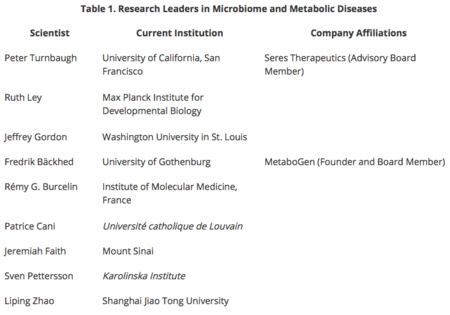
    A follow-up study in 2009 further characterized differences in the microbiomes of lean and obese twins, highlighting a shift in relative abundance of and a decrease in the number of different microbiome members that are associated with the onset of obesity.  Turnbaugh, his colleagues, and other prominent leaders in this subject area are highlighted in Table 1.

    Dysbiosis of the microbiome is now a hallmark of obesity and the basis for microbiome-based treatments.  Gut bacteria are a particularly attractive therapeutic target because of the paucity of safe and effective treatments for obesity.  Current treatments for obesity, such as lorcaserin (Belviq) have been associated with cancer and heart valve dysfunction.  Previous medications, such as fenfluramine (a component of Fen-Phen) were taken off the market due to concerns about heart-related side effects.

    Several microbiome companies are working to address this unmet need for obesity therapies, and some treatments are also used for related metabolic disorders, such as diabetes and cardiovascular disease.  MicroBiome Therapeutics LLC has three candidate microbiome modulators in its pipeline:  One candidate, MT303 contains a small molecule glyceollin microbiome modulator, intended to increase bacterial diversity in the gut and reduce fat absorption.  Another, NM505, is being evaluated in clinical trials for the treatment of diabetes.  Second Genome has identified metabolic disease as a "focus" area:  in 2014, the company announced a partnership with Pfizer and plans to launch a study on obesity and metabolic disease, and began a collaboration with the Mayo Clinic.  A Swedish company, Metabogen, is developing a platform for identifying biomarkers of atherosclerosis and diabetes.  Seres Therapeutics, which boasted a $134 million IPO last June, is evaluating whether their Ecobiotic® drugs, currently used for the treatment inflammatory bowel syndrome, are effective against metabolic diseases, including type II diabetes.

    Closing

    Manipulating the microbiome may hold the key to treating obesity, diabetes, and cardiovascular disease.  Due to a combination of continued research, the efforts of several prominent microbiomics companies, and an unmet need for safe, effective obesity therapies, prospects for the field remain high.  Stay tuned for the next installment of this series, a follow up to this article that which will review microbiomics patents relating to obesity and metabolic disorders.

    Table 1

    * Jessica Miles is a Technology Specialist at Dilworth IP
    ** Dr. Sabatelli is a Partner with Dilworth IP

    For additional information regarding this topic, please see:

    • "Guest Post — The Emergent Microbiome: A Revolution for the Life Sciences – Part III, Psychobiotics," October 13, 2015
    • "Guest Post — The Emergent Microbiome: A Revolution for the Life Sciences – Part II, 2015 Patent Trends," August 11, 2015
    • "Guest Post — The Emergent Microbiome: A Revolution for the Life Sciences – Part I, R&D Leaders," August 10, 2015

  • By Kevin E. Noonan

    Sandoz #1As reported earlier today in IP Law360, Sandoz has petitioned the U.S. Supreme Court for certiorari to review the Federal Circuit's decision that reversed the District Court in Amgen v. Sandoz.  In its decision, two members of the Federal Circuit panel (Judges Lourie and Newman) held that the BPCIA required notice of commercial marketing of a biosimilar product be given by the biosimilar applicant to the reference product sponsor only after the FDA had given regulatory approval for the biosimilar.  Judge Chen dissented, on the grounds that this constituted an extra 180 days of regulatory exclusivity beyond the 12 years expressly set forth in the statute.

    Supreme Court Building #2Sandoz argues that this decision was outside the scope of the plain meaning of the statutory language, was inconsistent with the policy objectives of the BPCIA and in conflict with Supreme Court decisions on statutory interpretation.  Specifically, Sandoz argues that Amgen's remedy to prevent commercial marketing immediately upon approval was to ask a district court for an injunction based on patent infringement, which Amgen has not done (and Sandoz pointed out to the Court).  Indeed, Sandoz inferred that Amgen could not do so, based on SEC filings concerning whether Amgen owned an unexpired patent related to filgrastim.

    Sandoz's petition also argues that the decision "disrupts the careful balance struck by Congress by delaying the launch of every biosimilar product by six months" (emphasis added).  Again in this argument Sandoz maintains that the only remedy in the statute providing for an injunction was based on patent litigation, either pursuant to the "patent dance" or, according to its successful arguments below, as provided by the "remedies" in the statute when a biosimilar applicant refuses to provide the reference product sponsor with its application or relevant manufacturing methods.  According to Sandoz, the statute is clear that "once the expressly granted [12 year] exclusivity period has run, the FDA's approval is 'made effective,' and the biosimilar applicant should be able to market immediately, absent the successful assertion by the sponsor of any valid patent claims."

    The last portion of Sandoz statutory arguments contends that the Federal Circuit's interpretation "erroneously divorced the notice of commercial marketing provision from the patent resolution scheme and created an extra-textual injunctive remedy to enforce it."  Sandoz characterizes the Federal Circuit's action as an extra-statutory judicial intervention into the process, by granting an injunction against commercial marketing (that was lifted 180 days after FDA approval, on September 4, 2015).  Sandoz's point is that an "already approved biosimilar" was (and will be, for other biosimilars) kept off the market for an additional 180 days "without regard to whether the sponsor could show any valid patent rights or any irreparable harm."  The argument with regard to the statutory scheme is as follows:

    With the exception of the confidentiality provision — which is not applicable here — Congress did not make the provisions in Section 262(l) specifically enforceable.  In other words, it created no cause of action for either the applicant or the sponsor to obtain an injunction to compel the other party to comply with any of the provisions in that subsection.  In contrast, Congress expressly made the confidentiality provision enforceable by an injunction — and that provision proves that Congress knew how to provide an injunctive remedy when it wished to do so.

    Further:

    As particularly relevant here, and consistent with the BPCIA's overall patent-based remedial approach, the remedy Congress provided for the failure to provide the notice of commercial marketing under subsection (l)(8)(A) is the ability to bring an artificial infringement suit.  Specifically, when an applicant engages in the patent exchange process, yet does not provide notice of commercial marketing: "the reference product sponsor, but not the subsection (k) applicant, may bring" an action for a "declaration of infringement, validity, or enforceability" with respect to certain patents identified earlier in the patent exchange process.

    Sandoz also noted that the Federal Circuit did not consider the "traditional equitable factors" involved in a decision to grant an injunction, which decision is in conflict with the Court's eBay decision.

    The petition also makes the public policy argument that, left intact, the Federal Circuit's decision will impact not only Sandoz but every biosimilar applicant, supporting this argument with citations to the FTC's Report on biosimilars and other references regarding the importance of biosimilar drugs to patient accessibility to biologic drugs.  This outcome will "disrupt[] the careful balance struck by Congress between competition and innovation" Sandoz asserts, in language certain to get the attention of at least some members of the Court.

    The Court will take up the petition in due course (and in view of the public policy implications may solicit the Solicitor General's views), and of course Amgen will have the opportunity to oppose.  There were a few amici who filed briefs supporting Sandoz's position on these issues in its petition for rehearing en banc, and briefs from those and any other amici will be due in the coming weeks.

  • Despite Amendments during Reexamination, Intervening Rights Not Found

    By Joseph Herndon

    Federal Circuit SealOn February 10, 2016, the Federal Circuit issued an opinion in a case captioned Convolve, Inc., and Massachusetts Institute of Technology v. Compaq Computer Corp., Seagate Technology, Inc., and Seagate Technology, LLC.

    This case has been before the Federal Circuit previously, and returns after a remand to the Southern District of New York.  In the first appeal, the Federal Circuit reversed the District Court's summary judgment ruling that no accused products met some of the patent's claim limitations and remanded for further proceedings.  On remand, the District Court granted summary judgment on alternative grounds.  Now, on appeal again, the Federal Circuit has agreed with the District Court that the accused products do not possess a claim limitation, but has concluded that the District Court erred with construction of other claim limitations and in granting summary judgment based on intervening rights.  The case is again now remanded to correct some of these issues.  Below, we only consider issues presented with respect to the finding that intervening rights do not exist.

    The technology at issue relates to improvements in computer hard drives described in U.S. Patent No. 6,314,473.  Hard drives store data as magnetized spots on the surface of disks or "platters" inside the drive.  These spots are arranged in concentric circles, called tracks, on the surface of the platters.  The hard drive also contains a mechanical arm that "seeks" between different "tracks" to read or write information on those tracks.  As relevant to this appeal, hard drives ordinarily employ two motors to read and write data:  (1) a spindle motor that spins circular platters, "allowing the head to cover the platters' area while traversing over a line or arc"; and (2) "the voice coil motor . . . that moves the arm across the spinning platters."  The process of moving the arm across the platters, called "seeking," generates vibrations in the arm and the attached read/write head, which generates acoustic noise audible to the user (e.g., seek acoustic noise).

    The patent specification describes the inverse relationship between the seek time and the acoustic noise:  the shorter the seek time, the greater the vibration and the greater the acoustic noise.  Although acoustic noise can be generated from both the spindle motor and the seek process, the '473 patent focuses on methods and apparatuses for improving hard drives by reducing the seek acoustic noise generated by the movement of the disk drive's arm and read/write head, i.e., the seek process.  The patent describes a technique to minimize the vibrations of the head as it moves over the rotating hard disk that requires a "user interface" to control the speed at which the seek arm operates such that a user could select a quiet mode, which may have a slower read/write time but generates less noise.

    Convolve, Inc. (Convolve) filed suit against Seagate Technology, LLC and Seagate Technology, Inc. (Seagate) and Compaq Computer Corp. (Compaq) in July 2000, alleging, among other things, infringement of the '473 patent.  The '473 patent was placed into reexamination, during which the patentee added the modifier "seek" in front of "acoustic noise" after a prior art rejection.  After initial litigation, on remand, the District Court granted summary judgment that patent infringement liability is precluded by intervening rights arising from the substantive amendment made during reexamination to the asserted claims.  Convolve appealed.

    Claim 10 is representative, and is reproduced below.  The words added during reexamination are underlined and the words deleted are in brackets:

    10.  Method for controlling operation of a data storage device, comprising:
        providing a user interface for controlling one of a seek time of the data storage device and [an] a seek acoustic noise level of the data storage device;
        operating the user interface so as to alter settings of one of the seek time and the seek acoustic noise level of the data storage device in inverse relation; and
        outputting commands to the data storage device causing the data storage device to alter seek trajectory shape by shaping input signals to the data storage device to reduce selected unwanted frequencies from a plurality of frequencies in accordance with the altered settings.

    With respect to intervening rights, a patentee of a patent that survives reexamination is only entitled to infringement damages for the time period between the date of issuance of the original claims and the date of the reexamined claims if the original and the reexamined claims are "substantially identical".  The Federal Circuit noted that it is the scope of the claim that must be identical, not that identical words must be used.

    The Federal Circuit thus analyzed the claims to determine whether the pre-2008 reexamination claims are limited to "seek acoustic noise" or whether the original claims cover both seek and spindle acoustic noise.  Ultimately, the Federal Circuit found that the claims were originally limited to seek acoustic noise, and the addition of the word "seek" did not alter the scope of the claims.  Thus, no intervening rights were found to exist.

    On their face, the original claims recite only "acoustic noise," which could encompass any manner of acoustic noise, including that generated from the spindle.  The Federal Circuit found, however, that when read in conjunction with the remaining claim limitations and in light of the specification and prosecution history, a person of ordinary skill in the art would understand the claims to be limited to seek acoustic noise.

    Of important note is that the specification does not use the term "seek acoustic noise" or expressly exclude acoustic noise generated by spindle rotation, and, at some points, it teaches that acoustic noise can arise from more than one type of vibration.  However, the Federal Circuit found that the focus of the specification is on the seek process and the noise it generates.  As support of this finding, the Federal Circuit noted that the specification states that "the present invention" is directed to employing a "dynamic system" to "reduc[e] unwanted vibrations, which, if unchecked, could lead to disk read/write errors or excessive noise."

    The Federal Circuit found that this understanding is reinforced by other claim limitations.  For example, the claims expressly tie "acoustic noise" to "seek time" by reciting settings for "seek time" and "acoustic noise" "in inverse relation."

    The Federal Circuit found that Seagate did not show that there is any relation between "seek time" and acoustic noise other than the noise generated by the movement of the seek arm.

    The Federal Circuit further found that the prosecution history of the '473 patent supports the finding that the original claims were limited to "seek acoustic noise".  Before the 2008 reexamination, a prior art rejection identified references that teach a mechanism for controlling seek time and both electrical noise and acoustic noise from the spindle motor.  In response, the patentee amended the claims "to state explicitly that the noise to be controlled is acoustic noise as opposed to electrical noise."  In explaining the reasoning for the amendment, the applicant went further and made clear that the acoustic noise problems addressed by the claims and the specification are limited to those generated by the seek function, not the spindle motor.

    Thus, to the extent the specification alone does not limit the claims to seek acoustic noise, these prosecution history statements were enough to show to the Federal Circuit a clear intent to limit the scope of the claims to seek acoustic noise — i.e., acoustic noise generated by the movement of the drive's arm and read/write head during the seek process.

    In summary, the Federal Circuit found support for the conclusion that the original claims were limited to "seek acoustic noise" despite no explicit recitation of a type of noise in the claims, nor any recitation of the term "seek acoustic noise" whatsoever in the specification as filed.  One has to wonder why the patentee amended the claims during reexamination in the first place?  The reasons given by the patentee were for "clarifying purposes"; however, the amendment was made in response to a prior art rejection.  Thus, it seems to reason that the original claims as filed were not clear as to the scope of the type acoustic noise being considered, and in fact, under the broadest reasonable interpretation standard likely covered multiple types of noise.  The specification as filed describes multiple types of acoustic noise, and if it was unclear in the claims as filed as to which acoustic noise was being considered, wouldn't amending the claims to expressly declare the claims directed to the "seek acoustic noise" alter the scope of the claims to overcome the prior art rejection?

    The outcome of this case is somewhat troubling and relies far too much on the patent application and prosecution file history to "read" limitations into the claims.  The Federal Circuit noted that the specification at some instances teaches that acoustic noise can arise from more than one type of vibration, but used statements in the specification supporting the conclusion that the claims were in fact originally limited beyond the explicitly filed language.  These contrary statements in the specification should be enough to show that the claims as originally filed were unclear, rendering the original filed claims open to interpretation beyond only "seek acoustic noise".  In any event, this case has been remanded for round three at the District Court since the intervening rights were found to not exist.

    Convolve, Inc. v. Compaq Computer Corp. (Fed. Cir. 2016)
    Panel: Circuit Judges Dyk, Taranto, and Hughes
    Opinion by Circuit Judge Hughes

  • By Donald Zuhn

    PfizerLast month, in Pfizer, Inc. v. Lee, the Federal Circuit determined that the District Court for the Eastern District of Virginia did not err in granting summary judgment in favor of the U.S. Patent and Trademark Office on the issue of whether the USPTO properly calculated the Patent Term Adjustment for U.S. Patent No. 8,153,768, and affirmed the judgment of the District Court.

    The '768 patent, which is directed to compositions comprising a drug conjugate that comprises calicheamicin derivatives and an antibody, is assigned to Wyeth Holdings Corp., which was acquired by Pfizer in 2009.  The '768 patent issued from U.S. Application No. 10/428,894, which was filed on May 2, 2003.  On August 10, 2005, the USPTO issued a restriction requirement in the case.  During a telephonic interview with the Examiner on February 6, 2006, Wyeth noted that the restriction requirement had omitted claims 75, 76, and 103-106 from its categorization of the claims presented in the application.  The Examiner acknowledged the omission during the interview and agreed to withdraw the restriction requirement and issue a corrected restriction requirement, which the Examiner did on February 23, 2006.  Wyeth filed a response to the corrected restriction requirement on May 22, 2006.

    When the '894 application issued as the '768 patent nearly six years later, the patent was awarded 1,291 days of PTA, of which 684 days were attributed to A Delay (or USPTO delay).  The A Delay consisted of 404 days for issuing the first restriction requirement on August 10, 2005 more than a year past the fourteen-month deadline of July 2, 2004 for the USPTO to issue an action under 35 U.S.C. § 132, and 280 days for another USPTO delay that was not at issue in the case.  The USPTO did not, however, award the 197 days that elapsed between the issuance of the first restriction requirement on August 10, 2005 and the issuance of the corrected restriction requirement on February 23, 2006.

    In response to the USPTO's PTA determination, Wyeth brought an action against the Office in the Eastern District of Virginia, seeking a corrected PTA determination including the 197 days between the issuance of the first restriction requirement and the issuance of the corrected restriction requirement.  Wyeth and the USPTO cross-moved for summary judgment on the issue, and the District Court issued a decision granting the USPTO's motion for summary judgment and denying Wyeth's motion.

    On appeal, Wyeth argued that the USPTO's original restriction requirement failed to satisfy the notice requirement of § 132.  In particular, Wyeth argued that the original restriction requirement failed to satisfy the notice requirement because it failed to classify six dependent claims into the Examiner's defined invention groups, and thus failed to place Wyeth on notice of the restriction requirement as to those dependent claims.  Wyeth also argued that the first restriction requirement was not valid because the Examiner treated that action as though it had been withdrawn.

    Noting that Title 35 "provides that A Delay will stop accruing when the PTO 'provide[s] at least one of the notifications under Section 132,'" the majority indicated that "under the statute's plain meaning, the issue of whether the PTO provided a notification under Section 132 is dispositive of this case."  The majority cited Chester v. Miller, 906 F.2d 1574 (Fed. Cir. 1990), for the proposition that "[s]ection 132 is violated when a rejection is so uninformative that it prevents the applicant from recognizing and seeking to counter the grounds for rejection."

    Siding with the USPTO, and affirming the judgment of the District Court, the majority determined that in the instant case:

    [T]he examiner's initial restriction requirement satisfied the statutory notice requirement because it informed the applicant of “the broad statutory basis for [the rejection of] his claims."  Chester, 906 F.2d at 1578.  Here, the examiner's detailed descriptions of the 21 distinct invention groups outlined in the examiner's initial restriction requirement were clear, providing sufficient information to which the applicants could have responded.  Indeed, the applicants never challenged the content of the invention groups defined by the examiner.  And, significantly, the examiner's defined invention groups remained identical between the two restriction requirements.  . . .  Viewed as a whole, the restriction requirement provided adequate grounds on which the applicants could "recogniz[e] and seek[] to counter the grounds for rejection."  Chester, 906 F.2d at 1578.

    The majority noted that "[a]s for the six claims whose classifications were omitted from the initial restriction requirement, Wyeth could have taken direction for their classification from the fact that their respective independent claims were each included in the initial restriction requirement."

    The majority also noted (as did the District Court) that the instant case was similar to Univ. of Mass. v. Kappos, 903 F. Supp. 2d 77 (D.D.C. 2012) ("UMass").  In UMass, a first restriction requirement was replaced with a second restriction requirement after the applicant pointed out a defect in the first restriction requirement and convinced the examiner to issue the second restriction requirement.  The District Court in UMass similarly declined to award additional time for A Delay for the period between the first and second restriction requirements, indicating that while the process of patent prosecution often involves changes in both the applicant's and examiner's positions, an examiner's reissuance of an Office action in response to an applicant's suggestion does not automatically mean that an application has been "delayed" for purposes of Patent Term Adjustment.

    The majority contrasted the UMass decision with two decisions cited by Wyeth, noting that "Janssen and Oncolytics are distinguishable from the present scenario because in both cases the examiner sua sponte rescinded and replaced the issued restriction requirements without explanation and without prompting from the applicants."  The majority therefore concluded that the District Court did not err in granting summary judgment in favor of the USPTO on the issue of whether the USPTO properly calculated the length of PTA for the '768 patent, and affirmed the judgment of the District Court.

    Writing in dissent, Judge Newman explained that:

    The panel majority reasons that Wyeth could have or should have filed a speculative response to the flawed restriction requirement, on the premise that Wyeth should have guessed as to which of the 21 groups the examiner would have chosen for each of the six claims that the examiner erroneously omitted from the requirement for restriction.  On the premise that Wyeth might have guessed correctly and that the examiner might have proceeded with the prosecution without correcting his error, my colleagues refuse to include the period of actual delay in the adjustment of the patent term.

    In reviewing the timeline, Judge Newman notes that:

    The Wyeth patent application was completed and filed on December 8, 2003.  The 14-month deadline for PTO issuance of the first official action was not met, and the incomplete initial restriction requirement was issued by the PTO on August 10, 2005, with response due on February 10, 2006.  Wyeth phoned the examiner on February 6, 2006, pointing out the error.  The examiner withdrew the flawed restriction requirement, and issued a corrected restriction requirement on February 23, 2006.  The patent issued on April 10, 2012.

    The PTO issued a Patent Term Adjustment of 1201 days.  Pfizer seeks to increase the adjustment by 197 days, measured as the period from the examiner's incomplete restriction requirement on August 10, 2005 to the issuance of the corrected restriction requirement on February 23, 2006.  It is not disputed that the pendency period was lengthened by this amount.

    With respect to the majority's distinguishing of UMass, Janssen, and Oncolytics, Judge Newman countered that "[t]he panel majority erroneously holds that term adjustment is not available because the applicant, not the PTO, spotted the PTO's error," stating that "[w]hether the examiner's actions 'were outside the normal 'give-and-take process' of patent prosecution,' should not turn on who recognized the error" (citation omitted).  With regard to the majority's characterization of UMass, Judge Newman contended that "UMass does not support the proposition that a facially incomplete Office action does not count for patent term adjustment."

    Pfizer, Inc. v. Lee (Fed. Cir. 2016)
    Panel: Circuit Judges Newman, Dyk, and O'Malley
    Opinion by Circuit Judge O'Malley; dissenting opinion by Circuit Judge Newman

  •         By Sherri Oslick

    Gavel About Court Report:  Each week we will report briefly on recently filed biotech and pharma cases.

    Salix Pharmaceuticals, Inc. et al. v. Apotex, Inc. et al.
    1:15-cv-00880; filed September 30, 2015 in the District Court of Delaware

    • Plaintiffs:  Salix Pharmaceuticals, Inc.; Glycyx Pharmaceuticals, Ltd.; Valeant Pharmaceuticals Int'l; Valeant Pharmaceuticals Luxembourg S.A.R.L.
    • Defendants:  Apotex Inc.; Apotex Corp.

    Infringement of U.S. Patent Nos. 6,197,341 ("Formulations of Balsalazide and Its Derivatives," issued March 6, 2001) and 8,497,256 ("Formulations and Uses of 2-Hydroxy-5-Phenylazobenzoic Acid Derivatives for the Treatment of Males," issued July 30, 2013) following a Paragraph IV certification as part of Apotex's filing of an ANDA to manufacture a generic version of Salix's Giazo® (balsalazide disodium, used for the treatment of mildly to moderately active ulcerative colitis in male patients 18 years of age and older).  View the complaint here.


    Rutgers, The State University of New Jersey v. Qiagen N.V. et al.
    3:15-cv-07187; filed September 30, 2015 in the District Court of New Jersey

    • Plaintiff:  Rutgers, The State University of New Jersey
    • Defendants:  Qiagen N.V.; Qiagen, Inc.

    Infringement of U.S. Patent Nos. 7,579,141 ("Proteins Expressed By Mycobacterium tuberculosis And Not By BCG and Their Use as Diagnostic Reagents and Vaccines," issued August 25, 2009), 8,021,832 (same title, issued September 20, 2011), and 8,974,800 (same title, issued March 10, 2015) based on Qiangen's manufacture and sale of its QFT and QFT-Plus in vitro diagnostic kits for the detection of TB infection.  View the complaint here.


    Dana-Farber Cancer Institute, Inc. v. Ono Pharmaceutical Co., Ltd. et al.
    1:15-cv-13443; filed September 25, 2015 in the District Court of Massachusetts

    • Plaintiff:  Dana-Farber Cancer Institute, Inc.
    • Defendants:  Ono Pharmaceutical Co., Ltd.; Tasuku Honjo; E.R. Squibb & Sons, LLC; Bristol-Myers Squibb Co.

    Correction of inventorship of U.S. Patents Nos. 7,595,048 ("Method for Treatment of Cancer by Inhibiting the Immunosuppressive Signal Inducted by PD-1," issued September 29, 2009), 8,168,179 ("Treatment Method Using Anti-PD-L1 Antibody," issued May 1, 2012), 8,728,474 ("Immunopotentiative Composition," issued May 20, 2014), 9,067,999 (same title, issued June 30, 2015), and 9,073,994 (same title, issued July 7, 2015).  View the complaint here.


    Helsinn Healthcare S.A. et al. v. Fresenius Kabi USA, LLC
    1:15-cv-00865; filed September 24, 2015 in the District Court of Delaware

    • Plaintiffs:  Helsinn Healthcare S.A.; Roche Palo Alto LLC
    • Defendant:  Helsinn Healthcare S.A.; Roche Palo Alto LLC

    Helsinn Healthcare S.A. et al. v. Fresenius Kabi USA, LLC et al.
    3:15-cv-07015; filed September 23, 2015 in the District Court of New Jersey

    • Plaintiffs:  Helsinn Healthcare S.A.; Roche Palo Alto LLC
    • Defendants:  Fresenius Kabi USA, LLC; Emcure Pharmaceuticals Ltd.; Emcure Pharmaceuticals USA, Inc.

    The complaints in these cases are substantially identical.  Infringement of U.S. Patent Nos. 7,947,724 ("Liquid Pharmaceutical Formulations of Palonosetron," issued May 24, 2011), 7,947,725 (same title, issued May 24, 2011), 7,960,424 (same title, issued June 14, 2011), 8,598,219 (same title, issued December 3, 2013), and 8,729,094 (same title, issued May 20, 2014) following a Paragraph IV certification as part of Fesenius' filing of an ANDA to manufacture a generic version of Helsinn's Aloxi® (palonosetron hydrochloride intravenous solution, used to prevent chemotherapy induced nausea and vomiting).  View the New Jersey complaint here.


    Rigel Pharmaceuticals, Inc. v. Novartis Pharmaceuticals Corp.
    5:15-cv-04370; filed September 23, 2015 in the Northern District of California

    Infringement of U.S. Patent Nos. 8,188,276 ("2,4-Pyrimidinediamine Compounds and Their Uses," issued May 29, 2012), 8,835,430 (same title, issued September 16, 2014), and 9,018,204 (same title, issued April 28, 2015) based on Novartis' manufacture and sale of its Zykadia® product (ceritinib, used to treat anaplastic lymphoma kinase-positive metastatic non-small cell lung cancer in people whose cancer progressed while taking, or who couldn't tolerate, crizotinib).  View the complaint here.

  • CalendarFebruary 17, 2016 – "Section 112(a) Enablement and Written Description: Leveraging CCPA and Early Federal Circuit Decisions — Capitalizing on Past Precedent to Withstand 112(a) Rejections and Attacks on Patent Validity and Patentability" (Strafford) – 1:00 to 2:30 pm (EST)

    February 17, 2016 – "The Patent Trial & Appeal Board Matures – Recent PTAB Rulemaking, Judicial Caseload and The Patent Process" (Federal Circuit Bar Association) – 2:00 to 3:00 pm (EST)

    February 18, 2016 – "PTAB Best Practices for Patentees" (American Intellectual Property Law Association) – 12:30 – 2:00 pm (Eastern)

    February 24, 2016 – "Patentable Subject Matter after Alice: Best Practices for Addressing 35 U.S.C. § 101" (McDonnell Boehnen Hulbert & Berghoff LLP) – 10:00 am to 11:15 am (CT)

    February 24, 2016 – "Patent Law Year in Review — 2015 and a Look Ahead to 2016" (Clear Law Institute) – 3:00 – 4:15 pm (ET)

    February 26, 2016 - 60th Annual Intellectual Property Law Conference (John Marshall Law School Center for Intellectual Property Law) – Chicago, IL

    March 10-11, 2016 - Advanced Patent Law Seminar (Chisum Patent Academy) – Cincinnati, OH

    March 16, 2016 – "Preparing for the European Unified Patent Court (UPC)" (McDonnell Boehnen Hulbert & Berghoff LLP) – 10:00 am to 11:15 am (CT)

    ***Patent Docs is a media partner of this conference or CLE

  • MBHB Logo 2McDonnell Boehnen Hulbert & Berghoff LLP will be offering a live webinar on "Preparing for the European Unified Patent Court (UPC)" on March 16, 2016 from 10:00 am to 11:15 am (CT).  In this presentation, Daniel Boehnen of MBHB and Edward Nodder of Bristows LLP will address the following topics:

    • The present system in Europe:

    — Patenting
    — Litigation

    • The new system:

    — Introduction and terminology
    — Unitary patents
    — Unified patent court
    — Opting out?
    — Understanding the transitional provisions
    — Practicalities: cost -proprietorship and licence issues

    While there is no fee to participate, attendees must register in advance.  Those wishing to register can do so here.  CLE credit is pending for the states of California, Illinois, New Jersey, New York, North Carolina, and Virginia.

  • AIPLA #1The American Intellectual Property Law Association (AIPLA) will be offering a webinar entitled "PTAB Best Practices for Patentees" on February 18, 2016 from 12:30 – 2:00 pm (Eastern).  Terry Rea of Crowell and Moring; Naveen Modi of Paul Hastings; and Hon. Michael Tierney, U.S. Patent & Trademark Office, Patent Trial & Appeal Board, Lead Administrative Patent Judge, Trial Section will discuss issues such as the patent owner preliminary response, amendments, discovery, depositions, objections to evidence, and hearings, and provide guidance as to how to handle multiple proceedings at the PTAB and district court and when to take certain actions.

    The registration fee for the program is $145 (AIPLA member rate) or $195 (non-member rate).  Those interested in registering for the program, can do so here.

  • Federal Circuit Bar AssociationThe Federal Circuit Bar Association (FCBA) will be offering a webcast entitled "The Patent Trial & Appeal Board Matures – Recent PTAB Rulemaking, Judicial Caseload and The Patent Process" on February 17, 2016 from 2:00 to 3:00 pm (EST).  Patrick C. Keane of Buchanan Ingersoll & Rooney PC will moderate a panel consisting of Circuit Judge Alan D. Lourie, U.S. Court of Appeals for the Federal Circuit; Judge Susan Mitchell, Patent Trial & Appeal Board; Eric C. Cohen of Brinks Gilson & Lione; Christian Hurt of Nix Patterson & Roach, LLP; and Laura Sheridan, Senior Patent Counsel, Google.  The panel will explore the most recent rulemaking efforts of the PTAB, along with a discussion of the PTAB caseload impact on the Federal Circuit and on Federal District Courts, and address rulemaking and specific procedural issues before the PTAB from the perspective of the PTO customer base.

    The registration fee for the webinar is $125 (non-member private practitioner), $50 (non-member government/academic/retired), or free (FCBA member).  Those interested in registering for the webinar, can do so here.