• By Donald Zuhn

    Report CoverThe U.S. Patent and Trademark Office recently released its Performance and Accountability Report for Fiscal Year (FY) 2015.  In describing the USPTO's strategic and performance-planning framework, the 2015 report begins by reminding readers that the Office issued a new strategic plan in 2014, the 2014-2018 Strategic Plan.  The report indicates that the 2014-2018 Strategic Plan "demonstrates the progress made to date by building on the tangible successes of recent years with a focus on achieving the USPTO's vision as a global IP leader by:

    • Establishing the optimal pendency and quality levels for both patents and trademarks that will enable the USPTO to operate efficiently and effectively within the expectations of the IP community;
    • Administering effectively the provisions of the AIA;
    • Continuing to transform the USPTO with next-generation technology and services;
    • Maintaining a strong and diverse leadership team, agile management structure, and a diverse and engaged cadre of employees in achieving the agency's mission and vision;
    • Continuing to work with other government agencies, Congress, and USPTO's global partners to establish IP systems that benefit innovation, create jobs, and lead to strong economies around the world; and
    • Recruiting and retaining the highest quality employees to accomplish the agency's important work."

    As in the previous 2010-2015 Strategic Plan, the Office's 2014-2018 Strategic Plan sets forth three strategic goals and one management goal in support of the Office's mission to foster innovation, competitiveness and economic growth, domestically and abroad by delivering high quality and timely examination of patent and trademark applications, guiding domestic and international intellectual property policy, and delivering intellectual property information and education worldwide, with a highly-skilled, diverse workforce.

    The 2014-2018 Strategic Plan specifies eleven performance outcome measures for which the Office has developed annual performance targets.  According to the report, the Office met its annual performance targets for eight of the eleven performance targets (as the Office did in FY 2014).  Unfortunately, two of the three targets that were missed fell within the first strategic goal, which concerns optimizing patent quality and timeliness.  In particular, average first action pendency was 17.3 months (higher than the 16.4-month target, but lower than the 18.4-month average first action pendency of FY 2014), and patent quality composite score was 42.9 (lower than the 83 to 91 target and lower than the 75.0 patent quality composite score of FY 2014).  Average total pendency, however, was 26.6 months (lower than the 27.7 month target and lower than the 27.4 month average total pendency of FY 2014).

    The patent quality composite score performance target was new to the 2014 report, replacing the percent of patent applications that were filed electronically (in the 2013 report, the Office noted that 98.1% of patent applications were filed electronically, which left little room for improvement).  The 2014 report noted that the Patent Quality Composite Score is a quality metric comprising seven individual quality metrics that were developed in conjunction with external stakeholders.  In particular, the 2014 report explained that the seven factors measure:

    (a) the quality of the action setting forth the final disposition of the application; (b) the quality of the actions taken during the course of the examination; (c) the perceived quality of the patent process as measured through external quality surveys of applicants and practitioners; (d) the quality of the examiner’s initial search; (e) the degree to which the first action on the merits follows best examination practices; (f) the degree to which global USPTO data are indicative of compact, robust prosecution; and (g) the degree to which patent prosecution quality is reflected in the perceptions of the examination corps as measured by internal quality surveys.

    Table 2 of the report provides data for the patent-related performance targets for FY 2011 to FY 2015 (click on any table to expand):
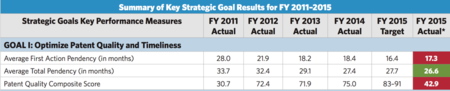
    Table 2
    The report also presents data for the following patent-related performance targets:  patent average first action pendency for FY 2010 to FY 2015 (upper graph) and patent average total pendency for FY 2010 to FY 2015 (lower graph).

    Pendency graphsAs for the third patent performance target, the report notes that:

    The USPTO is working with internal and external stakeholders to reevaluate the entire quality process at the USPTO by engaging in public forums and roundtables to increase the effectiveness, clarity, and simplicity of the USPTO's quality review process by focusing on excellence in work products, excellence in measuring patent quality, and excellence in customer service.  As part of this effort, the USPTO aims to define and introduce revised quality metrics based on stakeholder input by September 2017.  Because the precise contours of the metric will likely change in the upcoming years, it is not useful to portray trends for the current measure.

    The report also notes that the number of applications filed increased from 618,457 in FY 2014 to 617,216 in FY 2015, which constituted a 0.2% decrease in filings (see Table 1 below).  This followed a 6.3% increase in application filings in FY 2013 and a 2.8% increase in application filings in FY 2014.

    Table 1
    The report also indicates that while the Office accepted more than 600,000 patent applications for the third straight year and topped 500,000 applications for the sixth consecutive year (see Table 2 below), it was able to reduce the number of applications awaiting action from 642,949 in FY 2014 to 592,417 in FY 2015 (see Table 3 below).  The total number of pending applications also decreased from 1,127,701 in FY 2014 to 1,099,468 in FY 2015.

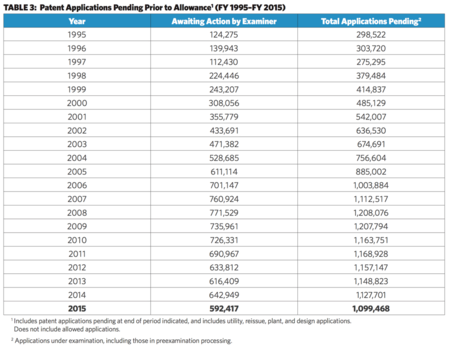
    Table 2 - patent applications

    Table 3
    Stopping a seven-year trend, utility patent issuances were down in FY 2015, dropping from 303,930 in FY 2014 to 295,459 in FY 2015 (see Table 6 below).

    Table 6
    As noted above, the results for first action and total pendency were mixed, with first action pendency coming in above the Office's target, and total pendency coming in below the Office's target (see Tables 4 and 5 below).  And the goals for FY 2016 and FY 2017 present even tougher challenges:  for first action pendency, the annual performance target drops from 16.4 months for FY 2015 (which the Office failed to meet) to 14.7 months for FY 2016 and 13.2 months for FY 2017, and for total pendency, the annual performance target drops from 27.7 months in FY 2015 (which the Office met) to 23.9 months in FY 2016 and 22.6 months in FY 2017.

    Tables 4 and 5When comparing pendency statistics by Technology Center, Tech Center 1600 (biotechnology and organic chemistry) produced the best average first action pendency (14.1 months) and Tech Center 2100 (computer architecture, software, and information security) produced the worst average first action pendency (20.5 months) (see Table 4 below).  As for total average pendency, both Tech Center 1600 and Tech Center 2800 (semiconductor, electrical, optical systems, and components) produced the best numbers (25.3 months), and Tech Center 2100 the worst (31.1 months).

    Table 4 - pendency
    Finally, the report indicates that 1,737 inter partes review cases were filed in FY 2015, up from 1,310 in FY 2014, and 11 post grant review cases were filed in FY 2015, up from 2 in FY 2014 (see Table 15 below).
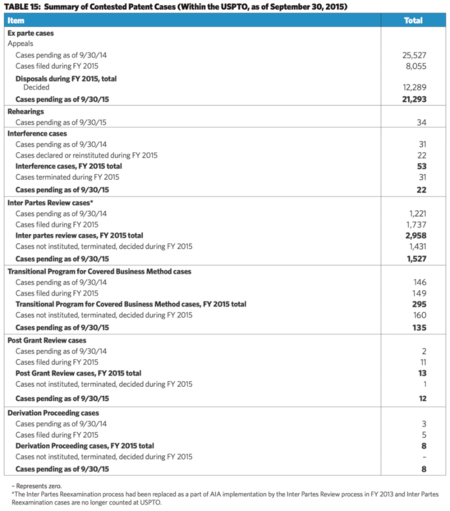
    Table 15

    For additional information regarding this and other related topics, please see:

    • "USPTO Issues Performance and Accountability Report for FY 2014," April 7, 2015
    • "USPTO Releases Performance and Accountability Report for FY 2013," January 9, 2014
    • "USPTO Releases Performance and Accountability Report for FY 2012," November 28, 2012
    • "USPTO Releases Performance and Accountability Report for FY 2011," November 30, 2011
    • "USPTO Releases 2010 Performance and Accountability Report," November 17, 2010
    • "USPTO Announces 'Highest Performance Levels in Agency's History' in 2008," November 18, 2008
    • "USPTO Announces 'Record Breaking' 2007 Performance," November 15, 2007
    • "Patent Office Announces Record-Breaking Year," December 27, 2006

  • By Andrew Williams

    Apotex #1According to the Federal Circuit website, the appeal from the Amgen Inc. v. Apotex Inc. case will be argued on April 4, 2016 in Courtroom 402.  This case is an appeal from a decision by Judge Cohn of the Southern District of Florida ordering a preliminary injunction requiring Apotex to "provide Amgen with at least 180 days notice before the date of the first commercial marketing of the biological product approved by the FDA."  Moreover, Apotex was "enjoined from any commercial marketing of it biosimilar pegfilgrastim product, including selling that product or offering it for sale for use in the United States, until Apotex gives Amgen proper notice . . . and the 180-day notice period is exhausted."  At first glance, this case appears to fit squarely within the Federal Circuit's Amgen v. Sandoz case — indeed Judge Cohn felt bound by that prior decision.  However, there is one crucial difference — Apotex provided Amgen with its aBLA and participated in the so-called "Patent Dance."  Therefore, the Federal Circuit will have the opportunity to address the apparent loophole that it created in its prior decision.

    AmgenThe issue in this case stems from the patent-dispute-resolution section of the BPCIA, found at 42 U.S.C. § 262(l).  This section is related to, but distinct from, the regulatory licensure provisions found at subsection (k) of the same statute.  The so-called patent dance is supposed to begin within 20 days of acceptance of a subsection (k) "biosimilar" application with the applicant providing to the reference product sponsor (or RPS) the aBLA "and such other information that describes the process or processes used to manufacture the biological product that is the subject of such application."  This begins a cascade of information exchange regarding patents that might possibly be asserted against the biosimilar applicant if they were to launch before expiration.  The culmination of this process is a (potential) two-phase litigation, where (potentially) only a subset of patents are asserted initially, and the balance of patents are held in reserve until the subsection (k) applicant provides notice that it intends to market sometime after 180 days from the date of notice.  At that time, the RPS can seek a preliminary injunction with regard to the second-phase patents.  Importantly, the statute provide in section (l)(9)(B) that "[i]f a subsection (k) applicant fails to complete an action required" by this patent resolution mechanism — including the Notice of Commercial Marketing provision of paragraph 8(A) — the RPS "may bring an action . . .  for a declaration of infringement, validity, or enforceability of any patent included in the list described in paragraph 3(A), including as provided under paragraph (7)."  In other words, the RPS can immediately bring suit with respect to any identified patent.

    The Federal Circuit, in the Amgen v. Sandoz case, appeared to turn this process on its head.  Even though the word "shall" is used in the provision beginning this process — the providing of the aBLA and other information — the Court held that because the statute contemplates such an action and provides a remedy, the subsection (k) applicant can voluntarily choose not to participate.  In the cases where the applicant fails to participate in the patent dance by not turning over the aBLA, the statute provides in (l)(9)(C) that the RPS can bring a declaratory judgment suit for "any patent that claims the biological product or a use of the biological product."  It is presumed that this remedy was provided because in such situations there would be no list of identified patents.  The Court also provided that the notice of commercial marketing could only be effective after the FDA has licensed the product, in other words after approval.  However, the "majority," (in this instance Judges Lourie and Newman), held that the Notice provision was a standalone provision, and therefore was independent of the patent dance.  Judge Chen disagreed in his dissent in part.  He believed that the Notice provision was "part and parcel to, and contingent upon" the patent dance.  This is where the Amgen v. Apotex case picks up.

    This dichotomy stems from section B(II)(b) of the majority decision and Judge Chen's dissent-in-part.  The majority noted that the BPCIA does not specify the consequence for noncompliance with paragraph (l)(8)(A) (the Notice of Commercial Marketing provision), even while acknowledging that paragraph (l)(9)(B) specifically references a remedy for violating this provision.  However, according to the Court, this remedy is only available "after the applicant has complied with paragraph (l)(2)(A) . . . ." (emphasis in original).  Therefore, "because Sandoz did not provide the required information to Amgen under paragraph (l)(2)(A), Amgen was unable to compile a patent list as described in paragraph (l)(3)(A) or paragraph (7)."  And, after stating that "Paragraph (l)(8)(A) is a standalone notice provision in subsection (l)," the Court concluded that:

    [W]here, as here, a subsection (k) applicant completely fails to provide its aBLA and the required manufacturing information to the RPS by the statutory deadline, the requirement of pargraph (l)(8)(A) is mandatory.  Sandoz therefore may not market Zarxio before 180 days from March 6, 2015, i.e., September 2, 2015.

    This of course leaves open the question of what happens if the subsection (k) applicant provides its aBLA.

    Judge Chen, on the other hand, found that "[t]he interwoven structure of subsection (l) indicates that Congress viewed the procedures of (l)(8) as inseverable from the preceding steps in (l)."  To reach this conclusion, he looked to the purpose behind the Notice provision:  "the entirety of (l)(8), including (l)(8)(A)'s notice provision, serves to ensure that an RPS will be able to assert all relevant patent before the (k) applicant launches it biosimilar product."  As such, "the most logical conclusion when reading (l)(8) in context is that (l)(8)'s vitality is predicated on the performance of the proceeding steps in subsection (l)'s litigation management process [the patent dance]."  Indeed, according to Judge Chen, "[w]ithout first engaging in these procedures, (l)(8) lacks meaning."  Therefore, according to him:

    The most persuasive reading of subsection (l) as a whole is that Congress provided two paths to resolve patent disputes: (1) the intricate route expressed in (l)(2)-(l)(8); and (2) the immediate, more flexible route provided in (l)(9), should the (k) applicant falter on any of its obligations recited in (l)(2)-(l)(8).

    With such a reading, the Notice provision should be as optional as the patent dance, with (l)(9) providing the requisite remedy should the subsection (k) applicant choose not to comply.

    We will continue to preview this case in upcoming posts, including detailing the positions advocated by both parties and the various amici that filed briefs in this case.  And, of course, we will assuredly have plenty of analysis once the Federal Circuit issues its decision sometime later this year.

  • Antitrust Violation Found in Patent Infringement Litigation, and (Trebled) Attorney Fees for Defending Infringement Awarded as Damages

    By Joseph Herndon

    Federal Circuit SealOn February 10, 2016, the Federal Circuit issued an opinion in a case captioned Transweb, LLC v. 3M Innovative Properties Company, 3M Company.

    3M had sued TransWeb for infringement of several patents.  TransWeb sued for declaratory judgment of invalidity and non-infringement of the patents.  A jury found the patents to be invalid based on TransWeb's prior public use of the patented method.  Further, in accordance with an advisory verdict from the jury, the District Court found the patents unenforceable due to inequitable conduct.

    Among other outcomes of the district court litigation, the jury found 3M to be liable for a Walker Process antitrust violation, based on fraudulent procurement and subsequent assertion of the patents, and that attorney fees were an appropriate antitrust remedy.  The District Court awarded approximately $26 million to TransWeb, including trebled attorney fees as antitrust damages.  On appeal, the Federal Circuit affirmed that the attorney fees are an appropriate basis for damages under the antitrust laws in this context.  The Federal Circuit found that TransWeb's attorney fees appropriately flow from the unlawful aspect of 3M's antitrust violation, and thus, are an antitrust injury that can properly serve as the basis for antitrust damages.

    Looking at the technology involved, TransWeb and 3M are both manufacturers of filters for respirators, such as might be worn by workers in a dirty or otherwise contaminated worksite.  The filter media at issue in this case consist of "nonwoven fibrous webs," which rely on a "web" of fibers rather than traditional woven material.  Both TransWeb and 3M use a process of melting pellets of a filter material, such as polypropylene, blowing the melted material into a thin film, and then allowing the material to cool and solidify into the nonwoven fibrous web.

    3M asserted U.S. Patent Nos. 6,397,458 and 6,808,551 against TransWeb.  These patents generally disclose uses of "hydrocharging," which is a technique that uses water to impart electrical charges on the filter medium to enable the medium to repel or capture particulates both by mechanical and electro-magnetic means.

    The District Court ultimately presented many issues to a jury including questions of infringement, invalidity, and unenforceability of the two patents.  Of note for this commentary is the Walker Process antitrust violation that was presented to the jury based on fraudulent procurement and subsequent assertion of the patents; sham litigation antitrust violation based on assertion of the patents; entitlement to lost profits damages for antitrust violations; and entitlement to attorney fees as damages for antitrust violations.  The jury delivered all verdicts (with the exception of no sham litigation) against 3M, and TransWeb was entitled to lost profits and attorney fees as antitrust damages.

    Walker Process Antitrust Violation

    In Walker Process, the Supreme Court held that a plaintiff could bring an action under § 2 of the Sherman Act based on the alleged maintenance and enforcement of a fraudulently-obtained patent.  To prevail on a Walker Process claim, the antitrust-plaintiff must show two things: (1) that the antitrust-defendant obtained the patent by knowing and willful fraud on the Patent Office and maintained and enforced the patent with knowledge of the fraudulent procurement; and (2) all the other elements necessary to establish a Sherman Act monopolization claim (e.g., (i) that the defendant has engaged in predatory or anticompetitive conduct with (ii) a specific intent to monopolize and (iii) a dangerous probability of achieving monopoly power).  In determining the dangerous probability of achieving monopoly power for element (iii), the courts look at the relevant market and the defendant's ability to lessen or destroy competition in that market.

    In this case, 3M does not contest that TransWeb's inequitable conduct showing, if affirmed, along with 3M's bringing of the infringement suit proves the first Walker Process requirement, as well as elements (i) and (ii) of the second Walker Process requirement.

    Because 3M did not challenge the sufficiency of the evidence supporting the jury's Walker Process fraud finding beyond challenging the inequitable conduct finding, the Federal Circuit accepted as admitted that TransWeb sufficiently demonstrated the Walker Process fraud component (note that the showing required for proving inequitable conduct and the showing required for proving the fraud component of Walker Process liability may be nearly identical, but debate still exists as to whether Walker Process liability requires a higher, more specific showing of knowing and willful fraud than the more inclusive inequitable conduct doctrine).

    On Appeal, 3M challenged whether the District Court properly defined the relevant market for determining dangerous probability of monopoly power in element (iii), and whether the award of TransWeb's attorney fees is appropriate even if the Walker Process case were proven.

    The relevant market is defined by both a product market and a geographic market.  TransWeb defined two distinct markets: an "upstream" market for "fluorinated polymeric material" and a "downstream" market for NIOSH-certified respirators in the United States.

    Product Market: The relevant product market consists of all products that are reasonably interchangeable by consumers for the same purposes.  Looking at all evidence submitted, the Federal Circuit concluded that a sufficient basis existed on which a reasonable jury could conclude that the price, use, and qualities of fluorinated material render it a distinct market from other filter media.

    Geographic Market: The relevant geographic market is the area in which a potential buyer may rationally look for the goods or services he or she seeks.  3M argued that the District Court erred in limiting the downstream market for NIOSH-certified respirators to the United States.  The Federal Circuit concluded, however, that there was a sufficient basis on which a reasonable jury could conclude that the United States was the relevant geographic market for the NIOSH-certified respirators.

    Thus, with the fraud component of the antitrust claim being admitted, and having found that the District Court properly defined the relevant market for determining dangerous probability of monopoly power in element (iii), the Federal Circuit affirmed that 3M is liable for the Walker Process anti-trust violation.

    Attorney Fees as Antitrust Damages?

    Section 4 of the Clayton Act provides that "any person who shall be injured in his business or property by reason of anything forbidden in the antitrust laws . . . shall recover threefold the damages by him sustained, and the cost of suit, including a reasonable attorney's fee."  15 U.S.C. § 15(a) (2012).

    The jury concluded that TransWeb was entitled to its lost profits ($34,000) and attorney fees in recompense for 3M's antitrust violation.  The District Court trebled the lost profits to the amount of approximately $103,000.

    But, for attorney fees, the District Court concluded that TransWeb incurred approximately $3.2 million in attorney fees prosecuting the antitrust claim and approximately $7.7 million defending the infringement suit.  The District Court awarded the $3.2 million on a one-for-one basis as "cost of suit" fees but awarded the $7.7 million trebled to approximately $23 million as damages for a total of over $26 million in trebled attorney fees damages.

    3M argued that the District Court erred in awarding the $23 million of attorney-fees damages due to defending the infringement suit because TransWeb failed to show any link between those attorney fees and an impact on competition.  3M argued that those attorney fees had no effect on competition because they did not force TransWeb out of the market or otherwise affect prices in the market.  On this basis, 3M argued that those attorney fees are not an antitrust injury, and thus cannot be a proper basis for antitrust damages.

    Section 4 of the Clayton Act does not provide recompense for any injury causally linked to a violation of the antitrust laws, but rather only for antitrust injury.  Thus, TransWeb's injury-in-fact of $7.7 million must be attributable to an anti-competitive aspect of the practice under scrutiny in order to qualify as an antitrust injury.

    The Federal Circuit noted that in this case, 3M's unlawful act was in fact aimed at reducing competition and would have done so had the suit been successful because 3M's unlawful act was the bringing of suit based on a patent known to be fraudulently obtained.  What made this act unlawful under the antitrust laws was its attempt to gain a monopoly based on this fraudulently-obtained patent.  TransWeb's attorney fees flow directly from this unlawful aspect of 3M's act.  That is, TransWeb's attorney fees flow from that which makes 3M's acts unlawful, and are attributable to this anti-competitive aspect of the practice under scrutiny.

    No assertion of a patent known to be fraudulently obtained can be a proper use of legal process.  No successful outcome of that litigation, regardless of how much the patentee subjectively desires it, would save that suit from being improper due to its tainted origin.  Therefore, the Federal Circuit found that allowing attorney fees as antitrust damages in contexts such as sham litigation and lawsuits in furtherance of a broader anticompetitive scheme is proper.

    The antitrust laws exist to protect competition.  The Federal Circuit noted that this outcome furthers the purpose of the antitrust laws to encourage TransWeb to bring its antitrust suit instead of waiting to be excluded from the market.  In summary, TransWeb's attorney fees that were incurred defending the infringement suit are an antitrust injury, and thus can form the basis for damages under § 4.

    The outcome of this case provides great power to defendants who are successful in challenging a patent as being unenforceable due to inequitable conduct, or knowing and willful fraud on the Patent Office.  With such a finding, defendants then need only show "a dangerous probability of achieving monopoly power," albeit a challenge itself, to achieve a successful Walker Process antitrust violation.  That violation, which may not ordinarily be attributable to large monetary damages to the defendant, now attaches attorney fees (trebled) for defending the infringement suit.

    Transweb, LLC v. 3M Innovative Properties Co. (Fed. Cir. 2016)
    Panel: Circuit Judges Wallach, Bryson, and Hughes
    Opinion by Circuit Judge Hughes

  • By Kevin E. Noonan

    Federal Trade Commission (FTC) SealIn January, the Federal Trade Commission issued a report on the terms of settlement agreements between branded and generic drug companies in ANDA litigation under the Hatch-Waxman Act, according to the provisions of the Medicare Prescription Drug, Improvement, and Modernization Act of 2003.  While the Commission has been issuing these Reports since the MMA was enacted, this year's report is significant, because it is the first Report issued by the FTC after the Supreme Court's decision in FTC v. Actavis, which held that under some circumstances such settlement agreements containing so-called "reverse payments" could violate the antitrust laws.

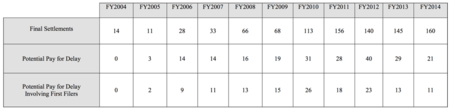
    According to the report (which can be accessed here), there were 160 settlement agreements between branded pharmaceutical companies and generic competitors filed in Fiscal Year 2014.  This number, according to the Report, is "substantially the same" as the number of settlement agreements in recent years.  Specifically, the Report notes that by comparison there were 156 agreements filed in FY 2011, 145 in FY 2012, and 140 in FY 2013.  As set forth in the Report, of the 160 agreements reported to the Commission in FY 2014:

    • 21 contained "potential" reverse payment provisions, involving 20 different drugs with sales totaling $6.2 billion;

    • 10 of these 21 involved compensation "solely in the form of cash," in amounts ranging from $35,000 – $5 million;

    • 6 of these 21 involved a "side" business deal between the parties;

    • 5 of the 21 included a promise from the branded pharmaceutical not to market an authorized generic;

    • 8 of the agreements contained ambiguous provisions, for example, related to "a declining royalty structure" that could act like an agreement not to market an authorized generic;

    • Of the rest, (111 of 160) the agreements restricted a generic company's ability to market their products but do not contain either explicit or "possible" compensation from the branded to the generic; and finally

    • 20 of the settlements contained no provisions limiting generic entry.

    What has changed is the number of these agreements containing reverse payment provisions, which "decreased significantly" (by about 50%).  The trend is clear:  there were 31 agreements containing reverse payment provisions in FY 2010, 28 in FY 2011, and 29 in FY 2013.  The trend is most pronounced for "first filers," those generic manufacturers who are first to file an ANDA application.  For first filers there were 18 agreements in FY 2011, 23 in FY 2012, and 13 in FY 2013, compared with 11 in FY 2014.  There has also been a reduction in the number of settlements involving first filers containing agreements by the branded drug maker not to market an "authorized generic" in competition with the generic entrant.  These provisions are particularly important to first filers, who get 180 days of market exclusivity if they successfully challenge the branded company's patents; competition by a "generic" form of the drug made by the branded manufacturer can greatly reduce the short-term profits (and hence economic incentives) for the generic entrant.  There were 15 agreements containing such provisions filed in FY 2010, 11 in FY 2011, 19 in FY 2012, and 4 in FY 2013, compared with 5 in FY 2014.

    Overall, the Report reveals that 81-87% of ANDA litigation settlement agreements filed in FY 2014 did not contain any compensation from the branded to the generic company and/or restrictions on generic market entry.  These results show that the outcome desired by the FTC in a decade of challenging these agreements that culminated in the Court's Actavis decision have borne the desired fruit.  Whether this outcome facilitates generic entry and reduced drug costs for consumers is a conclusion the data do not yet support.

    Table
    Exhibit 1 from Report (click to enlarge table)

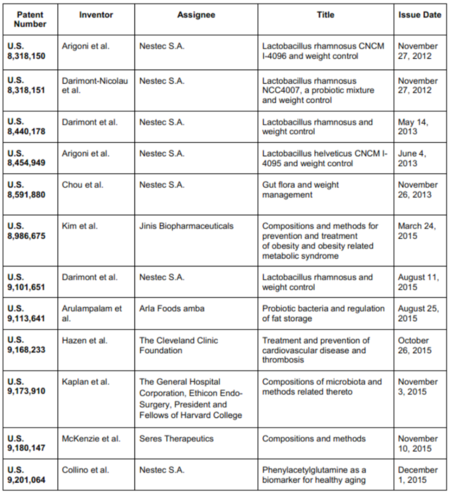
  • The gut microbiome, a collection of microbes living in the gastrointestinal tract, has emerged as an attractive target for pharmaceutical intervention for the treatment of a variety of disorders.  This is the fifth article in a series on advancements in microbiome research and development.  This installment will summarize issued U.S. microbiome-based patents that describe therapies relating to obesity and other metabolic disorders.  It is a follow-up to the fourth part of the series, which reviewed important research and development in this subject area.  The patents reviewed herein are neatly summarized in the table at the end of this installment.  Upcoming articles will continue to review important topics in this technology area, and patents of interest.

    By Jessica Miles* and Anthony D. Sabatelli** —

    The diet and nutrition industry is big business: the industry brings in over $60 billion dollars from the nation's 100 million-plus dieters.  Yet, years of R&D have failed to produce a blockbuster weight loss drug.  Clearly, there is a big incentive to develop new and effective therapies for this area, particularly considering the risks and adverse events that have plagued previous prescription therapies, and companies are looking to the untapped potential of the microbiome for an elusive wonder drug.

    The earliest patents issued relating to obesity and the microbiome describe formulations of lactic acid bacteria used to prevent weight gain.  Patent activity in this area started a few years ago with a series of patents obtained by Nestec S.A.  Recently dubbed "Pharma's newest nemesis" for its efforts to create pharmaceutical food products, the four-year-old research and development subsidiary of Nestlé has Patent Nos. 8,318,150; 8,318,151; 8,440,178; 8,454,949; and 8,591,880.  The '150 and '151 patents describe the use of two strains of the same probiotic species, Lactobacillus rhamnosus, for weight loss and treatment of metabolic disorders.  Patent No. 8,440,178 describes the use of two additional L. rhamnosus strains, while Patent No. 8,454,949 relates to the use of a similar probiotic species, L. helveticusPatent No. 8,591,880 describes a composition of L. rhamnosus to modulate a patient's microbiome.

    After growing steadily, the number of patents granted in this field peaked in 2015.  Patent No. 8,986,675 was issued to Jinis Biopharmaceuticals, a South Korean clinical and commercial life sciences manufacturer for an invention comprising mutagenized L. acidophilus strains.  Later that year, Nestec S.A. obtained another patent (Patent No. 9,101,651) for the use of probiotic L. rhamnosus strains for weight management.  Patent No. 9,113,641 relates to a composition of L. paracasei and a milk product used to regulate fat uptake.  The patent was granted to Arla Foods amba, the largest producer of dairy products in Scandanavia, and Sven Pettersson, a renowned microbiome researcher at Sweden's Karolinska Institute, is one of its listed inventors.

    Recently issued patents have focused on modulating the microbiome to diagnose and ameliorate obesity and other metabolic disorders.  MicroBiome Therapeutics LLC obtained Patent No. 9,040,101, which was mentioned in the second installment of this series, which describes a drug being evaluated in clinical trials for the treatment of diarrhea in patients taking metformin, a treatment for type II diabetes.  Patent No. 9,168,233 relates to the inhibition of Trimethylamine (TMA) N-oxide (TMAO), a product of the gut microbiome that is associated with atherosclerosis.  Patent No. 9,173,910, whose inventors include Peter Turnbaugh, relates to the use of bacteria of the phyla Verrucomicrobia to modulate the microbiome for the treatment of a suite of metabolic disorders, including obesity and diabetes.  Seres Therapeutics, which is still riding high on its widely-publicized 2015 IPO, was granted Patent No. 9,180,147, which describes a composition of bacterial spores and probiotic strains as a therapy for metabolic disorders and other diseases.  Patent No. 9,201,064 relates to the use of two microbial metabolites — phenylacetylglutamine (PAG) and p-cresol sulphate — as biomarkers in aging adults.

    Closing

    2015 was the best year yet for patent activity in microbiomics and obesity, with higher numbers and diverse technologies represented among the patent grantees.  These signs indicate that the field will see continued growth and increased commercialization activity in 2016.  However, securing patent protection has become more complicated in the aftermath of the Supreme Court's infamous Mayo and Alice decisions defining more stringent criteria for patent subject matter eligibility under 35 U.S.C. § 101.  Microbiomics inventions, which often utilize living bacteria and other natural products, will be vulnerable to such 101 rejections, and already-issued patents could also be vulnerable in post grant proceedings.  Careful, thoughtful, and creative patent drafting and prosecution will be vital for protecting on-going innovation in this area.

    Table 1: Selected Patents in Microbiomics Relating to Obesity and Metabolic Disorders (click on table to expand)

    Table_1
    * Jessica Miles is a Technology Specialist at Dilworth IP
    ** Dr. Sabatelli is a Partner with Dilworth IP

    For additional information regarding this topic, please see:

    • "The Emergent Microbiome: A Revolution for the Life Sciences – Part IV, Obesity and other Metabolic Disorders," February 18, 2016
    • "Jackson Laboratory Hosts Microbiome Symposium Related to Cancer and Immunology," January 19, 2016
    • "Guest Post — The Emergent Microbiome: A Revolution for the Life Sciences – Part III, Psychobiotics," October 13, 2015
    • "Guest Post — The Emergent Microbiome: A Revolution for the Life Sciences – Part II, 2015 Patent Trends," August 11, 2015
    • "Guest Post — The Emergent Microbiome: A Revolution for the Life Sciences – Part I, R&D Leaders," August 10, 2015

  • CalendarMarch 1, 2016 – "PTAB Best Practices for Petitioners" (American Intellectual Property Law Association) – 12:30 – 2:00 pm (Eastern)

    March 3, 2016 – "Patents and Export Control Compliance: Managing Risk and Avoiding Unintentional Violations — Minimizing Export Control Liability in Patent Application Preparation, Development and Analysis of Innovation, and Licensing" (Strafford) – 1:00 to 2:30 pm (EST)

    March 8, 2016 – Patent Quality Chat webinar series: "Latest on the Cooperative Patent Classification (CPC) System" (U.S. Patent and Trademark Office) – 12:00 to 1:00 pm (ET)

    March 9, 2016 – "Strategic Use of Patent Reissue Applications for University IP" (Technology Transfer Tactics) – 1:00 to 2:00 pm (Eastern)

    March 10, 2016 – "Biotech Patents and §101 Rejections: Meeting Patent Eligibility Requirements — Leveraging Recent Decisions and USPTO Guidance to Overcome Rejections" (Strafford) – 1:00 to 2:30 pm (EST)

    March 10-11, 2016 - Advanced Patent Law Seminar (Chisum Patent Academy) – Cincinnati, OH

    March 13, 2016 - American Intellectual Property Law Association Quarterly Journal (AIPLA QJ) Symposium – George Washington University Law School

    March 16, 2016 – "Preparing for the European Unified Patent Court (UPC)" (McDonnell Boehnen Hulbert & Berghoff LLP) – 10:00 am to 11:15 am (CT)

    March 16, 2016 – "Trade Secrets in Biotech, Biosimilars & Medical Devices" (American Intellectual Property Law Association) – 12:30 – 2:00 pm (Eastern)

    ***Patent Docs is a media partner of this conference or CLE

  • AIPLA #1The American Intellectual Property Law Association (AIPLA) will be offering a webinar entitled "Trade Secrets in Biotech, Biosimilars & Medical Devices" on March 16, 2016 from 12:30 – 2:00 pm (Eastern).  Victoria Cundiff of Paul Hastings will moderate a panel consisting of Elizabeth Howard of Orrick, ​Debora Plehn-Dujowich of Prismatic Law Group, and Austin Wang of Hologic will discuss using Trade Secrets Law as a complement or alternative to Patent Law, particularly in areas such as Biotech and Medical Devices where patent eligibility has become more uncertain.

    The registration fee for the program is $145 (AIPLA member rate) or $195 (non-member rate).  Those interested in registering for the program, can do so here.

  • AIPLA #1The first annual American Intellectual Property Law Association Quarterly Journal (AIPLA QJ) Symposium will be held on March 18, 2016 at the George Washington University Law School.  The program will offer panel discussions on the following topics:

    • Panel 1: Drafting Claims during Prosecution
    • Panel 2: Claim Construction during Post-grant Review
    • Panel 3: Practitioner Panel on Claim Construction in Federal Courts and ITC
    • Panel 4: Judicial Panel on Claim Construction in Federal Courts and ITC

    Additional information about the symposium can be found here, and a program, including a list of speakers, can be found here.

  • Technology Transfer Tactics will be offering a webinar entitled "Strategic Use of Patent Reissue Applications for University IP" on March 9, 2016 from 1:00 to 2:00 pm (Eastern).  Michael L. Goldman and Megan O'Gara of LeClair Ryan will discuss reissue opportunities as well as challenges and risks.  The webinar will cover the following topics:

    • What factors indicate that post-grant proceedings are warranted for your patent
    • Overview of Post-Issuance Proceedings Before the U.S. Patent and Trademark Office
        – Ex parte Reexamination
        – Supplemental Examination
        – Reissue Application
        – Inter Partes Review
        – Post-Grant Review
    • Components of a Reissue Application and Requirements for Filing
    • How reissue claims effect active patents
    • Errors Correctable by Reissue (e.g., claiming more or less than applicant had a right to claim, correcting errors relating to statutory subject matter)
    • Errors NOT Correctable by Reissue
    • Special Considerations when Broadening Claims
    • Considering how a Reissue Application will Affect Litigation

    The registration fee for the webinar is $197.  Those interested in registering for the webinar, can do so here.

    Technology Transfer Tactics

  • Strafford #1Strafford will be offering a webinar/teleconference entitled "Patents and Export Control Compliance: Managing Risk and Avoiding Unintentional Violations — Minimizing Export Control Liability in Patent Application Preparation, Development and Analysis of Innovation, and Licensing" on March 3, 2016 from 1:00 to 2:30 pm (EST).  Thomas Crocker of Alston & Bird and David G. Henry of Gray Reed & McGraw will provide guidance for patent counsel on navigating the intersection of patents and export control laws; examine the challenges facing patent owners, when and where export control issues arise, and licensing issues; and offer best practices for complying with export control laws.

    The registration fee for the webinar is $297.  Those interested in registering for the webinar, can do so here.