• After Multiple CBM Petitions, Motorola Invalidates Software Patent

    By Joseph Herndon

    USPTO SealOn March 21, 2016, the USPTO Patent Trial and Appeal Board (PTAB) issued a final written decision in the Covered Business Method (CBM) patent review between Motorola Mobility, LLC and Intellectual Ventures I, LLC, in which challenged claims were found to be unpatentable under 35 U.S.C. § 101 as being directed to non-statutory subject matter.  This is another CBM decision in which the claims do not recite anything even remotely close to some kind of financial product or service, but since the specification has examples focused on Tax Filings and Financial Planning, the patent was doomed.

    Jurisdictional Termination Request

    Intellectual Ventures asserted U.S. Patent No. 6,658,464 against Motorola, and Motorola responded by requesting CBM review of claims 1, 8, 16, and 17 of the '464 patent.  As an initial matter, Motorola previously filed a request for CBM review of the '464 patent, and the PTAB determined that Motorola had not demonstrated adequately that the '464 patent is a CBM patent.  Intellectual Ventures asked the Board to terminate this second proceeding for lack of jurisdiction because Motorola should not be allowed to re-litigate whether the '464 patent qualifies as a CBM patent after fully litigating that issue in the earlier CBM petition and losing.

    The Board, however, noted that there is no authority supporting a lack of jurisdiction in these circumstances, nor does Intellectual Ventures explain persuasively why a prior petition denies the Board jurisdiction.  Consequently, the Board allowed Motorola a second chance.

    Covered Business Method (CBM) Patent?

    Whether a patent is a CBM patent is a two-part inquiry: (1) whether the patent "claims a method or corresponding apparatus for performing data processing or other operations used in the practice, administration, or management of a financial product or service," and (2) whether the patent is a technological invention (technological inventions are not covered business methods patents).

    The '464 patent is entitled "User Station Software that Controls Transport, Storage, and Presentation of Content from a Remote Source," and relates to a method and corresponding software for operating a user station for communications with a multiplicity of independently-operated data sources via a non-proprietary network.  Of the challenged claims, claim 1 is the sole independent claim, and claims 8, 16, and 17 depend from independent claim 1.  Claim 1 is reproduced below:

    1.  A software product for use at a user station, the user station including a processor and a storage device, the software product comprising computer executable instructions that, when executed by the processor:
        (a) enable a user at the user station to select content from each of a plurality of independent publishers;
        (b) effect transport of the selected content from each of the plurality of publishers to the user station over a communications network and, without user intervention,
        (c) effect storage of the transported content to the storage device such that the content is retained on the storage device upon shutting down of the user station and/or deactivation of the software product; and
        (d) effect presentation of the stored content to the user at the user station with a user interface that is customized to the respective publishers.

    1.  Financial Product or Service

    Intellectual Ventures argued that the challenged claims recite electronic content distribution operations and have no direct or indirect relationship to financial products or services.  But the Board noted that while the focus is on the claims, a financial product or service need not be explicitly recited in the claims, and thus, the Specification must not be ignored.

    Here, while the claims do not expressly refer to financial activity, the Specification discloses an application to financial activities.  The Specification notes that the claimed invention is useful "for providing financial planning and portfolio management systems, enabling electronic tax and government filings, or to obtain current statistics, place stock orders, and the like."  Thus, the Board found that Motorola demonstrated that at least one claim of the '464 patent covers data processing or other operations used in the practice, administration, or management of a financial service (e.g., tax filing and financial planning).

    2.  Technological Invention

    To determine whether a patent is directed to a technological invention, and therefore ineligible for CBM patent review, the Board considers: (1) whether the claimed subject matter as a whole recites a technological feature that is novel and unobvious over the prior art; and (2) solves a technical problem using a technical solution.

    Here, claim 1 recites the use of known prior art technology (a user station that includes a processor and a storage device, a communications network, and a user interface).  Intellectual Ventures attempted to show that the claimed subject matter recites more than known technology in that it recites "a sequence of four detailed steps, implemented by a computer processor and using computer storage, unknown in the prior art."  But the Board noted that even if this is true that the sequence of four steps was unknown in the prior art, claim 1 does not avoid classification as a CBM patent.  The Board noted that the Federal Circuit in Versata clarified that whether the claimed subject matter as a whole recites a technological feature that is novel and unobvious over the prior art for purposes of CBM patent eligibility is not the same inquiry as determining if the claimed subject matter is anticipated or obvious under 35 U.S.C. § 102 or § 103.

    Because the steps of claim 1 provide a very general description of how components carry out instructions there was no technological invention exception found.  Thus, the '464 patent was considered a CBM patent.

    Challenge under 35 U.S.C. § 101

    Motorola challenged the claims as being directed to ineligible patent subject matter under 35 U.S.C. § 101.  The Board followed the Supreme Court's Alice Corp. and Mayo framework to (i) first determine whether the claims at issue are directed to a patent-ineligible concept, and then (ii) consider whether the elements of each claim both individually and as an ordered combination transform the nature of the claim into a patent-eligible application.

    1.  Abstract Idea

    Motorola contended that the '464 patent claims the abstract concept of selecting, transporting, storing, and displaying content, and these steps were well-known in the art, and are analogous to the processes of purchasing a book from a bookstore, purchasing a record by mail order, or renting a VHS tape from a video rental store.  Motorola argued that the mere presence of a computer (user station) to carry out these steps is inconsequential.  In fact, the '464 patent describes that electronic publications were commonly replicated in computer-readable form on magnetic or optical storage diskettes and distributed to retail stores or by direct mail sales.  Thus, the concept of distributing electronic information products (content) was known prior to the '464 patent.

    The Board noted that the '464 patent does not describe solving a problem necessarily rooted in computer technology, and that the claims are directed to the idea of distributing content, which was a longstanding commercial practice.  Thus, the finding of the claims being directed to an abstract concept of distributing electronic content was easily found.

    2.  Inventive Concept

    The Board also easily found that the challenged claims utilize conventional components to carry out conventional instructions, thus, lacking any inventive concept.

    The claims provide a very general description of how the components carry out the instructions.  For example, the instructions: are "executed by" the processor, "effect transport" of the selected content over a communications network, "effect storage", etc.  The challenged claims do nothing more than automate the process of selecting content and presenting it in a format with some similarity to the original format.

    The Board admitted that to some extent, the claims limit the abstract idea to a particular technological environment.  But, this alone, is not sufficient to demonstrate an inventive concept.  The claimed subject matter does not "improve the functioning of the computer itself," or "effect an improvement in any other technology or technical field," as there is no recitation in the claims of improved computer technology or advanced programming techniques.

    The Board confirmed this determination by reference to the machine or transformation test.  The steps of the challenged claims are well-known, conventional, and routine and do not transform a general purpose computer (user station comprised of a processor and storage device) into a specific machine.  Rather, the claimed instructions are the normal basic functions of a computer.

    Thus, the Board found that claims 1, 8, 16, and 17 are directed to patent-ineligible subject matter under 35 U.S.C. § 101.

    This decision follows a trend by the PTAB of instituting CBM review of challenged claims, despite no recitation of anything remotely financial in the claims, when the Specification describes that the invention has use in some financial sector.  And, once the CBM is instituted, section 101 challenges are allowed and easily invalidate generic software claims.

    Motorola Mobility, LLC, v. Intellectual Ventures I, LLC (PTAB 2016)
    Before Jameson Lee, Phillip J. Kauffman, and Jo-Anne M. Kokoski, Administrative Patent Judges.
    Final Written Decision by Phillip J. Kauffman

  •         By Sherri Oslick

    Gavel About Court Report:  Each week we will report briefly on recently filed biotech and pharma cases.

    Fresenius Kabi USA, LLC et al. v. Mylan Laboratories Ltd. et al.
    1:15-cv-00942; filed October 19, 2015 in the District Court of Delaware

    • Plaintiffs:  Fresenius Kabi USA, LLC; Fresenius Kabi Deutschland GmbH
    • Defendants:  Mylan Laboratories Ltd.; Mylan Inc.; Agila Specialties Inc.; Mylan Pharmaceuticals Inc.

    Fresenius Kabi USA, LLC et al. v. Mylan Laboratories Ltd. et al.
    1:15-cv-00185; filed October 19, 2015 in the Northern District of West Virginia

    • Plaintiffs:  Fresenius Kabi USA, LLC; Fresenius Kabi Deutschland GMBH
    • Defendants:  Mylan Laboratories Ltd.; Mylan Inc.; Agila Specialties Inc.; Mylan Pharmaceuticals Inc.

    The complaints in these cases are substantially identical.  Infringement of U.S. Patent Nos. 7,828,787 ("Connector for Packaging Containing Medical Fluids and Packaging for Medical Fluids," issued November 9, 2010), 7,857,802 ("Connector for Medical Liquid-Containing Packages and Medical Liquid-Containing Packages," issued December 28, 2010), 8,118,802 ("Connector for Packaging Containing Medical Fluids and Packaging for Medical Fluids," issued February 21, 2012), and 8,162,915 ("Connector for Packings Containing Medical Liquids, and Corresponding Packing for Medical Liquids," issued April 24, 2012) following Mylan's filing of an ANDA to manufacture a generic version of Fresenius' Naropin® (ropivacaine hydrochloride injection product, used for the production of regional or local anesthesia for surgery and for acute pain management).  View the Delaware complaint here.


    Jazz Pharmaceuticals, Inc. et al. v. Par Pharmaceutical, Inc.
    2:15-cv-07580; filed October 19, 2015 in the District Court of New Jersey

    • Plaintiffs:  Jazz Pharmaceuticals, Inc.; Jazz Pharmaceuticals Ireland Ltd.
    • Defendant:  Par Pharmaceutical, Inc.

    Infringement of U.S. Patent No. 9,050,302 ("Method of Administration of Gamma Hydroxybutyrate with Monocarboxylate Transporters," issued June 9, 2015) following a Paragraph IV certification as part of Par's filing of an ANDA to manufacture a generic version of Jazz's Xyrem® (sodium oxybate, used to treat narcolepsy).  View the complaint here.


    Horizon Therapeutics, Inc. v. Lupin Ltd. et al.
    1:15-cv-07624; filed October 19, 2015 in the District Court of New Jersey

    • Plaintiff:  Horizon Therapeutics, Inc.
    • Defendants:  Lupin Ltd.; Lupin Pharmaceuticals Inc.

    Infringement of U.S. Patent Nos. 8,404,215 ("Methods of Therapeutic Monitoring of Nitrogen Scavenging Drugs," issued March 26, 2013), 8,642,012 ("Methods of Treatment Using Ammonia-Scavenging Drugs," issued February 4, 2014), and 9,095,559 ("Methods of Therapeutic Monitoring of Nitrogen Scavenging Drugs," issued August 4, 2015) following Lupin's filing of an ANDA to manufacture a generic version of Horizon's Ravicti® (glycerol phenylbutyrate oral liquid, used as a nitrogen binding agent for chronic management of adult and pediatric patients ≥ 2 years of age with urea cycle disorders that cannot be managed by dietary protein restriction and/or amino acid supplementation alone).  View the complaint here.


    Otsuka Pharmaceutical Co., Ltd. v. Aurobindo Pharma Ltd. et al.
    1:15-cv-07584; filed October 19, 2015 in the District Court of New Jersey

    • Plaintiff:  Otsuka Pharmaceutical Co., Ltd.
    • Defendants:  Aurobindo Pharma Ltd.; Aurobindo Pharma USA, Inc.; Aurolife Pharma LLC

    Infringement of U.S. Patent No. 9,089,567 ("Method of Treating Cognitive Impairments and Schizophrenias," issued July 28, 2015) following Aurobindon's filing of an ANDA to manufacture a generic version of Otsuka's Abilify® (aripiprazole, used to treat bipolar disorder and schizophrenia).  View the complaint here.  [NB: The complaint was later voluntarily dismissed.


    Purdue Pharma LP et al. v. Alvogen Pine Brook LLC et al.
    1:15-cv-00940; filed October 16, 2015 in the District Court of Delaware

    • Plaintiffs:  Purdue Pharma LP; Purdue Pharmaceuticals LP
    • Defendant:  Alvogen Pine Brook Inc.; Alvogen Pine Brook LLC

    Infringement of U.S. Patent Nos. 9,084,816 ("Tamper Resistant Dosage Forms," issued July 21, 2015), 9,095,614 (same title, issued August 4, 2015), and 9,095,615 (same title, issued August 4, 2015) following a Paragraph IV certification as part of Alvogen's filing of an ANDA to manufacture a generic version of Purdue's Hysingla® ER (hydrocodone bitartrate, used for the management of pain severe enough to require daily, around-the-clock, long-term opioid treatment and for which alternative treatment options are inadequate). View the complaint here.


    Astrazeneca Pharmaceuticals LP et al. v. Mylan Pharmaceuticals Inc. et al.
    1:15-cv-00183; filed October 15, 2015 in the Northern District of West Virginia

    • Plaintiffs:  Astrazeneca Pharmaceuticals LP; Astrazeneca UK Ltd.; AstraZeneca AB
    • Defendants:  Mylan Pharmaceuticals Inc.; Mylan Laboratories Ltd.; Mylan Inc.

    Infringement of U.S. Patent Nos. 6,774,122 ("Formulation," issued August 10, 2004), 7,456,160 (same title, issued November 25, 2008), 8,329,680 (same title, issued December 11, 2012), and 8,466,139 (same title, issued June 18, 2013) following a Paragraph IV certification as part of Mylan's filing of an ANDA to manufacture a generic version of AstraZeneca's Faslodex® (fulvestrant injection, used to treat hormone receptor positive metastatic breast cancer in postmenopausal women with disease progression following antiestrogen therapy).  View the complaint here.

  • By Kevin E. Noonan

    Federal Circuit SealEarly last month, the Federal Circuit addressed an important question regarding the interplay between a decision to institute inter partes review before the Patent Trial and Appeal Board and the ultimate determination by the Board regarding whether claims are invalid for the reasons contained in the petition, in TriVascular v. Samuels.

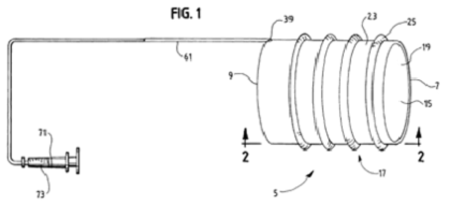
    The IPR involved U.S. Patent No. 6,007,575, which claimed intraluminal stents, particularly vascular stents, and specifically such stents that can be "affixed" to vascular walls using an inflatable cuff (designated 17 in this drawing):

    FIG1wherein the cuff can inflate and deflate by introducing or withdrawing fluid into circumferential ridges 25.

    Claim 1 is representative:

    1.  An inflatable intraluminal stent adapted to be secured to the interior of a tubular structure within the human body comprising:
        a) an inflatable and deflatable cuff of generally hollow cylindrical continuation having a collapsible lumen, an inner surface, an inlet, an outlet and a friction enhancing outer surface, said friction-enhancing outer surface featuring inflatable protrusion(s) including at least one circumferential ridge disposed about the inflatable cuff, said friction-enhancing outer surface engaging the interior of the tubular structure without penetration to prevent the cuff from moving in a longitudinal direction with respect to the tubular structure when said cuff is in a fully inflated condition;
        b) means for injecting an inflation material into said cuff to inflate it; and
        c) a valve integral with the inflatable cuff for permitting entry of the inflation material from the means for injecting and thereafter sealing said cuff to prevent deflation.

    TriVascular filed its IPR petition in response to an infringement action by Samuels, with the Board instituting the IPR on obviousness grounds over the combination of an earlier Samuels patent (U.S. Patent No. 5,423,851) in view of a patent to Todd (U.S. Patent No. 5,423,745) and separately over the combination of a patent to Lazarus (U.S. Patent No. 5,693,088) and the Todd patent.

    At the initiation stage, the PTAB construed the term "circumferential ridge" to mean "raised strip disposed circumferentially about the outer surface of the inflatable cuff."  Under that construction, the Board held that the Samuel's '851 patent did not teach away from the circumferential ridges taught in the '575 patent by teaching "penetrating anchoring barbs" and also that removing the barbs (by substituting the circumferential ridges) would not "destroy the objective" of the '851 patent.

    Nevertheless, the Board held that TriVascular had not carried its burden of showing the claims to be obvious by a preponderance of the evidence.  Specifically, the Board further construed the term "inflatable protrusions" to mean "protrusions that are themselves inflatable, i.e., expandable by being filled with fluid" and that these were not disclosed in the prior art (nor would there be a motivation to combine the art to achieve the invention claimed in the '575 patent).  The Board also found that, under its construction the circumferential ridges were continuous and cannot be discontinuous inflatable protrusions as disclosed in the cited art.  Under its claim construction and in view of expert evidence adduced during trial, the Board held that TriVascular had not carried its burden that the claims were obvious by a preponderance of the evidence.

    The Federal Circuit affirmed, in a decision by Judge O'Malley, joined by Judges Moore and Wallach.  The Court applied de novo review to the ultimate question of obviousness but deferred to the Board on it factual determinations.  With regard to the Board's claim construction, the Court noted that the Board had used the broadest reasonable interpretation standard in assessing whether the ridges should be construed to include discontinuous embodiments.  Specifically, the opinion noted that it is not reasonable to construe individual words in a claim out of context (i.e., as would be understood to be the ordinary and customary meaning of the term to one of ordinary skill in the art).  In reaching its factual determinations, the Board relied upon the specification and dictionary definitions, from which it held that TriVascular's reading that the claims encompasses "discontinuous" circumferential ridges was inconsistent with the customary and ordinary meaning of the term.  (In an amusing sidenote, the opinion recited that TriVascular alluded to the Blue Ridge Mountains to illustrate that a "ridge" can be discontinuous; the panel first gently castigated the petitioner for not providing any basis for imputing a "topological or cartographical" definition of the word, and in a footnote finding that the meaning of Blue Ridge Mountain did not use the word "ridge" to modify the word "mountain.")  The panel also noted in a footnote that it was issuing its decision rather than await the Supreme Court's decision in In re Cuozzo Speed Tech. LLC v. Lee, because TriVascular was arguing for a broader rather than narrower construction.

    TriVascular also argued the existence of prosecution history disclaimer, on the ground that during prosecution Samuels distinguished its '851 prior art patent based on continuous inflatable ridges but that the word "continuous" was not in the claims as granted.  The Board found that the claims were deemed allowable after further amendment and prosecution ignored by TriVascular and that omitting the word "continuously" in favor of the phrase "at least one circumferential ridge disposed about the inflatable cuff" was not "clear and unmistakable" disclaimer.  As reviewed by the Court, TriVascular bore the burden of showing "clear and unmistakable" disclaimer in order to prevail, citing Elbex Video, Ltd. v. Sensormatic Elecs. Corp., 508 F.3d 1366, 1371 (Fed. Cir. 2007).

    The Court agreed with the Board that TriVascular had not met this burden, saying that the "continuous" limitation was one of several Samuels offered to distinguish over the prior art and that the Examiner never adopted this amendment as the basis for allowing the claims (indeed, the panel understood that the Examiner allowed the claims in view of amendments other than the "continuous" amendment).  The panel also rejected TriVascular's argument that, to overcome prosecution history disclaimer "there must be 'written evidence' to contradict an applicant's concessions made in an amendment, and that '[w]here the record is devoid of any written documentation, no inferences can be made as to what the examiner relied upon or understood,'" purportedly relying on Litton Systems, Inc. v. Whirlpool Corp., 728 F.2d 1423 (Fed. Cir. 1984); Genzyme Corp. v. Transkaryotic Therapies, Inc., 346 F.3d 1094 (Fed. Cir. 2003); and Rohm & Haas Co. v. Crystal Chemical Co., 722 F.2d 1556 (Fed. Cir. 1983), calling that reliance "misplaced."  The opinion states in this regard that this case did not involve nondisclosure of the contents of an examiner interview (Litton), nor introduction of a last-minute amendment that omitted a limitation that had been relied upon throughout prosecution (Genzyme), nor a charge of inequitable conduct based on intentional misrepresentations (Rohm), and thus none of this precedent supported TriVascular's argument.

    Turning (at last) to the obviousness issue, the panel found no error in the Board's distinguishing the claimed invention from the prior art.  The Samuels '851 patent disclosed stents comprising inflatable protrusions containing penetrating spikes illustrated in Fig.3 (inflated) and Fig.4 (deflated) of the patent:

    FIG3-4
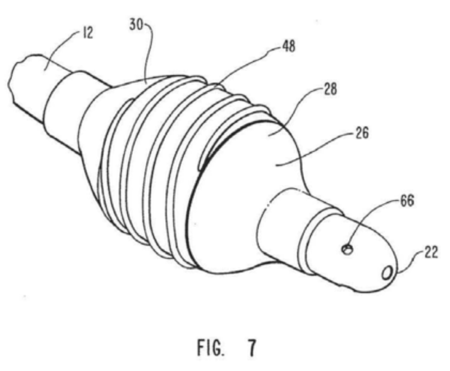
    while the Todd patent showed "non-penetrating 'gripping protuberances' on the outer surface of the stent," illustrated in Fig.7 (wherein the panel noted these protuberances were solid instead of inflatable:

    FIG7For the panel, "a key point of distinction between the '575 patent and the prior art is that the '575 patent teaches the use of inflatable, circumferential ridges that do not penetrate the vessel wall" (emphasis in opinion).  The Court agreed with the Board's decision that TriVascular had not carried its burden of showing obviousness based, inter alia, on its understanding that substituting the barbs in the Samuels '851 patent with the ridges from the Todd patent "would destroy the basic objective of the barbs, which is to penetrate the surrounding tissue" (emphasis in opinion).  This in view of other distinctions (such as that the Todd patent's ridges are not inflatable) convinced the Court that there was substantial evidence supporting the Board's decision that TriVascular had not established obviousness for the claims at issue.

    The most significant portion of the opinion involves the panel's rejection of TriVascular's argument that, having decided to implement the IPR, the Board was under an obligation to explain its "inconsistent" decision that the claims were not obvious:

    Contrary to TriVascular's assertions, the Board is not bound by any findings made in its Institution Decision.  At that point, the Board is considering the matter preliminarily without the benefit of a full record.  The Board is free to change its view of the merits after further development of the record, and should do so if convinced its initial inclinations were wrong.  To conclude otherwise would collapse these two very different analyses into one, which we decline to do.  If those determinations were somehow binding with respect to the Board's final decision, as TriVascular urges, the patentee's appeal rights as to that second determination would be close to illusory.  TriVascular's argument also fails to appreciate that there is a significant difference between a petitioner's burden to establish a "reasonable likelihood of success" at institution, and actually proving invalidity by a preponderance of the evidence at trial.  Compare 35 U.S.C. § 314(a) (standard for institution of inter partes review), with 35 U.S.C. § 316(e) (burden of proving invalidity during inter partes review).  The Board's findings in its Final Written Decision were thus not inconsistent with those in its Institution Decision; they were made under a qualitatively different standard (emphasis in opinion).

    These differences in the record supporting the Board's nonobviousness determination included expert testimony and an appreciation that the art provided no basis for substituting just the barbs in the Samuels '851 patent with the protuberances of Todd, particularly because even if substituted the Todd protuberances would not satisfy the limitation that the circumferential ridges be inflatable.

    TriVascular, Inc. v. Samuels (Fed. Cir. 2016)
    Panel: Circuit Judges Moore, O'Malley, and Wallach
    Opinion by Circuit Judge O'Malley

  • By Andrew Williams

    Washington - Capitol #3It has been some time since we have heard serious discussions about patent reform legislation from Congress.  Sure, the Innovation Act (H.R. 9) is still pending in the House, and the Patent Act (S. 1137) is still pending in the Senate.  But even though these bills resemble the Innovation Act (H.R. 3309), which was passed by the House of Representatives by an overwhelming margin on December 5, 2013 (see "Innovation Act Passed By House — A Closer Examination"), and even though everyone predicted that the Republican's success in the mid-term elections would resolve the patent reform deadlock (see "Patent Litigation Reform — Will the Outcome of the Mid-Term Elections Matter, and Is Reform Still Necessary?"), further Congressional action has been almost non-existent.  Therefore, it came as a bit of a surprise that on March 17, 2016, Sen. Flake of Arizona introduced S. 2733, the "Venue Equity and Non-Uniformity Elimination Act of 2016," on behalf of himself, Sen. Gardner of Colorado, and Sen. Lee of Utah (all Republicans).  This VENUE bill (wherein the "V" stands for venue) is limited to one single issue – amending Section 1400 of title 28 of the United States Code to limit the venues in which patent holders could bring patent infringement lawsuits.

    We have written extensively on the patent reform initiatives that have been percolating in Congress over the past few years.  One of the main concerns that has been expressed regarding these "omnibus" patent reform bills (such as the Innovation Act) is that they contain many provisions that are not narrowly tailored to address the perceived problem of "Patent Trolls."  Instead, these initiatives were more akin to blunt instruments that would have impacted all patent owners regardless of whether they were asserting their patents in an abusive manner.  In fact, we have even questioned whether patent reform is still necessary in view of the recent opinions by the Supreme Court in the past few years and the rise of IPR and CMB patent proceedings before the Patent Trial and Appeal Board (see "Patent Litigation Reform — Will the Outcome of the Mid-Term Elections Matter, and Is Reform Still Necessary?").

    The Venue bill itself is more narrowly tailored to one particular perceived problem — the use of the Eastern District of Texas as the venue of choice by patent trolls.  Currently, venue for patent litigation is controlled by 28 U.S.C. § 1400(b), as understood in view of 28 U.S.C. § 1391(c):

    Any civil action for patent infringement may be brought in the judicial district where the defendant resides, or where the defendant has committed acts of infringement and has a regular and established place of business.

    28 U.S.C. § 1400(b).  And, even though that appears clear on its face, the Federal Circuit has concluded that 28 U.S.C. § 1391(c) controls:

    (2) an entity with the capacity to sue and be sued in its common name under applicable law, whether or not incorporated, shall be deemed to reside, if a defendant, in any judicial district in which such defendant is subject to the court's personal jurisdiction with respect to the civil action in question and, if a plaintiff, only in the judicial district in which it maintains its principal place of business.

    28 U.S.C. § 1391(c).  So, basically, any judicial district in which a corporation is subject to personal jurisdiction is considered to be an appropriate venue.

    Of course, the problem with this approach is that certain district courts can become popular for patent infringement litigation, even when the relationship to the alleged action appears tenuous at best.  This is exactly what has happened in the Eastern District of Texas — this venue is often cited as the poster child for patent abuse by every anti-patent advocate.  This bill, however, does not call out the Eastern District of Texas specifically, but instead mandates that patent infringement suits (or related patent invalidity actions) can only be brought in a judicial district that has a tie to the action in some way.  The Act does this by first amending the statute to read "(b) Notwithstanding subsections (b) and (c) of section 1391 . . . ."  This is apparently necessary to avoid the more expansive reading of what constitutes proper venue (as interpreted by the Federal Circuit).  Then, the act adds language to dictate that patent litigation can only be brought based on actions of the alleged infringer (such as where the corporation is located, or where it committed the acts that lead to the lawsuit), actions of the inventor (such as where the research and development of the invention occurred), and even actions of a Plaintiff that did not originally obtain the patent, provided that party has done something in the district related to the suit (such as manufacturing products covered by the patent).  The act also makes it easier to seek mandamus relief, and clarifies that teleworkers in a particular location do not subject the corporation to proper venue there.

    In general, this bill appears to be less controversial than the previous bills, and therefore stands a decent chance of passing.  That is, of course, if the groundswell of support for such patent reform still exists.  Moreover, its passage will help minimize the need for the more comprehensive bills that are currently pending.  With regard to whether this bill will be successful at accomplishing its goal if it passes, it can be safely assumed that it will likely result in fewer patent infringement suits properly brought in the Eastern District of Texas.  However, it will be interesting to see if this will deter other "patent troll"-like activity.  Or, will this bill just require patent trolls to file in several different districts (some of which might not be as patent owner friendly).  The one thing that is sure is that the likely outcome if passed is that this bill will cause an uptick in the number of cases filed in Delaware.  This is because the bill allows infringement actions to take place in the states where defendants are incorporated, and many companies are incorporated in Delaware.  It probably does not help that Delaware is seen as more patent friendly than most.

    Interestingly, this legislation comes on the heels of the oral argument at the Federal Circuit for In re TC Heartland LLC case.  The defendant of the Kraft Foods Group Brands LLC v. TC Heartland, LLC litigation had petitioned the appeals court for a writ of mandamus to the U.S. District Court for the District of Delaware in order to have the case transferred to Indiana.  TC Heartland is asking the Court to consider statutory changes that were previously made to the above-referenced sections.  The argument is that Congress amended the venue statute recently, thereby making § 1400(b) controlling.  As such, it should be more difficult for patent holders to bring suits wherever they want.  In essence, TC Heartland is asking the Federal Circuit to make changes to the understanding of what is proper venue that are similar to those found in the recently introduced bill.  Most likely a function of coincidence, Judge Moore during oral argument commented that the changes TC Heartland is seeking might be more appropriately made by Congress.  Within days of that comment, the Venue bill was introduced.

    We will continue to monitor the progress (if any) of this bill, and will have a more completely report of the In re TC Heartland case after the Federal Circuit renders its decision.

  • By Kevin E. Noonan

    Purdue PharmaLast Thursday, the Federal Circuit handed down its non-precedential decision in Purdue Pharma v. Depomed, reviewing the decision of the Patent Trial and Appeal Board on three related inter partes reviews.  While not quite a unicorn, the PTAB decision was unusual in that it affirmed the validity of all claims at issue over a challenge for obviousness.

    The challenged patents, U.S. Patent Nos. 6,340,475 and 6,635,280, claimed "controlled-release oral dosage form[s] of a soluble drug and a method of use thereof," which comprised drug dispersed within a solid polymeric matrix.  Such dosage forms were structured so that, after administration, the matrix would swell in the stomach (from absorbing water) and as a consequence remain in the stomach in the presence of food.  As a result, release of the drug from the matrix and adsorption by the body is delayed, which reduces the risk of overdose and controls drug dosage over an extended period of time at safer and more effective levels.

    The three IPRs were directed to the following claims, all asserted to be invalid for obviousness:  (1) claims 1, 8–10, 13–15, 43, 45, and 46 of the '280 patent; (2) claims 1, 8–10, 13–15, 61, and 62 of the '475 patent; and (3) claims 43, 54, 55, 57, 58, and 66 of the '475 patent.  Claims 1 and 43 of the '475 patent are representative:

    1.  A controlled-release oral drug dosage form for releasing a drug whose solubility in water is greater than one part by weight of said drug in ten parts by weight of water,
        said dosage form comprising a solid polymeric matrix with said drug dispersed therein at a weight ratio of drug to polymer of from about 15:85 to about 80:20,
        said polymeric matrix being one that swells upon imbibition of water thereby attaining a size large enough to promote retention in the stomach during said fed mode ["the swelling limitation"],
        that releases said drug into gastric fluid by the dissolution and diffusion of said drug out of said matrix by said gastric fluid,
        that upon immersion in gastric fluid retains at least about 40% of said drug one hour after such immersion and releases substantially all of said drug within about eight hours after such immersion,
        and that remains substantially intact until all of said drug is released ["the substantially intact limitation"].

    43.  A method of administering to a subject a drug that is therapeutic to said subject when absorbed in the stomach where said drug has at least one ionized group in the pH range 5 through 8,
        said method comprising orally administering to said subject a dosage form of said drug while said subject is in a fed mode,
        said dosage form comprising a solid polymeric matrix with said drug dispersed therein at a weight ratio of drug to polymer of from about 0.01:99.99 to about 80:20,
        said polymeric matrix being one that:
        (a) swells upon imbibition of gastric fluid to a size large enough to promote retention in the stomach during said fed mode ["the swelling limitation"],
        (b) releases said drug into gastric fluid by the dissolving of said drug by said gastric fluid and either erosion of said matrix or diffusion of said dissolved drug out of said matrix,
        (c) retains at least about 40% of said drug one hour after such immersion in gastric fluid,
        (d) releases substantially all of said drug within about ten hours after such immersion, and
        (e) remains substantially intact until all of said drug is released ["the substantially intact limitation"],
        thereby extending the release rate of said drug with time during said fed mode while releasing substantially all of said drug within said stomach where said drug is maintained in an acidic environment.

    Petitioner Purdue Pharma asserted several prior art references, only two of which were relevant to the PTAB's decision and reviewed by the Federal Circuit:  a scientific journal article by Baveja et al., Zero-Order Release Hydrophilic Matrix Tablets of β-Adrenergic Blockers, 39 Int'l J. Pharmaceutics 39 (1987) ("Baveja"), and U.S. Patent No. 5,582,837 ("Shell").

    The PTAB held that Purdue had failed to establish that the claims were invalid for obviousness by a preponderance of the evidence, the Board standard in IPRs.  It agreed with Purdue that the Baveja reference disclosed delayed release drug formulations but failed to disclose the "swelling" and "substantially intact" limitations, and that the Shell patent disclosed drug formulations comprising these missing limitations.  Nevertheless, the Board held that Purdue failed to show that the art provided "a reasoned basis for combining these references with a reasonable expectation of success" at achieving the claimed formulations.  Specifically, the Board held that Purdue had failed to show the "how or why" the skilled worker would have combined the features from the Shell patent in the Baveja formulation.  In addition, the PTAB held that insofar as the motivation to combine the cited references was determined by the problem to be solved it constituted hindsight reconstruction and thus was not a proper basis for finding the claims to be obvious.

    In addition, the Board found that Purdue had not established that there would have been a reasonable expectation by the skilled worker of success, based on expert testimony proffered by the patentee on the number of variables involved in combination with inventor testimony regarding how long it had taken to achieve the claimed formulation.  In addition, the Board held that Purdue had not shown that adding the swelling and substantially intact features would not change the other properties of the formulation.

    The Federal Circuit affirmed, in an opinion by Judge Lourie, joined by Chief Judge Prost and Judge Newman.  The Court reviewed the Board's legal conclusion of obviousness de novo and its factual determinations for substantial evidence (citing In re Gartside).  Moreover, concerning the questions before it, the panel stated that "the determinations of what a reference teaches and the existence of a reason to combine references are questions of fact," citing In re Beattie, 974 F.2d 1309, 1311 (Fed. Cir. 1992), and In re Hyon, 679 F.3d 1363, 1365–66 (Fed. Cir. 2012).  The opinion agreed that there was substantial evidence supporting the Board's determination that "each limitation of the challenged independent claims was known in the art, as evidenced by the teachings of Baveja and Shell."  However, the Court also agreed that Purdue bore the burden of showing that the skilled worker had a reason to combine these teachings and have had a reasonable expectation of success, citing PAR Pharm., Inc. v. TWI Pharm., Inc., 773 F.3d 1186, 1193 (Fed. Cir. 2014).  The Court credited the expert opinion relied upon by the Board that the teachings of the cited references were "interrelated," but found that Purdue "did not explain in sufficient detail how or why a skilled artisan would have been motivated to combine the 'swelling' and 'substantially intact' features of the Shell formulation with the Baveja formulation to attain the claimed dosage form."  Regarding the Board's hindsight determination, the Court found that "[Purdue] failed to demonstrate to the Board that the problem was known in the art or that Purdue's formulation of the problem was derived directly from the prior art, rather than from the challenged claims," citing Insite Vision Inc. v. Sandoz, Inc., 783 F.3d 853, 859 (Fed. Cir. 2015), for the proposition that "[d]efining the problem in terms of its solution reveals improper hindsight in the selection of the prior art relevant to obviousness."  The panel also agreed with the Board that Purdue had failed to show that the skilled worker would have expected that modifying the dosage formulation disclosed by Baveja to incorporate the features of the Shell patent would not affect (presumably negatively) the "other desired properties" of the patented formulation.

    While being of limited significance (constrained by its facts and lacking precedential value), the case may provide some comfort that the PTAB can in the right circumstances uphold the validity of a pharmaceutical claim challenged for obviousness with sufficient legal support to be affirmed by the Federal Circuit.

    Purdue Pharma L.P. v. Depomed, Inc. (Fed. Cir. 2016)
    Nonprecedential disposition
    Panel: Chief Judge Prost and Circuit Judges Newman and Lourie
    Opinion by Circuit Judge Lourie

  • CalendarMarch 30, 2016 – "Patent Prosecution from a Litigator's Viewpoint: Position Your Patent to Succeed in Litigation & Post-Grant Procedures" (American Intellectual Property Law Association) – 12:30 – 2:00 pm (Eastern)

    March 31, 2016 – "Conducting and Analyzing Patent Searches — Strategies for Validity, Patentability, Infringement, FTO and State-of-the-Art Searches" (Strafford) – 1:00 to 2:30 pm (EDT)

    April 1, 2016 – "Obviousness, the CAFC, and Second Generation Filing Strategies" (Practising Law Institute) – 1:00 to 2:00 pm (Eastern)

    April 5, 2016 – "Two Views of the U.S. Patent and Trademark Office" (John Marshall Law School Center for Intellectual Property, Information & Privacy Law) – Chicago, IL

    April 5-7, 2016 – IP Strategy, Patent Portfolio Development and Innovation*** (Fleming) – Boston, MA

    April 12, 2016 – "A Federal Trade Secrets Act? The Defend Trade Secrets Act of 2016" (McDonnell Boehnen Hulbert & Berghoff LLP) – 10:00 am to 11:15 am (CDT)

    April 13, 2016 – "Protecting Your IP Overseas: WIPO Services and Initiatives" (World Intellectual Property Organization, American Intellectual Property Law Association, and U.S. Patent and Trademark Office) – Nashville, TN

    April 14, 2016 – "Building a Winning Evidentiary Record at the PTAB (and Surviving Appeal) — Selecting and Tailoring Evidence, Timing of Submission by Petitioner and Patent Owner, and Best Practices for Challenging Evidence" (Strafford) – 1:00 to 2:30 pm (EDT)

    April 15, 2016 – "Protecting Your IP Overseas: WIPO Services and Initiatives" (World Intellectual Property Organization, American Intellectual Property Law Association, and U.S. Patent and Trademark Office) – Atlanta, Georgia

    April 21, 2016 – 32nd Annual Joint Patent Practice Seminar (Connecticut, New Jersey, New York, and Philadelphia Intellectual Property Law Associations) – New York, NY

    ***Patent Docs is a media partner of this conference or CLE

  • JMLSNathan Kelley, Acting Chief Administrative Patent Judge for the U.S. Patent and Trademark Office's Patent and Trial Appeal Board, will give a presentation on "Two Views of the U.S. Patent and Trademark Office" from 4 to 5:30 pm on April 5, 2016 as part of the John Marshall Law School Center for Intellectual Property, Information & Privacy Law IP Lecture Series.  Judge Kelley, who previously served as the USPTO's Solicitor and Deputy General Counsel for Intellectual Property Law, will share insights and observations gained from his service as Solicitor and now as Acting Chief Judge of the PTAB.

    Those interested in registering for the lecture can do so here; the registration fee is $20 (general registration); JMLS Students, Faculty, and Staff can register for free.

  • PLI #1Practising Law Institute (PLI) will be offering a one-hour webcast entitled "Obviousness, the CAFC, and Second Generation Filing Strategies" on April 1, 2016 from 1:00 to 2:00 pm (Eastern).  Brian C. Trinque, Ph.D. of Lathrop & Gage LLP will provide a summary of the most recent Federal Circuit cases pertaining to "second generation" patents, which are directed toward discoveries involving previously-known pharmaceuticals, such as pharmaceutical formulations, dosing strategies, and combination therapies.  The webcast will include:

    • A discussion of the most recent Federal Circuit cases that focus on second generation patents;
    • Practice tips for effectively preparing pharmaceutical patent applications for filing in the U.S. and abroad; and
    • A brief discussion of recent small-molecule obviousness cases decided by the Federal Circuit.

    The registration fee for this webcast is $299.  Those interested in registering for the webcast, can do so here.

  • Strafford #1Strafford will be offering a webinar/teleconference entitled "Building a Winning Evidentiary Record at the PTAB (and Surviving Appeal) — Selecting and Tailoring Evidence, Timing of Submission by Petitioner and Patent Owner, and Best Practices for Challenging Evidence" on April 14, 2016 from 1:00 to 2:30 pm (EDT).  Scott E. Kamholz, M.D., Ph.D., of Foley Hoag; Teresa (Terry) Rea of Crowell & Moring; and James Donald Smith, Chief IP Counsel, Ecolab will provide patent counsel with guidance for navigating evidentiary issues in PTAB trials; look at PTAB evidentiary standards, address types of permitted discovery, contrast the weight versus admissibility of evidence, review timing requirements, and examine evidentiary objections; and discuss best practices for the use of expert witnesses and considerations for ensuring that a evidentiary record stands up to Federal Circuit review.  The webinar will review the following issues:

    • How can practitioners prepare and submit evidence to support the petitioner's or patent owner's position?
    • What limitations do patent owners face in submitting evidence?
    • What best practices should practitioners employ when challenging evidence and expert analysis?

    The registration fee for the webinar is $297.  Those interested in registering for the webinar, can do so here.

  • JPPCLE 32The Connecticut, New Jersey, New York, and Philadelphia Intellectual Property Law Associations will be holding their 32nd Annual Joint Patent Practice Seminar on April 21, 2016 in New York, NY.  The seminar will consist of five panels:  USPTO Practice, PTAB, Pharmaceuticals/Life Sciences, Foreign Practice/Licensing, and Litigation with each panel addressing a series of cases and topics.  An agenda for each of the panels can be found here.

    A featured morning address will be given between 8:40 and 9:15 am by Drew Hirshfeld, Commissioner of Patents, U.S. Patent and Trademark Office.  In addition, Nathan Kelley, Acting Chief Administrative Judge, USPTO Patent Trial and Appeal Board, will provide an address on the "State of the PTAB and Recent Developments," and Hon. Kathleen M. O'Malley, Circuit Judge, U.S. Court of Appeals for the Federal Circuit will provide a keynote address.

    The registration fee for the conference is $450 (for those registering by April 8, 2016).  Those interested in registering for the conference can do so here.