• By Andrew Williams —

    AmgenTo date, Amgen has been the reference product sponsor for many biosimilar applications.  Correspondingly, Amgen has been the Plaintiff in many of the litigations that have been based on the provisions of the Biosimilar Price Competition and Innovation Act ("BPCIA").  For example, Amgen's lawsuit against Sandoz was one of the first in which a district court and the Federal Circuit had the opportunity to interpret sections of that statute (see "Federal Circuit Decides Amgen v. Sandoz (in an opinion that will make neither party happy)").  And just last month, the Federal Circuit confirmed that the Notice of Commercial Marketing is mandatory, regardless of whether or not the biosimilar applicant participated in the Patent Dance (see "Amgen Inc. v. Apotex Inc. (Fed. Cir. 2016)").  It was therefore noteworthy that Amgen is once again involved in a BPCIA litigation — but this time as the aBLA filer.  Last week, on August 4, 2016, AbbVie sued Amgen pursuant to the BPCIA and 35 U.S.C. § 271(e)(2)(C) because Amgen submitted an application to the FDA to market a biosimilar version of adalimumab, AbbVie's anti-TNFα therapeutic antibody that is otherwise known as HUMIRA®.

    AbbvieWhile this is case is significant, it has been expected for some time.  As we reported last October, Amgen had completed significant Phase III clinical trials for this biosimilar drug last year.  Moreover, Amgen filed two IPR petitions last year directed to two AbbVie anti-TNFα antibody formulation patents, although the PTAB decline to institute both of these proceedings earlier this year.  This activity culminated in Amgen filing its biosimilar application near the end of last year, which the FDA accepted on or around January 22, 2016.  It had been previously unknown, however, if the parties had been engaging in the BPCIA's patent dance since that time, because the process consists of various disclosures and exchanges, none of which are meant to be publically available.  Therefore, AbbVie's complaint is the first glimpse into what has been occurring since January.  It is important to keep in mind, however, that the complaint only provides the point of view of one of the parties (AbbVie), and that we will need to wait until Amgen files its answer before we see its side of the story.

    The question most people were wondering was whether Amgen would disclose its aBLA to AbbVie after it was accepted by the FDA.  Famously, Amgen argued to the Federal Circuit that this BPCIA requirement was mandatory, although the Court ultimately disagreed.  Amgen would have been justified in relying on this current state of the law if it has chosen not disclose its aBLA.  However, according to the complaint, Amgen did so disclose its biosimilar application.  On the other hand, Amgen allegedly did not disclose the "other information that describes the process or processes used to manufacture" the biosimilar, as is also required by 42 U.S.C. § 262(l)(2)(A).  Amgen also allegedly refused to make the application available to others beyond the limited number provided for in the BPCIA — Amgen did not allow more than one AbbVie in-house attorney or AbbVie outside expert witness to have access to the aBLA.

    With regard to the patent estate that covers adalimumab, AbbVie alleged that there are more than 100 patents that it could have potentially asserted.  Instead, when AbbVie took its first dance step, it identified 61 patents and 5 allowed patent applications that could reasonably be asserted against Amgen and its biosimilar drug product.  AbbVie followed this list with at least three supplemental lists: the first indicating that one of the allowed patent applications had subsequently issued, the second indicating that two more of the allowed applications had issued, and finally a third when the final two applications issued.  After Amgen provided its statement contesting infringement and the validity of these patents, AbbVie responded by allegedly providing Amgen with a nearly 1,500 page statement showing how ABP 501 (the biosimilar drug product) would infringe more than 1,100 claims of 60 AbbVie patents.  At the same time, AbbVie withdrew its infringement claims related to the remaining six identified patents.  Finally, on June 22, AbbVie supplemented its list a final time, pursuant to 42 U.S.C. § 262(l)(7), and added one more issued patent.  This brought the number of patents that AbbVie has signaled will ultimately be asserted against Amgen's biosimilar drug product to 61.

    In the BPCIA process, after all of the patents have been identified, the parties can negotiate as to which patents will be litigated in an initial phase of litigation.  Amgen apparently chose not to negotiate, and instead dictated that both parties could chose up to six patents for litigating in this initial stage.  For its own part, AbbVie alleged that it had suggested that they litigate all patents to avoid the two waves of litigation.  Nevertheless, it is the biosimilar applicant that has the option and ability to limit the scope of the initial phase of litigation.  Both parties identified six patents, but because two of the patents were in common on both lists, the litigation was limited to ten patents.  Specifically, AbbVie identified:

    Table 1
    At the same time, Amgen identified (with the common patents identified by the symbol "*"):
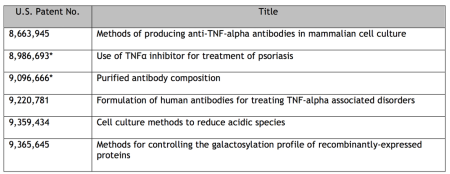
    Table 2
    The entire list of 60 patents can be found on pages 13-15 of the complaint.  Of course, neither party was required to indicate why it had selected the patents it had, and even if they were, AbbVie would have had no reason to include that in the complaint.  We can only speculate that AbbVie may have chosen its patents as a representative sample of its estate with the goal of finding at least one claim that will delay the launch of Amgen's biosimilar drug product.  We can also only speculate that Amgen may have chosen its particular set of patents because they may represent the most significant concern for a "launch at risk" scenario.  It is also possible that Amgen chose these patents because they have the longest patent remaining patent term (although we have not assessed the relative remaining term of all 61 identified patents).  It is interesting that Amgen chose to litigate the patent that issued most recently — on June 14, 2016.  There is no guarantee that this patent has the longest remaining term, however.  It is also interesting that AbbVie, but not Amgen, chose to litigate one of the patents, U.S. Patent No. 8,916,157, which was the subject of one of Amgen's failed IPR attempts.

    One final insight that can be gleaned from the complaint is that Amgen apparently failed to assure AbbVie that it will provide the Notice of Commercial Marketing once it receives FDA approval.  According to the complaint, at paragraph 218-19, AbbVie had asked Amgen to confirm by June 28, 2016 that it would provide the requisite 180-day notice, but Amgen apparently failed to respond.  As a result, AbbVie is also seeking an order compelling Amgen to comply with the notice provision and preliminary and/or permanent equitable relief enjoining Amgen from engaging in any infringing activity until after the 180-day period would run.  It might not be insignificant that AbbVie's imposed deadline came just days before the Federal Circuit decided the Amgen v. Apotex case.  That case made clear that the notice provision is mandatory in all cases, and that it is enforceable by an injunction.  Considering that the FDA committee reviewing Amgen's application has recommended approval of the biosimilar, it would not be surprising to see AbbVie more forward on this remedy sooner than later.

    As indicated above, the information found in the complaint is all from AbbVie's perspective, and we will need to wait until Amgen files its Answer before we get its side of the story.  Until then, we will continue to monitor this case and provide updates as warranted.
  • By Kevin E. Noonan —

    Federal Circuit SealIn parallel, nonprecedential decisions regarding litigation over the same patent, the Federal Circuit affirmed a District Court decision that the claims were invalid for indefiniteness under 35 U.S.C. § 112(b).  This decision, expressly applying the Supreme Court's revision to how courts apply the indefiniteness test in Nautilus Inc. v. Biosig Instruments, Inc. illustrates how district courts can now address indefiniteness issues and the effects on the standard of review that these efforts can have.

    The patent-in-suit, U.S. Patent No. 6,921,351, claims an exercise system that can act as a "virtual coach" via a computer linkup between an individual user and a remote server.  Claims 1 and 5 are representative:

    1.  An exercise system comprising:
        a local system including at least one exercise apparatus and at least one associated local server, said at least one local server monitoring the operation of said at least one exercise apparatus, said exercise apparatus and said local server having an in-band communication using a bid-directional [sic] wireless protocol;
        an out-of-band communication with a user of said at least one exercise apparatus, wherein said out-of-band communication has a relationship to said in-band communication;
        a remote server; and
        wherein said local server and said remote serve include communication interfaces which permits communication over a packet network connection that at least part-time couples said local server to said remote server for data communication between said local server and said remote server, such that said remote system may receive local system data from said local server concerning said operation of said exercise apparatus, and such that said local system may receive remote server data from said remote server providing feedback concerning said operation of said exercise apparatus.

    5.  An exercise system comprising:
        at least one exercise apparatus having an in-band bi-directional wireless communication device;
        an out-of-band communication device capable communication with a user of said at least one apparatus that has a relationship to said in-band communication;
        at least one associated local server having a bidirectional wireless communication device such that said exercise apparatus and said local server may communicate with each other via a wireless connection; and
        at least one remote server in communication with said local server via, at least in part, an Internet connection, said remote server at least temporarily storing information concerning exercise sessions performed on said exercise apparatus.

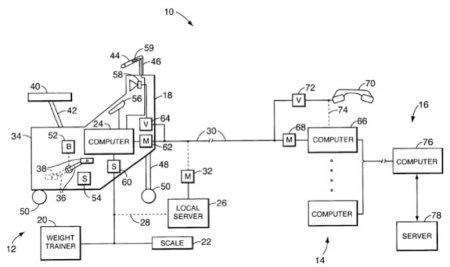
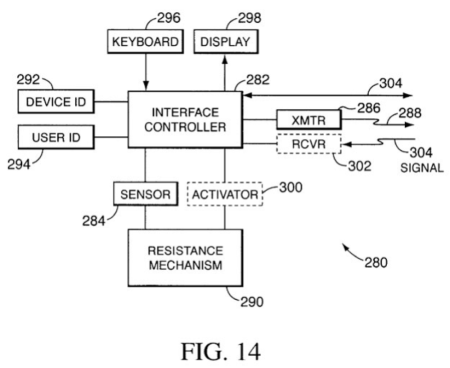
    (The disputed claim terms are italicized in the claims above.)  The claimed invention was illustrated in two Figures included in the Federal Circuit's decision:

    Figure_1Figure 1


    Figure_14
    The opinion acknowledges that Figure 1 does not illustrate any structure directly corresponding to any of the disputed terms, while Figure 14 sets out at representations, albeit incomplete in the Court's opinion, of the terms "in-band communication" and "out-of-band" communication.  Also missing from the specification was any disclosure relating to the "relationship" between in-band and out-of-band communications as recited in the claims.

    Important to the Court's decision was the portion of the proceedings before the District Court, wherein the Court required additional briefing and for each party to submit expert testimony regarding the disputed terms.  Because the indefiniteness issue was presented in the context of construing the claims in a Markman hearing, such expert testimony constituted extrinsic evidence and, hence, Icon as appellant was required to show clear error to prevail on appeal under Teva Pharm. USA, Inc. v. Sandoz, Inc., 135 S. Ct. 831, 842 (2015).  This it could not do.

    The Federal Circuit affirmed the District Court's determination that the claims were indefinite, in an opinion by Judge O'Malley joined by Judges Newman and Moore.  Applying the Nautilus indefiniteness standard under the clear error review mandated by Teva, the panel found that Icon had not shown clear error by the District Court in view of the competing opinions provided by each party's expert.  Icon's argument was simple: there existed in-band communication and out-of-band communication that were different, and "the fact that there is a difference is alone sufficient to render the claims definite and capable of construction."  Polar argued that the specification failed to disclose any relationship between in-band and out-of-band communications: "there is no reference provided in the specification to teach a person of ordinary skill what constitutes an in-band communication versus an out-of-band communication (other than the fact, and without such disclosure that they are different) or how the two are related." These are relative terms, according to Polar, and in particular there was no way to distinguish an "in-band" communication from mere communication itself (since "any communication can be considered 'in-band' to itself").  Further:

    One of ordinary skill in the art would understand that the words of the claims are supposed to have meaning, and "in-band communication" should be narrower (more limiting) than "communication".  But, unless the meaning can be elucidated from the specification or file history, there would be no way to draw this distinction, and thereby determine the metes and bounds of the claim (and the claims that depend from this claim) with reasonable certainty.

    Even worse, according to Polar, is that the term "out-of-band communication" is "completely untethered" to an "in-band communication," which thus could be any communication, even one outside the claimed system itself.  Polar's expert proffered ten prior art patents and textbook references to support his position, which of course constituted additional extrinsic evidence.

    The Federal Circuit noted that the District Court expressly relied on the evidence contained in these references in determining that the '351 patent claims were indefinite.  According to the opinion, "[t]his is precisely the type of extrinsic evidence upon which a district court may rely in analyzing the record before it when construing claim terms," and [t]he district court's findings on such evidence constitute findings of fact [that] we review [] for clear error," citing Teva.  Finding no clear error, nor any error in the District Court's legal conclusion of indefiniteness, the Federal Circuit affirmed.

    The panel rejected both Icon's arguments that the District Court improperly considered extrinsic evidence and Polar's argument that Icon had waived this argument by not raising it before appeal.  Insofar as Icon's arguments were "intended only to reinforce Icon's assertion that "'in- band' and 'out-of-band' are separate and distinct instances of communication" they are "redundant and unnecessary," because "Polar does not contest, and the district court did not question, that 'in-band' and 'out-of-band' [communications] are 'separate and distinct.'"  The question was whether the "ambiguous nature of the distinction between the two claim terms renders them incapable of construction," which was the District Court's conclusion with which the Federal Circuit agreed.

    And illustrating the catholic nature of the indefiniteness requirement, the panel supported its conclusion by citing its decision in Amgen Inc. v. Hoechst Marion Roussel, Inc., 314 F.3d 1313 (Fed. Cir. 2003), a biotech case.  There, the ambiguous claim term was erythropoietin "having glycosylation which differs from that of human urinary erythropoietin [uEPO]."  In that case (decided under the "insolubly ambiguous" test negated by Nautilus), the fact that two preparations of urinary EPO produced from the same source could yield EPO having difference glycosylation patterns made the claims indefinite.  Under such circumstances "the claim itself was a moving target" because "one must know what the glycosylation of uEPO is with certainty before one can determine whether the claimed glycoprotein has a glycosylation different from that of uEPO" (emphasis in this opinion).  The panel found the same deficiency here, because "Icon argues that the scope of the claim term 'in-band' would be selected by a person of ordinary skill, but that the scope could vary from day-to-day and from person-to-person."  This is the same type of "moving target" in this technology as was the uEPO glycosylation pattern in the Amgen case, and was just as indefinite according to the Court.

    Icon Health & Fitness, Inc. v. Polar Electro Oy (Fed. Cir. 2016)
    Icon Health & Fitness, Inc. v. Garmin Int'l., Inc. (Fed. Cir. 2016)
    Nonprecedential disposition
    Panel: Circuit Judges Newman, Moore, and O'Malley
    Opinion by Circuit Judge O'Malley

  • By Donald Zuhn —

    Colombia FlagLast month, we reported on letters sent by two Senators and fifteen Representatives to the U.S. Trade Representative, seeking clarification regarding the Administration's position on compulsory licenses.  The letters were prompted by reports that representatives of the U.S. government may have pressured the Colombian government not to issue a compulsory license for Imatinib, marketed by Novartis as Gleevec® or Glivec.  We also reported on a letter sent by three Colombian organizations (the IFARMA Foundation, Misión Salud, and CIMUN) to a World Health Organization (WHO) working group, alleging that "enormous pressure" had been applied by developed countries and pharmaceutical companies to block Colombia from issuing the compulsory license for Imatinib, and resistance to the compulsory license had combined "inaccuracies, distortions of international trade rules and even threats of trade claims under the dispute settlement mechanism."  Finally, we reported on a letter sent to President Obama by 28 organizations "concerned with access to medicines and U.S. aid to support peace in Colombia" that echoed the comments of the letters from Senate and House legislators.

    In a letter sent to Colombian President Juan Manuel Santos in May, 122 "lawyers, academics and other experts specializing in fields including intellectual property, trade and health" wrote to "encourage [his] administration, the Ministry of Health and the Superintendency of Industry and Trade to proceed with the public interest declaration" and grant a compulsory license for Imatinib.  The group of experts also wrote to "affirm that international law and policy support Colombia's right to issue compulsory licenses on patents in order to promote public interests including access to affordable medicines."

    With respect to reports that representatives of the U.S. government had pressured the Colombian government not to issue a compulsory license, the group "condemn[ed] any pressure levied against Colombia for its use of lawful policies such as compulsory licensing to promote public health," adding that "[i]f the reports are accurate, those officials have acted inappropriately, and contravened U.S. government policy, which supports trading partners' rights to issue compulsory licenses."  The group also noted that:

    Article 31 of the World Trade Organization's Agreement on Trade-Related Aspects of Intellectual Property (WTO's TRIPS) permits all WTO members, including Colombia, to issue compulsory licenses at any time on grounds of their choosing.  The only compensation due to patent-holders in instances of compulsory licensing is a reasonable royalty, which governments may determine at their discretion.

    Contending that "[h]igh prices for any important medicine impose a burden on the public health system responsible for providing it, and lead to the rationing of treatment and other health services," the group stated that "[w]hen a pharmaceutical company uses a patent to exclude competition, it can charge much higher prices."  The group concluded the letter by stating that:

    Issuing a compulsory license does not expropriate the property rights of the patent holder.  Rather, the right of a government to authorize other uses of a patented invention is embedded and reserved in the grant of a patent.  Furthermore, a license does not prevent the patent holder from continuing to sell its product, prohibit non-licensed uses of the invention, or prohibit non-licensed parties from using the invention.

  • CalendarAugust 8-9, 2016 - Advanced Patent Law Seminar (Chisum Patent Academy) – Seattle, WA

    August 9, 2016 - European biotech patent law update (D Young & Co) – 4:00 am, 7:00 am, and 12:00 pm (ET)

    August 9, 2016 - Patent Quality Chat webinar series — Post-Prosecution Pilot (P3) Program (The U.S. Patent and Trademark Office) – 12:00 to 1:00 pm (ET)

    August 10, 2016 – "Section 101 – The Way Ahead — software" (Intellectual Property Owners Association) – 2:00 to 3:00 pm (ET)

    August 11, 2016 – "Section 101 – The Way Ahead — life science" (Intellectual Property Owners Association) – 2:00 to 3:00 pm (ET)

    August 11, 2016 – "Patent Prosecution in the Post-Alice Era" (Juristat) – 1:00 to 2:00 pm (ET)

    August 16, 2016 – "Attorney's Fees in Patent and Trademark Litigation: Best Practices Two Years After Octane and Highmark" (American Bar Association Center for Professional Development) – 1:00 to 2:00 pm (EST)

    August 17, 2016 – "Navigating Patent Eligibility: Leveraging New USPTO Guidance and the Enfish and TLI Communications Decisions" (Strafford) – 1:00 to 2:30 pm (EDT)

    August 18-19, 2016 - Advanced Patent Prosecution Workshop 2016: Claim Drafting & Amendment Writing (Practising Law Institute) – San Francisco, CA

    August 25, 2016 – "The Next Wave of Data Privacy: What the GDPR, Privacy Shield and Brexit Mean for U.S. Intellectual Property Litigation" (McDonnell Boehnen Hulbert & Berghoff LLP) – 10:00 am to 11:15 am (CT)

    September 1, 2016 – "Drafting and Prosecuting Patent Applications to Withstand PTAB Scrutiny — Building Reasonable Claim Construction to Avoid Unpatentability and Using Declarations to Survive Post-Grant Proceedings" (Strafford) – 1:00 to 2:30 pm (EDT)

    September 7, 2016 – "USPTO's Subject Matter Eligibility: A 2016 Update" (The Knowledge Group) – 12:00 to 2:00 pm (EST)

    September 8, 2016 – "After-Final Practice: Navigating Expanding PTO Options to Compact Patent Prosecution — Utilizing Post-Prosecution Pilot Program (P3), After-Final Consideration Pilot 2.0, Pre-Appeal Conference and More" (Strafford) – 1:00 to 2:30 pm (EDT)

    September 11-13, 2016 - 44th Annual Meeting (Intellectual Property Owners Association) – New York, NY

    September 14-15, 2016 - Advanced Patent Prosecution Workshop 2016: Claim Drafting & Amendment Writing (Practising Law Institute) – Chicago, IL

    ***Patent Docs is a media partner of this conference or CLE

  • Strafford #1Strafford will be offering a webinar/teleconference entitled "After-Final Practice: Navigating Expanding PTO Options to Compact Patent Prosecution — Utilizing Post-Prosecution Pilot Program (P3), After-Final Consideration Pilot 2.0, Pre-Appeal Conference and More" on September 8, 2016 from 1:00 to 2:30 pm (EDT).  Andrew T. Harry and Scott A. McKeown of Oblon McClelland Maier & Neustadt will provide guidance to patent counsel on the various USPTO options for responding after final rejection of a patent application, and touch on the basics of each option and focus on strategic considerations and use of the different options.  The webinar will review the following issues:

    • What options are available to patent counsel upon receiving a final rejection to a patent application?
    • What factors should patent counsel consider when determining if and which PTO option to use in response to a final rejection?
    • How can patent counsel and applicants leverage the PTO options for compact patent prosecution?

    The registration fee for the webinar is $297.  Those registering by August 12, 2016 will receive a $50 discount.  Those interested in registering for the webinar, can do so here.

  • ABAThe American Bar Association (ABA) Center for Professional Development will be offering a live webinar entitled "Attorney's Fees in Patent and Trademark Litigation: Best Practices Two Years After Octane and Highmark" on August 16, 2016 from 1:00 to 2:00 pm (EST).  Megan S. Woodworth of Venable (moderator), R. Benjamin Cassady of Finnegan, Tim P. Cremen of Paul Hastings will explore the evolution of the law governing attorneys' fees awards in the two years since the Octane and Highmark decisions, discuss progeny cases applying the decisions and how the law has continued to evolve, and explore strategies and best practices that both plaintiffs and defendants can pursue to leverage the changing landscape around attorney's fees.

    The registration fee for the webcast is $150 for members and $195 for non-members.  Those interested in registering for the webinar, can do so here.

  • Strafford #1Strafford will be offering a webinar/teleconference entitled "Drafting and Prosecuting Patent Applications to Withstand PTAB Scrutiny — Building Reasonable Claim Construction to Avoid Unpatentability and Using Declarations to Survive Post-Grant Proceedings" on September 1, 2016 from 1:00 to 2:30 pm (EDT).  Anthony M. Gutowski, Thomas L. Irving, and John M. Mulcahy of Finnegan Henderson Farabow Garrett & Dunner will provide guidance to patent counsel for drafting and prosecuting U.S. patent applications to achieve the broadest claim interpretations that may avoid unpatentability and yet still provide a basis for proving infringement, and offer best practices to solidify novelty, non-obviousness, enablement, and written description positions, both for litigation and PTAB AIA Post Grant Proceedings.  The webinar will review the following issues:

    • How can practitioners draft and prosecute patent applications and claims to minimize the threat and/or efficacy of a third-party's post-grant challenges?
    • How can patent owners obtain broad claims to keep competitors at bay while countering attempts to render those broad claims unpatentable under the broadest reasonable interpretation standard before the PTAB?
    • How can practitioners introduce strong grounds for patentability under §§ 102, 103 and 112 in the specification and prosecution history in the hopes that IPRs and PGRs are either denied or otherwise ineffective against the challenged instituted claims?

    The registration fee for the webinar is $297.  Those interested in registering for the webinar, can do so here.

  • The Knowledge GroupThe Knowledge Group will offer a live webcast entitled "USPTO's Subject Matter Eligibility: A 2016 Update" on September 7, 2016 from 12:00 to 2:00 pm (EST).  Robert C Faber of Ostrolenk Faber LLP; Jonathan K. Waldrop of Kasowitz, Benson, Torres & Friedman LLP; and Dr. Orlando Lopez of Burns & Levinson LLP will cover the following topics:

    • Overview on Subject Matter Eligibility
    • The December 2014 Interim Patent Eligibility Guidance
    • July 2015 Updated Guidance
    • Subject Matter Eligibility for Natural Phenomena, Diagnostic Method and Software Patents
    • Recent Patent Subject Matter Eligibility Litigations
        – McRO v. Namco Bandai
        – Ariosa v. Sequenom
    • Patent Eligibility: Best Strategies During Uncertainties
    • Latest Trends and Updates

    The registration fee for the webcast is $249 (early bird rate; register on or before August 28, 2016), $349 (regular rate), or $149 (government/nonprofit rate).  Those interested in registering for the webinar can do so here.

  • IPO #2The Intellectual Property Owners Association (IPO) will be holding its 44th Annual Meeting on September 11-13, 2016 in New York, NY.  Among the presentations being offered at the annual meeting are:

    • The U.S. Courts' Influence on Patent Law — Case Law Update
    • Protection of Trade Secrets and Cybersecurity
    • Are Patents Under Attack Using Competition Laws?
    • AI — Created Intellectual Property: Issues and Future Directions
    • Using IP Portfolio Metrics to Demonstrate Value and Alignment to Internal Business Clients
    • Function Claiming in the United States: Evolving Law and Best Practice
    • Patent Litigation Trends — The Effects of PTAB Proceedings, Rules Amendments, and U.S. Supreme Court Decisions
    • Corporate Patent Portfolio Strategies in Europe
    • IPRs, CBMs, and the PTAB: Where Have We Been and Where Are We Going?
    • Global Perspective on Patent Eligibility
    • Ethics

    In addition, Congressman Hakeem Jeffries, 8th District of New York, will present a keynote address on September 13, and European Patent Office President Benoît Battistelli will present a keynote address on September 13.

    A program for the meeting, including an agenda, descriptions of the scheduled sessions, and list of speakers, can be obtained here.

    The registration fee for the meeting is $500 (government/academic), $995 (IPO members), or $1,475 (non-members).  Those interested in registering for the meeting can do so here.

  • By Donald Zuhn –-

    Hudson InstituteIn June, the Hudson Institute released a research report that analyzes several positions taken by the United Nations (UN) High Level Panel on Access to Medicines (HLP) on the impact of patents on global access to medicines.  The report, entitled "The Patent Truth About Health, Innovation and Access," focuses on several assertions of the HLP, which was launched in 2015 by UN Secretary-General Ban Ki-moon with the goal of reviewing and assessing proposals and recommending solutions for "remedying the policy incoherence between the justifiable rights of inventors, international human rights law, trade rules and public health in the context of health technologies."  In particular, the Hudson Institute report addresses the following premises of the HLP:

    1. Millions of poor people in low- and middle-income countries have been denied access to ARVs and other medicines;

    2. Patents are the main cause of higher costs of medicines for poor people in low- and middle-income countries;

    3. The intellectual property system, including patents and voluntary licenses, limits research and disadvantages local producers in low- and middle- income countries.

    The report concludes that "[t]hese basic assumptions . . . are not supported by global health research."

    Before addressing each of the HLP's premises, the report first discusses the role of intellectual property in the global economy, stating that "intellectual property (IP) is a fundamental driver of human progress, fueling innovation, creative thinking and economic growth," and adding that "[t]he security of private intellectual property rights for inventors and investors is fundamentally important to a public good: the sharing and flow of information and ideas, which in turn generate new inventions and innovations that drive technological advancements, economic development and economic growth."  Asserting that "the inventors of tomorrow's life-changing products face challenges in protecting their IP rights," the report describes three such challenges: the costs for developing new technologies (particularly in the pharmaceutical industry, where the report notes that the research and development of new pharmaceuticals requires an average of ten years and billions of dollars); the time, effort, and cost required to secure a patent; and the protection of intellectual property rights both within and across borders (the report notes that approximately 95% of the world's population, or potential customer base, lives outside the U.S.).  In discussing a fourth challenge, the report states that:

    [I]ntellectual property rights have been, and continue to be, under systematic assault.  The intentional erosion of IP rights occurs passively, by failure to police piracy and counterfeiting, and actively, through advocacy against IP protections in trade agreements and multilateral bodies by NGOs, activist groups and many governments seeking to challenge the legal and moral underpinnings of intellectual property rights.  Paradoxically, the transfers of high technology and advanced medicine these groups seek to promote are undermined as the incentives for innovation and information sharing are also undermined with weakened IP protections.

    Turning to the HLP's premises, the report begins by pointing out that a study in the American Economic Review (Cockburn et al., "Patents and the Global Diffusion of New Drugs," American Economic Review 106(1): 136-64 (2016)) has shown that "strengthening IP has resulted in better access to medicines in developing countries" (emphasis in original).  The report includes a table (shown below) that provides evidence of "the extraordinary progress that has been made against death and disease in poor countries."

    Table 1
    The report also notes that "[c]ommunicable diseases are no longer the major cause of death in developing countries since people are living long enough to develop non-communicable diseases like cancer, cardiovascular disease, and stroke," pointing out that the World Health Organization (WHO) determined in 2012 that "the top two causes of death in lower middle income countries were ischemic heart disease and stroke, the same as high-income countries."  With respect to the HLP's first premise, the report concludes that if the HLP "had looked at the track record of affordable life-saving medicines and technologies available to the developing world, they would have seen that the most important problems impeding access to medicines and better health for poor people are not patents and prices."

    Moving on to the HLP's second premise, the report cites an article by Attaran and Gillespie-White ("Do Patents for Antiretroviral Drugs Constrain Access to AIDS Treatment in Africa," JAMA 286(15): 1886-92 (2001)), which examined the patent status of fifteen drugs for treating HIV in 53 African countries and found that patents were not a barrier to HIV treatment.  The report notes that a follow-up paper from 2004 (Attaran, "How Do Patents and Economic Policies Affect Access to Essential Medicines in Developing Countries," Health Affairs 23(3): 155-66 (2004)) concluded that "[p]atents are an infrequent determinant of access to essential medicines."  According to the report, the authors of the 2001 paper determined that poverty, weak healthcare systems, taxes, and poor supply systems had more of an impact on access to medicines in developing countries than patents.

    Examining the prices of patented and non-patented (or "copy") ARV (antiretroviral) drugs that were available for treating HIV in 2004, the report notes that only one of thirteen drugs was significantly higher-priced than its copy, and that other than this outlier, "the copy drugs were even more expensive than the patented [drugs]."  The report also notes that while patient coverage nearly tripled from 2010 to 2014 in the world's largest AIDS treatment program (the President's Emergency Plan for AIDS Relief (PEPFAR)), overall treatment prices for patients significantly decreased.  With respect to the HLP's second premise, the report concludes that "[h]ad the HLP considered the most important factors behind access to medicines and had it properly consulted with UN member states, their panel might have pursued more meaningful solutions than eliminating the intellectual property system."

    As for the HLP's third premise, the report argues that the HLP's assertion "blatantly ignores the lifesaving drugs and vaccines that have dramatically reduced infant mortality and increased life expectancy in low-income countries."  The report contends that "nowhere is the importance of innovation and drug development for the poor more clear than in the case of HIV/AIDS over the last 35 years," stating that:

    In the history of therapeutic medicine, there has not been a comparable period during which so much innovation resulted in so many new products—which principally benefited the poor in markets far away from those of the manufacturers.  In the United States, between 600,000 and 900,000 people were living with HIV in 1989, while approximately 5-10 million people were living with HIV around the world, most in lower income countries.  In just over ten years, the number of people living with HIV around the world had grown to approximately 37 million while the number in the United States was just under one million people.

    Declaring that "the current intellectual property system has not denied millions of poor people access to ARVs and other medicines," and that "[p]atents have not been a cause of high cost drugs for the poor, or led to limited drug research, or disadvantaged local producers," the report concludes that "[o]n the contrary, . . . the intellectual property system has encouraged innovation that has saved millions of lives by providing the poor with access to lifesaving therapies" (emphasis in original).  According to the report, the main barriers to access to medicines in developing countries are "not patents and prices," but rather are "lack of good governance, poor physical infrastructure and distribution systems, a shortage of healthcare facilities and providers, insufficient public health spending, corruption, taxes and tariffs on medicines, and the lack of policies that promote economic growth and incentives for individuals and businesses to develop new technologies so their countries can grow and prosper."  Although the report concedes that "improvements can still be made in global health policy to increase access to medicines and better healthcare," the report argues that "the achievements to date have been remarkable."