• By Kevin E. Noonan –

    Supreme Court Building #3Amgen recently filed its Reply brief to the Supreme Court in Amgen v. Sanofi.  While a conventional proportion of Amgen's Reply is directed to arguments Respondent Sanofi made in its brief, at trial, and before the Federal Circuit, significant portions of the Reply brief are focused on the Federal Circuit's grounds for its decision, which may be wise for at least two reasons.  The first, of course is the seeming anathema the Supreme Court has had for Federal Circuit jurisprudence for over a decade, reversing almost all that circuit court's decisions in whole or part.  (It will be understood that the likelihood of reversal of Federal Circuit decisions may be higher than other circuit courts because the court's exclusive jurisdiction over patent matters means the only situations analogous to "circuit splits" arise from disagreements between the Federal Circuit judges, tempered by whatever deference lingers for that court's "special expertise" noted in Warner-Jenkinson Co. v. Hilton Davis Chemical Co.)  The other reason is that Amgen's argument in its principal brief is that the Federal Circuit has crafted a new test for enablement, which it termed the "full scope" test, that is contrary to the plain meaning of the statute (as well as Supreme Court precedent) because the new test mandates that each and every species in a claimed genus be set forth rather than that the disclosure merely teach the skilled worker how to make and use the claimed invention.

    In its argument, Amgen asserts that the defects of the Federal Circuit's "full scope" enablement test include that it depends on "the cumulative time and effort" needed to determine and disclose the full scope of what is claimed (which for a genus claim would encompass all or substantially all of the species falling within the scope of the genus) (which Amgen asserts that the Solicitor General contends is "a test [that] has no foundation in the text [of § 112] or [the] Court's precedent").  The proper enablement test, Amgen asserts, is the statutory "make and use" test, which "requires a practical inquiry into what skilled artisans can do using the patent's disclosures."  And if the disclosure is "sufficiently definite to guide those skilled in the art to" the "successful application" of "the invention," Amgen contends, the patent is enabled, citing Minerals Separation, Ltd. v. Hyde, 242 U.S. 261, 271 (1916).  Amgen further argues that the number of embodiments (or species in a genus) is irrelevant to this standard (although as a practical matter it seems this argument cannot be an absolute one).  "The Federal Circuit's opinion [that Amgen's claims are not enabled] plainly turns on the effort required to identify and make all or nearly all the antibodies within Amgen's patent claims," Amgen asserts, which is a "heightened" enablement standard beyond the statutory requirements.  The Federal Circuit's purported new test "consider[s] the quantity of experimentation that would be required to make and use, not only the limited number of embodiments that the patent discloses, but also the full scope of the claim" Amgen contends (emphasis in brief).  The amount of experimentation (how many potential species fall within the scope of a genus) needed can by itself amount to undue experimentation under the Federal Circuit's test, Amgen contends.  The basis for the Federal Circuit's decision below was the "substantial time and effort" necessary for this identification of all these antibodies (undue experimentation would be required to practice the full scope of these claims) and the consequence of this new interpretation of enablement law, in Amgen's view, is that the Federal Circuit reached its non-enablement conclusion based on the "millions of candidate antibodies" the claims encompass.  As a result "'it would be necessary to first generate and then screen each candidate antibody' to determine whether those antibodies fell within the claims" to satisfy the Federal Circuit's test.  Illustrating both this meaning of the Federal Circuit's opinion and the potential danger it raises, Amgen cites the decision in Human Power of N Co. v. Heartbeet Ltd., No. PGR2021-00110, 2022 WL 683124, at *9 (P.T.A.B. Feb. 25, 2022), and the district court's decision in Baxalta Inc. v. Genentech, Inc., 579 F. Supp. 3d 595, 616 (D. Del. 2022), and Astra-Zeneca AB v. Mylan Pharms. Inc., No. 1:18CV193, 2022 WL 16857400, at *8 (N.D. W. Va. Nov. 9, 2022), which have applied the Federal Circuit's decision below to impose this increased disclosure requirement in finding claims non-enabled.

    The Federal Circuit erred, according to Amgen, because that court "varied the Wands factors by asking whether there would be 'undue experimentation in identifying,' from 'millions of ' potential embodiments, those that 'satisfy' the genus's 'requirement[s],' i.e., the effort to "reach the full scope."  Amgen asks the Supreme Court to "restore the statutory standard" of "make and use" which requirement is a clear, practical test, so that "the patentee [is required] to describe his invention so that others may construct and use it after the expiration of the patent," citing Schriber-Schroth Co. v. Cleveland Tr. Co., 305 U.S. 47, 57 (1938).  The fact that a claim encompasses numerous embodiments that may be different from one another does not render the claim nonenabled according to Cont'l Paper Bag Co. v. E. Paper Bag Co., 210 U.S. 405, 418-419 (1908), Amgen argues.  And rather than the Federal Circuit's new bright line rule what should be used is a flexible inquiry "that takes into account the nature of the claimed invention and the field in which it arises," citing the Solicitor General's amicus brief in this regard.

    One portion of Amgen's brief illustrates the thorny and contrary considerations the Supreme Court must grapple with:

    Amgen agrees patents must reasonably enable the entire scope of the claim.  Where an invention has many embodiments, the patent enables the invention's "full scope" if skilled artisans can "reasonabl[y]" make and use "variation[s]," without gaps in subject matter skilled artisans would consider significant with "regard to [the patent's] subject-matter."  Minerals Separation, 242 U.S. at 270.  If the patent's instructions are "sufficiently definite to guide" skilled artisans to "successful application" across the scope of the "invention," the claims are enabled.  Id. at 271.  In such cases, the "enabling disclosure" is 'commensurate with the scope of the claims.'"  But cataloging every embodiment is a task for "the mechanic, not the inventor."  2 W. Robinson, The Law of Patents for Useful Inventions §485 (1890) (other citations omitted).

    Amgen supports this calculus with Supreme Court and other precedent, including Mowry v. Whitney, 81 U.S. (14 Wall.) 620 (1872) (methods for manufacturing railway wheels not required to recite "the specific timing and temperature parameters for every type of wheel skilled artisans might make"); Wood v. Underhill, 46 U.S. (5 How.) 1 (1846) (while exceptions arose in formula for mixing clay and coal dust to make bricks, those exceptions did not amount to non-enablement where "artisans would be able to apply the formula to most types of clay."); and Carver v. Braintree Mfg. Co., 5 F. Cas. 235, 237 (C.C.D. Mass. 1843) (claims enabled where a "skillful mechanic" could use the specification to make a rib for many kinds of cotton).

    Addressing the asserted necessity for the "full scope" test, that without it there would be no reasoned way to prevent overbroad genus claiming, Amgen argues that "[t]here are various ways defendants can disprove enablement" including where a skilled artisan cannot make the invention at all, Beidler v. United States, 253 U.S. 447, 453 (1920); where there is a "distinct category of embodiments within the claim's scope that cannot be made following the patent's disclosures, Auto. Techs. Int'l, Inc. v. BMW of N. Am., Inc., 501 F.3d 1274, 1285 (Fed. Cir. 2007); or in "needle-in-a-haystack" situations involving "labor-intensive hunt for working embodiments that exceeds what skilled artisans typically do," Consol. Elec. Light Co. v. McKeesport Light Co., 159 U.S. 465, 472-475 (1895); Béné v. Jeantet, 129 U.S. 683, 684-686 (1889); and Holland Furniture Co. v. Perkins Glue Co., 277 U.S. 245, 250-251, 257 (1928).

    The brief then discusses the impact of inoperative embodiments in a genus claim on enablement, asserting that such emodiments within a genus do not alone invalidate a claim, citing Atlas Powder Co. v. E.I. du Pont De Nemours & Co., 750 F.2d 1569, 1576 (Fed. Cir. 1984).  Amgen illustrates the impact (or lack of it) of inoperative embodiments in Consolidated Electric, wherein the defendant prevailed by presenting clear-and-convincing evidence that months of experimentation, with thousands of materials, was necessary to find one fiber (bamboo) that would function as claimed.  159 U.S. at 472-474.  Amgen further states in this regard that the Federal Circuit's decision was based on a factual error:  rather than being limited to 26 expressly disclosed antibodies its specification disclosed 384 antibodies (reminiscent of the situation in Wands where the Patent Office considered demonstration of 9 positive antibodies from amongst 143 produced to be nonenabled while the Federal Circuit considered these 9 antibodies in the context of 16 tested).  The "millions" of potential candidates forming another (albeit related) basis for the Federal Circuit's decision could be produced by conservative substitution Amgen notes, but counters that the patent teaches these variants.  What its specification doesn't do, Amgen concedes, is teach which ones would be functional but according to Amgen there is no "needle in the haystack" problem with their specification because there was no evidence that any conservative substitution produced an inoperative embodiment.  Amgen contends that these considerations are only relevant under the full scope test rather than being a reasoned basis for it (and Amgen does not mention that this test bypasses the principle from Wands that even extensive experimentation does not negate enablement if it is routine, well understood in the art, and operative embodiments can be readily and reliably identified).

    Another target for Amgen's arguments is the government:  Amgen contends that while the Solicitor General's (SG) brief pays lip service to a "reasonableness" standard based on Minerals Separations it then deviates from that standard, "from the record and the rules of procedure and evidence."  Amgen cites the government's reliance in its brief on the limited number (26) of  expressly exemplified antibodies as a basis for the claims being overbroad, and that the SG asks the Court to infer that accordingly Amgen didn't make additional antibodies because it did not know how to do so (which of course Amgen counters with the 384 antibodies recited in the specification).  And with regard to the procedural deficiencies Amgen asserts against the SG's brief, the Reply brief cites the presumption of validity of a granted patent that must be overcome by clear and convincing evidence to the contrary.  This quote from Minerals Separations is usefully cited in supporting this argument:  "A patent's teachings may "guide" skilled artisans to the "successful application" of a nearly "infinite[ ]" number of embodiments beyond those disclosed in the specification" as well as from Smith v. Snow, 294 U.S. 1, 11 (1935), that "it is "not necessary to . . . describe in the specification[ ] all possible forms in which the claimed principle may be reduced to practice."

    One (perhaps novel) government argument identified by Amgen is the requirement that when a patent claims a genus, an enabling disclosure requires "some general quality" described in structural terms that distinguishes the claimed products from others outside the scope of the claimed genus, a rubric derived from Consol. Elec., 159 U.S. at 475 and Holland Furniture, 277 U.S. at 256).  The error here, according to Amgen, is that "[w]hile describing a structure may be one way to enable a genus, the Court has never held it is the only way, regardless of the nature of the art," citing examples like Neilson v. Harford (1841) 151 Eng. Rep. 1266, 1273-1274 (Exch.), and more recently Diamond v. Chakrabarty, 447 U.S. 303, 305-306 (1980).

    And with regard to Amgen's purported "roadmap" for how to produce functional antibodies having the required specificity, Amgen asserts that "[f]ar from requiring skilled artisans to 'retrace' Amgen's "research steps," the patents allow them to start where Amgen's research ended," which of course is the benefit disclosure in a patent confers on the public, Amgen enumerating eight specific benefits.  Amgen refutes the assertion that the roadmap or its other teachings amount to "trial and error" methods, stating rather that these are screening methods understood by the skilled workers.

    Most of Amgen's arguments specifically directed to Sanofi's Respondent's brief (besides the rhetorical) are directed to disputes about the record below, whether Sanofi's positions have changed between what was argued before the Federal Circuit and in its Supreme Court briefing and that the level of disclosure in Amgen's competitors' patents (including Sanofi's) are no more enabling under the full scope test than in Amgen's patent-in-suit.

    The brief concludes with reference to proper patent policy, where Amgen argues that the Federal Circuit's full-scope test is not consistent with the patent bargain, citing Pfaff v. Wells Elecs., Inc., 525 U.S. 55, 63 (1998).  The brief cites the analysis by the late Professor Karshtedt and colleagues, The Death of the Genus Claim, 35 Harv. J.L. & Tech. 1, 1 (2021), regarding the need for genus claiming in biotechnology and antibody inventions and the paucity of protection afforded to antibody claims limited to specific antibody sequences.  Amgen further argues that using the roadmap provided by Amgen's patents permits competitions to make their own antibodies based on this disclosure.  Amgen also reminds the Court that the doctrine of equivalents is insufficient to protect claims to specifically disclosed antibodies because "[c]ourts . . . have refused to apply 'the equivalence argument' because it is feared that this 'would read the amino acid sequence limitation out of' the claim and 'effectively expand' the claim's scope to encompass any 'antibody that has the [claimed] effect,'" citing Teva Pharms. Int'l GmbH v. Eli Lilly & Co., No. 18-cv-12029, 2022 WL 4824318, at *19 (D. Mass. Oct. 3, 2022).  Under these circumstances, Amgen warns that "[n]o company would invest billions in researching and developing new antibodies in hopes that the doctrine of equivalents will prevent competitors from evading an amino-acid-sequence claim."

    Addressing again the weakness (in Amgen's view) of arguments regarding the danger of overbroad genus claims Amgen cites Westinghouse v. Boyden Power Brake Co., 170 U.S. 537, 568 (1898), for the principle that a species (here, an antibody) that "'has so far changed the principle of the' patent claim can be held not to fall within its enabled scope 'even if it "literally" falls within the class [of antibodies])'", and to the argument that broad genus claims harm innovation Amgen argues that improvements (in the form of particular species) incentivizes innovation (i.e., that patents incentivize the search for a "better mousetrap" rather than preclude that search).

    Finally, Amgen argues that this case is not the case presented in O'Reilly v. Morse that claimed "'the use of  . . . electro-magnetism, however developed, for making or printing intelligible characters . . . at any distances,'" on the basis that there are alternatives (such as siRNA, or antibodies that bind outside the sweet spot and small molecule inhibitors) for the antibodies disclosed in its specification.  As a consequence, Amgen argues:

    That is the type of innovation the patent system should promote—encouraging companies to develop diverse therapies, not minor variations of antibodies performing the same function in the same way.  Upholding genus claims for pioneering inventions accelerates the progress of science as inventors seek their own breakthroughs instead of developing "me too" products . . . ."

    The Supreme Court is scheduled to hear oral argument from the parties and the Solicitor General on March 27th; in the meantime posts on the positions of various amici will appear here.

  • CalendarMarch 14, 2023 – "Prep, Prosecution & Profitability: Thoughtful Strategies for Managing to The Bottom Line" (IPWatchdog and UnitedLex) – 11:00 am (ET)

    March 15, 2023 – "Best Practices for Searching IP5 Literature" (Patent Information Users Group, Inc.) – 10:00 am to 11:00 am (EDT)

    March 15, 2023 – "The Unified Patent Court Is Coming — Benefits and Risks of the New Court System" (OxViews Limited) – 15:00 (GMT)

    March 15, 2023 – "Finding Mentors and Opportunities" (U.S. Patent and Trademark Office) – 2:00 pm and 4:35 pm (ET)

  • IPWatchdogIPWatchdog and UnitedLex will be offering a webinar entitled "Prep, Prosecution & Profitability: Thoughtful Strategies for Managing to The Bottom Line" on March 14, 2023 at 11:00 am (ET).  Gene Quinn of IPWatchdog, Inc. will moderate a panel consisting of Carlo Cotrone of Techtronic Industries (TTI), Andrew Weaver of Polsinelli, and Matthew Joyce of UnitedLex.  The panel will explore operational strategies designed to ensure IP investments are delivering to their maximum potential; discuss proven, high-impact strategies that can keep you on budget in 2023 without sacrificing coverage and quality; and also discuss the following topics:

    • Measuring overhead investment through an operational assessment to surface friction and inefficiencies throughout the IP lifecycle
    • Process and workflow diagnostics that identify cost-saving opportunities for non-billable and high-volume admin tasks
    • Conducting objective data analysis to identify your high-value assets and those ripe for pruning
    • Forging a process refinement path that compliments your organization both culturally and financially

    There is no registration fee for this webinar.  However, those interested in registering for the webinar, should do so here.

  • PIUGPatent Information Users Group, Inc. (PIUG) will be offering a webinar on "Best Practices for Searching IP5 Literature" from 10:00 am to 11:00 am (EDT) on March 15, 2023.  Kartar Singh Arora of Clarivate will present an overview of differences in patents and procedures used by IP5 patent offices (USPTO, EPO, SIPO, JPO and KIPO) with a particular focus on the following items:

    • Types of patents granted
    • Patentable inventions
    • Critical dates i.e., bar dates
    • Definition of novelty and lack of invention step
    • Procedures for challenging pending and granted patents
    • Patent terms including extensions
    • Patent offices and services provided including online databases including timeline for grant of patents and statistics

    The registration fee for the webinar is $129 for non-members or $79 for PIUG members.  Those interested in attending the webinar can register here.

  • OxViewsOxViews Limited will be offering a webinar entitled "The Unified Patent Court Is Coming — Benefits and Risks of the New Court System" on March 15, 2023 at 15:00 (GMT).  Philipp Rastemborski and Florian Henke of Meissner Bolte will address the Unitary Patent and the Unified Patent Court from a business perspective and will provide an overview about the risks, rewards, and arbitrage opportunities companies are facing when using the new system, as well as the checks and decisions that need to be taken today to secure all the benefits, whilst mitigating potential risks of the new system.

    While there is no cost to participate in the program, those interested in attending the webinar should register here.

  • Womens-entrepreneurship-symposium-evergreen-logo-stackedThe U.S. Patent and Trademark Office will be offering part two of its 2023 Women's Entrepreneurship Symposium on "Finding Mentors and Opportunities" from 2:00 pm and 4:35 pm (ET) on March 15, 2023.  The event will address the importance of mentors and how building a reliable network can impact growth, opportunities, and success, as well as cover:

    • Best practices that helped women innovators overcome challenges in their fields
    • How to give back and be a mentor
    • Where to find mentors, and the ways that mentorships bring growth and opportunities

    Those interested in registering for the event, can do so here.

  • By Donald Zuhn

    U.S. Patent Cover - NewIn a final rule published in the Federal Register (88 Fed. Reg. 12560) last week, the U.S. Patent and Trademark Office announced that it will start issuing patents electronically under a new digital USPTO seal and bearing the digital signature of the USPTO Director beginning on Tuesday, April 18, 2023.  The Office indicated that electronic patent issuance will reduce pendency of patent applications, foster a green economy by reducing paper waste, and permit issued patents to be viewed and printed by applicants and the public immediately upon issuance in Patent Center.

    The Office noted that following a transition period, patents will no longer be issued on paper and will no longer be mailed to the correspondence address of record as part of the patent issuance process.  During the transition period (the length of which has not yet been specified) the Office will provide a paper copy of the electronic patent as a courtesy ceremonial copy, delivered to the correspondence address of record.  And even after the transition period, ceremonial copies of patents will be available for purchase at a nominal charge.  In addition to ceremonial copies, the Office will also offer presentation copies (a certified copy of the first page of a patent suitable for framing and display) and certified copies of issued patents for a nominal fee.  However, the Office will no longer accept orders for Advance copies of issued patents, and the Issue Fee Transmittal form (PTOL–85B) will be revised to eliminate the option for ordering Advance copies of patents.

    The lone rule change required by the implementation of electronic patent issuance will be the removal of 37 C.F.R. § 1.315, which states that "[t]he patent will be delivered or mailed upon issuance to the correspondence address of record."  The move to electronic patent issuance will, however, impact patent practice to some extent.  The notice points out that under the current paper patent issuance process, electronic capture of the information needed to issue a patent begins shortly after the mailing of the notice of allowance, and an Issue Notification is typically mailed several weeks prior to the issue date to inform the applicant of the patent number and issue date.  (While there is no set period after payment of the issue fee when a patent will issue, in our experience patents often issue within about five weeks following payment of the issue fee.)  Under the electronic patent issuance process, the Office notes that patents will issue "shortly after the patent number and issue date are assigned, which will result in the reduction of pendency for allowed patent applications."  Thus, the Office indicates that patents will issue "shortly after the payment of the issue fee," and Applicants therefore "will have less time, after the payment of the issue fee, to file continuing applications, Quick Path Information Disclosure Statements, or petitions under 37 CFR 1.313(c) to withdraw an application from issue."  The Office recommends that the best practice would be for Applicants to file any of the above submissions as early as possible, with continuing applications preferably being filed before the payment of the issue fee.  The Office notes, however, that patents will continue to be issue on Tuesdays, and that Issue Notifications will continue to be available electronically via Patent Center, generally on the Wednesday or Thursday before a patent issues.  Thus, Applicants can still monitor Patent Center to determine the patent number and issue date of a patent at least a few days prior to that patent's issuance.

    As for the format of the electronic patent, the Office notes that the electronic patent cover sheet will be nearly identical in appearance to the cover sheets currently used for paper patents, except that the seal and Director's signature will be in digital form.  In addition, the new seal will be an official USPTO seal in digital form that serves to authenticate the patent, with an encrypted digital signature embedded within the seal.

    The notice indicates that the Office received 21 comments in response to an earlier notice of proposed rulemaking regarding implementation of electronic patent issuance.  The Office noted that some comments argued that the time between the Issue Notification and patent issuance should not be shortened because it leaves too little time to determine a continuation filing strategy.  The Office responded that "[d]elaying issuance to counteract th[e] time savings [from electronic patent issuance] because [an] applicant may possibly choose to file a continuing application is not in accordance with the statutory directive," and "[t]he USPTO appreciates this may cause a change in some applicant's practice, but agrees with the comments that state that applicants will adapt to the new timeline."  In response to comments suggesting that certificates of correction also be issued electronically, the Office noted that it would continue to mail certificate of corrections to the correspondence address of record, but "is making efforts to also issue certificates of corrections electronically via Patent Center with the electronic patent grant."  The Office also noted in response to some comments that it has no plans to make certified copies available electronically beyond the current practice of using CD–ROM media.

  • By Kevin E. Noonan –

    Federal Circuit SealThe Supreme Court's (re)consideration of the enablement requirement expected in its decision later this year in Amgen v. Sanofi may be the most closely watched patent case since AMP v. Myriad Genetics.  But in a decision handed down on Monday, Regents of the University of Minnesota v. Gilead Sciences, Inc., the Federal Circuit reminded us that the principles and considerations that form the basis for the Federal Circuit's recent enablement jurisprudence originated in that Court's analysis of the other side of Section 112(a), the written description requirement.

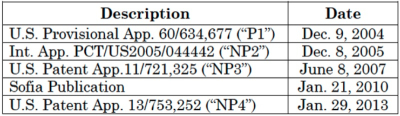
    The case arose in an inter partes review decision by the Patent Trial and Appeal Board involving Gilead's challenge of claims 1−9, 11−21, and 23−28 of U.S. Patent 8,815,830.  The issue was reached in the only way it can be in an IPR:  Gilead challenged Minnesota's right to priority to applications earlier filed than Gilead's patent on its commercial product, sofosbuvir used to treat hepatitis C infections.  The temporal relationships between the patents and applications at issue are set forth in this table in the opinion:

    Table
    Claim 1 was considered representative of the claims challenged in the IPR and illustrate the legal principles that formed the basis for the Court's opinion:

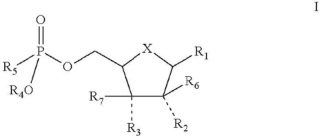
    1.  A compound of formula I:

    Structurewherein:

    R1 is guanine, cytosine, thymine, 3-deazaadenine, or uracil, optionally substituted by 1, 2, or 3 U; wherein each U is independently halo, hydroxy, (C1-C6)alkyl, (C3-C6)cycloalkyl, (C1-C6)alkoxy, (C3-C6)cycloalkyloxy, (C1-C6)alkanoyl, (C1-C6)alkanoyloxy, trifluoromethyl, hydroxy(C1-C6)alkyl, -(CH2)1-4P(=O)(ORw)2, aryl, aryl(C1-C6)alkyl, or NRxRy;

    R2 is halo;

    R6 and R7 are independently H or (C1-C6)alkyl;

    R3 is hydroxy;

    R4 is hydrogen, (C1-C6)alkyl, (C3-C6)cycloalkyl, aryl, aryl(C1-C6)alkyl, or 2-cyanoethyl;

    R5 is an amino acid;

    X is oxy, thio, or methylene;

    each Rw is independently hydrogen or (C1-C6)alkyl;

    Rx and Ry are each independently hydrogen, (C1-C6)alkyl, (C3-C6)cycloalkyl, phenyl, benzyl, phenethyl, or (C1-C6)alkanoyl; or Rx and Ry together with the nitrogen to which they are attached are pyrrolidino, piperidino or morpholino;

    wherein any (C1-C6)alkyl of R1, R4-R7, Rw, Rx, and Ry is optionally substituted with one or more halo, hydroxy, (C1-C6)alkoxy, (C3-C6)cycloalkyloxy, (C1-C6)alkanoyl, (C1-C6)alkanoyloxy, trifluoromethyl, azido, cyano, oxo(=O), (C1-C6)alkyl, (C3-C6)cycloalkyl, (C3-C6)cycloalkyl(C1-C6)alkyl, (C1-C6)alkyl-S-(C1-C6)alkyl-, aryl, heteroaryl, alkyl(C1-C6)alkyl, or heteroaryl(C1-C6)alkyl, or NRajRak; wherein each Raj and Rak is independently hydrogen, (C1-C6)alkyl, (C3-C6)cycloalkyl, phenyl, benzyl, or phenethyl;

    and wherein any aryl or heteroaryl may optionally be substituted with one or more substituents selected from the group consisting of halo, hydroxy, (C1-C6)alkyl, (C3-C6)cycloalkyl, (C1-C6)alkoxy, (C3-C6)cycloalkyloxy, (C1-C6)alkanoyl, (C1-C6)alkanoyloxy, trifluoromethyl, trifluoromethoxy, nitro, cyano, and amino;

    or a pharmaceutically acceptable salt thereof.

    It should be noted that this claim and the notational complexity thereof is not that different from many claims in chemical and biotechnological patents.

    There was no dispute that the Sofia patent discloses every limitation of the claims challenged in the IPR and thus the '830 patent claims would be invalid if the patent was not entitled to priority to one of the three Minnesota patent applications (designated "P1," "NP2," and "NP3" in the opinion) that preceded it (as shown in the table).

    As discussed in the opinion, the disclosure of the NP3 application was the same as the NP2 application, and the Board "focused its priority analysis on the disclosures of NP2 and P1, each of which was filed before Sofia was published."  The PTAB held that the challenged claims were invalid for anticipation by Gilead's Sofia publication because the disclosures of the NP2 and P1 prior applications did not provide an adequate written description of the claims in the '830 patent.  Thus the '830 patent was not entitled to the priority date of any of these applications and the Sofia patent publication was anticipating prior art.  The basis of the Board's decision was that "these documents contained neither ipsis verbis support nor sufficient blaze marks to guide the skilled artisan to the claims of the '830 patent."  The Board issued a Final Written Decision invalidating the challenged claims of the '830 patent and this appeal followed.

    The Federal Circuit affirmed, in an opinion by Judge Lourie joined by Judges Dyk and Stoll.  (It should be remembered that Judge Lourie almost single-handedly developed the modern application of the Court's written description jurisprudence, particularly for biotechnology claims, in cases including Amgen, Inc. v. Chugai Pharmaceutical Co., Fiers v. Revel, Enzo Biochem, Inc. v. Gen-Probe Inc., University of Rochester v. G.D. Serle Co., and most particularly Regents of California v. Eli Lilly & Co. and Ariad Pharmaceuticals, Inc. v. Eli Lilly & Co.)  The opinion addressed Minnesota's three grounds for appeal in order:  first, that the Board erred in finding no adequate written description for the '830 claims in the priority documents; second, that the decision was contrary to the Administrative Procedures Act; and third, that Minnesota as a sovereign State was immune from the Board's jurisdiction.

    With regard to the written description question per se, the opinion sets forth a brief but informative synopsis of the standard properly applied by the Board.  As part of the patent "quid pro quo," the panel noted that the "judicial gloss" imposed by the courts is that a disclosure must show that the applicant made what was claimed.  In the context of claims to a chemical genus, the Court apprehends "particular issues" to be raised because such claims must be supported by disclosure of "either a representative number of members of the genus or structural features common to the members of the genus, in either case with enough precision that a relevant artisan can visualize or recognize the members of the genus," citing Ariad.  Minnesota's argument sounded in the second basis for an adequate written description, setting forth "blaze marks" sufficient to disclose the genus.  Under the substantial evidence standard applied to factual questions decided by the Board (which for written description issues "must be assessed on a case-by-case basis" under Vas-Cath Inc. v. Mahurkar, 935 F.2d 1555, 1562 (Fed. Cir. 1991)), the Federal Circuit agreed that the Board did not err in finding against Minnesota.  Minnesota contended that a collection of dependent claims, each being directed to species for one of the several substituents (P1 Claim 47 for R7 substituents, P1 Claim 45 for R6 substituents, P1 Claim 33 for R5 substituents, P1 Claim 21 for R3 substituents, P1 Claim 13 for R2 substituents, and P1 Claim 2 for R1 substituents, and P1 Claim 1 for R4 substituents and X) provided ipsis verbis disclosure of the subgenus claimed in the '830 patent.  Calling this recitation a "maze-like path" needing to be followed, with "each step providing multiple alternative paths," this is "not a written description of what might have been described if each of the optional steps had been set forth as the only option."  The inadequacy in the argument (and the written description) is its indeterminacy and lack of direction because "all those optional choices do not define the intended results of claim 1 of the'830 patent."  The panel states that the situation before them was analogous to the claims invalidated on written description grounds in Fujikawa v. Wattanasin, 93 F.3d 1559, 1571 (Fed. Cir. 1996), which provided what the Court characterized in that case to be an assertion of "laundry list disclosure of every possible moiety for every possible position" as providing an adequate written description, which the Court rejected because "such a disclosure would not 'reasonably lead' those skilled in the art to any particular species."*  Here, the panel asserts that the disclosure relied upon by Minnesota recited "a compendium of common organic chemical functional groups, yielding a laundry list disclosure of different moieties for every possible side chain or functional group" and "[i]ndeed, the listings of possibilities are so long, and so interwoven, that it is quite unclear how many compounds actually fall within the described genera and subgenera."  On this basis, the Federal Circuit held that the P1 priority document does not provide sufficient ipsis verbis support for the challenged '830 patent claims to entitle these claims to its priority date.

    Turning to the question of whether the prior applications provided the requisite "blaze marks" to satisfy the written description requirement, the Federal Circuit again agreed with the PTAB that they did not.  In doing so (after stretching the "tree in the forest" analogy about as far as it could be taken), the opinion rejects Minnesota's attempted reliance on rubrics from Ariad, stating that Ariad stood for the principle that what is required is:

    [A] description of a claimed genus disclosing either (1) "a representative number of species falling within the scope of the genus," which the parties do not dispute is lacking here, or (2) "structural features common to the members of the genus," either of which must enable "one of skill in the art [to] 'visualize or recognize' the members of the genus" [emphasis in opinion].

    In the applications considered here (P1 and NP2) "the structures here are so extensive and varied that the structures of P1 claim 47, which, through its multiple dependencies, encompasses a significantly larger genus than that claimed in the '830 patent, are not sufficiently common to that of claim 1 of the '830 patent to provide written description support."  Under these circumstances there are no "blaze marks" in the P1 nor NP2 applications to the subgenus claimed in the '830 patent for the skilled worker to appreciate.  Having failed to satisfy either alternative basis for an adequate written description, the Federal Circuit held that the PTAB properly invalidated the challenged claims as being anticipated by the Sofia publication.

    Minnesota's remaining grounds for appeal were dealt with by the Court more expeditiously.  With regard to the APA challenge, the opinion rejects there being an APA basis for objection to the Board "disregard" for Minnesota's experts, because the Court states "[i]t is within the discretion of the Board to weigh the evidence of record," citing Tiger Lily Ventures Ltd. v. Barclays Cap. Inc., 35 F.4th 1352, 1365−66 (Fed. Cir. 2022), and regardless the record showed that the Board had cited Minnesota's experts "more than a dozen times" in its FWD.  Nor does the APA require the Board to perform a "creditability determination" for expert witness testimony according to the panel.  The Court also rejected Minnesota's claim that the Board's decision was contrary to an earlier decision involving Gilead, the opinion reciting five ways in which the earlier case was different from this one.  And the panel rejected Minnesota's objections on certain procedural grounds, stating that they had been given an adequate opportunity to respond during the IPR.

    Finally, the opinion summarily rejected Minnesota's sovereign immunity claims based on its earlier decision in Regents of the University of Minnesota v. LSI Corp., 926 F.3d 1327 (Fed. Cir. 2019), on collateral estoppel and stare decisis grounds.

    As with enablement, the Federal Circuit (albeit supported by over thirty years of precedent) has established a standard requiring heightened disclosure supporting claims to chemical and biological inventions.  The inherent complexity in these arts provides a logical basis for the distinctions drawn in this case and in earlier written description cases, and the Court's concern over a patentee receiving claims of broader scope than what is expression disclosed is a consistent theme in these cases and the more recent enablement cases before the Federal Circuit.  This parsimony is likely to resonate with the Supreme Court and thus encase in stone the disclosure requirements for written description developed for a generation by the Federal Circuit.

    *Such an objection has not, sadly, prevented the Patent Office from making arguments encompassing prior art laundry list disclosures in asserting lack of patentability.

    Regents of the University of Minnesota v. Gilead Sciences, Inc. (Fed. Cir. 2023)
    Panel: Circuit Judges Lourie, Dyk, and Stoll
    Opinion by Circuit Judge Dyk

  • By Michael Borella

    USPTO Building FacadeThe U.S. Patent and Trademark Office (USPTO) organizes its examining corps into technical centers (TCs).  Each TC is dedicated to one or more general technical fields.  In some cases, one TC may include two or more unrelated fields, while some fields (software, for example) are represented in multiple TCs.  Currently there are nine TCs, not counting one dedicated to reissues.

    Each TC is further subdivided into art units (usually 4-10) and examiners are assigned to these art units.  Thus, examiners tend to focus their efforts on examining patent applications within a fairly narrow field.

    Over the nine years since 2014's Alice Corp. v. CLS Bank Int'l Supreme Court case, the number of 35 U.S.C. § 101 rejections has dramatically increased throughout the USPTO.  Anecdotally, however, many practitioners believe that certain TCs are much more likely to result in 101 rejections than others.  In practice, it is generally accepted that TC 3600 — the TC to where most business-related inventions are routed — issues the most Alice-based 101 rejections.

    We tested this hypothesis by gathering data on Alice rejections per TC from 2020.  We had to look back this far due to the USPTO's 18-month publication delay causing not all relevant data from 2021 to be available.  Here, an Alice rejection is a rejection of at least one claim on the grounds of the claim(s) not meeting the judicial patent eligibility requirements of Alice.  This is a slightly narrower scope than § 101 rejections in general, which include claims rejected on grounds of failing to meet the statutory requirements and grounds of double patenting.

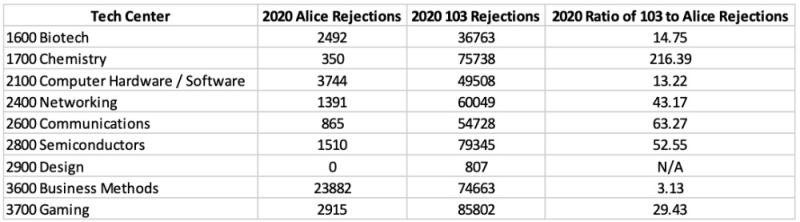
    While the raw numbers of Alice rejections per TC in 2020 were not hard to obtain, they were also not very insightful when considered in isolation.  To be able to compare Alice rates across TCs, we also collected a count of § 103 rejections per TC in 2020.  By considering the ratio of § 103 rejections to Alice rejections, we are able to obtain a clearer understanding of how "difficult" each TC is with respect to § 101.  Particularly, using § 103 rejections (which are quite common) as a baseline, we can get a clear understanding of how many Alice rejections to expect per § 103 rejection.

    Table
    As shown above, the ratio of § 103 to Alice rejections varies wildly across the TCs.  For instance, in TC 1600, you can expect one Alice rejection for about every fifteen § 103 rejections.  On the other hand, in TC 3600, you can expect one Alice rejection for about every three § 103 rejections.  Indeed, TC 3600 has the highest likelihood of an Alice rejection by far when compared to § 103 rejection volume.  This appears to confirm our anecdotal observations.

    Other TCs that have relatively high rates of Alice rejections are 1600 and 2100.  Both of these TCs receive a high volume of software applications.  In contrast, TCs 1700, 2600, and 2800 have the lowest rates, with 1700 being quite low.

    Based on experience, we expected a higher rate of Alice rejections in TC 3700.  In particular, gaming inventions get routed to this TC, and we have seen frequent Alice rejections for their applications.  This TC, however, also examines mechanical and medical inventions, which typically are not subject to § 101 challenges as often.  Thus, across TC 3700 as a whole, Alice rates fall about in the middle of the field.  This suggests that it might be informative to further break this data down by art unit in a follow-on exercise.

    A word of caution — while this data suggests that TC is highly influential on whether an application is going to receive a § 101 rejection, there are other factors.  By their very nature, some inventions (e.g., business methods, data processing) are more prone to a § 101 rejection than others (e.g., mechanical devices, chemical compounds).  Inventions with a high likelihood of triggering an Alice analysis may receive a § 101 rejection regardless of its TC.

    Still, if a goal is to avoid TCs with higher Alice rates, this data provides a compelling view of just how much each TC relies on Alice rejections when compared to § 103 rejections.  As such, TC prediction and steering tools can be advantageous when used in conjunction with the numbers above.

  • Strafford #1Strafford will be offering a webinar entitled "Patent Year in Review: Key Decisions, Trends, and Strategies — Patent Eligibility, Obviousness, Written Description, Pleading Standards, and More" on March 7, 2023 from 1:00 to 2:30 pm (EST).  Thomas L. Irving of Finnegan Henderson Farabow Garrett & Dunner, Sarah Hooson of Merck Sharp & Dohme, Krista Kostiew of Unilever, and Xiaoguang Michelle Gao of Eli Lilly and Company will guide patent counsel on recent trends and developments in patent practice; examine the Supreme Court, Federal Circuit, and PTAB cases from the past year; and discuss some of the key developments and strategies.  The webinar will review the following issues:

    • Key patent decisions in the Federal Circuit and Supreme Court and the impact on patent practice
    • Impact of recent PTAB decisions and developments on patent practice
    • Lessons from recent decisions and strategies going forward

    The registration fee for the webcast is $347.  Those interested in registering for the webinar, can do so here.