• By Aaron Gin

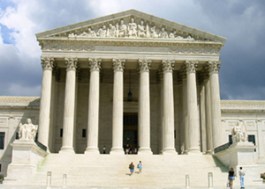
    Supreme Court Building #2Dr. Stephen Thaler, Ph.D., a computer scientist and inventor, has petitioned the Supreme Court of the United States to consider the question of whether the Patent Act restricts the definition of an "inventor" to human beings.  The petition represents an opportunity for the Court to clarify whether an artificial intelligence (AI) can be an inventor under U.S. patent law.

    The primary reasons provided by Thaler for the Court to grant certiorari include:  1) describing a conflict between the lower court decisions and the text of the Patent Act; 2) pointing out conflicts with prior Supreme Court jurisprudence; and 3) a policy argument highlighting the importance of patentability of AI-generated inventions in the U.S. and worldwide.

    Thaler is the creator of DABUS (Device for the Autonomous Bootstrapping of Unified Sentience), which is a combination of multiple artificial neural networks.  The various neural networks of the DABUS system were each programmed to represent discrete concepts such as "temperature", "enjoyment", or "survival."  DABUS was then trained under external supervision from a human trainer to form short consequence chains, such as taking a drink at an appropriate temperature results in enjoyment.  Subsequently, during an unsupervised activity, DABUS autonomously extended the consequence chains into longer, more-complex chains that resulted in positive outcomes.

    Based on this architecture and training, Thaler claimed that DABUS autonomously developed two novel concepts:  "Neural Flame," an emergency beacon that flashes in a desired pattern to attract the attention of rescuers, and "Fractal Container," a beverage container that improves grip and better regulates heat transfer to increase user enjoyment.  These concepts formed the basis of two patent applications U.S. Application Nos. 16/524,350 and 16/524,532.  Thaler filed the patent applications with the USPTO, listing the sole inventor as "DABUS" under "given name" and "Invention generated by artificial intelligence" under "family name" in an Application Data Sheet.  Thaler also included a "Statement on Inventorship," which described some of the functional aspects of DABUS and argued why the AI should be considered as an inventor under the Patent Act.

    The USPTO issued a Notice to File Missing Parts to amend the ADS.  Through several rounds of petitions, Thaler asked the USPTO to vacate the Notice and provided further arguments.  However, the USPTO pointed to numerous references to an inventor as a "person" in Title 37 of the Code of Federal Regulations and the MPEP definition of "conception" as "the complete performance of the mental part of the inventive act," and dismissed Thaler's request for reconsideration in a final written decision.

    Thaler challenged the USPTO's decision in a suit filed against the USPTO in the Eastern District of Virginia.  The District Court judge granted summary judgment for the defendant based on the plain statutory language of the Patent Act (35 U.S.C. §§ 100 and 115) and Federal Circuit (Univ. of Utah v. Max-Planck-Gesellschaft, 734 F.3d 1315 (Fed. Cir. 2013)) authority.  Thaler appealed to the Federal Circuit, which affirmed the District Court in an August 2022 decision.  In brief, the CAFC agreed that an inventor must be a human being, barring AIs from inventorship.

    Through his counsel, Thaler filed the Petition on March 17, 2023.  The case was docketed on March 21, 2023 as Supreme Court No. 22-919 and captioned "Stephen Thaler, Petitioner v. Katherine K. Vidal, Under Secretary of Commerce for Intellectual Property and Director, United States Patent and Trademark Office, et al."  A response from the Director of the USPTO is due by April 20, 2023.

    For additional information, please see:

    Supreme Court Docket No. 22-919
    • Stephen Thaler v. Vidal; Petition for Writ of Certiorari

  • By Kevin E. Noonan –

    Supreme Court Building #3The Supreme Court heard oral argument in Amgen v. Sanofi last week in an extended session with argument from the parties and the U.S. government.  Petitioner was represented by Jeffrey Lamken, Respondents by Paul Clement, and the Government by Colleen Sindak.

    The Justices showed a great deal of interest, albeit with some difficulty, in making sure that they properly understood the complexity of the genus at issue.  Justice Thomas, for example, began the Court's questioning by asking how many antibodies were invented, suggesting it was 26 and after Mr. Lamken explained that Amgen contended the actual number was about 400, the Justice said, "in other words, you can't say how many."  Justice Thomas later returned to the question at the end of Petitioner's counsel's time requesting clarification.  Justice Jackson also queried Mr. Lamken, who expanded on his answer to Justice Thomas by saying "we got 3,000 [antibodies], which were filtered down to 384 [antibodies].  The 26 [antibodies] are something different.  The 26 are the ones where we went through and figured out the exact amino acid sequence and then listed them in the patent."  He then drew the distinction that "there's a reason why you don't go and do 384 amino acid sequences for every one of them in the patent.  Patent law has never required it, you go from the 3,000 to the 384 that bind the sweet spot and stop."

    The answers to the question (depending on who was answering) was the 26 expressly disclosed (Respondent) to ~400 (Petitioner) based on the number Amgen isolated, with Respondent emphasizing the "millions and millions" allegedly falling within the scope of the claims (saying "the numbers don't lie").  Petitioner reminded the Court that these estimates included antibodies having "conservative substitutions" in the amino acid sequence expected to yield equivalent antibodies in structure and claimed function (calling them the "swapped amino acid species," Mr. Lamken said they were "99.99% identical and routine to make").  Regarding the conservative substitution species, Mr. Clement challenged the assertion that antibodies differing from the disclosed sequences by any amino acid sequence change could be assumed to be functional, saying "You have to go through that whole experimental process again to confirm that it binds in the right place" and referring the Court to Sir Gregory Winter's amicus brief in this regard.  When asked by Justice Gorsuch, Mr. Clement stated that only the 26 identified antibodies were enabled.  The Government agreed, stating that the only antibodies that were enabled were those for which Amgen had provided the amino acid sequence (indeed, when asked by Justice Gorsuch whether there was anything in Mr. Clement's argument the government disagreed with, Ms. Sindzak said there wasn't).

    Missing from the argument was a reminder that, to the extent Amgen's genus claims can be analogized to a conventional pharmaceutical genus claim any particular, undisclosed antibody that is patentably distinct from the genus can be independently patentable and Amgen does not "own" those antibodies (although their patent may be a dominating patent).

    The Justices asked both parties' counsel whether this was at root a factual issue, Justice Gorsuch specifically asking Mr. Lamken whether there were any disagreements of law other than the appropriateness of the cumulative effort test, and if not "why isn't this just a fact-bound dispute?"  (Mr. Lamken responded in the negative, based on the Federal Circuit's "full scope" test wherein "it would be necessary to first generate and then screen each candidate antibody to determine whether it meets the double function limitations, that's a statement saying you've [sic] got to be able to make them all.  That can't be right").  The Justice asked Mr. Clement whether there was any dispute on the law (as opposed to how the law had been applied to the facts at the Federal Circuit).  Justice Kagan asked, "do you understand the parties now all to agree on the appropriate legal test, and are we simply arguing now about how that test applies in this case?" to which Mr. Lamken replied, "I think the parties all agree that the cumulative effort, the idea of reach the full scope, that that cannot be sustained."  Mr. Clement was less sanguine on the scope of the parties' agreement, telling Justice Kagan that "there must be" disagreement on the law because Amgen's assessment is that it is enough to "consign people skilled in the art to Sisyphean tasks forever" in making the antibodies falling within the scope of the claim and "what skilled artisans want is not to randomly generate something within the broad range that's claimed, but they want to be able to pick a specific embodiment, not a hypothetical one, but a specific one" contrary to Petitioner's position.

    As often happens in arguments before the Court, analogies abounded, with Petitioner arguing that James Watt did not need to disclose every possible embodiment of a steam engine to enable claims to one.  Mr. Lamken's argument motivated Justice Thomas to remark that this case was perhaps more akin to claiming using steam pressure to produce mechanical work, much like Claim 8 in the Morse patent invalidated in O'Reilly v. Morse (i.e., using electricity to produce "writing at a distance").  Mr. Clement used as an analogy claims to paints of different colors, where if robin's egg blue paint was disclosed it would be enabled whereas it would not if the public needed to make mixtures of different dyes and wait to find one that produced that color.  Even the Court (Justice Kavanaugh) raised the government's analogies in its brief to recipes for cake, bread, and stew.  And later Ms. Sindzak analogized to knowledge by the skilled artisan that pine was not a suitable type of wood from which to make a baseball bat and thus a claim to making bats from wood would not be invalidated due to this one, art-recognized exception.

    Two amicus briefs were discussed, one by Professor Lemley and the other by Sir Gregory Winter, the latter brief being sufficiently (potentially) persuasive on the underlying scientific facts that Mr. Lamken characterized it as "the functional equivalent of an expert report," while the Ms. Sindzak noted that in footnotes to two recent papers Professor Lemley had suggested that Amgen's claims could be invalid for non-enablement.  Mr. Clement dismissed the Lemley brief by telling the Court the Federal Circuit had not invalidated all biotechnology claims on enablement grounds (citing Bayer Healthcare LLC v. Baxalta Inc.) and said the Justices should rely on the Winter brief "for the science."  Mr. Clement posited that "it may be that in this particular area of antibody science given the current state of the science that you may not have an ability to functionally claim a genus, and that's kind of at some level nobody's fault, it's just the way the science works."

    Mr. Clement also reiterated a line of argument from the Winter brief in suggesting to the Court that these claims could be considered an effort to make an "end run" around the Court's precedent in Assoc. Molec. Pathol. v. Myriad Genetics, insofar as the "sweet spot" in PCSK9 could not itself be patented under that precedent because it was naturally occurring (a clever way of persuading the Court against the claims outside the strict bounds of enablement law itself).  Mr. Clement also took from the Winter brief the argument that the "roadmap" does not facilitate identifying antibodies falling within the scope of the claim because in addition to the routine experiments required to produce them it then "adds additional steps that somebody skilled in the art wouldn't want to do and are just basically an additional step, additional test they have to run to see whether they infringe, because the people skilled in the art don't really care where it binds.  They care that it blocks."  These steps "slow down others in the field" accordingly.

    In his only engagement at any length, Justice Alito asked Mr. Lamken whether there was "something unique in this decision or has the CAFC been doing this all along?  And if so, why now?"  The response was that the Federal Circuit has shown a "basic hostility to the breadth of claims, and I think that this is basically the apogee, we've reached an endpoint where, frankly, the industry can't take it any longer because you can't invest $2.6 billion if the breadth of your claims is such that it means you can't get adequate protection because, if you cover everything you invented, then it's invalid because it's too hard to make them all."  The Justice challenged this answer by asking whether the Federal Circuit's decisions had been inhibiting research for antibody-based pharmaceuticals and Mr. Lamken cited Professor Lemley's article (Dmitry Karshtedt, Mark A. Lemley & Sean B. Seymore, The Death of the Genus Claim, 35 HARV. J. L. & TECH. 1, 23-35 (2021)) in support of the assertion.  Justice Alito also inquired whether the "roadmap" disclosed in the patents was not (just) a research plan to which Mr. Lamken responded the patent disclosed "these two new antibodies that didn't exist before our invention" and "they allow you to find everything that will bind to the sweet spot in PCSK9 because they cover it completely."

    Justice Jackson evinced an appreciation regarding the burdens of proof below and the issue of whether the District Court and the Federal Circuit had properly overruled the jury determination that respondents had not satisfied the clear and convincing evidence standard.  Mr. Lamken stated that the Respondents had not shown even one antibody falling within the scope of the claim that could not have been made using the "roadmap" in Amgen's specification.  In reply Mr. Clement relied on the "millions and millions" of antibodies that fall within the scope of Amgen's claims and the amount of trial-and-error experimentation needed to produce them.  In this regard Justice Gorsuch expressed agreement with Mr. Clement that the cumulative effort needed to produce all species in a claimed genus is not dispositive but a relevant consideration.

    With regard to the relevance of the amount of effort it takes to practice the invention, Justice Sotomayor asked whether Mr. Lamken agreed with the statement in the Federal Circuit opinion that "It was 'appropriate' to look at the amount of effort needed to obtain embodiments outside the scope of the disclosed examples."  The eventual answer from Mr. Lamken was that "if it said an embodiment, that would be correct.  Embodiments means that you're looking at . . . what [the Federal Circuit] called reaching the full scope, and I think that is incorrect" and "the effort to make every single embodiment within the invention simply means that if you have an invention of any scope, it's not going to be enabled.  There may be millions of ways to make the James Watts steam engine, but you're not invalidated simply because it would take a long time to make all of those different variants of the steam engine."

    Several of the Justices asked what remedy the parties wanted (Justice Jackson frankly asking "what is the one thing we can do?") and how the Court would provide clarification in the law, the Chief Justice inquiring on the amount of disclosure that would be considered reasonable under the Court's Minerals Separation, Ltd. v. Hyde decision, Justice Gorsuch asking counsel about the continuing relevance of the Wands factors, and Justices Jackson, Alito, and Barrett inquiring on what could be considered undue experimentation.  Mr. Lamken's responded to Justice Gorsuch that "at the very least, we should have a remand so that we try again under the proper standard without the reach the full scope standard or try to hypothesize how long it takes to make millions of antibodies and then test each of them."  Justice Barrett asked "why" and Mr. Lamken stated that "the Federal Circuit could not possibly have gotten it right because of what I just read to you from [the record], where it looks at the effort to make each and every antibody of the potential millions" [and] "somebody who's trying to overturn a PTO-issued patent and two jury verdicts should at least say here's an actual antibody, an actual embodiment, that is difficult to make.  It requires undue experimentation to get there."  Justice Kavanaugh in a similar vein asked Mr. Lamken whether there was disagreement with any of the Court's precedent (counsel wisely responding "no").

    Regarding the question of the undue experimentation standard, Justice Gorsuch asked Mr. Lamken whether he agreed that "a patent fails the enablement test if it would force a person skilled in the art to undertake undue experiment to produce the claimed invention?" (answer: "yes") and if the Wands factors were valuable in making an undue experimentation assessment.  To this latter question Mr. Lamken responded that "the Wands factors can be useful in particular cases when properly applied" [but they have] "become something of a checklist that's abstracted and therefore replaces the ultimate statutory standard."  To the Justice's question "do you agree that the broader the patent the more difficult it is to prove enablement" Mr. Lamken responded, "not necessarily" because "'harder' and 'broader' are not necessarily synonymous."  And to Justice Jackson's question on finding undue experimentation as to a species, Mr. Lamken responded "if you just have a one-off that doesn't mean anything to skilled artisans, you're not going to invalidate the patent."  The Justice then asked, "How many of these 'one-offs' can you have?" to which Mr. Lamken stated,  "if you have so many that it means that you're searching for a needle in a haystack and you don't have instructions on how to do it so that it's –it is that trial and error for years on end, it's Edison and Consolidated Electric."

    In his responses Mr. Clement gave full-throated voice to the opinion that "functional claims are terrible because the retard science," using Morse claim 8 and the patentee's position in Consolidated Electric v. Edison, but he also said he did not think the test should be "zero-tolerance" regarding at least "some" experimentation.  In responding to Justice Alito, he stated that both "time and effort" and the nature of the effort were relevant and that if the claims had recited the amino acid sequences of the disclosed sequences there would have been no need for experimentation.

    Ms. Sindzak spoke at considerable length compared with the brief expository remarks both Mr. Lamken and Mr. Clement made in their presentations.  While the government's argument paralleled the respondent's, the assistant solicitor general emphasized the amino acid sequence as the "recipe" for an antibody, without which a claim is not properly enabled ("it really is that simple").  Ms. Sindzak asserted that it was dangerous to relax the enablement rules because the antibody field is unpredictable and there may be other unknown antibodies that "work[] better than everything else, or the one that's going to be tolerated by more patients or the one that's going to be cheaper to manufacture" (not considering independently patentable species).  The government also referred to the doctrine of equivalents as the proper way under the statute to protect antibodies structurally indistinct enough from the expressly recited antibodies to be deemed infringing (a position advocated by at least one amicus brief).  The Chief Justice posited that the doctrine might be less protective (something Mr. Lamken asserted in rebuttal) to which Ms. Sindzak responded that to the extent a patentee hasn't invented something "I don't think the doctrine of equivalents is going to get them things they haven't invented yet."

    With regard to In re Wands, Ms. Sindzak stated that precedent cannot be relied upon because at the time antibodies were not defined by amino acid sequence but by functional properties and satisfied the enablement requirement by deposit.  (Unmentioned was the fact that had Amgen deposited the 384 antibodies they would have been enabled at least those antibodies.)  The government also agreed with Justice Kavanaugh that an affirmance would quell arguments that the Federal Circuit had erred and leave any further remedy to Congress.  In response to Justice Gorsuch asking if you could, for example, every single time get a winner, then the fact that it would require a long time to get them all wouldn't — wouldn't necessarily defeat a patent, would it?"  Ms. Sindzak said "it can be relevant, and I think it can particularly be relevant if, for example, you figure out that . . . there's a million types of ammonia in the world and 10 of them . . . can be used instead of gasoline to run superefficient cars, right?  But you don't know which 10, so you just claim the genus of ammonia that can be used to run cars, and then what you're saying is you have to go out there and try them.  And you may actually have to try all a million of them so — to get to those 10.  And so there the cumulative effort is relevant because you're going to be there testing and testing and testing."

    On rebuttal Mr. Lamken reasserted Petitioner's most straightforward argument, that "The key fact in this case is that Sanofi has not identified one antibody that would require undue experimentation to make."

    Both the respondent's counsel (jokingly) and the assistant solicitor general (more earnestly) suggested that the Court dismiss the certiorari writ as having been improvidently granted (which the Petitioner's counsel warned would have the same consequence as an affirmance, mentioning that the PTAB had relied on the Federal Circuit's decision in two recent cases).  The Justices' focus on the factual predicates of the case makes this outcome not as unlikely as it might otherwise be.

    In view of the argument, if the Court does rule, it is likely to provide "guidance" (as requested by the petitioner) on the proper scope of the inquiry (without rejecting the "full scope" test per se) and send the matter back to the Federal Circuit on remand for reconsideration on that basis.  This would be consistent with the Court's stance in other cases (Arthrex v. U.S. and Minerva Surgical v. Hologic, for example) and generally with its exercise of its role in supervising and where necessary (in the Court's estimation) correcting the Federal Circuit's application of U.S. patent law.

  • By Kevin E. Noonan –

    Supreme Court Building #1During oral argument before the Supreme Court on Monday in Amgen v. Sanofi, all three advocates (Jeff Lamken for Amgen, Paul Clement for Sanofi, and Colleen Sindzak for the United States) had reason to reference and discuss an amicus brief submitted on behalf of Nobel Prize-winning scientist Sir Gregory Winter and colleagues,* on the scientific questions raised in the case with regard to what is sufficient to satisfy the enablement requirement of 35 U.S.C. § 112(a).

    The brief first extols the success of antibody technology as treatments for auto-immune inflammatory diseases and cancer that "has revolutionized the pharmaceutical industry." It characterizes Amgen's position as being that "because it was the first to determine the identity of the amino acids that make up the natural site on PCSK9 where LDL receptors bind (the alleged 'sweet spot') it should be entitled to patents covering any and all antibodies that bind there."  The scientists take issue with this assertion, as they have characterized it, because "Amgen did not invent the natural binding site, nor did Amgen even use its discovery of that alleged 'sweet spot' to make its own two lead antibodies," and contend that Amgen's invention is merely "a hindsight characterization of that which existed naturally.  Amgen attempts to monopolize the natural PCSK9 binding site by reciting the specific amino acid residues of that site."  Moreover, the scientists criticize Amgen for not teaching how to make and use the invention they have claimed.

    The scientists state that they have filed their amicus brief to "provide[] information and scientific perspectives concerning several issues at the heart of this case"; these are:

    "(1) the unpredictability of antibody design and engineering, including methods of generating and testing antibodies for a particular function;
    (2) the lack of guidance provided by Amgen's patents, and indeed, the additional hurdles created by Amgen's claims to make and use the claimed class of antibodies; and
    (3) the devastating impact of overbroad, purely functional claims like Amgen's on antibody development and innovation for pharmaceutical drugs."

    An antibody's structure (its amino acid sequence) determines its structure ("a fundamental tenet of basic antibody science") but the reverse is not true, according to the brief.  Thus, knowing an antibody's function (such as binding PCSK9 at the "sweet spot") does not provide any information about its structure (which the scientists assert is "what it is," emphasis in the brief).  In addition, Amgen's claims do not encompass "a narrow class of specific antibodies," the scientists assert, but are broadly recited to encompass "any and all antibodies (of unspecified and unknown structure) that bind to a natural antigen at its natural interface with natural receptors."  Referencing undue experimentation (a bit obliquely in the argument), the scientists contend that these claims add to the undue burden of identifying PCSK9-binding antibodies by necessitating that scientists must "make, test, and characterize each one of potentially billions of antibodies to determine whether they are covered by Amgen's claims," i.e., bind to these specific residues in the sweet spot.  And permitting this situation to stand (rather, resurrecting it by reversing the Federal Circuit) would "stifle innovation and set a dangerous precedent for the scientific and pharmaceutical community at large."

    The brief then dissects the scientific bases for its arguments.  After providing an "overview" of antibody structure and design, including the graphic:Image 1
    and the amino acid sequence of the heavy chain variable region comprising CDRs from one of Amgen's antibodies:

    Image 2
    the scientists assert that as a consequence of the complexity of antibody structure, antibodies having different amino acid sequences can bind to PCSK9, as illustrated by Respondent's "demonstrative exhibit" (as it was called by Justice Gorsuch during oral argument):

    Image 3
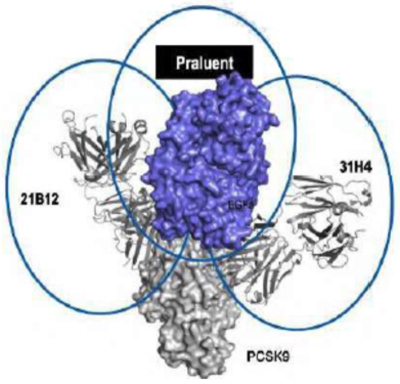
    (which illustrates, importantly for Respondents' arguments, that while Amgen's antibodies contact only 2-3 amino acids in the sweet spot, the "competitor antibodies" contact nearly all of them, due purportedly to the different methods by which the competitors produced them).  These structural differences have functional consequence, according to the scientists, as illustrated by the topography of where Sanofi/Regeneron's Praluent antibody binds PCSK9:

    Image 4
    (where "21B12" and "31H4" are Amgen's antibodies disclosed in Amgen's patent that bind on either side of the site to which Praluent binds).

    The brief states that an antibody's amino acid sequence is the "recipe" for the antibody (a description used by the U.S. during oral argument) because it determines both what an antibody is and what it does (its function), which is dependent on "precise order of amino acids [that] dictates how they will interact, how the chains will fold and arrange, and, additionally, which amino acids will comprise the CDR loops that ultimately interact with antigens."  Consequently, according to the brief, changing even a single amino acid in the sequence "could turn an antibody that binds to an antigen into an antibody that does not bind to that same antigen" as attested at trial by Amgen's expert (a property that can be shared with chemical entities, the scientists asserts in a footnote).  As a consequence, the scientists remind that it is unpredictable how an amino acid sequence change will influence function (in an antibody's case, what it binds to and how well).  The scientists use this unpredictability to criticize Amgen's reliance on "conservative substitutions" as somehow enabling a scientist to modify the antibodies whose sequences are disclosed in Amgen's patent to produce other antibodies having the same PCSK9 binding capabilities.  The scientists attest that conservative substitutions "are by no means a 'shortcut' in antibody engineering for therapeutics" because "the impact of such substitutions remains highly unpredictable," the brief going on to criticize some of Amgen's assertions about such conservative substitutions.  "The only sure way to determine whether the function of an antibody tolerates an amino acid substitution is to make the substitution and test the resulting antibody" according to the scientists.  Nothing about an antibody is predictable, from having an antibody having the desired function to changing portions of the amino acid sequence of such an antibody, even by conservative substitutions.

    The logical conclusion advanced by the scientists is that this feature of antibody structure makes obtaining antibodies other than those expressly disclosed by Amgen undue experimentation.  The degree of experimentation is more, not less, for antibodies that must bind to the identified amino acids in the PCSK9 sweet spot according to the brief.

    The brief then makes the argument that Amgen's invention is the result of hindsight and that the elements (the existence of the sweet spot) was not invented by Amgen (nor according to the scientists did Amgen discover PCSK9 or how LDL receptors bind to it, the brief identifying by name those scientists who did, none of which "had any connection with Amgen").  And the scientists affirm Respondents' argument that Amgen's claims do not encompass a small genus but rather "cover the entire genus of antibodies that bind to specific amino acid residues on PCSK9 and block PCSK9 from binding" to the LDL receptors (quoting the Federal Circuit), despite not reciting any amino acid sequence limitations.  (The brief spends a considerable number of pages addressing and rebutting analogies made by Amgen and other amici.)

    At the end of their legal arguments, the scientists assert that Amgen's disclosure does not satisfy the statutory "make and use" requirement because they "do not come close to teaching an antibody scientist how to make and use antibodies that bind to its claimed specific residues and block binding of LDL receptors."  With regard to Amgen's purported "roadmap" the scientists state that "[n]owhere in this 'roadmap' is any teaching or guidance that provides a practical shortcut to other scientists to make and use the claimed broad genus of antibodies without undue experimentation."

    The brief ends on a policy note, the scientists asserting that letting Amgen's claims stand would "block innovation and access to new medicines."  Amgen provided the two expressly recited antibodies (defined by structure) but did not "create or alter any of these natural residues; they existed in nature before Amgen found them."  This strikes (for the scientists) the "warning bell" that permitting claims having Amgen's scope would inherently give Amgen patent protection over the naturally occurring structure of PCSK9, contrary to Ass'n for Molecular Pathology v. Myriad Genetics, Inc., 569 U.S. 576, 589-90 (2013).  Having an enablement standard that would permit disclosures such as Amgen's here to pass muster would "incentivize companies to use their considerable resources to block access to new therapies by essentially calling 'dibs' on anything that binds to a naturally occurring target of interest" according to the brief.  These scientists rebut arguments by Amgen's amici that claims like Amgen's promote innovation and state that the opposite is true, that "an arms race to patent natural interfaces or surfaces of targets involved in key interactions in a disease undermines scientific development and gives an unfair advantage to companies with unlimited resources."

    The brief ends with this summary statement:

    In sum, purely functional claims like Amgen's are enormously harmful to scientists who seek to understand, research, and develop new therapies for known targets, particularly where the technology at issue is complex and unpredictable.  No entity should be able to contribute only a few drops and claim ownership of the ocean.  The current enablement standard protects innovation and limits exclusivity to that which is truly inventive.  It should be upheld.

    *This group of scientists were Sir Gregory Winter, who won a Nobel Prize in 2018 for methods of making fully human recombinant antibodies by antibody phage display technology; Timothy Springer, Ph.D., the Latham Family Professor of Biological Chemistry and Molecular Pharmacology at Harvard Medical School and Boston Children's Hospital, as well as the Principal Investigator in the Program of Cellular and Molecular Medicine, Division of Hematology/Oncology, Department of Medicine at Boston Children's Hospital, whose work has been in integrins; Robert Kamen, Ph.D., who is an advisory partner at Third Rock Ventures; Andrew Griffith, Ph.D., Professor of Biochemistry at École Supérieure de Chimie Industrielles de Paris (ESPCI Paris) in Paris and a founder of Cambridge Antibody Technology; Royston Jefferis, Ph.D., who is Professor Emeritus in the Institute of Immunology and Immunotherapy within the College of Medical and Dental Sciences at the University of Birmingham, UK, whose work is on antibody design; Nick Ray, Ph.D., Chief Scientific Officer of a UK drug discovery company, C4X Discovery, who has worked on oncology, respiratory diseases, inflammation, central nervous system, pain and metabolic disease and is a named inventor on over 75 patents; and David Manuta, Ph.D., current Board Chair of the American Institute of Chemists (AIC), "a national, non-profit organization founded in 1923 for emphasizing and promoting the relevance of the chemical profession and its practitioners to society at large."

  • By Kevin E. Noonan –

    Supreme Court Building #3The Supreme Court's decision to grant certiorari in Amgen v. Sanofi is the first time in almost a hundred years that the Court has deigned to consider sufficiency of disclosure decisions, in this case enablement under 35 U.S.C. § 112(a).  While these circumstances themselves might motivate amici to file briefs with the Court to weigh in on the Question Presented, the Federal Circuit's trend in recent years to apply more tightly the strictures of Section 112 to chemical and biotechnology inventions and to pharmaceutical cases has provided its own incentive for such briefing.

    A total of thirty-four amicus briefs were filed, wherein twelve support Petitioner Amgen, seventeen support Respondents Sanofi and Regeneron, and five were filed in support of neither party.  One of the briefs in support of Respondents was filed by three law professors*, and it is this amicus brief that is discussed in this post.

    The Question Presented in the Supreme Court's certiorari grant frames every brief and states:

    Whether enablement is governed by the statutory requirement that the specification teach those skilled in the art to "make and use" the invention, 35 U.S.C. § 112, or whether it must instead enable those skilled in the art "to reach the full scope of claimed embodiments" without undue experimentation ― i.e., to cumulatively identify and make all or nearly all embodiments of the invention without substantial "time and effort," Pet. App. 14a [emphasis in Question].

    In arguing in support of Respondents, these professors' thesis is that the quid pro quo of patent law embodied in Section 112 has two facets.  The first, that an applicant must show possession of an invention, is commonly considered the province of the written description requirement.  In addition, however, the law has a second requirement, the professors argue, which is to disclose sufficient information for the skilled worker to be able to make and use the invention, which is mandated by the enablement requirement.  This second requirement necessitates disclosure of what the professors call "additional information," arrived at by inter alia a parsing of the language of the statute reminiscent of similar linguistic analyses performed by amici in Ariad v. Eli Lilly & Co. (see "Amicus Briefs in Ariad v. Lilly: Federal Circuit Bar Association" and "Amicus Briefs in Ariad v. Lilly: Regents of University of California et al." and in particular the brief filed by Dr. Roberta J. Morris) with regard to written description.  As a doctrinal framework this argument presents a reasoned basis for the statute containing both a written description and enablement requirement, which has been the law at least since the Federal Circuit's Ariad decision (there being both Federal Circuit judges and amici in that case who questioned this construction of the statute).  Whether the statute supports this interpretation is the task undertaken in their arguments.

    The distinction frames the entire argument both explicitly and implicitly; the introduction to the Summary of the Argument asserts that "[f]or over two hundred years, the Patent Act has consistently required that an applicant for a patent actually conceive an invention and disclose what they have invented, in a manner that also enables skilled practitioners to make and use the invention conceived and disclosed" (the memes "conceived and disclosed" or "invented and disclosed" being repeated throughout to reinforce the distinction).  The invalidating deficiency in genus claims can arise from "the applicant [having] failed to disclose a sufficient structural-functional relationship" to satisfy the disclosure requirement, particularly where what is disclosed are members of the genus recited merely by their function, according to the professors.  When this happens, what an applicant has done is "shift[ed] to the public the burden of 'inventing' the claimed genus" because the applicant has failed to "provide sufficient information for the public to 'make and use' a properly disclosed and claimed genus invention."

    The professors further argue that while the Federal Circuit's decision is "clearly correct" under existing precedent (In re Wands), the Supreme Court needs to provide "guidance" on the two aspects of the proper standard for satisfying the enablement requirement, because "[t]he current 'undue experimentation' standard in Wands . . . does not provide any meaningful referent to guide such analysis ('undue' compared to what?), and improperly conflates these two required inquiries."  The two aspects the professors believe the Court should address are:

    First, how much of a structural-functional relationship must be disclosed to validly support a genus claim without improperly shifting the burden of inventing to skilled artisans?  Second, for an already invented and properly disclosed genus, how much additional information must an applicant provide to "enable" skilled artisans to "make and use" the claimed genus?  This second requirement must consider how much time, money, and effort can be imposed by applicants on skilled practitioners in regard to the scope of the invention actually claimed [emphasis in brief].

    The policy reasons the professors set forth regarding the necessity for the Court to clarify these standards are that granting genus claims that do not disclose a "sufficient structural-functional relationship" between the species they encompass "provides a disproportionate reward to applicants."  In their view, an applicant should be entitled to the species explicitly disclosed, functionally equivalent species according to the doctrine of equivalents, and if and only if the applicant can "identify a common structural-functional relationship that sufficiently assures that other structures will perform the required functions" should such an applicant be permitted to claim species that they have not individually identified.  The professors also assert that granting genus claims that fail to satisfy these requirements is equivalent to permitting applicants to claim research plans, which "blocks sequential innovation and commercialization of additional structures that the applicant has not yet identified to possess the desired result or recited function, but has claimed using structural or functional language."  This negative consequence is exacerbated because there is a "constrained" experimental use exception under Madey v. Duke Univ., 307 F.3d 1351, 1355, 1362 (Fed. Cir. 2002), that precludes the public or successor inventors from producing such species without potential infringement liability (paradoxically, a consequence less likely for antibody species falling within the scope of the claims at issue here due to the safe harbor provisions of 35 U.S.C. § 271(e)(1)).

    The brief characterizes as "a false dichotomy" the choice before the Court argued by Petitioners, between the statutory enablement standard under the strictures of "undue experimentation" and the Federal Circuit's putative "full scope" test.  Because the Constitution grants the patenting power to Congress for inventions, what constitutes an invention they argue "requires [(1)] subjective mental comprehension by applicants of what they claim to have invented; (2) . . . the completed, objectively disclosed inventions that must be enabled for others to "make and use"; and (3) the claims (to be proper) must correspond in scope to the inventions subjectively recognized by the applicant (i.e., what is "regarded" as the invention)."  (These categories correspond to the written description and enablement requirements of 35 U.S.C. § 112(a), respectively, and the "particularly point out and distinctly claim" requirement of 35 U.S.C. § 112(b).)  The professors argue that there is no actual dichotomy here because the "statutory standard requires enabling the invention actually conceived, disclosed, and claimed."  This is itself a "full scope" disclosure standard and not a new creation of the Federal Circuit in its opinion below.  And the professors challenge the assertion that the current Federal Circuit standard requires actual reduction to practice (i.e., to "physically make") all species in a claimed genus (which courts have "never required").  The question comes down to sufficiency in disclosing structure-function relationships between the species that identifies the genus as the invention and provides "additional information" to enable the genus to be made and used by others (where the "degree of time, money, and effort" that does not amount to undue experimentation is "undefined") (here, the professors abandon, as have many, the conventional belief that the amount of "time, money, or effort" is not undue to the extent that the experimentation required is routine and the outcomes predictable).

    The professors' brief recites a historical litany of cases illustrating the various ways the Court has attempted to limit the scope of claims depending on the sufficiency of a supporting specification's disclosure, including O'Reilly v. Morse, 56 U.S. 62 (1853); Corning v. Burden, 56 U.S. 252, 269 (1853); Risdon Iron & Locomotive Works v. Medart, 158 U.S. 68 (1853); and Halliburton Oil Well Cementing Co. v. Walker, 329 U.S. 1, 12-13 (1946).  The brief recognizes that Congress stepped in after the Halliburton decision by permitting functional claiming under a specific statutory provision, 35 U.S.C. § 112(f), but in doing so the statute "specified the permissible limits of structural genus claiming using functional language, limiting claim scope to equivalent species of embodiments actually invented by the applicant and disclosed in the specification."**  The brief cites Brenner v. Manson, 383 U.S. 519 (1966), a decision usually appreciated as being directed to the utility requirement under Section 101, as being consistent with the proscription against claiming a research plan, which is what in their view claiming a genus unsupported by sufficient disclosure amounts to.  (To be fair, Section 112(a) is also recognized as having a utility requirement; see In re Brana, 51 F.3d 1560 (Fed. Cir. 1995).)  The brief also acknowledges the application of the written description requirement to establish possession of an invention under Ariad Pharm., Inc. v. Eli Lilly & Co., 598 F.3d 1336 (Fed. Cir. 2010) (en banc), but asserts that "the Federal Circuit has not yet clearly articulated when sufficient species have been disclosed or when a sufficient structural-functional relationship is identified to justify that the applicant subjectively 'possess[ed]' the genus of a claimed species, and thus invented rather than just claimed that genus."  And, according to the professors, the Supreme Court has also recognized a need for an applicant to identify and disclose "a sufficient structural-functional relationship of a claimed genus to qualify as an 'invention' under the 'enablement' doctrine," citing Consolidated Elec. Light Co. v. McKeesport Light Co., 159 US. 465 (1895) in support.  The brief distinguishes the Court's decision in Minerals Separation, Ltd. v. Hyde, 242 U.S. 261 (1916), a case cited by Amgen and some amici writing in support of their position, stating that in that case the Court "merely held that applicants need not reduce to practice (i.e., physically create) and enumerate in the specification all of the generically claimed species embodiments in order to show what species within the claims work best, when and only when disclosure of a limited number of embodiments was sufficient to demonstrate that the applicant had identified the required structural-functional relationship" (emphasis in brief).

    Having set forth their arguments for the enablement requirement having two aspects of what needs to be disclosed to support a genus claim, the professors ask the Court to provide guidance on the proper application of both.  This requires guidance on how much of this structure-function relationship would be needed to satisfy the enablement requirement (a fact-specific question not apparently amenable to the type of broad pronouncements usually made by the Court for such principles).  The professors provide their interpretation of what such a pronouncement would provide from earlier precedent:  that species expressly not disclosed but falling within the scope of a genus claim be the product of "mechanical" rather than "inventive" skill; that the existence of any inoperative embodiments be per se invalidating; and the structure-function relationship must be a "'quality common to all of' the claimed species."  As part of this exercise the professors urge the Court to correct the deficiencies they perceive in how the lower courts and Patent Office have implemented the Wands factors, to the extent that the undue experimentation standard conflates whether the disclosure permits species falling within a claimed genus to be identified with whether these species can be made and used without "too much time, money, and effort" (wherein the first requirement has generally been assessed under the written description requirement).

    The professors assert that both the Wands calculus and the Court's precedent (Minerals Separation's "reasonable[ness]" standard) "provide no basis to draw the line between insufficient instruction and sufficient instruction that 'leav[es] something to the skill of persons applying the invention.'"  That standard should depend on economic factors and "whether [it] promotes or restricts sequential innovation" in the professors' view, citing a variety of academic treatments of the question.

    Finally, the professors argue the enablement requirement's importance in preventing applicants from obtaining claims to a mere "research plan."  Much of their contentions in this regard, that confining the scope of genus claims too narrowly would not harm innovation, is based on a patentee's ability to rely on the doctrine of equivalents for species falling outside the literal scope of what is claimed (regardless of the unpredictability of such reliance and the limitations otherwise imposed on exercise of the doctrine).  The policy (or doctrinal) position stems from the belief that overbroad claiming (to the extent the Court is persuaded by the argument) "blocks sequential innovation and commercialization of additional structures that the applicant has not yet identified to possess the required function," which was the Court's concern in Halliburton.  And the professors in this context remind the Court of the "constrained experimental use" exception under Madey v. Duke Univ., 307 F.3d 1351 (Fed. Cir. 2002), because under this interpretation of the law "no sequential innovator may seek to discover any additional, functional species within the scope of the claims by making and testing embodiments of the claimed genus."  The professors use the history of antibody claiming, as explicated in S. Sean Tu & Christopher M. Holman, Antibody Claims and the Evolution of the Written Description/Enablement Requirement, 63 IDEA 84, 96 (2021), to illustrate how permitting claims based on function (antigen binding) would have stifled innovation into "the many medically useful alternatives and the variety of antibody options that were developed, some of which are at issue in this case" (although it must be borne in mind that the technology at the time prevented "better" disclosure of antibody species, inter alia, by amino acid sequence).

    The brief ends with a call for the Court to decide this "easy case" by affirming the Federal Circuit, while also reiterating the professors' request for the Court's guidance on how to implement the enablement requirement to achieve the policy goals they advocate in their brief.  Their argument boils down to where to draw the line on the scope given to genus claims, and the professors believe innovation is better served in preventing applicants from obtaining claims having a scope that is greater than what an applicant can reliably demonstrate at the time of filing, with invalidation being the price for inadvertent inclusion of inoperative embodiments, no matter how infrequent or easy to discern.  Whether this level of stringency is consistent with innovation will become evident only if the Court were to adopt the standards proposed in the professors' brief, with equally deleterious consequences being possible in either event.

    * Professor Joshua D. Sarnoff, DePaul University School of Law; Professor Sharon K. Sandeen, Mitchell Hamline School of Law; and Professor Ana Santos Rutschman, Villanova University, Charles Widger School of Law.

    ** The brief also notes that Graver Tank & Mfg. Co. v Linde Air Prods. Co., 336 U.S. 271 (1949), an earlier case related to its more famous relative that established the doctrine of equivalents, invalidated a patent to a genus "defined by structure that contained inoperative embodiments," thereby claiming a result rather than an invention (as the professors understand the Court's reasoning).

  • By Kevin E. Noonan –

    Supreme Court Building #2The Supreme Court's decision to grant certiorari in Amgen v. Sanofi is the first time in almost a hundred years that the Court has deigned to consider sufficiency of disclosure decisions, in this case enablement under 35 U.S.C. § 112(a).  While these circumstances themselves might motivate amici to file briefs with the Court to weigh in on the Question Presented, the Federal Circuit's trend in recent years to apply more tightly the strictures of Section 112 to chemical and biotechnology inventions and to pharmaceutical cases has provided its own incentive for such briefing.

    A total of thirty-four amicus briefs have been filed, wherein twelve support Petitioner Amgen, seventeen support Respondents Sanofi and Regeneron, and five were filed in support of neither party.  One of the latter briefs was filed by the Solicitor General representing the U.S. Government, and it is this amicus brief that is discussed in this post.

    The Question Presented in the Supreme Court's certiorari grant frames every brief and states:

    Whether enablement is governed by the statutory requirement that the specification teach those skilled in the art to "make and use" the invention, 35 U.S.C. § 112, or whether it must instead enable those skilled in the art "to reach the full scope of claimed embodiments" without undue experimentation ― i.e., to cumulatively identify and make all or nearly all embodiments of the invention without substantial "time and effort," Pet. App. 14a [emphasis in Question].

    It will be recalled that the Supreme Court issued a Call for the Views of the Solicitor General (CVSG) last year, and in their responsive brief, the government urged the Court not to grant certiorari (for many of the same reasons set forth in their amicus brief).*

    The brief's explication of the proceedings below focused on a few key points.  First, the Solicitor General asserted the determination by the District Court that the claimed invention required that the "millions" of antibodies produced according to the methods disclosed in the specification would need to be tested to determine whether they would be functional (i.e., in preventing binding of PCSK9 to LDL receptors in vivo).  The SG then asserted that there was great uncertainty in the art as to whether an antibody that bound PCSK9 would prevent LDL receptor binding and what the brief stated was a lack of explicit guidance regarding what sequence alterations would result in having or lacking such neutralizing activity.  Making these determinations would take "substantial time and effort" which, the SG contends, could amount to undue experimentation even under the conventional test from In re Wands, particularly at what the Federal Circuit had characterized to be the "far corners of the claimed landscape."  Amgen had chosen to disclose its claimed antibodies by function rather than structure, according to the SG, which as a consequence required such extensive characterization.  In addition, the SG contended that functional descriptions raise "special problems" for enablement, including that a skilled artisan or member of the public can only know whether an antibody falls within the scope of the genus after it is made and tested.  "A specification does not enable a person skilled in the art to make and use a product if the person is compelled to engage in the same trial-and-error process the inventor undertook to produce her innovation in the first place" (emphasis added) according to the brief, and this is the situation here.

    In something reminiscent of the "quacks like a duck" test, the SG says that this specification, limited to 26 exemplified antibodies (a calculation Amgen disagrees with in its Reply brief) and perhaps some derivatives cannot support the breadth of the claims, particularly when its "roadmap" essentially instructs to "make the antibody pool and fish for the useful ones."  Taking recourse in a baking analogy (to be repeated later in the brief, perhaps thinking it might resonate with the Court), the SG states in this regard that "Petitioners may not evade an undue-experimentation problem merely by baking the need for experimentation into their roadmap."  The brief makes a comparison between Amgen's 26 exemplars and "structural diversity within the class" of PCSK9-binding antibodies, asserting that Amgen's 26 exemplars "do not even capture the structural diversity represented among the antibodies that petitioners' competitors have already created."

    The SG argues that these factual circumstances support the Federal Circuit's decision that the claims were invalid for lack of enablement.  The brief rejects Amgen's characterization of the decision as creating a "full-scope" enablement test, and provides a synopsis of the means an inventor can protect an invention of a genus:

    Where an inventor develops an innovative process that may be applied across multiple contexts, she can protect it with a process patent.  Where she invents an innovative product and others attempt to market that product with insignificant alterations designed to evade an infringement suit, the inventor may use the doctrine of equivalents to enforce her patent against those copyists.  But an inventor whose novel product achieves a widely-shared research goal may not obtain a patent for the entire genus of products that perform the same function, thereby foreclosing others from inventing potentially better products that achieve the same goal, unless she provides the information necessary to enable others to make and use the full range of products within the genus.

    The SG's legal arguments parallel others who support the Federal Circuit's application of the enablement standard, emphasizing the quid pro quo relationship between patent exclusivity for a limited time and providing an enabling disclosure, as well as encouraging follow-on innovation and ensuring post-expiry that the public has the benefit of the quid pro quo bargain.  The brief cites Supreme Court precedent, including Consolidated Electric Light Co. v. McKeesport Light Co., 159 U.S. 465, 476 (1895) (requiring the disclosure to enable the full scope of the claims prevents an "unwarranted extension of [the] monopoly"), stating that "a patent generally cannot satisfy the enablement requirement when its specification references a broad class of substances without giving a person skilled in the art a means of discerning whether and to what extent each substance will produce a working invention."  Regarding undue experimentation, the SG argues that it will "generally depend not on any bright-line rule but on a flexible inquiry that takes into account the nature of the claimed invention and the field in which it arises," making the first of two baking analogies regarding a cake recipe that provides merely a list of ingredients and leaves it to the baker to determine how to apportion them in making a cake (non-enabling).  The brief then compares baking a cake with making a stew, where it is permissible to instruct the cook to "season to taste" "because similar instructions are standard in recipes, and a more precise instruction is generally impossible given natural variations in ingredients and sodium tolerances."  Finally, the SG argues that seasoning (at least with regard to adding salt) would not be permissible for a bread recipe, because the variable ingredient (salt) has a functional consequence to whether the bread is successfully baked; as a consequence the SG asserts that bread recipes "almost invariably specify the precise quantity necessary to produce the chemical reaction that makes the bread rise."

    Returning to situations frankly concerned with enablement, the brief cites Wood v. Underhill, 46 U.S. (5 How.) 1, 4 (1846), for situations where what counts is the "degree of vagueness and uncertainty" of the disclosure to the expected/desired outcome, wherein there can be some accommodation to naturally occurring variances (in Wood, the variable compositions of clay used in making bricks).  Minerals Separation, Ltd. v. Hyde, 242 U.S. 261 (1916), is cited for the existence of a "reasonableness" standard in the application of the enablement requirement, again dependent on the subject matter of the claimed invention (backed by an impossibility standard for any more precise definition, where it is "obviously impossible to specify in a patent the precise treatment which would be most successful and economical in each case").  But even with these cases the brief asserts there must be a balance between these realities (of inherent uncertainties arising from the subject matter) and the need that "the degree of experimentation required may not be so great as to defeat the basic command of the enablement requirement by forcing others skilled in the art to retrace the patentee's research steps."

    The SG also contends that there should be "some general quality" in the members of a claimed genus, which for example was not found among the claimed light filaments asserted against Edison's bamboo filament in Consolidated Electric, as an illustration of how a genus claim can be adequately supported by a generic disclosure.  The SG further uses Consolidated Electric to illustrate undue experimentation arising from the need for Edison to exercise "the most careful and painstaking experimentation" that distinguished his light bulb from what had been disclosed and claimed in his competitor's patent, a good but extreme definition of the undue experimentation principle.  The brief also set forth Holland Furniture Co. v. Perkins Glue Co., 277 U.S. 245 (1928), as an example of insufficient disclosure for enablement, where starch-based glues were found to be equivalent to animal-based glues when combined at specific proportions with water.  In this case the specification provided no characterization of which starches to use or how to select them except by finding that they work when practiced according to the claims, meaning experimentation was required both to practice and avoid practicing the claimed invention.  The SG crafts a rule from these cases, that a "specification cannot satisfy Section 112(a)'s enablement requirement merely by providing an example of the products that fall within the class and a generalized description that captures other products similar to the example."  Rather, "the patent must describe, with enough particularity to avoid the need for undue experimentation, the structural features that distinguish the genus."  (While perhaps helpful it will be immediately appreciated that the enablement devil will be very much in the details of how the rule is applied.)

    With regard to the application of these rubrics to Amgen's patents, the SG perceives two types of undue experimentation here:  first to find antibodies that bind to the PCSK9 "sweet spot" comprising 16 specific amino acids in PCSK9 itself and then to identify those antibodies that prevent LDL receptor binding, equivalent to requiring independent invention to determine which antibodies are which.**  The SG maintained that Amgen's specification fails the test she has crafted because the specification does not identify common structural characteristics "running through" the claimed antibody.***  The SG's brief discounts Amgen's "roadmap" disclosure on the basis that these methods merely produce antibodies but do not necessarily (or with enough certainty) produce antibodies having the functions of the claimed antibodies.  And the SG asserts an unsupported speculation (denied by Amgen in its Reply brief), to the effect that "given petitioners' incentive to create and disclose as broad a range of antibodies as possible to bolster their claims, the specifications' inclusion of only 26 antibodies suggests that petitioners do not know how to produce and describe additional exemplars without undue experimentation."  The SG supports this argument with comparisons between Amgen's exemplars and competitor antibodies (and the number of sweet spot amino acids they bind to) which suggests to SG that Amgen wasn't able ("did not know how") to make any others.  The SG's conclusion is that even for Amgen production of these other antibody species would have required the exercise of undue experimentation.

    The brief concludes by more summarily asking the Court to reject Amgen's other arguments, e.g., on the impropriety of the Federal Circuit's "full scope" test, based on the SG's interpretation of Federal Circuit dicta, and that the policy goals Amgen asserts can be better served through other means, including using method claims (suggesting patenting the roadmap, which has the advantage of permitting antibodies to be made by other methods) and resort to the doctrine of equivalents.

    The government's amicus brief explicated the history of the proceedings below, including that after two trials the jury in each rendered a verdict that the patents-in-suit had not been shown to be invalid for failing to satisfy the enablement requirement, and that in both instances the Federal Circuit had held otherwise (in this case upholding the District Court's grant of JMOL that the claims were invalid for lacking enablement).  Practitioners before the Supreme Court have noted that there is a belief among some that the Supreme Court respects the jury process and the wisdom that can arise from its exercise.  The government's brief emphasizing these procedural aspects of the question may put any such faith to the test.

    * Amgen in its Reply brief noted that the government's brief mistakenly used the grant date of at least some of Amgen's patents for their filing dates, creating the incorrect impression that Amgen had filed these patents after at least some of their competitors' application filings.

    The actual dates for these Amgen patents are:
    USP 8,030,457 (granted Oct. 4, 2011), filed Aug. 22, 2008, priority to Aug. 23, 2007
    USP 8,829,165 (granted Sept. 9, 2014) filed 4/10/2013, priority to Aug. 23, 2007
    USP 8,859,741 (granted Oct. 14, 2014), filed 4/24/2014, priority to Aug. 23, 2007

    To be fair, the SG's brief made the same error in at least one of Sanofi's patents:
    USP 8,062,640 (granted Nov. 22, 2011), filed 12/15/2009, priority to Dec. 15, 2008

    ** There was a certain amount of scientific misunderstanding in this portion of the brief, which asserts:  "For the remaining 24 exemplars, the specifications provide only the amino acid sequences.  Nonetheless, this kind of structural information is generally sufficient to permit a scientist to 'make and use' any of the exemplars she chooses through standard laboratory techniques that allow scientists to use an antibody's amino acid sequence to reverse-engineer additional antibodies with the same sequence"; perhaps the SG meant antibodies with equivalent amino acid sequences.

    *** It should be noted that the specification discloses the crystal structure of two of Amgen's antibodies and it is possible that Amgen might have been able, but did not, to extract sufficient common structural characteristics to satisfy the SG's test.


  • By Kevin E. Noonan –

    Supreme Court Building #1The Supreme Court's decision to grant certiorari in Amgen v. Sanofi is the first time in almost a hundred years that the Court has deigned to consider sufficiency of disclosure decisions, in this case enablement under 35 U.S.C. § 112(a).  While these circumstances themselves might motivate amici to file briefs with the Court to weigh in on the Question Presented, the Federal Circuit's trend in recent years to apply more tightly the strictures of Section 112 to chemical biotechnology, and pharmaceutical cases has provided its own incentive for such briefing.

    Nearly three dozen amicus briefs were filed, with twelve supporting petitioners, seventeen supporting respondents, and five filed in support of neither party (although one of them, filed on behalf of the High Tech Inventors Alliance and the Computer and Communications Industry Association argues that the Federal Circuit's decision below was correct and consistent with settled law); these amici include AbbVie; Glaxo Smith Kline; Instil; a combined brief on behalf several pharmaceutical and other companies, and the Association of University Technology Managers; patent law associations, including the NY Patent Law Association, the Intellectual Property Lawyers Association of Chicago, and the National Association of Patent Practitioners; the Intellectual Property Owners association; the American Chemical Society; and more than a dozen intellectual property law professors (with Mark Lemley as Counsel of Record).

    The Question Presented in the Supreme Court's certiorari grant frames every brief and states:

    Whether enablement is governed by the statutory requirement that the specification teach those skilled in the art to "make and use" the invention, 35 U.S.C. § 112, or whether it must instead enable those skilled in the art "to reach the full scope of claimed embodiments" without undue experimentation ― i.e., to cumulatively identify and make all or nearly all embodiments of the invention without substantial "time and effort," Pet. App. 14a [emphasis in Question].

    AbbVie's brief is directed at the consequences of the Federal Circuit's recent foray into restricting the scope of so-called "genus" claims to what an applicant has expressly disclosed in her specification.  And those consequences are to "chill investment and innovation" for subject matter like chemicals, pharmaceuticals and biotechnology inventions AbbVie argues.  The Federal Circuit's decisions are contrary to both the text of the statute as well as how enablement interacts with the rest of patent law and is contrary to the Supreme Court's "longstanding patent precedent" in AbbVie's view and should be overturned.

    With regard to AbbVie's "innovation and investment" argument the brief extols the genus claim as a way for an inventor to obtain protection not only for the species expressly disclosed but for related compounds that "shar[e] the same innovation."  And this scope of patent protection is what a "pioneering inventor" who discloses "a breakthrough invention with broad applicability" deserves, the brief argues, not just for the inventor's benefit but to "promote the progress of science " (technically, the Useful Arts).  As with many of the briefs this one cites the Federal Circuit's statement that it was "rais[ing] the bar for enablement" in its decisions (emphasis in brief).  This test requires that "patent specifications for genus claims with functional limitations do not comply with the enablement requirement of 35 U.S.C. § 112 unless they enable those skilled in the art 'to reach the full scope of claimed embodiments' experimentation," which in practice means an inventor must "enable a person having ordinary skill in the art . . . to cumulatively identify and make the various embodiments of the invention without 'substantial time and effort.'"  This standard is to be applied to the "full scope" of the claim (which for chemical, biotechnological and pharmaceutical claims could easily encompass millions of compounds), making the requirement into an "insuperable" hurdle to patenting claims having functional language applicable to a broad genus, the brief argues.  The consequence of this standard is to "destroy[] the basic 'bargain' of patent law" by "not giv[ing] pioneering inventors adequate range of patent protection for breakthrough inventions with broad applicability" according to AbbVie.  This affects (negatively) "investment and innovation" because the type of chemical, biotechnological and pharmaceutical inventions having severely reduced scope under this test are also those that "typically require significant risk, substantial investment, and years of research" and thus patent protection for these inventions is particularly vulnerable to the reduced scope the Federal Circuit's test that has "invalidated genus claim after genus claim" in these arts.  As a result, competitors have been able to "design around" claims to such inventions and "captur[e] a patent's economic returns."

    On the law, the brief argues that there is nothing in the statutory language suggesting much less mandating that "enablement depends on the cumulative time and effort required to make virtually all variations of the invention," which in the context of the case before the Court amounts to "whether the specification enables virtually every species within the genus without undue experimentation" (emphasis in brief).  In re Wands is the relevant (and correct) standard for enablement, AbbVie argues, and the Supreme Court should affirm its primacy (which of course the Court has never taken the opportunity to do).

    The brief casts the question in terms of the "carefully crafted bargain" between the inventor and the public, trading an enabling disclosure of the invention for the exclusivity term of the patent grant, relying on Kewanee Oil Co. v. Bicron Corp., 416 U.S. 470, 480-81 (1974), and Pfaff v. Wells Elecs., Inc., 525 U.S. 55, 63 (1998), for these principles, and emphasizing the public benefit of an increase in scientific progress, economic competition, and prompt delivery of advances in the art from which subsequent inventors can build.  AbbVie argues that the Federal Circuit's test "does not further the fundamental purposes of the enablement requirement" but rather "disrupts the patent bargain, chills investment in new discoveries and innovation, and creates uncertainty and litigation by adding an unnecessary layer of analysis to the settled Wands factors for determining enablement."

    This disruption is not limited to the chemical, biotechnological, and pharmaceutical arts AbbVie reminds the Court, because "nearly every field" uses genus claiming to seek broader claim scope than the species expressly disclosed. But genus claims are particularly important to  inventions in the chemical, biotechnological, and pharmaceutical arts because in these disciplines "breakthrough innovations invariably require very significant investments of time and money" that would lose the incentive to be pursued without patent protection of adequate scope (with concomitant loss of scientific progress according to AbbVie).  Taking extensively from the late Dmitriy Karshtedt's paper entitled The Death of Genus Claims (Dmitry Karshtedt, Mark A. Lemley & Sean B. Seymore, The Death of the Genus Claim, 35 HARV. J. L. & TECH. 1, 23-35 (2021), the brief catalogs the Federal Circuit's recent case law applying the "full scope" principle to chemical, biotechnological, and pharmaceutical patent claims, contrary to earlier precedent like In re Angstadt, 537 F.2d 498, 502-03 (C.C.P.A. 1976), as well as Wands.  Illustrating the negative consequences arising from this doctrine, the brief notes that trade secret law is not an available option, for example for claims reciting active pharmaceutical ingredients and in any event the Court recognized it to be a "much weaker choice" in Kewanee Oil.

    The full scope test is also unnecessary insofar as it does not "further the purpose of the enablement requirement because it departs from the practical inquiry of what a PHOSITA needs to know in order to make and use an invention," something the Supreme Court recognized to be the purpose of the enablement requirement in The Telephone Cases, 126 U.S. 1, 536 (1888), and Minerals Separation, Ltd. v. Hyde, 242 U.S. 261, 271 (1916).  The Wands test has "provided a predictable framework for analyzing enablement and undue experimentation" since 1987, is "derived from [the] Court's precedent" (citing cases in a long footnote) and has "demonstrated a time-tested ability to operate effectively for all kinds of claims" based on case-specific facts.  For these reasons, AbbVie urges the Court not to "engraft" the full scope test onto the Wands analysis, which is a "context-specific, case-by-case method [that] provides a balanced and workable enablement test" and should be preserved, AbbVie's brief urges.

    Finally, the brief argues that the test is contrary to the statutory language and Supreme Court precedent (finding not surprisingly no mention of the "full scope" test in the statute) and comparing the required disclosure for enablement with what is required for priority (i.e., a single embodiment) (but to be fair these requirements are directed at two different aspects of patent law).  The brief argues that other sections of the Patent Act police overbroad claiming, such as Sec. 101 and 103 and Sec. 112(a) itself, in the written description requirement (something the Court has also not opined upon and affirmatively avoided doing so in denying certiorari in Juno v. Kite).  Regarding the Court's putatively contrary precedent, the brief recites (in addition to The Telephone Cases and Minerals Separation; Mowry v. Whitney, 81 U.S. 620 (1871); Tilghman v. Proctor, 102 U.S. 707 (1880); Expanded Metal Co. v. Bradford, 214 U.S. 366, 380 (1909); and Eibel Process Co. v. Minn. & Ontario Paper Co., 261 U.S. 45, 65-66 (1923).

    Only rarely (Graver Tank and Bowman v. Monsanto) has the Supreme Court been persuaded by the types of arguments AbbVie makes in its brief, particularly with regard to the negative economic consequence of permitting an "unscrupulous copyist" to reap the benefits of a claimed invention.  The Court can be inscrutable regarding the reasons the Justices decide to take a case and have been known to appear to be sensitive to arguments of questionable provenance but ample public passion (see Assoc. Molec. Pathol. v. Myriad Genetics as an example).  Similar passions are at play here, regarding for example increasing drug costs, and how the Court ultimately decides the issues before it in this case, in the face of these extralegal considerations, may not depend as much AbbVie might hope on the arguments and precedents set forth in its brief.

  • By Kevin E. Noonan –

    Supreme Court Building #3The Supreme Court's decision to grant certiorari in Amgen v. Sanofi is the first time in almost a hundred years that the Court has deigned to consider sufficiency of disclosure decisions, in this case enablement under 35 U.S.C. § 112(a).  While these circumstances themselves might motivate amici to file briefs with the Court to weigh in on the Question Presented, the Federal Circuit's trend in recent years to apply more tightly the strictures of Section 112 to chemical, biotechnology, and pharmaceutical cases has provided its own incentive for such briefing.

    Nearly three dozen amicus briefs were filed, with twelve supporting petitioners, seventeen supporting respondents, and five filed in support of neither party; these amici include AbbVie; Instil; a combined brief on behalf several pharmaceutical and other companies, and the Association of University Technology Managers; patent law associations, including the NY Patent Law Association, the Intellectual Property Lawyers Association of Chicago, and the National Association of Patent Practitioners; the Intellectual Property Owners association; the American Chemical Society; and more than a dozen intellectual property law professors (with Mark Lemley as Counsel of Record), and the subject of this post, GlaxoSmithKline (GSK).

    The Question Presented in the Supreme Court's certiorari grant frames every brief and states:

    Whether enablement is governed by the statutory requirement that the specification teach those skilled in the art to "make and use" the invention, 35 U.S.C. § 112, or whether it must instead enable those skilled in the art "to reach the full scope of claimed embodiments" without undue experimentation ― i.e., to cumulatively identify and make all or nearly all embodiments of the invention without substantial "time and effort," Pet. App. 14a   in Question].

    After establishing its bona fides as a leading biopharmaceutical company, GSK begins its brief by focusing on genus claims per se and their importance for protecting and fostering development of its products and the concomitant benefit to the public that comes from those products.  According to GSK, genus claims often are directed to "major scientific breakthroughs, establish first-in-class medicines, and encourage downstream improvements that can themselves be patented."  The importance of genus claims, GSK explains, is that they encompass "closely related species of modifications" that can be exploited by competitors to expropriate "the heart of the invention" unless the innovator has a genus claim that prevents such expropriation.  And of course if the invention cannot be protected from copying by a competitor the incentive to innovate and bring an innovative compound to market is diminished.  An innovator would be motivated instead "to maintain secrecy over the breadth of her breakthrough for as long as possible" and as a result "[t]he public's ability to build on the collective knowledge of discoveries and inventions would suffer and, most importantly, patients would have access to fewer vital medicines."

    GSK also reminds the Court that genus claims encourage further innovation, including for example improved species in the genus that are independently patentable due to "non-obvious benefits or unexpected properties."  This situation can provide access to better medicines even if these downstream products while patentably distinct are not independently patentable, due to the "safe harbor" under 35 U.S.C. § 271(e)(1) during development and regulatory exclusivities thereafter.

    GSK argues (as does Amgen as well as other amici) that the proper test is the "undue experimentation" test of inter alia In re Wands and not the "full scope" test purported to have been created below by the Federal Circuit in this case.  This is due to the quid pro quo bargain between patentee (who obtains exclusivity limited in time) and the public (that gains the unfettered right to make, use, sell, offer to sell and import after the term of the patentee's exclusive right has expired).  The enablement requirement has been developed to keep that bargain balanced so the public can understand how to make and use the claimed invention when the patentee's  exclusivity has expired.  But, GSK argues, this does not require the patent to "literally teach every variation of an invention to satisfy the enablement requirement" and the claims' breadth should not be dispositive, according to GSK (and this is true "even if the variations included in the scope are numerous or infinite").  GSK asserts that this is once again another inflexible Federal Circuit test that "den[ies] recourse to common sense" that the conventional undue experimentation standard supplies.  And to make matters worse, the "full scope" test is "atextual," punishes life sciences innovators and usurps Congress's role over patent law, according to the brief which characterizes the "full scope" test as a "domain-specific patentability rule" that has recently resulted in "focused, unfavorable treatment" of biotechnology and pharmaceutical claims by the Federal Circuit.

    GSK then makes four related, more detailed arguments in support of its urging the Court to reject the Federal Circuit's analysis and reverse the judgment below.  The first of these is in both practical and doctrinal terms the "critical importance" of genus claims (which the brief apprehends the Court recognized by granting certiorari on this Question Presented and not on the alternative, i.e., whether enablement is a question of fact or law).  This question is important not just in the chemical, biotechnological and pharmaceutical arts, GSK argues (although conceding that these claims have the greatest impact in those disciplines, citing a law review article by the late Dmitry Karshtedt (Karshtedt, Lemley & Seymore, The Death of the Genus Claim, 35 HARV. J.L. & TECH. 1 (2021)) that genus claims are "[t]he central feature of patent law in the chemical, biotechnology, and pharmaceutical industries." (emphasis added in brief).  Genus claims are also important "to protect a class of apparatuses or methods sharing the common advancement of the invention against unscrupulous competitors seeking to evade the literal scope of the claims" in all arts according to the brief, setting forth illustrations of other technology areas where patents are drafted to claims a class, including Edison's lightbulb (Patent No. 223,898) that was claimed broadly enough to ensnare "copycat lightbulbs."  However, the brief stays focused on the importance of genus claims in life sciences patenting for chemical compounds having a use (for treating disease, for example) because related analogues to a particular chemical species are likely to have similar properties.  This produces the risk of copyists that genus claiming solves, evidence for this being that genus claims are "ubiquitous" in life science patents, citing Sean B. Seymore, Patenting the Unexplained, 96 WASH. U.L. REV. 707, 729 (2019).

    As a consequence, according to GSK's brief, if genus claims are not allowed (i.e., are not considered to be enabled absent a recitation of an impossible number of species) the incentive to innovate will be harmed, citing Karshtedt that the "full scope" test is a trap because it is impossible to satisfy the test so the choice is to disclose the invention claimed narrowly and thus invite copycat competitors or perform "impractical, wasteful experiments" to support a genus claim.  GSK argues that the futility of the latter approach was recognized by the CCPA in In re Angstadt, 537 F.2d 498, 502 (C.C.P.A. 1976), because even then (should an applicant attempt to disclose a multitude of species) a court could decide that "in the far corners of the genus" there could be species that were too difficult to make to support the genus and thus invalidate the claim.  The brief also asserts that the Federal Circuit's decision if allowed to stand will have a disastrous, retroactive effect on already-disclosed innovation in life sciences claims.

    GSK's second argument is that, perhaps counterintuitively to the casual observer genus claiming encourages follow-on innovation.  The very risk the Federal Circuit recognized as a policy basis for its decision paradoxically (according to GSK) is more likely to be caused by the decision.  The reason for this outcome is that genus claims to an invention do what all claims do: provide an incentive for additional innovation, here to species within the genus that are separately patentable, being "non-obvious improvements to past discoveries, including for species with unexpected properties that fall within the genus claims of a preexisting patent," citing Abbvie Inc. v. Mathilda & Terence Kennedy Inst. of Rheumatology Tr., 764 F.3d 1366, 1379 (Fed. Cir. 2014); accord, Prometheus Labs., Inc. v. Roxane Labs., Inc., 805 F.3d 1092, 1098 (Fed. Cir. 2015); Iron Grip Barbell Co. v. USA Sports, Inc., 392 F.3d 1317, 1321–22 (Fed. Cir. 2004); Eli Lilly & Co. v. Bd. of Regents of Univ. of Wash., 334 F.3d 1264, 1270 (Fed. Cir. 2003); In re Petering, 301 F.2d 676, 683 (C.C.P.A. 1962).  This provides the patent incentive to patentably distinct species which will  (of course) be subject to the dominating effect of the genus patent.  As a result "[m]arket forces then encourage cooperation" in the form of cross-licensing.  These incentives are even more compelling in pharmaceutical and biotechnology inventions because seeking (and obtaining) injunctions can be "untenable" for important medicines, GSK argues.  And the patent does not provide a disincentive to "downstream" innovators because their efforts are protected from infringement liability (at least for regulated products like drugs) by the safe harbor of 35 U.S.C. § 271(e)(1).

    GSK's third argument focuses on the undue experimentation test and its rationale.  This portion of the brief recapitulates arguments by others that the enablement requirement is part of the patent quid pro quo under Supreme Court precedent, citing Evans v. Eaton, 20 U.S. (7 Wheat.) 356, 418 (1822); Kellogg Co. v. Nat'l Biscuit Co., 305 U.S. 111, 120 (1938); Universal Oil Co. v. Globe Co., 322 U.S. 471, 484 (1944); Kewanee Oil Co. v. Bicron Corp., 416 U.S. 470, 480–81 (1974).  But, GSK argues, "artisans are not automatons" (KSR Int'l Co. v. Teleflex Inc., 550 U.S. 398, 421 (2007)) and "[u]ntil recently, courts have recognized the folly of counting the number of species included within the scope of a claim for determining its validity (In re Cavallito, 282 F.2d 357, 361 (C.C.P.A. 1960)), culminating in the "undue experimentation" analysis set forth in In re Wands, 858 F.2d 731, 737 (Fed. Cir. 1988), that GSK asserts provides the proper standard for enablement. In the face of this precedent the brief characterizes the Federal Circuit's decision under review as a "rigid and inelastic" one that "leave[s] no room for nuance and den[ies] factfinders recourse to common sense," citing KSR.  And this test is "untethered" to the reason enablement is part of patent law, again citing Professor Karshtedt's The Death of Genus Claims law review article.  Moreover, GSK argues, the law already contains limits on the scope of genus claiming, such as O'Reilly v. Morse, 56 U.S. (15 How.) 62, 135 (1853), making the Federal Circuit's "more stringent" test unnecessary in GSK's view.

    Finally, GSK argues that the test punishes pharmaceutical and biotechnology companies.  According to the brief, the Federal Circuit's test is an example of a "domain-specific" rule because its effects will largely fall on life-science inventions, citing Wyeth & Cordis Corp. v. Abbott Labs., 720 F.3d 1380, 1382 (Fed. Cir. 2013), and Idenix Pharms. LLC v. Gilead Scis. Inc., 941 F.3d 1149, 1153–54 (Fed. Cir. 2019).  The reason for this situation is "no accident," because biotech and pharma inventions depend, perhaps disproportionately on genus claims.  This is because the nature of chemical and biological science is that there are large but finite ("countable") numbers of species within the genus of many inventions in these disciplines (noting that in the patents before the Court there are 97,000 antibody species that can be envisioned using the amino acid substitutions in Table 1 in these patents).  If it is truly necessary to "fine-tune intellectual property law and incentives for particular industries," GSK asserts, then that should be up to Congress, not the courts, using the Hatch-Waxman Act, the Plant Variety Protection Act, the and the Biologics Price Competition and Innovation Act (BPCIA) as examples of Congress doing such fine-tuning.

    For all these reasons, GSK urges the Court to reverse the Federal Circuit's decision below.

  • J A KempJ A Kemp will be offering a webinar entitled "Priority Entitlement in Europe — Current Best Practice" on March 21, 2023 at 16:00 pm (GMT).  Andrew Clark and Guy Brain of J A Kemp will review European case law and practice in this area and outline practical steps and measures that can be taken by applicants to help safeguard priority claims in Europe, and look forward to potential developments in the assessment of priority entitlement at the EPO in view of the referrals of the Enlarged Board of Appeal pending as G 1/22 and G 2/22.  The webinar will address the following topics:

    • Keeping track of who holds the right to claim priority as a procedural right
    • A round-up of key cases at the EPO on law and practice relating to priority entitlement
    • The background leading to EPO Enlarged Board referrals G 1/22 and G 2/22
    • Practical advice to help mitigate against attacks on priority claims in Europe

    There is no registration fee for this webinar.  However, those interested in registering for the webinar, should do so here.

  • Strafford #1Strafford will be offering a webinar entitled "Obtaining and Managing REMS Patents: What Patent Prosecutors Need to Know, USPTO and FDA Policies and Rules" on March 21, 2023 from 1:00 to 2:30 pm (EDT).  Joanna T. Broughet of BioPharma Law Group and Mark J. Feldstein, Thomas L. Irving, and Adriana L. Burgy of Finnegan Henderson Farabow Garrett & Dunner will guide patent counsel on the issues surrounding Risk Evaluation and Mitigation Strategy (REMS) patents and listing in the Orange Book, discuss REMS patents and what patent prosecutors need to know, address the current efforts of the USPTO and FDA to determine what policy or rules will govern the listing of REMS patents, discuss other issued patents relating to REMS, and offer best practices for obtaining and managing REMS patents.  The webinar will review the following issues:

    • What are the considerations for patent counsel when deciding whether to list a REMS patent in the Orange Book?
    • What is the significance of the FTC intervention in the Jazz case?
    • What best practices should counsel employ when obtaining and managing REMS patents?

    The registration fee for the webcast is $347.  Those interested in registering for the webinar, can do so here.

  • By Kevin E. Noonan –

    Supreme Court Building #2The Supreme Court's decision to grant certiorari in Amgen v. Sanofi is the first time in almost a hundred years that the Court has deigned to consider sufficiency of disclosure decisions, in this case enablement under 35 U.S.C. § 112(a).  While these circumstances themselves might motivate amici to file briefs with the Court to weigh in on the Question Presented, the Federal Circuit's trend in recent years to apply more tightly the strictures of Section 112 to chemical and biotechnology inventions and to pharmaceutical cases has provided its own incentive for such briefing.

    Nearly three dozen amicus briefs were filed, with twelve supporting petitioners, seventeen supporting respondents, and five filed in support of neither party (although one of them, filed on behalf of the High Tech Inventors Alliance and the Computer and Communications Industry Association argues that the Federal Circuit's decision below was correct and consistent with settled law); these amici include AbbVie; GlaxoSmithKline; Instil; a combined brief on behalf several pharmaceutical and other companies, and the Association of University Technology Managers; patent law associations, including the NY Patent Law Association, the Intellectual Property Lawyers Association of Chicago, and the National Association of Patent Practitioners; the Intellectual Property Owners association; the American Chemical Society; and more than a dozen intellectual property law professors (with Mark Lemley as Counsel of Record).  It is the amicus brief filed by these law professors that is discussed in this post.

    The Question Presented in the Supreme Court's certiorari grant frames every brief and states:

    Whether enablement is governed by the statutory requirement that the specification teach those skilled in the art to "make and use" the invention, 35 U.S.C. § 112, or whether it must instead enable those skilled in the art "to reach the full scope of claimed embodiments" without undue experimentation ― i.e., to cumulatively identify and make all or nearly all embodiments of the invention without substantial "time and effort," Pet. App. 14a [emphasis in Question].

    The professors'* arguments, by lead author Mark Lemley of Stanford University, rely heavily on the late Dmitriy Karshtedt's paper entitled The Death of Genus Claims (Dmitry Karshtedt, Mark A. Lemley & Sean B. Seymore, The Death of the Genus Claim, 35 HARV. J. L. & TECH. 1, 23-35 (2021).  "The central feature of patent law in the life sciences industries is the genus claim" is the first assertion in the brief.  The basis for the primacy of genus claims the brief explains is that without them, "a competitor could make a minor change to the chemical the patentee invented and avoid liability while capturing the heart of the invention."  Prior to the recent spate of Federal Circuit decisions, including this one, the Supreme Court, the Federal Circuit, the C.C.P.A., and the Patent Office had recognized the usefulness and upheld the validity of genus claims in complying with the enablement requirement of 35 U.S.C. § 112(a) under the statutory mandate that the specification teach the skilled worker to make and use a chemical compound (as with every other type of invention) without undue experimentation.  Recently however, the professors argue, the Federal Circuit had changed the law ("dramatically") to the extent that "it is no longer possible to have a valid genus claim in the chemical and biotechnology industries."  The basis for this change is that "the Federal Circuit now rejects claims as invalid because the genus contains thousands or millions of possible chemicals, unless the patent itself identifies exactly which of those myriad species will work."  This burden is impossible to satisfy, in the professors' view, and represents "a categorical shift in thinking away from teaching the PHOSITA and towards a precise delineation of the boundaries of the claim" they argue, citing the Karshtedt article.

    Expounding on these arguments, the brief sets forth a brief history of the enablement requirement and how the Court has interpreted it, citing as examples The Telephone Cases, 126 U.S. 1, 539 (1888); Tilghman v. Proctor, 102 U.S. 707, 728-29 (1880); Carnegie Steel Co. v. Cambria Iron Co., 185 U.S. 403, 437 (1902); Cont'l Paper Bag Co. v. E. Paper Bag Co., 210 U.S. 405, 419-20 (1908); and Minerals Separation, Ltd. v. Hyde, 242 U.S. 261, 271 (1916).  These interpretations, the professors argue, uniformly held that "a patent for such a discovery is not to be confined to the mere means he improvised to prove the reality of his conception" (The Telephone Cases), and that where an invention is "susceptible of being applied in many modes and by the use of many forms of apparatus . . . [t]he inventor is not bound to describe them all in order to secure to himself the exclusive right to the process" (Tilghman).  And the law as it was had been sufficient to avoid the issues and uncertainties the Federal Circuit advanced as a rationale for its current jurisprudence, the brief stating that "a genus claim cannot survive if the patentee failed to provide any guidance on how to practice the claimed invention" (emphasis in brief), citing Wood v. Underhill, 46 U.S. (5 How.) 1, 4-5 (1846); Tyler v. Boston, 74 U.S. (7 Wall.) 327, 330 (1868); and Consol. Elec. Light Co. v. McKeesport Light Co., 159 U.S. 465 (1895).

    The brief further explicates that the CCPA, Federal Circuit, and PTO had complied with this Supreme Court standard until recently, citing several cases and most prominently In re Wands, 858 F.2d 731, 737 (Fed. Cir. 1988), for the principle that a patent satisfies the enablement requirement even when the skilled worker must "engage in a reasonable amount of routine experimentation to figure out compounds that can achieve the claimed result."  The need for some experimentation ''does not preclude enablement" the professors argue, citing Atlas Powder Co. v. E.I. du Pont de Nemours & Co., 750 F.2d 1569, 1576-77 (Fed. Cir. 1984).  Summarizing, the professors assert that "enablement has not traditionally turned merely on whether there are many compounds within the claimed genus or whether routine screening takes considerable time" under the Wands test.

    In contrast, the brief asserts that the current course of Federal Circuit jurisprudence is a "massive shift" in the enablement doctrine as applied by the Federal Circuit.  That change is labeled the "full scope" standard, consistent with Amgen and other amici's positions.  It differs from the traditional requirement because it "gauges enablement not by whether the experimentation needed to make and test particular species is undue, but by how long it would take the PHOSITA to make and screen every species within the claimed genus—even if that work would be routine" the professors argue, again citing the scholarship in the Karshtedt article.  Under this new standard the brief argues that "'[a] chemical genus with any decently large number of species will never be able to satisfy' the Federal Circuit's new enablement standard" and it will become easy for defendants to prevail by arguing the "substantial time and effort" theory regarding satisfaction of the "full scope" test.  And the Federal protestations to the contrary in its opinion denying rehearing en banc "ring[] hollow" to these professors because "the Federal Circuit is rejecting essentially every large genus claim challenged on enablement grounds, suggesting that the Federal Circuit's proposed method is illusory."  The very basis for the Federal Circuit's distinction (structural differences) "misunderstands the science" because, the professors argue that in biological molecules, "[t]here might sometimes be a structural chemical difference that divides operative from non-operative species, but often there won't be," citing Mark A. Lemley & Jacob S. Sherkow, The Antibody Patent Paradox, Yale L.J.**

    In addition, the professors assert that the Federal Circuit's "full scope" standard "misunderstands the point of the enablement requirement."  This is because this "new approach . . . focuses on knowing exactly which species of a claimed genus will work instead of knowing how to make and use the invention" as required by the statute (as the CCPA recognized, a "certainty" standard makes any experimentation undue because by definition experimentation involves uncertainty; In re Angstadt, 537 F.2d 498, 503 (C.C.P.A. 1976)).  Moreover, the Federal Circuit's emphasis on certainty could, the professors predict, result in "less, not more, disclosure of new ideas to the public" because it "would delay disclosure and frustrate, rather than further, the interests of the public," citing In re Bundy, 642 F.2d 430, 434 (C.C.P.A. 1981).  Expanding on this theme, the brief argues that the "full scope" test "threatens patent protection for many inventions in the chemical and life sciences, where large genus claims are ubiquitous," which in turn "frustrates patenting and innovation."  The conundrum the test creates is that satisfying the enablement requirement makes inventors "carry out a prohibitive number of actual experiments" and will result in "discourage[ing] inventors from filing patent applications in an unpredictable area since the patent claims would have to be limited to those [working] embodiments which are expressly disclosed," citing In re Angstadt.  The reason the test cannot be satisfied for genus claims in the chemical and biotechnological arts is that "[n]o matter how much testing the patentee does, there will always be untested species, so courts cannot know whether they are properly included in the genus," a standard that is "fatal to genus claims."  As a consequence:

    Patent protection is important in the pharmaceutical and biotechnology industries, perhaps more than anywhere else.  Given the importance of strong patent protection in these industries, the unwillingness of courts to permit chemical genus claims seems quite troubling as a policy as well as a doctrinal matter.  The new rule makes it unreasonably difficult for a pharmaceutical company that comes up with an innovative new class of drugs to protect that class against imitation.  That result threatens innovation.

    For these reasons the professors advocate that the Court return enablement law to its "traditional moorings" because this interpretation of the doctrine "serves important purposes, including policing against overbroad and purely functional claims" while the current Federal Circuit standard "to teach or enable every possible species within the genus is unnecessary and unworkable."  The law prior to these recent changes was not in need of them according to the professors because "the 'undue experimentation' test articulated in Wands has offered a useful and practical way" to address the question of what constitutes a sufficient enabling disclosure.  This is because the focus of the standard was rooted in the understanding of the person of ordinary skill in the art, which provided a basis that was not in the application of "an arbitrary judicial rule."  Under this standard the professors maintain that not all genus claims need satisfy the requirement, citing two examples.  First, the brief asserts that "a genus claim must be accompanied by disclosure of some operable species within the claim" and "[i]t is doubtful a PHOSITA could 'make and use' a truly new and nonobvious invention without any working examples at all" (emphases in brief).  This proscription will avoid the concern understood by the Court regarding "pure functional claiming."***  Second, the brief argues that a genus must share "some identifiable characteristics in common that set it apart from other categories," citing the Court's Consolidated Edison decision.  These are instances of "improper generalization" the professors argue, wherein "the patentee defined a genus of things that don't have enough identifiable characteristics in common (something that can happen whether the genus is large or small).  These claims are ultimately (according to the professors) dependent on whether "the patentee possess[ed] a true genus or merely a random assemblage of features without identifying a relevant property in common among them"(in the latter case there being no enabled genus claim).

    Applying these rubrics the professors argue that Amgen disclosed a sufficient number of species to satisfy the proper test for enablement:

    In this case, Amgen disclosed a number of working embodiments of anti-PCSK9 antibodies, it identified the particular epitopes of PCSK9 to which their antibody invention bound, and it provided other detail in its specification about the antibodies constituting its invention, including listing partial amino acid sequences for the business end of twenty-six antibodies.  The claims are limited to antibodies that bind at least one of fifteen amino acids on the PCSK9 protein.  Amgen's patent therefore does not appear to present either of the concerns identified above –pure functional claiming without workable examples or improper generalization without common identifiable characteristics.

    For these reasons the professors argue the Court should reverse the Federal Circuit and specifically reject the full scope enablement standard that was the basis for the decision below.

    *Another group of professors have filed an amicus brief in favor of Respondent Sanofi's position.

    **This article will be the subject of a future post.

    ***In a footnote the professors discuss briefly (and somewhat unnecessarily) "prophetic examples" and that applications and patents containing them should be "viewed with special caution."