 The newly formed PTAB Bar Association will be hosting a webinar entitled "Industry Perspective on PTAB Proceedings – Important Issues and What Industry Insiders Seek from PTAB Counsel" from 1:00 pm to 2:00 pm Eastern on Thursday, January 26, 2017. This "kick-off" webinar will be free to members and non-members, but CLE credit will not available (however, credit for future webinars will be available). The Panelists include Kenneth Maikish, Litigation Counsel at Google; David Killough, Assistant General Counsel in the Litigation, Competition and Compliance Group of Microsoft's Corporate, External, and Legal Affairs department; Steve Chiang, Director of Patent Analysis and IP Counsel at RPX Corporation; and Mark Rachlin, Senior Patent Litigation counsel for GlaxoSmithKline. Those interested in registering can do so here.

Patent Law Weblog
recent posts
- Ex parte Chowdhury (PTAB 2026)
- Biofer S.P.A. v. Vifor (International) AG (Fed Cir. 2026)
- Exelixis, Inc. v. MSN Laboratories Private Ltd. (Fed. Cir. 2026)
- Patentees File Claim under 28 U.S.C. § 1498 before Court of Federal Claims, and Federal Government Files Motion to Dismiss under 28 U.S.C. § 1500
- Amici Address Section 1498 Scope in Moderna COVID-19 Infringement Appeal: In Favor of Reversal
about
-
-
Computer-Related Data Security Patents Found to Recite Patent Eligible Subject Matter
By Joseph Herndon —
 Spex sued Apricorn for infringing U.S. Patent Nos. 6,088,802 and 6,003,135 in the U.S. District Court for the Central District of California. Apricorn moved to dismiss the complaint due to the patents at issue being directed to abstract ideas under 35 U.S.C. § 101.
The Court analyzed the claims under the two-step Alice framework for distinguishing patents that claim laws of nature, natural phenomena, and abstract ideas from those that claim patent eligible applications of those concepts. That framework requires that first, the Court determine whether the claims at issue are directed to one of those patent-ineligible concepts. If so, then the second step requires the Court to search for an "inventive concept" by considering the elements of each claim — both individually and as an ordered combination — to determine whether the additional elements transform the nature of the claim into a patent-eligible application. If the claims at issue are directed to a patent-ineligible concept and the elements of each claim do not transform it into a patent-eligible application, then the claims are patent-ineligible under 35 U.S.C. § 101.
The Court denied the motion, and found that the claims at issue are not directed to a patent-ineligible abstract idea, and thus, the Court did not analyze the claims under step two.
Looking at the patents, the '802 patent is entitled "Peripheral Device with Integrated Security Functionality," and the '135 patent is entitled "Modular Security Device." The patents at issue cover a device and the systems/methods that occur between that device and a host computer. The '135 patent specifically describes a modular, typically portable, device (as well as the methods employed by such a modular device, and the systems including such a modular device and host computing device with which the modular device communicates) that can communicate with a host computing device to enable one or more security operations to be performed by the modular device on data stored within the host computing device. In addition, the '802 patent is similar and adds that the invention relates to a peripheral device that can communicate with a host computing device to enable one or more security operations to be performed by the peripheral device on data stored within the host computing device, data provided from the host computing device to the peripheral device, or data retrieved by the host computing device from the peripheral device.
Independent claim 11 of the '802 patent is representative and is reproduced below:
11. A peripheral device, comprising:
security means for enabling one or more security operations to be performed on data;
target means for enabling a defined interaction with a host computing device;
means for enabling communication between the security means and the target means;
means for enabling communication with a host computing device; and
means for mediating communication of data between the host computing device and the target means so that the communicated data must first pass through the security means.Independent claim 57 of the '135 patent is representative and is reproduced below:
57. For use in a modular device adapted for communication with a host computing device, the modular device comprising a security module that is adapted to enable one or more security operations to be performed on data and a target module that is adapted to enable a defined interaction with the host computing device, a method comprising the steps of:
communicating with the host computing device to exchange data between the host computing device and the modular device;
performing one or more security operations and the defined interaction on the exchanged data;
mediating communication of the exchanged data between the host computing device and the modular device so that the exchanged data must first pass through the security module; and
operably connecting the security module and/or the target module to the host computing device in response to an instruction from the host computing device.The Court noted that under step one of the analysis, a court needs to consider whether a patent claim's "character as a whole" is "directed to" excluded subject matter, such as an abstract idea. During this step, a court needs to avoid oversimplifying a patent's claims because, to a certain extent, all inventions are built from abstract ideas.
The Court noted that there is a distinction between (1) systems or methods that simply use a computer and (2) systems or methods that improve computer technology.
1. Systems or Methods that Simply Use a Computer are Abstract Ideas
The Court reviewed prior Federal Circuit cases to identify examples in which claims were directed to Abstract Ideas. One example includes claims directed to mathematical algorithms, including those executed on a generic computer, are abstract ideas. Without additional limitations, a process using mathematical algorithms to alter existing data is not patent eligible. Another example includes the concept of data collection, recognition, and storage, generically recited, will be considered an abstract idea.
2. Systems or Methods that Improve Computer Technology Are Not Abstract Ideas
The Court noted, however, that other courts have found that claiming an improvement in computer capabilities does not always entail claiming an abstract idea. Here, the Court highlighted the Enfish case, in which the Federal Circuit determined that a logical model for a computer database was not abstract because it was "designed to" improve the way that a computer stores and retrieves data. The Court also highlighted the McRO case, in which the Federal Circuit determined that the claims were limited to achieving automated lip synchronization of 3-D characters, and it had a computer conduct a task that humans did not previously perform. Therefore, the Federal Circuit in McRO determined that the claims were directed to improving automated lip-synchronization, and not directed to an abstract idea.
Applying this analysis to claim 11 of the '802 patent, the Court found that claim 11 is not directed to an abstract idea. The Court found that claim 11 is tied to a specific structure, which is a peripheral device, and produces a technological improvement. The invention addresses security problems pertaining to peripheral devices, and the "means" components of claim 11 describe a physical structure that contains a combination of components, in contrast to a method or system that uses a general computer, to secure access to secret information. Thus, the Court found that claim 11 is not directed to an abstract idea, and did not need to review the claim under step 2 of the section 101 analysis.
Applying this analysis to claim 57 of the '135 patent, the Court again found that claim 57 is not directed to an abstract idea. The preamble of the claim describes a series of steps that a modular device can use with a host computing device. The Court noted that the steps occur "to enable one or more security operations to be performed on data and a target module that is adapted to enable a defined interaction with the host computing device . . . ." Therefore, the steps in claim 57 occur for the purpose of creating a technological improvement, which is to enhance security operations, so this claim is not an abstract idea.
The Court did note that while a full Alice analysis of step two was not performed, it would appear that the technological improvements in the context of peripheral devices are inventive concepts.
Thus, the Court denied the motion to dismiss.
The analysis by the Court was very conclusory, but a welcome surprise. With respect to the device claim, the analysis indicated that because a specific structure is recited (e.g., "means" components), the functions are tied to a particular application and is patentable subject matter. This appears to be a good way to address claim 11, and allow any novelty/obviousness challenges to occur separately. Claim 57 appears stronger in that the functions are necessarily rooted in computer technology, and the Court was convinced that this created a technological improvement. Such strategies are seen as the best ways to overcome section 101 challenges.
Spex Technologies Inc. v. Apricorn (C.D. Cal. 2017)
Order Regarding Motion to Dismiss by Judge James V. Selna -
 The Preparatory Committee of the UPC has published a revised timetable for the final stages of preparations for the opening of the Unified Patent Court (UPC). The revised timetable indicates that the Sunrise Period during which existing European Patents can be opted out of the jurisdiction of the UPC could start in September 2017 and the UPC could start accepting cases in December 2017 when the Unified Patent Court Agreement (UPCA) comes into effect.
In order for the UPCA to come into effect, it remains for the UK and Germany to ratify the UPCA. The UK recently announced its intention to proceed with ratification. Germany was always expected to be the last state to ratify, in order to control the timing of the UPCA coming into effect. Once the UPCA has come into effect, it will be possible for the EPO to grant Unitary Patents.
The Preparatory Committee has stressed that the revised timetable is conditional, and there is no guarantee that the timing will not slip further back again. Patent users should bear in mind that the UPC could be operational by the end of 2017 and so may wish to make preparations to decide which of their granted patents should be opted out of the jurisdiction of the UPC during the Sunrise Period which might start in September 2017.
This article was reprinted with permission from J A Kemp.
-
By Kevin E. Noonan —
"It was a sight no one could ever forget. Over the range of hills, as far as eye could see, crept a darkening hem, ever longer and broader, until the shadow spread across the slope from east to west, then downwards, downwards, uncannily swift, and all the green herbiage of that wide vista was being mowed down as if by a giant sickle, leaving only the vast moving shadow, extending, deepening, and moving rapidly nearer."
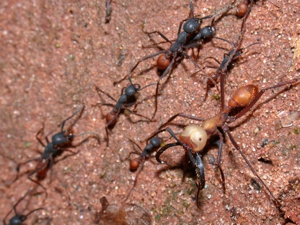 While not one of the "monsters of god" set out in Daniel Quamen's eponymous book, legions of army ants on the move can be terrifying, as illustrated in the quote about from Carl Stephenson's classic 1950's pulp short story, Leiningen versus the Ants. Recently, the genetic history of these insects has been used for more benign and academic purposes, wherein a team of researchers has used genetic evidence to enlighten our understanding of the geographic development of Central America.
The study, by Winston et al.[1] and entitled Early and dynamic colionization of Central America drives speciation in Neotropical army ants, assessed genomic DNA differences between nine Eciton species (E. vagans, E. quadriglume, E. rapax, E. dulcium, E. mexicanum, E. lucanoides, E. burchellii, E. drepanophorum and E. hamatum) for sequence diversity over spatial habitats ranging from Brazil to Mexico. Phylogeny was inferred from 146 specimens comprising 419,804 loci and 6,700,494 nucleotide sites therein. It was motivated by suggestive evidence that the conventional explanation of how and when the Isthmus of Panama was formed (and the biological consequences thereof) was incomplete. Until recently, the Isthmus was believed to have formed about 3 million years ago (Ma) and to have resulted in an intermingling of species that had evolved independently in North and South America (called the Great American Biotic Exchange). However, physical evidence inconsistent with this scenario has been detected, including difference in salinity and benthic carbon between the Pacific Ocean and the Caribbean arising between 4.2 and 4.7 million years ago; Panamanian fluvial deposits in South America that suggest closure of the Isthmus between 13-15 million years ago; and tectonic reconstructions suggesting formation of a volcanic arc about 12 million years ago and development of a series of islands in the area of the Isthmus about 6 million years ago. There has also been a suggestion that "corridors" arose in the area of the Isthmus surrounding a volcanic area in modern-day Nicaragua and Costa Rica.
In the face of this uncertainty, the authors chose to make genomic DNA comparisons of Eciton species because these nomadic ants have wingless queens and cannot swim or use foliage or flotsam to bridge water barriers by rafting, indicating that the results of allopatric speciation events could illustrate the history of how the Isthmus arose in the relevant paleogeographic time period. The paper describes two alternative hypotheses for this speciation: the Full Closure Colonization (FCC) model, which depends on Eciton colonization after closure of the Isthmus about 3 million years ago; and the Early Dynamic Colonization (EDC) model, which posits episodic, earlier colonization as land bridges, islands, and other land corridors arose (and sometimes retreated) over a much longer time period. With regard to the EDC model the authors state:
[D]ispersal into Central America presents both a novel ecological opportunity for colonization and an opportunity for clade diversification across a spaiotemporally complex landscape. Specifically, rather than a single migration across a suitable corridor into Central America, the complex landscape provided a series of patches of suitable habitat analogous to steppingstones with respect to the eventual colonization of Central America. In this model, we would likely infer in situ divesification/speciation before full formation of the isthmus (c. 3 Ma) as a result of dispersing across a complex geological substrate.
The results of genomic DNA comparisons of these ant species provide evidence that the EDC model is far superior to the FCC model and indeed that the FCC model is inconsistent with the speciation events that can be inferred from the genomic DNA comparisons. Divergence times for three specie coincident across the Nicaraguan-Costa Rican volcanic range (north of the Isthmus) are earlier (E. burchellii, 4.27 Ma; E. vagans, 5.5 Ma; E. mexicanum, 6.61 Ma) than predicted by the FCC model, for example.
The authors summarize their findings as follows:
As the early timing (4 –7 Ma) of Central American colonization by Neotropical army ants was robust to multiple calibrations, this provides strong evidence for ephemeral land bridges prior to the full closure of the {Isthmus]. We suggest that these early, inter-continental land connections played an important role in the dispersal of many taxa during the GABI, and likely functioned as a mechanism of speciation through alternating bouts of dispersal and vicariance. Considering that the majority of lineages in lower Central America exhibit genetic structure in this region—including other Neotropical army ant genera—we predict that support for cryptic diversification and the EDC model will only increase as more research is conducted on weakly dispersing Central American species. Lastly, our research suggests that the spatial and temporal complexity of the emerging isthmus needs to be seriously evaluated when invoking the commonly used biogeographic phenomenon of sweepstakes dispersal.
This paper once again illustrates how the ability to elucidate and compare genomic DNA in naturally occurring species can supply important evidence to validate — or rebut — hypotheses regarding subjects as diverse and evolutionary biology and paleogeography, providing a better understanding of the Earth's deep past, the organisms living at those times and how the modern world developed from those beginnings.
[1] Winston, Kronauer and Moreau, Molec. Ecol., doi: 10.1111/mec.13846 (October 25, 2016)
-
By Michael Borella —
 As discussed in a previous article, the U.S. Patent and Trademark Office recently published new subject matter eligibility examples directed to the abstract idea exception to patentability under 35 U.S.C. § 101. These "December 2016 examples" each involve a so-called business method. Business methods have, in general, been looked down upon by the courts and the USPTO for some time, but especially since the Alice Corp. Pty. Ltd. v. CLS Bank Int'l decision.
That case set forth a two-part test to determine whether claims are directed to patent-eligible subject matter. One must first determine whether the claim at hand is directed to a judicially-excluded law of nature, a natural phenomenon, or an abstract idea. If so, then one must further determine whether any element or combination of elements in the claim is sufficient to ensure that the claim amounts to significantly more than the judicial exclusion. But generic computer implementation of an otherwise abstract process does not qualify as "significantly more."
Alice was particularly impactful on business methods, because the Court held that financial and business transactions (the subject matter of many business method claims) are virtually per se abstract. As a consequence, most eligible business methods have to recite sufficient technical detail (usually computer-related software and hardware) in order to prevail in part two of the inquiry. In practice, this makes the distinction between business methods claims and software claims fuzzy at best.
Nonetheless, the USPTO has provided three examples of business methods that can be claimed in a fashion that is eligible. In last week's article, we discussed the first two (Examples 34 and 35), and here we will cover Example 36.
Example 36
Example 36 is a hypothetical invention provided by the USPTO. Thus, it is not based on the facts of any particular case. This example is titled "Tracking Inventory," but is much more specific than that.
The claimed invention is directed to inventory management in a warehouse. In the prior art, tracking devices, such as RFID tags, may be attached to items stored therein. Using RFID equipment, one would be able to rapidly locate a particular item. However, this solution requires the overhead of attaching the RFID tags when storing items, and detaching these tags when removing the items from inventory. Other prior art methods used cameras to capture images of the items, more specifically, identification codes on the items. However, using a single camera for this purpose does not provide an accurate 3D location of the item when it is stored. Of course, items and their locations can be manually logged, but doing so requires even more overhead and is prone to data entry mistakes. As a result, known inventory management techniques have unacceptably high error rates.
In order to overcome these deficiencies, the invention uses a high-resolution camera array with overlapping views. Using this camera array, the contour and shape of stored items, as well as markings on these items can be recorded along with the 3D locations of the items. Recognition of objects uses a machine-learning-based pattern classifier, such as "a Gaussian mixture model, neural network, Bayes classifier or other known pattern classifier." According to this hypothetical, "computer vision technology has not been used in the manner disclosed by this inventor prior to the filing of the application."
The example includes three claims, which we will discuss in turn. Claim 1 recites:
1. A system for managing an inventory record comprising a memory and processor configured to perform the steps of:
(a) creating an inventory record for an item of inventory comprising acquired images of the item;
(b) adding classification data relating to the acquired images to the inventory record;
(c) adding location data relating to each acquired image to the inventory record; and
(d) updating the inventory record with a physical location of each item of inventory in the warehouse to thereby manage the items of inventory.Conducting part one of the Alice analysis, the USPTO characterized the claim as being directed to an abstract idea due to its similarity to other claims deemed abstract. Particularly, the data collection, recognition, and storage steps are "similar to the data collection and management concepts" found abstract in previous cases. Additionally, unlike the eligible claims in Enfish, LLC v. Microsoft Corp., the claim's mere invocation of a memory and a processor does not provide a specific improvement to these computer components.
Turning to step two of Alice, the additional elements of "[a] memory for storing data and a processor for processing data are well‐understood, routine, conventional computer components, which in this claim are recited at a high level of generality and perform generic computer functions." Therefore, when viewed individually, these elements do not lend eligibility. Furthermore, viewing the elements as a combination only reflects "ordinary usage typically performed by a generic computer, as would be recognized by those of ordinary skill in the field of data processing." Therefore, claim 1 lacks an inventive concept and is ineligible under § 101.
The next exemplary claim recites:
2. A system for managing an inventory record by tracking the location of items of inventory in a warehouse:
a high‐resolution video camera array, each video camera positioned at pre‐determined locations with overlapping views, for acquiring at least one high‐resolution image sequence of each item of inventory;
a memory and processor configured to perform the steps of:
(a) creating an inventory record for an item of inventory comprising the acquired image sequence of the item from the video camera array;
(b) adding classification data relating to the acquired image sequence to the inventory record;
(c) adding location data relating to each acquired image to the inventory record, the location data providing a position of the item of inventory in the image sequence;
(d) reconstructing the 3‐D coordinates of an item of inventory using the location data from multiple overlapping images and prior knowledge of the location and field of view of the camera(s); and
(e) automatically updating the inventory record with the 3‐D coordinates of each item of inventory in the warehouse to thereby manage the items of inventory.Beginning with part one of Alice, the USPTO concluded that this claim is also directed to an abstract idea, due to four of its steps being analogous to those of claim 1. Moving on to part two, the USPTO stated that the additional elements of "a high‐resolution video camera array at predetermined positions with overlapping views, memory and processor to (d) reconstruct the 3‐D coordinates of the item of inventory from multiple overlapping images obtained from the camera array and prior knowledge of the location and field of view of the camera(s)" were well-known and conventional. Since these components perform their typical functions, individually they do not contain an inventive concept.
But when viewed as an ordered combination, the story is different. Particularly, the recent Federal Circuit case of BASCOM Global Internet v. AT&T Mobility LLC, stands for the principle that a claim directed to an abstract idea, with additional elements that are individually generic and conventional, can be patent-eligible if the combination of these elements is non-conventional and non‐generic. In claim 2, "the use of [the] camera array provides the ability to track objects throughout the entire storage space rather than simply the view of a single camera and determine their 3‐D location without any of the manual steps that were required of previous methods." As noted above, such use is assumed to be non-conventional by the hypothetical. Moreover, the "claimed solution here is necessarily rooted in computer technology to address a problem specifically arising in the realm of computer vision systems," and the ordered combination of limitations yields a particular, useful application of the abstract idea. Therefore, the claim satisfies the second part of Alice, and is patent-eligible.
The final exemplary claim recites:
3. A system for managing inventory by tracking the location of items of inventory in a warehouse using image recognition, comprising:
a high‐resolution video camera array for acquiring at least one high resolution image sequence of each item;
a memory for storing the acquired image sequences, classification and location data relating to the acquired image sequences, and a recognition model representing contour information and character information of each item; and
a processor that is configured to manage inventory by performing, for each item, the steps of:
(a) creating an inventory record for the item comprising the acquired image sequence(s)of the item;
(b) extracting characteristics from the acquired image sequence(s) of an item to form feature vectors, the characteristics comprising contour information and character information that is stored in the inventory record as classification data relating to the acquired image sequence(s);
(c) recognizing and tracking the position of item in the image sequence as classification and location data by processing the feature vectors using the stored recognition model and adding the classification and location data to the inventory record;
(d) determining a physical location of the item in the warehouse using the location data relating to the item in the image sequence(s); and
(e) automatically updating the inventory record with the physical location of the item.Applying step one of Alice, the USPTO concluded that this claim, like claims 1 and 2, is directed to an abstract idea because it entails "data collection and management techniques to practice the concept of inventory management." With regard to step two, the additional elements of "the camera array, memory and processor limitations do not amount to significantly more for the reasons discussed above for claims 1 and 2."
Viewing the elements as an ordered combination, however, results in the claim being determined to be eligible. The USPTO noted that:
[T]he camera array's acquisition of high resolution image sequences, and the processor's performance of step (b)'s extracting contour and character information from the images to create feature vectors, step (c)'s recognizing and tracking items of inventory using the feature vectors and a recognition model, and step (d)'s determining the physical location of the recognized items using the position of the item in the image sequence(s) is not well‐understood, routine, conventional activity in this field.
Accordingly, the claim recites features that improve over the inaccurate solutions of the past. Notably, this claim recites detail about how feature vectors are extracted from images, and then later used find the items. As a result, the claim is patent eligible.
Analysis
Not unlike Example 35, which we discussed in the previous post, the eligible claims for Example 36 recite technical detail that goes beyond the high-level steps that are used in generic solutions to the problem. Chiefly, claim 2 recites how specific features of the camera array are used to carry out these steps, and claim 3 provides steps that are specific to a particular way of processing, storing, and retrieving representations of the images and the items' locations. On the other hand, claim 1 is ineligible because it recites a high-level process that could be carried out by generic hardware in virtually any fashion.
Rather than rejecting claim 1 as being indefinite or obvious, the USPTO is signaling that it will continue to use § 101 as a hammer to knock down overly-broad claims. Nonetheless, these examples provide illustrations of what type of technical detail and how much of it is needed to meet the requirements of the statute and Alice.
-
 January 25, 2017 – "Functional Patent Claims After Williamson: Understanding the Benefits and Risks for Your University's Patent Portfolio" (Technology Transfer Tactics) – 1:00 to 2:00 pm (Eastern)
January 26, 2017 – "Leveraging Latest Patent Decisions, Navigating New Complexities, Cases to Watch in 2017 — Key Lessons on Patent Eligibility, Deference on Appeal, Venue, Estoppel, Continuation Patent Applications, and More" (Strafford) – 1:00 to 2:30 pm (EST)
January 31, 2017 – "Patent Mistakes in the Administrative State" (John Marshall Law School Center for Intellectual Property, Information & Privacy Law) – 12:00 to 1:30 pm, Chicago, IL
January 31, 2017 – "Proving and Avoiding Inequitable Conduct in Patent Prosecution and Litigation — Leveraging Court Treatment Post-Therasense and the AIA's Answer to Inequitable Conduct Issues" (Strafford) – 1:00 to 2:30 pm (EST)
February 1, 2017 – "Patent Litigation 2017: The Courts and Patent Trial and Appeal Board" (Federal Circuit Bar Association) – 10:00 am to 5:00 pm (PT), Santa Clara, CA
February 22, 2017 – "Patent-Eligibility Update: Abstract Ideas in the Federal Circuit and USPTO" (McDonnell Boehnen Hulbert & Berghoff LLP) – 10:00 am to 11:15 am (CT)
March 9-10, 2017 - Advanced Patent Law Seminar (Chisum Patent Academy) – Cincinnati, OH.
***Patent Docs is a media partner of this conference or CLE
-
The Chisum Patent Academy will be offering the next session of its Advanced Patent Law Seminar on March 9-10, 2017 in Cincinnati, OH. The seminar is co-taught by Donald Chisum, author of the treatise Chisum on Patents (LexisNexis), and Janice Mueller, who was a tenured full Professor at the University of Pittsburgh School of Law from 2004-2011. The registration fee for the seminar is $1,500; a maximum of ten registrations will be accepted for the seminar. Those interested in registering for either seminar can do so here. Additional information regarding the seminar can be obtained here or by e-mailing info@chisum.com.

-
 The John Marshall Law School Center for Intellectual Property, Information & Privacy Law will be hosting Saurabh Vishnubhakat, Associate Professor of Law, Texas A&M University School of Law, who will be presenting on "Patent Mistakes in the Administrative State" from 12:00 to 1:30 pm on January 31, 2017 at the John Marshall Law School in Chicago, IL. Professor Vishnubhakat will discuss how to differentiate among the various types of mistakes that arise in the patent system and will share empirical insights about how the means for correcting those mistakes is changing. He will draw in particular on his own ongoing research into patent examination and both judicial and administrative review of patent validity.
The registration fee for the lecture is $30. Those interested in registering for the conference can do so here.
-
 Strafford will be offering a webinar/teleconference entitled "Proving and Avoiding Inequitable Conduct in Patent Prosecution and Litigation — Leveraging Court Treatment Post-Therasense and the AIA's Answer to Inequitable Conduct Issues" on January 31, 2017 from 1:00 to 2:30 pm (EST). Thomas L. Irving and Amanda K. Murphy, Ph.D., of Finnegan Henderson Farabow Garrett & Dunner, and Margaret J. Sampson of Baker Botts will provide guidance to patent counsel on understanding the types of activity that may lead to a finding of inequitable conduct and practical tactics to reduce the risk of a finding of inequitable content in litigation, and also examine arguments that have worked to avoid a finding of inequitable conduct and those that haven't. The webinar will review the following issues:
• What are the most common assertions defendants make when raising the inequitable conduct defense?
• What are best practices prosecutors and litigators should employ when pursuing and defending inequitable conduct allegations?
• What guidance do post-Therasense decisions and the USPTO proposed rules provide on how inequitable conduct will be treated?The registration fee for the webinar is $297. Those interested in registering for the webinar, can do so here.
-
 The Federal Circuit Bar Association (FCBA) will be offering a program entitled "Patent Litigation 2017: The Courts and Patent Trial and Appeal Board" on February 1, 2017 from 10:00 am to 5:00 pm (PT) at the Santa Clara University School of Law in Santa Clara, CA. The program will include presentations on the following topics:
• Patent Policy in the New Administration
• Practice Before the Board
• Lunch Q&A with Circuit Judge Jimmie V. Reyna of the U.S. Court of Appeals for the Federal Circuit
• Trial Court Practice
• Appellate PracticeThose interested in registering for the program, can do so here. Additional information regarding the program can be found here.

