• By Donald Zuhn —

    NVCALast month, the National Venture Capital Association (NVCA), a trade association representing the U.S. venture capital industry, released the results of its Pitchbook-NVCA Venture Monitor report on venture funding for the fourth quarter of 2016, as well as for the year as a whole.  With respect to the fourth quarter, the report indicates that venture capitalists invested $12.71 billion in 1,744 deals in the fourth quarter, which constituted a 19% decrease in dollars and an 11.8% decrease in deals as compared with the third quarter of 2016, when $15.7 billion was invested in 1,979 deals (see chart below, which shows total venture funding from the first quarter of 2013 through the fourth quarter of 2016; data from Pitchbook report; click on chart to expand).  The fourth quarter of 2016 was the 16th consecutive quarter in which more than $10 billion in venture capital was invested.  However, as compared with the fourth quarter of 2015, invested dollars and deals were down 24.7% and 26.6%, respectively, in the fourth quarter of 2016.

    Venture Funding - Quarterly
    The report also indicates that venture capitalists invested $69.11 billion in 8,136 deals in 2016, which constituted a 12.8% decrease in dollars and a 22.3% decrease in deals as compared with 2015, when $79.26 billion was invested in 10,468 deals (see chart below, which shows total venture funding from 2006 to 2016; data from Pitchbook report; click on chart to expand).  Although venture funding topped $68 billion for the third consecutive year, which represented the second highest annual investment total in the past 11 years, the drop in venture funding in 2016 as compared with 2015 snapped a string of four consecutive year-over-year increases.  The NVCA, however, explained that "[g]iven the high levels of venture investment activity recorded in 2014 and 2015, 2016 represented less of a decline and more of a return to normal for the venture capital industry."  NVCA President and CEO Bobby Franklin suggested that "venture investment levels are readjusting after peaking in 2015," and that the NVCA viewed the "recalibration [in 2016] as a healthy normalization and a return to a much steadier pace of investment."

    Venture Funding - 2006 to 2016
    In 2016, the software sector once again took the top spot in funding — with $32.98 billion invested in 3,100 deals — which constituted an 11-year high in funding for that sector, and marked the third consecutive year in which the sector topped $29 billion in funding and the eighth consecutive annual increase in funding for this sector.  Funding in the software sector in 2016 was up 5.6% as compared with 2015.  Pharma and biotech venture funding in 2016 ran a distant second to the software sector, with $7.79 billion invested in 515 deals, with funding in 2016 down 21.2% as compared with 2015.  The decrease in funding in 2016 in the pharma and biotech sector snapped a six-year string of consecutive year-over-year increases.

    For additional information regarding this and other related topics, please see:

    • " Second Quarter Venture Funding Increases 20% from First Quarter," October 11, 2016
    • "Venture Funding Reaches Highest Level in More Than a Decade," February 25, 2016
    • "Third Quarter Venture Funding Declines 27% from Second Quarter," October 22, 2014
    • "Software Sector Leads Pack in 2Q Venture Funding and Biotech Sector Finishes Second," July 20, 2014
    • "Software Sector Leads First Quarter Venture Funding to Thirteen Year High; Biotech Sector Finishes Second (Again)," April 30, 2014
    • "Biotech Venture Funding Rebounded in 2013 After Strong Fourth Quarter," January 26, 2014
    • "Biotech Venture Funding Sees Second Quarter Rebound," July 22, 2013
    • "Biotech Venture Funding Down 33% in First Quarter," April 30, 2013
    • "Annual Venture Funding Drops for First Time in Three Years," February 4, 2013
    • "Biotech Venture Funding Up 64% in Third Quarter," October 29, 2012
    • "Venture Funding in Life Sciences Sector Drops 9% in Second Quarter," July 22, 2012
    • "Biotech Venture Funding Drops 43% in First Quarter," May 3, 2012
    • "Venture Funding Increased 22% in 2011," February 2, 2012
    • "Life Sciences Venture Funding Drops in Third Quarter," October 27, 2011
    • "Life Sciences Venture Funding up 37% in Second Quarter," August 1, 2011
    • "VentureSource Reports 35% Increase in 1Q Venture Funding," April 26, 2011
    • "NVCA Reports Modest Gains in First Quarter Venture Funding," April 19, 2011

    • "NVCA Reports 31% Drop in Venture Funding for Third Quarter," October 17, 2010

    • "NVCA Reports 34% Increase in Venture Funding for Second Quarter," July 22, 2010

    • "NVCA Report Shows First Quarter Drop in Venture Funding," April 20, 2010

    • "Biotech/Pharma Financing Improving, R&D Spending Up," August 31, 2009
    • "NVCA Study Shows Increase in Third Quarter Venture Funding," October 23, 2009

    • "First Quarter Venture Capital Funding at 12-Year Low," April 23, 2009

    • "NVCA Study Shows Decline in 2008 Investment; BIO Study Predicts Biotech Rebound in 2009," February 16, 2009

  • By Donald Zuhn —

    USPTO SealLast month, the U.S. Patent and Trademark Office published a notice in the Federal Register (82 Fed. Reg. 3758) requesting comments from stakeholders regarding whether the accelerated examination program should be retained or discontinued.  The Office notes that while the accelerated examination program, which was implemented in August 2006, was once relatively popular, fewer than 250 applications were accepted into the program annually between 2012 and 2015.  As a result, the Office is now seeking stakeholder feedback as to whether the program provides a sufficient benefit to the public to justify the cost of implementation.

    Part of the decrease in the popularity of the accelerated examination program may be due to the creation in September 2011 of the prioritized examination ("Track One") program under the Leahy-Smith America Invents Act.  In contrast with the accelerated examination program, where applicants must file a petition to make special and perform a pre-examination search, the Track One program requires that applicants simply pay an additional fee to advance an application out of turn.  According to the Office's notice, since the Track One program was implemented, the number of annual requests has approached 10,000.

    The notice also suggests that the drop in accelerated examination requests may be attributable in part to a recent decrease in overall first action pendency.  From FY 2006 to FY 2011, when the accelerated examination program was the only option available, average first action pendency increased from 22.6 months to 28.0 months (the latter being an 11-year high), but from FY 2012 to FY 2016, first action pendency decreased from 21.9 months to 16.2 months (the latter being an 11-year low).  In addition, average total pendency increased from 31.1 months in FY 2006 to an 11-year high of 35.3 months in FY 2010, and then decreased from 33.7 months in FY 2011 to an 11-year low of 25.3 months in 2016.  Average first action pendency (blue line) and average total pendency (orange line) from FY 2006 through FY 2016 are shown in the chart below (click on chart to expand).

    Pendency
    In the notice, the Office suggests that "[a] lower first action pendency and lower accelerated examination numbers seem to indicate that applicants have less need for as many programs that expedite patent examination."  Comments regarding the retention or discontinuation of the accelerated examination program can be submitted by e-mail to AEcomments2016@ uspto.gov, or by regular mail addressed to:  Mail Stop Comments—Patents, Commissioner for Patents, P.O. Box 1450, Alexandria, VA 22313–1450, marked to the attention of Pinchus Laufer, Senior Legal Advisor, Office of Patent Legal Administration, Office of the Deputy Commissioner for Patent Examination Policy.  Comments must be received by the Office by March 13, 2017 to be ensured of consideration.

  • By Donald Zuhn —

    CoverThe U.S. Patent and Trademark Office recently released its Performance and Accountability Report Fiscal Year 2016.  In describing the USPTO's strategic and performance-planning framework, the 2016 report reminds readers that the Office issued a new strategic plan in 2014, the 2014-2018 Strategic Plan.  The report reiterates that the 2014-2018 Strategic Plan "demonstrates the progress made to date by building on the tangible successes of recent years with a focus on achieving the USPTO's vision as a global IP leader by:

    • Establishing the optimal pendency and quality levels for both patents and trademarks that will enable the USPTO to operate efficiently and effectively within the expectations of the IP community;
    • Administering effectively the provisions of the AIA;
    • Continuing to transform the USPTO with next-generation technology and services;
    • Maintaining a strong and diverse leadership team, agile management structure, and a diverse and engaged cadre of employees in achieving the agency’s mission and vision;
    • Continuing to work with other government agencies, Congress, and USPTO’s global partners to establish IP systems that benefit innovation, create jobs, and lead to strong economies around the world; and
    • Recruiting and retaining the highest quality employees to accomplish the agency’s important work."

    The 2016 Report specifies ten key performance outcome measures for which the Office has developed annual performance targets.  According to the report, the Office met its annual performance targets for eight of the ten performance measures.  Missing from this year's report was the Patent Quality Composite Score performance measure (for FY 2015, the Office did not meet its target for this measure, hitting eight of eleven performance targets).  With regard to the omitted performance measure, the 2016 report explains in a footnote that:

    The USPTO is working with internal and external stakeholders to reevaluate the entire quality process at the USPTO by engaging in public forums and roundtables to increase the effectiveness, clarity, and simplicity of the USPTO's quality review process by focusing on excellence in work products, excellence in measuring patent quality, and excellence in customer service.  As part of this effort, the USPTO aims to define and introduce revised quality metrics based on stakeholder input by October 2016.  Because the precise contours of the metric will likely change in the upcoming years, it is not useful to portray trends for the current measure.

    With respect to the remaining performance measures, two of the ten measures fall within the Office's first strategic goal, which concerns optimizing patent quality and timeliness.  In particular, average first action pendency was 16.2 months (higher than the 14.8-month target, but lower than the 17.3-month average first action pendency of FY 2015), and average total pendency was 25.3 months (lower than the 25.4-month target and lower than the 26.6-month average total pendency of FY 2015).

    Table 2 of the report provides data for the patent-related performance targets for FY 2012 to FY 2016 (click on any table to expand):

    Table 2_Strategic Goals
    The report also notes that the number of applications filed increased from 618,062 in FY 2015 to 650,411 in FY 2016, which constituted a 5.2% increase in filings (see Table 1 below).  This followed a slight decrease in application filings in FY 2015 and a 2.8% increase in application filings in FY 2014.

    Table 1
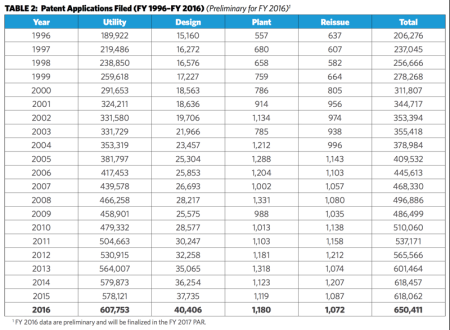
    The report also indicates that while the Office accepted more than 600,000 patent applications for the fourth straight year and topped 500,000 applications for the seventh consecutive year (see Table 2 below), it was able to reduce the number of applications awaiting action from 592,417 in FY 2015 to 570,074 in FY 2016 (see Table 3 below).  The total number of pending applications also decreased from 1,099,468 in FY 2015 to 1,070,163 in FY 2016.  It was the Office's third consecutive reduction in number of applications awaiting action and sixth consecutive reduction in total number of pending applications.

    Table 2

    Table 3
    After dropping from 303,930 utility patent issuances in FY 2014 to 295,459 in FY 2015, patent issuances were once again on the rise in FY 2016, hitting 334,107 (see Table 6 below).

    Table 6
    As noted above, the results for first action and total pendency were mixed, with first action pendency coming in above the Office's target, and total pendency coming in below the Office's target (see Tables 4 and 5 below).  And the goals for FY 2017 present even tougher challenges:  for first action pendency, the annual performance target drops from 14.8 months for FY 2016 (which the Office failed to meet) to 14.5 months for FY 2017, and for total pendency, the annual performance target drops from 25.4 months in FY 2016 (which the Office met) to 23.5 months in FY 2017.

    Table 4_Pendency

    Table 5_Pendency
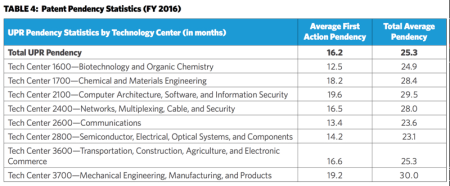
    When comparing pendency statistics by Technology Center, Tech Center 1600 (biotechnology and organic chemistry) produced the best average first action pendency (12.5 months), and Tech Center 2100 (computer architecture, software, and information security) produced the worst average first action pendency (19.6 months) (see Table 4 below).  As for total average pendency, Tech Center 2800 (semiconductor, electrical, optical systems, and components) produced the best total average pendency (23.1 months), and Tech Center 3700 (mechanical engineering, manufacturing, and products) produced the worst (30.0 months).

    Table 4
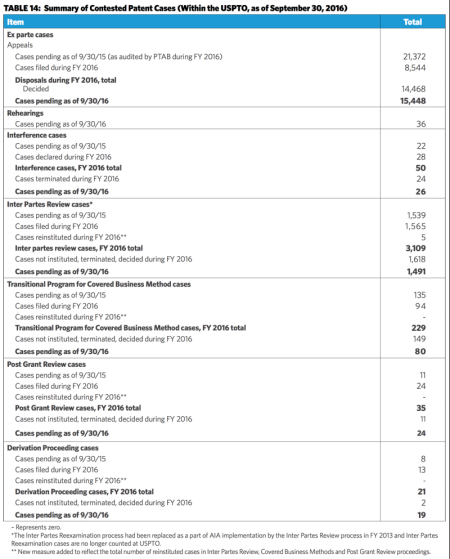
    Finally, the report indicates that 1,565 inter partes review cases were filed in FY 2016, down from 1,737 in FY 2015, and 24 post grant review cases were filed in FY 2016, up from 11 in FY 2015 (see Table 14 below).

    Table 14

    For additional information regarding this and other related topics, please see:

    • "USPTO Issues Performance and Accountability Report for FY 2015," March 3, 2016
    • "USPTO Issues Performance and Accountability Report for FY 2014," April 7, 2015
    • "USPTO Releases Performance and Accountability Report for FY 2013," January 9, 2014
    • "USPTO Releases Performance and Accountability Report for FY 2012," November 28, 2012
    • "USPTO Releases Performance and Accountability Report for FY 2011," November 30, 2011
    • "USPTO Releases 2010 Performance and Accountability Report," November 17, 2010
    • "USPTO Announces 'Highest Performance Levels in Agency's History' in 2008," November 18, 2008
    • "USPTO Announces 'Record Breaking' 2007 Performance," November 15, 2007
    • "Patent Office Announces Record-Breaking Year," December 27, 2006

  • In December 2016, the Norwegian Court of Appeal handed down its decision in Pharmaq v Intervet[1], which concerns the validity of Intervet's SPC for a viral vaccine for preventing pancreatic disease (PD) in salmonid fish.  Followers of SPC case law will be aware that questions relating to this case have previously been considered by the EFTA Court[2], having been referred by the Oslo District Court.  The advisory opinion of the EFTA Court was subsequently interpreted by the District Court who found in favour of Intervet[3].  The recent decision concerns Pharmaq's appeal.

    The case is of general interest in that it relates to the extent to which an SPC for a biological product may be considered to encompass closely-related alternatives such as biosimilars.  The guidance of the EFTA court was that an SPC is invalid due to non-compliance with Article 4 of the SPC Regulation[4], to the extent that it has been granted with a wider scope than that set out in the relevant Marketing Authorisation (MA).  However, the EFTA Court also proposed that an SPC for a viral vaccine could extend to cover a specific strain of virus encompassed by the claims of the patent but not mentioned in the MA, provided said strain constitutes the "same active ingredient" as the authorised product, and has therapeutic effects within the same indications for which the MA was granted.

    Applying this guidance, the Oslo District Court had found in a majority decision that the competing products of Pharmaq and Intervet did constitute the "same active ingredient", thus holding in favour of Intervet.  However, reconsidering the EFTA Court's guidance in the light of new evidence before it, the Norwegian Court of Appeal has now overturned that earlier decision.

    Claim 1 of Intervet's patent explicitly recited the deposited virus strain (of type SAV-1) that was used in its own vaccine.  However, the claim referred also to "closely-related strains which share similar genotypic or phenotypic characteristics".  In proceedings relating to the patent, the virus strain (of type SAV-3) used in Pharmaq's competing product was found to infringe the claim by virtue of this "closely-related" feature.  Intervet's MA specifically describes the deposited strain used in its own product.  Nonetheless, when applying for an SPC from the Norwegian Patent Office, Intervet stipulated a definition of the product which precisely mirrored the wording of claim 1 of the patent, thus including the reference to "closely-related strains".

    The Norwegian Patent Office was evidently concerned that this product definition was broader than that provided by the MA, and thus problematic under Article 4 of the SPC Regulation.  There is some suggestion that the examiner's preference would have been to limit to closely-related strains of the SAV-1 type, but he found no basis for this interpretation in the patent.  Therefore, recognising a legitimate concern that an SPC limited solely to the deposited strain could be easily circumvented, the Office awarded Intervet the benefit of the doubt — in the knowledge that Pharmaq were bringing a legal challenge to the SPC and that the question would ultimately be decided in the courts.

    The proceedings before the Court of Appeal spent a considerable amount of effort interpreting the EFTA Court's guidance, and the extent to which Intervet's and Pharmaq's products might be considered to constitute the same active ingredient.  As part of their argumentation, Intervet relied upon the decision of the CJEU in Farmitalia[5].  This long-standing decision established that where a patent claims a chemical compound and the marketing authorisation specifies a particular salt, the SPC is interpreted to cover alternative salts and esters of the same compound, which are in principle therapeutically equivalent.  It has been argued (including by Intervet) that similar reasoning should apply for closely-related biological products in order for the purpose of the SPC Regulation to be met.

    The Norwegian Court of Appeal recognised the importance of Farmitalia in establishing that the purpose of the SPC Regulation would not be satisfied if therapeutically equivalent salts and esters were not covered by an SPC for a small chemical entity.  They also recognised the desirability of establishing a corresponding definition for biological medicinal products which, in line with Farmitalia, prevents third parties from escaping the scope of an SPC by making only minor changes to an active ingredient that otherwise remains therapeutically equivalent.  However, they noted that Farmitalia provides limited guidance for biological products (unsurprisingly given the age of that decision) and the Court was concerned also to balance the scope of protection of SPCs for such products against the other objectives of the SPC regulation.  In particular, the aim that improved medicinal products should not be kept off the market to the detriment of human or veterinary health.  Much of the Norwegian Court of Appeal's decision is thus spent grappling with these conflicting pressures.

    They found what they considered to be helpful guidance in a 2009 judgment of the Dutch Appellate Court submitted by Pharmaq,  referred to as the "Yeda judgment" (2000809060/1/H3).  In that judgment, the Dutch Court upheld the decision of the Dutch Patent Office to grant an SPC only in respect of the specific active ingredient Adalimumab (a monoclonal antibody) mentioned in the relevant MA, despite the patent claims encompassing other antibodies specific for the same target.  Yeda had argued that the other antibodies would be expected to have the same therapeutic effect as Adalimumab, and pointed to Farmitalia as supporting grant of an SPC with a broader product definition.  The Dutch Court found that it was not proven that other antibodies would have the same therapeutic effect, and furthermore that even closely related biological medical products are qualitatively different to salts and esters of a chemical product.  The Dutch Court noted that even minor differences in a biological product could be significant for the quality, safety, and efficacy of the said product.

    The Norwegian Court of Appeal adopted much of the same reasoning, stating that for there to be a different active ingredient, the difference between two products must be expressed such that there is a practical and appreciable effect on the quality, safety, and efficacy of the medicine in question.  Intervet argued that any such difference must be systematic, consistent and significant in order for two products to be found different.  The Court expressed some doubt that a "significant" standard was too high a threshold, but did not need to consider this further since, on the evidence before it, they found that Pharmaq's product was systematically, consistently and significantly more efficacious against SAV-3 infection than Intervet's product.

    Having reached this conclusion, the Norwegian Court of Appeal decided that Intervet's SPC was invalid for lack of compliance with Article 4 of the SPC Regulation.  The Court noted that this is not a ground for invalidity under Article 15 of the SPC Regulation, and thus was obliged to define Article 15 as "not exhaustive" in order to make their decision.  Interestingly, the Court also felt that they had no legal basis to amend the SPC to provide a compliant product definition, even though the guidance from the EFTA Court appeared to suggest such an option.  The EFTA Court's guidance was that an SPC would be invalid to the extent that it covers anything other than the authorised product.

    The decision of the Norwegian Court of Appeal is not yet final since an appeal to the Norwegian Supreme Court remains possible at time of writing.  In addition, it remains to be seen whether the CJEU and/or other national courts will adopt similar reasoning.  Nonetheless, we offer the following conclusions and recommendations:

    1.  Applicants should be alert to the risk involved if the definition of the product offered in an SPC application could be interpreted as broader than the authorised medicinal product — a definition that is too broad may result in loss of the entire SPC and it may be impossible to amend after grant.

    2.  The approach of the CJEU in Farmitalia for salts and esters of small chemical compounds has been confirmed, but it appears likely that this will not be found to be directly applicable to (complex) biological products.

    3.  There may be some scope for an SPC to protect biological products that are "therapeutically equivalent" to an authorised product, but it remains unclear how best to define the product in order to allow for this — language relating to a lack of any systematic, consistent (and significant) difference in quality, safety and efficacy may be helpful.

    4.  Where possible (bearing in mind patent claim scope and time limits) consider applying for a separate SPC based on the applicant's own patent and a competitor's MA.  Such an application could use a narrow product definition directed specifically to the competitor's authorised biological product.  This will permit an SPC application for the applicant's own product to be presented with a definition that minimises the risk mentioned in 1.

    [1] Translation of decision available here.
    [2] Translation of decision available here.
    [3] Similar status to the CJEU for matters referred by the national courts of the EFTA states: Norway, Iceland, Liechtenstein. Copy of the advisory opinion available here.
    [4] Article 4: Within the limits of the protection conferred by the basic patent, the protection conferred by a certificate shall extend only to the product covered by the authorisation to place the corresponding medicinal product on the market and for any use of the product as a medicinal product that has been authorised before the expiry of the certificate.  Full regulation available here.
    [5] C-392/97.  Full decision available here.Bottom of Form

    This article was reprinted with permission from J A Kemp.

  • CalendarFebruary 7, 2017 – "Two Years of Federal Circuit Review of PTAB Proceedings: What We Know and Still Don't Know" (Federal Circuit Bar Association) – 1:00 to 2:00 pm (EST)

    February 14, 2017 – "Post-Grant Proceedings: Practical Tips and Strategies in 2017" (Knowledge Group) – 3:00 to 4:00 pm (EST)

    February 14, 2017 – "Understanding the ADS: Little Things Make a Big Difference" (U.S. Patent and Trademark Office) – 12:00 to 1:00 pm (ET) on 

    February 15, 2017 – "Identifying the Effects of Brexit on the Protection and Enforcement of IP Rights" (Knowledge Group) – 10:00 to 11:00 am (EST)

    February 16, 2017 – "Trade Secrets and Patents: A Comprehensive Approach to Protecting Intellectual Property — Evaluating the Protection Options, Weighing the Benefits and Risks" (Strafford) – 1:00 to 2:30 pm (EST)

    February 22, 2017 – "Patent-Eligibility Update: Abstract Ideas in the Federal Circuit and USPTO" (McDonnell Boehnen Hulbert & Berghoff LLP) – 10:00 am to 11:15 am (CT)

    March 9-10, 2017 - Advanced Patent Law Seminar (Chisum Patent Academy) – Cincinnati, OH.

    ***Patent Docs is a media partner of this conference or CLE

  • Federal Circuit Bar AssociationThe Federal Circuit Bar Association (FCBA) will be offering a webcast entitled "Two Years of Federal Circuit Review of PTAB Proceedings: What We Know and Still Don't Know" on February 7, 2017 from 1:00 to 2:00 pm (EST) at the FCBA Conference Room in Washington, DC.  Christopher A. Suarez of Williams & Connolly LLP will moderate a panel consisting of Justin Krieger of Kilpatrick Townsend & Stockton LLP; Derek McCorquindale of Finnegan, Henderson, Farabow, Garrett & Dunner, LLP; and Rachel Elsby of Akin Gump Strauss Hauer & Feld LLP.  The panel will provide an overview of the Federal Circuit's decisions in IPR appeals to date, provide statistics as well as a detailed discussion of various topics, including developments in claim construction, motions to amend practice, and the Federal Circuit's deferential posture toward the PTAB, and discuss issues that have not yet been resolved or will be resolved en banc, including the issues raised by the Wi-Fi One and In re Aqua Products cases.

    The registration fee for the webcast is $125 (non-member private practitioner), $50 (non-member government/academic/retired), or free (FCBA member).  Those interested in registering for the webcast, can do so here.

  • The Knowledge GroupThe Knowledge Group will offer a live webcast entitled "Post-Grant Proceedings: Practical Tips and Strategies in 2017" on February 14, 2017 from 3:00 to 4:00 pm (EST).  Jonathan R. Bowser of Buchanan Ingersoll & Rooney PC, and Vivek Ganti of Hill, Kertscher & Wharton, LLP will provide attendees with practice tips for post-grant validity proceedings.  The panel will cover the following topics:

    • An Overview of Post-Grant Proceedings
    • Current Statistics and Trends
    • USPTO Rules for AIA Post-Grant Proceedings
    • Estoppel Challenges
    • Recent Filings and Decisions
    • Strategic Filing Considerations

    The registration fee for the webcast is $299 (regular rate) or $199 (government/nonprofit rate).  Those interested in registering for the webinar can do so here.

  • Strafford #1Strafford will be offering a webinar/teleconference entitled "Trade Secrets and Patents: A Comprehensive Approach to Protecting Intellectual Property — Evaluating the Protection Options, Weighing the Benefits and Risks" on February 16, 2017 from 1:00 to 2:30 pm (EST).  Steven M. Cohen, Senior Intellectual Property Counsel, Open Text; R. Mark Halligan of FisherBroyles; and Pejman F. Sharifi of Winston & Strawn will provide guidance for IP counsel in determining whether trade secret or patent protection is the optimal mode for inventions and technologies, and outline best practices for counsel to consider in determining the optimal form of protection.  The webinar will review the following issues:

    • What impact will the DTSA have on patents?
    • What impact is the AIA having on trade secrets?
    • For what types of inventions is trade secret protection most suitable?
    • Which inventions are more suitable for patents?
    • What factors should counsel consider when choosing between trade secrets and patents to protect IP?

    The registration fee for the webinar is $297.  Those interested in registering for the webinar, can do so here.

  • The Knowledge GroupThe Knowledge Group will offer a live webcast entitled "Identifying the Effects of Brexit on the Protection and Enforcement of IP Rights" on February 15, 2017 from 10:00 to 11:00 am (EST).  Steven Baldwin of Allen & Overy LLP, and Dr. Sean Jauss of Mewburn Ellis LLP will provide attendees with an in-depth analysis of the significant effects of Brexit on the protection and enforcement of IP Rights, and highlight the important issues and provide knowledgeable insight with regards to this topic.  The panel will cover the following topics:

    • IP Rights After Brexit
    • Impacts and Implications
    • Protection and Enforcement of IP Rights
    • The Unitary Patent System
    • Recent Trends and Developments

    The registration fee for the webcast is $299 (regular rate) or $199 (government/nonprofit rate).  Those interested in registering for the webinar can do so here.

  • USPTO SealThe U.S. Patent and Trademark Office will be offering the next webinar in its Patent Quality Chat webinar series from 12:00 to 1:00 pm (ET) on February 14, 2017.  Sandie Spyrou, Supervisor, Office of Patent Quality Assurance, and Mary Beth Jones, Supervisor, Office of Patent Quality Assurance, will discuss "Understanding the ADS: Little Things Make a Big Difference."

    Instructions for viewing the webinar can be found here.

    Additional information regarding the Patent Quality Chat webinar series can be found on the USPTO's Patent Quality Chat webpage.