By Kevin E. Noonan —
 It has been the experience of more than a few first-year law students taking Civil Procedure I that the only correct answer to a complex procedural problem is that there is no way for a plaintiff to bring suit. The student usually develops this legal insight on the final exam, where the professor (in part under the rubric that "what doesn't defeat you makes you stronger," and perhaps in part for less altruistic motives) includes a variety of factual predicates to procedural rules that are in sufficient conflict that the only correct answer is that the action must be dismissed under Rule 12. While less common in "real life," a pro se putative inventor lived one of these final exam problems in Ali v. Carnegie Institution of Washington and the University of Massachusetts, with consequences much more severe than not receiving an "A".
The case involved Mr. Ali's contention that he was improperly not named as an inventor in a series of patents (U.S. Patent Nos. 6,506,559, 7,538,095, 7,560,438, and 7,622,633) related to RNAi technology. These patents claimed methods for exploiting a natural genetic defense mechanism (regarding "interfering RNA" and comprising, inter alia, enzymes including DICER) to modify gene expression in mammalian cells. Claim 1 of the '559 patent is representative:
1. A method to inhibit expression of a target gene in a cell in vitro comprising introduction of a ribonucleic acid (RNA) into the cell in an amount sufficient to inhibit expression of the target gene, wherein the RNA is a double-stranded molecule with a first strand consisting essentially of a ribonucleotide sequence which corresponds to a nucleotide sequence of the target gene and a second strand consisting essentially of a ribonucleotide sequence which is complementary to the nucleotide sequence of the target gene, wherein the first and the second ribonucleotide strands are separate complementary strands that hybridize to each other to form said double-stranded molecule, and the double-stranded molecule inhibits expression of the target gene.
These patents are commercially valuable because the technology they protect is hoped to be important for novel drug development; the scientific significance of the underlying inventions is evidenced by two of the named inventors (Dr. Andrew Fire of Carnegie and Dr. Craig C. Mello of the University of Massachusetts) receiving the Nobel Prize in 2006. Plaintiff Ali contended that he made "a critical contribution" to the inventions as a member of Dr. Mello's lab, but that the named inventors (and their institutions) refused his repeated entreaties to recognize his contribution by naming him as an inventor.
 The suit was first filed in the District of Oregon under 35 U.S.C. § 256 (for correcting inventorship of a granted patent) as well as damages for royalties and other monies the named inventors had received. The District Court granted the University's motion to dismiss under Fed. R. Civ. P. (12)(b)(1) on the grounds that the university, as an "arm" of the state, was immune from suit under the Eleventh Amendment's sovereign immunity doctrine. The Oregon Court then sua sponte transferred the action to the D.C. District Court, because the Oregon Court held it did not have either general or specific personal jurisdiction (which the D.C. Court did as the residence of the Institution). That Court then dismissed the action under Fed. R. Civ. P. (12)(b)(7) because the University of Massachusetts was a necessary party (due to co-ownership of the patents-in-suit). In this regard the Federal Circuit set forth the three "variables" the District Court considered in making it's decision:
(1) [W]hether the absent party is "required" for the litigation according to the factors enumerated in [Fed. R. Civ. P. 19(a)]; (2) whether the required party can be joined; and (3) if joinder is not feasible, whether the action can nevertheless proceeding in "equity and good conscience" under [the factors identified in Fed. R. Civ. P. 19(b)].
With regard to the first variable, the District Court relied on the analysis set forth in OAO Healthcare Solutions, Inc. v. Nat'l Alliance of Postal & Fed. Emps., 394 F. Supp. 2d 16, 19 (D.D.C. 2005), and Kickapoo Tribe of Indians of Kickapoo Reservation in Kan. v. Babbitt, 43 F .3d 1491, 1494 (D.C. Cir. 1995):
[A] party is to be joined if feasible if (1) the court cannot accord complete relief among existing parties; (2) the party's absence may, as a practical matter, impair or impede that party's ability to protect its interest; or (3) the party's absence may subject the existing parties to substantial risk of incurring multiple or otherwise inconsistent obligations.
Further, with regard to the third variable the District Court considered:
(1) the extent to which a judgment rendered in the person's absence might prejudice that person or the existing parties; (2) the extent to which any prejudice could be lessened or avoided by: (A) protective provisions in the judgment[,] (B) shaping the relief[,] or (C) other measures; (3) whether a judgment rendered in the person's absence would be adequate; and (4) whether the plaintiff would have an adequate remedy if the action were dismissed for nonjoinder.
The D.C. District Court found in applying these principles that the University of Massachusetts was a necessary party under Rule 19(a). Mr. Ali's claim threatened the University's "ownership interest" that, although not implicated in the correction of inventorship issue was impacted by his claims for monetary damages. The D.C. District Court agreed with its sister court in Oregon that Massachusetts was immunized from suit under the Eleventh Amendment, and held that "equity and good conscience" did not permit proceeding in the University's absence. Applying the three factors involved in considering the first variable (and emphasizing the "substantial discretion" the Court had in deciding whether to proceed), the D.C. District Court held that, while Massachusett's interests in the inventorship question aligned with Carnegie's, "UMass's relationship with [Mr. Ali] is much more central to the case than is Carnegie's" in view of Mr. Ali's claim arising from his employment at the University in Dr. Mello's lab. The Court also noted that the two research institutions' interests were not completely aligned, because, for example, "Carnegie may even be incentivized to settle the case early as to the . . . inventorship claim to eliminate its own potential liability which would highly prejudice the absent UMass's ownership interest in the patents" (emphasis in opinion). It would also be "highly prejudicial" to Carnegie to have to defend Mr. Ali's monetary damages claims over monies that would be owed by the University of Massachusetts and not itself.
The Court could find no alternative relief that would mitigate this prejudice to Massachusetts, nor could the Court provide complete relief to Mr. Ali because it could only rule on the inventorship counts in his complaint in Massachusetts' absence. On Mr. Ali’s requested reconsideration, the D.C. District Court rejected his contentions that the other co-owners could pay the University's share of the damages, and also held that the fixed nature of the recompense Massachusetts gives its inventors did not negate the fact that Massachusetts would be liable for damages to Mr. Ali should he prevail. It did not help Mr. Ali's cause that "sovereign immunity reigns supreme" in the D.C. Circuit.
This appeal followed. The Federal Circuit affirmed, in a per curiam opinion by a panel of Judges Dyk, Bryson, and Chen, with Judge Dyk writing a concurring opinion. The court applied its own law de novo to the question of sovereign immunity, but applied regional circuit law to the procedural questions underlying the motions to dismiss; in both regional circuits, the standard of review for these questions is abuse of discretion.
On the question of sovereign immunity, the panel found no evidence that Massachusetts waived this constitutional privilege by accepting Federal research funds under the Bayh-Dole Act. There are only two circumstances under which the Federal Circuit recognizes such waiver: "first, if the state on its own initiative invokes the jurisdiction of the federal courts; and second, upon a clear declaration by the state of its intent to submit to federal jurisdiction," citing Xechem Int'l, Inc. v. Univ. of Tex. M.D. Anderson Cancer Ctr., 382 F.3d 1324, 1329 (Fed. Cir. 2004), and Coll. Sav. Bank v. Fla. Prepaid Postsecondary Educ. Expense Bd., 527 U.S. 666, 675–76 (1999). Here, the waiver cited by Mr. Ali was to suit by the federal government not private parties. The Court rejected Mr. Ali's arguments regarding limitations on discovery (first granted and then rescinded by the Oregon District Court) on substantially the same grounds, that the subject matter of the discovery was not related to Mr. Ali's inventorship interests in the patents-in-suit.
Turning to the procedural issues, the panel found no fault with either district courts' application of the procedural rules, and particularly found no due process violations in how the courts had applied these procedural rules. And the Court distinguished its contrary holding in a similar case (Univ. of Utah v. Max-Planck-Gesellschaft Zur Forderung Der Wissenschaften E.V., 734 F.3d 1315, 1326 (Fed. Cir. 2013)) on the grounds that there, "UMass had entered into a[n] . . . agreement wherein it 'handed sole and exclusive control of th[e] suit' to one of the named defendants in the action," which was not the case here. Finally, the Court found no error in the D.C. District Court refusing to permit Mr. Ali from filing a second amended complaint because he had not provided any reason why such a complaint would not have been futile (as well as noting certain technical difficulties in the actual filing that justified the District Court in denying Mr. Ali's motion to amend his complaint).
Judge Dyk wrote in concurrence to remind us that "[o]rdinary property disputes between individuals and state entities are resolved in state court" and thus the Eleventh Amendment "does not operate to leave the property owner without a remedy when a suit in federal court is dismissed." But patent disputes are different, and "a claimant's only remedy lies in a federal cause of action under 35 U.S.C. § 256 to correct inventorship." Under these circumstances, he writes, "it seems to me particularly harsh to hold that the federal action—in which the relief sought is directed to the Director of the Patent Office—cannot proceed without the state entity as a party." Thus, for Judge Dyk "it remains for us to determine in another case how the Rule 19(b) factors should apply to a claim for inventorship, given the lack of any alternative remedy."
Ali v. Carnegie Institution of Washington (Fed. Cir. 2017)
Nonprecedential disposition
Panel: Circuit Judges Dyk, Bryson, and Chen
Per curiam opinion; concurring opinion by Circuit Judge Dyk
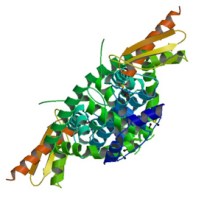
Structure of RNaseIIIb and dsRNA binding domains of mouse Dicer (above) by RCSB, from the Wikipedia Commons under the Creative Commons Attribution-ShareAlike 4.0 International license.