• CalendarApril 6, 2017 – "Markush Claims in Pharma/Chemical Patent Prosecution and Litigation: Leveraging Federal Court Guidance — Constructing Group Claims, Navigating Comprising and Consisting of, Avoiding Improper Rejections" (Strafford) – 1:00 to 2:30 pm (EDT)

    April 7, 2017 – "Patent Litigation: Trial and Appellate Issues and Trends" (Baylor Law School & Federal Circuit Bar Association) – Hyatt Regency Washington on Capitol Hill in Washington, DC – 10:30 am to 2:35 pm (EST)

    April 18, 2017 – "The Defend Trade Secrets Act at (Almost) One" (McDonnell Boehnen Hulbert & Berghoff LLP) – 10:00 am to 11:15 am (CT)

    April 18, 2017 – "A Patent Exhaustion Doctrine for the 21st Century" (Intellectual Property Law Association of Chicago Patent Committee – 4:00 to 6:00 pm (CT), Chicago, IL

    April 19, 2017 – "The Intersection of the PTO Practice and the Courts" (Federal Circuit Bar Association and Wayne State University) – Wayne State University McGregor Memorial Conference Center, Detroit, MI – 9:00 am to 5:00 pm (ET)

    April 20, 2017 – "Double Patenting: Defeating Double Patenting Rejections and Avoiding Terminal Disclaimers" (Strafford) – 1:00 to 2:30 pm (EDT)

    ***Patent Docs is a media partner of this conference or CLE

  • Federal Circuit Bar AssociationThe Federal Circuit Bar Association (FCBA) in connection with Wayne State University will be offering a program entitled "The Intersection of the PTO Practice and the Courts" on April 19, 2017 from 9:00 am to 5:00 pm (ET) at the Wayne State University McGregor Memorial Conference Center in Detroit, MI.  The program will include presentations on the following topics:

    • Best Practices before PTAB
    • A View from the Bench
    • Lunch Keynote by Dr. Christal Sheppard, Director, Elijah J. McCoy Midwest Regional U.S. Patent and Trademark Office
    • New TTAB Rules and the Effects of B&B Hardware on TTAB Rules
    Ex Parte and Inter Partes Patent Appeals Concerning Obviousness

    Those interested in registering for the program, can do so here.  Additional information regarding the program can be found here.

  • Strafford #1Strafford will be offering a webinar/teleconference entitled "Double Patenting: Defeating Double Patenting Rejections and Avoiding Terminal Disclaimers" on April 20, 2017 from 1:00 to 2:30 pm (EDT).  Thomas L. Irving and Leslie A. McDonell of Finnegan Henderson Farabow Garrett & Dunner and Margaret J. Sampson of Baker Botts will provide guidance to IP counsel for understanding Patent Term Adjustment (PTA) B-delay possibilities and double patenting, particularly in view of a desire not to lose PTA in an earlier issued patent.  The panel will also analyze recent court treatment and offer best practices to defeat double patenting rejections and avoid terminal disclaimers, and if a terminal disclaimer must be filed, some specific language to consider.  The webinar will review the following issues:

    • What is the scope of double patenting?
    • What is the examiner's duty for presenting double patenting rejections?
    • What steps can be taken to defeat double patenting rejections?
    • What best practices can be employed to avoid terminal disclaimers?
    • How can practitioners craft terminal disclaimers with an eye towards patent litigation?

    The registration fee for the webinar is $297.  Those interested in registering for the webinar, can do so here.

  • IPLACThe Intellectual Property Law Association of Chicago (IPLAC) Patent Committee will be offering a presentation on "A Patent Exhaustion Doctrine for the 21st Century" by David L. De Bruin of Honigman Miller Schwartz and Cohn LLP on April 18, 2017 from 4:00 to 6:00 pm (CT) in Chicago, IL.  The event is free for IPLAC members and non-members.  Those interested in registering for event can do so here.

  • Claims Lacking Details Found to be Directed to Patent-Ineligible Subject Matter

    By Joseph Herndon

    Ao_sealIn the U.S. District Court for the District of Utah (Central Division), Polar filed a motion for judgment on the pleadings contending that certain claims of U.S. Patent No. 6,701,271 (owned by Icon Health & Fitness) are directed to patent-ineligible subject matter and are, therefore, invalid under 35 U.S.C. § 101.

    The District Court granted the motion, and held that the asserted claims were directed to patent ineligible subject matter because they simply recite receiving data, determining an evaluation of the data, and providing a notification regarding the evaluation without reference to details for how such functions are performed.  In addition, the '271 patent recites that conventional components may be used to perform such functions, and thus, the claims were found to be similar to those invalidated by the Federal Circuit in prior cases.

    The '271 Patent

    The '271 patent generally discloses a method and system for providing feedback that includes receiving data indicative of a physical characteristic of a first subject and a physical characteristic of a second subject, determining an evaluation of the data or course of action, and providing a notification regarding the evaluation or course of action to a device.

    The '271 patent broadly defines the terms used to describe and to claim the disclosed method via examples.  With respect to "physical characteristic," the '271 patent gives examples, stating that it might be or include the subject's heart rate, blood pressure, blood sugar level, posture, temperature, respiration rate, facial response or position, weight, height, galvanic skin response, pheromone emission, brain wave pattern or rhythm, odor, motion, etc., or a change in any one or more of them.  For examples of "determining an evaluation," the '271 patent describes that it may be or include summarizing, tabulating, charting, collecting, aggregating, averaging, comparing, correlating, etc. some or all of the raw physical characteristic data received.  For "determining a course of action," the '271 patent shows that the course of action can be either of an actor such as a teacher or entertainer, or of a subject such as a student or an audience member.  Lastly, for examples of a "notification", the '271 patent describes that it may include  an email message, instant message communication, electronic signal or other communication (e.g., radio or wireless transmission, FTP, HTTP or HTML transmission, XML feed), an audible sound, a visual display, a voice message, etc.

    The '271 patent gives examples of the claimed invention by a person reading stories or giving a lecture.  In those examples, the person is provided with feedback on the stories or on the parts of the lecture that the audience liked best, or on what story ending they might prefer.  The '271 patent describes that a teacher may wish to know if the students in her class understand the material the teacher is discussing.  A lecturer may wish to know what portions of his lecture the audience members find most interesting.  Alternatively, the lecturer may want to have a better idea of when to take a break.  An entertainer may wish to know what ending to provide to a story or song medley being presented to an audience.

    The '271 patent discloses that no unique or specific hardware or software is needed to implement the disclosed method, stating, for example, that embodiments of the present invention are not limited to any specific combination of hardware and software.  Thus, implementation of the disclosed method can be via conventional technology used conventionally.

    All of the asserted claims depend directly or indirectly from claim 1, which reads:

    1.  A method for providing feedback, comprising:
        receiving first data indicative of a physical characteristic of a first subject from a first device associated with said first subject and second data indicative of a physical characteristic of a second subject from a second device associated with said second subject;
        determining an evaluation of said first data and said second data, wherein said evaluation is representative of a state of both said first subject and said second subject; and
        providing a notification regarding said evaluation to a device.

    The District Court determined that claim 1 exemplifies the general concept claimed by the asserted claims, and that it is further apparent that the general concept claimed by the asserted claims is providing and using feedback based upon data gathered from subjects, which amounts to (1) observing physical characteristic(s) of subjects, (2) evaluating the characteristic(s), and (3) providing a notification of the evaluation.

    Patent-Eligible Subject Matter

    The Court followed the two-step process to determine whether a claim recites patent-eligible subject matter set out in Mayo Collaborative Servs. v. Prometheus Labs., Inc., 132 S. Ct. 1289, 1296-97 (2012).  The first step is to determine whether the claims at issue are directed to patent-ineligible concepts, such as laws of nature, natural phenomena, or abstract ideas.  If the claims recite, for example, an abstract idea, the court proceeds with second step to determine if there are additional claim elements that introduce an inventive concept to the claim that is sufficient to transform the abstract idea into patent-eligible subject matter.

    1.  Step One: Are the claims directed to a patent-ineligible abstract idea?

    Polar argued that the asserted claims recite the abstract idea of providing and using feedback based on data gathered from subjects.  Initially, the District Court noted that humans have received and assessed information and thereafter provided feedback to one or more people from time immemorial.  Today, the process of aggregating information and providing advice is much quicker than in the past due to, for example, the use of computers in the process.  But, information gathering from particular sources through the use of sensors, absent uniqueness of a sensor, does not change the nature of the information gathering.  As noted above, the '271 patent does not disclose any unique sensor or require any special hardware or programming.

    The District Court agreed with Polar and summarized the abstract idea as three ordinary activities: (1) receiving data indicative of physical characteristics of two subjects; (2) evaluating the data, which can be as simple as collecting the received data; and (3) providing a notification regarding the evaluation, which can be as simple as displaying the received data.

    Icon argued that the recitation of an evaluation and a notification render the asserted claims not abstract.  The '271 patent, however, does not disclose such actions as being unique or novel.  Instead, it discloses that these are common actions where an evaluation can be as simple as summarizing, tabulating, charting, or collecting information, and a notification according to the '271 patent can be as simple as an audible sound.  Icon did not argue that the '271 patent teaches an improvement in how a computer functions, or any new sensor structure.  Instead, Icon discussed the claims as using conventional sensors to collect objective data and a conventional computer to evaluate data, send notifications, and make determinations.  These are the ordinary functions of sensors and a computer.  Because the '271 patent claims are not directed to an improvement in how sensors sense or operate, or an improvement in how computers compute, the asserted claims are directed to an abstract idea.

    2.  Step Two: Do the claims recite additional elements sufficient to transform them into patent-eligible subject matter?

    If a claim involves an abstract idea, the court next examines the elements of the claim to determine whether it contains an inventive concept sufficient to transform the claimed abstract idea into a patent-eligible application.  The court looks at the elements both individually and as an ordered combination.  In other words, if a claim recites an abstract idea, it must include additional features to ensure that the claim is more than a drafting effort designed to monopolize the abstract idea.

    Polar argued that the asserted claims do not improve an existing technological process or product and merely recite using conventional devices for their conventional purpose, e.g., sensors for sensing and displays for displaying.

    Icon argued that the asserted claims recite an inventive concept and provided several different bases for its argument.  First, Icon argued that as an ordered combination, the additional elements introduce inventive concepts.  Icon contended that by putting a sensor that collects data indicative of a physical characteristic in communication with a remote, internet-accessible server that also receives similar data about one or more other subjects, the claims at issue enable the combined evaluation of more than one subject's objective physical-characteristics data, resulting in the provision of one or more options.  Second, Icon also argued that the asserted claims teach a unique distributed architecture of databases and, for this reason, the asserted claims contain an inventive concept.

    The District Court, however, found no inventive concept in the ordered combination of the claim limitations.  Here, the '271 patent does not disclose and the asserted claims do not require anything other than off-the-shelf, conventional computer, network, and display technology for gathering, sending, and presenting the desired information and, therefore, do not include an inventive concept of the application.

    For this same reason, the District Court dismissed Icon's argument related to a unique architecture of databases.  As noted above, the '271 patent discloses that no unique or specific hardware or software is needed to implement the disclosed method, stating, for example, that "embodiments of the present invention are not limited to any specific combination of hardware and software."

    Icon did not argue or explain why this Court should consider sharing and comparing information either new or inventive.  The asserted claims do not solve or claim to solve any internet or tech-centric problem.

    Because the District Court concluded that the asserted claims are directed to an abstract idea and do not include an inventive concept that would render them patent-eligible, Polar's Motion for Judgment on the Pleadings was granted.

    Memorandum Opinion & Order by District Judge Bruce S. Jenkins

  • By Kevin E. Noonan

    ABAThe Intellectual Property Law Section of the American Bar Association (ABA-IPL) sent today to continuing U.S. Patent and Trademark Office Director Michelle Lee a letter containing its proposal for revising 35 U.S.C. § 10i in light of recent U.S. Supreme Court decisions interpreting (and seriously revising) the scope of subject matter eligibility.  The proposal, set out as a resolution, contains the following revisions to the statute:

    RESOLVED, that the American Bar Association Section of Intellectual Property Law supports, in principle, amendment of 35 U.S.C. § 101 to clarify that useful inventions as defined by each and every limitation of the claims of a patent satisfy the patent eligibility requirements of section 101 so long as the claims do not preempt the use by others of all practical applications of laws of nature, natural phenomena or abstract ideas, and to clarify that the determination of patent eligibility under Section 101 is independent of patentability under other sections of the patent statute.

    FURTHER RESOLVED, the ABA-IPL Section supports, in principle, replacing in its entirety the current statutory language of 35 U.S.C. § 101 with language substantively consistent with the following:

    101. Conditions for patentability: eligible subject matter.

    (a) Eligible Subject Matter.- Whoever invents or discovers any useful process, machine, manufacture, or composition of matter, or any useful improvement thereof, shall be entitled to obtain a patent on such invention or discovery, absent a finding that one or more conditions or requirements under this title have not been met.

    (b) Exception.– A claim for a useful process, machine, manufacture, or composition of matter, or any useful improvement thereof, may be denied eligibility under this section 101 on the ground that the scope of the exclusive rights under such a claim would preempt the use by others of all practical applications of a law of nature, natural phenomenon, or abstract idea. Patent eligibility under this section shall not be negated when a practical application of a law of nature, natural phenomenon, or abstract idea is the subject matter of the claims upon consideration of those claims as a whole, whereby each and every limitation of the claims shall be fully considered and none ignored.  Eligibility under this section 101 shall not be negated based on considerations of patentability as defined in Sections 102, 103 and 112, including whether the claims in whole or in part define an inventive concept.

    This legislative proposal was approved by the Section Council on March 7, 2017.  This effort is part of the response to the Supreme Court's recent subject matter eligibility jurisprudence by major patent bar groups (see "What to Do about Section 101? IPO Provides Its Answer" and "Proposed Amendments to Patent Eligible Subject Matter under 35 U.S.C. § 101").  Like the IPO's proposal, the ABA-IPL removes the novelty requirement from Section 101, and strengthens the section by including that an applicant is "entitled" to a patent (rather than may be granted one) provided that the other requirements of Title 35 are met.  The ABA-IPL Section's proposal also includes express statutory exceptions to patentability intended to codify (and restrict the scope) of the "judicial exceptions" that the Court has relied upon in its jurisprudence.  The proposal explicitly ties those exceptions to instances where a law of nature, natural phenomenon, or abstract idea would "preempt the use by others of all practical applications" thereof, and excludes from the exceptions instances where the subject matter of the claimed invention is a practical application of a law of nature, natural phenomenon, or abstract idea.  The proposed revised statute also encompasses the requirement enunciated by the Court in Diamond v. Diehr that claims must be considered as a whole in making an eligibility determination, and attempts to restore the traditional boundaries between Section 101 and the other statutory sections.

    Like the IPO proposal, the ABA-IPL Section's suggested revised statute does not attempt to abrogate outrightly Supreme Court precedent.  Unlike the earlier proposal, this one is supported by a short letter by Section Head Donna P. Suchy, rather than a full explication of the rationale behind it (that rationale and the Section's concerns are contained in its comments in response to the Office's invitation published in the Federal Register at 81 Fed. Reg. 71485, PTO-P-2016-0041, October 17, 2016).  In this recent letter, the Section reiterates its concerns that the Supreme Court has "injected ambiguity" into the determination of subject matter eligibility, by injecting principles that in the application of the law beforehand had been limited to questions of novelty and obviousness.  In addition, the Court has seemingly countenanced ignoring claim limitations and has turned the "gateway function" of Section 101 into a test of patentability better suited to the other statutory sections.

    The letter identifies as the Court's principal concern the possibility of undue preemption of a natural law, phenomenon of nature, or abstract ideas, but asserts that the way the Court has converted those concerns into a test for patent eligibility in Mayo v. Prometheus and Alice v. CLS Bank is where the Court has gone astray.  This has caused lower courts to "lose sight of the fundamental preemption concern that has driven patent eligibility jurisprudence" as exemplified by the decisions in Ariosa v. Sequenom according to the Section's letter, where "the Federal Circuit said the Supreme Court's newly minted eligibility test must be applied so aggressively as to require lower courts to hold that 'groundbreaking, innovative, or even brilliant discoveries' can be excluded from patent protection"; this the Federal Circuit did even while at the same time recognizing the Supreme Court's concerns about preemption and "expressly rejecting applying preemption in rendering its decision."

    The Section's proposal, in contrast, expressly recognizes the Court's preemption concerns and its "proper role" in "establishing a patent eligibility gateway consistent with" those concerns.  The letter further states that its proposal "at least substantially mitigates if not resolves newly injected ambiguity and confusion into the eligibility determination caused by the use of factors that are relevant only to novelty, obviousness, and the requirements of particularity in claiming an invention."

    The Section claims nothing other than this being "an important first step" in providing "a politically palatable solution to the unworkable and detrimental state of current 101 jurisprudence."  Time, of course, will tell how "politically palatable" addressing Section 101 turns out to be.  But the Section has shouldered its part of the responsibility for attempting to do more than throw up it hands and instead rolled up its sleeves and produced a concrete proposal for policymakers' due consideration.

    The author was a member of the task force involved in developing this proposal.

  • By Kevin E. Noonan

    University of UtahDespite the Supreme Court's admonition, in Octane Fitness, LLC v. ICON Health & Fitness, Inc. and Highmark Inc. v. Allcare Health Mgmt. Sys., Inc., that attorney's fees and other measures of enhanced damages be granted, in a district court's discretion, only in rare cases (in keeping with the statutes requirement for "exceptional" cases; 35 U.S.C. § 285), the lure of exacting such fees, particularly by a prevailing defendant, is proving to be almost irresistible.

    Such appears to have been the case in University of Utah v. Max-Planck-Gesellschaft Zur Foerderung der Wissenschatfen E.V.  This case involved an inventorship dispute between universities regarding "interfering RNA" (RNAi or siRNA technology) developed and patented by a collection of inventors having patents referred to in the opinion as the "Tuschl II" patents, including U.S. Patent Nos. 7,056,704; 7,078,196; 8,329,463; 8,362,231; 8,372,968; 8,445,237; 8,765,930; 8,778,902; 8,796,016; and 8,853,384.  These patents are owned in varying combinations by Max-Planck-Gesellschaft Zur Foerderung der Wissenschatfen E.V.; Max-Planck-Innovation GmbH; the Whitehead Institute for Biomedical Research; the Massachusetts Institute of Technology; Alnylam Pharmaceuticals Inc.; and the University of Massachusetts; these were the defendants named in Utah's complaint, as well as several officials of these institutions named in their official capacities.  The dispute involved whether Dr. Brenda Bass of the University of Utah should have been named, solely or jointly, as an inventor on one or more of the Tuschl II patents.  Her claim arose from a paper she published in the journal Cell prior to the filing date of the earliest of the Tuschl II patents, and on evidence that she originated a hypothesis that siRNA species should include a 3' overhang at the 3' end of double-stranded RNA molecules used in RNAi technology.  It was undisputed that the principal named inventor, Dr. Thomas Tuschl, had discussed siRNA technology with Dr. Bass and had read the Cell paper prior to filing the earliest of the patents-in-suit; indeed, the opinion states that Dr. Tuschl "transitioned to a new line of research that would result in the patented Tuschl II invention" thereafter.  And this line of research included the discovery that dsRNA molecules containing such 3' overhangs were more active in RNAi than those without them.

    Max Planck GesellschaftsvgIn the ensuing litigation the District Court denied defendants' motion to dismiss, and during discovery Dr. Bass in deposition made a number of admissions relevant to the Court's decision on the merits against Utah.  These included that she never performed any of the experiments supporting the invention claimed in any of the Tuechl patents; nor that she ever performed experiments relating to introducing siRNAs into cells or "making [RNAi] work"; and that she never tested siRNAs for targeting mRNA to have a phenotypic effect.  Even her testimony regarding her behavior in claiming credit for being a discoverer of siRNA species containing 3' overhangs was unsupportive of Utah's position, wherein she stated that "I don't think it would have ever crossed my mind to say [I was the discoverer]."  In addition, the only allegation made by Utah in support of its allegation that Dr. Bass was a sole or co-inventor was her testimony that she had discussed Dr. Tuschl's research with him, and her appreciation of the importance of 3' overhangs in siRNAs, over dinner at a scientific conference.

    Utah withdrew its allegations that Dr. Bass was the sole inventor with prejudice before trial, and the Court granted defendants' motion for summary judgment on their joint inventorship claim.  The District Court also denied defendants' motion for $8 million in attorney fees under 35 U.S.C. § 285, which was the basis for their appeal.  The District Court found that the record supported Utah's contention in its complaint that Dr. Tuschl "incorporated Dr. Bass' hypothesis into his research," corroborated by Dr. Bass's Cell paper.  The Court also found that the legal basis for Utah's inventorship claim was consistent with the Federal Circuit's decision in Kimberly-Clark Corp. v. Proctor & Gamble Distributing Co., 973 F.2d 911, 917 (Fed. Cir. 1992), that an inventor building upon a "relevant report" on another could raise an inventorship interest in the report's author.  The fact that Utah was unable to muster sufficient evidence to prevail was not enough to establish this as an exceptional case, and with regard to Utah's damages position the court said "[a]lthough Utah may have been asking for pie in the sky, that does not differentiate this case from most patent cases" in denying defendants' motion.

    The Federal Circuit affirmed in an opinion by Judge Reyna, joined by Judges O'Malley and Wallach.  Defendants contended that the District Court had not properly applied the Supreme Court's opinion on how courts should find a case exceptional in Octane Fitness, LLC v. Icon Health & Fitness, Inc., 134 S. Ct. 1749 (2014).  The panel found that the District Court's denial of defendants' motion was within its sound discretion, and that the Supreme Court's Octane Fitness decision imposed "no specific evidentiary burden, much less a high one" for finding a case exceptional.  Moreover, this discretion must be exercised on a "case-by-case manner" and thus is not subject to "precise rule or formula for making these determinations" under Octane Fitness.  Defendants' arguments that the District Court abused its discretion failed at the Federal Circuit because the panel believed they are based on there being a "framework" for determining that a case is exception that is set out in Octane Fitness; the opinion bluntly states that this is incorrect.  The panel also affirmatively declined defendants' invitation to second guess the District Court in the exercise of its discretion, saying:

    Max Planck presents evidence from the record suggesting that the district court failed to take certain facts into account and overstated the factual and legal strength of UUtah's position.  UUtah presents evidence from the record suggesting the contrary and defending its litigation strategy.  We should be wary to wade in such circumstantial waters.  The trial judge was in the best position to understand and weigh these issues.  She had no obligation to write an opinion that reveals her assessment of every consideration.  This court will not second guess her determination.

    This case illustrates the expected effect of the Court's Octane Fitness decision:  by insulating district courts' decisions on finding an exceptional case to the exercise of its sound discretion, it is likely that only the most exceptional of putatively exceptional cases will be at risk of being overturned by the Federal Circuit.

    University of Utah v. Max-Planck-Gesellschaft Zur Foerderung der Wissenschatfen E.V. (Fed. Cir. 2017)
    Panel: Circuit Judges O'Malley, Reyna, and Wallach
    Opinion by Circuit Judge Reyna

  • No CBM Review for On-Line Registration Patent Having Financial Applications and Uses

    By Joseph Herndon

    USPTO SealTwilio Inc. filed a Petition requesting covered business method patent review of claims 1–18 of U.S. Patent No. 9,300,792.  The Board decided that no covered business method patent review would be instituted because the '792 patent is not a CBM patent based on the recent Federal Circuit's Unwired decision.  The Board strictly applied the CBM definition to the claims of the '792 patent, and since the claims are absent any financially related terms, this was not deemed to be a CBM patent.

    The '792 Patent

    The '792 patent pertains to "on-line or web-site registration," and describes processes for (1) verifying an on-line registration by a telephone connection separate from the on-line connection between the web-site and potential registrant, and (2) notifying registrants of predetermined events using information obtained during the registration process.  According to the '792 patent, there was a need in the art for a way to accurately verify an individual's identity during registration because potential registrants often register with untraceable or false e-mail addresses and phone numbers.  Similarly, there was a need to prevent fraud by subsequently notifying the registered individual when certain events occur and potentially seeking the individual's authorization.

    The registration process begins with a user filling out an on-line registration form accessed through a website (i.e., a first communication connection).  For example, the registrant or consumer could be an individual attempting to access a web-site and set up an account with a financial institution.  The user provides certain information requested in the form, such as his or her telephone number.  The website then sends a Short Message Service (SMS) message to the user's telephone (i.e., a second communication connection) containing a verification code.  The user enters the verification code in the website form and, if there is a match and the information provided shows that the user is who he or she purports to be, the user is verified and may login.

    After registration, notification events are established by the user or business utilizing the system or by a third party.  A notification event may comprise, for example, a news event, or a request to access or alter the registrant's account.  When a previously established notification event occurs, the user is notified via the telephone number provided during registration.  For example, the system may send an SMS message or voice message to the user's telephone containing a verification code.  The user then enters the verification code into a website form, allowing the user to verify his or her identity, provide confirmation of receipt of the information and, where necessary, authorization for the event to occur, such as access to the account, etc.

    Claim 1 of the '792 patent recites:

    1.  A verification and notification method implemented by a computing system, the method comprising:
        receiving, from a user, information via a computing interface presented to the user as a result of an attempt by the user to access a service, the received information including a telephone number associated with the user;
        verifying the telephone number by:
            establishing a short message service (SMS) connection with the user using the received telephone number;
            communicating a verification code to the user through the SMS connection;
            receiving, via the computing interface, a submitted verification code that is entered by the user; and
            verifying the telephone number if the submitted verification code is the same as the communicated verification code;
        completing a registration of the user based on the received information and verified telephone number, wherein the completed registration enables the user to access the service;
        maintaining a record of one or more notification events associated with actions that require acknowledgement by the user;
        upon receiving an indication of an occurrence of an established notification event, transmitting a message addressed to the verified telephone number indicating the occurrence of the notification event; and
        receiving, from the user, an acknowledgement of an action associated with the established notification event.

    CBM Decision

    A "covered business method patent" is "a patent that claims a method or corresponding apparatus for performing data processing or other operations used in the practice, administration, or management of a financial product or service, except that the term does not include patents for technological inventions."  AIA § 18(d)(1).

    CBM patents are limited to those with claims that are directed to methods and apparatuses of particular types and with particular uses in the practice, administration, or management of a financial product or service.

    Claims 5 and 14 of the '792 Patent recite that "the notification event is associated with activity related to a financial account associated with the user."  Claims 7 and 16 recite "charging a fee to the user based at least in part on the user being notified of the occurrence of the established notification event."  Petitioner points to these limitations as supporting its contention that the '792 patent is a covered business method patent.  Patent Owner, however, statutorily disclaimed claims 5, 7, 14, and 16, pursuant to 35 U.S.C. § 253(a) and 37 C.F.R. § 1.321(a).  Thus, the Board treated the '792 patent as though these claims never existed.

    With respect to claim 1, the Board determined that the question is whether the '792 patent "claims a method or corresponding apparatus for performing data processing or other operations used in the practice, administration, or management of a financial product or service."  AIA § 18(d)(1).

    Petitioner pointed to the recitation in claims 1 and 10 of a "service" and "notification event," arguing that a "primary embodiment" in the Specification of the '792 patent is a financial fraud detection system with notification events linked to financial activity.  However, the Board determined that, as used in the claims, "service" and "notification event" are generic, context-neutral terms, without any express or implicit connection to financial products or services.  The Board also found no other language in claim 1 relating to financial products or services.

    Although the Specification of the '792 patent describes various embodiments pertaining to finance-related services and notification events, such embodiments are characterized as merely "examples," and do not indicate that the disclosed system is limited, or even directed primarily, to just finance-related activities.  In fact, the Specification indicates just the opposite, and states "[t]here are also instances which are not financially based in which notification could benefit both the consumer as well as the business."

    The Specification provides multiple examples of services and notification events outside the financial context, such as providing access to information on a secure website and notifying the user of sports scores, airline flight changes, etc.

    The Board rebutted Petitioner's attempts to import the finance-related embodiments described in the Specification to show that the primary purpose of the '792 patent is financially related, and instead stated that the focus is on what the '792 patent claims.

    Thus, the Board did not find Petitioner's arguments persuasive given the generic claim language and broad disclosure in the Specification.  Also, the Board disagreed that the primary purpose of the '792 patent relates to finance.  The '792 patent describes a need in the art for a more secure way to verify a registrant's identity during online registration and notify the registrant of designated events because individuals often register with untraceable or false e-mail addresses and phone numbers, which can compromise the intended purpose of the registration, create a breach of security and constitute fraud on the web-site owners.

    Thus, the Board found that the Petitioner had not established that the '792 patent claims a method or apparatus for performing data processing or other operations used in the practice, administration, or management of a financial product or service.  Therefore, the '792 patent did not qualify as a "covered business method patent" under § 18(d)(1) of the AIA, and no CBM patent review was instituted.

    A nice decision by the Board to apply the recent Unwired decision by the Federal Circuit, and be strict in application of the claim language as the primary factor for determining whether the patent qualifies as a CBM patent.

    Before Administrative Patent Judges Sally C. Medley, Michael W. Kim, and Justin T. Arbes
    Decision by Administrative Patent Judge Arbes

  • By Andrew Williams

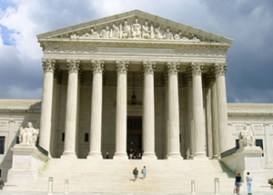
    Supreme Court Building #3As we reported last week, the Supreme Court will hear oral arguments in the TC Heartland LLC v. Kraft Foods Group Brands LLC case on Monday March 27.  In that previous report, we covered the background of the case, and presented the positions of both sides of the issue.  Ultimately, this case should boil down to a straight statutory interpretation involving the interplay of the specific patent venue statute with the general venue statute found in the same chapter.  Nevertheless, as we previously mentioned, around 30 amicus briefs were filed in this case, whether in support of petitioner TC Heartland, in support of respondent Kraft Foods Group, or in support of neither party.  And while these briefs provided some discussion of statutory construction, the overwhelming majority of ink was spent explaining why public policy dictates a specific outcome, with the fate of U.S. patent law hanging in the balance.  While we can maintain the somewhat naïve impression that the Supreme Court is not influenced by these public policy arguments for a statutory construction case, it is interesting (and perhaps useful) to look at some of the positions proffered in these briefs.  To that end, we provide a review of the arguments advanced by at least 98 self-identified professors that signed onto three different amicus briefs.

    Professors in Support of Petitioner

    Mark A. Lemley of Stanford Law School was counsel of record on an amici curiae brief filed on behalf of 61 professors of law and economics advocating a narrow interpretation of the patent venue statute.  This brief allocates a few pages as to why the patent venue statute should be construed narrowly.  Basically, the Supreme Court interpreted the patent venue statute in Fourco Glass Co. v. Transmirra Products Corp., 353 U.S. 222 (1957), and nothing has changed to disturb that ruling.  The 1988 changes in the general venue statute were described in this brief as "ministerial," and these professors could find no indication that Congress intended a change to the specific patent venue statute.  The Federal Circuit opinion in VE Holding Corp. v. Johnson Gas Appliance Co., 917 F.2d 1574 (Fed. Cir. 1990), was described as wrong for two reasons.  First, these professors applied the well-established rule of statutory construction that "Congress does not hide elephants in mouseholes."  In other words, if Congress had meant to change the patent venue statute, it would not have done so "in vague terms or ancillary provisions."  Second, and more persuasive, these professors pointed out that the Federal Circuit's interpretation renders the second half of § 1400(b) superfluous.  As a reminder, that statutory section reads:

    Any civil action for patent infringement may be brought in the judicial district where the defendant resides, or where the defendant has committed acts of infringement and has a regular and established place of business.

    As such, the argument goes, "resides" has to mean something other than having "a regular and established place of business."  Because patent infringement jurisdiction often focuses on specific jurisdiction, corporations will be subject to jurisdiction anywhere it "has committed acts of infringement and has a regular and established place of business."  Therefore, if "resides" means the same thing as being subject to personal jurisdiction, the second half of § 1400(b) would be superfluous.

    The 61 professors of law and economics focus most of the argument on the harms that the Federal Circuit's expansive reading of the patent venue statute has caused.  Not surprisingly, the term "Patent Troll" is used early and often.  "It has led to forum selling and forum shopping, it has contributed to the growth of opportunistic patent litigation by patent trolls, and it has led to undue case concentration."  The Eastern District of Texas is touted as the poster child for these problems, with citation to several articles including one by signatory Colleen V. Chien and Michael Risch.  (Colleen V. Chien & Michael Risch, Recalibrating Patent Venue, Santa Clara Univ. Legal Studies Research Paper No. 10-1 (Sept. 1, 2016), available here.)  Some of the advantages of this district were provided: (1) judges in the Eastern District of Texas take 150 additional days on average to rule on a motion to transfer; (2) they are 10 percentage points less likely to stay cases in favor of concurrent IPRs; and (3) discovery rules have been adopted that begin earlier, end sooner, and require broader disclosure than almost everywhere else.  All of these spell large discovery costs for the alleged infringer, which plays into the business model of the so-called trolls because they seek to settle cases for nuisance value.

    The ultimate conclusion regarding the Eastern District of Texas is that forum shopping has led to an overall concentration of 44 percent of all patent cases in this district.  Moreover, it was found that Judge Rodney Gilstrap of Marshall, Texas was assigned almost one fourth of all patent cases filed from 2014 to 2016.  The 61 professors of law and economics professors concluded that Congress did not intend such a concentration of patent cases in a single court, "much less a court chosen by only one side."

    Professors in Support of Respondent

    Megan M. La Belle of the Catholic University of America, Columbus School of Law, and Rachel C. Hughey of Merchant & Gould filed an amici brief on behalf of about 15 professors of law and civil procedure.  These professors filed their brief in support of Kraft Foods, and advocated for a broad reading of the specific patent statute.  This brief focused more attention on statutory construction and how the Federal Circuit's interpretation of the patent venue statute was consistent with other Federal Civil cases.  In contrast, Ted M. Sichelman of the University of San Diego School of Law filed an amici curiae brief as counsel of record on behalf of 22 law, economics, and business professors that appeared to be a response to the previous 61 professors.  This brief focused almost exclusively on the reasons why the aims of patent law are better served under the current interpretation of the statute as provided by the Federal Circuit.

    First, these 22 professors point out that even if the Supreme Court reverses the Federal Circuit on its interpretation, the result would not be a meaningful difference in the distribution of patent cases.  It was acknowledged that a significant number (around 60%) of patent lawsuits are filed in just five districts — the Eastern District of Texas, the District of Delaware, the Central District of California, the Northern District of California, and the District of New Jersey.  But citing to the same Chien and Risch article, this brief points out that restricting venue would still leave roughly 60% of patent cases in the same five districts.  The difference is that the Eastern District of Texas would drop to about 15% of all cases, and the Northern District of California and the District of Delaware would combine to account for about 37%.  In other words, about 21% of cases would shift from one forum to only two other districts.  The professors point out that there is no plausible argument that such a shifting in concentration would result in a meaningful distribution of cases.

    Second, instead of the red herring of "unjust concentration," these professors allege that the real goal of previous 61 amici professors is "to make it more difficult for certain patent owners to win their lawsuits in district court."  This brief points out that it is well known that the Northern District of California and the District of Delaware (for non-pharmaceutical cases) is less favorable for patent owners (including NPEs) than the Eastern District of Texas.  Moreover, if the Supreme Court were to adopt Petitioner's construction of the statute, the District of Delaware will become even less favorable because the small number of judges there will find it difficult to manger such an increase in caseload.

    These professors again acknowledge that the corporate defendants that find themselves victims of these so-called "patent trolls" have filed numerous briefs in support of Petitioner.  In addition, they have lobbied Congress to change the venue statute.  However, instead of demonstrating support for Petitioner's position, these lobbying efforts have not resulted in a change to the statute.  This suggests that Congress is not necessarily motivated to change the status quo.  In fact, despite these lobbying efforts, Congress "effectively authorized" the Eastern District of Texas by including it in the Patent Pilot Program, which is designed to channel cases to particular judges.

    Finally, these professors point out that the general rule that corporations can be sued in any district for which there is personal jurisdiction is equally sensible for patent actions.  The "forum shopping" highlighted by Petitioner and its amici is essentially federal policy for suits involving corporate defendants.  Moreover, the Supreme Court has consistently and regularly corrected the Federal Circuit in recent years when it has attempted to treat patent law differently than other cases.  For example, the Court has pointed out there should not be patent specific differences for subject matter jurisdiction (Gunn v. Minton, 133 S. Ct. 1059 (2013)); declaratory judgement actions (Medimmune, Inc. v. Genentech, Inc., 549 U.S. 118 (2007)); and injunctions (eBay Inc. v. MercExchange, L.L.C., 547 U.S. 388 (2006)).  The brief then addressed the "implicit allegation" that a large percentage of cases brought by NPEs are essentially baseless by citing to several articles to establish there is no valid empirical evidence for such an assertion.  Nevertheless, these professors counter the argument by alleging that severally limiting all patent owners because of the actions of some patent owners is "not only ill-advised but fundamentally unfair to those patent owners who file good faith claims."  They need look no further for a relevant example than the present case, in which Kraft (a non-troll practicing corporation) filed suit somewhere other than the Eastern District of Texas.  As a matter of fairness, why should a blatant infringer get to dictate where it can be sued by a legitimate patent holder asserting its rights?

    It will be interesting to see if the Supreme Court Justices provide any hints during the oral argument about whether they were swayed by these 98 professors.  We will, of course, continue to monitor this case and provided updates as warranted.

  • CalendarMarch 27, 2017 – Post-argument discussion on TC Heartland LLC v. Kraft Foods Group Brands LLC case (American University Washington College of Law Program on Information Justice & Intellectual Property) – American University Washington College of Law, Washington, DC – 4:15 to 5:45 pm (Eastern)

    March 29, 2017 – "IPR Estoppel in District Court: How Wide?" (Intellectual Property Owners Association) – 2:00 to 3:00 pm (ET)

    March 30, 2017 – "Latest PTAB Decisions: Leveraging Trends in Institution and Final Written Decisions, Understanding Federal Circuit Scrutiny To Date" (Strafford) – 1:00 to 2:30 pm (EDT)

    April 6, 2017 – "Markush Claims in Pharma/Chemical Patent Prosecution and Litigation: Leveraging Federal Court Guidance — Constructing Group Claims, Navigating Comprising and Consisting of, Avoiding Improper Rejections" (Strafford) – 1:00 to 2:30 pm (EDT)

    April 7, 2017 – "Patent Litigation: Trial and Appellate Issues and Trends" (Baylor Law School & Federal Circuit Bar Association) – Hyatt Regency Washington on Capitol Hill in Washington, DC – 10:30 am to 2:35 pm (EST)

    April 18, 2017 – "The Defend Trade Secrets Act at (Almost) One" (McDonnell Boehnen Hulbert & Berghoff LLP) – 10:00 am to 11:15 am (CT)

    ***Patent Docs is a media partner of this conference or CLE