• By Juan Luis Serrano* —

    LogoCOFECEIn the first installment of this series, we outlined the general contents of the study published on August 9, 2017 by the Federal Commission for Economic Competition[1], highlighting that the Antitrust authority is calling for an overhaul of several aspects of the drug market in Mexico to promote competition.  In this second installment, we delve into the patents and marketing authorizations sections, including the author's comments on the study's recommendations.

    For the purposes of this entry, we'll refer to Mexican authorities by their acronyms; COFECE for the antitrust body, COFEPRIS for the regulatory authority, and IMPI for the patent office.

    The patents section of the study (3.1), contains an explanation of the status in Mexico for patent granting, explaining that Mexico allows for several types of patents on pharmaceutical products, including those covering active ingredients and its variants, formulations, uses and processes.  This section is mostly academic, and does not require much additional comment.

    This is followed by a section on drug marketing authorizations (3.2), where the first shots are fired; COFECE criticizes some of the positions taken by COFEPRIS, such as forming "generic approval packages" (several approvals are issued in bulk, along with a press conference, instead of approving products on a first filed/first released basis), a lack of adherence to regulatory approval times, and a lack of transparency on available information on marketing authorizations at COFEPRIS' website.

    Fixing these problems will fall mostly on COFEPRIS.  Information available on authorization processes (both for innovators and generics) is indeed sorely lacking, and the rates of approval within the regulatory timeframes are low, for all industry participants.

    The next section (3.3) delves into our linkage system, which was enacted in 2003, has been subject to partial Supreme Court review, and has substantial differences with the one established in the U.S. through the Drug Price Competition and Patent Term Restoration Act of 1984.

    The study points two major problems with linkage; lack of transparency is the first, as inquiries on possible patent infringement are done in communications between COFEPRIS and IMPI without any immediate disclosure or right of hearing by the applicant or the patent holder.  Transparency mechanisms do allow companies to obtain copies of these communications, but many times after decisions have already been taken.

    The second problem is that patents listed in the linkage gazette are not necessarily related to an approved drug product.  Any patent covering an active ingredient or formulation can be listed regardless of whether it covers a product which would be subject of generic competition or not.

    This is one of the sections where I agree with COFECE; the system, in order to function properly for both innovators and generic manufacturers should allow interested parties to know precisely which patents are covering an approved product, and both generic drug applicants and patent holders should have an opportunity to be heard, either before administrative authorities or in an infringement proceeding, before an authorization is granted or denied.

    The following section of the study will be quite interesting for both companies and policy makers; section 3.4 "Strategic behavior" refers to concepts that innovative companies will very likely object to, such as patent evergreening, patent clustering, and reference product switching based on new patents.  There are also references to positions taken by other Latin American countries such as Brazil (which subjects some patents to prior approval by regulators) or Argentina (which forbids the grant of several types of pharmaceutical patents).

    These sections are followed by an explanation on past litigation activity on these topics, mentioning that it has been used as a deterrent to generic competition, and several recommendations, both of which will be analyzed in a subsequent post.

    * Mr. Serrano is Of Counsel with ROMO DE VIVAR V.IP SERVICES, S.C.

    [1] https://www.cofece.mx/cofece/index.php/prensa/historico-de-noticias/cofece-el-vencimiento-de-patentes-no-se-ha-traducido-en-suficiente-presion-competitiva-en-el-mercado.  The press statement also contains the link to download the full study.

  • By Kevin E. Noonan –

    Human history is often something modern man only sees as through a glass, darkly.  This is particularly the case when that history did not occur in the Mediterranean, the Nile Valley, India, or China, or when there is no written record on which scholars can rely.  Exacerbating the disrupting effects of time on history can be when that history occurs in a region where extensive migration has disrupted whatever temporarily stable civilization happened to have taken root at that place at any particular time.

    But humans leave traces of themselves in their history and a variety of such traces have been the source of reconstructions outside conventional sources.  Luigi Cavalli-Sforza began the study of human population genetics as a way to understand this history in 1971 in The Genetics of Human Populations, and later extended these studies to include language and how it influences gene flow between human populations.  More recent efforts to use genetics to reconstruct history include Deep Ancestry: The Landmark DNA Quest to Decipher Our Distant Past by Spencer Wells (National Geographic: 2006), and The Seven Daughters of Eve: The Science that Reveals our Genetic Ancestry by Brian Sykes (Carrol & Graf: 2002).  And even more recently, genetic studies have illuminated the "fine structure" of human populations in England (see "Fine-structure Genetic Mapping of Human Population in Britain").

    Two recent reports illustrate how genetics can inform history:  the first, in the American Journal of Human Genetics entitled "Continuity and Admixture in the Last Five Millennia of Levantine History from Ancient Canaanite and Present-Day Lebanese Genome Sequences"; and a second in the Proceedings of the National Academy of Sciences USA, entitled "Genomic landscape of human diversity across Madagascar."  In the first study, authors* from The Wellcome Trust Sanger Institute, University of Cambridge, University of Zurich, University of Otago, Bournemouth University, Lebanese American University, and Harvard University found evidence of genetic admixture over 5,000 years of a Canaanite population that has persisted in Lebanese populations into the modern era.  This population is interesting for historians in view of the central location of the ancestral home of the Canaanites, the Levant, in the Fertile Crescent that ran from Egypt through Mesopotamia.  The Canaanites also inhabited the Levant during the Bronze Age and provide a critical link between the Neolithic transition from hunter gatherer societies to agriculture.  This group (known to the ancient Greeks as the Phoenicians) is also a link to the great early societies recognized through their historical writings and civilizations (including the Egyptians, Assyrians, Babylonians, Persians, Greeks, and Romans); if the Canaanites had any such texts or other writings they have not survived.  In addition, the type of genetic analyses that have been done for European populations has not been done for descendants of inhabitants of the Levant from this historical period.  This paper uses genetic comparisons between 99 modern day residents of Lebanon (specifically, from Sidon and the Lebanese interior) and ancient DNA (aDNA) from ~3,700 year old genomes from petrous bone of individuals interred in gravesites in Sidon.  For aDNA, these analyses yielded 0.4-2.3-fold genomic DNA coverage and 53-264-fold mitochondrial DNA coverage, and also compared Y chromosome sequences with present-day Lebanese, two Canaanite males and samples from the 1000 Genomes Project.  Over one million single nucleotide polymorphisms (SNPs) were used for comparison.

    These results indicated that the Canaanite ancestry was an admixture of local Neolithic populations and migrants from Chalcolithic (Copper Age) Iran.  The authors estimate from these linkage disequilibrium studies that this admixture occurred between 6,600 and 3,550 years ago, a date that is consistent with recorded mass migrations in the region during that time.  Perhaps surprisingly, their results also show that the majority of the present-day Lebanese population has inherited most of their genomic DNA from these Canaanite ancestors.  These researchers also found traces of Eurasian ancestry consistent with conquests by outside populations during the period from 3,750-2,170 years ago, as well as the expansion of Phoenician maritime trade network that extended during historical time to the Iberian Peninsula.
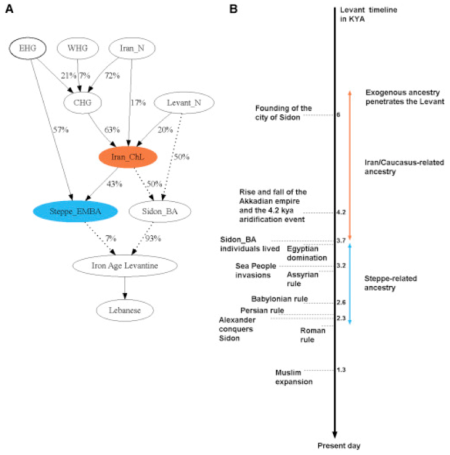
    Figure 1
    The second paper arose from genetic studies of an Asian/African admixture population on Mozambique.  This group** from the University of Toulouse, INSERM, the University of Bordeaux, University of Indonesia, the Max Plank Institute for Evolutionary Anthropology, Institut genomique, Centre Nacional de Genotypage, University of Melbourne, and the Universite de  la Rochelle, showed geographic stratification between ancestral African (mostly Bantu) and Asian (Austronesean) ancestors.  Cultural, historical, linguistic, ethnographic, archeological, and genetic studies supports the conclusion that Madagascar residents have traits from both populations but the effects of settlement history are termed "contentious" by these authors.  Various competing putative "founder" populations (including Arabic, Indian, Papuan, and/or Jewish populations as well as first settlers found only in legend, under names like "Vazimba," "Kimosy," and "Gola") have been posited as initial settlers.  These researchers report an attempt to illuminate the ancestry of the Malagasy by a study of human genetics.

    These results showed common Bantu and Austronesian descent for the population with what the authors termed "limited" paternal contributions from Europe and Middle Eastern populations.  The admixture of African and Austronesian populations occurred "recently" (i.e., over the past millennium) but was gender-biased and heterogeneous, which reflected for these researchers independent colonization by the two groups.  The results also indicated that detectable genetic structure can be imposed on human populations over a relatively brief time (~ a few centuries).

    Using a "grid-based approach" the researchers performed a high-resolution genetic diversity study that included maternal and paternal lineages as well as genome-wide data from 257 villages and over 2,700 Malagasy individuals.  Maternal inheritance patterns were interrogated using mitochondrial DNA and patterns of paternity assayed using Y chromosomal sequences.  Non-gender specific relationships were assessed through 2.5 million SNPs.  Mitochondrial DNA analyses showed maternal inheritance from either African or East Asian origins (with one unique Madagascar variant termed M23) in roughly equal amounts, with no evidence of maternal gene flow from Europe or the Middle East.  The M23 variant shows evidence of recent (within 900-1500 years) origin.  Y chromosomal sequences, in contrast are much more prevalent from African origins (70.7% Africa:20.7% East Asia); the authors hypothesize that the remainder may reflect Muslim influences, with evidence of but little European ancestry.

    Admixture assessments support Southeast Asian (Indonesian) and East African source populations for the Malagasy admixture.  These results provide the frequency of the African component to be ~59%, the Asian component frequency to be ~37%, and the Western European component to have a frequency of about 4% (albeit with considerable variation, e.g., African ancestry can range from  ~26% to almost 93%).  Similar results were obtained when the frequency of chromosomal fragments shared with other populations were compared to the Malagasy population (finding the closest link to Asian populations from south Borneo, and excluding Indian, Somali, and Ethiopian populations, although the analysis was sensitive in one individual to detect French Basque ancestry).  The split with ancestral Asian populations either occurred ~2,500 years ago or by slower divergence between ~2,000-3,000 years ago, while divergence with Bantu populations occurred more recently (~1,500 years ago).

    There were also significant differences in geographic distribution between descendants of these ancestral populations.  Maternal African lineages were found predominantly in north Madagascar, with material Asian lineages found in central and southern Madagascar (from mtDNA analyses).  Paternal lineages were generally much lower overall for Asian descendants (~30% in central Madagascar) based on Y chromosome analyses.  Genome-wide analyses showed "highlanders" had predominantly Asian ancestry (~65%) while coastal inhabitants had predominantly (~65%) African ancestry; these results depended greatly on the method of performing the analyses which affected the granularity of the geographic correlates.  Finally, assessing admixture patterns indicated that the genetic results are consistent with single intermixing event (500-900 years ago) for all but one geographic area, which may have seen a first event 28 generations ago and a second one only 4 generations ago.  These researchers also found evidence of at least one population bottleneck, where the number of individuals dropped to a few hundred people about 1,000-800 years ago.

    These results are represented pictorially in the paper:

    Figure 2
    In view of the current political climate, the eloquent opening of the paper deserves attention:

    Ancient long-distance voyaging between continents stimulates the imagination, raises questions about the circumstances surrounding such voyages, and reminds us that globalization is not a recent phenomenon.  Moreover, populations which thereby come into contact can exchange genes, goods, ideas and technologies.

    * Marc Haber, Claude Doumet-Serhal, Christiana Scheib, Yali Xue, Petr Danecek, Massimo Mezzavilla, Sonia Youhanna, Rui Martiniano, Javier Prado-Martinez, Michał Szpak, Elizabeth Matisoo-Smith, Holger Schutkowski, Richard Mikulski, Pierre Zalloua, Toomas Kivisild, Chris Tyler-Smith

    ** Denis Pierrona, Margit  Heiskea, Harilanto  Razafindrazakaa, Ignace Rakotob, Nelly Rabetokotanyb, Bodo Ravololomangab, Lucien M.-A. Rakotozafyb,  Mireille  Mialy  Rakotomalalab,  Michel Razafiarivonyb,  Bako Rasoarifetrab,  Miakabola  Andriamampianina Raharijesyb, Lolona Razafindralambob, Ramilisoninab, Fulgence Fanonyb, Sendra Lejamblec, Olivier Thomasc, Ahmed Mohamed  Abdallahc, Christophe Rocherc,, Amal Arachichec, Laure Tonasoa, Veronica Pereda-lotha, Stéphanie Schiavinatoa, Nicolas Brucatoa, Francois-Xavier Ricauta, Pradiptajati Kusumaa,d,e, Herawati  Sudoyod,e, Shengyu Nif, Anne Bolandg, Jean-Francois Deleuzeg, Philippe Beaujardh, Philippe Grangei, Sander Adelaarj, Mark Stonekingf, Jean-Aimé Rakotoarisoab,  Chantal Radimilahy, and Thierry Letelliera

  • Study Suggests Several Changes to Legislation on Patents, Marketing Authorizations, and Government Procurement

    By Juan Luis Serrano* —

    LogoCOFECEIn July of 2016, the Federal Commission for Economic Competition announced a broad ranging study on the entry of generic drug alternatives to the Mexican market, both for private purchasing and government procurement.  The results of this study were released last week, along with a press statement[1], which outlined the following main findings:

    • Entry of generic drugs to the market is unduly slow.
    • Patent expiration has not caused enough competition in the market.
    • Entry of generic drugs has not caused enough price reductions in comparison to other jurisdictions.
    • Industry regulations is affecting competition conditions.
    • Some of the current rules have provide incentives for innovator companies to engage in litigation.

    In this study, the Commission makes several recommendations, addressed at the Patent Office (IMPI), the Regulatory Authority (COFEPRIS), the Ministry of Health (Secretaría de Salud) and Congress, which affect different aspects of relevance to the industry, such as patent-marketing authorization linkage, limitation of grant of certain patents, regulatory data exclusivity, prescription rules, substitution/interchangeability, and government procurement rules.

    Whereas each of these recommendations will be subject to specific analysis and future blog entries, we’ll start the series with a highlight of the study as a callout by the competition authority for an overhaul of the regulatory framework under which both innovator and generic companies participate in the Mexican Market.

    Even though the study does not constitute a mandate for other authorities to act upon it, it does provide insight based on current official information, numbers of approvals, market penetration, and comparison with other legislations with a strong message of a need for change.

    It will certainly be interesting to follow up on the fallout of this study, including possible endorsements or criticisms to its conclusions and recommendations.

    * Mr. Serrano is Of Counsel with ROMO DE VIVAR V.IP SERVICES, S.C.

    [1] https://www.cofece.mx/cofece/index.php/prensa/historico-de-noticias/cofece-el-vencimiento-de-patentes-no-se-ha-traducido-en-suficiente-presion-competitiva-en-el-mercado

  • CalendarAugust 22, 2017 – Semiconductor Customer Partnership Meeting (U.S. Patent and Trademark Office) – 1:00 to 5:00 pm (ET), Alexandria, VA

    August 24, 2017 – "Section 112(a) Enablement and Written Description: Leveraging CCPA and Early Federal Circuit Decisions — Capitalizing on Precedent to Withstand 112(a) Rejections and Attacks on Patent Validity and Patentability" (Strafford) – 1:00 to 2:30 pm (EDT)

    August 29, 2017 – "The Evolving 5 W's of Global IP Enforcement: The Strategic Implications of Recent Global IP Law Developments" (McDonnell Boehnen Hulbert & Berghoff LLP) – 10:00 am to 11:15 am (CT)

    August 31, 2017 – "Navigating the Patent Prosecution Highway and Other Accelerated Filing Options — Evaluating the Different Options, Weighing the Benefits and Risks, Obtaining Patent Protection" (Strafford) – 1:00 to 2:30 pm (EDT)

    September 6, 2017 – "Sovereign Immunity as Inter Partes Defense: Legal Guidance and Analysis of Impact on Licensing" (Technology Transfer Tactics) – 1:00 to 2:00 pm (Eastern)

    September 12, 2017 – "Addressing and Understanding the Significant Developments and Latest Decisions on Patent Eligibility" (The Knowledge Group) – 3:00 to 5:00 pm (EST)

    September 12-13, 2017 – "Advanced Patent Prosecution Workshop 2017: Claim Drafting & Amendment Writing" (Practising Law Institute) – Chicago, IL

    September 13, 2017 – "Patent Litigation 2017 — The Courts and Patent Trial and Appeal Board" (Federal Circuit Bar Association) – 10:45 am to 3:10 pm (EDT), Wilmington, DE

    September 13-15 – FDA Boot Camp (American Conference Institute) – Boston, MA

    September 14, 2017 – "Patent Cooperation Treaty: Evaluating the Benefits and Risks, Obtaining International Patent Protection — Navigating the PCT, Priority, Selection of International Authorities, PCT Search and Examination, and More" (Strafford) – 1:00 to 2:30 pm (EDT)

    September 14-15, 2017 – "International Patent Prosecution and Practice Seminar" (John Marshall Law School Center for Intellectual Property, Information & Privacy Law, World Intellectual Property Organization, and Kuhnen & Wacker) – Chicago, IL

    October 2-3, 2017 – Paragraph IV Disputes master symposium*** (American Conference Institute) – Chicago, IL

    ***Patent Docs is a media partner of this conference or CLE

  • ACIAmerican Conference Institute (ACI) will be holding its 5th Annual Paragraph IV Disputes master symposium on October 2-3, 2017 in Chicago, IL.  ACI faculty will provide insights into:

    • The impact of TC Heartland on jurisdiction and venue
    • The legal and business repercussions of Helsinn
    • Sandoz v. Amgen from an ANDA litigator’s point of view
    • The FDA Final MMA Rule
    • Novartis v. Noven and differing standards of review
    • Secondary considerations in obviousness reviews
    • Alternative forums: PTAB and ITC
    • Oil States vs. Greene’s Energy Group and the constitutionality of IPR proceedings
    • Exceptional case findings
    • Reverse payment settlements
    • Patent lawsuit risk assessment and other IP due diligence essentials

    The conference will offer presentations on the following topics:

    • Paragraph IV Litigation Trends, Analysis and Future Predictions
    • Exploring Litigation Considerations in Pharmaceutical IP Due Diligence Assessments – The Dollars and Cents of Paragraph IV
    • Practical Implications of Helsinn – Legal and Business Perspectives on the On-Sale Bar
    • The Policy and Practicalities of Jurisdiction: Debating the Impact of TC Heartland on Paragraph IV Litigation
    • Amgen v. Sandoz: An Update on Biosimilar Litigation for the Hatch-Waxman Litigator
    • Exploring New Developments in the Law of Divided and Contributory Infringement and Its Continuing Impact on Paragraph IV Litigation
    • Examining the ITC as an Alternate Forum in an ANDA Challenge
    • PTAB Pharmaceutical Patent Invalidity Round-Up: Update on Wins, Losses, Appeals and Supreme Court Activity
    • The PTAB Live: Thoughts on Practice, Procedure, IPRs and More in the World of Pharmaceutical Patent Validity Challenges
    • Brand and Generic Perspectives on the FDA Final MMA Rule: Assessing Its Impact on Hatch-Waxman Practice
    • Taking a Deeper Dive into Local Patent Rules
    • A View from the Bench: The Federal Judges Speak on Paragraph IV Litigation
    • An Open Dialogue on Reverse Payment Settlements
    • Novartis v. Noven – A Study in Obvious Contrasts: Dilemmas Associated with Different Standards of Review
    • Obviousness at Another Glance: Exploring Secondary Considerations in ANDA Litigation
    • Exploring Exceptional Case Findings in a Hatch-Waxman Setting
    • Ethics Lab for Paragraph IV Practice: Identifying and Avoiding Ethics Pitfalls in Hatch-Waxman Litigation

    In addition, two post-conference workshops will be offered on October 4, 2017.  The first, entitled "Let the Games Begin: Master Class on Advanced Strategies for Pleading Drafting, Discovery and Motion Practice in the Evolving Patent End Game" will be offered from 8:30 am to 12:00 pm, and the second, entitled "Parallel Proceedings Master Class: Devising Strategies for Navigating Dual Forums in Hatch-Waxman Litigation" will be offered from 1:00 to 4:30 pm.

    The agenda for the Paragraph IV Disputes master symposium can be found here.  More information regarding the workshops can be found here.  A complete brochure for this conference, including an agenda, detailed descriptions of conference sessions, list of speakers, and registration form can be obtained here.

    The registration fee is $2,295 (conference alone) or $3,495 (conference and both workshops).  Patent Docs readers are entitled to a 10% discount off of registration using discount code P10-999-PTD18.  Those interested in registering for the conference can do so here, by e-mailing CustomerService@AmericanConference.com, or by calling 1-888-224-2480.

    Patent Docs is a media partner of ACI's Paragraph IV Disputes Master Symposium.

  • Technology Transfer Tactics will be offering a webinar entitled "Sovereign Immunity as Inter Partes Defense: Legal Guidance and Analysis of Impact on Licensing" on September 6, 2017 from 1:00 to 2:00 pm (Eastern).  Kerry S. Taylor and Peter Law of Knobbe Martins, and Andrew M. Howard of Shore Chan DePumpo LLP will provide a review of sovereign immunity cases and their implications, as well as important guidance addressing the factors that can work for you or against you when faced with an inter partes challenge.  The webinar will cover the following topics:

    • Legal background regarding sovereign immunity in administrative proceedings (SCOTUS Federal Maritime Commission case)
    • Review of decisions and pending cases including:
        – Covidien LP v. Univ. of Florida Research Found. Inc., IPR2016-01274 decision
        – Neochord, Inc. v. Univ. of Maryland, Baltimore and Harpoon Medical, Inc., IPR2016-00208
        – Reactive Surfaces LTD., LLP, v. Toyota Motor Corp., IPR2016-01914 Decision
        – Are these decisions appealable?
    • What actions can create a waiver of sovereign immunity, and how can you ensure your protection is preserved?
    • Is dismissal of a petition, or termination of an IPR on sovereign immunity grounds, subject to judicial review? Or is the PTAB acting outside its limits?
    • Implications for public universities, research entities, and private companies:
        – Can private companies protect themselves from IPR, PGR, CBM challenges by partnering with universities?
        – Is the structure of IP ownership — for example, by a separate research foundation — a potential bar to sovereign immunity?
        – Should state universities avoid joint development projects that result in co-ownership of a patent with a private university or a private company?
    • Implications for licensing:
        – Marketing your sovereign immunity advantage – taking IPR risk off the table
        – Can state schools leverage the sovereign immunity defense in license negotiations? How big a factor is this for licensees, and how might you adjust your terms and expectations?

    The registration fee for the webinar is $197.  Those interested in registering for the webinar, can do so here.

    Technology Transfer Tactics

  • Strafford #1Strafford will be offering a webinar/teleconference entitled "Patent Cooperation Treaty: Evaluating the Benefits and Risks, Obtaining International Patent Protection — Navigating the PCT, Priority, Selection of International Authorities, PCT Search and Examination, and More" on September 14, 2017 from 1:00 to 2:30 pm (EDT).  Rebecca M. McNeill of McNeill Baur and Jens Viktor Nørgaard of HØIBERG will provide guidance for patent practitioners on the Patent Cooperation Treaty (PCT), and discuss the system's advantages and disadvantages and how to strategically use the PCT to obtain international patent protection.  The webinar will review the following topics:

    • What are the benefits of and reasons to use the PCT?
    • What should patent counsel weigh when determining where to file the international application?
    • What should patent practitioners consider when selecting the ISA?
    • When should patent counsel consider filing a Demand for International Examination?
    • When to use the Patent Prosecution Highway after positive international examination?
    • When to file through the PCT and when to consider Paris Convention filings in PCT countries?

    The registration fee for the webinar is $297.  Those interested in registering for the webinar, can do so here.

  • Federal Circuit Bar AssociationThe Federal Circuit Bar Association (FCBA) will be offering a program entitled "Patent Litigation 2017 — The Courts and Patent Trial and Appeal Board" on September 13, 2017 from 10:45 am to 3:10 pm (EDT) at the Chase Center on the Riverfront, Riverfront Ballroom, 815 Justison St., Wilmington, DE.  The program will include presentations on the following topics:

    • Impact of TC Heartland: District Court Perspective and ANDA case implications
    • Lunch Keynote
    • Shifting the Standards of the IPR Estoppel
    • Judicial Resources: The Utilization of Magistrate Judges and Related Issues

    The registration fee for the program is $165 (FCBA or Delaware Chapter of Federal Bar Association) or $185 (non-members).  Those interested in registering for the program, can do so here.  Additional information regarding the program can be found here.

  • The Knowledge GroupThe Knowledge Group will offer a live webcast entitled "Addressing and Understanding the Significant Developments and Latest Decisions on Patent Eligibility" on September 12, 2017 from 3:00 to 5:00 pm (EST).  John Jarosz of Analysis Group, Inc. and Eli Mazour of Harrity & Harrity, LLP will discuss the latest key judicial developments, including Supreme Court, Federal Circuit and PTAB decisions related to patent eligibility, and provide insights into the impact of these developments and offer best practices for handling patent cases.  The panel will cover the following topics:

    • Subject Matter Eligibility Update
    • Latest USPTO Patent-Eligibility Guidance
    • Key Judicial Developments
    • Supreme Court, Federal Circuit and PTAB Decisions
    • Impact to Future Cases
    • Roadmap for Practitioners

    The registration fee for the webcast is $99.  Those interested in registering for the webinar can do so here.

  • WIPOThe John Marshall Law School Center for Intellectual Property, Information & Privacy Law, World Intellectual Property Organization (WIPO), and Kuhnen & Wacker will be offering an "International Patent Prosecution and Practice Seminar" on September 14-15, 2017 at the John Marshall Law School in Chicago, IL.  The seminar is a two-day, comprehensive CLE program that brings together seasoned experts to provide instruction on the issues of contemporary significance when seeking to obtain patent rights under the Patent Cooperation Treaty (PCT) and the European Patent Convention (EPC), as well as enforcing such patent rights.  Topics to be discussed during the seminar include:

    • Recent and Future Developments
    • Procedures and Time Limits
    • Filing Strategies for U.S. Applicants
    • Claim Drafting, Correcting Defects, and Amendments
    • Claiming and Restoring Priority
    • Search and Examination
    • Opposition Procedures
    • Unitary Patent and Unified Patent Court
    • EPC (UPP) vs. AIA
    • Global Patent Practice Dos and Don'ts

    JMLSA brochure for the seminar, including a schedule, list of speakers, and registration information can be found here.

    The registration fee for the seminar is $245 (day 1 or day 2), $385 (day 1 and day 2), or free (JMLS students, faculty, or staff).  Those interested in registering for the conference can do so here.