• Strafford #1Strafford will be offering a webinar/teleconference entitled "Patents and Export Control Compliance: Managing Risk and Avoiding Unintentional Violations — Minimizing Export Control Liability in Patent Application Preparation, Development and Analysis of Innovation, and Licensing" on August 3, 2017 from 1:00 to 2:30 pm (EDT).  David G. Henry of Gray Reed & McGraw and Edward J. Radlo of Radlo IP Law Group will provide guidance for patent counsel on navigating the intersection of patents and export control laws; examine the challenges facing patent owners, when and where export control issues arise, and licensing issues; and offer best practices for complying with export control laws.  The webinar will review the following topics:

    • What export control compliance challenges do patent owners and applicants face?
    • When do export violations arise in the patent context?
    • What are the best practices for counsel to patent owners for compliance with ITAR and EAR requirements?

    The registration fee for the webinar is $297.  Those interested in registering for the webinar, can do so here.

  • Technology Transfer Tactics will be offering a webinar entitled "Improve the Quality of Invention Disclosures through Researcher Outreach and Education" on July 31, 2017 from 1:00 to 2:00 pm (Eastern).  Rebecca Stoughton of Fuentek, LLC will discuss the following topics:

    • What factors deem a disclosure "high quality"? – it's not one-size-fits-all
    • How to evaluate your disclosure process and get solid feedback from researchers
    • Heeding feedback to revise procedures effectively
    • How tapping successful researchers as mentors for up-and-comers can be a win-win
    • Tips for structuring easy-to-attend educational programs inventors will respond to
    • What to include in your training modules
    • Coaching researchers on how to tell their invention's story
    • Examples of "best in class" disclosures and what makes them work so well

    The registration fee for the webinar is $197.  Those interested in registering for the webinar, can do so here.

    Technology Transfer Tactics

  • By Josh Rich

    U.S. Trade RepresentativeOn July 17, 2017, the United States Trade Representative released the summary of its objectives for NAFTA renegotiation, including its objectives for the intellectual property and competition provisions of the agreement.  As part of the overview of its objectives, the USTR indicated that the revised version of NAFTA "must continue to break down barriers to American exports," including by eliminating "burdensome restrictions of intellectual property."  But the provisions that the USTR indicated it would be seeking — which appear to be intended to create a template for future bilateral or multilateral agreements — reestablish the basic framework initially negotiated by the Obama Administration as part of the Trans-Pacific Partnership, which President Trump rejected as a "continuing rape of our country."

    The USTR set forth a number of intellectual property-related goals to be achieved in renegotiation of NAFTA, many of which do not appear to be directed at changing Canadian or Mexican laws.  Specifically, the Trump Administration seeks to ensure that NAFTA's terms "reflect a standard of protection similar to that found in U.S. law" and provide strong measures for enforcing such rights; fully and quickly implement the WTO Agreement on Trade-Related Aspects of Intellectual Property Rights (TRIPS), especially the enforcement obligations under TRIPS; and prevent or eliminate distinctions between protection of domestic and foreign intellectual property rights.  The objectives also relate to the negotiation of issues that were not addressed in NAFTA's original text, including those directed to new technologies involved in digital trade and works distributed through the Internet and other global communications media.  Finally, the goals include some that do not address concerns that have actually arisen between the United States and Canadian and Mexican trading partners, such as preventing government involvement in cybertheft and piracy, preventing the improper use of protection of geographical indications, and establishing basic rules for procedural fairness in competition law enforcement.

    Not without considerable irony, the USTR's objectives are most notable for how closely they follow the goals that the Obama Administration achieved in negotiating the TPP.  The TPP included the United States, Canada, Mexico, and nine other countries; because Canada and Mexico already agreed to the intellectual property provisions in the TPP agreement, it should not be all that difficult to get their agreement to very similar provisions as part of NAFTA.  Notably, the TPP agreement set forth the intellectual property requirements for membership with great specificity, in order to ensure standards similar to those required under U.S. law.

    With regard to patents, for example, TPP members were required to agree to grant patents to any invention that is "new, involves an inventive step, and is capable of industrial application."  Under that standard, patentable inventions would include new uses for known products, new methods of making known products, and new methods for using known products.  The TPP agreement also discarded any requirement for "absolute novelty," wherein a public disclosure by the applicant itself, less than twelve months before the filing of a patent application, would not constitute invalidating prior art (as it does, in Europe, for example).  After filing, there would have to be patent term adjustment for unreasonable delay in issuance of a patent (specifically, a delay of more than five years after filing or three years after a request for examination), patent term extension for unreasonable delay in marketing approval, and substantial data exclusivity for agricultural chemicals, pharmaceutical products, and biologics.  The data exclusivity would be at least ten years for agricultural chemicals, at least eight years for a biologic drug, at least five years for a new chemical pharmaceutical entity, and at least three years for a new indication for an existing pharmaceutical.  And a TPP member state could not discriminate between rights granted to a domestic applicant and an applicant from another TPP member state.

    With regard to competition law, the resemblance of the USTR's objectives and the TPP agreement is even closer.  The USTR's objectives for renegotiation of NAFTA even use some of the language used in the TPP agreement, although set forth with more detail there.

    The Trump Administration's decision to pursue many of the same intellectual property protection objectives in renegotiating NAFTA as had been negotiated as part of TPP is all the more remarkable in light of the decision by the other TPP member states to continue to seek a broader free trade market with the same sort of intellectual property requirements.  Last week — only days before the USTR issued its NAFTA objectives — representatives of the "TPP-11" (all of the TPP member states other than the United States) met to discuss implementation of the TPP without U.S. involvement.  They indicated that they will continue to meet and negotiate, but hope to finalize a trade agreement by the end of the year that has only minimal differences from the original text of the TPP agreement.  The juxtaposition of the TPP-11's discussions and the USTR's objectives for NAFTA renegotiation is striking, in that it suggest that both the Trump Administration and the TPP-11 are seeking to reconstruct the international intellectual property and competition regime that they negotiated through the TPP.  It leaves one question: what did President Trump really think was so bad about the TPP agreement, besides the historical reality that it had been successfully negotiated by his predecessor?

    For additional information regarding this and other related topics, please see:

    • "Why President Trump Is Wrong about Trans-Pacific Partnership Agreement," January 26, 2017
    • "Public Health Organizations Urge Congress to Reject Trans-Pacific Partnership Agreement," April 18, 2016
    • "What Are the IP Provisions of the TPP?" November 9, 2015
    • "What May Be the IP Provisions of the Trans Pacific Partnership Agreement," October 15, 2015
    • "Transparency and the Trans-Pacific Partnership Treaty," March 11, 2015
    • "GPhA Issues Statement Regarding Proposed IP Provisions of Trans-Pacific Partnership Agreement," October 23, 2014
    • "Democratic House Leadership Does Not Want TPP to Undermine Public Health," February 12, 2014
    • "AARP Seeks Reduced Data Exclusivity Period in TPP," October 31, 2013
    • "White Paper Asserts That Existing Trade Agreements Provide No Data Exclusivity for Biologics," August 26, 2013
    • "U.S. Negotiators on TPP — Don't Trade Away the Biopharmaceutical Research Sector," September 30, 2012

  • By Joseph Herndon

    District Court for the Central District of CaliforniaIn the U.S. District Court for the Central District of California, Dialware Communications sued Hasbro, Inc. alleging that Hasbro's Furby toys infringe on five patents:  U.S. Patent Nos. 7,183,929 (the "'929 Patent"), 7,383,297 (the "'297 Patent"), 7,568,963 (the "'963 Patent"), 9,039,482 (the "'482 Patent"), and 9,275,517 (the "'517 Patent").  According to the Complaint, Hasbro's Furby is a toy that communicates with human users and electronic devices.  Furby can be controlled either by voice commands or by commands sent from a smartphone or tablet app.  Furbys can also perform various actions such as moving their ears or feet.  Plaintiff alleges that these features, among others, infringe the Patents-In-Suit.

    As a whole, the Patents-In-Suit generally claim methods of interacting, controlling, or communicating with toys via acoustic sounds generated by either a human or another device.  As such, Hasbro filed a Motion to Dismiss for Failure to State a Claim in which Hasbro contended that each of the Patents-In-Suit claims unpatentable subject matter and the Patents-In-Suit are therefore invalid.  More specifically, Hasbro argued that the Patents-In-Suit are directed toward the abstract idea of communication.  The District Court agreed, and granted the Motion to Dismiss.

    Patents-In-Suit

    The '929 Patent generally relates to a method of controlling a device by sound.  Claim 45 is representative and is reproduced below.

    45.  A method of controlling at least one device by sound, comprising:
        generating a sound;
        receiving the sound by the at least one device;
        analyzing the received sound for at least one parameter of a distance from the at least one device to a source of the sound, whether the source of the sound is approaching or moving away, an amplitude of the sound and a pitch of the sound; and
        responding by the at least one device with different physical responses to sounds with different values of the at least one parameter.

    The '297 Patent relates generally to a method of communicating between an electronic device and computer by "providing" a computer with a sound receiving and generating system; "transmitting from the electronic device at least one first acoustic signal" to the computer; "receiving" the sound by the computer; and "processing" the received sound ('297 Patent, cl. 1).

    The '963 Patent generally relates to two toys communicating; claim 35 is representative and is reproduced below.

    39.  A toy kit comprising:
        a first child-safe toy which indirectly generates acoustic signals, by motion of at least parts thereof; and
        at least a second child-safe toy which receives the acoustic signals through a microphone and analyzes the acoustic signals and exhibits a behavior, responsive to said analysis of said acoustic signals,
        whereby the motion that indirectly generates the acoustic signals is perceptible by a player of the first toy.

    The '482 patent claims a "method for interactive communication with a toy . . . comprising: receiving by the toy . . . at least one first signal including an embedded code;" "analyzing" the code; "determining" a response such as "transmitting" the data elsewhere, "processing the code to obtain a coupon," and various other responses ('482 Patent, cl. 7).

    Finally, the '517 Patent relates to a method of interactive play between two toys and claim 1 is representative and is reproduced below.

    1.  A method for interactive communication with a toy apparatus, said method comprising:
        programming the toy apparatus;
        transmitting a machine-originated signal by a cellphone;
        receiving the signal by the toy apparatus; and
        producing by the toy apparatus at least one response to the signal,
        wherein said toy apparatus is programmed by the signal.

    Abstract Idea Analysis

    The District Court followed the two-step analysis for determining whether the patents claim abstract ideas or patent-eligible subject matter.  The first step is to determine whether the claims at issue are directed to patent-ineligible subject matter.  If so, then a court proceeds to the second step to look to the claims individually and "as an ordered combination" for an "inventive concept" which transforms the nature of the claim into a patent eligible application.

    Here, the District Court found that the Patents-In-Suit involve toys that communicate or interact amongst one another, with humans, or with computers.  The District Court summarized the patents as claiming toys that generate, receive, and analyze sounds; transmit, receive, and respond to a signal; and generate acoustic signals, receive the acoustic signals, analyze the signal, and then perform a responsive function.  In summary, the District Court found that the patents attempt to state methods for toys to communicate by sending, receiving, and responding to signals.

    As such, the District Court found that since claims do not state a means by which to communicate, or details of the communication, the claims are directed at the abstract process of communication itself.  Of course, communication is a practice which has long been used by both people and devices.  Furthermore, the claims here do little to limit or describe the stated communication beyond their basic general terms.  The claims lack technical descriptions or solutions.

    Plaintiff attempted to characterize the patents as "tangible toys or devices" and therefore not abstract.  However, the District Court, while acknowledging that the Patents-In-Suit do involve tangible toys and devices, noted that the mere inclusion of tangible elements in an otherwise abstract idea does not render the subject matter any less abstract.

    Having found that the Patents-In-Suit are directed to an abstract idea, the Court then turned to step two.

    The District Court found that the Patents-In-Suit generally rely upon generic descriptors rather than technical elements to carry out the communication between toys and humans or computers.  On the whole, the Patents-In-Suit state claims for "generating," "receiving," "analyzing," "responding," "processing," and "transmitting" with very little technical specificity.  What few technical components are included in the Patents-In-Suit are common speakers, microphones, and motors.

    In its Opposition, Plaintiff predominately argued that the conventional components found in the Patents-In-Suit are combined for unconventional purposes.  Specifically, Plaintiff argued that the Patents-in-Suit teach the use of audio hardware, which is designed for human communications, for the unconventional purpose of computer communications.  But the claims here do no more than require basic microphones and speakers to perform basic functions of microphones and speakers.  The Patents-In-Suit do nothing more than apply basic technology contained in other devices existing at the time the patent was created to carry out their abstract idea.

    Accordingly, the District Court found that the asserted claims fail to disclose any inventive concept which would transform the claims' abstract idea into a patent-eligible subject matter.  As such, the asserted claims of the Patents-In-Suit were found invalid under 35 U.S.C. § 101.

    Clearly, in today's reality for software patents, the claims in these patents are too broad.  Many of the patents have priority dates going back to 1998 and issue dates over 10 years ago.  But, claims of this scope and lack of detail would not make it through the Patent Office using today's examination standards.

    This case is yet another example, however, where the language of the claims should satisfy section 101 and be considered patentable subject matter, and then, the invalidity challenge should arise under section 102/103 to show that nothing new and unobvious is claimed by virtue of such broad claims.

    Order Granting Defendant's Motion to Dismiss by District Judge Manuel L. Real

  • By Kevin E. Noonan –

    Millennium PharmaceuticalsIn multiple ANDA litigations against multiple defendants, Millennium Pharmaceuticals, Inc. had several of its asserted claims held invalid for obviousness at the district court.  The Federal Circuit reversed these decisions earlier this week in an opinion styled Millennium Pharmaceuticals, Inc. v. Sandoz Inc.  The decision is consistent with recent trends at the Court, reviewing both district court obviousness determinations as well as those by the PTAB at the USPTO (see "Securus Technologies, Inc. v. Global Tel*Link Corp. (Fed. Cir. 2017)"; "In re Nuvasive (Fed. Cir. 2016)"), putting a greater emphasis on fact findings consistent with the ultimate legal question of obviousness in addition to fully satisfying the legal requirements of Section 103 of the Patent Statute.

    The case involved Velcade®, Millennium's oncology product prescribed for multiple myeloma and mantle cell lymphoma and protected by U.S. Patent No. 6,713,446 ("the '446 Patent").  As described in the Federal Circuit opinion, the '446 patent is directed to D-mannitol N-(2-pyrazine)carbonyl-L-phenylalanine-L-leucine boronate (a D-mannitol ester of bortezomib):
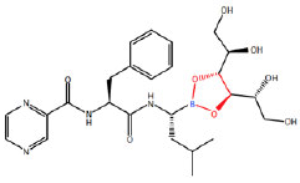
    Structurewhere the portion of the molecule in red identifies the ester linkage between bortezomib and the mannitol sugar.  This compound is claimed in claim 20 of the '446 patent:

    20.  The lyophilized compound D-mannitol N-(2-pyrazine)carbonyl-L-phenylalanine-L-leucine boronate.

    Importantly, the other invalidated claims recited methods for preparing this compound, a lyophilized embodiment thereof and reconstitution of the lyophilized form into an injectable pharmaceutical formulation.  Bortezomib itself was known in the prior art; indeed, it was described and claimed in U.S. Patent No. 5,780,454 ("the '454 Patent").  Also known was the compound's activity as a proteasome inhibitor and its anticancer properties.  However, it was also known to be highly unstable, insoluble in aqueous-based pharmaceutical excipients and to rapidly degrade in liquid formulations.  Accordingly, no form or formulation of the compound had ever been FDA approved or marketed, despite record evidence of "extensive research efforts" ("approximately 20 different formulations") by the '454 inventors and Millennium.

    A solution came from a researcher at the National Cancer Institute and the University of Kansas, as disclosed and claimed in the '446 patent (licensed by Millennium).  This researcher had encountered difficulties with bortezomib similar to the Millennium researchers ("preparing approximately twenty-five different liquid formulations") and then turned to lyophilized forms.  Lyophilization was a known technique that was "not intended to change the chemical structure of the active pharmaceutical ingredient."  During these experiments, lyophilization in the presence of D-mannitol was performed using the sugar for its recognized properties as a bulking agent.  The resulting lyophilized formulation was found to have "dramatic improvement in dissolution and stability."  Presumably (in view of the Court's decision) unexpectedly, "[i]t was discovered that the reason for the dramatic improvement in dissolution and stability for this formulation was the formation of a new chemical compound during lyophilization: the claimed ester of bortezomib and mannitol."

    Sandoz #1ANDA litigation arose when Sandoz Inc., Accord Healthcare, Inc., Actavis LLC, Mylan Laboratories Ltd., Agila Specialties Inc., Dr. Reddy's Laboratories, Ltd., Dr. Reddy's Laboratories, Inc., Sun Pharmaceutical Industries Ltd., Sun Pharma Global FZE, Glenmark Pharmaceuticals Ltd., Glenmark Generics Ltd., Glenmark Generics Inc., USA, Hospira, Inc., Wockhardt Bio Ag, and Wockhardt USA LLC (collectively referenced as "Sandoz" in the opinion) each filed ANDAs and sent Paragraph IV letters to Millennium over Velcade®.  In separate litigations initiated after the first collection of lawsuits but before the District Court had made its determination in those cases, Millennium sued Teva Pharmaceuticals USA, Inc. and Apotex Corp. and Apotex Inc. based on their ANDA filings and Paragraph IV letters.

    In the first litigations, the District Court found asserted claims 20, 31, 49, and 53 of the '446 Patent to be invalid for obviousness.  The District Court held that the claims were "the inherent result of an allegedly obvious process," specifically lyophilizing bortezomib and mannitol together.  Bortezomib and mannitol were both known in the art, bortezomib having anticancer properties and mannitol being useful as a bulking agent; lyophilization was known in the art; and the produced ester (admittedly resulting merely from lyophilization of bortezomib and mannitol together) was thus the inherent result.  Millennium argued (unsuccessfully) that the skilled worker would not have used lyophilization with a compound with bortezomib's known (in)stability characteristics, but the District Court rejected this argument in view of testimony from Sandoz's expert that "lyophilization 'was well-known in the field of formulation' and that it was considered an obvious alternative 'when a liquid formulation provided limited success.'"  Foreshadowing its decision, the panel opinion set out the factual findings the District Court had not made:

    The district court did not find that the prior art taught or suggested that the claimed new compound would be formed, or taught or suggested making the claimed new compound by any method, or taught or suggested that this new compound would have the properties of stability, solubility, and dissociability that it exhibited.  No reference taught or suggested reacting bortezomib with mannitol, and no reference hinted that such an esterification reaction might occur during lyophilization.  No reference taught or suggested that the product of such lyophilization would be a new chemical compound that would solve the problems that had inhibited development of bortezomib in oncology.

    In addition, the District Court stated that the disclosure of the '454 patent "pointed directly to mannitol" despite there being no such disclosure in this patent.  The District Court apparently also disregarded inventor testimony ("and others") that the new compound was neither intended nor expected (there being "no contrary evidence" according to the Federal Circuit), finding that "the 'natural result' of a chemical procedure is inherent in the procedure, and thus the product thereof 'would have been obvious to a person of ordinary skill.'"  The District Court also rejected Millennium's assertion of objective indicia (unexpected results and long-felt need) of non-obviousness.

    In the later-filed actions, the District Court entered (stipulated) final judgment in favor of Teva and the Apotex entities based on collateral estoppel.  The parties' appeals were consolidated before the Federal Circuit.

    The Court reversed, in an opinion by Judge Newman joined by Judges Mayer and O'Malley.  Giving due regard to the deference owed to the District Court on factual inquiries related to obviousness ("[r]ecognizing our obligation to give deference to a district court's greater familiarity with the record and authority to reach factual conclusions therefrom"), the panel nevertheless found that the District Court had erred in applying the Supreme Court's obviousness standard under KSR Int'l Co. v. Teleflex Inc.  For the Federal Circuit:

    [T]he question is whether a person of ordinary skill, seeking to remedy the known instability and insolubility and to produce an efficacious formulation of bortezomib, would obviously produce the D-mannitol ester of bortezomib, a previously unknown compound.

    The Court's reasoning as to why its answer to this question differs from the District Court's is as follows.  According to the opinion, there was no "teaching or suggestion" in the art regarding the claimed (novel) compound, nor was there any appreciation in the prior art that this compound would be formed during lyophilization of the combination of bortezomib and mannitol, or would have the improved stability and solubility of the compound claimed in the '446 patent.  Citing post-KSR chemical obviousness precedent (including Otsuka Pharm. Co., Ltd. v. Sandoz, Inc.; Bristol-Myers Squibb Co. v. Teva Pharm. USA, Inc.; and In re Rosuvastatin Calcium Patent Litig.), the opinion sets forth its analysis that focused on whether the art would provide the skilled worker with a reason for modifying a "lead compound" in a way that would result in the claimed compound.  (In this case, the parties agreed that lead compound to be bortezomib according to the opinion.)  The Federal Circuit finds error in the District Court's obviousness determination because "[t]here is no teaching or suggestion in the references to produce the claimed mannitol ester," "[n]o reference shows or suggests ester formation at freeze-drying conditions, or that any such ester might solve the problems of instability and insolubility of the free acid while dissociating rapidly in the bloodstream," and "[n]o reference provides a reason to make the mannitol ester of bortezomib."

    The panel conceded that lyophilization was a generally known method for pharmaceutical formulation, that bulking agents were known to be used in such lyophilizations, and that mannitol was a known bulking agent.  What was unknown in the prior art was that lyophilizing these two compounds would "produce a chemical reaction and form a new chemical compound," "provide a reason to make this specific new chemical compound," or make a new compound that would provide a solution to the "previously intractable problems of bortezomib formulation" useful as an anticancer pharmaceutical.  The panel states that the art cited by Sandoz to support its obviousness contentions are lacking these characteristics and that the expert testimony proffered by the Sandoz defendants does not "fill the gaps" in the art.  Even references such as the '454 patent disclosing boronic acid esters of bortezomib say "nothing about the stability of any ester."  Indeed, the panel agreed with Millennium's position that the skilled worker would have avoided mannitol esterification because "several different esters, each with different chemical and possibly biological properties" might result.  The opinion suggests that obviousness requires the art to provide a reason for taking the particular experimental route leading to the claimed success, as well as a reasonable expectation of achieving that success.  Instances, as here, where the result is unforeseen and serendipitous cannot satisfy these criteria.

    As for the purported "inherency" of the outcome relied upon by the District Court in its reasoning, the panel found that the District Court had erred in agreeing with Sandoz that, because the result (the claimed bortezomib-mannitol ester) was "inevitable" it was also inherent, and therefore could not be inventive (in the archaic meaning of that term, i.e. non-obvious).  The error stems from the principle that the inventor's intention is not the relevant consideration; it is whether the invention would have been objectively obvious to one of ordinary skill in the art.  Here, there was no evidence that anyone "foresaw, or expected, or would have intended, the reaction between bortezomib and mannitol, or that the resulting ester would have the long-sought properties and advantages" and hence the invention was non-obvious.

    Finally with regard to the District Court's obviousness determination, the Federal Circuit found that there was an insufficient consideration of the objective indicia of non-obviousness, which factors can be "independent evidence of nonobviousness," citing Ortho-McNeil Pharm., Inc. v. Mylan Labs., Inc., 520 F.3d 1358, 1365 (Fed. Cir. 2008).  Regarding evidence of unexpected results, the opinion asserts that Millennium adduced expert testimony regarding the properties of the compound prepared by lyophilizing bortezomib together with mannitol (specifically, "greatly improved stability, solubility, and dissolution").  The District Court erred by determining that Millennium should have compared Velcade® with the glycerol esters of bortezomib as taught in the '454 patent.  However, according to the opinion, these esters are not specifically disclosed, nor prepared, nor tested in the '454 patent, and that patent is devoid of evidence regarding stability or solubility (increased or otherwise) of bortezomib esters.  The principle, from Pfizer, Inc. v. Apotex, Inc., is that "[u]nexpected results are shown in comparison to what was known, not what was unknown" and the absence in the prior art of specific disclosure regarding bortezomib esters makes bortezomib itself the closest prior art compound.  In view of the known stability and solubility deficiencies of bortezomib, the mannitol ester claimed in the '446 patent has improvements in these properties not disclosed in the prior art that support a determination of non-obviousness.  On the question of long-felt need, the Court found the District Court's conclusion "both perfunctory and clearly erroneous," there being "no dispute" that there was a need for anticancer treatment for multiple myeloma and the claimed compound satisfied that need.  (In a footnote, the opinion countered Sandoz's argument that others failed because the '454 patent precluded them from bringing bortezomib ester formulations to market by reminding Sandoz that long-felt need and failure of others while closely related were distinct indicia and long-felt need can be established without evidence that others had failed.)  The Court also considered it error for the District Court to attribute Velcade's® success to bortezomib itself.

    With regard to judgment against Millennium in favor of Teva and independently the Apotex companies, all parties agreed that dismissal would be and accordingly was vacated and the case remanded, giving these generic drug makers a chance to make their invalidity cases against the asserted claims of the '446 patent.

    Millennium Pharmaceuticals, Inc. v. Sandoz Inc. (Fed. Cir. 2017)
    Panel: Circuit Judges Newman, Mayer, and O'Malley
    Opinion by Circuit Judge Newman

  • By Nicholas Vincent* and Anthony D. Sabatelli** —

    Knowledge of, and interest in, the human microbiome has rapidly expanded in recent years: each week, there seems to be additional advancements in our understanding of the microbial communities that call our bodies home.  As investigations into these microbial communities and their impact on our health continue to develop, many researchers have rightfully begun to untangle the web of microbial communities external to us (see "The Emergent Microbiome: A Revolution for the Life Sciences — Part VII, The Microbiology of the Built Environment").  In particular, we have observed an increased interest in the microbial communities associated with agriculture and crops.  Having a clearer understanding of agriculture-associated microbial communities, and how they can be manipulated and modulated, will play an increasingly important role in the safety and security of our food supply.  In fact, we have seen several encouraging efforts devoted to the advancement of microbiome research in agriculture, and we expect to see a subsequent increase in the need for intellectual property protection in this space.  Importantly, we also see a clear path forward for patent-eligible inventions in this historically challenging area.  While this article will focus on agriculture and the microbiome, we have also observed an increase in the attention being given to livestock production and the microbiome.  In an upcoming installment of The Emergent Microbiome, we will address the history, importance, and advancements with respect to this field of research and related intellectual property issues and challenges.

    A Brief History

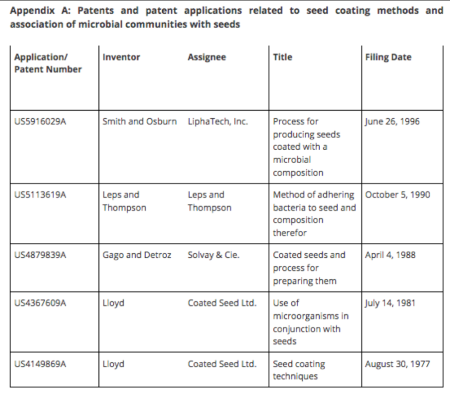
    Although there have historically been challenges with the patenting of bacterial communities or inoculants for plants, we do, in fact, see a clear path forward for the patent eligibility of advancements in this space.  The governing precedent has been Funk Brothers Seed Co. v. Kalo Inoculant Co., a 1948 Supreme Court case ruling that held that the use of naturally occurring bacterial strains, or combinations thereof, in supplementing the growth of crops was no more than the attempt to patent a naturally occurring product.  As a result, the inoculants were deemed to be patent ineligible.  Interestingly, however, there were several patent applications filed between the 1970s and late 1990s that focused on the use of microorganisms and seeds, including methods to coat seeds with various materials such as microbial communities (see Appendix A).  These patents represented an advancement over Funk Brothers.  Some of the claims are directed to methods of coating seeds or associating microbial components with the seeds and not merely attempting to patent a combination of naturally occurring microbes that can supplement plant growth.

    Moreover, in recent years, we have seen a further development of patents and patent applications directed to the association of microbial communities with agricultural crops (see Appendix B).  In particular, many researchers have emphasized methods of creating associations of plants and microbial communities beyond what had been proposed in these patents from the 1970s-1990s.  For example, some applications have focused on the association of microbial communities with the inside of the seed rather than merely an outer coating.

    Additionally, in the December 2014 subject matter eligibility guidance update (Nature-based product examples- Example 6), the USPTO provided an example directed to the patent eligibility of bacterial mixtures in association with plants.  The first claim example was modeled after the Funk Brothers case and is not patent eligible as written.  The second claim focuses on an inoculant that harbors additive qualities that are not naturally prescribed to the individual components.  These claims are exemplified as patent eligible because they provide “something more” than what is found in nature.

    Taken together, we believe that this progression of pioneering patents from the 1970s-1990s followed by more recent developments suggests a promising landscape for the patent-eligibility of advancements made in this space.

    The Importance of Plant Microbiomes and Subsequent Business Related Developments

    According to the most recent USDA Census of Agriculture (2012), the market value of all crops sold in 2012 was just over 200 billion dollars, yet questions remain about the sustainability of production methods in light of an ever-increasing demand and growing global population.  There have been many efforts, both public and private, into finding ways of increasing the sustainability, productivity, and security of crop production by better understanding the interaction between microbial communities and plant growth.

    In 2016, the National Microbiome Initiative (NMI) was established with the aim of "foster[ing] the integrated study of microbiomes across different ecosystems," including those of plants and livestock.  In fact, more than 120 million dollars were dedicated to the NMI, including approximately 16 million from the USDA to better understand microbial communities associated with crops, livestock animals, and fish in addition to the communities found in the air, water, and soil, as they are implicated in the growth, maintenance, and production of agricultural and animal products.

    Although the NMI has served as an important call to increase research efforts in the area of plant and crop microbiome research, perhaps the most interesting advances have been made in the private sector and are related to 'microbials' for improving crop growth, yield, and tolerance.  Although established companies such as Dupont, Monsanto, and Bayer have entered the microbials space, smaller start up companies have made especially interesting and important contributions.  In particular, Indigo Agriculture, New Leaf Symbiotics, and BioConsortia have each contributed important advances.  Indigo, formerly known as Symbiota, has developed technology using bacteria to enhance the growth of crops under conditions of stress, such as limited access to water.  Indigo has focused primarily on the bacteria found inside the growing plant (endophytes) rather than those found on it or around it in the soil.  Association of plants with particular bacterial strains, it is thought, will help these plants to better withstand conditions of stress that can affect crop production and yield.  Indigo announced its first commercial product, Indigo Cotton, in the summer of 2016 and reported at the beginning of 2017 that test plantings in areas of Texas resulted in significant increases in crop yield per acre.  In addition to Indigo Cotton, the company has also developed Indigo Wheat.

    Similarly, NewLeaf Symbiotics is pioneering technology using a family of bacteria that is typically associated with plants called pink-pigmented facultative methylotrophs (PPFMs).  Association of PPFMs with certain plants has been shown to result in faster growing plants that produce higher crop yields.  BioConsortia has also devoted its efforts to understanding how microbial populations can increase crop health and yield and developed a proprietary approach called Advanced Microbial Selection (AMS), whereby plants that have been exposed to various bacterial communities are selected for changes that result in growth improvements.  These beneficial communities are then further analyzed for future use in wide-ranging agricultural applications.  BioConsortia has focused on crops ranging from wheat to tomatoes to turf.

    Looking Ahead

    In light of these recent efforts and advancements and the burgeoning promise of understanding plant microbiomes, researchers have called for the standardization of priorities to better streamline research efforts and findings.  In March 2017, Bubsy, et al. called for five research priorities concerning plant microbiomes and agriculture.  In particular, the authors called for both the development of better model systems for plants and for defining core microbiomes in these model systems to better understand how microbial communities can be manipulated and modulated for agricultural applications.  Although companies like Indigo have made considerable advancements in this space, it is possible that standardizing research efforts and building a strong foundation to back up these efforts could lead to even more successful attempts at modulating crop growth and yield in the future.

    As research into the plant microbiome is standardized and as companies continue to develop novel technologies related to plant microbiomes, we expect there to be an increase in the need for associated intellectual property protection.  We believe that the push for even higher quality and more standardized research, alongside the historical progression of patents in this area, will provide a fruitful and productive space for innovation and subsequent legal protections.

    Appendix A Appendix B

    * Nicholas Vincent is a Technology Specialist at Dilworth IP
    ** Dr. Sabatelli is a Partner with Dilworth IP

    For additional information regarding this topic, please see:

    • "The Emergent Microbiome: A Revolution for the Life Sciences — Part X, The Big Data Component," February 20, 2017
    • " The Emergent Microbiome: A Revolution for the Life Sciences — Part IX, The Microbiome and Immunotherapy II," December 6, 2016
    • "The Emergent Microbiome: A Revolution for the Life Sciences — Part VIII, The Microbiome and Immunotherapy I," October 31, 2016
    • "The Emergent Microbiome: A Revolution for the Life Sciences — Part VII, The Microbiology of the Built Environment," October 5, 2016
    • "The Emergent Microbiome: A Revolution for the Life Sciences – Part V, Patents Relating to Obesity and Metabolic Disorders," February 28, 2016
    • "The Emergent Microbiome: A Revolution for the Life Sciences – Part IV, Obesity and other Metabolic Disorders," February 18, 2016
    • "Jackson Laboratory Hosts Microbiome Symposium Related to Cancer and Immunology," January 19, 2016
    • "The Emergent Microbiome: A Revolution for the Life Sciences – Part III, Psychobiotics," October 13, 2015
    • "The Emergent Microbiome: A Revolution for the Life Sciences – Part II, 2015 Patent Trends," August 11, 2015
    • "The Emergent Microbiome: A Revolution for the Life Sciences – Part I, R&D Leaders," August 10, 2015

  • By Michael Borella

    Federal Circuit SealOver the last 18 months, the Federal Circuit has been quietly shoring up the non-obviousness provisions of 35 U.S.C. § 103 by enforcing the requirement that an obviousness argument entails making the full prima facie case.  That is, in order to invalidate a claim over two or more prior art references, the challenger needs to (i) establish that all elements of the claim are either present in or suggested by the prior art, (ii) that one of ordinary skill in the art would be motivated to combine these references in a fashion that would result in the claimed invention, and (iii) had a reasonable expectation of success in doing so.

    All too often, attacking these two final steps of the obviousness analysis are left out in a § 103 rebuttal.  This is hardly surprising, given that many USPTO examiners seem to believe that merely stating that references could be combined (and perhaps providing a terse explanation of the reasons for doing so) is sufficient to establish the motivation prong of the prima facie case.  During interviews and in written arguments, it is typically much easier to convince an examiner to withdraw a § 103 rejection by arguing that the references do not teach a particular claim element.

    Before the Patent Trial and Appeal Board (PTAB) things can be different.  PTAB judges are more open to rebuttals of the challenger's motivation to combine.  Thus, patentees are more likely to emphasize such arguments.  Nonetheless, the Federal Circuit has had to frequently correct the PTAB's misapplication of this nuance, especially of late (see "Personal Web Technologies, LLC v. Apple, Inc. (Fed. Cir. 2017)" as just one recent example).  This case is an example of the Federal Circuit affirming a PTAB decision that "got it right" with respect to § 103.

    Petitioner Securus appealed a final written decision from the PTAB in an inter partes review (IPR) of Global Tel*Link's U.S. Patent No. 7,853,243.  The PTAB had ruled that Securus did not make out a proper prima facie case of obviousness.

    The '243 patent "relates to a secure telephone call management system that can authenticate the identity of users seeking to make a telephone call from the inside of penal institutions or similar facilities."  Particularly, the "system authenticates users before they attempt to make a phone call by requiring a user to first supply his or her pre-assigned personal identification number (PIN), as well as certain biometric data."  The biometric data can be fingerprints, voiceprints, retinal scans, etc.

    Claim 1 of the '243 patent recites:

    1.  A method for restricting access to a public telephone network using a telephone call management system, said method comprising the steps of:
        assigning a first identification number to each of a plurality of potential callers;
        recording a first voice print of at least one potential caller;
        storing said first voice print and said first identification number in a database;
        during each access attempt to said public telephone network by said potential caller:
        prompting said at least one potential caller to input a second identification number;
        recording a second voice print of said at least one potential caller;
        matching said first and second identification numbers;
        comparing said second voice print with said first voice print associated with said first identification number;
        granting said at least one potential caller access to said public telephone network to attempt to place a telephone call if said second voice print matches said first voice print;
        monitoring at least one conversation to detect the presence of a three-way call attempt; and
        recording at least one conversation between said at least one potential caller and a third-party remotely located from said at least one potential caller if said recording is permissible; and
        detecting the presence of predetermined keywords in audio of said at least one conversation.

    Notably, the "during" step ends with a colon rather than a semicolon.  This subtlety is easy to miss, but turned out to be important even if not determinative.

    Securus argued that claim 1 was obvious over the combination of two references, Susen and Gainsboro.  Susen "generally discloses the use of voice recognition to verify users before they can access a particular line on [a] PBX or mobile terminals," where "[v]oice recognition can be used in conjunction with PINs in the verification process."  Gainsboro "addresses the problem of having employees of [penal] institutions review recorded phone calls for suspicious behavior."  These phone calls are made by the inmate.  Further, "[Gainsboro] includes automatic speech recognition (ASR) technology to existing telephone systems in these institutions so as to eliminate the need for these employees."

    The Court first reviewed a claim construction dispute.  Securus took the position that the "during" step only includes the immediately following "prompting" step, because the former ends with the colon as noted above and the later ends with a semicolon.  The "recording" step and all following steps would not be part of this combined "during" step.  In other words, Securus asserted that a proper construction of claim 1 would be:

                        * * *
        storing said first voice print and said first identification number in a database;
        during each access attempt to said public telephone network by said potential caller: prompting said at least one potential caller to input a second identification number;
        recording a second voice print of said at least one potential caller;
                        * * *

    In contrast, Global Tel*Link's proposed construction was that the "during" step incorporated the next five steps.  This construction would read as follows:

                        * * *
        storing said first voice print and said first identification number in a database;
        during each access attempt to said public telephone network by said potential caller: prompting said at least one potential caller to input a second identification number; recording a second voice print of said at least one potential caller; recording a second voice print of said at least one potential caller; matching said first and second identification numbers; comparing said second voice print with said first voice print associated with said first identification number; granting said at least one potential caller access to said public telephone network to attempt to place a telephone call if said second voice print matches said first voice print;
        monitoring at least one conversation to detect the presence of a three-way call attempt; and
                        * * *

    The PTAB adopted Global Tel*Link's construction and found that the relevant reference, Susen, did not disclose all of these steps.  The Court agreed, noting that "the most natural reading of the [during] limitation is one that incorporates all the steps from the beginning of the attempt to access the telephone network to the end of that attempt," which includes all five elements following the "during" step.  The Court found that this construction was logical and explicitly supported by the specification.

    The PTAB also ruled that Securus "failed to explain why a person of ordinary skill in the art (skilled artisan) would combine Susen and Gainsboro to arrive at the claimed invention."  Securus challenged this part of decision as well.

    The Court set forth the controlling law, noting that "it is not enough to simply show that the prior art references disclose the claim limitations; in addition, it can be important to identify a reason that would have prompted the skilled artisan to combine the elements as the new invention does."  Securus contended that since "[b]oth prior art patents are in the same field of telecommunications monitoring and control," one skilled in the art "would be motivated to combine Susen with Gainsboro to include monitoring said telephone call for a hook flash indicative of three-way calling."

    The Court agreed with the PTAB, observing that "Securus' case against the patentability of the claimed invention amounts to mere conclusory statements, which fall short of some articulated reasoning with some rational underpinning to support the legal conclusion of obviousness" as required by § 103.  Continuing, the Court wrote that "Securus failed to explain how or why the skilled artisan would combine the teachings of Susen, which are generally directed to authorizing telephone access through voice recognition in corporate settings, with the teachings of Gainsboro, which are generally directed to listening in on and reviewing phone conversations in penal settings, to arrive at the claimed invention."  Moreover, "a broad characterization of Susen and Gainsboro as both falling within the same alleged field of telecommunications monitoring and control, without more, is not enough for Securus to meet its burden of presenting a sufficient rationale to support an obviousness conclusion . . . [s]uch short-cut logic would lead to the conclusion that any and all combinations of elements known in this broad field would automatically be obvious, without the need for any further analysis."

    Consequently, the Court upheld the PTAB's decision that Securus did not meet its burden to establish that the claims were obvious.

    There are two main take home points to this case.  The most important one should be obvious (pun intended) — when making obviousness contentions, a well-reasoned motivation to combine must be present.  The second is that claim formatting matters.  Especially in software claims where there are steps and sub-steps, it can be important to make sure the claim structure itself clearly spells out these relationships.  Some practitioners use enumeration, others use indentation or other types of formatting.  Both have their pros and cons.  Here, Global Tel*Link was fortunate that the PTAB and the Court saw things its way.  But patentees should not count on the proper structure being imposed on claims that might not be 100% clear on their face.

    Securus Technologies, Inc. v. Global Tel*Link Corp. (Fed. Cir. 2017)
    Nonprecedential disposition
    Panel: Circuit Judges Newman, Chen, and Stoll
    Opinion by Circuit Judge Chen

  • CalendarJuly 20, 2017 – "Structuring Freedom-to-Operate Opinions: Reducing Risk of Patent Infringement — Combating Troubling FTO Results, Overcoming Potential Roadblocks, Addressing Impact of Post-Grant Process on FTO Opinions" (Strafford) – 1:00 to 2:30 pm (EDT)

    July 20, 2017 – "Winning Attorney Fees: What Works, What Doesn't" (Intellectual Property Owners Association) – 2:00 to 3:00 pm (ET)

    July 24-25, 2017 – TTS North America summit*** (TTS Ltd.) – Weill Cornell Medicine in New York, NY

    July 27, 2017 – "Drafting Patent Counsel Engagement and Disengagement Letters — Structuring Scope of Engagement, Confidentiality, Conflicts of Interest and Other Key Provisions" (Strafford) – 1:00 to 2:30 pm (EDT)

    July 27, 2017 – "Bayh-Dole Compliance Check-up: Effectively Address the Challenge of Complacency" (Technology Transfer Tactics) – 1:00 to 2:00 pm (Eastern)

    July 27-29, 2017 – Annual Meeting & Conference (National Association of Patent Practitioners) – Silicon Valley U.S. Patent & Trademark Office in San Jose, CA

    August 10-11, 2017 – Advanced Patent Law Seminar (Chisum Patent Academy) – Seattle, WA

    August 14-15, 2017 – Advanced Patent Law Seminar (Chisum Patent Academy) – Seattle, WA

    ***Patent Docs is a media partner of this conference or CLE

  • NAPP_1The National Association of Patent Practitioners (NAPP) will be holding its Annual Meeting & Conference on July 27-29, 2017 at the Silicon Valley U.S. Patent & Trademark Office in San Jose, CA.  Topics to be discussed during the conference will include:

    July 27
    • 20,000-foot Overview of Current Challenges and USPTO Plans/Programs
    • Examiner Panel
    • Panel of PTAB Judges
    • Ethics Considerations
    • Pilot Programs Available

    July 28
    • Patent Validity in a Post-Alice World
    • How to Address/Fix 101 Issues — to be presented in part by Patent Docs author and MBHB attorney Michael Borella
    • When Things Go Wrong
    • Patent Monetization: Buy, Sell, License, Hold?

    July 29
    • U.S. Case Law Updates
    • Patenting for the Small Company
    • Foreign Practice
    • Patent Agent Privilege
    • Case Hypo

    An agenda for the meeting can be found here.

    The registration fee for the annual meeting and conference is $895 (for NAPP member practitioners) or $1,095 (for non-member practitioners).  Those interested in registering for the meeting can do so here.

  • IPO #2The Intellectual Property Owners Association (IPO) will offer a one-hour webinar entitled "Winning Attorney Fees: What Works, What Doesn't" on July 20, 2017 from 2:00 to 3:00 pm (ET).  D. Clay Holloway of Kilpatrick Townsend & Stockton LLP; Lionel Lavenue of Finnegan, Henderson, Farabow, Garrett & Dunner LLP; and Robert Palmersheim of Honigman Miller Schwartz & Cohn LLP discuss issues including:

    • How to choose between a Rule 11 sanction or a Section 285 fee award when both may be attainable;
    • How to handle the delicate matter of disclosing billable hours and hourly fees, particularly in joint defense groups;
    • Is there a best time to request fees?
    • What milestones make such a request appropriate?
    • What are the routes to collecting fees from a non-practicing entity that is using a corporate veil to shield assets?

    The registration fee for the webinar is $135 (government and academic rates are available upon request).  Those interested in registering for the webinar can do so here.