• By Michael Hinrichsen* and Anthony D. Sabatelli** —

    On May 30th, the Supreme Court ruled in Impression Products, Inc. v. Lexmark International, Inc. that all patent rights are automatically exhausted upon the sale of a product irrespective of contract stipulations and regardless of whether the sale is made domestically or internationally.  While the dispute in this case involved articles of manufacture, the decision has strong implications for the biotechnology and pharmaceutical Industry, and may make it easier for drugs sold legally overseas to make their way back to the U.S. market.

    Lexmark, a manufacturer of laser printers, holds multiple patents on the toner ink cartridges used in their laser printer products.  To protect their market position, Lexmark had U.S. customers sign a contract when they bought a toner cartridge, agreeing to neither reuse nor resell the purchased cartridge.  Despite the contract, many of these customers subsequently sold their spent cartridges to outside companies, called remanufacturers, who then refilled the empty cartridges with new toner for resale.  Remanufacturers also purchased and resold spent cartridges from customers outside the U.S.  Lexmark sued Impression Products on the grounds of patent infringement, asserting that they still held patent rights on the resold cartridges because of the contracts signed by U.S. customers, and because rights cannot be exhausted on products that are sold outside the U.S.

    Agreeing in part with both sides, the District Court initially ruled that while all patent rights are immediately exhausted when a product is sold domestically, patent rights are not exhausted for international sales.  The Federal Circuit agreed with regard to international sales, but reversed the domestic portion, ruling that patent rights can be retained so long as the seller specifies which rights are being retained.  The Supreme Court reversed the Federal Circuit ruling on both counts, finding that all patent rights are automatically exhausted wherever a sale is made, regardless of a signed contract.

    Impact on the pharmaceutical industry

    The Lexmark decision has implications for any industry that sets different prices for the same product, and makes it easier for customers charged a relatively low price to resell the product at a profit to customers being charged more.  In the pharmaceutical industry, this kind of price differential is common between countries, with prices in the U.S. often being higher.  This situation is due in part to strong governmental price controls present in other developed nations, and the steep discounts, patent exceptions and donations granted in developing countries.

    It might appear at first blush that there are a few avenues for drugs sold overseas to make their way to the U.S. market.  Drugs could be resold by customers, either directly to customers in the United States, or to a third party company, who would then import the drugs in bulk to the U.S. for resale.  Alternatively, drug wholesalers or pharmacies in other countries could sell directly to U.S. wholesalers, or pharmacies, or customers.  What currently blocks these importations is not patent law but FDA regulations.  To sell a prescription drug in the U.S., the drug must be approved by the FDA in order to ensure that it is safe, effective, labelled properly, and manufactured and tested using approved protocols.  Although drugs manufactured overseas can be sold in the U.S., all production facilities must be registered with the FDA and undergo regular inspection.  Since the FDA cannot verify that all drugs sold overseas pass these stringent safety requirements, the agency currently prevents the resale of drugs across U.S. borders.

    Given the safety risks, it seems unlikely that the FDA would allow drugs purchased from individual consumers in other countries to be resold in the U.S.  In the current political environment, however, restrictions on all drug imports are by no means guaranteed.  Several congressional bills have been proposed in recent years that would allow U.S. citizens to buy drugs from pharmacies in countries with similar safety standards to our own [1], and a recent survey found that a majority of Americans support these proposals [2].  Should such legislation pass, the Lexmark decision could prove critical, as it removes patent law as a means to exclude such drug imports.  Assessing the exact impact that foreign drug imports would have on U.S. drug prices is difficult.  Should these bills achieve their intended goal and cause drug prices to drop significantly, a potential unintended consequence could be a reduction in research and development spending, as has occurred in European and other countries after employing strong price controls [3].

    Another possible effect of the Lexmark decision is a decrease in drug donations from pharmaceutical companies to developing nations, out of concern that these drugs could be potentially resold in the U.S.  This concern has basis in the Federal Circuit's decision in Lifescan v. Shasta, which found that compensation is not necessary in a transaction for patent rights to be exhausted.

    Are there any legal recourses left to pharmaceutical companies?

    As Chief Justice Roberts notes in the Court's decision, the Lexmark ruling does not prevent companies from placing post-sale restrictions on a product.  Rather, it only prevents the use of patent law to enforce these restrictions.  Pharmaceutical companies could have overseas pharmacies and wholesalers enter contracts with provisions against reselling drugs in the U.S. market.

    [1] The Affordable and Safe Prescription Drug Importation Act. S. 469, 115th Cong. (2017).
    [2] The Henry J. Kaiser Family Foundation (2017). Kaiser Health Tracking Poll (April, 2017)., "The Future of the ACA and Health Care & the Budget."
    [3] Eger, S. and J.C. Mahlich. Pharmaceutical regulation in Europe and its impact on corporate R&D. Health economics review, 2014. 4(1): p. 23.

    * Mike Hinrichsen is a Ph.D. Candidate in the Molecular Biophysics and Biochemistry department at Yale University.  His thesis research is focused on using protein design to develop novel methods for imaging proteins and genomic loci in living cells.
    ** Dr. Sabatelli is a Partner with Dilworth IP

  • By Kevin E. Noonan –

    Federal Circuit SealThe Patent Trial and Appeal Board (PTAB) gets most of its attention (judicial and otherwise) regarding its decisions in inter partes review and covered business method proceedings.  But the Board also has responsibility for deciding ex parte appeals of Examiner rejections that fell within the purview of its predecessor, the Board of Patent Appeals and Interferences.  In August, the Federal Circuit reviewed the Board's decision affirming rejection of claims for obviousness in In re Stepan Co. in a precedential decision vacating the decision and sending it back on remand for a proper application of the law.

    The application at issue, U.S. Application No. 12/456,567 (U.S. Patent Application Publication No. US 2009/0318294 A1), claimed an invention related to herbicidal formulations of glyphosate salt and a surfactant, which the specification described as being "based on the unexpected discovery that surfactant systems comprising dialkoxylated alkylamine, water miscible solubilizer and amine oxide allow for formulation of ultra-high loaded ('high-strength') glyphosate salt concentrates possessing high or no cloud points."  The advantage of the formulation having high or no cloud point was quicker formulation and quicker delivery to market.  Claim 1 is representative:

    Claim 1:  An ultra-high load, aqueous glyphosate salt-containing concentrate comprising:
        a.  water;
        b.  glyphosate salt in solution in the water in an amount greater than about 39 weight percent of acid equivalent, based on the weight of the concentrate, said glyphosate salt being selected from the group consisting of the isopropylamine salt of glyphosate, the potassium salt of glyphosate, mixtures of the isopropylamine salt and the potassium salt of glyphosate and mixtures of the potassium salt and the ammonium salt of glyphosate;
        c.  a surfactant system in an amount ranging from about 1 to about 20 weight percent, based on the weight of the concentrate, comprising:
            i.  from about 10 to about 60 weight percent, based on the weight of the surfactant system, of one or more dialkoxylated alkylamines;
            ii.  from about 5 to about 30 weight percent, based on the weight of the surfactant system, of one or more water miscible solubilizers; and
            iii.  from about 30 to about 75 weight percent, based on the weight of the surfactant system, of one or more amine oxides;  
        said concentrate having a cloud point above at least 70oC or no cloud point when the concentrate is heated to its boiling point.

    Dependent Claim 26 specifies that the water miscible solubilizer is a polyalkylene glycol with a molecular weight from about 200 to about 1000, and claim 27 further limits the water miscible solubilizer to polyethylene glycol.

    The Examiner rejected all claims as being obvious under 35 U.S.C. § 103 over prior art disclosing glyphosate formulations with surfactants having cloud points of 50-60oC (Pallas).  The Examiner contended that this art taught species recited in dependent claims, and as to the ranges recited in the claims these were "routine optimization."  Higher cloud points (i.e., 70oC) disclosed in the prior art were also unconvincing in establishing non-obviousness for the Examiner as being merely optimization of the claimed formulations.

    With regard to dependent claim 26 and 27, the Examiner rejected these claims as being obvious over the combination of the Pallas reference and U.S. Patent No. 5,843,866, which discloses formulations comprising PEG 600 (falling within the range of 200-1000).

    The Board adopted these grounds of rejection and Stepan appealed.

    The Federal Circuit vacated the Board decision and remanded to the PTAB for further consideration, in a decision by Judge Moore, joined by Judge O'Malley; Judge Lourie filed a dissenting opinion.  While acknowledging that its review of factual matter required the Court to give deference to the Office the opinion faulted the Board for failing to provide sufficient basis for review:

    Because the Board failed to adequately articulate its reasoning, erroneously rejected relevant evidence of nonobviousness, and improperly shifted to Stepan the burden of proving patentability, we vacate the Board's decision that claims 1–31 of the '567 application would have been obvious.

    According to the opinion, the Examiner (and the Board) failed to explain the basis for finding the distinctions between the claimed invention and the prior art to be nothing more than routine experimentation.  This failure to make findings of fact sufficient for reviewing court to "conduct meaningful review" required the matter to return to the Board for proper explication of the Office's reasoning in the Court's opinion, citing In re Lee, 277 F.3d 1338, 1346 (Fed. Cir. 2002).  Merely stating that the skilled worker would have arrived at the claimed invention through routine experimentation does not satisfy the standard, because what is missing is why this is the case.  The opinion analogizes the case before it and the Board's failure to enunciate its reasoning to cases where the Board has based rejection on "common sense" or "intuition" without explanation, such as Arendi S.A.R.L. v. Apple Inc., 832 F.3d 1355, 1362 (Fed. Cir. 2016), and In re Van Os, 844 F.3d 1359, 1360 (Fed. Cir. 2017).  The explanation of the Board's reasoning was held to be insufficient in these cases and the same reasoning applies here according to the majority.

    Of all the rationales proffered by the Office on appeal, the panel majority considered them to be "post hoc generalizations" and not a proper basis for the required findings.

    The panel also based its decision on the grounds that the Board did not enunciate a reason why the cited art would not have given the skilled worker a reasonable expectation of success: "to have a reasonable expectation of success, one must be motivated to do more than merely to vary all parameters or try each of numerous possible choices until one possibly arrived at a successful result," citing  Pfizer, Inc. v. Apotex, Inc., 480 F.3d 1348, 1365 (Fed. Cir. 2007) (quoting Medichem, S.A. v. Rolabo, S.L., 437 F.3d 1157, 1165 (Fed. Cir. 2006)).

    The opinion also found that the Board ignored Stepan's evidence that the claimed surfactants had failed in the experiments disclosed in the Pallas reference and directed the Board to consider this evidence on remand.

    Finally, the panel opined that the Board had shifted the burden of proof onto Stepan without providing a prima facie case of obviousness because it failed to articulate its reasoning, citing In re Kahn, 441 F.3d 977, 986 (Fed. Cir. 2006).  In this regard, the panel held that the Board did not properly consider the cloud point element in considering obviousness (which was a feature the majority found might distinguish the prior art formulations with regard to nonobviousness).

    Judge Lourie's dissent was based on his opinion that the claims were obvious based on their expressly recited elements and not on the cloud point limitation (which he considered a feature and not a limitation that Stepan could rely upon to establish nonobviousness).  Furthermore, in Judge Lourie's reading of the claims the Pallas reference itself almost anticipates claim 1, based on the recited elements.  The claims in his view in this case are broad, and broad ("shotgun") claims cannot be non-obvious due to a discovery of a new property (in this case, the cloud point).

    And with regard to the reasonable expectation of success requirement he states:  "Where, as here, there is a single prior art reference, there does not need to be a finding of reasonable expectation of success for those skilled in a particular art to make conventional modifications to the prior art and look for improvements in some parameter," citing In re Ethicon, Inc., 844 F.3d 1344, 1351 (Fed. Cir. 2017)

    In re Stepan Co. (Fed. Cir. 2017)
    Panel:  Circuit Judges Lourie, Moore, and O'Malley
    Opinion by Circuit Judge Moore; dissenting opinion by Circuit Judge Lourie

  • Telephone Call Processing Patent Claims Found Invalid under 35 U.S.C. § 101

    By Joseph Herndon

    District Court for the District of DelawareIn the United States District Court for the District of Delaware, Plaintiff filed a declaratory judgment action on seeking a declaration that none of Plaintiff's accused products infringed any valid claims of Defendant's U.S. Patent Nos. 8,351,591 and 7,822,188, and further that one or more claims of those patents were invalid under 35 U.S.C. § 101.

    The '591 and '188 patents share a common specification and generally relate to "systems and methods for processing and placing telephone calls."  The parties separate the asserted claims into two categories:  the sequential dialing claims and the single number outcall claims.  Generally, the patents are directed to flexible call processing systems.  In one example, an inbound call intended for a called party can be rerouted based on whether the call is successfully connected or not.  The methods for rerouting include the sequential dialing or single number outcall methods.

    A.  Sequential Dialing Claims

    Claim 40 of the '188 patent is an independent claim and is representative of the sequential dialing claims.  It reads as follows:

    40.  A method of processing calls, comprising:
        receiving at a call processing system a message from an Internet protocol proxy regarding a first call from a caller;
        determining if the first call is directed to a telephone address of a subscriber of services offered by the call processing system, wherein at least partly in response to determining that the telephone address is that of a subscriber:
        accessing an account record associated with the subscriber, the account record including at least one subscriber instruction;
    based at least in part on the subscriber instruction, placing a first outcall to a first communication device associated with the subscriber;
        if the first outcall is not answered within a first number of rings or period of time, placing a second outcall to a second communication device associated with the subscriber; and
        receiving a call connect instruction from the subscriber; and
        instructing the call processing system to connect the first call to a third communication device.

    Abstract Idea

    The analysis under 35 U.S.C. § 101 first requires determination of whether the claims at issue are directed to an abstract idea.

    Plaintiff argued that the claims are like the concept of sending, receiving, and managing information between a subscriber and a network, and as such, are directed to the abstract idea of sequentially dialing a list of telephone numbers.

    Plaintiff also asserted that the sequential dialing claims provide no improvement to any computer or technological process; instead, they merely access a list of telephone numbers in a database associated with the called party and sequentially dial them in the ordinary fashion, providing simple automation of a task previously performed manually.

    All of Plaintiff's arguments centered around comparing the claims of the patents to claims previously held to be patent ineligible in other cases.

    Defendant countered that Plaintiff's analogy oversimplified the sequential dialing claims.  According to Defendant, the problem addressed by the invention is redirecting the call to another number associated with the subscriber without hanging up and redialing after receipt of a busy signal from one of the subscriber's phone numbers.  Defendant further argued that the claims are not abstract because humans have not practiced and cannot practice the claims:  a conventional operator cannot redirect a call in a situation where the caller does not know the called party's other phone numbers.

    The Court agreed with Plaintiff that claims are directed to an abstract idea.  Like Plaintiff, the Court simplified the claim into functions that can be considered directed to organizing human activity:  accessing stored information when prompted by a user's incoming call, and executing an automated response according to stored instructions provided in advance by a subscriber.

    The Court noted that the '188 patent describes the problem addressed by the claims as callers receiving busy signals or getting sent to voicemail instead of successfully connecting with the called party.  Thus, the Court found that the "problem" addressed by the claims is a human unavailability problem, rather than a problem specific to telephony technology.  As a result, the claims were not found to improve telephony technology, and instead invoked known telephony technology merely as a tool to address this human unavailability problem.

    Inventive Concept

    The determination that a patent is directed to an abstract idea does not render the subject matter ineligible.  Having decided that the patent's claims are directed to an abstract idea, the Court must next determine whether the claims do significantly more than simply describe the abstract method so as to involve an inventive concept.

    Plaintiff argued that the claims lack an inventive concept because the claims merely implement the idea of sequential dialing in the context of computer telephony and recite only conventional telephony elements.

    Defendant again complained that Plaintiff improperly oversimplified each limitation in the claims and failed to consider each claim as a whole.  Defendant asserted that an inventive concept exists because the patent contemplates employing a select set of timing rules for the length that the first outcall is permitted to go unanswered before placing the second outcall.

    The Court found, however, that the rules here merely require initiating a second outcall after a preset number of rings or period of time.  Here, unlike McRo, no rule derivation is required, and the rules are not directed to a complex interaction.  The Court found nothing inventive about using a preset amount of time to determine when to initiate a particular step in a process, and it is difficult to imagine using in this system alternative rules not based on the passage of some period of time.

    Further, the Court found that the rules recited here do not represent an improvement to telephony technology.  The Court rejected all of Defendant's arguments, and found that the claims of the '188 patent are drawn to an abstract idea and do not provide an inventive concept.  Thus, the claims were found to be patent ineligible under 35 U.S.C. § 101.

    B.  Single Number Outcall Claims

    Claim 1 of the '591 patent is representative of the single number outcall claims, and it reads as follows:

    1.  A method of processing calls, the method comprising:
        storing in computer readable memory associated with a call processing system a first phone address associated with a first subscriber;
        storing in computer readable memory a plurality of phone addresses for the first subscriber;
        participating at the call processing system in a first call associated with the first subscriber, the first call associated with a second phone address different than the first phone address;
        placing a first outcall from the call processing system to a first called party, wherein the call processing system inserts at least a portion of the first phone address in a callerID field associated with signaling information associated with the first outcall;
        causing the first call and the first outcall to be bridged;
        participating at the call processing system in a second call associated with the first subscriber, the second call involving a subscriber communication device associated with a third phone address different than the first phone address placing a second outcall from the call processing system to a second called party, wherein the call processing system inserts at least a portion of the first phone address in a callerID field associated with signaling information associated with the second outcall; and
        causing the second call and the second outcall to be bridged.

    Abstract Idea

    Plaintiff argued that the asserted single number outcall claims are directed to the abstract idea of identifying a caller with a single telephone number.  Plaintiff asserted that the claims do not improve telephony technology; instead, the claims merely store information (i.e., telephone addresses), categorize that information (i.e., associate the telephone addresses with particular subscribers), and then transmit the information (i.e., insert the telephone address into a callerID field).

    Plaintiff also asserted that the abstract concept to which the claims are directed has been practiced for decades because a call involving an assistant located in an office who connects an employee working from home with a third party would display a number for the office, rather than the employee's home phone number, in the callerID field.  In this scenario, although the employee would initiate the call from a home phone address (the second phone address), the callerID field would display the office phone address (the first phone address), not the employee's home phone address when the employee was connected to the called party.

    The Court agreed with Plaintiff that the asserted single number outcall claims are directed to an abstract idea.  The Court found that essentially, the claim is directed to storing data in a database, looking up data from that database in response to the initiation of a phone call, and inserting at least a portion of that data in the already-existing callerID field.

    The claims do not focus on a specific means or method that improves the relevant technology but are instead directed to a result or effect that itself is the abstract idea and merely invokes generic processes and machinery.

    Inventive Concept

    Plaintiff argued that the single number outcall claims lack an inventive concept because the claim scope is not limited to anything narrower than identifying a caller with a single telephone number.  Plaintiff further contended that the claims merely implement this abstract idea using generic and conventional components and operations.

    For the same reasons discussed with respect to the sequential dialing claims, the Court agreed with Plaintiff that the call processing system fails to provide an inventive concept for the single number outcall claims.

    Defendant admitted during oral argument that the hardware that was utilized in the patent claims was known at the time, but asserted that what was new was combining those known hardware elements together through programming in a new way.  But rather than disclosing a detailed program to achieve the claimed functionality, the patents simply append conventional steps, specified at a high level of generality, which is not enough to supply an inventive concept.

    Thus, the Court found that the single number outcall claims are directed to an abstract idea and do not provide an inventive concept.  Thus, the claims were found to be patent ineligible under 35 U.S.C. § 101.

    Looking at the outcome here, most of Plaintiff's arguments centered around comparing the claims of the patents to claims previously held to be patent ineligible in other cases.  This can be a high burden to overcome for the Defendant because now the Defendant must either demonstrate that the claims are unlike those previously found invalid, or demonstrate that the claims previously found invalid were done so improperly.  This brings up a problematic issue because a Court is unlikely to consider previous cases to have been decided improperly.  As a result, once a case is decided finding claims to be patent ineligible under 35 U.S.C. § 101, those claims now are examples to use for all future section 101 challenges.

    As with many of the patent ineligible decisions, many other additional arguments were focused on demonstrating that the claims are directed to old technology, or as stated here, to technology that "has been practiced for decades".  Of course, if that is the case, the proper validity challenge should arise under section 102 or 103 to invalidate the claims based on prior art.  I still cannot agree that a patent eligibility issue has anything to do with whether the claims recite new/novel features.

    Memorandum Opinion by Richard G. Andrews, U.S. District Judge

  • CalendarOctober 10, 2017 – "The Ever-Evolving Estoppel Effect of PTAB Decisions" (LexisNexis) – 1:30 to 2:00 pm (ET)

    October 12, 2017 – "Patent Term Adjustments and Extensions: Leveraging Recent Decisions and USPTO Rules" (Strafford) – 1:00 to 2:30 pm (EDT)

    October 17, 2017 – "The Good, the Bad, and the Ugly: Patent Litigation Forum Selection in the Wake of TC Heartland" (McDonnell Boehnen Hulbert & Berghoff LLP) – 10:00 am to 11:15 am (CT)

    October 17, 2017 – "Strategic Considerations in Anticipation of Oil States" (LexisNexis) – 1:30 to 2:00 pm (ET)

    October 18, 2017 – "Patent Trolls Uprising: Tips and Strategies to Win the War Against Them" (The Knowledge Group) – 12:00 to 1:30 pm (EST)

    October 26, 2017 – "Drug Substance Patents: FDA Guidance, Protecting Composition-of-Matter Patents, Drafting Solid Form Claims" (Strafford) – 1:00 to 2:30 pm (EDT)

    November 2-3, 2017 – Summit on IP Due Diligence*** (American Conference Institute) – Philadelphia, PA

    ***Patent Docs is a media partner of this conference or CLE

  • Strafford #1Strafford will be offering a webcast entitled "Drug Substance Patents: FDA Guidance, Protecting Composition-of-Matter Patents, Drafting Solid Form Claims" on October 26, 2017 from 1:00 to 2:30 pm (EDT).  Eyal H. Barash of Barash Law and Dr. Steef Boerrigter, Senior Research Investigator, Materials Science, SSCI will examine solid forms, provides specific examples of products in the Orange Book using patents to such forms to provide drug substance protection beyond composition of matter, discuss both patentability and infringement issues related to such patents, and also discuss the recent FDA guidance on co-crystals and implications for patent strategy, outline how solid form claims are drafted, and review lessons from recent cases.  The webinar will review the following topics:

    • A brief scientific introduction to solid forms
    • What are the key patentability issues when preparing solid form patents?
    • How are pharmaceutical companies using solid form patents?
    • What is different about claiming solid form patents with respect to “organic chemistry” claims in other composition-of-matter patents?
    • What impact does the FDA guidance on co-crystals have on patenting composition of matter?

    The registration fee for the webcast is $297.  Those interested in registering for the webinar, can do so here.

  • LexisNexisLexisNexis will be offering a webinar on "The Ever-Evolving Estoppel Effect of PTAB Decisions" on October 10, 2017 from 1:30 to 2:00 pm (ET).  Gina Shishima and Tom Owens of Norton Rose Fulbright and Miri Beiler of LexisNexis will discuss the following:

    • How the PTAB has interpreted the estoppel provision
    • Federal court cases interpreting the estoppel provision
    • The potential impact of the Supreme Court's coming decision in SAS Institute Inc. v. Matal, considering whether a final written decision in an IPR must address all challenged claims, and its implications for the scope estoppel

    Those interested in registering for the webinar, can do so here.

  • The Knowledge GroupThe Knowledge Group will offer a live webcast entitled "Patent Trolls Uprising: Tips and Strategies to Win the War Against Them" on October 18, 2017 from 12:00 to 1:30 pm (EST).  Neal Rubin, Senior Vice President at RPX Corporation, Herbert H. Finn of Greenberg Traurig, LLP, and Mark P. Wine of Orrick will provide attrendees with an overview of the latest trends and critical issues with respect to the rise of patent trolls, and also offer best practices in developing and implementing effective tips and strategies to win the war against patent trolls.  Key topics to be addressed by the webcast include:

    • The Rise of Patent Trolls
    • Recent Court Decisions
    • Emerging Trends and Critical Issues
    • Significant Implications to Patent Owners and Businesses
    • Defense Tips and Strategies
    • Best Practices in Battling Patent Trolls

    The registration fee for the webcast is $99.  Those interested in registering for the webinar can do so here.  Additional information regarding the webinar can be found here.

  • LexisNexisLexisNexis will be offering a webinar on "Strategic Considerations in Anticipation of Oil States" on October 17, 2017 from 1:30 to 2:00 pm (ET).  Orion Armon of Cooley LLP, Sarah Guske of Baker Botts LLP, and Miri Beiler of LexisNexis will discuss the following:

    • The potential impact of the Supreme Court's decision in Oil States
    • Guidance for how to use IPRs while Oil States is pending
    • How to leverage PTAB proceedings in district court even if the Supreme Court finds IPRs unconstitutional

    Those interested in registering for the webinar, can do so here.

  • More Than a Mere Academic Exercise

    By Andrew Williams

    Federal Circuit SealToday, in Aqua Products, Inc. v. Matal, a highly fractured en banc Federal Circuit determined that the PTAB can no longer place the burden of establishing the patentability of amended claims on the patent owner in IPR proceedings.  This case should result in more claim amendments surviving such proceedings, and it also opens that possibility that more motions to amend will be filed.  However, this decision is unlikely to be the panacea hoped for by patent owners.  First, any amended claim is still likely going to be subject to intervening rights.  Considering that the majority of patents involved in IPRs are also being asserted in concurrent district court litigation, claim amendments might not always be feasible.  Moreover, the decision makes clear that the Patent Office could again place the burden of persuasion for claim amendments back on the patent owner, provided that the Office first goes through proper notice and comment rule-making.  As a result, any benefit that patent owners gain from this decision might be fleeting.

    As we reported at the time, the Federal Circuit granted the petition for rehearing en banc on August 13, 2016, to address two questions:

    (a) When the patent owner moves to amend its claims under 35 U.S.C. § 316(d), may the PTO require the patent owner to bear the burden of persuasion, or a burden of production, regarding patentability of the amended claims as a condition of allowing them?  Which burdens are permitted under 35 U.S.C. § 316(e)?

    (b) When the petitioner does not challenge the patentability of a proposed amended claim, or the Board thinks the challenge is inadequate, may the Board sua sponte raise patentability challenges to such a claim?  If so, where would the burden of persuasion, or a burden of production, lie?

    The three judge panel that rendered the Aqua opinion consisted of Chief Judge Prost, Circuit Judge Reyna, and Chief District Judge Stark (sitting by designation).  That panel felt constrained by the precedent of cases like Microsoft and Nike.  Instead, the panel only considered whether the Board abused its discretion by not evaluating "objective indicia of non-obviousness and various new limitations in the proposed claims," and ultimately affirmed the PTAB.

    For those interested, the technology at issue in the case involved automated swimming pool cleaners.  Specifically, the patent disclosed cleaners that used angled jet drive propulsion systems to move the system in a controlled manner.  This was a less expensive alternative to cleaners in the art that required the use of motor-driven wheels.  Moreover, the motorless prior art cleaners that did exist allegedly used suction or water jets, which caused the units to move erratically.

    This decision has been some time in coming as oral arguments were held on December 9, 2016.  It should be no surprise therefore that there were multiple opinions (five to be exact), and that figuring out the actual outcome is not trivial.  Even identifying which Judge agreed with which opinion is fairly convoluted.  The "main" opinion, which expressed the judgment of the Court, was authored by Judge O'Malley, and was joined by Judges Newman, Lourie, Moore, and Wallach.  Judge Moore authored another short opinion that was joined by Judges O'Malley and Newman, whom authored and joined, respectively, the first opinion.  Judge Reyna authored the final opinion that was not considered a dissent (because the ultimate outcome that it reached was in agreement with the O'Malley opinion).  Judge Reyna was joined in whole by Judge Dyk.  However, Judge Reyna's opinion included the soon-to-be-infamous "Part III" that was joined by Chief Judge Prost and Judges Taranto, Chen, and Hughes, all of whom dissented from the ultimate judgment.  In fact, Part III (directed to the burden of production) was the only part of the entire decision that was joined by a majority of the Court.  However, Judge O'Malley belittled Part III because it allegedly had no proposed judgement attached to it.  Therefore, according to her, it amounted to nothing more than dicta (but more on this below).  Judge Taranto wrote a substantial dissent that was not only joined by Chief Judge Prost and Judges Chen and Hughes, but was also joined by Judges Reyna and Dyk (at least in part).  Finally, Judge Hughes filed a second dissent that was joined by Judge Chen.  Got it?

    With regard to what can be considered precedential in the five opinions, Judge O'Malley noted that there are only two legal conclusions that can be gleaned as supporting the judgment of the Court.  Because a majority of Judges believed that 35 U.S.C. § 316(e), the statute that establishes the evidentiary standard for IPRs, was ambiguous with regard to whether the burden of persuasion of establishing the unpatentability of substitute claims should be on the petitioner, it was necessary to reach "Chevron Step Two."  The first legal conclusion, therefore, was that "the PTO has not adopted a rule placing the burden of persuasion with respect to the patentability of amended claims on the patent owner that is entitled to deference."  The second legal conclusion flowed from this, specifically "in the absence of anything that might be entitled to deference, the PTO may not place that burden on the patentee."  As a result, the Court vacated the original PTAB final written decision "insofar as it denied the patent owner's motion to amend."  The case was "remanded for the Board to issue a final decision under § 318(a) assessing the patentability of the proposed substitute claims without placing the burden of persuasion on the patent owner."  Moreover, the Board was instructed to follow the same practice "for all pending IPRs unless and until the Director engages in notice and comment rule-making."

    Everything else in the decision Judge O'Malley labeled as "cogitations" — "[e]ven our discussions on whether the statute is ambiguous are mere academic exercises."  However, Judge Rayna and those joining Part III of his opinion disagreed.  As indicated above, these two pages were the only part of the entire 148-page decision that was joined by a majority of Judges.  This section dealt with the burden of production, and specifically whether the patent owner as the moving party has the burden of production for motions to amend.  And even though Judge O'Malley disagreed, Judge Rayna believed that Part III of his opinion did set forth a judgement of the Court "on what the Board may and may not do with respect [to] the burden of production on remand in this case."  As a result, Judge Rayna's opinion concluded by stating that "the Patent Office must by default abide by the existing language of inter partes review statute and regulations, § 316(d) and 37 C.F.R. § 42.121, which only allocate a burden of production to the patent owner."  Apparently the Patent Office will be left to determine whether to follow Judge Rayna's pronouncement or agree with Judge O'Malley that Part III is dicta and therefore does not have the force of law.

    It will certainly be interesting to see how the Patent Office reacts to this decision.  The current motion-to-amend practice before the PTAB is ill-equipped to deal with this shift in burdens.  For example, will the petitioner be given more space to make its argument that a proposed substitute claim is not patentable, especially considering new evidence will likely need to be introduced?  Moreover, now that the petitioner bears the ultimate burden of persuasion, will it be provided the opportunity to have the last word in the briefing?  Similarly, will the timing of the briefing for motions to amend adapt to the Court's decision?  These questions will need to be addressed sooner rather than later, especially considering the Court's opinion is to be applied to all pending IPRs.  And will the Patent Office move speedily with the notice and comment rule-making, will it chose to live with the Court's decision for the foreseeable future, or will it seek Supreme Court review?  The fractured nature of the decision practically begs for review from the Supreme Court, but whether that comes to pass remains to be seen.  We will continue to monitor the fall-out from this case and provide additional commentary as warranted.

    Aqua Products, Inc. v. Matal (Fed. Cir. 2017)
    Panel: Chief Judge Prost and Circuit Judges Newman, Lourie, Dyk, Moore, O'Malley, Reyna, Wallach, Taranto, Chen, and Hughes; Circuit Judge Stoll did not participate
    Opinion by Circuit Judge O'Malley, joined by Circuit Judges Newman, Lourie, Moore, and Wallach; Circuit Judges Dyk and Reyna concur in result;
    Opinion by Circuit Judge Moore, joined by Circuit Judge Newman and O'Malley;
    Opinion by Circuit Judge Reyna, joined by Circuit Judge Dyk and joined in part by Chief Judge Prost and Circuit Judges Taranto, Chen, and Hughes;
    Opinion by Circuit Judge Taranto, joined by Chief Judge Prost and Circuit Judges Chen and Hughes, dissenting from the judgment, and joined in part by Circuit Judges Dyk and Reyna;
    Opinion dissenting from the judgment by Circuit Judge Hughes, joined by Circuit Judge Chen

  • By David Puleo and Anthony D. Sabatelli —

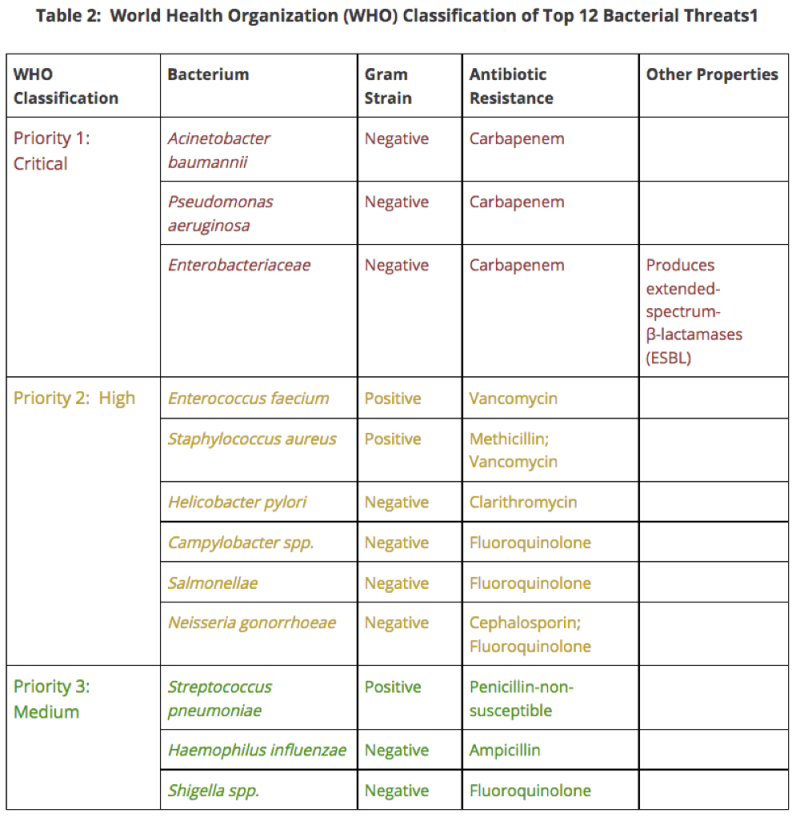
    Antibiotic resistance is a major problem in the United States and is considered by the World Health Organization (WHO) to be one of the largest threats to human health.  The top 12 bacterial threats classified by WHO are shown in Table 21.  Researchers are going so far as to send antibiotic resistant bacteria into space in order to determine how the bacteria mutate, with the thought being that in space, bacteria will mutate at an accelerated rate, making it easier to study bacterial resistance patterns and, therefore, develop better antibiotics that are active against resistant bacterial forms.

    Government-run institutions are investing significantly in the study of antibiotic resistance and resistance mechanisms.  For example, in early 2015, the White House released its "National Action Plan For Combating Antibiotic-Resistant Bacteria".  Similarly, in 2016, the CDC passed the Antibiotic Resistance Solutions Initiative, allocating roughly $160 Million in order to "detect, respond, and contain resistant infections across healthcare setting and communities."The CDC also awarded $14 Million to 34 different projects that will further investigate antibiotic resistance as it relates to the microbiome.  Yale University is one of the institutions to which funds were given.  This article will review antibiotic resistance, how antibiotics affect the microbiome, and those therapeutic strategies being used to prevent or correct microbiome imbalances.  Furthermore, we will review some of the significant players and patents in this area.

    Problems with Antibiotic Use

    Research published in the Journal of the American Medical Association (JAMA 2016, 315: 1864-73) suggests that antibiotics were prescribed unnecessarily in roughly 30% of patient cases.  This unwarranted exposure to antibiotics, as well as the misuse, overuse, or incorrect prescription of antibiotics, increases the likelihood of developing resistance.  Specifically, the majority of nosocomial (hospital-related) infections are caused by so-called ESKAPE pathogens (Enterococcus faecium, Staphylococcus aureus, Klebsiella pneumoniae, Acinetobacter baumannii, Pseudomonas aeruginosa, and Enterobacter species).  These "opportunistic infections" are especially deleterious for patients who have weakened immune systems, e.g., cancer patients undergoing chemotherapy.

    The emergence of resistance can occur via different mechanisms which include, but are not limited to (1) production of efflux, or multi-drug resistance (mdr), pumps that, as the name implies, "pump" out antibiotics that are harmful to the organism; (2) production of enzymes that modify antibiotics and, thus, inactivate them or make them less efficacious; and/or (3) mutation of those enzymes that are the targets of antibiotics, thus allowing those enzymes to evade antibiotics.3  The end result is that those resistant bacteria are able to colonize the host, flourish, and overtake host commensal microbiota.

    Combatting Clostridium difficile infection (CDI)

    Typically, broad-spectrum antibiotics are prescribed for un-diagnosed conditions as a prophylactic, or preventative, measure.  However, it is common that treatment with broad-spectrums can wipe out an individual's healthy gut microflora and cause microbiome imbalance, or dysbiosis.  This may further predispose patients to infections from MRSA (Methicillin-resistant Staphylococcus aureus), CRE (carbapenem-resistant Enterobacteriaceae), or Clostridium difficileClostridium difficile infection (CDI) is a relatively common and refractory infection, often acquired in hospitals and nursing homes by susceptible elderly patients.  The standard-of-care treatment for CDI is usually treatment with other antibiotics, firstly metronidazole, and if that is not efficacious, vancomycin.  However, one concern with treatment using vancomycin is the emergence of vancomycin-resistant bacteria.

    Rather than treating patients with antibiotics, clinicians are turning to a procedure known as fecal microbiota transplant (FMT), whereby fecal bacteria are transferred from a healthy individual to a recipient patient.  The transplant is meant to replenish bacteria that have been depleted from antibiotic treatment in the recipient and, thus, restore eubiosis.  An increased number of patents in this space reflect this trend.  For example, US 9,511,099 refers to the use of a similar methodology, termed Microbiota Restoration Therapy (MRT).  Although mainly used for the treatment of CDI, the patent application also discloses colon cancer.  The company that filed the patent application, Rebiotix, has several therapies in clinical trials for CDI treatment and prevention.  Referenced briefly in Part V of the Microbiome Series, patents US 9,028,841 and US 9,446,080 from Seres Therapeutics were included below, which also disclose methods for the treatment and prevention of recurrent CDI.  Seres's current lead, SER-109, is currently in Phase II clinical trials and has been reviewed earlier here by Dilworth IP.

    Figure
    Another company, OpenBiome (The Microbiome Health Research Institute), is a non-profit organization that is the first public stool bank.  It has patented a capsule containing microbes for the treatment of gastrointestinal disorders (WO 2016/178775).  OpenBiome is also collaborating with Finch Therapeutics on a treatment for CDI.

    Alternatives to Antibiotics: Using Immunotherapies to Alter the Microbiome

    Although some companies are still focusing their efforts on identifying new antibiotics, others have begun undertaking new approaches.  As mentioned above, in the case of CDI, missing bacteria can be replenished via FMT and, thus, restore a patient to eubiosis.  However, is it possible to remove a specific bacterium from the host commensal population, which would completely eliminate the need for antibiotics?  Numerous companies are attempting just that.  Using their proprietary Cloudbreak™ Immunotherapy Platform, Cidara Therapeutics can selectively target and clear gram-negative bacteria.  Although no patent directed to the Cloudbreak™ Platform could be found, Cidara has patent application US 2016/0213742 for the treatment of fungal infections, specifically from Aspergillus fumigatus and Candida albicans.

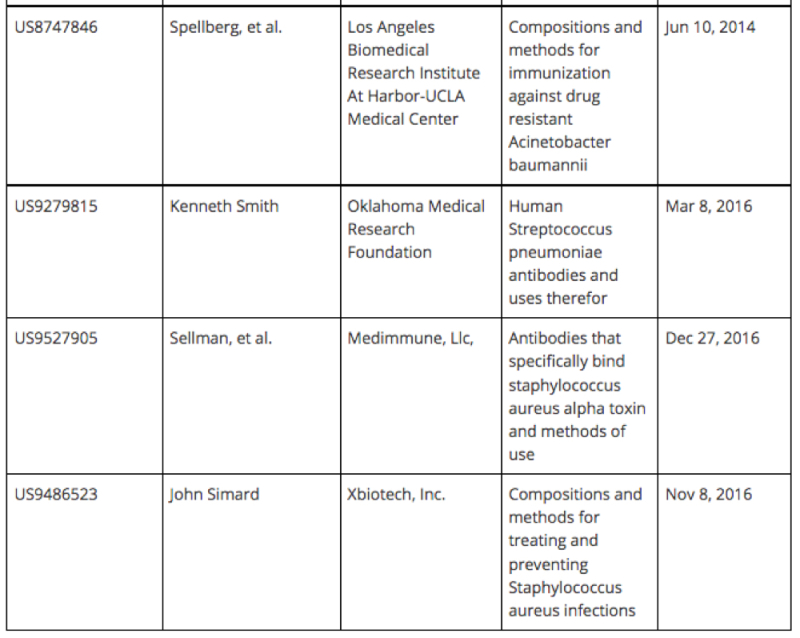
    MedImmune, the biologics arm of AstraZeneca, has patented several monoclonal antibodies (mAbs) targeting bacterial-specific antigens as a means of selectively clearing bacteria.  Patent US 9,527,905 claims the use of a mAb targeting Staphylococcus aureus α toxin, a component that enhances the proliferation of this Gram-negative bacteria.  The in vivo efficacy of one such mAb, MEDI4893, was described in a 2016 article in Science Translational Medicine [Sci. Transl. Med. 2016, 8: 329ra31].  Another patent application from Arsanis Biosciences, US 2015/0086539, and patent from XBiotech, US 9,486,523, detail mAbs targeting S. aureus.  Patent application US 2015/0284450 describes a bispecific mAb targeting Pseudomonas aeruginosa.  The clinical candidate, MEDI3902, is detailed in the following: Sci. Transl. Med. 2014, 6: 262ra155.  Another anti-P. aeruginosa mAb is detailed in patent US 9,403,901.  A mAb that binds the outer membrane of Acinetobacter baumannii is detailed in patent US 8,747,846.  An anti-Streptococcus pneumoniae mAb is detailed in patent US 9,279,815.

    Moving Forward to Combat Resistance

    While seemingly attractive years ago, the use of broad-spectrum antibiotics is now being questioned.  A recent paper in Nature Communications (Nat. Commun. 2017, 8: 15062) posits that the use of antibiotics in infants significantly changes their microbiome composition later in life.  Thus, in the short term, determining if and when a patient needs antibiotics will help to limit the spread of resistance.  Although the aforementioned mAb therapeutics may in fact be superior to standard-of-care broad-spectrum antibiotics, whether and how resistance will develop is still a question.  Similarly, the insurance dynamics and cost to the patient may be a significant concern.  As new therapies develop, patent protection will certainly be an integral part of the process.

    Table 1_a Table 1_b
    Table 2

    1 http://www.who.int/mediacentre/news/releases/2017/bacteria-antibiotics-needed/en/
    2 https://www.cdc.gov/drugresistance/solutions-initiative/
    3 https://www.cdc.gov/getsmart/community/about/antibiotic-resistance-faqs.html

    David Puleo is a Ph.D. Candidate in the Pharmacology Department at Yale University.  Prior to attending Yale, David graduated from Boston College with a B.S. in Biochemistry, after which he worked for two years in the Center for Proteomic Chemistry at Novartis Institutes for BioMedical Research in Cambridge, MA.
    ** Dr. Sabatelli is a Partner with Dilworth IP

    For additional information regarding this topic, please see:

    • "The Emergent Microbiome: A Revolution for the Life Sciences Part XII: Taking Stock of Livestock," September 26, 2017
    • "The Emergent Microbiome: A Revolution for the Life Sciences Part XI: Agriculture and the Microbiome," July 17, 2017
    • "The Emergent Microbiome: A Revolution for the Life Sciences — Part X, The Big Data Component," February 20, 2017
    • " The Emergent Microbiome: A Revolution for the Life Sciences — Part IX, The Microbiome and Immunotherapy II," December 6, 2016
    • "The Emergent Microbiome: A Revolution for the Life Sciences — Part VIII, The Microbiome and Immunotherapy I," October 31, 2016
    • "The Emergent Microbiome: A Revolution for the Life Sciences — Part VII, The Microbiology of the Built Environment," October 5, 2016
    • "The Emergent Microbiome: A Revolution for the Life Sciences – Part V, Patents Relating to Obesity and Metabolic Disorders," February 28, 2016
    • "The Emergent Microbiome: A Revolution for the Life Sciences – Part IV, Obesity and other Metabolic Disorders," February 18, 2016
    • "Jackson Laboratory Hosts Microbiome Symposium Related to Cancer and Immunology," January 19, 2016
    • "The Emergent Microbiome: A Revolution for the Life Sciences – Part III, Psychobiotics," October 13, 2015
    • "The Emergent Microbiome: A Revolution for the Life Sciences – Part II, 2015 Patent Trends," August 11, 2015
    • "The Emergent Microbiome: A Revolution for the Life Sciences – Part I, R&D Leaders," August 10, 2015