• Strafford #1Strafford will be offering a webcast entitled "Divided Patent Infringement and Inducement: Protecting IP Rights and Allocating Liability" on October 31, 2017 from 1:00 to 2:30 pm (EDT).  Thomas L. Irving, Paul W. Browning, and Barbara R. Rudolph of Finnegan Henderson Farabow Garrett & Dunner will provide guidance to counsel on handling divided infringement claims when enforcing patent rights, and review recent court decisions and outline steps to protect IP rights and allocate liability in the event of infringement.  The webinar will review the following issues:

    • How are the federal courts treating the issue of divided infringement?
    • What guidance is offered in recent decisions concerning the agency relationship and infringement?
    • What steps can companies and counsel take to assess their risk when partnering with other companies to minimize potential exposure?

    The registration fee for the webcast is $297.  Those interested in registering for the webinar, can do so here.

  • Cardinal IPCardinal IP will be offering a presentation entitled "Post Grant Review Strategy – Choose Wisely" on October 30, 2017 from 3:00 to 4:00 pm (CT) at the University of Chicago Gleacher Center in Chicago. IL.  Nathan Frederick, Director, IP Services for Cardinal IP will discuss the differences between IPRs, CBMs, and PGRs and how to choose the most effective path to invalidating problematic patents.

    Those interested in registering for the presentation, can do so here.

  • Patents Directed to Mail Barcodes Found to be Directed to Ineligible Subject Matter

    By Joseph Herndon

    Federal Circuit SealSecured Mail Solutions LLC appealed from the U.S. District Court for the Central District of California's grant of a motion to dismiss on grounds that the claims of seven asserted patents are directed to subject matter ineligible for patenting under 35 U.S.C. § 101.

    The Federal Circuit analyzed the claims under the two-step procedure set forth by the Supreme Court in Alice, and found that because the claims of the asserted patents are directed to an abstract idea and the claims contain no additional elements that transform the nature of the claims into a patent-eligible application of the abstract idea, the claims are ineligible for patenting under 35 U.S.C. § 101.

    This appeal involved seven patents that Secured Mail grouped into three categories.  U.S. Patent Nos. 7,814,032, 7,818,268, and 8,073,787 are the "Intelligent Mail Barcode" patents.  U.S. Patent Nos. 8,260,629 and 8,429,093 are the "QR Code" patents.  U.S. Patent Nos. 8,910,860 and 9,105,002 are the "Personalized URL" patents.  All of the patents involve methods whereby a sender affixes an identifier on the outer surface of a mail object (e.g., envelope or package) before the mail object is sent.  Computers and networks are used to communicate information about the mail object's contents and its sender after the mail object is delivered.

    The Intelligent Mail Barcode patents recite a method for verifying the authenticity of the mail object.  The identifier or barcode on the outer surface of the package is a single set of encoded data that is generated by concatenating a sender-assigned unique identifier with sender data, recipient data, and shipping method data.  The barcode is affixed to the outside of the mail object and an authenticating portion of the barcode is stored in a database.  The recipient of the mail object can access the database and use that authenticating portion to verify that a mail object is authentic.

    For the Intelligent Mail Barcode patents, claim 1 of the '268 patent is representative:

    1.  A method of verifying mail identification data, comprising:
        affixing mail identification data to at least one mail object, said mail identification data comprising a single set of encoded data that includes at least a unique identifier, sender data, recipient data and shipping method data, wherein said unique identifier consists of a numeric value assigned by a sender of said at least one mail object;
        storing at least a verifying portion of said mail identification data;
        receiving by a computer at least an authenticating portion of said mail identification data from at least one reception device via a network, wherein said authenticating portion of said mail identification data comprises at least said sender data and said shipping method data; and
        providing by said computer mail verification data via said network when said authenticating portion of said mail identification data corresponds with said verifying portion of said mail identification data.

    The QR Code and Personalized URL patents additionally require that a reception device (e.g., personal computer) be used to scan the encoded data and display the resulting data on the reception device's display screen.  In the QR Code patents, the identifier is a QR code (two-dimensional barcode) which a user can scan to look up additional electronic information related to the mail object.  Specifically, the barcode includes data that allows the recipient of the mail object to request data directly from the sender and allows the sender to provide personalized data directly to the recipient, without the involvement of the mail carrier.  For example, a customer might scan the QR code and be directed straight to her account rather than having to log in to access the account.  In the Personalized URL patents, a method similar to the QR Code patents is used, except the identifier is a personalized network address, or URL.  For example, the user can type the URL into her web browser and be directed straight to a specific account, or to other personalized information.  The types of data provided by the sender include content information, warranty information, and account information.

    For the QR Code patents, claim 1 of the '093 patent is representative:

    1.  A method for providing electronic data to a recipient of a mail object, comprising:
        generating, by a processor, a barcode for a mail object, said barcode including at least a first set of mail data, said first set of mail data including data corresponding to said recipient of said mail object;
        affixing said barcode to said mail object;
        submitting said mail object to a mail carrier for delivery to said recipient of said mail object;
        receiving said first set of mail data, including data corresponding to said recipient of said mail object, from a reception device of said recipient via a network;
        providing said electronic data to said reception device via said network in response to receiving said first set of mail data, said electronic data including a content of said mail object;
        wherein said reception device displays said electronic data to a recipient of said mail object by displaying said electronic data on a screen of said reception device.

    For the Personalized URL patents, claim 1 of the '860 patent is representative:

    1.  A method for providing electronic data to a recipient of a mail object, comprising:
        using an output device to affix a single set of mail ID data to said mail object, said single set of mail ID data including at least recipient data, said recipient data comprising a personalized network address associated with said recipient of said mail object;
        submitting said mail object to a mail carrier for delivery to said recipient of said mail object;
        receiving said recipient data from a reception device of said recipient via a network; and
        providing by at least one processor said electronic data to said reception device via said network in response to receiving said recipient data, said electronic data including data on a content of said mail object;
        wherein said reception device displays said electronic data to a recipient of said mail object by displaying said electronic data on a screen of said reception device.

    The Defendant, Universal Wilde, Inc., moved to dismiss Secured Mail's complaint under Fed. R. Civ. P. 12(b)(6), arguing that Secured Mail's patents were not patent-eligible under Section 101.  The District Court found that all seven patents were directed to patent-ineligible subject matter.  It reasoned that the asserted claims, viewed individually or in combination, do not meaningfully limit the abstract idea of communicating information about a mailpiece by use of marking.

    1.  Alice Step One

    On appeal, the Federal Circuit followed the two-step procedure set forth by the Supreme Court in Alice.  Under Alice, it is considered whether the claims focus on a specific means or method or are instead directed to a result or effect that itself is the abstract idea and merely invokes generic processes and machinery.

    The District Court found that the claims of all seven of the asserted patents are directed to the abstract idea of communicating information about a mail object by use of a marking.

    First, with the Intelligent Mail Barcode patents, the Federal Circuit found that they are not directed to specific details of the barcode or the equipment for generating and processing it.  Rather, the claims generically provide for the encoding of various data onto a mail object but do not set out how this is to be performed.  The claims state that various identifiers are affixed to a mail object, stored in a database, scanned from the mail object, and retrieved from the database.  No special rules or details of the computers, databases, printers, or scanners are recited.  There is also no description of how the unique identifier is generated or how a unique identifier is different from a personal name, or return address.  Rather, the claim language cited by Secured Mail merely recites that the unique identifier is generated by the sender.  The fact that the sender generates a barcode, which itself is not claimed, does not render the idea any less abstract.

    The Federal Circuit continued with the next set of patents and found that the claims of the QR Code patents fared no better.  The Federal Circuit found that the claims of these patents provide a method whereby a barcode is generated, affixed to a mail object, and sent through the mail system.  Then, upon receipt, the barcode is scanned, and data corresponding to the sender is sent to the recipient over the network and displayed on the recipient's device.  This method is not limited to any particular technology of generating, printing, or scanning a barcode, of sending a mail object, or of sending the recipient specific information over a network.  Rather, each step of the process is directed to the abstract process of communicating information about a mail object using a personalized marking.

    Lastly, the Federal Circuit found that the Personalized URL patents are directed to the same abstract idea.  The claims recite a personalized network address that is affixed to a mail object using an output device, the mail object is submitted to a mail carrier, and then once the mail object is received, a request is made by the recipient over the network using the personalized network address, and data is displayed on a screen.  As with the other patents, each step of the process uses an identifier, in this case a personalized network address, to communicate information about a mail object.

    The claims of the three sets of patents are not limited by rules or steps that establish how the focus of the methods is achieved.  Instead, the claims embrace the abstract idea of using a marking affixed to the outside of a mail object to communicate information about the mail object, i.e., the sender, recipient, and contents of the mail object.  Because the claims are directed to an abstract idea, the Federal Circuit turned to the second step of the Alice inquiry.

    2.  Alice Step Two

    In step two, the Federal Circuit considered whether the elements of the claims transform the nature of the claim into a patent-eligible application of the abstract idea.  This is the search for an inventive concept, which is something sufficient to ensure that the claim amounts to significantly more than the abstract idea itself.

    In the Intelligent Mail Barcode patents, the sender generated identifier is created by combining various pieces of data, such as a unique identifier, sender data, recipient data and shipping method data.  The data need not even be in the form of a barcode, much less a specific new type of barcode.  The claim language does not explain how the sender generates the information, only that the information itself is unique or new.  The claim language does not provide any specific showing of what is inventive about the identifier or about the technology used to generate and process it.  The Federal Circuit found that the District Court was correct in determining that the sender-generated identifier is not a sufficiently inventive concept.

    For the QR Code and Personalized URL patents, the District Court concluded that there was no inventive concept, and again, the Federal Circuit agreed.  The claims merely provide that an identifier is affixed to a mail object that is used by the recipient to request and display electronic information.  The use of barcodes was commonplace and conventional in 2001.  In addition, sending a personalized URL to a recipient was not an unconventional use of the Internet in 2001, for example, in emails that contained a personalized response URL.

    Moreover, some of the claim elements, such as submitting a mail object to a mail carrier or affixing information to a mail object, are routine to persons that have mailed a letter.  The Federal Circuit found no inventive concept that transforms the nature of the claims into a patent-eligible application of the abstract idea.

    Thus, the Federal Circuit found all claims ineligible for patenting under 35 U.S.C. § 101, and affirmed the District Court's grant of Universal's motion to dismiss.

    Secured Mail Solutions LLC v. Universal Wilde, Inc. (Fed. Cir. 2017)
    Panel:  Chief Judge Prost and Circuit Judges Clevenger and Reyna
    Opinion by Circuit Judge Reyna

  • By Kevin E. Noonan –

    Financial TimesYesterday, the Financial Times (London) published an article by Rana Foroohar entitled "Big Tech vs. Big Pharma: the battle over US patent protection."  If the article can be encapsulated in a word, that word would be "debunked" for what the article calls the "patent troll narrative" that patent trolls are impeding innovation and costing U.S. jobs to go down and consumer costs to go up.  As has been said in other contexts, "it ain't necessarily so" and, in fact, it isn't so at all.

    The article starts with a testimonial from Sherry Knowles, former Chief Patent Counsel at GlaxoSmithKline and a breast cancer survivor, who acknowledges that the drug that "saved her life" — Adriamycin — would not have been able to be developed had it been discovered under the unfriendly conditions patentees face today.  She recites an inconvenient truth sometimes ignored by policymakers unduly swayed by the desired outcome of cheaper drug prices:  "[i]f companies can't defend their intellectual property, they won't invest.  It's that simple."

    While noting that Big Pharma is unlikely to garner much sympathy, the article properly notes that voices that have been raised against current trends in the USPTO, Congress, and the courts (particularly the Supreme Court) include start-up biotech companies, semiconductor and electronics firms, universities, and other innovators, precisely the sources of both innovation and job growth.

    The article discusses the reasons for the complaints — changes in patent laws including the America Invents Act and Supreme Court decisions like Mayo Collaborative Services v. Prometheus Laboratories and Alice Corp. v. CLS Bank and some of the negative consequences of these trends.  For example, the article shows that the U.S. (which spends 2.79% of gross domestic product on research and development, a total of $518,077,890,000 in 2015 according to the World Bank) has gone from 1st to 10th in patent protection according to Chamber of Commerce, and is now tied with Hungary (which spends 1.38% of its GDP on R&D, a total of $1,715,933,400).  As a consequence, the article says that some companies are encouraged to engage in "efficient infringement" defined in the article as companies that "simply copy or take the IP they want, then settle with aggrieved parties out of court for less than the full value of the IP."

    The reason for the change:  "the patent troll narrative," which the author says had reached a "fever pitch" by the time President Obama was inaugurated.  This narrative was a large part of the impetus to change U.S. patent law that culminated in the America Invents Act.  But even after passage of the AIA and institution of inter partes and covered business method reviews (which were intended to solve the problem of improvidently granted patents more cheaply and efficiently than through litigation), the article states that some high tech companies wanted even more patent-unfriendly "reform."  According to David Kappos, former Director of the U.S. Patent and Trademark Office as quoted in the article, "[u]ltimately the read agenda sunk in.  This second round of drastic cutbacks to the patent system was a commercial ploy designed not to stop abuse but to cut supply chain costs by devaluing others' innovation."

    In 2013, according to the article, the White House issued a report that 2/3rds of patent litigation was provoked by patent trolls.  This number was disputed by the nonpartisan Governmental Accounting Office (GAO), which estimated the number at about 20%.

    The article quotes Randall Rader and Paul Michel, both former Chief Judge of the Court of Appeals for the Federal Circuit, as being against how the USPTO has administered the inter partes review process.  On the other hand Mark Chandler, General Counsel at Cisco, is quoted as saying that the problem is patents that should not have been granted, which "put[] a deadweight burden on the economy by blocking innovation by others and unnecessarily driving up prices to consumers."  But Gary Lauder, a venture capitalist from Silicon Valley, says that the patent system America needs is one where established companies pay innovator companies for their innovations rather than being able to expropriate them.  "We need to protect the larger start-up ecosystem, which is where the majority of jobs are created," he says.

    Also cited in the article is a recent study from the National Bureau of Economic Research which found that having a patent increases the likelihood of acquiring venture capital by 53%, of start-up job growth by 36% and start-up sales by 51%.  And a paper by Stanford economist Stephen Haber is cited for finding that the patent troll narrative is inconsistent with the actual behavior of patentees and accused infringers.

    The article closes with a view to what may happen next, which includes a bill by Senator Christopher Coons (D-DE) intended to shore up the U.S. patent system in the face of global competition particularly from China.  The article notes that there may be some acquiescence to changing the patent system to accommodate the needs of biotech and pharma with the different needs of the high technology sector, perhaps with different rules for each.

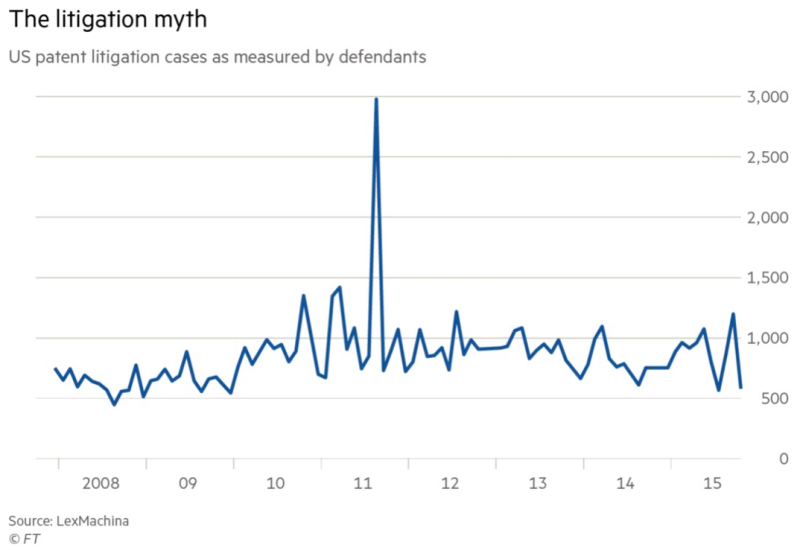
    The most cogent commentary in the article regards statistics generated by Lex Machina regarding the effect of trolls on the patent system:  "There has been an abundance of data that both advocates and critics of the current patent system spin in all sorts of ways to make their case," according to the article.  The USPTO estimate that 2/3rds of patent cases involved trolls did not take into account changes in how patent cases could be brought so that this number was somewhat artificially exaggerated.  And the contemporaneous GAO study expressly refuted this number with an estimate of 20%.

    Using "the best way to compare" patent lawsuit numbers pre- and post-AIA (using individual defendants as the metric), Lex Machina found that the number of patent lawsuits in fact didn't change with the change in the law, and that the brief spike in 2011 (which was the basis of much of the troll narrative) was accounted for by the law change occasioned by passage of the AIA.  These data are illustrated by Lex Machina's graph, reproduced below:

    Plot
    In short, the article concludes, "[t]rolls have been overblown as a patent issue."  But the consequences of this inaccurate narrative persist.

    The paper's conservative bona fides are established on its website:

    First published in 1888 as a four-page newspaper, the Financial Times' initial readership was the financial community of the City of London.  The Financial Times soon established itself as the sober but reliable "stockbroker's Bible", with its only rival being the slightly older and more daring Financial News.  In 1893, the FT turned salmon pink — a masterstroke that made it immediately distinguishable from its competitor.  From their initial rivalry, the two papers merged in 1945 to form a single six-page newspaper.  The Financial Times brought with it a higher circulation, while the Financial News provided enormous editorial talent.

    Insofar as many of our elected leaders profess to be conservatives, perhaps it would behoove them to listen to an authentic conservative voice on these matters.

  • By Kevin E. Noonan –

    Saint Regis Mohawk TribeIn something of an anticlimax, Federal Circuit Judge William Bryson, sitting by designation on the bench of the U.S. District Court for the Eastern District of Texas, granted Allergan's motion to join the St. Regis Mohawk Nation to ANDA litigation as a necessary party, and then found claims of the Orange Book-listed patents asserted in ANDA litigation to be invalid.  This decision renders moot the inter partes review proceedings before the Patent Trial and Appeal Board (insofar as the claims at issue before the District Court and the Board were the same).  And, of course, it renders a nullity the basis for Allergan's assignment of these patents to the Nation that raised considerable dudgeon amongst Allergan's generic competitors, members of Congress, and some commentators on pharmaceutical patents and sovereign immunity.

    Judge Bryson's decision on Allergan's motion was simple:

    Accordingly, in order to ensure that any judgment entered in this case will be protected against challenge on the ground that the proper parties were not all joined as plaintiffs, the Court hereby orders the joinder of the Tribe as a co-plaintiff in this action under Federal Rule of Civil Procedure 25(c).  In so doing, the Court does not hold that the assignment of the patent rights to the Tribe is valid, but instead proceeds on the ground that the assignment may at some point be held valid, and that joining the Tribe as a party in this action is necessary to ensure that the judgment in this case is not rendered invalid because of the absence of a necessary party.

    And entered for solid jurisprudential reasons the Court was at pains to ensure were not misinterpreted as approval:

    While it is important to ensure that any judgment in this case will not be subject to challenge based on the omission of a necessary party, the Court is not required to decide whether the assignment of the patent rights from Allergan to the Tribe was valid in order to resolve the question whether to add the Tribe as a co-plaintiff.  Instead, the Court will adopt the safer course of joining the Tribe as a co-plaintiff, while leaving the question of the validity of the assignment to be decided in the IPR proceedings, where it is directly presented.

    AllerganThe Order, however, was also loaded with the Court's dim view of Allergan's strategic assignment of its patent rights (which Allergan never attempted to conceal).  Nevertheless, the Court made plain its understanding, saying that "it is clear that Allergan's motivation for the assignment was to attempt to avoid the IPR proceedings that are currently pending in the PTO by invoking the Tribe's sovereign immunity as a bar to those proceedings" and that "[t]he Court has serious concerns about the legitimacy of the tactic that Allergan and the Tribe have employed."  This is because the arrangement between Allergan and the Tribe was not a conventional assignment in the Court's view, but rather an agreement permitting Allergan to "rent" the Tribe's sovereign immunity right to be immune from PTAB proceedings.  The Court's view of the inequities of this arrangement stems from Allergan's having availed itself of the benefits of the patent system and now seeking "the right to continue to enjoy the considerable benefits of the U.S. patent system without accepting the limits that Congress has placed on those benefits through the administrative mechanism for canceling invalid patents."

    Calling this a "ploy," the Court understands that, should this arrangement be countenanced it would permit "any patentee facing IPR proceedings [to] be able to defeat those proceedings by employing the same artifice."  And the Court believes that:

    [S]overeign immunity should not be treated as a monetizable commodity that can be purchased by private entities as part of a scheme to evade their legal responsibilities.  It is not an inexhaustible asset that can be sold to any party that might find it convenient to purchase immunity from suit.

    Judge Bryson also suggested that the contract between Allergan and the Tribe should be stricken as being against public policy, a conclusion he does not reach (if only because he has no basis to do so on the issue before him) (although he does analogize the agreement to abusive tax shelters and sham payday loan agreements, citing People ex rel. Owen v. Miami Nation Enterprises, 386 P.3d 357 (Cal. 2016)).

    With regard to whether the Tribe has retained sufficient rights to be a necessary party, the Court considered the question "a close one" because those retained rights are of questionable value.  Also relevant to the Court's decision is that sovereign immunity does not apply to this ANDA litigation.  See, Competitive Techs., Inc. v. Fujitsu Ltd., 374 F.3d 1098, 1102-03 (Fed. Cir. 2004); United States v. Oregon, 657 F.2d 1009, 1014-16 (9th Cir. 1981).

    Ultimately, despite his misgivings, Judge Bryson found that the Tribe can be joined as an exercise of the Court's sound discretion without holding the assignment valid, and that defendants have not asserted and indeed would not be prejudiced by his doing so.

    Turning to the Court's substantive decision, while finding that defendants' generic product would infringe the Orange Book-listed patents asserted by Allergan, the Court also found these patents to be invalid for obviousness.  The primary reference relied upon by the Court, U.S. Patent No. 5,474,979, was Allergan's own predecessor patent that expired in 2014, according to the opinion.  This patent specified a 0.1% cyclosporin A formulation, in contrast to the 0.05% formulations that were claimed in the patents-in-suit (which is the concentration of cyclosporine A in RESTASIS®).  In a complicated prosecution history reviewed in the opinion, Allergan first conceded and then withdrew its concession that the RESTASIS® formulation would have been obvious over the '979 patent.  These patents (U.S. Patent Nos. 8,629,1118,633,1628,642,5568,648,0488,685,930, and 9,248,191) were allowed only after applicants submitted evidence of unexpected results, commercial success, and long-felt need, as well as expert declarations supported by experimental evidence.

    The Orange Book-listed patents-in-suit (the '111, 048, '930, and '119 patents; Allergan granted the ANDA defendants a covenant not to sue with regard to the '162 and '556 patents), were "intended to protect the Restasis composition and the method of using that composition in treating dry eye and KCS [keratoconjunctivitis sicca] after the expiration of the ['979] patent in 2014" according to the Court's opinion.  Allergan asserted 13 of the 157 claims granted in its patents, which included Claims 1, 11, 13, 14, and 23 of the '048 patent; Claim 35 of the '390 patent; Claims 13, 16, 22, 26, and 27 of the '191 patent; and Claims 26 and 27 (which depend from claim 18) of the '111 patent, set forth herein as representative:

    18.  A topical ophthalmic emulsion for treating an eye of a human, the topical ophthalmic emulsion comprising: cyclosporin A in an amount of about 0.05% by weight; castor oil in an amount of about 1.25% by weight; polysorbate 80 in an amount of about 1.0% by weight; acrylate/C10-30 alkyl acrylate cross-polymer in an amount of about 0.05% by weight; glycerine in an amount of about 2.2% by weight; sodium hydroxide; and water; wherein cyclosporin A is the only peptide present in the topical ophthalmic emulsion.

    26.  The topical ophthalmic emulsion of claim 18, wherein the topical ophthalmic emulsion is therapeutically effective in treating keratoconjunctivitis sicca.

    27.  The topical ophthalmic emulsion of claim 18, wherein the topical ophthalmic emulsion is therapeutically effective in increasing tear production.

    The issues at trial were obviousness over a combination of references including the '979 patent; anticipation by the '979 patent; obviousness-type double patenting; nonjoinder of inventorship; lack of an enabling disclosure; and non-infringement based on interpretation of the term "crosspolymer."  The Court found that the claims were obvious in view of the disclosure of the '979 patent, that the objective indicia of nonobviousness did not rebut the obviousness determination, and that there was sufficient motivation to combine the asserted references to support its obviousness determination.  The Court found no anticipation ("[t]hat argument is meritless") and also ruled against defendants on their inventorship, enablement, and obviousness-type double patenting contentions.  The opinion, extending to 135 pages, was (not surprisingly) a thorough explication of the issues presented at trial and the court's application of the applicable law to the evidence the parties presented.

    While it may be tempting to conclude that the Court's decision rendered futile Allergan's strategy involving assignment to the Mohawk Nation, it should be kept in mind that two of its patents may escape unscathed should the PTAB decide that sovereign immunity prevents inter partes review on those patents from proceeding.  As for the other four patents, not all claims were asserted and would have remained at risk (from these defendants or any future ones) without the protections assignment (and the resulting sovereign immunity) is expected to provide.  But these defendants can compete with Allergan (subject to the first filer's 180-day exclusivity as the only generic) immediately and the effects of this competition on the royalties the Nation can expect to garner is now much more uncertain than it has been.  Whether the Mohawk Nation will benefit financially from assignment of these patents or whether its, and all other Native American tribes', sovereign immunity will be further eroded by Congress intent on reducing drug prices will be the ultimate measure of whether this arrangement was clever or foolhardy.

  • Duty to Disclose Does Not Include Duty to Respond to Examiner Confusion

    By Donald Zuhn

    District Court for the Northern District of CaliforniaEarlier this month, in Nevro Corp. v. Boston Scientific Corp., District Judge Vince Chhabria of the U.S. District Court for the Northern District of California granted a motion to strike filed by Plaintiff Nevro Corp., determining that the specific facts alleged by Defendants did not rise to the level of inequitable conduct.

    Defendants had alleged that after the inventor had disclosed a specific reference — the Fang reference — the Examiner had indicated that claim 58 of the asserted patent would be rejected as obvious because the Fang reference disclosed all but one of the limitations, and the one undisclosed limitation was obvious.  According to Defendants, the attorney prosecuting the application that issued as the asserted patent informed the Examiner that the Fang reference was the inventor's own reference, and therefore argued that obviousness did not apply.  The Examiner then allowed claim 58.  Defendants contended that the Fang reference did in fact disclose the missing limitation, inherently if not explicitly, and argued that the prosecuting attorney should have pointed this out to the Examiner, which Defendants asserted would have resulted in an anticipation rejection of claim 58.  Defendants explained that while disclosure of a prior art reference is usually enough to avoid a charge of inequitable conduct, when the Examiner made clear that he misunderstood the scope of the Fang reference, the prosecuting attorney had a duty to respond to the Examiner's confusion by pointing out that Fang inherently disclosed the allegedly missing limitation.

    In granting Nevro's motion to strike Defendants' inequitable conduct defense, the District Court explained that "[a]lthough [Defendants'] argument is not unreasonable, it goes against the great weight of the case law, which stands for the proposition that while an inventor must disclose all material information to the patent examiner, he is not required to make sure the patent examiner understands that information."  In support of this determination, the Court cited Fiskars, Inc. v. Hunt Mfg. Co., 221 F.3d 1318, 1327 (Fed. Cir. 2000), which states that there can be no liability for inequitable conduct "if [a] reference was cited to the examiner, whether or not it was a ground of rejection by the examiner."

    The District Court also noted that based on Defendants' allegations, the instant case was not one in which "the inventor made an affirmative misrepresentation about prior art or withheld information uniquely in its possession that would have cleared up a patent examiner's known misunderstanding."  The Court concluded that "even if there could be a factual scenario where an inventor commits inequitable conduct by failing to clear up a misunderstanding of prior art held by a patent examiner that the patent examiner could have recognized on his own, the specific facts alleged here by [Defendants] would not rise to the level of inequitable conduct."  However, because the Court realized that it may be possible for Defendants to allege additional facts that would raise a viable inequitable conduct defense –- such as an affirmative misrepresentation of fact by the prosecuting attorney or concealment of information that the Examiner could not have discovered on his own — the Court granted the motion with leave to amend.

    Nevro Corp. v. Boston Scientific Corp. (N.D. Cal. 2017)
    Order Granting Motion to Strike by District Judge Chhabria

  • CalendarOctober 17, 2017 – "The Good, the Bad, and the Ugly: Patent Litigation Forum Selection in the Wake of TC Heartland" (McDonnell Boehnen Hulbert & Berghoff LLP) – 10:00 am to 11:15 am (CT)

    October 17, 2017 – "Strategic Considerations in Anticipation of Oil States" (LexisNexis) – 1:30 to 2:00 pm (ET)

    October 18, 2017 – "Patent Trolls Uprising: Tips and Strategies to Win the War Against Them" (The Knowledge Group) – 12:00 to 1:30 pm (EST)

    October 18, 2017 – "Heartland & Lexmark – The Business Impact" (Dorsey & Whitney) – 9:00 to 10:00 am (PDT)

    October 20, 2017 – "IP Protection in China – What Companies in the 'Heart of America' Need to Know Now" (U.S. Patent and Trademark Office & John Marshall Law School) – Chicago, IL

    October 26, 2017 – "Drug Substance Patents: FDA Guidance, Protecting Composition-of-Matter Patents, Drafting Solid Form Claims" (Strafford) – 1:00 to 2:30 pm (EDT)

    October 26, 2017 – "Taking Another Bite at the Apple: Multiple Proceedings Before the PTAB Involving the Same Patent" (Federal Circuit Bar Association) – 1:00 pm to 2:00 pm (EDT)

    November 2-3, 2017 – Summit on IP Due Diligence*** (American Conference Institute) – Philadelphia, PA

    ***Patent Docs is a media partner of this conference or CLE

  • Federal Circuit Bar AssociationThe Federal Circuit Bar Association (FCBA) will be offering a webcast entitled "Taking Another Bite at the Apple: Multiple Proceedings Before the PTAB Involving the Same Patent" on October 26, 2017 from 1:00 pm to 2:00 pm (EDT).  Russell E. Cass of Clark Hill PLC will moderate a panel consisting of Chief Judge David P. Ruschke of the U.S. Patent and Trademark Office Patent Trial and Appeal Board, Eldora L. Ellison of Sterne Kessler Goldstein & Fox, David L. Cavanaugh of WilmerHale, and Eugene Goryunov of Kirkland & Ellis.  The panel will explore issues that arise when a party or parties file multiple inter partes review proceedings before the Patent Trial and Appeal Board that involve the same patent or patents.  Topics will include a background of the statutory and regulatory framework, case law before the PTAB and the Federal Circuit, joinder issues, and strategic considerations.

    The webinar is complimentary for FCBA or $125 for non-members).  Those interested in registering for the webcast, can do so here.

  • USPTO SealThe U.S. Patent and Trademark Office and John Marshall Law School will be holding a program on "IP Protection in China – What Companies in the 'Heart of America' Need to Know Now" on October 20, 2017 at the John Marshall Law School in Chicago, IL.  The one-day program, which is part of the USPTO China team's nationwide efforts to help U.S. businesses and inventors better understand how they can obtain and enforce IP rights in China, will bring policymakers and thought leaders from the U.S. government, academia, and private enterprise together to share their insights on critical issues involving China IP.  The John Marshall Law School is home to the only Chinese IP Resource Center of its kind, which has been educating Chinese patent examiners and practitioners since 1994.  Topics will include:

    JMLS• An Overview of Intellectual Property Protection in China
    • IP Enforcement in China
    • How to Enforce IP in the United States
    • U.S.-China Technology Competition and Collaboration

    There is no registration fee for the program.  Those interested in registering for the conference can do so here.

  • Dorsey & WhitneyDorsey & Whitney will be offering a web conference entitled "Heartland & Lexmark – The Business Impact" on October 18, 2017 from 9:00 to 10:00 am (PDT).  Case Collard and Gina Cornelio of Dorsey & Whitney will ;provide a business-focused review of the Supreme Court's recent decisions in Impression Products, Inc. v. Lexmark International, Inc. and TC Heartland LLC v. Kraft Foods Group Brands LLC, including a look at the overall effect on day to day decisions and strategy.

    Registration is complimentary, but space is limited to 150 people.  Those interested in attending the webinar can register here.