• Fitch EvenFitch Even will be offering a webinar entitled "Discretionary Denial and Beyond: Recent Developments in AIA Trial Practice" on July 27, 2023 from 12:00 pm to 1:00 pm (EDT).  Paul B. Henkelmann and Brian P. Herrmann of Fitch Even will address the following topics:

    • Recent guidance and proposed changes to discretionary denial procedures
    • The latest notable decisions from the PTAB and the Federal Circuit affecting AIA trial practice
    • A summary of proposed changes to AIA trial practice issued by the USPTO

    While there is no cost to participate in the program, advance registration is required.  Those interested in attending the webinar can register here.

  • By Kevin E. Noonan –

    AAMFor at least a decade, Congress has been concerned (not to say obsessed) with drug costs (understandably so, no matter how ineffectively; see "FTC to the Rescue Regarding High Drug Prices and Patents"; "Even More Ill-Conceived Remedies from Congress Regarding Prescription Drug Costs"; "More Ill-conceived Remedies from Congress Regarding Prescription Drug Costs"; "A Solution in Search of a Problem"; Senate Once Again Tries to Address Drug Pricing).  A consequence has been a focus on patents and their contribution to the crisis.  Recently, David Gaugh, Interim CEO of the Association for Accessible Medicines (formerly the Generic Pharmaceutical Association) wrote an article entitled "Congress is Ignoring the Best Solution to Reducing Drug Prices" on realclearpolicy.com challenging if not rebutting much of this rhetoric by identifying more relevant sources for increases in drug pricing.

    Mr. Gaugh not surprisingly asserts that the only way to reliably reduce drug prices is generic and biosimilar competition.  This case can certainly be made for generic drugs, which have an almost 40-year track record leading to the statistic that "generics and biosimilars account for 91% of prescriptions filled in the U.S. but only 18% of prescription spending."  But Mr. Gaugh argues that these gains are at risk from problems with sustainability of the generic (and biosimilar) drug industries.  As Mr. Gaugh explains, often "the price of generic medicines has fallen to an unsustainably low level, resulting in market exits and creating the optimal conditions for shortages," which shortages are appearing in the aftermath of the economic and supply chain disjunctions caused by the pandemic.  (This statement is ironic albeit truthful, because Mr. Gaugh also quotes FDA statistics that generic competition results in "an astounding 95% price drop on a mature market."  This suggests that the meme that high prices for branded drugs were solely caused by pharmaceutical company greed was incorrect.)

    Even the newer generic and biosimilar drugs are "being squeezed" by "historically slow adoption," Mr. Gaugh writes (although the reasons for this between these classes of drugs are likely not to be the same).  With regard to biosimilars, the financial benefits are patent, being "on average more than 50% less than the brand price was when the biosimilar launched" (for drugs that although representing only a fraction of prescriptions, drive almost half of all drug spending) and yet are "woefully underutilized."  Mr. Gaugh uses Humira® as an example, which starting July 1st of this year is subject to competition by several biosimilars (see "The New York Times Is at It Again Regarding Patents").  But who will benefit may not be patients; Mr. Gaugh identifies "middlemen" as being able to exact greater rebates from Humira® sales while formularies are expected (by Mr. Gaugh) to "sideline" these biosimilar equivalents.

    Mr. Gaugh uses Semglee, the first interchangeable insulin biosimilar, to illustrate the effect of the market and its participants on this failure of biosimilar substitution to reap the benefits promised by passage of the Biologics Price Competition and Innovation Act (BPCIA) as part of Obamacare.  According to the article:

    Semglee has two different prices, one with a slight decrease in price compared to the brand and a high rebate, and another with a major (65%) decrease in price.  Although the lower list price would have translated into lower costs to patients, PBMs have largely stuck with the higher priced brand insulin rather than encouraging use of the lowest list price.

    In addition to these economic consequences, Mr. Gaugh also argues that "manufacturing and regulatory challenges, runaway price deflation driven by middlemen market consolidation, and government policies in Medicaid, Medicare and 340B that reduce the financial viability of generic manufacturing."

    While conceding that there is no "magic bullet" for correcting (or at least improving) these circumstances, Mr. Gaugh argues that adoption of the following options could provide some solutions:

    • Improving FDA internal collaboration between inspectors and its drug shortage staff (DSS) and between the agency and manufacturers working to avoid a shortage,

    • Creating a reserve capacity supply of key medicines as well as creating incentives for hospitals to purchase reserve supply at sustainable, long-term fixed price and volume contracts,

    • Improving Medicare drug formulary coverage of new generics and biosimilars, and

    • Removing financial burdens such as the Medicaid inflation penalty and 340B that make continued production of low-margin generics unsustainable.

    Mr. Gaugh concludes his article that both the branded and generic/biosimilar drugs industries are businesses driven by investment and "if government policies continue to penalize low-cost generic medicines and block adoption of new generics and biosimilars" decreased investment may follow.  Which of course will just exacerbate high drug prices and increased shortages that burden the health care system.

    While the message of Mr. Gaugh's article are anything but hopeful, it was refreshing for a change to have problems with drug pricing in the U.S. not to focus on (or even mention) patents as being the cause.  That may be a popular refrain from the media and some politicians (see, e.g., "The New York Times Is at It Again Regarding Patents"; "Faux-Populist Patent Fantasies from The New York Times"; "The More the Merrier: The Journal Joins the Times in Complaining about Patents"; "New York Times to Innovation: Drop Dead"; "Science Fiction in The New York Times") but Mr. Gaugh's assessment provides a welcome, informed alternative to what people think "everybody knows."

  • By Kevin E. Noonan –

    Federal Circuit SealOne of the wonderful (as in, it makes one wonder) and frustrating (which needs no explanation) aspects of patent law is that just when you think a question is settled it either isn't or the conventional interpretation is called into question.  The Federal Circuit was created to minimize such instances, and while its track record in this regard has been a little spotty since the Supreme Court began reversing its decisions over a decade ago, the Court got it right in SNIPR Technologies Ltd. v. Rockefeller University.

    The case arose over an interference declared between patents having an effective filing date after the date the Leahy-Smith America Invents Act (AIA) came into force (March 16, 2013) and an application that had its effective filing date prior to March 16th.  The interference involved SNIPR's related U.S. Patent Nos. 10,463,049; 10,506,812; 10,561,148; 10,524,477; and 10,582,712, which claimed priority to PCT Application No. PCT/EP2016/059803, filed May 3, 2016 (after March 16th and thus prosecuted under the first-inventor-to-file provisions of the AIA) and Rockefeller's U.S. Application No. 15/159,929, which claimed priority to PCT Application No. PCT/US2014/015252, filed on February 7, 2014, and U.S. Provisional Application 61/761,971, filed February 7, 2013 (prior to March 16th and filed and prosecuted under the first-to-invent provisions of the 1952 Patent Act).  The technology at issue were methods of selectively killing bacteria in a mixed set of bacteria by gene editing performed using clustered regularly interspaced short palindromic repeats (CRISPR) methodology.

    The opinion sets forth extensively the motivation for the change from the first-to-invent to the first-inventor-to-file provisions regimes as recorded in the legislative history, including that "using a patent's filing date to determine priority among competing inventors is objective and simple, whereas an invention date determination 'is often uncertain, and, when disputed, typically requires corroborating evidence as part of an adjudication'"; that resolving inventorship questions required "a lengthy, complex and costly administrative proceeding (called an 'interference proceeding')" that "can take years to complete . . . , cost hundreds of thousands of dollars, and require extensive discovery"; and that "because it is always possible that an applicant could be involved in an interference proceeding, companies must maintain extensive recording and document retention systems in case they are later required to prove the date they invented the claimed invention."  In addition, the panel appreciated the benefits of harmonizing U.S. patent law with patent regimes abroad (which universally have "first to invent" priority standards).

    The opinion also recited the "significant changes to the statutory scheme" occasioned by the change.  But Congress did not apply them retroactively (a decision responsible in part for the issue before the court in this case).  The opinion set out the three categories of patents and applications created by the AIA and their relationship to interference practice:

    • Pure pre-AIA patents and applications: patents and applications that have only ever contained claims with pre-AIA effective filing dates (i.e., before March 16, 2013) are subject to the patentability requirements and Interference Provisions in the pre-AIA versions of 35 U.S.C. §§ 102, 103, 135, and 291.  AIA § 3(n)(1).

    • Pure AIA patents and applications: patents and applications that have only ever contained claims with post-AIA effective filing dates (i.e., on or after March 16, 2013) are subject to the patentability requirements and derivation proceedings in the AIA versions of 35 U.S.C. §§ 102, 103, 135, and 291.  AIA § 3(n)(1).

    • Mixed patents and applications: patents and applications that contain (or contained at any time) at least one claim with a pre-AIA effective filing date and at least one claim with a post-AIA effective filing date are subject to the patentability requirements in the AIA versions of 35 U.S.C. §§ 102–103 but are also subject to the pre-AIA Interference Provisions.  See AIA § 3(n)(1)–(2).

    Below, the Patent Trial and Appeal Board granted priority to the Rockefeller application because SNIPR did not file a priority statement that antedated Rockefeller's earliest accorded priority date (February 7, 2014), after denying two SNIPR motions to dismiss the interference because none of their claims were filed prior to the March 16, 2013 date and thus were not subject to an interference proceeding.  This appeal followed.

    The Federal Circuit reversed, in an opinion by Judge Chen joined by Judges Wallach and Hughes.  The basis for the PTAB's decision below was language in pre-AIA 35 U.S.C. § 135(a) that the Director was authorized to declare an interference between any application and "any unexpired patent"; accordingly, the PTAB decided that an interference to determine priority of invention was available to Rockefeller's application and the Director was authorized to declare the interference with the SNIPR patents.  The Federal Circuit interpreted the AIA, and specifically Section 3(n), according to the plain meaning of the statutory language, that language in context with the AIA, and the intent of Congress (to eliminate interferences, as that intent was effected by the statute).  In the panel's view, "AIA § 3(n) makes clear that only pure pre-AIA and mixed patents may be part of an interference" using that plain meaning.  The statutory language includes that the first-inventor-to-file regime, "'shall apply' to any  patents that have ever contained a claim with an effective filing date on or after March 16, 2013."  This language was significant as interpreted by the court because "[t]he word "'shall' is 'both mandatory and comprehensive' and 'generally imposes a nondiscretionary duty,'" citing SAS Inst., Inc. v. Iancu, 138 S. Ct. 1348, 1354 (2018).  The opinion interprets AIA § 3(n)(2) to establish "one limited exception" for "mixed patents" (that does not apply to the SNIPR patents at issue) which for the Federal Circuit is "strong evidence that Congress did not wish to further open the interference door to pure AIA patents and applications."  Under such circumstances the opinion states that "additional exceptions are not to be implied, in the absence of evidence of a contrary legislative intent," citing United States v. Smith, 499 U.S. 160, 167 (1991).  The panel found "no hint of congressional intent to expose pure AIA first-inventor-to-file patents and applications to interferences" and "[t]o the contrary, the purpose and history behind the AIA reinforce our understanding  of the text" that "Congress was dead set on eradicating interferences for new applications, criticizing them as lengthy, expensive, and requiring companies to maintain extensive documentation and systems to prove the date of their invention."

    With regard to the Director's reliance on the "any expired patent" language in pre-AIA § 135 the Federal Circuit opined that their task is "to construe statutes, not provisions," citing King v. Burwell, 576 U.S. 473, 486 (2015).  In the context of the rest of the AIA and express recitations of Congressional intent, the opinion states it was "clear that the language 'any unexpired patent' cannot refer to pure AIA patents" because such a reading "would be inconsistent with the plain language of AIA § 3(n), which does not allow for pure AIA patents to be part of interferences, and the AIA amendments repealing interferences and the priority of invention requirement for pure AIA patents."  The opinion notes that such an interpretation would "defeat a central purpose of the AIA," i.e., "to transition the U.S. patent system to a first-inventor-to-file system and eliminate the specter of interferences going forward for new applications."  The panel also asserts that judicial interpretation of specific provisions in the AIA, such as AIA § 3(n) should prevail over the "general" language in pre-AIA § 135, citing Bulova Watch Co. v. United States, 365 U.S. 753, 758 (1961), and that interpreting the AIA as the Director and Rockefeller urge "would render superfluous Congress's limited exception in AIA § 3(n)(2)."

    As for the remaining arguments asserted by the Director and Rockefeller (such as the possibility of patents being granted to different inventive entities for the same invention), the Federal Circuit posits that inter partes review, post-grant review, and ex parte reexamination provide alternative and adequate remedies under the AIA, and that the temporal logistics, that pure pre-AIA applications will always be prior art to pure AIA patents, make this scenario unlikely to impossible.

    For completeness and as an illustration of how the USPTO can discern potential complications in how patents are applied for, examined, and adjudicated, the opinion sets forth this possible scenario:

    1) the AIA patent must have been filed on or after March 16, 2013, see AIA § 3(n)(1);

    2) the subject matter disclosed in the AIA patent must have been previously disclosed by the inventor of the AIA patent, see 35 U.S.C. § 102(b)(2)(B);

    3) the previous disclosure must have been made less than one year before the AIA patent was filed so that the previous disclosure cannot be considered prior art, see 35 U.S.C. § 102(b)(1);

    4) the pre-AIA application being considered as prior art must be a U.S. patent, published application, or published PCT application, see 35 U.S.C. § 102(a)(2);

    5) the pre-AIA application being considered as prior art must have an effective filing date before March 16, 2013, see AIA § 3(n)(1);

    6) the pre-AIA application must have been filed between the disclosure of the AIA invention and the filing of the AIA application or patent, see 35 U.S.C.§ 102(b)(2)(b); and

    7) the pre-AIA application and the AIA patent must claim the same invention.

    The panel considered this to be a "remote possibility" and an "obscure situation" that the Director admitted had not arisen.

    The Federal Circuit then made short work of the case before it, holding that the SNIPR patents were not subject to an interference proceeding under its (proper) interpretation of the AIA, but that (as set forth in a footnote) "[w]hether [Rockefeller's] published application anticipates any of SNIPR's claims was never adjudicated during the interference.  Likewise, the Board never considered whether the Rockefeller Application satisfies the written description and enablement requirements for the claims Rockefeller amended to correspond to the SNIPR Patents [and] [t]hese issues remain disputed between the parties," giving Rockefeller some possibility of recourse in its challenge to SNIPR's patents.

    The on-going multiple interferences over priority of invention to CRISPR technology (between four parties involved in six interferences over seven years (and counting) provides a counterpoint to the simple resolution to this case (for good or ill, depending on your patent proclivities).  But to the extent the PTAB believed that interferences should be available to determine inventorship disputes under the AIA the Federal Circuit's decision has closed the door once and for all on this possibility, even as the number of applications filed under the first-to-invent regime inexorably reduces to zero.

    SNIPR Technologies Ltd. v. Rockefeller University (Fed. Cir. 2023)
    Panel: Circuit Judges Chen, Wallach, and Hughes
    Opinion by Circuit Judge Chen

  • By Jonathan Stroud*

    In der Beschränkung zeigt sich erst der Meister,
    Und das Gesetz nur kann uns Freiheit geben.[1]

        — Johann Wolfgang von Goethe, Das Sonnett[2]

    More than a decade ago Congress considered, and rejected, any standing requirements for post-grant proceedings.[3]  Congress could hardly have been more explicit.  The provisions were debated over a decade.[4]  In 2008, statutory standing language was added, and then removed, from the then-pending bill.[5]  A standing requirement was explicitly included for the now-sunset covered business methods law.[6]  The USPTO itself repeated this understanding via rulemaking.[7]  Since then, the district courts,[8] the Federal Circuit,[9] and even the Supreme Court have said so.[10]

    To be sure, the organic statute that grants the Office rulemaking power,[11] like other organic statutes before it,[12] explicitly affords some gap-filling discretion to the agency, in particular contexts.[13]  But that discretion was circumscribed, applying to the power to join petitioners,[14] to avoid reconsidering arguments and art already presented,[15] to deal with timing related to litigation,[16] and let the agency limit institutions in the first four years, so the agency could avoid being "overwhelmed."[17]

    Fast-forward to today.  The Office now often argues that, despite those other express grants of discretion, the Office's real power lies in a single word, "may," as in, "may not institute."[18]  The Supreme Court, to be sure, has noted that this passage vests with the Office the discretion whether to institute; the Office, in the years following, has repeatedly relied on that uncontroversial observation to expand their already-broad authority over post-grant proceedings,[19] injecting party-driven policy considerations and overlaying them on circumscribed statutory authority to expand their own.[20]

    Through the eye of that statutory loophole—"may not"—the agency would slip elephants, placing super-statutory restrictions on filers via some questionable adjudication and policy diktats,[21] the upshot of which are all barriers to the public to petitioning and merits review.[22]  By some estimates, half of the thousands of reviews filed each year discuss at length these fraught, inventive requirements—the NHK/Fintiv factors.[23]  Those factors serve as a de facto bars that serve to cut off review early in the statutorily prescribed one-year post-suit window.[24]  While denials have abated in the past year, the time spent addressing these issues has steadily increased.[25]

    Doubling down, the USPTO has written and released an Advance Notice of Proposed Rulemaking (ANPRM)[26] that seeks, in myriad ways, to stretch that word "may" to its breaking point.  It proposes a bevy of ideas, not endorsed by the agency, many of which seem to lack Congressional authority to implement.  The Office has noted that the proposals come from various "stakeholders," not the Office.[27]

    To say the USPTO has already received significant feedback, or that these rules are controversial, is an understatement.[28]  Former Senators, Congressmen, USPTO Directors, and the Chief Judge of the Federal Circuit have all commented publicly that most proposals are outside the agency's power; a vast majority of U.S. business, public interest groups, and individual commenters have commented that the changes would embolden NPEs and hurt the US economy and are bad policy.  Some 14,000 comments were submitted; to date, the office has posted almost 2,000 of them and counting, more than double what the earlier iterations of Fintiv policymaking provoked.  Almost half of those posted comments are from individuals suggesting the changes would embolden non-practicing entities to sue productive American businesses, and the Office should not be considering changes that will raise the cost of litigation and make it more difficult to objectively challenge the merits of patents, as Congress intended.  Of all of the ANPRM's wide-ranging proposals, perhaps the most controversial and widely opposed by companies and the public is adding "standing"—so-called in the testimony and writings of the Office—for certain entities.

    But standing is just the clearest example of a rule beyond the agency's power to impose.  The ANPRM's "laundry list" of proposals also includes an arbitrary six-month "grace period" in which defendants would have unhindered permission to file—something they once enjoyed—the upshot of which is shortening the yearlong window Congress proscribed for defendants sued or threatened with suit.[29]  And it proposes stipulation requirements and additional expansions of the legal scope of the limits Congress put on filing; the Office indicates they are all animated by vague if "key" "policy" considerations—explicitly, "the USPTO intends to make policy changes through notice-and-comment rulemaking."[30]

    Unfortunately for the agency, as the Supreme Court recently noted, "policy considerations cannot create an ambiguity when the words on the page are clear."[31]

    The USPTO lacks the rulemaking authority to legislate most of these changes, which would likely provoke a raft of legal challenges.  Congress elucidated timing requirements, the interaction between district courts and the Office, and what the agency asks of the parties and of its decisionmakers.  It is for the Courts to interpret them.  Even existing legal challenges to the USPTO's controversial Fintiv practice suggest that, were the agency to attempt rulemaking over protests and Congressional opprobrium, courts may find many of these proposals likely exceed the Office's Congressional mandate.[32]

    Proposed Standing Bars

    The Office proposes that the Board "would"—not may—deny any petition for IPR or PGR filed by any entity that "is a for-profit entity;" "has not been sued on the challenged patent or has not been threatened with infringement of the patent in a manner sufficient to give rise to declaratory judgment standing;" "[i]s not otherwise an entity that is practicing, or could be alleged to practice, in the field of the challenged patent with a product or service on the market or with a product or service in which the party has invested to bring to market;" and "[d]oes not have a substantial relationship with an entity that falls outside the scope of elements (1)-(3).

    This overcomplicated new inquiry would require the Office to 1) investigate and confirm entity status, 2) investigate and confirm declaratory judgment standing, 3) investigate and determine hypothetical market status, competition, product or service offerings, and potential investments; and 4) investigate and confirm there is no 'substantial relationship' between the filer and any entity meeting 1-3, another new test found elsewhere in the proposal.  The language makes clear it would not be optional for the Board—i.e., it would rob them of the very discretion it claims it embodies.

    The language is facially tortured.  Double negatives aside, it suggests that wide swaths of the for-profit marketplace could run afoul of the language.  Those entities could easily include: generic pharmaceutical companies without current practice or investments in a field; venture-funded start-ups that as yet don't practice or invest in a field; for-profit interest or industry groups like the Texas Association of Realtors or do-gooder organizations working to lower the cost of prescription drug prices;[33] future defendants not practicing in the same field as the challenged patent (whatever that is); and entities owned or controlled by venture capital or litigation funders (i.e., entities quite obviously not practicing in the field).  Ironically, membership organizations found to have a substantial relationship with members, would, it appears, not be barred—despite that it appears that it was intended to reach them.  The one thing it isn't is easy to implement.

    The Office also proposes rewriting and expanding restrictions on filing after filings, ex parte reexams, a District Court judgment, and the like—all things Congress considered and embodied or excluded in their carefully negotiated statutory language.  These concerns are captured in the law as interpreted by the Courts.  It is not for the Office to usurp their authority.

    These Bars Must Come from Congress

    It is indisputable that Congress considered, and rejected, any standing requirements for AIA trials.[34]  Over a decade of debate, it carefully considered and put in place other limitations on filing, detailing the interaction with district court, ITC, and ex parte reexamination, for instance.  Adding new requirements Congress considered and rejected is unlawful.

    Congress, for its part, clearly understands this.  It has since then debated, and discarded, multiple bills over multiple Congresses (which have garnered little support) that sought to add a standing requirement, one-and-done provisions, or other Congressional rewriting of the requirements.  The previous Senate cosponsors of those earlier bills are self-evidently aware that these must come from Congress.

    So aware are they that now, in the wake of the 14,000 almost entirely negative comments, they have released PREVAIL Act.  (Metadata in drafts of press releases indicate the two were clearly coordinated.)  Unfortunately for advocates of weakening the AIA, and for any case to be made those changes make any policy sense, the public has spoken; and any argument that these changes are anything other than draconian rollbacks has been substantially weakened—the fourth iteration of the STRONGER Act appears dead on arrival, given the overwhelmingly negative response to the ANPRM.

    But that is tomorrow's debate.  What seems unanimous among the bar is that the Office lacks the authority to start ultra vires standing, timing, and filing bars, and endorses them, even tacitly, at its peril.  Discretion is not license to legislate.  To do so would invite years of obvious legal challenges.  It is not up to the administrative state to end-run around Congress and put policies in place it plainly does not have public and Congressional support to otherwise enact.

    [1] "Only within limits does mastery show itself; And only the law can give us freedom." (My translation.)

    [2] Johann Wolfgang von Goethe, Das Sonnett, available at https://www.projekt-gutenberg.org/goethe/sonette/sonette.html (last visited May 31, 2023).

    [3]  Compare H.R. 1908, 110th Congress (Sept. 2007) (post grant-review provision with no standing requirement) with S. 3600, 110th Congress (2008) (post-grant review required petitioner to be "a person who has a substantial economic interest adverse to a patent"); and S. 515, 111th Congress (2009) (post-grant review provision with original language allowing anyone other than the patent owner to file).

    [4] See, e.g., 157 Cong. Rec. 131 at S5357 (Sept. 7, 2011) (Klobuchar, D.) (noting that the AIA "provides a modernized, streamlined mechanism for third parties who want to challenge a recently issued, low-quality patents that should never have been issued in the first place. Eliminating these potential trivial patents will help the entire patent system by improving certainty"); at 154 Cong. Rec. 155 at S9987 (Sept. 27, 2008) (Kyl, R.) (discussing standing proposals); see generally Patrick Doody, Comprehensive Legislative History of the America Invents Act (compiled, edited, and abridged 2012) (including numerous discussions of third-party filers, their status and import in ex parte reexamination, and the desire of legislators to expand their access to filings).

    [5] Compare H.R. 1908, 110th Congress (Sept. 2007) with S. 3600, 110th Congress (2008); and S. 515, 111th Congress (2009).

    [6]  See § 18(a)(1)(B), 125 Stat. 330 (noting that petitioners may only file for CBM review if sued or threatened with suit).

    [7] 37 CFR § 42.101 ("A person who is not the owner of a patent may file with the Office a petition to institute an inter partes review of the patent . . .").

    [8] Mizuho Orthopedic Sys, Inc. v. Allen Med. Sys, Inc., 610 F.Supp.3d 362, 364 (D. Mass. 2022).

    [9] Apple Inc. v. Qualcomm Inc., 17 F.4th 1131, 1136 (Fed. Cir. 2021) ("IPR petitioners, for example, may lack constitutional standing.") (internal quotations omitted); Consumer Watchdog v. Wisconsin Alumni Rsch. Found., 753 F.3d 1258, 1261 (Fed. Cir. 2014) (interpreting similar language of inter partes reexamination statute)

    [10] Cuozzo Speed Techs., LLC v. Lee, 579 U.S. 261, 279 (2016) ("Parties that initiate the proceeding need not have a concrete stake in the outcome; indeed, they may lack constitutional standing."). See also id. at "any third party can ask the agency to initiate inter partes review of a patent claim" and that "[p]arties that initiate the proceeding need not have a concrete stake in the outcome; indeed, they may lack constitutional standing." Id. at 268, 279; see also Return Mail, Inc. v. Postal Service, 587 U. S. ____, 139 S.Ct. 1853, 1860 (2019) ("the 'inter partes review' provision permits "a person" other than the patent owner to petition for the review and cancellation of a patent.") (citing § 311).  Indeed, the Supreme Court has explained the soundness of such policy, stating that the "public's . . . paramount interest in seeing that patent monopolies . . .  are kept within their legitimate scope" favors the "authoritative testing of patent validity" and the "removal of restrictions on those who would challenge . . . patents." Blonder-Tongue Labs., Inc. v. Univ. of Illinois Found., 402 U.S. 313, 344-45 (1971) (internal quotations omitted).

    [11] 35 U.S. Code § 2; see also 35 U.S.C. § 316(a).

    [12] See, e.g., Pub. L. 82-593 (1952); Pub. L. 93-596 (1975); Pub. L. 106–113, div. B, § 1000(a)(9) [title IV, § 4712] (1999); Pub. L. 106–400, § 2 (2000); Pub. L. 107–273, div. C, title III, § 13206(a)(1) (2002).  Per usage, Congress creates federal agencies only through legislative acts known as "organic" or "enabling" statutes, which tightly circumscribe when and how the agency may issue rulemaking, and over what.  See United States v. Grimaud, 220 U.S. 506,517 (1910) (noting that Congress must specifically delegate rulemaking authority to agencies); Richard J. Pierce, Jr. et al, Administrative Law and Process 35,220 (1985) (noting that enabling statutes, also referred to as "organic" statutes, are how Congress conveys powers to agencies).

    [13] 35 U.S.C. § 314(a).

    [14] See 35 U.S.C. § 315(c) ("the Director, in his or her discretion, may join as a party to [a previously instituted] inter partes review any person who properly files a petition under section 311 that the Director . . . determines warrants the institution of an inter partes review . . . ."). It is worth noting that, even under this circumscribed grant of discretion, Senator Kyl made the following comments during the AIA debates, which suggest Congress and the PTO contemplated additional parties could join existing proceedings as a matter of right:

    The Office anticipates that joinder will be allowed as of right—if an inter partes review is instituted on the basis of a petition, for example, a party that files an identical petition will be joined to that proceeding, and thus allowed to file its own briefs and make its own arguments. If a party seeking joinder also presents additional challenges to validity that satisfy the threshold for instituting a proceeding, the Office will either join that party and its new arguments to the existing proceeding, or institute a second proceeding for the patent.

    157 Cong. Rec. S.1360, S1376 (March 8, 2011) (statement of Sen. Kyl).

    [15] See, e.g., 35 U.S.C. § 325(d).

    [16] 35 U.S.C. § 315(b) (stating that an IPR "may not be instituted" after the 1-year statutory bar).

    [17] 157 Cong. Rec. S1376-77 (daily ed. Mar. 8, 2011) ("[A] transition from current inter partes reexamination to new inter partes review . . . allow[s] the Director to place a limit on the number of post-grant and inter partes reviews that will be instituted during the first four years that the proceedings are in effect . . . to protect the Office from being overwhelmed").

    [18] See Oil States Energy Servs., LLC v. Greene's Energy Grp., LLC, 138 S. Ct. 1365, 1371 (2018) ("The decision whether to institute inter partes review is committed to the Director's discretion."); but see Saurabh Vishnubhakat, Disguised Patent Policymaking, 76 Wash. & Lee L. Rev. (2019), https://papers.ssrn.com/sol3/papers.cfm?abstract_id=3242146 (cautioning that "[USPTO] power has grown immensely in this decade" and arguing "the agency is wielding its power in predictably troubling ways."").

    [19] 85 Fed. Reg. at 66503 (Oct. 20, 2020) (quoting Cuozzo Speed Techs., 579 U.S. at 273).

    [20] I, too, am guilty of this: I have argued that the one place their discretion is at its zenith is in avoiding regulatory conflict with existing administrative/legislative schemes to litigate patents and resolve disputes, namely, the longstanding Drug Price Competition and Patent Term Restoration (Hatch-Waxman) Act of 1984.  Carlos Garcia and Jonathan Stroud, Ships in the Night: Resolving Administrative Conflict Between FDA- and Patent-Related Legislation, 68 Am. U. L. Rev. 1111 (2019) (arguing the Office should deny, at a minimum, inter partes review challenges that conflict with the statutorily imposed, FDA-approval-related litigation framework created by the Hatch–Waxman Act).

    [21] SAS Inst., Inc. v. Iancu, 584 US __, 138 S. Ct. 1348, 1358 (2018) (holding "policy considerations cannot create an ambiguity when the words on the page are clear").

    [22] See, e.g., Apple v. Fintiv, IPR2020-00019, Paper 11 (Mar. 20, 2019).  Note that the district court case on which the Fintiv denial there was based, first filed in 2018, has still, four years later, yet to happen, after trial delays produced in large part by Fintiv itself, who, inter alia, filed an emergency motion prior to a scheduled trial last June that was granted, delaying trial still further.  See generally Ryan Davis, Fintiv's Emergency Motion Delays Apple Patent Trial in WDTX, Law360 (June 7, 2022), available at https://www.law360.com/articles/1500531/fintiv-s-emergency-motion-delays-apple-patent-trial-in-wdtx.

    [23] The Office receives around 1300 IPR petitions on average each year, down substantially since the advent of the NHK/Fintiv era, with far fewer instituted, going to trial, or not settling. See Patent Trial and Appeal Board Parallel Litigation Study (June 21, 2022) (showing that 50.6% raised the NHK/Fintiv factors); Discretion Dominant: 45% of all 2021 Institutions Analyzed, UNIFIED PATENTS (Mar. 21, 2022), https://www.unifiedpatents.com/insights/discretion-dominant-45-of-all-2021-institutions-analyzed-fintiv%5D. ("On average, the Board analyzed Fintiv for more than 8 pages in institutions (and more than 11 in denial), representing on average more than 50% of the Board's workload for denials").

    [24] See 35 U.S.C. 315(b) (prescribing a one-year window in which to file for current defendants).

    [25] In this criticism, "[m]y purpose was simply to diminish that mass of contradictions and abuses which eventually turn legal procedure into a wilderness where decent people hardly dare to venture, and where bandits abound."  Marguerite Yourcenar, Memoirs of Hadrian, at 226 (1974). To put it pithily, let's keep it simple.

    [26] Dept. of Commerce Patent and Trademark Office, Department of Commerce, Changes under Consideration to Discretionary Institution Practices, Petition Wordcount Limits, and Settlement Practices for America Invents Act Trial Proceedings Before the Patent Trial and Appeal Board, 37 CFR Part 42 (April 21, 2023) [Docket No. PTO-P-2020-0022, RIN 0651-AD47].  This form of stepwise regulation is not unprecedented outside of the patent space; some agencies have adopted this nomenclature in the past, and I have heard it described by representatives of the office as, practically, more serious than a request for comments, which poses open questions, and less final than a Notice of Proposed Rulemaking (NPRM), which is largely the end of the road, as it proposes regulations that almost certainly would issue into the Code of Federal Regulations, if not first withdrawn.  More than a question, less than a rule.

    [27] U.S. Congress. The House Judiciary Subcommittee on Courts, Intellectual Property, and the Internet, "Oversight of the U.S. Patent and Trademark Office." (4/27/23) Text from: Federal Document Clearing House Congressional Testimony, available on ProQuest® Congressional; Accessed 05/31/23, also available at https://judiciary.house.gov/committee-activity/hearings/oversight-us-patent-and-trademark-office (statement of Dir. Vidal confirming that "there is no standing requirement right now for people to engage in the PTAB practice. In the ANPRM, we have made some proposals based on feedback we heard from stakeholders.") (emphases added). Note that even one member of the legislature who voiced support for stricter standing requirements suggested that they "would prefer that the legislative branch handle that" rather than the USPTO "through the rulemaking process." Id. (statement of Rep. Moran).  It is worth noting that the ANPRM does not include proposals from huge swaths of stakeholders—many of the comments the Office solicited in 2020 requested repeal of the Fintiv rule, suggested it was unlawful, and noted pending court challenges to the Office's authority; nowhere does ANPRM contemplate that well-supported contingency.

    [28] In less than a month during the pre-Congressional recess dead period, the Office has already received upwards of 7,000 comments, a record (as far as I am aware) for any patent-related issue ever before the office.  Former Senators, Congressmen, and USPTO Directors have all expressed concerns with the proposals.

    [29] The irony of this particular proposal—of shortening a Congressionally prescribed window for review and presenting it with magnanimity, should not be lost on the reader.  It seems to tacitly acknowledge that no limits were intended, that limits were then unfairly and unilaterally imposed, and that now the office, in a tacit show of guilt, is willing to return some piece of what it has administratively taken.

    [30] Emphasis mine.

    [31] SAS Inst., Inc. v. Iancu, 584 US __, 138 S. Ct. 1348, 1358 (2018).  The current Court is keen to prevent such administrative policymaking via regulatory fiat.

    [32] The ANPRM, for instance, includes an equally arbitrary suggestion of a six-month grace period for Fintiv-type denials, despite the extensive debate that went into the one-year grace period and time bar.  It is exactly the arbitrary trial date and average time-to-trial calculations that have so vexed the bar, and led to facial challenges of even the existing rule.

    [33] Texas Ass'n of Realtors v. POI Search Sols. LLC, IPR2016-00615 (filed Feb. 11, 2016)

    [34] Compare H.R. 1908, 110th Congress (Sept. 2007) (post grant-review provision with no standing requirement) with S. 3600, 110th Congress (2008) (post-grant review required petitioner to be "a person who has a substantial economic interest adverse to a patent"); and S. 515, 111th Congress (2009) (post-grant review provision with original language allowing anyone other than the patent owner to file) see also Apple Inc., 17 F.4th at 1136 ("IPR petitioners, for example, may lack constitutional standing.") (internal quotations omitted); Cuozzo Speed Techs., 579 U.S. at 279 ("Parties that initiate the proceeding need not have a concrete stake in the outcome; indeed, they may lack constitutional standing.")

    * Mr. Stroud is General Counsel of Unified Patents.

  • By Kevin E. Noonan –

    University of California-BerkleyThe decision by the Patent Trial and Appeal Board (PTAB) in favor of Senior Party the Broad Institute, Harvard University, and MIT (collectively, "Broad") and against Junior Party the University of California/Berkeley, the University of Vienna, and Emmanuelle Charpentier (collectively, "CVC") sixteen months ago in the latest CRISPR interference No. 106,115 is the subject of appeal from both parties.  CVC filed its Opening Brief (discussed herein) on September 20, 2022; the remaining briefs will be the subject of later posts.

    To recap, the Board was convinced by Broad's arguments that CVC's attempts to reduce eukaryotic CRISPR to practice were unavailing until after Broad's reduction to practice as evidenced by a manuscript submitted on October 5, 2012.  Operating on the legal principle that "priority of invention goes to the first party to reduce an invention to practice unless the other party can show that it was the first to conceive of the invention and that it exercised reasonable diligence in later reducing that invention to practice," Cooper v. Goldfarb, 154 F.3d 1321, 1327 (Fed. Cir. 1998), the Board was unconvinced that CVC's March 1, 2012 conception satisfied the requirements of "complete" conception.  Using much of the same argument (albeit for different purposes) as it had to prevail in Interference No. 106,048 (see "PTAB Decides CRISPR Interference in Favor of Broad Institute — Their Reasoning"), the Broad persuasively argued that the evidence of CVC's attempts to reduce eukaryotic CRISPR to practice showed sufficient uncertainty and failures for the Board to conclude that CVC did not satisfy the requirements for conception.  On this evidence the Board was unpersuaded that all that had been needed was the application of routine experimentation using the sgRNA detailed in CVC's March 1st priority statement.  Nor was the Board convinced that Broad derived the embodiments of eukaryotic CRISPR that they reduced to practice embodying sgRNA only after Dr. Marraffini obtained it from CVC and disclosed it to the Broad inventors (see "CVC Files Reply to Broad's Opposition to CVC's Priority Motion").  In addition to the decision on priority, the Board denied CVC's motion for improper inventorship under 35 U.S.C. § 102(f) (see "CVC Files Substantive Motion No. 3 (for Improper Inventorship) and Broad Opposes") for evidentiary deficiencies, and in their discretion refused to consider CVC's allegations of inequitable conduct against the Broad (see "Inequitable Conduct by Senior Party Broad Alleged in Interference No. 106,115 (and PTAB May Finally Hear Evidence About It)").

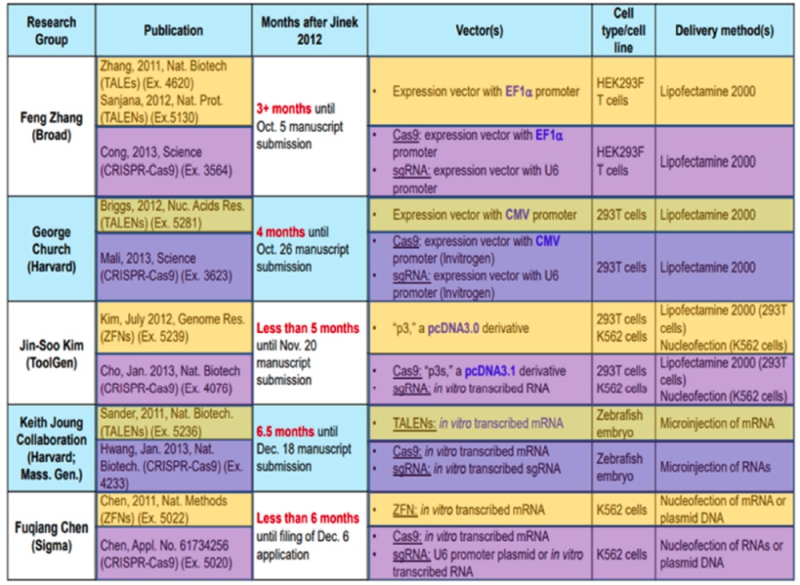
    CVC's brief begins with a reminder that Drs. Doudna and Charpentier had received the Nobel Prize for CRISPR (as every paper filed in the '115 Interference has done since the award).  The brief also sets forth the timeline of CVC's conception and reduction to practice, containing several relevant considerations for the Federal Circuit to ponder when assessing whether the Board erred in reaching its decision.  These include (first and foremost) that Broad and colleagues derived their invention totally from CVC's public disclosure of sgRNA species; according to CVC everything else was just routine applications of introducing exogenous molecules into eukaryotic cells using methods well known in the art.  Evidence (according to CVC) of the routine nature of these methods was that five other groups "quickly" performed CRISPR cleavage of eukaryotic DNA, as illustrated by this table:

    Table
    (where methods using prior art systems, such as ZFNs and TALENS are shown in orange and those using CRISPR are shown in purple).  In this regard CVC argues that its own efforts, which formed the basis for the Board's determination that their conception was incomplete, took only four months of diligent effort.

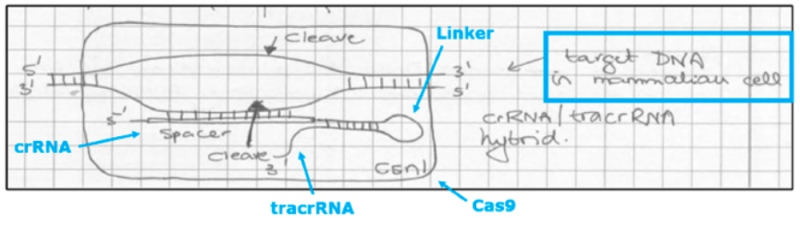
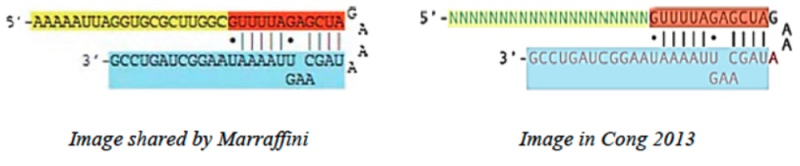
    The recitation of the factual background recites that it was the CVC inventors who recognized the role the tracrRNA played in the CRISPR complex (in work showing DNA cleavage in vitro) and, most importantly, that the tracrRNA and target site-specific CRISPR RNA (crRNA) could be linked by an oligonucleotide linker to form sgRNA.  Others, specifically the Broad group in CVCs retelling had been investigating whether there were "other factors" that needed to be included, such as RNase III, in so-called "preprocessing steps."  CRISPR as conceived by CVC is illustrated in the brief by this graphic:

    Image 1
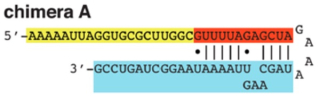
    and the laboratory notebook from March 1, 2012 showing conception of sgRNA (termed "chimera A") is also provided:

    Image 2
    Chimera A was later disclosed in CVC's scientific publication, A Programmable Dual-RNA-Guided DNA Endonuclease in Adaptive Bacterial Immunity ("Jinek et al., 2012"):

    Image 3
    According to the brief, when used in their in vitro DNA cleavage system, embodiments of CRISPR comprising chimera A "cleaved the [DNA] target each time."  This disclosure was included in CVC's P1 provisional application (No. 61/652,086, filed May 12, 2012), along with prophetic examples for producing or introducing sgRNA-containing CRISPR complexes into eukaryotic cells (including "fruit fly," "fish, amphibian, reptile, bird, mammal," and "human" cells) using prior art-recognized, "routine" techniques "(e.g., microinjection, electroporation, transfection, etc.)," according to CVC.  Later-filed provisional applications (P2, filed October 19, 2012 and P3, filed January 28, 2013, the latter being the earliest priority date awarded to CVC by the Board) contained more details of their invention, the brief asserts.

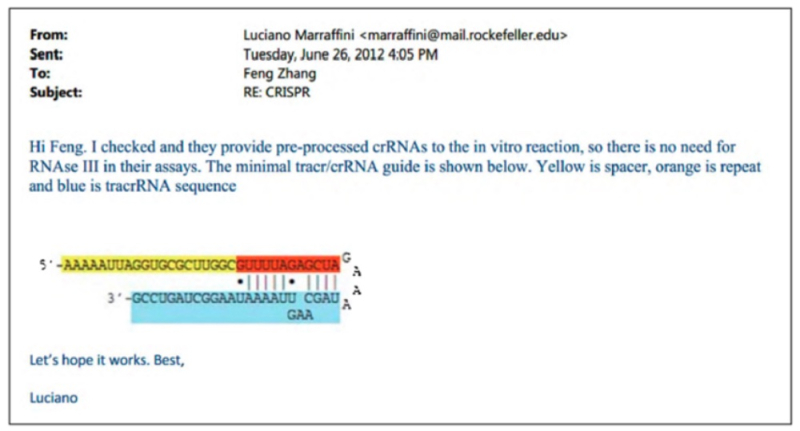
    According to the brief, the Broad group "had attempted—unsuccessfully—to use incomplete CRISPR-Cas9 systems to edit eukaryotic genes " because they did not understand "that mature tracrRNA was a necessary third component of the final DNA-cleavage complex" (emphasis in brief).  Consequently, Broad "struggled with experiments using unprocessed RNAs and other extraneous elements, wondering what 'other factors need to be identified.'"  Importantly, the brief asserts that it was only when Dr. Marraffini informed the Broad group of the CVC inventors' disclosure of the sgRNA species that Broad was able to reduce eukaryotic CRISPR to practice.  Indeed, the brief identifies the Broad's asserted conception date (June 26, 2012) to be the very day Dr. Marraffini disclosed sgRNA to them, illustrated by a copy of an e-mail:

    Image 4
    The brief also notes that "[d]espite years of litigation, including an earlier appeal to this Court [in Interference No. 106,048], Broad withheld that communication until discovery halfway through the proceedings below" (emphasis in brief).  The brief goes on to describe the steps taken by Broad in reducing eukaryotic CRISPR to practice using the same chimera A sgRNA disclosed by CVC and communicated to Broad by Dr. Marraffini:

    Image 5The brief asserts that the CVC inventors had "conceived of and described every element of the invention before Broad's first alleged conception."  The brief asserts further than the PTAB "never identified any inventive contribution Broad made" and awarded priority to Broad solely on the purported basis of first reduction to practice (emphasis in brief).

    With regard to their efforts to reduce to practice sgRNA-comprising CRISPR in eukaryotic cells, the brief sets forth those attempts in ways that contradict or at least minimize the Board's basis for finding CVC's conception to be incomplete.  For example, the brief emphasizes that the vectors used to produce sgRNA and Cas 9 protein were designed in May 2012 and ordered by June 2012.  The brief also describes the efforts of a colleague to introduce preformed sgRNA-comprising CRISPR complexes into eukaryotic cells by microinjection into zebrafish.  As for those experiments using vectors to produce both sgRNA and Cas 9 protein in eukaryotic cells, the brief emphasizes that these experiments were initially performed by a graduate student (who CVC argues was not a person of ordinary skill in the art) who, after some preliminary positive results in CRISPR-mediated cleavage of eukaryotic DNA in vivo was unable to demonstrate homology-directed DNA repair in the cells (which embodiments were outside the scope of the interference count).  It was only after about three months of failure that the project was given to another graduate student who the brief asserts was able to reduce CRISPR-mediated cleavage to practice in eukaryotic cells "just weeks after joining Doudna's lab and only four months after CVC's first human-cell experiments."  For the microinjection experiments, while positive results were obtained they did not demonstrate CRISPR cleavage with the efficiency obtained from in vitro experiments, and thus these results were never published (something the brief notes the PTAB interpreted as indicating a lack of success, despite this frequency, 1 in 30, being better than the frequency obtained in the Broad's initial experiments in mouse cells, 2 in 275).

    The brief asserts several grounds of error by the PTAB.  The first error is in refusing to apply an "objective" standard for conception, i.e., "whether CVC's invention was sufficiently complete that it was ready for skilled artisans to reduce it to practice without further invention."  Instead, CVC argues that the PTAB required that the CVC inventors knew the invention would work, "disregard[ing] copious unrebutted evidence that artisans understood exactly how to reduce CVC's invention to practice using routine techniques," as illustrated by the evidence provided by synopsis in the table above.  This was due to assertions by Broad that paralleled those made in the earlier '048 Interference with regard to the "theoretical hurdles to introducing the CRISPR-Cas9 complex into eukaryotic cells using expression vectors—RNA degradation, potential need for nuclear localization signals and codon optimization, and chromatin access," without the Board ever identifying which of those hurdles would prevent a skilled artisan from achieving CRISPR-mediated DNA cleavage in a eukaryotic cell according to the brief.  The brief also asserts that the PTAB did not recognize or acknowledge that CVC "never changed its invention in any material way" nor determined whether the microinjection experiments represented an actual reduction to practice.  Second, CVC argues that the PTAB did not identify "a single limitation of the count" that was independently provided by Broad.  Third, CVC argues with regard to the PTAB's denial of their priority claim to their P1 and P2 provisional application that the Board used the wrong standard for written description:  "[r]ather than assess whether CVC's patent disclosures were sufficient to allow skilled artisans to identify the invention, the PTAB demanded more:  It required CVC's disclosures to persuade skeptical artisans the invention would overcome various imagined hurdles to reduction to practice in eukaryotic cells."  Finally, CVC argued that the Board violated the Administrative Procedures Act because it "failed to engage in . . . reasoned decisionmaking" and its priority determination was thus arbitrary and capricious.

    The brief supports these assertions of error with interference practice precedent.  Regarding conception the brief argues that "CVC conceived of every limitation in the count before Broad's first alleged conception date of June 26, 2012."  The Board's decision to the contrary, the brief argues, is based on "twin legal errors."  The first is that it is hornbook law for over a century that "'conception' occurs once 'the inventor is ready to instruct the mechanic in relation to putting [the invention] in working form,'" citing Cameron & Everett v. Brick, 1871 C.D. 89, 90 (Comm'r Pat.), and that an idea is "sufficiently 'definite and permanent' if the inventors had 'both the idea of the invention's structure and possession of an operative method of making it,'" citing Amgen, Inc. v. Chugai Pharm. Co., 927 F.2d 1200, 1206 (Fed. Cir. 1991).  Particularly relevant to the facts in this case, CVC argues that "[c]onception thus is complete when "[a]ll that remains to be accomplished . . . belongs to the department of construction, not invention," citing Mergenthaler v. Scudder, 11 App. D.C. 264, 276 (1897), that is, "when one of ordinary skill in the art could construct the apparatus without unduly extensive research or experimentation," citing Sewall v. Walters, 21 F.3d 411, 415 (Fed. Cir. 1994).  Contrary to the standard in Sewall, that conception must provide the skilled artisan with a sufficient description that the invention could be reduced to practice, the brief argues that the Board ignored the evidence that five other laboratory groups, including Broad, achieved sgRNA-comprising CRISPR-mediated DNA cleavage in eukaryotic cells using CVC's disclosed invention.  CVC argues that whatever challenges or delays were occasioned in their own efforts to reduce their invention to practice are "irrelevant" "when the evidence shows the invention is sufficiently firm, definite, and developed that skilled mechanics can do so," which CVC asserts the evidence shows was the case (emphasis in brief).  The brief relies on Cameron for the principle that "[c]onception can be complete even if 'much patience and mechanical skill, and perhaps a long series of experiments,' are required to reduce the invention to practice."  The brief then sets forth examples of instances where a patent was granted to the first to conceive even though an inventor did not, or could not, actually reduce the invention to practice.  These cases include Dolbear v. American Bell Telephone Co., 126 U.S. 1 (1888)(Bell's invention of the telephone); the Wright Brothers invention of the airplane "nearly a year before their first successful flight and—despite an intervening series of discouraging tests—the patent was granted"; and the use of AZT to treat AIDS, which was conceived before demonstrating that the drug "actually worked," citing Burroughs Wellcome Co. v. Barr Labs., Inc., 40 F.3d 1223, 1228 (Fed. Cir. 1994).

    The reason the PTAB "reached the wrong result" with regard to priority was because, CVC asserts, the Board "asked the wrong question," specifically by "insisting that inventors must know their invention would work for conception to be complete" because "[c]onception does not require even an 'expectation' the invention will work, much less knowledge it will," citing Burroughs Wellcome Co. and Univ. of Pittsburgh of Commonwealth Sys. of Higher Educ. v. Hedrick, 573 F.3d 1290, 1299 (Fed. Cir. 2009).  The brief characterizes as "overwhelming" evidence that "CVC's invention was ready to be handed off to skilled artisans," as illustrated by the table from the brief set forth above. CVC argues that "[i]t is hard to imagine more powerful, objective, real-world evidence that conception was 'complete' . . . than the fact that so many actually did, so quickly after learning of CVC's invention."  The brief also argues that the Board ignored the widespread recognition in the art, beginning with public disclosure of sgRNA-comprising CRISPR embodiments, that CRISPR was expected to be capable of cleaving DNA in eukaryotic cells (this evidence bolstered CVC argues by Broad reducing their invention to practice "within weeks" of receiving CVC's disclosure of chimera A).

    Instead, CVC maintains, the Board was "doubly wrong" in focusing on purported subjective "uncertainty" by CVC inventors regarding their own attempts to reduce their invention to practice.  First, the brief argues that "the 'existence of research or experimentation'—even 'a long series of experiments'—does not itself prove conception incomplete," citing Sewall and Cameron. What is determinative, CVC argues, is whether any experimentation required the exercise of "more than routine skill," citing Rey-Bellet v. Engelhardt, 493 F.2d 1380, 1387 (C.C.P.A. 1974), something CVC argues the Board never did.  And the Board also never explained why the purported "months of failed experiments" were "too long" in view of their being performed by graduate students who were not persons of ordinary skill, CVC argues.  Prior interference decisions (Dolbear, Hedrick) awarded priority based on evidence such as laboratory notebooks that "sufficiently described to those skilled in the art how to proceed."  These rubrics were supported in CVC's brief by citation of other  precedent, including Barba v. Brizzolara, 104 F.2d 198, 202 (C.C.P.A. 1939); Field v. Knowles, 183 F.2d 593, 603 (C.C.P.A. 1950); In re Tansel, 253 F.2d 241, 243-44 (C.C.P.A. 1958); Acromed Corp. v. Sofamor Danek Group, Inc., 253 F.3d 1371, 1380 (Fed. Cir. 2001); and Sewall.  CVC's brief distinguishes the case, Alpert v. Slatin, 305 F.2d 891 (C.C.P.A. 1962), relied upon by the Board for incomplete conception being evidenced by failures in actual reduction to practice on the grounds that in that case the only evidence was the inventor's failure, whereas here multiple other groups including Broad were able to reduce to practice sgRNA comprising CRISPR-mediated DNA cleavage in eukaryotic cells from CVC's disclosure of their invention.

    CVC also contends that the Board was wrong in characterizing their reliance on the successful work of others to demonstrate their own complete conception as an attempt at nunc pro tunc conception, or that CVC was improperly attempting to use Broad's success to inure to their benefit, because there was nothing defective in their conception (which was used without revision or modification by Broad and others) and CVC did not fail to recognize its invention, as was the case in Hitzeman v. Rutter, 243 F.3d 1345, 1358 (Fed. Cir. 2001).

    The Board, CVC argues, further erred in applying a "subjective expectation of success" standard, that "the inventors kn[e]w their invention would work" (emphasis in brief).  This standard "defies" precedent, the brief maintains, citing City of Elizabeth v. Nicholson Pavement, 97 U.S. 126 (1877) (where the inventor was "not sure" the invention would work); Applegate v. Scherer, 332 F.2d 571, 573 (C.C.P.A. 1964); Dana-Farber Cancer Inst., Inc. v. Ono Pharm. Co., 964 F.3d 1365, 1372 (Fed. Cir. 2020); Hedrick; and Burroughs (although the Board stated that it did not "base [its] decision on a lack of reasonable expectation of success by the CVC inventors" the PTAB "contradicted that standard as quickly as it articulated it" according to the brief).  And the brief in a footnote anticipates assertion of the "simultaneous conception and reduction to practice" standard of conception, which was earlier raised by Broad in some of their preliminary motions, by stating that PTAB's "failure to rely on it—and explain why it would apply—precludes its assertion on appeal" under In re Lee, 277 F.3d 1338, 1344-45 (Fed. Cir. 2002).

    The brief then turns to what in some ways is the heart of the matter, regarding the question (the basis of all interferences) of who invented the invention of Count 1.  According to CVC, the PTAB awarded priority to Broad based on first reduction to practice while identifying nothing the Broad inventors "actually invented," including no "adaptation" or "technical element" lacking in CVC's disclosure or that the skilled worker would have lacked.  "Any test that awards inventorship to a party without identifying the inventive element he contributed cannot be right," CVC argues, because "[p]atent law rewards 'innovation,' not "'the work of a mechanic'" in reducing others' inventions to practice," citing Sinclair & Carroll Co. v. Interchemical Corp., 325 U.S. 327, 330 (1945).  The brief argues that the PTAB concluded that "there must have been differences" between Broad's actual reduction to practice and CVC's based on the differences in when each party achieved actual reduction to practice.  Because this is an "ipse dixit [that] is unexplained and inexplicable" the brief argues the Board never provided any reason or rationale that these "assumed" differences "reflected different inventive approaches, or [were] simply mechanical skill or luck."  Nor did the Board acknowledge that Broad reduced the invention to practice using the same techniques [including chimera A] first disclosed by CVC.  The brief answers its own rhetorical question — why not? — by asserting that the reason is that Broad derived its invention in toto from CVC, as evidenced by the activities of Dr. Marraffini (once again mentioning that these activities were kept undisclosed by Broad until "after a decade of patent prosecution and litigation").  CVC argues that "patents [are to] be awarded to an 'original inventor'—not a 'borrower or a copyist,'" citing 1 W. Robinson, The Law of Patents for Useful Inventions § 58 (1890) as well as the Constitution, and that someone who merely confirms another's conception using ordinary skill is not an "original" inventor, citing Applegate.  CVC further argues that the PTAB "almost conceded" that, had CVC hired the Broad to reduce its invention to practice CVC and not Broad would be entitled to priority and states that the "result should not be different simply because [Broad], instead of being hired by CVC, took chimera A from CVC's still-unpublished manuscript and proved the invention works."  "Patent rights to the invention of the century should not be awarded based on a footrace to implement it using routine techniques" according to CVC's brief.

    CVC also argues that the Board contravened the standards and statutory requirements of the Administrative Procedures Act in arriving at its incorrect priority determination under the "reasoned decisionmaking" requirement and is thus arbitrary and capricious.  Support for these allegations include the PTAB's failure to provide evidentiary support for its "must be differences" theory of CVC's alleged incomplete conception (the brief calls this "res ipsa reasoning") and the failure to identify the technical features purportedly lacking in CVC's attempts at actual reduction to practice.  Citing Morall v. DEA, 412 F.3d 165, 178 (D.C. Cir. 2005), CVC argues that "[a]gency decisions must be grounded in evidence" and that the PTAB's priority determination lacked any such evidence, asserting:

    Here, the PTAB did not identify any relevant difference between CVC's conception and Zhang's reduction to practice—because the record would not support any.  Zhang used the same tools CVC had selected by June 2012 to reduce the invention to practice: expression vectors; standard promoters, including the U6 promoter; NLSs; and codon optimization.  . . .  The PTAB, moreover, did not explain how any of those techniques could make a difference: Broad conceded that none required more than ordinary skill.  . . .  Broad touted the "combination" as inventive, but never meaningfully disputed that CVC identified the same combination first [emphasis in brief].

    Moreover, CVC argues that "[c]ourts cannot 'uphold agency action if' the agency decision 'fails to consider "significant and viable and obvious alternatives,"'" citing Dist. Hosp. Partners, L.P. v. Burwell, 786 F.3d 46, 59 (D.C. Cir. 2015), which "precisely describes the PTAB's decision here" according to CVC.  After all, Broad's purported success rate (0.75%) at sgRNA-comprising CRISPR-mediated DNA cleavage in mammalian cells was not demonstrably better than success rates by CVC scientists that they deemed inconclusive (e.g., one transformed zebrafish embryo in 30, or ~3%) CVC argues.  In addition, CVC argues that "the line between CVC's supposed failures and its successes was not drawn by a change in techniques.  It followed a change in graduate students and could be the result of "random chance . . . human error, equipment quality, and measurement failures."  And many of the first graduate student's "failures" were the result of attempts to reduce to practice CRISPR embodiments (HDR) that were outside the scope of the count (which was limited to CRISPR-mediated DNA cleavage).

    CVC also argued that the Board "ignored rafts of evidence contrary to its position" (or conclusions).  The brief cites Princeton Vanguard, LLC v. Frito-Lay N. Am., Inc., 786 F.3d 960, 970 (Fed. Cir. 2015), for the proposition that under the APA "the PTAB must address the evidence for and against the results it reached," and then recites 4 species of such evidence they argue the Board did not consider.  These included contemporary opinion by "CRISPR luminaries" regarding how "straightforward" application of CRISPR-mediated DNA cleavage would be in eukaryotic cells; that five other labs were able to reduce to practice CRISPR cleavage methods within the scope of the interference count "shortly" after CVC announced its conception of sgRNA-comprising CRISPR embodiments; that CVC (and everyone else) ultimately achieved actual reduction to practice of the invention CVC had conceived with no changes; and that CVC was in fact subjectively confident that its invention "would work in eukaryotic cells," contrary to the meme of doubt successfully argued to the Board by Broad.  In this regard CVC brought up the (relatively) short time (four months) between conception and undisputed actual reduction to practice and that the Board "never explained why a four-month [delay in] reduction to practice amounts to 'perplexing' difficulties 'every step of the way,'" contrasting this time with difficulties encountered by the Wright Brothers and Bell for reducing their inventions to practice.  "Nowhere did the PTAB explain why the inventors awarded the Nobel Prize for probably the most stunning advance of the century should be disqualified because their graduate students initially stumbled but ultimately succeeded in just four months.  That lack of reasoned explanation is arbitrary and unsustainable," CVC argued.  And the Board's treatment of the microinjection experiments "fares worse still, CVC argues because "the PTAB simply refused to engage with evidence that there is 'something different about microinjection' that 'negates' the purported hurdles that (according to the PTAB) might prevent implementing the count with vectors, and this failure is a violation of the APA, citing Provisur Techs., Inc. v. Weber, Inc., — F.4th —, 2022 WL 4474941, at *4-5 (Fed. Cir. Sept. 27, 2022).  CVC characterizes the Board's analysis of these experiments as comprising "bare assertion without 'substantial evidence,' or any evidence, behind it" because it did not dispute that "microinjecting a pre-formed complex into rapidly dividing cells like zebrafish embryos obviates most, if not all, of" the purported obstacles in using vectors to express functional sgRNA and Cas9 in eukaryotic cells.  The Board's decision with regard to CVC's reduction to practice without considering these differences was thus arbitrary and capricious, according to CVC.  And the brief raises similar objections to the Board's application of the written description requirement to the microinjection experiments based on purported obstacles arising from the vector-mediated experiments (because microinjection of preformed sgRNA-comprising CRISPR complexes obviated such obstacles).

    The brief concludes with CVC's arguments regarding the Board's application of the written description requirement to the question of whether CVC was entitled to the priority dates of its P1 or P2 provisional applications (which if granted would have make CVC the Senior Party, with the advantages regarding burdens of proofs and presumptions attendant thereto).  Citing Alcon Rsch. Ltd. v. Barr Labs., Inc., 745 F.3d 1180, 1190 (Fed. Cir. 2014), Crown Packaging Tech., Inc. v. Ball Metal Beverage Container Corp., 635 F.3d 1373, 1380-81 (Fed. Cir. 2011), and Ariad Pharms., Inc. v. Eli Lilly & Co., 598 F.3d 1336, 1351 (Fed. Cir. 2010) (en banc), CVC argues that the Board used an incorrect standard; in an interference the proper standard entails providing a description of even "one embodiment within the scope of the court" to be  enough to constitute a constructive reduction practice, citing Falkner v. Inglis, 448 F.3d 1357, 1362 (Fed. Cir. 2006).  CVC argues that its P1 provisional provides such a description of expressing sgRNA-comprising CRISPR-mediate DNA cleavage on a eukaryotic cell, i.e., how to make and use the invention.  The PTAB's error was in requiring that P1 do more than this, needing to "convince skilled artisans that the invention would work" according to CVC.  (While enunciating the extent of the disclosure relating to sgRNA-comprising CRISPR-mediated DNA cleavage in eukaryotic cells in P1 what remains unmentioned in the brief is that this disclosure is prophetic with regard to in vivo embodiments.)  The brief cites Evans v. Eaton, 20 U.S. (7 Wheat.) 356, 434 (1822), for the principle that P1 discloses what CVC claims as its invention, and Crown Packaging to support CVC's conception of this invention.  The brief argues that P1 discloses the "scientific principles underlying [the] invention" and discloses how to use CRISPR-Cas9 in eukaryotic cells using the same "well-known techniques" used in prior art TALENS and ZFN methods, including microinjection and use of expression vectors as well as including nuclear location sequences and codon optimization for Cas9 protein components.  In the face of this disclosure CVC argues that the Board erred by "improperly engraft[ing] a burden-to-convince requirement onto written description."  The proper standard is disclosure sufficient for the skilled worker to "recognize that what was claimed corresponds to what was described" and "not about whether the patentee has proven to the skilled reader that the invention works," citing Alcon.  The Board erred, according to CVC, because it required evidence in the P1 disclosure that what was described "worked," i.e., a disclosure of actual rather than constructive reduction to practice. CVC argues that the law does not require such a showing (Alcon) nor disclosure of "examples," "data" or "prior experimental work" (Ariad).  And delay by an inventor in achieving actual reduction to practice does not negate a showing of possession of an adequately disclosed invention the brief states, citing BASF Plant Sci., LP v. Commonwealth Sci. & Indus. Rsch. Org., 28 F.4th 1247, 1267 (Fed. Cir. 2022).  CVC's brief enumerates the evidence the Board improperly required, including "data from eukaryotic experiments"; how "all possible difficulties" were to be overcome; disclosure of "specific instructions or conditions necessary for CRISPR-Cas9 activity in a eukaryotic cell"; and "[c]onvincing skeptics they should not 'doubt' the in vitro experiment results."  Precedent holds that a lack of adequate written description involves a failure to disclose not a failure to persuade, CVC argues, citing Ariad and Biogen Int'l GMBH v. Mylan Pharms. Inc., 18 F.4th 1333, 1343-44 (Fed. Cir. 2021), and the Board's requirement for persuasion in the P1 priority document was thus error.  And the nature and root of this error is illustrated, according to CVC, by the Board's acknowledgement thereof by awarding priority to the P3 provisional application, which differed from P1 and P2 only because it included a working example of sgRNA-comprising CRISPR-mediated DNA cleavage in a eukaryotic cell.  CVC summarizes this argument by stating:

    No inventor can anticipate and preempt with instructions every single litigation-inspired hypothetical problem that can be conjured.  Lawyers can always imagine 1,001 reasons an invention might not work.  Paid experts can invent still more.  "'[W]hen the question is whether a thing can be done or not, it is always easy to find persons ready to show how not to do it.'"  Dolbear, 126 U.S. at 536.  For groundbreaking inventions like this, it is easier still to hypothesize why they might fail.  But written description is description of the invention, not proof it works.  "Possession" means possession of the idea, not construction of a working example.  The patent system does not punish inventors of breathtaking innovations by saddling them with the burden of convincing putative skeptics their invention will work.

    The brief concludes by asking the Federal Circuit to vacate the PTAB's judgment and findings and to reverse or remand, presumably for consideration under the proper interpretation of the law as set forth in CVC's brief.

  • By Michael Borella

    Federal Circuit SealEstablishing a prima facie case of obviousness based on a multiple prior art references generally requires that the references teach or suggest all claim elements and that one of ordinary skill in the art would be motivated to combine the references to achieve the invention as claimed.  During patent prosecution, rebutting an examiner's motivation to combine is often considered to be more difficult than rebutting a contention that the references teach one or more specific claim elements.  This is especially true in the software arts, where many examiners implicitly take the position that it would be obvious to combine any two or more preexisting software features just because those features could (in theory) be combined.[1]  Thus, rather than rebutting the motivation to combine (arguments that are all too frequently ignored by examiners), prosecution of software applications focuses on the examiner's mapping of the prior art to the claim elements.

    Nonetheless, over the last 15-plus years since KSR Int'l Co. v. Teleflex Inc. mandated a more flexible and fact-specific approach for the obviousness inquiry, the Federal Circuit has slowly been fleshing out the post-KSR requirements to establish a motivation to combine.  Applicants should pay attention to this line of cases (which include Allied Erecting & Dismantling Co. v. Genesis Attachments, LLC; Belden Inc. v. Berk-Tek LLC; and Henny Penny Corp. v. Frymaster LLC, among others), as they provide grist for refuting poorly-reasoned obviousness rejections.

    Medtronic asserted two patents against Axonics, and the latter pulled these patents into an inter partes review (IPR) before the Patent Trial and Appeal Board (PTAB).  For both, the PTAB found that Axonics had failed to establish that any of the challenged claims were obvious.  The Federal Circuit reversed on appeal.  Despite this case not ending in favor of the patentee, its reasoning supports patentee endeavors by pointing out where motivations to combine do not meet the threshold needed to establish obviousness.

    In particular, Axonics established that a combination of three or four references taught each limitation of the claims at issue.  Relying on arguments and expert testimony from Medtronic, the PTAB concluded that Axonics had not established that one of ordinary skill in the art would have been motivated to combine two of these references.

    The Federal Circuit wrote "the Board committed a fundamental legal error in confining the motivation inquiry to whether a motivation would exist to make the proposed combination for use in the [context of one of these references]—to which the Medtronic patents are not limited."  Thus, the Court found a misalignment between the scope of the Medtronic claims and that of the references used in the motivation to combine.  This was a fatal flaw.

    The words of the Court set forth its reasoning in a quotable manner:

    When an obviousness challenge asserts a combination of identified prior art, the motivation-to-combine portion of the inquiry is whether a skilled artisan would have been motivated to combine the teachings of the prior art references to achieve the claimed invention . . . .  The inquiry is not whether a relevant artisan would combine a first reference's feature with a second reference's feature to meet requirements of the first reference that are not requirements of the claims at issue.  A contrary view would run counter to established principles, including that the claim defines the invention whose obviousness is being assessed . . . .

    Put another way, even if one can find a motivation to combine two references based on the teachings of the references themselves, this motivation is not relevant to an obviousness analysis unless the references' teachings are commensurate with the scope of the claims under consideration.  If, as in this case, the motivation for combining is based on a narrower use than what is claimed, then the motivation cannot stand.  Thus, the Court vacated and remanded the PTAB's decisions.

    This means that finding just any reason to combine references is not sufficient when that reason is not reasonably related to the claims.  In practice, this rebuttal of the motivation to combine might not be available in all cases.  But, given the proclivity of examiners to throw any motivation around that is tangentially related to the claimed invention, it is worthwhile to at least consider a rebuttal when the facts line up against a conclusion of obviousness.

    Again, this may be an odd case to rely on for such a rebuttal.  The Court ultimately held that the PTAB's motivation to combine inquiry was too narrowly confined to a use set forth by the cited references rather than that of the claims.  Nonetheless, the Court's language is strong and may be handy for doing away with poorly-reasoned motivations.

    [1] Examiners in other technological fields take different approaches.  For instance, the motivation to combine is frequently easier to rebut in the mechanical arts because examiners understand that most claim elements are known but these elements have specific characteristics that may not be readily combinable.  There is also a slightly higher burden to establish the obviousness of claims in unpredictable arts, such as chemistry.

    Axonics, Inc., v. Medtronic, Inc. (Fed. Cir. 2023)
    Panel: Circuit Judges Lourie, Dyk, and Taranto
    Opinion by Circuit Judge Taranto

  • By Kevin E. Noonan –

    Federal Circuit SealIt is not surprising that the Federal Circuit has taken the opportunity to apply the Supreme Court's recent precedent in Amgen v. Sanofi regarding the sufficiency of disclosure needed to satisfy the statutory enablement requirement under 35 US.C. § 112(a).  After all, the decision is a rare affirmance of Federal Circuit decision by the Supreme Court, and the legal rationale set forth is consistent with recent enablement jurisprudence developed by the Federal Circuit over recent years (see "Wyeth & Cordis Corp. v. Abbott Laboratories", "Enzo Life Sciences, Inc. v. Roche Molecular Systems, Inc.", and "Idenix Pharmaceuticals LLC v. Gilead Sciences Inc.").  But the decision, in Medytox, Inc. v. Galderma S.A., is itself significant because it adopts the analytical framework that the Patent and Trademark Office and district courts can be expected to follow going forward, for better or worse.

    The case arose in a post-grant review (PGR) proceeding against U.S. Patent No. 10,143,728 before the Patent Trial and Appeal Board pursuant to 35 U.S.C. § 321 et seq. and brought by Galderma et al.  The challenged claims were directed towards "the use of an animal-protein-free botulinum toxin composition that exhibits a longer lasting effect in the patient compared to an animal protein-containing botulinum toxin composition," which encompasses a Medytox product designated MT10109L in the opinion.  Substitute claim 19 was set forth in the opinion as representative:

    A method for treating glabellar lines a condition in a patient in need thereof, comprising:
        locally administering a first treatment of therapeutically effective amount of a botulinum toxin composition comprising a serotype A botulinum toxin in an amount present in about 20 units of MT10109L, a first stabilizer comprising a polysorbate, and at least one additional stabilizer, and that does not comprise an animal-derived product or recombinant human albumin;
        locally administering a second treatment of the botulinum toxin composition at a time interval after the first treatment;
        wherein said time interval is the length of effect of the serotype A botulinum toxin composition as determined by physician's live assessment at maximum frown;
        wherein said botulinum toxin composition has a greater length of effect compared to about 20 units of BOTOX®, when whereby the botulinum toxin composition exhibits a longer lasting effect in the patient when compared to treatment of the same condition with a botulinum toxin composition that contains an animal-derived product or recombinant human albumin dosed at a comparable amount and administered in the same manner for the treatment of glabellar lines and to the same locations(s) as that of the botulinum toxin composition; and
        wherein said greater length of effect is determined by physician's live assessment at maximum frown and requires a responder rate at 16 weeks after the first treatment of 50% or greater that does not comprise an animal-derived product or recombinant human albumin, wherein the condition is selected from the group consisting of glabellar lines, marionette lines, brow furrows, lateral canthal lines, and any combination thereof.

    (wherein the claim is presented with limitations removed from the substitute claim indicate by strikethrough and those added by underlining).  The compositions were disclosed in earlier applications incorporated by reference; this application newly provides in support of these method claims the results of two clinical trials that compared botulinum toxin stabilized with human serum albumin and animal-protein-free botulinum toxin composition.  One of these was results of a Phase III clinical trial making the relevant comparison between BOTOX® and the claimed MT10109L product (showing not surprisingly "significant improvement" with the Medytox product), and results of a Phase II clinical trial comparing the two products (showing consistent improved results with the Medytox product).

    The PTAB instituted a PGR against granted claims 1-10 of the '728 patent and Medytox filed a motion to amend by cancelling claims 1-10 and substituting claims 11-18.  Medytox also requested the Board to issue a Preliminary Guidance (as part of the PTO's Pilot Program regarding amendment practice in PGRs and other post-grant review proceedings) relating to the likelihood that the motion met statutory and regulatory requirements.  Galderma opposed the motion to amend on new matter grounds, and the PTAB issued a Preliminary Guidance that "Medytox had not shown a reasonable likelihood that it satisfied the statutory and regulatory requirements under 35 U.S.C. § 326(d) and 37 C.F.R. § 42.221(a)."  But the Guidance also contained the caveat that the Board would not be bound by this Guidance in its Final Written Decision, which would depend on the full record before the Board at the end of the proceedings.  In response, Medytox moved to cancel original claim 6 and substitute the remaining claims with new claims 19-27, which motion Galderma also opposed.

    The Board issued its FWD and cancelled original claims 1-5 and 7-10.  On the merits of the remaining claims at issue, the Board construed the term "responder rate" with regard to Galderma's (a range of 50-100%) and Medytox's (a minimum threshold of 50%) constructions, ultimately deciding that the responder rate limitation had an upper limit of 100% (a construction that differed from the one in the Preliminary Guidance).  The Board also found that Medytox's substitute claims introduced new matter in the responder rate limitation and thus failed to meet the requirements for its revised motion to amend.  The Board accordingly found that the proposed substitute claims were invalid for failure to satisfy the written description requirement (a finding not addressed by the Federal Circuit on appeal, in view of its other grounds for affirming the Board).  On the Board's decision that the substitute claims were also not enabled, the Board applied the factors set forth in In re Wands and, based in part on expert testimony, found that the full scope of the claims was not enabled because the specification would not have enabled the skilled worker to achieve a responder rate higher than 62% without undue experimentation.  All claims in the '728 patent were thus cancelled or replacement with substitute claims precluded by their being invalid.  This appeal followed.

    The Federal Circuit affirmed, in an opinion by Judge Reyna joined by Judges Dyk and Stark.  The opinion first discussed claim construction, the panel holding that the Board properly construed the "responder rate" limitation to be a range (Galderma also arguing that Medytox on appeal for the first time contended that its construction relied on intrinsic evidence in the specification rather than extrinsic, expert testimony understandably, in light of the substantial evidence standard of review of Board decisions based on factual determinations such as expert testimony).  The Court did not address Galderma's underlying forfeiture argument, asserting instead that the parties did not dispute that the "responder rate" limitation had an "inherent" upper limit of 100% and that "there appears to be no substantive difference in the claim construction proposed by the parties for the responder rate limitation," the Federal Circuit affirming the Board's construction on that basis.

    Turning to enablement, the Federal Circuit held that the Board had properly found the '728 specification did not satisfy the enablement requirement of § 112(a).  The panel rejected Medytox's argument that "the specification does not need to include a working example of 'every possible embodiment to enable the full scope of the claims,'" citing (somewhat anachronistically) Bayer Healthcare LLC v. Baxalta Inc., 989 F.3d 964, 982 (Fed Cir. 2021), and Medytox's reliance on expert testimony that there would require no undue experimentation because it was "routine to clinically confirm" whether a composition met the duration limitation (a "greater length of effect").  Galderma had argued that Medytox was required "to provide a clinical study for each formulation because clinical trials are not routine for 'determining whether pharmaceutical compositions fall within the scope of a patent claim.'"  The Federal Circuit agreed, cabining the extent of its agreement by asserting that "our caselaw may not require disclosure of every possible working example of responder rates" but noting that here the specification disclosed "at most three examples of responder rates above 50% at 16 weeks."  While citing earlier caselaw, including Wyeth & Cordis Corp. v. Abbott Lab'ys, 720 F.3d 1380, 1385–86 (Fed. Cir. 2013), and MagSil Corp. v. Hitachi Global Storage Techs., Inc., 687 F.3d 1377, 1381 (Fed. Cir. 2012), the panel based its decision on the Supreme Court rubric recently set forth in Amgen v. Sanofi that "[t]he more one claims, the more one must enable."  The opinion expressly states the basis for its analytical reasoning as also sounding in Amgen, that:

    Though a specification need not always "describe with particularity how to make and use every single embodiment within a claimed class," it must nevertheless "enable the full scope of the invention as defined by its claims," for example by "disclosing [a] general quality" of the class that may "reliably enable a person skilled in the art to make and use all of what is claimed."

    Applying these principles, the Federal Circuit affirmed the Board's non-enablement decision based on substantial evidence that that "the arguments and evidence were insufficient to demonstrate enablement to a skilled artisan because said artisan 'would not have been able to achieve' responder rates higher than the limited examples provided in the specification."

    Procedurally, Medytox argued that the Board erred in changing its claim construction in the FWD from the construction in the Preliminary Guidance as a violation of the Administrative Procedures Act (APA) as being arbitrary and capricious under 5 U.S.C. § 706(2)(A).  Medytox's arguments focused on the Board's purported failure to consider intrinsic evidence and this had resulted in "inconsistent conclusions on a nearly identical record" [that] render[ed] its decision arbitrary and capricious," citing BASF Corp. v. Enthone, Inc., 749 F. App'x 978, 985 (Fed. Cir. 2018), and Robert Bosch, LLC v. Iancu, 778 F. App'x 871, 875 (Fed. Cir. 2019).  The Federal Circuit's assessment is in line with the arguments put forth by the Solicitor General on behalf of the Patent Office, that the Preliminary Guidance is preliminary and any contrary conclusions the Board may arrive at in its FWD is due to the further development of the record during the proceedings, something the Federal Circuit has held is an obligation falling on the Board, citing In re Magnum Oil Tools Int'l, Ltd., 829 F.3d 1364, 1377 (Fed. Cir. 2016).  Here, the panel held that the Board "provided a reasoned analysis for its ultimate claim construction" and consequently that the decision to change its construction of the claims with regard to the responder rate limitation was not arbitrary and capricious.

    Finally, Medytox argued that the Board's decision and the way it was arrived at denied them due process and was contrary to the APA.  The Federal Circuit considered the public notice in the Federal Register that the Pilot Program would product a preliminary guidance, and that the "initial" and non-binding nature thereof was evident.  Reviewing the procedural steps below the Court held that there was no irregularities or denial of due process.  Some caution is provided by the Court on the limits of the application of these processes, however:

    To be sure, the agency must inform the parties on procedures relevant to its practices, like the Pilot Program, and must respect the boundaries imposed by the APA.  There must be structural integrity to the program in ensuring that the patent owners who have requested such guidance be given an opportunity to be heard and due process.

    But on the record before the panel the Court held that these requirements were met.

    However this first foray into applying the Supreme Court's latest imperative on how patent law will be interpreted, it is hard to say whether it bodes well.  Perhaps it is the inevitable consequence of a generalist Court steeped in considerations of the "totality of the circumstances" as the reviewing court for an inferior court charged by Congress with interpreting and harmonizing a specific area of the law.  Perhaps it has something to do with that Court spending more than a decade objecting to precedent from the inferior court that attempted to provide such harmony by developing a jurisprudence that could be applied reliably to diverse circumstances and technologies with a minimum of uncertainty.  But as with so much of the Court's "guidance" (to both the courts, the Patent Office, and the patenting public) this one on enablement seems more attuned to the Potter Steward method of legal analysis, wherein "you know it when you see it."  In addition to being anathema to the vision Congress and the early judges had in establishing the Federal Circuit, its difficulty in putting the rubrics (such as they may be) into practice has created disharmony in other areas of the law (see, e.g., "An Analytic Approach to Patent Eligibility") that may now be the fate of enablement law.  The one thread to be grasped in the Court's Amgen decision is the possibility of "[a] general quality" of the class that may "reliably enable a person skilled in the art to make and use all of what is claimed."  Whether this thread can be woven into a fabric through which enablement law can be applied consistently of course remains to be seen.

    Medytox, Inc. v. Galderma S.A. (Fed. Cir. 2023)
    Panel: Circuit Judges Dyk, Reyna, and Stark
    Opinion by Circuit Judge Reyna

  • By Michael Borella

    They may have known that it was coming.  Over the last several weeks, lobbying organizations and high-tech blogs have been slowly introducing the same old false, misleading, and deceptive arguments against patent law.  These propaganda screeds are once again claiming that the patent system is awash with bad actors belligerently patenting vague and obvious inventions, and then slowing scientific and technological progress by asserting these patents against the world.  The solution, in their minds, is to weaken patent law.

    Then, last month saw the introduction of the Patent Eligibility Restoration Act of 2023 (to address the inequities of 35 U.S.C. § 101) as well as the Promoting and Respecting Economically Vital American Innovation Leadership Act, conveniently acronymized as PREVAIL (to address abuses of the USPTO's Patent Trial and Appeal Board).  Both of these bills are modest reforms to strengthen areas of patent law that have been eviscerated by Congress and the Supreme Court.

    So let's take a step back and, with full awareness of Brandolini's Law, both rebut and pre-but the fear, uncertainty, and doubt (FUD) about patent law that is brewing.  Like many lies, the positions taken by the anti-patent crowd are often based on a kernel of truth.  But then this underlying truth is twisted and distorted beyond recognition into a harmful policy position.

    In other words, criticism of patent law often raises valid concerns.  However, it is essential to examine this discourse with balanced perspective that considers both the benefits and challenges associated with patents.

    Patents are intended to serve as incentives for innovation, providing inventors with exclusive rights to their creations for a limited term.  This exclusivity encourages inventors to invest substantial resources, money, time, and creativity in developing groundbreaking technologies — such as investment-heavy endeavors like advanced artificial intelligence models and pharmaceutical development.  By offering protection for this limited term, patents create an environment that rewards inventors and can stimulate further research and development.

    To that point, the patent system requires inventors to fully disclose their inventions in exchange for the right to exclude others from making, using, selling, or importing these inventions.  By making detailed information publicly available, patents contribute to the collective knowledge of society.  This knowledge sharing can serve as a foundation for future innovations, allowing others to build upon existing ideas and drive further progress.

    On the other hand, a weak patent system results in more inventions being held as trade secrets, potentially forever.  Maybe this is not a huge concern if the invention is a widget that makes automobiles a few percent more efficient.  But life-saving drugs and diagnostic methods may never enter the research phase if a potential patent is not available.

    Worries over the balance between exclusivity and accessibility are legitimate.  It is important to ensure that patents do not impede competition or creativity.  For example, an overly permissive patent system (in which just about anything would be patentable) would stifle innovation and establish gridlock in certain technologies.  But we do not live under such a regime.

    While the USPTO does grant patents that it should not from time to time, it also refuses to grant patents that it should.  The USPTO also makes the process to grant so lengthy and time consuming that some startups and small companies are effectively excluded from full participation in the system.

    A well-balanced patent system empowers U.S. companies to compete effectively in global markets.  Patents protect products and technologies from unauthorized use, giving U.S. businesses an advantage in the global arena against copyists from low-cost regions.  This protection fosters a culture of entrepreneurship, enabling U.S. companies to create unique products and maintain a competitive edge against foreign rivals.  Encouraging technological advancement and protecting American inventions helps U.S. industries continue to lead in areas such as biotechnology, pharmaceuticals, artificial intelligence, data science, communications, advanced computing, and other critical sectors.

    Regarding patent quality, critics often point to the potential for abuse from broad and vague patents.  No one should question the need for rigorous USPTO examination processes to grant patents only for truly novel and non-obvious inventions.  Current USPTO examination procedures are inconsistent across art units and individual examiners.  Evaluation and improvement of these procedures can mitigate concerns regarding quality.  Additionally, mechanisms for post-grant review and opposition proceedings (even if the PREVAIL Act passes) currently serve and would continue to serve as a safeguard against errors by examiners.

    Another bogeyman raised ad nauseum by the anti-patent crowd is the specter of so-called patent trolls.  Trolls are non-practicing entities (NPEs) that exploit patents for litigation and licensing purposes rather than for protection of products and services.  While they pose a legitimate concern and can be annoying and expensive to deal with, it is important to note that their activities represent a distortion of the patent system rather than a fundamental flaw in the system itself.  Efficient legal mechanisms, such as early dismissal of meritless cases and fee-shifting provisions, can help alleviate their impact.  Other options including limiting the damages afforded to aggressive litigators.

    But we need to keep in mind that some of the most active entities in development of scientific and technological advances are NPEs — our university systems.  Any attempt to address "trolls" needs to recognize that academics should be able to benefit from the patent system through licensing rather than forcing them to start and run companies.

    Finally, some detractors simply do not like software patents.  Their rationale has never been clear but it seems to be based on one or more of the false assumptions that all software patents are too broad (they are not), that it is obvious to invent software based processes (not ones that are patentable), programming is an administrative activity that does not warrant patent protection (you try writing non-trivial bug-free code), or that the patent system should not protect non-physical inventions (software requires physical hardware to run).  None of these positions have any legal or technical credibility.

    Over the next few weeks and months, apply a skeptical eye to criticisms of the patent system.  Many have and will come from individuals who are not well-versed in patent law — journalists, commentators, hyper-libertarian tech bros with an axe to grind, or even lawyers who do not practice in the patent space.  Be cautious and do not fall victim to their prevarications.

  • By Kevin E. Noonan –

    Washington - Capitol #5In addition to his efforts regarding patent subject matter eligibility law (see "Senate Bill Proposed to Provide Subject Matter Eligibility Solution", co-sponsored with Senator Tillis), Senator Coons, joined by Senators Tillis, Durbin, and Hirono, introduced the ''Promoting and Respecting Economically Vital American Innovation Leadership Act'' (the ''PREVAIL Act'') last month.  This legislative effort is directed towards amending portions of the Leahy-Smith America Invents Act, particularly with regard to the Patent Trial and Appeal Board and post grant review (PGR) and inter partes review (IPR) provisions of the Act.

    The bill recites in Introductory Section 2 "Findings" that "United States inventors have made discoveries leading to patient cures, positive changes to the standard of living for all people in the United States, and improvements to the agricultural, telecommunications, and electronics industries, among others."  It also raises the specter of Chinese competition, stating that "the People's Republic of China is leveraging and exploiting intellectual property as a critical tool within its national strategies for emerging technologies" (Section 2:7(A)) and "the United States has failed to similarly recognize the importance of intellectual property in securing its own national security, economic interests, and technological competitiveness" (Section 2:7(B)).  Section 2:(8) raises national security concerns that "the United States needs reliable and effective patent protections to safeguard national security interests and maintain its position as the most innovative country in the world."

    The more frankly political aims of the bill are stated in Section 2:(10) regarding "unintended consequences" of the Leahy-Smith America Invents Act in 2011, "including the strategic filing of post-grant review proceedings to depress stock prices and extort settlements, the filing of repetitive petitions for inter partes and post-grant reviews that have the effect of harassing patent owners, and the unnecessary duplication of work by the district courts of the United States and the Patent Trial and Appeal Board, all of which drive down investment in innovation and frustrate the purpose of those patent reform laws."  Finally, in Section 2:(11) the bill places the blame for current circumstances on "[e]fforts by Congress to reform the patent system without careful scrutiny [that] create a serious risk of making it more costly and difficult for innovators to protect their patents from infringement, there-by— (A) disincentivizing United States companies from innovating; and (B) weakening the economy of the United States."

    Turning to the substantive provisions of the bill, Section 3 concerns amendments to the PTAB provisions of the AIA.  The first amendment in this section of the bill concerns a Code of Conduct for PTAB members, to be established by the Director (Section 3(b)).  The bill directs that this Code be patterned after the Code of Conduct for United States Judges to the extent these provisions can be applied to PTAB judges.  Other provisions include the composition of PTAB panels, which should include at least three members designated by the Director (Section 3(b)(3)) and towards which any "officer who has supervisory authority or disciplinary authority with respect to an administrative patent judge" shall (mandatory) "refrain from communications with the panel that direct or otherwise influence any merits decision of the panel."  The bill also precludes any member of a PTAB panel involved in a decision to institute an IPR or PGR from being eligible to hear the review.

    Section 4 is specifically directed to amendments in IPR proceedings.  Section 311 of 35 U.S.C. is amended to define "charged with infringement" to mean "a real and substantial controversy regarding infringement of a patent exists such that the person would have standing to bring a declaratory judgment action in Federal court," thus restricting the scope of individuals having standing to bring IPR petitions, being a person "sued for infringement of the patent" or "charged with infringement of the patent" (Section 4(a)).  The definition of a "real party in interest" is expanded to include "a person that, directly or through an affiliate, subsidiary, or proxy, makes a financial contribution to the preparation for, or conduct during, an inter partes review on behalf of a petitioner shall be considered a real party in interest of that petitioner."  Section 314 is amended, adding a 45-day limitation to Director consideration of "any request for reconsideration, rehearing, or review," except that the Director can extend that period for an additional 30 days "for good cause shown" (Section 4(b)).

    Perhaps one of the more significant proposed changes (Section 4(c)) is directed towards eliminating repetitive proceedings by amending Section 315 of the statute, wherein the time period limitation shall raise a rebuttable presumption against joinder and by restricting validity challenges to a "single forum," i.e., once an IPR is instituted a "petitioner, a real party in interest, or a privy of the petitioner" can neither file or maintain an action in district court nor the ITC under Section 337 of the Tariff Act, or assert "a claim, counterclaim, or affirmative defense . . . on any ground defined in Section 311(b)" and the Director may reject an IPR petition should the petitioner have filed or maintained such a claim or counterclaim in these alternative fora.  The capacity for the Director to grant joinder is maintained, but while the Director may permit a party that rebuts the presumption against joinder under Section 315 as amended such a party would be precluded from serving as lead petitioner or maintain the IPR should a lead petitioner that satisfied the time limitations fail to remain in the IPR (Section 4(d)).

    The Director is directed to reject petitions asserting prior art submitted to the Office in other remedial proceedings such as reissue (Section 4(e)).  The scope of estoppel (Section 4(f)) against a petitioner with regard to petitioning for subsequent IPRs is expanded to include any ground of invalidity that the petitioner raised or could have raised, unless the petitioner, after filing a first petition, is charged with infringement of additional claims of the patent, or the subsequent petition is directed to such additional claims that are the subject of accused infringement, and the petition is accompanied by a request for joinder to the earlier-filed IPR (and overcomes the presumption of untimeliness).  These estoppel provisions also apply to any party or real party in interest or in privity therewith that is joined to an IPR and arise upon filing instead of after Final Written Decision.

    The amendments also include a prohibition against an IPR of a patent claim for which a district court or the ITC has entered a final judgment on validity based on any ground as described in Section 311(b).  Conforming amendments to Section 316(a) of the statute set forth provisions for the conduct of IPRs, including ones for discovery, depositions, evidence for identifying the real party of interest, allowing the patent owner to move to amend the claims and revise such claims after the PTAB provides "guidance" on such amendments, and "ensuring that any information submitted by the patent owner in support of any amendment entered under subsection (d), and any guidance issued by the Patent Trial and Appeal Board, is made available to the public as part of the prosecution history of the patent."  Amendments to Section 316(e) specify evidentiary standards, including ones regarding the presumption of validity (i.e., which is specified to apply to challenged claims), burden of proof (consistent with the presumption, raised to the clear and convincing evidence standard), and Section 316(f) amendments that establish a statutory basis for claim construction following the Philips factors used in patent litigation before a district court (including having the PTAB "consider" any claim construction made in a civil action).

    Section 317(a) is amended to strike the sentence that reads "If the inter partes review is terminated with respect to a petitioner under this section, no estoppel under section 315(e) shall attach to the petitioner, or to the real party in interest or privy of the petitioner, on the basis of that petitioner's institution of that inter partes review."  Amendments regarding timing of issuing trial certificated and decisions on rehearing are also included.

    Another significant amendment is set forth in Section 4(f) on Director review.  Regarding "re-hearing, reconsideration, or review of a decision by the Patent Trial and Appeal Board" by the Director any decision shall be issued in a separate written opinion that is part of the public record and sets forth the reasoning of the re-hearing, reconsideration, or review, which will be considered a Final Written Decision and subject to the appellate review proceedings under Section 141.  Decisions on remand from appellate review shall be rendered no later than 120 days from the date a mandate issues, which deadline can be extended by not more than 60 days by the Director for good cause shown.

    Section 5 of the bill applies many of these same amendments to the portion of the statute governing post-grant review proceedings (35 U.S.C. § 321 et seq.), particularly with regard to single forum, multiple proceedings, estoppel, joinder, presumption of validity, burdens of proof, claim construction, settlement, conduct of post-grant review proceedings, and review by the Director.

    Section 6 of the bill is concerned with re-examination under 35 U.S.C. § 302 et seq.  Significant amendments include that that reexamination request must identify all real parties in interest (Section 6(a)) and is barred "if the request for reexamination is filed more than 1 year after the date on which the requester or a real party in interest or a privy of the requester is served with a complaint alleging infringement of the patent," which is to be applied to any person "that directly or through an affiliate, subsidiary, or proxy makes a financial contribution to the preparation for, or conduct during, an ex parte re-examination on behalf of a requester" (Section 6(b), amending 35 U.S.C. § 303 by adding new subsection 303(d)).  The Director is mandated to reject any re-examination request that relies on "prior art or an argument that is the same or substantially the same as prior art or an argument that previously was presented to the Office" (added § 303(e)(1)) and may reject any request that, at the Director's determination, "has used a prior Office decision as a guide to correct or bolster a previous deficient request filed under this chapter or a previous deficient petition filed under chapter 31 [inter partes review] or 32 [post-grant review]."  Section 304 is amended to take into consideration the Director's ability to reject a re-examination request under §§ 303(d) or 303(e).

    Section 7 mandates elimination of diversion of USPTO fees, a frequent temptation for Congress to obtain monies for other governmental activities and largess.  This prohibition would apply to fees for service by PTO (Section 7(a)) and the Innovation Promotion Fund (Section 7(b)), and such fees are to be used to defray expenses of USPTO activities until such activities are carried out (Section 7(c)).  Such fees include patent fees (Section 7(b)(2)(A)) and trademark fees (Section 7(b)(2)(B)).  The bill establishes in the U.S. Treasury a revolving fund (the "United States Patent and Trademark Office Innovation Promotion Fund") for these purposes and provide a substitution for the  Patent and Trademark Fee Reserve Fund, which will be terminated (Section 7(b)).

    Finally, Section 8 (institutions of higher education) and Section 9 (U.S. Small Businesses) contain provisions for providing financial benefits as a microentity (universities) and free on-line availability of public research facility materials (small businesses).

    Many of the provisions of the PREVAIL act are reminiscent if not identical to those in the STRONGER Act which was introduced in an earlier Congresses in 2015, 2016, 2017, 2018, and 2019 (see "The STRONGER Patents Act of 2019: Weakening Post-Grant Proceedings"), although some seem to have been left out (such as provisions for overturning the Supreme Court's eBay decision regarding standards for injunctive relief).  This bill apparently has as much chance for passage as the STRONGER Act did; however, there may be other considerations at play.  As suggested by Scott McKeown (see "New PTAB Bill to Drive 101 Compromise?"), one possibility may be that this bill and the subject matter eligibility bill also introduced by Senators Coons and Tillis (see "Senate Bill Proposed to Provide Subject Matter Eligibility Solution") may be part of a broader legislative strategy.  As posited by Mr. McKeown, the PREVAIL Act is something of an anti-tech "stick" that might be used to obtain concessions from the high-tech industry on its subject matter eligibility position (which has been that that industry segment is quite content with the status quo).  This analysis brings to mind an episode of "The West Wing," ("Hartsfield Landing," Season 3, Episode 15, first aired February 27, 2002) where in the context of chess matches with his staff President Bartlett illustrates the need to "see the whole board" in a geopolitical chess match with China over Taiwan, caused by a U.S. offer to supply advanced weapons systems that Taiwan couldn't afford and the U.S. could not risk falling into mainland Chinese hands.  It is unclear whether Mr. McKeown is onto something concerning the political machinations between pharma/biotech and the high-tech industry with regard to patent reform.  But to many, anything that makes more likely some solution to the current subject matter eligibility "chaos" occasioned by recent Supreme Court jurisprudence would be welcome (and for political junkies, if Mr. McKeown is right, perhaps somewhat entertaining to boot).

  • By Kevin E. Noonan –

    Federal Circuit SealThe Federal Circuit provided a reminder last week that merely identifying an unappreciated consequence of a prior art method cannot confer non-obviousness on practice of methods that did not acknowledge that consequence, in In re Couvaras.

    The appeal arose from a Patent Trial and Appeal Board affirming an Examiner's rejection that the claims of U.S. Application No. 15/131,442 were obvious.  The claims were directed to a method for increasing prostacyclin release in systemic blood vessels when administered to a human having essential hypertension; the consequence was improved vasodilation.  How this beneficial outcome was achieved as claimed was by co-administration of two art-recognized antihypertensive agents:  a GABA-a agonist and an Angiotensin II Receptor Blocker ("ARB").  Claim 11 was included in the opinion as representative:

    11.  A method of increasing prostacyclin release in systemic blood vessels of a human individual with essential hypertension to improve vasodilation, the method comprising the steps of:
        providing a human individual expressing GABA-a receptors in systemic blood vessels due to essential hypertension;
        providing a composition of a dosage of a GABA-a agonist and a dosage of an ARB combined into a deliverable form, the ARB being an Angiotensin II, type 1 receptor antagonist;
        delivering the composition to the human individual's circulatory system by co-administering the dosage of a GABA-a agonist and the dosage of the ARB to the human individual orally or via IV;
        synergistically promoting increased release of prostacyclin by blockading angiotensin II in the human individual through the action of the dosage of the ARB to reduce GABA-a receptor inhibition due to angiotensin II presence during a period of time, and
        activating the uninhibited GABA-a receptors through the action of the GABA-a agonist during the period of time; and
        relaxing smooth muscle of the systemic blood vessels as a result of increased prostacyclin release.

    (wherein the underlined limitations illustrate the distinctions relied upon by the patent applicant).

    It was not disputed (before the Board or the Federal Circuit) that the two co-administered compounds were known in the art as treatment for essential hypertension ("for many, many decades"), supported if not compelled by the Examiner's citation of 10 prior art references disclosing such use.  The Examiner rejected all pending claims based on his determination that the claimed results of the recited method ("increased prostacyclin release, activation of uninhibited GABA-a receptors, and smooth muscle relaxation") "naturally flowed from the claimed administration of the known antihypertensive agents."

    The Board agreed and affirmed the rejection, unpersuaded by Applicant's argument that prostacyclin release was an unexpected result of the claimed methods.  The Board also held that the claimed distinction was an inherent result from co-administration of the two known antihypertensive agents.

    The Federal Circuit (not surprisingly) affirmed, in an opinion by Judge Lourie joined by Judge Dyk and Stoll.  The opinion addresses three Appellant arguments:  first, that the Board erred in affirming that the skilled worker would have had a motivation to combine the asserted prior art (and a reasonable expectation of success in doing so); second, that the claimed method of action would have been unexpected and that the Board improperly discounted the resulting patentable weight this fact was entitled to; and third, that prostacyclin production as a consequence of co-administration should have been weighed under the objective indicia rubric of Graham v. John Deere (and considered to overcome the asserted prima facie obviousness determination by the Examiner).

    Applicant's first argument failed to persuade the panel that the Board erred on the principle that "[i]t is prima facie obvious to combine two compositions each of which is taught by the prior art to be useful for the same purpose, in order to form a third composition which is to be used for the very same purpose," citing In re Kerkhoven, 626 F.2d 846, 850 (CCPA 1980).  In addition, the Board relied on a prior art reference that taught "the use of ARBs 'in combination with other classes of antihypertensive agents to lower blood pressure,' but also that various guidelines 'acknowledge the need for multiple drug therapy in many patients to adequately lower blood pressure.'"  The specificity of the motivation to combine arising from this reference satisfied the requirement, according to the opinion (and Applicant's arguments regarding whether the skilled worker would have had a reasonable expectation of success were waived in the Court's view because they had not been properly asserted or preserved below).

    Regarding the second argument, that the Board had improperly "downgraded" the weight give the prostacyclin-releasing effect of co-administration because it was inherent, the panel rejected Applicant's reliance on Honeywell International Inc. v. Mexichem Amanco Holdings S.A., 865 F.3d 1348, 1355 (Fed. Cir. 2017), because in that case the Federal Circuit had held "unexpected properties may cause what may appear to be an obvious composition to be nonobvious" (emphasis in opinion) which was not the same as Applicant's assertion here that "unexpected mechanisms of action must be found to make the known use of known compounds nonobvious."  In the panel's view the mechanism of action "naturally flows" from co-administration and the "ultimate result" (decreasing blood pressure) was the same.  Citing In re Montgomery, 677 F.3d 1375, 1381 (Fed. Cir. 2012) and In re Huai-Hung Kao, 639 F.3d 1057, 1070–71 (Fed. Cir. 2011), the opinion states as settled law that "[n]ewly discovered results of known processes directed to the same purpose are not patentable because such results are inherent."  Consequently, the panel held that the Board had properly determined that "the recitation of various mechanistic steps in the pending claims [were] insufficient to overcome the prima facie obviousness of the claimed methods."

    Finally, the Federal Circuit rejected Applicant's arguments relating to the objective indicia, inter alia, because they did not show any unexpected benefits, such as "better control of hypertension, less toxicity to patients, or the ability to use surprisingly low dosages."  The panel also agreed that the evidence presented by Applicant regarding any of the other objective indicia (teaching away, failure of others, and the length of time between teaching co-administration of antihypertensive compounds in the art and the claimed invention) did not support overcoming the asserted prima facie obviousness case raised by the Examiner and affirmed by the Board.

    In re Couvaras (Fed. Cir. 2023)
    Panel: Circuit Judges Lourie, Dyk, and Stoll
    Opinion by Circuit Judge Lourie