• By Kevin E. Noonan

    Federal Circuit SealThere has been some comment in certain quarters regarding the recent penchant for the Federal Circuit to issue Rule 36 summary affirmances instead of full-fledged opinions as had been the Court's practice for much of its 40-year existence (see, e.g., D. D. Crouch, Wrongly Affirmed without Opinion, 52 Wake Forest Law Review 561 (2017)).  The Supreme Court has deigned not to review the practice (see, e.g., writs of certiorari in Shore v. Lee (2017) and Broadband ITV v. Hawaiian Telecom (2017)).  In its recent decision in Azurity Pharmaceuticals Inc. v. Alkem Laboratories Ltd., the Court handed down a non-precedential opinion that is unlikely to still those voices raised in criticism of cases affirmed without opinion.

    The case arose in ANDA litigation as an appeal of a decision by the U.S. District Court for the District of Delaware finding the asserted claims of U.S. Patent Nos. 10,786,482 and 10,918,621 to be invalid for obviousness and insufficient written description.  These patents claimed liquid formulation of enalapril, a drug for treating high blood pressure that conventionally was dispensed in tablet form.  Some patients (children and the elderly) have difficulties swallowing tablets but liquid formulations had the drawback that the drug degrades in water.  The claimed formulation overcame this limitation; claim 16 is set forth here to illustrate the claimed invention:

    16.  An oral liquid formulation, comprising:
        (i) about 0.6 to about 1.2 mg/ml enalapril or a pharmaceutically acceptable salt or solvate thereof;
        
    (ii) a buffer comprising a mixture of citric acid and sodium citrate, wherein the buffer is present at a concentration between about 5 mM and about 20 mM in the oral liquid formulation;
        
    (iii) about 1 mg/ml of a preservative, wherein the preservative is a paraben or a mixture of parabens; and
        
    (iv) water;
        
    wherein the formulation maintains about 95% w/w or greater of the initial enalapril amount at the end of a storage period of at least 12 months at about 5±3° C, wherein the sweetener is sucralose.

    (As set forth, the italicized portion of the claim is recited in independent claim 14 and the remainder in dependent claim 16.)

    The Federal Circuit affirmed in an opinion by Judge Dyk joined by Judges Hughes and Stoll.  The following is the entirety of the discussion portion of the opinion:

    "Obviousness is a mixed question of fact and law."  Novartis AG v. Torrent Pharms. Ltd., 853 F.3d 1316, 1327 (Fed. Cir. 2017).  The district court's legal conclusion of obviousness is subject to de novo review, while "subsidiary factual findings are reviewed for substantial evidence."  Id.  Substantial evidence is "such relevant evidence as a reasonable mind might accept as adequate to support a conclusion."  Consol. Edison Co. v. NLRB, 305 U.S. 197, 229 (1938).

    We see no legal error in the district court's obviousness determination and conclude that it was supported by substantial evidence.  Because we affirm the district court's obviousness determination, we decline to reach the issue of written description.

    For anyone counting at home, the total word count for the discussion portion of the opinion is 115 words (the entire opinion takes 332 words to be expressed).  For comparison, this post is 536 words in length.

    Azurity Pharmaceuticals Inc. v. Alkem Laboratories Ltd. (Fed. Cir. 2023)
    Nonprecedential disposition
    Panel: Circuit Judges Dyk, Hughes, and Stoll
    Opinion by Circuit Judge Dyk

  • ACIThe American Conference Institute (ACI) will be presenting its 3rd Annual Passport to Proficiency on the Essentials of Hatch-Waxman and BPCIA as part of its VIRTUAL proficiency series on October 10-26, 2023.  The course provides a primer on IP basics and regulatory fundamentals relating to small molecules and biologics for practitioners representing brand name, generic, and biopharma drugs.

    The three week virtual course is set out in three topic areas.  Week 1 (sessions on October 10th and 12th) will set forth the regulatory foundation of pharmaceutical patent protection and regulatory approval.  These sessions will discuss the interplay of the FDA and PTO; pre-commercialization concerns; the links between the drug approval process at FDA and patenting before the USPTO; and discuss the intricacies of the Orange Book.

    Week 2 (October 17th and 19th) explore the Hatch-Waxman and BPCIA regulatory frameworks, including the Hatch-Waxman landscape; Paragraph IV dispute and litigation; biosimilars, the BPCIA and aBLA; participation in the "patent dance" set out in the BPCIA statutory regime; and the Purple Book, the biologics/biosimilar counterpart of the Orange Book, as well as the distinctions between the two.

    Week 3 (October 24th and 26th) will focus on bioequivalence, exclusivity, extensions, and exceptions.  These sessions will discuss bioequivalcency, interchangeability, and the distinctions between the two; the 180-day exclusivity provided to first generic filers under Hatch-Waxman; non-patent/regulatory exclusivities; exploring the safe harbor for research under 35 U.S.C. § 271(e)(1); and obtaining patent term extensions.

    Instructors include Li Feng/Finnegan, Henderson, Farabow, Garrett, and Dunner; Rachel L. Pernic Waldron/Rakoczy Molino Mazzoci Siwik; David B. Abramowitz/Locke Lord; Michael A. Davitz/Leason Ellis; Daniel Klein/Groombridge, Wu, Baughman & Stone; Frederick Ball/Duane Morris; Dov Grossman/Williams & Connolly; Keeto Sabharwal/Husch Blackwell; Daniel P. Margolis/Allen & Overy; Bryan Vogel/Robins Kaplan; April Weisbruch/McDermott Will & Emery; Kyle Musgrove/Parker Poe Adams & Bernstein; Gary Vernon/Hogan Lovells; Mureen Rurka/Winston & Strawn; Christina Markus/King & Spaulding; Jordan Markham/Steptoe & Johnson; Christopher Noyes/WilmerHale; Brian Burgess/Goodwin Proctor; Lara E. FitzSimmons/ Rakoczy Molino Mazzoci Siwik; David Ffazier/Latham & Watkins; Rob Vrna/Young Conaway Stargatt & Taylor; Fabian Koenigbauer/Ice Miller; and Matthew Murphy/Axinn, Veltrop & Harkrider.

    The brochure, agenda, and registration information can be found here.  The registration fee for the program, including all modules, is $1,795 if registration and payment is received by September 22, 2023 and $1,895 if registration and payment is received by October 10th.  ACI can be contacted by e-mail at customerservice@americanconference.com and by telephone at 1-888-224-2480.

    Patent Docs readers can save 10% by using promo code: D10-999-PD24.

  • ACIThe American Conference Institute (ACI) will be presenting its 9th Annual Paragraph IV Disputes Master Symposium on October 24-25, 2023 in Chicago, IL.  As in the past, this curated program will not only address "hot" topics but also will put the issues within the context of pre-suit considerations, case filings, final adjudication, and every step in between.

    This year's co-chairs are Laura DeMoor, IP Associate General Counsel, Baxter Healthcare Corp.; Andrea D. Tiglio, Executive Director, Assistant General Counsel, Intellectual Property, Jazz Pharmaceuticals; and Honorable Theresa Rea, Partner, Crowell and Moring.

    Sessions include the following topics:

    • Patents, Drug Pricing, and Price Controls: Understanding the Inflation Reduction Act (IRA) Will Impact The Value of Pharmaceutical IP
    • Insights on the Future of §112: Satisfying the Requirements of Enablement and Written Description under Amgen v. Sanofi
    • The Pain of Rejection: A Deep Dive into the Business and Legal Implications of the Supreme Court's Denial of Cert. in Recent Patent Eligibility and Carve-Out Cases
    • What Every U.S. Pharmaceutical Patent Litigator Needs to Know About the Unitary Patent (UP) and the Unified Patent Court (UPC)
    • Patent Reissue and Reexamination in the Hatch-Waxman Realm: Strategies for When to Pursue and Correct Patent Errors
    • Brand and Generic Insights on FDA Programs Impacting Pharmaceutical Patents: Regulatory Initiatives and Recent FDA Litigation Every PIV Practitioner Needs to Know About
    • A 360 Degree Examination of Reverse-Payment Settlements: Non-Monetary Provisions, State Legislation, Expert Testimony, and Recent Litigation
    • A Comprehensive Handbook for Pharmaceutical Patent Litigation Funding and Alternative Fee Arrangements
    • Ethics Case Studies on Cybersecurity, Information Security, and the Ethical Protection of Data

    Also included are a Chief IP Counsel Roundtable on day-to-day concerns and forward-looking strategic planning; a Magistrate Town Hall on Understanding the Roles of the Magistrate Judges and Local Counsel in Paragraph IV Proceedings featuring the Hon. Christopher Burke from the District Court of Delaware; a View from the Federal Bench on District Court Judges on the Present State of Paragraph IV Litigation: Filing Trends, Settlements and Timings, featuring the Hons. Tonianne J. Bongiovanni from the District Court of NJ and Joshua Wolson of the Eastern District Court of Pennsylvania; an FTC Keynote address on Antitrust Developments concerning Brands and Generics from Rebecca Egeland; and a collection of APJs from the PTAB speaking about practices, policy, and procedures, including the Hons. Linda Horner and Grace Obermann.

    The brochure, agenda, and registration information can be found here.  The fee for the conference is $2,395 for registering and payment by October 25, 2023, with a special in-house counsel rate of $1,895.  ACI can be contacted by e-mail at customerservice@americanconference.com and by telephone at 1-888-224-2480.

    Patent Docs readers can save 10% by using promo code: D10-999-PD24.

  • By Kevin E. Noonan

    Federal Circuit SealIn those (in retrospect) halcyon days more than a decade ago (before Mayo, Myriad, Alice, and the subject matter eligibility quagmire arose), perhaps the most significant Supreme Court decision was KSR Int'l Co. v. Teleflex Inc. (2007), where the Court addressed the proper standard for determining obviousness for the first time since the Federal Circuit was created by Congress in 1982.  While the consequences of that decision may have been somewhat less dire than first feared (see "Implications of the Supreme Court's KSR v. Teleflex Decision for Biotechnology"; "Bayer Schering Pharma AG v. Barr Laboratories, Inc. (Fed. Cir. 2009)"), the impact of the decision continues to be felt (as does the Court's decision in Dickerson v. Zurko regarding judicial deference to the USPTO on questions of fact) as illustrated by the Federal Circuit decision earlier this year in Sanofi-Aventis Deutschland GmbH v. Mylan Pharmaceuticals Inc.

    The case arose in an inter partes review initiated by Mylan Pharmaceuticals over Reissue Patent No. RE47,617.  The reissue patent was directed to drug delivery devices having settings permitting selection of different dose sizes; Claim 1 was considered to be representative:

    1.  A drug delivery device comprising:
        a housing with a proximal end and a distal end,
        a cartridge adapted to accommodate a drug,
        a cartridge retaining member adapted to retain the cartridge, the cartridge retaining member releasably secured to the housing, and
        a spring washer arranged within the housing so as to exert a force on the cartridge and to secure the cartridge against movement with respect to the cartridge retaining member,
        wherein the spring washer has at least two fixing elements configured to axially and rotationally fix the spring washer relative to the housing.

    (wherein the italicized limitations were relevant to the issues on appeal).  As explained in the opinion, the spring washer is secured to the device housing to "prevent relative axial movement between [the] spring washer and housing" wherein the spring washer "exert[s] a force on the cartridge and secure[s] the cartridge against movement."

    Challenger Mylan asserted a combination of three prior art references:  (1) U.S. Patent Application No. 2007/0021718 ("Burren"); (2) U.S. Patent No. 2,882,901 ("Venezia"); and (3) U.S. Patent No. 4,144,957 (a patent directed to clutch bearings in an automobile).  Mylan argued that the '718 application disclosed the use of springs in a drug delivery device and that the combination of this reference with the '901 patent taught using spring washers in drug delivery devices.  Mylan's petition and position before the Board was that the '957 patent "addresse[d] a problem analogous to that addressed in [the '901 patent] ([axial] fixation and support of two components relative to one another)"; this argument was supported by expert testimony.  As it did on appeal, Sanofi argued that the '957 patent was non-analogous art (cars versus drug delivery devices) wherein "a person of ordinary skill in the art 'would not have considered a clutch bearing to be within the same field of endeavor'."  Mylan in response argued that the problem to be solved was the same and that the skilled worker would have considered the solution disclosed in the '957 patent to be relevant to the claimed drug delivery device.  The PTAB rendered a Final Written Decision finding all eighteen challenged claims of the '617 reissue patent to be invalid for obviousness, stating that the combination of the '718 application and the '901 patent was not sufficient to support an obviousness determination, but the addition of the '957 patent's teachings rendered the challenged claims obvious.  In doing so, the Board held that the '957 patent was analogous art to the '718 application (wherein the common problem to be solved was "axially fixing two components relative towards each other" as argued by Mylan).  This appeal followed.

    The Federal Circuit reversed, in an opinion by Judge Cunningham joined by Judges Reyna and Mayer.  Sanofi's argument on appeal was based on the Mylan's purported failure to argue that the '957 patent was analogous art to the claimed invention in the '617 reissue patent, instead arguing that the '957 patent was analogous art to another prior art reference, the '901 patent.  Mylan argued that there was "no functional difference" between the problem addressed in the '718 patent and the solution/invention claimed in the '617 reissue patent.

    In reversing the Board, the Federal Circuit held that Mylan had not shown that the '957 patent was analogous art to the '614 reissue claims.  According to the opinion, the test for analogous art is either that the art is from the same field of endeavor, "regardless of the problem addressed," or that when it is not within the same field of endeavor, "whether the reference still is reasonably pertinent to the particular problem with which the inventor is involved," citing In re Bigio, 381 F.3d 1320, 1325 (Fed. Cir. 2004); In re Clay, 966 F.2d 656, 658–59 (Fed. Cir. 1992); and In re Wood, 599 F.2d 1032, 1036 (CCPA 1979).  The Federal Circuit stated that it had "consistently held that a patent challenger must compare the reference to the challenged patent" (which was clearly not what the Board had done here), citing Donner Tech., LLC v. Pro Stage Gear, LLC, 979 F.3d 1353, 1358 (Fed. Cir. 2020), and Unwired Planet, LLC v. Google Inc., 841 F.3d 995, 1001 (Fed. Cir. 2016).  The rationale for these principles is that the factfinder must "examine whether a reference can be considered as prior art to the challenged patent in the first place," citing Chemours Co. FC, LLC v. Daikin Indus., Ltd., 4 F.4th 1370, 1376 (Fed. Cir. 2021).  The defects in Mylan's assertions that the '957 patent was analogous art was that the Federal Circuit's jurisprudence consistently required a determination of whether art is analogous to be in comparison to the claimed invention, the Court stated.  The opinion also distinguished the factual predicates in cases cited by Mylan in support of its argument, which included Mandel Bros., Inc. v. Wallace, 335 U.S. 291, 295–96 (1948), and In re Mariani, 177 F.2d 293, 294–96 (CCPA 1949).  The deficiencies in Mylan's interpretation of precedent were that they would "allow a challenger to focus on the problems of alleged prior art references while ignoring the problems of the challenged patent," the panel stated.  Although analogous art can (or must, according to Mylan) be construed broadly because "familiar items may have obvious uses beyond their primary purposes," citing KSR and Wyers v. Master Lock Co., 616 F.3d 1231, 1238 (Fed. Cir. 2010) (italics in opinion), "that conclusion does not allow a fact finder to focus on the problems contained in other prior art references to the exclusion of the problem of the challenged patent" according to the Federal Circuit's opinion here.

    Turning to the facts before the Board, the panel held that Mylan had not borne its burden to assert substantial evidence supporting its obviousness argument, because Mylan did not show that the '957 patent was analogous art to the challenged '614 reissue patent claims.  After asserting its precedent that the challenger has the burden of showing obviousness and that the Court will reverse PTAB obviousness determinations where a challenger fails to satisfy its burden (e.g., on motivation to combine, citing In re Magnum Oil Tools International, Ltd., 829 F.3d 1364 (Fed. Cir. 2016)), the panel held Mylan's failure to argue that the '957 patent was analogous art to the challenged '617 reissue patent claims was fatal to its IPR challenge (noting, no doubt to Mylan's chagrin, that it had passed up the opportunity to remedy this deficiency in its Reply to the patent owner's "opposition, patent owner preliminary response, patent owner response, or [the Board's] decision on institution).

    Sanofi-Aventis Deutschland GmbH v. Mylan Pharmaceuticals Inc. (Fed. Cir. 2023)
    Panel: Circuit Judges Reyna, Mayer, and Cunningham
    Opinion by Circuit Judge Cunningham

  • By Kevin E. Noonan

    Broad InstituteIn its contingent cross-appeal from the Patent Trial and Appeal Board's (PTAB) adverse decision on priority against Junior Party the University of California/Berkeley, the University of Vienna, and Emmanuelle Charpentier (collectively, "CVC") in Interference No. 106,115 (directed to CRISPR-mediated gene editing), Senior Party Broad Institute, Harvard University, and MIT (collectively, "Broad") argues that the PTAB erred in denying two Preliminary Motions in that interference.  The first, Broad's Motion No. 2 would have changed the Count to encompass double-guide RNA (dgRNA) species of the CRISPR-Cas9 complex, and the other (Motion No. 3) would have designated certain (a majority) of Broad's claims as not corresponding to the Count.  On July 24th, Broad filed its Reply brief to CVC's responsive brief against Broad's appeal.

    The basis for Broad's appeal (which the brief acknowledges the Federal Circuit will not address unless the Court overturns the Board's decision in its favor on priority) is that the Board did not give the term "guide RNA" it broadest reasonable interpretation.  This argument relies on what Broad contends was the understanding of the term at the time the invention was conceived and reduced to practice (~late 2012), which would have included both dgRNA and single-guide RNA (sgRNA) species, the latter being the species the Board declared the Count to exclusively encompass.  Broad further argues that the Board's limited construction was not consistent with the definition of guide RNA in its specification(s), and also argues, counter to CVC's contentions, that the Court has discretion to address the claim construction issue regardless of whether that interpretation would affect the Board's decisions on these Motions.  The importance of the interpretive scope given the term "guide RNA" is that if the Count was broadened to include dgRNA Broad's evidence regarding its purported earlier reduction to practice of dgRNA embodiments of eukaryotic CRISPR could be used to establish their priority claim.  Regarding Motion No. 3, a decision in Broad's favor would have left Broad with dominating claims for CRISPR performed using either guide RNA species (similar to the position CVC was in at the conclusion of the earlier interference between these parties, No. 106,048, with regard to claims to eukaryotic cells versus claims not limited to biological species).  Broad also argues the ultimate issue, that the Board erred in not granting its motions.

    On the specifics, the brief cites Microsoft Corp. v. Proxyconn, Inc., 789 F.3d 1292, 1301-02 (Fed. Cir. 2015), for the principle that "if there are different reasonable constructions of a claim term to the POSITA in light of all of the evidence, the Court must adopt the broadest of those constructions."  The brief also cites the Jinek 2012 reference (from CVC's Doudna lab; Jinek et al., 2012, "A Programmable Dual-RNA–Guided DNA Endonuclease in Adaptive Bacterial Immunity," Science 337(6096): 816-21))) that the term "guide RNA" would be understood by one of ordinary skill in the art to encompass both dgRNA and sgRNA CRISPR embodiments.  Broad argues than Jinek was the only reference prior to Broad's asserted conception that disclosed the sgRNA species, and that all other prior references disclosed the dgRNA form.  Moreover, Broad contends that Jinek disclosed this sgRNA as only an alternative to dgRNA-based CRISPR.  Further, the brief counters CVC's position in its responsive brief that Broad's specification provided an express definition that overcame the more generic meaning by arguing that "[where] a plain and ordinary meaning exists and the specifications as a whole do not clearly provide a different and narrower meaning, the plain meaning controls," citing Home Diagnostics, Inc. v. LifeScan, Inc., 381 F.3d 1352, 1356-58 (Fed. Cir. 2004), and  Thorner v. Sony, 669 F.3d 1362 (Fed. Cir. 2012).  Broad's specification, the brief maintains, provides no support for the CVC's contention (or the Board's conclusion) that "guide RNA" should be limited to the sgRNA form.  Under these circumstances and the cited precedent the Board erred in choosing the narrower sgRNA-only construction, according to Broad.

    Broad appears to be on weaker rhetorical ground in challenging CVC's contention and the Board's conclusion that Broad's own specification equates "guide RNA" with "sgRNA," based on this sentence:

    In aspects of the invention the terms "chimeric RNA," "chimeric guide RNA," "guide RNA," "single guide RNA," and "synthetic guide RNA" are used interchangeably and refer to the polynucleotide sequence comprising the guide sequence, the tracr sequence and the tracr mate sequence [emphasis in brief].

    Broad's argument is that dgRNA and sgRNA fall within the scope of this definition because they both encompass "the guide sequence, the tracr sequence and the tracr mate sequence."  While this may be functionally true to the extent this disclosure was related to the structure of the guide RNA, it seems unsupported that sgRNA and dgRNA were used interchangeably.  And Broad's further arguments, that the sentence lacks such characteristics as reciting a phrase like "as used herein" to negate the disclosure's provision of a definition would not appear to negate the construction CVC asserts and the Board applied, even in the context of the Broad specifications using such definitional phrases elsewhere.  Broad's further contention that the word "interchangeably" can be reasonably interpreted to mean "that the concepts are used interchangeably only in certain contexts, and do not mean the same thing for all purposes" seems similarly uncompelling compared with the Board's interpretation.  Broad also argues that using the term "aspects" does not require an interpretation to apply to all aspects; while this may be true it seems to be a heavy burden for the Court to rebut the Board's interpretation in the context of the other rationales used in the interference.  Finally, the brief parses the meaning of "the" in the phrase "the polynucleotide sequence."  The brief distinguishes the cases (Rumsfeld v. Padilla, 542 U.S. 426 (2004), Shum v. Intel Corp., 629 F.3d 1360 (Fed. Cir. 2010)) cited by CVC to support its interpretation.  On the basis of all these arguments, Broad contends that "[t]he question before the Court is whether "guide RNA" must exclusively be read as limited to the single-molecule configuration.  Taking the specifications as a whole, the answer to that question is a resounding 'no.'"

    The brief then parses through various portions of Broad's specification(s) that disclose or could be construed to disclose dgRNA species as alternatives to sgRNA species and further argues the significance of dgRNA embodiments to Broad's proofs of earlier conception.  In doing so, Broad contends that the existence of examples of dgRNA CRISPR species is what is relevant, not experimental results and whether the skilled worker would have considered the dgRNA species to be operable.  Broad further argues that the PTAB erred under the rubric that "construction like the PTAB's here that reads out embodiments, especially preferred embodiments, is 'rarefy, if ever, correct,'" citing Vitronics Corp. v. Conceptronic, Inc., 90 F.3d 1576, 1583 (Fed. Cir. 1996); MBO Labs., Inc. v. Becton, Dickinson & Co., 474 F.3d 1323, 1333 (Fed. Cir. 2007); and Oatey Co. v. IPS Corp.,514 F.3d 1271, 1276 (Fed. Cir. 2008).  Finally, the brief cites disclosure in the specifications regarding dgRNA CRISPR embodiments that reflect experiments performed in 2011-2012 that provide an earlier priority date for the proposed Count having broadened scope that would result in Broad being awarded on that basis.

    The Broad concludes this portion of the brief by asserting the Court's discretion to revisit the Board's claim construction even if it would not affect the judgment on appeal, citing Thorner.

    The brief then counters CVC's argument that the Board had "independent bases" to reach its conclusions in denying Broad's Motions No. 2 and No. 3, asserting that claim construction is a "threshold issue" as recognized by the Board.  This is so because the motion were directed, the brief asserts, to "to bring the scope of the count of the interference in line with the scope of the involved claims, under the proper claim construction."  Moreover, in the event that the Board denied Motion No. 2 (which it did) Broad sought in Motion No. 3 to remove claims that were not limited to sgRNA (i.e., wherein inter alia the claims recited "guide RNA" which, in Broad's view encompassed both species and should be removed from the interference under a Count limited to sgRNA for that reason).  Denying both motions was error on this basis according to Broad and supported the Court reversing these decisions:

    "By simultaneously retaining Count 1 (denying Motion 2), while keeping Broad's generic RNA claims in the interference (denying Motion 3), the PTAB created a disconnect: Count 1 was not commensurate in scope with the involved claims and this worked a significant unfairness to Broad.  Under the PTAB's decision, the interference was not fulfilling its 'primary purpose' of determining the priority over 'the common inventions claimed by the parties,'" [in contravention of this purpose as enunciated by] Godtfredsen v. Banner, 598 F.2d 589, 592 (C.C.P.A. 1979) (overruled on other grounds).

    The Federal Circuit is expected to hear oral arguments by year's end.

  • By Kevin E. Noonan

    Federal Circuit SealThe Federal Circuit decided a question left open during a recent spate of opinions involving the judicially created doctrine of obviousness-type double patenting (ODP):  the effect patent term adjustment (PTA) can (or should) have on creating circumstances where ODP will operate to find a patent invalid in the absence of a timely filed terminal disclaimer, in its opinion handed down yesterday in In re Cellect.

    The issue arose in a series of ex parte reexaminations over five patents owned by Cellect, U.S. Patent Nos. 6,424,369; 6,452,626; 6,982,742; and 7,002,621, that involve "solid state image sensors which are configured to be of a minimum size and used within communication devices specifically including video telephones" according to the '621 patent (only four of these patents were invalidated, the fifth, U.S. Patent No. 6,862,036 not having any PTA that raised the issue).  The chronological situation is set forth in an exhibit from Cellect's Federal Circuit appeal brief and reproduced in modified form in the opinion:

    Image
    The opinion also set forth the chain of invalidation under obviousness-type double patenting, stating that:

    [T]he '621 patent claims were found to be unpatentable over the '626 patent claims, which were found to be unpatentable over the '369 patent claims.  The '742 patent claims were also found to be unpatentable over the '369 patent claims.  The '369 patent claims were themselves found to be unpatentable over the '036 patent claims.  Thus, although the ODP invalidating reference patents form a network across the four ex parte reexamination proceedings, all invalidated claims can be traced back to the single family member patent that did not receive a grant of PTA:  the '036 patent.

    There was no dispute that the claims in these applications were patentably indistinct.  The Board issued four Decisions on Appeal affirming the reexamination division's invalidation of the '369, '626, '621, and '742 patents, all on the grounds that the provisions of 35 U.S.C. § 154(b)(2)(B):

    No patent the term of which has been disclaimed beyond a specified date may be adjusted under this section beyond the expiration date specified in the disclaimer . . .

    mandated that a terminal disclaimer be filed under circumstances where obviousness-type double patenting arose due to extension of patent term as PTA, i.e., that ODP must be determined after application of PTA.  (It will be recalled that the Federal Circuit reached a different conclusion with regard to patent term extension (PTE) under 35 U.S.C. § 156 in Novartis AG v. Ezra Ventures LLC, the Court expressly refusing to permit "a judge-made doctrine to cut off a statutorily-authorized time extension.") Because all of these patents had expired (but Cellect retained the right to sue for prior infringement under 35 U.S.C. § 286), the Board's decision invalidated these patents with no available remedy left for Cellect.  In its consolidated decision, the Board emphasized the potential inequities to the public due to the possibility of harassment by different parties owning patents to obvious variants of one another (in the absence of a terminal disclaimer preventing this potentiality) as representing an unjust extension of patent term to the public's detriment; see In re Fallaux, 564 F.3d 1313 (Fed. Cir. 2009)).  Finally, the Board rejected arguments that the Federal Circuit's jurisprudence did not rely on whether or not there was gamesmanship or the potential thereof under Gilead Sciences, Inc. v. Natco Pharma Ltd, but that under In re Longi, the public was entitled to the assumption that it is free to practice what is claimed in the patent and obvious modifications and variants thereof once the patent has expired.  759 F.2d 887 (Fed. Cir. 1985).

    The Federal Circuit affirmed the Board's judgment in these re-examinations in an opinion by Judge Lourie joined by Judges Dyk and Reyna.*  Although patentee asserted five arguments in its briefing, the Court discussed only three of these arguments (albeit in some instances apparently condensing the five arguments to three).

    The first argument which was dispositive for the Court in its affirmance was Cellect's position that PTA under 35 U.S.C. § 154 and PTE under 35 U.S.C. § 156 should be treated equivalently as Congressional mandates that should not be abridged by judicially created doctrines like obviousness-type double patenting.  The Court's opinion to the contrary was based on three principles.  The first was that it is inequitable to the public that a second, later-expiring patent should be obtained ("an unjustified timewise extension of patent term") on an obvious variant of a patented invention, based on AbbVie Inc. v. Mathilda & Terence Kennedy Inst. of Rheumatology Tr., 764 F.3d 1366, 1373 (Fed. Cir. 2014).  The panel's opinion found support in the statute (as had the Board), wherein application of PTA was limited under circumstances where there was or should have been a terminal disclaimer filed (35 U.S.C. § 154(b)(2)(B)): "Disclaimed term.— No patent the term of which has been disclaimed beyond a specified date may be adjusted under this section beyond the expiration date specified in the disclaimer" (emphasis in brief).  There is no such limitation in 35 U.S.C. § 156 and even though both statutes recite that an extension of the term shall be granted this distinction between the two types of extension was enough to convince the Court that the Board had come to the correct conclusion.

    This conclusion was based in part by the Court's precedent, particularly AbbVie, and by the panel's agreement with the distinction in statutory construction between 35 U.S.C. § 154 and § 156 as advocated by the Solicitor representing the USPTO.  The overriding policy consideration is the Court's focus on the need to "ensure that the applicant does not receive an unjust timewise extension of patent term" (as it has for over a decade; see "In re Janssen Biotech, Inc.; G.D. Searle LLC v. Lupin Pharmaceuticals, Inc."; "AbbVie Inc."; "Gilead Sciences, Inc. v. Natco Pharma Ltd."; "Eli Lilly & Co. v. Teva Parenteral Medicines, Inc."; and "Sun Pharmaceutical Industries, Ltd. v. Eli Lilly & Co.").  The fact that the limitations of terminal disclaimers is in the PTA statute but not the PTE statute indicates to the Court that Congress intended the effect of ODP to differ between these two approaches to statutory term restoration.  They "are dealt with in different statutes and deal with differing circumstances" and while "the expiration date used for an ODP analysis where a patent has received PTE is the expiration date before the PTE has been added" pursuant to Novartis AG v. Ezra Ventures LLC (Fed. Cir. 2018), and Merck & Co. v. Hi-Tech Pharmacal Co., 482 F.3d 1317 (Fed. Cir. 2007), the "expiration date used for an ODP analysis where a patent has received PTA is the expiration date after the PTA has been added" as the holding in this case.  Cellect's argument that both PTA and PTE should be treated equally because they "provide statutorily authorized time extensions" is "an unjustified attempt to force disparate statutes into one" according to the opinion.

    The panel perceived differences in the statutes ("each has its own independent framework established through an independent statutory schema") that justify the distinctions raised in this opinion despite the similarities that "both PTA and PTE are statutorily authorized extensions, and each serves to recover lost term," because they have "quite distinct purposes."  Importantly, the panel construes the statute in this manner because for them "[t]here is nothing in the PTA statute to suggest that application of ODP to the PTA-extended patent term would be contrary to the congressional design."  On the contrary, the Court understands Cellect's position to "effectively extend the overall patent term awarded to a single invention contrary to Congress's purpose" (which is to limit an extended term for a patentably distinct invention).  In the panel's view, the overriding consideration is "to ensure that the applicant is not receiving an unjust extension of time."

    Finally, in this regard, the Court understands that if terminal disclaimers are the solution to the problem of unjust extensions of time precluded by ODP, permitting PTA to apply where a terminal disclaimer has not been filed (to avoid application of 35 U.S.C. § 154(b)(2)(B)) would "frustrate the clear intent of Congress [by permitting] applicants to benefit from their failure, or an examiner's failure, to comply with established practice concerning ODP" (i.e., using terminal disclaimers to avoid invalidation).

    The opinion refuses to find the equities asserted in Cellect's second argument arising from the particular circumstances in this case to be a basis to come to a different conclusion than the Board had.  The Federal Circuit recognizes the preeminent policy purpose for applying ODP to the PTA circumstances in this case like every other.  If, as the Board asserted and the Federal Circuit agreed, Cellect's patents received an "unjust timewise extension" of their patent term, the absence of gamesmanship does not remedy these circumstances nor excuse Cellect from the consequences arising therefrom ("it does not matter how the unjustified extensions are obtained").  Moreover, the Federal Circuit agreed with the Board that a risk continued to exist regarding the other consideration in ODP, the possibility of separate ownership of patents that are not patentably distinct (no matter Cellect's promises that it would not alienate them, nor how remote or theoretical these risks might be).

    Finally, the Federal Circuit rejected Cellect's third argument that the re-examinations were improvidently granted because there was no substantial new question of patentability raised in them, based on the same examiner being responsible for permitting these patents to grant and not issuing a rejection in any of them based on ODP.  The panel found that institution of these re-examinations was supported by substantial evidence because, inter alia, there was nothing in the prosecution history of any of these patents that "affirmatively indicates that the examiner considered whether or not an ODP rejection should be made."  The Court also rejected the alternative proposed by Cellect of only considering the adjustment term, and not the entire patent term, for invalidation as an attempt to have the PTO or the Court grant a "retroactive" terminal disclaimer, giving Cellect "the opportunity to benefit from terminal disclaimers that it never filed."

    While we have come a long way from the conventional use of terminal disclaimers to protect the public from shenanigans of intentional delay by doling our patentably indistinct variations on an invention to extend protection beyond the statutory 17-year term prior to revision of the patent stature in response to U.S. accession of the GATT/TRIPS agreement, the philosophy applied by the Court in this decision is consistent with that judicial attempt to prevent "unjust" extensions of patent rights.  Of course, there are stratagems existing and to be developed to adapt to the regime established by the Federal Circuit's decision, which only reinforces the value of the clever draftsman in protecting important technologies under creative applications of the law as the Federal Circuit construed it in this case.

    * In June, the Court affirmed the Board's judgment under Rule 36 in Reexamination No. 90/014,452 and Cellect, LLC v. Samsung Electronics Co. in inter partes review proceedings IPR2020- 00475, IPR2020-00476, IPR2020-00477, and IPR2020-00512.

    In re Cellect (Fed. Cir. 2023)
    Panel: Circuit Judges Lourie, Dyk, and Reyna
    Opinion by Circuit Judge Lourie

  • By Kevin E. Noonan –

    University of California-BerkleyIn its appeal from an adverse decision on priority by the Patent Trial and Appeal Board (PTAB) in Interference No. 106,115 (directed to CRISPR-mediated gene editing), Junior Party the University of California/Berkeley, the University of Vienna, and Emmanuelle Charpentier (collectively, "CVC") filed on May 19th its Response and Reply Brief to earlier briefing by Senior party Broad Institute, Harvard University, and MIT (collectively, "Broad").

    CVC's approach has always been directed to the apparent equities — that its inventors conceived first and were diligent in efforts to reduce their invention to practice while Broad obtained the seminal sgRNA embodiment from their (perhaps improvident, in retrospect) disclosure, while Broad has taken the approach of applying interference law to these facts and using the at least equally improvident statements of CVC's inventors in support of their argument that CVC was not entitled to the claimed invention because their conception was not complete.  CVC follows their basic approach in the Reply brief, avoiding arguments that could be countered by the "substantial evidence" deference the Board's factual determinations are given in favor of "legal standards" (which are reviewed de novo).

    In the Reply portion of the brief, CVC argues that "Broad's brief speaks most loudly through omission" insofar as CVC argues the brief does not identify anything Broad's inventors contributed to the Count (meaning conception, presumably, because it cannot be denied that the Broad inventors achieved successful reduction to practice before CVC).  The reason for Broad's "admission" and the basis for the Board's putative error according to CVC is that "[Broad inventor] Zhang learned of every feature of the count—CVC's discovery of the necessary and sufficient components for CRISPR-Cas9 gene editing, CVC's then still-unpublished single-guide RNA sequence, and their use for eukaryotic gene editing—when Zhang's collaborator, Marraffini, gave them to Zhang" (emphasis in brief).  And CVC points out the curious circumstance of the Board citing (and relying on) as evidence of Broad's conception an e-mail from Dr. Marraffini to the Broad inventor describing what he had learned from CVC.  Thereafter, CVC contends, all Broad did was what several other labs were able to do — efficiently practice sgRNA-comprising embodiments of CRISPR for gene editing in eukaryotic cells.  (The difference, of course, is that none of these other labs filed patent applications or obtained patents on claimed CRISPR embodiments that interfered with CVC's applications.)  Under Applegate v. Scherer, 332 F.2d 571, 573-74 & n.1 (C.C.P.A. 1964), CVC contends, the Board's determination that Broad was the first to invent under these circumstances contradicts the principle that the patent should be awarded to the inventor "'who had the thought,' not the mechanic who 'merely made the test' to prove it worked."  Voicing a direct challenge to Broad's (understandable) reliance on the Board's factual determinations and the substantial evidence deference due thereto, CVC argues the question before the Court is one of law, that their conception — the completeness vel non thereof being the basis for the Board's decision — was complete when a skilled artisan can reduce it to practice "regardless of whether the inventor succeeds" (emphasis in brief).

    CVC argues that "conception is complete when the invention is ready for hand-off to skilled artisans for reduction to practice," which is the situation in this interference in their telling of the tale.  CVC argues that the Board failed to apply this "governing" law, under which the facts establish that CVC had conceived of the invention before Broad.  In this regard, CVC cites Sewall v. Walters, 21 F.3d 411, 415 (Fed. Cir. 1994)(that conception is complete when an inventor's idea is sufficiently "definite and permanent" that "one of ordinary skill in the art could construct the apparatus without unduly extensive research or experimentation"); Cameron & Everett v. Brick, 1871 C.D. 89, 90 (Comm'r Pat.), and Dolbear v. American Bell Telephone Co., 126 U.S. 1 (1888) (the telephone interferences, wherein Bell prevailed despite not being first to reduce to practice).  The Board erred, CVC contends, by improperly relying on Burroughs Wellcome Co. v. Barr Laboratories, Inc., 40 F.3d 1223 (Fed. Cir. 1994), for the principle that a need for "extensive research or experimentation" can indicate incomplete conception.  CVC arrays copious precedent to the contrary, including Mergenthaler v. Scudder, 11 App. D.C. 264, 279 (1897), and In re Tansel, 253 F.2d 241, 244 (C.C.P.A. 1958), to the extent that, in their view, all these cases "say the same thing": that "[c]onception is complete when 'the work of the inventor ceases and the work of the mechanic begins'" and that additional work that was not "inventive" does not rebut conception, citing Acromed Corp. v. Sofamor Danek Group, Inc., 253 F.3d 1371 (Fed. Cir. 2001).  CVC accuses Broad of "changing the subject" by convincing the Board to focus on CVC's purported "difficulties" in reducing the invention to practice rather than recognizing CVC's exclusive conception of sgRNA-comprising CRISPR-mediated gene editing in eukaryotic cells, citing the conventionality of how the invention was reduced to practice by several other groups once CVC's conception of the invention was shared with the scientific community.  And the brief characterizes as "new rationales" Broad's assertions that two of the other groups that reduced the invention to practice were not "independent" of CVC, noting that these groups reduced the invention to practice using "different (prior art) techniques" than those proposed and used by CVC (emphasis in brief).  Repeating in this context its fundamental argument regarding conception versus reduction to practice, CVC posits that taking Broad's and the Board's position would result in "award[ing] the invention of the century to the lab that was quickest to reduce to practice" which "cannot be correct," citing Edison v. Foote, 1871 C.D. 80, 81 (Comm'r Pat.) ("Invention is not the work of the hands, but of the brain,"), and Sinclair & Carroll Co. v. Interchemical Corp., 325 U.S. 327, 330 (1945) ("patent law rewards 'innovation,' not 'the work of a mechanic'").

    The brief then attacks the basis for the Board's priority decision, CVC's difficulties in reducing its invention to practice.  CVC here relies on Sewall and Rey-Bellet v. Engelhardt, 493 F.2d 1380, 1387 (C.C.P.A. 1974), in arguing that even "extensive testing" itself does not disprove conception, and Cameron that an inventor can have complete conception even where "much patience and mechanical skill, and perhaps a long series of experiments" turn out to be necessary to reduce an invention to practice.  The proper interpretation of the history of its efforts to reduce their invention to practice, CVC argues, is that they "planned to reduce its invention to practice with prior-art techniques; that [their] plan never changed; and that [they] succeeded with the same design it started with."  Instead, and erroneously CVC argues, the Board imposed a standard of "certainty of success" that the history of CVC's efforts did not satisfy (but should not have been required to do so) that even Broad concedes.  But while Broad emphasizes that the Board recited the proper legal standard (that did not require certainty) CVC argues that this was not the standard the Board applied (that did so require).  CVC supports this argument with citations to the record where the Board stated as much, defining conception for example as "a definite and permanent idea . . . of a system [CVC} knew would" work, and that their research plan was required to "achieve a functional . . . system" (emphasis in brief).

    Finally in this regard the brief recites arguments made by Broad that are consistent with this misapplication of the legal standards CVC argues support its claim to priority for this invention, most of which involve CVC's experimental difficulties (wherein the proper standard is "whether a skilled artisan could succeed with ordinary skill, not whether the inventor did") (emphasis in brief).  CVC also repeats its argument that the students initially tasked to reduce to practice sgRNA-comprising CRISPR-mediated gene editing in eukaryotic cells were of less than ordinary skill in the art (which while true does not impress as their strongest argument).

    CVC also attacks Broad's arguments in its brief by invoking seven "failed" attempts by CVC inventors, 5 of which that were not considered by the Board and the other two having been successful:

    Image 1
    And could be further distinguished either by not having been begun by October 2012 or that were later successful:

    Image 2
    Broad's arguments are further flawed, CVC argues, because they simply repeat the Board's errors of law regarding incomplete conception.  Rather than being supported by the Burroughs Wellcome precedent (misapplied, according to CVC), the Board's and Broad's arguments on incomplete conception are contrary to interference rubrics that conception is evaluated at the alleged conception date whether "subsequent testing succeeded or failed, or even took place" which is not by itself dispositive, citing In re Jolley, 308 F.3d 1317, 1325 (Fed. Cir. 2002) ("[w]hether the inventor's experiments 'succeeded or failed, or even took place, does not determine whether conception was complete'").  And the consistency of the elements of the invention, i.e., "(1) a single-guide CRISPR-Cas9 complex; (2) comprising crRNA, tracrRNA, and Cas9; (3) in a 'eukaryotic cell'; (4) 'capable of cleaving' 'target DNA'" which was used by CVC, Broad, and the other labs was further evidence of conception.  Broad's arguments (erroneous, according to the brief) that CVC was "reconsidering" other elements (such as codon optimization) are "irrelevant" and wrong, inter alia, as not being recited in the Count.

    CVC turns from arguing about the bases and grounds of the Board's decision to recite its fundamental argument that "awarding the invention to a copyist flouts the originality requirement."  Most of the arguments in this section of the brief reiterate CVC's contentions that Broad obtained every element of the invention from CVC's disclosure ("Zhang contributed nothing") and reduced the invention to practice using "routine techniques."  CVC cites Burroughs Wellcome (somewhat ironically) for its holding wherein priority was awarded to the party that conceived of treating AIDS with AZT, not the party that had "confirmed [its] operability"; the outcome in Barba v. Brizzolara, 104 F.2d 198 (C.C.P.A. 1939), that "awarded the patent to Brizzolara, who 'had the idea' of mounting an air conditioner above the train car headroom, not Barba, who worked out 'particular means' to mount it 'without the exercise of invention'"; and the outcome in Applegate where the patent was awarded to the party that "'had the thought' of using the particular chemical on lampreys—not Applegate, 'who merely made the test' to prove efficacy."  Yet another Board error, according to CVC, is to "equat[e] reduction to practice with invention where originality is at issue," under circumstances where "Zhang spent a year trying to solve a puzzle with the wrong pieces before jettisoning his experiments, and claiming conception, the same day Marraffini slipped him the right pieces—every feature of the count—from CVC" (emphasis in brief).  And CVC dismisses Broad's assertions that their inventors had reduced dual-guide CRISPR embodiments by late 2011 as being "flatly contradicted by the record" and barred under SEC v. Chenery Corp., 318 U.S. 80, 93-94 (1943), as not being raised below.  Additionally, CVC reminds the Court that in 2011 there was no recognition in the art that the tracrRNA molecule was needed for CRISPR activity until CVC's inventors disclosed that "mature tracrRNA was critical to the final DNA-cleavage complex" (emphasis in brief).  There is no evidence according to CVC that the Broad inventors either told anyone they appreciated the importance of the tracrRNA nor performed any experiments to confirm this activity, while on the contrary there was evidence (records from a Broad lab meeting and an NIH grant proposal) indicating that the Broad inventors had no understanding of the role of the tracrRNA in CRISPR-mediated gene editing.  And all that changed, according to CVC, when Dr. Marraffini disclosed CVC's sgRNA CRISPR embodiment, illustrated by this graphic:

    Image 3
    The brief is succinct:  "Zhang invented nothing before June 26."

    CVC completes this portion of the brief by frankly accusing Broad of misrepresenting the facts on several occasions ("reflect[ing] an unfortunate pattern"): in 2014 during ex parte prosecution, by telling the PTO that its inventors had successfully achieved CRISPR-mediated gene editing including tracrRNA that, in this interference, was admitted to be untrue, and that a 2012 NIH grant proposal recognized sgRNA species could be used in CRISPR and in this interference admitting that sgRNA was provided by Dr. Marraffini from CVC. CVC provides this synopsis:

    After a decade of patent prosecution, a prior interference, and an appeal to this Court, Broad finally revealed—halfway through this second interference—that Zhang learned of CVC's invention, including its sgRNA sequence, from Marraffini.  Broad concealed that for years.  It resisted discovery even after the Marraffini email was revealed.  . . .  Broad's assertions that Zhang invented everything cannot be credited, let alone for the first time on appeal.

    The remainder of CVC's Reply brief is devoted to CVC's other grounds of appeal.  These include their arguments that the PTAB violated the requirements for Administrative Procedures Act (APA) review for being "inconsistent with the APA's promise of reasoned decisionmaking."  These arguments substantially repeat the arguments in CVC's opening brief, including that the Board held for Broad because there "must be differences" between CVC's efforts to reduce the invention to practice and the Broad inventors' efforts with no evidence other than the difference in timing of successful outcomes; that the Board "fail[ed] to consider contrary evidence" to Broad's argument that CVC's conception was incomplete, including the consistency in CVC's inventive efforts in reducing the invention to practice; disregarding the success of other groups to reduce to practice gene editing in eukaryotic cells by sgRNA-comprising CRISPR based on CVC's conception; and the Board's purportedly mistaken analysis of CVC's actually achieving success in reducing embodiments within the scope of the Count using microinjection.

    The Reply also addresses CVC's argument — and Broad's  response — regarding the proper standard for satisfaction of the written description requirement as it was applied by the Board in denying CVC benefit to its earliest-asserted priority document, U.S. provisional application 61/654,086, filed May 25, 2012 ("P1") (the significance of which is a contrary decision would have resulted in CVC being Senior Party in the interference). CVC insists that its disclosure satisfies the statutory requirements as they have been explicated by the Supreme Court, in Evans v. Eaton, 20 U.S. (7 Wheat.) 356, 434 (1822); and the Federal Circuit, in Alcon Rsch. Ltd. v. Barr Labs., Inc., 745 F.3d 1180, 1190 (Fed. Cir. 2014); and Crown Packaging Tech., Inc. v. Ball Metal Beverage Container Corp., 635 F.3d 1373, 1380-81 (Fed. Cir. 2011).  This allegation of misapplication is based on CVC's assertion that the PTAB required them to provide a working example to support an "expectation of success," based on the Board awarding priority to CVC's later-filed U.S. provisional application 61/757,640, filed January 28, 2013 ("P3") which differs, CVC contends, only by providing such a working example.  This is contrary to how the written description requirement has been interpreted by the Court, inter alia, in Ariad Pharms., Inc. v. Eli Lilly & Co., 598 F.3d 1336, 1352 (Fed. Cir. 2010) (en banc), and by the Supreme Court in Diamond Rubber Co. v. Consolidated Rubber Tire Co., 220 U.S. 428, 435-36 (1911).  Once again, CVC is succinct in its argument, stating that "[c]onvincing others the invention will work is not part of written description" (emphasis in brief).  The brief further characterizes Broad's argument that the Board's decision is supported by substantial evidence as a "strawman" because it supports (not surprisingly) the Board's factual determinations (and their accompanying entitlement to deference) on the written description issue.

    The brief then turns to CVC's response to Broad's appeal of its contingent motion that the Board should have either expanded the Count to encompass dual-guide RNA (dgRNA) or remove certain of Broad's claims from the scope of the interference.  Part of CVC's argument is procedural: despite the Board having "multiple, independent grounds" for denying Broad's Preliminary Motions on these issues in the interference Broad challenges only one ground for each, which "dooms the cross-appeal" by "fail[ing] to show entitlement for relief," citing LSI Corp. v. Regents of Univ. of Minn., 43 F.4th 1349, 1355 (Fed. Cir. 2022), and providing illustrations of these alternative yet unchallenged grounds for each Motion.

    After setting forth its counter-statement of the issues and facts on appeal (and providing the following illustration of the differences between sgRNA and dgRNA species):

    Image 4
    CVC's brief sets forth the Board's decision on motions and CVC's contentions that the decisions were proper and correct.  The bases for CVC's argument is that the Board's construction of the term "guide RNA" (as a claim construction issue, reviewed de novo by the Federal Circuit; Intel Corp. v. Qualcomm Inc., 21 F.4th 801, 808 (Fed. Cir. 2021)), to mean sgRNA species thereof was consistent with Broad's own disclosure in the specification(s) of Broad's patents and applications in the interference.  On this basis, CVC argues the Board's claim construction was correct under the "broadest reasonable interpretation" standard applied in interferences, under Dionex Softron GmbH v. Agilent Techs., Inc., 56 F.4th 1353, 1358 (Fed. Cir. 2023).  And using that standard, CVC argues, the meaning of the term "guide RNA" is controlled by the disclosures in the specification (which are "clear and unambiguous" and "consistent" according to CVC) under Phillips v. AWH Corp., 415 F.3d 1303, 1315 (Fed. Cir. 2005) (en banc).  Nor does the doctrine of claim differentiation mandate a different construction, according to CVC, because the doctrine is "a guide" that does not provide a "rigid rule," and the specification dictates a contrary construction as recognized in GPNE Corp. v. Apple Inc., 830 F.3d 1365, 1371 (Fed. Cir. 2016).  And the Board's claim construction cannot be overturned by the application of the Jinek 2012 reference (Jinek et al., 2012, "A Programmable Dual-RNA–Guided DNA Endonuclease in Adaptive Bacterial Immunity," Science 337(6096): 816-21)) because that is extrinsic evidence (which the Board and both parties recognized during the interference), and in any case the Jinek 2012 reference did not establish a plain and ordinary meaning of the term "guide RNA" understood by those skilled in the art according to CVC.  Finally, CVC notes that the Board refused to consider publications asserted by Broad in its brief and in the interference that predated the Jinek 2012 reference in view of the plain meaning of the "guide RNA" term in Broad's specifications.

    Broad has filed its Reply to CVC's Responsive brief (which will be the subject of a future post).  With this filing briefing in this interference is complete and the parties (and the rest of us) await scheduling of the oral hearing (which to date is not on the Federal Circuit's calendar).


  • IPWatchdogIPWatchdog and CAS will be offering a webinar entitled "Use Sequence Data to Strengthen Biologics Patent Claims and Applications" on August 29, 2023 at 12:00 pm (ET).  Gene Quinn of IPWatchdog, Inc. will moderate a panel consisting of Lisa L. Mueller of Casimir Jones, S.C.; Raymond N. Russell of Tarolli, Sundheim, Covell & Tummino LLP; and Anne Marie Clark of CAS IP Services, who will discuss challenges and ways to use quality sequence data more effectively to build stronger biologics patent claims and applications.  The panel will address the following topics:

    • Avoiding claims pitfalls with competent sequence search strategies
    • Insights to ensure biologics claims meet novelty and obviousness
    • How recent court rulings are affecting written claims
    • When and why to make go/no-go application decisions
    • Amending claims as new research data arises to capture IP value

    There is no registration fee for this webinar.  However, those interested in registering for the webinar, should do so here.

  • By Kevin E. Noonan –

    FDAIt was not so long ago that many, including members of Congress, were bemoaning the slow approval and introduction into the marketplace of biosimilar alternatives to (generally expensive) biologic drugs.  See "Trump Administration Considering Reduction in Biologics Exclusivity Period"; "A Solution in Search of a Problem"; "FDA Issues Plan for Further Facilitating Biosimilar Development"; "Senators Ask FTC to Investigate Biosimilar Litigation Settlement Agreement"; "Biosimilars Action Plan: Balancing Innovation and Competition"; "Congress Jumps on Bandwagon to Reduce Biologic Drug Exclusivity Term".  These sentiments were largely from outcome-oriented groups with little understanding or regard for process or an appreciation of what has been required of the U.S. Food and Drug Administration and biosimilar applicants to bring safe and effective biosimilar drugs to market (and to be sure the same chorus would be vocally critical should a biosimilar fail to be safe, effective, and cheaper than the reference biologic drug product).  These calls have only intensified in the wake of the COVID pandemic (see, e.g., S6: The Biosimilar Red Tape Elimination Act, introduced on November 17, 2022; "Interchangeable Biosimilars: In a Battle of Safety vs. Cost, Where Does Sen. Lee Stand?").

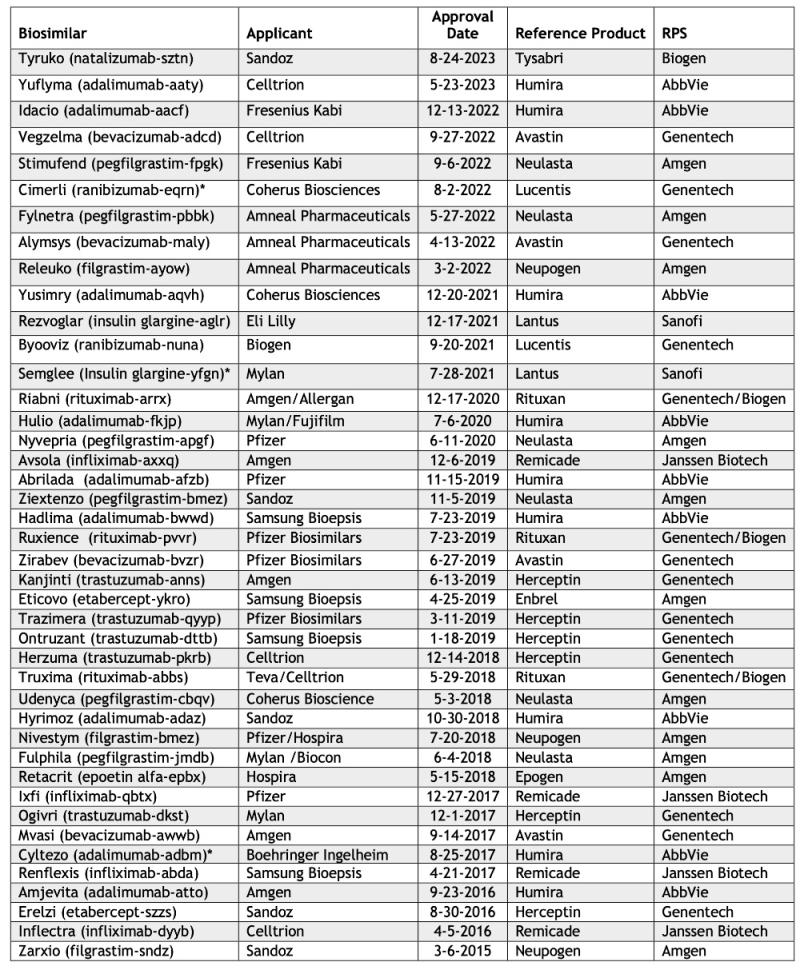
    Things have been looking up with a half dozen biosimilar drugs having been allowed in the past year (see Table).  The most recent is Tyruko (natalizumab-sztn) from Sandoz, whose approval was announced by the FDA and is a biosimilar for Biogen's Tysabri (natalizumab) approved for the treatment of relapsing forms of multiple sclerosis (MS), specifically clinically recognized forms of the disease that includes clinically isolated MS, relapsing-remitting MS (West Wing viewers will recognize this as the form President Bartlet suffered from), and active secondary progressive MS.

    According to the announcement, in addition to MS the drug is approved for "inducing and maintaining clinical response and remission in adult patients with moderately to severely active Crohn’s Disease (CD) with evidence of inflammation who have had an inadequate response to, or are unable to tolerate, conventional CD therapies and inhibitors of TNF-α (tumor necrosis factor)."

    The announcement contains a caution, that use of Tyruko, like Tysabri, is associated with an increased risk of progressive multifocal leukoencephalopathy (PML), "a viral infection of the brain that usually leads to death or severe disability."  For this reason availability of the drug is limited by a risk evaluation and mitigation strategy (REMS).

    This approval brings to 42 the number of approved biosimilar products.

    Table* Approved as interchangeable biosimilar

  • By Kevin E. Noonan –

    USPTO SealOne of the many criticisms of the post-grant review proceedings instituted by the Leahy-Smith America Invents Act, both post-grant review (PGR) available within 9 months of patent grant based on all provisions of the Patent Act and inter partes review (IPR) throughout the entire term of the patent but limited to prior art-based rejections under Section 102 and 103), is that patentees can be harassed by multiple challenges by multiple parties on the same patent and similar prior art (including both serial and parallel varieties of such challenges).  The U.S. Patent and Trademark Office, being sensitive to these criticisms has provided statistical analyses of PGR and IPR challenges and the most recent was posted in July on the PTO website (see Patent Trial and Appeal Board
    Multiple Petitions Study).

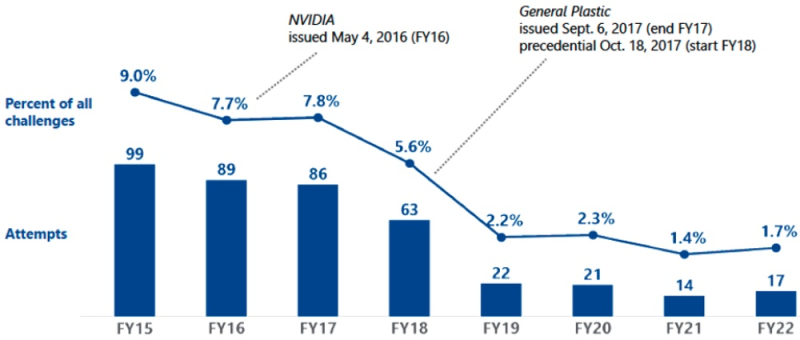
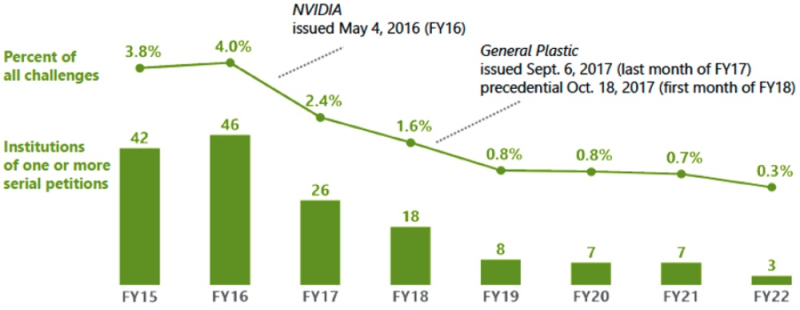
    The Report begins with serial IPR petitions, defined as "one petition or a group of two or more petitions filed more than 90 days after the first petition by the same petitioner challenging same patent, with one count per group per fiscal year."  The statistics, accumulated from FY15 to FY22, illustrate the effect of two PTAB decisions:  NVIDIA Corp. v. Samsung Elecs. Co., Case IPR2016-00134, Paper 9 (PTAB May 4, 2016), and General Plastic Industrial Co., Ltd. v. Canon Kabushiki Kaisha, Case IPR2016-01357 et al., Paper 19 (PTAB Sept. 6, 2017) (precedential).  As explained by the Office, the General Plastic decision provided non-exclusive factors for the Board to consider when exercising its discretion to institute an IPR and directed to "follow-on" petitions for PGR, IPR, and the now sunsetted Covered Business Methods proceedings.  These statistics are set forth in graphs of attempts at PGR/IPR institution:

    Image 1

    and instituted PGRs/IPRs:

    Image 2
    showing a gradual and then accelerating decline in serial petitions after the precedential General Plastics decision was handed down.  The PTO explains that serial petitions were instituted for a number of reasons, including patent owner acquiescence, the patent owner asserting new claims in district court litigation, there being a large number of claims at issue, and in one case, Apple Inc. v. Fintiv, Inc., IPR2020-00019, Paper 11 (PTAB Mar. 20, 2020) (precedential), the petitioner dismissing an ITC proceeding which had provided the basis for institution denial of the original petition.  The PTO assessment of the collated data show that 74 out of 4,233 challenges (~1.75%) involved serial petitions, with only 25 or ~0.6% resulting in institution.

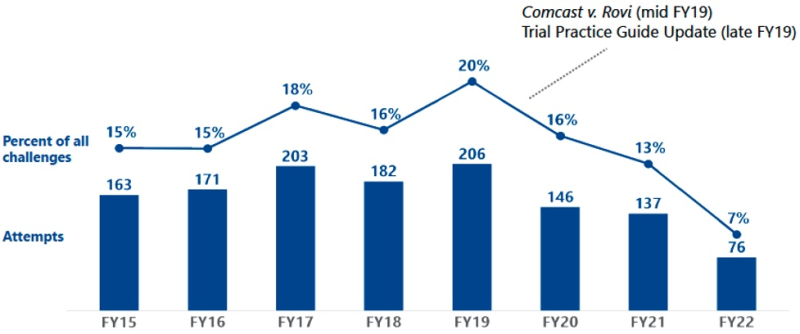
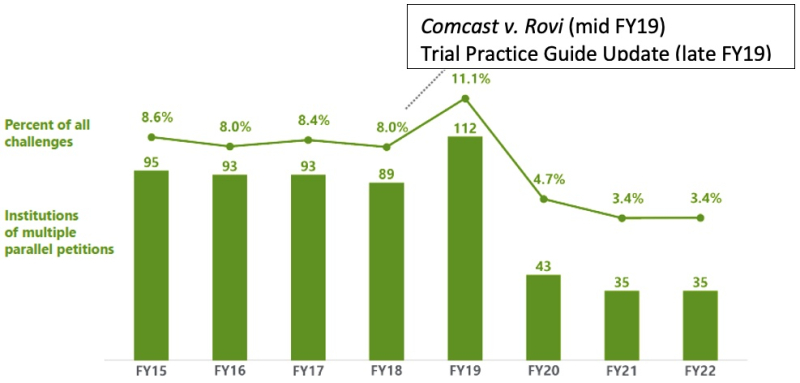
    Similar statistical assessments were presented to "parallel institutions," i.e., where a group of petitions are filed 90 days or less apart by the same petitioner against the same patent.  These statistics are set forth in graphs of attempts at parallel PGR/IPR institution:

    Image 3

    and instituted parallel PGRs/IPRs:

    Image 4
    For parallel petitions, the PTO identified Comcast Cable Commc'ns, LLC v. RoviGuides, Inc., IPR2019-00224, Paper 10 (PTAB Apr. 3, 2019), and an update to the Trial Practice Guide as relevant events during a single fiscal year that were responsible for the decline in granted parallel PGRs and IPRs.  The PTO identified instances where a petitioner prevailed on institution of parallel petitions over patent owner objection as cases where there were a large number of claims, priority date issues, prior art eligibility, or different claims contested.  The Office notes that in FY21 70% of those instituted parallel PGRs/IPRs were instance where the patent owner did not contest institution, whereas those statistics dropped to 54% in FY22.

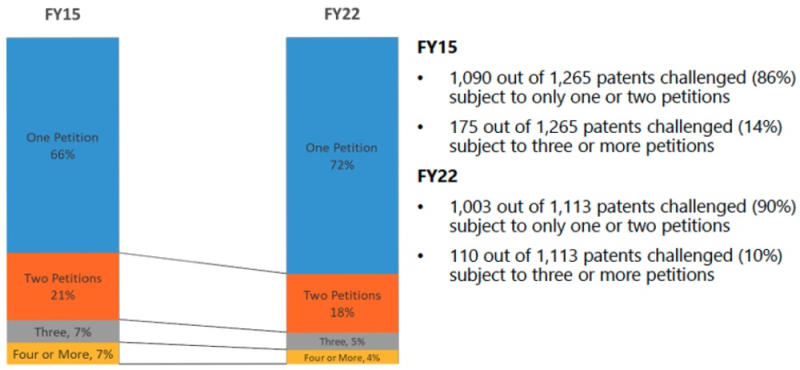
    The Office presented an assessment of these statistics showing that the majority of petitions in FY15 and FY22 were single petitions, but that the instances of multiple petitions had a steady trend downward during that time:

    Image 5
    While these statistics are certainly useful at a low level of granularity to show that multiple serial and parallel petitions are declining over the period the statistics were studied, it is unlikely that the picture they present will be considered sufficiently rosy to rebut or even stem the Findings and proposed amendments to the statute being considered by Congress (see "Senator Coons And Co-Sponsors Introduce the PREVAIL Act").

    For those interested in further statistics, these are provided in an Appendix and the Office has also provided an Executive Summary of the study.