• Purely Business Method Patent Found Ineligible under Section 101

    By Joseph Herndon —
    Federal Circuit SealIn an appeal from a rejection in initial examination of appellant Mark Eberra's patent application, the Federal Circuit affirmed the Patent Trial and Appeal Board's ("Board") determination that the claims are patent-ineligible under § 101.

    The patent application is entitled "Business Method for Opening and Operating a National Television Network" with serial number 12/230,058 ("the '058 application").  The Examiner rejected all claims of the '058 application as patent-ineligible under 35 U.S.C. § 101 and as anticipated under 35 U.S.C. § 102.

    The Board initially affirmed the Examiner's anticipation rejection without reaching the § 101 issue.  Then, on rehearing, the Board affirmed the Examiner's rejection under both § 101 and § 102.  Mr. Eberra appealed and represented himself pro se.

    The '058 application describes a business method for providing a television network "that requires the masses of the general public to purchase products in exchange for being allowed to perform in television programs shown on the network."  Claim 1, which the Board treated as exemplary, reads:

    1.  A process for providing a television network comprising:
        (a) opening at least one physical location for a production of a television program;
        (b) requiring at least one customer to make a purchase of a product;
        (c) allowing said customer to give a performance in said production of said television program, in exchange for making said purchase of said product;
        whereby said purchase made by said customer results in said production of said television program for said performance of said customer on said television network.

    To determine whether a claim is patentable under § 101, the Supreme Court has instructed use of a two-step framework.  First, a court must determine whether the claim is directed to a patent-ineligible concept, i.e., a law of nature, a natural phenomenon, or an abstract idea.  If so, the court must proceed to step two and ask whether the elements of the claim, considered both individually and as an ordered combination, add enough to transform the nature of the claim into a patent-eligible application.

    Starting at step one of the test, the Federal Circuit agreed with the Board's conclusion that the claims at issue are directed to an abstract idea, namely "promoting the purchase of a product with the incentive being a spot in a television program, i.e. product promotion."

    Like the concept of risk hedging, which the Supreme Court found to be an abstract idea in Bilski v. Kappos, the Federal Circuit found that the concept of product promotion is a fundamental economic practice long prevalent in our system of commerce.

    The Appellant argued that the claims are not directed to the abstract idea of product promotion and are instead directed to what the specification describes as a "new Customercast model of television" in which "the basic principle is to attract large numbers of people to perform on television, and require a purchase for the experience."  But the Federal Circuit found that the abstract nature of the claims is not altered at step one by the existence of claim limitations (much less characterizations in the specification) that add a degree of particularity to the implementation of the abstract idea.

    Here, claim 1, considered as an ordered combination, simply describes a form of product promotion in which the incentive for purchasing a product is the opportunity to perform in a television program.  The Federal Circuit noted that this is more specific than the concept of product promotion, but it is no less abstract.

    Turning to step two, each specific step in the claims—opening a location (which requires nothing more than finding a location), requiring a purchase, and allowing a performance in a television program—was found to be a routine television-production or advertising activity performed in a conventional way, as described in the specification.  Thus, there was no inventive concept found, and the claims in the '058 application were found to not be directed toward patentable subject matter under § 101.

    Because the Court affirmed the Board's determination that the claims are patent-ineligible under § 101, they did not address the Board's decision with respect to anticipation.

    In re Eberra (Fed. Cir. 2018)
    Nonprecedential disposition
    Panel: Chief Judge Prost and Circuiot Judges Dyk and O'Malley
    Per curiam opinion

  • CalendarMay 8, 2018 – Symposium on Intellectual Property (George Washington University Law School, Pillsbury, NERA Economic Consulting, and Mayer Brown) – Washington, DC

    May 8, 2018 – "Intellectual Property Valuation and Damages: Nuts and Bolts in 2018" (The Knowledge Group) – 12:00 to 1:30 pm (ET)

    May 8, 2018 – Patent Quality Chat webinar – "Subject Matter Eligibility: Revised Guidance in view of Berkheimer v. HP, Inc." (U.S. Patent and Trademark Office) – 12:00 to 1:00 pm (ET)

    May 8-10, 2018 – Patent Fundamentals Bootcamp 2018: An Introduction to Patent Drafting, Prosecution, and Litigation (Practising Law Institute) – Chicago, IL

    May 9, 2018 – "Supplemental Examination Requests: Benefits and Limitations, Strategic Use — Assessing Enforceability of Patent Portfolios, Evaluating the High Burden" (Strafford) – 1:00 to 2:30 pm (EDT)

    May 10, 2018 – "Will the Supreme Court Step in Again in Helsinn v. Teva? Does a Sale of Confidential Materials Trigger the On-Sale Bar?" (Federal Circuit Bar Association) – 3:00 pm to 4:00 pm (EST)

    May 10, 2018 – European Patent Strategies (Intellectual Property Law Association of Chicago Corporate Committee and Weickmann & Weickmann) – 5:00 pm to 6:05 pm (CT), Chicago, IL

    May 15, 2018 – "USPTO Post-Grant Patent Trials 2018: Change & Recalibration" (Practising Law Institute) – San Francisco

    May 17, 2018 – "Patenting Antibodies at the EPO" (J A Kemp) – 15:30 (Greenwich Mean Time)

    May 17, 2018 – "Patent Exclusivity Health Checks for Biologics: Are Your U.S. Patents Ready to Maximize ROI?" (Strafford) – 1:00 to 2:30 pm (EDT)

    May 18, 2018 – "US-China: The Relationship and Concerns Raised in the Section 301 Investigation and Report" (Federal Circuit Bar Association) – 3:00 pm to 4:30 pm (EST)

    May 22, 2018 – "Sovereign Immunity and Patents at the PTAB and District Courts" (McDonnell Boehnen Hulbert & Berghoff LLP) – 10:00 am to 11:15 am (CT)

    June 13-15, 2018 – Patent Fundamentals Bootcamp 2018: An Introduction to Patent Drafting, Prosecution, and Litigation (Practising Law Institute) – New York, NY

    June 25-27, 2018 – Summit on Biosimilars (American Conference Institute) – New York, NY

    July 18-20, 2018 – Patent Fundamentals Bootcamp 2018: An Introduction to Patent Drafting, Prosecution, and Litigation (Practising Law Institute) – San Francisco, CA

    September 21, 2018 – "USPTO Post-Grant Patent Trials 2018: Change & Recalibration" (Practising Law Institute) – New York & Groupcasts in Philadelphia, Indianapolis, New Brunswick, NJ, Pittsburgh, and Mechanicsburg, PA

  • MBHB Logo 2McDonnell Boehnen Hulbert & Berghoff LLP will be offering a live webinar entitled "Sovereign Immunity and Patents at the PTAB and District Courts" on May 22, 2018 from 10:00 am to 11:15 am (CT).  In this presentation, Patent Docs author and MBHB attorney Kevin Noonan and MBHB attorneys James Lovsin and George "Trey" Lyons, III will discuss sovereign immunity as it applies to Native American Tribes in comparison with the several States and review the Allergan strategy for protecting patent franchises for blockbuster drugs, as well as similar efforts for high technology inventions, and consider the scope of Congressional authority on this question and the likelihood for legislative intervention.

    While there is no fee to participate, attendees must register in advance.  Those wishing to register can do so here.  CLE credit is pending for the states of California, Illinois, New Jersey, New York, North Carolina, and Virginia.

  • USPTO SealThe U.S. Patent and Trademark Office will be offering the next webinar in its Patent Quality Chat webinar series from 12:00 to 1:00 pm (ET) on May 8, 2018.  The latest webinar, entitled "Subject Matter Eligibility: Revised Guidance in view of Berkheimer v. HP, Inc." will be hosted by USPTO Deputy Commissioner for Patent Examination Policy Bob Bahr, will discuss the USPTO's recently-issued memorandum implementing changes to examination procedure in view of the Federal Circuit's decision in Berkheimer v. HP, Inc., which provides clarification on the subject matter eligibility analysis.

    Instructions for viewing the webinar and additional information regarding the Patent Quality Chat webinar series can be found on the USPTO's Patent Quality Chat webpage.

  • J A KempJ A Kemp will be offering a webinar entitled "Patenting Antibodies at the EPO" on May 17, 2018 starting at 15:30 (Greenwich Mean Time).  Sarah Roques and Pamela Tuxwirth of J A Kemp will address the following topics:

    • When broad antibody claims can be obtained
    • How to approach inventive step when the target is known
    • What data to provide to support inventive step
    • Functional/epitope claims
    • Other routes to patentability

    Those wishing to register can do so here.

  • PLI #1Practising Law Institute (PLI) will be holding a program entitled "USPTO Post-Grant Patent Trials 2018: Change & Recalibration" in San Francisco (May 15) and New York (September 21).  Webcasts of both sessions will be offered, and groupcasts will be held in Philadelphia, Indianapolis, New Brunswick, NJ, Pittsburgh, and Mechanicsburg, PA on September 21.  The San Francisco session of the program will offer presentations on the following topics:

    • Roadblock PTAB: Hardening Patent Portfolios and Adjusting Patent Prosecution Strategies
    • PTAB Launch: The Preliminary Proceeding – New Tactics, Evolving Estoppel Risks and Trial Institution
    • PTAB Trial Route: The Article I Trial Court: Mechanics – Discovery, Motion Practice and Amendment
    • PTAB Endgame: The Final Written Decision, Rehearing and Appeals to the CAFC
    • The Long Road: Patent Monetization in Silicon Valley – Licensing and Navigating Efficient Infringement

    The New York session of the program will offer presentations on the following topics:

    • Roadblock PTAB: Hardening Patent Portfolios and Adjusting Patent Prosecution Strategies
    • PTAB Launch: The Preliminary Proceeding – New Tactics, Evolving Estoppel Risks and Trial Institution
    • PTAB Trial Route: The Article I Trial Court: Mechanics – Discovery, Motion Practice and Amendment
    • PTAB Endgame: The Final Written Decision, Rehearing and Appeals to the CAFC
    • Northeast Corridor: Bio/Pharma at the PTAB
    • Leveraging the PTAB Journey: Concurrent District Court Trial Strategies

    Schedules for both sessions can be found at here.

    The registration fee for the program is $1,850.  Those interested in registering for the conference can do so at the PLI website.

  • Strafford #1Strafford will be offering a webinar entitled "Patent Exclusivity Health Checks for Biologics: Are Your U.S. Patents Ready to Maximize ROI?" on May 17, 2018 from 1:00 to 2:30 pm (EDT).  M. Paul Barker, Steven P. O’Connor, and Sanya Sukduang of Finnegan Henderson Farabow Garrett & Dunner will guide patent counsel on the essentials of patent exclusivity that are in critical need of independent checking, and discuss crucial health checks on U.S. patent exclusivity for biologics in Phase II efficacy trials and proceedings through large scale randomized Phase III clinical trials, submission of the BLA, and subsequent approval and marketing.  The webinar will review the following issues:

    • How should counsel respond if a health check uncovers sub-optimal protection or defects in a patent claim?
    • Are the BCPIA claims definite or enabled under the current standards?
    • Is there a need for supplemental examination to clear the path to enforceability?

    The registration fee for the webcast is $297.  Those interested in registering for the webinar, can do so here.

  • Federal Circuit Bar AssociationThe Federal Circuit Bar Association (FCBA) will be offering a webcast entitled "US-China: The Relationship and Concerns Raised in the Section 301 Investigation and Report" on May 18, 2018 from 3:00 pm to 4:30 pm (EST).  Terry Stewart of Stewart and Stewart will moderate a panel consisting of Erin Ennis, Senior Vice President, US-China Business Council; K.C. Swanson, Director, Global Policy, Telecommunications Industry Association; Owen Herrnstadt, Chief of Staff to the International President, International Association of Machinists and Aerospace Workers; and David Ross of WilmerHale.

    The webinar is complimentary for FCBA members and $50 (government/academic/retired) or $125 (private practitioner) for non-members.  Those interested in registering for the webcast, can do so here.

  • By Shin Hee Lee* and Anthony D. Sabatelli** —

    The cosmeceutical industry is ever more competitive and continues to grow with a myriad of new cosmeceutical products entering the market every day.  Well-established and new companies are busily adapting to new trends created by people's changing tastes.  The total revenue of the U.S. cosmeceutical industry has only been increasing since 2009, marking $62.46 billion in 2016.  While this revenue comes from a number of cosmeceutical product categories, skin care has always been the most profitable category, covering 36% of the global market.  In this article, we discuss some of the recent growth and trends in skin care cosmeceutical patents.

    It is often unknown that the 182 most recognized beauty brands in the world are actually owned by seven major cosmeceutical companies:  L'Oréal, Johnson and Johnson, Shiseido, Estée Lauder Companies, Unilever, Coty, and Procter & Gamble.  L'Oréal umbrellas the most brands with a total of 39 prevalent companies in an array of beauty stores.  These store brands are very well-known, including Kiehl's, Lancôme, The Body Shop, Urban Decay, and Maybelline.  On the other hand, the Estée Lauder Companies own internationally recognized luxury brands such as Clinique, Bobbi Brown, MAC, Jo Malone, Lab Series, and Glamglow.  These brands highly occupy the shelves in Sephora and other popular beauty vendors.  The plethora of products and the explosion of marketing venues suggests how competitive it can be for new cosmeceutical companies to succeed in the market.

    To be competitive in the cosmeceutical industry, a company, whether new, rising or established, should focus on establishing solid intellectual property (IP) rights.  IP rights protect and support elements that help companies distinguish their products from rival companies.  Furthermore, the number of patents can be a powerful marketing tool, especially when touting the "patented" technology used to develop the product.

    Because of the significance of IP rights in the cosmeceutical industry, there is currently an overwhelming number of cosmeceutical patents.  Skin care has the leading number of patents, correlating to its enormous global sales (projected to reach $130 billion by 2019).

    Anti-aging has been the most popular category within skin care, attributed to the high demand of products promoting youthful looks that defy a consumer's biological age.  The majority of anti-aging patents relate to inventions based on unique compositions of known or novel ingredients.  An assortment of vitamins like retinol (made from vitamin A), vitamin C, coenzyme Q-10, and alpha-hydroxy acids (AHAs) have traditionally been touted to have anti-aging efficacies.  However, with the recent beauty trend of "clean cosmeceuticals," some patentees have pointed at the toxicity of some complementary additives in these vitamins and have filed patents for supposedly more natural plant-based components.  Some anti-aging products contain peptides instead of vitamins as their main component.  A recent study has shown that defensins, a group of antimicrobial peptides that activate stem cells to produce new skin, provide incredible anti-aging effects.  Many reporters have been labeling defensins as "a game changer," and "the newest anti-aging weapon."  Patents on anti-aging formulations will likely surface in the near future.

    Another area of intense patent activity relates to cosmetic devices.  Portable home skin care devices for measuring and improving skin conditions have been increasingly patented and commercialized.  One of the pioneers that popularized hand-held devices was a company named Clarisonic (or Pacific Biosciences Laboratories), which owns 40 patents on their devices.  Clarisonic's iconic cleansing tool is a mechanically rotating face brush that oscillates back and forth over the skin to thoroughly remove any oil, debris, makeup and environmental pollutants.  Recently, Neutrogena has introduced small portable stick that treats acne using phototherapy.  Depending on the light color, the stick can treat different types of skin problems.  One futuristic skin care device on the rise is a mirror with built-in digital sensors that detect and analyze the skin's moisture, oiliness, and redness.  Devices that were only accessible at a dermatologist's office are increasingly becoming home-friendly.  We expect the skin care device patents continue to increase in the coming years, especially the design patents.

    Shown below are two tables summarizing some of the patent trends for cosmetics and recent devices.

    Table 1
    Table 2

    * Shin Hee Lee is a Ph.D. Candidate in the Chemistry Department at Yale University.  She is currently associated with the Yale Energy Sciences Institute, where she specializes in organic synthesis of novel light-harvesting dye molecules for solar cells.  Prior to attending Yale, Shin Hee obtained her B.S. in Chemistry with High Honors at the University of Michigan – Ann Arbor, during which she published patents and papers on developing synthetic methodologies for fluorinated small molecules.
    ** Dr. Sabatelli is a Partner with Dilworth IP

  • By Kevin E. Noonan —

    Sweet PotatoHiram Bentley Glass and classical geneticists of the Twentieth Century elucidated some of the ways that genetics could inform regarding human populations and their history, using observations like genetic drift (famously, among the Amish) and the "founder effect."  The "genomics" revolution of the last thirty years has extended these observations, for human populations as well as many other animal and plant species (see, e.g., "Genetic Assessment of Squash Genomes in Related Species"; "The Domestication History of Apples Revealed by Genomic Analysis"; and "Domestic Cat Genome Sequenced").  Recently, several outstanding questions regarding the genetics of sweet potato were resolved, in a report in Current Biology, entitled "Reconciling Conflicting Phylogenies in the Origin of Sweet Potato and Dispersal to Polynesia," resulting from genomic and chloroplast DNA analyses that establish the phylogenetic, temporal and geographical relationships between this important crop species and its wild naturally occurring relatives.

    The paper, from an international group of researchers* from the University of Oxford, Oregon State University, International Potato Center (Lima, Peru) and Duke University, used genome skimming and target DNA capture on 199 specimens comprising sweet potato (Ipomoea batatas) and all its wild relatives (I. trifida, I. triloba, I. ramosissima, I. cordatotriloba, and I. leucantha).  One of the most consumed crops worldwide, the species originated in the Caribbean region (Central and northeastern South America and the islands comprising the region) but is also endemic to Polynesia.  In addition to the evolutionary relationship between I. batatas and its wild relatives, this geographical distribution pattern has long raised the question of whether dispersion occurred without human intervention (wind, water, birds) or whether there were humans transiting the Pacific much earlier than anthropological evidence suggests.  The genetic evidence shows that human intervention is not necessary to explain sweet potato presence in Polynesia based on comparisons of the relationship (and divergence) of the Polynesian species (Ipomoea littoralis Blume) with I. batatas and other New World members of its family.

    The researchers report that their dataset consisted of 199 individuals representing all sixteen species in Ipomoea series Batatas and twenty-four other species across the Ipomoea genus.  These included fresh samples growing contemporaneously as well as herbarium specimens dating back to 1769.  Probes for 605 putative single copy nuclear regions of Ipomoea were derived from a comparison between genomic information from I. lacunosa and coding sequence-restricted data from the related Solanum tuberosum (potato).  The team interrogated genomic regions with a one-to-one match at 70% identity along at least half the length of a Solanum CDS and the results were filtered to retain Ipomoea loci that were at least 1000 bp long.  From these loci 100 bp-long RNA probes were developed, excluding probes with GC content < 25%.  In addition, the researchers obtained complete chloroplast DNA sequences from each specimen.

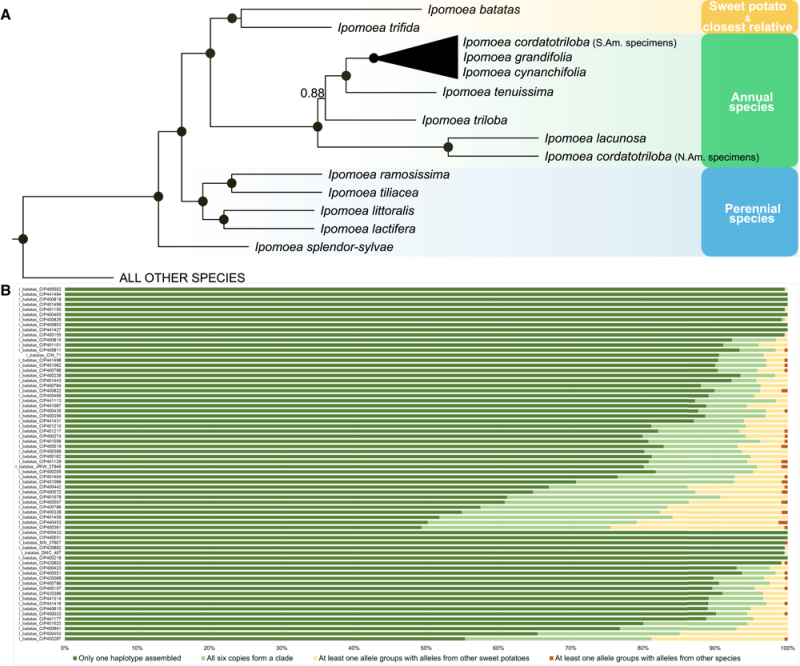
    From these comparisons the scientists concluded that the I. batatas sweet potato species is most closely related to I. trifida.  Speciation arose from a first autohexaploidy event, with the related species having the following family tree set forth in A:

    Figure 2_lrg
    Muñoz-Rodríguez et al., 2018, Current Biology 28(8): 1246-56, Figure 2

    Sweet potato is also the only member of this extended family whose evolution contains an autohexaploidy event.  This origin was supported by an analysis of the six alleles in each I. batatas genome, which the researchers found were more closely related to each other than to any other species (shown in B).

    When did I. batatas diverge from I. trifida?  Using nuclear DNA comparisons over 21 nuclear regions, the researchers estimated that divergence occurred at least 800,000 years ago; there was also evidence of a population bottleneck ~640,000 years ago.

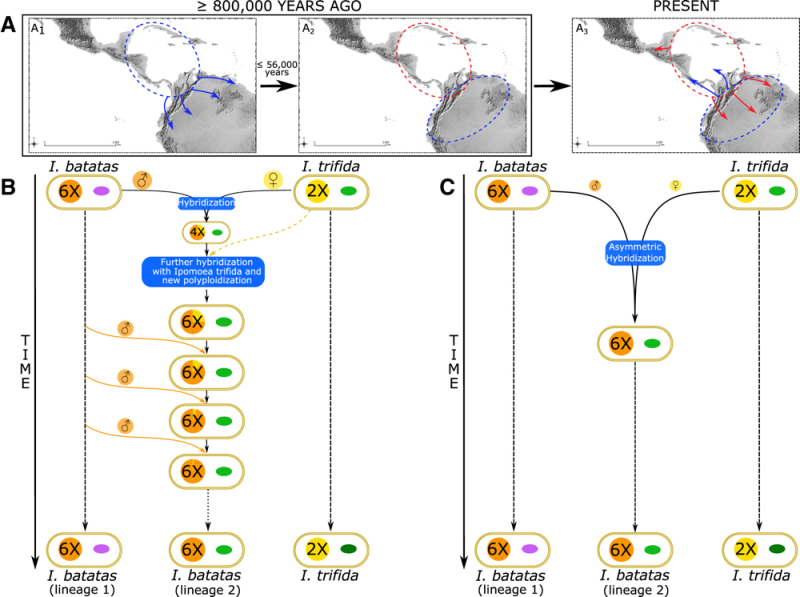
    Whole chloroplast genome analysis was performed and revealed two genetically distinct lineages, with one (termed CL2) being more closely related to chloroplasts contained in I. trifida.  The relationship between the two chloroplast species compared with chloroplasts from I. trifida reported showed no shared insertion/deletion events (indels) between CL1 and CL2, but that I. batatas CL2 chloroplasts shared indels in common with I. trifida chloroplasts.  The results of these analyses suggested that the sweet potato species had undergone two speciation events:  the first, autohexaploidy from an I. trifida-like ancestor, followed by later introgresssion (occurring within about 56,000 years from the autohexapolidy event) by I. trifida, resulting in two populations of chloroplasts in natural species.  The Figure represents this history:

    Figure 4_lrg

    Muñoz-Rodríguez et al., 2018, Current Biology 28(8): 1246-56, Figure 4

    This Figure shows two alternative histories to explain the two chloroplast lineages in natural populations, with the evidence being more consistent with Figure C, resulting in an I. batatas species having CL1 and Cl2 chloroplasts.

    Turning to the genetic evidence for Polynesian dispersion (which extends today from Polynesia to Madagascar), comparison between the Ipomoea littoralis Blume species and I. batatas indicated (through genetic differences that would have been familiar to Bentley Glass and colleagues) that the sweet potato dispersed to Polynesia 111,500 – 139,000 years ago, predating human contact and putting to rest speculation for the occurrence of trans-Pacific exploration by Polynesia populations earlier than anthropological and other more conventional data suggest.

    One of the benefits noted by the scientists in their paper is the practical consequence that, by knowing the relationships between sweet potato and its relatives it may be possible to improve production or other aspects of breeding for a commercially important crop.  More broadly, though, researches such as these extend to more quotidian questions the reach of modern genetic analysis to address long-standing historical conundrums (both human and natural) that were hoped for by the pioneers of the genomics revolution.  Indeed, in view of the transitory nature of history and its artifacts, it is likely that many such questions can only reliably be answered from the history of life written in the genetic code of the organisms that have survived (which makes preserving them all the more important).

    *Pablo Muñoz-Rodríguez, Tom Carruthers, John R.I. Wood, Bethany R.M. Williams, Kevin Weitemier, Brent Kronmiller, David Ellis, Noelle L. Anglin, Lucas Longway, Stephen A. Harris, Mark D. Rausher, Steven Kelly, Aaron Liston, and Robert W. Scotland

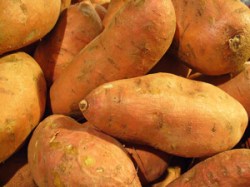
    Image of Ipomoea batatas, Sweet Potato by Llez, from the Wikimedia Commons under the Creative Commons Attribution-Share Alike 3.0 Unported license.