• Shapes and Shading of Graphical User Interface Not Enough to Uphold Validity

    By Joseph Herndon —
    Federal Circuit SealIn a nonprecedential decision, the Federal Circuit found all challenged claims directed to a graphical user interface of a U.S. Patent obvious over a combination of prior art.  Valmont Industries, Inc. appealed from the final decision of the Patent Trial and Appeal Board in an inter partes review, finding claims 1–10, 12–15, 17, and 18 of U.S. Patent No. 7,003,357 unpatentable as obvious.  Lindsay Corp. also cross-appealed the Board's determination that claim 11 was not obvious.  Reviewing all prior art, the Federal Circuit found that all of these claims were, in fact, obvious.

    The '357 patent is directed to remotely monitoring and controlling irrigation equipment using handheld devices.  A remote user interface displays icons, referred to in this patent as graphical user interfaces ("GUIs"), which show the status of irrigation equipment and allow its control.  Prior art systems monitored and controlled irrigation equipment through personal computers.  Because personal computers are typically located at a base station, these systems required users to return to the base station to control the irrigation equipment.  The '357 patent is directed to the use of handheld devices to allow a user to view the status of and control irrigation equipment from any location using wireless telemetry technology, as shown below in Figure 1 of the patent.
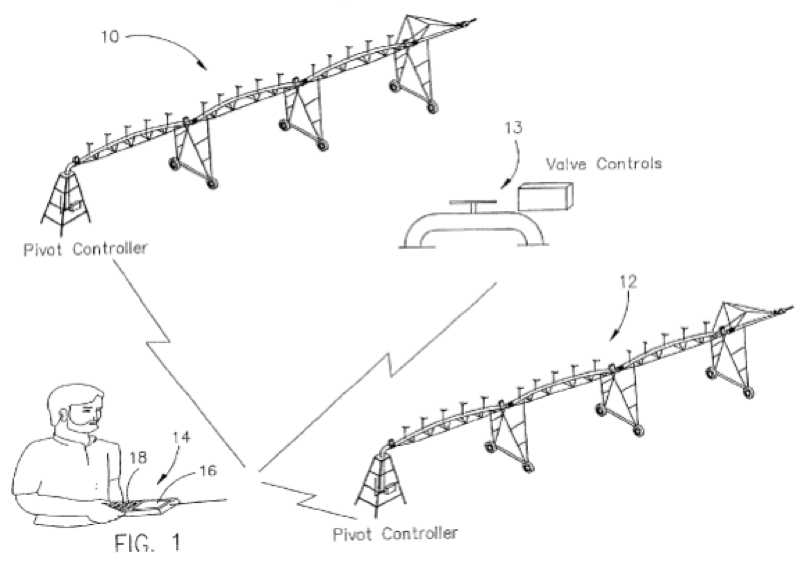
    FIG. 1
    Claim 1 is illustrative and reads as follows:

    1.  A remote user interface for reading the status of and controlling irrigation equipment, comprising:
        a hand-held display;
        a processor;
        wireless telemetry means for transmitting signals and data between the remote user interface and the irrigation equipment; and
        software operable on said processor for:

    (a) displaying data received from the irrigation equipment as a plurality of GUIs that are configured to present said data as status information on said display;
    (b) receiving a user's commands to control the irrigation equipment, through said user's manipulation of said GUIs; and
    (c) transmitting signals to the irrigation equipment to control the irrigation equipment in accordance with said user's commands.

    Dependent claim 6 requires GUIs shaped to identify particular types of irrigation equipment, and dependent claim 10 requires GUIs shaped to identify operating irrigation patterns for specific irrigation equipment.  Claim 11, which depends from claims 1, 6, and 10, further requires:

    11.  The remote user interface of claim 10 wherein said software is further operative on said processor to change the shape of said plurality of GUIs change [sic] in response to a change in the status of the irrigation equipment.

    The Board found that all of the challenged claims, except claim 11, would have been obvious to a person of ordinary skill in the art, but that claim 11 would not have been obvious.

    In particular, the Board found that claims 1–3, 6–10, 12–14, 17, and 18 would have been obvious in view of two prior art references including a primary reference that described remotely monitoring and controlling an irrigation system using a computer to display GUIs, and a secondary reference brought in for describing remotely monitoring and controlling various types of field devices for industrial processes using a handheld device displaying GUIs.

    On appeal, Valmont argued that there was insufficient evidence of a motivation to combine the references because the handheld devices in the secondary reference lacked sufficient display capabilities and computing capacity to operate the system described in the primary reference.  The '357 patent has a 2001 priority date, and expert testimony was provided to demonstrate that at the time of the invention, a person of ordinary skill would be able to employ the system of the primary reference on a mobile device disclosed in the secondary reference.  In particular, mobile phones at the time, could display GUIs and receive user commands through manipulation of GUIs.

    The Federal Circuit agreed and found that substantial evidence supported the Board's determination that a person of ordinary skill would have had a reasonable expectation of success in combining the references and would have been motivated to make the combination.

    Addressing dependent claim 11, which requires that the software be operative "to change the shape of said plurality of GUIs change [sic] in response to a change in the status of the irrigation equipment," a third reference was cited for teaching a display of circle-shaped or square-shaped GUIs in which status information as to irrigation patterns is indicated in various ways, including by shading.

    The question to consider was whether a change in shading constituted a change in "shape."  Applying the broadest reasonable construction, the Board concluded that "shading within the original GUI does not change the shape of the GUI."  But the Federal Circuit disagreed and found that a change in shape occurs when there is a change in pattern, such as through shading.

    The Federal Circuit first turned to a dictionary definition of "shape" as "the visible makeup characteristic of a particular item or kind of item," and found that a change in shading falls within this definition as it is a change in the visible makeup characteristics of the circle.

    Most importantly, however, the specification discusses shading and discloses that shading constitutes a change in shape as well.  For example, the specification describes a GUI to represent a pivot irrigation system that could be partitioned into wedges to depict different settings along the pivot path.  It then states, "[d]ifferent colors or patterns can be used to shade each wedge to depict the particular spray pattern chosen for each wedge," and further describes how "cross-hatching" may represent one setting and a "speckled pattern" may represent another.  Thus, changes in shading of the GUI reflect a change in status of irrigation patterns.  The Federal Circuit thus found that this suggests that a change in shading is a change in shape within the scope of claim 11.

    Additionally, during oral argument before the Board, Valmont conceded that shape includes the color within a GUI, by responding that:

    One thing to keep in mind is that when it says the shape or the status information in the GUI, shape doesn't necessarily have to be just that it's a circle or just that it's a triangle.  It could potentially be that it's a circle that's got lines through it or a triangle that has a checkerboard pattern across it.  So there's different kinds of shapes that it could be that would allow it to show all of these different products.

    Thus, under Valmont's own definition or under the broadest reasonable construction standard, a change in shading would constitute a change in shape of the GUI.  As a result, since the third reference describes a change in shading to reflect a change in irrigation pattern, the resulting combination of references encompassed the limitations of claim 11.  Thus, the Federal Circuit also found claim 11 obvious as well.

    Valmont Industries, Inc. v. Lindsay Corp. (Fed. Cir. 2018)
    Nonprecedential disposition
    Panel: Circuit Judges Lourie, Dyk, and Hughes
    Opinion by Circuit Judge Dyk

  • CalendarMay 29, 2018 – "The Impact of Oil States and SAS Institute on Your PTAB Strategy" (IAM) – 4:00 (BST)

    May 31, 2018 – "Oil States and SAS: Implications of the Supreme Court's Decisions for Patent Practice" (Strafford) – 1:00 to 2:30 pm (EDT)

    May 31, 2018 – "The Defend Trade Secrets Act Turns Two: New Perspectives and Analysis on the Current State of the Law" (LexisNexis) – 1:30 to 2:00 pm (ET)

    May 31, 2018 – "A New PTAB Landscape: The Impact of SAS, Recent Federal Circuit Decisions, and the Proposed Change to the BRI Standard" (Intellectual Property Owners Association) – 2:00 to 3:00 pm (ET)

    June 4-7, 2018 – BIO International Convention (Biotechnology Innovation Organization) – Boston, MA

    June 5, 2018 – "Functional Claiming for Software Patents: Leveraging Recent Court Treatment — Surviving 112(f) and Disclosing Functional Basis for Software to Meet Heightened Standard of Review" (Strafford) – 1:00 to 2:30 pm (EDT)

    June 7, 2018 – "Views on Patent Cases from the Chambers — PTAB, VA, and MD" (Federal Circuit Bar Association, Virginia Bar Association IP Department, Maryland State Bar Association IP Department, and Bar Association of the District of Colombia IP Department) – Eastern District of Virginia courthouse, Alexandria, VA

    June 13-15, 2018 – Patent Fundamentals Bootcamp 2018: An Introduction to Patent Drafting, Prosecution, and Litigation (Practising Law Institute) – New York, NY

    June 14, 2018 – "Secondary Considerations at the PTAB: Combating Obviousness Challenges, Establishing Nexus" (Strafford) – 1:00 to 2:30 pm (EDT)

    June 19, 2018 – "Protecting Software as a Medical Device: Patents, Design Patents and Trade Secrets" (Strafford) – 1:00 to 2:30 pm (EDT)

    June 25-27, 2018 – Summit on Biosimilars (American Conference Institute) – New York, NY

    July 18-20, 2018 – Patent Fundamentals Bootcamp 2018: An Introduction to Patent Drafting, Prosecution, and Litigation (Practising Law Institute) – San Francisco, CA

    September 21, 2018 – "USPTO Post-Grant Patent Trials 2018: Change & Recalibration" (Practising Law Institute) – New York & Groupcasts in Philadelphia, Indianapolis, New Brunswick, NJ, Pittsburgh, and Mechanicsburg, PA

  • IPO #2The Intellectual Property Owners Association (IPO) will offer a one-hour webinar entitled "A New PTAB Landscape: The Impact of SAS, Recent Federal Circuit Decisions, and the Proposed Change to the BRI Standard" on May 31, 2018 from 2:00 to 3:00 pm (ET).  Hon. David Ruschke, Chief Judge of the Patent Trial and Appeal Board of the U.S. Patent and Trademark Office; Gregory Castanias of Jones Day; and Erika Arner of Finnegan, Henderson, Farabow, Garrett & Dunner, LLP will discuss the path ahead after the recent host of major developments that will affect PTAB practice, including tips on how to build a successful appeal that results in remand or reversal, the impact of Federal Circuit decisions on PTAB practice, and how to try to convince the PTAB to change its mind about invalidating a patent on remand.

    The registration fee for the webinar is $135 (government and academic rates are available upon request).  Those interested in registering for the webinar can do so here.

  • IAMIAM will be offering a free webinar on "The Impact of Oil States and SAS Institute on Your PTAB Strategy" on May 29, 2018 starting at 4:00 (BST).  IAM North America editor Richard Lloyd will moderate a roundtable discussion of attorneys from Oblon, McClelland, Maier & Neustadt; Knobbe Martens; and Finnegan, Henderson, Farabow, Garrett & Dunner to discuss the implications of the Supreme Court's decision in decisions in Oil States v Greene's Energy and SAS Institute v Iancu and how they will affect the Patent Trial and Appeal Board (PTAB), inter partes review petitioners, and patent owners.  The roundtable will address the following topics:

    • Key takeaways from both the majority and dissenting opinions in Oil States
    •
    Where the decision in Oil States leaves further challenges to inter partes reviews
    • The likely impact of SAS on petitioners and patent owners
    • How the PTAB intends to implement SAS
    •
    The long-term effects on PTAB strategy for both petitioners and patent owners
    • The likely impact of a move away from broadest reasonable interpretation to the Philips claim construction standard in post-issuance reviews

    Those interested in registering for the webinar, can do so here.

  • Federal Circuit Bar AssociationThe Federal Circuit Bar Association, Virginia Bar Association IP Department, Maryland State Bar Association IP Department, and Bar Association of the District of Colombia IP Department will be hosting a program entitled "Views on Patent Cases from the Chambers — PTAB, VA, and MD" on June 7, 2018 at Eastern District of Virginia courthouse in Alexandria, VA.  A panel consisting of Chief Judge David Ruschke of Patent Trial and Appeal Board, U.S. Patent and Trademark Office; Magistrate Judge John F. Anderson, Eastern District Court of Virginia; District Judge Liam O'Grady, Eastern District Court of Virginia; and District Judge Marvin J. Garbis, District Court of Maryland will each provide insight into the day-to-day operations of their chambers and how they handle patent cases and answer questions from attendees.

    Additional information regarding the program can be found here.  The registration fee for the program is $25 (members of the sponsoring bar associations and non-members); there is no registration fee for jduges or students.  Those interested in registering for the conference can do so here.

  • Strafford #1Strafford will be offering a webinar entitled "Secondary Considerations at the PTAB: Combating Obviousness Challenges, Establishing Nexus" on June 14, 2018 from 1:00 to 2:30 pm (EDT).  Matthew L. Fedowitz, Philip L. Hirschhorn, and Christopher M. Cherry of Buchanan Ingersoll & Rooney will guide patent counsel on the use of secondary considerations at the Patent Trial and Appeal Board (PTAB), examine what works and what does not when seeking to defeat validity challenges, review Federal Circuit decisions addressing secondary considerations evidence presented in an IPR trial, and offer best practices for arguing secondary considerations at the PTAB.  The webinar will review the following issues:

    • What lessons can be learned from cases where secondary considerations successfully defeated validity challenges?
    • What trends can be observed from unsuccessful attempts when using secondary considerations?
    • How have the federal courts addressed secondary considerations?

    The registration fee for the webcast is $297.  Those interested in registering for the webinar, can do so here.

  • Strafford #1Strafford will be offering a webinar entitled "Protecting Software as a Medical Device: Patents, Design Patents and Trade Secrets" on June 19, 2018 from 1:00 to 2:30 pm (EDT).  Cory C. Bell, Elizabeth D. Ferrill, and Susan Y. Tull of Finnegan Henderson Farabow Garrett & Dunner will guide counsel for companies in the medical device industry on protecting software as a medical device (SaMD), and discuss the new FDA rules regulating SaMD and how to leverage IP law to protect SaMD.  The webinar will review the following issues:

    • What are the hurdles for patent counsel to demonstrate a software-related claim is not abstract?
    • What factors should counsel consider when determining what type of IP protection to seek?
    • What guidance have the courts provided in recent decisions concerning patent eligibility for software-related inventions?

    The registration fee for the webcast is $297.  Those interested in registering for the webinar, can do so here.

  • By Kevin E. Noonan —

    Federal Circuit SealEver since the Supreme Court loosened the reins on declaratory judgment actions in patent cases twelve years ago, in MedImmune v. Genentech, courts have decided cases fleshing out the metes and bounds of the factual predicates thereof.  One of the most persistent questions is what is the extent to which a declaratory judgment plaintiff can base the action not on traditional grounds (such as those between competitors for a patented product) but rather on the effects of patents on consumers or beneficiaries of a patented compound; these questions have arisen with greatest vigor over patented drug products.  The public policy issues surrounding drug costs and regulation, and those of the proper interplay with patent law was considered by the Federal Circuit (and rejected) in AIDS Healthcare Foundation, Inc. v. Gilead Sciences, Inc. earlier this month.

    The case arose when AIDS Healthcare Foundation (AHF) filed suit against defendants Gilead Sciences, Inc., Japan  Tobacco Inc., Johnson & Johnson, and Janssen Sciences Ireland UC over various drugs comprising the anti-HIV compound tenofovir alafenamide fumarate ("TAF") used in the treatment of AIDS.  Such drugs included TAF itself (sold as Genvoya®) as well as several embodiments comprising assorted other antiviral drugs (including Descovy® and Odefesey®).  Each defendant was either an owner of a patent relating to these drugs or licensee of such patents.  AHF provides healthcare to AIDS patients, including TAF-comprising drugs.  In filing its declaratory judgment action, AHF frankly stated that it was interested in "clear[ing] out the invalid patents" to enable generic drug companies to enter the marketplace as soon as possible; to that end AHF filed this action a mere two months after the FDA approved Genvoya® and thus almost four years before a generic competitor could file an Abbreviated New Drug Application.  AHF's justification for taking this preemptive strike so early was the "lengthy time consumed by litigating patent validity"; the opinion notes that it was "undisputed that no unlicensed source was offering a TAF product or preparing to do so when this declaratory action was filed."  AHF freely admitted that it was a consumer of AIDS treatment products and would not be involved in manufacturing any generic equivalents of any of the drugs protected by the patents-in-suit.

    The District Court dismissed AFH's declaratory judgment complaint on these grounds, that "encouraging others to produce generic TAF products in the future, and Healthcare's interest in purchasing such products," did not satisfy the "case or controversy" requirements for declaratory judgment relief.  This appealed followed.

    The Federal Circuit affirmed, in a precedential opinion by Judge Newman joined by Judges Dyk and Stoll.  The opinion notes at the outset the jurisdictional implications of AHF's complaint, and that a court is without authority to render a judgment unless the jurisdictional requirements are satisfied (which is complainant's burden to carry).  The facts comprising this burden are that there is "injury-in-fact, [a] connection between the challenged conduct and the injury, and redressability by the requested remedy," the Court citing Steel Co. v. Citizens for a Better Env't, 523 U.S. 83, 103–04 (1998).  The mere existence of a patent is not enough, without more, to establish these grounds.

    The panel rejected the three bases for jurisdiction asserted by AHF on appeal:

    (1) Healthcare is an indirect infringer of the TAF patents based on its requests to potential producers to provide the patented products;

    (2) Gilead's non-response to Healthcare's request for a covenant not to sue created a present controversy; and

    (3) public policy favors invalidation of invalid patents and thus the testing of "weak" patents.

    The facts adduced before the District Court did not establish that "under all the circumstances, []here is a substantial controversy, between parties having adverse legal interests, of sufficient immediacy and reality to warrant the issuance of a declaratory judgment" as required under MedImmune Inc. v. Genentech, Inc., 549 U.S. 118, 127 (2007) (quoting Maryland Cas. Co. v. Pac. Coal & Oil Co., 312 U.S. 270, 273 (1941)).  The alleged lengthy time incurred by patent litigation was not enough, according to the opinion, to provide the required "immediacy and reality" because there was no current infringement (or preparation for infringing activity) and thus no threat of patent infringement litigation.  "If a declaratory judgment plaintiff has not taken significant, concrete steps to conduct infringing activity, the dispute is neither 'immediate' nor 'real' and the requirements for justiciability have not been met," according to the opinion, citing  Cat Tech LLC v. Tubemaster, Inc., 528 F.3d 871, 880 (Fed. Cir. 2008).  And "the mere possibility of future infringement does not meet the immediacy and reality criteria, for '[a] party may not obtain a declaratory judgment merely because it would like an advisory opinion,'" citing Matthews Int'l Corp. v. Biosafe Eng'g, LLC, 695 F.3d 1322, 1328 (Fed. Cir. 2012).  Here, AHF was only an "encourager" of future infringing activity and a future consumer of any  product resulting therefrom, and this was not enough to satisfy the "immediacy and reality" requirement.  And the Federal Circuit notes the procedures constituting the Hatch-Waxman generic drug regime (including the filing of an ANDA) none of which had occurred.

    Moreover, AHF alleged activities that at most would incur infringement liability for inducing infringement under 35 U.S.C. § 271(b).  However such liability depends on there being a direct infringer under § 271(a), and because of the lack of an ANDA filer or any party as a direct infringer, this basis also failed to establish declaratory judgment jurisdiction.  AHF had solicited third parties to produce a generic (and infringing) version of TAF-containing anti-AIDS drugs.  But no party had responded to AHF (they "elicited no response from the solicited pharmaceutical manufacturers") by taking steps to produce such infringing products, and under these circumstances AHF's supplications were not enough to establish declaratory judgment jurisdiction.  And AHF's role as a purchaser was also not enough, the opinion stating that "[s]uch an economic interest alone, however, cannot form the basis of an 'actual controversy' under the Declaratory Judgment Act," citing Creative Compounds, LLC v. Starmark Labs., 651 F.3d 1303, 1316 (Fed. Cir. 2011) (quoting Microchip Tech. Inc. v. Chamberlain Group, Inc., 441 F.3d 936, 943 (Fed. Cir. 2006)).  The Federal Circuit agreed with the District Court that "a potential customer's interest in buying infringing product does not create present liability for induced infringement," citing Arris Grp., Inc. v. British Telecomms. PLC, 639 F.3d 1368, 1374–75 (Fed. Cir. 2011).

    Finally, the Federal Circuit rejected AHF's argument that it had established that its legal interests were adverse to any of the defendants or that this created an existing controversy.  Once again, the Court relied on its Arris precedent that an adverse economic interest was by itself insufficient to support declaratory judgment jurisdiction.

    The panel also affirmed the District Court's holding that Defendants' refusal to grant AHF a covenant not to sue did not support declaratory judgment jurisdiction, even in light of Gilead's alleged known penchant for protecting its patent rights.  Citing BP Chems. Ltd. v. Union Carbide Corp., 4 F.3d 975, 980 (Fed. Cir. 1993) and SanDisk Corp. v. STMicroelectronics, Inc., 480 F.3d 1372, 1380–81 (Fed. Cir. 2007), the panel held that this by itself (i.e., in the absence of any affirmative actions by Defendants) was not enough ("[D]eclaratory judgment jurisdiction generally will not arise merely on the basis that a party learns of the existence of a patent owned by another or even perceives such a patent to pose a risk of infringement, without some affirmative act by the patentee." (emphasis added)).  And the Court rejected out of hand the policy considerations, for access to generic drugs, as being properly within the scope of the Hatch-Waxman regulatory regime, which provides "a balance of several policy interests, seeking to preserve the patent incentive to invent new drugs, while enabling validity challenge by ANDA filers before actual infringement occurs," citing Andrx Pharm., Inc. v. Biovail Corp., 276 F.3d 1368, 1371 (Fed. Cir. 2002).

    The entirety of the Federal Circuit's opinion reinforces the focus since MedImmune on the totality of the circumstances (rather than some bright line formula) as the proper measure of whether a declaratory judgment plaintiff has alleged sufficiently for a court to find declaratory judgment jurisdiction has been established.  Using this approach, while lacking the consistency of a bright line rule appears robust enough to prevent expansion of declaratory judgment jurisdiction into the realm of permitting public or patient interest groups interested in promoting their agendas onto the patent and regulatory frameworks for innovator and generic drugs, regardless of any purported societal benefits these groups may assert in support of their efforts.

    AIDS Healthcare Foundation, Inc. v. Gilead Sciences, Inc. (Fed. Cir. 2018)
    Panel: Circuit Judges Newman, Dyk, and Stoll
    Opinion by Circuit Judge Newman

  • PTAB Affirms Patent Eligibility of Claims for Training a Spoken Language Understanding Classifier

    By James Korenchan —

    USPTO SealIn a decision issued earlier this month, the U.S. Patent and Trademark Office Patent Trial and Appeal Board reversed the final rejection of all twenty pending claims in U.S. Application No. 14/846,486, for which the real party in interest is Microsoft.  The claims at issue are directed to a system that trains a spoken language understanding (SLU) classifier based on user intent gleaned from user utterances (i.e., spoken natural language sentences and phrases, such as "send Mom an email").  In particular, the claimed invention involves collecting a variety of user utterances and semantically parsing the utterances (i.e., mapping the utterances into machine-understandable representations of their respective meanings) to generate a single graph that represents all the utterances in the form of nodes.  The claimed invention then involves clustering (i.e., grouping) the utterances by similar user intent, and using the resulting groups to train the SLU classifier.

    The claims had been rejected under 35 U.S.C. § 101 as reciting patent ineligible subject matter in the form of a mathematical calculation.  Representative claim 1 is as follows, and the other independent claims recite similar limitations:

    1.  A system for training a spoken language understanding (SLU) classifier, comprising:

    one or more computing devices, said computing devices being in communication with each other via a computer network whenever there is a plurality of computing devices; and

    a computer program having program modules executable by the one or more computing devices, the one or more computing devices being directed by the program modules of the computer program to,

    receive a corpus of user utterances,

    for each of the user utterances in the corpus,

    semantically parse the user utterance, and


    represent the result of said semantic parsing as a rooted semantic parse graph,


    combine the parse graphs representing all of the user utterances in the corpus into a single corpus graph that represents the semantic parses of the entire corpus and comprises a root node that is common to the parse graph representing each of the user utterances in the corpus,

    cluster the user utterances in the corpus into intent-wise homogeneous groups of user utterances, said clustering comprising finding subgraphs in the corpus graph that represent different groups of user utterances, each of said different groups having a similar user intent, each of the subgraphs being more specific than the root node alone and more general than the full semantic parses of the individual user utterances,

    use the intent-wise homogeneous groups of user utterances to train the SLU classifier, and

    output the trained SLU classifier.

    With the two-part Alice framework in mind, the key point of contention between the Appellant and the Examiner was whether the claim limitations involving the feature of clustering utterances based on user intent (referred to by the Appellant as "utterance intent clustering") are similar to the claim limitations at issue in McRO, Inc. v. Bandai Namco Games Am. Inc., 837 F.3d 1299, 1316 (Fed. Cir. 2016), and thus whether the reasoning in McRO applies in the present case.  To this point, the Appellant argued that, similar to McRO, the claims focus on a specific improvement to a SLU subsystem that is not used by other SLU systems.  The Appellant also argued that the utterance intent clustering feature recited by the claims is used to determine user intent in a way that is not found in conventional spoken dialog computing systems.  For these reasons, the Appellant asserted that the claims amount to significantly more than any abstract idea.

    The Examiner's arguments in support of the § 101 rejection were threefold.  First, the Examiner plainly disagreed that the reasoning in McRO is applicable to the claims at issue.  Second, the Examiner asserted that the utterance intent clustering is a mathematical calculation, and thus the improvement is not to a computer or other technology, but rather to the calculation itself.  Third, in citing to various portions of App. No. 14/846,486 for alleged support, the Examiner asserted that SLU classifiers themselves are mathematical calculations, and thus that any limitations directed to training a SLU classifier are merely field of use limitations and do not add significantly more to the abstract idea of utterance intent clustering.

    But the Board disagreed with the Examiner on all three points.  The Board was quick to note that, although the portions of App. No. 14/846,486 cited by the Examiner might describe mathematical calculations, they do not discuss an SLU classifier, but rather discuss a method of developing the graph used to train the SLU classifier.  In addition, the Board stated that the last two steps of claim 1 are more than just field of use limitations.

    Yet the Board's reasoning for finding the claims patent-eligible was focused on differentiating the claims from those in McRO.  In McRO, the patent-eligible claims were directed to a system of automating facial animation through the use of a specific set of rules.  The McRO court found the claimed rules-based process was not the same as facial animation processes conventionally performed by human animators, and thus that the rules-based process provided a technological improvement and limited the claims to a specific, non-abstract animation process.  In addition, the McRO court went as far to state that "processes that automate tasks that humans are capable of performing are patent eligible if properly claimed."

    Here, although the claimed utterance intent clustering involves mathematical operations, the Examiner did not show that the utterance intent clustering is a process conventionally performed by humans.  In fact, as the Board was sure to note, Appellant's own specification describes how the claimed utterance intent clustering differs from (and improves upon) conventional processes where spoken dialog applications incorporate "a pre-determined set of domains and user intents that are manually designed by domain experts."  Before concluding that the claims are directed to patent-eligible subject matter, the Board provided an additional comparison to McRO:

    Further, similar to McRO, the claims do not merely organize information into a new form.  Rather, the utterance intent clustering limitation recites a specific order of steps (parsing utterances, combining all utterances into one graphs with a common root node, and then clustering into intent-wise homogeneous groups) that renders the information in a specific format used to create the desired results.  McRO, 837 F.3d at 1315.  The utterance intent clustering limitation, which produces intent-wise homogeneous groups that are then used to train the SLU classifier, is improving a technological process, as it is improving a specific process by which an SLU classifier is trained.

    This decision is somewhat reminiscent of another statement by the McRO court which was not mentioned here by the Board — particularly that "processes that automate tasks that humans are capable of performing are patent eligible if properly claimed."  Proper claiming of such processes is a line delicately walked by applicants operating in a variety of fields, and the buzzword "machine learning" certainly comes to mind in reading this decision.  Classification and training are leading aspects of machine learning, and the Board's decision here gives further insight into how some panels at the Patent Office handle claims in this realm.

    Ex parte Hakkani-Tur (PTAB 2018)
    Panel: Administrative Patent Judges Allen R. MacDonald, Robert E. Nappi, and James W. Dejmek
    Decision on Appeal by Administrative Patent Judge Nappi

  • By Donald Zuhn —

    District Court for the Eastern District of VirginiaEarlier this month, in Genetic Veterinary Sciences, Inc. v. LABOklin GmbH, Senior District Judge Henry Coke Morgan, Jr. of the U.S. District Court for the Eastern District of Virginia granted a motion for judgment as a matter of law under Rule 50 of the Federal Rules of Civil Procedure filed by Plaintiff Genetic Veterinary Sciences, Inc. (doing business as Paw Prints Genetics) that claims 1-3 of U.S. Patent No. 9,157,114, which is assigned to Defendant University of Bern, are invalid under 35 U.S.C. § 101.  Genetic Veterinary Sciences ("GVS") had initiated the dispute between the parties by filing a complaint for declaratory judgment of invalidity and noninfringement of the '114 patent.

    The '114 patent, which is entitled "Method of determining the genotype relating to hereditary nasal parakeratosis (HNPK) and nucleic acids usable in said method," is directed to in vitro methods for genotyping a Labrador Retriever in order to determine whether the Labrador Retriever is a genetic carrier of Hereditary Nasal Parakeratosis ("HNPK"), which causes fissures to appear on a dog's nose.  Claims 1-3, which were at issue in this case, recite:

    1.  An in vitro method for genotyping a Labrador Retriever comprising:
        a) obtaining a biological sample from the Labrador Retriever;
        b) genotyping a SUV39H2 gene encoding the polypeptide of SEQ ID NO: 1 and
        c) detecting the presence of a replacement of a nucleotide T with a nucleotide G at position 972 of SEQ ID NO: 2.

    2.  The method according to claim 1, wherein the genotyping is achieved by PCR, real-time PCR, melting point analysis of double-stranded DNA, mass spectroscopy, direct DNA sequencing, restriction fragment length polymorphism (RFLP), single strand conformation polymorphism (SSCP), high performance liquid chromatography (HPLC), or single base primer extension.

    3.  The method of claim 1, wherein the genotyping utilizes a primer pair comprising a first primer and a second primer, each comprising a contiguous span of at least 14 nucleotides of the sequence SEQ ID NO: 2 or a sequence complementary thereto, wherein:
        a) said first primer hybridizes to a first DNA strand of the SUV39H2 gene;
        b) said second primer hybridizes to the strand complementary to said first DNA strand of the SUV39H2 gene; and
        c) the 3' ends of said first and second primers are located on regions flanking the position 972 of SEQ ID NO: 2, or of nucleotide positions complementary thereto.

    Prior to trial, GVS filed a motion for summary judgment regarding validity of the '114 patent, which the District Court denied.  GVS then filed a motion for reconsideration of the Court's denial of its motion for summary judgment, which the District Court also denied.  At trial, following the close of GVS' evidence, LABOklin moved for judgment as a matter of law, arguing that no reasonable juror could find claims 1-3 of the '114 patent invalid.  The District Court denied LABOklin's motion.  After the close of LABOklin's evidence, GVS moved for judgment as a matter of law that claims 1-3 were invalid as not patent eligible, which the District Court granted.

    In assessing the patent eligibility of claims 1-3 of the '114 patent, the District Court noted that the analysis follows the two-step framework set forth by the Supreme Court in Alice Corp. Ptv. Ltd. v. CLS Bank Int'l (2014).  Pursuant to that framework, courts first determine whether the claims at issue are directed to a patent-ineligible concept, and if so, then consider the elements of each claim both individually and as an ordered combination to determine whether the additional elements transform the claim into a patent-eligible application.  The District Court noted that this second step "represents a 'search for an 'inventive concept''—i.e., an element or combination of elements that is 'sufficient to ensure that the patent in practice amounts to significantly more than a patent upon the [ineligible concept] itself.'"

    In applying the Alice two-step framework to the claims at issue, the District Court "[r]eview[ed] Claim one (1) individually, and then as an ordered combination with Claims two (2) or three (3)," and determined that "Claim one (1) of the '114 Patent, even in combination with Claims two (2) and three (3), is directed to patent ineligible subject matter, namely the discovery of the genetic mutation that is linked to HNPK."  The Court noted that as in Ariosa Diagnostics, Inc. v. Sequenom, Inc. (Fed. Cir. 2015), "[s]imilarly here, the methods claimed in the '114 patent begin and end with the discovery of a natural phenomenon," adding that "[t]he fact that the research to which the patent refers is conducted in a lab [i.e., noting that claim 1 recites an in vitro method] does not form a basis for transforming the discovery of a law of nature into patent eligible subject matter."  According to the Court, "[p]arts (a), (b), and (c) of Claim 1, which break down how the mutation is discovered, do not provide anything apart from the scientific designation of the mutation," and "the mutation of the SUV39H2 gene at position 972 in a Labrador Retriever arises through a natural process."

    In response to GVS' motion, LABOklin argued that claims 1-3 were patent eligible in view of the Federal Circuit's decisions in Vanda Pharmaceuticals Inc. v. West-Ward Pharmaceuticals Int'l Ltd., and Rapid Litigation Management Ltd. v. CellzDirect, Inc.  The District Court noted that in Vanda, the Federal Circuit reasoned that the patent claim at issue "was distinguishable from a patent claim that was aimed at a natural phenomenon because the claim did more than simply recite how to discover the correlation between CYP2D6 and iloperidone, it additionally applied that discovery to a particular regimen of treatment."  According to the Court, however, "Vanda is distinguishable from this case because the '114 Patent does not claim a method of applying the discovery—the presence a point mutation in the SUV39H2 gene—to a new method of treating Labrador Retrievers."

    As for LABOklin's reliance on CellzDirect, the District Court indicated that this too was "misplaced."  The Court noted that in CellzDirect, "the Federal Circuit held that a claim was not directed to natural law when it claimed a 'new and useful laboratory technique for preserving hepatocytes,'" and that "[t]he Federal Circuit was careful to distinguish its ruling from other cases where claims amounted to nothing more than 'observing or identifying the ineligible concept itself.'"  According to the Court, "Claim 1 of the '114 Patent is not a new and useful laboratory technique," and "amounts to nothing more than 'observing or identifying' the natural phenomenon of a mutation in the SUV39H2 gene, which has been rejected by the Federal Circuit as a basis for satisfying Step 1 of Alice."

    The opinion concludes by finding that contrary to the testimony of LABOklin's expert that claim 1 of the '114 patent recites a patentable method of discovery, "the evidence does not support Dr. Friedenberg's opinion that paragraphs (a), (b), and (c) of Claim 1 constitutes a method."  In particular, the District Court determined that:

    [P]aragraphs (a) through (c) merely provide the supplying of Labrador DNA in part (a), point to the location of the mutation in dog's DNA in (b), and in (c) describe and locate the point mutation.  These three paragraphs constitute a discovery of a natural phenomenon, not a method.

    With respect to claims 2 and 3, the District Court noted these claims "only contain a number of alternative methods to locate the mutation, all of the methods are well known and have been around for decades."

    The Court indicated that "after translating the complex scientific jargon used in the patent, the result is that it contains a valuable scientific discovery of a natural phenomenon without any inventive concept which transforms it from patent ineligible subject matter to patent eligible subject matter."  The Court therefore granted GVS' motion for judgment of invalidity as a matter of law.

    Genetic Veterinary Sciences, Inc. v. LABOklin GmbH (E.D. Va. 2018)
    Opinion & Order by Senior District Judge Morgan, Jr.