• IPO #2The Intellectual Property Owners Association (IPO) will offer a one-hour webinar entitled "Patent Eligibility in the Life Sciences: Exergen and Praxair – and USPTO Memos on Vanda and Berkheimer" on June 14, 2018 from 2:00 to 3:00 pm (ET).  Paul Golian of Bristol-Myers Squibb Company, Ali Salimi of the U.S. Patent & Trademark Office, and Warren Woessner of Schwegman, Lundberg & Woessner, P.A. will assess the cumulative impact of recent changes on patent eligibility and delineate prosecution strategies to address them.

    The registration fee for the webinar is $135 (government and academic rates are available upon request).  Those interested in registering for the webinar can do so here.

  • Strafford #1Strafford will be offering a webinar entitled "Double Patenting: Defeating Double Patenting Rejections and Avoiding Terminal Disclaimers" on June 21, 2018 from 1:00 to 2:30 pm (EDT).  Thomas L. Irving and Jill K. MacAlpine of Finnegan Henderson Farabow Garrett & Dunner, and Amelia Feulner Baur and Rebecca B. Scarr of McNeill Baur will guide IP counsel for understanding Patent Term Adjustment (PTA) B-delay possibilities and double patenting, particularly given a desire not to lose PTA in an earlier issued patent, analyze recent court treatment, and offer best practices to defeat double patenting rejections and avoid terminal disclaimers, and if a terminal disclaimer must be filed, some specific language to consider.  The webinar will review the following issues:

    • What is the scope of double patenting?
    • What is the examiner’s duty for presenting double patenting rejections?
    • What steps can be taken to defeat double patenting rejections?
    • What best practices can be employed to avoid terminal disclaimers?
    • How can practitioners craft terminal disclaimers with an eye towards patent litigation?

    The registration fee for the webcast is $297.  Those interested in registering for the webinar, can do so here.

  • PLI #1Practising Law Institute (PLI) will be offering a program entitled "Patent Eligibility, Prior Art and Obviousness 2018: Current Trends in Sections 101, 102, and 103" on June 12, 2018 in San Francisco, CA.  The program, which will be webcast, is geared to patent lawyers who have some familiarity with existing 35 U.S.C. Sections 101/102/103 and regularly work with the statute in either litigation or patent prosecution.  The course will advance the knowledge of all attendees from their respective starting points and provide new insights into the statute, recent amendments, and case law.  The program will address the following topics:

    • Section 101-on the move-where?
    • 102 and its dates: Is there a "grace period" for a secret sale?
    • Understanding the "effective filing date" in global terms
    • Analyzing 102 – pre and post AIA
    • A comprehensive review of KSR and 103 via the CAFC and PTAB
    • Impact of proper and improper benefit claims on the prior art date of a reference and the effective filing date of the application being examined
    • Application of the new 101 and 103 PTO specific guidance post-Myriad, Mayo, Alice and KSR respectively

    PLI faculty will offer presentations on the following topics:

    • 35 U.S.C. 101: The Complete Guideline Breakdown of Alice, Myriad and Mayo
    Section 102: Inside and Outside the PTO — the AIA and the Future
    KSR and 103: Tools You Can Use?
    • 35 U.S.C. 103 and the CAFC from District Courts
    • The Concepts of Old 102 v. New 102; Something Old, Something New, . . . Embrace Both

    The registration fee for the seminar or webcast is $1,850.  Those interested in registering, can do so here.

  • Strafford #1Strafford will be offering a webinar entitled "Means-Plus-Function Patent Claims: Treatment in Prosecution, Litigation and Post-Grant Proceedings" on June 26, 2018 from 1:00 to 2:30 pm (EDT).  Thomas L. Irving, Anthony M. Gutowski, and C. Brandon Rash of Finnegan Henderson Farabow Garrett & Dunner will provide patent counsel with a review of the impact of the Williamson decision on means-plus-function and/or functional claims, and the benefits and risks of using means-plus-function and/or functional claims given district court litigation, actual patent claims issued by the USPTO, and PTAB post-grant proceedings.  The panel will offer their experiences and best practices for overcoming the challenges of means-plus-function claims and leveraging §112(f) and functional claims for maximum patent protection.  The webinar will review the following issues:

    • How are means-plus-function claims being used since the Williamson decision?
    • What are the benefits and limitations of using means-plus-function patent claims?
    • What practices can counsel employ to leverage §112(f) to increase the likelihood of surviving IPRs, PGRs and district court litigation?

    The registration fee for the webcast is $297.  Those interested in registering for the webinar, can do so here.

  • By Donald Zuhn

    District Court for the Northern District of CaliforniaLast month, in Celltrion, Inc. v. Genentech, Inc., District Judge Jeffrey S. White of the U.S. District Court for the Northern District of California granted two motions to dismiss filed by Defendants Genentech, Inc.; Hoffman La-Roche, Inc.; and City of Hope ("Genentech"), which sought to dismiss the first amended complaint filed by Plaintiffs Celltrion, Inc.; Celltrion Healthcare, Co. Ltd.; Teva Pharmaceuticals International GMGH; and Teva Pharmaceuticals USA, Inc. ("Celltrion").  Celltrion had initiated the dispute between the parties by filing complaints for declaratory judgment with respect to patents related to Genentech's Herceptin and Rituxan biologic drugs.

    Both of the cases involve the Biologics Price Competition and Innovation Act of 2009 ("BPCIA"), which provides a regulatory approval pathway for biosimilar drugs.  Under the BPCIA, a biologic licensed by the U.S. Food and Drug Administration is known as a reference product, and the entity that manufactures the reference product is known as the reference product sponsor ("RPS").  An entity that wishes to manufacture a biosimilar drug — the biosimilar applicant (BA) — may apply to the FDA for approval, and upon a showing that there are no "clinically meaningful differences" between the biosimilar drug and the biologic drug, can procure FDA approval for the biosimilar drug.

    42 U.S.C. § 262(l) of the BPCIA prescribes a detailed mechanism for resolving infringement claims arising between the reference party sponsor and the biosimilar applicant, which is colloquially referred to as the "patent dance."  A timeline showing a number of steps in that patent dance is depicted below:

    BPCIA TimelineThe two cases between Celltrion and Genentech relating to Herceptin and Rituxan involved §§ 262(l)(5)(A) and 262(l)(5)(B)(i), which specify the steps in the patent dance that take place after the biosimilar applicant and reference product sponsor engage in "good faith negotiations" to reach an agreement identifying the patents that will be the subject of patent infringement litigation (pursuant to § 262(l)(4)(A)).  If the biosimilar applicant and reference product sponsor cannot agree on a list of patents to be litigated, the parties must simultaneously exchange lists of patents that each believes should be immediately litigated ("5(B) Lists"), and before that exchange takes place, the biosimilar applicant must identify the number of patents that it will identify on its own 5(B) List ("5(A) Number").  Pursuant to § 262(l)(9)(B), if a biosimilar applicant fails to serve its 5(A) Number or 5(B) List (or comply with several other steps), the applicant may not bring an action for declaratory judgment.

    With respect to Herceptin, Celltrion had applied for FDA approval to market a biosimilar of that biologic drug called "Herzuma," and received notice that its application had been accepted by the FDA for review.  When it came time for the parties to conduct good faith negotiations, Genentech proposed that the parties agree to litigate a discrete number (fewer than all) of the patents under discussion, and Celltrion responded by indicating that it wished to litigate a larger number of patents than Genentech's opening offer.  Without providing its 5(A) Number or 5(B) List, Celltrion served a notice of commercial marketing on Genentech and then filed a declaratory judgment action against Genentech regarding the Herceptin patents it wished to litigate.

    With respect to Rituxan, Celltrion had applied for FDA approval to market a biosimilar of that biologic drug called "Truxima," and received notice that its application had been accepted by the FDA for review.  During good faith negotiations, Celltrion indicated that it wished to litigate all forty of the patents Genentech had placed on its § 262(l)(3)(A) List.  As with Herceptin, Celltrion served a notice of commercial marketing on Genentech without providing its 5(A) Number or 5(B) List, and then filed a declaratory judgment action against Genentech regarding the Rituxan patents Celltrion wished to litigate.

    Genentech responded to the declaratory judgment actions by filing motions to dismiss both suits for lack of subject matter jurisdiction, or alternatively, failure to state a claim.  With respect to subject matter jurisdiction, the District Court noted that "Genentech has cited no 'clear statement' by Congress suggesting that Congress intended the BPCIA's requirements to be jurisdictional prerequisites," and therefore treated Genentech's motions as seeking dismissal for failure to state a claim under Federal Rule of Civil Procedure 12(b)(6).

    In arguing against those motions, Celltrion contended that it may streamline its obligations under the BPCIA and satisfy several steps of the patent dance at once.  In particular, Celltrion argued that it was absolved of the responsibility to comply with § 262(l)(5) because it told Genentech it "wished" to litigate all of the patents on Genentech's § 262(l)(3)(A) Disclosure, and that this statement both fulfilled its obligations to engage in "good faith negotiations" under § 262(l)(4) and made the exchange of the 5(A) Number and 5(B) Lists "redundant."  The District Court, however, countered that "[t]his argument . . . improperly conflates Sections (l)(4) and (l)(5)," pointing out that "[t]he parties' obligations under Section (l)(5) only arise if the parties are unable to agree, after fifteen days of good faith negotiations, on a final and complete list of patents to litigate in Phase I."  The Court concluded that "[g]iven the plain language of this provision, and the relationship between Sections (l)(4) and (l)(5) more generally[,] . . . no single statement or gesture can satisfy the requirements of both sections simultaneously."

    With respect to the Rituxan complaint, Celltrion argued that that it was not obligated to offer its 5(A) Number or exchange 5(B) Lists because it filed its lawsuit nine days before the expiration of the fifteen-day period provided under § 262(l)(4) for good faith negotiation.  The Court found this argument to be unpersuasive, noting that "[b]y this argument, Celltrion suggests that the filing of this declaratory judgment action was permissible because it skipped required statutory steps, where the non-occurrence of those statutory steps explicitly bars Celltrion from filing this action—an unpersuasive legal Catch-22."  The Court stated that "Celltrion was obligated to complete all required procedures before filing this lawsuit, and it did not."

    Celltrion's final argument was that the notices of commercial marketing it served for Herzuma and Truxima enabled it to file the declaratory judgment actions regardless of its compliance with other portions of the BPCIA.  In particular, Celltrion contended that because a notice of commercial marketing lifts the ban on declaratory judgment actions described in § 262(l)(9)(A), a notice of commercial marketing should also lift §§ 262(l)(9)(B) and (C)'s prohibitions.  The District Court, however, pointed out that the Central District of California had recently considered and rejected a similar argument in Amgen v. Genentech, Inc., 17-cv-7349-GHW, 2018 WL 910198 (C.D. Cal. Jan. 11, 2018).  The Court reiterated that "a notice of commercial marketing only opens the door for an applicant to file a declaratory judgment action if the applicant complies with the rest of the statute."

    "Because Celltrion did not complete its obligations under Section (l)(5)," the District Court determined that "Celltrion may not file actions for declaratory judgment with respect to the patents at issue," and therefore granted both of Genentech's motions to dismiss, while affording Celltrion leave to amend its complaints.

    Celltrion, Inc. v. Genentech, Inc. (N.D. Cal. 2018)
    Order Granting Defendants' Motions to Dimiss by District Judge White

  • By Jing Zhou* and Anthony D. Sabatelli** —

    Nanoparticles have been used in cancer and other diseases as both diagnostics and therapeutic agents; for example, magnetic nanoparticles for theranostics, quantum dots for bioimaging, nanoparticles as cancer biomarkers and for cancer therapy, and nanoparticles as drug delivery carriers.  These applications of nanotechnology not only have attracted increased attention from pharmaceutical companies and academic researchers, but have led to the development of innovative candidatesin clinic trials and even successful products selling in global markets.  Beyond this thriving therapeutic field, another huge market for utilizing nanotechnology that might not be as widely recognized, but which already has had a great impact, is the market for cosmeceuticals.

    The term "cosmeceuticals" is used by the cosmetic industry to define a cosmetic product having drug-like benefits and falling into the category between cosmetics and pharmaceuticals.  However, the term is not recognized by the FDA.  Even though cosmeceutical products can have measurable biological effects on the human skin or hair, they are not regulated as drug products so long as the product labeling and advertising is limited to cosmetic language, such as relating to the effects of altering appearance, promoting attractiveness, and improving beauty.

    Cosmeceuticals have revolutionized the personal care industry with a rapid compound annual growth rate of 7.7% (see RNCOS E-Services Pvt. Ltd., "Global cosmeceuticals market outlook 2016").  According to the "Cosmeceuticals market to 2020" report, the global market is estimated to reach $61 billion by 2020.  Globally, the Asia Pacific market, comprising Japan, China, and India, is the largest market and has the greatest potential for future growth.  Major cosmeceutical product areas are skin care, hair care, and injectables.  Of these, skin care holds the largest market share with anti-aging products accounting for the largest share within skin care.  A reason for this is believed to be the demand from the 35+ age group of consumers seeking products that provide a more youthful appearance.  Following skin care, hair care products are in second place, particularly those targeting improving the appearance of and/or repairing damage to the hair.  Although injectable products currently have the least market share, with the launch of new injectables, e.g., solid Hyaluronic Acid (HA) fillers, the injectable market is expected to have the highest growth rate in the near term.

    Nanotechnology has found a unique place in cosmeceuticals.  For example, the smaller the particle, the potential for deeper penetration into the skin is potentially achieveable.  It is hypothesized that it could be much more efficient to use nanoparticles to deliver nutrients into the skin to prevent aging and to repair damage.  It is postulated that nanoparticles can encapsulate nutrients and other compounds to be delivered intact and that the particles can prevent them from degradation.  Also, it is postulated that deeper penetration enables these materials to more efficiently interact with more layers of cells in the skin.  With surface modification, the nanoparticles can even target specific sites and provide controlled release of the materials for an extended period.  We do note that these "treatment" and "delivery" product characteristics that are being touted sound very drug-like and could raise regulatory concerns.  However, that is an interesting and entirely different discussion, perhaps the topic for another article.

    One of the first nanoparticle-containing cosmeceutical products was launched by the French company L'Oreal in 1995.  This product was formulated to deliver prolonged cosmetic and/or pharmaceutical activity to the skin (U.S. Patent Nos. 5,556,617 and 5,993,831).  Nowadays there are many cosmeceutical products using nanotechnology for many different purposes.  For example, ZnO and TiO2 nanoparticles are used to provide a transparent and less greasy sunscreen product to protect the skin from ultraviolet ray damage (U.S. Patent Application Publication No. US 20120097068).  Core-shell structured nanoparticles have been developed to deliver active agents to specific sites (U.S. Patent No. 6,635,720 and U.S. Patent Application Publication No. US 20170000737).  Gold and/or silver nanoparticles have been combined in various ratios with pigments to provide long lasting and variable brilliant colors (U.S. Patent Application Publication No. US 20090022765).  Hard nanoparticles, such as nanoclay, nanosilica, and nanoceramics, have been incorporated into nail polish to increase the strength and scratching/cracking resistance of these products (U.S. Patent Application Publication No. US 20100196294).

    From a report of the Environmental Working Group (EWG) Skin Deep, there are nearly 10,000 products out of 25,000 personal care products in the market containing nano-scale ingredients.  These products are manufactured by both large and small companies.  There are so many products competing to take a share of this growing consumer market.  We are consequently seeing a demand for intellectual property protection for new/improved nanotechnology based cosmeceutical products.

    Table

    * Dr. Zhou is a Patent Agent with Dilworth IP
    ** Dr. Sabatelli is a Partner with Dilworth IP

  • Signal Processing Claims Found to be Patent Eligible

    By Joseph Herndon

    District Court for the Central District of CaliforniaIn the U.S. District Court for the Central District of California, Hybrid Audio, LLC sued Visual Land, Inc. for patent infringement with respect to audio signal processing technology used in conjunction with MP3 technologies.  Defendant filed a motion to dismiss, alleging that the patent was invalid under 35 U.S.C. § 101.  Despite seemingly very broad claims, the Court found that it was clear from the asserted patent that the claims were directed to an improvement in the functioning of a computer, and thus, were patent eligible.

    The patent at issue is entitled "Signal Processing Utilizing a Tree-Structured Array," which originally issued as U.S. Patent No. 6,252,909 on June 26, 2001.  After a reissue application was filed for the '909 Patent, the '909 Patent reissued with certificate number RE40,281, and subsequently, a request for reexamination of the '281 Patent was filed, and the PTO issued a reexamination certificate for the '281 Patent confirming patentability of the reexamined claims.

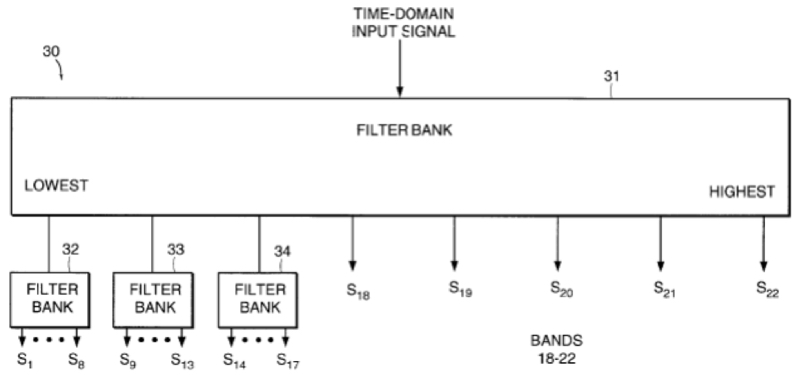
    The '281 patent describes a communication system for sending a sequence of symbols on a communication link, and the system includes a transmitter for placing information indicative of the sequence of symbols on the communication link and a receiver for receiving the information placed on the communication link by the transmitter.  An input data stream is received by a symbol generator that converts a run of data bits from the input stream into M symbols S1, S2, . . . , SM for transmission.  The transmitter treats the symbols Sas if they were the amplitude of a signal in a narrow frequency band.  For efficient design, each sub-channel must be sufficiently narrow to allow the distortions in that sub-channel to be modeled by a single phase shift and attenuation.  This occurs through decomposition of a signal into frequency sub-bands by a tree structured filter as shown in Figure 2 of the '281 patent, which is reproduced below.  At the receiving end of transmission link, the transmission segment is recovered.

    Image
    Claims 5 and 18 are representative of the asserted claims in the '281 Patent, and are reproduced below:

    5.  A signal processing method comprising:
        splitting a signal into subbands using a plurality of filter banks connected to form a tree-structured array having a root node and greater than two leaf nodes, each node comprising one filter bank having greater than two filters, and at least one of the leaf nodes having a number of filters that differs from the numbers of filters in a second leaf node.

    18.  A signal processing method comprising:
        synthesizing a signal using a plurality of synthesis filter banks connected to form a tree-structured array having greater than two leaf nodes and a root nod, wherein each of the nodes comprises one synthesis filter bank having a number of filters that differs from the number of filters in a second leaf node.

    Put more simply, claim 5 focuses on the splitting of the audio signal for transmission, while claim 18 focuses on the synthesizing of the processed signal after reception.

    Patent Eligibility Under 35 U.S.C. § 101

    The Defendant asserted two patent-eligibility challenges to the '281 patent, each of which is summarized below.

    1.  Nuijten Analysis

    First, the Defendant argued that the '281 Patent is patent-ineligible under the holding in In re Nuijten, 500 F.3d 1346 (Fed. Cir. 2007).  In Nuijten, the Federal Circuit decided (prior to both Mayo and Alice), that transitory signals did not fall within one of the four categories of patentable subject matter and thus were patent ineligible.  In Nuijten, the Federal Circuit allowed processing claims, but clearly denied patent eligibility for claims that covered the signals themselves.

    Here, the Court found that claims 5 and 18 describe the process of splitting and synthesizing signals, rather than claiming the signals per se.  In fact, both claims begin with, "A signal processing method."  Since both claims are processing claims, neither claim covers a signal per se, and thus, a Nuijten analysis was deemed unnecessary.

    2.  Alice Analysis

    Next, the Defendant argued that the '281 Patent is patent-ineligible under the holding in Alice.  Under the two-step framework established in Alice, the court first asks "whether the claims at issue are directed to one of those patent-ineligible concepts," as opposed to "patent eligible applications of those concepts."  If so, the court then "consider[s] the elements of each claim both individually and 'as an ordered combination' to determine whether the additional elements 'transform the nature of the claim' into a patent-eligible application."

    The Defendant argued that the asserted claims are directed to the abstract idea of splitting and combining signals into a tree-structured array.  This characterization of the claims as being directed to "splitting and combining signals into a tree-structured array," appears correct, but whether such actions are indeed an "abstract idea" was argued at length.

    To support their allegations, the Defendant argued that the asserted claims are not directed to an improvement in computer technology and are instead an abstract idea implemented on a general purpose computer.

    The Court found that it was clear from the '281 Patent that the claims are directed to an improvement in the functioning of a computer.  The claimed invention purported to require less computational capability than the prior art, and further allowed the quality of the playback to be varied in response to the computational capability of the playback platform without the use of multiple copies of the compressed material, as described in the patent.

    The claimed invention aimed to solve this problem and allowed for quality playback without the aliasing, or distortion, effects of the prior art.  Ultimately, the claimed invention makes computers more efficient without sacrificing the quality of the sound, thus making the claims patent eligible.  This reasoning was supported throughout the patent description making the decision easy to support.

    The Court further found the patent at issue to be similar to that in a prior district court case (Audio MPEG, Inc. v. HP Inc., No. 2:15-cv-00073-HCM-RJK, 2016 U.S. Dist. LEXIS 181710, at *38 (E.D. Va. June 29, 2016), in which audio files were compressed and stored using much less space, and claims of that scope were found patent eligible.  For example, in Audio MPEG, the Defendant argued that the plaintiffs were trying to patent mathematical formulas, an abstract idea.  However, the court in Audio MPEG noted that the plaintiffs were not seeking to patent a mathematical formula or the general idea of receiving and outputting information, but rather, claims directed to encode and decode a wide-band signal in a manner that takes into account the hearing capabilities of the human ear to produce a realistic replica of the original signal with the minimal amount of data.  The court found this to be a patent-eligible concept and thus denied Defendant's motion at step one of Alice.

    Likewise, here, the Court found that the '281 Patent involves a similar process of compressing and decompressing an audio signal, taking into account the capabilities of the human ear and reducing the computational power needed.  The asserted claims were thus found to resemble those at issue in Enfish and Audio MPEG—claims directed to patent-eligible concepts.

    Thus, despite broad claims that recite only functional aspects, and no physical components or elements that perform the functions, the claims were found to be patent eligible because the patent disclosure clearly set forth how the claimed processes improved computer functionality as compared to prior art.  This enable the plaintiff to show that the claims were necessarily rooted in computer technology, solved a technical problem with a technical solution, and improved upon prior computer technology—all factors weighing in favor of patent eligibility.

    Order by Senior District Judge Ronald S.W. Lew

  • By Michael Borella

    Federal Circuit SealOne of the more substantive questions in the recent interpretation of what encompasses patentable subject matter under 35 U.S.C. § 101 is whether facts should play any role in the analysis.  The Supreme Court has not been perfectly clear on this issue, and the Federal Circuit appears to have taken both sides at various times.  In last week's denial of en banc review for two cases, the Federal Circuit answered with an emphatic "yes."  Thus, the question seems resolved.  For now.

    Background

    It all started with Alice Corp. v. CLS Bank Int'l.  There, the Supreme Court set forth a two-part test to determine whether claims are directed to patent-eligible subject matter under § 101.  One must first decide whether the claim at hand is directed to a judicially-excluded law of nature, a natural phenomenon, or an abstract idea.  If so, then one must further decide whether any element or combination of elements in the claim is sufficient to ensure that the claim amounts to significantly more than the judicial exclusion.  But generic computer implementation of an otherwise abstract process does not qualify as "significantly more," nor will elements that are well-understood, routine, and conventional lift the claim over the § 101 hurdle.

    While the Supreme Court did not specify whether the well-understood, routine, and conventional determination was to be carried out as a matter of law, fact, or a hybrid of both, its earlier Mayo Collaborative Srvs. v. Prometheus Labs, Inc. decision strongly suggested that the § 101 inquiry may overlap with fact-sensitive inquiries such as novelty under § 102 in at least some situations.  However, the Federal circuit has stated, in OIP Techs., Inc. v. Amazon.com, Inc., that "[p]atent eligibility under 35 U.S.C. § 101 is an issue of law reviewed de novo."  But in other cases, different panels have implied that facts may be considered.

    In February, the Federal Circuit published two decisions attempting to flesh out the role of facts in the § 101 analysis.  In Berkheimer vs. HP Inc., the Court stated:

    The question of whether a claim element or combination of elements is well-understood, routine and conventional to a skilled artisan in the relevant field is a question of fact.  Any fact . . . that is pertinent to the invalidity conclusion must be proven by clear and convincing evidence.  Like indefiniteness, enablement, or obviousness, whether a claim recites patent eligible subject matter is a question of law which may contain underlying facts [emphasis added].

    The outcome of the Court's factual analysis was that some of Berkheimer's dependent claims recite "limitations directed to the arguably unconventional inventive concept described in the specification" and therefore the case was remanded to the District Court for fact finding.

    Quickly following Berkheimer was Aatrix Software Inc. v. Green Shades Software, Inc., where the Court further explained that it has held that patent eligibility can be determined on the pleadings, but that "[t]his is true only when there are no factual allegations that, taken as true, prevent resolving the eligibility question as a matter of law."  On the other hand, "[i]f there are claim construction disputes . . . either the court must proceed by adopting the non-moving party's constructions . . . or the court must resolve the disputes to whatever extent is needed to conduct the § 101 analysis, which may well be less than a full, formal claim construction."  Particularly, the patentee's pleadings contained specific allegations regarding the technical improvements of, and problems solved by, the claimed invention.  This was enough to also remand the case back to District Court.

    The parties that came up on the short end of both of these decisions requested en banc review.  The Federal Circuit published two identical opinions denying both petitions.  As we have come to expect from § 101 decisions in the Federal Circuit, these cases are not without controversy.  While seven of twelve judges of the en banc Court agreed with the denials (providing two different concurrences), one judge dissented.

    Judge Moore's Concurrence

    The first concurrence was authored by Judge Moore (who also wrote the Berkheimer and Aatrix opinions).  She was joined by judges Dyk, O'Malley, Taranto, and Stoll.

    Judge Moore begins with a bang, stating that "Berkheimer and Aatrix stand for the unremarkable proposition that whether a claim element or combination of elements would have been well-understood, routine, and conventional to a skilled artisan in the relevant field at a particular point in time is a question of fact."  After noting that the Supreme Court did leave the door open to this conclusion in Mayo, her argument is largely procedural.  She states that § 282(a) places the evidentiary burden of invalidating a claim on the challenger, and that the Federal Rules of Civil Procedure require that where there is a genuine dispute of material fact on summary judgment, the motion is to be denied.  Similarly, a Rule 12(b)(6) motion must be denied when viewed "in the light most favorable to the plaintiff and with every doubt resolved in the pleader's favor—but disregarding mere conclusory statements—the complaint states any legally cognizable claim for relief."

    She digs deeper by observing that "[i]n a situation where the specification admits the additional claim elements are well-understood, routine, and conventional, it will be difficult, if not impossible, for a patentee to show a genuine dispute."  But extrinsic sources, such as a pleadings or expert testimony, could raise such a genuine dispute (so long as the points being made are not conclusory or otherwise disqualifying).

    Judge Moore also makes it clear that the existence of such a factual dispute does not resolve the patent eligibility of the claims, but does require a factual inquiry:

    We cannot adopt a result-oriented approach to end patent litigation at the Rule 12(b)(6) stage that would fail to accept as true the complaint's factual allegations and construe them in the light most favorable to the plaintiff, as settled law requires.  The conclusion that the patent claims in Aatrix survived the motion to dismiss is not a holding that they are eligible.  And the mere fact that there were sufficient allegations in the pleading to state a claim for patent infringement does not mean that the case need go to trial.

    Instead, a determination of invalidity on the pleadings can be proper when there is no genuine factual dispute or when such a dispute has been resolved in the favor of the challenger.  Thus, according to Judge Moore, Berkheimer and Aatrix are consistent with Federal Circuit precedent that has "properly permitted pretrial resolution of many eligibility disputes."

    Judge Lourie's Concurrence

    The next concurrence was written by Judge Lourie and joined by Judge Newman.  In it, he appears to send up a red flag regarding § 101 jurisprudence in general, stating that "I believe the law needs clarification by higher authority, perhaps by Congress, to work its way out of what so many in the innovation field consider are § 101 problems."

    He suggests that the simple § 101 inquiry set forth in the statute has become too complicated:  "We now are interpreting what began, when it rarely arose, as a simple § 101 analysis, as a complicated multiple-step consideration of inventiveness ("something more"), with the result that an increasing amount of inventive research is no longer subject to patent."  But Judge Lourie's proposed solution is to combine both steps of Alice into one:

    But why should there be a step two in an abstract idea analysis at all?  If a method is entirely abstract, is it no less abstract because it contains an inventive step?  And, if a claim recites "something more," an "inventive" physical or technological step, it is not an abstract idea, and can be examined under established patentability provisions such as §§ 102 and 103.  Step two's prohibition on identifying the something more from "computer functions that are 'well-understood, routine, conventional activities' previously known to the industry," is essentially a §§ 102 and 103 inquiry.  Section 101 does not need a two-step analysis to determine whether an idea is abstract.

    Consequently, Judge Lourie calls for the higher authority to sort things out.  He sums up by stating that "[e]ven if [the denial of en banc review] was decided wrongly, which I doubt, it would not work us out of the current § 101 dilemma . . . [i]n fact, it digs the hole deeper by further complicating the § 101 analysis."

    Judge Reyna's Dissent

    As the sole dissenting voice, Judge Reyna employs a multi-prong attack on the reasoning set forth in the concurrences.  His initial point is that, in his view, "there is no precedent that the § 101 inquiry is a question of fact."  Furthermore, he believes that, under Berkheimer and Aatrix, eligibility is predominately a factual issue rather than an analysis that may consider some types of facts in certain situations.  According to Judge Reyna, "Step two is thus divorced from the claims."

    He also criticizes the Court for offering no "meaningful guidance to the bar, the government, or the public on how to proceed on these new grounds," contending that "we have no established parameters or guidance for what evidence we can and should consider for inventive concept purposes."  His parade of horribles includes a number of purportedly unanswered questions:

    Does this new factual inquiry extend to other aspects of the § 101 inquiry, such as whether a claim is directed to an abstract idea or a natural phenomenon?  Can expert opinion supplant the written description?  Does the court or jury determine this factual issue?  What deference is due to the fact finder?

    Like Judge Moore, Judge Reyna also discusses the role of extrinsic evidence in the factual inquiry.  But he finds that "Aatrix removes the inventive concept inquiry from the claims and the specification, and instead places it firmly in the realm of extrinsic evidence . . . [which] is a change in our law, and is counter to guidance from the Supreme Court and our own precedent."  Particularly, Judge Reyna is concerned that, given these decisions, there is no reason why the factual inquiry cannot be applied to step one of Alice as well.

    But to support his concerns, he relies on statements from Diamond vs. Diehr regarding the complete separateness of the § 101 inquiry from those of § 102 and § 103.  This point ignores Mayo's explicit statement that overlap may exist, Alice's reinforcement thereof, and the indisputable reality that, in practice, whether a claim element is well-understood, routine, and conventional is a factual analysis.

    Judge Reyna goes on to make an analogy between a patent and contract.  Each should be evaluated as a matter of law and the analysis should be limited to the four corners of the document, with factual matters rarely needing consideration.  He also makes a further analogy to claim construction:  "When construing patent claims, the court may rely on factual findings in some instances, but predominately construes the terms according to the claims and specification, i.e., a purely legal determination."

    Conclusion

    Regardless of one's position regarding the now-final outcomes of Berkheimer and Aatrix in the Federal Circuit, it is undeniable these cases are the most significant to be decided with regard to § 101 since Alice.  While it remains to be seen how broadly they are applied, they have added a new twist to the eligibility analysis.

    The next question, though, is whether either or both will be taken up by the Supreme Court (assuming that one of the parties requests certiorari, which is likely).  On one hand, Berkheimer and Aatrix involve interactions between patentability and federal procedure that may pique the Supreme Court's interest, and may also afford it an opportunity to clarify (or further muddy) what it meant in Mayo and Alice.  On the other hand, the Supreme Court may observe that the Federal Circuit is largely in agreement on the issue, and therefore may allow the lower court to scope out what can be well-understood, routine, and conventional for a while longer.


    Berkheimer vs. HP Inc.
    (Fed.Cir. 2018)

    Per curiam
    Circuit Judge Moore concurring in the denial of the petition for rehearing en banc, joined by Circuit Judges Dyk, O'Malley, Taranto, and Stoll;
    Circuit Judge Lourie concurring in the denial of the petition for rehearing en banc, joined by Circuit Judge Newman;
    Circuit Judge Reyna dissenting from the denial of the petition for rehearing en banc.

    Aatrix Software Inc. v. Green Shades Software, Inc. (Fed. Cir. 2018)
    Per curiam
    Circuit Judge Moore concurring in the denial of the petition for rehearing en banc, joined by Circuit Judges Dyk, O'Malley, Taranto, and Stoll;
    Circuit Judge Lourie concurring in the denial of the petition for rehearing en banc, joined by Circuit Judge Newman;
    Circuit Judge Reyna dissenting from the denial of the petition for rehearing en banc.

  • CalendarJune 4-7, 2018 – BIO International Convention (Biotechnology Innovation Organization) – Boston, MA

    June 5, 2018 – "Functional Claiming for Software Patents: Leveraging Recent Court Treatment — Surviving 112(f) and Disclosing Functional Basis for Software to Meet Heightened Standard of Review" (Strafford) – 1:00 to 2:30 pm (EDT)

    June 7, 2018 – "Views on Patent Cases from the Chambers — PTAB, VA, and MD" (Federal Circuit Bar Association, Virginia Bar Association IP Department, Maryland State Bar Association IP Department, and Bar Association of the District of Colombia IP Department) – Eastern District of Virginia courthouse, Alexandria, VA

    June 13-15, 2018 – Patent Fundamentals Bootcamp 2018: An Introduction to Patent Drafting, Prosecution, and Litigation (Practising Law Institute) – New York, NY

    June 14, 2018 – "Secondary Considerations at the PTAB: Combating Obviousness Challenges, Establishing Nexus" (Strafford) – 1:00 to 2:30 pm (EDT)

    June 19, 2018 – "Protecting Software as a Medical Device: Patents, Design Patents and Trade Secrets" (Strafford) – 1:00 to 2:30 pm (EDT)

    June 25-27, 2018 – Summit on Biosimilars (American Conference Institute) – New York, NY

    July 18-20, 2018 – Patent Fundamentals Bootcamp 2018: An Introduction to Patent Drafting, Prosecution, and Litigation (Practising Law Institute) – San Francisco, CA

    September 21, 2018 – "USPTO Post-Grant Patent Trials 2018: Change & Recalibration" (Practising Law Institute) – New York & Groupcasts in Philadelphia, Indianapolis, New Brunswick, NJ, Pittsburgh, and Mechanicsburg, PA

  • When the PTAB Attacks!

    By Andrew Williams

    Federal Circuit SealIn the past few years, the public's perception of the patent system in the United States has been at a low point.  One of the causes of this lack of confidence in the system has been the increase in abusive patent litigation from entities that have been labelled as "patent trolls."  This problem has been magnified (and likely blown out of proportion) by the mainstream media that has been reporting on (and exaggerating) the evils of the current patent system.  The patent system's alleged failings appeared to reach the public consciousness with the two episodes of the NPR show "This American Life" entitled "When Patents Attack!" and "When Patents Attack . . . Part Two!"  As we reported at the time, these episodes concluded by focusing on a single case and extrapolated all of its "perceived problems to be indicative of the entire patent system, leaving the uninitiated to probably question why we even have a patent system in the first place."  This was followed by even more one-sided "reporting" from the NPR "Planet Money" podcast (see "When NPR Podcasters Hit the Patent System") and John Oliver's HBO commentary/comedy show "Last Week Tonight."  A response from defenders of the patent system (outside of the blogosphere) has been slow in coming.  But a couple of new videos released by, of all places, the Federalist Society does just that by highlighting the plight of Josh Malone and his struggles defending his invention "Bunch O Balloons" (see here and here).  Mr. Malone's company Tinnus Enterprises has been embroiled in multiple district court litigations and post-grant review proceedings before the PTAB.  The latest chapter of that saga occurred on May 30, 2018, when the Federal Circuit reversed and remanded the Board's final written decision in PGR2015-00018.

    For those readers unfamiliar with "Bunch O Balloons," (and who have not yet watched the above-referenced videos), they can be seen in the following figure next to an accused infringing device (taken from a prior Federal Circuit opinion on the subject patents):

    Figure 1These devices can fill multiple water balloons (or as they are known in the art "fluid-filled inflatable containers") in less time than it normally takes to fill and tie a single water balloon.  Figure 1 from U.S. Patent 9,051,066 provides a more detailed explanation of the device:

    Figure 2These devices have been very popular, from the initial Kickstarter campaign to the alleged copying of the accused infringing devices.

    The history of the PTAB proceedings and the concurrent district court litigation is extensive.  In short, on the day the '066 patent issued, June 9, 2015, Tinnus filed suit against Telebrands and moved for a preliminary injunction.  Telebrands filed its first PGR against a Tinnus patent (and the PGR that is the subject of this appeal) on June 22, 2015.  On September 11, 2015, after the Board instituted the PGR, the Eastern District of Texas granted the injunction after determining that Telebrands had "not raised a substantial question concerning the validity of the '066 [p]atent based on the claim term 'substantially filled' being indefinite."  That decision was affirmed by the Federal Circuit in a prior opinion on January 24, 2017.  The month prior, the PTAB issued its final written decision finding the same claim term to be indefinite, thereby rendering all challenged claims to be unpatentable.  Tinnus appealed both this determination and the Board's decision granting institution.

    What the Patent Office Gives, the Patent Office Takes Away

    This case highlights the frustration experienced by patent owners when their patents are challenged at the Patent Office in post-issuance proceedings.  In essence, the same institution that granted the intellectual property right turns around and takes it away, often after substantial investment has been made in reliance on that grant.  In this case, issued claim 1 read (with the relevant section highlighted):

    1.  An apparatus comprising:
        a housing comprising an opening at a first end, and a plurality of holes extending through a common face of the housing at a second end;
        a plurality of flexible hollow tubes, each hollow tube attached to the housing at a respective one of the holes at the second end of the housing;
        a plurality of containers, each container removably attached to a respective one of the hollow tubes; and
        a plurality of elastic fasteners, each elastic fastener clamping a respective one of the plurality of containers to a corresponding hollow tube, and each elastic fastener configured to provide a connecting force that is not less than a weight of one of the containers when substantially filled with water, and to automatically seal its respective one of the plurality of containers upon detaching the container from its corresponding hollow tube, such that shaking the hollow tubes in a state in which the containers are substantially filled with water overcomes the connecting force and causes the containers to detach from the hollow tubes thereby causing the elastic fasteners to automatically seal the containers, wherein the apparatus is configured to fill the containers substantially simultaneously with a fluid.

    The claim term "substantially filled" was not defined in the specification, nor were the two words used in conjunction at any point in the disclosure.  Instead, the term was added by the Examiner in an Examiner's Amendment that was included in the Notice of Allowability.  And the focus of the Amendment was not on the "substantially filled" limitation, but rather was included in a description of the configuration and functional capability of the elastic fasteners, that was described by the Examiner as necessary to distinguish the prior art.  As the Federal Circuit put it, it "presume[d] that an examiner would not introduce an indefinite term into a claim when he/she choose to amend the claim for the very purpose of putting the application in a condition for allowance."

    Correspondingly, the Federal Circuit found that the patent was "not indefinite under the Nautilus standard because the claims, viewed in light of the specification and prosecution history, inform a person of ordinary skill about the scope of the invention with reasonable certainty."  In addition, the Court found that "the claims, in the context of the specification, 'notify the public of what is within the protections of the patent, and what is not,'" thereby also satisfying the standard articulated in In re Packard.  This conclusion was perhaps not surprising in view of the prior Federal Circuit decision in which the Court found "it difficult to believe that a [person of ordinary skill in the art, defined as] a person with an associate's degree in a science or engineering discipline[,] who has read the specification and relevant prosecution history would be unable to determine with reasonable certainty when a water balloon is 'substantially filled.'"  As a result, the Court reversed and remanded for the Board to consider the obviousness allegations.

    There were other interesting legal and procedural issues considered by the Court that were ultimately deferred to the future.  And did we mention that this was one of the first (if not the first) PGR appeals considered by the Federal Circuit.  Nevertheless, this case stands as a prime example of why patent owners are frustrated with the current system, and why the attack on the patent system has perhaps gone too far.

    Tinnus Enterprises, LLC v. Telebrands Corp. (Fed. Cir. 2018)
    Nonprecedential disposition
    Panel: Circuit Judges O'Malley, Wallach, and Hughes
    Opinion by Circuit Judge O'Malley