• CalendarJuly 17, 2018 – "Drafting and Defending Software Patents to Survive Section 101 and AIA Challenges — Anticipating and Minimizing the Risk of 101, 103 Rejections, Recent Court Guidance" (Strafford) – 1:00 to 2:30 pm (EDT)

    July 17, 2018 – Technology Center (TC) 2600 Customer Partnership Meeting (Rocky Mountain Regional Office, U.S. Patent and Trademark Office) – 8:15 am to 3:00 pm (MT), Denver, CO

    July 17, 2018 – "Biotech/pharma subject-matter — Patentability at the EPO and how to avoid pitfalls for US based applicants" (Oppedahl Patent Law Firm LLC) – 7:30 to 9:30 am (MT)

    July 17, 2018 – "The 2018 Bayh Dole Revisions: Practical Compliance Guidance for Technology Transfer Offices" (Technology Transfer Tactics) – 1:00 to 2:00 pm (ET)

    July 17-18, 2018 – Post-Grant PTO Proceedings Conference (American Conference Institute) – Washington, D.C.

    July 18-20, 2018 – Patent Fundamentals Bootcamp 2018: An Introduction to Patent Drafting, Prosecution, and Litigation (Practising Law Institute) – San Francisco, CA

    July 19, 2018 – "Labeling and Induced Infringement in Pharma Patent Litigation and Protecting IP Rights" (Strafford) – 1:00 to 2:30 pm (EDT)

    July 19, 2018 – "An Update on the On-Sale Bar: Helsinn at the Supreme Court" (Intellectual Property Owners Association) – 2:00 to 3:00 pm (ET)

    July 24, 2018 – "Proving and Avoiding Inequitable Conduct and Unclean Hands in Patent Prosecution and Litigation" (Strafford) – 1:00 to 2:30 pm (EDT)

    July 24, 2018 – "WesternGeco and Lost Profits: Fair Compensation for Domestic Infringement or Extraterritorial Extension of Patent Rights?" (Practising Law Institute) – 1:00 – 2:00 pm (Eastern)

    July 25, 2018 – "Protecting and Licensing University Patents in a Post-Oil States and SAS World" (Technology Transfer Tactics) – 1:00 to 2:00 pm (ET)

    July 25-27, 2018 – Women Leaders in Life Sciences Law conference (American Conference Institute) – Boston, MA

    August 16-17, 2018 – "Advanced Patent Prosecution Workshop 2018: Claim Drafting & Amendment Writing" (Practising Law Institute) – San Francisco, CA

    September 21, 2018 – "USPTO Post-Grant Patent Trials 2018: Change & Recalibration" (Practising Law Institute) – New York & Groupcasts in Philadelphia, Indianapolis, New Brunswick, NJ, Pittsburgh, and Mechanicsburg, PA

    September 27-28, 2018 – "Advanced Patent Prosecution Workshop 2018: Claim Drafting & Amendment Writing" (Practising Law Institute) – Chicago, IL

  • IPO #2The Intellectual Property Owners Association (IPO) will offer a one-hour webinar entitled "An Update on the On-Sale Bar: Helsinn at the Supreme Court" on July 19, 2018 from 2:00 to 3:00 pm (ET).  John Duffy of the University of Virginia, Jennifer Johnson of DuPont, and Christopher Loh of Fitzpatrick, Cella, Harper & Scinto will review the current status quo after two significant Federal Circuit decisions in recent years on the on-sale and public use bars, Merck & CIE v. Watson Labs and The Medicines Co. v. Hospira.  The panel will also consider what questions may remain unanswered after Helsinn v. Teva, such as (1) does a fully-secret sales offer count to bar a patent under section 102? And (2) even if it serves as a bar to patentability under section 102, to what extent does a secret sale count as "prior art" for obviousness purposes?  The panel will also consider the Supreme Court's options in this case.

    The registration fee for the webinar is $135 (government and academic rates are available upon request).  Those interested in registering for the webinar can do so here.

  • Strafford #1Strafford will be offering a webinar entitled "Proving and Avoiding Inequitable Conduct and Unclean Hands in Patent Prosecution and Litigation" on July 24, 2018 from 1:00 to 2:30 pm (EDT).  Paul W. Browning, Thomas L. Irving, and Amanda K. Murphy will guide patent counsel on understanding the types of activity that may lead to a finding of inequitable conduct or unclean hands, provide insights into practical tactics to avoid the risk of a court's ruling of inequitable conduct or unclean hands, and also examine arguments that have worked to avoid a finding of inequitable conduct or unclean hands and those that haven't.  The webinar will review the following issues:

    • What are the most common assertions defendants make when raising the inequitable conduct and unclean hands defenses?
    • What are best practices prosecutors and litigators should employ to avoid and/or defend against inequitable conduct or unclean hands allegations?
    • What guidance do post-Therasense decisions provide on how inequitable conduct will be treated?
    • What guidance do post-Therasense decisions provide on how unclean hands defenses will be treated?
    • How will Supplemental Examination effect both unclean hands and inequitiable conduct?

    The registration fee for the webcast is $297.  Those interested in registering for the webinar, can do so here.

  • Technology Transfer Tactics will be offering a webinar entitled "Protecting and Licensing University Patents in a Post-Oil States and SAS World" on July 25, 2018 from 1:00 to 2:00 pm (ET).  Tyson Benson and Doug Robinson of Harness, Dickey & Pierce, PLC and Cheryl Horst and Zane Gernhart of NUtech Ventures will address the following topics:

    • What the Oil States and SAS decisions mean
        – the end of partial institution
        – estoppel after PTAB decisions
        – impact on licensing
    • Changes to PTAB rules and procedures the PTO is implementing
        – 'usual and customary meaning' versus 'broadest reasonable interpretation'
        – implications for claim construction
    • Overall impact on IPRs, PGRs and covered business method reviews
    • Best practices to ensure patent protection and license-ability

    The registration fee for the webinar is $197.  Those interested in registering for the webinar, can do so here.

    Technology Transfer Tactics

  • PLI #1Practising Law Institute (PLI) will be offering a one-hour webcast on "WesternGeco and Lost Profits: Fair Compensation for Domestic Infringement or Extraterritorial Extension of Patent Rights?" on July 24, 2018 beginning at 1:00 pm (Eastern).  Douglas R. Nemec of Skadden, Arps, Slate, Meagher & Flom LLP will:

    • Provide a detailed analysis of the Supreme Court's decision in WesternGeco v. ION Geophysical;
    • Explore the potential ramifications of the WesternGeco decision for patent damages more generally; and
    • Examine how WesternGeco fits into the broader scheme of recent Supreme Court patent decisions, as practitioners seek signs of how the Court may handle upcoming patent cases.

    The registration fee for this webcast is $299.  Those interested in registering for the webcast, can do so here.

  • By Michael Borella —

    Background

    District Court for the Northern District of CaliforniaCellspin sued Fitbit and thirteen other defendants in the Northern District of California alleging infringement of U.S. Patent Nos. 8,738,794, 8,892,752, 9,749,847, and 9,258,698.  The defendants filed a motion to dismiss, alleging invalidity of the patents under 35 U.S.C. § 101.

    As an example of one of the asserted claims, claim 1 of the '794 patent recites:

    1.  A method for acquiring and transferring data from a Bluetooth enabled data capture device to one or more web services via a Bluetooth enabled mobile device, the method comprising:
        providing a software module on the Bluetooth enabled data capture device;
        providing a software module on the Bluetooth enabled mobile device;
        establishing a paired connection between the Bluetooth enabled data capture device and the Bluetooth enabled mobile device;
        acquiring new data in the Bluetooth enabled data capture device, wherein new data is data acquired after the paired connection is established;
        detecting and signaling the new data for transfer to the Bluetooth enabled mobile device, wherein detecting and signaling the new data for transfer comprises:
            determining the existence of new data for transfer, by the software module on the Bluetooth enabled data capture device; and
            sending a data signal to the Bluetooth enabled mobile device, corresponding to existence of new data, by the software module on the Bluetooth enabled data capture device automatically, over the established paired Bluetooth connection, wherein the software module on the Bluetooth enabled mobile device listens for the data signal sent from the Bluetooth enabled data capture device, wherein if permitted by the software module on the Bluetooth enabled data capture device, the data signal sent to the Bluetooth enabled mobile device comprises a data signal and one or more portions of the new data;
        transferring the new data from the Bluetooth enabled data capture device to the Bluetooth enabled mobile device automatically over the paired Bluetooth connection by the software module on the Bluetooth enabled data capture device;
        receiving, at the Bluetooth enabled mobile device, the new data from the Bluetooth enabled data capture device;
        applying, using the software module on the Bluetooth enabled mobile device, a user identifier to the new data for each destination web service, wherein each user identifier uniquely identifies a particular user of the web service;
        transferring the new data received by the Bluetooth enabled mobile device along with a user identifier to the one or more web services, using the software module on the Bluetooth enabled mobile device;
        receiving, at the one or more web services, the new data and user identifier from the Bluetooth enabled mobile device, wherein the one or more web services receive the transferred new data corresponding to a user identifier; and
        making available, at the one or more web services, the new data received from the Bluetooth enabled mobile device for public or private consumption over the internet, wherein one or more portions of the new data correspond to a particular user identifier.

    In summary, this claim relates to an application on a Bluetooth enabled mobile device assisting a Bluetooth enabled data capture device (e.g., a digital camera or wireless fitness tracker) to publish data received from the latter on one or more web sites.  According to the '794 patent, doing so overcomes difficulties associated with manual transfer of files from the capture device to the communication device, as well as uploading and publishing such files.

    In Alice Corp. v. CLS Bank Int'l, the Supreme Court set forth a two-part test to determine whether claims are directed to patent-eligible subject matter under § 101.  One must first decide whether the claim at hand is directed to a judicially-excluded law of nature, a natural phenomenon, or an abstract idea.  If so, then one must further decide whether any element or combination of elements in the claim is sufficient to ensure that the claim amounts to significantly more than the judicial exclusion.  But generic computer implementation of an otherwise abstract process does not qualify as "significantly more," nor will elements that are well-understood, routine, and conventional lift the claim over the § 101 hurdle.

    Patent Eligibility Dispute

    In briefings, the defendants argued that:

    Cellspin's claims were (i) directed to the abstract concept of acquiring data using a "data capture device," transferring data over a connection to a mobile device, and publishing the data to a website and (ii) recite only generic computer technology to carry out the abstract idea, technology which the specification describes as "pervasive [and] flexible," such as a "ubiquitous mobile phone," "fairly widespread" personal digital assistants, and "general purpose computers and computing devices."

    In its opposing brief, Cellspin countered that the claims were not abstract because they "described specific improvements comprising, acquiring, transferring, and publishing new-data on the Internet, including, a purported improvement in battery consumption, an elimination of the need for bulky hardware, and a purported improvement in the order or timing of the Bluetooth or wireless pairing."  Invoking Berkheimer v. HP, Cellspin also argued that "factual disputes exist regarding whether the claimed features are well-understood, routine, and conventional."  In addition, Cellspin filed an amended complaint "which contained the arguments regarding improvements that plaintiff had asserted in its opposition."

    The Court applied the Alice test.  In doing so, it rejected Cellpsin's part one argument because "plaintiff fails to identify these alleged specific improvements or otherwise explain how these improvements result in enhanced 'computer capabilities' rather than a process that qualifies as an abstract idea for which computers are invoked merely as a tool."  The Court was similarly unconvinced by Cellspin's part two position, writing "the asserted claims merely provide a generic environment in which to carry out the abstract ideas of acquiring, transferring, and publishing data, [and] fail to supply an inventive concept sufficient to transform the underlying abstract idea into patentable subject matter."  (In fairness, the reasoning behind the actual decision was far less conclusory than the Court summarized here.)

    Thus, the Court entered a judgment in favor of the defendants and invalidated the patents.

    Attorney's Fees

    Afterward, six of the defendants filed motions for attorney's fees on the grounds that Cellspin's litigation activities were exceptional under 35 U.S.C. § 285.

    Regarding this motion, the Court reviewed the standard for determining whether a case is exceptional enough to award attorney's fees to the prevailing party.  Particularly, such a case "stands out from others with respect to the substantive strength of a party's litigating position (considering both the governing law and the facts of the case) or the unreasonable manner in which the case was litigated."  The moving party must show exceptionality by a preponderance of evidence and the ultimate determination is in the discretion of the Court after taking into account the totality of circumstances.

    Here, the Court relied on the Federal Circuit's Inventor Holdings, LLC v. Bed Bath & Beyond, Inc. decision, which held that "a case presenting either subjective bad faith or exceptionally meritless claims may sufficiently set itself apart from mine-run cases to warrant a fee award."  The Court stated that "[a]s in Inventor Holdings, the claims at issue here are manifestly directed to an abstract idea and the only components disclosed in the specification for implementing the asserted method claims are unambiguously . . . conventional."

    The Court also stated that "Cellspin filed its complaint in the face of significant post-Alice precedent" and "chose to file more than a dozen lawsuits asserting four ineligible patents and, in so filing, ignored substantial precedent dismissing analogous data manipulation patent claims."

    Further, the Court took issue with Cellspin's "aggressive" litigation conduct, because it did not agree to stay discovery pending resolution of the § 101 motion, as well as filing its amended complaint only three days prior to the hearing on this motion.  While the Court admitted that this conduct "may not amount to bad faith litigation, it does contribute to the totality of the circumstances weighing in favor of a fee award."

    Moreover, the Court rejected Cellspin's asserted reliance on an issued patent's presumption of validity.  Particularly, the Court cited to Ultramercial, Inc. v. Hulu to support its position that even though "issued patents are presumed valid, they are not presumed eligible under Section 101."

    Finally, the Court reprimanded Cellspin because it did not "analyze its patents critically" and "chose to file and pursue aggressively fourteen lawsuits simultaneously."

    For these reasons, the Court awarded a total of $563,000 of attorney's fees to the defendants.

    Analysis

    Where to start . . . .  There are two distinct issues here, whether the claims are indeed ineligible under § 101, as well as whether that alone or in combination with other factors rise to the level of exceptionality under § 285.  But even if the Court's § 101 determination was correct, it's granting of attorney's fees is highly questionable.

    Given the extreme lack of clarity regarding how § 101 is to be applied, it seems unreasonable to contend that Cellspin could somehow determine ahead of time whether its claims would ultimately be invalidated.  For instance, very broad and vague claims in Thales Visionix Inc. v. U.S. and Finjan, Inc. v. Blue Coat Systems, Inc. were found to meet the requirements of § 101.  Nobody has access to a patent-eligibility crystal ball, including Cellpsin.

    Also, the Court appears to have misapplied Inventor Holdings.  In that case, attorney's fees were justified because the action was filed prior to Alice and the plaintiff did not reassess the strength of its position given that Alice was a significant shift in § 101.  Here, the suit was filed after Alice, but before Berkheimer and Aatrix Software, Inc. v. Green Shades Software, Inc.  If anything, these two cases are very pro-plaintiff with respect to § 101.  Therefore, Cellspin's case arguably strengthened as this proceeding continued.

    Additionally, to the extent that the Court relied on the concurrence in Ultramercial to conclude that patents are not presumed eligible, that is plain wrong.  35 U.S.C. § 282 clearly sets forth that patents are presumed valid, and no Supreme Court or Federal Circuit case (including Ultramercial) establishes binding precedent otherwise.  The fee award may be reversible on this basis alone.

    Speaking of which, Cellspin has appealed the § 101 determination to the Federal Circuit.  It would not be surprising if they add the § 285 issue to their appeal.  Stay tuned, as this one is far from over.

    Cellspin Soft, Inc. v. Fitbit, Inc. (N.D. Cal. 2018)
    Order Granting in Part Motion for Attorney's Fees by District Judge Yvonne Gonzalez Rogers

  • By Donald Zuhn —

    District Court for the Northern District of CaliforniaLast month, in Illumina, Inc. v. Natera, Inc., District Judge Susan Illston of the U.S. District Court for the Northern District of California denied a motion to dismiss filed by Defendant Natera, Inc., to dismiss a complaint filed by Plaintiff Illumina, Inc. against Natera.  Illumina initiated the dispute between the parties by filing a patent infringement action against Natera, asserting that Natera's sale of its Panorama™ Prenatal Screen, a non-invasive prenatal test for Down syndrome, infringed U.S. Patent No. 9,493,831.  In response to Illumina's complaint, Natera filed a motion to dismiss under Federal Rule of Civil Procedure 12(b)(6), arguing that the claims of the '831 patent are invalid under 35 U.S.C. § 101 as being directed to patent-ineligible subject matter and for being void of any inventive concept.

    The '831 patent, which is entitled "Methods for Fetal Abnormality Detection," is directed to methods for "selectively enriching non-random polynucleotide sequences," "generating libraries of sequences," and "detect[ing] fetal aneuploidy."  Representative claim 1 recites:

    1.  A method for preparing a sequencing library from a maternal blood sample, the method comprising:
        a.  obtaining a maternal blood sample comprising fetal and maternal cell-free DNA;
        b.  selectively enriching a plurality of non-random polynucleotide sequences of genomic DNA from said fetal and maternal cell-free DNA to generate a library of enriched non-random polynucleotide sequences, wherein said plurality of non-random polynucleotide sequences comprises at least 100 different nonrandom polynucleotide sequences selected from a chromosome tested for being aneuploid, said enriching comprising:
            (i)  a first amplification step to generate a plurality of first reaction products, said amplification comprising at least 100 first primers configured to amplify at least 100 different non-random polynucleotide sequences;
            (ii)  a second amplification step to generate a second reaction product, said amplification comprising a second set of primers comprising sequences contained in the first reaction products; and
            (iii)  a third amplification step to generate a third reaction product comprising said library of enriched non-random polynucleotide sequences, said amplification comprising a third set of primers comprising sequences contained in the second reaction products;
            wherein at least one primer of at least one of the second and third sets of primers includes a sequence configured to be added to the different non-random polynucleotide sequences to permit the enriched non-random polynucleotide sequences of the library to anneal to a same sequencing primer for the enriched non-random polynucleotide sequences of the library.

    In considering Natera's motion to dismiss, the District Court began by noting that the Supreme Court set forth a two-step analytic framework for distinguishing patents that claim laws of nature, natural phenomena, and abstract ideas from those that claim patent-eligible applications of those concepts.  The District Court then cited to the Federal Circuit's decision in Ariosa Diagnostics, Inc. v. Sequenom, Inc. for an articulation of this two-step analysis:

    The first step looks to determine whether claims are directed to a patent-ineligible concept.  If they are, the second step is to consider whether the additional elements recited in the claim transform the nature of the claim into a patent-eligible application by reciting an inventive concept that is sufficient to ensure that the patent in practice amounts to significantly more than a patent upon the [ineligible concept] itself.

    88 F.3d 1371, 1380 (Fed. Cir. 2015) (internal quotations and citations omitted).

    With respect to the first step of the patent eligibility analysis, Natera argued that the '831 patent is directed to a patent-ineligible concept because it is concerned primarily with obtaining a library that contains non-altered DNA sequences that are naturally occurring, and further, that the addition of sequence tags or indexing sequences does not confer patent eligibility because they do not otherwise alter the naturally occurring genetic information contained in the DNA sequences of interest.  Illumina countered that the '831 patent is directed to a method of preparing a synthetic nucleic acid library comprised of non-naturally occurring nucleic acid molecules, wherein the resulting nucleic acid molecules include the same sequencing primer (claim 1) and/or an index sequence (claims 2, 3, and 14).

    Looking to the Federal Circuit's decision in Ariosa Diagnostics, Inc. v. Sequenom, Inc., the District Court concluded that:

    The claims of the '831 patent similarly use cffDNA, beginning with samples of naturally occurring "fetal and maternal cell-free DNA."  '831 Patent col. 63 l. 41-42.  The '831 patent is also directed towards amplifying specific sequences of the cell-free DNA and detecting fetal aneuploidies.  See '831 Patent at [57].  Like the claims in Ariosa that were directed to the detection of naturally occurring cffDNA, the claims of the '831 patent only enable aneuploidy detection if the non-random sequences retain their natural arrangement.  Consequently, the method claims of the '831 patent also "end[] with a natural phenomenon."  See Ariosa, 788 F.3d at 1376.

    The District Court therefore determined that the '831 patent is directed to patent-ineligible subject matter.

    With respect to the second step of the patent eligibility analysis, Natera argued that the '831 patent does not contain an inventive concept because the selective enrichment of DNA in the patent involves well-known, routine, and conventional amplification techniques.  Illumina responded by arguing that the '831 patent improves upon prior art techniques by addressing a need for selective enrichment of DNA sequencing for aneuploidy analysis to avoid producing non-target amplification products.

    In denying Natera's motion, however, Judge Illston determined that "at this stage in litigation the factual record is not sufficient for the Court to conclude whether there is an inventive concept."  In particular, the District Court noted that it "cannot determine whether the amplification of 'at least 100 different non-random polynucleotide sequences' and the performance of 'successive rounds of amplification using primers that are directed to sequences within the products of prior amplification reactions' are routine or conventional" (emphasis in order).  In addition, the District Court noted that it "cannot determine whether the claimed selective enrichment leads to a technological improvement."

    Illumina, Inc. v. Natera, Inc. (N.D. Cal. 2018)
    Order Denying Motion to Dismiss by District Judge Illston

  • By Kevin E. Noonan –
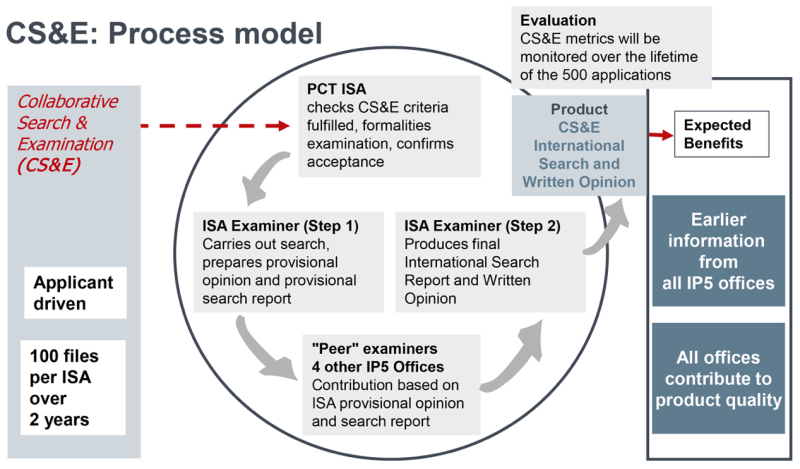
    The World Intellectual Property Organization (WIPO) launched a pilot program on July 1st termed Collaborative Search and Examination (CS&E) that will enable an applicant to have searching performed by all five of the major global patent offices (the USPTO, European Patent Office (EPO), Chinese Patent Office (SIPO), Japan Patent Office (JPO), and Korean Intellectual Property Office (KIPO)).

    According to WIPO, the program has the following features:  it is "applicant driven," insofar as applicants must request searching under the pilot program.  It envisions a "balanced workload distribution," wherein each office will perform a search as a "main ISA" for 100 applications and perform "peer ISA" searches for another 400 applications for the two years of the pilot program.  Finally, each ISA will use a "common set of quality and operational standards" in performing the searches.  Initially, all applications accepted into the pilot program must be filed in the English language (although WIPO anticipates that it may accept applications in other languages later in the program).

    The program is depicted schematically on the WIPO website as follows:

    CS&E
    The request for participation in the pilot program should be included with the application as filed, using this form.  Anticipating future acceptance of applications in other languages, WIPO has made available versions of this form in the Chinese, French, and German languages.

  • By Donald Zuhn —

    USPTO SealIn a memorandum distributed to the patent examining corps last month by Robert W. Bahr, Deputy Commissioner for Patent Examination Policy at the U.S. Patent and Trademark Office, the Office addresses a recent decision by the Federal Circuit in Vanda Pharmaceuticals Inc. v. West-Ward Pharmaceuticals.  The memorandum notes that claims at issue in Vanda "recite a method of treating a patient having schizophrenia with iloperidone, a drug known to cause QTc prolongation (a disruption of the heart's normal rhythm that can lead to serious health problems) in patients having a particular genotype associated with poor drug metabolism," and sets forth the following representative claim:

    A method for treating a patient with iloperidone, wherein the patient is suffering from schizophrenia, the method comprising the steps of:
        determining whether the patient is a CYP2D6 poor metabolizer by:
            obtaining or having obtained a biological sample from the patient; and
            performing or having performed a genotyping assay on the biological sample to determine if the patient has a CYP2D6 poor metabolizer genotype; and
        if the patient has a CYP2D6 poor metabolizer genotype, then internally administering iloperidone to the patient in an amount of 12 mg/day or less, and
        if the patient does not have a CYP2D6 poor metabolizer genotype, then internally administering iloperidone to the patient in an amount that is greater than 12 mg/day, up to 24 mg/day,
        wherein a risk of QTc prolongation for a patient having a CYP2D6 poor metabolizer genotype is lower following the internal administration of 12 mg/day or less than it would be if the iloperidone were administered in an amount of greater than 12 mg/day, up to 24 mg/day [emphasis in memorandum].

    The memorandum explains that in Vanda, the Federal Circuit determined that the claims at issue are "patent eligible under 35 U.S.C. § 101 because they are not 'directed to' a judicial exception" (emphasis in memorandum).

    According to the memorandum, "[t]he Federal Circuit's decision in Vanda illustrates several important points regarding the subject matter eligibility analysis."  The memorandum sets forth three such points:

    • "[T]he Federal Circuit evaluated the claims as a whole, including the arguably conventional genotyping and treatment steps, when determining that the claim was not 'directed to' the recited natural relationship between the patient's genotype and the risk of QTc prolongation."

    • "[T]he Federal Circuit cited the Supreme Court '[t]o further underscore the distinction between method of treatment claims and those in Mayo.' . . . Method of treatment claims (which apply natural relationships as opposed to being 'directed to' them) were identified by the Supreme Court as not being implicated by its decisions in Mayo and Myriad because they 'confine their reach to particular applications'" (emphasis in memorandum).

    • "[T]he Federal Circuit did not consider whether or not the treatment steps were routine or conventional when making its 'directed to' determination" (emphasis in memorandum).

    The memorandum concludes by stating that:

    The USPTO's current subject matter eligibility guidance and training examples are consistent with the Federal Circuit's decision in Vanda, with the understanding that: (1) "method of treatment" claims that practically apply natural relationships should be considered patent eligible under Step 2A of the USPTO's subject matter eligibility guidance; and (2) it is not necessary for "method of treatment" claims that practically apply natural relationships to include nonroutine or unconventional steps to be considered patent eligible under 35 U.S .C. § 101.  For example, claims 5 and 6 of USPTO Example 29 (Diagnosing and Treating Julitis) should be considered patent eligible under Step 2A of the USPTO's subject matter eligibility guidance in light of the Federal Circuit decision in Vanda.

  • By Kevin E. Noonan –

    House of Representatives SealIn the 1970's, the New York Tristate area was entertained by (or subjected to) television and radio ads for a discount stereo outlet named Crazy Eddie's.  Under the tag line "Our Prices are Insane," the ads involved a number of outrageous scenarios, one of which was "Christmas in July" (or August), complete with Santa Claus in shorts hawking electronic wares.

    Representatives Thomas Massie (R-KY, 4th dist.) and Marcy Kaptur (D-OH, 9th dist.) introduced a bill recently that is reminiscent of Christmas in July, at least for pro-patent people.  The bill, H.R. 6264, entitled "Restoring America's Leadership in Innovation Act," seeks to undo many of the changes in U.S. patent law produced by the Leahy-Smith America Invents Act of 2012.  While Rep. Kaptur's interests (and bona fides) in patent law are unclear, Rep. Massie's are not.  He holds a degree in electrical engineering from MIT and has been awarded two dozen patents.  He has also been quoted extensively on patent law; for example, speaking of the proponents of patent "reform," on July 5, 2017:

    A lot of those companies want to become automobile manufacturers, or cell phone manufacturers, or they want to write software for operating systems, but they didn't invent in those areas and they don't own the patents that have historically been the touchstone of innovation ownership.  "They'd love to just come in and start playing in those fields and start using their size and scale as an advantage, and to them, patents look like a hindrance," Massie explained.  "They are here in Congress looking to weaken patents and they are not just interested in weakening patents issued in the future, they are looking to weaken all patents."

    "Reform is not about strengthening the patent granting system, but about making it harder for patent owners to assert patents to protect their rights," Massie said emphatically.  "They didn't read the Constitution and come to say they have a better way more in line with what the Founding Fathers had in mind.  They just want all the patents to be public domain today.  It is very short sighted to attack the patent system in this way."

    The bill has as its avowed purpose "[t]o promote the leadership of the United States in global innovation by establishing a robust patent system that restores and protects the right of inventors to own and enforce private property rights in inventions and discoveries, and for other purposes."  It asserts that "[t]he Leahy-Smith America Invents Act (Public Law 112–29) enacted on September 16, 2011, and several decisions of the Supreme Court have harmed the progress of Science and the useful Arts by eroding the strength and value of the patent system" (Sec. 2(2)) and that "[a] United States patent secures a private property right to an inventor" (Sec. 2(4)).

    The substantive provisions are as follows:

    Sec. 3, entitled "Repeal of First-to-File System under the America Invents Act," restores U.S. patent law to a "first to invent" regime (Sec. 3(b)), and restores the meaning of "public use" and "on sale in this country" to their pre-AIA definitions (Sec. 3(c)).

    Sec. 4 abolishes inter partes (IPR) and post grant review (PGR), and provides a "sense of Congress" that (1) IPR and PGR have harmed innovation by subjecting inventors to serial patent challenges; (2) that these procedures have invalidated patents at "an unreasonably high rate"; (3) that patents should not be subjected to "unfair" PTAB proceedings but should be adjudicated in court; (4) IPR, PGR, and inter partes reexamination to be repealed but (5) ex parte reexamination will remain (Sec. 4(c)).

    Sec. 5 abolishes the Patent Trial and Appeal Board (PTAB) as being unnecessary in view of elimination of IPRs and PGRs.  It reestablishes the Board of Patent Appeals and Interferences (BPAI) in its stead (Sec. 5(a)) and the BPAI's duties (Sec. 5(b)) and also reestablishes appeals to district court (Sec. 5(c)).

    Sec. 6 eliminates fee diversion from the USPTO and establishes an "Innovation Promotion Fund" (Sec. 6(a)(5)), to be funded by any fees collected by the patent and trademark activities of the Office to be used to fund the operations of the Office.  These provisions are to come into force on the first day of the first fiscal year after enactment; the bill also provides for termination of the Reserve Fund (Sec. 6(b)) "[u]pon the payment of all obligated amounts."

    Sec. 7(a) relates to changes intended to overcome the effects of the Supreme Court's recent § 101 jurisprudence.  This section derives from the proposals made by the IPO and AIPLA and reads as follows:

    AMENDMENT.—Section 101 of title 35, United States Code, is amended to read as follows:

    § 101. Inventions patentable

    (a) IN GENERAL.—Whoever invents or discovers any new and useful process, machine, manufacture, or composition of matter, or any new and useful improvement thereof, may obtain a patent therefor, subject to the conditions and requirements of this title.

    (b) EXCEPTION.—A claimed invention is ineligible patent subject matter under subsection (a) if the claimed invention as a whole, as understood by a person having ordinary skill in the art, exists in nature independently of and prior to any human activity, or exists solely in the human mind.

    (c) ELIGIBILITY STANDARD.—The eligibility of a claimed invention under subsections (a) and (b) shall be determined without regard as to the requirements or conditions of sections 102, 103, and 112 of this title, or the claimed invention's inventive concept.

    Sec. 7(b) provides a "sense of Congress" that recent Supreme Court decisions have harmed progress of science and the useful arts, the Constitutional justification for amending the statute in support of the enumerated Article I power of Congress to establish the patent system.  The amendment is direct in its effects on this jurisprudence in Sec. 7(b)(3):

    [T]his amendment effectively abrogates Alice Corp. v. CLS Bank International, 134 S. Ct. 2347 (2014) and its predecessors to ensure that life sciences discoveries, computer software, and similar inventions and discoveries are patentable, and that those patents are enforceable.

    Sec. 8(a) restores the prior definitions of the prior art, now enumerated rather than designated by subsection of Section 102.

    Sec. 8(b) eliminates from the prior art disclosures derived from the inventor, or that occur during the one-year grace period, or are commonly owned or subject to an obligation to assign:

    (b) DISCLOSURES IN PATENT APPLICATIONS AND PATENTS.—A disclosure shall not be prior art to a claimed invention under this section if before the issuance of a patent—

    (1) the information disclosed was obtained directly or indirectly from the inventor or a joint inventor;

    (2) the information disclosed to the Office or another party during the one-year period prior to the date of the application for patent had, before a patent application for the information was effectively filed, been publicly disclosed by the inventor or   joint inventor; or

    (3) the information disclosed and the claimed invention, not later than the effective filing date of the claimed invention, were owned by the same person or subject to an obligation of assignment to the same person.

    Sec. 9(a) "restore[s] patents as a property right," by adding new § 106 to the Patent Act:

    § 106. Private property patent right

    A patent right is a private property right secured to an inventor upon issuance of the patent that shall only be revoked by a court ruling in a judicial proceeding, unless the patent owner consents to an administrative or other procedure.

    And Sec. 9(c) asserts a "sense of Congress" that "recent jurisprudence of the United States Supreme Court, including Impression Products Inc. v. Lexmark International, Inc., have harmed the progress of science and the useful arts . . ."  Unmentioned but equally disturbing to the concept that a patent is a private property right is the Court's decision in SAS Institute Inc. v. Iancu; that decision would have much less relevance if Sections 4 and 9 of this bill were enacted into law.  But the bill's specific recitation of Lexmark also indicates that this provision is intended to overturn the post-sale restrictions the Court imposed on patentees in Lexmark, making explicit that the patent property right overcomes the common law principle against restraints on alienating property.

    Sec. 10(a) would end "automatic" publication of U.S. patent applications, authorizing publication only upon the request of the patent applicant, and eliminating public disclosure of the file history of any patent application until patent grant.

    Sec. 10(b) asserts a "sense of Congress" that:

    (1) automatic publication of patent applications after 18 months has harmed the progress of science and the useful arts by creating ''prior art'' by operation of law that prevents a patent owner from applying for a patent on the same invention if a patent does not issue; and

    (2) automatic publication of patent applications encourages early disclosure of claimed inventions and subjects innovative inventions and discoveries reduced to practice in the United States to theft or appropriation by foreign competitors.

    Sec. 11(a) proposes revised language in 35 U.S.C. § 282 that in addition to the statutory presumption of validity of a patent, each claim must be presumed valid "independently of the validity of other claims" and that a dependent claim must be presumed valid even if dependent on an invalid claim.

    Sec. 11(b) adds a patent term tolling provision, in new § 282(d), including a damages provision for validity challenged brought in "bad faith":

    TOLLING OF PATENT TERM DURING VALIDITY CHALLENGE.—In an action involving a patent where the validity of the patent has been challenged, the patent term shall be tolled from the time the validity of the patent is challenged to the time of resolution of the validity issue by the court.  The patent term shall resume once the validity challenge is resolved.  The court may award damages to the patent owner in a case in which another party brought a validity claim against the patent in bad faith.

    Sec. 12 amends § 283 to include a mandatory permanent injunction upon a finding of infringement, which can be overcome only by a showing by the infringer by clear and convincing evidence that the patentee would not be irreparably harmed.  A finding of irreparable harm does not require the patentee to be making or selling a product covered by the patent.  This provision effectively abrogates the Supreme Court's decision in eBay Inc. v. MercExchange, LLC, which introduced into the injunction calculus considerations such as whether the patentee was practicing the invention (which in itself was not supported by the express language of the statute).

    Sec. 13 restores the best mode requirement of § 112(a) as a defense in patent infringement litigation.

    The bill has been referred to House Judiciary Committee, where its prospects are, to say the least, very uncertain.