• CalendarJune 19, 2018 – "Protecting Software as a Medical Device: Patents, Design Patents and Trade Secrets" (Strafford) – 1:00 to 2:30 pm (EDT)

    June 19, 2018 – "The Influence of PTAB Proceedings on Bio/Pharma Patents" (Illinois Biotechnology Innovation Organization) – Lake Forest, IL

    June 21, 2018 – "Double Patenting: Defeating Double Patenting Rejections and Avoiding Terminal Disclaimers" (Strafford) – 1:00 to 2:30 pm (EDT

    June 25-27, 2018 – Summit on Biosimilars (American Conference Institute) – New York, NY

    June 26, 2018 – "Means-Plus-Function Patent Claims: Treatment in Prosecution, Litigation and Post-Grant Proceedings" (Strafford) – 1:00 to 2:30 pm (EDT)

    June 28, 2018 – "Patent Portfolio Management: Best Practices in 2018" (The Knowledge Group) – 12:00 to 1:30 pm (ET)

    July 5, 2018 – "Post-Sale Restrictions: Protecting Patented Products After Lexmark" (Strafford) – 1:00 to 2:30 pm (EDT)

    July 18-20, 2018 – Patent Fundamentals Bootcamp 2018: An Introduction to Patent Drafting, Prosecution, and Litigation (Practising Law Institute) – San Francisco, CA

    September 21, 2018 – "USPTO Post-Grant Patent Trials 2018: Change & Recalibration" (Practising Law Institute) – New York & Groupcasts in Philadelphia, Indianapolis, New Brunswick, NJ, Pittsburgh, and Mechanicsburg, PA

  • IBIOThe Illinois Biotechnology Innovation Organization (iBIO) will be hosting a CLE breakfast on "The Influence of PTAB Proceedings on Bio/Pharma Patents" on June 19, 2018 at Horizon Pharma Inc. in Lake Forest, IL.  Paula S. Fritsch and Alison J. Baldwin of McDonnell Boehnen Hulbert & Berghoff LLP will discuss the following topics:

    • A review of how bio/pharma patents have fared before the PTAB;
    • An analysis of how PTAB proceedings are impacting ANDA and biosimilar litigations;
    • A discussion of strategies for petitioners and patent owners in IPRs and PGRs challenging bio/pharma patents; and
    • A discussion of how the Supreme Court’s recent to grant cert in Oil States and SAS decisions could impact PTAB invalidity proceedings in the bio/pharma space.

    Additional information regarding the program can be found here.  The registration fee for the program is $28.45 (non-members); there is no registration fee for iBIO members.  Those interested in registering for the conference can do so here.

  • Strafford #1Strafford will be offering a webinar entitled "Post-Sale Restrictions: Protecting Patented Products After Lexmark" on July 5, 2018 from 1:00 to 2:30 pm (EDT).  Andrew Dolak of O'Melveny & Myers, and Audra C. Eidem Heinze and Timothy C. Meece of Banner & Witcoff will review the Supreme Court's Lexmark decision and discuss the impact of the decision for the patent world, and provide insight into protecting patent products without post-sale restrictions.  The webinar will review the following issues:

    • What implications does Lexmark have for patent practice?
    • What types of licenses are enforceable under contract law?
    • What strategies can patent owners and counsel employ to control use of patent products after a sale?

    The registration fee for the webcast is $297.  Those interested in registering for the webinar, can do so here.

  • The Knowledge GroupThe Knowledge Group will offer a webcast entitled "Patent Portfolio Management: Best Practices in 2018" on June 28, 2018 from 12:00 to 1:30 pm (ET).  Van Thompson of TechInsights, Peter A. Nieves of Sheehan Phinney, and Christopher Daley-Watson Partner of Perkins Coie LLP will address the following topics:

    • Patent Portfolio Management: Practical Tips and Strategies
    • Significant Issues and Trends in 2018
    • Opportunities and Legal Pitfalls
    • Common Risks and Pitfalls
    • What Lies Ahead

    The registration fee for the webcast is $99.  Those interested in registering for the webinar can do so here.

  • Method of Pulling Pipe Beneath Obstacle Not Directed to Patent Ineligible Abstract Idea

    By Donald Zuhn

    MinnesotaLast month, in Borehead, LLC v. Ellingson Drainage, Inc., District Judge Patrick J. Schiltz of the U.S. District Court for the District of Minnesota denied a motion to dismiss filed by Defendants Ellingson Drainage, Inc. and QuickConnect LLC ("Ellingson"), which sought to dismiss a patent infringement action brought by Borehead, LLC.  Borehead had filed suit against Ellingson for infringement of U.S. Patent No. 9,719,611.

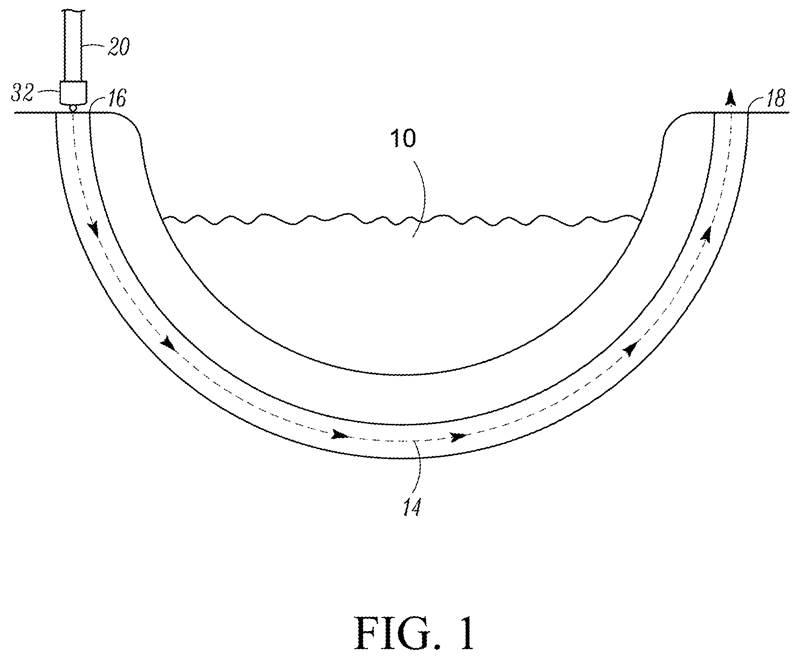
    The '611 patent, entitled "Underground Pipe Pulling Process and Pipe Pull Head," is directed to a method for pulling a pipe underground beneath an obstacle (such as a river or a road).  Figure 1 of the '611 patent illustrates an exemplary application of the described pipe pulling technique.

    Figure 1
    Claim 1 of the '611 patent recites:

    1.  A method of pulling a pipe underground beneath an obstacle from a first side to a second side of the obstacle, comprising:
        at the first side, attaching an adaptor to an end of the pipe, the adaptor being configured to connect to a pipeline component at the second side;
        at the first side, attaching a pull head to the adaptor;
        pulling the pipe underground from the first side to the second side by applying a pulling force to the pull head from the second side;
        at the second side, removing the pull head;
        at the second side, connecting the pipeline component to the adaptor; and
        wherein the adaptor is a pipe adaptor and the pipeline component is a second pipe.

    The '611 patent indicates that:

    In the conventional process, a pull head is attached to the pipe at the first side.  The pipe is then pulled underground through the borehole from the first side to the second side.  At the second side, the pull head is removed from the pipe, a section of pipe is then cut from the pipe end, and a pipe adaptor is then fused to the end of the pipe.  The end of a new section of pipe is then joined to the pipe adaptor to continue the pipeline.

    '611 patent, col. 1, ll. 17-24.

    However, in the claimed method of the '611 patent, the adaptor is attached to the end of the pipe before the pipe is placed underground.  The '611 patent notes that "attaching the adaptor to the pipe end at the first side while the pipe end is above ground, and prior to pulling the pipe underground, is faster and reduces danger to workers compared to the conventional process of attaching the adaptor at the second side within a trench" (id. at col. 1, ll. 48-52).

    Ellingson moved to dismiss Borehead's complaint, arguing that claim 1 is drawn to an abstract idea that is not patent eligible under 35 U.S.C. § 101.  To determine whether claim 1 is directed to a patent ineligible abstract idea, the District Court applied the two-part inquiry set forth by the Supreme Court in Alice Corp. Pty. Ltd. v. CLS Bank Int'l.  The inquiry requires that a court first determine whether the claim is directed to an abstract concept, and if so, determine whether additional elements transform the nature of the claim into a patent‐eligible application, which the Supreme Court described as "a search for an 'inventive concept.'"

    After applying the two-part inquiry of Alice, the District Court noted that "neither of these inquiries indicate that Claim 1 of the '611 patent is drawn to an unpatentable abstract concept."  In particular, the Court explained that:

    [T]he ['611] patent is not drawn to an abstraction, but to a concrete task—specifically, the task of pulling a pipe underground beneath an obstacle.  The claim requires specific physical tasks to be performed using specific tangible items in a specific order.  This is nothing like the claims in Alice, which were directed at the abstract idea of using a third party intermediary to mitigate settlement risk.  . . .  Not surprisingly, Ellingson had difficulty articulating the abstract concept to which Claim 1 is supposedly drawn.

    In addition, the Court noted that "[e]ven if Claim 1 could be considered to be directed at an abstract concept, it nevertheless incorporates the inventive idea of rearranging the conventional steps of moving pipe underground beneath an obstacle in a non‐conventional way in order to make the process easier and safer."  The District Court therefore denied Ellingson's motion to dismiss Borehead's complaint.

    Borehead, LLC v. Ellingson Drainage, Inc. (D. Minn. 2018)
    Order by District Judge Schiltz

  • Method of Treatment Claims Patent Eligible Even without Reciting Dosages

    By Kevin E. Noonan

    District Court for the District of DelawareIt appears that Judge William C. Bryson, U.S. Appellate Court Judge on the Federal Circuit bench, is riding the circuit these days, peripatetically ruling on the St. Regis Mohawk Tribe's motion to join ANDA litigation in the Eastern District of Texas last October and, last week, denying Defendant's motion to reconsider his grant of summary judgment that the claims at issue in Pernix Ireland Pain DAC v. Alvogen Malta Operations Ltd. were not invalid for being patent-ineligible subject matter under 35 U.S.C. § 101.  The significance of this decision, and more importantly the reasoning behind it, are important because "method of treatment" claims may be the last refuge against the pernicious stain of patent invalidation caused by inferior court's (and the USPTO's) implementation of the U.S. Supreme Court's questionably recent patent eligibility jurisprudence.

    The litigation arose over alleged infringement of claims 12, 17, and 19 of U.S. Patent No. 9,265,760 and claim 1 of U.S. Patent No. 9,339,499 related to methods for treating pain in certain hepatically impaired subjects:

    '760 patent:

    12.  A method of treating pain in a patient having mild or moderate hepatic impairment, the method comprising: administering to the patient having mild or moderate hepatic impairment an oral dosage unit having hydrocodone bitartrate as the only active ingredient, wherein the dosage unit comprises an extended release formulation of hydrocodone bitartrate, wherein the dosage unit provides a release profile of hydrocodone that: (1) does not increase average hydrocodone AUC0-in subjects suffering from mild hepatic impairment relative to subjects not suffering from renal or hepatic impairment in an amount of more than 14%; (2) does not increase average hydrocodone AUC0-in subjects suffering from moderate hepatic impairment relative to subjects not suffering from renal or hepatic impairment in an amount of more than 30%; (3) does not increase average hydrocodone Cmax in subjects suffering from mild hepatic impairment relative to subjects not suffering from renal or hepatic impairment in an amount of more than 9%; and (4) does not increase average hydrocodone Cmax in subjects suffering from moderate hepatic impairment relative to subjects not suffering from renal or hepatic impairment in an amount of more than 14%.

    17.  The method of claim 12, wherein the dosage unit provides a release profile of hydrocodone such that: (1) the average hydrocodone AUC0- per 20 mg of hydrocodone bitartrate dosed to subjects not suffering from renal or hepatic impairment is in the range of about 300 ng*h/mL to about 500 ng*h/mL; (2) the average hydrocodone AUC0- per 20 mg of hydrocodone bitartrate dosed to subjects suffering from mild hepatic impairment is in the range of about 300 ng*h/mL to about 570 ng*h/mL; and (3) the average hydrocodone AUC0- per 20 mg of hydrocodone bitartrate dosed to subjects suffering from moderate hepatic impairment is in the range of about 300 ng*h/mL to about 700 ng*h/mL.

    19.  The method of claim 17, wherein the dosage unit provides a release profile of hydrocodone such that the average hydrocodone AUC0- per 20 mg of hydrocodone bitartrate dosed to subjects suffering from moderate hepatic impairment is in the range of about 352 ng*h/mL to about 666 ng*h/mL.

    '499 patent:

    1.  A method of treating pain in a patient having mild or moderate hepatic impairment, the method comprising: administering to the patient having mild or moderate hepatic impairment an oral dosage unit having hydrocodone bitartrate as the only active ingredient, wherein the dosage unit comprises an extended release formulation of hydrocodone bitartrate, wherein the dosage unit provides a release profile of hydrocodone that: does not increase average hydrocodone AUC0- in subjects suffering from mild hepatic impairment relative to subjects not suffering from renal or hepatic impairment in an amount of more than 14%; and does not increase average hydrocodone AUC0- in subjects suffering from moderate hepatic impairment relative to subjects not suffering from renal or hepatic impairment in an amount of more than 30%.

    (Another set of '760 patent claims, comprising claims 1-4 and 11, was not at issue in the District Court's decision.)

    Judge Bryson previously denied (on May 15, 2018) Alvogen's summary judgment motion that claims 12, 17, and 19 of the '760 patent and claim 1 of the '499 patent were invalid under 35 U.S.C. § 101 as being directed to patent-ineligible subject matter, and part of the basis for Judge Bryson's denial of the Alvogen's motion for rehearing rests on District of Delaware precedent that such motions should be granted "sparingly" under local rule 7.1.5.

    On the merits, Alvogen argued that the District Court misapprehended the difference between claims reciting specific dosages and claims reciting the pharmacokinetic parameters produced by administration of dosages not recited with specificity in the claims.  The basis for Alvogen's argument of misapprehension stems from the statement in Judge Bryson's original opinion (denying Alvogen's summary judgment motion) that "the claims asserted in this case describe a specific dosing regimen to treat a specific condition based on the patient's medical status" like the claims the Federal Circuit found patent-eligible in Vanda Pharmaceuticals, Inc. v. West-Ward Pharmaceuticals International, Ltd., 887 F.3d 1117 (Fed. Cir. 2018).  The absence of limitations in the claims at issue here (and thus lacking "a specific dosing regimen" according to Alvogen) was the lynchpin of this argument, which Judge Bryson rejected.  He understood the claims, while not containing a dosing regimen "in [] conventional form" to be the same as regimens recited in claims that did contain such expressly recited dosages, because the resulting pharmacokinetic parameters were produced in each type of claim.  In a footnote Judge Bryson set forth his reasoning:

    While the dosing regimens in the "PK-only" claims are set forth in an unconventional manner, that is not unusual, as dosing regimens can be measured and designated in many ways other than simply by reference to the amount and frequency of administration of a drug.  For example, a direction to administer drug from a bronchial inhaler for short-term relief "until normal breathing is restored," but not for long-term relief, is a dosing regimen, as is a direction to reduce the dosage of a drug administered to a patient from a particular starting amount to the minimum amount necessary to achieve the desired efficacy.

    And more generally, and having significance for claims other than the ones at issue here:

    A claim to a method of treating an illness is typically more than an expression of a natural law; if it were otherwise, pharmaceutical patents would be hard to come by, as most methods of treatment using pharmaceuticals consist simply of the administration of a drug that affects the human body in a manner that is dictated by laws of nature.

    Judge Bryson's opinion also provides an illustrative example of a patent-eligible claim in this context (albeit one that "might have other infirmities, such as failing to pass muster under sections 102, 103, or 112 of the Patent Act).  Such a claim would be one that merely recited "a method for treating pain in subjects with mild or moderate hepatic impairment comprising administering an oral dosage of hydrocodone bitartrate as the only active ingredient, wherein the dosage unit comprises an extended release formulation of hydrocodone bitartrate."  This is enough, in his view, to pass muster as being something more than a claim reciting a natural law.  Accordingly (or "[a] fortiori" in the opinion), here the claims have additional limitations that describe the claimed dosage forms with reference to specific pharmacokinetic properties.  "Adding limitations to a claim that satisfies section 101 does not convert the claim into one that is directed to unpatentable subject matter," Judge Bryson writes.

    The opinion once more rejects Alvogen's argument that the claims at issue here are akin to the patent-ineligible claims in Mayo Collaborative Services v. Prometheus Laboratories, Inc., 566 U.S. 66 (2012).  Those claims were ineligible for reciting the relationship between blood metabolite concentration and effectiveness of drug treatment.  Here, as in Vanda, the claims affirmatively recite "treatment steps," "that is, directed at a new and useful method of treating pain in a certain population of patients using a specific set of hydrocodone bitartrate formulations" and thus, are patent eligible.

    Finally, Judge Bryson counters Alvogen's argument that a section 101 analysis "requires consideration of 'the claimed advance over the prior art," relying on language from Enfish, LLC v. Microsoft Corp., 822 F.3d 1327, 1335 (Fed. Cir. 2016).  He states that "Alvogen would be wrong to read a strong novelty inquiry into section 101 analysis," on the basis of the distinction that "the section 101 inquiry evaluates 'the focus of the claimed advance over the prior art to determine if the claim's character as a whole is directed to excluded subject matter,'" citing the Federal Circuit's reliance on Affinity Labs of Texas, LLC v. DIRECTV Dig. LLC, 838 F.3d 1253, 1257 (Fed. Cir. 2016), in its decision in Intellectual Ventures I LLC v. Erie Indem. Co., 850 F.3d 1315, 1325 (Fed. Cir. 2017).

    It is important not to read too much into this decision, it being denial of a motion for rehearing of a decision on summary judgment.  However, it is important to note that decisions such as this one have increased relevance in light of the Supreme Court's refusal to recognize that there may be solid grounds to reconsider their thinking on patent eligibility, as illustrated by their most recent refusal (yesterday) to grant certiorari in Cleveland Clinic Foundation v. True Life Health Diagnostics.  The Supreme Court may have intended the Federal Circuit and the district courts to "flesh out" the application of the principles and concerns it voiced in Bilski, Mayo, Myriad, and Alice.  After a certain period of apparently sheepish acquiescence it is possible that the inferior courts are beginning to fulfill the Court's expectations.

    Pernix Ireland Pain DAC v. Alvogen Malta Operations Ltd. (D. Del. 2018)
    Memorandum Opinion and Order by Judge Bryson

  • By Donald Zuhn

    NVCAEarlier this year, the National Venture Capital Association (NVCA), a trade association representing the U.S. venture capital industry, released the results of its Pitchbook NVCA Venture Monitor report on venture funding for the first quarter of 2018, noting that venture funding is on pace to experience another record-breaking year in 2018.  NVCA President and CEO Bobby Franklin noted that "[t]he first quarter of 2018 picked up right where 2017 left off, with the largest amount of capital deployed into venture-backed companies in a single quarter since 2006, marking a very strong start to venture investment this year."

    With respect to the first quarter, the report indicates that venture capitalists invested $28.2 billion in 1,683 deals, which marked the fourth consecutive quarter of more than $20 billion deployed to venture-backed companies (charts from Pitchbook NVCA Venture Monitor report for 1Q 2018; click to enlarge charts).

    Figure 2
    Interestingly, venture funding for the first quarter of 2018 surpassed venture funding for all of 2009.

    Figure 1
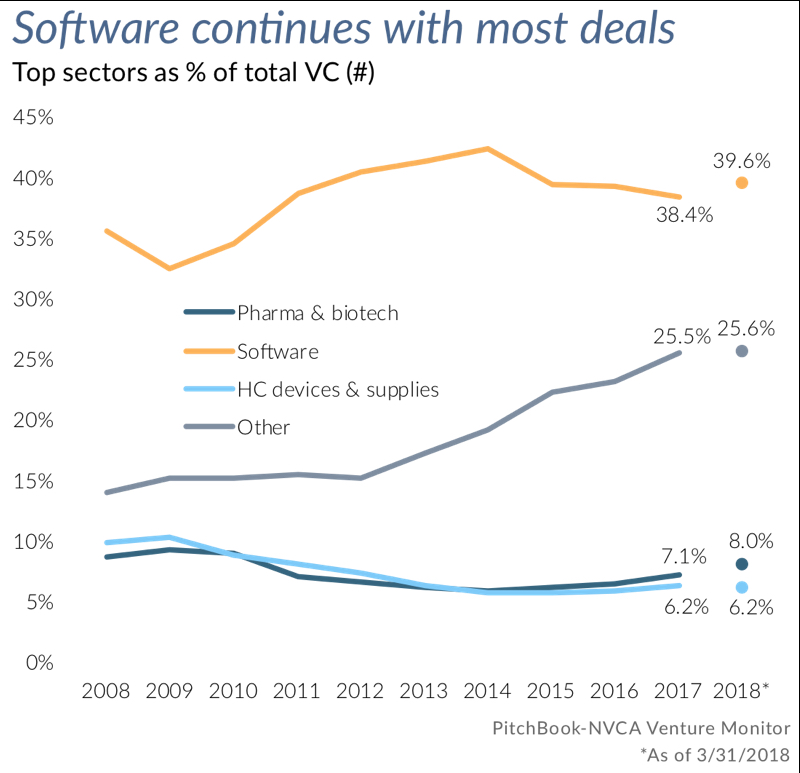
    With respect to venture funding by sector, the software sector once again surpassed all other sectors, securing almost 40% of venture funding in the first quarter of 2018.  The pharmaceutical and biotechnology sector and healthcare (HC) devices and supplies sector secured 8% and 6.2%, respectively, of venture funding in the first quarter of 2018.

    Figure 3
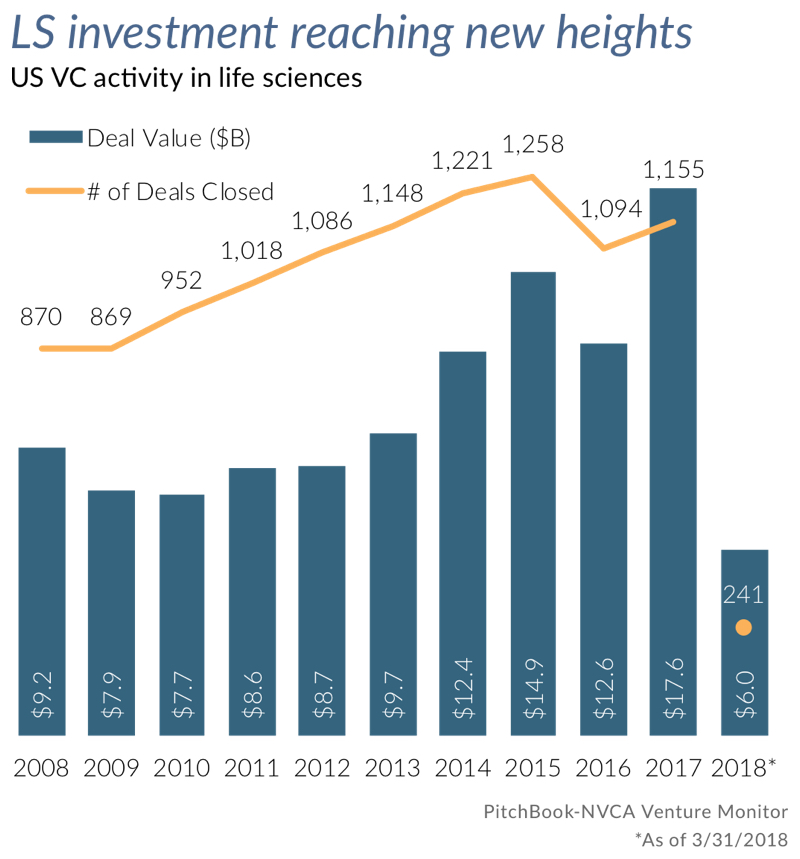
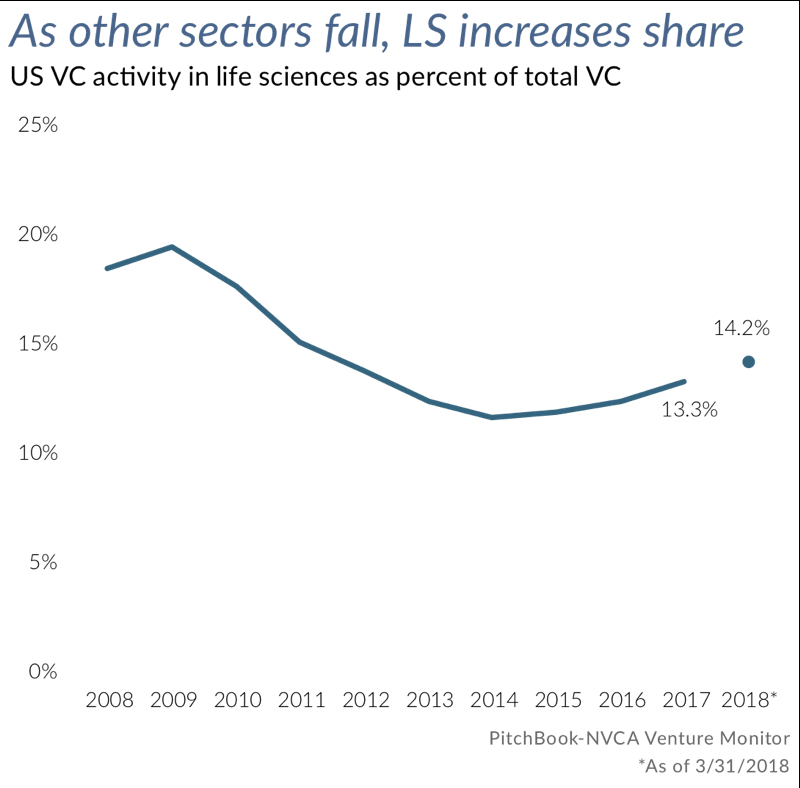
    The life sciences sector (which combines pharma and biotech and HC devices and supplies), like total venture funding, also appears to be on a record pace for 2018.  If the sector can maintain its first quarter pace, it could surpass in only two quarters annual funding totals posted for 2008-2013.

    Figure 4
    The 14.2% share of venture funding that the life sciences sector secured in the first quarter of 2018 also marked a continued increase in funding share for the sector.

    Figure 5

    For additional information regarding this and other related topics, please see:

    • "Third Quarter Venture Funding Remains Strong," December 18, 2017
    • "First Quarter Venture Funding Bounces Back from Fourth Quarter Low," May 31, 2017
    • "Venture Funding Normalizes in 2016 After Strong First Half," February 8, 2017
    • " Second Quarter Venture Funding Increases 20% from First Quarter," October 11, 2016
    • "Venture Funding Reaches Highest Level in More Than a Decade," February 25, 2016
    • "Third Quarter Venture Funding Declines 27% from Second Quarter," October 22, 2014
    • "Software Sector Leads Pack in 2Q Venture Funding and Biotech Sector Finishes Second," July 20, 2014
    • "Software Sector Leads First Quarter Venture Funding to Thirteen Year High; Biotech Sector Finishes Second (Again)," April 30, 2014
    • "Biotech Venture Funding Rebounded in 2013 After Strong Fourth Quarter," January 26, 2014
    • "Biotech Venture Funding Sees Second Quarter Rebound," July 22, 2013
    • "Biotech Venture Funding Down 33% in First Quarter," April 30, 2013
    • "Annual Venture Funding Drops for First Time in Three Years," February 4, 2013
    • "Biotech Venture Funding Up 64% in Third Quarter," October 29, 2012
    • "Venture Funding in Life Sciences Sector Drops 9% in Second Quarter," July 22, 2012
    • "Biotech Venture Funding Drops 43% in First Quarter," May 3, 2012
    • "Venture Funding Increased 22% in 2011," February 2, 2012
    • "Life Sciences Venture Funding Drops in Third Quarter," October 27, 2011
    • "Life Sciences Venture Funding up 37% in Second Quarter," August 1, 2011
    • "VentureSource Reports 35% Increase in 1Q Venture Funding," April 26, 2011
    • "NVCA Reports Modest Gains in First Quarter Venture Funding," April 19, 2011

    • "NVCA Reports 31% Drop in Venture Funding for Third Quarter," October 17, 2010

    • "NVCA Reports 34% Increase in Venture Funding for Second Quarter," July 22, 2010

    • "NVCA Report Shows First Quarter Drop in Venture Funding," April 20, 2010

    • "Biotech/Pharma Financing Improving, R&D Spending Up," August 31, 2009
    • "NVCA Study Shows Increase in Third Quarter Venture Funding," October 23, 2009

    • "First Quarter Venture Capital Funding at 12-Year Low," April 23, 2009

    • "NVCA Study Shows Decline in 2008 Investment; BIO Study Predicts Biotech Rebound in 2009," February 16, 2009

  •     The following article was reprinted with permission from J A Kemp.

    The European Patent Office (EPO) applies the same basic patentability criteria to antibodies as to other inventions, but it can sometimes appear that antibodies are treated as a special case.  For an explanation of the basic approach adopted by the EPO, please see our related briefing "Antibodies in the European Patent Office – Basic Principles" (an updated version of this report can be found here).  The present briefing is intended to develop those Basic Principles into a guide to the drafting and prosecution of patent applications for antibody inventions.

    The briefing focuses on the most common type of antibody invention at the present time — namely monoclonal antibody products for which the target and any associated disease indications are already known.  We also provide guidance on ensuring your antibody claims are appropriate to support future applications for Supplementary Protection Certificates (SPCs).

    Where is the Case Law?

    This Advanced Guide is drawn primarily from our experience prosecuting large numbers of antibody cases before the EPO and our discussions with EPO examiners.  This may raise the question:  Why is there so little supporting case law?

    The main reason is that antibody case law at the EPO has been relatively slow to develop in recent years.  In our opinion this is because the most common pending antibody applications during this period have focused narrowly on a lead molecule or molecules of the applicant.

    As a consequence, an innovator competitor is unlikely to have freedom to operate concerns for their own molecule, and could even prefer that a patent is granted and in force since this may reduce the likelihood of generic competition.  On the other hand, the 9 month opposition term after grant of European patents may come too early in product development for a generic / biosimilar competitor, or they may take the view that their primary barrier for market entry will be regulatory data exclusivity rather than the patent.  Again, they may therefore prefer the patent to be granted and maintained in force in the meantime.

    The net effect is that there are comparatively few oppositions filed against this type of invention, and thus comparatively few cases reach the Boards of Appeal.  The EPO Examining Divisions have therefore developed their approach from the principles outlined in earlier decisions, adapted by their exposure to high volumes of cases.

    Unexpected Technical Effect

    As is explained in more detail in our Basic Principles briefing, where the target and its relevance to a disease indication are known, the EPO generally assumes that any antibody with a unique amino acid sequence will be novel over prior art antibodies to the same target, but a demonstration of an unexpected (surprising) technical effect will be required to establish an inventive step[1].  It must be at least plausible that the unexpected technical effect, usually a functional characteristic, is shared by substantially all antibodies falling within the scope of the claim.

    The following sections provide our suggestions for how best to prepare a patent application to meet these requirements.

    Guide to Drafting and Prosecution — How to Prepare for the Unexpected

    A patent application for a new antibody to a known target having the necessary "unexpected technical effect" will typically require at least three forms of information or supporting data:

    • Structural information for at least one exemplary antibody — typically the lead molecule or molecules in the project — desirably for both the target-binding region and the constant region;
    • Functional data to show that the antibody specifically binds to the target; and
    • Functional data to show that the antibody has an unexpected technical effect / functional characteristic that can be relied on for inventive step.

    Structural information — Target-binding Region

    The claims will typically need to incorporate a structural definition of the antibody, at least for the target-binding region.  It can be assumed that a minimum of six CDRs will be required unless there is compelling data to show that target binding and other key characteristics are shared by antibodies defined less precisely.  It is now relatively common for complete variable region sequences to be required.

    Where there are multiple candidate antibodies in an application, it should be ensured that each molecule is defined by reference to as complete a set of structural information as possible, ideally all six CDRs and both complete variable region sequences.  The use of "mix and match" language, which typically seeks to encompass any combination of CDRs and variable region sequences from multiple candidates should not be relied on.  Instead, the specific combinations of target-binding region sequences that make up each of the candidates should be disclosed.

    It is increasingly common for EPO examiners to object that references to CDRs in the claims are unclear unless the identification method used is also recited.  Under strict EPO disclosure requirements, it may only be possible to comply with a request to insert a definition of the identification method into a claim if there is an explicit reference to it in the application as filed.

    The application as filed should therefore disclose how the structural information was determined.  In particular, the numbering scheme and definitions used to identify CDRs should be specified (Kabat, Chothia, AbM etc).  It is acceptable to list alternative CDR sequences for a given molecule based on the different available definitions, provided that each alternative is clearly identified alongside the definition used.

    Structural Information — Constant Region

    Sequence information for the variable region is routinely included in applications, but there is often no indication of the constant region either by reference to an isotype class or a specific sequence.  Desirably, at least one preferred isotype class should be recited, and ideally at least one exemplary constant region sequence should also be included.  This information should be presented together with the target-binding region information, such that there is an explicit disclosure of the structure of the combined target-binding region and constant region for each complete antibody molecule.

    It may be helpful to recite the sequence of a complete heavy chain and a complete light chain for each molecule, with an explicit statement that each heavy chain / light chain pair is combined to produce a complete molecule of the invention.  Once again, "mix and match" language should not be relied upon.

    In some cases it may be necessary to specify the isotype / constant region sequence in the claims, particularly if this is relevant to the unexpected characteristic relied upon for inventive step.  Under strict EPO disclosure requirements, this will likely only be possible if there is an explicit reference to the constant region in the application as filed.

    Functional Data Relating to Target Binding

    A demonstration that an antibody binds to a target should not be difficult to provide, since any antibody development plan will likely include a significant quantity of data demonstrating target specificity and affinity/avidity.

    There is no single preferred technique for measuring target binding for patent purposes, although surface plasmon resonance is increasingly regarded as the standard.  Whichever technique is used, the patent application should ideally describe this in general terms (optionally by reference to standard texts) but should also include the specific experimental conditions that apply to the determinations of binding that were actually conducted for the exemplary antibodies of the application:  temperature, ionic strength, nature of target etc.  At least one individual experiment should be described in full in the Examples and the corresponding data provided in the application.

    If a required level of affinity/avidity is recited in the claims, typically the EPO will now require that the claims also include an indication of the technique used to determine this parameter.  Under strict EPO disclosure requirements, it may only be possible to comply with a request to insert the technique if there is an explicit reference to it in the application as filed.

    Functional Data Relating to an Unexpected Technical Effect

    The type of functional data available will, of course, be highly dependent upon the nature of a given antibody project.  However, the EPO will be looking for evidence of a functional property of the claimed antibodies in the application.  Therefore, although additional data in support of an inventive step may be filed during prosecution, it is important to at least include a description of the functional characteristics of the antibodies.  The techniques used to demonstrate the functional characteristics should be described both in general and in more specific terms, and at least one individual experiment should be described in full in the Examples alongside the corresponding data.

    If it is necessary or desirable to limit the claimed antibodies by reference to a functional feature in the claims, an EPO examiner may request that claims also include an indication of the technique used to determine the feature for the exemplary antibodies disclosed in the application.  It may only be possible to comply with such a request if there is an explicit disclosure of the technique in the application as filed.

    Is Comparative Data Necessary?

    EPO examiners often look for comparative data with prior art antibodies as evidence of an unexpected technical effect.  A patent application does not necessarily need to include comparative data, and indeed it may not be possible to include comparisons to particular prior art antibodies — not least because these may only be identified in later Patent Office searches.  However, if the applicant wishes to rely upon comparative data generated after filing to prove that a functional characteristic of the claimed antibodies represents an improvement over the prior art, the comparative data must relate to information about the claimed antibodies that is disclosed in the application as filed.  It must be at least plausible from the application that the claimed antibodies possess the property relied upon.

    As a consequence, the more information that is included in the application regarding the antibody of interest, the easier it is likely to be to rely upon comparative data that is only generated later in response to an objection based on a particular prior art antibody.

    It can, in particular, be helpful to include comparative data from related antibodies produced in the course of the antibody development project which do not share the same characteristics as the lead antibody, or lead antibodies.

    This may seem counter-intuitive, since such data may limit the extent to which the structural definition in the claims can be broadened to a class of molecules.  However, comparative data of this type may help to illustrate or emphasise the unexpected nature of a characteristic relied upon for inventive step, since it can help to establish that anti-target antibodies (and hence prior art antibodies) cannot be assumed to share that characteristic.

    Another situation where including data relating to a number of different anti-target antibodies can be helpful is where a panel of antibodies have been developed in an attempt to identify candidates which have one specific improved property — such as improved solubility, reduced isomerisation etc.  Comparative data for antibodies for which such attempts were unsuccessful will help to show that the successful attempts were not predictable in advance, and thus are unexpected.

    Epitopes

    Although the EPO have historically allowed claims which define antibodies in terms of their epitope binding, such claims are coming under increasing scrutiny.  Our understanding is that the EPO now require more detailed information concerning how the epitope was identified and how binding to it is to be assessed.  The EPO may also require detailed information regarding any novel / inventive characteristics that are asserted as being conferred on an antibody by virtue of binding to a particular epitope, as well as evidence that prior art antibodies do not bind to the same epitope.  This need not necessarily take the form of epitope-binding data for prior art antibodies.  The EPO may accept a technical explanation as to why a prior art antibody would not bind to the same epitope.

    Where an epitope is identified in an application, it should be considered whether it represents a sequence bound by an antibody only when present in the context of the target molecule as a whole, or whether it can also be bound as a short peptide fragment in isolated form.  Care should be taken when drafting the specification so that it is clear exactly what properties are intended when referring to epitope binding.  There are a variety of different methods can be used in establishing epitope binding, including analysis of binding to short fragments, mutagenesis studies, and crystallography analysis.  It is desirable to include detailed information regarding the technique that has been used for the antibodies that are disclosed.

    When drafting an application, consideration should be given to the techniques employed both for epitope determination and for assessment of the resulting characteristics.  Sufficient information should be provided to ensure that the particular epitope is clearly defined, and that one of skill in the art could produce antibodies which can be identified as binding to it.  The EPO may also require evidence to establish that it is at least plausible that all antibodies binding to the particular epitope can be expected to share the resulting properties.

    Supplementary Protection Certificates (SPCs)

    The SPC Regulation[2] pre-dates the development of biological pharmaceuticals such as antibodies, and thus does not take into account the particular complexities of such molecules as compared to traditional small molecule pharmaceuticals.  As a consequence, the basic requirements to obtain a valid SPC are the same for all types of pharmaceutical.  One of these requirements is that the active ingredient of an authorised medicinal product must be "protected by the basic patent" (Article 3(a) of the SPC Regulation).

    This requirement is not satisfied merely because the active ingredient is encompassed within a claim of the patent for the purposes of infringement.  Rather, the cumulative effect of multiple CJEU decisions is that the active ingredient must be "specified" in the claims at some higher degree of precision.  For more detailed information, see our separate SPC briefing.

    The key point to bear in mind is that it is desirable to include a claim (or language to support a claim) that defines the expected active ingredient of any medicinal product with as high a degree of precision as possible.  Where possible, this should include as much structural information as is available regarding both target-binding and constant regions of an antibody.

    [1] Board of Appeal decision T735/00
    [2] Regulation 469/2009/EC

  • CalendarJune 12, 2018 – "Best Practices Before the Patent Trial and Appeal Board" (U.S. Patent and Trademark Office) – 12:00 to 1:00 pm (ET)

    June 12, 2018 – "Patent Eligibility, Prior Art and Obviousness 2018: Current Trends in Sections 101, 102, and 103" (Practising Law Institute) – San Francisco, CA

    June 13-15, 2018 – Patent Fundamentals Bootcamp 2018: An Introduction to Patent Drafting, Prosecution, and Litigation (Practising Law Institute) – New York, NY

    June 14, 2018 – "Secondary Considerations at the PTAB: Combating Obviousness Challenges, Establishing Nexus" (Strafford) – 1:00 to 2:30 pm (EDT)

    June 14, 2018 – "Patent Eligibility in the Life Sciences: Exergen and Praxair – and USPTO Memos on Vanda and Berkheimer" (Intellectual Property Owners Association) – 2:00 to 3:00 pm (ET)

    June 19, 2018 – "Protecting Software as a Medical Device: Patents, Design Patents and Trade Secrets" (Strafford) – 1:00 to 2:30 pm (EDT)


    June 21, 2018 – "Double Patenting: Defeating Double Patenting Rejections and Avoiding Terminal Disclaimers" (Strafford) – 1:00 to 2:30 pm (EDT

    June 25-27, 2018 – Summit on Biosimilars (American Conference Institute) – New York, NY

    June 26, 2018 – "Means-Plus-Function Patent Claims: Treatment in Prosecution, Litigation and Post-Grant Proceedings" (Strafford) – 1:00 to 2:30 pm (EDT)
    July 18-20, 2018 – Patent Fundamentals Bootcamp 2018: An Introduction to Patent Drafting, Prosecution, and Litigation (Practising Law Institute) – San Francisco, CA

    September 21, 2018 – "USPTO Post-Grant Patent Trials 2018: Change & Recalibration" (Practising Law Institute) – New York & Groupcasts in Philadelphia, Indianapolis, New Brunswick, NJ, Pittsburgh, and Mechanicsburg, PA

  • USPTO SealThe U.S. Patent and Trademark Office will be offering the next webinar in its Patent Quality Chat webinar series from 12:00 to 1:00 pm (ET) on June 12, 2018.  In the latest webinar, entitled "Best Practices Before the Patent Trial and Appeal Board," Patent Trial and Appeal Board (PTAB) Judges Kalyan Deshpande, Susan Mitchell, and Michael Zecher will provide an explanation of Board jurisdiction, rules, and proceedings, and then lead a discussion on practice tips for successful oral and written advocacy in the PTAB forum.

    Instructions for viewing the webinar and additional information regarding the Patent Quality Chat webinar series can be found on the USPTO's Patent Quality Chat webpage.