• CalendarJune 25-27, 2018 – Summit on Biosimilars (American Conference Institute) – New York, NY

    June 26, 2018 – "Means-Plus-Function Patent Claims: Treatment in Prosecution, Litigation and Post-Grant Proceedings" (Strafford) – 1:00 to 2:30 pm (EDT)

    June 26, 2018 – "Willfulness Since Halo" (Intellectual Property Owners Association) – 2:00 to 3:00 pm (ET)

    June 28, 2018 – "Patent Portfolio Management: Best Practices in 2018" (The Knowledge Group) – 12:00 to 1:30 pm (ET)

    July 5, 2018 – "Post-Sale Restrictions: Protecting Patented Products After Lexmark" (Strafford) – 1:00 to 2:30 pm (EDT)

    July 11-12, 2018 – "Advanced Patent Prosecution Workshop 2018: Claim Drafting & Amendment Writing" (Practising Law Institute) – New York, NY

    July 17, 2018 – "Drafting and Defending Software Patents to Survive Section 101 and AIA Challenges — Anticipating and Minimizing the Risk of 101, 103 Rejections, Recent Court Guidance" (Strafford) – 1:00 to 2:30 pm (EDT)

    July 18-20, 2018 – Patent Fundamentals Bootcamp 2018: An Introduction to Patent Drafting, Prosecution, and Litigation (Practising Law Institute) – San Francisco, CA

    August 16-17, 2018 – "Advanced Patent Prosecution Workshop 2018: Claim Drafting & Amendment Writing" (Practising Law Institute) – San Francisco, CA

    September 21, 2018 – "USPTO Post-Grant Patent Trials 2018: Change & Recalibration" (Practising Law Institute) – New York & Groupcasts in Philadelphia, Indianapolis, New Brunswick, NJ, Pittsburgh, and Mechanicsburg, PA

    September 27-28, 2018 – "Advanced Patent Prosecution Workshop 2018: Claim Drafting & Amendment Writing" (Practising Law Institute) – Chicago, IL

  • PLI #1Practising Law Institute (PLI) will be holding its "Advanced Patent Prosecution Workshop 2018: Claim Drafting & Amendment Writing" on July 11-12, 2018 in New York, NY, on August 16-17, 2018 in San Francisco, CA, and on September 27-28, 2018 in Chicago, IL.  Patent Docs author Donald Zuhn will chair and Patent Docs author Kevin Noonan will be presenting at the Chicago workshop.

    At the New York and Chicago seminars, PLI's faculty will offer presentations on the following topics:

    • Ethics in the PTO
    • Concurrent Sessions I – Advanced Specification Drafting Issues — all concurrent sessions and workshops will provide lectures specific to four different technologies: biotechnology, chemical/pharmaceutical, electromechanical, and electronics/computers
    • Concurrent Sessions II – Advanced Claim Drafting Issues
    • Concurrent Workshops I – Advanced Claim Drafting
    • Working with a Patent Examiner — Live Demonstration of WebEx Examiner Interview; Everything You Want to Know About the Patent Office
    • Lessons Learned from Six Years of Post-Grant Proceedings
    • Concurrent Sessions III – Advanced Patent Prosecution Issues
    • Concurrent Workshops II – Advanced Amendment Drafting
    • Examiner Interviews
    • Roundtable Discussions in Advanced Patent Prosecution Issues and Wrap-Up

    At the San Francisco seminar, presentations will be offered on the following topics:

    • Ethics for Patent Prosecutors
    • The New 35 U.S.C. § 102
    • Advanced Claim Drafting Issues — class to split into technology groups, including Electromechanical/Mechanical, Electronics/Computers, and Life Sciences (Biotechnology, Chemical/Pharmaceutical)
    • Patentable Subject Matter
    • Claim Drafting Workshops — class to split into technology groups
    • Advanced Issues for Written Description — class to split into technology groups
    • Working with a Patent Examiner — Live Demonstration of WebEx Examiner Interview; Everything You Want to Know About the Patent Office
    • Countering the Obviousness Rejection — class to split into technology groups
    • Advanced Issues for Written Description
    • The Litigation Perspective on Patent Prosecution
    • Amendment Workshops — class to split into technology groups

    A complete program schedule, including descriptions of the presentations and a list of speakers for each seminar can be found here.

    The registration fee for each conference is $1,895.  Those interested in registering for the conference can do so here.

  • IPO #2The Intellectual Property Owners Association (IPO) will offer a one-hour webinar entitled "Willfulness Since Halo" on June 26, 2018 from 2:00 to 3:00 pm (ET).  Prof. Thomas Cotter of the University of Minnesota, Richard Megley of Lee Sheikh Megley & Haan LLC, and Kathi Vidal of Winston & Strawn LLP will analyze recent case law from both district courts and the Federal Circuit and describe:

    • Current pleading standards for willfulness, including proving knowledge of the patent or willful blindness, and the impact of letters of counsel;
    • The effect of Halo on the availability of pre-suit and post-suit willfulness and the impact of the timing of the notice of infringement; and
    • The relevance of the Read factors (Read Corp. v. Portec, Inc. (Fed. Cir. 1992)) for egregious behavior in light of the fact that enhancement needn't always follow a finding of willfulness.

    The registration fee for the webinar is $135 (government and academic rates are available upon request).  Those interested in registering for the webinar can do so here.

  • Strafford #1Strafford will be offering a webinar entitled "Drafting and Defending Software Patents to Survive Section 101 and AIA Challenges — Anticipating and Minimizing the Risk of 101, 103 Rejections, Recent Court Guidance" on July 17, 2018 from 1:00 to 2:30 pm (EDT).  Michael L. Kiklis and Stephen G. Kunin of Oblon McClelland Maier & Neustadt will provide guidance to patent practitioners on how to draft patent applications to overcome both Section 101 and AIA challenges.  The webinar will review the following issues:

    • What are the hurdles for patent counsel to demonstrate a software-related claim is not abstract?
    • If an abstract idea is found, how can patent practitioners pass Alice’s step two?
    • What guidance have the courts provided in recent decisions concerning patent eligibility for software-related inventions?
    • What best practices should counsel use to help software-related inventions survive AIA challenges?
    • What is the best way to defend against §101 pre-trial attacks?

    The registration fee for the webcast is $297.  Those interested in registering for the webinar, can do so here.

  • By Shin Hee Lee* and Anthony D. Sabatelli** —

    "Your hair is your crowning glory" is an often-quoted phrase with biblical roots.1  Perhaps more importantly, one's hair is a visible barometer of one's health and age.  Hair care products are also big business.  The global hair care market reached $85.5 billion in annual sales in 2017.  This figure is expected to climb to over $100 billion by 2024.  The U.S. hair care market outcompeted the Asia-Pacific market in 2017, now making it the largest market in the world at about $15 billion.  This highly lucrative hair care market continues to grow rapidly with advances in nanotechnology and other areas.  A sampling of patents from the hair care sector is summarized at the end of this article.

    Today, there is an enormous array of hair products consumers can buy to satisfy their hair care needs.  In addition to implements and devices, hair care products can be classified into four categories:  hair care, hair styling, hair coloring, and perms/straighteners.  The hair care category umbrellas shampoos, conditioners, hair sprays, and hair treatments (e.g., anti-dandruff serums).  The hair styling category includes hair sprays, heat protectors, gels, mousses, and cremes.  Loréal, Procter and Gamble, Coty, Shiseido, Avon, and Unilever are the key players in the field.

    The hair is relatively fine and has a very large total surface area of over 40 square feet on an average head.  These properties make the hair easy to handle but make it difficult to apply and remove products after use.  Nanotechnology solves many of these problems, so that it is widely employed across all sectors in the hair care field.  Nanomaterials, because of their small size, possess the ability to interact with substrates at an atomic or molecular level and are also highly reactive due to their large surface area-to-mass ratio.  Furthermore, nanoparticle-based hair care products can penetrate deep inside the hair fiber core to more effectively deliver active ingredients to the hair.

    Two-in-one shampoos that are intended to both clean and condition the hair provide an interesting application of nanotechnology.  Some two-in-one shampoos are formulated as oil-in-water emulsions containing both surfactants and silicone oils.  The surfactants of the shampoo provide a cleansing effect on the surface of the hair fibers and are rinsed away with water, while the silicone oil of the conditioner remains behind to coalesce and diffuse nanosized particles onto and into the hair fibers.  These particles provide a conditioning effect on damaged hair strands and restore the hair's glossy texture.

    A wide array of biomaterials are also used in hair care products.  For example, sericin, a protein derived from silkworms, is currently one of the most promising biomaterials that is used with nanoparticles for conditioners and hair-straightening products.  Also, zinc and chitin nanofibril complexes have been shown to exhibit anti-dandruff and oil-control effects by reportedly promoting amino acid synthesis and keratin formation.

    A hair treatment product named Olaplex has been gaining immense popularity for effectively recovering damaged hair from the effects of excessive bleaching.  It gained public attention after celebrities such as Taylor Swift and Kim Kardashian acclaimed its efficacy.  Its key ingredient, bis-aminopropyl diglycol dimaleate, is believed to reconnect broken disulfide sulfur bonds in the cuticle and cortex layers of the hair fibers.

    Furthermore, an interesting use of small particles was recently disclosed by Coty.  The invention uses small particles as free radical scavengers to protect and treat skin or hair damage, particularly due to chemotherapy.

    "Dry" shampoos are a relatively new product category (although some have been around since at least the 1960s).  These products coat the hair with oil-absorbing powders to give the hair a fresher and cleaner appearance without the use of water.  Living Proof is one of the leading dry shampoo makers.  Leave-in conditioners have also gained enormous popularity. Hair care product companies Unite and It's-A-10 currently have the top-selling leave-in conditioners in the market.

    The hair coloring sector is a multi-billion-dollar industry that benefits largely from nanotechnology.  Nanotechnology has been providing healthy and more effective alternatives for traditional synthetic dyes such as p-phenylenediamine (PDA), which have been implicated with health problems such as various cancers, non-Hodgkin's lymphoma, and multiple myeloma.  Recently, researchers found that the incorporation of PDA in hyaluronic nanoparticles reduces the potential toxicity compared to PDA alone.  In addition, quantum dot luminescent nanoparticles have been shown to permanently change the hair's color without damaging the keratin proteins of the hair.  Even though new hair products are constantly entering the market, there are still a number of challenges.  For example, many hair coloring products are not permanent enough, and fade or wash out.  Also, while it is easy to darken light-colored hair, it is far more difficult to go in the other direction to lighten dark-colored hair, without a pre-bleaching step.

    The use of nanotechnology in hair care even extends to devices such as hair dryers.  Sophisticated hair dryers such as the Panasonic nanoeTM dryer claim to emit and deliver nano-sized charged particles onto the hair and scalp to tighten hair cuticles, moisturize the scalp, and improve hair shine.  Also, silver nanoparticles have been found to exhibit antibacterial and antifungal properties that minimize the spread of bacteria on the scalp.  Ceramic nanoparticles have been found to promote smooth, silky hair.

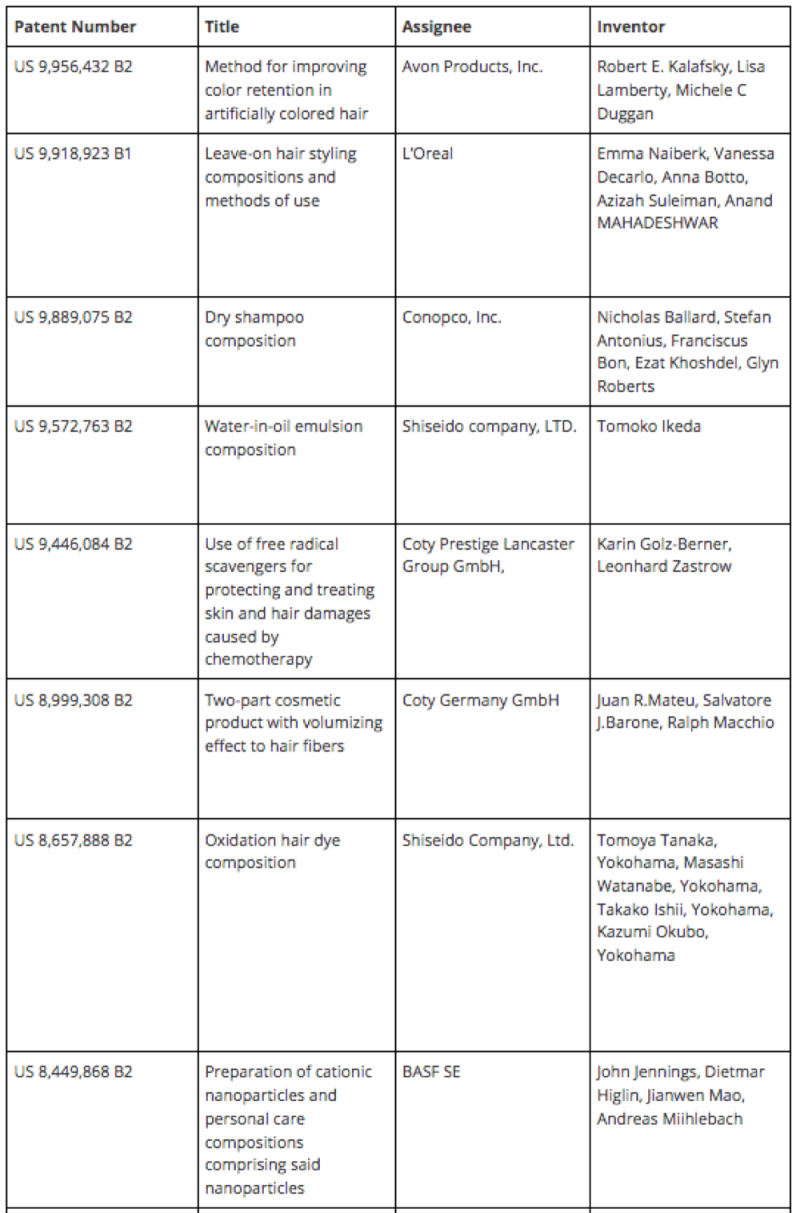
    Shown below is a table summarizing just a sampling of patents for hair care products, some of which go back to the 1980's.

    Table 1a Table 1b

    1 King James Version Bible, 1 Corinthians 11:15, "But if a woman have long hair, it is a glory to her."

    * Shin Hee Lee is a Ph.D. Candidate in the Chemistry Department at Yale University.  She is currently associated with the Yale Energy Sciences Institute, where she specializes in organic synthesis of novel light-harvesting dye molecules for solar cells.  Prior to attending Yale, Shin Hee obtained her B.S. in Chemistry with High Honors at the University of Michigan – Ann Arbor, during which she published patents and papers on developing synthetic methodologies for fluorinated small molecules.
    ** Dr. Sabatelli is a Partner with Dilworth IP

    For additional information regarding this topic, please see:
    • "Patent Beauty: IP and the Cosmeceutical Industry," May 3, 2018
    • "Nanomedicine: A Vast Horizon on a Molecular Landscape — Cosmeceuticals," June 6, 2018

  • By Kevin E. Noonan

    "You consider that to be important?" he asked.
    "Exceedingly so."
    "Is there any point to which you would wish to draw my attention?"
    "To the curious incident of the dog in the night-time."
    "The dog did nothing in the night-time."
    "That was the curious incident," remarked Sherlock Holmes.

    "The Adventure of the Silver Blaze," The Memoirs of Sherlock Holmes, Sir Arthur Conan Doyle

    Supreme Court Building #1Like Sherlock Holmes' quiet dog, the significance of the Supreme Court's patent eligibility jurisprudence following their decision in Mayo Collaborative Services v. Prometheus Laboratories, Inc. and Alice Corp. v. CLS Bank Int'l is that there hasn't been any.  The Court has shown a similar reticence towards wading into the uncertain waters created by the Federal Circuit regarding the safe harbor created by the Hatch-Waxman Act, codified at 35 U.S.C. § 271(e)(1).  Last Monday was the most recent instance of the Court's refusal to address how the lower courts have implemented these statutory provisions in denying certiorari in Cleveland Clinic Foundation v. True Health Diagnostics LLC and Classen Immunotherapies, Inc. v. Elan Pharmaceuticals Inc.

    The claims at issue in Cleveland Clinic relate to methods for detecting myeloperoxidase (MPO) in a bodily sample (U.S. Patent Nos. 7,223,5527,459,286, and 8,349,581) and methods for treating a patient having cardiovascular disease (U.S. Patent No. 9,170,260); the claims of the '522 patent are representative:

    11.  A method of assessing a test subject's risk of having atherosclerotic cardiovascular disease, comprising comparing levels of myeloperoxidase in a bodily sample from the test subject with levels of myeloperoxidase in comparable bodily samples from control subjects diagnosed as not having the disease, said bodily sample being blood, serum, plasma, blood leukocytes selected from the group consisting of neutrophils, monocytes, subpopulations of neutrophils, and sub-populations of monocytes, or any combination thereo[f]; wherein the levels of myeloperoxidase in the bodily from the test subject relative to the levels of [m]yeloperoxidase in the comparable bodily samples from control subjects is indicative of the extent of the test subject's risk of having atherosclerotic cardiovascular disease.

    14.  A method of assessing a test subject's risk of developing a complication of atherosclerotic cardiovascular disease comprising: determining levels of myeloperoxidase (MPO) activity, myeloperoxidase (MPO) mass, or both in a bodily sample of the test subject, said bodily sample being blood, serum, plasma, blood leukocytes selected from the group consisting of neutrophils and monocytes, or any combination thereof; wherein elevated levels of MPO activity or MPO mass or both in the test subject's bodily sample as compared to levels of MPO activity, MPO mass, or both, respectively in comparable bodily samples obtained from control subjects diagnosed as not having the disease indicates that the test subject is at risk of developing a complication of atherosclerotic cardiovascular disease.

    15.  The method of claim 14, wherein the test subject's risk of developing a complication of atherosclerotic cardiovascular disease is determined by comparing levels of my[elo]peroxidase mass in the test subject's bodily sample to levels of myeloperoxidase mass in comparable samples obtained from the control subjects.

    The Federal Circuit affirmed the District Court's grant of True Health's motion to dismiss under Fed. R. Civ. Proc. 12(b)(6) for failure to state a claim with regard to the diagnostic method patents, because the claims of these patents were directed to patent-ineligible subject matter (i.e., "laws of nature").  Cleveland Clinic's certiorari petition contained these two Questions Presented:

    1.  Whether the court below erred in holding, contrary to Mayo, that a method involving natural phenomena is ineligible for patent protection if it claims known techniques that have been adapted for a new use and purpose not previously known in the art.

    2.  Whether Mayo authorizes a district court to invalidate valuable patent rights on the pleadings when there are disputed questions of fact, a disputed question of claim construction or scope, and/or an undeveloped evidentiary record, notwithstanding the presumption of patent validity and settled procedural and Seventh Amendment safeguards that ordinarily prevent the resolution of such disputed questions on the pleadings.

    The Classen case involves whether the § 271(e)(1) safe harbor applies for activities post-FDA approval.  According to Petitioners, "[t]he [Federal Circuit] applies the safe harbor to use of a research tool employed for 'non routine' submissions to the FDA but does not apply the safe harbor to uses of the research tool that are deemed 'routine' submission to the FDA" and as a result reaches inconsistent outcomes.  The Classen petition sets forth the issue as follows:

    The Supreme Court decision in Merck v. Integra, 125 S.Ct. 2372 (2005) left uncertainty as to the enforceability of research tools under 35 U.S.C. §271(e)1.  The Supreme Court commented in Footnote 7 on p. 2382, "We therefore need not and do not-express a view about whether, or to what extent, 35 U.S.C. §271(e)1 exempts from infringement the use of "research tools" in the development of information for the regulatory process."  The CAFC has come to different conclusions on research tools used after marketing approval.  Two CAFC panels arrived at opposite rulings (Momenta Pharmaceuticals, Inc. v. Amphastar Pharmaceuticals, Inc., 686 F.3d 1348 (Fed. Cir. 2012), (Momenta Pharm., Inc. v. Teva Pharm. USA, Inc., 809 F.3d 610, 620 (Fed. Cir. 2015).  In the current case the two separate CAFC panels came to a different opinion on the applicability of Telectronics Pacing Sys. v. Ventritex, Inc., 982 F.2d 1520, 1523–24 (Fed. Cir. 1992) to a research tool.

    In the current case, in contrast to Momenta, the court ruled use of the research tool was "non-routine" and raises different questions than Momenta:

    1.  The CAFC has developed a litmus test to determine when 35 U.S.C. §271(e)1 applies to research tools used after marketing approval. The litmus test was introduce[d] in Classen Immunotherapies, Inc. v. Biogen IDEC, 659 F.3d 1057 (Fed. Cir. 2011) "The statute does not apply to information that may be routinely reported to the FDA, long after marketing approval has been obtained. Id at 1070." In subsequent cases including the current case the CAFC has struggled with defining what constitutes "non-routinely" reported and thus protected by the safe harbor. The litmus test classifies something as "routine" if it is FDA required for ongoing FDA approval but "non-routine" if the post[-] marketing use is not required by the FDA. Is the CAFC's litmus test for research tools consistent with the law?

    2.  In this case, as opposed to Momenta's case, the court granted safe harbor because Elan's submissions to the FDA were deemed "non-routine" because they were necessary to update the Skelaxin product label and to change the FDA-approval process for generic versions of Skelaxin (Appx. 42a). What if the FDA recommends but does not require its use, is use still "routine"? Is this arbitrary?

    3.  As written and intended by Congress the safe harbor of 35 U.S.C. §271(e)1 is applied when (the whole) "invention" is used to for submission of data to the FDA. Is the CAFC's decision in this case to extend the safe harbor under 35 U.S.C. §271(e)1, to inventions where one or more but not all steps of an invention creates or uses data submitted to the FDA, consistent with the law?

    4.  Is the CAFC's decision to extend the safe harbor in this case to sale of product, where the product is claimed by process claims and where the process may utilize data submitted to the FDA, consistent with the law?

    Denying certiorari petitions cannot be used to interpret the Court's views on whether the lower courts are properly applying its precedent; the Court frequently permits an issue to "percolate" through the courts and then chooses a case that, in their view provides a suitable vehicle for further clarification of the law.  The Court has recently used this practice in other contexts (Gill v. Whitford; Benisek v. Lamone).  In the meantime, however, patentees and the public await the time when the Court will deign to weigh in on either of these questions.

  • Claims for Managing and Delivering Targeted Advertising Data Found Invalid under Covered Business Method (CBM) Patent Review

    By James Korenchan

    USPTO SealOn June 11, 2018, the U.S. Patent and Trademark Office Patent Trial and Appeal Board (PTAB) issued a final written decision in the Covered Business Method (CBM) patent review between Dish Network Corp./LLC (collectively, "Dish Network") and Customedia Tech. LLC ("Customedia"), in which the challenged claims were found to be unpatentable under 35 U.S.C. § 101.  (Some challenged claims were also found to be unpatentable under 35 U.S.C. §§ 102 and 112, but this post addresses only the § 101 challenge.)

    Dish Network filed a petition requesting CBM review of claims 1-8, 17, and 23 of U.S. Patent No. 8,719,090, challenging each of the claims under 35 U.S.C. § 101, challenging claim 7 under 35 U.S.C. § 112, and challenging claims 1, 5, and 7 under 35 U.S.C. §§ 102 and 103.  In a related inter partes review proceeding, claims 1-8, 17, and 23 of the '090 patent were each challenged on §§ 102 and 103 grounds in view of the same references as in the CBM review.  Dish Network sought review by the PTAB through CBM to focus on the anticipation and obviousness challenges of only claims 1, 5, and 7.  But more importantly, since § 101 challenges are prohibited in inter partes reviews, Dish Network sought CBM review to issue a challenge under § 101.  As such, the PTAB issued a final written decision in the inter partes review simultaneously with the CBM decision.

    The '090 Patent

    The '090 patent, titled "System for Data Management and On-Demand Rental and Purchase of Digital Data Products," issued on May 6, 2014, and has a priority date of August 26, 1999.  The '090 patent discloses a digital data management system having a remote Account-Transaction Server ("ATS") and a local host Data Management System and Audio/Video Processor Recorder-player ("VPR/DMS") unit.  The '090 patent discloses various objectives of the digital data management system.  One of these objectives — particularly, to "[r]ent/lease storage space in users Data Box to personalize and target advertising to the individual preferences of the user" — is the focus of the challenged claims.  In practice, a broadcaster content provider would transmit advertising data to the VPR/DMS via the ATS, and the advertising data is then recorded on individual "data boxes" of the VPR/DMS.  Those data boxes can be reserved, rented, leased, or purchased from various entities, such as content providers, broadcasters, and cable/satellite distributors.  For example, the '090 patent notes that a cable distributor could provider a customer with a cable set-top box and reserve certain areas (e.g., data boxes) within the VPR/DMS storage for use by the cable company.

    As a representative claim, claim 1 is reproduced below.

    1.  A data delivery system for providing automatic delivery of multiple data products from one or more multimedia data product providers, the system comprising:
        a remote account transaction server for providing multimedia data products to an end user, at least one of the multimedia products being specifically identified advertising data; and
        a programmable local receiver unit for interfacing with the remote account transaction server to receive one or more of the multimedia data products and for processing and automatically recording the multimedia data products, said programmable local receiver unit including at least one individually controlled and reserved advertising data storage section adapted specifically for storing the specifically identified advertising data, said at least one advertising data storage section being monitored and controlled by said remote account transaction server and such that said specifically identified advertising data is delivered by said remote account transaction server and stored in said at least one individually controlled and reserved advertising data storage section.

    Standing to Seek CBM Patent Review

    A CBM patent claims a method or corresponding apparatus for performing data processing or other operations used in the practice, administration, or management of a financial product or service, except that the term does not include patents for technological inventions.

    Financial Product or Service

    Patent owner Customedia made a threefold argument against CBM eligibility of the '090 patent.  First, Customedia argued that the PTAB's analysis of certain dependent claims "was not based on arguments set forth in the Petition, exceeded statutory jurisdiction, was inconsistent with the express language of 35 U.S.C. § 324 and 37 C.F.R. § 42.208(c), was improperly raised sua sponte, and presents substantial due process issues."  But the PTAB was not convinced.

    Second, Customedia argued that, regardless of whether disclaimed claims meet the finance prong for CBM eligibility, any disclaimed claims (dependent claims 10, 15, 19, 32, 45, and 48 in the present case) must be treated as never having existed and cannot constitute the basis for CBM eligibility.  However, the PTAB stated that disclaimed claims here were not disclaimed at the time of institution of the CBM review, and thus it was proper to consider those claims in determining whether the '090 patent is CBM eligible.

    Third, Customedia argued that, although the claims of the '090 patent recite advertising, the claims do not recite selling advertising, and thus the '090 patent is not CBM eligible.  To this point, Customedia further argued that the selling of advertising must be central to the operation of the claim, and that claims 1, 5, and 7 do not recite selling advertising as a central operation of the claim.  But the PTAB disagreed with this position, arguing that the claims explicitly recite financial activities involving actual financial transactions, such as the data management system selling advertising data and the transaction server performing billing operations.  In support of this, the PTAB cited to various limitations in the claims, such as "an advertiser plac[ing] an advertising order," considerations of "advertising rates" and "cost effectiveness," and "financial transactions" that "can be instantly and automatically conducted directly through said system."

    Technological Invention

    The definition of CBM patents does not include patents for "technological inventions."  A two-prong framework is provided for determining whether a patent is for a technological invention.  In particular, the PTAB must consider (1) whether the claimed subject matter as a whole recites a technological feature that is novel and unobvious over the prior art and (2) solves a technical problem using a technical solution.

    As to prong one, Customedia asserted that "the use of reserved storage space for advertising data" in the '090 patent was novel and unobvious, citing to statements in the Notice of Allowability of the '090 patent concerning the combination of specific prior art cited during prosecution.  But the PTAB disagreed with Customedia's approach:

    Petitioner met its burden of showing, that a claim is anticipated or obvious over the cited prior art, is not commensurate with a determination that the claimed subject matter, as a whole, recites a technological feature that is novel and unobvious over the prior art.  . . .  While the former analysis focuses on the novelty or obviousness of the claim as a whole, the latter analysis [for CBM purposes] focuses on the novelty or obviousness of specific, discrete technological features recited in the claim as a whole [emphasis in original].

    In fact, the Notice of Allowability states the opposite of what Customedia asserted, and refers to a prior art teaching of the concept of data storage being reserved for advertising data storage.  The PTAB found no other technological feature in claim 1 to be novel or unobvious.  For instance, the PTAB also noted that the claimed programmable local receiver having a data storage section is a known device, such as a set-top box.

    The PTAB went on to address prong two, noting that the '090 patent itself describes that its purpose is "to provide a system that creates a transaction or commercial zone for data to be received, manipulated, stored, retrieved, and accessed by a user," such as by renting/leasing storage space in the data boxes to personalize and target advertising.  The PTAB also noted that the '090 patent is not concerned with a lack of storage space for targeted advertising, but rather is focused on delivering targeted advertisements (which Dish Network stated was "decidedly nontechnical").  For at least this reason, the PTAB concluded that the '090 patent does not solve a technical problem using a technical solution.

    Analysis under 35 U.S.C. § 101

    With respect to prong one of the Alice framework, Customedia argued that the '090 patent is "directed to solving the technical problem of how to ensure that the end user's storage device has enough storage for targeted advertising by claiming a system to deliver, control, and store the advertising data on local receivers in reserved data storage sections."  Customedia also argued that claim 1 involves "modifying the typical computer memory configuration to reserve storage space just for advertising data."  But the PTAB found these arguments to be unpersuasive because claim 1 does not require the advertising data storage section to have a specific structure, such as separate portions allocated to respective users, and does not require any data other than specifically identified advertising data to be received by and stored at the programmable local receiver unit.  The PTAB thus found claim 1 to be directed to the patent-ineligible concept of delivering targeted advertising to a user, similar to the patent-ineligible concepts in Affinity Labs, Smartfish, and Ultramerical.

    The PTAB also found that none of the elements of the challenged claims add an inventive concept sufficient to transform the patent-ineligible abstract idea into a patent-eligible invention.  Going through the challenged claims, Dish Network asserted that various claim elements are well-understood, conventional, and routine, and provided evidence (per Berkheimer) including prior art, expert testimony, and the '090 patent's specification.  Customedia relied on expert testimony and the Notice of Allowability as evidence to the contrary, arguing that use of a reserved storage space just for advertising data that is monitored and controlled by a remote account transaction server is an inventive concept.  But because claim 1 does not recite managing and integrating various types of advertising data, the PTAB was not convinced by Customedia.  The PTAB thus found that Dish Network showed patent-ineligibility by a preponderance of the evidence.

    Dish Network Corp. v. Customedia Technologies, L.L.C. (PTAB 2018)
    Panel: Administrative Patent Judges Meredith C. Petravick, Michael W. Kim, and Kalyan K. Deshpande
    Final Written Decision by Administrative Patent Judge Petravick

  • By Donald Zuhn

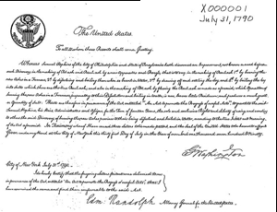
    First U.S. PatentThe U.S. Patent and Trademark Office announced earlier today that it has issued U.S. Patent No. 10,000,000.  The '000 patent, entitled "Coherent Ladar Using Intra-Pixel Quadrature Detection," is directed to a frequency modulated (coherent) laser detection and ranging system, which the Office indicated "symbolizes the breadth of American invention, with applications in such varied fields as autonomous vehicles, medical imaging devices, military defense systems, and space and undersea exploration."

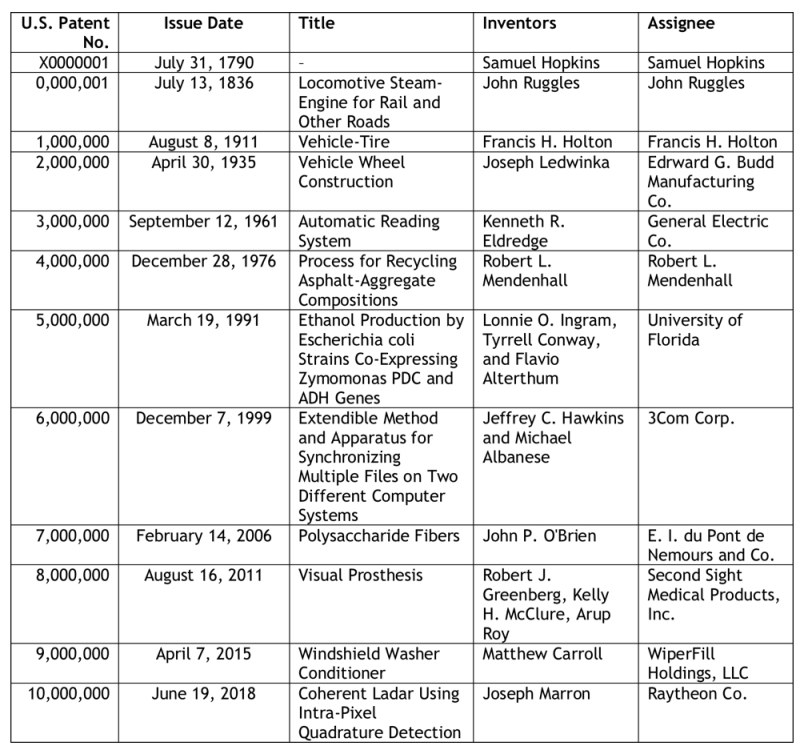
    According to the Office, the issuance of the 10 millionth U.S. patent was "[m]ore than just a number," and the milestone "celebrates the rich history and strength of the American intellectual property system dating back to the first U.S. patent."  That patent (above, right) was issued 228 years ago on July 31, 1790 to Samuel Hopkins for a process of making potash, an ingredient used in fertilizer.  The table below shows milestone U.S. patents issued between Hopkins' patent and today's 10 millionth patent.

    Table - US Patents
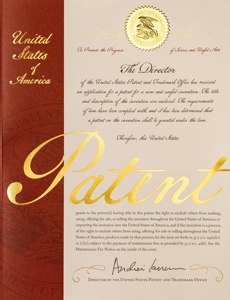
    New Patent CoverSecretary of Commerce Wilbur Ross asserted that "[i]nnovation has been the lifeblood of this country since its founding," and suggested that "[g]iven the rapid pace of change, we know that it will not take another 228 years to achieve the next 10-million-patent milestone."  USPTO Director Andrei Iancu declared that U.S. Patent No. 10,000,000 "represents one of ten million steps on a continuum of human accomplishment launched when our Founding Fathers provided for intellectual property protection in our Constitution," adding that "[s]ome of the greatest leaps humanity has made have been fueled by our greatest inventors, Americans who have changed the course of history with their brilliance and dogged perseverance."  Commissioner for Patents Drew Hirshfeld stated that "[t]he U.S. patent system serves as a reminder that our nation values and continues to be built by those who are willing to take risks, challenge traditions, push the boundaries of convention, and test new limits in design and thought."

    The Office pointed out that U.S. Patent No. 10,000,000 is the first U.S. patent to be issued with the new cover design (above, right) that was unveiled by the Office at the SXSW Interactive Festival in March.  The new cover design is only the second change in the patent cover in the last 100 years.

    As part of the milestone, the Office has provided an interactive timeline highlighting important moments, notable inventors, changing patent designs, and other interesting facts over more than two centuries of innovation in America.

  • Patentee Equitably Estopped from Asserting Patent Due to 10-Year Delay in Filing Suit

    By Donald Zuhn

    District Court for the Central District of CaliforniaEarlier this year, in Akeso Health Sciences, LLC v. Designs for Health, Inc., District Judge S. James Otero of the U.S. District Court for the Central District of California granted a motion for summary judgment filed by Defendant Designs for Health, Inc. ("DFH"), in which DFH argued, inter alia, that Plaintiff Akeso Health Sciences, LLC should be equitably estopped from asserting U.S. Patent No. 6,500,450 due to Akeso's ten-year delay in filing suit.  Akeso had filed suit against DFH for infringement of the '450 patent, which relates to a dietary supplement for the treatment of migraine headache, asserting that DFH's manufacture and sale of the migraine treatment product Migranol indirectly infringed the asserted claims due to various instructions and implications on the label.

    On April 18, 2006, counsel for Akeso's founder and the sole inventor of the '450 patent, Curt Hendrix, sent a letter to DFH informing DFH of Hendrix's ownership of the '450 patent and demanding that, due to the "similarity" between Migranol and the compositions of the patent, DFH "cease manufacture and/or distribution of [Migranol], remove the inventory of [Migranol] from any stores in which you have placed the product, destroy all inventory and returned product labeled as [Migranol] and provide our office with written confirmation of your specific actions in these regards by the close of business on May 1, 2006."  On April 27, 2006, counsel for DFH responded that it required additional time to analyze the patent and discuss the issue with DFH, and that it would provide a response "no later than 12 May 2006."  However, no further communications were exchanged between Akeso and DFH until Akeso filed its infringement action on October 18, 2016.  DFH responded to Akeso's complaint by filing a motion for summary judgement.

    The District Court noted that the applicability of equitable estoppel is "committed to the sound discretion of the trial judge," citing A.C. Aukerman Co. v. R.L. Chaides Constr. Co., 960 F.2d 1020, 1042 (Fed. Cir. 1992) (en banc).  Quoting Radio Sys. Corp. v. Lalor, 709 F.3d 1124, 1130 (Fed. Cir. 2013), the Court explained that:

    Three elements are required for equitable estoppel to bar a patentee's suit: (1) the patentee, through misleading conduct (or silence), leads the alleged infringer to reasonably infer that the patentee does not intend to enforce its patent against the alleged infringer; (2) the alleged infringer relies on that conduct; and (3) the alleged infringer will be materially prejudiced if the patentee is allowed to proceed with its claim.

    The Court indicated that for silence to be considered misleading, it "must be accompanied by some other factor which indicates that the silence was sufficiently misleading as to amount to bad faith," citing Hemstreet v. Computer Entry Sys. Corp., 972 F.2d 1290, 1295 (Fed. Cir. 1992) (emphasis in original).  Citing Meyers v. Asics Corp., 974 F.2d 1304, 1309 (Fed. Cir. 1992) (citations and quotations omitted), the Court also noted that "[i]n the cases that have applied intentionally misleading silence in the patent infringement context, a patentee threatened immediate or vigorous enforcement of its patent right but then did nothing for an unreasonably long time."  [It should be noted that in SCA Hygiene Products Aktiebolag v. First Quality Baby Products, LLC, where the Supreme Court eliminated laches as a defense in patent infringement actions, the Court indicated that equitable estoppel remained a viable defense.]

    According to the Court, the sole question in the dispute between Akeso and DFH was whether the ten-year silence after DFH received the cease-and-desist letter was by itself sufficiently misleading as to provide a basis for equitable estoppel.  On this question, the Court noted that the Federal Circuit's decisions in Hemstreet and Aspex Eyewear Inc. v. Clariti Eyewear, Inc. were instructive.  After reviewing these decisions, the Court stated that "[t]aken together, these cases suggest that in order for a period of silence to be construed as misleading, the initial contact leading to silence must be 'adversarial' in that it can be reasonably viewed 'as a threat of an infringement suit' rather than a 'license negotiation.'"  According to the Court:

    Here, the language of the cease-and-desist letter mirrors Aspex far more than it does Hemstreet; Hendrix demands that DFH immediately cease manufacture and distribution of the accused product as well as destroy all of its current inventory.  . . .  At no point in the letter does Hendrix suggest that licensing is a possibility.  There is simply no plausible interpretation that Hendrix's position was non-adversarial; the threat of litigation was implied heavily throughout, even if not explicitly stated.

    Upon finding that the cease-and-desist letter to DFH constituted a threat of litigation for the purposes of finding a misleading silence, the Court next turned to the question of whether the delay in filing suit constituted an "unreasonably long time."  The Court noted that "[w]hen DFH failed to meet its own extended deadline, Hendrix chose not to follow up on his threats," and concluded that "[t]his decision could have been interpreted by DFH, after a reasonable period of time, as a relinquishment of Hendrix's infringement claims."

    The Court indicated that its finding was further bolstered by 35 U.S.C. § 286, which precludes a patentee from recovering for any infringement committed more than six years prior to the filing of the complaint.  In particular, the Court explained that "the patentee's failure to preserve over four years' worth of potential lost profits is reasonably interpreted as an abandonment of its claims."  With respect to the first element of equitable estoppel, the Court therefore found that "the patentee, through misleading conduct (or silence), [led] the alleged infringer to reasonably infer that the patentee [did] not intend to enforce its patent against the alleged infringer," quoting Radio Sys. Corp. v. Lalor, 709 F.3d at 1130.

    With respect to the second element, detrimental reliance, the Court cited a declaration submitted by DFH Chairman Jonathan Lizotte stating that if Akeso had diligently pursued its claim of infringement, DFH would have considered modifying Migranol's labeling and/or composition to avoid DFH's claims or directing its investment, marketing, production and sales efforts into other products.  In response to Akeso's argument that DFH did rely on Akeso's conduct because its sales of Migranol were relatively low between 2006 and 2010 and did not substantially increase until 2012 to 2017, the Court pointed out that "an inference of abandonment would have been substantially bolstered after six years had passed from Akeso's threat of infringement, and therefore, "[c]ontrary to Akeso's arguments, the longer DFH waited to invest in Migranol, the stronger its claim of reliance may be."  The Court therefore concluded that DFH had adequately demonstrated reliance.

    Finally, with respect to the third element, material prejudice, the Court noted that in the six years leading up to Akeso's suit, DFH's marketing and investment efforts in Migranol yielded sales that nearly quadrupled its revenue.  The Court concluded that "[r]ather than demonstrate that the investment was 'simply a business decision to capitalize on a market opportunity,' as Akeso claims, these facts indicate more strongly that Akeso saw a market opportunity to resuscitate its previously abandoned claims in order to capitalize on DFH's stronger revenues."  The Court therefore found that "DFH would be undeniably prejudiced if the Court allowed Akeso to bring forth its claims only after DFH made substantial investments in its product."

    Finding evidence in support of all three elements for equitable estoppel to bar Akeso's suit, the District Court granted DFH's motion for summary judgment.

    Akeso Health Sciences, LLC v. Designs for Health, Inc. (C.D. Cal. 2018)
    Order Granting Defendant's Motion for Summary Judgment by District Judge Otero

  •     By Bryan Helwig

    Gavel_2About Court Report:  Each week we will report briefly on recently filed biotech and pharma cases, and a few interesting cases will be selected for periodic monitoring.


    Fresenius Kabi USA, LLC v. Eurohealth International Sarl
    1-18-cv-00835; filed June 1, 2018 in the District Court of Delaware

    • Plaintiffs: Fresenius Kabi USA, LLC and Fresenius Kabi Deutschland GmbH
    • Defendant: Eurohealth International Sarl

    Claim: Infringement of U.S. Patent Nos.
    9,248,229: ″Packaging System for Oxygen-Sensitive Drugs″
    9,731,082: ″Drug Container″

    Synopsis: Fresnius claims infringement of the ′082 and ′229 patents.  Fresenius owns all rights, title, and interest in the '082 and '229 patents.  Fresenius is the holder of NDA No. 019034 for Dilaudid® Injection.  Eurohealth submitted amendments to ANDA No. 202159 to engage in the commercial manufacture, use, importation, offer for sale, or sale of generic Deluadid® Injection.

    View the complaint here.


    Cipla Ltd. v. Eli Lilly and Company
    1-18-cv-01671; filed June 1, 2018 in the Southern District of Indiana, Indianapolis Division

    • Plaintiffs: CIPLA Ltd. and CIPLA USA, Inc.
    • Defendants: Eli Lilly and Company and ICOS Corp.

    Claim: Infringement of U.S. Patent Nos.
    6,821,975: ″Beta-carboline drug products″
    7,182,958: ″β-Carboline Pharmaceutical Compositions″

    Synopsis: Cipla seeks a declaratory judgment that the ′975 and ′958 patents are invalid.  ICOS is the assignee of the ′975 and ′958 patents.  Lilly is the exclusive licensee of both patents.  The patents are associated with submitted NDA No. 022332.  Cipla was not the first generic drug manufacturer to file an ANDA directed to tadalafil tablets in the 20 mg dosage strength.  Cipla sent Lilly and ICOS notice of Cipla's Paragraph IV certification with ANDA No. 210255.  Cipla's Notice Letter initiated a 45-day statutory period during which Defendants did not file an action against Cipla for infringement of the '975 or '958 patents.  Cipla believes the patents are an impediment to entry into the market.  As a subsequent ANDA filer, Cipla's ANDA for 20 mg tadalafil tablets cannot be approved by the FDA until the first ANDA filer's 180-day exclusivity period is either forfeited or runs out.  As of the date of this Complaint, the '975 and '958 patents are the only two remaining unexpired patents listed on the Orange Book for NDA No. 022332.  As such, there are no patents barring the first ANDA filer from entering the market.  Additionally, no first ANDA filer has entered the market.  Cipla seeks a declaratory judgment to allow entry into the market.

    View the complaint here.


    Astellas Parma Inc. v. Cipla Ltd.
    1-18-cv-00844; filed June 5, 2018 in the District of Delaware

    • Plaintiffs: Astellas Pharma Inc.; Astellas Pharma U.S., Inc.; Astellas Ireland Co., Ltd.; and Astellas Pharma Europe Ltd.
    • Defendant: Cipla Ltd.

    Claim: Infringement of U.S. Patent No.
    6,017,927: ″Quinuclidine derivatives and medicinal composition thereof″

    Synopsis: Astellas claims infringement of the ′927 patent.  Astellas Pharma U.S., Inc. holds approved NDA No. 21518 for VESIcare® tablets in 5 mg and 10 mg strength tablet dosage forms, which contain the active ingredient solifenacin succinate.  VESIcare® is indicated for treatment of overactive bladder with symptoms of urge urinary incontinence, urgency, and urinary frequency.  Cipla submitted ANDA No. 209839 for generic solifenacin succinate 5 mg and 10 mg tablets, as a pharmaceutical composition in an oral dosage form for the treatment of overactive bladder prior to the expiration of the '927 patent.  In response, Plaintiffs filed for patent infringement.

    View the complaint here.


    Biozone Laboratories, Inc. v. Next Step Laboratories Corp.
    1-18-cv-03296; filed June 5, 2018 in the Eastern District of New York (Brooklyn)

    • Plaintiff: Biozone Laboratories, Inc.
    • Defendants: Next Step Laboratories Corp. and Richard Rigg

    Claim: Infringement of U.S. Patent Nos.
    6,610,322: ″Self forming, themodynamically stable liposomes and their applications″
    6,958,160: ″Self forming, thermodynamically stable liposomes and their applications″
    6,495,596: ″Compounds and methods for inhibition of phospholipase A2 and cyclooxygenase-2″
    6,998,421: ″Compounds and methods for inhibition of phospholipase A2 and cyclooxygenase–2″
    7,150,883: ″Self forming, thermodynamically stable liposomes and their applications″
    7,718,190: ″Self forming, thermodynamically stable liposomes and their applications

    Synopsis: BioZone claims infringement of patents ′322, ′160, ′596, ′421, ′883, and ′190.  The Patents-in-Suit cover BioZone’s proprietary QuSome® and Inflacin® proprietary technologies.  Plaintiffs claim Defendants directly and indirectly infringe, by offering to sell QuSomes Products according to the claims of the patents-in-suit.

    View the complaint here.


    H. Lundbeck A/S v. MSN Laboratories Private Ltd.
    1-18-cv-00853; filed June 7, 2018 in the District of Delaware (Wilmington)

    • Plaintiffs: H. Lundbeck A/S, Takeda Pharmaceutical Co. Ltd., Takeda Pharmaceuticals U.S.A., Inc., Takeda Pharmaceuticals International AG, and Takeda Pharmaceuticals America, Inc.
    • Defendants: MSN Laboratories Private Ltd., MSN Pharmaceuticals, Inc., and MSN Pharmachem Private Ltd.

    Claim: Infringement of U.S. Patent No:
    9,861,630: ″1-[2-(2,4-dimethylphenylsulfanyl)-phenyl]piperazine as a compound with combined serotonin reuptake, 5-HT.sub.3 and 5-HT.sub.1A activity for the treatment of cognitive impairment″

    Synopsis: Plaintiffs claim infringement of the ′630 patent.  Plaintiff H. Lundbeck is the assignee and owner of the ′630 patent.  Lundbeck granted Takeda Japan an exclusive license to the ′630 patent.  Takeda Japan issued sublicenses to its subsidiary Plaintiffs.  Takeda USA is the holder of New Drug Application ("NDA") No. 204447 for TRINTELLIX® tablets (5 mg, 10 mg, 15 mg, and 20 mg dosage strengths) containing the active ingredient vortioxetine hydrobromide for the treatment of Major Depressive Disorder.  Defendants have submitted ANDA No. 211101 to FDA, or caused ANDA No. 211101 to be submitted to FDA, under 21 U.S.C. § 355(j), in order to obtain approval to engage in the commercial manufacture, use, or sale of vortioxetine hydrobromide tablets as purported generic versions of TRINTELLIX® tablets prior to the expiration of the ’630 Patent.

    View the complaint here.


    Purdue Pharma LP v. Ascent Pharmaceuticals, Inc.
    1-18-cv-00855; filed June 7, 2018 in the District Court of Delaware (Wilmington)

    • Plaintiffs: Purdue Pharma L.P., Purdue Pharmaceuticals L.P., P.F. Laboratories, Inc., Rhodes Technologies, and Grünenthal GmbH
    • Defendant: Ascent Pharmaceuticals, Inc.

    Claim: Infringement of U.S. Patent Nos:
    8,309,060: ″Abuse-proofed dosage form″
    9,060,976: ″Pharmaceutical formulation containing gelling agent″
    9,073,933: ″Oxycodone hydrochloride having less than 25 PPM 14-hydroxycodeinone″
    9,149,533: ″Tamper resistant pharmaceutical formulations″
    9,522,919: ″Oxycodone compositions″
    9,675,610: ″Abuse-proofed dosage form″
    9,861,582: ″Pharmaceutical formulation containing gelling agent″

    Synopsis: Plaintiffs claim infringement of the ′060, ′976, ′933, ′533, ′919, ′610, and ′582 patents.  Plaintiffs have approved NDA No. 022272 in the 10 mg, 15 mg, 20 mg, 30 mg, 60 mg and 80 mg dosage strengths.  Defendant filed ANDA No. 211178 seeking approval to engage in the commercial manufacture, use, or sale of Defendant's ANDA Products, a generic product based on the Reference Listed Drug OxyContin®, which is the subject of approved NDA No. 022272.  Plaintiffs sued for patent infringement.

    View the complaint here.


    Teijin Ltd. v. MSN Laboratories Private Ltd.
    1-18-cv-00881; filed June 7, 2018 in the District Court of Delaware (Wilmington)

    • Plaintiffs: Teijin Ltd., Teijin Pharma Ltd., and Takeda Pharmaceuticals U.S.A., Inc.
    • Defendants: MSN Laboratories Private Ltd. and MSN Pharmaceuticals, Inc.

    Claim: Infringement of U.S. Patent Nos:
    7,361,676: ′Solid preparation containing single crystal form″
    8,372,872: ″Methods for concomitant treatment of theophylline and febuxostat″
    9,107,912: ″Methods for concomitant treatment of theophylline and febuxostat″

    Synopsis: Plaintiffs claim infringement of the ′676, ′872, and ′912 patents.  Plaintiffs own the patents noted.  In addition, Takeda holds NDA No. 21-856 for oral tablets containing 40 mg or 80 mg of the active ingredient febuxostat.  Takeda markets and sells these tablets in the United States under the brand name Uloric®.  MSN certified in ANDA No. 210461 that the claims of 7 the patents-in-suit are invalid, unenforceable, or would not be infringed by the commercial manufacture, use, offer for sale, or sale of MSN’s Generic Products.  Plaintiff claims the Defendant infringes the claims of the ′676, ′872, and ′912 patents.

    View the complaint here.