• By Joseph Herndon —

    USPTO SealOn August 8, 2018, Director Iancu issued a letter to the Patent Public Advisory Committee notifying of proposed fee increases at the U.S. Patent and Trademark Office, and institution of new annual fee for active patent practitioners.

    The Director stated that the fee increases are needed to ensure commitment to fiscal responsibility, financial prudence, and operational efficiency.

    This is a patent fee proposal open for comment at this stage, and the Director stated that it is anticipated that the fee adjustments resulting from this effort will not be implemented until the January 2021 timeframe.  Generally, there are across the board fee increases, and the USPTO stated that given the nearly three-year gap between the implementation of the last fee adjustments and the anticipated effective date of this fee setting effort, a five percent increase to fees is similar to fees rising by 1.6 percent annually.

    In addition to the across the board increase in fees that will help raise revenue, this proposal includes introduction of new fees, targeted adjustments to existing fees, and discontinuation of some fees.

    New Fees

    1.  One proposed new fee is a surcharge for filing in a non-DOCX format.  This will be a $400 fee, and will encourage applicants to use the DOCX format, and is intended to improve Office efficiency and future search capabilities.

    2.  Another proposed new fee is an annual active patent practitioner fee of $340 (if filed electronically).  This will be similar to the annual fees charged by the vast majority of state and territorial bars, and will allow the costs associated with the services the Office of Enrollment and Discipline (OED) provides practitioners in administering the disciplinary system and roster maintenance to be recovered directly from those practitioners.  Further, a discount will be offered to those who certify completion of continued legal education (CLE), reducing the fee to $240.

    3.  A fee for non-registered practitioners to appear before the PTAB is proposed.

    Adjustments to Existing Fees

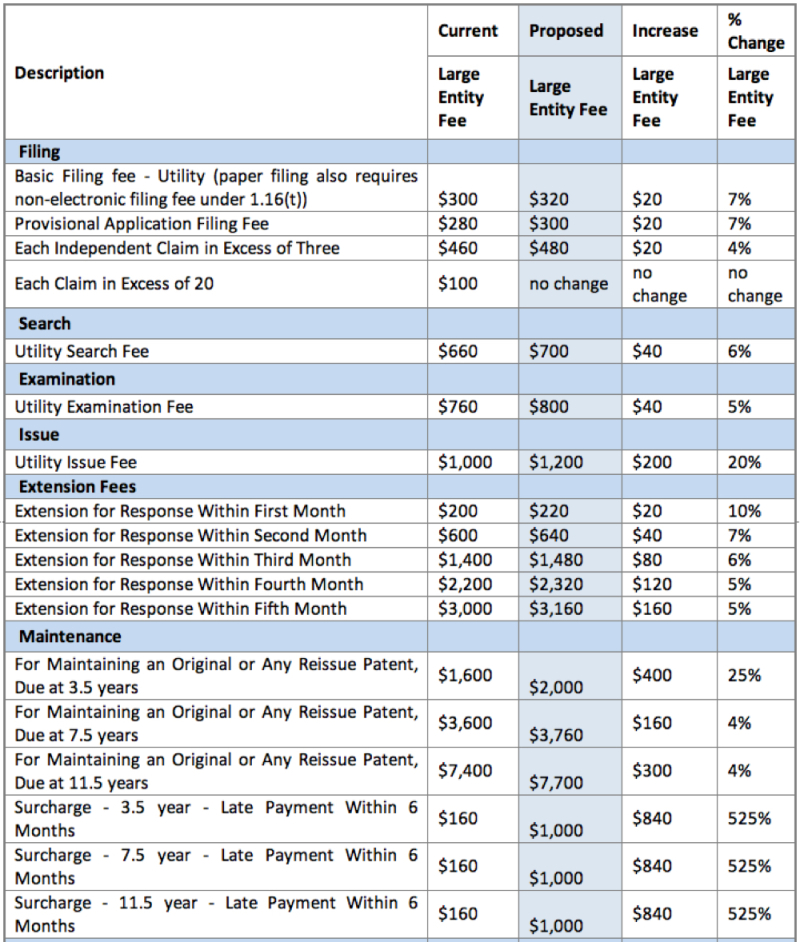
    1.  A significant increase (525%) to the surcharge for late payment of maintenance fees in order to encourage timely payment.  The fee is currently $160, but will be increased to $1000 for large entities.

    2.  An increase to the fee to request expedited examination of a design application, to help the Office manage staffing for these services (e.g., from $900 to $2000).

    3.  Issue and maintenance fees will be restructured under this proposal in order to recover initial search and examination costs earlier in the patent lifecycle.  The Office noted that as technology lifecycles grow shorter, it is important that USPTO not rely too heavily on fees paid late in the life of a patent.  As a result, some of these fees are proposed to increase by various amounts higher or lower than the five percent mentioned above.  The current large entity maintenance fees are $1600 (3.5 years), $3600 (7.5 years), and $7400 (11.5 years), and the proposal increases to $2000 (3.5 years), $3760 (7.5 years), and $7700 (11.5 years).

    4.  Fees for America Invents Act (AIA) trials are proposed to increase by roughly 25% due to a variety of factors, including the Supreme Court decision in SAS Institute Inc. v. Iancu.  The Office noted that the PTAB will no longer be able to institute on less than all claims challenged in a petition, leading to significant additional work for a given instituted inter partes review (IPR).

    Discontinuation of Fees

    Finally, the USPTO is proposing to discontinue three patent service fees, and instead provide those services, in a slightly modified form, for free.  Namely, these include fees related to obtaining copies of Patent Grant and Patent Application Publication TIFF Images or Full-Text W/Embedded Images.  These service fees will be eliminated and the Office will instead provide these services, in a slightly modified form (i.e. electronic), for free.

    Details of the proposal can be found here including a full spreadsheet of all fees and proposed changes (spreadsheet also available here).  Below is a summary table of the common fees for a large entity to illustrate some of the proposed changes.

    As seen below, total filing costs for a patent application (large entity) are currently $1720 and are proposed to increase to $1820.

    Table 1A_Fees Table 1B_Fees

  • By Steve Kennedy* and Anthony D. Sabatelli** —

    Over the last decade, antibody-drug conjugates (ADCs) have emerged as a highly promising new class of biopharmaceuticals.  By taking advantage of the specificity of monoclonal antibodies and the potency of small-molecule chemotherapy drugs, ADCs have proven to provide a highly effective combination — particularly in the oncology space.  The recent FDA approvals of Kadcyla (Genentech), Adcetris (Seattle Genetics), Mylotarg (Wyeth Holdings / Pfizer), and Besponsa (Wyeth Holdings / Pfizer), as well as the over sixty other ADCs in clinical trials, show that these drugs represent an increasing proportion of newly approved cancer therapies and will generate growing revenues for firms innovating in the field.  Accompanying this burst in ADC development is the corresponding activity in the patent space.  This article summarizes some of the important developments.

    ADC Mechanism of Action

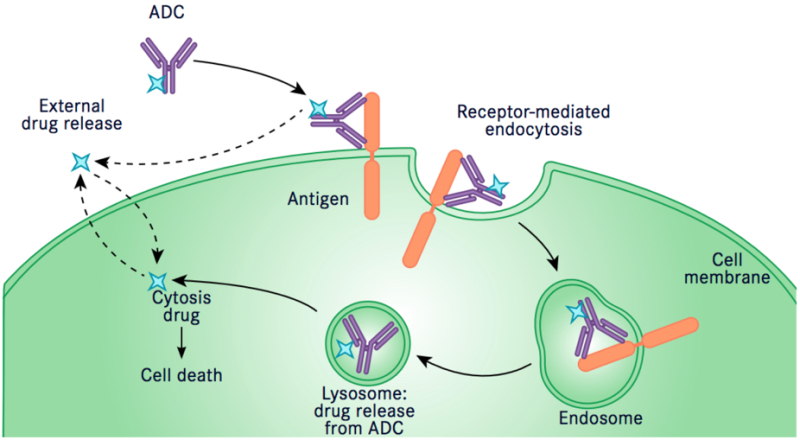
    An ADC is composed of an antibody conjugated to a cytotoxic compound (the payload) via a chemical linker. Traditional chemotherapy drugs can be highly effective at destroying cancer cells, but in general their specificity for cancer tissue is extremely low, and many healthy cells are killed as well. However linking highly potent anticancer drugs to antibodies that bind to antigens present at high levels in tumor cells greatly improves drug specificity for the cancer cells and reduces side effects. Generally, once an ADC binds an antigen on the cancer cell surface, it is internalized and sent along the endosome/lysosome pathway for degradation. In the lysosome the payload is released either through specific cleavage of the linker by lysosome enzymes or general degradation of the antibody. The released cytotoxic compound then leaves the lysosome and causes death of the cancer cell.  See the following scheme which illustrates this biochemical process.

    FigureSeveral processes by which ADCs specifically target and destroy cancer cells.  Figure from Lu et al., "Linkers Having a Crucial Role in Antibody-Drug Conjugates," Int. J. Mol. Sci. 17(4): 561 (2016).

    ADC Patent Landscape

    The ADC research space and development pipeline are growing rapidly.  This section is not meant as an exhaustive review of the patent landscape. Rather this section will provide insight into unique patent strategies employed for the intellectual property protection of ADC drugs. Because ADCs represent an extension of the well-established field of conventional therapeutic antibodies and a combination of biologic and organic drug components, the patent landscape is relatively crowded. However, the three components of an ADC, i.e. the antibody, the payload drug, and the linker, as well as their unique combination provide significant opportunities for innovation.

    Early ADC therapies suffered from low potency relative to standard chemotherapy agents. However, developments in linker technologies and the use of cytotoxic agents that were otherwise too potent for direct administration greatly improved ADCs' effectiveness. The first ADC therapy approved by the FDA, is marketed as Mylotarg (acquired by Pfizer via Wyeth Holdings). This drug targets the antigen CD33, which is expressed at high levels on the surface of acute myeloid leukemia cells, to deliver a highly toxic calicheamicin payload. Mylotarg had a challenging history, and despite accelerated approval in 2000, it was voluntarily removed from the market after several early deaths in follow-on confirmatory trials. After significant adjustments to the dosing regimen, Mylotarg was reapproved in 2017.  See, (US5773001)

    Since Mylotarg's first introduction to the market, three other ADC drugs have been approved by the FDA. Besponsa (US9351986B2, Wyeth Holdings) employs the same payload and linker of Mylotarg conjugated to an anti-CD22 antibody that targets B-cell precursor acute lymphoblastic leukemia cells. Both Mylotarg and Besponsa employ hydrazone linkers that are specifically cleavable in the lysosome and are otherwise highly stable in circulation. The calicheamicin payloads delivered by these drugs had also been under investigation by other groups, such as American Cyanamid Company as seen by an early patent from this area (US5714586).

    Adcetris (US7829531), licensed by Seattle Genetics, targets the antigen CD30, which is present at high levels in certain non-Hodgkins lymphoma cells. Its valine-citrulline linker (US7745394) is specifically cleavable by cathepsin B, a lysosome enzyme, allowing rapid release of the payload after internalization. Citrulline, biologically generated by post-translational modification of arginine residues, has higher stability in circulation than other amino acids and improves the bioavailability of valine-citrulline-linked ADCs. Other companies such as Ambrx (US9975936) have attempted to push this approach further through the use of nonnatural amino acids with even higher stability. Adcetris delivers a highly-potent MMAE payload (US6884869). Companies such as Mersana have developed several other auristatin compounds for use as ADC payloads (US9943609).

    Kadcyla (US8337856), licensed by Genentech, targets the HER2 antigen expressed at high levels in certain metastatic breast cancers and delivers the chemotherapy agent DM1. Its linker is noncleavable, but degradation of the antibody in the acidic environment of the lysosome eventually leads to payload release. The DM1 payload is typical of the relatively large class of maytansinoid cytotoxic agents, which are under development by several companies such as ImmunoGen (US5208020).

    As will be discussed in greater detail in future pieces, novel approaches to ADC antibodies, linkers, and payloads have been developed, both from a technological and IP perspective. The targeting of noninternalizing antigens (US20150030536, US20170028080A1) has generated particular excitement. Additionally novel antibody formats (US9290577, US9856314), the use of masked proproteins (US20130101555), and conditionally-active antibodies (US9637734B2) have provided new targeting mechanisms.

    Linker technologies also present significant opportunities for innovation. Different biological conjugation and cleavage mechanisms have been developed, such as the use of reactive thiols on engineered cysteine residues (US7521541B2), sortase-mediated conjugation (US9872923), MTGase-mediated linkage (US15214331), and transglutaminase linkage (US20170106096A1). Several other proprietary linkers have been developed as well (US9540438B2, US7223837B2).

    Payload development provides further opportunities for innovation. Both previously-developed and novel cytotoxic agents have been employed as ADC payloads, such as anthracyclin derivatives (US8900589), duocarmycins (US9629924B2, US5475092, US5585499), taxanes (US7390898), benzodiazepine derivatives (US9889207B2, US8765740, US9242013B2, US15724423), and tubulysins (US9801951B2).

    As evidenced from this research and IP activity, ADCs provide an innovative solution to intractable cancers, and there are significant opportunities for technical innovation. It will be particularly interesting to see how companies manage the overlapping intellectual property landscape and nearing expirations of patents on naked antibodies and payloads that could be used in ADC therapies. Later in this series, we will discuss in greater depth advancements in antibody, linker, and payload technologies, as well as patent strategies for navigating the significant patent landscape.

    Table 1a Table 1b

    * Steve Kennedy is a Ph.D. Candidate in the Chemistry Department at New York University.  He specializes in biophysical characterization of protein complexes and is currently focused on the role of adaptor proteins in signaling pathways.  Prior to attending NYU, Steve obtained his B.S. in Chemistry with Cum Laude honors at the University of Massachusetts – Boston, during which time he conducted bioanalytical mass spectrometry method development and lipidomics research.
    ** Dr. Sabatelli is a Partner with Dilworth IP

  • CalendarAugust 14, 2018 – Patent Quality Chat webinar (U.S. Patent and Trademark Office) – 12:00 to 1:00 pm (ET) on 

    August 16, 2018 – "Patent Drafting for Machine Learning: Structural Claim Limitations, Avoiding 101 or 112 Rejections" (Strafford) – 1:00 to 2:30 pm (EDT)

    August 16-17, 2018 – "Advanced Patent Prosecution Workshop 2018: Claim Drafting & Amendment Writing" (Practising Law Institute) – San Francisco, CA

    August 21, 2018 – "Navigating the Patent Prosecution Highway and Other Accelerated Filing Options — Evaluating the Different Options, Weighing the Benefits and Risks, Obtaining Patent Protection" (Strafford) – 1:00 to 2:30 pm (EDT)

    August 21, 2018 – "Patent Infringement Litigation: A Thorough Analysis of 2018 Developments and Its Implications for the Year Ahead" (The Knowledge Group) – 12:00 to 1:00 pm (ET)

    August 23, 2018 – "Antibody Patenting and Licensing Challenges in Light of Amgen v. Sanofi" (Technology Transfer Tactics) – 1:00 to 2:00 pm (ET)

    August 28, 2018 – "Ethics in USPTO Practice in 2018 – Understanding the Behavior as Well as the Rules" (Federal Circuit Bar Association) – 3:00 pm to 4:30 pm (EST)

    August 28, 2018 – "Structuring Patent Indemnification Provisions — Allocating Infringement Risk While Accounting for Changes to PTAB Estoppel and Statutory Bar Requirements" (Strafford) – 1:00 to 2:30 pm (EDT)

    September 21, 2018 – "USPTO Post-Grant Patent Trials 2018: Change & Recalibration" (Practising Law Institute) – New York & Groupcasts in Philadelphia, Indianapolis, New Brunswick, NJ, Pittsburgh, and Mechanicsburg, PA

    September 27-28, 2018 – "Advanced Patent Prosecution Workshop 2018: Claim Drafting & Amendment Writing" (Practising Law Institute) – Chicago, IL

  • Technology Transfer Tactics will be offering a webinar entitled "Antibody Patenting and Licensing Challenges in Light of Amgen v. Sanofi" on August 23, 2018 from 1:00 to 2:00 pm (ET).  Patent Docs author Kevin E. Noonan of McDonnell Boehnen Hulbert & Berghoff LLP will address the following topics:

    • Technology background
    • Legal development
        – Enablement v. written description
        – Noelle v Ledermann
        – Centocor v. Abbott
        – AbbVie v. Janssen
        – Yeda v. Abbott
    • Amgen v. Sanofi: the Federal Circuit clarifies written description for antibodies
        – Ariad v. Eli Lilly
    • Implications on antibody patent scope
    • Effects on licensing
    • Alternative antibody embodiments
    • Retroactivity
    • Strategy going forward
        – Review and revision of pending patents
        – Claim construction
        – How faculty researchers can help
        – Use of third-parties for characterization

    The registration fee for the webinar is $197.  Those interested in registering for the webinar, can do so here.

    Technology Transfer Tactics

  • Federal Circuit Bar AssociationThe Federal Circuit Bar Association (FCBA) will be offering a webcast entitled "Ethics in USPTO Practice in 2018 – Understanding the Behavior as Well as the Rules" on August 28, 2018 from 3:00 pm to 4:30 pm (EST).  Rey Barceló of Barceló, Harrison & Walker, LLP and Jenny C. Wu of Paul, Weiss, Rifkind, Wharton & Garrison LLP will moderate a panel consisting of Bernie Knight of BK Consulting LLC (former General Counsel, U.S. Patent and Trademark Office) and Dahlia George of the U.S. Patent and Trademark Office of Enrollment & Discipline (OED).  The panel will review the Office of Enrollment & Discipline ethics rules and how they were amended in May 2013, provide an overview of disciplinary ethics proceedings and how they are instituted, analyze the importance of both emotional intelligence and strong core values to ethical decision making, and examine the role that alcohol/drug abuse and mental health issues may play in ethics violations and how the new U.S. Patent and Trademark Office diversion program can help qualified practitioners.

    The webinar is complimentary for FCBA members and $50 (government/academic/retired) or $125 (private practitioner) for non-members.  Those interested in registering for the webcast, can do so here.

  • Strafford #1Strafford will be offering a webinar entitled "Structuring Patent Indemnification Provisions — Allocating Infringement Risk While Accounting for Changes to PTAB Estoppel and Statutory Bar Requirements" on August 28, 2018 from 1:00 to 2:30 pm (EDT).  William (Ty) Giltinan and Eleanor M. Yost of Carlton Fields Jorden Burt will prepare counsel to IP owners, licensees and licensors to protect their interests by allocating patent infringement risks during negotiations of indemnification provisions in a patent license or vendor contract, and offer best practices for negotiating and structuring patent indemnification provisions to allocate risk.  The webinar will review the following issues:

    • What should patent counsel consider when structuring indemnification provisions?
    • When does an indemnification clause create privity under the IPR statutes?
    • What approaches should counsel use to protect a client’s interests when negotiating an indemnification provision?

    The registration fee for the webcast is $297.  Those interested in registering for the webinar, can do so here.

  • The Knowledge GroupThe Knowledge Group will offer a webcast entitled "Patent Infringement Litigation: A Thorough Analysis of 2018 Developments and Its Implications for the Year Ahead" on August 21, 2018 from 12:00 to 1:00 pm (ET).  Jeffery A. Stec of Berkeley Research Group, LLC and Lauren Kindler of Analysis Group will address economic damages in patent infringement cases, trends in patent filings since TC Heartland, and patent damages implications from recent rulings in  Ericsson v. TCL and Power Integrations v. Fairchild.

    The registration fee for the webcast is $49.  Those interested in registering for the webinar can do so here.

  • By Kevin E. Noonan —

    Federal Circuit SealIt is black-letter law that a claim must be enabled throughout its full scope in order to satisfy the enablement requirement of 35 U.S.C. § 112(a); see, e.g., Liebel-Flarsheim Co. v. Medrad, Inc., 481 F.3d 1371, 1378–79 (Fed. Cir. 2007).  And in the Federal Circuit's recent decision in Trustees of Boston University v. Everlight Electronics Co., violation of this rubric invalidated Boston University's claims.

    The claims were directed to light-emitting diodes (LEDs) as disclosed in U.S. Patent No. 5,686,738; claim 19 was the only claim at issue:

    A semiconductor device comprising:
        a substrate, said substrate consisting of a material selected from the group consisting of (100) silicon, (111) silicon, (0001) sapphire, (11–20) sapphire, (1–102) sapphire, (111) gallium aresenide, (100) gallium aresenide, magnesium oxide, zinc oxide and silicon carbide;
        a non-single crystalline buffer layer, comprising a first material grown on said substrate, the first material consisting essentially of gallium nitride; and
        a growth layer grown on the buffer layer, the growth layer comprising gallium nitride and a first dopant material.

    (where the italicized claim terms were relevant to the District Court's decision below and the Federal Circuit's contrary decision in its opinion).  As explained in the opinion, LEDs are conventionally made comprising several layers, which include a substrate, an "n-type" semiconductor layer and a "p-type" semiconductor layer.  As solid-state materials, these layers are either monocrystalline, polycrystalline, or amorphous (which can include species comprising a mixture of amorphous and polycrystalline types).  Finally, a particular method of producing semiconductor layers is termed epitaxy, which comprises depositing successive semiconductor material in such a way that the newly added material "mimics the substrate's crystal lattice structure" as the semiconductor layer grows.  One particular semiconductor material is gallium nitride (GaN) that emits blue light in response to passage of an electric current.

    The '738 patent describes a method for producing GaN semiconductors using a form of epitaxy termed molecular beam epitaxy, which is "a two step process comprising a low temperature nucleation step and a high temperature growth step."  This produces a first buffer layer of amorphous GaN when heated in the second step to "crystallize the amorphous layer."  This permits monocrystalline GaN to be grown on the crystallized substrate layer.

    The District Court construed the term "grown on" to mean "formed indirectly or directly above," and construed the term "a non-single crystalline buffer layer" to mean "a layer of material that is not monocrystalline," i.e., one that is polycrystalline, amorphous, or a mixture of amorphous and polycrystalline, and that is "located between the first substrate and the first growth layer."  The parties' disagreement, and the Federal Circuit's opinion, concerned construction of the term "grown on."

    As set forth in the opinion:

    Assuming a monocrystalline growth layer, together these constructions raise six permutations for the relationship between claim 19's growth layer and buffer layer: (1) monocrystalline growth layer formed indirectly on a polycrystalline buffer layer; (2) monocrystalline growth layer formed indirectly on a buffer layer that is a mixture of polycrystalline and amorphous; (3) monocrystalline growth layer formed indirectly on an amorphous buffer layer; (4) monocrystalline growth layer formed directly on a polycrystalline buffer layer; (5) monocrystalline growth layer formed directly on a buffer layer that is a mixture of polycrystalline and amorphous; and (6) monocrystalline growth layer formed directly on an amorphous buffer layer [emphasis in opinion].

    Defendants were found by a jury to infringe claim 19 and that they had not established that the claim was invalid.  The District Court denied Defendants' motion for judgment as a matter of law (JMOL) based on nonenablement under 35 U.S.C. § 112(a), holding that the specification did not need to enable producing a monocrystalline growth layer directly on an amorphous substrate, and that it disclosed producing such a monocrystalline growth layer indirectly on the amorphous substrate.  Both parties appealed.

    The Federal Circuit reversed, finding claim 19 to be invalid for nonenablement, in an opinion by Chief Judge Prost joined by Judges Moore and Reyna.  "The enablement issue in this case concerns this sixth permutation—a monocrystalline growth layer formed directly on an amorphous buffer layer," according to the opinion, and whether the specification provided an enabling disclosure for producing a monocrystalline growth layer formed directly on an amorphous buffer layer.  The panel held that it did not, a conclusion supported by testimony from Defendants' expert that it was "[physically] impossible to epitaxially grow a monocrystalline film directly on an amorphous structure"; patentee's expert did not disagree.  (Boston University also contended that the specification did not disclose epitaxial growth, but the panel rejected this argument based, inter alia, on the "saturated" repetition of the word "epitaxy" in the short, four-column specification.)  The Federal Circuit also rejected argument that others, including the inventor, had grown a monocrystalline layer directly on an amorphous substrate, because:

    [T]he inquiry is not whether it was, or is, possible to make the full scope of the claimed device—a scope that here covers a monocrystalline growth layer directly on an amorphous layer.  The inquiry is whether the patent's specification taught one of skill in the art how to make such a device without undue experimentation as of the patent's effective filing date.  Viewed in this light, BU's evidence is not probative of enablement.  BU does not even suggest that these results were accomplished by following the specification's teachings, or that achieving these results was within an ordinary artisan's skill as of the patent's effective filing date.

    (citing Enzo Biochem, Inc. v. Calgene, Inc., 188 F.3d 1362, 1376 (Fed. Cir. 1999)).

    As has been the case in other precedent, this decision does not vitiate the "supplemental" effects on a disclosure provided by knowledge of one skilled in the art or routine experimentation and does not stand for the proposition that a patentee "must expressly spell out every possible iteration of every claim."  See Genentech, Inc. v. Novo Nordisk A/S, 108 F.3d 1361, 1365 (Fed. Cir. 1997), and Sitrick v. Dreamworks, LLC, 516 F.3d 993, 1000 (Fed. Cir. 2008).  But "epitaxially growing a monocrystalline layer directly on an amorphous layer would have required undue experimentation" (being that the expert testimony established it would have been impossible at the time the invention was made) and the specification contained no teachings purporting to show such growth could be achieved according to the invention.

    The opinion notes in closing that what occurred here is not uncommon:

    [T]o some extent, BU created its own enablement problem.  BU sought a construction of "a non-single crystalline buffer layer" that included a purely amorphous layer.  Having obtained a claim construction that included a purely amorphous layer within the scope of the claim [presumably to provide a basis for its infringement allegations], BU then needed to successfully defend against an enablement challenge as to the claim's full scope [citations to the record omitted].

    Trustees of Boston University v. Everlight Electronics Co. (Fed. Cir. 2018)
    Panel: Chief Judge Prost and Circuit Judges Moore and Reyna
    Opinion by Chief Judge Prost

  • By Donald Zuhn —

    Federal Circuit SealLast week, in Otonomy, Inc. v. Auris Medical, AG, the Federal Circuit reversed the decision by the U.S. Patent and Trademark Office's Patent Trial and Appeal Board according to Auris Medical, AG the benefit of priority to its earlier-filed International application.  The Federal Circuit also affirmed the Board's determination that certain claims of Otonomy Inc.'s application are not anticipated by the publication of Auris Medical's International application.

    The dispute between the parties concerns an interference between Auris Medical's U.S. Patent No. 9,066,865 ("the '865 patent") and Otonomy's U.S. Patent Application No. 13/848,636 ("the '636 application").  The '865 patent issued to Auris on June 30, 2015 from U.S. Patent Application 14/317,319 ("the '319 application"), which was filed on June 27, 2014; the '319 application is a continuation of U.S. Patent Application No. 11/992,632 ("the '632 application"), which is a national stage application of International Application No. PCT/EP2005/010478 ("the '478 PCT"), which was filed on September 28, 2005, and which was published as International Publication No. WO 2007/038949 ("the WO '949") on April 12, 2007.  On the same day that Auris filed the '319 application, it also filed a preliminary amendment adding claims directed to therapeutic compositions containing various claimed active ingredients, including fluoroquinolones, for use in the claimed methods.  Otonomy's '636 application was filed on March 21, 2013.

    The commonly claimed invention involved in the interference is a method of using a suspended-fluoroquinolone composition to treat middle and inner ear disorders.  The Board designated claim 1 of the '865 patent as the sole count of the interference, indicating that all nine of the claims of the '865 patent and claims 38, 43, and 46-50 of the '636 application correspond to the count.  Claim 1 of the '865 patent recites:

    1.  A method of treating a middle or inner ear disease comprising intratympanically administering to a patient in need thereof a controlled release composition comprising a pharmaceutically active agent and a thermosetting polymer; wherein the pharmaceutically active agent is selected from antibiotics and is suspended in the composition, and the thermosetting polymer has a gelation temperature of at least about 15° C.,
        wherein the thermosetting polymer is poloxamer 407 and is present at a concentration of about 20% (w/w), and
        wherein the antibiotic is fluoroquinolone.

    In the interference, the Board authorized the following motions:

    • Auris Motion 1: requesting that the Board accord benefit to the '632 application and the '478 PCT;
    • Auris Motion 2: seeking judgment that Otonomy's involved claims are anticipated under 35 U.S.C. § 102(b) by the WO '949;
    • Otonomy Motions 1 and 2: seeking judgment that the claims of the '865 patent are unpatentable based on the written description and enablement requirements of 35 U.S.C. § 112; and
    • Otonomy Motion 6: requesting that the Board accord benefit to a chain of previously filed applications and provisional applications.

    In its decision on these motions, the Board denied Auris Motion 2, finding that there "is no discernable single embodiment which teaches all of the claim elements as arranged," and explaining that there was "too much picking and choosing among embodiments for one of ordinary skill in the art to envision the claimed invention."  With respect to Otonomy Motions 1 and 2, the Board denied Otonomy's written description challenge to the claims of the '865 patent (Motion 1), relying on the preliminary amendment Auris filed with the '319 application to provide the necessary disclosure, and determined that only claim 9 of the '865 patent was enabled (Motion 2).  The Board granted Auris Motion 1, according the '319 application the benefit of the '632 application and the '478 PCT.  Finally, with respect to Otonomy Motion 6, the Board found that the '636 application is entitled to the benefit of its parent nonprovisional applications, and therefore had an effective filing date of May 14, 2009.  As a result of its decisions on the above motions, the Board accorded Auris the benefit of a filing date (September 28, 2005 of the '478 PCT) before Otonomy's earliest alleged priority date (May 14, 2009), and therefore entered judgment against Otonomy on count 1.

    On appeal, Otonomy argued that the Board erred in denying Otonomy Motion 1, and in particular, that the Board erred by relying on a theory neither party advanced — "that the ['319] application supported the present claims on the basis of the preliminary amendment (rather than the body of the specification itself)."  In the alternative, Otonomy sought reversal of the Board's decision on claim 9 of the '865 patent, arguing that the Board erred in granting Auris Motion 1 and in according benefit to Auris Medical.  The Federal Circuit agreed with Otonomy's alternative argument, reversing the Board's decision on Auris Motion 1, and concluding that the '319 application was not entitled to the benefit of the '478 PCT.

    The Federal Circuit began by noting that accorded benefit is defined in 37 C.F.R. § 41.201 as "Board recognition that a patent application provides a proper constructive reduction to practice under 35 U.S.C. § 102(g)(1)," and citing Hunt v. Treppschuh, 523 F.2d 1386, 1389 (CCPA 1975), for the proposition that "[t]o establish a constructive reduction to practice and thereby the right to benefit of an earlier-filed application for priority purposes, the movant need only show that the earlier-filed application discloses a single embodiment within the scope of the interference count that complies with 35 U.S.C. § 112."  In arguing that the '478 PCT demonstrated that Auris Medical possessed at least a single embodiment within the scope of the interference count, Auris specifically pointed to Example 2 of the '478 PCT, which includes 20% poloxamer 407 and ketamine, and a separate teaching in the '478 PCT that an antibiotic such as fluoroquinolone could be used as an additional ingredient.  Otonomy countered that the '478 PCT did not teach that fluoroquinolone was "suspended in the composition," as required by the count.  The Board had sided with Auris Medical, concluding that because "there is an example of ketamine suspended in poloxamer" together with a "clear teaching of an additional embodiment with an additional ingredient, including fluoroquinolones," the '478 PCT described an embodiment that satisfied the count.  In reversing the Board, the Federal Circuit stated, however, that "[i]t is undisputed that the '478 PCT lacks any explicit disclosure of a single embodiment of a suspended-fluoroquinolone composition or its use."

    Returning to Otonomy Motion 1, the Federal Circuit determined that "[s]ubstantial evidence supports the Board's decision that the original specification of the '319 application does not provide sufficient written description support for the claimed suspended-fluoroquinolone composition."  In the interference, the Board had explained that it was relying exclusively on the preliminary amendment filed with the '319 application in deciding Otonomy Motion 1.  The significance of the Board's explanation is that since the specifications of the '319 application and '478 PCT are substantially identical, and the Board relied exclusively on the preliminary amendment filed with the '319 application to deny Otonomy's written description challenge, the '478 PCT could not provide written description of the subject matter of the count.  The Federal Circuit therefore concluded that '865 patent was not entitled to the benefit of the '478 PCT filing date, and could not claim priority any earlier than June 27, 2014 when the preliminary amendment was filed with the '319 application.  As a result, the Court determined that the Board erred in awarding priority to Auris Medical, reversed the judgment of priority against Otonomy, and remanded for entry of judgment on priority against Auris.

    With respect to Auris Medical's cross-appeal that the Board erred in concluding that the WO '949 does not anticipate Otonomy's claims, the Federal Circuit concluded that substantial evidence supported the Board's determination that nothing in the WO '949 would have led a person of ordinary skill in the art to pick and choose among the elements of the disclosure to arrive at a suspended-fluoroquinolone composition as claimed.  Auris Medical argued that the Board's anticipation analysis "improperly focused on the relatively large number of theoretical combinations disclosed" in the WO '949 and failed to consider key teachings that would allow a person of skill in the art "to immediately narrow down or look past these theoretical combinations and recognize a single disclosed embodiment that anticipates Otonomy's broad claims."  The Federal Circuit, however, stated that "[w]hile Auris points to multiple, distinct teachings within the WO '949, it does not identify guidance in the disclosure to link them together."  The Federal Circuit therefore affirmed the Board's determination that the WO '949 does not anticipate Otonomy claim 38.

    Otonomy, Inc. v. Auris Medical, AG (Fed. Cir. 2018)
    Nonprecedential disposition
    Panel: Circuit Judges Moore, O'Malley, and Wallach
    Opinion by Circuit Judge O'Malley

  • By Donald Zuhn —

    USPTO SealIn April, the U.S. Patent and Trademark Office issued a memorandum to its Patent Examining Corps discussing changes in examination procedure pertaining to subject matter eligibility in view of the Federal Circuit's decision in Berkheimer v. HP, Inc. (see "USPTO Updates Patent Eligibility Guidance in View of Berkheimer").  Following the issuance of the memorandum, the Office also published a notice of the Federal Register seeking public comment on the Office's subject matter eligibility guidance, and particularly on its guidance in the Berkheimer memorandum.

    The notice, entitled "Request for Comments on Determining Whether a Claim Element Is Well- Understood, Routine, Conventional for Purposes of Subject Matter Eligibility" (83 Fed. Reg. 17536), discusses the Berkheimer decision as well as the Office's Berkheimer memorandum and sets an August 20, 2018 deadline for the submission of written comments.  Those wishing to submit comments can do so by sending them by e-mail to Eligibility2018@uspto.gov.  Submitted comments can be viewed here — to date, comments have been submitted by one law firm and five individuals.

    In its notice, the Office indicates that the Federal Circuit, in Berkheimer, found that whether a claim element, or combination of elements, represents well-understood, routine, conventional activities to a skilled artisan in the relevant field is a question of fact.  Prior to the Berkheimer decision, the Office notes that Examiners had been instructed to conclude that an element (or combination of elements) is well-understood, routine, conventional activity only when an Examiner can readily conclude that the element is widely prevalent or in common use in the relevant industry.  As a result of the Berkheimer decision, and as outlined in last April's memo, the Office now requires that such a conclusion must be based upon a properly supported factual determination.

    The notice explains that the Berkheimer memo specifies that the analysis for determining whether an element (or combination of elements) is widely prevalent or in common use is the same as the analysis under 35 U.S.C. 112(a) as to whether an element is so well-known that it need not be described in detail in the patent specification.  The notice also suggests that:

    The question of whether additional elements represent well-understood, routine, conventional activity is distinct from patentability over the prior art under 35 U.S.C. 102 and 103.  This is because a showing that additional elements are obvious under 35 U.S.C. 103, or even that they lack novelty under 35 U.S.C. 102, is not by itself sufficient to establish that the additional elements are well-understood, routine, conventional activities or elements to those in the relevant field.

    The notice points to guidance from its Berkheimer memo that in order for an Examiner to establish that an additional element (or combination of elements) is well-understood, routine, or conventional, the Examiner must find, and expressly support in writing, one or more of the following:

    1. A citation to an express statement in the specification or to a statement made by an applicant during prosecution that demonstrates the well- understood, routine, conventional nature of the additional element(s).

    2. A citation to one or more of the court decisions discussed in MPEP § 2106.05(d)(II) as noting the well-understood, routine, conventional nature of the additional element(s).

    3. A citation to a publication that demonstrates the well-understood, routine, conventional nature of the additional element(s).

    4. A statement that the examiner is taking official notice of the well- understood, routine, conventional nature of the additional element(s).

    Both the notice and Berkheimer memo provide additional discussion of the items above, and in particular, items 3 and 4.