• JMLSThe John Marshall Law School Center for Intellectual Property, Information & Privacy Law will be hosting an IP Executive Seminar on "Trade Secrets: What Every IP Attorney and In-house Counsel Should Know" from 9:00 am to 4:30 pm on September 14, 2018 in Chicago, IL.  The program, which will be presented by James Pooley of James Pooley, PLC (and former Deputy Director General of the World Intellectual Property Organization), will consist of the following sessions:

    • Session I: Trade Secret Law & Litigation
    • Session II: In-House Management of Trade Secrets

    Additional information about the program can be found here.  Those interested in registering for the conference online can do so here; the registration fee is $195 (one session) or $295 (both sessions); JMLS Students and Faculty can register for free.

  • Strafford #1Strafford will be offering a webinar entitled "Evolving PTAB Trial Practice: Navigating Complex Procedural Rules — Strategically Using Routine and Additional Discovery, Requests for Joinder, and Motions to Amend" on September 12, 2018 from 1:00 to 2:30 pm (EDT).  Kevin B. Laurence of Laurence & Phillips and Scott A. McKeown of Ropes & Gray will guide patent counsel on trends in Patent Trial and Appeal Board (PTAB) trial practice, focusing on motion opportunities, amendment, concurrent reissue/reexamination, evidentiary opportunities, and petition missteps.  The webinar will review the following issues:

    • Estoppel
    • Redundancy
    • Joinder
    • Motions to exclude
    • Supplemental evidence vs. supplemental information
    • Rehearing/appeal

    The registration fee for the webcast is $297.  Those registering by August 24, 2018 will receive a $50 discount.  Those interested in registering for the webinar, can do so here.

  • Technology Transfer Tactics will be offering a webinar entitled "How Notre Dame's IDEA Center Took University Start-Up Formation from Puny to Powerhouse: A Case Study in Performance Improvement" on September 11, 2018 from 1:00 pm to 2:00 pm (ET).  James Thompson, Associate Vice President for Innovation, Executive Director, Commercialization Team, and Karen Slaggert, Director, Student Entrepreneurship will reveal how the IDEA Center was conceived, implemented, and coordinated to attract record numbers of entrepreneurial-minded students and faculty, and how projects are vetted and supported.  They will also cover the following topics:

    • IDEA's conception and formulation
    • Where does IDEA's funding come from?
    • Insight into the daily management of the Center
    • Criteria for participation in IDEA
    • Review of faculty-related issues: University stake, IP ownership, facility use, etc.
    • Review of student-related issues: outreach, engagement, programs and contests that draw students in
    • What is the Center's role within the university and its commercialization pipeline?
    • Understanding how IDEA achieved a dramatic increase in start-up formation . . . and the plan to continue the upswing

    The registration fee for the webinar is $197.  Those interested in registering for the webinar, can do so here.

    Technology Transfer Tactics

  • U.S. Chamber of CommerceThe U.S. Chamber of Commerce Global Innovation Policy Center (GIPC) and the South Dade Chamber of Commerce and the Glen Ellyn, Lombard, Western DuPage, and Wheaton Chambers of Commerce will host two intellectual property and innovation business roundtables in Florida and Illinois.  The Florida roundtable will be held from 11:30 am to 12:30 pm (EDT) on August 22, 2018 at 5 South Flagler Avenue, Homestead, FL, and the Illinois roundtable will be held from 8:30 am to 10:00 am (CDT) on August 24, 2018 at 201 East Loop Road, Wheaton, IL.  The roundtables will highlight the importance of IP rights to the U.S., and will feature U.S. Representatives Carlos Curbelo (FL-26) and Peter Roskam (IL-06), as well as local members of IP-intensive industries.

  • Strafford #1Strafford will be offering a webinar entitled "Blockchain and IP: Navigating Emerging Issues — Blockchain, DLT Platforms, Crypto-Tokens, Smart Contracts, and More" on September 13, 2018 from 1:00 to 2:30 pm (EDT).  David Ng of Norton Rose Fulbright Canadam Evan Smith of Cogent Law Group, and Louis Stone, Managing Director, Global Head of Business Development, Symbiont will familiarize counsel with some of the current and potential uses of blockchains, and more broadly, distributed ledger technology (DLT), discuss the legal and regulatory hurdles that companies may encounter in implementing and transacting on DLT platforms, handling crypto-tokens, and working with smart contracts.  The webinar will review the following issues:

    • How are transactions conducted using a blockchain?
    • In what areas are blockchain technologies currently being used?
    • Are cryptocurrencies and crypto-tokens legal?
    • How do you work with a smart contract?

    The registration fee for the webcast is $297.  Those interested in registering for the webinar, can do so here.

  • By Donald Zuhn

    Federal Circuit SealLast week, in Pappalardo v. Stevins, the Federal Circuit affirmed-in-part, vacated-in-part, and remanded a decision by the U.S. District Court for the Middle District of Florida granting a motion to dismiss filed by Defendant-Appellee Samantha Stevins, in which Ms. Stevins sought to dismiss an amended complaint filed by Plaintiff-Appellant Michael Pappalardo for lack of subject matter jurisdiction.  Mr. Pappalardo had filed suit against Ms. Stevins asserting state law claims of fraud and negligent representation and seeking a declaratory judgment naming him as sole inventor of U.S. Patent Application No. 15/275,597.

    As alleged in Mr. Pappalardo's complaint, he met Ms. Stevins at a pharmaceutical products trade show, where he disclosed to her a product related to liquid and solid cannabis delivery systems.  As also alleged in the complaint, Ms. Stevins indicated that she had access to funding from a network of investors for the product, and the two entered into a business relationship to commercialize the product.  The complaint further alleges that Ms. Stevins recommended filing the '597 application, which names Ms. Stevins as a joint inventor.  Mr. Pappalardo's complaint further alleges that Ms. Stevins attempted to independently exploit his technology, and he responded by filing suit against her asserting claims of fraud and negligent representation and seeking declaratory judgment of sole inventorship.  The District Court dismissed the declaratory judgment claim on the grounds that it lacked jurisdiction to hear claims for correction of inventorship for a pending patent application, and dismissed the state law claims on the grounds that they were contingent on the U.S. Patent and Trademark Office's determination on the '597 application.

    On appeal, Mr. Pappalardo argued that the District Court erred in dismissing his claims because the District Court had both federal question and diversity jurisdiction over all three claims, and all three claims were pleaded with requisite specificity.  With respect to Mr. Pappalardo's declaratory judgment claim, the Federal Circuit agreed with the District Court that the claim should be dismissed, albeit on different grounds.  Rather than dismissing the declaratory judgment claim for lack of subject matter jurisdiction, as the District Court had done, the Federal Circuit determined that the claim should have been dismissed with prejudice for failure to state a claim for plausible relief pursuant to Rule 12(b)(6).

    The Federal Circuit explained that although Mr. Pappalardo pleaded the request for declaratory judgment under Florida state law, asserting that Ms. Stevins falsely filed a declaration with the USPTO that she was a joint inventor on the '597 application and that he should be declared the sole inventor, "the 'true nature' of Mr. Pappalardo's inventorship claim is for relief pursuant to federal law, specifically 35 U.S.C. § 256."  The Court therefore accepted that Mr. Pappalardo pleaded an action for correction of inventorship, and determined that "the District Court had subject matter jurisdiction over this claim '[b]ecause inventorship is a unique question of patent law,'" citing HIF Bio, Inc. v. Yung Shin Pharm. Indus. Co., 600 F.3d 1347, 1353 (Fed. Cir. 2010).  Nevertheless, the Federal Circuit agreed with the District Court's dismissal of the declaratory judgment claim because the claim failed to allege a cause of action upon which relief can be granted.  More specifically, the Federal Circuit noted that a § 256 claim for correction of inventorship does not accrue until the patent issues, and that there are no other private causes of action available to a litigant to challenge inventorship of a pending patent application.  The Federal Circuit also noted that "[s]hould a patent issue from the '597 application, nothing prevents Mr. Pappalardo from seeking declaratory judgment relief on a correction of inventorship claim at that time," explaining, however, that "[a]t this time . . . Mr. Pappalardo's claim must be dismissed with prejudice pursuant to Rule 12(b)(6)."  The Federal Circuit therefore vacated-in-part and remanded with instructions for the District Court to dismiss the declaratory judgment claim with prejudice.

    As for Mr. Pappalardo's state law claims, the Federal Circuit noted that the District Court had determined that Mr. Pappalardo's assertion that his damages exceeded $75,000, based on the loss of his exclusive right to his invention, hinged on whether the USPTO issues the patent with Ms. Stevins as a named inventor, and the alleged damages were "speculative at best and contingent on a matter for which the [District] Court lacks the authority to consider."  The Federal Circuit found no error in that conclusion.

    The District Court had also determined that it lacked diversity jurisdiction over Mr. Pappalardo's state law claims.  The Federal Circuit noted, however, that because the District Court had original jurisdiction over a federal question in the declaratory judgment claim, it could have exercised supplemental jurisdiction to hear the state law claims because they were so related to claims in the action that they formed part of the same case or controversy.  The Federal Circuit also noted that because that authority is generally discouraged where a court has dismissed all claims over which it has original jurisdiction, and because the District Court stated that it was "hard-pressed to find that [Mr.] Pappalardo has adequately plead[ed] damages and causation—both elements needed to state an actionable claim for fraud and negligent misrepresentation—with the requisite particularity," the Federal Circuit would interpret that statement as a decision declining to exercise supplemental jurisdiction over the state law claims.  The Federal Circuit therefore affirmed the District Court's dismissal of the state law claims.

    Pappalardo v. Stevins (Fed. Cir. 2018)
    Nonprecedential disposition
    Panel: Circuit Judges Lourie, O'Malley, and Wallach
    Opinion by Circuit Judge Wallach

  • By Kevin E. Noonan

    USPTO SealOn August 8th, the U.S. Patent and Trademark Office issued revisions to its Patent Trial and Appeal Board (PTAB) Guide (see "Trial Practice Guide Update"), first promulgated in 2012 as part of the Office's implementation of inter partes review (IPR), post-grant review (PGR), and covered business methods review (CBM) proceedings established under the Leahy-Smith America Invents Act (AIA).  As discussed in an accompanying memorandum from USPTO Director Iancu, this update is part of the Office's plan to issue updates periodically, on section-by-section, rolling basis; the Director anticipates further future updates "to take into account feedback received from stakeholders, changes in controlling precedent or applicable regulations, or the further refinement of the Board's practices over time."

    In addition to being a resource for petitioners and patent owners, the Guide has as its purpose "to encourage consistency of procedures among panels of the Board," akin to the role of the MPEP with examiners.  As with the practice of having "expanded panels" to promote consistency in decisions, this function further limits the extent to which APJ's activities are consistent with an independent adjudicatory arm of the USPTO.

    The following Sections are revised in this update:

    • I.G. (Expert Testimony),
    • II.A.3. (Word Count and Page Limits),
    • II.D.2. (Considerations in Instituting a Review),
    • II.I. (Reply to Patent Owner Response and Reply for a Motion to Amend; Sur-Replies),
    • II.K. (Challenging Admissibility; Motions to Exclude; Motions to Strike),
    • II.M. (Oral Hearing), and
    • Appendix A (Sample Scheduling Order).

    The revised provisions (which contain varying amounts of specific changes and in some instances just update the provisions consistent with PTAB practice) are set forth as follows.

    Section I.G. (Expert Testimony)

    Expert testimony can be entered into evidence with the petition, with the preliminary response, "and at other appropriate stages in a proceeding as ordered or allowed by the panel overseeing the trial."  The basis for admitting expert testimony (in the form of an affidavit or declaration) is "where the expert's scientific, technical, or other specialized knowledge will help the trier of fact to understand the evidence or to determine a fact in issue."  The status of a declarant as an expert witness must be supported by evidence regarding the expert's "knowledge, skill, experience, training, or education," but there is no requirement that there be "a perfect match between the expert's experience and the relevant field," citing SEB S.A. v. Montgomery Ward & Co., 594 F.3d 1360, 1373 (Fed. Cir. 2010) (and in particular there is no requirement that the expert be a "person or ordinary skill" in the art, citing Sundance, Inc. v. DeMonte Fabricating Ltd., 550 F.3d 1356, 1363–64 (Fed. Cir. 2008)).

    Expert witness testimony can be used "to explain the relevant technology to the panel . . . to establish the level of skill in the art and describe the person of ordinary skill in the art . . . [regarding] the teachings of the prior art and how they relate to the patentability of the challenged claims . . . [or] on the issue of whether there would have been a reason to combine the teachings of references in a certain way, or if there may have been a reasonable expectation of success in doing so," as well as offering evidence on the objective indicia of nonobviousness and how such evidence should be weighed against evidence of unpatentability, or to explain the "nature and import" of such objective evidence.

    The Board has "broad discretion" in assigning weight to evidence, but such testimony must disclose "sufficient facts and data" to be given evidentiary weight and be based on "reliable principles and methods," citing Fed. R. Evid. 702.  Parties can incorporate expert testimony into their "petitions, motions, or replies" but unless a party provides sufficient explanation of the testimony a party may "risk having the testimony not considered by the Board," citing Cisco Systems, Inc. v. C-Cation Techs., LLC, Case IPR2014-00454 (PTAB Aug. 29, 2014) (Paper 12) (informative).

    Expert testimony cannot take the place of a reference to establish lack of novelty or obviousness.  Verdegaal Bros., Inc. v. Union Oil Co. of Cal., 814 F.2d 628, 631 (Fed. Cir. 1987) (novelty); K/S Himpp v. Hear-Wear Techs., LLC, 751 F.3d 1362, 1365 (Fed. Cir. 2014) (obviousness).

    Section II.A.3. (Word Count and Page Limits)

    Certain papers have word counts:

    • petitions (for IPRs: 14,000 words; for PGRs and CBMs: 18,800 words);
    • patent owner preliminary responses, patent owner responses, and petitioner replies to patent owner responses (5,600 words), and
    • any sur-replies filed in AIA trial proceedings are limited to the word limits in the corresponding petitions, responses, or replies,

    while everything else has a page limit.  For example, motions to amend have a 25-page limit while all other motions have a 15-page limit.  Replies to oppositions to motions to amend are limited to 12 pages, while all other replies are limited to 5 pages.  The Guide has the following "practical guidance" regarding word count limits:

    Parties should not abuse the process.  Excessive words in figures, drawings, or images, deleting spacing between words, or using excessive acronyms or abbreviations for word phrases, in order to circumvent the rules on word count, may lead to a party's brief not being considered.

    Citing Pi-Net Int'l, Inc. v. JPMorgan Chase & Co., 600 F. App'x 774 (Fed. Cir. 2015).

    Section II.D.2. (Considerations in Instituting a Review)

    In General Plastic Co., Ltd. v. Canon Kabushiki Kaisha, the Board recognized the goals of the AIA ("to establish a more efficient and streamlined patent system that will improve patent quality and limit unnecessary and counterproductive litigation costs"), but also "recognize[d] the potential for abuse of the review process by repeated attacks on patents."  IPR2016-01357, slip op. 16–17 (PTAB Sept. 6, 2017) (Paper 19) (precedential).

    Based on General Plastic, the Guide sets forth non-exclusive factors that the Board will consider in exercising discretion on instituting inter partes review under 35 U.S.C. §§ 314(a), 324(a), especially as to "follow-on" petitions challenging the same patent as challenged previously:

    1. whether the same petitioner previously filed a petition directed to the same claims of the same patent;
    2. whether at the time of filing of the first petition the petitioner knew of the prior art asserted in the second petition or should have known of it;
    3. whether at the time of filing of the second petition the petitioner already received the patent owner's preliminary response to the first petition or received the Board's decision on whether to institute review in the first petition;
    4. the length of time that elapsed between the time the petitioner learned of the prior art asserted in the second petition and the filing of the second petition;
    5. whether the petitioner provides adequate explanation for the time elapsed between the filings of multiple petitions directed to the same claims of the same patent;
    6. the finite resources of the Board; and
    7. the requirement under 35 U.S.C. § 316(a)(11) to issue a final determination not later than 1 year after the date on which the Director notices institution of review.

    None of these factors are dispositive (or exclusive), but are "part of a balanced assessment of all relevant circumstances in the case, including the merits."  Also relevant are "events in other proceedings related to the same patent, either at the Office, in district courts, or the ITC," citing NetApp, Inc. v. Realtime Data LLC, Case IPR2017-01195, slip op. at 12–13 (PTAB Oct. 12, 2017) (Paper 9).

    With regard to subsequent petitions on the same or relevant art, and the Director's discretion under 35 U.S.C. § 325(d) to decide not to institute these proceedings, the Guide cites non-dispositive and non-exclusive considerations set forth in Becton Dickinson & Co. v. B. Braun Melsungen AG, Case IPR2017-01586, slip op. at 17–18 (PTAB Dec. 15, 2017) (Paper 8) (informative):

    1. the similarities and material differences between the asserted art and the prior art involved during examination;
    2. the cumulative nature of the asserted art and the prior art evaluated during examination;
    3. the extent to which the asserted art was evaluated during examination;
    4. the extent of the overlap between the arguments made during examination and the manner in which a petitioner relies on the prior art or a patent owner distinguishes the prior art;
    5. whether a petitioner has pointed out sufficiently how the Office erred in evaluating the asserted prior art; and
    6. the extent to which additional evidence and facts presented in the petition warrant reconsideration of the prior art or arguments.

    Section II.I. (Reply to Patent Owner Response and Reply for a Motion to Amend; Sur-Replies)

    In response to the Supreme Court's SAS decision, "the Board will permit the petitioner, in its reply brief, to address issues discussed in the institution decision" and "[t]he Patent Owner will similarly be allowed to address the institution decision in its sur-reply, if necessary to respond to petitioner's reply."  No new evidence or argument is permitted but "responsive rebuttal evidence" is permitted under Belden Inc. v. Berk-Tek LLC, 805 F.3d 1064, 1077–78 (Fed. Cir. 2015).  Such evidence is subject to cross-examination, motions to exclude, and "comment" on both in a sur-reply.

    Sur-replies will be permitted on a case-by-case basis, and are limited to evidence or argument raised in a reply, including expert testimony.  These sur-replies replace Patent Owner motions for observations and are available as of right to the patent owner.

    Section II.K. (Challenging Admissibility; Motions to Exclude; Motions to Strike)

    Objections on admissibility of evidence must be filed within 5 days of service/filing, and supplemental evidence in response to such objections are served not filed, and filed only in an opposition to a motion to strike.

    Motions to exclude: due dates for motions to exclude evidence are set in the Scheduling Order, and must include citation to the record where the objection was made; where that evidence was relied upon by an opponent; identify the objections to exhibits in numerical order; and explain the basis and grounds for each objection.

    Objections are procedural/categorical (relevance or hearsay) not substantive (that the evidence doesn't support the contention asserted), and are directed to admissibility not the weight the Board should give the evidence.  Most of the time, the Guide notes that the motion is mooted because the Board does not rely on that evidence in making its patentability determination.

    Motions to strike: the basis for these motions is "a brief filed by the opposing party [that] raises new issues, is accompanied by belatedly presented evidence, or otherwise exceeds the proper scope of reply or sur-reply."  These motions are considered on a case-by-case basis; they must be filed within one week of the objected-to brief.

    The Guide provides an alternative:  further briefing/sur-reply, but motions to strike will be considered if the additional brief is prejudicial (for late filing or otherwise), while a sur-reply is best used to influence the weight the Board will give the evidence at issue.

    Striking the entirety of an opponent's brief is "an exceptional remedy" and is unlikely to be granted.  The Guide provides an example of circumstances where a motion to strike could be favorably entertained:  "where a reply clearly relies on a new theory not included in prior briefing, and where addressing this new theory during oral hearing would prejudice the opposing party, striking the portion of the brief containing that theory may be appropriate."

    Section II.M. (Oral Hearing)

    Oral hearings must be requested, and each party usually gets one hour for argument but a party can request more time.  The Guide provides for a pre-hearing conference with Board at either parties' request (which can be done by e-mail) and the parties are expected to hold a meet-and-confer prior to the hearing to identify the issues to be raised in the conference.  The Guide provides that the intent of the conference is to preview but not argue each party's positions.

    The form of the proceedings allow the Petitioner to reserve up to half its time for rebuttal, and the Patent Owner can get a brief sur-rebuttal if requested.  Only demonstrative exhibits are permitted, and under circumstances where the Board believes it to be helpful live testimony can be heard.  But new evidence or arguments are strictly forbidden.

    Finally, the Guide provides a Sample Scheduling Order in an Appendix.

    Nothing in the revisions to the Guide is revolutionary, but is an example of the evolution of PTAB practice in the face of its own experience and in response to Supreme Court and Federal Circuit decisions.

    For further information the Guide directs practitioners to Michael Tierney and William Fink, Vice Chief Administrative Patent Judges, by telephone at (571) 272-9797.

  • By Joseph Herndon

    USPTO SealOn August 8, 2018, Director Iancu issued a letter to the Patent Public Advisory Committee notifying of proposed fee increases at the U.S. Patent and Trademark Office, and institution of new annual fee for active patent practitioners.

    The Director stated that the fee increases are needed to ensure commitment to fiscal responsibility, financial prudence, and operational efficiency.

    This is a patent fee proposal open for comment at this stage, and the Director stated that it is anticipated that the fee adjustments resulting from this effort will not be implemented until the January 2021 timeframe.  Generally, there are across the board fee increases, and the USPTO stated that given the nearly three-year gap between the implementation of the last fee adjustments and the anticipated effective date of this fee setting effort, a five percent increase to fees is similar to fees rising by 1.6 percent annually.

    In addition to the across the board increase in fees that will help raise revenue, this proposal includes introduction of new fees, targeted adjustments to existing fees, and discontinuation of some fees.

    New Fees

    1.  One proposed new fee is a surcharge for filing in a non-DOCX format.  This will be a $400 fee, and will encourage applicants to use the DOCX format, and is intended to improve Office efficiency and future search capabilities.

    2.  Another proposed new fee is an annual active patent practitioner fee of $340 (if filed electronically).  This will be similar to the annual fees charged by the vast majority of state and territorial bars, and will allow the costs associated with the services the Office of Enrollment and Discipline (OED) provides practitioners in administering the disciplinary system and roster maintenance to be recovered directly from those practitioners.  Further, a discount will be offered to those who certify completion of continued legal education (CLE), reducing the fee to $240.

    3.  A fee for non-registered practitioners to appear before the PTAB is proposed.

    Adjustments to Existing Fees

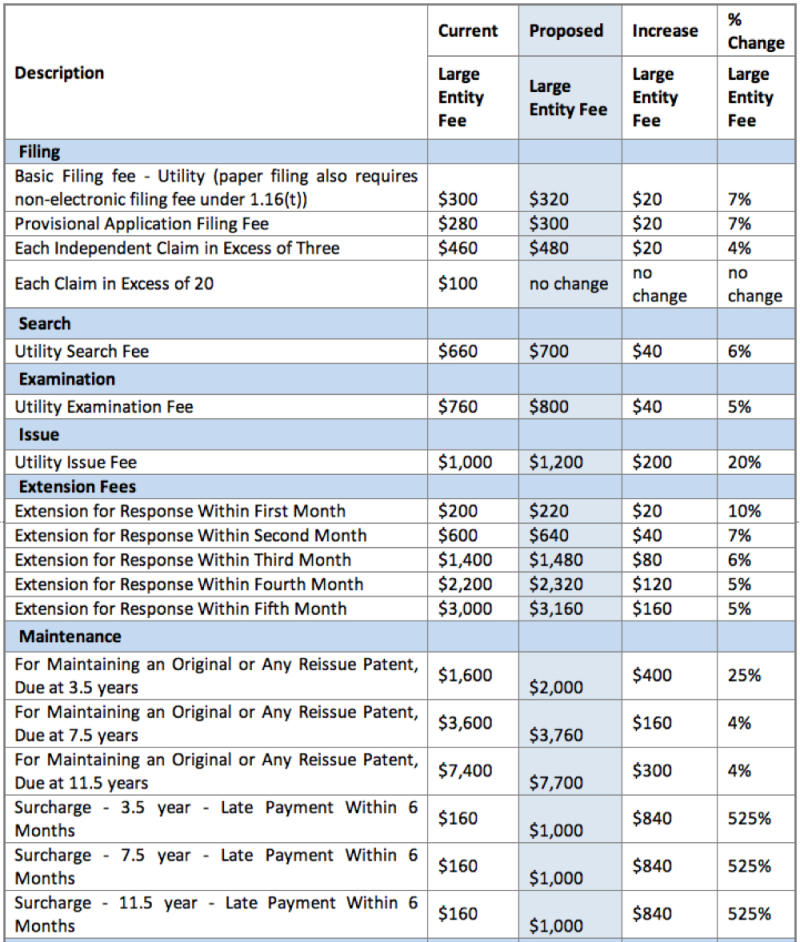
    1.  A significant increase (525%) to the surcharge for late payment of maintenance fees in order to encourage timely payment.  The fee is currently $160, but will be increased to $1000 for large entities.

    2.  An increase to the fee to request expedited examination of a design application, to help the Office manage staffing for these services (e.g., from $900 to $2000).

    3.  Issue and maintenance fees will be restructured under this proposal in order to recover initial search and examination costs earlier in the patent lifecycle.  The Office noted that as technology lifecycles grow shorter, it is important that USPTO not rely too heavily on fees paid late in the life of a patent.  As a result, some of these fees are proposed to increase by various amounts higher or lower than the five percent mentioned above.  The current large entity maintenance fees are $1600 (3.5 years), $3600 (7.5 years), and $7400 (11.5 years), and the proposal increases to $2000 (3.5 years), $3760 (7.5 years), and $7700 (11.5 years).

    4.  Fees for America Invents Act (AIA) trials are proposed to increase by roughly 25% due to a variety of factors, including the Supreme Court decision in SAS Institute Inc. v. Iancu.  The Office noted that the PTAB will no longer be able to institute on less than all claims challenged in a petition, leading to significant additional work for a given instituted inter partes review (IPR).

    Discontinuation of Fees

    Finally, the USPTO is proposing to discontinue three patent service fees, and instead provide those services, in a slightly modified form, for free.  Namely, these include fees related to obtaining copies of Patent Grant and Patent Application Publication TIFF Images or Full-Text W/Embedded Images.  These service fees will be eliminated and the Office will instead provide these services, in a slightly modified form (i.e. electronic), for free.

    Details of the proposal can be found here including a full spreadsheet of all fees and proposed changes (spreadsheet also available here).  Below is a summary table of the common fees for a large entity to illustrate some of the proposed changes.

    As seen below, total filing costs for a patent application (large entity) are currently $1720 and are proposed to increase to $1820.

    Table 1A_Fees Table 1B_Fees

  • By Steve Kennedy* and Anthony D. Sabatelli** —

    Over the last decade, antibody-drug conjugates (ADCs) have emerged as a highly promising new class of biopharmaceuticals.  By taking advantage of the specificity of monoclonal antibodies and the potency of small-molecule chemotherapy drugs, ADCs have proven to provide a highly effective combination — particularly in the oncology space.  The recent FDA approvals of Kadcyla (Genentech), Adcetris (Seattle Genetics), Mylotarg (Wyeth Holdings / Pfizer), and Besponsa (Wyeth Holdings / Pfizer), as well as the over sixty other ADCs in clinical trials, show that these drugs represent an increasing proportion of newly approved cancer therapies and will generate growing revenues for firms innovating in the field.  Accompanying this burst in ADC development is the corresponding activity in the patent space.  This article summarizes some of the important developments.

    ADC Mechanism of Action

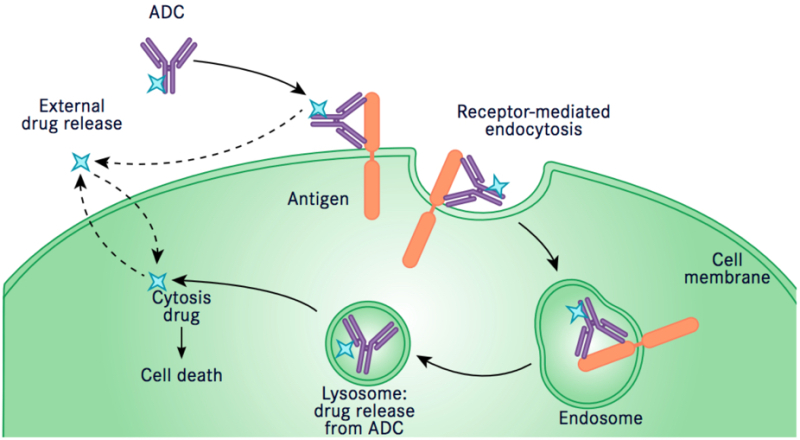
    An ADC is composed of an antibody conjugated to a cytotoxic compound (the payload) via a chemical linker. Traditional chemotherapy drugs can be highly effective at destroying cancer cells, but in general their specificity for cancer tissue is extremely low, and many healthy cells are killed as well. However linking highly potent anticancer drugs to antibodies that bind to antigens present at high levels in tumor cells greatly improves drug specificity for the cancer cells and reduces side effects. Generally, once an ADC binds an antigen on the cancer cell surface, it is internalized and sent along the endosome/lysosome pathway for degradation. In the lysosome the payload is released either through specific cleavage of the linker by lysosome enzymes or general degradation of the antibody. The released cytotoxic compound then leaves the lysosome and causes death of the cancer cell.  See the following scheme which illustrates this biochemical process.

    FigureSeveral processes by which ADCs specifically target and destroy cancer cells.  Figure from Lu et al., "Linkers Having a Crucial Role in Antibody-Drug Conjugates," Int. J. Mol. Sci. 17(4): 561 (2016).

    ADC Patent Landscape

    The ADC research space and development pipeline are growing rapidly.  This section is not meant as an exhaustive review of the patent landscape. Rather this section will provide insight into unique patent strategies employed for the intellectual property protection of ADC drugs. Because ADCs represent an extension of the well-established field of conventional therapeutic antibodies and a combination of biologic and organic drug components, the patent landscape is relatively crowded. However, the three components of an ADC, i.e. the antibody, the payload drug, and the linker, as well as their unique combination provide significant opportunities for innovation.

    Early ADC therapies suffered from low potency relative to standard chemotherapy agents. However, developments in linker technologies and the use of cytotoxic agents that were otherwise too potent for direct administration greatly improved ADCs' effectiveness. The first ADC therapy approved by the FDA, is marketed as Mylotarg (acquired by Pfizer via Wyeth Holdings). This drug targets the antigen CD33, which is expressed at high levels on the surface of acute myeloid leukemia cells, to deliver a highly toxic calicheamicin payload. Mylotarg had a challenging history, and despite accelerated approval in 2000, it was voluntarily removed from the market after several early deaths in follow-on confirmatory trials. After significant adjustments to the dosing regimen, Mylotarg was reapproved in 2017.  See, (US5773001)

    Since Mylotarg's first introduction to the market, three other ADC drugs have been approved by the FDA. Besponsa (US9351986B2, Wyeth Holdings) employs the same payload and linker of Mylotarg conjugated to an anti-CD22 antibody that targets B-cell precursor acute lymphoblastic leukemia cells. Both Mylotarg and Besponsa employ hydrazone linkers that are specifically cleavable in the lysosome and are otherwise highly stable in circulation. The calicheamicin payloads delivered by these drugs had also been under investigation by other groups, such as American Cyanamid Company as seen by an early patent from this area (US5714586).

    Adcetris (US7829531), licensed by Seattle Genetics, targets the antigen CD30, which is present at high levels in certain non-Hodgkins lymphoma cells. Its valine-citrulline linker (US7745394) is specifically cleavable by cathepsin B, a lysosome enzyme, allowing rapid release of the payload after internalization. Citrulline, biologically generated by post-translational modification of arginine residues, has higher stability in circulation than other amino acids and improves the bioavailability of valine-citrulline-linked ADCs. Other companies such as Ambrx (US9975936) have attempted to push this approach further through the use of nonnatural amino acids with even higher stability. Adcetris delivers a highly-potent MMAE payload (US6884869). Companies such as Mersana have developed several other auristatin compounds for use as ADC payloads (US9943609).

    Kadcyla (US8337856), licensed by Genentech, targets the HER2 antigen expressed at high levels in certain metastatic breast cancers and delivers the chemotherapy agent DM1. Its linker is noncleavable, but degradation of the antibody in the acidic environment of the lysosome eventually leads to payload release. The DM1 payload is typical of the relatively large class of maytansinoid cytotoxic agents, which are under development by several companies such as ImmunoGen (US5208020).

    As will be discussed in greater detail in future pieces, novel approaches to ADC antibodies, linkers, and payloads have been developed, both from a technological and IP perspective. The targeting of noninternalizing antigens (US20150030536, US20170028080A1) has generated particular excitement. Additionally novel antibody formats (US9290577, US9856314), the use of masked proproteins (US20130101555), and conditionally-active antibodies (US9637734B2) have provided new targeting mechanisms.

    Linker technologies also present significant opportunities for innovation. Different biological conjugation and cleavage mechanisms have been developed, such as the use of reactive thiols on engineered cysteine residues (US7521541B2), sortase-mediated conjugation (US9872923), MTGase-mediated linkage (US15214331), and transglutaminase linkage (US20170106096A1). Several other proprietary linkers have been developed as well (US9540438B2, US7223837B2).

    Payload development provides further opportunities for innovation. Both previously-developed and novel cytotoxic agents have been employed as ADC payloads, such as anthracyclin derivatives (US8900589), duocarmycins (US9629924B2, US5475092, US5585499), taxanes (US7390898), benzodiazepine derivatives (US9889207B2, US8765740, US9242013B2, US15724423), and tubulysins (US9801951B2).

    As evidenced from this research and IP activity, ADCs provide an innovative solution to intractable cancers, and there are significant opportunities for technical innovation. It will be particularly interesting to see how companies manage the overlapping intellectual property landscape and nearing expirations of patents on naked antibodies and payloads that could be used in ADC therapies. Later in this series, we will discuss in greater depth advancements in antibody, linker, and payload technologies, as well as patent strategies for navigating the significant patent landscape.

    Table 1a Table 1b

    * Steve Kennedy is a Ph.D. Candidate in the Chemistry Department at New York University.  He specializes in biophysical characterization of protein complexes and is currently focused on the role of adaptor proteins in signaling pathways.  Prior to attending NYU, Steve obtained his B.S. in Chemistry with Cum Laude honors at the University of Massachusetts – Boston, during which time he conducted bioanalytical mass spectrometry method development and lipidomics research.
    ** Dr. Sabatelli is a Partner with Dilworth IP

  • CalendarAugust 14, 2018 – Patent Quality Chat webinar (U.S. Patent and Trademark Office) – 12:00 to 1:00 pm (ET) on 

    August 16, 2018 – "Patent Drafting for Machine Learning: Structural Claim Limitations, Avoiding 101 or 112 Rejections" (Strafford) – 1:00 to 2:30 pm (EDT)

    August 16-17, 2018 – "Advanced Patent Prosecution Workshop 2018: Claim Drafting & Amendment Writing" (Practising Law Institute) – San Francisco, CA

    August 21, 2018 – "Navigating the Patent Prosecution Highway and Other Accelerated Filing Options — Evaluating the Different Options, Weighing the Benefits and Risks, Obtaining Patent Protection" (Strafford) – 1:00 to 2:30 pm (EDT)

    August 21, 2018 – "Patent Infringement Litigation: A Thorough Analysis of 2018 Developments and Its Implications for the Year Ahead" (The Knowledge Group) – 12:00 to 1:00 pm (ET)

    August 23, 2018 – "Antibody Patenting and Licensing Challenges in Light of Amgen v. Sanofi" (Technology Transfer Tactics) – 1:00 to 2:00 pm (ET)

    August 28, 2018 – "Ethics in USPTO Practice in 2018 – Understanding the Behavior as Well as the Rules" (Federal Circuit Bar Association) – 3:00 pm to 4:30 pm (EST)

    August 28, 2018 – "Structuring Patent Indemnification Provisions — Allocating Infringement Risk While Accounting for Changes to PTAB Estoppel and Statutory Bar Requirements" (Strafford) – 1:00 to 2:30 pm (EDT)

    September 21, 2018 – "USPTO Post-Grant Patent Trials 2018: Change & Recalibration" (Practising Law Institute) – New York & Groupcasts in Philadelphia, Indianapolis, New Brunswick, NJ, Pittsburgh, and Mechanicsburg, PA

    September 27-28, 2018 – "Advanced Patent Prosecution Workshop 2018: Claim Drafting & Amendment Writing" (Practising Law Institute) – Chicago, IL