• ACIAmerican Conference Institute (ACI) will be holding the next session of its FDA Boot Camp conference on September 27-28 in Boston, MA.  ACI faculty will help attendees:

    • Review the clinical trial process and how the results are used;
    • Understand market exclusivities and protections, including Hatch-Waxman, orphan exclusivity, pediatric exclusivity, and protection for biologics;
    • Evaluate follow-on applications (Hatch-Waxman ANDAs and BPCIA aBLAs);
    • Review the labeling process and how to use it as a defense in products litigation;
    • Understand the different pathways for expedited approval;
    • Consider the uniqueness of combination products and companion diagnostics;
    • Understand the respective roles of the FDA and PTO in the patenting of drug and biological products;
    • Evaluate patents and generate of validity opinions;
    • Review Commissioner Gottlieb's actions as his one-year anniversary approaches;
    • Examine current Good Manufacturing Practices and their scope of importance in pharmaceutical and biological product commercialization;
    • Understand the FDA's regulations and relevant guidance regarding labeling, advertising, and promotion;
    • Review FDA compliance requirements, enforcement mechanisms, and best practices; and
    • Examine adverse events monitoring, pharmacovigilance, risk management, and recalls.

    In particular, ACI's faculty will offer presentations on the following topics:

    • Clarifying the Clinical Trial Process for Drugs and Biologics
    • Navigating the Approval Process for Drugs and Biologics
    • Drugs and Biologics: Labeling
    • Exploring the Expedited Approval Process
    • Unique Considerations in the Approval of Combination Products and Companion Diagnostics
    • Patents and Related IP Protections and Mechanisms
    • Hatch-Waxman and BPCIA Overview
    • Ripped from the Headlines: Breaking News and Emerging Trends Impacting FDA Practice
    • Current Good Manufacturing Practices ("cGMPs") for Drugs and Biologics
    • Promotion, Off-Label Communications, and First Amendment Concerns
    • Enforcement
    • Adverse Events Monitoring, Pharmacovigilance, Risk Management, and Recalls

    In addition, two pre-conference workshops will be offered on the afternoon of September 26, 2018, from 1:00 pm to 4:00 pm and 4:15 to 5:15, respectively.  The first workshop is entitled "FDA Pharmaceutical Law 101: Introduction to the Fundamentals," and the second workshop is entitled "Resolving Ethical Challenges Encountered during the Drug Approval Process."  One post-conference workshop on "Skills Session: Tips and Strategies for Communicating with FDA" will be offered on September 28, 2018 from 2:00 to 5:00 pm.

    An agenda for the conference and information regarding the workshops can be found here.  A complete brochure for this conference, including an agenda, detailed descriptions of conference sessions, list of speakers, and registration form can be obtained here.

    The registration fee is $2,295 (conference alone), $3,395 (conference and all three workshop).  Patent Docs readers are entitled to a 10% discount off of registration using discount code P10-999-PTD18.  Those interested in registering for the conference can do so here, by e-mailing CustomerService@AmericanConference.com, or by calling 1-888-224-2480.

    Patent Docs is a media partner of ACI's FDA Boot Camp.

  • ACIAmerican Conference Institute (ACI) will be holding its 6th Annual Paragraph IV Disputes master symposium on October 2-3, 2018 in Chicago, IL.  ACI faculty will help attendees in:

    • Understanding the connection between drug pricing and drug patents;
    • Examining how different jurisdictions are interpreting the TC Heartland decision for pharmaceutical patent infringement filings;
    • Analyzing the significance of the Federal Circuit's Allegan Inc. v. Teva Pharmaceuticals decision holding that the defense of tribal sovereign immunity does not apply to IPR proceedings;
    • Assessing the latest decisions on § 101 and their implications for branded pharmaceuticals;
    • Reviewing the state of the law on induced infringement and its repercussions for Hatch-Waxman;
    • Identifying triggering events for the on-sale bar under the Helsinn and Medicines Co. decisions;
    • Understanding how Paragraph IV litigation costs have been affected by multiple filers;
    • Exploring how the PTAB has changed its operations since SAS;
    Examining the continued evolution of the obviousness-type double patenting doctrine; and
    • Evaluating typical ethical predicaments that may arise in Paragraph IV litigation.

    The conference will offer presentations on the following topics:

    • Examining the Nexus Between Pricing and Patents in the Hatch-Waxman Landscape
    • The Future of Venue and Jurisdiction: Examining the Latest Interpretations and Applications of TC Heartland
    • Brand and Generic Perspectives on the Latest FDA Initiatives in the Hatch-Waxman Space
    • A Question of Sovereignty: A Retrospect on Invoking Tribal and State Sovereign Immunity as a Means of Patent Protection
    • Assessing the Latest Use of § 101 Challenges to Method of Use Patents in a Paragraph IV Setting
    • Evolving Tests for Induced Infringement Relative to Method of Use Patents: Implications for Labels, Carve-Outs and Proof of Actual Inducement
    • Legal and Business Perspectives on the On-Sale Bar: Examining the Continued Aftermath of Helsinn
    The Distinctive Role of the Magistrate Judge and Local Counsel in Paragraph IV Proceedings
    • A Chat With the Chiefs: Perspectives from Chief Judges Castillo and Linares on the Latest Paragraph IV Litigation Challenges
    • Developing Effective Strategies for ANDA Litigation Management: Budgeting, Cost-Containment Strategies and Other Practical Considerations Based on Recent Trends
    • Assessing the Implications of the Supreme Court's Recent Decision in SAS and Its Impact on PTAB Practice
    • PTAB Pharmaceutical Patent Invalidity Round-Up: Update on Wins, Losses, Appeals and the Latest Estoppel Considerations and Concerns
    • The PTAB Live: A Hatch-Waxman Practitioner's Guide to Practice, Procedure, IPRs and More in the World of Pharmaceutical Patent Validity Challenges
    • Obviousness Update: Addressing Matters of Obviousness-Type Double Patenting, Inherency, Anticipation and Secondary Considerations in the World of Paragraph IV Litigation
    • Antitrust Developments Concerning Brand Name, Generic and Hybrid Interests
    • Assessing the True Measure of Damages in an At-Risk Launch
    • Identifying and Avoiding Common Ethical Dilemmas in Paragraph IV Practice

    In addition, two pre-conference workshops will be offered on October 1, 2018.  The first, entitled "Biosimilar Litigation Boot Camp for the Hatch-Waxman Litigator" will be offered from 9:00 am to 12:00 pm.  This pre-conference workshop will be presented by Patent Docs author Kevin Noonan.  The second, entitled "Parallel Proceedings Master Class: Strategies for Balancing and Streamlining Simultaneous Proceedings Before the Federal Courts, PTO & ITC in Pharmaceutical Patent" will be offered from 1:00 to 4:00 pm.

    The agenda for the Paragraph IV Disputes master symposium can be found here.  A complete brochure for this conference, including an agenda, detailed descriptions of conference sessions, list of speakers, and registration form can be obtained here.

    The registration fee for the conference alone is $2,395 (or a special $1,795 in-house rate for pharmaceutical & biotech organizations), or $3,495 for the conference and both workshops.  Patent Docs readers are entitled to a 10% discount off of registration using discount code P10-999-PTD18.  Those interested in registering for the conference can do so here, by e-mailing CustomerService@AmericanConference.com, or by calling 1-888-224-2480.

    Patent Docs is a media partner of ACI's Paragraph IV Disputes Master Symposium.

  • U.S. Chamber of CommerceAs part of its 2018 Driving Innovation Roadshow, the U.S. Chamber of Commerce Global Innovation Policy Center (GIPC) will host three intellectual property and innovation business roundtables in Minnesota and Illinois.  The Minnesota roundtable will be held from 1:00 pm to 2:00 pm (CDT) on August 29, 2018 at the St. Cloud Area Chamber of Commerce, 1411 W St. Germain Street, St. Cloud, MN, and two Illinois roundtables will be held on August 30, 2018 — from 9:00 am to 10:00 am (CDT) at the Peoria Chamber of Commerce, 403 NE Jefferson Street, Peoria, IL, and from 12:30 pm to 1:30 pm (CDT) at the Sarah Bush Education Center, 1000 Health Center Drive, Mattoon, IL.  The roundtables will highlight the importance of IP rights to the U.S., and will feature U.S. Representatives Tom Emmer (MN-06), Darin LaHood (IL-18), and John Shimkus (IL-15) as well as local members of IP-intensive industries.

  • By Joseph Herndon

    Federal Circuit SealLuminara Worldwide, LLC appealed from three inter partes review (IPR) decisions, in which the Patent Trial and Appeal Board held unpatentable a total of 31 claims across Luminara's three patents.  On appeal, Luminara challenged the Board's decisions as to one claim from each patent and asserted that the Board's application of the 35 U.S.C. § 315(b) time-bar was improper as to the '319 patent.  The Federal Circuit dismissed the IPR with respect to the '319 patent, holding that the § 315(b) time-bar applied, and affirmed the other two IPR decisions.

    The patents here are directed to making flameless candles that look and behave like real candles.  Shenzhen Liown Electronics Co., Ltd. (Liown) requested inter partes review of 31 claims of the Luminara patents including U.S. Patent Nos. 8,696,166; 8,070,319; and 8,534,869.  The three patents, which employ moving pendulums to simulate the appearance of a natural flame, are related.

    Time-Bar (the '319 patent)

    In instituting review of the '319 patent, the Board first addressed whether the IPR was time barred under 35 U.S.C. § 315(b), since the petition was filed more than a year after Liown was served with a complaint alleging infringement.

    35 U.S.C. § 315(b) provides that inter partes review may not be instituted if the petition requesting the proceeding is filed more than 1 year after the date on which the petitioner is served with a complaint alleging infringement of the patent.

    Specifically, on November 2, 2012, Candella, LLC, a predecessor in interest of Luminara, filed a complaint in the District of Minnesota against Liown for infringement of the '319 patent.  Service of the complaint was acknowledged on December 3, 2012.  On December 16, 2013, the parties having agreed to a dismissal, the District Court entered a voluntary dismissal without prejudice.

    On August 5, 2014, Luminara commenced another lawsuit against Liown, again alleging infringement of the '319 patent as to the same products involved in the earlier case.  On July 31, 2015, within one year of service of the second action, Liown filed for an IPR of the '319 patent.

    Luminara argued that Liown was time-barred as to the '319 patent under 35 U.S.C. § 315(b) because the petition was filed more than one year after service of the first action.  In instituting the IPR, the Board rejected the timeliness argument because the first action had been voluntarily dismissed without prejudice.

    However, now, in Click-To-Call Technologies, LP, v. Ingenio, Inc, No. 15-1242 (Fed. Cir. Aug. 16, 2018), the en banc court held that § 315(b)'s time-bar applies in such a scenario present here.  Thus, because the § 315(b) time-bar applies when the underlying complaint alleging infringement has been voluntarily dismissed without prejudice, the Board erred in instituting the IPR challenging the '319 patent.  Thus, the Board's final written decision as to the '319 IPR was vacated, and remanded for dismissal of that IPR.

    The Other Two IPRs

    On the merits, the Board issued final written decisions determining that the claims were either anticipated or would have been obvious over the prior art.

    Specifically, the Board determined that claim 14 of the '166 patent would have been obvious over the prior art.  Claim 14 reads:  "[t]he apparatus of claim 13, wherein the pivot hole is larger in diameter than an exterior dimension of the support element, whereby the flame body swings or pivots freely about the support element."

    The ability to rotate "about" or "around" a supporting rod means that there is relative motion between the two parts.  The Expert explained that such relative motion necessarily implies that the hole is bigger than the rod, and that parts of the prior art drawings indeed show a hole bigger than the rod.

    While Luminara argued that the claim limitation necessitates movement in additional directions, the claim only requires the ability to "swing or pivot," not necessarily movement in other directions.

    Thus, the Federal Circuit found that the conventional usage of rotation about a structure suggests movement relative to the structure, and if relative movement is possible, a person of ordinary skill would know that the pivot hole is larger in diameter than the rod.

    With respect to the '869 patent, the Board found that claim 34 would have been obvious.  That claim provides:

    An apparatus for simulating a flickering flame effect, comprising:
        a housing including an interior space;
        a pendulum member pivotally mounted within the interior space, the pendulum member including first and second ends, wherein the pendulum member further includes a flame element extending from a second end opposite the first end, such that at least a portion of the flame element extends outwardly from the housing;
        a first light source selectively transmitting light onto the flame element; and
        a drive mechanism positioned in the housing and operating to provide kinetic motion to the first end of the pendulum member
        wherein the pendulum member is pivotally mounted using a pendulum support member that extends through a hole in the pendulum member and
        wherein the pendulum support member is coupled to the housing to remain stationary during pivotal movement of the pendulum member by the drive mechanism.

    The Board explained that a gimbal mechanism in one piece of prior art could be replaced by a wire of another prior art reference to render the invention obvious and that there was motivation to combine the prior art references.  On appeal, Luminara argued that it was not afforded proper notice, because while Liown's petition specified the replacement of a rod in the prior art, it did not specify that the gimbal mechanism would be replaced and that this represents a change in the obviousness theory.

    The Federal Circuit disagreed, and concluded that the Board did not change the obviousness argument midstream.  Liown's petition explained that the proposed combination of art would remove the entire gimbal structure.  The petition specifically pointed out that the support wire, with its both ends connected to the housing, would provide a support.  The Federal Circuit found that these descriptions made it clear from the outset that the modification involved eliminating the entire gimbal.  Further, in its preliminary response, Luminara responded to the argument that the entire gimbal would be replaced.  Liown's reply further explained that the entire gimbal would be replaced.  Thus, the obviousness theory did not change, and the Federal Circuit affirmed the Board's decision.

    Looking at the specific rejection, however, it's hard to understand the theory of motivation, or how the first reference, when modified by the second reference, could be seen to arrive at the claimed invention.  Figure 6 of the primary reference is shown below, which includes the gimbaled mechanism allegedly modified by the secondary reference in which Figure 1 is reproduced showing the "wire" mechanism.

    Primary Reference:

    Primary Reference

    Secondary Reference:

    Secondary Reference

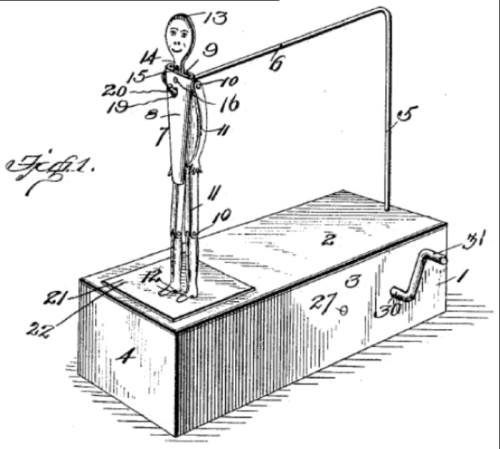
    Finally, below is Figure 1 of the '869 patent.  It would seem that many arguments could have been made to address the substantive obviousness rejection, however, such arguments were left on the table.

    Fig. 1

    Luminara Worldwide, LLC v. Iancu (Fed. Cir. 2018)
    Panel: Circuit Judges Lourie, Dyk, and Taranto
    Opinion by Circuit Judge Dyk

  • By Donald Zuhn

    Patents for Humanity_2Earlier this month, the U.S. Patent and Trademark Office announced the latest winners of the Patents for Humanity program.  The Patents for Humanity program, which was launched by the Office in February 2012 as part of an Obama Administration initiative to promote game-changing innovations to solve long-standing development challenges, is a competition recognizing innovators who use game-changing technology to meet global humanitarian challenges.  Entrants are divided into five categories:  medicine, nutrition, sanitation, household energy, and living standards.  The Office noted that in this latest round, there were nine winners and six honorable mentions.  Winners receive an acceleration certificate to expedite select proceedings at the USPTO (i.e., a patent application, ex parte reexamination, or an ex parte appeal to the Patent Trial and Appeal Board) in addition to public recognition for their work.  The nine winners are as follows:

    • Medtronic for creating a portable, low-water kidney dialysis machine for potential use in a wide variety of care settings, including those that lack the infrastructure required for traditional dialysis. The Office notes that chronic kidney disease affects more than 700 million people worldwide, and that developing countries lack suitable treatment options outside of major cities. The device developed by Medtronic weighs about 50 pounds and is the size of a large suitcase, making it roughly ten times smaller and lighter than conventional dialysis machines.  It is designed to only use approximately twenty liters of potable water per treatment, which is 75% less than current systems.

    • The U.S. National Institutes of Health for creating a low-cost, temperature tolerant rotavirus vaccine for addressing the six most common forms of rotavirus. The Office notes that rotavirus is a disease that affects nearly every child worldwide, and that while most cases have mild symptoms, rotavirus infections kill an estimated 200,000 children a year, mostly in developing countries. The vaccine lasts up to two years without refrigeration, and therefore is suitable for use in developing countries.  The government of India has ordered 3.8 million doses for their Universal Immunization Programme, and the NIH has partnered with Serum Institute of India Limited (SIIL) to produce affordable RotaSIIL vaccines in India for use in developing countries.

    • Little Sparrows Technologies for creating a portable low-cost phototherapy device for treating jaundice in infants, which causes 100,000 newborn deaths a year and can cause permanent neurological damage in those who survive. The Bili-Hut device developed by Little Sparrows Technologies uses blue LED lights in a reflective bassinet or tent that can run on battery power, and is built from off-the-shelf parts and is collapsible for transportation.  The devices have been used at locations in Burundi to treat jaundiced newborns.

    • Kinnos Inc.for creating time-sensitive color chemicals to ensure proper disinfection procedures by health workers in Ebola treatment centers and other health care settings.  The Office notes that during the Ebola outbreak in 2014, one out of every twenty deaths was a healthcare worker who contracted the disease while treating infected patients.  Students at Columbia University addressed the challenge of effective disinfection of surfaces in treatment centers by creating chemical additives to improve surface disinfection with chlorine — their Highlight additive turns the disinfectant blue so workers can verify surfaces are completely covered.  Kinnos Inc. was founded to commercialize this technology.  Highlight has been used at Ebola treatment centers in Liberia and Guinea, in Haiti for cholera, and in Uganda and Democratic Republic of Congo.  The Fire Department of New York HazMat team has also adopted the product.

    • Russell Crawford for creating tools for low-cost drilling of water wells to reach deep aquifers free from soil contaminants.  The Office notes that most drilling wells supplying clean drinking water are "shallow wells" that become contaminated with mud and debris from the surface, which can bring dangerous chemicals such as arsenic into the water supply.  Russell Crawford designed a drilling method to reach deeper aquifers hundreds of feet deep and avoid contamination while being inexpensive, easy to transport, and capable of use by two drillers without heavy equipment.  He has licensed his technology to the Institute for Transformational Technology at Lawrence Berkeley Laboratories, and created the charity One Million Wells that provides drilling equipment and instruction at no charge in developing countries.

    • Brooklyn Bridge to Cambodia Inc. (BB2C) for creating an affordable rice planting device that helps Cambodian farmers improve their crop yields, and which minimizes the number of farmers, mostly women, who have to work in the most exhausting and unhealthy conditions.  Engineers at BB2C created the Eli Rice Seeder, a low-cost mechanical planting device that uses high-pressure air blasts to shoot rice seeds under the soil at regular intervals.  Using the rice seeder can save up to 250 kilograms of seeds per hectare, worth about $200, and reduces the planting time from 320 hours to just two hours.  BB2C has begun a partnership with the International Rice Research Institute to help spread the Eli Rice Seeder throughout Southeast Asia.

    • Solight Design for designing a portable solar light that has been distributed to over 200,000 people worldwide including many in refugee camps.  The Office notes that access to light during the night affects 2.6 billion people without reliable electricity.  Columbia University architecture professor Alice Min Soo Chun designed an ultra-lightweight, portable solar lamp that could be distributed to people living in relief camps and carried with them as they change locations.  Two models of solar lamp, one inflatable and the other foldable, are sold by Prof. Chun's company, Solight Design, and two other companies (Luminaid and Mpowerd) created by her former students.

    • Sanivation LLC for designing a waste processing plant that transforms human waste into sanitary briquettes that replace wood and charcoal for heating and cooking, with four plants serving 10,000 people in Kenya by the end of the year.  The Office notes that up to 90% of human waste is disposed of untreated in developing regions, and that diseases spread by human waste are the second leading cause of death for children under five.  Kenyan-based Sanivation designed a treatment plant that processes human waste with solar thermal energy to create charcoal-like briquettes for cooking and heating needs.  The briquettes burn longer than charcoal and produce one-third the carbon monoxide and particulate emissions, saving 88 trees per ton sold.  Sanivation's work has been supported by the U.S. Centers for Disease Control, the UN Refugee Agency, the Gates Foundation, and the Kenyan government.

    • Because International for distributing 180,000 pairs of resizable shoes in over 95 countries, with local manufacturing taking place in Ethiopia, with plans for expanding into Haiti and Kenya.  Because founder Kenton Lee designed an adjustable sandal-like shoe that can be expanded as a child grows.  The shoes, which can be made with local materials and last for years, help reduce soil-transmitted illnesses that can lead to nutritional and physical impairment, inability to attend school, and physical suffering.

    The Office also awarded six honorable mentions for 2018 (the Office notes that applicants receiving honorable mentions may qualify for an award in future years with further developments):

    • Shift Labs for developing an electronic device that monitors the amount of intravenous medication given during gravity infusions to replace un-monitored delivery in areas with healthcare worker shortages.

    • Case Western Reserve University for creating a portable, quick hemoglobin scanner that can detect sickle cell and other blood conditions.

    • Vanderbilt University for distributing antibodies for Zika virus to other researchers to develop vaccines and treatments.

    • Centers for Disease Control and Prevention for creating a low-cost, simple-to-assemble, and easy-to-maintain mosquito trap to reduce the spread of diseases in resource limited settings.

    • Folia Water Inc. for developing an inexpensive paper water filter and holder that is affordable to low income customers and can be distributed to urban and remote areas for removing pathogens.

    • Prof. Arup SenGupta of Lehigh University for creating economically sustainable Hybrid Ion Exchange Nanotechnology to mitigate arsenic and fluoride crisis of contaminated groundwater in South and Southeast Asia.

    Additional information regarding the latest winners of the Patents for Humanity program can be found here, and information regarding the Patents for Humanity program can be found here.

  • By Kevin E. Noonan

    Saint Regis Mohawk TribeOn July 22nd, the Federal Circuit issued its opinion in St. Regis Mohawk Tribe v. Mylan Pharmaceuticals Inc., affirming the decision by the Patent Trial and Appeal Board (PTAB) of the U.S. Patent and Trademark Office that denied the Tribe's motion to terminate Mylan's inter partes review (IPR) proceedings as being barred by tribal sovereign immunity.  Yesterday, the Tribe filed its brief in support of its petition for rehearing en banc.

    To briefly recap, the issue arose over IPR Nos. IPR2016-01127, IPR2016-01128, IPR2016-01129, IPR2016-01130, IPR2016-01131, and IPR2016-01132 (and parallel IPRs filed by Petitioners Teva Pharmaceuticals USA, Inc. and Akorn, Inc., which had been joined with Mylan's IPRs) instituted against U.S. Patent Nos. 8,685,9308,629,1118,642,5568,633,1628,648,048, and 9,248,191 respectively.  After the PTAB instituted IPRs against these six patents owned by Allergan and directed to its Restasis® product, Allergan assigned its rights in the patents to the Tribe in return for a license (see "Allergan Avails Itself of Sovereign Immunity").  The Tribe argued unsuccessfully before the Board that as rightful owner of the patents the Board lost jurisdiction based on tribal sovereign immunity (see "Mohawk Nation Exercises Sovereign Immunity in Inter Partes Review"). The Board held that, as an issue of first impression the Tribe had not borne its burden of showing it was entitled to the requested relief, and that the nature of the license left all substantive patent rights with Allergan, and thus that the company could amply represent the Tribe's rights even in its absence (see "PTAB Denies St. Regis Mohawk Tribe's Motion to Terminate IPRs based on Sovereign Immunity").

    The Tribe's brief is focused on the Janus-like nature of these proceedings, which can be characterized as administrative agency or adversarial depending on the argument that supports an advocate's position.  The panel decision was based on the similarities of IPRs to other administrative agency proceedings (including, inter alia, ex parte reexamination).  In its brief, the Tribe set out the many ways IPRs are adversarial proceedings, including expressly these:

    • The private-party petitioner controls the claims challenged and the grounds of the attacks.
    • The proceeding cannot start until the private-party petitioner serves the patent owner with the petition.  35 U.S.C. § 312(a)(5).
    • The patent owner may respond to the petition with a motion or a preliminary response.  37 C.F.R. §§ 42.20-42.25.
    • The PTAB and Director are not parties to the proceeding.  37 C.F.R. § 42.2.
    • The PTAB and Director lack authority to initiate a proceeding without a private party's petition or to engage in investigations that would lead to the filing of a claim.
    • Once an IPR is initiated, neither the statute nor regulations provide any role for the PTAB or any federal officer to act as advocates in the proceedings, to add patent claims to an existing IPR, or to add prior art to that cited by the petition.
    • The private-party petitioner provides the evidence, 35 U.S.C. § 312(a)(3)(B), and shoulders the burden of proof.  Id. at § 316(e).
    • The parties (i.e., the petitioner and patent owner) can seek discovery, which the PTAB can enforce through sanctions.  37 C.F.R. §§ 42.51-42.65.
    • The PTAB and Director have no power to initiate discovery.
    • The Federal Rules of Evidence generally apply to IPRs.  Id. at § 42.62.
    • The parties (but not the Board) may offer rebuttal evidence "which is responsive to the adversary's evidence."  Belden Inc. v. Berk-Tek LLC, 805 F.3d 1064, 1082 (Fed. Cir. 2015) (emphasis added).
    • If a patent owner withdraws from an IPR, the Board may issue an "adverse judgment" cancelling the patent owner's claims.  37 C.F.R. § 42.73(b)(4).  But the judgment is limited to the grounds raised by petitioner.
    • The parties may settle the IPR, but "the Board is not a party to the settlement," id. at § 42.74(a), and the Board lacks authority to settle an IPR if the petitioner wishes to proceed.
    • The parties have the right to an oral hearing.  35 U.S.C. § 316(a)(10).
    • The three PTAB "judges" issue a final written decision known as a "judgment."  77 Fed. Reg. at 48,766-67.
    • The Board must decide the case based on the "arguments that were advanced by a party."  In re Magnum Oil Tools Int'l, Ltd., 829 F.3d1364, 1380-81 (Fed. Cir. 2016).
    • The loser of the IPR may be subject to estoppel.  37 C.F.R.§ 42.73(d)(3).  The Board, which is not a party, is not estopped.
    • The PTAB has continued to borrow judicial practices for IPR trials, including recently revised procedures for expert testimony, word counts, motion practice, and other matters.

    In support of its argument, the Tribe cites SAS Inst. Inc. v. Iancu, 138 S.Ct. 1348 (2018), that an IPR is a "procedure allow[ing] private parties to challenge previously issued patent claims in an adversarial process before the Patent Office that mimics civil litigation."  Id. at 1352 (emphases added).  Moreover, the Supreme Court characterized IPRs as being "party-directed, adversarial" proceedings before neutral judges with "many of the usual trappings of litigation" such as discovery, briefing, and oral hearing.

    The Tribe's brief further asserts (as it did before the merits panel) the applicability of Federal Maritime Comm'n v. S.C. State Ports Auth., 535 U.S. 743 (2002) ("FMC") as controlling precedent.  It cites the Board's prior decisions in Covidien LP v. Univ. of Fla. Research Found. Inc., 2017 WL 4015009 (PTAB Jan. 25, 2017); NeoChord, Inc. v. Univ. of Md., Balt., No. IPR2016-00208 (PTAB May 23, 2017), and Reactive Surfaces, Ltd. v. Toyota Motor Corp., 2017 WL 2992435 (PTAB July 13, 2017), that FMC applies to IPRs.  Also, the brief argues that the Supreme Court's reasoning that sovereign immunity can be asserted in interferences, in Vas-Cath, Inc. v. Curators of Univ. of Mo., 473 F.3d 1376 (Fed. Cir. 2007), also applies to IPRs.  The Board itself (and the AIA) define IPRs as "trials" 37 C.F.R. § 42.100(a), according to the brief.

    The Tribe further argues that "the panel misconstrued Alden v. Maine, 527 U.S. 706, 756 (1999), in opining that the Director's discretion whether to institute an IPR is comparable to the Attorney General's control over whether, how, and when to sue a sovereign state and in controlling the prosecution of any such action."

    In addition to these general arguments, the Tribe sets forth its response to the "four factors" it contends the panel relied upon to support its decision that tribal sovereign immunity cannot be asserted to avoid an IPR proceeding.  The first of these is that "the Director has discretion in deciding whether to institute an IPR."  The brief states that the Supreme Court in SAS rejected this argument, and that the Director's involvement in IPR institution does not act to transform an IPR into an "agency-led, inquisitorial process"; instead, the brief contends that an IPR continues to be a "party-directed adversarial process" that "mimics civil litigation," citing SAS, 138 S.Ct. at 1352, 1355.  This is because, inter alia, "the Director may not "start proceedings on his own initiative" or "initiate whatever kind of inter partes review he might choose."  Id. at 1355.  In IPRs, "the petitioner's petition, not the Director's discretion, is supposed to guide the life of the litigation," and "the statute tells us that the petitioner's contentions, not the Director's discretion, define the scope of the litigation all the way from institution through to conclusion."  138 S.Ct. at 1356-57.  This portion of the Tribe's argument also notes the similarities between the government's arguments in SAS and the reasoning of the panel decision, which they argue the Supreme Court rejected.

    With regard to the bases of the panel's analysis that an IPR is instituted by "a politically accountable officer," the brief distinguishes Alden v. Maine because:

    IPRs are brought in the name (and for the benefit) of a private-party petitioner, not the government.  Private parties draft IPR petitions and litigate the proceedings; the Director has no role in how IPRs are prosecuted.  Moreover, the Director has delegated to the PTAB responsibility to make institution decisions, citing SAS, 138 S.Ct. at 1353, and thus plays no role (and exercises no political accountability) in deciding which cases to institute.  In short, the Director's attenuated role in IPRs is far removed from the Attorney General's responsibility in Alden.

    The brief also cites FMC for the principle that "a subsequent enforcement action by the Attorney General does not 'retroactively convert an [administrative] adjudication initiated and pursued by a private party into one initiated and pursued by the Federal Government.'"  With regard to this ground of the panel's opinion, the brief argues that the panel ignored the Vas-Cath precedent entirely, which was error in light of the parallels between interferences and IPRs.  Finally, the Tribe argues that the panel's view of the nature of IPR proceedings is contrary to the legislative history of the Leahy-Smith America Invents Act (AIA):

    [T]he panel's reasoning is backwards.  Contrary to Judge Dyk's concurrence, the history of IPRs shows that Congress gave the Director discretion to institute privately-filed IPRs precisely because they mimic private litigation.  The Committee Report accompanying the American Invents Act explained that the legislation was intended to "convert[] inter partes reexamination from an examinational to an adjudicative proceeding."  H.R. Rep. No. 112-98, at 46 (2011) (emphasis added).  The report recognized the dangers posed by IPRs "as tools for harassment or a means to prevent market entry through repeated litigation and administrative attacks on the validity of a patent."  Id. at 48.  Accordingly, the Report instructed the Director to use his authority "to address potential abuses."  Id.  The statutory safeguard of the Director's discretion not to institute IPRs reflects a congressional understanding that they are not agency actions [emphasis in brief].

    The second basis for the panel's opinion is that "the Board may 'continue review even if the petitioner chooses not to participate' and intervene in appeals."  According to the brief, such instances are "exceptional" and only arise when the PTAB has already reached a decision.  Also, "[t]he Board lacks the power actually to prosecute a claim in the petitioner's absence."  Moreover, the brief cites FMC for the proposition that "the absence of a case-or-controversy requirement in administrative tribunals" is an even "greater insult" to a sovereign's interests.  535 U.S. at 760 n.11.

    The third ground of the panel's opinion, according to the Tribe, is that "procedures in IPR do not mirror the Federal Rules of Civil Procedure."  But this is not necessary, says the Tribe; "FMC and Vas-Cath did not require that the procedures be identical, and there is no reason for such a requirement."  And again, "FMC warned that the differences between an administrative tribunal and an Article III court actually presented a greater danger to sovereign interests.  535 U.S. at 760 n.11":

    The affront to a State's dignity does not lessen when an adjudication takes place in an administrative tribunal as opposed to an Article III court.11  In both instances, a State is required to defend itself in an adversarial proceeding against a private party before an impartial federal officer.12  Moreover, it would be quite strange to prohibit Congress from exercising its Article I powers to abrogate state sovereign immunity in Article III judicial proceedings, see Seminole Tribe, 517 U. S., at 72, but permit the use of those same Article I powers to create court-like administrative tribunals where sovereign immunity does not apply.13

    11 One, in fact, could argue that allowing a private party to haul a State in front of such an administrative tribunal constitutes a greater insult to a State's dignity than requiring a State to appear in an Article III court presided over by a judge with life tenure nominated by the President of the United States and confirmed by the United States Senate.

    12 Contrary to the suggestion contained in Justice Breyer's dissenting opinion, our "basic analogy" is not "between a federal administrative proceeding triggered by a private citizen and a private citizen's lawsuit against a State" in a State's own courts.  Post, at 779.  Rather, as our discussion above makes clear, the more apt comparison is between a complaint filed by a private party against a State with the FMC and a lawsuit brought by a private party against a State in federal court.

    13 While Justice Breyer asserts by use of analogy that this case implicates the First Amendment right of citizens to petition the Federal Government for a redress of grievances, see ibid., the Constitution no more protects a citizen's right to litigate against a State in front of a federal administrative tribunal than it does a citizen's right to sue a State in federal court.  Both types of proceedings were "anomalous and unheard of when the Constitution was adopted," Hans v. Louisiana, 134 U. S. 1, 18 (1890), and a private party plainly has no First Amendment right to haul a State in front of either an Article III court or a federal administrative tribunal [emphasis added].

    The fourth and final ground of the panel's opinion, as argued by the Tribe, is that "[t]he mere existence of more inquisitorial proceedings in which immunity does not apply does not mean that immunity applies in a different type of proceeding before the same agency."  This argument was rejected by the Supreme Court in its SAS decision and was relevant to the Court in its reasoning in support of that decision, according to the brief.

    Finally, the Tribe's brief argues that neither Oil States Energy Services v. Greene's Energy Group, LLC, 138 S. Ct. 1365 (2018), nor Cuozzo Speed Techs., LLC v. Lee, 136 S. Ct. 2131, 2143–44 (2016), supports the panel's reasoning.  The brief cites language in Oil States concluding that IPRs use "court-like procedures" before "an adjudicatory body" composed of "judges" and include "some of the features of adversarial litigation,"  Id. at 1371, 1378, and that Cuozzo Speed Techs., LLC v. Lee, 136 S.Ct. 2131 (2016), stated that IPRs "help[] resolve concrete patent-related disputes among parties."

    The brief also emphasizes that the panel's reasoning, if allowed to stand, could be applied to assertion of State sovereign immunity in IPRs, an issue now before the court in Regents of the University of Minnesota v. LSI Corp. as another reason the Court should take up en banc the question of sovereign immunity in IPR proceedings.


  • By Donald Zuhn

    Federal Circuit SealLast month, in Endo Pharmaceuticals Solutions, Inc. v. Custopharm Inc., the Federal Circuit affirmed a decision by the U.S. District Court for the District of Delaware finding that Defendant-Appellant Custopharm Inc. had not proven that claim 2 of U.S. Patent No. 7,718,640 or claim 18 of U.S. Patent No. 8,338,395 were invalid as obvious under 35 U.S.C. § 103.  The '640 and '395 patents are owned by Plaintiffs-Appellees Bayer Intellectual Property GmbH and Bayer Pharma AG.

    Seeking approval to market a generic version of Aveed®, a long-acting injectable testosterone replacement therapy for men suffering from physiologically low levels of testosterone, for which Plaintiff-Appellee Endo Pharmaceuticals Solutions, Inc. holds the approved New Drug Application, Paddock Laboratories, LLC (Custopharm's predecessor-in-interest) filed an Abbreviated New Drug Application (ANDA) with the FDA.  In response to that filing, Endo and Bayer brought an action for infringement of the '640 and '395 patents.  During the proceedings, Custopharm stipulated to infringement, and Endo and Bayer limited their asserted claims to claim 2 of the '640 patent and claim 18 of the '395 patent.

    Claim 1 of the '640 patent recites (emphasis in the following claims from opinion):

    A composition formulated for intramuscular injection in a form for single injection which contains 250 mg/ml testosterone undecanoate in a vehicle containing a mixture of castor oil and benzyl benzoate wherein the vehicle contains castor oil in a concentration of 40 to 42 vol %.

    Asserted claim 2 of the '640 patent recites:

    A composition formulated for intramuscular injection in a form for single injection according to claim 1, which contains 750 mg testosterone undecanoate.

    Claim 14 of the '395 patent recites:

    A method of treating a disease or symptom associated with deficient endogenous levels of testosterone in a man, comprising administering by intramuscular injection a composition comprising testosterone undecanoate (TU) and a vehicle consisting essentially of castor oil and a cosolvent, the castor oil being present in the vehicle at a concentration of 42 percent or less by volume, the method further comprising:
        (i) an initial phase comprising 2 initial intramuscular injections of a dose of TU at an interval of 4 weeks between injections, each dose including 500 mg to 1000 mg of TU, followed by,
        (ii) a maintenance phase comprising subsequent intramuscular injections of a dose of TU at an interval of 10 weeks between injections, each dose including 500 mg to 1000 mg of TU.

    Asserted claim 18 of the '395 patent recites:

    The method of claim 14, in which each dose contains 750 mg of TU.

    As the opinion points out:

    The key elements of both claims in dispute are: (1) 750 mg TU, (2) vehicle consisting of castor oil and a co-solvent (benzylbenzoate in the '640 patent) where the castor oil is 42% or less by volume, and (3) an injection schedule comprising two initial injections at an interval of four weeks followed by injections at ten week intervals ('395 patent only).

    At trial, Custopharm argued that the claims-at-issue were obvious in view of three primary references:  Behre et al., 140 Eur. J. Endocrinol. 414 (1999); Nieschlag et al., 51 Clin. Endocrinol. 757 (1999); and von Eckardstein et al., 23(3) J. Androl. 419 (2002).  These references describe clinical studies using 1000 mg TU injections, wherein the administered composition comprises 250 mg/mL TU in castor oil.  The parties agreed that these references do not describe the use of a co-solvent.  Custopharm also relied on two additional references:  Pushpalatha et al., 90 Naturwissenschaften 40 (2003); and Riffkin et al., 53(8) J. Pharm. Sci. 891 (1964).  Pushpalatha describes the effects of an injectable composition of hydroxyprogesterone in a mixture of 40% castor oil and 60% benzyl benzoate (Proluton Depot), which is administered once a week to pregnant women to prevent miscarriage.  Riffkin describes the use of castor oil for the parenteral administration of steroids.

    The District Court determined that Custopharm had not met its burden of proving that the claims-at-issue were obvious.  In particular, the District Court found that (a) the prior art did not disclose the 750 mg TU injection dosage, (b) Custopharm failed to show by clear and convincing evidence that a skilled artisan would have been motivated to lower the dosage of TU from 1000 mg to 750 mg due to concerns that patients were being overdosed, (c) the cited references do not inherently disclose benzyl benzoate as a co-solvent or the particular ratio of solvent to co-solvent recited in the claims-at-issue, and (d) the prior art did not disclose the specific injection schedule claimed in the '395 patent, and this specific schedule would not have been obvious to a skilled artisan.

    The opinion begins its discussion by noting that:

    The '640 and '395 patents disclose three primary elements in the composition and administration of Aveed®: (1) 750 mg TU in (2) a 40% castor oil and 60% benzyl benzoate vehicle (the benzyl benzoate element only applies to the '640 patent; the '395 patent only requires a cosolvent) (3) administered at an initial interval of two injections four weeks apart and maintenance injections at ten week intervals thereafter (’395 patent only).

    Custopharm argued that a skilled artisan would have recognized that patients were being overdosed with 1000 mg TU injections at a concentration of 250 mg/ml, and therefore that it would have been obvious to a skilled artisan to reduce the amount of injected fluid to 3 ml while maintaining the same TU concentration for a total of 750 mg TU per injection.  Custopharm also argued that the cited references inherently describe the vehicle formulation (40% castor oil and 60% benzyl benzoate).  Cusotpharm further argued that such a dose adjustment would have made it obvious to adjust the injection interval to use a two-phase dosing regimen.  The Federal Circuit, however, disagreed with each of Custopharm's arguments, finding no clear error in the District Court's underlying factual findings.

    With respect to Custopharm's argument that the District Court clearly erred in finding no motivation to lower the dose of TU from 1000 mg to 750 mg in view of the American Association of Clinical Endocrinologists (AACE) Guidelines (which Cusotpharm contended showed that patients were being overdosed in prior art clinical studies), the Federal Circuit noted that "Custopharm's overdose argument is predicated on the assumption that a skilled artisan would have applied the AACE Guidelines to the exclusion of other guidelines that existed at the time, including the FDA Guidelines."  The opinion also notes that the most prevalently applied guidelines in clinical practice and the guidelines cited in the patents-at-issue were, in fact, the FDA guidelines, which differed from the AACE guidelines.  The Federal Circuit therefore concluded that "the district court reasonably rejected Custopharm's argument that a skilled artisan would consider 1000 mg of TU to be an overdose and would have been motivated to lower the dosage to the patented 750 mg."

    Custopharm next argued that the District Court erred in finding that the vehicle formulation (i.e., 40% castor oil and 60% benzyl benzoate) was not inherently described by the cited references, and that the District Court also erred in finding no motivation to combine the vehicle formulation of Proluton with the lowered dose and modified injection schedule.  Custopharm's inherency argument was based on the revelation that the actual vehicle formulation used in the cited references was that recited in the claims-at-issue.  Custopharm also contended that a skilled artisan could derive that the vehicle formulation consisted of 40% castor oil and 60% benzyl benzoate from the detailed recitation of the TU injection composition's pharmacokinetic performance in the cited references.  The Federal Circuit, however, disagreed with Custopharm's arguments, countering that Custopharm did not demonstrate that a skilled artisan could extrapolate the vehicle formulation used in the cited references from pharmacokinetic performance data.  The Federal Circuit also observed that Custopharm's expert conceded that even knowing the identity of the co-solvent would not necessarily lead a skilled artisan to the particular ratio claimed in the '650 and '395 patents.  The Court was therefore not persuaded by Custopharm's inherency argument, stating that the cases cited by Custopharm:

    [W]ere about inherently present properties or characteristics for a "known" prior art product.  But here, the TU injection composition recounted in the Articles cannot be said to be "known" in the same way; the Articles failed to disclose that the composition's vehicle formulation included another, key ingredient, benzyl benzoate, let alone the ratio of benzyl benzoate to castor oil.  And there was no evidence in the record that a skilled artisan could determine the non-disclosed vehicle formulation based on the reported pharmacokinetic performance profile, or that the non-disclosed vehicle formulation was necessarily a feature of the TU injection studied in the Articles.  Under the circumstances of this case, the incomplete description of the TU injection composition elements denied skilled artisans from having access to that composition, thereby precluding use of the inherency doctrine to fill in disclosure about the product missing from the Articles.

    Thus, the Court concluded that "the district court did not err in finding that Custopharm did not present clear and convincing evidence showing the 40% castor oil to 60% benzyl benzoate as claimed was necessarily present in the Articles."

    As for Custopharm's argument that a skilled artisan would have been motivated to combine the vehicle formulation of Proluton with the lowered dose and modified injection schedule, the Federal Circuit again disagreed.  In particular, the Court noted that neither Pushpalatha nor Riffkin suggest the use of benzyl benzoate as a co-solvent, adding that Proluton is not a testosterone product for men, but rather is administered to pregnant women to prevent miscarriage, and further, that it is not an injectable steroid with prolonged activity.  The Federal Circuit therefore concluded that "the district court did not err in rejecting Custopharm's argument that the patented formulation for Aveed® was obvious over Proluton in view of the prior art."

    The opinion turned next to Custopharm's final argument on appeal, that once a skilled artisan recognized that patients injected with 1000 mg TU were being overdosed, the specific injection schedule claimed in claim 18 of the '395 patent would be the result of routine treatment of individual patients and thus obvious.  The Federal Circuit, however, dismissed this argument as well, explaining that "this argument is predicated on Custopharm's overdose theory, which we have already rejected supra."  The Court also noted that the cited references do not explicitly teach the use of loading doses, and could be interpreted as reasonably teaching a skilled artisan to increase the intervals between doses, not to initially shorten them to four weeks and then to lengthen them to ten weeks.  The Federal Circuit therefore concluded that "the district court properly found that Custopharm failed to meet its burden of showing that a skilled artisan would combine the lowered dose with the injection schedule in the manner claimed."

    Concluding that the District Court did not commit reversible error in finding that claim 2 of the '640 patent and claim 18 of the '395 patent were not proven to be obvious over the prior art, the Federal Circuit affirmed the District Court's decision that neither claim 2 of the '640 patent nor claim 18 of the '395 patent were invalid as obvious under 35 U.S.C. § 103.

    Endo Pharmaceuticals Solutions, Inc. v. Custopharm Inc. (Fed. Cir. 2018)
    Panel: Circuit Judges Moore, Linn, and Chen
    Opinion by Circuit Judge Chen

  • CalendarAugust 21, 2018 – "Navigating the Patent Prosecution Highway and Other Accelerated Filing Options — Evaluating the Different Options, Weighing the Benefits and Risks, Obtaining Patent Protection" (Strafford) – 1:00 to 2:30 pm (EDT)

    August 21, 2018 – "Patent Infringement Litigation: A Thorough Analysis of 2018 Developments and Its Implications for the Year Ahead" (The Knowledge Group) – 12:00 to 1:00 pm (ET)

    August 22, 2018 – Intellectual property and innovation business roundtable (U.S. Chamber of Commerce Global Innovation Policy Center and South Dade Chamber of Commerce) – 11:30 am to 12:30 pm (EDT), Homestead, FL

    August 23, 2018 – "Antibody Patenting and Licensing Challenges in Light of Amgen v. Sanofi" (Technology Transfer Tactics) – 1:00 to 2:00 pm (ET)

    August 23, 2018 – "After RPX: Privity, RPI, and Estoppel in AIA Post-Grant Proceedings" (The Intellectual Property Owners Association) – 2:00 to 3:00 pm (ET)

    August 24, 2018 – Intellectual property and innovation business roundtable (U.S. Chamber of Commerce Global Innovation Policy Center and Glen Ellyn, Lombard, Western DuPage, and Wheaton Chambers of Commerce) – 8:30 am to 10:00 am (CDT), Wheaton, IL

    August 28, 2018 – "Ethics in USPTO Practice in 2018 – Understanding the Behavior as Well as the Rules" (Federal Circuit Bar Association) – 3:00 pm to 4:30 pm (EST)

    August 28, 2018 – "Structuring Patent Indemnification Provisions — Allocating Infringement Risk While Accounting for Changes to PTAB Estoppel and Statutory Bar Requirements" (Strafford) – 1:00 to 2:30 pm (EDT)

    September 11, 2018 – "How Notre Dame's IDEA Center Took University Start-Up Formation from Puny to Powerhouse: A Case Study in Performance Improvement" (Technology Transfer Tactics) – 1:00 pm to 2:00 pm (ET)

    September 12, 2018 – "Evolving PTAB Trial Practice: Navigating Complex Procedural Rules — Strategically Using Routine and Additional Discovery, Requests for Joinder, and Motions to Amend" (Strafford) – 1:00 to 2:30 pm (EDT)

    September 13, 2018 – "Blockchain and IP: Navigating Emerging Issues — Blockchain, DLT Platforms, Crypto-Tokens, Smart Contracts, and More" (Strafford) – 1:00 to 2:30 pm (EDT)

    September 14, 2018 – "Trade Secrets: What Every IP Attorney and In-house Counsel Should Know" (John Marshall Law School Center for Intellectual Property, Information & Privacy Law ) – 9:00 am to 4:30 pm, Chicago, IL

    September 18, 2018 – "The Continued Influence of PTAB Proceedings on Bio/Pharma Patents" (McDonnell Boehnen Hulbert & Berghoff LLP) – 10:00 am to 11:15 am (CT)

    September 21, 2018 – "USPTO Post-Grant Patent Trials 2018: Change & Recalibration" (Practising Law Institute) – New York & Groupcasts in Philadelphia, Indianapolis, New Brunswick, NJ, Pittsburgh, and Mechanicsburg, PA

    September 27-28, 2018 – "Advanced Patent Prosecution Workshop 2018: Claim Drafting & Amendment Writing" (Practising Law Institute) – Chicago, IL

  • MBHB Logo 2McDonnell Boehnen Hulbert & Berghoff LLP will be offering a live webinar entitled "The Continued Influence of PTAB Proceedings on Bio/Pharma Patents" on September 18, 2018 from 10:00 am to 11:15 am (CT).  In this presentation, MBHB attorneys Alison J. Baldwin and Paula S. Fritsch will discuss the following topics:

    • A review of how bio/pharma patents have fared before the PTAB;
    • An analysis of how PTAB proceedings are impacting ANDA and biosimilar litigations;
    • A discussion of how the Supreme Court's recent SAS decision is impacting PTAB invalidity proceedings in the bio/pharma space;
    • A discussion of how the PTAB's proposed rulemaking regarding the claim construction standard could impact bio/pharma patents; and
    • A discussion regarding potential legislative action to alter the impact of PTAB proceedings on ANDA litigation.

    While there is no fee to participate, attendees must register in advance.  Those wishing to register can do so here.  CLE credit is pending for the states of California, Illinois, New Jersey, New York, North Carolina, and Virginia.

  • IPO #2The Intellectual Property Owners Association (IPO) will offer a one-hour webinar entitled "After RPX: Privity, RPI, and Estoppel in AIA Post-Grant Proceedings" on August 23, 2018 from 2:00 to 3:00 pm (ET).  Gregory Castanias of Jones Day, Craig Countryman of Fish & Richardson P.C., and Eldora Ellison of Sterne Kessler Goldsteing & Fox, PLLC will discuss how the decision in Applications in Internet Time (AIT) v. RPX is a significant addition to the Federal Circuit's oversight of the PTAB and what the resulting implications are for practitioners.  The panel will also discuss the time bar under Section 315(b) and the ongoing impact of the en banc Federal Circuit decision in Wi-Fi One v. Broadcom Corporation.  The panel will discuss the following topics:

    • How patent owners can take advantage of RPX decision and what changes may it require in the business models of some frequent IPR petitioners;
    • The options for patent owners who previously lost on privity issues at the PTAB or were denied discovery; and
    • The widely reported expectation that Wi-Fi One will file a petition for certiorari with the U.S. Supreme Court — as well as its efforts before the PTAB to raise the issue of a relationship alleged to be subject to the 315(b) time bar.

    The registration fee for the webinar is $135 (government and academic rates are available upon request).  Those interested in registering for the webinar can do so here.