• By Kevin E. Noonan

    The orange clownfish, Amphiprion percula, is an important denizen of many reef systems (and, thanks to Disney, Pixar, and Ellen Degeneris, one of the most famous fishes since the Billy Bass).  One of thirty species of anemonefishes in the family of damselfishes, the orange clownfish is found in northern Australia, including the Great Barrier Reef (GBR), and in Papua New Guinea, Solomon Islands, and Vanuatu.  There is a related species, the false clownfish A. ocellaris, that occurs in the Indo‐Malaysian region, from the Ryukyu Islands of Japan, throughout South‐East Asia and south to north‐western Australia (but not the GBR).  The orange clownfish has a mutualistic relationship with sea anemones, in particular, Stichodactyla gigantea and Heteractis magnifica.

    The clownfish genome was recently explicated in an article published in Molecular Ecology Resources, entitled "Finding Nemo's Genes: A chromosome‐scale reference assembly of the genome of the orange clownfish Amphiprion percula."  The study, by a number of researchers* haling from King Abdullah University of Science and Technology, Saudi Arabia; Australian National University, Canberra; and James Cook University, Queensland.  The work is preliminary, insofar as while it describes the fish genome and provides comparisons with other fishes, there is as yet no understanding of the genetic basis for a variety of ecological and behavioral peculiarities of these fish, including patterns and processes of social organization; sex change; mutualism; habitat selection; lifespan; predator–prey interactions; scale of larval dispersal and population connectivity in marine fishes.  The fish is recognized for its importance as a model member of reef fauna, and is expected to contribute to an better understanding of ecological effects of environmental disturbances in marine ecosystems, climate change, and particularly ocean acidification.

    As reported in the study, the haploid chromosome number was set as 24, which is consistent with the observed haploid chromosome number of the Amphiprioninae, as published for A. ocellaris (Arai et al., 1976), A. frenatus, (Molina & Galetti, 2004; Takai & Kosuga, 2007), A. clarkii (Arai & Inoue, 1976; Takai & Kosuga, 2007), A. perideraion (Supiwong et al., 2015), and A. polymnus (Tanomtong et al., 2012).  98% of the orange clownfish genome was mapped, comprising 908.8 Mbp.  Identified in the report are 26,597 protein-coding genes.  The genome sequences are provided in an integrated database, the Nemo Genome Database (www.nemogenome.org).  These genomic sequences are available for comparison with genome assemblies of two anemonefish, A. frenatus (Marcionetti et al., 2018) and A. ocellaris (Tan et al., 2018).

    Both genomic and mitochondrial DNA was sequenced from clownfish brain tissue, and mitochondrial DNA was reported to comprise 16,638 bp, 13 coding genes, 22 tRNA genes, 12S and 16S rRNA sequences, and a D-loop control region.  A. percula h mitochondria shares 95.5% sequence similarity to mitochondrial genomes with A. ocellaris.

    Image 1
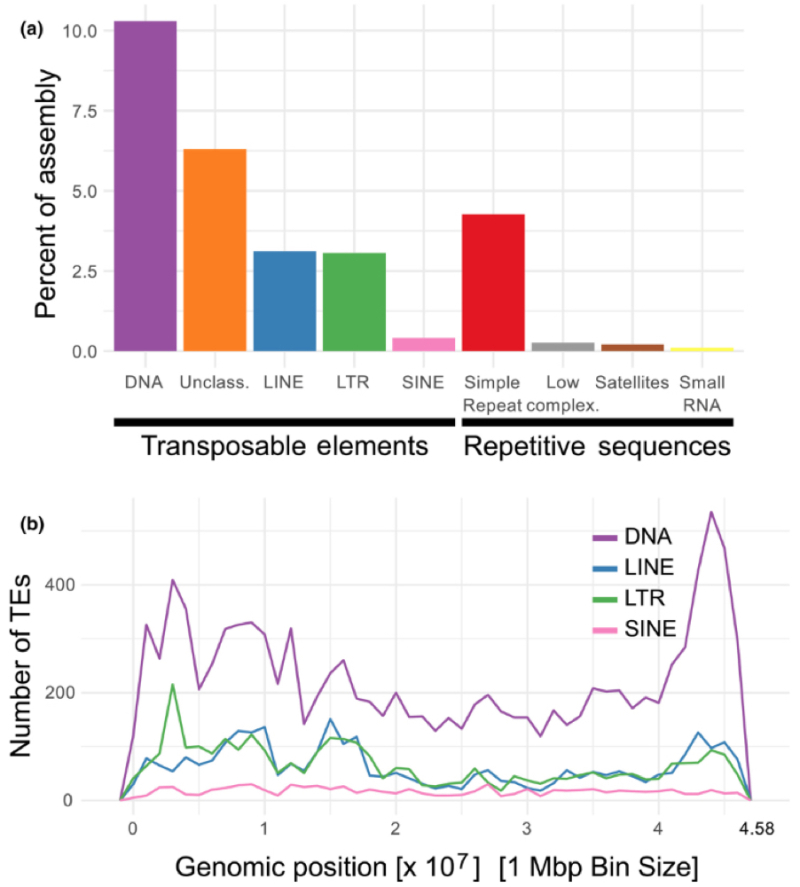
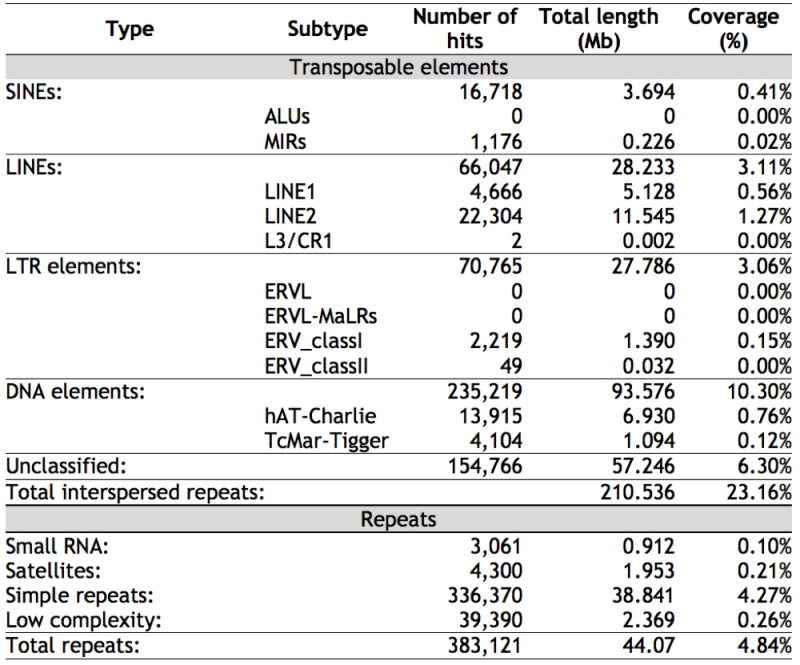
    Clownfish genomic DNA was found to contain 21,644 repetitive sequences, making up 28% of the genome repetitive DNA, wherein 10% of these repeats derived from transposons (compared with ~ 3% in mammals).  RNA sequence data was also obtained from 10 different tissues, showing 26,597 expressed genes from 35,478 transcripts.  8.1% of the clownfish genome comprises genome protein coding sequences, with a gene occurring on average every 30 Mbp.

    Image 2

    Table 1
    Comparisons between clownfish genes and genes from four other species (Asian seabass, Nile tilapia, southern platyfish and zebrafish) showed that 89% of the genes could be assigned to 19,838 "orthologous" groups while 4,429 genes were specific for the orange clownfish.  The largest gene identified in these studies was extracellular matrix protein FRAS1 (26.5 kb) and Titin was the largest encoded protein (18,851 amino acids).  The authors acknowledge the preliminary nature of these results by stating "future investigations will focus on the characterization of these unique genes and what roles they may play in orange clownfish phenotypic traits."

    *Robert LehmannDamien J. LightfootCelia SchunterCraig T. Michell,Hajime Ohyanagi, Katsuhiko Mineta Sylvain Foret, Michael L. Berumen,David J. Miller, Manuel Aranda,, Takashi Gojobori, Philip L. Munday, and Timothy Ravasi

  • By Kevin E. Noonan

    Federal Circuit SealThe varying appellate fortunes of patentees regarding the question of obviousness is illustrated nicely in the Federal  Circuit decision in Orexo AB v. Actavis Elizabeth LLC handed down earlier this month.  The statute, 35 U.S.C. § 103, was intended to tether the question of obviousness to the prior art (and untether it from judicial whim regarding "inventiveness" or "invention" as found in several Supreme Court decisions stating with Hotchkiss, and, to patent law's detriment, resurrected under § 101 by Justice Breyer and in other recent decisions from the Court).  Nevertheless, there cannot help to be a subjective aspect to the issue of obviousness, which is illustrated by this decision when placed in contrast, for example, with other recent obviousness determinations by the Federal Circuit (see, for example, "Acorda Therapeutics, Inc. v. Roxane Laboratories, Inc.").

    The case arose as litigation provoked by Actavis's Abbreviated New Drug Application (ANDA) over Orexo's Zubsolv® product, which was approved by the FDA for treating opioid dependence.  Orexo asserted its Orange Book-listed  U.S. Patent No. 8,940,330, where claims 1 and 6 are representative:

    1.  A tablet composition suitable for sublingual administration comprising:
        microparticles of a pharmacologically-effective amount of buprenorphine, or a pharmaceutically-acceptable salt thereof, presented upon the surface of carrier particles,
        wherein microparticles of buprenorphine or a pharmaceutically acceptable salt thereof are in contact with particles comprising citric acid,
        wherein the buprenorphine or pharmaceutically acceptable salt thereof and the citric acid are not in the same particle;
        a pharmacologically-effective amount of naloxone, or a pharmaceutically-acceptable salt thereof;
        and a disintegrant selected from the group consisting of croscarmellose sodium, sodium starch glycolate, crosslinked polyvinylpyrrolidone and mixtures thereof.

    6.  The composition as claimed in claim 1, wherein the particles of citric acid are presented and act as carrier particles.

    (wherein the italicized terms are relevant to the Court's determination).

    The District Court found the asserted claims of the '330 patent to be obvious, based on prior art disclosure of sublingual formulations of buprenorphine and naloxone in 4:1 concentration ratios known to be effective for treating opioid dependence.  Formulations according to the '330 patent provided smaller doses of buprenorphine that were effective and were less subject to abuse (which in the prior art comprised dissolving the formulation and injecting it directly into the bloodstream).  There was no dispute between the parties regarding the improved effectiveness of the '330 patent formulations.  The opinion states that the evidence presented at trial showed a 66% increase in bioavailability for buprenorphine for tablets containing 29% less of this drug.  The District Court's obviousness determination rested on the components recited in the claims being known in the art, and that "although the specific formulation was not shown or suggested in any reference" the claims to the specific formulation were obvious.  The District Court also held that evidence provided by Orexo regarding the objective indicia (aka secondary considerations) did not rebut its obviousness determination.

    The Federal Circuit reversed, in an opinion by Judge Newman joined by Judges Hughes and Stoll.  The prior art disclosed formulations (Suboxone®) comprising buprenorphine, naloxone, citric acid, sodium citrate, and sublingual excipients, made by a "wet granulation" process described as "buprenorphine, citric acid, and sodium citrate are dissolved together and then mixed with excipients."  Orexo argued that its claims specify (and the formulations produced thereby showed improved bioavailability due to) microparticles of buprenorphine that are adhered to citric acid carrier particles and that such a formulation, having 66% increased buprenorphine bioavailability were not "suggested or reasonable predictable" from the prior art.  This argument was supported by the Examiner's reasons for allowance:

    [T]he mere presence of citric acid in the sublingual tablets formulated according to the prior art (e.g. Cairns) is insufficient to achieve the superior pharmacokinetic profile exhibited by the instant invention.  Applicant has persuasively demonstrated that the instant tablet exhibits unexpectedly superior sublingual buprenorphine bioavailability due to the ingredients as well as the structural characteristics recited in the instant claims [emphasis in opinion].

    Also in the prior art were Suboxone® provided as "orally dissolvable films," which have the disadvantage (according to the opinion) that they cannot be easily removed once applied and limit the dosages that can be achieved (because no more than two films can be applied at one time).  In addition to buprenorphine and naloxone in a 4:1 ratio, the films contain citric acid to reduce the pH to 3.0-3.5 in order to provide optimum bioavailability.  This form of the drug dosage does not have the improved bioavailability or reduced amount of buprenorphine as provided in the '330 patent formulations.

    The District Court also relied on an earlier Orexo published application (which did not mention citric acid as a component) and a European patent, EP 0 324 725, which listed a "large number of water-soluble carrier particles."  Neither citric acid carrier particles, sublingual tablets, nor application of these formulations to opioids were mentioned in this reference.

    The Federal Circuit opinion characterizes the District Court's error(s) as relying on the prior art for not excluding Orexo's formulation, for example with regard to including citric acid in the formulation (and, sub silentio appearing to consider inherent the bioavailability-improving properties of using citric acid as carrier particles for the buprenorphine microparticles specified in the '330 patent claims).  The District Court also discounted Orexo's argument that lowering the pH using citric acid would change the effective concentrations of buprenorphine and naloxone, thus disrupting the 4:1 ratio known to be effective, saying that the ratio itself was an "unclaimed feature" and that this went to whether there would have been a reasonable expectation of success rather than any motivation to combine the prior art.  The District Court was persuaded by Actavis's expert's testimony that citric acid "fits the definition of a carrier particle" and would act as one, although the panel notes the cited art did not disclose using citric acid as a carrier.

    Regarding the objective indicia, although the District Court acknowledged that "the unexpected result of increased bioavailability provides some support for nonobviousness," the improved bioavailability was "a difference in degree,' not a difference in 'kind.'"  The District Court also was unpersuaded by Orexo's evidence regarding teaching away, long-felt need, and copying.

    The panel opinion rejected the District Court's analysis as being infected by hindsight and using the '330 patent disclosure as a template for finding the disclosed aspects of the claimed invention in the prior art.  The prior art disclosure of using citric acid to lower the pH of buprenorphine/naloxone formulations either disrupted the 4:1 drug ratio or did not increase buprenorphine bioavailability and thus did not support Actavis's argument nor the District Court's persuasion by it.  The Federal Circuit also did not find assertion of Orexo's earlier published application to support non-obviousness, insofar as this reference made no mention of including citric acid in any opioid formulation.  And the cited EP'725 patent merely recited a "general description of interactive mixtures as pharmaceutical formulations" and did not recite any specific disclosure relating to sublingual tablets, opioid formulations, citric acid as a carrier particle (despite reciting an "extensive list of carrier particles") or anything else relevant to the question of obviousness of the '330 patent claims.

    The opinion also cites the undisputed novelty of the claimed formulations, and colloquy during oral argument regarding the conventionality vel non of using citric acid as a carrier:

    Actavis Counsel:  Your Honor, I will confirm what counsel said before and what we've said in our briefs.  There is no piece of prior art that was presented that says citric acid is a carrier particle or should be used as a carrier particle.

    Court:  If both of those things are really well known, then one would think that if citric acid were routinely or it was obvious to use it as a carrier particle, you could have found some reference that used it. . . .  Your expert didn't even testify that he was familiar with this industry and that citric acid was routinely used as a carrier particle in interactive mixtures.  He just said it was the right size and it could be used.

    Actavis Counsel:  Well.  You're right Your Honor in terms of your characterization of the record.  There was not citric acid used as a carrier particle that was in the record.

    The opinion illustrates the District Court's error in accepting as evidence supporting obviousness testimony that, if selected, citric acid as a carrier particle would have been expected to work, citing In re Gordon, 733 F.2d 900, 902 (Fed. Cir. 1984) ("The mere fact that the prior art could be so modified would not have made the modification obvious unless the prior art suggested the desirability of the modification.").  A similar error arose concerning the District Court's dismissal of Orexo's argument regarding preserving the 4:1 ratio of buprenorphine to naloxone, the panel stating the error to be the District Court's finding that "there is nothing in the prior art which would have discouraged a person of ordinary skill from following the path set out in the various references" instead of recognizing that "no reference or combination of references proposes the path of the '330 Patent."  Put more succinctly the opinion states "[t]he question is not whether the various references separately taught components of the '330 Patent formulation, but whether the prior art suggested the selection and combination achieved by the '330 inventors."

    Finally, the opinion turns to the objective indicia, which "guide the analysis of obviousness," citing Leo Pharm. Prods., Ltd. v. Rea, 726 F.3d 1346, 1357–58 (Fed. Cir. 2013).  Without expressly stating it, the Court here finds clear error in the District Court's discounting these factors, for example, stating that a 66% increase in buprenorphine bioavailability was "more than a trivial 'degree.'"

    Orexo AB v. Actavis Elizabeth LLC (Fed. Cir. 2018)
    Panel: Circuit Judges Newman, Hughes, and Stoll
    Opinion by Circuit Judge Newman

  • By Joseph Herndon

    Federal Circuit SealZheng Cai DBA Tai Chi Green Tea Inc. appealed an opinion of the U.S. Patent and Trademark Office Trademark Trial and Appeal Board (TTAB) cancelling registration of his mark "WU DANG TAI CHI GREEN TEA" due to a likelihood of confusion with Diamond Hong, Inc.'s registered mark, "TAI CHI," pursuant to 15 U.S.C. § 1052(d) (2012).

    The Federal Circuit affirmed the decision, and despite the two marks (shown below) looking substantially different in appearance at first glance, other factors weighed in favor of the cancellation.

    Section 1052(d) provides that a trademark may be refused if it consists of or comprises a mark which so resembles a mark registered in the USPTO, or a mark or trade name previously used in the United States by another and not abandoned, as to be likely, when used on or in connection with the goods of the applicant, to cause confusion, or to cause mistake, or to deceive (15 U.S.C. § 1052(d)).

    In Application of E.I. DuPont DeNemours & Co., the Court articulated thirteen factors to consider when determining likelihood of confusion (DuPont factors).  Not all of the DuPont factors are relevant to every case, and only factors of significance to the particular mark need be considered.

    The thirteen factors are as follows:  (1) similarity of the marks; (2) similarity and nature of goods described in the marks' registrations; (3) similarity of established trade channels; (4) conditions of purchasing; (5) fame of the prior mark; (6) number and nature of similar marks in use on similar goods; (7) nature and extent of actual confusion; (8) length of time and conditions of concurrent use without evidence of actual confusion; (9) variety of goods on which mark is used; (10) market interface between applicant and owner of a prior mark; (11) extent to which applicant has a right to exclude others from use of its mark; (12) extent of potential confusion; and (13) any other established probative fact on effect of use.

    Between the two marks, in its likelihood of confusion analysis, the TTAB considered the first three DuPont factors, treating the remainder as neutral because neither party submitted evidence related to them.

    Mr. Cai argued that the TTAB improperly weighed these three DuPont factors to arrive at an incorrect conclusion regarding likelihood of confusion. A summary of the analysis of these factors is included below.

    1.  Similarity of the nature of the goods

    With respect to the similarity and nature of the goods, the goods covered by each mark overlap.  Mr. Cai's WU DANG TAI CHI GREEN TEA mark identifies the goods as "Green tea; Tea; Tea bags."

    In turn, among many goods identified in its registration, Diamond Hong's TAI CHI mark identifies "tea."  Given this plain overlap, the TTAB's determination that the parties' goods are identical in part is supported by substantial evidence.

    2.  Similarity of established trade channels

    With respect to similarity of the established trade channels through which the goods reach customers, the TTAB followed case law and presumed that the identical goods move in the same channels of trade and are available to the same classes of customers for such goods—here, general consumers who consume or purchase tea.

    Since the marks cover identical goods (tea), this presumption attaches.  Mr. Cai failed to produce evidence to rebut this presumption.

    3.  Similarity of the marks

    With regard to the similarity of the marks themselves, the TTAB must examine the similarity or dissimilarity of the marks in their entireties as to appearance, sound, connotation, and commercial impression.

    The Federal Circuit noted that the proper test is not a side-by-side comparison of the marks, but instead whether the marks are sufficiently similar in terms of their commercial impression such that persons who encounter the marks would be likely to assume a connection between the parties.

    Where the goods at issue are identical, the degree of similarity necessary to support a conclusion of likely confusion declines.

    Here, the marks were considered similar by the Federal Circuit, when considered as a whole, because they both invoke a large yin-yang symbol and prominently display the term TAI CHI.

    Specifically, the WU DANG TAI CHI GREEN TEA mark to Mr. Cai is described as follows:  the color(s) green and white is/are claimed as a feature of the mark, and the mark consists of a circle outlined in green, that divides to be half green and half white, with a single dot located at each half with the opposite color; on the top of the mark, it has words "Tai Chi Green Tea"; at the bottom of the mark, it has words "Wu Dang."  The mark is reproduced below.

    Image 1Similarly, the TAI CHI mark of Diamond Hong is presented in the following terms:  the mark consists of a man engaged in a tai chi position atop a yin-yang symbol with the term "Tai Chi" below the symbol and a Chinese character on each side of the symbol.  The mark is reproduced below.

    Image 2The Federal Circuit noted that color is not claimed as a feature of Diamond Hong's mark, and this further highlights the likelihood of confusion because, as the TTAB correctly identified, Diamond Hong's mark could be presented in a green-and-white color scheme like Mr. Cai's mark.

    The Federal Circuit agreed with the TTAB's findings as to the DuPont factors, and found that the findings were supported by substantial evidence.  Thus, the Federal Circuit affirmed the Opinion of the U.S. Patent and Trademark Office's Trademark Trial and Appeal Board.

    Despite the two marks looking quite different, the DuPont factors weighed heavily in factor of cancellation of Mr. Cai's mark since the nature of goods described in the marks' registrations were identical and the established trade channels were identical.

    There were other DuPont factors that Mr. Cai could have perhaps argued, however, he encountered errors through submission of evidence, and further briefs by Mr. Cai were not considered.

    Cai v. Diamond Hong, Inc. (Fed. Cir. 2018)
    Panel: Chief Judge Prost and Circuit Judges Wallach and Hughes
    Opinion by Circuit Judge Wallach

  • CalendarSeptember 18, 2018 – "The Continued Influence of PTAB Proceedings on Bio/Pharma Patents" (McDonnell Boehnen Hulbert & Berghoff LLP) – 10:00 am to 11:15 am (CT)

    September 18, 2018 – "3D Printing: Implications for Patents, Trademarks, Trade Secrets and Copyrights — Challenges With Additive Manufacturing, Policing and Enforcement Strategies to Protect IP" (Strafford) – 1:00 to 2:30 pm (EDT)

    September 21, 2018 – "USPTO Post-Grant Patent Trials 2018: Change & Recalibration" (Practising Law Institute) – New York & Groupcasts in Philadelphia, Indianapolis, New Brunswick, NJ, Pittsburgh, and Mechanicsburg, PA

    September 21, 2018 – Supreme Court IP Review (SCIPR) — Patent Edition (Program in Intellectual Property Law, Center for Empirical Studies of Intellectual Property, and Institute on the Supreme Court of the United States at the Chicago-Kent College of Law) – 9:00 am to 5:15 pm (Central), Chicago, IL

    September 23-25, 2018 – Annual Meeting (Intellectual Property Owners Association) – Chicago, IL

    September 24, 2018 – Biotechnology/chemical/pharmaceutical (BCP) customer partnership meeting (U.S. Patent and Trademark Office) – Alexandria, VA

    September 26, 2018 – "IP Audit Checklist: Best Practices to Identify, Protect, Monetize and Enforce University IP Assets" (Technology Transfer Tactics) – 1:00 pm to 2:00 pm (ET)

    September 26, 2018 – "European and Canadian Patent Practices" (Intellectual Property Law Association of Chicago Patents-International Committee) – 11:45 am to 1:00 pm (CT), Chicago, IL

    September 27, 2018 – "Using Broadest Reasonable Interpretation to Your Advantage in Patent Prosecution — Establishing Scope of Claims, Avoiding Sect. 112(f), Preserving Enforceability" (Strafford) – 1:00 to 2:30 pm (EDT)

    September 27-28, 2018 – "Advanced Patent Prosecution Workshop 2018: Claim Drafting & Amendment Writing" (Practising Law Institute) – Chicago, IL

    September 27-28, 2018 – FDA Boot Camp (American Conference Institute) – Boston, MA

    October 2, 2018 – "Advice of Counsel Defense in Patent Litigation and Protecting Attorney-Client Privilege — Limiting Scope of Discovery, Safeguarding Confidential Communications and Information" (Strafford) – 1:00 to 2:30 pm (EDT)

    October 2-3, 2018 – Paragraph IV Disputes master symposium (American Conference Institute) – Chicago, IL

    October 3, 2018 – "2018 Bench & Bar® in Dialogue: Federal Circuit Court Visit!" (Federal Circuit Bar Association) – 2:00 pm to 9:00 pm (CT), Chicago, IL

    October 4, 2018 – "Patent Litigation in Japan and Germany," German Patent and Trade Mark Office, Munich, Germany

  • Chicago-Kent College of LawThe Program in Intellectual Property Law, Center for Empirical Studies of Intellectual Property, and Institute on the Supreme Court of the United States at the Chicago-Kent College of Law will be holding its ninth annual Supreme Court IP Review (SCIPR) — Patent Edition on September 21, 2018 from 9:00 am to 5:15 pm (Central) at the IIT Downtown Campus – Chicago-Kent College of Law in Chicago, IL.  SCIPR is the only annual conference in the country focused exclusively on intellectual property cases before the Supreme Court.  Among the sessions being offered at the conference are:

    • Review of Supreme Court Cases
        – WesternGeco v. ION Geophysical
        
    Oil States Energy Services, LLC v. Greene’s Energy Group, LLC
        
    SAS Institute Inc. v. Iancu

    • Analytics and Preview of 2018 Term
        – Supreme Court Analytics on the Past Term
        – Preview of the Upcoming Term: IP cert. grants and cert. petitions to watch
        – Fourth Estate Public Benefit Corp. v. Wall-Street.com
        
    Helsinn Healthcare S.A., v. Teva Pharmaceuticals USA, Inc., et al.

    • Supreme Court IP Review Address – "Huge Numbers of Patent Cases: How One District Judge Manages Them" — presentation by the The Honorable William Alsup, District Judge, U.S. District Court for the Northern District of California

    • Staying on Top of Recent Developments at the PTAB

    • PTAB Strategy in a Changing Environment: Claim Construction, Amendments and Section 112(6)

    • Litigating Under the New Trial Practice Guidance

    • PTAB Perspectives from In-House Counsel

    A complete agenda for the conference, including a list of sessions and speakers can be found here.

    Additional information regarding the conference can be found here.  The registration fee for the program is $95 (public guest tickets, including Chicago-Kent alumni), $50 (PTAB Bar Association members), or $45 (outside academics).  There is no fee for Chicago-Kent faculty, current Chicago-Kent students, and current students of other law schools.  Those interested in registering for event can do so here.

  • Federal Circuit Bar AssociationThe Federal Circuit Bar Association (FCBA) will be offering a CLE program and dinner entitled "2018 Bench & Bar® in Dialogue: Federal Circuit Court Visit!" on October 3, 2018 from 2:00 pm to 9:00 pm (CT) at the Langham Hotel in Chicago, IL.  The program will include presentations on the following topics:

    • Supreme Court & Federal Circuit En Banc Round Up
    • Update on Estoppel in District Courts Based on PTAB Proceedings
    • Venue Update: Life after the Supreme Court's Decision in TC Heartland LLC v Kraft Foods Brands Group LLC
    A Conversation with the Federal Circuit Judges

    The registration fee for the program is $700.  Those interested in registering for the program, can do so here.  Additional information regarding the program can be found here.

  • IPLACThe Intellectual Property Law Association of Chicago (IPLAC) Patents-International Committee will be presenting a panel discussion entitled "European and Canadian Patent Practices" on September 26, 2018 from 11:45 am to 1:00 pm (CT) at the DePaul College of Law in Chicago, IL.  Part 1 of the seminar, to be presented by Dr. Mash-Hud Iqbal of Marks & Clerk, will be devoted to tips on drafting patent applications for filing in the European Patent Office.  Part 2 of the seminar, to be presented by Tomas Karger of Marks & Clerk, will cover maximizing patent protection in Canada.

    The registration fee for the presentation is $30 (non-members), $20 (IPLAC members), or free (students).  Those interested in registering for event can do so here.

  • Strafford #1Strafford will be offering a webinar entitled "Using Broadest Reasonable Interpretation to Your Advantage in Patent Prosecution — Establishing Scope of Claims, Avoiding Sect. 112(f), Preserving Enforceability" on September 27, 2018 from 1:00 to 2:30 pm (EDT).  Christopher Francis and Daniel Hegner of Bejin Bieneman will guide patent prosecution under the broadest reasonable interpretation (BRI) standard. The panel will provide practical lessons for using BRI to your advantage in prosecution by examining recent Federal Circuit and USPTO's Patent Trial and Appeal Board decisions.  The webinar will review the following issues:

    • What guidance do Federal Circuit and PTAB decisions give patent counsel on the application of BRI?
    • What arguments are useful in overcoming patent examiners’ unreasonable claim interpretations?
    • Why is defining claim terms in the specification and using the definitions critical?
    • How can patent counsel distinguish cases where extrinsic evidence has been used to supplement the specification? If and when should extrinsic evidence be used?

    The registration fee for the webcast is $297.  Those interested in registering for the webinar, can do so here.

  • German Patent and Trade Mark Office (GPTO)A one-day, comparative law symposium on "Patent Litigation in Japan and Germany" will be held on October 4, 2018 at the German Patent and Trade Mark Office (GPTO) in Munich, Germany.  Experts on patent litigation proceedings from Japan and Germany will be speaking at the event, providing an overview of the current case law in both countries.  Further, this event will offer a practice-oriented comparison of current legal issues such as claim construction and doctrine of equivalence or the protection of confidential information in patent litigation.  The language of the symposium will be English.

    Additional information regarding the symposium can be found here.  While there is no cost to participate in the program, advance registration is required.  Those interested in attending the webinar can register here.

  • By Kevin E. Noonan

    Acorda TherapeuticsDetermining obviousness is always a reconstruction, imperfectly done, of a past that never was.  The prior art is consulted and the question asked, would the worker of ordinary skill in the art have been able to achieve the claimed invention with a reasonable expectation of success?  Of course, this question is posed against a backdrop of the ordinarily skilled worker not having achieved the invention; that accomplishment was attained by the named inventor.  Nevertheless, the Supreme Court since Hotchkiss and the Patent Act since 1952 has recognized that sometimes the answer to the question must be no, if only to ensure that the constitutional mandate that Congress only grant patents that will "promote the progress of . . . the useful arts" be satisfied.

    Roxane LaboratoriesIn patent litigation, defendants have the motivation to cast the imperfect past in light most favorable to the claimed invention being obvious, and to balance the rhetorical scales they also bear the burden of establishing obviousness (as in all invalidity pleadings) by clear and convincing evidence.  But what is clear and convincing to some is not to others, and the Federal Circuit's split decision affirming the District Court's obviousness determination in Acorda Therapeutics, Inc. v. Roxane Labs., Inc. illustrates the point — and at the same time shows that even the "objective" indicia of non-obviousness identified by the Supreme Court in Graham v. John Deere do not always provide a reliable, fact-and historically based shield to a finding of non-obviousness.

    The lawsuit arose when Roxane and co-Defendants Mylan Pharmaceuticals, Inc., and Teva Pharmaceuticals USA, Inc. each filed an Abbreviated New Drug Application (ANDA) for Acorda's multiple sclerosis drug (Ampyra®) and sent Paragraph IV letters to Acorda (and co-Plaintiff Alkermes Pharma Ireland Ltd.) asserting that four Orange Book-listed patents (U.S. Patent Nos. 8,007,826; 8,663,685; 8,354,437; and 8,440,703) were invalid.  As the Federal Circuit panel stated, there was one additional patent, U.S. Patent No. 5,540,938, owned by Elan Corp. plc and exclusively licensed to Acorda.  That patent broadly claimed therapeutic formulations of 4-aminopyridine (4-AP); Acorda's patents were for more narrow formulations having specific characteristics and properties that distinguished (undisputedly, for novelty purposes) these claims from the claims of the '938 patent.

    For the purposes of the appeal all the asserted claims recited methods, dosing regimens, and sustained-release formulations for "methods of administering to a patient with multiple sclerosis a sustained-release 4-AP formulation (1) in a 10 mg dose twice daily, (2) at that stable dose for the entire treatment period of at least two weeks, (3) maintaining 4-AP serum levels of 15–35 ng/ml, (4) with walking improved."  The parties treated the following claims as representative:

    Asserted claim 7 (dependent on claim 6) of the '826 patent:

    6.  A dosing regimen method for providing a 4-aminopyridine at a therapeutically effective con- centration in order to improve walking in a human with multiple sclerosis in need thereof, said method comprising:
        initiating administration of 4-aminopyridine by orally administering to said human a sustained release composition of 10 milligrams of 4-aminopyridine twice daily for a day without a prior period of 4-aminopyridine titration, and then,
        maintaining administration of 4-aminopyridine by orally administering to said human a sustained release composition of 10 milligrams of 4-aminopyridine twice daily; without a subsequent period of 4-aminopyridine titration,
        whereby an in vivo CmaxSS:CminSS ratio of 1.0 to 3.5 and a CavSS of 15 ng/ml to 35 ng/ml are maintained in the human.

    Wherein asserted dependent claim 7 includes the limitation "whereby an increase in walking speed is obtained in said human."

    Asserted claim 22 of the '437 patent (dependent on claim 18, which in turn is dependent on claim 1):

    1.  A method of increasing walking speed in a human multiple sclerosis patient in need thereof comprising orally administering to said patient a sustained release composition of 10 milligrams of 4-aminopyridine twice daily for a time period of at least two weeks, wherein said 10 milligrams of 4-aminopyridine twice daily are the only doses of 4- aminopyridine administered to said patient during said time period.

    Wherein claim 18 recites that the dosage form is a tablet, and claim 22 recites that the tableted formulation of 4-aminopydirine "exhibit[s] a release profile to obtain a release profile of about CavSS of 15 ng/ml to 35 ng/ml."

    In the ensuing ANDA litigation the Defendants stipulated to infringement but recited as counterclaims that all claims at issue were invalid for obviousness.  The District Court found the '826, '685, '437, and '703 (but not the '938 patent) obvious, and entered final judgment and an injunction that precluded final approval by the FDA of Defendants' ANDAs until July 20, 2018 (the expiration date of the '938 patent).  This appeal ensued.

    Federal Circuit SealThe Federal Circuit affirmed, in an opinion by Judge Taranto joined by Judge Dyk; Judge Newman dissented (vigorously).  The opinion set forth the extensive prior art asserted against Acorda's claims, as well as evidence that Elan had tried (and failed) to produce a suitable 4-AP formulation, and that Sanofi had also attempted making such a formulation without success.  Distinctions with the prior art included the need to titrate the dose of 4-AP, which (as the opinion concedes) had a "narrow toxic-to-therapeutic range[]"; also noted in the opinion was the variable reports of efficacy and frequent reports of serious side effects (including seizures) and that Acorda's methods, administration regimens, and sustained-release formulations were the only ones the FDA approved to improve walking speed in MS patients.

    Nevertheless, the majority affirmed based on finding the salient limitations (set forth above numbered 1-4) recited in the prior art, and that the skilled worker would have had a reasonable expectation of success in achieving the claimed invention in view of this extensive prior art.  The majority rejected Acorda's three contentions:  "that the district court erred in finding that a person of skill would have had a motivation to combine the prior art to arrive at the Acorda invention and a reasonable expectation of success in doing so"; "that the claim limitations relating to pharmacokinetics—i.e., achieving 4-AP serum levels of 15–35 ng/ml— are inherent in the claimed invention and therefore obvious"; and "that the court improperly applied a categorical rule that a blocking patent (the Elan patent) negates any findings in favor of Acorda on the objective indicia of commercial success, failure of others, and long felt but unmet need."  While the majority appears to have cherry-picked the prior art and reconstructed the invention using the claims as a roadmap (illustrating why the Supreme Court might have underestimated the pernicious effects of hindsight in obviousness determinations in KSR Int'l. Co. v. Teleflex. Inc.), it is the majority's rejection of Acorda's third argument that makes this decision noteworthy.

    The majority's consideration of the so-called "secondary considerations" (aka objective indicia of non-obviousness) is grounded in the question of whether the '938 patent is a "blocking patent" that provides the basis for the commercial success of Acorda's Ampyra® drug product.  The commercial success objective indication of non-obviousness is burdened with the requirement that there be a nexus between the success and the claimed invention; it is frequently the case that such assertions are rebutted, inter alia, by a patentee's market power or other alternative explanation for the success.  The majority opinion sets forth the Court's precedent based on rebuttal of an assertion of commercial success as a basis for non-obviousness in Merck & Co. v. Teva Pharmaceuticals USA, Inc., 395 F.3d 1364 (Fed. Cir. 2005), Galderma Laboratories, L.P. v. Tolmar, Inc., 737 F.3d 731 (Fed. Cir. 2013), and Merck Sharp & Dohme Corp. v. Hospira, Inc., 874 F.3d 724 (Fed. Cir. 2017).  In each case, the Court held that the asserted commercial success did not support non-obviousness, due to the existence of another patent, as here not in issue, that explained why others had not marketed a competing product.  Specifically with regard to Merck Sharp & Dohme Corp. v. Hospira, Inc. ("Merck II"), the majority noted that "a blocking patent did not, all by itself, justify discounting evidence of commercial success," calling it a "fact-specific inquiry."  And:

    Merck II's reasoning reflects a common-sense recognition that, as a theoretical matter, a blocking patent may or may not deter innovation in the blocked space by commercially motivated potential innovators other than the owners or licensees of the blocking patent.  Where the owner of the blocking patent or exclusive licensee is different from the owner of the patent in suit, the granting of a license may be a realistic possibility.  Even where, as here, the owner of the patent in suit and the exclusive licensee of the blocking patent are the same, such a potential innovator might or might not think it could successfully challenge the blocking patent.  And such a potential innovator might or might not be willing to research in the blocked space without a license to a blocking patent—even if the research itself is within the safe harbor provided by 35 U.S.C. § 271(e)(1)—and wait until it has already developed and patented its aimed-at improvement to negotiate for a cross-license with the blocking patent's owner to share the profits from the improvement.  Besides the assessment of whether the blocking patent can be successfully challenged, a number of variables appear generally relevant to the calculus, including: the costliness of the project; the risk of research failure; the nature of improvements that might arise from the project, and whether such improvements will be entirely covered by the blocking patent; the size of the market opportunities anticipated for such improvements; the costs of arriving at the improvements and getting them to market; the risk of losing the invention race to a blocking-patent owner or licensee; the risk that the blocking-patent owner (making its own economic calculations, perhaps in light of its own other products or research activities) will altogether refuse to grant a license to the improvement or will demand so large a share of profits that the whole project is not worthwhile for the potential innovator—all evaluated in light of other investment opportunities.

    Taking these factors and the prior art into consideration (including the fact that Acorda been given an exclusive license to Elan's patent), the majority held that the District Court had not erred in its analysis, a conclusion supported by the deference due the District Court on the factual question of commercial success.  The same blocking effect was also fatal (to the panel majority) to the assertion of "long-felt need" and "failure of others" as objective indicia of non-obviousness.

    Not so for Judge Newman, whose dissent (in comparison to the majority) illustrates the pitfalls that exist in any obviousness determination.  Judge Newman considers the exact same prior art and evidence that convinced the majority, and it convinces her of their error.  To Judge Newman, the history of the prior art was one of failure of many others to achieve the claimed invention.  And to Judge Newman the "new legal theory" regarding the almost plenary effect of "blocking patents" on the objective indicia is not just inimical to the patentee but to "the afflicted public," who would have lost the opportunity for Ampyra® to have been developed if, in prescient retrospect Acorda had foreseen the majority's outcome.  Judge Newman cites the prior art as showing "decades of failure" to wrestle this unwieldy drug, with its "narrow toxic-to-therapeutic range[]" associated with unpredictable and severe side-effects, to the reliable therapeutic uses achieved by Acorda:

    The record shows that many scientists in many institutions studied and eventually abandoned 4-AP as a treatment prospect for multiple sclerosis.  These abandoned studies constitute the prior art on which the district court and my colleagues rely for obviousness of the Acorda Patents. However, the experimentation with 4-AP shows just the opposite – it shows that work with 4-AP was abandoned due to the inability to balance the compound's potential effectiveness with its toxicity.

    Over and over, through her litany of the prior art, she shows that the majority used prior art to support obviousness that revealed failure to achieve the therapeutic goals without risking (and incurring) serious side effects.  Judge Newman sets forth instances where the majority apparently ignored or downplayed evidence that prior art upon which their decision relied reported abandonment of research and development efforts on 4-AP due to "toxicity and seizures," encephalopathy, and hepatitis, or "dizziness, hypotension, or nausea" that accompanied the drug's use.  The record shows that even Acorda, like all the other researchers, initially failed to develop a sustained release formulation and administration regimen effective in improving walking speed in MS patients, and that it was only when Acorda achieved an "analytical breakthrough" (i.e., a reevaluation of the clinical data) that its Ampyra® product was successfully developed.

    In addition, with regard to the majority's base determination of obviousness, Judge Newman asserts that "the question is not whether these four elements [as set forth above], if combined, would produce a successful treatment.  The question is whether the prior art contains a suggestion or motivation to select these four elements from the decades of inconclusive prior art, with a reasonable expectation that the selection would eliminate the failures of the prior art," citing In re Cyclobenzaprine Hydrochloride Extended-Release Capsule Patent Litig., 676 F.3d 1063, 1068–69 (Fed. Cir. 2012).  For Judge Newman, "[t]he years of studies and failures weigh heavily against the simplistic post hoc predictability accepted by the court."  Judge Newman finds no basis for the majority's determination that the skilled worker would have had a reasoned basis from the art to make the selections Acorda did nor any reasonable expectation of success if the skilled worker had done so:

    Acorda is correct that there was no suggestion in the prior art that the claimed combination should be tried, and there is no hint of a reasonable expectation of success.  Acorda points to the decades of failure of others to develop a safe and effective treatment for multiple sclerosis using 4-AP, despite its known toxicity.  The district court's selection of separate limitations from separate sources, and retrospectively fitting them into the Acorda template, is achieved only with the hindsight knowledge of Acorda's eventual success.  See Sanofi-Synthelabo v. Apotex, Inc., 550 F.3d 1075, 1086 (Fed. Cir. 2008) ("The determination of obviousness is made with respect to the subject matter as a whole, not separate pieces of the claim.").  Here, only the Acorda Patents teach the combination that successfully treats this multiple sclerosis impairment while avoiding toxicity and seizures.

    And with regard to commercial success, Judge Newman's analysis provides a compelling argument that the District Court and the majority made the wrong comparison in deciding that Elan's "blocking patent" was relevant to the question:

    Commercial success is measured against the products available for the same purpose, not against infringing copies of the patented product.  Defendants do not contend that they are precluded from providing or developing other treatments for multiple sclerosis.  The Acorda product met a long-felt need, for which the failure of others, despite decades of experimenting with the neurological properties of 4-AP, is evidence of the unobviousness of the Acorda achievement.  Such evidence is an important aid to a court that is attempting to divine whether the patentee's discovery was obvious in accordance with law [emphasis added].

    For good measure, Judge Newman ends her dissent by noting that "[t]he district court was advised that the Patent Trial and Appeal Board sustained the validity of the Acorda Patents in inter partes review, at Coalition for Affordable Drugs (ADROCA), LLC v. Acorda Therapeutics, Inc., 2017 WL 950736 (P.T.A.B. Mar. 9, 2017).  Although the majority reports this event, as did the district court, its consequences are not explored, including issues of privity, estoppel, and finality."

    Acorda Therapeutics, Inc. v. Roxane Laboratories, Inc. (Fed. Cir. 2018)
    Panel: Circuit Judges Newman, Dyk, and Taranto
    Opinion by Circuit Judge Taranto; dissenting opinion by Circuit Judge Newman