• By Michael Borella

    Machine learning is more than just a buzzword.  It represents a fundamental shift in how problems are solved across industries and lines of business.  In the near future, a machine learning library may become a standard part of all operating systems, just like TCP/IP and database technologies have in the past.

    For the majority of the existence of computers, programmers wrote functions that were designed to take some input and produce a desired output.  Or, if i represents the input and o represents the output, the goal of the programmer was to develop a function f such that o=f(i).

    Machine learning inverts this paradigm to some extent.  A data set (which in practice usually needs to be quite extensive) of mappings between inputs and their respective outputs is obtained.  This data set is fed into a machine learning algorithm (e.g., a neural network, decision tree, support vector machine, etc.) which trains a model to "learn" a function that produces the mappings with a reasonably high accuracy.  In other words, if you give the computer a large enough set of inputs and outputs, it finds f for you.  And this function may even be able to produce the correct output for input that it has not seen during training.

    The programmer (who has now earned the snazzy title of "data scientist") prepares the mappings, selects and tunes the machine learning algorithm, and evaluates the resulting model's performance.  Once the model is sufficiently accurate on test data, it can be deployed for production use.

    The number of patent application filings related to artificial intelligence (of which machine learning is the hottest subset) has been growing dramatically in the past several years, especially in the U.S.  But so has the legal uncertainty of certain types of software and business method inventions due to the Supreme Court's rulings in Bilski v. Kappos, Mayo Collaborative Services v. Prometheus Labs., Inc., and Alice Corp. v. CLS Bank Int'l.  So a natural question to ask is what does the patent-eligibility landscape look like for machine learning inventions?  Not unlike all questions regarding patent-eligibility, there are no easy answers.

    But first, let's dig in to the nuances of the case law.  In Alice, the Supreme Court set forth a two-part test to determine whether claims are directed to patent-eligible subject matter under 35 U.S.C. § 101.  One must first decide whether the claim at hand is directed to a judicially-excluded law of nature, a natural phenomenon, or an abstract idea.  If so, then one must further decide whether any element or combination of elements in the claim is sufficient to ensure that the claim amounts to significantly more than the judicial exclusion.  But generic computer implementation of an otherwise abstract process does not qualify as "significantly more," nor will elements that are well-understood, routine, and conventional lift the claim over the § 101 hurdle.

    The Federal Circuit has not been a paragon of consistency across its § 101 cases.  For instance, Electric Power Group v. Alstom S.A. has been interpreted as holding that claims directed to no more than gathering, processing, and outputting data are ineligible.  On the other hand, in Enfish LLC v. Microsoft Corp., the Court found that a database arrangement that provided improvements over traditional relational databases met the § 101 requirements.  Likewise, in McRO, Inc. v. Bandai Namco Games America Inc., claims to software displaying lip synchronization and facial expressions of animated characters were eligible because they used a rule-based approach that was different from manual animation techniques.

    Clearly, it is advantageous for claims related to machine learning inventions to be more than Electric Power Group's gathering, processing, and outputting of data.  But, at its core, that is what machine learning is all about.  Training a model takes in data, crunches it, and produces a program as output.  Using a model also involves taking input data, running it through the model, and obtaining output data as a result.  Thus, a naïve approach to claiming machine learning procedures may lead to § 101 difficulties.

    To date, the Federal Circuit has not considered the patent-eligibility of machine learning claims.  The closest opportunity the Court had was in 2014's I/P Engine, Inc. v. AOL, Inc.  But in that case the claims were directed to non-specific ways of conducting a search for one user based on relevant search results found for other users.  While the patentee pointed out that its specification described use of a neural network to carry out the invention, the Court (in a footnote) dismissed this disclosure since the claims were not limited to such techniques.

    In the district courts, there is relatively little to report.  Most relevant decisions to date, such as Kaavo Inc. v. Amazon.com, Inc. (D. Del. 2018), eResearchTechnology, Inc. v. CRF, Inc. (W.D. Penn 2016), and Neochloris, Inc. v. Emerson Process Mgmt. LLLP (N.D. Ill. 2015) are similar to I/P Engine in that the claims and/or the specification do not explicitly detail specific aspects of machine learning.

    In Blue Spike, LLC v. Google Inc. (N.D. Cal. 2015), the claims were similarly non-specific to machine learning.  The patentee argued against the abstractness of inventions mirroring human perception and analysis on a computer, cautioning that a restrictive approach could render future breakthroughs in artificial intelligence technology unpatentable.  The Court remained focused on the breadth of the claims, stating that "[t]he mere fact that the claims may cover a computer implementation that surpasses in scope or complexity what a human mind is capable of accomplishing is irrelevant where the claims are not limited to such complex activities, but also encompass more basic approaches."
    District Court for the Northern District of CaliforniaOne case that provides a more substantive discussion is PurePredictive, Inc. v. H2O.AI, Inc. (N.D. Cal. 2017), and therefore is worthy of our attention.  PurePredictive sued H2O.AI, alleging infringement of U.S. Patent No. 8,880,446.  H2O.AI filed a motion to dismiss on the grounds that the claims of the '446 patent were invalid under § 101.

    The invention at was described in the '446 patent as "an apparatus, system, method, and computer program product to generate a predictive ensemble in an automated manner . . . regardless of the particular field or application, with little or no input from a user or expert."  In this context, an "ensemble" is a set of machine learning models that can be operated in series or in parallel, with the goal of doing so being to provide better results than the output of any one individual model.

    Claim 14 of the patent recites:

    A method for a predictive analysis factory, the method comprising:
        pseudo-randomly generating a plurality of learned functions based on training data without prior knowledge regarding suitability of the generated learned functions for the training data, the training data received for forming a predictive ensemble customized for the training data;
        evaluating the plurality of learned functions using test data to generate evaluation metadata indicating an effectiveness of different learned functions at making predictions based on different subsets of test data; and
        forming the predictive ensemble comprising a subset of multiple learned functions from the plurality of learned functions, the subset of multiple learned functions selected and combined based on the evaluation metadata the predictive ensemble comprising a rule set synthesized from the evaluation metadata to direct different subsets of the workload data through different learned functions of the multiple learned functions based on the evaluation metadata.

    The Court summarized the claim as consisting of three steps:  "First, it receives data and generates 'learned functions,' or, for example, regressions from that data[, then] it evaluates the effectiveness of those learned functions at making accurate predictions based on the test data[, and then] it selects the most effective learned functions and creates a rule set for additional data input."

    The Court applied the Alice test starting with part one.  H2O.AI took the position that the patent was "an attempt to monopolize the use of basic mathematical manipulations without reference to any specific implementation, application, purpose, or use."  PurePredictive disagreed, stating that the invention solved "a specific problem in and [made] improvements to computer-related technology," and argued that the claims were analogous to those of Enfish and McRO.

    The Court leaned heavily on FairWarning IP, LLC v. Iatric Systems, Inc. as the most relevant precedent.  Similar to Electric Power Group, FairWarning involved claims that (in the view of the Federal Circuit) amounted to no more than "collecting and analyzing information to detect misuse and notifying a user when misuse is detected" and did not improve a technological process.

    In light of this holding, the Court stated that "[t]he method of the predictive analytics factory is directed towards collecting and analyzing information."  Particularly, "[t]he first step, generating learned functions or regressions from data—the basic mathematical process of, for example, regression modeling, or running data through an algorithm—is not a patentable concept."  Further, the next two steps were "mathematical processes that not only could be performed by humans but also go to the general abstract concept of predictive analytics rather than any specific application."

    PurePredictive argued that it would be impossible for a human to carry out the claimed invention.  But the Court found that this point held little weight, noting that "just because a computer can make calculations more quickly than a human does not render a method patent eligible."  The Court also stated that "[t]he patent specification's description of this process as a 'brute force, trial-and-error approach,' reinforces that this process is merely the running of data through a machine."  Regarding Enfish and McRO, the Court concluded that the claimed invention did not improve the functionality of computers or computer-related technology, and instead just used computers as a tool.

    Moving on to part two of Alice, PurePredictive attempted to make analogies between its claims and those found to provide "significantly more" in DDR Holdings, LLC v. Hotels.com, L.P. and BASCOM Glob. Internet Servs., Inc. v. AT&T Mobility LLC.  Particularly, it contended that the claimed ensemble technique "do[es] not need extensive tuning and customization" and is "applicable regardless of the particular field or application."  But the Court disagreed because, unlike DDR Holdings, the claims address a broad scope of problems rather than being focused on solving a specific technical problem.  Furthermore, unlike BASCOM, the claims did not describe a specific physical architecture and instead was focused on software modules.

    As a consequence, the claims failed both parts of the Alice test, were ruled ineligible under § 101, and therefore held invalid.

    While this case is a useful data point, it reinforces the old saying that "bad facts make bad law."  The claims are indeed quite broad and not directed to solving a specific problem or making a particular technical improvement.  Prior to Alice and its progeny, this was unlikely to trigger issues under § 101, but now it does more often than not.

    Still, it should surprise no one that machine learning claims are treated like any other type of software claim in the § 101 analysis.  While one could posit that the whole point of machine learning is to train a computer to do something that a human can't do (or is impractical for a human to do) in a way that a reasonable person would not do it, that is not enough to avoid Alice pitfalls.  Machine learning claims can potentially be even more vulnerable to § 101 challenges when the claims recite only data manipulation and do not provide a well-defined technological need or advantage.

    Therefore, like other types of software inventions, those involving machine learning should be focused.  Some example claiming strategies involve reciting specific types of data associations, detailing the training phase and/or the structure of the model, and placing the model within the context of a larger system.  Until we hear more from the district courts — and hopefully from the Federal Circuit as well — moving forward with these best practices is the recommended approach.

  • MBHB Logo 2McDonnell Boehnen Hulbert & Berghoff LLP and Patent Docs will be hosting a CLE program on Biopharma Patent Law from 9:30 am to 1:00 pm on October 24, 2018 at the Boston Marriott Cambridge in Cambridge, MA.  MBHB attorneys and Patent Docs authors Kevin Noonan and Donald Zuhn, and MBHB attorneys Josh Rich, Lisa Hillman, Sarah Fendrick, John Conour, and Nate Chongsiriwatana will provide presentations on the following topics:

    • Updates on Subject Matter Eligibility Analysis
    • Patenting Repurposed Drugs
    • Antibody Patenting after Amgen v. Sanofi
    • The State of Biotech Patenting: Challenges
    • Maximizing Patent Term for Products Subject to Regulatory Review
    • Impact of Secondary Patents on Market Exclusivity
    • Strategies for Post-Grant Proceedings for Generics and Biosimilars

    There is no registration fee for the program.  However, because space is limited, those interested in attending the program must register by contacting Susan Hall at hall@mbhb.com.

  • CalendarSeptember 23-25, 2018 – Annual Meeting (Intellectual Property Owners Association) – Chicago, IL

    September 24, 2018 – Biotechnology/chemical/pharmaceutical (BCP) customer partnership meeting (U.S. Patent and Trademark Office) – Alexandria, VA

    September 26, 2018 – "IP Audit Checklist: Best Practices to Identify, Protect, Monetize and Enforce University IP Assets" (Technology Transfer Tactics) – 1:00 pm to 2:00 pm (ET)

    September 26, 2018 – "European and Canadian Patent Practices" (Intellectual Property Law Association of Chicago Patents-International Committee) – 11:45 am to 1:00 pm (CT), Chicago, IL

    September 27, 2018 – "Using Broadest Reasonable Interpretation to Your Advantage in Patent Prosecution — Establishing Scope of Claims, Avoiding Sect. 112(f), Preserving Enforceability" (Strafford) – 1:00 to 2:30 pm (EDT)

    September 27-28, 2018 – "Advanced Patent Prosecution Workshop 2018: Claim Drafting & Amendment Writing" (Practising Law Institute) – Chicago, IL

    September 27-28, 2018 – FDA Boot Camp (American Conference Institute) – Boston, MA

    October 2, 2018 – "Advice of Counsel Defense in Patent Litigation and Protecting Attorney-Client Privilege — Limiting Scope of Discovery, Safeguarding Confidential Communications and Information" (Strafford) – 1:00 to 2:30 pm (EDT)

    October 2-3, 2018 – Paragraph IV Disputes master symposium (American Conference Institute) – Chicago, IL

    October 3, 2018 – "2018 Bench & Bar® in Dialogue: Federal Circuit Court Visit!" (Federal Circuit Bar Association) – 2:00 pm to 9:00 pm (CT), Chicago, IL

    October 4, 2018 – "Patent Litigation in Japan and Germany," German Patent and Trade Mark Office, Munich, Germany

    October 4, 2018 – "Biosimilars in the Antitrust Spotlight: Patent Litigation and Settlement" (Intellectual Property Owners Association) – 2:00 to 3:00 pm (ET)

    October 11, 2018 – "Patent Term Adjustments and Extensions: Leveraging Recent Decisions and USPTO Rule Changes" (Strafford) – 1:00 to 2:30 pm (EDT)

    October 12, 2018 – "Standard Essential Patents: What Every IP Attorney and In-house Counsel Should Know" (John Marshall Law School Center for Intellectual Property, Information & Privacy Law) – 9:00 am to 4:30 pm, Chicago, IL

    October 16, 2018 – "Negotiating IP Rights in Industry Sponsored Research Agreements — Structuring Ownership, Licensing, Assignment, Confidentiality, Publication and Use Provisions" (Strafford) – 1:00 to 2:30 pm (EDT)

    October 16-18, 2018 – PCT Seminar (Oppedahl Patent Law Firm LLC) – Redwood City, CA

    October 24, 2018 – Biopharma Patent Law (McDonnell Boehnen Hulbert & Berghoff LLP and Patent Docs) – 9:30 am to 1:00 pm, Cambridge, MA

  • IPO #2The Intellectual Property Owners Association (IPO) will offer a one-hour webinar entitled "Biosimilars in the Antitrust Spotlight: Patent Litigation and Settlement" on October 4, 2018 from 2:00 to 3:00 pm (ET).  Nicholas Mitrokostas of Goodwin Procter LLP, Richard Mortimer of Anaylsis Group, and Michael Perry of Baker Botts LLP will discuss:

    • The likely shape of settlements in patent litigation between innovator biologic companies and biosimilar aspirants
    • In light of FTC challenges to a series of contemporaneous business deals including patent settlements, the future of non-cash forms of compensation
    • As multiple patents in biosimilar infringement litigation can be asserted in staggered waves over time, whether “at-risk” entry is more or less likely than for traditional generic drugs

    The registration fee for the webinar is $135 (government and academic rates are available upon request).  Those interested in registering for the webinar can do so here.

  • Oppedahl Patent Law Firm LLC will be offering an in-person PCT Seminar on October 16-18, 2018 in Redwood City, CA.  Carl Oppedahl of Oppedahl Patent Law Firm LLC will address the following:

    I.  Strategic topics:

    • Whether to use PCT or Paris Convention.
    • Choosing wisely when picking a Receiving Office.
    • Choosing wisely when picking an International Searching Authority.
    • Deciding whether or not to file a Demand.
    • Deciding whether or not to file an Article 19 Amendment.
    • Helping the applicant figure out where to enter the national/regional phase.

    II.  Profession practice topics:

    • Malpractice avoidance — the importance of making use of PCT-SAFE or ePCT to file a PCT application.
    • Drafting a PCT application so as to reduce problems in other patent offices.
    • Making strategic choices to maximize possible benefits from the Patent Prosecution Highway.
    • Choosing between US national phase entry or US bypass continuation.
    • Comparing various filing scenarios (PCT first, running a US case in parallel) and their effects on patent term and filing costs.

    III.  Skills and tasks:

    • Filing a PCT application.
    • How and where to file a 92bis request.
    • How and where to file a Demand and Article 34 amendment.
    • How and where to file an Article 19 amendment.
    • Checking the status and contents of a PCT application in ePCT (similar to Private PAIR).
    • Entry into US national phase.
    • Bypass continuation.
    • Docketing of PCT.

    The registration fee for the webcast is $699.  Those interested in registering for the webinar, can do so here.

  • Strafford #1Strafford will be offering a webinar entitled "Patent Term Adjustments and Extensions: Leveraging Recent Decisions and USPTO Rule Changes" on October 11, 2018 from 1:00 to 2:30 pm (EDT).  Thomas L. Irving, Jill K. MacAlpine, and Charles E. Van Horn of Finnegan Henderson Farabow Garrett & Dunner will guide IP counsel in calculating patent term adjustments, interplay with patent term extensions, examine recent court treatment, and offer approaches for preserving rights and maximizing patent term adjustments and patent term extensions.  The webinar will review the following issues:

    • What are the lessons from the recent Federal Circuit decisions regarding the patent term calculation?
    • How will the recent changes for the USPTO alter the landscape for PTA and PTE practice?
    • What best practices should patent applicants take to preserve rights and maximize PTA and PTE?

    The registration fee for the webcast is $297.  Those interested in registering for the webinar, can do so here.

  • JMLSThe John Marshall Law School Center for Intellectual Property, Information & Privacy Law will be hosting an IP Executive Seminar on "Standard Essential Patents: What Every IP Attorney and In-house Counsel Should Know" from 9:00 am to 4:30 pm on October 12, 2018 in Chicago, IL.  The program, which will be presented by Graham Bell of Cubicibuc Ltd., David L. Cohen of David L. Cohen, P.C./Kidon IP Corp., and Hon. Randall R. Rader (ret.), former Chief Judge of the U.S. Court of Appeals for the Federal Circuit, will consist of the following sessions:

    • Standard-Setting: Origins, Benefits, and Challenges
    • Standard Setting Organizations (SSOs) and the Patent Wars
    • Royalties and Injunctions
    • Panel Discussion: Trends and Predictions

    Additional information about the program can be found here.  Those interested in registering for the conference online can do so here; the registration fee is $245 (general admission) and JMLS students, staff, and faculty can apply for free registration.

  • Strafford #1Strafford will be offering a webinar entitled "Negotiating IP Rights in Industry Sponsored Research Agreements — Structuring Ownership, Licensing, Assignment, Confidentiality, Publication and Use Provisions" on October 16, 2018 from 1:00 to 2:30 pm (EDT).  Jeffrey D. Morton of Snell & Wilmer will guide counsel on negotiating and structuring industry sponsored research agreements (SRAs) to allocate IP ownership, outline challenges of SRAs with nonprofit organizations, and discuss key provisions of the SRA to protect IP rights and avoid unintended consequences.  The webinar will review the following issues:

    • What are the primary considerations for counsel when negotiating the SRA?
    • What are best practices for addressing IP ownership and rights in an SRA?
    • What challenges do multiple licenses create and how can counsel overcome those challenges?

    The registration fee for the webcast is $297.  Those interested in registering for the webinar, can do so here.

  • By Kevin E. Noonan

    Federal Circuit SealThe Federal Circuit reversed a finding of non-obviousness in a Patent Trial and Appeal Board decision in an inter partes review, in an opinion handed down Monday in E. I. du Pont de Nemours & Co. v. Synvina C.V.

    The patent was directed to methods for oxidizing 5-hydroxymethylfurfural or derivatives thereof under reaction conditions specified by the claims ("temperature, pressure, catalyst, and solvent"), to form 2,5-furan dicarboxylic acid ("FDCA").  FDCA can be produced from sugars and thus is considered by the Department of Energy to be a "green" or environmentally beneficial precursor to other materials.

    The instituted petition challenged claims 1-5 and 7-9 of U.S. Patent No. 8,865,921 as being invalid for obviousness; claim 1 is representative:

    1.  A method for the preparation of 2,5-furan di-carboxylic acid comprising the step of contacting a feed comprising a compound selected from the group consisting of 5-hydroxymethylfurfural ("HMF"), an ester of 5-hydroxymethylfurfural, 5-methylfurfural, 5-(chloromethyl)furfural, 5-methylfuroic acid, 5-(chloromethyl)furoic acid, 2,5-dimethylfuran and a mixture of two or more of these compounds with an oxygen-containing gas, in the presence of an oxidation catalyst comprising both Co and Mn, and further a source of bromine, at a temperature between 140° C. and 200° C. at an oxygen partial pressure of 1 to 10 bar, wherein a solvent or solvent mixture comprising acetic acid or acetic acid and water mixtures is present.

    (Where the italicized portion of the claim are the terms considered by the PTAB and the Federal Circuit.)  The opinion enumerated the four conditions recited in the claims (and that were the basis for its opinion) as:

    (1) a temperature between 140°C and 200°C ("higher than 140° C"; "at least 140° C., preferably from 140 and 200° C., most preferably between 160 and 190° C," albeit noting that "[t]emperatures higher than 180°C. may lead to decarboxylation and to other degradation products.")

    (2) an oxygen partial pressure ("PO2") of 1 to 10 bar ("The pressure is determined by the solvent (e.g., acetic acid) pressure at a certain temperature.  The pressure of the reaction mixture is preferably selected such that the solvent is mainly in the liquid phase"; "In the case of continuously feeding and removing the oxidant gas to and from the reactor, the oxygen partial pressure will suitably be between 1 and 30 bar or more preferably between 1 and 10 bar.");

    (3) a solvent comprising acetic acid ("[t]he most preferred solvent is acetic acid"); and

    (4) a catalyst comprising cobalt ("Co"), manganese ("Mn"), and bromine ("Br") ("based on both cobalt and manganese and suitably containing a source of bromine"; "The catalyst may also contain 'one or more additional metals, in particular [zirconium] and/or [cerium].'").

    The opinion also consulted the specification to further explicate the meaning of these terms, as shown in the parenthetical annotations above.  According to the opinion, "the specification states that the inventors 'surprisingly' achieved high yields of FDCA," which were asserted during the IPR proceedings to constitute one of the "secondary considerations" (aka objective indicia) of non-obviousness.

    The IPR was instituted over the following prior art:

    Obviousness claims 1–5, over the disclosure of International Publication WO 01/72732, either alone or in combination with Inventor's Certificate RU-448177 and U.S. Patent Application Publication 2008/0103318

    Obviousness, claims 7-9, over the disclosure of International Publication WO 01/72732, in combination with "Applicants Admitted Prior Art," or Jaroslaw Lewkowski, Synthesis, Chemistry and Applications of 5-Hydroxymethylfurfural and Its Derivatives, ARKIVOC 17 (2001) and/or Shigeru Oae, A Study of the Acid Dissociation of Furan- and Thiophenedicarboxylic Acids and of the Alkaline Hydrolysis of Their Methyl Esters, 38(8) Soc. Jpn. 1247 (1965)

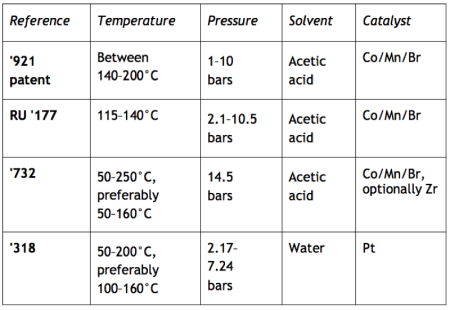
    All of the cited references disclosed methods for producing oxidized HMF or a derivative under differing conditions, which overlapped the claimed conditions of temperature, pressure, solvent and catalyst.  Depending on the reference, yields varied from 14% to 58.8%.  Paradoxically, the prior art reference having the best yield (98%) specified water as solvent and using a platinum catalyst.  The opinion set forth a table comparing the various reaction conditions.

    Table
    "The two additional references, Lewkowski and Oae, are relevant to the FDCA esterification claims 7–9.  Consistent with the '921 patent's acknowledgment that esterification of FDCA was known at the time of the invention, '921 patent col. 5 l. 42, Lewkowski and Oae both disclosed esterifying FDCA."

    At final hearing, DuPont argued that "a burden-shifting framework" applied to the question of obviousness.  The Board rejected this contention under In re Magnum Oil Tools International, Ltd., 829 F.3d 1364, 1375 (Fed. Cir. 2016), and Dynamic Drinkware, LLC v. National Graphics, Inc., 800 F.3d 1375, 1378 (Fed. Cir. 2015), which the PTAB held foreclosed this burden shift in an IPR.  This was the error that caused the Federal Circuit to reverse the Board's judgment.  The Board based its non-obviousness decision on its recognition that while the prior art disclosed performing the claimed reaction (oxidizing HMF or derivatives to FDCA), "none of the references relied upon by Petitioners expressly taught a process in which HMF or its derivatives were oxidized to FDCA using a Co/Mn/Br catalyst at a reaction temperature of between 140°C and 200°C while also maintaining the [PO2] between 1 and 10 bar," nor that adjusting the temperature and pressure variables to be within the claimed range would be a matter of mere routine experimentation.

    The Board also considered the objective indicia of non-obviousness is arriving at its conclusion, but found that evidence to be "less probative in supporting a conclusion of non-obviousness" particularly with regard to unexpectedly high yields.

    The Federal Circuit reversed, in an opinion by Judge Lourie, joined by Judges O'Malley and Chen.  The panel first addressed the standing issue raised by Patent Owner, holding that Petitioner DuPont had standing.  Analogizing this circumstance with a declaratory judgment plaintiff, the panel held that there need not be "a specific threat of infringement litigation by the patentee" but rather merely "a controversy 'of sufficient immediacy and reality' to warrant the requested judicial relief.  Id. (citing MedImmune, Inc. v. Genentech, Inc., 549U.S. 118, 127 (2007)).  The circumstances asserted by DuPont were enough to satisfy this standard:

    (1) DuPont has built a demonstration plant to produce FDCA and an FDCA ester ("FDME"), and the plant is capable of operating under conditions within the claimed ranges of the '921 patent; (2) Synvina is a competitor that alleged before the Board that Archer-Daniels-Midland Company's ("ADM") processes for producing FDCA were "embraced by the claims in the '921 patent," and (3) Synvina rejected DuPont's request for a covenant not to sue.

    (Interestingly, the evidence adduced by DuPont in support of standing establishes their intent to willfully infringe should the panel not decide that the PTAB erred in not finding the '921 patent to be invalid, although the panel was careful to state in a footnote that "we make no judgment on whether DuPont has infringed or is infringing the '921 patent.")

    Turning to the merits, the opinion states it is applying the "old" legal principle that "where the general conditions of a claim are disclosed in the prior art, it is not inventive to discover the optimum or workable ranges by routine experimentation," citing In re Aller, 220 F.2d 454, 456 (CCPA 1955); In re Geisler, 116 F.3d 1465, 1469–70 (Fed. Cir. 1997); and In re Woodruff, 919 F.2d 1575, 1578 (Fed. Cir. 1990).  Said another way, "[a] prima facie case of obviousness typically exists when the ranges of a claimed composition overlap the ranges disclosed in the prior art," citing In re Peterson, 315 F.3d 1325, 1329 (Fed. Cir. 2003), and "such overlap creates a presumption of obviousness," citing Galderma Labs., L.P. v. Tolmar, Inc., 737 F.3d 731, 737–38 (Fed. Cir. 2013); Ormco Corp. v. Align Technology, Inc., 463 F.3d 1299, 1311 (Fed. Cir. 2006); and Iron Grip Barbell Co. v. USA Sports, Inc., 392 F.3d 1317, 1322 (Fed. Cir. 2004).  The presumption can be rebutted, according to the opinion, in the usual manner:  by establishing one of the secondary considerations (aka objective indicia) of non-obviousness (unexpected results, typically by identifying a "critical" range of one of the recited parameters; or teaching away).  Alternatively, "a change to a parameter may be patentable if the parameter was not recognized as 'result-effective,'" citing In re Applied Materials, Inc., 692 F.3d 1289, 1295 (Fed. Cir. 2012), relying on In re Antonie, 559 F.2d 618, 620 (CCPA 1977)).  Finally, prior art that recites very broad ranges of variables "may not invite routine optimization."

    Here, the Federal Circuit held that the presumption of obviousness applied, and the Patent Owner had not adequately rebutted it.  Responding to the parties' arguments, the panel agreed with Petitioner that "the Board erred in concluding that the type of burden-shifting framework consistently applied in our overlapping range cases was implicitly foreclosed by subsequent cases not addressing this framework."  Specifically:

    "[W]here there is a range disclosed in the prior art, and the claimed invention falls within that range, the burden of production falls upon the patentee to come forward with evidence" of teaching away, unexpected results, or other pertinent evidence of nonobviousness.  Galderma, 737 F.3d at 738; see Allergan, Inc. v. Sandoz Inc., 796 F.3d 1293, 1304–05 (Fed. Cir. 2015) (citing Galderma, 737 F.3d at 737–38); Ormco, 463 F.3d at 1311 ("Where a claimed range overlaps with a range disclosed in the prior art, there is a presumption of obviousness.  The presumption can be rebutted if it can be shown that the prior art teaches away from the claimed range, or the claimed range produces new and unexpected results.")

    These cases applied this evidentiary standard in the context of district court litigation.  The Federal Circuit held that there was no basis for the same standard not to be applied in IPR proceedings, and held the Board had erred in not considering this case law and instead relying on recent cases (In re Magnum Oil Tools International, Ltd., 829 F.3d 1364 (Fed. Cir. 2016), and Dynamic Drinkware, LLC v. National Graphics, Inc., 800 F.3d 1375 (Fed. Cir. 2015)) that were inapposite to the question (albeit involving IPRs).  The panel cautioned that broad statements in their case law "must be interpreted in context" and that in overlapping range cases, "a patent challenger would have every incentive to point out the existence of an overlapping range, and virtually none to differentiate the claimed range from what was disclosed in the prior art."  That latter task is left to Patent Owner, and general principles of burden shifting must accommodate this reality.

    Further, the panel agreed with Petitioner that the Board erred in holding that the PO2 and temperature variables were not "result-effective variables."  The opinion found error in the Board not applying the proper legal standard ("[a]lthough the Board correctly articulated the basic standard for result-effective variables [], it did not follow it"):  "a person of ordinary skill would not always be motivated to optimize a parameter "if there is no evidence in the record that the prior art recognized that [that] particular parameter affected the result," citing In re Antonie.  In that case, the changes an inventor made in such a parameter could result in a non-obvious advance in the art, and provide an exception to the rule that "the discovery of an optimum value of a variable in a known process is normally obvious," citing In re Aller.  Here, according to the opinion, the Board imposed the improper burden on Petitioner "to prove that the disclosures in the prior art 'necessarily required' the variable to be within the claimed range, or that the variables 'predictably affected FDCA yields.'"  All that DuPont was required to show to support its obviousness contention was that the prior art recognized, either expressly or impliedly, that what was claimed (a method of oxidizing HMF and related molecules) was affected by the reaction temperature and PO2.  The references supported DuPont's argument that the art recognized the dependence of the oxidation reaction on these parameters and thus these were "results-effective variables."  Accordingly, mere optimization of them rendered the claimed methods prima facie obvious.  Applying this proper legal standard to each of the challenged claims, the panel arrived at the conclusion that each claim was obvious.  Importantly, the panel further refined its understanding of the Board's error insofar as "the Board did not consider the 'normal desire of scientists or artisans to improve upon what is already generally known,' which 'provides the motivation to determine where in a disclosed set of . . . ranges is the optimum combination,'" citing In re Peterson.

    Finally, the Federal Circuit held that the Board's refusal to credit the Patent Owner's evidence of secondary considerations was supported by substantial evidence and thus not subject to being second guessed by the Court.  With regard to long-felt need, the panel cited in support disclosure in the '921 of laboratory-scale, rather than industrial-scale, improvement in yields.  Should this become the standard, of course, it is unlikely that long-felt need would ever be sufficient as a persuasive objective index of non-obviousness.

    The Court's conclusion was summary:

    At bottom, this case involves a strong case of obviousness based on very close prior art and weak evidence of nonobviousness.  We conclude that the Board therefore erred in not concluding that claims 1–5 would have been obvious at the time of the claimed invention.

    The Court invalidated claims 7-9 using the same legal standard as applied to the art cited against claims 1-5 and the additional Lewkowski and Oae references, and that Synvina did not argue that claims 7-9 were separately patentable from claims 1-5.

    This decision illustrates an application (in the chemical arts) of the principle regarding claims encompassing an incremental change to a known process that this Court (and undoubtedly, the Supreme Court; see KSR Int’l. v. Teleflex) considers undeserving of patent protection, because it falls within the art's ordinary skill to optimize a known process by varying parameters known to be important to how the process achieves a desired goal.  As such there is nothing particularly remarkable about this case, except (as with all cases) to test whether the consequence of the application of this principle arrives at an outcome consistent with the purposes of patent law and thus affirm the correctness of the principle.  The extent to which this depends on the "eye of the beholder" is apparent and perhaps unavoidable.  But it is a proper exercise of the Federal Circuit's mandate, both to establish clear and (to the extent possible) consistent standards for patent law and provide a judicial check on the USPTO.  In the IPR era, this latter function is more important than ever, nicely illustrated by the decision in this case.

    E. I. du Pont de Nemours & Co. v. Synvina C.V. (Fed. Cir. 2018)
    Panel: Circuit Judges Lourie, O'Malley, and Chen
    Opinion by Circuit Judge Lourie

  • By John E. Conour

    DrugsEven with billions of dollars of funding and the cumulative knowledge and experience of over a hundred years of experimental pharmacology, de novo discovery of effective and safe therapeutics remains a costly and risky endeavor.  The number of unsuccessful attempts to obtain Food and Drug Administration (FDA) approval of drugs for specific indications is far greater than the number of successes.  As a result, there is an extensive and ever growing list of "failed" drugs, most of which are ultimately abandoned by pharmaceutical companies.

    More recently, failed drugs previously considered to be lost causes are being reconsidered as possible therapies for different indications than those for which they had originally been considered.  Such drug "repurposing" provides researchers and clinicians with a cost-effective way to identify potential new therapies without needing to start from scratch.  Many failed drugs have already established their relative safety in Phase I clinical trials, which can simplify and reduce the cost of obtaining FDA approval should a new indication be found.  Drug repurposing is not limited to failed drugs but is also being considered for currently marketed drugs as well as "off patent" generic compounds to expand and extend their usefulness.

    But because drug repurposing primarily concerns previously-known drugs, obtaining patent protection can be challenging.  In some cases, a drug to be repurposed is still protected by a patent that can be acquired and/or in-licensed, but often the drug itself is not protected by patent.  Without patent protection, commercialization of a repurposed drug (i.e., maximizing the potential beneficial impact of the drug) is not realistic.  This article discusses certain issues to be considered when trying to obtain new patent protection for repurposed drugs.  It should be expected that each attempt to patent a repurposed drug will have its own factspecific challenges.  Accordingly, the concepts discussed here are generalized and nonexhaustive.

    The foundational inquiry for determining whether a repurposed drug can be patented in the United States is to consider whether, under 35 U.S.C. § 101, the drug constitutes patentable subject matter.  Section 101, in relevant part, provides: "[w]hoever invents or discovers any new and useful process, machine, manufacture, or composition of matter, or any new and useful improvement thereof, may obtain a patent therefor . . . ."[1]  Repurposed drugs are often non-nature-based compositions of matter (i.e., synthetic compounds that are not naturally occurring) that can be used in useful processes (e.g., methods of treating a disease by administering to a patient in need thereof a therapeutically effective dose of a drug).  Therefore, claims directed to repurposed drugs and methods of their use should not typically run afoul of § 101.  Even repurposed drugs that are nature-based compositions of matter may still be patentable, for example, if recited in a method of treatment claim.  Indeed, method of treatment claims reciting nature-based compositions of matter seem to be on more secure footing under § 101 in light of the recent decision in Vanda Pharmaceuticals Inc. v. West-Ward Pharmaceuticals,[2] at least because the United States Patent and Trademark Office has issued a recent memorandum to the Patent Examining Corps advising that the Patent Office intends to follow the legal reasoning in this case.[3]  Nevertheless, care must be taken when drafting claims to avoid § 101 issues.

    Another significant hurdle to overcome with respect to patenting repurposed drugs is 35 U.S.C. § 102.  Section 102, as applied to a repurposed drug, requires that it was not previously patented, described in a printed publication, or in public use, on sale, or otherwise available to the public before a patent application is filed to cover the repurposed drug.  In other words, a claim to the repurposed drug itself must be novel, in that it must recite something not previously publicly known.  Practically speaking, most composition of matter claims reciting only the repurposed drug will be excluded from patentability under § 102, because (almost by definition for a "repurposed" drug) the drug was previously known and thus its earlier public disclosure would be prior art to any subsequent patent filing.  Accordingly, composition claims directed to the repurposed drug itself will likely be anticipated because they are not reciting anything new.  Yet there are ways to overcome § 102 to obtain composition claims on repurposed drugs.

    One useful approach for overcoming a § 102 rejection is to incorporate the repurposed drug into a composition that includes one or more other compounds to form a novel combination not previously known.  Importantly, the claimed combination can be any practical combination that is novel for purposes of overcoming § 102.  However, as discussed below, claims to pharmaceutical compositions that recite combinations with more than one key constituent (e.g., a therapeutically effective amount of a repurposed drug and a therapeutically effective amount of a second drug) are more likely to be patentable.  Additional details regarding specific amounts of drugs included in combinations or ratios between the drugs in the combination can add further grounds for finding such claims patentable over what was previously known in the prior art.

    A further approach to obtaining claims directed to previously known drugs that are patentable in a § 102 context is to draft claims to novel pharmaceutical dosage forms.  Pharmaceutical dosage forms can be, for example, solids, liquids, delayed or extended release forms, and/or for a specific type of administration (e.g., oral, parenteral, intramuscular, etc.).  Many types of variations are possible with pharmaceutical dosage forms, which lend themselves to drafting novel claims.  For example, desired release characteristics and/or routes of administration may differ for the new use of the repurposed drug compared to its previous use, which would provide the basis of a novel claim.

    As a final and particularly important example, a method claim reciting a repurposed drug may more easily overcome § 102 rejections.  Repurposing a drug for a new indication is typically a novel use of the drug.  Therefore, a method-of-use claim that recites a repurposed drug for treating a subject with the new indication should also be novel.  Such method claims are particularly useful because they are difficult for competitors to design around, and they are also available in many foreign jurisdictions (though with potentially different formats).

    What is often more challenging for patenting a repurposed drug is overcoming an obviousness rejection.  Obviousness (or lack of inventive step) falls under 35 U.S.C. § 103, which states, in relevant part, that:

    A patent for a claimed invention may not be obtained . . . , if the differences between the claimed invention and the prior art are such that the claimed invention as a whole would have been obvious before the effective filing date of the claimed invention to a person having ordinary skill in the art to which the claimed invention pertains.[4]

    Here, the basic calculus is that if a skilled artisan (e.g., a clinician or researcher in the same field of practice or study as the person seeking to repurpose a drug and with the average skill level of such clinicians or researchers) who understands the prior art would have reasonably expected the drug to be useful for the new indication, then a claim to a repurposed drug for the new indication may be obvious.  Obviousness rejections of claims to repurposed drugs can be very complex and can be based on a combination of several prior art references, each teaching one or more aspects of the rejected claims.

    Unfortunately, the relatively straightforward strategies for overcoming a § 102 rejection are mostly ineffective for overcoming obviousness rejections.  Simple chemical combinations of repurposed drugs with other drugs that may make a novel composition are arguably obvious if they are nothing more than a routine exercise for a skilled pharmacologist.  Fortunately, there are ways to overcome obviousness rejections, but they can require planning well before filing a patent application, and indeed, experiments to investigate the usefulness of a repurposed drug should be designed with obviousness rejections in mind.  This is because one of the most powerful arguments against an obviousness rejection of claims directed to a repurposed drug is a showing of unexpected results.[5]  In this context, a showing of unexpected results can be a presentation of scientific data (often in the patent application, but data can also be presented after filing) that, for example, show a surprising effect of a drug that would not have been expected based on what was known at the time.  Examples of unexpected results can include that a drug surprisingly works as intended for a new indication, or that a drug works at the dose used (e.g., a surprisingly low dose), or that a combination of drugs demonstrates synergy when used together (their combined effect being greater than each drug acting alone), among others.[6]  Another powerful example of unexpected results is the discovery that the drug acts via a different target or has a different mechanism of action for the new use than for its previous use.  Such examples of unexpected results can overcome obviousness rejections for claims directed to method of use, or pharmaceutical dosage forms, or pharmaceutical compositions comprising a combination of drugs, respectively.  Therefore, care should be given to experimental design and the types of data that are collected in support of such evidence of non-obviousness.

    Finally, a patent for a repurposed drug must satisfy 35 U.S.C. § 112, which requires that a patent application include:

    [A] written description of the invention, and of the manner and process of making and using it, in such full, clear, concise, and exact terms as to enable any person skilled in the art to which it pertains, or with which it is most nearly connected, to make and use the same.[7]

    Section 112 also requires an application to have one or more claims "particularly pointing out and distinctly claiming the subject matter which the inventor or a joint inventor regards as the invention."[8]  Basically, § 112 requires that, at the time of filing, the written description must enable a skilled artisan to replicate the invention (much like a scientific paper should enable a researcher to replicate the experiments and data presented in the paper) and that the claims must be fully supported by the written description.

    Careful patent application planning and drafting can avoid or overcome § 112 rejections.  At a minimum, literal support for each claim should be provided, examples of various embodiments of the invention described (e.g., the repurposed drugs and indication, possible drug substitutions and/or derivatives, dosing amounts, dosage forms, excipients, dosing regimens, methods of treatment, etc.), and experimental data establishing drug effectiveness included.  The written description should also be drafted with sufficient detail and distinct variations of the invention to permit claim amendments that can dispose of a prior art rejection (under either § 102 or 103).  Indeed, all important details and variations of the invention envisioned must be included before filing because § 112 prohibits addition of "new matter" after filing.

    In conclusion, patent protection is possible for previously known drugs being repurposed for new indications.  The best chances for patenting repurposed drugs occur when care is given to initial experimentation to establish the usefulness of the drugs and for identifying any unexpected properties of the drugs.  By combining robust invention disclosures with thoughtful and detailed application preparation, patent applications directed to repurposed drugs will be better prepared to successfully navigate the rigors of the Patent Office.

    [1] 35 U.S.C. § 101.

    [2] 887 F.3d 1117 (Fed. Cir. 2018).

    [3] See Memorandum from Robert W. Bahr, Deputy Comm'r for Patent Examination Policy, to Patent Examining Corps (Jun. 7, 2018), available at https://www.uspto.gov/sites/default/files /documents/memo-vanda-20180607.PDF.

    [4] 35 U.S.C. § 103.

    [5] Other important objective evidence of non-obviousness, also known as "secondary considerations," includes evidence of commercial success, long-felt but unsolved needs, and failure of others.  See Graham v. John Deere Co. of Kansas City, 383 U.S. 1, 17 (1966).

    [6] See Manual of Patent Examining Procedure §§ 716.02, 2145.

    [7] 35 U.S.C. § 112(a).

    [8] Id. § 112(b).