• IPLACThe Intellectual Property Law Association of Chicago (IPLAC) AIA Trials Committee and John Marshall Law School will be offering an "AIA Trials Seminar" on November 14, 2018 from 1:00 pm to 5:00 pm (CT) at the John Marshall Law School in Chicago, IL.  The seminar will consist of the following panel discussions:

    Panel 1 — The Evolving Administration of the PTAB
    Panel 2 — The Federal Circuit and the PTAB
    Panel 3 — The Way Forward

    For IPLAC members and students, the seminar is complimentary.  The registration fee for non-members is $5.  Those interested in registering for event can do so here.

  • Federal Circuit Bar AssociationThe Federal Circuit Bar Association (FCBA) Patent Litigation Committee will be offering a webcast entitled "Litigating § 101 Issues After Berkheimer" on November 14, 2018 from 3:00 pm to 4:30 pm (EST).  Irene Yang of Sidley Austin LLP will moderate a panel consisting of Peter Menell, Koret Professor of Law, The University of California, Berkeley School of Law; and Jared Bobrow of Herrington & Sutcliffe LLP.  The panel will discuss the legal underpinnings of Berkheimer, the implications of Berkheimer for resolving § 101 issues before trial, and practices for litigating and trying § 101 issues in district court.

    The webinar is complimentary for FCBA members, $100 for government, academic, or retired practitioners, or $175 for private practitioners.  Those interested in registering for the webcast, can do so here [http://fedcirbar.org/Programs-Sponsorship/Calendar/ArticleID/1052/Litigating-%C2%A7101-Issues-After-Berkheimer-Webcast].

  • U.S. Chamber of CommerceThe U.S. Chamber of Commerce Global Innovation Policy Center (GIPC), together with IAM, will host a patent law and policy conference from 8:00 am to 6:30 pm (EST) on November 13, 2018 at the Ronald Reagan Building and International Trade Center in Washington, DC.  The conference will address the impact that legal and political climates have on the patent market, with GIPC Vice President for U.S. Policy Frank Cullen leading a discussion on the future of intellectual property policy.

  • By Kevin E. Noonan —

    One of the most powerful, visceral arguments made by the American Civil Liberties Union in Assoc. Molecular Pathol. v. Myriad Genetics, 689 F. 3d 1303 (2013), was that permitting Myriad and the University of Utah to have patent rights to isolated human DNA inhibited basic research.  Indeed, the meme that patents can interfere with free access to the "building blocks" of science and technology can be found in Supreme Court dicta from Funk Brothers Seed Co. v. Kalo Inoculant Co., 333 U.S. 127 (1948), to Myriad and Mayo Collaborative Services v. Prometheus Labs., Inc., 132 S.Ct. 1289 (2012).  Similarly, opponents of the Bayh-Dole Act (codified at 35 U.S.C. §§ 200-212), which permits universities to patent inventions made using Federal funding, base some of their arguments on the inequity visited on the public in allowing these inventions to be protected by patent and thus (at least technically) making scientific and research use an act of infringement.

    These concerns were exacerbated by the Federal Circuit decision in Madey v. Duke Univ., 307 F.3d 1351 (Fed. Cir. 2002), where the Court agreed that the practice of a patented invention by Duke University researchers was not protected by an "experimental use" exemption.  In doing so, the Court recharacterized the nature of such scientific use by universities, ostensibly based on the "commercial" nature of modern university practice:

    In short, regardless of whether a particular institution or entity is engaged in an endeavor for commercial gain, so long as the act is in furtherance of the alleged infringer's legitimate business and is not solely for amusement, to satisfy idle curiosity, or for strictly philosophical inquiry, the act does not qualify for the very narrow and strictly limited experimental use defense.  Moreover, the profit or non-profit status of the user is not determinative.

    This decision cabined the (common law) experimental use exemption to activities akin to the Victorian practice of observing with crude microscopes rotifers in a drop of pond water as an after-dinner amusement amongst gentlemen.  The Court's reasoning was set forth as follows:

    Our precedent clearly does not immunize use that is in any way commercial in nature.  Similarly, our precedent does not immunize any conduct that is in keeping with the alleged infringer's legitimate business, regardless of commercial implications.  For example, major research universities, such as Duke, often sanction and fund research projects with arguably no commercial application whatsoever.  However, these projects unmistakably further the institution's legitimate business objectives, including educating and enlightening students and faculty participating in these projects.  These projects also serve, for example, to increase the status of the institution and lure lucrative research grants, students and faculty.

    Regardless of the practicality of these distinctions, there the law has rested ever since, and it is generally recognized that there is no effective experimental use exemption under U.S. patent law.

    There are, of course, exemptions to infringement liability in the statute; for example, 35 U.S.C. § 287(c) provides:

    (1) With respect to a medical practitioner's performance of a medical activity that constitutes an infringement under section 271(a) or (b), the provisions of sections 281, 283, 284, and 285 shall not apply against the medical practitioner or against a related health care entity with respect to such medical activity.

    where

    "medical activity" means the performance of a medical or surgical procedure on a body, but shall not include (i) the use of a patented machine, manufacture, or composition of matter in violation of such patent, (ii) the practice of a patented use of a composition of matter in violation of such patent, or (iii) the practice of a process in violation of a biotechnology patent.

    "medical practitioner" means any natural person who is licensed by a State to provide the medical activity described in subsection (c)(1) or who is acting under the direction of such person in the performance of the medical activity.

    "body" shall mean a human body, organ or cadaver, or a nonhuman animal used in medical research or instruction directly relating to the treatment of humans.

    And the exemption does not apply to activities directly related to "commercial development, manufacture, sale, importation, or distribution of a machine, manufacture, or composition of matter or the provision of pharmacy or clinical laboratory services (other than clinical laboratory services provided in a physician's office)," and "regulated under the Federal Food, Drug, and Cosmetic Act, the Public Health Service Act, or the Clinical Laboratories Improvement Act."

    Since the Madey decision there has been no traction for expanding the statutory exemption beyond the scope of § 287(c), but the Court's Madey decision itself provides a possible hint at a path forward.  In footnote 6 of the opinion, the Court states (citing footnote 3 in the District Court's opinion):

    In a footnote, the district court cites to a section from the Bayh-Dole Act to support its reasoning that the government has a license to have patents practiced on its behalf when the government contributed to the funding of such patents.  Id. at 16 n. 3 (citing 35 U.S.C. § 202(c)(4) (2000)).  The relevant section is set forth below.

    (c) Each funding agreement with a small business firm or nonprofit organization shall contain appropriate provisions to effectuate the following: (4) With respect to any invention in which the contractor elects rights, the Federal agency shall have a nonexclusive, nontransferrable, irrevocable, paid-up license to practice or have practiced for or on behalf of the United States any subject invention throughout the world․  35 U.S.C. § 202(c)(4) (2000).

    The district court stated that the "funding agreements for the inventions created under the ′994 and ′103 patents[-in-suit] expressly provide that the Government retained rights in those inventions."  Id.  Thus, the district court reasoned, in light of the Bayh-Dole Act, Duke's use of the patents that has been authorized by the government does not constitute patent infringement.  Finally, the district court noted that: "[a]lthough the parties have presented conflicting evidence as to the extent to which the patented devices have been used for a purpose consented to by the Government, because [Madey] has failed to create a genuine issue of material fact as to whether [Duke] has commercially benefited or intends to do so with respect to the patents at issue, the uses that have been made to date with respect to both patents are, at this point, exempt from infringement liability."  Id.

    The Bayh-Dole Act itself expressly provides limits and direction on how technology patented and licensed by universities under its provisions should behave; for example, in 35 U.S.C. § 204:

    Notwithstanding any other provision of this chapter, no small business firm or nonprofit organization which receives title to any subject invention and no assignee of any such small business firm or nonprofit organization shall grant to any person the exclusive right to use or sell any subject invention in the United States unless such person agrees that any products embodying the subject invention or produced through the use of the subject invention will be manufactured substantially in the United States [subject to waiver under conditions where this proscription cannot be carried out].  (Added Pub. L. 96–517, § 6(a), Dec. 12, 1980, 94 Stat. 3023.)

    This suggests a possible avenue to enact at least a partial experimental use exemption for the members of society most impacted by even technical liability for infringement (i.e., university researchers, where the overwhelming amount of such technical infringement occurs).  Specifically, Congress could amend the Bayh-Dole Act to provide that licenses of university technologies contain, and the universities themselves be bound to grant, non-exclusive licenses to use patented technology to university researchers for non-commercial purposes:

    Any patent subject to the provisions of this title, and any license to any such patent granted to any commercial entity, shall be subject to a non-exclusive license to practice the patented invention for non-commercial research purposes by researchers of a U.S. university, non-profit organization, or other scientific research institute.

    The statute would be limited to university patents and to university or other research institutes or organizations, but it is precisely these patents and these entities purportedly most negatively affected by the present existence of technical infringement liability (and were the entities involved in Madey v. Duke).  The proposed statutory change is not intended to be a panacea, but its existence could ameliorate the angst felt by lawmakers and the judiciary (as well as policymakers and pundits) by the possible chilling effect of patenting on innovation.  Make no mistake, the evidence is scant that there has been any such chill; after all, the poster child for the effects of this behavior, the Myriad gene patents, had tens of thousands of scientific papers published from grant to invalidation by the Supreme Court and Federal Circuit (see "In Defense of Patenting").  But to the extent that this is a genuine issue, actual or potential, having a statutory shield for any possible misbehavior by patentees (and their licensees) might influence policymakers to be less mindful of the rhetoric and more cognizant of the benefits of almost forty years of technology transfer under the Bayh-Dole Act.

  • Video Game Patent Found to be Patent Eligible

    By Joseph Herndon —

    District Court for the District of DelawareIn the U.S. District Court for the District of Delaware, Plaintiff (Blackbird) sued Defendant (Niantic) alleging infringement of U.S. Patent No. 9,802,127.  Niantic filed the present motion to dismiss the case for failure to state a claim under Rule 12(b)(6), on the basis that the asserted patent claims are invalid under 35 U.S.C. § 101.

    The Court followed the two-step approach set forth by Alice to evaluate the section 101 challenge, and ultimately found the claims satisfied step 1 (leaving step 2 unnecessary), and thus, the motion was denied.

    The '127 patent is directed to a video game in which user determined location information (e.g. GPS, Google Maps, an entered address or the like) is acquired, and the determined location information of a physical location is mapped to a video game environment so that the user of the video game experiences objects from the user's physical location while playing the video game.

    The '127 patent describes an example in which if a user is playing a car racing game, he or she is able to race through the streets of his or her local neighborhood in the game.  This is achieved by first obtaining user determined location information relating to a user's location.  In a particular example, the user is able to load information relating to the user's current physical location.  This may be accomplished by taking a GPS reading of the user's current physical location and a certain radius around the user location or by the user entering an address.  Other sources of user determined location information relating to the users physical location, such as Google Maps, may also be used to acquire a set of user determined location information to be mapped into the video game.  Once acquired, the information is mapped into the game.  In this example, if the user is at a residence at 1 Sarah Lane in Maynard, MA, user determined location information relating to Sarah Lane and the town of Maynard, MA is acquired (via GPS, Google Map®, Google Earth® and the like).  The user determined location information is mapped into the video game such that the user can race around the streets of Maynard, MA.  In the game, the user can leave the residence at 1 Sarah Lane, turn onto Route 117 and race to downtown Maynard.  Upon entering the downtown area the user is able to race around the town, passing local points of interest such as Clock Tower Place, local fast food places (e.g., McDonalds®), past local stores (e.g., The Outdoor Store®) and onto Route 62.  By allowing the user to experience his or her desired location in the video game, an entirely new and entertaining form of game playing is achieved.

    Claim 1 of the '127 patent recites:

    1.  A computer-implemented method comprising:
        receiving a first position indicator representing a first current physical location for a user of a video game, wherein said first position indicator is determined at least in part by taking a global navigation satellite system reading of said first current physical location;
        obtaining image data relating to said first current physical location, said image data comprising two or more camera images of said first current physical location;
        mapping said image data into a virtual environment of said video game by displaying said image data as a video, wherein said user experiences within said virtual environment real life objects from said first current physical location, and said user simultaneously encounters within said virtual environment virtual objects that are not physically present in said first current physical location;
        receiving a second position indicator representing a second current physical location for said user as said user navigates a geographic area surrounding said first current physical location;
        saving at least said second position indicator to a memory; and
        storing at least said second position indicator in said memory when said video game is not executing.

    In the motion to dismiss, the Defendant argued that the '127 patent claims are directed to the abstract idea of "receiving, processing, and displaying or storing location information."  The Defendant analogized the asserted claims to the method claim in Concaten, Inc. v. Ameritrack Fleet Solutions, LLC, which was found invalid under § 101.  The Concaten claim provided steps for relaying weather and road data to and from snowplows, comprising: (1) "receiving" information on a snowplow's physical location, and the weather and road conditions in that area; (2) "processing" the information to provide a map and determine an instruction for the snowplow operator; and (3) "providing" the map and instruction to the operator.  The claim further required that the map be "visually displayed, by a touch screen monitor," and that specific conditions be included in the instruction.

    The Defendant argued that the '127 patent claims are directed to an abstract concept because they merely describe the idea of receiving, processing, and displaying location information in the context of a video game virtual environment using generic computer components, and are therefore, invalid for the same reasons as noted in Concaten.

    The Court, however, found that the Defendant was oversimplifying the claims.  Under the Alice framework, courts must be wary of describing the claims at such a high level of abstraction and untethered from the language of the claims lest the exceptions to § 101 swallow the rule.

    The Court found the Concaten claim distinguishable from the '127 patent claims.  The Court explained that the Defendant forced the analogy by essentially reading out the '127 patent's "mapping" limitation, which requires taking camera images of a real physical space where the user is located, and integrating those images as a video into a virtual video game environment.

    The Court explained that such mapping ensures that the claimed method does not merely take steps routinely performed by humans and apply them on a computer because "mapping" as described in the claims could not be performed by humans.  Further, unlike the abstract optimization step done by unexplained "processing" step in Concaten, the mapping step here is tethered to specific instructions on which images are to be mapped (camera images from the user's physical location), where those images are to be mapped (the video game virtual environment), and how those images are to be displayed (as a video wherein the user experiences both real and virtual objects within the video game virtual environment).

    The Court noted that Defendant argued that claim 1 includes an insufficient level of detail as the claims fail to explain how the image data is displayed as a video and how the images are allegedly combined, but such an enablement argument is beyond the scope of § 101.

    The Court further rejected Defendant's arguments regarding the idea that the "wherein" clause in the mapping limitation merely described an outcome and thus was an aspirational and result-focused claim lacking specificity.  Again, the Court found that claim 1 provides specific instructions on how the mapping is done.  The Court cited McRO, and found the '127 patent claims, like the claims in McRO, to be directed to a specific means or method that improves the relevant technology.  Namely, the claimed technology allegedly solves the problem in the existing art of being confined to a predetermined and merely virtual location in a video game by incorporating a user's physical location as part of the game environment.  This is done by the specific means of first taking camera images of the user's physical location, and then mapping those images as a video into the virtual game environment.

    Also, the Court found that the asserted claims, like in McRO, are directed to the creation of something physical, here, the display of camera images depicting the user's location overlaid with the virtual images from the video game for viewing by human eyes.

    As a result, the Court found that the '127 patent claims are not directed to ineligible subject matter under Alice step one, and Alice step two was not needed.  Thus, the motion to dismiss was denied.

    Here, the Court found that the claim included sufficient detail to avoid being considered a result-oriented claim.  Although the "mapping" limitation is awkwardly worded (and appears to have some antecedent basis issues), it does include descriptive or non-generic terms to avoid the abstract characterization.

    Blackbird Tech LLC v. Niantic, Inc. (D. Del. 2018)
    Memorandum Order by District Judge Andrews

  • IPO #2The Intellectual Property Owners Association (IPO) will offer a one-hour webinar entitled "Federal Circuit Appeals and Remands to the PTAB: Recent Lessons and a Look Ahead" on November 8, 2018 from 2:00 to 3:00 pm (ET).  Michael Flibbert of Finnegan, Henderson, Farabow, Garrett & Dunner, LLP; Sheila Kadura of Dell Technologies; and John O'Quinn of Kirkland & Ellis, LLP will review case law and discuss strategies for affirming or reversing a PTAB decision.  The panel will analyze and discuss:

    • The decision to appeal
    • Trends in remands, including what kinds of procedural grounds have been raised successfully by patent owners
    • How counsel can counter arguments based on procedural oversights, including arguing harmless error
    • Emerging case law regarding standing
    • The expected impact on appeals of the PTAB's switch to the BRI claim construction standard
    • Steps in developing your appeal strategy
    • Tactical tips for briefs and oral argument

    The registration fee for the webinar is $135 (government and academic rates are available upon request).  Those interested in registering for the webinar can do so here.

  • By Josh Rich —

    USPTO SealIn AIA post-grant proceedings — specifically, Post-Grant Review ("PGR"), Inter Partes Review ("IPR"), and Covered Business Method ("CBM") review — the patentee has the right to seek to amend the claims rather than fight over the issued claims.  However, in 90% of the cases in which a motion to amend has been decided by the Patent Trial and Appeal Board ("PTAB"), the motion has been denied.  Based significantly on the dismal success rate of those motions to amend, the U.S. Patent and Trademark Office has now proposed an altered protocol for considering motions to amend in AIA post-grant proceedings.  Specifically, it proposes having the PTAB provide a preliminary review of whether amended claims would satisfy statutory and regulatory requirements, then allowing the parties to react and a Patent Owner to potentially revise the motion to amend.  Separately, the Office asked whether it should reallocate the burden of persuasion in motion to amend proceedings.  Comments on these proposals are due by December 14, 2018.

    Currently, the motion-to-amend process in PGR, IPR, and CBM reviews runs directly parallel to the substantive process:  the Patent Owner must submit its motion to amend at the same time it files its Response (three months after institution), the Petitioner files its response to the motion to amend with its Reply to the Patent Owner's Response (three months later), the Patent Owner has an opportunity to reply in support of its motion to amend (one month later), and the issue is then decided in the Final Written Decision in which the PTAB resolves all of the other issues raised in the Institution Decision (twelve months after institution).[1]  Applying that procedure, parties had filed 305 motions to amend as of March 31, 2018.  The PTAB had ruled on 189 motions to amend by substituting claims (20 had requested simply cancelling claims, 35 found the original claims patentable or had already been decided, and 61 were withdrawn either by the party or by termination of the case).  Of the motions to amend resolved by the PTAB, only 7 (4%) were granted and 11 (6%) were granted in part; 171 (90%) were denied.

    The vast majority (88%) of the denials of motions to amend, either in whole or in part, was on statutory grounds:

    Table
    In light of these circumstances, the Patent and Trademark Office has proposed a revised process that would decouple the motion to amend and substantive filings in AIA proceedings to allow a preliminary decision from the PTAB four months after institution and two and one-half months after the filing of a motion to amend.  The Patent Owner would benefit by being able to address any statutory or procedural deficiencies in its Reply or a revised motion to amend; the Petitioner would benefit by getting the last word on any revised motion to amend.  If the preliminary decision indicates that the original motion is likely to be denied, the Patent Owner would go first with a filing one month after the decision; if the preliminary decision indicates that the motion is likely to be granted, the Petitioner would go first.  In fact, the process would potentially involve four additional briefs on the revised motion to amend (the revised motion, the Petitioner's response to the revised motion, the Patent Owner's reply in support of the revised motion, and the Petitioner's sur-reply).  The PTAB would consider all of the briefs — on both the original motion to amend and the revised motion — and would not be limited to the arguments on the revised motion.

    The Federal Register notice provided a helpful timeline of the proposed new motion to amend process, as compared to the existing practice:

    Timeline
    The Patent and Trademark Office also asked whether it should reconsider the burden of persuasion in AIA proceedings, and proposed a process for dealing with recalcitrant Petitioners.  The Office has never adopted a rule regarding the burden of persuasion on a motion to amend.  The Federal Circuit held, in Aqua Products, Inc. v. Matal, 872 F.3d 1290 (Fed. Cir. 2017) (en banc), that it would be inappropriate to place it on the Patent Owner, stating:

    The only legal conclusions that support and define the judgment of the court are: (1) The PTO has not adopted a rule placing the burden of persuasion with respect to the patentability of amended claims on the patent owner that is entitled to deference; and (2) in the absence of anything that might be entitled deference, the PTO may not place that burden on the patentee.

    Id. at 1327.  In response, the Office issued formal guidance indicating that the PTAB would no longer place the burden of persuasion on a Patent Owner.

    A wrinkle arises, however, when the Petitioner stops participating in the AIA proceeding.  In one such case, Bosch Auto. Servs. Sol'ns, LLC v. Matal, 878 F.3d 1027 (Fed. Cir. 2017), amended on reh'g (Mar. 18, 2018), the parties to the proceeding had settled.  The Court first confirmed that "'the petitioner bears the burden of proving that the proposed amended claims are unpatentable by a preponderance of the evidence.''  Id. at 1040.  The Court then indicated that the PTAB could deny the motion to amend only when the existing evidence would support that conclusion:  "[W]here the challenger ceases to participate in the IPR and the Board proceeds to final judgment, it is the Board that must justify any finding of unpatentability by reference to the evidence of record in the IPR.''  Id. (quoting Aqua Products, 872 F.2d at 1311 (opinion of O'Malley, J.)).

    In light of the Aqua Products and Bosch cases, as applied to PTAB proceedings in the informative decision Western Digital Corp. v. SPEX Techs., Inc. (IPR2018-00082 (Paper 13)), the Patent and Trademark Office is proposing a new rule for handling cases in which the Petitioner stops participating.  Specifically, it has proposed giving the PTAB the discretion to solicit assistance from a patent examiner to develop the record on a motion to amend.  The examiner would provide an advisory report that marshals the evidence and provides an assessment on patentability of amended claims without taking a position on any final legal determination.

    The proposed changes to the motion to amend process may lack the elegance and simplicity of the current procedures, but they reflect a general agreement that the current procedures are not achieving the intended goal of the process.  Thus, while the multiple rounds of briefing, and potential involvement of examiners, in the motion to amend process may add substantially to the administrative burden of motions to amend, they are likely to increase the likelihood of motions to amend being granted, thereby permitting the Patent Owner to obtain claims to which it is would be entitled in light of the arguments raised in the AIA proceeding.

    [1] The parties may alter the dates for these filings (other than the Final Written Decision) by stipulation or motion.  The can also agree to a schedule in which the motion to amend filings are not contemporaneous with the substantive filings.  However, the presumption is the timeline set forth above.

  • Poster

    By Donald Zuhn –-

    While the U.S. Patent and Trademark Office has yet to receive any patent applications describing  inventions for dealing with a widespread rise of zombies (other than hi-tech "zombie" servers, virtual machines, processes, etc.), the Centers for Disease Control and Prevention (CDC) and U.S. Department of Defense (DOD) have taken steps to prepare for a zombie apocalypse.

    The CDC website, for example, provides information on zombie preparedness.  Products listed on the page include links to a Zombie Preparedness Blog and Zombie Preparedness for Educators.  The CDC's Zombie Preparedness Blog advises that "[t]here are all kinds of emergencies out there that we can prepare for," including "a zombie apocalypse," and notes that "[y]ou may laugh now, but when it happens you'll be happy you read this, and hey, maybe you'll even learn a thing or two about how to prepare for a real emergency."  The blog provides a brief history of zombies and includes a list of items for an emergency kit.  The CDC notes that "what first began as a tongue-in-cheek campaign to engage new audiences with preparedness messages has proven to be a very effective platform," and therefore, the CDC continues "to reach and engage a wide variety of audiences on all hazards preparedness via 'zombie preparedness'."  The CDC even provides a graphic novel, entitled "Preparedness 101: Zombie Pandemic," which demonstrates the importance of being prepared before disaster (actual rather than fictional) strikes.

    The CDC is not alone in preparing for a zombie apocalypse, as reported in a History Channel article (see "Are You Prepared for a Zombie Apocalypse? The U.S. Government Is").  In 2011 (coincidentally, the same year that the CDC began its zombie preparedness campaign), the DOD released a strategy to combat a potential zombie apocalypse – CONPLAN 8888-11.  The plan states that it "was not actually designed as a joke."  Of course, the rest of the plan's disclaimer explains that:

    During the summers of 2009 and 2010, while training augmentees from a local training squadron about the JOPP [Joint Operation Planning Process], members of a USSTRATCOM [U.S. Strategic Command] component found out (by accident) that the hyperbole involved in writing a "zombie survival plan" actually provided a very useful and effective training tool.  Planners who attended JPME II at the Joint Combined Warfighting School also realized that training examples for plans must accommodate the political fallout that occurs if the general public mistakenly believes that a fictional training scenario is actually a real plan.  Rather than risk such an outcome by teaching our augmentees using the fictional "Tunisia" or "Nigeria" scenarios used at JCWS, we elected to use a completely-impossible scenario that could never be mistaken as a real plan.

    Although the zombie apocalypse is confined to the small and big screens, both the CDC and DOD have found ways to use the extremely popular zombie genre to prepare people for real-life disasters and explore the basic concepts of plan and order development.

  • By Kevin E. Noonan —

    University of California-BerkleyThe U.S. Patent and Trademark Office granted U.S. Patent No. 10,113,167 today to the University of California/Berkeley, directed to an aspect of its CRISPR technology (where CRISPR is an acronym for Clustered Regularly lnterspaced Short Palindromic Repeats).  The interference between the Broad Institute and the University of California/Berkeley over patents directed to CRISPR technology has been in the spotlight over the past few years (see "CRISPR Interference Declared"; "PTAB Decides CRISPR Interference — No interference-in-fact"; "PTAB Decides CRISPR Interference in Favor of Broad Institute — Their Reasoning"; "University of California/Berkeley Appeals Adverse CRISPR Decision by PTAB"; and "Berkeley Files Opening Brief in CRISPR Appeal").  And while the Broad was successful in getting the Federal Circuit to affirm the PTAB's decision that there was no interference-in-fact between the parties' claims (see "Regents of the University of California v. Broad Institute, Inc. (Fed. Cir. 2018): Federal Circuit Affirms PTAB in Appeal of CRISPR Interference") and there have been reports of the outcomes of other skirmishes between the parties in the meantime (see "The CRISPR Chronicles — Broad Institute Wins One and Loses One"), questions remain about how the rights to this technology will be apportioned between the parties and useful, reliable patent licenses will be granted to permit robust development and fulfillment of the many promises of CRISPR in a wide variety of genetic contexts.

    The Broad's extensive patent portfolio survived the interference, particularly these patents directly at issue:

    • U.S. Patent No. 8,697,359 — claims 1-20
    • U.S. Patent No. 8,771,945 — claims 1-29
    • U.S. Patent No. 8,795,965 — claims 1-30
    • U.S. Patent No. 8,865,406 — claims 1-30
    • U.S. Patent No. 8,871,445 — claims 1-30
    • U.S. Patent No. 8,889,356 — claims 1-30
    • U.S. Patent No. 8,895,308 — claims 1-30
    • U.S. Patent No. 8,906,616 — claims 1-30
    • U.S. Patent No. 8,932,814 — claims 1-30
    • U.S. Patent No. 8,945,839 — claims 1-28
    • U.S. Patent No. 8,993,233 — claims 1-43
    • U.S. Patent No. 8,999,641 — claims 1-28

    The Berkeley application-in-interference, U.S. Application No. 13/842,859, published as U.S. Patent Application Publication No. US 2014/0068797, remains in Patent Office limbo during the pendency of court proceedings; these claims include the following:

    165.  A method of cleaving a nucleic acid comprising contacting a target DNA molecule having a target sequence with an engineered and/or non-naturally-occurring Type II Clustered Regularly Interspaced Short Palindromic Repeats (CRISPR)-CRISPR associated (Cas) (CRISPR-Cas) system comprising
        a) a Cas9 protein; and
        b) a single molecule DNA-targeting RNA comprising
            i) a targeter-RNA that hybridizes with the target sequence, and
            ii) an activator-RNA that hybridizes with the targeter-RNA to form a double-stranded RNA duplex of a protein-binding segment,
        wherein the activator-RNA and the targeter-RNA are covalently linked to one another with intervening nucleotides,
        wherein the single molecule DNA-targeting RNA forms a complex with the Cas9protein,
        whereby the single molecule DNA-targeting RNA targets the target sequence, and the Cas9 protein cleaves the target DNA molecule.

    203.  An engineered and/or non-naturally occurring Type II Clustered Regularly Interspaced Short Palindromic Repeats (CRISPR)-CRISPR associated (Cas) (CRISPR-Cas) system comprising
        a) a Cas9 protein, or a nucleic acid comprising a nucleotide sequence encoding said Cas9 protein; and
        b) a single molecule DNA-targeting RNA, or a nucleic acid comprising a nucleotide sequence encoding said single molecule DNA-targeting RNA;
        wherein the single molecule DNA-targeting RNA comprises:
            i) a targeter-RNA that is capable of hybridizing with a target sequence in a target DNA molecule, and
            ii) an activator-RNA that is capable of hybridizing with the targeter-RNA to form a double-stranded RNA duplex of a protein-binding segment,
        wherein the activator-RNA and the targeter-RNA are covalently linked to one another with intervening nucleotides; and
        wherein the single molecule DNA-targeting RNA is capable of forming a complex with the Cas9 protein, thereby targeting the Cas9 protein to the target DNA molecule,
    whereby said system is capable of cleaving or editing the target DNA molecule or modulating transcription of at least one gene encoded by the target DNA molecule.

    224.  A Type II Clustered Regularly Interspaced Short Palindromic Repeats (CRISPR)-CRISPR associated (Cas) (CRISPR-Cas) system comprising:
        a Cas9 protein; and
        a single molecule DNA-targeting RNA, or a nucleic acid comprising a nucleotide sequence encoding said single molecule DNA-targeting RNA,
        wherein the single molecule DNA-targeting RNA comprises:
            i) a targeter-RNA that is capable of hybridizing with a target sequence in a target DNA molecule, and
            ii) an activator-RNA that is capable of hybridizing with the targeter-RNA to form a double-stranded duplex of a protein-binding segment,
        wherein i) and ii) are arranged in a 5' to 3' orientation and are covalently linked to one another with intervening nucleotides;
        wherein the single molecule DNA-targeting RNA is capable of forming a complex with the Cas9 protein and hybridization of the targeter-RNA to the target sequence is capable of targeting the Cas9 protein to the target DNA molecule, and
        wherein the single molecule DNA-targeting RNA comprises one or more sequence modifications compared to a sequence of a corresponding wild type tracrRNA and/or crRNA.

    The '167 patent granted today, includes the following claims:

    1.  A non-naturally occurring DNA-targeting RNA, or a nucleic acid encoding the non-naturally occurring DNA-targeting RNA, wherein the non-naturally occurring DNA-targeting RNA comprises: (a) a targeter-RNA comprising: (i) a first nucleotide sequence that is complementary to a target sequence of a target DNA molecule, and (ii) a second nucleotide sequence that hybridizes with an activator-RNA, wherein the first and second nucleotide sequences are heterologous to one another; and (b) the activator-RNA, which hybridizes with the second nucleotide sequence of the targeter-RNA to form a double-stranded RNA (dsRNA) duplex of a protein-binding segment, wherein the activator-RNA hybridizes with the targeter-RNA to form a total of 8 to 15 base pairs, wherein the non-naturally occurring DNA-targeting RNA is capable of forming a complex with a Cas9 polypeptide and targeting the complex to the target sequence of the target DNA molecule.

    12.  A non-naturally occurring DNA-targeting RNA that comprises: (a) a targeter-RNA comprising a nucleotide sequence that is complementary to a target sequence of a target DNA molecule, and (b) an activator-RNA that hybridizes with the targeter-RNA to form a double-stranded RNA (dsRNA) duplex of a protein-binding segment, wherein the activator-RNA hybridizes with the targeter-RNA to form a total of 8 to 15 base pairs, wherein the non-naturally occurring DNA-targeting RNA comprises one or more of: a non-natural internucleoside linkage, a nucleic acid mimetic, a modified sugar moiety, and a modified nucleobase, and wherein the non-naturally occurring DNA-targeting RNA is capable of forming a complex with a Cas9 polypeptide and targeting the complex to the target sequence of the target DNA molecule.

    19.  One or more nucleic acids encoding a non-naturally occurring DNA-targeting RNA that comprises: (a) a targeter-RNA comprising a nucleotide sequence that is complementary to a target sequence of a target DNA molecule, and (b) an activator-RNA that hybridizes with the targeter-RNA to form a double-stranded RNA (dsRNA) duplex of a protein-binding segment, wherein the activator-RNA hybridizes with the targeter-RNA to form a total of 8 to 15 base pairs, wherein the non-naturally occurring DNA-targeting RNA is capable of forming a complex with a Cas9 polypeptide and targeting the complex to the target sequence of the target DNA molecule, and wherein the one or more nucleic acids comprises a first nucleotide sequence encoding the targeter-RNA and a second nucleotide sequence encoding the activator-RNA; wherein the first nucleotide sequence, the second nucleotide sequence, or both, is operably linked to a heterologous transcriptional control sequence and/or a heterologous translational control sequence.

    36.  A composition comprising: (1) a non-naturally occurring DNA-targeting RNA, or a nucleic acid encoding the non-naturally occurring DNA-targeting RNA, wherein the non-naturally occurring DNA-targeting RNA comprises: (a) a targeter-RNA comprising a nucleotide sequence that is complementary to a target sequence of a target DNA molecule, and (b) an activator-RNA that hybridizes with the targeter-RNA to form a double-stranded RNA (dsRNA) duplex of a protein-binding segment, wherein the activator-RNA hybridizes with the targeter-RNA to form a total of 8 to 15 base pairs, wherein the non-naturally occurring DNA-targeting RNA is capable of forming a complex with a Cas9 polypeptide and targeting the complex to the target sequence of the target DNA molecule; and (2) one or more of: a nuclease inhibitor, a buffering agent, a detergent, a polyamine, an adjuvant, a wetting agent, a stabilizing agent, an antioxidant, and a complexing agent.

    54.  A composition comprising: (1) a Cas9 polypeptide, or a nucleic acid encoding the Cas9 polypeptide; and (2) a non-naturally occurring DNA-targeting RNA, or a nucleic acid encoding the non-naturally occurring DNA-targeting RNA, wherein the non-naturally occurring DNA-targeting RNA comprises: (a) a targeter-RNA comprising: (i) a first nucleotide sequence that is complementary to a target sequence of a target DNA molecule, and (ii) a second nucleotide sequence that hybridizes with an activator-RNA, wherein the first and second nucleotide sequences are heterologous to one another; and (b) the activator-RNA, which hybridizes with the second nucleotide sequence of the targeter-RNA to form a double-stranded RNA (dsRNA) duplex of a protein-binding segment, wherein the activator-RNA hybridizes with the targeter-RNA to form a total of 8 to 15 base pairs, wherein the non-naturally occurring DNA-targeting RNA is capable of forming a complex with the Cas9 polypeptide and targeting the complex to the target sequence of the target DNA molecule.

    While the Broad was quicker off the mark in applying for and having granted patents on its flavor(s) of CRISPR, UC/Berkeley has a number of pending applications, including U.S. Serial No. 14/942,782, as well as the following eight other applications:

    • U.S. Application No. 15/435,233, filed on 2-16-2017, which claims the benefit of U.S. Application No. 15/138,604;
    • U.S. Application No. 15/925,544, filed on 3-19-2018, which claims the benefit of U.S. Application No. 15/138,604;
    • U.S. Application No. 15/947,700, filed on 4-6-2018, which claims the benefit of U.S. Application No. 15/138,604;
    • U.S. Application No. 15/947,718, filed on 4-6-2018, which claims the benefit of U.S. Application No. 15/138,604;
    • U.S. Application No. 15/981,808, filed on 5-16-2018, which claims the benefit of U.S. Application No. 15/138,604;
    • U.S. Application No. 15/981,809, filed on 5-16-2018, which claims the benefit of U.S. Application No. 15/138,604;
    • U.S. Application No. 16/136,159, filed on 9-19-2018, which claims the benefit of U.S. Application No. 15/138,604; and
    • U.S. Application No. 16/136,165, filed on 9-19-2018, which claims the benefit of U.S. Application No. 15/138,604.

    Today's granted patent joins previously granted U.S. Patent No. 10,000,772, which contains claims directed to these embodiments of the invention:

    1.  A method of modifying a target DNA molecule, the method comprising: contacting a target DNA molecule having a target sequence with a complex comprising: (a) a Cas9 protein; and (b) a DNA-targeting RNA comprising: (i) a targeter-RNA that hybridizes with the target sequence, and (ii) an activator-RNA that hybridizes with the targeter-RNA to form a double-stranded RNA (dsRNA) duplex of a protein-binding segment, wherein the activator-RNA hybridizes with the targeter-RNA to form a total of 10 to 15 base pairs, wherein said contacting takes place outside of a bacterial cell and outside of an archaeal cell, thereby resulting in modification of the target DNA molecule.

    This patent has eight pending related applications:

    • U.S. Application No. 15/138,604, filed on 4-26-2016, which claims the benefit of U.S. Application No. 14/685,502;
    • U.S. Application No. 15/435,233, filed on 2-16-2017, which claims the benefit of U.S. Application No. 14/685,502;
    • U.S. Application No. 15/947,700, filed on 4-6-2018, which claims the benefit of U.S. Application No. 14/685,502;
    • U.S. Application No. 16/136,159, filed on 9-19-2018, which claims the benefit of U.S. Application No. 14/685,502;
    • U.S. Application No. 15/925,544, filed on 3-19-2018, which claims the benefit of U.S. Application No. 14/685,502;
    • U.S. Application No. 15/947,718, filed on 4-6-2018, which claims the benefit of U.S. Application No. 14/685,502;
    • U.S. Application No. 15/981,808, filed on 5-16-2018, which claims the benefit of U.S. Application No. 14/685,502;
    • U.S. Application No. 15/981,809, filed on 5-16-2018, which claims the benefit of U.S. Application No. 14/685,502;
    • U.S. Application No. 16/136,165, filed on 9-19-2018, which claims the benefit of U.S. Application No. 14/685,502; and
    • U.S. Application No. 15/343,156, filed on 11-3-2016, which claims the benefit of U.S. Application No. 14/685,502.

    With regard to today's issued claims, they are not limited to the type of cell in which the CRISPR reaction occurs (nor, indeed, are limited to any cell at all).  The subject matter eligibility of the claimed RNA molecules is presumably supported by limitations to "non-naturally occurring" (reminiscent of limiting transgenic animals to "non-human" embodiments) as well as specific embodiments of non-naturally occurring nucleic acid forms (comprising a "non-natural internucleoside linkage, a nucleic acid mimetic, a modified sugar moiety, and a modified nucleobase"); indeed, the prosecution file history shows applicants overcame subject matter eligibility rejections under 35 U.S.C. § 101.  While there are dependent claims directed to more specific embodiments of the claimed RNAs, the breadth of scope, necessarily limited extent of disclosure of specific embodiments, and functional characterization of the claimed RNAs (e.g., "the activator-RNA, which hybridizes with the second nucleotide sequence of the targeter-RNA to form a double-stranded RNA (dsRNA) duplex of a protein-binding segment") raise legitimate questions regarding whether these claims will stand up to inevitable challenge on 35 U.S.C. § 112 grounds.

    All this is to say that the patent situation remains somewhat murky, at least with regard to which entity, or both, or another, will ultimately have sufficiently strong or comprehensive patent protection to give licensees confidence in their rights to develop CRISPR technology to fulfill its great promise.


  • By Josh Rich —

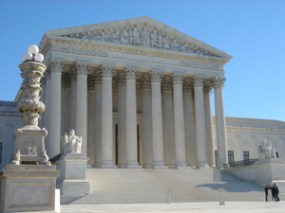
    Supreme Court Building #1On Friday, October 26, 2018, the Supreme Court granted certiorari in Return Mail, Inc. v. U.S. Postal Service, in order to answer the question whether the government can bring post-grant review proceedings under the Leahy-Smith America Invents Act, or AIA.  Specifically, the Supreme Court agreed to review whether the government is a "person" under the AIA, as is required to file a petition seeking the institution of AIA review proceedings.

    The case began with Return Mail seeking to license its patent to the Postal Service as early as 2006.  Return Mail is the assignee of U.S. Patent No. 6,826,548, which claims methods, computer programs, and systems for processing undeliverable or returned mail.  Claim 1 covers using encoded data (essentially, a bar code) that is added to the item before mailing to identify the intended recipient and notify the sender with new recipient information to allow the sender to update its records.  Instead of licensing the '548 patent, the Postal Service filed a petition for ex parte reexamination with the U.S. Patent and Trademark Office.  The USPTO instituted the reexamination proceeding, but eventually confirmed the validity of the patent.  Return Mail then filed a complaint against the Postal Service in the Court of Federal Claims.

    Return Mail's complaint against the Postal Service was based on the government's unlicensed use of the invention covered by the '548 patent, but it technically was not a patent infringement suit.  Rather, claims against the government seeking compensation are brought under 28 U.S.C. § 1498(a), an eminent domain statute.  While that action was pending, the Postal Service filed a petition seeking the institution of covered business method ("CBM") review of the '548 patent.

    Return Mail opposed the institution of the CBM review​ on both substantive and procedural grounds, including that the Postal Service lacked standing to file a CBM petition.  Standing in administrative proceedings, like the USPTO's AIA proceedings, is different from the requirement for standing in a court.  Rather than requiring a case or controversy, it requires meeting statutory requirements.[1]  Under § 18(a)(1)(B) of the AIA, for CBM proceedings, "[a] person may not file a petition for a transitional proceeding with respect to a covered business method patent unless the person or the person's real party-in-interest or privy has been sued for infringement of the patent or has been charged with infringement under that patent."  Return Mail challenged the Postal Service's standing on two points:  first, that the government is not a "person" under the AIA; and, second, that the Postal Service had been (or could be) "sued for infringement of the patent" or "charged with infringement of that patent."

    Return Service's challenge of the government's personalty under the AIA arose out of the interplay between the standing and estoppel provisions of the statute.  The estoppel provision, AIA § 18(a)(1)(D), states:

    The petitioner in a transitional proceeding that results in a final written decision under Section 328(a) of title 35, United States Code, with respect to a claim in a covered business method patent, or the petitioner's real party in interest, may not assert, either in a civil action arising in whole or in part under section 1338 of title 28, United States Code, or in a proceeding before the International Trade Commission under section 337 of the Tariff Act of 1930 (19 U.S.C. § 1337), that the claim is invalid on any ground that the petitioner raised during that transitional proceeding.

    The estoppel was viewed as a cornerstone of the CBM process (and other AIA proceedings) and was intended to prevent CBM petitioners from getting more than one bite at the same apple in litigation.  But by its own language, this estoppel does not apply to a proceeding under § 1498 in the Court of Claims.

    Both the PTAB and the majority of the Federal Circuit panel found that the Postal Service satisfied both the requirement that it be a "person" and that it be "sued for infringement of the patent" or "charged with infringement of that patent."  With regard to requirement that the petitioner be a "person," even the Postal Service noted the oddity of it not being subject to estoppel.  However, the panel majority believed that it would be better to assume that the Postal Service was a "person" and allow Congress to fix the estoppel problem, if it so desired.  The majority addressed two further points.  First, it noted that the parties had not discussed the issue in any detail, which would have constituted a waiver if the issue was waivable.  Second, assuming the issue was unwaivable, the majority found that the AIA as a whole suggested that the term should include the government because otherwise the government would not benefit from intervening rights with regard to patents amended during IPRs.

    Judge Newman dissented on the issue of government personalty.  First, she asserted that standing — as an aspect of subject matter jurisdiction — cannot be waived.  She then noted that it was the Court's obligation to ascertain and confirm jurisdiction, which required it to look at the definitions in the statute.  In doing so, she relied on the longstanding rule that, absent an indication otherwise, the presumption has been that the government does not fall within the definition of a "person."  That applies both when the government would benefit from being a "person" and when it would be harmed by fitting in the definition.  And here, where the Federal government (albeit not the Postal Service) argued strongly for the estoppel provision to apply as the AIA was being considered by Congress, the statutory history suggests applying the presumption against government personalty rather than abandoning it.

    In its petition for certiorari, Return Mail challenged both the finding that the Postal Service was a "person" and that it had been sued for patent infringement when Return Mail brought its § 1498 action in the Court of Claims.[2]  With regard to the definition of "person," Return Mail argued that the Federal Circuit's chosen meaning, based on the lack of express Congressional guidance, conflicted with Supreme Court precedent presuming that statutes presumptively exclude the government from the scope of this term.  That is especially true when the construction would be awkward, as Return Mail asserted it was in light of the conflict between the Federal Circuit's construction and the overall intent of the statutory scheme.  In addition, Return Mail asserted that the statutory scheme indicated an intent to exclude the government from the definition of "person."  Finally, Return Mail pointed out that the Federal government already had a role in CBM review, specifically the PTO sitting in judgment over the review.

    The Federal government responded by arguing, first, that Return Mail had not raised the issue below and therefore the dispute had not been fully fleshed out.  Second, even though it acknowledged that the general rule is that the government is not a "person," the government argued that the context of the AIA and the CBM review provision reinforced that the government should be considered a "person" in these circumstances.  The government's argument relied on the fact that the Patent Statute permits the government to obtain patents, yet other sections (such as § 102) limit when "a person shall be entitled to a patent."  Third, the government argued that allowing it to bring CBM petitions was consistent with the statutory intent to allow streamlined review of suspect patents.  Finally, the government argued that this case was a poor vehicle for deciding this issue because the Postal Service was fundamentally different from other Federal agencies because it is more like a business than other agencies.

    In its reply, Return Mail pointed out that this situation is important to patent owners, and has been a recurring issue.  The issue of whether the government is "person" extends to all AIA proceedings, and several have been brought by the Federal government.  In addition, Return Mail pointed out (as had one of the amici that filed a brief in support of Return Mail's petition) that the government was seeking to act as both a sovereign power and a private party in the same proceeding.

    The Supreme Court granted certiorari only on the first issue identified by Return Mail, whether the government is a "person" in the context of the AIA's CBM proceeding.  Thus, by the middle of next year, we should know whether government agencies are "persons," permitted to bring AIA proceedings.

    [1] Here, however, in the context of a CBM review, administrative standing incorporates the Article III courts' requirements for standing:

     A petitioner may not file with the Office a petition to institute a covered business method patent review of the patent unless the petitioner, the petitioner's real party-in-interest, or a privy of the petitioner has been sued for infringement of the patent or has been charged with infringement under that patent.  Charged with infringement means a real and substantial controversy regarding infringement of a covered business method patent exists such that the petitioner would have standing to bring a declaratory judgment action in Federal court.

    37 C.F.R. § 42.302.

    [2] The Federal Circuit found that a § 1498 action was similar enough to a patent infringement action to give rise to standing, even though it clearly is not a patent infringement action and does not permit certain remedies (such as injunctive relief, treble damages, and attorneys' fees for an exception case).  In doing so, the unanimous panel found that "infringement" did not necessarily mean an action brought solely on the basis of the Patent Act.