• By Brian Pattengale* and Anthony D. Sabatelli** —

    Lowering carbon dioxide (CO2) levels in our atmosphere is one of the most important challenges to be overcome in the next century.  While fossil-fuel fired plants produce a visible smoke consisting almost entirely of water vapor, the invisible CO2 released along with it is the real concern.  In a previous article, we highlighted the IP aspects of carbon capture technologies and the chemistry that is involved in the various processes (see "Rising Carbon Dioxide Levels: Capture Methods & Patent Trends").  Industrially, CO2 is most predominantly used as an inert gas in various chemical and manufacturing processes, as a propellant, or to make dry ice which is the solid form of CO2.1 All of these applications simply end up releasing CO2 into the atmosphere, negating the effects of capture.  In order to achieve the goal of lowering CO2 emissions, captured CO2 must be either stored permanently or chemically converted into another substance.  These two distinct processes, known as sequestration and conversion, respectively, are both potentially viable, and even profitable processes.  Entrepreneurial ventures are already bringing carbon-conscious products to market that consume CO2 during their manufacturing.  The developments and intellectual property associated with CO2 sequestration and conversion are the focus herein.

    Carbon Sequestration

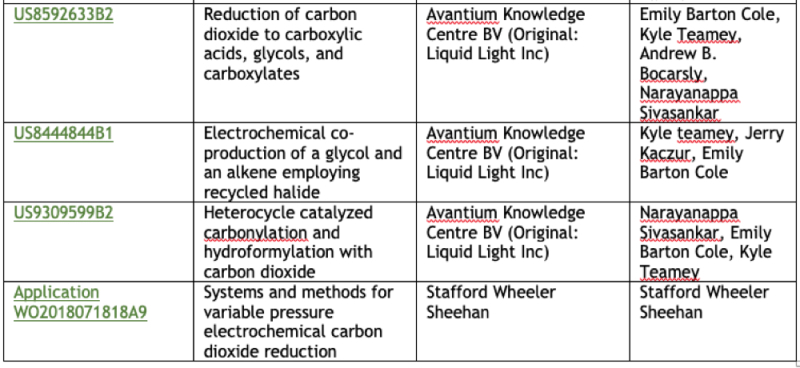
    CO2 sequestration, broadly defined, is the process of permanently storing CO2.  One of the first industrial examples of CO2 sequestration is the Sleipner gas field off the coast of Norway.  This is a natural gas field with a high CO2 content of 9%.  This high level of CO2 is nearly four times the Norwegian government emission limit of 2.5%, which if exceeded, would trigger large carbon emission fee penalties for the operator, Statoil Petroluem.  To comply with this limit, the CO2 was pumped into the Utsira formation, which is a saline aquifer in the North Sea that was identified as a possible reservoir.2 From its inauguration in 1996 to 2008, the CO2 sequestration efforts at Sleipner resulted in the storage of 10 million tons of CO2.  The operation is still ongoing.3  Statoil Petroleum holds patents related to methods for storing carbon dioxide in geologic formations (US9586759B2 & US9815626B2).

    While storing CO2 in geologic formations is evidently a viable option for CO2 sequestration, scientists have been exploring other methods.  These technologies rely on storing CO2 in a chemical form that is stable, easy to store, and can support a high CO2 density.  A recent patent application (US20170274318A1) describes a process that uses ammonia to capture gaseous CO2 to form an aqueous ammonium carbonate solution.  This aqueous carbonate is then subjected to an ion exchange reaction with a cation, such as sodium or potassium under conditions that form a solid carbonate.  Following the exchange reaction, the CO2 sequestering carbonate is recovered, and the ammonia is regenerated to be reused for the capture cycle.  The sodium carbonate, potassium carbonate, or other carbonates are then stored.  Notably, these carbonates are also industrially useful for making glass, water softening, and other various uses.

    Another patent application to ExxonMobil Research and Engineering Co (US20180229178A1) describes a process for sequestering CO2 as a clathrate.  A clathrate is a crystal host that traps a molecular guest inside of its structure — sort of a "molecular cage".  In the described process, the CO2 is trapped under pressure in a network of water molecules.  The application also describes various chemical additives or "promoter molecules" to facilitate forming and stabilizing the clathrate.  It is then encapsulated in a molecular barrier that prevents CO2 escape.  The barrier-encapsulated clathrate containing the captive CO2 can then be deposited on the sea floor at depths of over 100 meters, where the pressure ensures the stability of the clathrate.  This method could provide a feasible option in offshore locations where geologic reservoirs are unavailable for sequestration.

    Carbon Conversion

    In the above sequestration examples, CO2 is stored permanently in either a reservoir or converted to a different chemical form from which CO2 can be released, if desired.  In contrast, carbon conversion can be delineated as converting it into a new product by decreasing the oxidation state of carbon successively until a desired stable product is reached.  This process if often referred to as CO2 reduction.  Products of CO2 reduction include formaldehyde, methanol, methane, ethylene, and ethanol, amongst others.  In addition to consuming CO2, the products produced are value-added products that are of industrial, pharmaceutical, or other uses.  Reduction of CO2 is often achieved using electrolysis, which is a widely used process in industry that produces products such as aluminum, sodium hydroxide, or electroplated layers.  Electrolysis requires electricity, which is currently produced primarily by fossil fuel combustion.  There is, however, opportunity to develop solar-powered CO2 electrolysis systems that would not re-contribute to carbon pollution.

    CO2 electrolysis is not currently prevalent in industry because it is difficult to perform, and it is challenging to control which reduction product is obtained (i.e., the reaction is not usually selective to a single product).  In addition, a common byproduct of CO2 electrolysis is hydrogen gas, particularly when non-selective catalysts are used.  Scientists are therefore working to develop new catalysts that reduce CO2 efficiently and achieve selectivity, which is defined as the ability to form one of the specific products listed above without forming the others or byproducts such as hydrogen gas.  In the following examples, there is a focus on electrocatalytic systems of different design/catalyst composition and factors that affect selectivity.

    The least challenging reaction is the reduction of CO2 to CO.  Toyota Motor Corp. patented a CO2 reduction system employing an anodized silver electrode as the catalyst (US9435042B2).  It was found that anodization time greatly affected the CO selectivity, where longer time is reported to give a more selective electrode, reaching approximately 70% CO.  Toshiba Corp has filed an application for an analogous system that employs a molecular catalyst species known as a metalloporphyrin as the electrocatalyst material (US20180066370A1), reaching 60% CO selectivity.  Another system was reported by Toshiba consisting of gold particles synthesized in a specific manner that reaches >90% selectivity for CO (US20170073825A1).

    Catalysts that form further products typically form a mixture of products containing CO and other products due to the complexities of the reactions involved, however any appreciable efficiency and selectivity for a complicated product is of interest in the field.  Panasonic reports a system composed of crystalline copper phthalocyanine, a molecular species, that produces predominantly ethylene (C2H4) at 40% efficiency (US20180142365A1).  Researchers at the California Institute of Technology discovered that a selectivity-determining layer composed primarily of organic molecules can be added to electrodes to tune the selectivity, where 41% selectivity for ethylene was reached (US20180291515A1).

    Some additional systems aim to utilize the machinery within cells and microorganisms to perform CO2 transformation, requiring careful interfacing of gas and reactant feedstocks with the bioreactor system.  An example (US10131924B2) requires the addition of an organic intermediate compound that is combined with CO2 to form more complex products.  Perhaps the most impressive system to date in this category splits water using H2 and O2, and then H2 is combined with CO2 by a bacterial species that, all together, exceeds the efficiency of natural photosynthesis (US20180265898A1).

    Finally, it is worth noting that CO2 transformation has become more than a research venture, with entrepreneurs seeking to bring some exciting technologies to market.  Novomer developed a process to combine CO2 with epoxides to form polymers, useful plastic materials (US8247520B2).  Another company, Liquid Light, holds many patents related to CO2 reduction technologies and is backed by investors such as BP Ventures and The Coca-Cola Company, the latter of which is interested in a precursor for plant-based plastic bottles.4 ­ Catalytic Innovations, a startup focused on CO2 transformation and oxidation catalysis, has recently applied to patent a process for efficiently converting CO2 to alcohols such as ethanol (WO2018071818A9).  The ethanol produced will be consumer-grade and will be used in products such as perfume and spirits.5

    The table below highlights patents and published applications related to CO2 sequestration and conversion technologies.
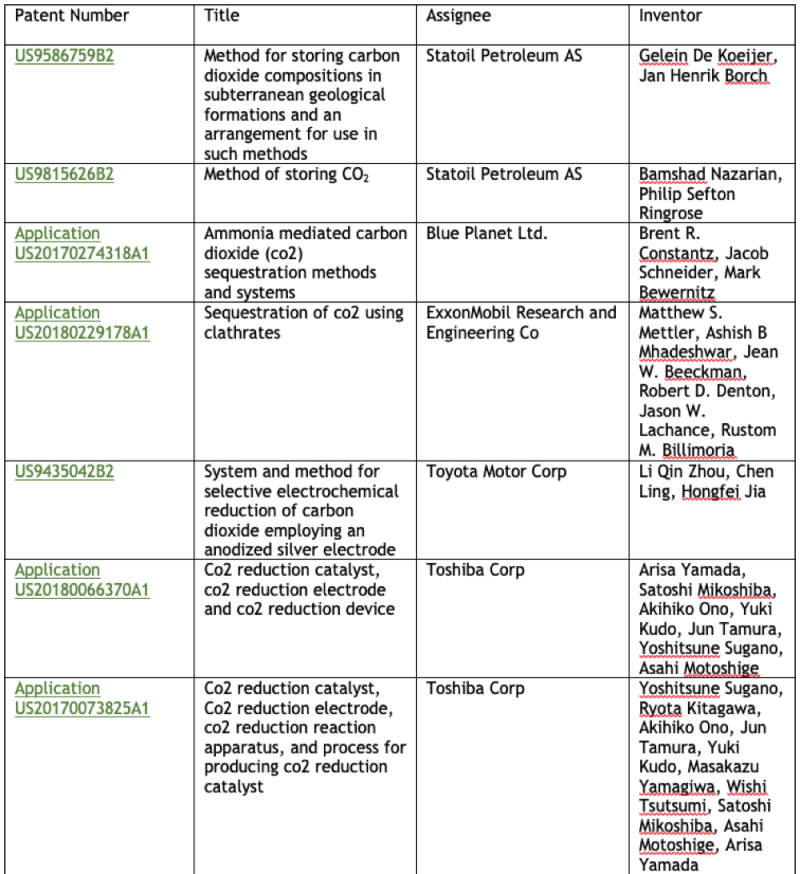
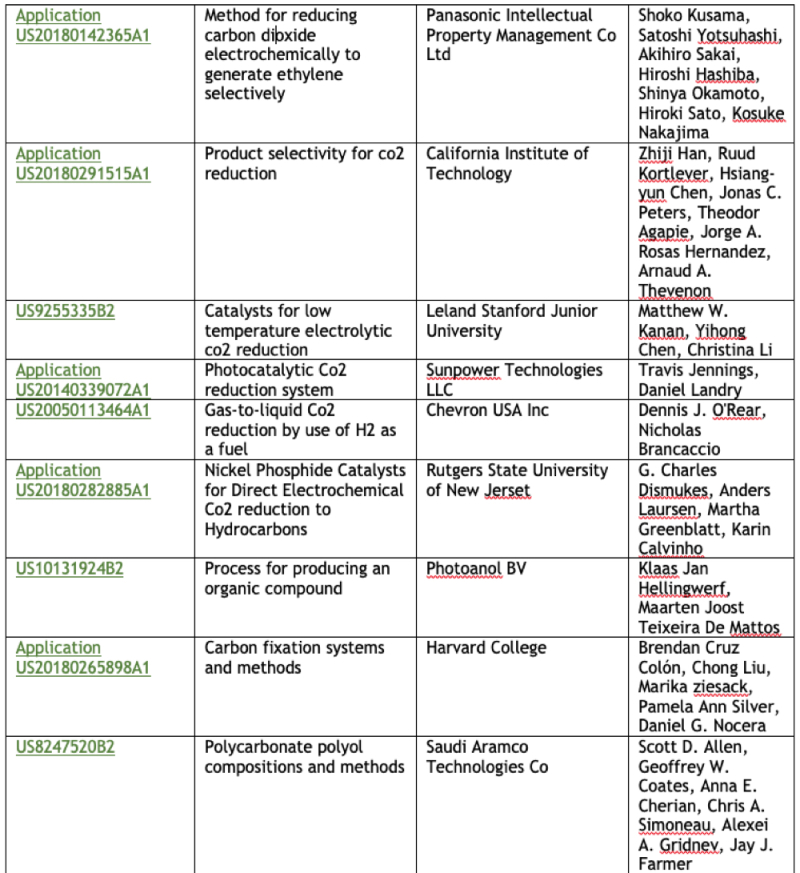
    Table 1a Table 1b Table 1c

    * Brian Pattengale is a Postdoctoral Associate in the Energy Sciences Institute at Yale University, where he is investigating the photodynamic properties of emerging materials and their catalytic/photocatalytic applications to reactions such as water splitting or carbon dioxide reduction.  Prior to his position at Yale, Brian obtained his Ph.D. in Physical/Materials Chemistry at Marquette University, where he published numerous papers using ultrafast transient absorption and synchrotron X-ray absorption spectroscopies to study functional light absorbing and photocatalytic materials.
    ** Dr. Sabatelli is Patent Counsel with Wiggin and Dana LLP


    1
    http://www.uigi.com/carbondioxide.html

    2 Schepper, S.D.; Mangerud, Gunn. Norwegian Journal of Geology. 2017, 97, 305.

    3 Akervoll, I; Lindeberg, E; Lackner A. Energy Procedia. 2009, 1, 2557-2564.

    4 https://llchemical.com/news/liquid-light-signs-agreement-further-advance-its-cosub2sub-chemicals-technology/

    5 https://www.americaninno.com/rhodeisland/rhode-island-startup/catalytic-innovations-aims-to-create-carbon-negative-consumer-products/

  • CalendarMarch 5, 2019 – Customer partnership meeting of Technology Center 2600 (U.S. Patent and Trademark Office) – 8:30 am to 4:00 pm (EST), USPTO's Madison Auditorium, North, Alexandria, VA

    March 5, 2019 – "The USPTO's Updated Guidance on Section 101: Adjusting Your IP Evaluations for Maximum Protection" (Technology Transfer Tactics) – 1:00 pm to 2:00 pm (ET)

    March 5, 2019 – "Celebrating Women in Innovation" (U.S. Patent and Trademark Office) – 4:00 pm to 5:30 pm (ET), Alexandria, VA

    March 5, 2019 – "The Impact of Recent Cases Addressing Patent Term: Insights for Patent Prosecution and Litigation" (Intellectual Property Owners Association) – 2:00 to 3:00 pm (ET)

    March 5, 2019 – "The Chinese Intellectual Property Framework — Structural Changes" (Pracitising Law Institute) – 1:00 to 2:00 pm (ET)

    March 7, 2019 – "Functional Claiming for Mechanical and Electrical Arts — Surviving 112(f) and Disclosing Functional Basis to Meet Heightened Standard of Review" (Strafford) – 1:00 to 2:30 pm (EST).

    March 12, 2019 – "Practical Tips on Patent Prosecution in India and China" (J A Kemp) – 3:30 to 4:30 pm (GMT)

    March 12, 2019 – Customer partnership meeting of Technology Center 2800, Semiconductor/Memory Workgroup and Printing/Measuring and Testing Workgroup (U.S. Patent and Trademark Office) – 12:00 pm to 4:30 pm (EDT)

    March 14, 2019 – "Obvious-Type Double Patenting and PTEs After Breckenridge Pharmaceutical and Ezra Ventures LLC Decisions" (Strafford) – 1:00 to 2:30 pm (EDT)

  • USPTO SealThe U.S. Patent and Trademark Office will be hosting a Women's History Month Event "Celebrating Women in Innovation" on March 5, 2019, from 4:00 pm to 5:30 pm (ET) at the USPTO headquarters, Madison Auditorium, 600 Dulany Street, Alexandria, VA.  The event will consist of remarks by Secretary of Commerce Wilbur L. Ross, a panel of successful women in innovation, and the dedication of an auditorium.

    Those interested in registering for the event, can do so here.

  • IPO #2The Intellectual Property Owners Association (IPO) will offer a one-hour webinar entitled "The Impact of Recent Cases Addressing Patent Term: Insights for Patent Prosecution and Litigation" on March 5, 2019 from 2:00 to 3:00 pm (ET).  Jack Brennan of Fish & Richardson, P.C., Jeff Hohenshell of Medtronic, Inc., and Nicholas Mitrokostas of Goodwin Procter, LLP will help patent owners and their counsel navigate both patent prosecution and litigation issues related to patent term by drawing on insights from three recent Federal Circuit decisions:  Novartis AG v. Ezra Ventures LLC, Novartis Pharmaceuticals Corp. v. Breckenridge Pharmaceutical, and Supernus Pharmaceuticals, Inc. v. Iancu.  The panel will consider and analyze:

    • Strategies for obtaining PTA/PTE at the USPTO, including deciding which of multiple patents covering a product are best suited for PTE
    • How to try to avoid terminal disclaimers
    • Options for applicants with pending patent applications
    • The remaining threat of double-patenting challenges in litigation

    The registration fee for the webinar is $135 (government and academic rates are available upon request).  Those interested in registering for the webinar can do so here.

  • J A KempJ A Kemp will be offering a webinar entitled "Practical Tips on Patent Prosecution in India and China" on March 12, 2019 from 3:30 to 4:30 pm GMT (Greenwich Mean Time).  Amanda Simons, Ravi Srinivasan, and Tom Carver of J A Kemp will provide some practical tips on prosecuting patent applications in two important jurisdictions, India and China, consider some recent and up-coming changes in the laws of both states, and also discuss the current picture for those involved in litigation in China.  The webinar will address the following topics:

    • Patentability requirements in India
    • Compulsory licensing
    • Indian National Biodiversity Act
    • Progress relating to post-filed data in China
    • Proposals for term extension and data exclusivity in China
    • Recent Changes in Chinese Litigation practice

    Those wishing to register can do so here.

  • Strafford #1Strafford will be offering a webinar entitled "Obvious-Type Double Patenting and PTEs After Breckenridge Pharmaceutical and Ezra Ventures LLC Decisions" on March 14, 2019 from 1:00 to 2:30 pm (EDT).  Thomas L. Irving, Adriana L. Burgy, and Jill K. MacAlpine of Finnegan Henderson Farabow Garrett & Dunner will guide IP counsel for understanding double patenting, analyze recent court treatment, including two significant Federal Circuit decisions, offer best practices to defeat double patenting rejections and avoid terminal disclaimers, and provide specific language to consider if a terminal disclaimer must be filed.  The webinar will review the following issues:

    • What is the scope of double patenting?
    • How do the two recent Federal Circuit decisions impact the scope?
    • What steps can be taken to defeat double patenting rejections?
    • What are best practices to avoid terminal disclaimers?
    • How can practitioners craft terminal disclaimers with an eye towards patent litigation?

    The registration fee for the webcast is $347.  Those interested in registering for the webinar, can do so here.

  • PLI #1Pracitising Law Institute (PLI) will be offering a webinar on "The Chinese Intellectual Property Framework — Structural Changes" on March 5, 2019 from 1:00 to 2:00 pm (ET).  Elizabeth Chien-Hale of CKR Law will focus on some of the most notable changes for 2019:  the role and function of the newly merged CNIPA, the establishment of a national IP appeals court within China's Supreme People's Court, and the new, hopefully final amendments, to the Patent Law.  The webinar will address the following topics:

    • The background information for the new changes to the Chinese IP protection framework
    • The legal ramifications of the new changes to the Chinese IP protection framework
    • Explanations for what these changes may mean for foreign holders of Chinese IP rights

    The registration fee for this webcast is $299.  Those interested in registering for the webinar, can do so here.

  • USPTO SealThe U.S. Patent and Trademark Office will be holding a customer partnership meeting of Technology Center 2800, Semiconductor/Memory Workgroup and Printing/Measuring and Testing Workgroup, from 12:00 pm to 4:30 pm (EDT) on March 12, 2019.  The meeting will include:

    • Review of the new 101 guidance
    • Facilitated table discussions with the Technology Center 2800 SPEs and examiners
    • Presentation by an external customer (topic TBD)
    • An "Ask a SPE anything" panel.

    The meeting will be held at the USPTO's Madison Auditorium, 600 Dulany Street, Alexandria, VA.  Those wishing to attend the meeting can register here.  Additional information regarding the customer partnership meeting, including how to participate via WebEx, can be found here.

  • Strafford #1Strafford will be offering a webinar entitled "Functional Claiming for Mechanical and Electrical Arts — Surviving 112(f) and Disclosing Functional Basis to Meet Heightened Standard of Review" on March 7, 2019 from 1:00 to 2:30 pm (EST).  Doris Johnson Hines of Finnegan Henderson Farabow Garrett & Dunner and Theresa Stadheim of Schwegman Lundberg Woessner will guide IP counsel on functional claiming in electrical and mechanical arts patents and USPTO prosecution, examine recent court treatment, and how to navigate the issue of functionality given the uncertainties in the context of prosecution and litigation.  The webinar will review the following issues:

    • What are the risks of a 112(f) interpretation for the patentee?
    • What is sufficient structure for supporting 112(f) claims?
    • What are best practices for drafting specifications to support functional claims?

    The registration fee for the webcast is $347.  Those interested in registering for the webinar, can do so here.

  • By Kevin E. Noonan —

    Federal Circuit SealOne of the criticisms of the post-grant review proceedings instituted under the Leahy-Smith America Invents Act (post-grant review, inter partes review, and covered business method review) was the (relative) unavailability of pursuing amendments during the proceedings, making them "all or none" propositions for patent owners.  The Federal Circuit improved this situation in its en banc decision in Aqua Products, Inc. v. Matal, 872 F.3d 1290 (Fed. Cir. 2017).  Earlier this month, the Federal Circuit took another step in the process of making amendments more frequently considered in IPRs in Sanofi Mature IP v. Mylan Laboratories Ltd.

    The case arose in an IPR over U.S. Patent No. 8,927,592, directed to methods for treating prostate cancer, and particularly metastatic cancer resistant to traditional treatment regimens.  The challenged claims in the '592 patent (claims 1-5 and 7-30) were directed to treatment regimens comprising a combination of a cabazitaxel (an antitumor agent) and a corticoid.  In the IPR, Sanofi filed a motion to amend its claims by adding the italicized limitations to proposed new claim 31 (corresponding to original claim 27):

    31.  A method of increasing survival comprising administering to a patient in need thereof (i) an antihistamine, (ii) a corticoid, (iii) an H2 antagonist, and (iv) a dose of 20 to 25 mg/m2 of cabazitaxel, or a hydrate or solvate thereof, wherein said antihistamine, said corticoid, and said H2 antagonist are administered prior to said dose of 20 to 25 mg/m2 of cabazitaxel, or hydrate or solvate thereof, in combination with prednisone or prednisolone, wherein said patient has castration resistant or hormone refractory, metastatic prostate cancer that has progressed during or after treatment with docetaxel.

    The Board invalidated the challenged claims for obviousness, and Sanofi did not challenge this decision on appeal.  The Board denied Sanofi's motion to amend (which was the basis of this appeal), based on its determination that Sanofi had not shown that the amended claims were patentable.  In making this decision, the Board construed the amended claim language in the preamble: "[a] method of increasing survival."  Sanofi argued that this language was limiting, as a "statement of intentional purpose for how the method is to be performed," in reliance on the Federal Circuit's decision in Jansen v. Rexall Sundown, Inc., 342 F.3d 1329, 1333 (Fed. Cir. 2003).  The Board rejected this argument, applying the Federal Circuit's decision in Bristol–Myers Squibb Co. v. Ben Venue Laboratories, Inc., 246 F.3d 1368, 1375–78 (Fed. Cir. 2001).  In that case, the Court held that "a method of treatment preamble stating the intended purpose of the treatment does not impose a result limitation on the recited method step."  Because the Board found the survival preamble not to be limiting, the Board dismissed Sanofi's argument on the merits that the prior art did not "disclose or suggest" that the combination of cabazitaxel and prednisone and prednisolone would increase overall survival.  The Board rejected other arguments not relevant to the Court's decision, and this appeal followed.

    The Federal Circuit vacated the Board's decision and remanded for reconsideration of the motion to amend claims, in an opinion by Judge O'Malley, joined by Chief Judge Prost and Judge Stoll.  Citing Aqua Products, the panel recited the fundamental principle that "the petitioner bears the burden of proving that proposed amended claims are unpatentable."  The Board (a creature of the PTO) imposed this burden on Sanofi, using the generic requirement that a party before the Office (whether an Examiner or the Board) has the burden of showing that an amended claim is patentable.  Mylan contended that this error was harmless because they had established that the proposed amended claims were unpatentable.  The panel was unconvinced on the record.  Accordingly, the opinion stated that "[w]e therefore decline to speculate as to how the Board would resolve this case under the correct legal standard," citing several post-Aqua cases coming to the same decision under similar circumstances in those cases.

    The Court also rejected Mylan's argument that Sanofi had waived its opportunity for a remand because it had not requested rehearing before the Board, saying that Sanofi was not required to request rehearing based on In re Magnum Oil Tools Int'l, Ltd., 829 F.3d 1364, 1377 (Fed. Cir. 2016), and the plain language of the appeal statute, 35 U.S.C. § 141(c).  Finally, the panel rejected Mylan's argument for "administrative exhaustion."

    Turning to the PTAB's claim construction, the opinion asserts a de novo standard of review with all factual determinations reviewed for substantial evidence, based on PPC Broadband, Inc. v. Corning Optical Commc'ns RF, LLC, 815 F.3d 747, 751 (Fed. Cir. 2016).  Under this review standard, the Federal Circuit held the Board erred in holding that the preamble language was not limiting, based on its Jansen decision and Rapoport v. Dement, 254 F.3d 1053 (Fed. Cir. 2001).  And in a footnote, the panel indicates that its decision was based on the "broadest reasonable interpretation" standard applied by the Board.  It may be instructive to consider the preambles in these prior cases for comparison with the preamble in Sanofi's proposed amended claim 31:

    Rapoport:

    A method for treatment of sleep apneas comprising administration of a therapeutically effective regimen of a Formula I azapirone compound . . . to a patient in need of such treatment.

    For this claim the Federal Circuit found the "method of treatment" term in the preamble to be limiting because without it, the phrase "a patient in need of such treatment" would have no antecedent basis.  Applying this reasoning to the case at bar, the Federal Circuit held that the "method of treatment" term was limiting because "the method–administering a certain compound­–must be practiced to achieve the purpose stated in the preamble."

    Jansen:

    A method of treating or preventing macrocytic megaloblastic anemia in humans which anemia is caused by either folic acid deficiency or by vitamin B12 deficiency which comprises administering a daily oral dosage of a vitamin preparation to a human in need thereof comprising at least about 0.5 mg. of vitamin B12 and at least about 0.5 mg. of folic acid.

    Similarly, the Court's decision that the preamble in the Jansen claim was limiting supported the decision here that the "method of treating" preamble was limiting because "it articulated the 'purpose for which the method must be performed,'" i.e., "increasing survival."

    Analogizing the preamble in the Sanofi claim in light of this precedent, the Federal Circuit concluded the PTAB had erred in finding Sanofi's preamble not to be limiting.  The panel also found support for this construction in the '592 specification, which contained an Example and other disclosure relating to increasing patient survival as an important feature of the claimed invention.  In contrast, the Federal Circuit was unpersuaded by Mylan's arguments that Bristol-Myers Squibb (where the preamble was held not to be limiting) was more compelling precedent, because in that case "the claim language 'strongly suggest[ed] the independence of the preamble from the body of the claim'" whereas here the claim language suggested the opposite to the panel.  And the Court also rejected Mylan's argument that the prosecution history of the '592 patent supported its position, saying that "Mylan conflates concepts of curing cancer or sending it into remission with longer survival while the cancer remains intact."

    Because the Board erred in its claim construction, and procedurally in imposing the burden of patentability improperly on the patent owner, the Court vacated the PTAB's claim construction and remanded for further consideration based on the Court's claim construction.

    The opinion also included an interesting footnote regarding the Board's claim construction:

    To the extent the Board disregarded Jansen simply because it was on appeal from a district court, '592 Decision, 2017 WL 4221400 at *30 ("Jansen is distinguishable from the present case because it was an infringement case . . . ."), it erred.  Claim construction standards vary between district court litigations and inter partes reviews, but basic principles of construction do not.  Cf. Power Integrations, Inc. v. Lee, 797 F.3d 1318, 1326 (Fed. Cir. 2015) [emphasis added].

    Sanofi Mature IP v. Mylan Laboratories Ltd. (Fed. Cir. 2019)
    Nonprecedential disposition
    Panel: Chief Judge Prost and Circuit Judges O'Malley and Stoll
    Opinion by Circuit Judge O'Malley