• By Kevin E. Noonan –

    One of the characteristics of patent infringement litigation in the aftermath of the Supreme Court's decision in Markman v. Westview Instruments, Inc. (holding that claim construction was a matter of law to be reviewed de novo by the Federal Circuit; but see Teva Pharma. USA, Inc. v. Sandoz, Inc.) was that an inordinate proportion of claim construction decisions were overturned in whole or part.  Those proclivities have been attenuated in the years following the Cybor v. FAS Technologies* opinion, but the Court's recent decision in Malvern Panalytical Inc. v. TA Instruments-Waters LLC is reminiscent of those bygone days of Federal Circuit preeminence.

    The case arose in patent infringement litigation when Malvern sued Waters for infringement of U.S. Patent Nos. 8,827,549 and 8,827,549.  The claims of each patent asserted by Malvern were directed to isothermal titration microcalorimeters, used to measure energy absorbed or released during chemical reactions between two compounds.  The claimed microcalorimeters comprise an automatic pipette assembly 220 illustrated in the opinion by this diagram:

    Image 1The limitation at issue was another component, the pipette guiding mechanism that guides the pipette assembly "between and into at least two positions of operation."  Disclosed are two embodiments, one being "a pipette arm 520 that supports the pipette assembly 220, and an essentially vertical guide rod 530," illustrated by this Figure 5a:

    Image 2
    The operation of this structure is described in the specification to be:

    "The pipette arm 520 is moveably attached by a sleeve 540 to the guide rod 530, but its motion about the guide rod is restricted by a guide grove 550 in the guide rod 530 and a guide pin 560 that protrudes from the inner surface of the sleeve 540 and which fits into the guide groove 550" wherein the "movement of the pipette assembly 220 in the vertical direction is restricted to the angular positions of the positions of operation," and "rotational movement of the pipette assembly 220 between the angular positions only is permitted when the titration needle 260 is fully retracted from respective positions of operation."

    The second embodiment of this claimed element is illustrated by this Figure 6:
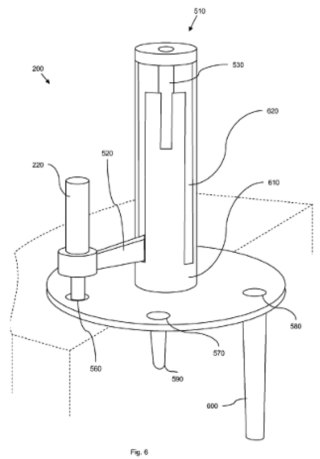
    Image 3
    In this embodiment, the guide groove in the guide rod 530 is replaced by a coaxial external guide sleeve 610 with corresponding guide paths 620 for the guide arm 520."

    Claim 1 of the '549 patent and claim 9 of the '175 patent are set forth as representative:

    1.  A micro titration calorimetry system comprising:
        an automatic pipette assembly comprising a titration needle arranged to be inserted into a sample cell for supplying titrant, a syringe for supplying titrant to the titration needle, a stirring paddle for stirring fluid in the sample cell, and a stirring motor for rotating the stirring paddle, and
        a pipette guiding mechanism arranged to restrict the movement of the pipette assembly along safe paths to ensure that the titration needle cannot be damaged during movement thereof between different positions of operation.

    9.  A micro titration calorimetry system comprising:
        an automatic pipette assembly comprising a titration needle arranged to be inserted into a sample cell for supplying titrant, a syringe for supplying titrant to the titration needle, a stirring paddle for stirring fluid in the sample cell, and a stirring motor
        for rotating the stirring paddle, and
        a pipette guiding mechanism arranged to guide the pipette assembly between and into at least two positions of operation, wherein a first position of operation is a pipette washing position wherein the titration needle is inserted in a washing apparatus, and a second position of operation is a titration position wherein the titration needle is inserted into the sample cell for calorimetric measurements.

    The opinion states as being "relevant to this appeal" prosecution of an unrelated patent, U.S. Patent No. 9,103,782 owned by Malvern.  In that case, applicants were able to overcome an anticipation rejection over U.S. Patent Application Publication No. 2010/0238968 based on common ownership.  Also relevant was a supplemental examination request under 35 U.S.C. § 257 that Malvern filed upon acquisition of the '175 patent.  As part of that effort, Malvern filed an Information Disclosure Statement including references cited against the '782 patent, including the '968 application (although as noted in the opinion Malvern did not characterize the references).  During supplemental examination, the Examiner cited an owner's manual for a prior art microcalorimeter disclosing a manually operated pipette guiding mechanism, which Malvern overcame by affidavit that this manual was the inventors' own work.

    Turning to claim construction, the opinion recites the parties' proposed constructions of the term "pipette guiding mechanism," wherein Malvern argued the term meant a "mechanism that guides the pipette assembly," while Waters argued that it should mean a "mechanism that manually guides the pipette assembly"; the District Court adopted Waters' construction.  In ruling on this decision, the District Court characterized the phrase "pipette guiding mechanism" to be a "coined term" that required an examination of the intrinsic evidence to determine the "objective boundaries to the scope of the term," citing Iridescent Networks, Inc. v. AT&T Mobility, LLC, 933 F.3d 1345, 1353 (Fed. Cir. 2019).  In doing so, the District Court relied on statements on the meaning of the term made during prosecution of the '782 patent and that applicants had limited the meaning of the term to manual embodiments.  These arguments were attributed to Malvern as the common assignee of the '782, '549, and '175 patents and because statements made during prosecution of the '782 patent were incorporated into the intrinsic record during supplemental examination.  The parties consented to a stipulated judgment of infringement based on the disputed claim construction and this appeal followed.

    The Federal Circuit vacated the stipulated judgment in an opinion by Judge Prost, joined by Judges Hughes and Cunningham.  The panel agreed with Malvern that the term "pipette guiding mechanism" encompassed both manual and automated embodiments based on the intrinsic evidence, specifically the plain meaning of the claims, the specification, and the prosecution history.  Regarding the claim language, the panel considered the plain meaning of the words individually, citing Littelfuse, Inc. v. Mersen USA EP Corp., 29 F.4th 1376, 1381 (Fed. Cir. 2022), and 3M Innovative Props. Co. v. Tredegar Corp., 725 F.3d 1315, 1329 (Fed. Cir. 2013), and found no basis for limiting the pipette guide mechanism to only manual embodiments ("Instead, the broad claim language supports the conclusion that the 'pipette guiding mechanism' encompasses both manual and automatic embodiments.")  Interpreting the claim broadly is consistent, in the panel's view, with how the Court construed the claims in Hill-Rom Services, Inc. v. Stryker Corp., 755 F.3d 1367 (Fed. Cir. 2014), wherein broad claim language supported broad claim interpretation.  And the Court found that the remaining language of the claims similarly supported this interpretation.  According to the opinion, while "[t]he claims clarify and restrict what the guiding mechanism does, . . . they provide no language suggesting the restriction to manual embodiments Waters advocates."

    The specification supports this interpretation according to the Court, based on disclosure of two embodiments neither of which is limited to manual pipette guiding mechanisms.  "In fact," the Court says, "the specification states nothing about whether the guiding mechanism is manual or automatic," and cites Hill-Rom Services, Inc. v. Stryker Corp., 755 F.3d 1367, 1373 (Fed. Cir. 2014), for the principle that "[t]here are no magic words that must be used, but to deviate from the plain and ordinary meaning of a claim term to one of skill in the art, the patentee must, with some language, indicate a clear intent to do so in the patent" and, as in Hill-Rom, "there is no such language here."  The Court dismissed Waters' arguments to the contrary because they were based on portions of the disclosure that "say nothing about whether the guiding mechanism is manually or automatically operated."  Nor was the Court persuaded by the fact that other components were described as automatic (and thus not describing the pipette guiding mechanism as being automatic implied the term should be limited to manual embodiments).

    Finally, regarding the prosecution history, the Court was not persuaded to Waters' construction by the supplemental examination of the '175 patent, wherein the inventors testified that a manual for a prior art microcalorimeter comprising a manual pipette guide mechanism was their own work and thus not prior art.  Waters argued that this testimony should be interpreted to mean the claimed microcalorimeters of the '175 patent were themselves limited to manual embodiments of the pipette guide mechanisms.  (In a footnote the panel explains that they found the statements to be "too vague or ambiguous to qualify as a disavowal of claim scope.")

    Turning to the "coined term" issue which provided one basis for the district court's decision, the opinion notes the District Court's reliance on Indacon, Inc. v. Facebook, Inc., 824 F.3d 1352,  1357–58 (Fed. Cir. 2016), in construing the claims.  While recognizing that their Indacon decision involved the question of construing a claim that did not have an established meaning in the art, the panel maintained that what the District Court had needed to do was "answer the question of what plain and ordinary meaning a term has in the context of a patent," which the District Court here did not do, in the Federal Circuit's opinion.

    Finally, the panel considered what weight (if any) to give the prosecution history of the '782 patent.  The Court concluded that the '782 prosecution was not relevant to claim construction of the '175 and '549 patents-in-suit merely because that history had been submitted in an IDS during the supplemental examination of the '175 patent.  The Court relied on its precedent in Goldenberg v. Cytogen, Inc., 373 F.3d 1158, 1167 (Fed. Cir. 2004), that "[i]n the absence of an incorporation into the intrinsic evidence, this court's precedent takes a narrow view on when a related patent or its prosecution history is available to construe the claims of a patent at issue and draws a distinct line between patents that have a familial relationship and those that do not."  And the opinion further asserts that citing the prosecution history in an IDS is at most an admission that "'references in the disclosure may be material to prosecution of the pending claims,' but [] "does not admit materiality," citing Abbott Labs. v. Baxter Pharm. Prods., Inc., 334 F.3d 1274, 1279 (Fed. Cir. 2003) (emphasis added).  The Court concluded here that there was no such admission by Malvern's "bare listing" of the IDS.  And even if considered to be so, the opinion further states that this disclosure was insufficient to amount to disclaimer of automatic pipette guiding mechanisms, because the applicant of the '782 patent had abandoned arguments having to do with scope of claims reciting pipette guiding mechanisms.  Reaching this conclusion was supported by their decision in Ecolab, Inc. v. FMC Corp., 569 F.3d 1335, 1343 (Fed. Cir. 2009), in the Court' view.

    For these reasons the panel vacated the District Court's claim construction and remanded, where questions of infringement and claim invalidity will be assessed under the Federal Circuit's construction of the "pipette guiding mechanism" term.  The Court also awarded costs to Malvern.

    * In his dissent from this en banc decision upon which de novo review of claim construction by the Federal Circuit was established until partially overturned by the Supreme Court in Teva Pharma v. Sandoz, Judge Rader cited statistics that in 1997, the Federal Circuit reversed 53% of the cases decided (27% reversed completely, 26% reversed in part) and for 246 cases decided by the Federal Circuit after Markman, 141 explicitly reviewed the District Court's claim construction, and reversed, in whole or part, in 54 of these cases (about 38%).  He identified eight problem areas caused by Markman: multiple trials, bias towards summary judgment, new evidence, the "learning curve problem," and a propensity for every decision to be appealed to the CAFC for de novo review.

    Malvern Panalytical Inc. v. TA Instruments-Waters LLC (Fed. Cir. 2023)
    Panel: Circuit Judges Prosy, Hughes, and Cunningham
    Opinion by Circuit Judge Prost

  • By Aaron Gin

    NSFThis week, the U.S. National Science Foundation (NSF) alongside public and private sector collaborators launched the National Artificial Intelligence Research Resource (NAIRR) pilot program.  NAIRR seeks to advance AI discovery and innovation by making resources available from 11 different federal agencies and over 25 private companies.  The pilot program was formed as a direct reaction to President Biden's 2023 AI Executive Order (specifically section 5.2(a)(i)) and targets several of the EO's broad topics including "Ensuring Responsible and Effective Government Use of AI" and "Promoting Innovation and Competition."

    With an estimated six-year budget of $2.6 billion, NAIRR seeks to provide researchers with access to AI-relevant data and compute resources, which are being made available by agencies including the NSF, Defense Advanced Research Projects Agency (DARPA), National Aeronautics and Space Administration (NASA), National Institutes of Health (NIH), and National Institute of Standards and Technology (NIST) to name a few.

    USPTO SealThe contribution of the U.S. Patent and Trademark Office (USPTO) is expected to include provision of its "bulk datasets," which include U.S. patents and trademarks in a structured format.  Such data offers a "rich and diverse" dataset of complex language, which may be used for the development of robust language models.  The USPTO is also making available "research datasets," which include patent and trademark information relating more generally to "intellectual property, entrepreneurship, and innovation topics."  The datasets and related documentation is specifically formatted for academic researchers.  The patent and trademark information is provided for NAIRR users in a variety of different formats, including the official gazette, multi-page PDFs, full text/XML version, and others.

    Kathi Vidal, Under Secretary of Commerce for Intellectual Property and Director, USPTO commented with respect to the NAIRR Pilot: "The USPTO is committed to advancing US innovation including AI innovation and AI-assisted innovation.  We are focused on maximizing AI's benefits and distributing them broadly across society, confining the risks through technical mitigations and human governance and empowering a diversity of individuals and organizations to participate in AI innovation."

    Broadly speaking, the information and resources provided by the USPTO through the NAIRR pilot program may help democratize access to AI resources and assist researchers in areas related to intellectual property, data governance, and patent data.

    For additional information, please see:

    NSF NAIRR Pilot News Release
    NAIRR Pilot

  • By Donald Zuhn –-

    FireworksAfter reflecting upon the events of the past twelve months, Patent Docs presents its 17th annual list of top patent stories.  For 2023, we identified ten stories that were covered on Patent Docs last year that we believe had (or are likely to have) a significant impact on patent practitioners and applicants.  On Monday and Wednesday last week, we counted down stories #10 to #8 and stories #7 to #5, and today we count down the top four stories of 2023.  As with our other lists (2022, 2021, 2020, 2019, 2018, 2017, 2016, 2015, 2014, 2013, 2012, 2011, 2010, 2009, 2008, and 2007), links to our coverage of these stories (as well as a few links to articles on related topics) have been provided in case you missed the articles the first time around or wish to go back and have another look.  As always, we love to hear from Patent Docs readers, so if you think we left something off the list or disagree with anything we included, please let us know.  In addition, we will be offering a live webinar on the "Top Patent Law Stories of 2023" on January 23, 2024 from 10:00 am to 11:15 am (CT).  Details regarding the webinar, which will focus on a few of the most important stories on this year's list, can be found here.

    4.  Federal Circuit Decides In re Cellect

    At the end of August, in In re Cellect, the Federal Circuit decided a question left open during a recent spate of opinions involving the judicially created doctrine of obviousness-type double patenting (ODP):  the effect patent term adjustment (PTA) can (or should) have on creating circumstances where ODP will operate to find a patent invalid in the absence of a timely filed terminal disclaimer.  The Patent Trial and Appeal Board had issued four Decisions affirming the USPTO reexamination division's invalidation of four Cellect patents, all on the grounds that the provisions of 35 U.S.C. § 154(b)(2)(B) mandated that a terminal disclaimer be filed under circumstances where ODP arose due to extension of patent term as PTA, i.e., that ODP must be determined after application of PTA.  The Federal Circuit affirmed the Board's judgment in the re-examinations.  As we noted at the time of the decision, there are stratagems existing and to be developed to adapt to the regime established by the Federal Circuit's decision in In re Cellect, which only reinforces the value of the clever draftsman in protecting important technologies under creative applications of the law as the Federal Circuit construed it in In re Cellect.

    (On Friday, the Federal Circuit issued an Order denying Cellect's petition for rehearing en banc.)

    For information regarding this and other related topics, please see:

    • "In re Institut Pasteur (Fed. Cir. 2023)," December 13, 2023
    • "Overcoming the Consequences of In re Cellect," October 5, 2023
    • "In re Cellect (Fed. Cir. 2023)," August 30, 2023


    3.  Unified Patent Court Agreement Enters into Force

    The Unitary Patent (UP) and Unified Patent Court (UPC) finally arrived in 2023, with the Agreement on a Unified Patent Court (UPCA) coming into force on June 1.  Unitary Patents confer uniform patent protection in participating EU member states (i.e., EU member states that have ratified the UPCA), of which there are currently seventeen:  Austria, Belgium, Bulgaria, Denmark, Estonia, Finland, France, Germany, Italy,  Latvia, Lithuania, Luxembourg, Malta, the Netherlands, Portugal, Slovenia, and Sweden.  The UPC is a supranational court where proprietors of Unitary Patents and certain European patents (i.e., those that have not been opted out of the UPC) can seek enforcement and third parties can seek revocation of patents in the above EU member states.  Prior to the entry into force of the UPCA, proprietors and applicants were able to file requests to opt out of the UPC for European patents that had already granted and European applications that had published.  These requests could be filed beginning on March 1, 2023 during the UPC Sunrise Period.  The three-month Sunrise Period was a busy time for proprietors, applicants, and representatives as opt out decisions needed to be made, and in many cases opt out requests had to be filed.  Moving forward, proprietors, applicants, and representatives will have to continue to make opt out decisions (at least during the seven year transitional period, which may be extended further) and decide whether to request unitary effect for newly granted European patents.

    For information regarding this and other related topics, please see:

    • "UPC Postpones Start of Sunrise Period to March 1, 2023," December 12, 2022


    2.  Supreme Court Decides Amgen v. Sanofi — Maintains Status Quo on Enablement

    In May, The Supreme Court handed down its decision in Amgen v. Sanofi, affirming the Federal Circuit's decision below in a unanimous opinion written by Justice Gorsuch.  The opinion relies heavily on its own precedent that was heavily cited by both parties in their briefs and arguments, including O'Reilly v. Morse, 15 How. 62; The Incandescent Lamp Patent, 159 U. S. 465; and Holland Furniture Co. v. Perkins Glue Co., 277 U. S. 245.  In the Court's view, the statute plainly requires that "[i]f a patent claims an entire class of processes, machines, manufactures, or compositions of matter, the patent's specification must enable a person skilled in the art to make and use the entire class."  The Court does state, however, that "[a]ll this is not to say a specification always must describe with particularity how to make and use every single embodiment within a claimed class."  But the enablement requirement specifies, for example, that the specification discloses "some general quality . . . running through" the class that gives it "a peculiar fitness for the particular purpose," as in Incandescent Lamp, and situations where there is some adaptation or testing is needed does not make the disclosure "necessarily inadequate," as in Wood v. Underhill, 5 How. 1, 4– 5.  Under Minerals Separation, Ltd. v. Hyde, 242 U. S. 261, 270–271, the opinion states that "[a] specification may call for a reasonable amount of experimentation to make and use a claimed invention, and reasonableness in any case will depend on the nature of the invention and the underlying art."

    For information regarding this and other related topics, please see:

    • "In the Wake of the Supreme Court's Amgen v. Sanofi decision: What’s Next for Biotechnology Claims?" October 2, 2023
    • "Baxalta Inc. v. Genentech, Inc. (Fed. Cir. 2023)," September 24, 2023
    • "Medytox, Inc. v. Galderma S.A. (Fed. Cir. 2023)," July 9, 2023
    • "Supreme Court Decides Amgen v. Sanofi; Status Quo Extended," May 18, 2023
    • "Amicus Briefing in Amgen v. Sanofi: The Rest of the Story – Part III," May 14, 2023
    • "Amicus Briefing in Amgen v. Sanofi: The Rest of the Story – Part II," May 11, 2023
    • "Amicus Briefing in Amgen v. Sanofi: The Rest of the Story," May 8, 2023
    • "The Supreme Court Grapples with Patent Enablement," April 3, 2023
    • "Esteemed Scientists File Amicus Brief in Amgen v. Sanofi on Respondents' Behalf," March 29, 2023
    • "Another Group of Law Professors File Amicus Brief in Amgen v. Sanofi," March 27, 2023
    • "U.S. Government Files Amicus Brief in Amgen v. Sanofi," March 26, 2023
    • "AbbVie Files Amicus Brief in Amgen v. Sanofi," March 21, 2023
    • "GlaxoSmithKline Files Amicus Brief in Amgen v. Sanofi," March 19, 2023
    • "Patent Law Academics File Amicus Brief in Amgen v. Sanofi," March 14, 2023
    • "Amgen Files Reply Brief in Amgen v. Sanofi," March 12, 2023
    • "Sanofi and Regeneron File Respondents' Brief on Amgen v. Sanofi," February 19, 2023
    • "Amgen Files Its Principal Brief in Amgen v. Sanofi," February 5, 2023


    1.  Legal and Patent Communities (Along with Everyone Else) Navigate Rapid Advancements in Artificial Intelligence

    The 2023 story of the year — and not just in patent law or even in the law in general, but in almost every industry and sector of the economy — was the rise of Artificial Intelligence (AI).  Numerous publications have tabbed AI as the top story of 2023, so Patent Docs joins quite a large group.  In patent law, practitioners investigated how large language models like OpenAI's ChatGPT can impact patent prosecution in the near future.  And in February, the U.S. Patent and Trademark Office published a Federal Register notice requesting public comments regarding the current state of AI and Emerging Technologies (ET), and associated inventorship issues that may arise with the advance of such technologies.  The latter request concerned a request from Dr. Stephen Thaler, a computer scientist and inventor, that the Supreme Court consider the question of whether the Patent Act restricts the definition of an "inventor" to human beings.

    With regard to the impact of AI in the law in general, a New York personal injury case rocketed into infamy in 2023, when two lawyers filed a brief in the Southern District of New York that had been written at least in part by ChatGPT.  After opposing counsel and the judge determined that the brief cited to case law that did not exist and the quotes from these fictitious cases were fabrications by ChatGPT, the court imposed sanctions under Rule 11 for purposes of deterrence.  Perhaps in response to this case, we reported on a number of judges who issued standing orders last year on how AI can and cannot be used in proceedings before them.

    In other AI developments, President Biden signed an executive order in October governing the development, testing, and use of AI.  Formally titled, "Executive Order on the Safe, Secure, and Trustworthy Development and Use of Artificial Intelligence," the order sets forth guiding principles and actions to be taken by federal agencies.  These actions include research, coordination with industry, academia, and the international community, promulgation of regulations, publication of reference materials, and establishment of a White House Artificial Intelligence Council to assist the administration with all of the above.  And in December, after two-and-a-half years of negotiation, the European Parliament and the European Council reached a provisional understanding of how AI should be regulated within the European Union (EU).  The goal is to promote the investment in and use of safe AI that honors fundamental human rights.

    For information regarding this and other related topics, please see:

    • "European Union Agrees to Terms of Artificial Intelligence Act," December 10, 2023
    • "College Football's Latest Controversy: NCAA IP-Like "Sign Stealing" Rules Not Ready for Big Data or AI," November 24, 2023
    • "An Analogy for the Current Wave of AI Copyright Lawsuits," November 12, 2023
    • "Early Responses to Proposed AI Regulation," November 5, 2023
    • "Biden Administration Signs Executive Order on Artificial Intelligence," October 31, 2023
    • "Judges Issue Standing Orders Regarding the Use of Artificial Intelligence," August 13, 2023
    • "The Quest for an 'Artificial Intelligence' Inventor," May 23, 2023
    • "ChatGPT Throws Wrench into Europe's Attempts to Regulate AI," April 30, 2023
    • "The Copyright Office Issues Guidance Regarding Works Produced by Generative AI," April 16, 2023
    • "Will Artificial Intelligence Force Us to be Less Dumb about How We Evaluate Humans?" April 9, 2023
    • "Petition for Writ of Certiorari filed in DABUS AI-as-Inventor Case," April 6, 2023
    • "The AI-Assisted Patent Attorney," February 27, 2023
    • "USPTO Requests Public Comments on Artificial Intelligence and Inventorship," February 14, 2023
    • "Can ChatGPT Draft Patent Applications?" February 6, 2023
    • "The Existence of ChatGPT Does Not Justify Attempts to Equate Human and Machine Cognition," January 11, 2023

  • By Donald Zuhn –-

    FireworksAfter reflecting upon the events of the past twelve months, Patent Docs presents its 17th annual list of top patent stories.  For 2023, we identified ten stories that were covered on Patent Docs last year that we believe had (or are likely to have) a significant impact on patent practitioners and applicants.  On Monday, we counted down stories #10 to #8, and today we count down stories #7 to #5, as we work our way towards the top four stories of 2023.  As with our other lists (2022, 2021, 2020, 2019, 2018, 2017, 2016, 2015, 2014, 2013, 2012, 2011, 2010, 2009, 2008, and 2007), links to our coverage of these stories (as well as a few links to articles on related topics) have been provided in case you missed the articles the first time around or wish to go back and have another look.  As always, we love to hear from Patent Docs readers, so if you think we left something off the list or disagree with anything we included, please let us know.  In addition, we will be offering a live webinar on the "Top Patent Law Stories of 2023" on January 23, 2024 from 10:00 am to 11:15 am (CT).  Details regarding the webinar, which will focus on a few of the most important stories on this year's list, can be found here.

    7.  University of California/Berkeley Appeals PTAB Ruling in CRISPR Interference; FDA Approves CRISPR Gene Editing Treatment

    In December 2022, the Patent Trial and Appeal Board rendered its decision on Preliminary Motions in Interference No. 106,133 between Senior Party Sigma-Aldrich and Junior Party The Broad Institute, Harvard University, and MIT (collectively, "Broad").  As with the priority phase in co-pending Interference Nos. 106,126, No. 106,127, and No. 106,132, the Board suspended the priority phase in Interference No. 106,133 until the appeal in Interference No. 106,115 has been decided by the Federal Circuit.  2022 and 2023 saw briefing in that appeal.

    Meanwhile, the significance of the final outcome in the CRISPR interferences was demonstrated last fall, when the U.S. Food and Drug Administration's Cellular, Tissue, and Gene Therapies Advisory Committee announced on October 27 that exagamglogene autotemcel (exa-cel), which was the subject of biologics license application (BLA) 125787 from Vertex Pharmaceuticals, Inc. in collaboration with CRISPR Therapeutics (Zug, Switzerland) and provides for the first time gene therapy for sickle cell anemia, was shown to be effective, having 29 of 30 patients stay pain-free for 18 months.  On October 31, the Advisory Committee issued its recommendation that exa-cel is safe for clinical use, and the FDA then approved the treatment on December 8.  The treatment, being marketed as CASGEVY, is the first CRISPR-based gene-editing therapy to be approved in the U.S.

    For information regarding this and other related topics, please see:

    • "FDA Signals Willingness to Approve CRISPR-Based Treatment for Sickle Cell Anemia," November 2, 2023
    • "Broad Files Reply Brief in Interference No. 106,115 Cross-Appeal," September 7, 2023
    • "CVC Files Response and Reply Brief in Interference No. 106,115 Appeal," August 27, 2023
    • "Amici Support Reversal of PTAB Decision in CRISPR Interference," July 25, 2023
    • "Broad Files Opening Brief and Cross-Appeal in CRISPR Interference," July 23, 2023
    • "CVC Appeals PTAB Decision in CRISPR Interference," July 12, 2023
    • "PTAB Rules on Preliminary Motions in Interference No. 106,133," January 22, 2023


    6. 
    Judicial Council of Federal Circuit Suspends Judge Newman

    Efforts to have Judge Pauline Newman, Circuit Judge on the Court of Appeals for the Federal Circuit, removed from the Federal Circuit for being unfit or guilty of misconduct were the subject of several reports in mid-2023.  In September, the Judicial Council of the Federal Circuit ordered Judge Newman to be suspended from the court for one year.  The Judicial Council's Order repeated allegations made previously against Judge Newman, supplemented with 16 (sometimes) heavily redacted Exhibits and notations and other supporting exhibits that were redacted in their entirety for confidentiality purposes.  The arguments and supporting exhibits were apparently provided to justify the grounds for the decision, which were Judge Newman's purported refusal to cooperate with the Special Committee's investigation into her competency (despite the Judge having provided medical and psychological results from her own doctors rather than the Committee's hand-picked ones).  The suspension remains subject to Judge Newman's on-going lawsuit in the D.C. District Court asserting that the Council's suspension is unconstitutional and a violation of Judge Newman's due process rights.

    For information regarding this and other related topics, please see:

    • "Judge Newman Suspended for One Year by Federal Circuit," September 20, 2023
    • "Federal Circuit Special Committee Recommends One-Year Suspension of Judge Newman," August 6, 2023
    • "Federal Circuit Special Committee Responds to Judge Newman's Counsel's Request for Clarification Regarding Misconduct Hearing," June 21, 2023
    • "Judge Newman Matter Continues," June 20, 2023
    • "Judge Newman and the On-Going Attempts to Remove Her from the Federal Circuit," May 21, 2023


    5.  Supreme Court Denies CareDx Petition; Senators Coon & Tillis Try to Fix Patent Eligibility (Again)

    In May, CareDx and Stanford University filed a petition for certiorari in CareDX, Inc. v. Natera, Inc. and CareDx, Inc. v. Eurofins Viracor, Inc.  At the time, we noted that the arguments in the petition threaded a very narrow needle in giving the Court a reason to grant certiorari and emphasize (as has been emphasized before) the need to do so.  In particular, the petition directed the Court's attention to the "heav[y] investment CareDx made in bringing this technology to market" and infringing behavior of both Natera and Eurofin in bringing their own "copycat" products to market.  Those hoping for a certiorari grant (and positive outcome), however, were frustrated (yet again) when the Court denied the patentees' petition in October.

    Given the refusal of the Supreme Court to wade back into the subject matter eligibility waters, Senators Coons and Tillis, who chaired a series of Congressional hearings on patent eligibility in 2019, who have asked the U.S. Patent and Trademark Office for its statistics and other information on patent eligibility, and who have proposed several bills providing various iterations of legislative solutions, proposed their latest attempt to provide a legislative solution in June when they introduced "The Patent Eligibility Restoration Act of 2023."  As we noted at the time, this proposal marks the third time that one or both of the Senators have proposed or introduced a bill to revise § 101.  The first two attempts garnered discussion but little tangible progress, leaving the patent community feeling like Charlie Brown repeatedly getting the football yanked away.

    In one bit of good news on the subject matter eligibility front, the storied case of American Axle v. Neapco Holdings entered a new chapter in July — not the final chapter, but the plot thickened considerably.  We provided a recap at the time, noting that Judge Stark, then of the District Court for the District of Delaware, had found all asserted claims of U.S. Patent No. 7,774,911 invalid under 35 U.S.C. § 101 as being directed to a law of nature implemented by well-understood, routine, and conventional means, a decision that was affirmed by the Federal Circuit, with the majority subsequently withdrawing its original opinion and handing down a revised opinion (finding claim 22 still ineligible but vacating and remanding the District Court's decision on claim 1) in response to a petition for en banc rehearing, and the Supreme ultimately denying American Axle's petition for certiorari.  On remand, Judge Williams (who had taken on the case given Judge Stark's promotion to the Federal Circuit), denied Neapco's motion for summary judgment of invalidity pursuant to § 101 and granted American Axle's motion for summary judgment of no invalidity.

    For information regarding this and other related topics, please see:

    • "American Axle's Claims Found Eligible on Remand," August 1, 2023
    • "Senators Tillis and Coons Once More Attempt to Fix Patent Eligibility," June 25, 2023
    • "Senate Bill Proposed to Provide Subject Matter Eligibility Solution," June 22, 2023
    • "Can Judge Michel and John Duffy Convince the Supreme Court to Revisit Subject Matter Eligibility?" May 31, 2023
    • "Stanford Asks Supreme Court to Revisit Subject Matter Eligibility on Diagnostic Claims," May 3, 2023
    • "Sequoia Technology LLC v. Dell Inc. (Fed. Cir. 2023)," April 23, 2023
    • "On Alice Rejections per USPTO Technical Center," March 6, 2023
    • "ITC Takes Section 101 to Its Illogical Extreme," March 1, 2023
    • "Chromadex, Inc. v. Elysium Health, Inc. (Fed. Cir. 2023)," February 15, 2023
    • "PTAB Remains Hostile to Section 101 Appeals," January 31, 2023
    • "The Mental Process Exception to Patent Eligibility is Remarkably Brainless," January 9, 2023

  • By Donald Zuhn

    USPTO SealIn an email News Brief distributed today, the U.S. Patent and Trademark Office reminded stakeholders that starting at 12:01 am (ET) on January 17, the filing of new, non-provisional utility patent applications with specification, claims, and abstract in a non-DOCX filing format will incur a surcharge of up to $400.  The Office noted that an Applicant will still have the option of providing a backup (or auxiliary) PDF version of a newly filed application with the DOCX version, and that there would be no fee associated with providing the backup PDF.

    The Office indicated that the transition to the DOCX format is intended "to modernize [the Office's] patent application systems to improve user experience, provide applicants a more streamlined process, harmonize across country borders, and strengthen [the Office's] ability to examine applications quickly and effectively."  The Office stated that it had "worked carefully with stakeholders to shape both the transition to DOCX as well as the timing," and that the Office's systems will "provide[] pre-prosecution checks that improve the robustness and reliability of patents."

    Further information regarding the DOCX format can be found on the Office's DOCX webpage, and a video explaining "How to file your patent application documents in DOCX" can be found here.  Questions regarding DOCX filing can be directed to the Patent Electronic Business Center at ebc@uspto.gov or 866-217-9197.

  • By Donald Zuhn –-

    FireworksAfter reflecting upon the events of the past twelve months, Patent Docs presents its 17th annual list of top patent stories.  For 2023, we identified ten stories that were covered on Patent Docs last year that we believe had (or are likely to have) a significant impact on patent practitioners and applicants.  Today, we count down stories #10 to #8, and later this week we will count down the remaining top stories of 2023.  As with our other lists (2022, 2021, 2020, 2019, 2018, 2017, 2016, 2015, 2014, 2013, 2012, 2011, 2010, 2009, 2008, and 2007), links to our coverage of these stories (as well as a few links to articles on related topics) have been provided in case you missed the articles the first time around or wish to go back and have another look.  As always, we love to hear from Patent Docs readers, so if you think we left something off the list or disagree with anything we included, please let us know.  In addition, we will be offering a live webinar on the "Top Patent Law Stories of 2023" on January 23, 2024 from 10:00 am to 11:15 am (CT).  Details regarding the webinar, which will focus on a few of the most important stories on this year's list, can be found here.

    10.  Debate on Expansion of COVID Waiver Continues; WHO Releases Draft Agreement on Pandemic Prevention, Preparedness, and Response

    The year began with the World Health Organization (WHO) releasing a draft agreement on pandemic prevention, preparedness, and response in February for consideration by the Intergovernmental Negotiating Body (INB), which is comprised of the 194 Member States of the WHO, and which was established in December 2021 at a special session of the WHO's World Health Assembly to draft and negotiate an agreement to strengthen global pandemic prevention, preparedness, and response.  The draft includes a 49-clause preamble, with at least ten of the clauses concerning intellectual property.  The agreement is expected to be agreed upon by the World Health Assembly in 2024.

    And the year ended with the International Trade Commission (ITC) issuing a Report, in response to a request by the U.S. Trade Representative, Ambassador Katherine Tai, in anticipation of negotiations over expansion of the World Trade Organization (WTO) IP waiver that applies to COVID-19 vaccines (but not yet to COVID-19 diagnostics and therapeutic drugs).  The mandate from the Trade Representative was that the ITC Report be a product of market and other research within the Commission's expertise and also reflect the views of stakeholders and the public, and that the Report would not have as a goal to "draw any policy conclusions."  Despite not drawing any policy conclusions, however, the ITC Report has renewed discussions in some quarters over expansion of the COVID-19 waiver, the deadline of which was extended indefinitely in December 2022 (see "Nine Countries Seek Extension of WTO Waiver to COVID-19 Therapeutics and Diagnostics" and "Top Four Stories of 2022").

    For information regarding this and other related topics, please see:

    • "International Trade Commission Issues Report of COVID-19 IP Waiver," November 8, 2023
    • ""Zero Draft" of WHO CA+ Released," February 7, 2023


    9.  Supreme Court Declines to Hear Teva Pharmaceuticals v. GlaxoSmithKline

    In May, the Supreme Court declined to grant certiorari in Teva Pharmaceuticals USA v. GlaxoSmithKline LLC, disregarding the views of the Solicitor General regarding whether to grant cert.  Perhaps the Justices felt that the Federal Circuit's backtracking in its second panel decision on the breadth of infringement inducement set forth in its first decision, in light of then Chief Judge Prost's strong dissent and the firestorm of protest (public and through amicus briefing regarding Teva's petition for rehearing), was enough to cabin the decision to the somewhat unique facts in the case.  The petition for cert. involved the Federal Circuit's decisions in GlaxoSmithKline LLC v. Teva Pharmaceuticals USA, Inc. (Fed. Cir. 2020) and GlaxoSmithKline LLC v. Teva Pharmaceuticals USA (Fed. Cir. 2021), in both of which former Chief Judge Prost issued strong dissents, and which concerned whether a generic applicant filing a "skinny label" ANDA could properly be found liable for inducing infringement under 35 U.S.C. § 271(b).  The Court issued an Order to the Solicitor General soliciting the government's views and that brief advocated that the Court grant cert.

    For information regarding this and other related topics, please see:

    • "H. Lundbeck A/S v. Lupin Ltd. (Fed. Cir. 2023)*," December 18, 2023
    • "Solicitor General Files Brief Advocating Certiorari Grant in Teva Pharmaceuticals v. GlaxoSmithKline; Court Declines Invitation," May 15, 2023


    8.  Patent Law under Attack (Again)

    The New York Times is (in)famous in this space for its attacks on the patent system (see "Top Stories of 2022: #8 to #10"; #9. New York Times Reopens Attack on U.S. Patent System).  And last year at this time, the Times was at it again in a front page piece on Humira, a drug used for a variety of ailments that has brought relief to millions of patients who otherwise suffered with earlier, less effective drugs.  The "problem" seems to be that Humira has made a pharma company a lot of money (purportedly $116 billion), that the drug is expensive (said to cost upwards of $50,000/year) and that the drug company has amassed a large number of patents to protect its intellectual property.  But as we noted in response to the Times article, the bigger problem is that the Times failed to recognize several important facts relating to the circumstances under which Humira's makers made this money and amassed its patent estate (or "thicket" as the anti-patent crowd likes to call it).

    In May, the U.S. Senate's Health, Education, Labor & Pensions (HELP) Committee passed out of committee five bills that attempted to address high drug prices:  the Ensuring Timely Access to Generics Act of 2023 (S. 1067); the Expanding Access to Low-Cost Generics Act of 2023 (S. 1114); the Retaining Access and Restoring Exclusivity Act (S. 1214); and the Increasing Transparency in Generic Drug Applications Act (S. 775).  And in September, a letter from 25 scholars, former judges, and former government officials sent to the Senate Health, Education, Labor and Pensions Committee, the Chair and Ranking Member of the House Ways and Means Committee, and the Secretary of Health and Human Services, Xavier Becerra, intended to "correct[] false claims that the federal government can use [the "march-in rights" provisions of] the Bayh-Dole Act . . . to impose price controls on prescription drugs."

    Attacks on the patent system are not confined to an asserted impact of patents on drug pricing, however.  Some attacking the patent system are also opposed to software patents, with such opposition seemingly being based on one or more of the false assumptions that all software patents are too broad, that it is obvious to invent software based processes, programming is an administrative activity that does not warrant patent protection, or that the patent system should not protect non-physical inventions.  As we noted in July, none of these positions have any legal or technical credibility.

    For information regarding this and other related topics, please see:

    • "Patent Luminaries Try to Set Congress Straight on Drug Price Controls," September 26, 2023
    • "FTC Announces Efforts to Police Pharmaceutical Companies' Patent Behavior," September 19, 2023
    • "Drugs May Cost Too Much, But Patents Are Not the Cause," July 18, 2023
    • "You Are Going to Hear A Lot More FUD about Patent Law, So Here Are Some Facts," July 5, 2023
    • "Senate Once Again Tries to Address Drug Pricing," May 16, 2023
    • "The New York Times Is at It Again Regarding Patents," January 29, 2023

  • By Kevin E. Noonan –

    Federal Circuit SealThe importance of claim construction, and how construing the same term facing a challenge based on different prior art in separate inter partes review proceedings can result in contrary findings on invalidity, was illustrated by the Federal Circuit's decision recently in Pacific Biosciences of California, Inc. v. Personal Genomics Taiwan, Inc.

    The case arose in Pacific Bioscience's IPR challenges to different combinations of claims* of U.S. Patent No. 7,767,441, owned by Personal Genomics Taiwan (PGI).  Claim 1, challenged in both IPRs, is representative:

    1.  An apparatus for identifying a single biomolecule, comprising:
        a substrate having a light detector; and
        a linker site formed over the light detector, the linker site being treated to affix the biomolecule to the linker site;
        wherein the linker site is proximate to the light detector and is spaced apart from the light detector by a distance of less than or equal to 100 micrometers.

    The two instituted IPRs were directed to claims 1, 2, 6, 7, 10–22, 24, and 27–36 ("the '1200 IPR") and claims 1–6, 9, and 43–58 ("the '1163 IPR").  Pacific Biosciences (PacBio) asserted U.S. Patent Application Publication No. 2004/0197793 A1 in the '1200 IPR, on anticipation and obviousness grounds, and International Publication No. WO 2007/045755 A1 in the '1163 IPR, also asserting anticipation or obviousness against the challenged claims.  The Board held in separate Final Written Decisions that PacBio failed to establish invalidity of the challenged claims in the '1200 IPR on either ground, but that the claims challenged in the '1163 IPR were invalid as being anticipated by the '755 published PCT application.  (The opinion notes that the FWD in the '1163 IPR also found invalidity on obviousness grounds that was not at issue in the appeal assessed below.)  As discussed in the Federal Circuit's opinion, both these determinations relied on the Board's construction of the term "identifying a single biomolecule" to have its plain and ordinary meaning encompassing identification of a single molecule and not multiple copies of the same molecule.  This appeal followed by each of the losing parties on each of the IPRs.

    The Federal Circuit affirmed the Board's determinations in each IPR, in an opinion by Judge Taranto, joined by Judges Prost and Hughes.  The opinion first addresses the Board's construction of the phrase "identifying a single biomolecule," which was given its plain and ordinary meaning of identifying a single biomolecule and not an amplified or multiplicity of the same biomolecule, or as stated in the opinion "requiring an apparatus capable of ascertaining the identity of one single, individual biomolecule by examining only that biomolecule."  The panel held that the plain and ordinary meaning, both on its face and in the context of the claims and specification supported the Board's construction that as a feature of the claimed apparatus the language recites "(a) ascertaining the identity of a biomolecule, i.e., what that biomolecule is, and (b) doing so by examining just that one biomolecule, not others (even copies)."  The Federal Circuit, reviewing the Board's construction without deference (because it was based solely on intrinsic evidence), nevertheless resorted to two dictionary definitions of "identify" to affirm the Board's construction with regard to the first portion of the definition, and the panel relied on the context of the claim to decide conformity with the second portion.  The "striking feature" the court stated that provided this context was the word "single," the panel stating that "[t]here is no apparent reason for the inclusion of the word 'single' in the phrase except to indicate that the capability required is to identify a molecule with just that one molecule in view."  The Federal Circuit was also persuaded by statements in the specification that the capability to identify singe biomolecules was "critical" to the invention, and that the "single molecule" feature avoided recognized problems in detecting "a population-level signal from an ensemble or cluster of amplified or copied biomolecules."  Finally, regarding claim construction the opinion uses comparisons with the language in other claims in the '441 patent that related to detecting more than one biomolecule to limit claim 1 to identifying a single biomolecule.

    Turning to the Board's factual predicates for its decisions on validity (challenged by both appellants), the panel held that the Board's conclusions in each case were supported by substantial evidence.  For the '1200 IPR, the "principal embodiment" disclosed in the cited art was using an assay having a sensitivity that permitted detection of biomolecules in amounts "as low as 0.1 attomoles."  This corresponds to detecting more than 60,000 molecules (according to PacBio's expert), and other portions of the prior art reference recited even higher amounts ("1 amol to 100 amol").  "This evidence," according to the opinion, "provides substantial-evidence support for the Board's finding that [the asserted prior art] does not disclose 'identifying a single biomolecule.'"  For the '1163 IPR, the "critical disclosure" was the capacity of the prior art apparatus to include openings in the detector sufficiently small to detect "individual chromophores" (emphasis in opinion).  In the Court's opinion, this disclosure provided substantial evidence supporting the Board's determination that the prior art was capable of detecting a single biomolecule, because such biomolecules were typically tagged with a single chromophore.  The panel found that the Board had sufficient basis for rejecting a contrary opinion from PGI's expert (that the sensitivity of the prior art detector was no less than 78 biomolecules) that included rebuttal evidence from PacBio that the disclosed improvement in detection provided by the cited prior art ("a factor of 400") could result in a sensitivity improvement permitted single biomolecule detection.  While the panel recognized that PacBio's expert asserted a lower estimate of improved sensitivity ("30 or 40 or 50 times better"), "[w]here the overall evidence reasonably allows the Board's factual finding on a point, we do not 'reweigh the evidence' to reject that finding," citing Regents of the University of California v. Broad Institute, Inc., 903 F.3d 1286, 1294 (Fed. Cir. 2018).  Accordingly, the Federal Circuit affirmed the Board's decisions in these IPRs.

    Pacific Biosciences of California, Inc. v. Personal Genomics Taiwan, Inc. (Fed. Cir. 2024)
    Panel: Circuit Judges Prost, Taranto, and Hughes
    Opinion by Circuit Judge Taranto

    * The challenged claims of the '441 patent:

    '1200 IPR

    '1163 IPR

    1. An apparatus for identifying a single biomolecule, comprising:

    a substrate having a light detector; and

    a linker site formed over the light detector, the linker site being treated to affix the biomolecule to the linker site;

    wherein the linker site is proximate to the light detector and is spaced apart from the light detector by a distance of less than or equal to 100 micrometers.

    2. The apparatus of claim 1, further comprising a blind sheet formed over the substrate, the blind sheet including a pinhole having a diameter, wherein the linker site is formed proximate to the pinhole.

    6. The apparatus of claim 2, further comprising a microlens formed between the substrate and the blind sheet.

    7. The apparatus of claim 1, wherein the distance is less than or equal to 25 micrometers.

    10. An optical detection system, comprising at least 10,000 apparatuses as recited in claim 1.

    11. A method of sequencing a plurality of nucleic acid molecules, the method comprising the steps of:

    affixing a plurality of nucleic acid molecules to the linker sites of the optical detection system of claim 10; and

    performing nucleic acid sequencing of the nucleic acid molecules in parallel on the optical detection system.

    12. A method of detecting a plurality of biomolecules, the method comprising the steps of:

    affixing a plurality of biomolecules to the linker sites of the optical detection system of claim 10; and

    detecting the biomolecules on the optical detection system in parallel.

    13. An optical detection system, comprising at least 250,000 apparatuses as recited in claim 1.

    14. An optical detection system, comprising at least 2,000,000 apparatuses as recited in claim 1.

    15. An optical detection system, comprising at least 10,000,000 apparatuses as recited in claim 1.

    16. A method of sequencing a nucleic acid, comprising the steps of:

    affixing one nucleic acid molecule to the linker site of the apparatus of claim 1; and

    performing nucleic acid sequencing of the nucleic acid molecule on the apparatus.

    17. The method of claim 16, wherein the nucleic acid is affixed to the linker site by binding to a polymerase molecule affixed to the linker site.

    18. The method of claim 16, wherein the nucleic acid sequencing comprises the step of adding labeled nucleotides to the apparatus.

    19. The method of claim 18, wherein the nucleotides are labeled fluorescently.

    20. The method of claim 19, wherein the nucleotides are labeled fluorescently on their terminal phosphate.

    21. The method of claim 16, wherein the nucleic acid sequencing is base extension sequencing and includes the step of adding blocked and labeled nucleotides to the apparatus.

    22. The method of claim 21, wherein the nucleotides are labeled fluorescently.

    24. The method of claim 22, wherein the nucleotides have distinct fluorescent labels and are added simultaneously.

    27. The method of claim 16, wherein the sequence of the nucleic acid is unknown.

    28. The method of claim 16, wherein the nucleic acid is detected with a label excited by Förster resonance energy transfer (FRET).

    29. The method of claim 16, wherein the nucleic acid is detected with a label by time-resolved fluorescence technology.

    30. A method of detecting a biomolecule, comprising the steps of:

    affixing one or more biomolecule to the linker site of the apparatus of claim 1; and

    detecting the biomolecule on the apparatus.

    31. The method of claim 30, wherein the biomolecule comprises a label.

    32. The method of claim 31, wherein the label is fluorescent.

    33. The method of claim 32, wherein the biomolecule comprises a moiety chosen from a polypeptide, antibody, lipid, vitamin, low molecular weight organic molecule, and polysaccharide.

    34. The method of claim 33, wherein the biomolecule is affixed to the linker site of the apparatus by a linking molecule.

    35. The method of claim 34, wherein the linking molecule comprises a capture molecule.

    36. The method of claim 35, wherein the capture molecule is a protein.

    1. An apparatus for identifying a single biomolecule, comprising:

    a substrate having a light detector; and

    a linker site formed over the light detector, the linker site being treated to affix the biomolecule to the linker site;

    wherein the linker site is proximate to the light detector and is spaced apart from the light detector by a distance of less than or equal to 100 micrometers.

    2. The apparatus of claim 1, further comprising a blind sheet formed over the substrate, the blind sheet including a pinhole having a diameter, wherein the linker site is formed proximate to the pinhole.

    3. The apparatus of claim 2, wherein the pinhole has a diameter of less than or equal to 1,000 nanometers.

    4. The apparatus of claim 2, wherein the pinhole has a diameter of less than or equal to 200 nanometers.

    5. The apparatus of claim 2, further comprising a filter layer formed between the substrate and the blind sheet.

    6. The apparatus of claim 2, further comprising a microlens formed between the substrate and the blind sheet.

    9. The apparatus of claim 1, wherein the light detector collects light from the biomolecule within a solid angle, the solid angle being greater than or equal to 0.8 SI steridian.

    43. A method of providing biomolecule analysis service, comprising the steps of:

    providing a sample comprising a biomolecule from a service requester to a service provider;

    the service requester receiving analytical results from the service provider, wherein the results are produced using the apparatus of claim 1.

    44. The method of claim 43, wherein the method is performed for remunerative consideration.

    45. The method of claim 44, wherein the service requester and the service provider are mediated by a vendor.

    46. The method of claim 43, wherein the analytical results are produced in another country.

    47. The method of claim 43, wherein the analytical results are produced in a country other than the United States of America.

    48. An apparatus for identifying a single biomolecule, comprising:

    a substrate having a light detector;

    a linker site formed over the light detector, the linker site being treated to affix the biomolecule to the linker site; and

    an excitation light source formed over the substrate;

    wherein the linker site is proximate to the light detector and is spaced apart from the light detector by a distance of less than or equal to 100 micrometers.

    49. The apparatus of claim 48, wherein the excitation light source includes a light emitting layer, the light emitting layer emitting excitation light to the linker site along a horizontal direction parallel to a surface of the light detector.

    50. The apparatus of claim 49, further comprising a filter layer formed between the substrate and the light emitting layer.

    51. The apparatus of claim 48, wherein the excitation light source is chosen from a light emitting diode (LED), an organic light emitting diode (OLED), a polymer light emitting diode (PLED), and a laser diode (LD).

    52. The apparatus of claim 48, wherein the excitation light source provides excitation light of a first wavelength range not overlapping with a second wavelength range of light emitted from the biomolecule.

    53. An apparatus for identifying a single biomolecule, comprising:

    a substrate having a light detector; and

    a linker site formed over the light detector, the linker site being treated to affix the biomolecule to the linker site;

    wherein the light detector collects light emitted from the biomolecule within a solid angle of greater than or equal to 0.8 SI steridian.

    54. An apparatus for identifying a single biomolecule, comprising:

    a substrate having a light detector;

    a linker site formed over the light detector, the linker site being treated to affix the biomolecule to it; and

    an excitation light source formed over the substrate;

    wherein the light detector collects light emitted from the biomolecule within a solid angle of greater than or equal to 0.8 SI steridian.

    55. A method for manufacturing an apparatus for identifying a single biomolecule, comprising:

    forming a light detector and a control circuit on a substrate;

    forming a blind sheet having a pinhole over the substrate; and

    forming a linker site over the light detector and proximate to the pinhole, the linker site being treated to affix the biomolecule to the linker site, wherein the linker site is proximate to the light detector and is spaced apart from the light detector by a distance of less than or equal to 100 micrometers.

    56. The method of claim 55, further comprising forming a filter layer between the substrate and the blind sheet.

    57. The method of claim 56, wherein forming the blind sheet comprises:

    forming an opaque layer on the filter layer;

    forming a photoresist layer on the opaque layer;

    patterning the photoresist layer to expose a portion of the opaque layer;

    etching the opaque layer using the patterned photoresist layer as a mask until the filter layer is exposed; and

    removing the photoresist layer.

    58. The method of claim 57, wherein the opaque layer comprises metal.

  • MBHB Logo 2McDonnell Boehnen Hulbert & Berghoff LLP will be offering a live webinar on the "Top Patent Law Stories of 2023" on January 23, 2024 from 10:00 am to 11:15 am (CT).  Since 2007, the Patent Docs weblog has presented an annual, end-of-the-year review of the top stories in patent law.  In this presentation, Patent Docs co-authors Donald Zuhn, Kevin Noonan, and Michael Borella will take a look back at the top patent stories of 2023, many of which will likely impact patent applicants and practitioners in the coming year.

    While there is no fee to participate, attendees must register in advance.  Those wishing to register can do so here.  CLE credit is pending for the states of California, Illinois, New Jersey, New York, North Carolina, and Virginia.

  • IPO #2The Intellectual Property Owners Association (IPO) will offer a one-hour webinar entitled "2023 PTAB Year in Review," on January 16, 2024 from 1:00 pm to 2:00 pm (ET).  Sendil Devadas of Corteva Agriscience; Joshua Goldberg of Finnegan, Henderson, Farabow, Garrett & Dunner, LLP; and Kassandra Officer of Finnegan, Henderson, Farabow, Garrett & Dunner, LLP will discuss some of the most significant developments in PTAB practice in 2023 and how those developments will impact future cases, and discuss important decisions promulgated last year, including several designated precedential, as well as court treatment of PTAB decisions with implications for PTAB practice.

    The registration fee for the webinar is $150 for non-members or free for IPO members (government and academic rates are available upon request).  Those interested in attending the webinar should register here.

  • IPWatchdogIPWatchdog and Bardehle Pagenberg will be offering a webinar entitled "The State of Play at the UPC from a US-Perspective — Insights from a UPC Litigator" on January 17, 2024 at 12:00 pm (ET).  Gene Quinn of IPWatchdog, Inc. and Tobias Wuttke of Bardehle Pagenberg will discuss Unified Patent Court (UPC) developments from a U.S. perspective and how U.S. companies should adjust their enforcement and defense strategies in light of the emerging legal framework, and also cover how UPC litigation may complement U.S. patent enforcement as well as U.S. patent defense strategies.  The webinar will address the following topics:

    • Insights on how the UPC is operating, what the UPC time schedules and case management look like, and how internal workflows should be optimized
    • Clarity on the most relevant case law handed down by the UPC
    • Ways to improve defensive and offensive patent strategies involving this new forum
    • A better understanding of what the UPC really means from a U.S. perspective

    There is no registration fee for this webinar.  However, those interested in registering for the webinar, should do so here.