• By Kevin E. Noonan —

    Federal Circuit SealThe Federal Circuit continued its explication of the circumstances wherein an inter partes review petition is time-barred under 35 U.S.C. § 315(b) in Mayne Pharma Int'l v. Merck Sharp & Dohme Corp., decided earlier this month, and as a bonus, illustrated how including disclosure in a specification for completeness and expanded claim scope can result in an invalidated claim when that scope unnecessarily encompasses the prior art.

    The case arose as an appeal from the decision of the Patent Trial and Appeal Board (PTAB) in inter partes review of U.S. Patent No. 6,881,745 that claims 2, 6, and 9-14 are invalid as anticipated or obvious.  The '745 patent claims pharmaceutical formulations of azole antifungal drugs having the distinguishing feature that they are almost insoluble in water.  This limits their therapeutic effectiveness because it results in poor bioavailability inter alia due to low absorption.  The claims of the '745 patent are directed to formulations having improved bioavailability; claim 9 is representative:

    A pharmaceutical composition, consisting essentially of:
        about 100 mg of an azole antifungal drug; and
        one or more polymer[s] having acidic functional groups; and
        optionally one or more additional ingredients selected from the group consisting of a disintegrant, a diluent, a filler, an inert solid carrier, an inert solid matrix, a lubricant, a glidant, a colouring agent, a pigment, a flavour, water, ammonia, an alkaline agent, and methylene chloride,
        wherein in vivo the composition provides a mean CMAX of at least 100 ng/ml, after administration in the fasted state.

    (where the italicized claim terms are relevant for the issues before the Court).  Claims 6, 12, 13, and 14 further require a mean area under the curve (AUC) value of at least 800 ng-h/ml.  Although the Board instituted on three grounds, Mayne Pharma cancelled claims 1, 3, 5, and 6, rendering one of the grounds moot.  The remaining grounds decided by the PTAB were: 1) that claims 2, 6, 9, 11, 12, and 14 were anticipated by a scientific journal article to Kai, and 2) that these claims and claims 10 and 13 were obvious over the combination of Kai with two additional references (PCT Publication No. WO 98/00113 and European Patent Application No. EP 1027866).  Mayne appealed, arguing: 1) that the PTAB had erred because the IPR was time barred under § 315(b), and 2) by not limiting the claims to non-toxic embodiments of the claimed formulations.

    The Federal Circuit affirmed, in an opinion by Judge Lourie, joined by Judges Dyk and O'Malley.  The circumstances surrounding Mayne Pharma's assertion of the § 315(b) time bar were that the real party in interest was Merck & Co. instead of Merck Sharp & Dohme Corp. (relevant because of earlier litigation outside the one-year limit for instituting an IPR after a complaint alleging patent infringement lawsuit has been served).  Mayne Pharma raised this issue throughout the proceedings before the PTAB, starting at the institution phase and throughout the review proceedings.  The Board eventually acquiesced, but refused to change the petition filing date, on the grounds that this would both "promote[] the core functions" from the PTAB Trial Practice Guide as well as "serv[ing] the interests of justice."  Mayne Pharma argued that the PTAB's own rules, specifically 37 C.F.R. § 42.104, permitted amendments to the petition without penalty regarding the filing date only for "clerical or typographical mistakes," which was not the case here.  Merck argued that the issue was beyond the scope of Federal Circuit review under § 314(d) and consistent with the Supreme Court's decision in Cuozzo Speed Technologies, LLC v. Lee, 136 S. Ct. 2131 (2016).  In the alternative, Merck argued that the Board ruled within the scope of its discretion in deciding not to alter the petition filing date when adding MCI as the real party in interest.  The issue is sufficiently important to the PTAB that the PTO intervened in the appeal in support of Merck's position.

    The panel decided that there was no need to address the appealability issue because the § 314(d) bar is not a jurisdictional issue.  And in any event, the panel opined that the Board "committed no reversible error" and thus appealability is not an issue.  On the merits, the Federal Circuit made reference to the Trial Practice Guide for the purpose of identifying the real party in interest, which is to "identify[] conflicts and assure[] proper application of statutory estoppel."  The Board properly found (according to the panel opinion) that there was no evidence of "bad faith, or prejudice to a patent owner caused by the delay," or "intentional concealment, . . . bad faith on MSD's part, [an] attempt to circumvent the estoppel rules, or any other material benefit to it in its delay," permitting amendment to the identify of the real party in interest was "in the interest of justice under § 42.5(c)(3)."  After citing the provisions of the Leahy-Smith America Invents Act granting the PTO the discretion to promulgate rules to effectuate Congressional intent regarding inter partes review, and the principles regarding proper judicial deference to administrative agency rulemaking pursuant to Chevron, U.S.A., Inc. v. Natural Resources Defense Council, Inc., 467 U.S. 837 (1984), the panel affirmed the Board's decision based on the "interests of justice."  These interests would not be promoted, in the Court's opinion, by "unwinding the proceedings" and reversing the Board's decision.  And the Court further found that the primacy of § 42.104(c) purported by Mayne Pharma in support of reversing the Board was inconsistent with the Board having expressly determined that a petitioner could change the real party in interest without changing the petition filing date in Elekta Inc. v. Varian Med. Sys., Inc., No. IPR 2015-01401, 2015 WL 9898990, at *5 (P.T.A.B. Dec. 31, 2015), and Lumentum Holdings, Inc. v. Capella Photonics, Inc., No. IPR2015-00739, 2016 WL 2736005, at *3 (P.T.A.B. Mar. 4, 2016), as well as the Court's own precedent, citing Wi-Fi One, LLC v. Broadcom Corp., 878 F.3d 1364 (Fed. Cir. 2018).

    Turning to the merits of the Board's invalidation decision, the panel noted that the Board had given the claims their broadest reasonable interpretation regarding the term "pharmaceutical composition."  Specifically, under this construction the Board considered both toxic and substantially non-toxic embodiments of azole antifungal drugs.  Mayne argued that their proffered construction was consistent with the parameters for the claimed formulations set forth in the "wherein" clauses of the challenged claims (referring to the pharmacokinetic characteristics of the claimed formulations in humans).  The Board had based its construction on the presence in the specification of toxic azole antifungal drugs such as saperconazole as well as (relatively) non-toxic azole antifungal drugs such as itraconazole.  And the "wherein" clauses were not limiting because their effect on claim scope was to limit the claims to "in vivo" applications, which could encompass administration to animals as well as human beings.

    Applying this construction to Merck's anticipation and obviousness contentions, the Board found that Kai disclosed all the elements of the claimed formulation as administered to beagle dogs.  Regarding the obviousness case, the Board found sufficient motivation to combine the cited references, and a reasonable expectation of success.  Finally, the Board considered and rejected secondary considerations of non-obviousness asserted by Mayne Pharma.

    The Federal Circuit also affirmed this portion of the Board's decision, applying the substantial evidence standard to the factual portions of the decision and reviewing claim construction de novo.  The panel agreed that the claims were not limited to non-toxic azole antifungal formulations, despite the modifier in the claims that these were "pharmaceutical" compositions based on (in hindsight, ill-advised) language in the specification.  In view of this language, and the panel's understanding that "few pharmaceuticals are free of toxic effects in some circumstances and dosages," the Federal Circuit found no basis to import a limitation of non-toxicity into the claim.  The opinion also credits the Board's understanding that extrinsic evidence supports the Board's construction.  Similarly, the panel affirmed the Board's construction not to be limited to administration to humans, in the face of a rather creative argument by Mayne Pharma that "in vivo" applies to plants as well as animals, and the pharmacokinetic properties recited in the claims are "irrelevant" to plants.  The Board's construction was consistent with the broadest reasonable interpretation of these claims, according to the opinion, based again on the express language in the specification.  The correctness of the Board's claim construction being the only bases for error asserted by Mayne Pharma, the Federal Circuit affirmed the Board's invalidation of the claims of the '745 patent.

    Mayne Pharma Int'l v. Merck Sharp & Dohme Corp. (Fed. Cir. 2019)
    Panel: Circuit Judges Lourie, Dyk, and O'Malley
    Opinion by Circuit Judge Lourie

  • Patent Claims for Digital Camera Are Not Patent Eligible

    By Joseph Herndon —

    District Court for the Northern District of CaliforniaIn two related actions in the U.S. District Court for the Northern District of California brought by Yanbin Yu and Zhongxuan Zhang (patentee), Apple Inc. and Samsung Electronics Co., Ltd. were sued for infringement of U.S. Patent No. 6,611,289, entitled "Digital Cameras Using Multiple Sensors with Multiple Lenses".  The dispute is over use of dual-lens cameras in cell phones.  Yu alleged that the dual-lens cameras in Apple and Samsung cell phones infringe the '289 patent.

    Apple moved to dismiss for patent ineligibility under 35 U.S.C. § 101, and Samsung joined the motion.  In Defendants' view, the asserted claims cannot be patented because they "are directed to the abstract idea of creating an image by using one image to enhance another image," without any saving inventive concept.  The Court agreed and dismissed the complaints.

    The '289 Patent

    The '289 patent issued August 26, 2003, and is directed to improving digital photos that were said to lack resolution and dynamic color range of traditional film images.  The patent claims an invention of a digital camera capable of producing high resolution images with better colors and details in a greater range through an arrangement of multiple image sensors, lenses, and a processor to produce high quality and film-like true color digital images.

    Claim 1 is representative and recites:

    1.  An improved digital camera comprising:
        a first and second image sensor closely positioned with respect to a common plane, said second image sensor sensitive to a full region of visible color spectrum;
        two lenses, each being mounted in front of one of said two image sensors;
        said first image sensor producing a first image and said second image sensor producing a second image;
        an analog-to-digital converting circuitry coupled to said first and said second image sensor and digitizing said first and said second intensity images to produce correspondingly a first digital image and a second digital image;
        an image memory, coupled to said analog-to-digital converting circuitry, for storing said first digital image and said second digital image; and
        a digital image processor, coupled to said image memory and receiving said first digital image and said second digital image, producing a resultant digital image from said first digital image enhanced with said second digital image.

    Patent Ineligibility under Section 101

    For the merits of the Section 101 issue, the scope of patentable subject matter includes "any new and useful process, machine, manufacture, or composition of matter, or any new and useful improvement thereof."  35 U.S.C. § 101.  But, of course, abstract ideas are specific exceptions to § 101's broad patent-eligibility principles.  According to Alice, Courts must distinguish between patents that claim the building blocks' of human ingenuity and those that integrate the building blocks into something more, because overbroad patent protection would risk disproportionately tying up the use of the underlying ideas.

    Applying the two-step analysis of Alice, the District Court first determined whether the claims at issue are directed to a patent-ineligible concept such as an abstract idea.

    Claim 1 recites a digital camera, comprising "[1] a first and a second image sensor closely positioned with respect to a common plane . . . [2] two lenses . . . [3] said first image sensor producing a first image and said second image sensor producing a second image . . . [4] an analog-to-digital converting circuitry coupled to said first and said second image sensor . . . [5] an image memory . . . and [6] a digital image processor . . . producing a resultant digital image from said first digital image enhanced with said second digital image."

    The Court concluded that this plain language makes clear that claim 1 is drawn to the abstract idea of taking two pictures and using those pictures to enhance each other in some way.  The Court stated that since the earliest years of the photographic medium, those having skill in the art have used multiple exposures, or the combining of multiple images, to enhance images.

    From a patent attorney's viewpoint, however, if the issue is that it has been known for some time to use multiple exposures, surely that issue would be better addressed under 35 U.S.C. § 102 or 35 U.S.C. § 103 as a prior art issue, and not as a patent eligibility issue.  But I digress.

    Next, the Court noted that the claims here are defined only in terms of their functions.  For support of this statement, the Court noted that the '289 patent does not require special hardware or software, but instead, describes that "there is a great need for a generic solution that makes digital cameras capable of producing high resolution images without enormously incurring the cost of photosensitive chips with multimillion photocells."

    This is an odd statement by the Court, however, since the claim explicitly recites structure of the camera (e.g., a first and second image sensor closely positioned with respect to a common plane, . . . two lenses, each being mounted in front of one of said two image sensors), so the claim in fact is not "only" defined in terms of function.

    The patentee attempted to equate Thales Visionix Inc. v. United States, 850 F.3d 1343 (Fed. Cir. 2017), to the present case.  Thales upheld a patent that dealt with an arrangement of sensors, and Yu contends the result should be the same here because the '289 patent similarly instructs a "particular configuration" of sensors.  The Court, however, found that Thales is distinguishable because its patent-in-suit stated why and how the "particular configuration" of sensors contributed to an advancement over the prior art.  In contrast, the only configuration to which "benefits and advantages" are attributed in the specification in the '289 patent is the mere use of multiple lenses and sensors.

    The Court noted that the '289 patent expressly eschews any special hardware or software in favor of a "generic solution," and other components in the claim are described at a high level and lack detail (the analog-to-digital circuitry is described simply as "digitiz[ing] the output signals"; the image processor is described functionally as "[u]sing a set of digital image processes embedded in a digital signal processing chip, images . . . are processed . . . and subsequently produce high quality and film-like true color digital images.").

    Thus, it would appear that the Court found the claim directed to an abstract idea due to lack of a detailed description having a technical effect.  This is generally a European requirement or standard, and is not a requirement in the U.S.  The claim clearly recites structure or a configuration of tangible components, and it would seem that the claim should have been found to have satisfied step 1.

    Since the Court found the patent to be directed to a patent-ineligible concept under step 1, the Court turned to the second step in Alice to look for an "'inventive concept'—i.e., an element or combination of elements that is sufficient to ensure that the patent in practice amounts to significantly more than a patent upon the ineligible concept itself."

    The Court found that there were no allegations that the asserted combination and arrangement of "well-understood, routine and conventional" digital camera components goes beyond the abstract idea of using multiple images to enhance one image.  The Court stated that once the abstract idea is removed from the claim, all that is left here is the "conventional technology" of a digital camera, such as image sensors, lenses, circuitry, memory, and a processor being used in conventional ways.

    Thus, the Court found that because the '289 patent is directed to an abstract idea and does not add an inventive concept, the patent was directed to ineligible patent subject matter and the complaints were dismissed.  Since the motion was decided at this early stage, the Court dismissed the complaints with leave to file amended complaints with more detail.

    Yu v. Apple Inc. (N.D. Cal. 2019)
    Order Re Motion to Dismiss by District Judge Donato

  • By Kevin E. Noonan —

    Sigma-AldrichOn Friday, Sigma-Aldrich filed a self-described "extraordinary" petition to the Director of the U.S. Patent and Trademark Office (under 37 C.F.R. §§ 1.181-1.183) and the Chief Judge of the PTAB (under 37 C.F.R. § 41.3 and § 41.103), asking that the USPTO declare an interference between itself and the University of California, Berkeley "parallel" to the one recently declared between Berkeley and the Broad Institute and its companion institutions (see "CRISPR Battle Joined Again").

    The petition is extraordinary because Sigma's claims are not in condition for allowance, which is a prerequisite for the Office declaring an interference.  The basis for Sigma's prayer for extraordinary relief is that the Examiner reviewing its pending applications, U.S. Application Nos. 15/188,911, 15/188,924, and 15/456,204, has refused to find that two Berkeley provisional applications (U.S. Application Nos. 61/652,086 and 61/716,256) do not anticipate nor render obvious its claims to applications of CRISPR in eukaryotic cells, despite determinations to the contrary with regard to Broad et al. patents having later priority dates by the Patent Trial and Appeal Board (see "PTAB Decides CRISPR Interference — No interference-in-fact" and "PTAB Decides CRISPR Interference in Favor of Broad Institute — Their Reasoning") and Federal Circuit (see "Regents of the University of California v. Broad Institute, Inc. (Fed. Cir. 2018)").  The very similar claims in Sigma's three pending applications read as follows:

    U.S. Application No. 15/188,911:

    1.  A method for integrating an exogenous sequence into a chromosomal sequence of a eukaryotic cell, the method comprising:
        a) introducing into the eukaryotic cell (i) at least one RNA-guided endonuclease comprising at least one nuclear localization signal or codon-optimized nucleic acid encoding at least one RNA-guided endonuclease comprising at least one nuclear localization signal, wherein the at least one RNA-guided endonuclease is a clustered regularly interspersed short palindromic repeats (CRISPR)/CRISPR associated (Cas) (CRISPR-Cas) type II system protein and the CRISPR-Cas type II system protein is a Cas9 protein, (ii) at least one guide RNA or DNA encoding at least one guide RNA, and (iii) at least one donor polynucleotide comprising the exogenous sequence; and
        b) culturing the eukaryotic cell such that the at least one guide RNA guides the at least one RNA-guided endonuclease to a target site in the chromosomal sequence where the RNA-guided endonuclease introduces a double-stranded break, the target site in the chromosomal sequence is immediately followed by a protospacer adjacent motif (PAM), and repair of the double-stranded break by a DNA repair process leads to integration of the exogenous sequence into the chromosomal sequence.

    U.S. Application No. 15/188,924:

    1.  A method for modifying a chromosomal sequence in a eukaryotic cell, the method comprising:
        a) introducing into the eukaryotic cell (i) at least one RNA-guided endonuclease comprising at least one nuclear localization signal or codon-optimized nucleic acid encoding at least one RNA-guided endonuclease comprising at least one nuclear localization signal, wherein the at least one RNA-guided endonuclease is a clustered regularly interspersed short palindromic repeats (CRISPR)/CRISPR associated (Cas) (CRISPR-Cas) type II system protein and the CRISPR-Cas type II system protein is a Cas9 protein, (ii) at least one guide RNA or DNA encoding at least one guide RNA, and, optionally, (iii) at least one donor polynucleotide; and
        b) culturing the eukaryotic cell such that the at least one guide RNA guides the at least one RNA-guided endonuclease to a target site in the chromosomal sequence where the RNA-guided endonuclease introduces a double-stranded break, the target site in the chromosomal sequence is immediately followed by a protospacer adjacent motif (PAM), and repair of the double-stranded break by a DNA repair process leads to modification of the chromosomal sequence.

    U.S. Application No. 15/456,204:

    1.  A method for modifying a chromosomal sequence in a eukaryotic cell by integrating a donor sequence, the method comprising introducing into the eukaryotic cell: (i) a Clustered Regularly Interspersed Short Palindromic Repeats (CRISPR)/CRISPR-associated (Cas) (CRISPR-Cas) type II protein linked to at least one nuclear localization signal (NLS) or a nucleic acid encoding the CRISPR-Cas type II protein linked to at least one NLS, wherein the CRISPR-Cas type II protein is a Cas9 protein, and the nucleic acid encoding the CRISPR-Cas type II protein is codon optimized for expression in the eukaryotic cell; (ii) a guide RNA or DNA encoding the guide RNA, wherein the guide RNA comprises a first region that is complementary to a target site in the chromosomal sequence that is immediately followed by a protospacer adjacent motif, and a second region that interacts with the CRISPR-Cas type II protein; and (iii) a donor polynucleotide comprising the donor sequence;
        wherein the guide RNA guides the CRISPR-Cas type II protein to the target site in the chromosomal sequence, the CRISPR-Cas type II protein introduces a double stranded break at the target site, and repair of the double-stranded break by a DNA repair process leads to integration or exchange of the donor sequence into the chromosomal sequence.

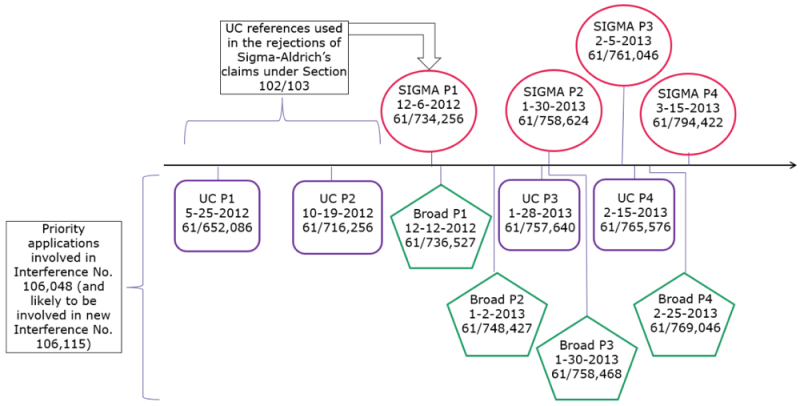
    The relationship between patents and applications owned by Berkeley, the Broad, and Sigma are set forth in Figure 1 of the petition graphically as follows:

    Image
    The Examiner (who is the same Examiner responsible for allowing Berkeley's patents), according to the petition, has provided no legal justification for refusing to acknowledge what Sigma contends is the precedential value of the decisions in the earlier interference.  Sigma's position is that if the Doudna et al. provisional applications did not provide sufficient support to find the Broad's claims obvious (in an interference context) they cannot support a determination of obviousness in ex parte patent prosecution involving Sigma's applications.  Sigma further alleges that the evidence adduced in its ex parte examination of the three identified pending applications is "even more extensive" than the record in the earlier Berkeley/Broad interference; here, Sigma asserts that it has provided "multiple declarations from prominent experts explaining in even greater detail why (a) UC's disclosure of CRISPR-Cas9 in a prokaryotic environment does not render obvious Sigma-Aldrich's CRISPR-Cas9 eukaryotic claims, and (b) UC's provisional applications (UC P1 and UC P2) do not enable or adequately describe use of CRISPR-Cas9 in eukaryotic cells."

    According to the petition, the Examiner merely responds that their evidence is "unpersuasive" in refusing to recognize the allowability of their pending claims (in the latest Office Action, in the '911 application, Sigma asserts that this phrase or its equivalent was repeated "over 70 times").  (It is only fair to the Examiner to note that there was an in-person interview between Sigma's representatives and "the Examiner, her Supervisory Patent Examiner, two Interference Practice Specialists, and the Group Art Unit Director" that did not resolve the issue in Sigma's favor.)  Sigma-Aldrich argues that "[f]or the effective administration of justice, efficiencies of the USPTO and the parties, conservation of considerable valuable resources, and the public interest" the new interference should be declared (between Berkeley and Sigma in their petition; it is difficult to see the USPTO not including the Broad et al. patents in any such interference).  The alternative, according to the petition, would be appeal to the PTAB over the obviousness rejection and, if need be, further appeal to the Federal Circuit.

    Confident of its position, Sigma contends that this would be contrary to the Director's recent pronouncements (albeit in a different context) regarding there being a "level playing field" for all applicants and other parties; this portion of the petition waxes wroth regarding the "palpable" unfairness to Sigma and that "[i]n today's highly charged political environment, certainly the Director and CAPJ are sensitive to criticism leveled at the Agency regarding issues of fairness and equity."  In addition, Sigma notes that it would be "grossly inefficient" for the USPTO to conduct the current interference between Berkeley and the Broad and then have to conduct a further interference between Sigma and either or both of the other parties.  Finally, the petition notes the public interest in resolving the priority and ownership disputes between the several parties to prevent inhibiting development of the technology due to uncertainties regarding licensing and freedom to operate issues.

    Should the Director and/or Chief Judge grant Sigma its requested relief, it is likely that the current interference will be redeclared naming all three parties, the patents and applications currently in interference, and the Sigma-Aldrich applications (with their attendant priority claims).  The interfering subject matter has been set forth in alternate counts, corresponding either as claim 18 of the Broad's U.S. Patent No. 8,697,359 (dependent on claim 15), which taken together recites the following invention:

    An engineered, programmable, non-naturally occurring Type II CRISPR-Cas system comprising a Cas9 protein and at least one guide RNA that targets and hybridizes to a target sequence of a DNA molecule in a eukaryotic cell, wherein the DNA molecule encodes and the eukaryotic cell expresses at least one gene product and the Cas9 protein cleaves the DNA molecules, whereby expression of the at least one gene product is altered; and, wherein the Cas9 protein and the guide RNA do not naturally occur together, wherein the guide RNAs comprise a guide sequence fused to a tracr sequence.

    (where the underlined portion recites the relevant language from claim 18) and claim 156 of Berkeley's U.S. Patent Application No. 15/981,807:

    A eukaryotic cell comprising a target DNA molecule and an engineered and/or non-naturally occurring Type II Clustered Regularly Interspaced Short Palindromic Repeats (CRISPR)-— CRISPR associated (Cas) (CRISPR-Cas) system comprising
        a) a Cas9 protein, or a nucleic acid comprising a nucleotide sequence encoding said Cas9 protein; and
        b) a single molecule DNA-targeting RNA, or a nucleic acid comprising a nucleotide sequence encoding said single molecule DNA-targeting RNA; wherein the single molecule DNA-targeting RNA comprises:
            i) a targeter-RNA that is capable of hybridizing with a target sequence in the target DNA molecule, and
            ii) an activator-RNA that is capable of hybridizing with the targeter-RNA to form a double-stranded RNA duplex of a protein- binding segment,
        wherein the activator-RNA and the targeter-RNA are covalently linked to one another with intervening nucleotides; and
        wherein the single molecule DNA-targeting RNA is capable of forming a complex with the Cas9 protein, thereby targeting the Cas9 protein to the target DNA molecule, whereby said system is capable of cleaving or editing the target DNA molecule or modulating transcription of at least one gene encoded by the target DNA molecule.

    There is no time frame for the petition to be considered much less granted, but as Sigma notes, the latest Berkeley-Broad interference is in the earliest stage; the parties must submit their proposed motions to the Board by July 30th and a teleconference between the Board and the parties is scheduled for August 5th.  None of these dates is written in stone, of course, and the Director or the Board could postpone progress in the pending interference to consider Sigma's request.  That would be the logical course; whether it is the Office's course remains to be seen.

  • CalendarJuly 23, 2019 – Commemoration of 50th anniversary of moon landing (U.S. Patent and Trademark Office) – 2:00 pm to 4:30 pm (ET), USPTO headquarters, Alexandria, VA

    July 25, 2019 – "Winning at §112: The Language of Patents" (IPWatchdog) – 12:00 pm EDT

  • USPTO SealThe U.S. Patent and Trademark Office will be hosting an event to commemorate the 50th anniversary of the moon landing on July 23, 2019, from 2:00 pm to 4:30 pm (ET) at the USPTO headquarters, 600 Dulany Street, Alexandria, VA.  The event will also focus on space innovation, technology transfer from the Apollo missions, and an overview of the current administration's policy on space exploration and space commerce.  Featured speakers at the event will include:

    • Secretary of Commerce Wilbur Ross
    • NASA Administrator Jim Bridenstine
    • Under Secretary of Commerce for Intellectual Property and Director of the USPTO Andrei Iancu
    • Director of the Office of Space Commerce Kevin O'Connell
    • Deputy Under Secretary of Commerce for Intellectual Property and Deputy Director of the USPTO Laura Peter
    • Former Associate Director, Satellite Servicing Capabilities Office, NASA and National Inventors Hall of Fame inductee Frank Cepollina
    • Astronaut Kathryn Sullivan
    • Astronaut Paul Richards
    • VP and General Manager of Strategic Operations of Ball Aerospace Debra Facktor
    • CEO of NanoRacks Jeffrey Manber
    • Founder and Chief Strategy Officer of Slingshot Aerospace Melanie Stricklan

    Additional information regarding the event can be found here.  Those interested in registering for the event, can do so here.  The event can be viewed here or here.

  • IPWatchdogIPWatchdog will be offering a webinar entitled "Winning at §112: The Language of Patents" on July 25, 2019, at 12:00 pm EDT.  Gene Quinn will discuss what the future may look like in light of possible § 112 reforms, best practices for today, and tools to help attendees mitigate filing errors before they happen.

    Those interested in registering for the webinar, can do so here.

  • By Kevin E. Noonan —

    District Court for the District of New JerseyThose with moderate memories may recall that there was a spate of qui tam actions several years ago for false marking of patented articles, aimed at manufacturers who had neglected to remove patent marking from their products after their patents had expired.  Some of these transgressions were of ancient provenance, particularly with regard to consumer goods; these were attractive targets because the "damages" to the private attorneys general accrued on a "per instance" basis and thus the reward (50% of which going to the "relator" who brought the action) could be sizable.  Alas, for these enterprising public guardians, the troll-like nature of these actions was enough for Congress to amend the statute as part of the Leahy-Smith America Invents Act for them to disappear as quickly as they had arisen.

    Recently, a complaint was filed in the U.S. District for the District of New Jersey on behalf of the relator (a New York-based patent attorney) and the States of California, Colorado, Connecticut, Delaware, Florida, Georgia, Hawaii, Illinois, Indiana, Iowa, Louisiana, Massachusetts, Michigan, Minnesota, Montana, Nevada, New Jersey, New Mexico, New York, North Carolina, Oklahoma, Rhode Island, Tennessee, Texas, Vermont, Virginia, Washington, and the District of Columbia against Janssen Biotech, Jansen Oncology, Janssen R&D, Johnson and Johnson, and BTG International alleging violation of the Federal False Claims Act (31 U.S.C. §§ 3729-3733) and corresponding state laws.  The alleged "false claims":  "Medicare, Medicaid, and other government program[]" reimbursement for the prostate cancer drug Zytiga® (abiraterone acetate, administered in combination with prednisone) paid after expiration of Orange Book-listed U.S. Patent No. 5,604,213, which expired on December 13, 2016.  The complaint was based on an allegation that Orange Book-listed U.S. Patent No. 8,822,438 was obtained by "fraud,", i.e. inequitable conduct.  (That patent has been invalidated in related inter partes review (IPR) proceedings but has not been held to have been obtained as the result of inequitable conduct in ANDA litigation.  Rather, in a consolidated action the District Court held the patent to be invalid for obviousness, and the Federal Circuit affirmed both the District Court decision and the Final Written Decisions of obviousness in the related IPRs.)

    As set forth in the complaint, the basis for the action is "civil liability [that arises] when a defendant makes, or causes to be made, a false or fraudulent claim for payment to the government."  The "false claim" here is "overpriced prescription drugs," which the complaint asserts are the basis for "many FCA cases."  Here, in addition to allegedly improperly obtaining allowance of the '438 patent, the complaint alleges that defendants "manipulate[ed] the regulatory structure for generic approval [that] allowed Defendants to wrongfully shield over $1 billion in Zytiga revenue, most of it paid by federal and state government funds."  (Elsewhere in the complaint, the amount rises to $2.5 billion.)  The rhetoric regarding the nature of the problem of prescription drug prices and the perfidy of these defendants is reliably purple, and a review of the substance of the allegations useful for discerning whether there is any basis for the allegations.

    According to the complaint, the two "fraudulent" acts alleged to have been performed by defendants were 1) failing to disclose that "one of its competitors had not obtained FDA approval [for its competing drug] during the time period for which Defendants were making critical market share comparisons between Zytiga and its biggest competitor, Xtandi®" and "withheld material information from the Patent Office that the claimed commercial success of Zytiga lacked any nexus" to the invention claimed in the '438 patent.  Their allegation is "but for" — by engaging in inequitable conduct, Defendants were able to exclude generic competition and thus their reimbursement by the Federal government amounted to filing false claims with the government.  The complaint lays out the course of patent prosecution for the '438 patent, whose claims were repeatedly rejected on obviousness grounds under 35 U.S.C. § 103.  Defendant patent owner Janssen asserted so-called "secondary considerations" or objective indicia of non-obviousness in response to these rejections, specifically that the commercial success of Zytiga rebutted the prima facie obviousness case established by the Office.  The course of prosecution of the application (U.S. Application No. 13/034,340) was not excessively lengthy, the application having been filed in February 2011 and granted on September 2, 2014.  The defect in applicants' assertion of commercial success is purportedly due to a failure to properly establish commercial sales with the benefits of the putatively obvious invention to be patented, which the complaint further states must show "increasing market share and the maintenance of such shares in the face of competitors and other adverse market forces," citing Gaderma Labs L.P. v. Tolmar Inc. and Ashland Oil v. Delta Resins & Refractories.  (The complaint includes the further caveat that the success cannot be due to blocking patents or other "reasons other than the merits of the claimed invention.")

    The complaint characterizes as "misleading and fraudulent" statements made by Defendants in response to the Office refusing to accept the evidence of commercial success first submitted, based on statements that market share increased from 15% to 20%, instead of relator's calculation that it was only an increase of 3%, and that one of the comparator drugs, Xtandi®, had not been approved by the FDA.  The complaint further alleges inequitable conduct because Xtandi® overtook Zytiga sales "by the end of 2015"; however, to the extent the '438 patent was granted on September 2, 2014, is it difficult to understand how this datapoint supports an inequitable conduct allegation.  For another subset of the patient market (chemorefractory patients), Xtandi® overtook Zytiga sales in the relevant timeframe, but Defendants' representations were with regard to the ~70% of the market that was "chemo-naïve" and thus the relevance of this market information is somewhat questionable, particularly because the complaint states that "[i]n the same submission" Defendants acknowledged the reduction in sales.  If the "submission" was not Defendants' response to the Office's obviousness rejection, it is unclear that is intended, and if it was, then Defendants seem to have satisfied their duty of disclosure.  Additional allegations regarding relative timing of FDA approval for Zytiga and competing drugs, and the complex interplay between market share and the pattern in which the drugs are prescribed will no doubt be more fully argued by relator and Defendants' experts at trial.  But the central allegation — that the Office granted the '438 patent based on the arguments for commercial success — is supported by the prosecution history.

    The complaint also alleges that the '213 patent was a "blocking" patent and makes much of the procedural facts that the '438 patent was not a continuation of the '213 patent and that the Examiners of the two patents were not the same, but neglects to allege than the '213 patent was cited to the Examiner of the '438 patent.  Other allegations have less potential persuasive punch, such as asserting Defendants' statements that Zytiga was "the most successful oral oncology launch in history" was misleading because "numerous non-oral cancer drugs have been far more successful than Zytiga" (which is a non sequitur on its face).  And others lack context in the complaint sufficient to be persuasive without further expert explication.

    Relator will be required to establish his theories regarding misrepresentation and show the requisite intent to deceive, both by clear and convincing evidence, in order to prevail.

    In addition, the complaint alleges that listing the '438 patent in the Orange Book was in itself a "false and fraudulent statement to the U.S. government," raising another, related ground for bringing this qui tam action.  And citing requirements for federal contracts that suppliers affirm and attest that their prices are "fair and reasonable" the complaint established its own nexus between the alleged fraud in procuring the '438 patent, listing the purportedly invalid and unenforceable '438 patent in the Orange Book, and collecting branded prices from the government on account of avoided regulatory approval of presumably lower priced generic competitors (there having been more than a dozen ANDA filers precluded by the market by the Orange Book-listed '438 patent after expiry of the '213 patent in December 2016).

    The prayer for relief includes the statutory amount of treble damages as well as "not less than $5,500 or more than $21,916" for "each and every" violation of the Federal False Claims Act, as well as treble damages and other penalties in each of the state law-based violations.

    The false-marking qui tam plaintiffs would be no doubt envious of the potential windfall due the relator should he prevail.

  • By Donald Zuhn —

    Federal Circuit SealOn July 3, the Federal Circuit issued a per curiam Order in Athena Diagnostics, Inc. v. Mayo Collaborative Services, LLC, denying a petition for rehearing en banc filed by Plaintiffs-Appellants Athena Diagnostics, Inc., Oxford University Innovation Ltd., and the Max-Planck-Gesellschaft zur Forderung der Wissenschaften E.V.  The Court also denied Plaintiffs-Appellants a panel rehearing.

    The four page per curiam Order was accompanied by eight opinions, four concurring in the denial of the petition and four dissenting in the denial of the petition, adding an additional 82 pages to the Order.  The four concurring opinions were authored by Circuit Judges Lourie, Hughes, Dyk, and Chen, with Chief Judge Prost and Circuit Judges Reyna, Taranto, and Hughes joining in one of the concurrences and Circuit Judge Chen joining in one concurrence and several parts of another.  The four dissenting opinions were authored by Circuit Judges Moore, Newman, Stoll, and O'Malley, with Circuit Judges O'Malley and Stoll joining in one of the dissents and Circuit Judge Wallach joining in three of the dissents.  Thus, a total of seven members of the Court (Chief Judge Prost and Circuit Judges Lourie, Dyk, Reyna, Taranto, Chen, and Hughes) authored or joined opinions concurring in the denial, and a total of five members (Circuit Judges Newman, Moore, O'Malley, Wallach, and Stoll) authored or joined opinions dissenting in the denial.

    Last week, we reviewed the procedural history of the case and provided a brief summary of the eight concurring and dissenting opinions (see "Athena Diagnostics, Inc. v. Mayo Collaborative Services, LLC (Fed. Cir. 2019)").  On Sunday, we reviewed the four opinions concurring in the Order's denial of the petition for rehearing en banc (see "Athena Diagnostics v. Mayo Collaborative Services — The Concurrences").  In this post, we focus more closely on the four opinions dissenting in the Order's denial of the petition for rehearing en banc.  As we noted last week, several of the dissenting authors disagreed with the concurring authors that Mayo compelled a finding of patent ineligibility in this case.

    In the first dissent (which at just over twenty-two pages is the longest of the four dissents), Judge Moore, joined by Judges O'Malley, Wallach, and Stoll, disagrees with the majority of her colleagues that "believe that our hands are tied and that Mayo requires this outcome," indicating instead that "[t]he claims in this case should be held eligible, and they are distinguishable from Mayo."  Judge Moore contends that the Court "should reconsider this case and clarify our precedent."

    Judge Moore begins her opinion by noting that:

    This is not a case in which the judges of this court disagree over whether diagnostic claims, like those at issue in Athena, should be eligible for patent protection.  They should.  None of my colleagues defend the conclusion that claims to diagnostic kits and diagnostic techniques, like those at issue, should be ineligible.  The only difference among us is whether the Supreme Court's Mayo decision requires this outcome.  The majority of my colleagues believe that our hands are tied and that Mayo requires this outcome.  I believe Mayo does not.

    Citing Cleveland Clinic Found. v. True Health Diagnostics LLC (Fed. Cir. 2019) ("Cleveland Clinic II"); Athena Diagnostics, Inc. v. Mayo Collaborative Servs., LLC (Fed. Cir. 2019); Roche Molecular Sys., Inc. v. CEPHEID (Fed. Cir. 2018); Cleveland Clinic Found. v. True Health Diagnostics LLC (Fed. Cir. 2017) ("Cleveland Clinic I"); Genetic Techs. Ltd. v. Merial L.L.C. (Fed. Cir. 2016); Ariosa Diagnostics, Inc. v. Sequenom, Inc. (Fed. Cir. 2015); In re BRCA1- and BRCA2-Based Hereditary Cancer Test Patent Litig. (Fed. Cir. 2014); and PerkinElmer, Inc. v. Intema Ltd. (Fed. Cir. 2012), Judge Moore notes that "[s]ince Mayo, we have held every single diagnostic claim in every case before us ineligible," concluding that "[w]e have turned Mayo into a per se rule that diagnostic kits and techniques are ineligible."  According to Judge Moore, the per se rule is a result of the Federal Circuit's "fervor for clarity and consistency."  However, she does not fault her colleagues, "who under protest have concluded that they have no choice but to hold the claims in Athena ineligible because of Mayo," explaining that:

    There is surely some broad language in Mayo which could lead to this conclusion.  I, however, think we have extended Mayo too far.  Reading the entirety of Mayo and the subsequent Myriad decision, the Supreme Court did not intend Mayo to be the "sweeping" decision my colleagues have concluded it is.

    Nevertheless, her opinion calls of the members of the Court "to rethink our interpretation of Mayo."

    In the second part of her opinion, Judge Moore asserts that "diagnostic techniques and kits when narrowly claimed are precisely the type of innovation the patent system exists to promote," pointing out that "[t]he importance of diagnostics and their cost-reducing effects on patient treatment cannot reasonably be questioned."  She contends that "when there are specific advances, discoveries, or inventions in the diagnostics industry, they must be eligible for patent protection," explaining that:

    Unless one opposes the notion of patent protection entirely, it cannot be reasonably disputed that claims to diagnostic kits and techniques, like pharmaceuticals, which require enormous initial investments in terms of both time and money, are the reason we suffer the promise of a monopoly.  As many have explained, without patent protection, there will be little incentive for companies to invest the monumental amount of time and money necessary to develop diagnostic kits, tools and techniques.

    Judge Moore concludes the second part of her opinion by stating that:

    The math is simple, you need not be an economist to get it:  Without patent protection to recoup the enormous R&D cost, investment in diagnostic medicine will decline.  To put it simply, this is bad.  It is bad for the health of the American people and the health of the American economy.  And it is avoidable depending on our interpretation of the Supreme Court’s holding in Mayo.

    Turning to Athena's claims in the third part of her opinion, Judge Moore declares that "[i]t is my view that § 101 and Mayo, when read together and in their entireties, compel the holding that the claims in Athena are eligible."  Looking at Mayo, Judge Moore explains that:

    The breadth and generality of the Mayo claims led to their demise, as they recited nothing more than the natural law.  We have since ignored these considerations, treating every claim that includes a law of nature as directed to that law, even if the claim as a whole recites a specific way of applying that law of nature to a new and useful end.

    And she concludes that "[t]he Athena claims differ significantly from the Mayo claims."  In particular, she finds that "[t]he [Athena] claims are not directed to a natural law or phenomenon."  More specifically, Judge Moore explains that:

    Athena discovered that 20% of people suffering from MG [Myasthenia gravis] generate autoantibodies that bind to a MuSK protein.  Its claims recite concrete steps to detect the presence of autoantibodies to MuSK to diagnose MG.  These antibody/MuSK complexes had never been used by prior art MG diagnostic tests.  In contrast, the claims in Mayo recited a generic "determining" step, with no laboratory test at all specified by the claims, and the specification itself stated that the methods were "well-understood, routine, and conventional activity already engaged in by the scientific community."

    Judge Moore concludes her opinion by stating that she did "not believe that the Supreme Court intended Mayo to be the sweeping decision it has become," adding that:

    I do not understand Mayo to render ineligible a claim which covers a specific, concrete application of a natural law simply because such a claim is diagnostic as opposed to therapeutic.  Both should be eligible.  The last word on this from the Supreme Court came in Myriad where the Court made clear "patents on new applications of knowledge about BRCA1 and BRCA2 genes" could be eligible.  569 U.S. at 596.  To the extent that this Court has read Mayo so broadly that it precludes exactly that sort of patent, we have erred.  Doing so leaves Mayo at odds with the patent statutes and the later Myriad decision.

    As for diagnostic method claims, Judge Moore finds that their eligibility "is no longer uncertain," reiterating that "[s]ince Mayo, every diagnostic claim to come before this court has been held ineligible," and suggesting that there was no need for patentees "to waste resources with additional en banc requests," as "[y]our only hope lies with the Supreme Court or Congress."

    In the second dissent (which a numbers just over thirteen pages), Judge Newman, who dissented in the panel decision, asserts in her opinion dissenting in the denial of the petition for rehearing en banc (which was joined by Judge Wallach) that:

    The majority's position is a flawed interpretation of the Court's decision in Mayo Collaborative Services v. Prometheus Laboratories, Inc., 566 U.S. 66 (2012).  The Court did not hold that methods of diagnosis are subject to unique patent-eligibility rules.  We have mistakenly enlarged the Court's holding, in substance and in application.

    Judge Newman begins her opinion by noting that with respect to Athena's claims, "[t]he reaction between the specified antibodies and the MuSK protein was not previously known, and the specified claim steps had not previously been performed, separately or in combination."  She then reminds that in Diamond v. Diehr, 450 U.S. 175, 188 (1981), the Supreme Court stressed that "[i]t is inappropriate to dissect the claims into old and new elements and then to ignore the presence of the old elements in the analysis."  Judge Newman states that "[t]his established rule does not evaporate when the subject matter is a diagnostic method," adding that "[t]he Mayo Court did not effect such a change."

    According to Judge Newman, the Mayo Court also did not create a § 101 distinction between diagnostic methods and therapeutic methods.  Nevertheless, she points to the Federal Circuit's "inconsistent rulings between diagnosis and treatment of disease," citing In re BRCA1- & BRCA2-Based Hereditary Cancer Test Patent Litigation (Fed. Cir. 2014); Ariosa Diagnostics, Inc. v. Sequenom, Inc. (Fed. Cir. 2015); Genetic Technologies Ltd. v. Merial L.L.C. (Fed. Cir. 2016); Cleveland Clinic Foundation v. True Health Diagnostics LLC (Fed. Cir. 2017); Roche Molecular Systems, Inc. v. CEPHEID (Fed. Cir. 2018); and Cleveland Clinic Foundation v. True Health Diagnostics LLC (Fed. Cir. 2019), as examples of cases in which "the claims were held ineligible under section 101, whether or not the method of diagnosis was new and unobvious, and independent of patentability under sections 102, 103, and 112"; and citing Rapid Litigation Management Ltd. v. CellzDirect, Inc. (Fed. Cir. 2016); Vanda Pharmaceuticals Inc. v. West-Ward Pharmaceuticals Int'l Ltd. (Fed. Cir. 2018); Natural Alternatives Int'l, Inc. v. Creative Compounds, LLC (Fed. Cir. 2019); and Endo Pharmaceuticals Inc. v. Teva Pharmaceuticals USA, Inc. (Fed. Cir. 2019), as examples of cases in which method of treatment claims were held to be patent eligible.

    As for the instant case, Judge Newman concludes by stating that:

    This case presents an opportunity for judicial review and judicial remedy.  Although diagnostic methods are not the only area in which section 101 jurisprudence warrants attention, Federal Circuit precedent is ripe for reconsideration specific to diagnostic methods, to correct our application of the Mayo decision and to restore the necessary economic incentive.

    In the third dissent (which at three pages is the shortest of the four dissents), Judge Stoll, joined by Judge Wallach, contends that the Federal Circuit had, "[i]n a series of cases since the Supreme Court's decision in Mayo Collaborative Services v. Prometheus Laboratories, Inc., 566 U.S. 66 (2012), . . . established a bright-line rule of ineligibility for all diagnostic claims."  While conceding that "[t]his rule as applied to the facts of this case dictated that the majority panel find the claimed invention ineligible," she asserts that "this court's bright-line rule is based on an over-reaching and flawed test for eligibility, a test that undermines the constitutional rationale for having a patent system—promoting the progress of science and useful arts," and therefore she concluds that the Federal Circuit "should take this opportunity to correct its erroneous rule."

    Despite indicating that she "stand[s] by the panel decision in this case," Judge Stoll explains that her dissent is warranted "because the question of the eligibility of diagnostic inventions is exactly the type of exceptionally important issue that warrants full consideration by this court."  She also states that:

    En banc rehearing would not only permit us to have a more extensive view of the various considerations underlying Mayo, but it would also allow us to create judicial doctrine geared toward the practical application of Mayo's principles.  At the very least, en banc review would help the court develop an articulable standard for its § 101 jurisprudence moving forward.

    Judge Stoll concludes by declaring that "[i]n my view, by consistently bypassing en banc review of a critical issue that goes to the heart of this court's jurisdiction, we are abdicating our responsibility."

    In the fourth and final dissent (which numbers five pages), Judge O'Malley agrees with her dissenting colleagues that the Federal Circuit's precedent "applies the Supreme Court's holding in Mayo Collaborative Services v. Prometheus Laboratories, Inc., 566 U.S. 66 (2012) too broadly."  However, she also opines that:

    [C]onfusion and disagreements over patent eligibility have been engendered by the fact that the Supreme Court has ignored Congress's direction to the courts to apply 35 U.S.C. sections 101, et seq ("Patent Act") as written.  Specifically, the Supreme Court has instructed federal courts to read into Section 101 an "inventive concept" requirement—a baffling standard that Congress removed when it amended the Patent Act in 1952.  I encourage Congress to amend the Patent Act once more to clarify that it meant what it said in 1952.

    Judge O'Malley begins her opinion by providing some "historical perspective" on "the 'invention requirement'—itself 'invented' by the Supreme Court rather than Congress or the Constitution," noting that "[i]f the invention requirement and its criticisms sound familiar, that is because they are."  And Judge O'Malley suggests that even though, in 1952, "Congress attempted to address these criticisms by amending the Patent Act to replace the ill-defined and judicially-created invention requirement with the more workable anticipation and obviousness tests codified in Sections 102 and 103," "the search for an inventive concept—now enshrined in the § 101 inquiry via Mayo—calls back to the invention requirement that Congress quite deliberately abrogated through the Patent Act of 1952."

    Judge O'Malley wonders whether the outcome in Athena would be different "[h]ad the Supreme Court not disregarded Congress's wishes for a second time."  She concludes by stating that:

    Because the Supreme Court judicially revived the invention requirement and continues to apply it despite express abrogation, I dissent to encourage Congress to clarify that there should be no such requirement read into § 101; to clarify that concepts of novelty and "invention" are to be assessed via application of other provisions of the Patent Act Congress designed for that purpose.

  • By Kevin E. Noonan —

    Federal Circuit SealThe doctrine of equivalents, a Supreme Court-created patent doctrine of vintage similar to inequitable conduct, arose in Graver Tank & Mfg. Co. v. Linde Air Products Co., 339 U.S. 605 (1950) (an uncharacteristically pro-patent decision by the Court, the doctrine recognized that an "unscrupulous copyist" could practice a claimed invention without literal infringement in some circumstances, and as a consequence the patent right could be turned into a "hollow and useless thing"):

    Such a limitation would leave room for — indeed encourage — the unscrupulous copyist to make unimportant and insubstantial changes and substitutions in the patent which, though adding nothing, would be enough to take the copied matter outside the claim, and hence outside the reach of law.  One who seeks to pirate an invention, like one who seeks to pirate a copyrighted book or play, may be expected to introduce minor variations to conceal and shelter the piracy.  Outright and forthright duplication is a dull and very rare type of infringement.  To prohibit no other would place the inventor at the mercy of verbalism and would be subordinating substance to form.  It would deprive him of the benefit of his invention and would foster concealment rather than disclosure of inventions, which is one of the primary purposes of the patent system.

    The doctrine fell into disfavor at the Federal Circuit during the 1990s and arguably provided the first inkling to the Court that the Federal Circuit's patent jurisprudence would benefit from the Court's closer oversight.  In Warner-Jenkinson Co. v. Hilton Davis Chem. Co., 520 U.S. 17, 36 (1997), and the seemingly interminable Festo v. Shoketsu Kinzoku Kogyo Kabushiki, the Supreme Court reiterated the vibrancy of the doctrine; nevertheless its successful assertion has continued to decline.  Thus, the Federal Circuit's decision a few weeks ago in UCB, Inc. v. Watson Laboratories Inc., affirming a District Court's determination in ANDA litigation that the generic challenger's product infringed under the doctrine was a welcome surprise.

    According to the Federal Circuit opinion, the case involved Neupro, a transdermal patch for delivering rotigotine (the (S) enantiomer of (-)-5,6,7,8-tetrahydro-6-[propyl-[2-(2-thienyl)ethyl]amino]-1-naphthalenol) for treating Parkinson's disease, for which U.S. Patent Nos. 6,884,434 and 8,232,414 were listed in the Orange Book.  Individual Plaintiff's interests are set forth in the opinion as follows:  UCB Mfg. Ireland Ltd. and LTS Lohmann Therpie-Systeme AG are co-assignees of '434 patent, and UCB Pharma GmbH is the assignee of the'414 patent; UCB Inc. owns the NDA for Neupro.  The claims at issue in ANDA litigation against Watson Labs Inc. and Actavis Labs UT, Inc. are set forth in the opinion:

    The '434 patent:

    1.  A transdermal therapeutic system comprising a self-adhesive matrix layer containing the free base (–)-5,6,7,8-tetrahydro-6-[propyl-[2-(2-thienyl)ethyl]amino]-1-naphthalenol [rotigotine] in an amount effective for the treatment of the symptoms of Parkinson's syndrome, wherein the matrix is based on [] an acrylate-based or silicone-based polymer adhesive system having a solubility of ≧5% (w/w) for the free base [rotigotine], all of said free base being present in the matrix in the absence of water; a backing layer inert to the components of the matrix layer; and a protective foil or sheet covering the matrix layer to be removed prior to use.

    The '414 patent:

    1.  A polymorphic form of rotigotine characterized by at least one parameter selected from the group consisting of:
        (a) a powder X-ray diffraction spectrum comprising at least one peak at the following °2θ angles (± 0.2): 12.04, 13.68, 17.72, and 19.01;
        (b) a Raman spectrum comprising at least one peak at the following (±3 cm-1): 226.2, 297.0, 363.9, 737.3, 847.3, 1018.7, and 1354.3 cm-1;
        (c) a DSC peak with a Tonset at 97°C. ± 2°C. measured with a heating rate of 10°/min; and
        (d) a melting point of 97°C. ± 2°C.

    2.  The polymorphic form of rotigotine of claim 1, wherein the polymorphic form of rotigotine is characterized by at least the following powder X-ray diffraction peaks at °2θ angles (± 0.2): 12.04, 13.68, 17.72 and/or 19.01.

    3.  A polymorphic form of rotigotine having a powder X-ray diffraction spectrum substantially as shown in FIG. 1.

    At trial, Defendants alleged that the claims of the '434 patent were invalid for obviousness and the claims of the '414 patent were anticipated, the latter theory on a unique set of facts.  After FDA approval of the transdermal patch claimed in the '434 patent:

    [B]atches of rotigotine patches were manufactured for distribution in the United States [and u]ntil August 2007, UCB manufactured Neupro patches by dissolving rotigotine in ethanol, among other steps, to create a rotigotine solution.  It then prepared a coating mass from this solution and other components (including a silicone-based polymer), which, after drying, produced a matrix.  The matrix did not contain crystalline rotigotine, and the rotigotine in the resulting patches, pre-distribution, was non-crystalline.

    On August 7, 2007, an unknown solid precipitated during the dissolution step, causing UCB to halt manufacture of Neupro patches.  Over the next few months, UCB investigated and determined that the solid was a polymorph of rotigotine, characterized by unique single-crystal X-ray diffraction parameters.

    UCB filed a patent application to cover the newly dis-covered Form II polymorph of rotigotine.  This resulted in the '414 patent . . . .

    The earliest priority date for the '414 patent was November 28, 2007, and Plaintiffs did not adduce evidence of any earlier date of invention than this filing date.  There was, on the other hand, evidence at trial that patients were treated with patches that contained this polymorph and that those patches were produced prior to the November 28, 2007 priority date of the '414 patent.

    The basis for the District Court's determination that Defendants' generic patches containing rotigotine infringed under the doctrine of equivalents is that those patches contained a polyisobutylene (PIB) adhesive, not the acrylate-based or silicon-based adhesives recited in the '434 patent claims.  The District Court found these embodiments to be "substantially similar" and that application of the doctrine of equivalents was not precluded by prosecution history estoppel, vitiation, ensnarement, or dedication to the public based on patentee's choice to claim narrowly.  The District Court also rejected Defendants' invalidity contentions under §§ 102 and 103.  The District Court found the asserted claims of the '414 patent to be invalid under § 102 based on the existence of the claimed polymorphic form of rotigotine in batches produced prior to the asserted priority date of November 28, 2007.

    The Federal Circuit affirmed, in an opinion by Judge Chen joined by Judges Schall and Taranto.  Regarding infringement of the '434 patent under the doctrine of equivalents, the opinion first discussed the lack of any limitation to the doctrine of equivalents.  With regard to prosecution history estoppel, the Court noted that the claims that granted in the '434 patent had not been amended during prosecution, the usual route for finding estoppel under Festo.  Specifically, the claim language that the patches included "acrylate-based or silicone-based polymer adhesive system having a solubility of ≥ 5% (w/w) for [rotigotine free base]" was never amended during prosecution, according to the Court.  There had been a restriction requirement that involved an unclaimed group reciting the use of polyvinylpyrrolidone (PVP) as a solubility enhancer, which was useful for embodiments comprising silicone-based but not acrylate-based polymers.  Both the District Court and the Federal Circuit rejected Defendants' argument that the election of embodiments not including PVP raised an estoppel because generally restriction requirement responses do not do so, citing Bayer Aktiengesellschaft v. Du-phar Int'l Research B.V., 738 F.2d 1237, 1243 (Fed. Cir. 1984).  In addition, taking the rubrics on the proper application of estoppel to election decisions enunciated in Merck & Co. v. Mylan Pharm., Inc., 190 F.3d 1335, 1340 (Fed. Cir. 1999), the opinion states that the restriction requirement was not directed at the choice of adhesive and thus plaintiffs did not "give up" scope that would include Defendants' PIB adhesive.

    Next, the opinion addressed Defendants' argument that Plaintiffs had relinquished scope that encompassed PIB by choosing to claim more narrowly.  While the Supreme Court has recognized a "foreseeability" limitation to the doctrine of equivalents for claims amended during prosecution to which estoppel can apply, the opinion states that there has never been such a limitation to unamended claims.  The opinion sets forth the logical necessity for this distinction:  "known interchangeability" is the basis for finding equivalents, so that "foreseeability at the time of claim drafting is not a per se bar to the application of the doctrine of equivalents."  Considering the totality of the evidence, the panel concluded that:

    [T]here is not enough indication from the patent specification, claims, or the record evidence of the inventor's knowledge here to conclude that UCB surrendered polyisobutylene as a possible equivalent.  In the absence of such facts, we agree with the district court that UCB's claiming of acrylates and silicates does not bar treating polyisobutylenes as an equivalent for infringement purposes.

    And:

    [W]e note as a policy matter that the patent system should not incentivize inventors to claim equivalents that they had not invented or tested, just because they know of the possibility of an equivalent, and also should not force inventors to delay filing for a patent on what they have invented while testing all known possible equivalents for fear of being unable to assert infringement under the doctrine of equivalents in the future.

    Regarding the doctrine of vitiation (that equivalents fails "if it renders a claim limitation inconsequential or ineffective," Akzo Nobel Coatings, Inc. v. Dow Chem. Co., 811 F.3d 1334, 1342 (Fed. Cir. 2016), and cannot "eliminate [an] element in its entirety"), including PIB as an equivalent does not result in such elimination, according to the Federal Circuit, because it does not thereby include all adhesives within the scope of the claim.  And regarding ensnarement, the panel agreed with the District Court that including PIB as an equivalent did not "ensnare" the prior art.  In making this determination, the Court engaged in the exercise of crafting a hypothetical claim that literally encompassed embodiments comprising PIB as an adhesive, and then assessed the prior art asserted by Defendants to determine whether the hypothetical claim was patentable over that art.  Unfortunately for Defendant, that art also disclosed acrylate-based and silicone-based adhesives, so that inclusion of PIB in the hypothetical claim did not uniquely encompass the prior art.

    Turning to the merits, the panel deferred to the District Court on the factual determination, which in a bench trial required a finding of clear error.  Here, the Federal Circuit did not find clear error in the District Court's finding that there were insubstantial differences between PIB and the acrylate-based and silicone-based adhesives recited in the claims and thus affirmed:

    [A]t the time the '434 patent was filed, silicates, acrylates, and polyisobutylenes were the most commonly used pressure-sensitive adhesives in transdermal patches.  The district court then identified a set of properties that silicates, acrylates, and polyisobutylenes share: they are pressure-sensitive, adhesive, biologically inert, non-irritating, and non-toxic.  Thus, the district court found that a skilled artisan "would recognize that polyisobutylene is not substantially different from the classes of adhesives literally within the scope of the claims."

    The District Court arrived at this conclusion despite evidence of differences in polarity, the presence of different functional groups, and the capacity to interact with crosslinking groups between polyisobutylene and acrylate-based and silicone-based adhesives, which the Court held were not substantial based on comparisons between Neupro and Defendants' generic alternatives.

    Regarding Defendants' invalidity arguments, the panel affirmed the District Court's decision that failed prior art efforts to develop rotigotine transdermal patches neither anticipated nor rendered obvious the claims of the '434 patent.  That art did not disclose a water-free patch having rotigotine in free base rather than salt form and thus comprised significant amounts of water (10-15% w/w) to solubilize the salt form of the drug.  And none of the other art asserted by Defendants "fill[ed] the gap" in this disclosure, because they did not disclose rotigotine or other anti-Parkinson's disease drugs, and in particular did not disclose the free base form of the drug in the absence of water in the formulation.  The Federal Circuit also affirmed the District Court's finding that other art, disclosing transdermal rotigotine administration by direct application to skin and transdermal patches not comprising water, did not render the claims of the '434 patent obvious because there was no "adequate rationale for combining the references' teachings" nor reasonable expectation of success at treating Parkinson's disease using a transdermal patch.  The opinion finds the cited art as being "a list of thousands of possibilities out of which a skilled artisan would have to select the claimed combination as one to try" and thus would not have provided the skilled worker with a reasonable expectation of successfully achieving the claimed patch.

    Turning to the '414 patent, the Federal Circuit affirmed the District Court's determination that the claimed rotigotine polymorph was used in the art prior to the earliest claimed priority date based on the presence of the polymorph in patches produced prior to that date, which constituted prior public use of the polymorph.  Because (as with all factual determinations) appellate review of questions of fact before the district court is reviewed for clear error, the Federal Circuit found no clear error that Defendants had shown anticipation by clear and convincing error, and thus affirmed.

    UCB, Inc. v. Watson Laboratories Inc. (Fed. Cir. 2019)
    Panel: Circuit Judges Taranto, Schall, and Chen
    Opinion by Circuit Judge Chen

  • By Donald Zuhn —

    Federal Circuit SealOn July 3, the Federal Circuit issued a per curiam Order in Athena Diagnostics, Inc. v. Mayo Collaborative Services, LLC, denying a petition for rehearing en banc filed by Plaintiffs-Appellants Athena Diagnostics, Inc., Oxford University Innovation Ltd., and the Max-Planck-Gesellschaft zur Forderung der Wissenschaften E.V.  The Court also denied Plaintiffs-Appellants a panel rehearing.

    The four page per curiam Order was accompanied by eight opinions, four concurring in the denial of the petition and four dissenting in the denial of the petition, adding an additional 82 pages to the Order.  The four concurring opinions were authored by Circuit Judges Lourie, Hughes, Dyk, and Chen, with Chief Judge Prost and Circuit Judges Reyna, Taranto, and Hughes joining in one of the concurrences and Circuit Judge Chen joining in one concurrence and several parts of another.  The four dissenting opinions were authored by Circuit Judges Moore, Newman, Stoll, and O'Malley, with Circuit Judges O'Malley and Stoll joining in one of the dissents and Circuit Judge Wallach joining in three of the dissents.  Thus, a total of seven members of the Court (Chief Judge Prost and Circuit Judges Lourie, Dyk, Reyna, Taranto, Chen, and Hughes) authored or joined opinions concurring in the denial, and a total of five members (Circuit Judges Newman, Moore, O'Malley, Wallach, and Stoll) authored or joined opinions dissenting in the denial.

    Last week, we reviewed the procedural history of the case and provided a brief summary of the eight concurring and dissenting opinions (see "Athena Diagnostics, Inc. v. Mayo Collaborative Services, LLC (Fed. Cir. 2019)").  In this post, we focus more closely on the four opinions concurring in the Order's denial of the petition for rehearing en banc.  As we noted last week, the general theme of the concurrences is that the Supreme Court's decision in Mayo Collaborative Services v. Prometheus Laboratories, Inc. left the members of the Court with no choice other than to deny the petition.

    In the first concurrence, Judge Lourie, joined by Judges Reyna and Chen, declares in a 4-page opinion that the Court "can accomplish little in [rehearing the case en banc], as we are bound by the Supreme Court's decision in Mayo," adding that:

    If I could write on a clean slate, I would write as an exception to patent eligibility, as respects natural laws, only claims directed to the natural law itself, e.g., E=mc2, F=ma, Boyle's Law, Maxwell's Equations, etc.  I would not exclude uses or detection of natural laws.  The laws of anticipation, obviousness, indefiniteness, and written description provide other filters to determine what is patentable.

    "But," as Judge Lourie states, "we do not write here on a clean slate; we are bound by Supreme Court precedent."

    Judge Lourie notes that the Federal Circuit has "held claims focused on detecting new and useful natural laws with conventional steps to be ineligible," citing Cleveland Clinic Found. v. True Health Diagnostics LLC and Ariosa Diagnostics, Inc. v. Sequenom, Inc. in support (without mentioning that both examples concern claims to diagnostic methods), but that "[i]n contrast, new method of treatment patents do not fall prey to Mayo's prohibition," citing Vanda Pharm. Inc. v. West-Ward Pharm. Int'l Ltd.  Judge Lourie also notes that "unconventional arrangements of known laboratory techniques, even if directed to a natural law" have also been found by the Federal Circuit to be patent eligible, citing Rapid Litig. Mgmt. Ltd. v. CellzDirect, Inc.  However, the instant case, as he points out, "involves neither scenario."

    While explaining that "[t]he only unconventional aspect is the inventors' discovery of what the Supreme Court would call the natural law—the correlation between MuSK autoantibodies and the neurological disorder myasthenia gravis," Judge Lourie concedes that the Court "cannot premise eligibility solely on the natural law's novelty."  Judge Lourie also opines that:

    Under Supreme Court precedent, I do not believe that specific yet purely conventional detection steps impart eligibility to a claim that otherwise only sets forth what the Court has held is a natural law.  That is the situation presented in Ariosa, Cleveland Clinic, and now Athena.  Accordingly, as long as the Court's precedent stands, the only possible solution lies in the pens of claim drafters or legislators.  We are neither.

    And to those in the patent community (including amici) who have complained that the Federal Circuit's eligibility precedent is "confused," Judge Lourie responds that "our cases are consistent," explaining that the Court has "distinguished between new method of treatment claims and unconventional laboratory techniques, on the one hand, and, on the other hand, diagnostic methods that consist of routine steps to observe the operation of a natural law," which he finds to be "a clear line."  He concludes his opinion by stating that beyond this distinction, he does "not see a way clear to distinguish Mayo in a useful, principled, fashion," and therefore is left to concur with the denial of the petition "because I do not believe we can convincingly distinguish Mayo in this case."

    In the second concurrence (which at a little over a page is the shortest of the concurring opinions), Judge Hughes, joined by Chief Judge Prost and Judge Taranto, notes that "[t]he multiple concurring and dissenting opinions regarding the denial of en banc rehearing in this case are illustrative of how fraught the issue of § 101 eligibility, especially as applied to medical diagnostics patents, is."  However, he also notes that while "the bottom line for diagnostics patents is problematic . . . this is not a problem that we can solve," adding that "[a]s an inferior appellate court, we are bound by the Supreme Court."

    Judge Hughes concludes by stating that:

    I, for one, would welcome further explication of eligibility standards in the area of diagnostics patents.  Such standards could permit patenting of essential life saving inventions based on natural laws while providing a reasonable and measured way to differentiate between overly broad patents claiming natural laws and truly worthy specific applications.  Such an explication might come from the Supreme Court.  Or it might come from Congress, with its distinctive role in making the factual and policy determinations relevant to setting the proper balance of innovation incentives under patent law.

    In the third concurrence (which numbers more than thirteen pages), Judge Dyk, joined by Judges Hughes and Chen (with Judge Chen only joining the last three parts of the concurrence), points out (to begin Part IV of his opinion) that:

    [T]here is tension between Mayo and the Supreme Court's later decision in Association for Molecular Pathology v. Myriad Genetics, Inc., 569 U.S. 576 (2013), and that the holding of Mayo may be overbroad.  The language of § 101 does cover "discover[ies]," 35 U.S.C. § 101, and there is no doubt that determining the relationship between specific genetic abnormalities and specific diseases constitutes an important discovery with proven utility.  There is much to be said for the patentability of claims to such discoveries, if not drafted overbroadly.

    Of the authors of the four concurring opinions, Judge Dyk stands apart in finding something beneficial in the Supreme Court's precedent on subject matter eligibility.  In Part I of his opinion, Judge Dyk explains that:

    In the realm of abstract ideas, the Mayo/Alice framework has successfully screened out claims that few would contend should be patent eligible, for example, those that merely apply well-known business methods and other processes using computers or the Internet.  The Mayo/Alice framework has thus proven to be both valuable and effective at invalidating overly broad, non-inventive claims that would effectively "grant a monopoly over an abstract idea."

    In support of his position, he cites Trading Techs. Int'l, Inc. v. IBG LLC (Fed. Cir. 2019); SAP Am., Inc., v. Investpic, LLC (Fed. Cir. 2018); Credit Acceptance Corp. v. Westlake Servs. (Fed. Cir. 2017); Elec. Power Grp., LLC v. Alstom S.A. (Fed. Cir. 2016); Intellectual Ventures I LLC v. Capital One Bank (Fed. Cir. 2015); Ultramercial, Inc. v. Hulu, LLC (Fed. Cir. 2014); and buySAFE, Inc. v. Google, Inc. (Fed. Cir. 2014).  However, Judge Dyk also notes that the Federal Circuit's subject matter eligibility precedent "has allowed room for claims that do more than recite conventional applications of abstract concepts," citing Ancora Techs., Inc. v. HTC Am., Inc. (Fed. Cir. 2018); Finjan, Inc. v. Blue Coat Sys., Inc. (Fed. Cir. 2018); and Enfish, LLC v. Microsoft Corp. (Fed. Cir. 2016) in support.

    In Part II of his opinion, Judge Dyk defends the need for Alice/Mayo framework, contending that "[d]espite assertions to the contrary, the doctrines of novelty under § 102, obviousness under § 103, and enablement and written description under § 112 cannot adequately guard against the dangers of overclaiming."  Judge Dyk also notes that these provisions do not "typically allow early stage resolution of the 'threshold' issue of patent eligibility . . . necessary to avoid the costs of lengthy litigation," and therefore concludes that the patent eligibility analysis of "§ 101 serves an important purpose not served by these other provisions in the Patent Act."  Offering an example of the alleged inadequacy of the other provisions to guard against overclaiming, Judge Dyk suggests that "[i]f the first person to identify the relationship between a genetic abnormality and a disease had sought a broad patent on a method of searching for genetic abnormalities and determining their relationship to disease, the claims would have been neither anticipated nor obvious."

    For Judge Dyk, "[t]he problem with § 101 arises not in implementing the abstract idea approach of Alice, but rather in implementing the natural law approach of Mayo," explaining in Part III of his opinion that "[a]lthough Mayo's framework is sound overall, I share the concerns expressed by my dissenting colleagues that the Mayo test for patent eligibility should leave room for sufficiently specific diagnostic patents."  However, as Judge Hughes indicated in his concurrence, Judge Dyk states that "it is the Supreme Court, not this court, that must reconsider the breadth of Mayo."

    In Part IV of his concurrence, Judge Dyk elaborates on the tension between the Supreme Court's decisions in Mayo and Myriad, stating that:

    Myriad thus recognized that an inventive concept can sometimes come from the discovery of an unknown natural phenomenon and its application for a diagnostic purpose.  This appears to be in tension with Mayo.  Under Mayo, a natural phenomenon itself, no matter how narrow and specific, cannot supply the requisite "inventive concept."

    Judge Dyk suggests that "it would be desirable for the Supreme Court to refine the Mayo framework to allow for sufficiently specific diagnostic patent claims with proven utility," contending that "[t]he inventive concepts in this area may lie primarily in the application of a natural law."

    According to Judge Dyk, however, the refinements to the Mayo framework that are needed are "limited."  In particular, Judge Dyk explains in Part V of his opinion that "if the claim is sufficiently tied to a specific and useful application of a natural law at Mayo step one, that application itself should serve as the necessary inventive concept at Mayo step two."  However, "the application must be more than determining the precise correlation of a known relationship using prior art processes, as was the case in Mayo itself."

    With respect to the claims at issue in Athena, Judge Dyk suggests in Part VI of his concurrence that "this case may involve claims that could be patent eligible under []his suggested approach."  He points out that "claims 7–9 do not claim the natural law itself—the relationship between MuSK autoantibodies and MG, a rare neurological disorder—but rather claim specific methods of diagnosing neurological disorders like MG by detecting MuSK autoantibodies."  Thus, according to Judge Dyk, Athena, unlike Mayo, "involves a 'discovery' of the relationship, not mere determination of the precise correlations of a known natural law using prior art processes."  Judge Dyk concludes his opinion by suggesting that "this case could provide the Supreme Court with the opportunity to refine the Mayo framework as to diagnostic patents."

    In the fourth and final concurrence (which at more than sixteen pages is the longest of the concurring opinions), Judge Chen states that "[w]hile I believe our court would benefit from the Supreme Court's guidance as to whether it intended to override central tenets of [Diamond v.] Diehr [450 U.S. 175 (1981)], Mayo's reasoning is clear and we are bound by it," adding that the analysis in Mayo "requires the affirmance of the district court’s decision to invalidate Athena's claims."  Judge Chen notes, however, that "[e]ven though Athena's claims likely would be found patent-eligible under Diehr's framework, it is not an inferior court's role to dodge the clear, recent direction of the Supreme Court."

    Judge Chen begins his concurrence by noting that the Supreme Court in Diehr "adopted a relatively narrow and more administrable version of the judicial exceptions to the statutory text of 35 U.S.C. § 101 compared to what the Court articulated three years earlier in Parker v. Flook, 437 U.S. 584 (1978)."  He also suggests that "[u]nder Diehr's 'claim as a whole' principle, which does not divide the claim into new versus old elements, Athena's claims, particularly claims 7 and 9, likely would have been found to be directed to a patent-eligible process."  However, he acknowledges that in Mayo, the Supreme Court "set forth an inventive concept/point of novelty framework, which is a more far-reaching, aggressive version of the judicial exceptions to the statute and is largely incompatible with Diehr's core rationale," even though "nothing in Mayo suggests that it sought to repudiate Diehr's analysis."

    Judge Chen provides a detailed analysis of Diehr, Flook, Mayo, and Alice, before turning to Athena's claims.  With respect to Diehr and Flook, Judge Chen contends that "[g]iven Diehr's evident disagreement with Flook's analysis, Diehr, as the later opinion, was widely understood to be the guiding, settled precedent on § 101 for three decades," with Diehr "reject[ing] the point of novelty/inventive concept approach to patent eligibility."  According to Judge Chen, "Mayo provided a framework for the judicial exceptions that strongly tracked the reasoning of Flook and the Diehr dissent."  Thus, Judge Chen argues that "Mayo is in considerable tension with Diehr's instruction to consider claims 'as a whole' and Diehr's disapproval of dissecting claims into elements and ignoring non-novel elements in the § 101 analysis."  And, as Judge Chen explains:

    When it comes to applying the judicial exceptions, it bears noting that the Mayo analytical approach is considerably harder to apply consistently than the Diehr framework, and more aggressive in its reach.  Consider the claim in Mayo.  If that claim had recited just the single step of administering a synthetic drug to a patient, that single-step claim would be patent-eligible, but lack novelty under § 102.  And if that claim added a second step for determining the subsequent level of a non-naturally occurring metabolite in a patient, that claim also would pass muster under § 101, but lack novelty.  But when the claim further recites a relationship between a metabolite level and its efficacy in a patient, that claim suddenly would be invalid under § 101 for violating the law of nature exception.  In other words, steps 1 and 2 now get pushed aside and declared insignificant, and the last step is designated as the "focus" of the claim, i.e., the heart of the invention.  The notion that adding claim language can convert an otherwise patent-eligible claim into a patent-ineligible claim is counterintuitive and a very difficult thing to explain to 8,000 patent examiners.  Moreover, the process of determining what the claim is "really about" when the claim is viewed in pieces, rather than as a whole, can be highly subjective and impressionistic.

    According to Judge Chen, "there is a serious question today in patent law as to what extent Diehr remains good law in light of Mayo," and he indicates that this is a question for the Supreme Court to resolve.

    In the last part of his opinion, Judge Chen examines the claims at issue in Athena.  While conceding that "the Supreme Court has made clear that detecting a law of nature (without more than conventional steps for accessing the law of nature) does not qualify as a patent-eligible application of a law of nature," Judge Chen notes that "given that the dual 'invention or discovery' structure consistently has been part of every Patent Act since 1790, this statutory provision suggests that at least some discoveries, including Athena's 'discovery' of how to diagnose myasthenia gravis, have always been contemplated as patentable subject matter."  Thus, while Judge Chen "do[es] not think the claims here can withstand Mayo's scrutiny," he argues that "perhaps when read 'as a whole' under Diehr, claims such as claims 7 and 9 in this case could be viewed as methods of testing for a specific medical condition, employing a sequence of steps that physically transform materials," adding that "this sounds like a contribution to the 'useful arts' stated in Article I, Section 8, Clause 8 of the U.S. Constitution."

    Judge Chen concludes his opinion by suggesting that:

    New methods for diagnosing medical conditions, as a general matter, intuitively seem to be the kind of subject matter the patent system is designed for:  to encourage the risky, expensive, unpredictable technical research and development that people would not otherwise pursue in the hope that if they discover something of great medical value, then they will be protected and rewarded for that successful effort with a patent.

    Nevertheless, Judge Chen declares that he is bound by "the clear, recent direction of the Supreme Court" to concur with the denial of Athena's petition for rehearing en banc.

    In a subsequent post, we will focus more closely on the dissenting opinions.