• By Aaron Gin

    USPTO SealThe public comment period regarding patenting of artificial intelligence (AI), which was scheduled to close on October 11, 2019, has been extended until November 8, 2019.  In a Notice posted August 27, 2019, USPTO Director Iancu sought public input on issues relating to AI-based inventions in an effort to determine whether further AI-specific guidance should be provided to the Examiner corps.

    The Notice centered around twelve questions involving topics ranging from AI patent policy to whether new forms of intellectual property protection are needed.  The questions are summarized as follows:

    1.  What are the main elements of an AI-based invention?

    2.  What are the different ways that a natural person can contribute to conception of an AI invention and be considered a proper inventor?

    3.  Do current patent laws regarding inventorship need to be revised to take into account inventions where an entity or entities other than a natural person contributed to the conception of an invention?

    4.  Should an entity other than a natural person, or company to which a natural person assigns an invention, be able to own a patent on the AI invention?

    5.  Are there any patent eligibility considerations unique to AI inventions?

    6.  Are there any disclosure-related considerations unique to AI inventions? Does there need to be a change in the level of detail an applicant must provide in order to comply with the written description requirement, particularly for deep-learning systems that may have a large number of hidden layers with weights that evolve during the learning/training process without human intervention or knowledge?

    7.  How can AI-based patent applications best comply with the enablement requirement, particularly given the unpredictability of certain AI systems?

    8.  Does AI impact the level of a person of ordinary skill in the art? If so, how? For example: Should assessment of the level of ordinary skill in the art reflect the capability possessed by the AI itself?

    9.  Are there any prior art considerations unique to AI inventions?

    10.  Are there any new forms of intellectual property protections that are needed for AI inventions, such as data protection?

    11.  Are there any other issues pertinent to patenting AI inventions that the USPTO should examine?

    12.  Are there any relevant policies or practices from other major patent agencies that may help inform the USPTO's policies and practices regarding patenting of AI inventions?

    Responses to the request for public comment could lead to new and/or revised examining guidance (and practices) at the PTO.  In the Notice, Director Iancu stated that such new guidance could help "promote the reliability and predictability" of patenting AI inventions.

    Notably, the USPTO appears to be trying to understand whether current patent laws should be revised to take into account inventions where "an entity or entities other than a natural person" contributed to the conception of an invention.  That is:  for inventions arising, at least in part, through AI (e.g., machine learning systems), can or should the AI be eligible to be named as an inventor or an applicant?

    In a blog post on the USPTO "Director's Forum," Deputy Director of the USPTO Laura Peter remarked that comments from the public regarding this Notice will allow the USPTO to "continue to ensure the appropriate balance in the administration of our IP system," and consider "if new legal rights are needed in the wake of more advanced AI."

    Written comments can be provided by email to AIPartnership@uspto.gov during the period for comment, originally slated to end October 11, 2019, but which has been extended to November 8, 2019.  Written comments will be made available for public inspection.

    For additional information regarding this and other related topics, please see:

    Request for Comments on Patenting Artificial Intelligence Inventions (FR Doc. 2019-18443)
    • Laura Peter, "USPTO announces Federal Register Notice on artificial intelligence patent issues," Director's Forum: A Blog from USPTO's Leadership, August 26, 2019.
    • Aaron Gin, "Intelligent Machines – Engines of Intellectual Property Creation?" Snippets, Spring 2018

  • By Donald Zuhn

    USPTO SealEarlier today, the U.S. Patent and Trademark Office announced via an e-mail to its stakeholders and in a post on the Director's Form Blog that the Office had achieved its long-term goals of reducing first action pendency to less than 15 months and reducing total pendency to less than 24 months for the 2019 fiscal year (see chart below).  The Office noted that it averaged 14.7 months for first action pendency and 23.8 months for total pendency for the fiscal year, which ended on September 30, which "marks the USPTO's lowest first action pendency since January 2002, despite total application filings nearly doubling in that time, from 353,000 in FY 2002 to 667,000 in FY 2019."

    Pendency
    In its FY 2018 Performance and Accountability Report, the Office had established targets of 14.5 months for first action pendency and 23.8 months for total pendency (see "USPTO Releases Performance and Accountability Report for FY 2018").  For FY2018, the Office had achieved an average first action pendency of 15.8 months and an average total pendency of 23.8 months.

    In announcing that the Office had met its goals to reduce patent examination pendency, the Office indicated that at the same time, it had "maintained and indeed improved the quality of our examination."  The Office also noted that the efforts of its employees on increasing efficiencies to accelerate the overall patent examination process had resulted in, for example, a decrease in the average processing time for an amendment filed in a patent application from 26.2 days to 6.8 days.

    The Office pointed out that it will now "redouble our efforts to optimize pendency using considered analytics that make sense," including improving how cases are routed to examiners and how examination time is allocated to examiners.  With respect to first action pendency, the Office will now "strive to meet in as many cases as possible the time frames outlined by the patent term adjustment statute (35 U.S.C. 154b)," which means issuing a first office action in no more than 14 months.

  • By Kevin E. Noonan

    Federal Circuit SealLast week, the Federal Circuit overturned an obviousness determination in an inter partes review by the Patent Trial and Appeal Board in OSI Pharmaceuticals LLC v. Apotex Inc.  The Court also reaffirmed its holdings in earlier-decided cases that applying the IPR portion of the Leahy-Smith America Invents Act to patents arising from applications filed before enactment of the AIA is not unconstitutional.

    The challenged patent, U.S. Patent No. 6,900,221, was listed in the Orange Book for OSI's cancer treatment Tarceva® (erlotinib), an epidermal growth factor receptor (EGFR) inhibitor used in the treatment of non-small cell lung cancer (NSCLC).  The opinion explains that NSCLC was the leading cause of cancer deaths in 2001, amounting to greater than one million cases.  At that time, chemotherapy was the standard therapy but was limited by the toxicity of most cancer chemotherapeutic agents, which showed little specificity in killing normal as well as cancer cells.

    Efforts during the timeframe of the earliest claimed priority date of the '221 patent were directed to EGFR inhibitors, but (importantly for the Court's decision) the opinion notes that "many of these [EGFR inhibitors] failed in clinical trials."  One reason for these negative outcomes, according to the opinion, is that "[c]ancer treatment is highly unpredictable" and that while some promising compounds were effective in vitro, such successes were "a poor proxy for how effective that drug actually was in treating cancer in vivo (i.e., in the body)" (the opinion citing several reasons for these results).  The opinion also recites the regulatory hurdles prospective drugs much overcome, and that "[a] great majority of therapies for NSCLC failed in clinical trials" (including the 1,631 new drugs for treating NSCLC between 1990 and 2005, and the mere 7 that were approved by the FDA, one of which was OSI's erlotinib).

    Before the Patent Trial and Appeal Board, Petitioner challenged claims 44-46 and 53 of the '221 patent for being unpatentable as obvious:

    44.  A method for the treatment of NSCLC (non small cell lung cancer), pediatric malignancies, cervical and other tumors caused or promoted by human papilloma virus (H[P]V), Barrett's esophagus (pre-malignant syndrome), or neoplastic cutaneous diseases in a mammal comprising administering to said mammal a therapeutically effective amount of a pharmaceutical composition comprised of at least one of N-(3-ethynylphenyl)-6,7-bis(2-methoxyethoxy)-4-quinazolinamine, or pharmaceutically acceptable salts thereof in anhydrous or hydrate forms, and a carrier.

    45.  The method of claim 44, wherein the treatment further comprises a palliative or neo-adjuvant/adjuvant monotherapy.

    46.  The method of claim 44, wherein the treatment further comprises blocking epidermal growth factor receptors (EGFR).

    53.  The method of claim 44 for the treatment of non-small cell lung cancer (NSCLC).

    The asserted prior art disclosed "a class of '4-(substituted phenylamino)quinazoline derivatives which are useful in the treatment of hyperproliferative diseases, such as cancers, in mammals" (Schnur); a scientific review article summarizing studies related to cell signaling mechanisms and molecules like EGFR involved therein with regard to malignant tumors (Gibbs); and OSI's 10-K filing with the Security and Exchange Commission.  Schnur discloses 105 different compounds including erlotinib (a "preferred" compound) and that this compound could be used as a treatment for cancers of many tissues, including lung (but not specifically NSCLC).  Gibbs discloses that erlotinib was in clinical development, with "good anti-cancer activity in preclinical models."  The Gibbs reference discloses other references that did not reference erlotinib for use in treating NSCLC and had no data regarding the use of erlotinib for treating NSCLC.  OSI's 10-K discloses the company's efforts to obtain FDA approval of erlotinib for treating NSCLC (as well as several other tumor types).  This disclosure was limited to Phase I and Phase II clinical trials and there were no clinical trial data in the document.

    The Board held that "a person of ordinary skill 'would have combined Gibbs or OSI 10-K with Schnur and had a reasonable expectation of success of achieving the invention of challenged claims 44 and 53.'"  Specifically, the Board found that all the limitations of claims 44 and 53 were disclosed in the Schnur reference except treatment of NSCLC with erlotinib, and this element of the claims was disclosed in OSI's 10-K or in the Gibbs disclosure that erlotinib "appear[s] to have good anti-cancer activity in preclinical models, with an acceptable therapeutic index particularly in patients with non-small cell lung cancer" (albeit without any disclosure of clinical data to support these activities).  The Board entered judgment in the IPR that claims 44-46 and 53 were invalid for obviousness, and OSI appealed.

    The Federal Circuit reversed, in an opinion by Judge Stoll, joined by Judges Newman and Taranto.  While acknowledging that the Board's factual findings were due deferential, "substantial evidence" review, citing Dickinson v. Zurko, 527 U.S. 150, 162 (1999), "'[m]ere speculation' is not substantial evidence," citing Intellectual Ventures I LLC v. Motorola Mobility LLC, 870 F.3d 1320, 1331 (Fed. Cir. 2017).  The panel used the district court standard to illustrate that "substantial evidence is not a fixed quantum of evidence, and may only be determined with respect to the standard of proof," citing Eli Lilly & Co. v. Aradigm Corp., 376 F.3d 1352, 1363 (Fed. Cir. 2004) (although the relevance to the issue before the Court is not immediately apparent).  Nevertheless, the opinion states that "[t]he same point logically applies to review of the Board's finding," citing In re Hotels.com, L.P., 573 F.3d 1300, 1302 (Fed. Cir. 2009).

    Applying these standards, the panel held that the Board's finding was not supported by substantial evidence because:

    As an initial matter, in reaching its conclusion, the Board misinterpreted the asserted references to teach more than substantial evidence supports.  When the references are properly read, the Board's finding that the asserted references provide a reasonable expectation of success also is not supported by substantial evidence.  To be clear, the claims require only treatment of a mammal with erlotinib—efficacy in humans is not required.  But the asserted references do not disclose any data or other information about erlotinib's efficacy in treating NSCLC.  The record does not contain any clinical (human) data or pre-clinical (animal) data.  It does not even include in vitro (test tube) data regarding erlotinib's effect on NSCLC.  At the same time, it is undisputed that NSCLC treatment was highly unpredictable with an over 99.5% rate of failure for drugs entering Phase II clinical studies.  On this record, we are not persuaded that a reasonable factfinder could conclude that a person of ordinary skill would have reasonably expected success based on the combination of Schnur and Gibbs or Schnur and OSI's 10-K.

    The opinion then sets out, for each reference, the deficiencies in the Board's understanding of the references and why alone or in combination they don't support an obviousness determination by substantial evidence.  Gibbs, according to the panel, is merely a reference article with no independent data of its own, and the data of others it does disclose does not include data showing that erlotinib could be used to treat NSCLC.  The references cited by Gibbs (who submitted a declaration in support of patentee during the IPR) that disclosed erlotinib did not disclose its use for treating NCSLC and the references disclosing NSCLC treatments did not disclose erlotinib, according to the opinion.

    Turning to the question of whether the cited art would provide the required reasonable expectation of success, the panel held that "properly read" the cited art did not.  Regarding the combination of the Schnur and Gibbs references, "the asserted references do not disclose any information about erlotinib's efficacy in treating NSCLC in a mammal" according to the Court.  The Schnur reference "fails to disclose any in vitro or in vivo efficacy data for erlotinib or otherwise suggest the use of erlotinib to treat NSCLC" and Gibbs, "[p]roperly read in context,[] discloses only that erlotinib inhibits the EGFR and has good anti-cancer activity in some cancers, not including NSCLC."  The absence of any data "or other promising information regarding erlotinib's efficacy in treating NSCLC," combined with the "highly unpredictable nature of treating NCSLC" precluded in the Court's view these references from providing the skilled worker with a reasonable expectation of success regarding the claimed inventive methods.

    With regard to the combination of the Schnur reference and OSI's 10-K document, the Court found fault with the Board's reliance on the existence of Phase I and Phase II clinical trials in the 10-K document, again without any data or reference to data showing that erlotinib could successfully treat NSCLC.  The panel also placed the Board's reliance on the 10-K statements in the context of the failure of 1,630 putative EGFR-directed anti-cancer compounds (a 99.5% failure rate), and faulted the Board for not considering this evidence when weighing the reasonableness of any likelihood for success the 10-K disclosed information would have had on the skilled artisan.  "These references provide no more than hope—and hope that a potentially promising drug will treat a particular cancer is not enough to create a reasonable expectation of success in a highly unpredictable art such as this" according to the opinion.

    The United States intervened over OSI's other grounds for appeal, questioning the constitutionality of subjecting to inter partes review proceedings patents arising from applications filed before passage of the Leahy-Smith America Invents Act.  The opinion notes that only after oral argument in this case did the Federal Circuit decide that applying IPR to pre-AIA patents is not a constitutional violation, in Celgene Corp. v. Peter, 931 F.3d 1342, 1362 (Fed. Cir. 2019); and Arthrex, Inc. v. Smith & Nephew, Inc., No. 2018-1584, 2019 WL 3938271, at *7 (Fed. Cir. Aug. 21, 2019).  In the face of this precedent, OSI conceded and the panel entered judgment in accordance with its earlier decisions that applying the IPR statute to pre-AIA patents is not unconstitutional.

    OSI Pharmaceuticals, LLC v. Apotex Inc. (Fed Cir. 2019)
    Panel: Circuit Judges Newman, Taranto, and Stoll
    Opinion by Circuit Judge Stoll

  • By Joshua Rich

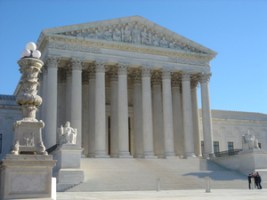
    Supreme Court Building #1On the first day of the 2019-20 term, the Supreme Court heard oral argument in Peter v. NantKwest, Inc.,[1] a case raising the question of whether a patent applicant should be responsible to pay all of the PTO's attorneys' fees in a § 145 "appeal"; it did not go well for the government.  With the Supreme Court's new procedures, the Deputy Solicitor General arguing the case was able to set forth the three main points of the government's case in two uninterrupted minutes.  After that, he was barraged by pointed questions.  Morgan Chu of Irell & Manella, arguing for NantKwest, faced less difficult questions and was better able to turn them to his advantage.  Ultimately, the argument left the impression that the Justices are very skeptical of the government's desire to recover attorneys' fees as "expenses" of a  § 145 action regardless of whether the applicant prevails.

    The NantKwest case arose after a patent applicant lost an argument at the Patent Trial and Appeal Board.  A dissatisfied applicant has two options after an adverse PTAB decision:  a routine appeal of the agency decision to the Federal Circuit under the Administrative Procedure Act under 35 U.S.C. § 141, or a civil action the U.S. District Court for the Eastern District of Virginia under 35 U.S.C. § 145.  The § 145 action allows for fulsome discovery, introduction of new evidence, and de novo review of the decision.  However, it requires that "[a]ll of the expenses of the proceeding shall be paid by the applicant."  35 U.S.C. § 145.

    Since the enactment of the statute in 1839, the PTO has required patent applicants to pay certain costs arising from a § 145 action, such as travel expenses, expert fees, and document reproduction.  For the first time in 170 years, however, the PTO demanded that NantKwest pay its attorneys' fees from the § 145 appeal.  The District Court rejected the PTO's demand but, on appeal, a split panel of the Federal Circuit agreed that NantKwest should be liable for the PTO's attorneys' fees regardless of the outcome of the appeal.  The full Federal Circuit then reheard the decision en banc and rejected the panel's decision.  The Supreme Court granted certiorari exclusively on the issue of whether the statute's requirement that the applicant pay "all of the expenses" meant that it would be required to pay attorneys' fees, win or lose.

    During oral argument, the PTO spelled out three arguments to support its position.  First, the term "expenses" unambiguously includes costs, but is necessarily broader than the legal term of art "costs," and therefore may include fees.  Second, Congress has directed that the PTO cover fees that are sufficient to cover its operating costs (including the personnel fees it incurs, such as agency solicitors) and § 145 can be part of the fee schedule that approximates the costs of various actions "in a rough and ready way."  Third, applicants have § 141 available as an alternative means of review of an adverse decision (without any obligation to pay the PTO's personnel fees), and therefore something more would be expected of applicants pursuing review under § 145.

    The Justices then jumped on the Deputy Solicitor General in rapid, bipartisan succession.  First, Justice Ginsburg established that § 145 and the parallel trademark provision being considered as part of the same argument are the only provisions in the entirety of the Federal Code in which the government has suggested the term "expenses" alone would include attorneys' fees.[2]  Then, Justice Kavanaugh raised a question to make sure that this was the only statute under which attorneys' fees could be awarded to the government as a losing (non-prevailing) party, which the Justice described as a "radical departure."  In its defense, the PTO argued that while it would be unusual for an adversarial proceeding involving the government, it wouldn't be unusual when compared to other aspects of patent prosecution in which the Office charges various fees.  But that led Justice Gorsuch to pounce on the issue and ask what more the PTO could charge — "The electric bill?  The sewage bill?  Other things that were required in order to be able to litigate these cases?"[3]  And again, the Office had little response:  such costs might be part of the fully burdened rate for personnel costs, but might also be considered in patent applications generally.  More fundamentally, the PTO had no response for why it hadn't attempted to collect attorneys' fees for 170 years.  Both Justice Breyer and Justice Gorsuch were quite troubled by the long practice of not seeking to recoup fees.  And they seem less than satisfied by the Deputy Solicitor General's attempt to shorten the time until only 2011, when the PTO became self-funding by statute (which nonetheless involved a delay before seeking fees).

    Like the PTO, NantKwest raised three basic arguments.  First, the "American Rule" is a bedrock principle of U.S. litigation, creating a strong presumption that parties bear their own fees in the absence of a clear statement to the contrary.  Second, this is a radical departure from the American Rule in which a party can be held liable for the opposite party's attorneys' fees not only if it loses — a rare, but not unprecedented departure from the American Rule — but also if it prevails.  Third, there are 3,274 Federal statutes that use the term "expenses" without discussing attorneys' fees, and none of them, except the two at issue here, even arguably would include attorneys' fees within their scope.

    The Chief Justice started the questioning by asking why this wasn't analogous to a very costly filing fee, as is seen with certain agency filings.  NantKwest refused to take the bait and instead insisted that this was an adversarial litigation in which the PTO was seeking attorneys' fees as part of the litigation, not a filing fee, which necessarily implicated the American Rule.  Justice Ginsburg, who had earlier betrayed her leanings, asked if there were any words other than explicitly calling for attorneys' fees that would do.  Mr. Chu offered some other options to show that there were no "magic words" required.  In response to questions from Justices Sotomayor, Kagan, and Kavanaugh, he made it clear that the statute would have to provide some indication that attorneys' fees were intended (not just personnel costs) because the American Rule is such a strong presumption.  He discussed what expenses beyond costs might be included in the statutory recovery, always distinguishing attorneys' fees.  Mr. Chu then seemed to enlist Justices Breyer[4] and Alito on his side, both by arguing the strength of the American Rule and pointing out the extensive length of consistent practice of the PTO not seeking attorneys' fees under § 145.  Finally, he pointed out that the case would likely affect other statutory provisions that discuss "expenses" without reference to attorneys' fees, including provisions relating to customs forfeitures and taxpayers' property.

    On rebuttal, the Deputy Solicitor General attempted to lessen the importance of the long practice of foregoing fees by calling "an atmospherically unhelpful point," but asserting that it didn't fall within any recognized doctrinal category.  He then pointed out that NantKwest had argued about what might or might not be covered, but had failed to propound any test that could be applied in future cases to determine what expenses would be recoverable.  However, the PTO's practice itself hadn't been consistent:  sometimes it charged for travel, sometimes it didn't; sometimes it charged for printing; sometimes it didn't.

    All in all, the Justices' questions put the PTO in a difficult position, while NantKwest was able to parry the blows easily.  Given the thrust of the argument, it would be surprising if the PTO were to prevail on the recovery of attorneys' fees under § 145; indeed, it would be surprising if even two or three of the justices did not apply the American Rule once again.

    [1] The case has been known as NantKwest, Inc. v. Matal and NantKwest, Inc. v. IancuSee https://www.patentdocs.org/2017/06/nantkwest-inc-v-matal-fed-cir-2017.html and https://www.patentdocs.org/2018/07/nantkwest-inc-v-iancu-fed-cir-2018-en-banc.html for a more extensive discussion of the history of the case.

    [2] Ultimately, Justice Ginsburg made it clear that she simply wasn't buying the government's argument, saying, "I can see the argument, Mr. — Mr. Stewart, that the word 'expenses' could include attorneys' fees, but I don't understand the argument that expenses alone must include attorneys' fees."

    [3] Perhaps farcically, Chief Justice Roberts asked if the government would be sending NantKwest a bill for the Supreme Court argument.  While the Deputy Solicitor denied it, the question pointed out that there wasn't as clear a division between § 141 and § 145 as the government might like.

    [4] In a bit of a surreal exchange, Justice Breyer created a predicate for another question with the following exchange:

    JUSTICE BREYER: Is — you probably, I'm just looking at your resume here, have experience in this patent area.  Is that true?

    CHU: Yes.

    It was more than a bit of an understatement to say that Morgan Chu "probably" has experience in the patent area.

  • By Donald Zuhn

    USPTO SealOn Friday, the U.S. Patent and Trademark Office published a notice of proposed rulemaking in the Federal Register (84 Fed. Reg. 53090), in which the Office proposes certain revisions to the rules of practice concerning Patent Term Adjustment (PTA) in view of the Federal Circuit's decision in Supernus Pharm., Inc. v. Iancu.  In particular, the Office proposes revising the period of reduction of PTA in the following provisions of 37 C.F.R. § 1.704:

    • Deferral of issuance of a patent (37 C.F.R. § 1.704(c)(2));
    • Abandonment of an application (37 C.F.R. § 1.704(c)(3));
    • Submission of a preliminary amendment (37 C.F.R. § 1.704(c)(6));
    ª Submission of papers after a decision by the Patent Trial and Appeal Board or by a Federal court (37 C.F.R. § 1.704(c)(9)); and
    • Submission of papers after a notice of allowance under 35 U.S.C. § 151 (37 C.F.R. § 1.704(c)(10)).

    According to the Office's notice, the proposed changes will specify a period of reduction corresponding to "the period from the beginning to the end of the applicant's failure to engage in reasonable efforts to conclude prosecution" as opposed to the consequences to the Office of applicant's failure to engage in reasonable efforts to conclude prosecution.

    In Supernus Pharmaceuticals, Inc. v. Iancu, the Federal Circuit reversed the entry of summary judgment by the District Court for the Eastern District of Virginia, which concluded that the U.S. Patent and Trademark Office had not erred in calculating the PTA for U.S. Patent No. 8,747,897.  During prosecution of U.S. Application No. 11/412,100, which issued as the '897 patent, the Examiner issued a final Office Action, and Supernus responded by filing a Request for Continued Examination (RCE).  After filing the RCE, Supernus was notified that an opposition had been filed in related European Patent No. EP 2 010 189 (which had issued from a European application corresponding to an International application that claimed priority from the '100 application).  One hundred days after the European Patent Office's notification of the opposition, Supernus filed a supplemental Information Disclosure Statement (IDS) citing the Notice of Opposition and other documents concerning the opposition.  The USPTO ultimately issued the '100 application as the '897 patent, determining that the '897 patent was entitled to 1,260 days of PTA.  The Office's PTA determination included an assessment of 886 days of applicant delay, of which 646 days were assessed for the time between the filing of the RCE and the submission of the supplemental IDS.  Supernus filed a request for Reconsideration of Patent Term Adjustment, but the Office rejected Supernus' request, concluding that the 646-day reduction in PTA was proper.

    Supernus challenged the Office's PTA determination in the Eastern District of Virginia, contending that it was entitled to at least 546 of the 646 days of PTA reduction (i.e., the period of time between the filing of the RCE and the EPO notification of opposition).  The District Court granted summary judgment in favor of the USPTO, finding that the USPTO did not err in the PTA calculation for the '897 patent.

    In January, the Federal Circuit reversed the District Court's grant of summary judgment in favor of the USPTO, finding that because there were "no identifiable efforts" that Supernus could have undertaken in the time period between the filing of an RCE during prosecution of the application that issued as the '897 patent and the mailing of an EPO notification of opposition for a European counterpart patent (which resulted in Supernus filing a supplemental Information Disclosure Statement during prosecution of the '897 patent), Supernus had not failed to engage in reasonable efforts to conclude prosecution during that time period.  The Federal Circuit noted in Supernus that "Congress expressly granted the USPTO authority to determine what constitutes reasonable efforts [under 35 U.S.C. § 154(b)(2)(C)(i)], but the USPTO lacks any authority to exceed the statutory 'equal to' limitation by including the 546-day time period during which it does not contend that Supernus failed to undertake reasonable efforts to conclude prosecution."  The Court therefore found the USPTO's PTA reduction for the '897 patent to be inconsistent with the PTA statute, accorded no deference to the USPTO's application of the regulations at issue in the circumstances of this case, and reversed and remanded the District Court's summary judgment order.

    In May, the USPTO issued a Federal Register notice notifying stakeholders of the impact of the Supernus decision on its PTA determinations (see "USPTO Issues Notice on Impact of Federal Circuit's Supernus Decision on PTA Procedures").  In its earlier notice, the Office indicated that it was "modifying its patent term adjustment procedures in view of the decision."  However, that notice stated that "the USPTO will continue to make the patent term adjustment determinations indicated in patents under the existing regulations using information recorded in its PALM [Patent Application Locating and Monitoring] system," and that a patentee who believes there were no identifiable efforts it could have undertaken to conclude prosecution of an application (as Supernus argued with respect to the '897 patent) "may raise the issue in a timely request for reconsideration of the patent term adjustment, providing any relevant information that is not recorded in the USPTO's PALM system."

    In the Office's latest notice regarding the impact of the Federal Circuit's Supernus decision, the Office points out that "[t]he Federal Circuit in Supernus held that a reduction of patent term adjustment under 35 U.S.C. 154(b)(2)(C) must be equal to the period of time during which the applicant failed to engage in reasonable efforts to conclude prosecution of the application."  As a result, the Office is now proposing revisions to certain provisions of 37 C.F.R § 1.704 for consistency with the Federal Circuit's decision in Supernus.  The Office's notice explains that the Federal Circuit's decision in Supernus involved a reduction in PTA under the provisions of 37 C.F.R. § 1.704(c)(8), which specifies a period of reduction of PTA equal to "the number of days, if any, beginning on the day after the date the initial reply was filed and ending on the date that the supplemental reply or other such paper was filed," which "corresponds to 'the period from the beginning to the end of the applicant's failure to engage in reasonable efforts to conclude prosecution,' except in the rare situation in which such period includes 'a period of time during which there is no identifiable effort in which the applicant could have engaged to conclude prosecution.'"  The Office notes that "[w]hile the Federal Circuit decision in Supernus involved 37 CFR 1.704(c)(8), there are several provisions in 37 CFR 1.704(c)(1) through (c)(14) whose period of reduction corresponds to or includes the consequences to the Office of applicant's failure to engage in reasonable efforts to conclude prosecution, rather than 'the period from the beginning to the end of the applicant's failure to engage in reasonable efforts to conclude prosecution.'"

    Marked-up versions of the rules that the Office has proposed revising are as follows:

    1.704 Reduction of period of adjustment of patent term.

    * * *

    (c)  * * *

    (2)  Deferral of issuance of a patent under § 1.314, in which case the period of adjustment set forth in § 1.703 shall be reduced by the number of days, if any, beginning on the date a request for deferral of issuance of a patent under § 1.314 was filed and ending on the earlier of the date a request to terminate the deferral was filed or the date the patent was issued;

    (3)  Abandonment of the application or late payment of the issue fee, in which case the period of adjustment set forth in § 1.703 shall be reduced by the number of days, if any, beginning on the date of abandonment or the date after the date the issue fee was due and ending on the earlier of:
        (i)  The date of mailing of the decision reviving the application or accepting late payment of the issue fee; or
        (ii)  The date that is four months after the
    date the grantable petition to revive the application or accept late payment of the issue fee was filed;

    * * *

    (6)  Submission of a preliminary amendment or other preliminary paper less than one month before the mailing of an Office action under 35 U.S.C. 132 or notice of allowance under 35 U.S.C. 151 that requires the mailing of a supplemental Office action or notice of allowance, in which case the period of adjustment set forth in § 1.703 shall be reduced by the lesser of:
        (i)  The
    number of days, if any, beginning on the day after the mailing date that is eight months from either the date on which the application was filed under 35 U.S.C. 111(a) or the date of commencement of the original Office action or notice of allowance national stage under 35 U.S.C. 371(b) or (f) in an international application and ending on the date of mailing of the supplemental Office action or notice of allowance; the preliminary amendment or
        (ii)  Four months other preliminary paper was filed;

    * * *

    (9)  Submission of an amendment or other paper after a decision by the Board of Patent Appeals Trial and Interferences Appeal Board, other than a decision designated as containing a new ground of rejection under § 1.19641.50(b) of this title or statement under § 1.19641.50(c) of this title, or a decision by a Federal court, less than one month before the mailing of an Office action under 35 U.S.C. 132 or notice of allowance under 35 U.S.C. 151 that requires the mailing of a supplemental Office action or supplemental notice of allowance, in which case the period of adjustment set forth in § 1.703 shall be reduced by the lesser of:
        (i)  The
    number of days, if any, beginning on the day after the mailing date of the original Office action decision by the Patent Trial and Appeal Board or notice of allowance by a Federal court and ending on the mailing date of the supplemental Office action or notice of allowance; amendment or
        (ii)  Four months other paper was filed;

    (10)  Submission of an amendment under § 1.312 or other paper, other than a request for continued examination in compliance with § 1.114, after a notice of allowance has been given or mailed, in which case the period of adjustment set forth in § 1.703 shall be reduced by the lesser of:
        (i)  The
    number of days, if any, beginning on the day after the mailing date of the notice of allowance under 35 U.S.C. 151 and ending on the date the amendment under § 1.312 or other paper was filed and ending on the mailing date of the Office action or notice in response to the amendment under § 1.312 or such other paper; or
        (ii)  Four months
    ;

    While the Office notes that "prior notice and opportunity for public comment for the changes proposed by this rulemaking are not required pursuant to 5 U.S.C. 553(b) or (c), or any other law," the Office has issued the notice of proposed rulemaking in order "to benefit from the public's input."  Those interested in submitting comments regarding the proposed revisions to §§ 1.704(c)(2), (c)(3), (c)(6), (c)(9), and (c)(10), must do so by December 3, 2019.  Comments may be submitted by e-mail to:  AD38.comments@uspto.gov; by regular mail addressed to:  Mail Stop Comments-Patents, Commissioner for Patents, P.O. Box 1450, Alexandria, VA 22313–1450, marked to the attention of Kery Fries, Senior Legal Advisor, Office of Patent Legal Administration, Office of the Deputy Commissioner for Patent Examination Policy; or via the Federal eRulemaking Portal.

  • CalendarOctober 7, 2019 – Post-argument discussion on the Peter v. Nantkwest case (American University Washington College of Law Program on Information Justice & Intellectual Property) – 5:00 pm (Eastern), Washington, DC

    October 15, 2019 – "The In-House Counsel Guide: Best Practices for Managing Your PTAB Trials and Litigation / IPR Strategies" (McDonnell Boehnen Hulbert & Berghoff LLP) – 10:00 am to 11:15 am (CT)

    October 15, 2019 – "The ITC: An Insider's View" (John Marshall Law School Center for Intellectual Property, Information & Privacy Law and Intellectual Property Law Association of Chicago Board of Managers) – 6:00 to 7:30 pm, Chicago, IL

  • MBHB Logo 2McDonnell Boehnen Hulbert & Berghoff LLP will be offering a live webinar entitled "The In-House Counsel Guide: Best Practices for Managing Your PTAB Trials and Litigation / IPR Strategies" on October 15, 2019 from 10:00 am to 11:15 am (CT).  In this presentation, MBHB attorneys Grantland G. Drutchas and George "Trey" Lyons, III will look at how AIA Trial Proceedings before the PTAB have substantially altered the patent litigation framework. They also address other risks and pitfalls that come along the way in AIA Trial Proceedings, including:

    • Rehearing Requests: Worth the bother (and the risks)?
    • Appeals: When does it make sense and what issues can be persuasive?
    • Preliminary Responses: What benefit (or not) does a Patent Owner get post-SAS for filing a Preliminary Response?
    • Expert Depositions: What are the nuances of deposing experts in PTAB Trials (vs district court litigation)?
    • Estoppels: What impact could an IPR have on your litigation options, both AIA estoppel and estoppels arising from agency determinations?
    • Declaratory Judgment Actions: What place do they have in a post-AIA world?

    While there is no fee to participate, attendees must register in advance.  Those wishing to register can do so here.  CLE credit is pending for the states of California, Illinois, New Jersey, New York, North Carolina, and Virginia.

  • Washington College of LawAs part of its ongoing Supreme Court series, the American University Washington College of Law Program on Information Justice & Intellectual Property will be hosting a post-argument discussion on the Peter v. Nantkwest case beginning at 5:00 pm (Eastern) on October 7, 201 at the American University Washington College of Law in Washington, DC.

    Additional information about the post-argument discussion, including registration/CLE information, can be found here.  The discussion will be webcast here.

  • JMLSThe John Marshall Law School Center for Intellectual Property, Information & Privacy Law and Intellectual Property Law Association of Chicago (IPLAC) Board of Managers will be hosting former U.S. International Trade Commission (ITC) judge Theodore R. Essex who will be presenting on "The ITC: An Insider's View" from 6:00 to 7:30 pm on October 15, 2019 at the John Marshall Law School in Chicago, IL.  Mr. Essex will provide insight into one of the most consequential agencies of the U.S. Government for the enforcement of IP — the U.S. International Trade Commission (ITC), which is at the epicenter of litigation for patent disputes — not only in the U.S. but also disputes originating between companies around the globe, adjudicating cases involving billions of dollars in product value.

    There is no cost to attend the lecture; however, registration is requested.  Those interested in registering for the conference can do so here.

  • By Kevin E. Noonan

    Federal Circuit SealRecently, Seth Waxman and his team filed a wonderful certiorari petition in the Athena Diagnostics v. Mayo Collaborative Serv. case, which we will discuss in a forthcoming post.  Using quotations from the various combinations of Federal Circuit judges in the eight (!) opinions concurring and dissenting from refusal to grant rehearing en banc, the petition paints an accurate picture of a Court struggling to properly apply Supreme Court and its own precedent with regard to claims to reagents and methods for medical diagnostics, and failing (i.e., none of the diagnostic claims brought before the Court have passed eligibility muster).

    Lest anyone think this situation exists only for medical diagnostics-related claims, consideration of today's decision in American Axle & Mfg. v. Neapco Holdings LLC will quickly dispel any such illusion.  In this case, American Axle sued Neapco Holdings for infringing claims of U.S. Patent No. 7,774,911, directed to methods for manufacturing driveline propeller shafts that "attenuate[e] . . . vibrations transmitted through the shaft assembly."  Claims 1 and 22 are representative according to the majority in the Federal Circuit's opinion; Judge Moore dissented, even as to this characterization:

    1.  A method for manufacturing a shaft assembly of a driveline system, the driveline system further including a first driveline component and a second driveline component, the shaft assembly being adapted to transmit torque between the first driveline component and the second driveline component, the method comprising:
        providing a hollow shaft member;
        tuning at least one liner to attenuate at least two types of vibration transmitted through the shaft member; and
        positioning the at least one liner within the shaft member such that the at least one liner is configured to damp shell mode vibrations in the shaft member by an amount that is greater than or equal to about 2%, and the at least one liner is also configured to damp bending mode vibrations in the shaft member, the at least one liner being tuned to within about ±20% of a bending mode natural frequency of the shaft assembly as installed in the driveline system.

    22.  A method for manufacturing a shaft assembly of a driveline system, the driveline system further including a first driveline component and a second driveline component, the shaft assembly being adapted to transmit torque between the first driveline component and the second driveline component, the method comprising:
        providing a hollow shaft member;
        tuning a mass and a stiffness of at least one liner, and
        inserting the at least one liner into the shaft member;
        wherein the at least one liner is a tuned resistive absorber for attenuating shell mode vibrations and
        wherein the at least one liner is a tuned reactive absorber for attenuating bending mode vibrations.

    The District Court granted summary judgment that these claims, and all other asserted claims, were invalid under Section 101 for being directed to a natural law (at least Hooke's law and "friction damping") and did nothing more than instruct the skilled worker to "apply" that law, in contravention of the patent eligibility requirements for satisfying Section 101 set forth in Mayo Collaborative Servs. v. Prometheus Labs., Inc.  The District Court's basis for arriving at this conclusion was that the '911 specification did not provide a "particular means of how to craft the liner and propshaft in order to do so".  American Axle appealed.

    The Federal Circuit affirmed, in an opinion by Judge Dyk joined by Judge Taranto; Judge Moore filed what can charitably called a vociferous dissent.  The majority set out its understanding of the invention and the basis for the District Court's decision to invalidate.  According to the opinion, the way propshafts in automotive drivetrains are constructed can in their use cause three modes of vibration:  bending, torsion, and shell modes, specifically, taken from the '911 patent specification:

    Bending mode vibration is a phenomenon wherein energy is transmitted longitudinally along the shaft and causes the shaft to bend at one or more locations.  Torsion mode vibration is a phenomenon wherein energy is transmitted tangentially through the shaft and causes the shaft to twist.  Shell mode vibration is a phenomenon wherein a standing wave is transmitted circumferentially about the shaft and causes the cross-section of the shaft to deflect or bend along one or more axes.

    Each of these vibration modes has a different frequency, according to the majority.  An important component of the majority's analysis (contradicted in Judge Moore's dissent) is that the prior art addressed the vibration problem using liners, defined in the opinion as "hollow tubes made of a fibrous material (like cardboard) with outer resilient members that 'frictionally engage the inner diameter of the [propshaft].'"  These liners also vibrate, so careful matching of propshaft and liner can result in damping the vibration of the propshaft, and this matching can be "tuned" by varying "certain variables" of the liner.  According to the majority, "[i]t was known in the prior art to alter the mass and stiffness of liners to alter their frequencies to produce dampening.  Indeed, this was sufficiently well known that prior art patents disclosed the use of particular materials to achieve dampening."

    Turning to specifics, the majority identify two relevant types of attenuation of these vibrations:  resistive attenuation ("a vibration attenuation means that deforms as vibration energy is transmitted through it . . . so that the vibration attenuation means absorbs . . . the vibration energy ") and reactive attenuation ("a mechanism that can oscillate in opposition to the vibration energy [of the propshaft] to thereby 'cancel out' a portion of the vibration energy").  The '911 specification (according to the majority) discloses that the prior art contained means and methods for attenuating each of the three propshaft vibration modes, but were limited insofar as they could not attenuate two vibration modes simultaneously; the specification identified a "need in the art" to dampen shell mode and bending mode vibrations simultaneously (which American Axle contended below and at the Federal Circuit comprised the "inventive concept" required by Supreme Court precedent to make their claim patent eligible).  While recognizing these assertions, in the majority's view the '911 specification does not disclose how to achieve these goals (this being the basis for finding the claims were not patent eligible).

    The majority set forth the now well-worn recitation of the two-step test for patent eligibility announced in Mayo and further clarified in Alice Corp. Pty. Ltd. v. CLS Bank International.  First, a court asks if the claim is "direct to" a law of nature, natural phenomenon, or abstract idea.  If it is, then the court must ascertain whether the claims recite an "inventive concept" that is not merely activities that are routine, conventional and well-understood and that provide "something more" than the law of nature itself and an instruction to "apply" the law.  Seemingly anticipating the reaction that the opinion would engender, the majority asserts that "[t]here is no legal principle that a claim to a method of manufacturing cannot be directed to a natural law, nor are there any cases saying so."  The majority believe that the '911 specification establishes that "most aspects of the '911 patent were well known in the art," meaning in context that the vibration "problem" addressed by the claimed methods, methods for attenuating resistive and reactive vibration with liners and other things, and that selection of frequencies needed for such attenuation are obtained by an application of Hooke's law (which the majority believes to have been undisputed according to select portions of testimony from both parties' witnesses).

    The majority opinion gets to the analytical basis for its decision when it says that "the patent claims do not describe a specific method for applying Hooke's law in this context.  They simply state that the liner should be tuned to dampen certain vibrations."  This in their view "essentially amounts to the sort of directive prohibited by the Supreme Court in Mayo—i.e. 'simply stat[ing] a law of nature while adding the words ''apply it.''"  The majority rejected testimony to the contrary (to the effect that axle liner tuning is not simply an application of Hooke's law) saying "[t]he problem with AAM's argument is that the solution to these desired results is not claimed in the patent.  We have repeatedly held that features that are not claimed are irrelevant as to step 1 or step 2 of the Mayo/Alice analysis," citing Alice; Synopsis, Inc. v. Mentor Graphics Corp.; and Ariosa Diagnostics, Inc. v. Sequenom, Inc., in support of this legal principle.  According to the majority, "the patent specification recites only a nonexclusive list of variables that can be altered to change the frequencies exhibited by a liner and a solitary example of a tuned liner (though not the process by which that liner was tuned).  Most significantly, the claims do not instruct how the variables would need to be changed to produce the multiple frequencies required to achieve a dual-damping result, or to tune a liner to dampen bending mode vibrations."  And such "trial and error" methods of identifying appropriate damping frequencies were also well known in the art, according to the majority who cite the '911 specification for support.  And further:

    This case might well be significantly different, if, for example, specific FEA [finite element analysis] models were included in the claims.  But, the claims' general instruction to tune a liner amounts to no more than a directive to use one's knowledge of Hooke's law, and possibly other natural laws, to engage in an ad hoc trial-and-error process of changing the characteristics of a liner until a desired result is achieved.

    The majority then cites Supreme Court and Federal Circuit case law for the principle that ""[a] patent is not good for an effect, or the result of a certain process, as that would prohibit all other persons from making the same thing by any means whatsoever," Le Roy v. Tatham, 55 U.S. (14 How.) 156, 174–75 (1853), and particularly Parker v. Flook (although apparently conflating or equating the rationale enunciated regarding the ineligibility of an abstract idea with their analysis of inventions based on laws of nature); the opinion then contrasted that situation with the patent-eligible invention in Diamond v. Diehr (not surprisingly, to the extent these decisions can be reconciled).  The majority reiterated its basis for finding ineligibility, that there is no "physical structure or steps for achieving the claimed result of damping two different types of vibrations" and that the "focus of the claimed advance here is simply the concept of achieving that result, by whatever structures or steps happen to work."  (If this language reminds anyone of the Court's reasoning in University of Rochester v. G.D. Searle, note Judge Moore's dissenting opinion that follows.)  And the majority provoked Judge Moore's analytical ire in its assessment of the second step of the Alice/Mayo test to these claims, where the majority states that "it makes no difference to the section 101 analysis whether the use of liners to attenuate bending mode vibration was known in the prior art."

    Judge Moore's full-throated dissent is based on her belief that "[t]he majority's decision expands § 101 well beyond its statutory gate-keeping function and the role of this appellate court well beyond its authority."  She characterized the majority's analysis as merely "parrot[ing]" the Alice/Mayo test and reducing the test to the single question of whether a claim is directed to a law of nature.  Judge Moore states that she is "deeply troubled by the majority's disregard for the second part of the Alice/Mayo test, its fact finding on appeal and its repeated misrepresentation of the record, in each instance to the patentee's detriment" under circumstances (appeal of summary judgment) where the proper standard is to give the non-movant (here, the patentee) the benefit of any evidentiary ambiguities.  As the majority recognized, Judge Moore's primary concern is that invalidity, if it is to lie against these claims, must be based on Section 112(a) for lack of enablement, not Section 101, saying "[w]e cannot convert § 101 into a panacea for every concern we have over an invention's patentability, especially where the patent statute expressly addresses the other conditions of patentability and where the defendant has not challenged them" (an argument the majority easily rejected under Justice Breyer's similar jurisprudential disdain for any section of the Patent Statute other than Section 101 in Mayo).  The Judge was equally critical of the majority's failure to identify which natural law the claims were directed to, stating that "Section 101 is monstrous enough, it cannot be that now you need not even identify the precise natural law which the claims are purportedly directed to."

    Judge Moore also believes there is sufficient disclosure of an "inventive concept" for the claims to pass Section 101 muster even if they are directed to a not completely defined (by the court) natural law.  In her view there are many inventive concepts disclosed in the '911 specification, and there exists at least sufficient questions of fact regarding this aspect as to preclude summary judgment.  (It should be remembered that Judge O'Malley recently called into question the propriety of another opinion by Judge Dyk, In re BRCA1– and BRCA2– Based Hereditary Cancer Test Patent Litig., where the question was whether the district court properly denied Myriad Genetics' motion for preliminary injunction and instead invalidated all claims at issue; see "Roche Molecular Systems v. Cepheid").  Here, Judge Moore enumerates a half dozen such novel uses for liners that constitute in her view an "inventive concept" (and a finding of unconventionality) sufficient to overcome Neapco Holdings' patent eligibility challenge under Section 101.  When addressing the citations to the '911 specification used by the majority to support its conclusion that the claims did not satisfy the "inventive concept" (and unconventionality) prong of the Alice/Mayo test Judge Moore is blunt:  "These statements are false."  The Judge's reading of the very same specification identifies ample instances where the patentee distinguished the invention from what was known in the art ("More than a dozen times in the briefs and during oral argument the patentee argued that the use of liners to attenuate bending mode vibration was one of its inventive concepts.").  The Judge even cites to an instance during oral argument when American Axle's counsel corrected a member of the majority when he asserted the conventionality of using liners for the claimed purpose, and that "[e]ven Neapco acknowledged that the patent states that liners had not been used to attenuate bending mode vibrations." Judge Moore characterizes these conclusions by the majority as de novo "fact-finding," including application of the disclosure of a patent (U.S. Patent No. 3,075,406) "never introduced as evidence in this case or cited by either party" to support its (erroneous, in Judge Moore's view) conclusions.  "Moreover," Judge Moore states, "a disclosure in a single patent does not establish that the use of liners to attenuate bending mode vibration was "well-understood, routine, conventional activity" as required by the Supreme Court," and the majority's statement that "the inventive concept 'makes no difference to the section 101 analysis'" is "an outright rejection of the second step of the Alice/Mayo test."  Judge Moore asserts that the majority's explanation that "Section 101 is concerned with whether the claims at issue recite a natural law, not whether the specification has adequately described how to make and use the concretely claimed structures and steps" is "just plain wrong" as a statement of the law.

    In Judge Moore's view, "[t]he majority's true concern with these claims is not that they are directed to Hooke's Law (because this is clearly a much more complex system not limited to varying mass and stiffness), but rather the patentee has not claimed precisely how to tune a liner to dampen both bending and shell mode vibrations," and the Judge cites almost a dozen statements from the majority opinion in support of this conclusion.  For Judge Moore, that deficiency is one falling properly under the scope of Section 112, not Section 101 of the statute.  (Seemingly somewhat tongue in cheek, Judge Moore recites the majority's statement that if the specification had disclosed computer-based methods for determining vibration dampening frequencies it might have satisfied Section 101, and then states "[s]urely, this is the first time adding software to a claim would make it eligible.")  Judge Moore further notes that:

    The majority acknowledges that there is a very specific example given in the patent with precise dimensions, weights, lengths, materials, positioning, etc.  Whether this disclosure combined with the knowledge of a skilled artisan would permit that skilled artisan to tune a liner to a given propshaft in order to reduce bending mode vibrations without undue experimentation is exactly and precisely the enablement test pursuant to § 112.  A patentee's failure to enable his invention renders the claims invalid under § 112, it does not, however, render the claims ineligible under § 101.

    and:

    To be clear, according to the majority, even if these claims are enabled, they are still ineligible because the claims themselves didn't teach how.  This is now the law of § 101.  The hydra has grown another head.

    And finally:

    The majority holds that [the '911 claims] are directed to some unarticulated number of possible natural laws apparently smushed together and thus ineligible under § 101.  The majority concludes that the inventive concepts "make no difference."  Section 101 simply should not be this sweeping and this manipulatable.  It should not be used to invalidate claims under standards identical to those clearly articulated in other statutory sections, but not argued by the parties.  It should not subsume § 112.  It should not convert traditional questions of fact (like undue experimentation) into legal ones.  The majority's validity goulash is troubling and inconsistent with the patent statute and precedent.  The majority worries about result-oriented claiming; I am worried about result-oriented judicial action.

    Anyone having read the Court's decision not to grant rehearing en banc in Athena Diagnostics v. Mayo Collaborative Serv. should be well aware of the fractious nature of the Section 101 inquiry among the Federal Circuit judges, and the desperate need for the Supreme Court to clarify the patent eligibility standard it recited (murkily) in its Mayo and Alice decisions.  Even if in agreement with Judge Moore, it is not difficult to see how the majority arrived at its conclusions, and how easy it is to apply Section 101 in a "sweeping and manipulatable" way.  When a specialized appellate court, created by Congress to harmonize and clarify U.S. patent law, can find a method of manufacturing a propshaft for an automobile to be ineligible under Section 101 as a natural law, it is clear that the Court, and as a consequence the rest of us, has clearly lost its way.

    American Axle & Mfg. v. Neapco Holdings LLC (Fed. Cir. 2019)
    Panel: Circuit Judges Dyk, Moore, and Taranto
    Opinion by Circuit Judge Dyk; dissenting opinion by Circuit Judge Moore