• By Kevin E. Noonan

    As reported in John Carrol's EndPoint News early last month, GlobalData has published a list of the Top 20 Pharmaceutical Companies by market cap as of March 31, 2019.  Notable advances include Takeda (up 142% based in part on its Shire acquisition, and jumping in the rankings from 23rd to 17th Q4 2018 – Q1 2019), with several other companies showing robust growth (including Celgene Corp., 37%; Novo Nordisk AS, 17%; Novartis AG, 14%; and Merck KGa, 13%; Hoffmann-La Roche, 12.7%).  Companies declining included Bristol-Myers Squibb, 7.9%; Pfizer, 6.9%; and Bayer AG 4.9%.  Biogen, the article notes, fell out of the Top 20.  Expected acquisitions are expected to change this landscape again in the next several months.

    Chart

  • By Kevin E. Noonan

    BBGMonarchButterflyWingsOne of the wonders and satisfactions of modern science has been the elucidation (usually based in genetics) of the wonders of nature that have been famously observed but not explained until the proper tools (again, usually genetic) have been developed.  One of these is the ability of certain animals to grow and thrive on a diet comprising otherwise toxic substances.  The koala is one example; on a different scale are insects, most noticeably monarch butterflies, that grow on milkweed known to contain cardiac glycosides inimical to life.

    Recently an international group published a paper in the journal Nature entitled "Genome editing traces the evolution of toxin resistance in the monarch butterfly" that elucidated the genetic basis of this phenotype.  The molecular target for these cardiac glycosides is known to be the alpha subunit of the sodium-potassium ATPase (ATPα) involved in energy generation (in higher animals associated with cardiac tissue but present in other tissues in insects).  Genetic analysis of the amino acid sequence of this protein (or more accurately, the nucleotide sequence of the genes encoding them) from several species (including the monarch butterfly, Danaus plexippus) identified mutations in a particular region of the protein (the first extracellular loop, H1-H2) that is associated with target-site insensitivity (TSI), i.e., a loss of the ability for the protein to bind cardiac glycosides.  Two resistance phenotypes were known, one that enables feeding on cardiac glycosides and the other that sequesters the toxin to avoid toxicity (and that make such species unpalatably bitter as a food source for birds and other predators).  The mutations were detected in amino acid residues at three sites (111, 119, and 122), with mutations at the 111 and 122 sites undergoing frequent parallel substitutions associated with the TSI phenotype.  The 119 site showed repeated substitutions in resistant species and co-evolution with mutations at the 111 site; paradoxically, mutations at the 119 were not phenotype-specific, because they are found in non-resistant species as well.  Assessing the genetic history of how these mutations arose revealed that mutation in almost all cases arose at site 119 before or in conjunction with mutation at site 122, with "repeated substitutions at the three sites [that] evolved concurrently with specialization."  These authors concluded that:

    The mutational paths lead to three predictions for how substitutions at sites 111, 119 and 122 affect fitness.  First, the mutational paths provide stepwise fitness advantages at increasing toxin concentrations.  Second, the mutational paths contribute to sequestration of cardiac glycosides through passive toxin accumulation.  Third, given the ordered appearance of the substitutions, interactions between substitutions (epistasis) increase fitness and mitigate the pleiotropic fitness costs of adaptive substitutions.

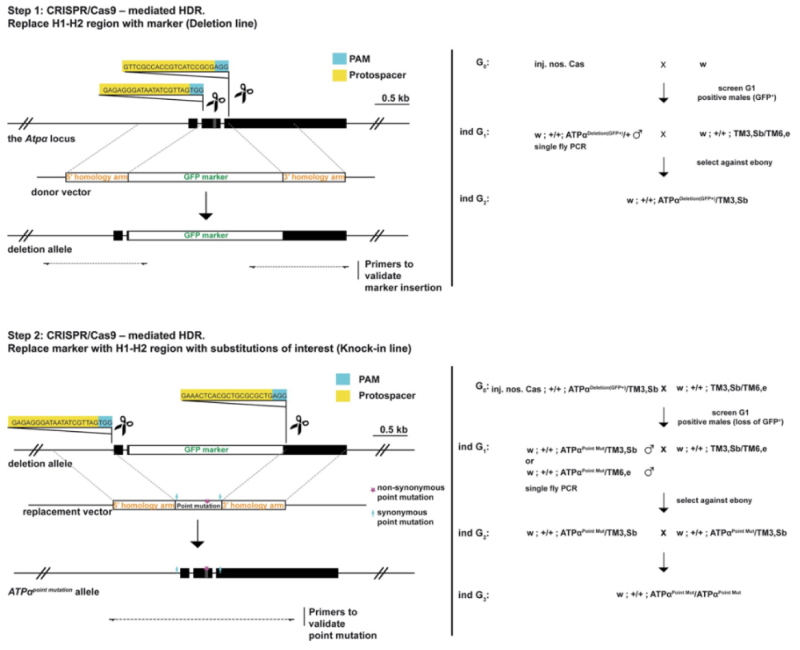
    These researchers then tested the effects of these mutations on resistance by using CRISPR-Cas9 mutagenesis techniques to genetically engineer Drosophila cell lines to encode ATPα having one or more of these mutations, as illustrated in this diagram:

    Image
    Four genotypes were tested:  substitution of glutamine at amino acid 111 with either leucine or valine; substitution of serine at amino acid 119 with serine; and substitution of asparagine at amino acid 122 with histidine (producing mutants represented as LAN, LSN, VSN, and VSH, respectively; the unmutated sequence is QAN).  These mutations were chosen because the mimicked the evolutionary progression of the mutations observed in the determination of sequences phylogenetically.  Single site mutants were also produced (represented as QSN and QAH).  Expression of the ATPα gene and sodium pump activities were unaffected in these mutants.  These mutations were then used to produce "knock-in" lines of fruit flies that showed increased resistance to ouabain, a hydrophilic cardiac glycoside familiar for its use as a selective agent against human B cells in conventional hybridoma technology.  In larval-adult and adult survival experiments, the LAN mutant showed increased survival in larval-adults only at low ouabain concentrations.  Resistance increased in these experiments for LSN mutants, with VSN mutants behaving similarly.  The VSH mutant (which is the native monarch butterfly mutant) "was unaffected by even the highest levels of ouabain in larvae and adults," a phenotype not associated merely with reductions in toxin ingestion or feeding rates.  Experiments with knock-in eggs using leaves from Asclepais curassavica (milkweed) showed increased survival for the LSN, VSN, and VSH genotypes.

    Physiological assessment of enzymatic activity of the mutant sodium ATPases showed a "neutral to positive" effect of TSI to ouabain.  Resistance progressed (again, following the observed phylogenetic progression) from a small increase in TSI with the LAN mutant, to a ten-fold increase for LSN and VSN mutants, and a thousand-fold increase for the VSH mutation array.  According to these authors, "VSH is sufficient for 'monarch [Drosophila] flies' to achieve the same degree of TSI to ouabain as the monarch butterfly, suggesting that TSI is the predominant biological mechanism for the in vivo toxin resistance observed above."

    Returning to the genetics, the paper notes that "[s]ite 119 co-evolves with site 111 . . . and substitutions at site 119 always occurred before or with TSI-conferring substitutions at site 122," from which the authors speculate that "antagonistic pleiotropy and epistasis may have shaped mutational paths to resistance and TSI."  To test this hypothesis, the paper reports the results of experiments using QZH and QSN mutants; the former genotype was "often the last substitution to evolve" while the latter occurs in both resistant and sensitive species.  While the QSN mutant could not increase larval-adult survival at low ouabain concentrations there was a survival benefit as ouabain concentrations were increased (this effect "dropped sharply" at the higher concentrations).  The results with adults were different, with QSN providing  "slight" survival benefit.  The last mutation to arise (N122H) gave the highest TSI phenotype but was phylogenetically contingent on substitution arising in site 119.  Neurological testing showed the QSN flies were least sensitive and QAH flies the least, and the first mutant LAN was more sensitive that LSN.

    The authors note that "this is, to our knowledge, the first in vivo validation of a multi-step adaptive walk in a multicellular organism, and illustrates how complex organismal traits can evolve by following simple rules."

    * Department of Integrative Biology, University of California, Berkeley, Berkeley, CA, USA; Department of Biology, Center for Genomics and Systems Biology, New York University, New York, NY, USA; LAI, U1067 Aix-Marseille Université, Inserm, CNRS, Marseille, France; Department of Ecology and Evolutionary Biology, Cornell University, Ithaca, NY, USA; Department of Statistics, University of California, Berkeley, Berkeley, CA, USA; Molecular Evolutionary Biology, Zoological Institute, Biocenter Grindel, Universität Hamburg, Hamburg, Germany; Department of Entomology, Cornell University, Ithaca, NY, USA

  • By Kevin E. Noonan

    University of CaliforniaOn September 11th, Junior Party (Regents of the University of California, University of Vienna, and Emmanuelle Charpentier, collectively "CVC") in Interference No. 106,115 with The Broad Institute et al. filed a motion to file its priority statement under seal.  Specifically, CVC's motion requested that it be permitted to have the PTAB seal the priority statement until 45 days after final judgment or indefinitely; CVC also asked for 45 days after judgment to move that the statement be expunged from the record.  (In the alternative, CVC requested that its statement remain sealed until a scheduling order issued by the Board for the priority phase of the interference, and that CVC be permitted to file a motion to expunge, e.g., if the count was changed).  Last week, the Patent Trial and Appeal Board (PTAB) denied this motion, in a Decision by Administrative Patent Judge Katz, joined by APJs Moore and Lane.

    CVC's motion was based on their contention that their priority statement "will contain sensitive research and development information that would be otherwise kept confidential."  CVC asserted that there were "several third-party competitors [specifically, Sigma-Aldrich, ToolGen, and Vilnius University] in the field of CRISR-Cas9 gene editing technology and that it will be prejudiced in any potential interference with these parties if its confidential research and development information were to be made public."  These competitors, according to CVC, all have competing applications filed within 10 months of CVC's priority date, and have argued that their claims interfere with CVC's claims in this interference (see "Sigma-Aldrich Wants Its Piece of CRISPR Pie").

    The Board opined that, in agreement with the Broad, CVC's arguments were "based on speculation," because as yet there have been no other interferences declared between CVC and any of these other parties.  Relying as it frequently does on the procedural aspects of the questions before it (see "Sigma-Aldrich Tries Again"), the Board asserts in support of this point that "no count has been used to describe interfering subject matter between any of CVC's applications or patents" and that "CVC presents no evidence that any of the claims it asserts might interfere with CVC's own claims have been determined to be allowable."  Under these circumstances, the Board was not persuaded to deviate from its policy that "[t]he record of a Board proceeding [be] available to the public unless a patent application not otherwise available to the public is involved," citing 37 C.F.R. § 41.6(b)(1).  In particular, the opinion reminds the parties that the Board "strive[s] towards making all filings in an interference public at least by the time we issue a final judgment," and that CVC has requested that its priority statement be held under seal until 45 days after final judgment (although the Board notes that CVC can file a renewed request once judgment has been entered).

    The Board was persuaded by CVC's request to keep its priority statement under seal until the Board issued a schedule for the priority phase, stating that CVC had correctly noted that 37 C.F. R. § 41.120(a) permits the Board to keep priority statements confidential "for a limited time."  The Board remained unpersuaded by the Broad's arguments that it would be prejudiced, inter alia, because "Broad's potential licensees, commercial partners, and the public will not be able to evaluate for themselves CVC's claims to priority, and Broad's patents will continue to be subject to the uncertainty CVC has sought to create around them since suggesting the 048 interference four years ago."  The opinion states in support that the parties' priority evidence will not be "made in full" until priority motions are filed if there is a priority phase in this interference.  And the Board does not see prejudice to the Broad's ability to establish priority if CVC's priority statement is kept in confidence until the priority phase commences.

    The opinion mandates that CVC file by November 7th a revised proposed protective order taking into account the Board's decision to keep CVC's priority statement under seal until commencement of the priority phase.

  • New Cures for CancersA new non-profit advocacy organization, New Cures for Cancers, recently announced its launch and the opening of its website.  The mission of the organization is to give cancer patients and their families and friends a podium to tell their stories and to demand judicial and legislative advocacy to motivate new diagnostics, personalized medicines, and drugs to treat cancer.

    One goal of the organization is to change the law currently applied by the U.S. Supreme Court that has caused the invalidation of every patent on personalized diagnostics since 2012.  Without patent protection for their investments, companies will not be interested in the personalized diagnostics field.

    Another goal is to change the U.S. Supreme Court case law that isolated natural products are not eligible for patent protection, because isolated natural products have played a major role in extending and saving the lives of cancer patients.  Newer drugs such as checkpoint inhibitors and cell therapy are typically used in addition to or as a second line therapy to conventional chemotherapy, which means that the public should not lose sight that improved chemotherapies, including those based on natural products, are still needed.

    A third goal is to counterbalance the narrative of the ACLU and other organizations that the only goal of pharmaceutical drug advocacy is drug pricing.  The price of the drug or the diagnostic doesn't matter if it has not been invented.  The major advocacy now ongoing about drug prices and "access to medicine" misses the point:  our first goal is to demand laws that motivate new and effective diagnostics, personalized medicines and cancer drugs. The details of marketing and pricing don't come until years later.

    Ms. Sherry Knowles founded New Cures for Cancers after promising herself that if she made it through breast cancer, she would do everything possible to help cancer patients and their families.  In 2019, the American Cancer Society estimates that 1,762,450 Americans will be newly diagnosed with cancer.  The American Cancer Society estimates that 606,800 Americans will die of cancer.  Men have a 39.66% chance of developing cancer in their lifetime and women have a 37.65% chance of getting cancer.  Only 67% of people who have cancer will survive for 5 years.  These cancer patients and their families and friends need a direct vehicle for advocacy to make their voices heard.  And they need to be able to break through false narratives and force progress to create new diagnostics, personalized medicines, and drugs.

    If you have been touched by cancer, either personally or through a family member or friend, New Cures for Cancers asks that you please go to the group's website and post your story.  Given the medical sensitivity of cancer matters, you can add your story with "name withheld" or using only your first name if desired.  The goal is to raise the voice in any way you feel comfortable doing so.

  • By Kevin E. Noonan and James L. Lovsin

    Federal Circuit SealToday in Arthrex, Inc. v. Smith & Nephew, Inc., a three-judge panel of the Federal Circuit held that the way the U.S. Patent and Trademark Office has appointed administrative patent judges at the Patent Trial and Appeal Board violates the Appointments Clause of the Constitution (Art. II, sec. 2, cl. 2), in an opinion by Judge Moore, joined by Judges Reyna and Chen.  According to the opinion, because APJs are principal officers they must be nominated by the President and confirmed by the Senate.  Although the opinion provides a remedy (having Congress abrogate the portion of the Patent Act restricting removal of the APJs), the legitimacy of the PTAB to render decisions in the meantime has been abrogated by the Court, and the effect on (1) pending PTAB proceedings, (2) pending appeals of PTAB decisions at the Federal Circuit and the Supreme Court, and (3) the thousands of judgments by the PTAB since passage of the Leary-Smith America Invents Act is uncertain.  District court litigation stayed in favor of a PTAB proceeding may also be impacted.

    This decision will be the subject of a future post.

  • By Kevin E. Noonan

    Federal Circuit SealSection 112 of the Patent Act as codified, entitled "Specification" in the statute, specifies the amount of disclosure required to support a patent claim (among other requirements).  Section 112(a) contains three requirements:  written description, enablement, and best mode (although the latter has been in something of a state of limbo since the Leahy-Smith America Invents Act (AIA) disabled it as a defense).  Today in Idenix Pharmaceuticals LLC v. Gilead Sciences Inc., the Federal Circuit held that Idenix's patent was invalid on both grounds, affirming the District Court's overturning of a jury verdict on enablement and the District Court's post-trial denial of judgment as a matter of law (JMOL) regarding satisfaction of the written description requirement.  In doing so, the Court illustrated ways in which it has been able to impose its views (and recently, the Chief Judge's views) on both aspects of Section 112 requirements despite its reliance on fact finding by the jury or district court below (with Judge Newman characteristically dissenting from what she viewed as appellate court overreach by her brethren).

    The case arose in litigation over Idenix's U.S. Patent No. 7,608,597 that was directed to drugs for treating hepatitis C virus (HCV), which Idenix alleged Gilead would infringe by launch of its sofobuvir (Solvadi®) HCV treatment.  Independent claim 1 of the '759 is representative of Idenix's invention:

    1.  A method for the treatment of a hepatitis C virus infection, comprising administering an effective amount of a purine or pyrimidine β-D-2'-methyl-ribofuranosyl nucleoside or a phosphate thereof, or a pharmaceutically acceptable salt or ester thereof.

    The opinion illustrates the structure of the purine or pyrimidine β-D-2'-methyl-ribofuranosyl nucleoside as disclosed in the '759 patent:

    Nucleoside
    which differs from naturally occurring embodiments by the substitution of a methyl group at the 2' position on the ribofuranosyl sugar, cis to the nitrogenous base (or in the "up" position as understood by the Federal Circuit).  Gilead argued (and the District Court and Federal Circuit agreed) that the '759 specification did not provide guidance regarding the "billions" of possible molecules falling within the scope of the claims.  This argument was based on the acknowledged difference between the compounds exemplified in the '759 patent (having a hydroxyl, -OH, group at the 2' "down" position) while Gilead's accused infringing compound had a fluorine atom at that position.  After protracted ("years," according to the opinion) litigation, the District Court conducted a jury trial in which Gilead conceded infringement but challenged the '759 claims as failing to satisfy the Section 112(a) enablement requirement.  This trial resulted in a jury verdict that Idenix's '759 patent claims were not invalid for failure satisfy the enablement requirement of Section 112(a).  The Court granted Gilead's JMOL motion overturning the jury's verdict but denied Gilead's JMOL motion that the claims were invalid for failing to satisfy the written description requirement.  This appeal followed.

    The Federal Circuit affirmed the District Court's JMOL decision on enablement, and reversed the District Court's denial of JMOL on written description, in an opinion by Chief Judge Prost joined by Judge Wallach; Judge Newman dissented.  The majority rendered its decision under the de novo review standard applied to JMOL motions, which permitted the appellate panel to more easily dismiss the jury's factual determinations.  The majority opinion characterized the issue before the Court as "whether a person of ordinary skill in the art would know, without undue experimentation, which 2'-methyl-up nucleosides would be effective for treating HCV."  The majority held that the answer to this question is no, because "a reasonable jury would not have had a legally sufficient basis to find otherwise."  The opinion rendered its decision by applying the factors delineated in In re Wands, 858 F.2d 731, 737 (Fed. Cir. 1988):

    (1) the quantity of experimentation necessary;
    (2) how routine any necessary experimentation is in the relevant field;
    (3) whether the patent discloses specific working examples of the claimed invention;
    (4) the amount of guidance presented in the patent;
    (5) the nature and predictability of the field;
    (6) the level of ordinary skill; and
    (7) the scope of the claimed invention.

    For context in appreciating how the majority applied the Wands factors, it is relevant to consider that the chemical arts have traditionally been considered unpredictable as compared with, for example, mechanical inventions.  While a mechanical device comprising a fastener, for example, could have as embodiments a handful of alternatives (a crew, a nail, a rivet, a bolt, glue, Velcro®), chemical compounds can have a multiplicity of substituents at a multiplicity of positions in a molecule, wherein the permutations can quickly exceed hundreds of thousands to millions, while but a few hundred exemplary compounds are disclosed in the specification.  The biotechnological arts are even more complex, for at least two reasons.  First, the molecules are even larger and have the capacity for additional substitutions, and the effects of those substitutions on function of a biological molecules are themselves unpredictable.  These scientific facts engendered the Federal Circuit's explication of the application of the written description requirement of Section 112 that culminated in the Court's en banc Ariad v. Eli Lilly decision (as well as earlier promulgation of Guidance from the U.S. Patent and Trademark Office in 2001).  Paradoxically, biotechnology patents (unlike chemical patents) do not disclose hundreds of exemplars (and frequently only one or a few), which has led to the scope of biotechnology claims to be relatively narrow.

    These considerations provide an opportunity for the Federal Circuit to apply the factors set out in Wands stringently to find failure to satisfy the enablement requirement of Section 112(a), as the Court did here.  Going in order, the majority agreed with the District Court that the amount of experimentation required to support the "billions and billions" of putative species was high, supported by Gilead's expert testimony.  The District Court and the majority held that experimentation was too high even if mitigating circumstances would have presented a much smaller number of species (thousands) to the person of ordinary skill in the art.  This aspect of Idenix's argument was contradicted by its own evidence that "the field of modifying nucleosides for anti-HCV activity was 'in its infancy' and 'unpredictable'."  This conclusion was also supported by evidence that "many" of the candidate nucleosides would need to be synthesized because they were not commercially available, although the majority acknowledges that such synthesis was routine.

    The majority then turned to the "working examples" and "amount of guidance" factors, which the opinion not surprisingly held supported non-enablement.  The opinion asserts in support of this conclusion that "Claim 1 requires more than just an identification of 2'-methyl-up: it requires identification of which 2'-methyl-up nucleosides will effectively treat HCV" and that "[w]ithout specific guidance on that point, the specification provides "only a starting point, a direction for further research," citing ALZA Corp. v. Andrx Pharm., LLC, 603 F.3d 935, 941 (Fed. Cir. 2010).  The (un)predictability prong of the factors was supported by trial testimony from both parties' experts, and the claim scope prong (essentially overbreadth) followed from the majority's conclusions regarding the rest of the factors.  The opinion's discussion characterized the situation as the person of skill in the art "the "large number" of 2'-methyl-up nucleosides falls into the 'small' group of candidates that effectively treats HCV."

    As a consequence of these analyses, the majority readily concluded that the District Court correctly granted JMOL because no reasonable jury could conclude other than that Idenix did not satisfy the written description requirement.  The opinion notes that their decision has "striking similarities" to Wyeth and Cordis Corp. v. Abbott Laboratories based on the "millions of compounds made by varying the substituent groups" in that case wherein "only a 'significantly smaller' subset of those compounds would have the claimed 'functional effects'."  The opinion says that the decision here, as in Wyeth, "rests on the 'limits on permissible experimentation'," and states the somewhat new principle that "[w]here, as here, 'practicing the full scope of the claims would have required excessive experimentation, even if routine,' the patent is invalid for lack of enablement."

    Turning to the written description issue, the majority readily pivoted from its enablement decision to hold that the '759 patent specification fails to provide an adequate written description because there was insufficient evidence that the Idenix inventors possessed the invention throughout its full scope.  In particular, the majority held that there was no evidence that the '759 inventors were in possession of Gilead's product.  As has been the case since the Federal Circuit's seminal decision in Regents of the University of California v. Eli Lilly, the absence of explicit disclosure of this species, in the further absence of a sufficient number of species to define a genus comprising Gilead's species, or structure/function relationships that would ensnare this species within the scope of the species expressly disclosed, was enough for the majority to conclude that the specification failed to satisfy the written description requirement.

    The majority rejected Idenix's argument that the specification provided "abundant traditional blazemarks for the claims—working examples, formulas, data, synthesis routes, and the target," stating that the flaw in this analysis was that Idenix provided "lists or examples of supposedly effective nucleosides, but do not explain what makes them effective, or why."  In almost the reverse of the majority's reasoning regarding enablement, the opinion states that "the specification lists tens or hundreds of thousands of possible nucleosides, substituent-by-substituent, with dozens of distinct stereochemical structures, and yet the compound in question is conspicuously absent."

    Judge Newman dissented; it must be said that the tone of the dissent, and that of a footnote in the majority opinion regarding the dissent, denotes a certain impatience on the part of both authors.  Judge Newman contends that "[t]he large number of unclaimed chemical variants in the specification are not described, not synthesized, and not tested for antiviral activity" and thus "[i]t is incorrect to include these variants in the claims and then to invalidate the claims because these variants are not described and not enabled."  The Judge believes that a reasonable jury could have considered the claims as being limited to the much smaller number of species exemplified in the specification and thus both enabled and adequately described.  She characterizes the majority's enablement theory as flawed for requiring description of "unclaimed and unsupported subject matter," and states that "a reasonable jury could have understood that subject matter that is unclaimed is irrelevant to validity under section 112."

    In Judge Newman's view, the claims are limited by what is exemplified in the specification, wherein interpreting claim scope necessarily restricts the scope to that disclosure.  This is certainly a more parsimonious interpretation than the majority's and has the advantage that it would guard against a patentee expanding the scope of a claim to encompass species that a conscientious competitor pursues in an effort to avoid the claim.  The dissent recites copiously (18 separate citations, with the opinion stating there is "much more" ) from the expert testimony in this regard.  Judge Newman asserts that "[i]t was undisputed that the '759 specification did not describe and enable products other than those whose synthesis and antiviral properties were shown in the specification, all of which had the narrow formula of three OH groups and a CH3 group as pictured.  A reasonable jury could have so viewed the claims."  She further states the jurisprudential principle that "[c]ourts are not free to reweigh the evidence and set aside the jury verdict merely because the jury could have drawn different inferences or conclusions or because judges feel that other results are more reasonable," citing Tennant v. Peoria & P.U. Ry. Co., 321 U.S. 29, 35 (1944).  Judge Newman concludes her dissent by stating that, despite Gilead's stipulation of infringement, the proper outcome of this case would be that the '759 patent claims were not invalid (when properly cabined to the scope supported by the specification) and not infringed by Gilead's fluorinated product (based on testimony as well as the absence of this species in the '759 disclosure).

    In her own way, Judge Newman is putting her appellate thumb as heavily on the scale as did the majority, but in contrast, her jurisprudence would preserve the patent within the scope of the disclosure while absolving Gilead of infringement, while the majority's approach seems to be to interpret the claims broadly to reach the conclusion that they are invalid.  This decision continues the appearance, illustrated most starkly in the Court's decision denying rehearing en banc in Athena Diagnostics v. Mayo Collaborative Services, that the Court is seriously fractured in how it approaches its role as principle arbiter of U.S. patent law.

    Idenix Pharmaceuticals LLC v. Gilead Sciences Inc. (Fed. Cir. 2019)
    Panel: Chief Judge Prost and Circuit Judges Newman and Wallach
    Opinion by Chief Judge Prost; dissenting opinion by Circuit Judge Newman

  • By Kevin E. Noonan

    Federal Circuit SealEver since the Supreme Court's decision in Dickerson v. Zurko, decisions from the U.S. Patent and Trademark Office (whether in ex parte examination or any of the many varieties of actions before the Patent Trial and Appeal Board) involving questions of fact are treated on appeal with almost overwhelming deference.  This lesson was learned again by the losing party in an interference, styled Wilson v. Martin, where the PTAB held the claims corresponding to the count in the interference were anticipated by the prior art.

    The interference was declared between Wilson's U.S. Patent No. 8,809,044 and Martin's U.S. Application No. 14/814,267.  The claims of the '044 patent were directed to methods for using a cell culture apparatus comprising semipermeable membranes (that permit passage of gas but not liquids like culture media).  The culture apparatus comprises multiple vertical shelves with two or more compartments for culturing cells wherein cells and the liquid culture media are placed:

    FIG. 3
    Martin's '276 application is also directed to a liquid cell culture apparatus having two or more compartments having a gas permeable membrane.

    The count in the interference is identical to claim 1 of the '044 patent:

    1.  A method of culturing animal cells in a gas permeable multi-shelf cell culture apparatus, the method comprising:
        adding animal cells and media into a gas permeable multi-shelf apparatus comprising two or more culture compartments, each compartment including a shelf comprised of gas permeable, liquid impermeable material for cells to reside upon, each shelf connected to an opposing surface, a fluid pathway shared by said culture compartments, and each said shelf is in contact with a gas space,
        whereby said apparatus is incubated in the presence of ambient gas suitable for animal cell culture, oriented in a position such that said culture compartments are located one above the other, each said shelf is in a horizontal position with said gas space located below it, animal cells reside upon at least a portion of each said shelf, said culture compartments include media in contact with said shelf and said opposing surface, and ambient gas resides within each said gas space and is in contact with each shelf.

    For comparison, the opinion set forth claim 2 of the '267 application:

    2.  A method of culturing cells in a gas permeable multi-shelf cell culture apparatus, the method comprising:
        adding cells and media into a gas permeable multi-shelf apparatus comprising two or more culture compartments, each compartment including a shelf comprised of gas permeable, liquid impermeable material for cells to reside upon, each shelf connected to an opposing surface, a fluid pathway shared by said culture compartments, and each said shelf is in contact with a gas space,
        whereby said apparatus is incubated in the presence of ambient gas suitable for cell culture, oriented in a position such that said culture compartments are located one above the other, each said shelf is in a horizontal position with said gas space located below it, cells reside upon at least a portion of each said shelf, said culture compartments include media in contact with said shelf and said opposing surface, and ambient gas resides within each said gas space and is in contact with each shelf.

    The "ambient gas" term italicized in each claim was the basis for the PTAB's invalidation of Wilson's claims and the Federal Circuit's review.

    Martin filed a motion in the interference that a prior art reference to Toner (U.S. Patent No. 6,759,245) anticipated most of Wilson's claims-in-interference corresponding to the Count, supported by two expert witness declarations.  The Toner reference discloses "systems and methods for culturing animal cells using modular cell culturing devices with gas-permeable membranes" having structures with common (left, 222) or individual (right, 20) oxygenated fluid compartments:

    FIG. 8a & 8b
    The parties proposed different constructions for the term "ambient gas" that were not used by the Board, which did not construe the term because the Toner reference, in its opinion, disclosed the "ambient gas' limitation using either of the proposed constructions.

    The Board held that the reference disclosed a multiplicity of ports that communicate between the interior and exterior of the device that would permit outside air to enter the device.  The Board held that the gas could be air or other oxygenated "fluid" and that "ambient gas" describes "[a]ir passing from the exterior of the device into the interior of the device" supported by Martin's expert who averred that "the common gas space inside the device is open to the ambient environment for venting air or the mixture of air with other gases supplied into the gas space via the inlet."

    Wilson contended before the Board that the Toner reference did not anticipate its claims-in-interference because it required the gas to be "pumped or forced into the device."  The Board rejected this interpretation because the reference disclosed "static, as well as directional, flow of the oxygenated fluid."  The Board also rejected Wilson's characterization of the nature of the gas disclosed in the Toner reference as having "carefully controlled characteristics different from 'those found in standard ambient cell culture conditions,'" stating that the gas in Toner needs merely to be "ambient" (albeit conceding that Toner does not expressly use the word "ambient" but that it is "inherent or otherwise implicit" in the reference, citing Standard Havens Prods., Inc. v. Gencor Indus., Inc., 953 F.2d 1360, 1369 (Fed. Cir. 1991)).

    Finally, the Board refused to preclude Martin from asserting the Toner reference for disclosing the "ambient gas" reference based on judicial estoppel because assignee Corning (the real party in interest) had made inconsistent statements during prosecution of the parent application to the '267 application-in-interference, inter alia because the Board could rely on the expert testimony before it from both parties.

    Consequently, the Board held that all Wilson's claims in the '044 patent at issue in the interference were invalid as being anticipated or obvious over the Toner reference.  Wilson appealed.

    The Federal Circuit affirmed, in an opinion by Judge Reyna joined by Chief Judge Prost and Judge Stoll.  With regard to the Board's anticipation determination, the panel found that this conclusion was supported by the written description of the Toner patent and the figures set forth therein.  Important in this outcome was Wilson's argument that Toner only disclosed embodiments wherein the gas was provided by a gas tank (and thus not "ambient"), where the Federal Circuit pointed to Figure 8A not showing a gas tank and disclosure that embodiments having a gas tank as the source of gas were "preferable" but not required.  Further, the panel credited (and gave deference to) the Board's consideration of Martin's expert.  Despite the absence of the conventional bases for giving deference to expert witness testimony at trial (that the factfinder can observe the witness' demeanor, for example, which the Board cannot, relying on only the written record and portions of deposition transcripts), the Federal Circuit states that "the Board was entitled to weigh and credit that testimony," citing Elbit Sys. of Am., LLC v. Thales Visionix, Inc., 881 F.3d 1354, 1358 (Fed. Cir. 2018); Inwood Labs., Inc. v. Ives Labs., Inc., 456 U.S. 844, 856 (1982); and Yorkey v. Diab, 601 F.3d 1279, 1284 (Fed. Cir. 2010).  Under the substantial evidence standard, the panel held that the Board's determination was "such that a reasonable mind might accept as adequate to support the Board's conclusion," citing Fleming v. Escort Inc., 774 F.3d 1371, 1375 (Fed. Cir. 2014).

    The panel also rejected Wilson's other arguments, that the expert witness testimony was extrinsic evidence, stating that "[e]xtrinsic evidence may be used to interpret the allegedly anticipating reference and to shed light on what it would have meant to a person of ordinary skill in the art," citing Monsanto Tech. LLC v. E.I. DuPont de Nemours & Co., 878 F.3d 1336, 1345 (Fed. Cir. 2018) (citing In re Baxter Travenol Labs., 952 F.2d 388, 390 (Fed. Cir. 1991)).  The panel held that the expert's testimony was consistent with the disclosure in the Toner reference and did not "provide missing disclosure of the claimed invention."  In like manner, the panel rejected Wilson's arguments regarding differences between "air" as disclosed in the Toner reference and "ambient gas" recited in its claims, based on its previous rejection of Wilson's argument (reiterated here) that Toner required a gas tank, and again in reliance on Martin's expert declarations.

    Turning to the question of judicial estoppel (that "where a party successfully urges a particular position in a legal proceeding, it is estopped from taking a contrary position in a subsequent proceeding where its interests have changed," citing Data Gen. Corp. v. Johnson, 78 F.3d 1556, 1565 (Fed. Cir. 1996) (citing Davis v. Wakelee, 156 U.S. 680, 689 (1895)), the panel states that the Board has the authority to apply the doctrine.  The opinion then sets forth the factors to be considered in deciding to apply judicial estoppel:

    (1) whether a party's later position is "clearly inconsistent" with its earlier position; (2) whether a court has accepted the party's prior position, such that accepting its "inconsistent position in a later proceeding would create the perception that either the first or the second court was misled"; and (3) whether the party changing its position "would derive an unfair advantage or impose an unfair detriment on the opposing party if not estopped,"

    citing New Hampshire v. Maine, 532 U.S. 742, 751 (2001).  The standard of review for this Board determination is abuse of discretion (an even more deferential standard) and the Federal Circuit held that the Board's decision here satisfied those criteria.  The opinion notes two distinctions in support of its decision.  The first is that the purported arguments made in the related prosecution were made regarding an embodiment of the Toner invention different from the ones at issue here (specifically, Figure 8b, rather than Figure 8a which the Board relied upon here).  The purportedly inconsistent argument is based, according to the opinion, on the different configuration of the two embodiments and are thus not inconsistent and do not raise the estoppel.  The second basis for finding no abuse of discretion is that "Martin's current position is not clearly inconsistent with Corning's prior statements because those statements were made in a different context and were part of a different evidentiary record," specifically that the claims in the earlier, related patent were directed to the structural components of the apparatus rather than methods for culturing cells with it.  Indeed, according to the panel opinion the claims of this earlier patent did not recite the "ambient gas" limitation.  Finally, the Court held that the differences in context between ex parte examination and the interference here (specifically the expert testimony) was sufficient to support the conclusion that the Board did not abuse its discretion.

    Of course, anyone familiar with interference practice will recognize that a finding of anticipation of one party's claims in interference will usually result in the moving party's claims also being held to be anticipated, and that is the final conclusion in the opinion, i.e., all claims in interference were held anticipated by the Toner reference.  The Federal Circuit, at least, awarded Martin its costs.

    Wilson v. Martin (Fed. Cir. 2019)
    Nonprecedential disposition
    Panel: Chief Judge Prost and Circuit Judges Reyna and Stoll
    Opinion by Circuit Judge Reyna

  • Functional Language in Device Claim Ignored for Patentability Purposes

    By Joseph Herndon

    USPTO SealThe U.S. Patent and Trademark Office Patent Trial and Appeal Board recently issued a decision indicating that certain claims of a patent directed to the popular PopSockets are invalid.  In Quest USA Corp. (Petitioner) v. PopSockets LLC (Patent Owner) (Case IPR2018-00497), the PTAB determined that Quest showed, by a preponderance of the evidence, that claims 9–11, 16, and 17 ("challenged claims") of U.S. Patent No. 8,560,031 are unpatentable.

    Quest filed a Petition for inter partes review of claims 9–11, 16, and 17 of the '031 patent based on the five different grounds.  Only one is discussed below—namely, claims 9–11, 16, and 17 as being anticipated by UK Patent Application GB 2 316 263 (Grinfas).

    The '031 Patent

    The '031 patent, entitled "Extending Socket for Portable Media Player," was filed on February 23, 2012.  The '031 patent specification describes extending sockets for attaching to the back of a portable media player or media player case.

    Figure 3A illustrates a preferred embodiment of the socket in an accordion shape in its expanded configuration.

    Figure 3A
    Of the challenged claims, claims 9 and 16 are independent, and claim 9 is representative and reproduced below.

    9.  A socket for attaching to a portable media player or to a portable media player case, comprising:
        a securing element for attaching the socket to the back of the portable media player or portable media player case; and
        an accordion forming a tapered shape connected to the securing element, the accordion capable of extending outward generally along its [axis] from the portable media player and retracting back toward the portable media player by collapsing generally along its axis; and
        a foot disposed at the distal end of the accordion.

    Overview of Grinfas

    Grinfas relates to a collapsible sound conduit for attaching to a cellular telephone earpiece.  Grinfas states that a concern had arisen regarding the safety of users of portable hand-held cellular telephones, namely with regard to radiation emitted by such telephones.  To address such concern, Grinfas discloses a collapsible sound conduit placed between the telephone's earpiece and the user's ear, for enabling a user to maintain the telephone at a spaced distance away from the user's head to reduce radiation exposure while nevertheless maintaining an acceptable level of hearing.

    Grinfas discloses that the collapsible sound conduit can be "attached to either the telephone or the carrying case," by bonding or fastening.

    Figure 2 of Grinfas (shown below), shows an example of the collapsible sound conduit in use.  Figure 3 of Grinfas (shown below) shows a cellular telephone 40 and collapsible sound conduit 42, wherein conduit 42 includes adhesive pad 46 for bonding the conduit to earpiece 44 of telephone 40.

    Figures 2 & 3Petitioner identified the collapsible sound conduit as the asserted socket for attaching to a portable media player or portable media player case.

    Patent Owner disputed Petitioner's assertions that Grinfas discloses "a securing element" and "an accordion," as those terms are used in the claim.

    The Board found that with regard to the recitation in claim 9 that the socket comprises "a securing element for attaching the socket to the back of the portable media player or portable media player case" ("securing element limitation"), there is no genuine dispute that Grinfas discloses the recited structure, namely "a securing element."  However, the parties disputed whether the remaining language, "for attaching the socket to the back of the portable media player or portable media player case," recites 1) functional language that must be given patentable weight, or 2) an intended use that is not limiting.

    As the Patent Owner pointed out, Grinfas describes attaching the collapsible sound conduit to the front of the telephone, whereas claim 9 recites a securing element for attaching the socket to the back of a portable media player.

    The Board pointed to a number of Federal Circuit decisions, in which the Court stated that in an apparatus claim, "choosing to define an element functionally, i.e., by what it does, carries with it a risk."  This is because it is well settled that the recitation of a new intended use for an old product does not make a claim to that old product patentable.  This finds support from the notion that an apparatus claim covers what a device is, not what a device does.  Thus, "[w]here all structural elements of a claim exist in a prior art product, and that prior art product is capable of satisfying all functional or intended use limitations, the claimed invention is nothing more than an unpatentable new use for an old product."  Bettcher Indus., Inc. v. Bunzl USA, Inc., 661 F.3d 629, 654 (Fed. Cir. 2011).

    Thus, the Board found that because Grinfas discloses securing structures that are inherently capable of performing the function of attaching the asserted socket to the back of the portable media player, it has supporting disclosure for the limitation "a securing element for attaching the socket to the back of the portable media player or portable media player case."

    The Patent Owner argued that the issue is not whether Grinfas' securing structures would adhere the conduit to the back of a phone, but rather was whether Grinfas discloses attaching the conduit to the back of a phone.  Therefore, Patent Owner's argument was not about whether Grinfas' securing structures are capable of attaching a conduit to the back of a phone, but rather was about whether Grinfas discloses the function of attaching to the back of a phone.  The Patent Owner argued that an expert declaration failed to provide evidence that the claimed function is necessarily present in Grinfas, and that expert testimony, without (additional) evidence is insufficient to establish inherency.

    The Board disagreed that the Petitioner failed to establish inherency.  In particular, the Board disagreed that the Petitioner is required to show that the claimed function is actually performed or must be performed when the full structure is described.

    Thus, despite the cited art failing to describe the full use of the structure, as recited in the claim, and also being directed to a clearly different use altogether, it was found to anticipate the claim because the structure in Grinfas was capable of performing the recited use.

    As a result, because Grinfas discloses a securing element inherently capable of being attached to the back of a portable media player, the Board found that Grinfas discloses the securing element limitation.  Thus, the Board determined that Petitioner demonstrated, by a preponderance of the evidence, that claim 9 is anticipated by Grinfas.

    Panel: Administrative Patent Judges Zado, Kaiser, and Margolies
    Final Written Decision by Administrative Patent Judge Zado

  • By Kevin E. Noonan

    Any party who has ever come before the U.S. Patent and Trademark Office's Patent Trial and Appeal Board (PTAB) quickly realizes the extent to which the Board enforces procedural niceties.  This tendency sometimes leads to logically incongruous results; for example, in its St. Regis Mohawk Tribe v. Mylan decision, the Board cited as sufficient grounds for denying the Tribe's motion to dismiss on sovereign immunity grounds, that there was no precedent for that decision (while conceding that it was a case of first impression).  But that basis for denying the motion was consistent with the Board rule (37 C.F.R. § 41.121(b)) that the proponent of a motion bears the burden of establishing its right to the relief requested.  (Fortunately, the Board reached the merits in supporting its decision.)

    Sigma-AldrichSigma-Aldrich found itself in a similar situation, recently, related to its filing of an extraordinary motion to the Director and the Chief PTAB Judge, asking the Office to declare an interference between the University of California et al.'s patents and applications directed to CRISPR technology and its own applications having an earlier filing date (see "Sigma-Aldrich Wants Its Piece of CRISPR Pie").  Sigma's motion was based on the PTO's refusal to find its claims in condition for allowance, a perquisite for declaring an interference.  Sigma made compelling arguments in its Petition, including that the Examiner (according to the Petition) provided no legal justification for refusing to acknowledge what Sigma contends is the precedential value of the decisions in the earlier interference.  Sigma argued (to the Examiner and in its Petition) that if the Doudna et al. provisional applications did not provide sufficient support to find the Broad's claims obvious (in an interference context) they cannot support a determination of obviousness in ex parte patent prosecution involving Sigma's applications.

    The Office dismissed this Petition without prejudice on September 23rd.  To these arguments, the Board recited procedural deficiencies in Sigma's Petition; specifically, the Board dismissed the Petition (without prejudice) on the grounds that:  1) the petition is improper, because Sigma had included multiple petitions filed under different regulations, in contravention of 37 C.F.R. § 1.4(c); 2) the proper route to challenge the Examiner's decision was to appeal, under 37 C.F.R. § 41.21 (ignoring Sigma's argument that it would be prejudiced if required to appeal, in view of the delay that would be occasioned by appeal); 3) that declaring an interference would be "premature" because no claims were deemed allowable, as required under 37 C.F.R. § 41.102; and 4) Sigma had not satisfied the requirements of 37 C.F.R. §§ 41.202(a) and 41.202(d), governing suggesting an interference or adding an application to an interference (including, inter alia, "identify[ing] all claims that the applicant believes interfere, as well as propos[ing] one or more counts, and [explaining] how the claims correspond to the proposed count(s)") and explaining why the proponent would prevail on priority.

    Sigma has replied to dismissal of its petition by refiling the petition in all its related, pending applications (U.S. Application Nos. 15/188,911, 15/188,924, and 15/456,204) and filing a paper in satisfaction of 37 C.F.R. §§ 41.202(a) and 41.202(d) suggesting the Office declare an interference between each of these applications and California's U.S. Applications Nos. 15/9547,718 and 15/981,809 (whole "reserve[ing] the right to supplement the request" for additional patents and applications).  Also filed were amendments to the claims, a response to an outstanding Office Action in the '911 application, and extensive support for these amendments and the suggestion for interference.  Except for these additional submissions and reference to the dismissal without prejudice of its initial Petition, Sigma's arguments were substantially reiterated, that the Examiner refused to be persuaded by Sigma's evidence and refused to recognize the allowability of its pending claims (reminding the Office that in the latest Office Action, in the '911 application, the phrase "unpersuasive" (or its equivalent) was repeated "over 70 times").  Sigma again argues that "[f]or the effective administration of justice, efficiencies of the USPTO and the parties, conservation of considerable valuable resources, and the public interest," the new interference should be declared (between Berkeley and Sigma in its petition; it is difficult to see the USPTO not including the Broad et al. patents in any such interference).  And Sigma continues to argue that the delay that would be occasioned by following the Office of Petition's application of the rules by filing an ex parte appeal.

    It took the Office about five weeks to render its decision on the Petition; if the Office considers Sigma's arguments on the merits, it is likely to take somewhat longer for Sigma to get a decision.  In the meantime, the current interference between University of California et al. and The Broad Institute and its friends had continued apace (see "CRISPR Interference Parties Propose Motions"; "PTAB Redeclares CRISPR Interference and Grants Leave for Some (But Not All) of Parties' Proposed Motions"; "CRISPR Interference: Motion Practice; Broad Institute Takes Its Turn in Interference Motion Practice"; and "University of California/Berkeley et al. Authorized to File Motion Opposed to Broad Substantive Motion No. 1").  Sigma may have lost its moment, but it is not hindered by the Board's prior decision that there is no interference-in-fact with California's claims (or The Broad's) and, eventually, may have the opportunity to challenge claims from either or both parties to priority for CRISPR technology.

  • MBHB Logo 2McDonnell Boehnen Hulbert & Berghoff LLP will be offering a live webinar entitled "Drafting Life Sciences Claims to Satisfy the Written Description and Support Requirements in the U.S. and Europe" on November 7, 2019 from 10:00 am to 11:15 am (CT).  In this presentation, Patent Docs author and MBHB attorney Donald Zuhn, MBHB attorney Nathaniel Chongsiriwatana, and Forresters attorney Charlotte Teall will discuss and compare compliance with the written description and support requirements in the U.S. and Europe for claims directed to life sciences inventions.

    While there is no fee to participate, attendees must register in advance.  Those wishing to register can do so here.  CLE credit is pending for the states of California, Illinois, New Jersey, New York, North Carolina, and Virginia.