• By Michael Borella and Yuri Levin-Schwartz* —

    The recent rise in generative artificial intelligence (AI) models has granted powerful tools to the public that enable the creation of realistic, yet fake, images, sounds, and videos.  Though more than six months remain until the U.S. general election in November, these tools have already been used to create fake calls from President Biden and fake images of President Trump.

    Motivated by the impact that such tools could have on an election, at least ten states have enacted statutes governing the use of AI models in electioneering.  These states are California, Indiana, Michigan, Minnesota, New Mexico, Oregon, Texas, Utah, Washington, and Wisconsin (some of these statutes do not specifically mention or imply AI but are written broadly enough to cover use of AI).  Moreover, four states, Michigan (bill 1, bill 2), Minnesota, New York, and Washington, recently enacted further statutes governing the use of synthetic media in elections.**

    The statutes have a variety of proscriptions, ranging from requiring the disclosure of the use of AI models to creating the possibility of injunctions and criminal charges for the deceitful use of such models.  While potentially powerful, many of these statutes require a showing for deceitful intent.  Such a showing may prove difficult to establish and it may hinder effective use of these statutes to regulate AI-generated content especially if such content is released shortly before an election.

    Generally, state statutes do not call for an outright ban on the use of AI models to generate images, sounds, or videos relating to candidates or political parties.  However, nearly all statues require some form of disclosure to indicate that the content was generated using AI.  An example is California Election Code § 20010, which prohibits the distribution of "materially deceptive audio or visual media . . . of [a] candidate with the intent to injure the candidate's reputation or to deceive a voter into voting for or against the candidate."  This prohibition does not apply if the audio or visual media includes a disclosure, which states: "This [Image/Video/Audio] has been manipulated."  Such a disclosure must "appear in a size that is easily readable by the average viewer" or "clearly spoken manner and in a pitch that can be easily heard by the average listener."  Such disclosures are crucial, especially as AI-generated content becomes increasingly common and humans are less able to differentiate real images from those generated using AI.

    Though each state's statute is different, a common trend across these statutes is the creation of disincentives for the misuse of AI-generated content in elections.  Three states, Michigan, Minnesota, and Texas, establish criminal penalties for the misuse of AI-generated content in the context of an election.  One such example is Texas Election Code Ann. § 255.004, which makes it a Class A misdemeanor to create and cause to be published or distributed "a deep fake video," defined as "a video, created with the intent to deceive, that appears to depict a real person performing an action that did not occur in reality."  The punishment for committing a Class A misdemeanor is a fine not exceeding $4,000 and/or a jail term not exceeding a year.

    As noted, many statutes addressing the use of AI in elections has some form of intent requirement, generally an intent to deceive or affect an election.  Such a requirement has the advantage of limiting liability in cases where the use of AI was not intended to harm an individual or affect an election.  However, such a threshold can hinder effective use of injunctive relief, especially when content is created shortly before an election.  Interestingly, neither New Mexico's statue (N.M. Stat. Ann. § 1-19-26.4) nor Indiana's statue (Ind. Code § 3-9-8-6) require intent for liability.  Thus, both statutes regard misuse of AI during an election as a strict liability offense.  But like other states, both allow the publication of election content generated using AI if the content has a disclosure acknowledging the use of AI in the production of such content.

    So far, a relatively small number of states have taken steps to address potential misuse of AI during the upcoming 2024 election.  These statutes could help curb misuse of AI in the generation of misleading video, pictorial, and audio content — but only within those states.  Further, only two of these states (Michigan and Wisconsin) are considered "swing states" that could end up deciding the election.  Notably, none of these statutes would punish the developers of AI models, thus implicitly acknowledging the dual use nature of these models.

    * Yuri Levin-Schwartz, Ph.D., is a law clerk at MBHB.

    ** For more information on state statutes governing the use of AI in elections, see "Artificial Intelligence (AI) in Elections and Campaigns".

  • By Kevin E. Noonan –

    Bluewhale877The "genome revolution" over the past 30 years has resulted in the elucidation of several species, both domesticated (see, e.g., "The Genetic Basis of Coat Variation in Dogs"; "Further and More Detailed Study of Domestic Cat Genome"; "Chicken Origins Established (But Philosophical Questions Remain)"; "Rose Genome Reveals Its Exquisite Complexities") and not ("Red Fox Genome Sheds Light on Domesticated Dogs (and Maybe Humans)"; "Lowland Gorilla Genome Sequenced"; "Giraffe Genome Reveals Relevant Adaptations"; "Genome Structure of the American Cockroach").  Recently, a group of researchers from the U.S., Canada, Europe, and the United Kingdom published the results of their studies with the blue whale, Balaenoptera musculus, which while being "the largest animal to have ever existed, reaching up to 110 feet in length and weighing 330,000 pounds" does not have the largest eukaryotic genome (at 2.7 billion base pairs (Gbps), compared with Paris japonica at 149 Gbps and the Australian lungfish at 43 Gbps); see Bukhman et al., 2024, A high-quality blue whale genome, 1 segmental duplications, and historical  demography, Molec. Biol. Evol. Vol. 41, No. 3; https://doi.org/10.1093/molbev/msae036).

    The paper acknowledges the existence of four subspecies of blue whales that are currently recognized:  three found in the Southern Hemisphere and northern Indian Ocean, and the fourth (an individual from which produced the "high-quality" genomic information they disclose*) that includes blue whales in the North Atlantic and North Pacific.  The results presented here suggest that these two populations began to diverge 100–200,000 years ago, and became "completely genetically isolated" from one another at the time of the last interglacial period (about 20,000 years ago).

    One of the goals of the research is related to the observation that large animals seem to have developed mechanisms to resist cancer (a phenomenon termed Peto's Paradox).  Previous genome sequencing of large animals had revealed mutations and duplications of tumor suppressor genes and genes involved in DNA repair and apoptosis, which may account for the observed biology (large mammals, which by having more cells that would suggest higher susceptibility to cancer).  Previous studies had also identified segmental duplications (SDs) associated with longevity and increased body size in cetaceans and elephants and duplicated genes and gene families in cetacean genomes using short-read and long-read sequencing methods.

    Here, the assembled blue whale genomic sequences obtained by these researchers could be assigned to 23 chromosomal-level scaffolds from the 21 whale autosomes plus the X and Y chromosomes (the sample was a male, although sequencing of the Y chromosome was incomplete).  Comparative analysis was performed between the blue whale genome and the vaquita (Phocoena sinus), bottlenose dolphin (Tursiops trunca), and cattle (Bos taurus) genomes which are evolutionarily related as members of the placental mammal Order Artiodactyla.

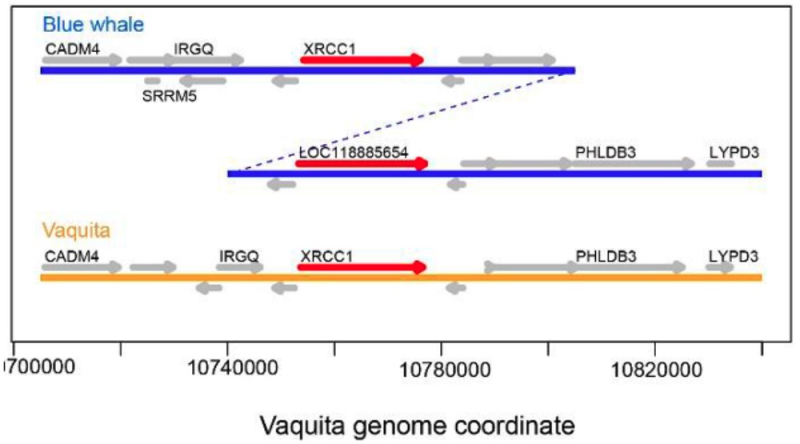
    The assembly showed both a high level of completeness and revealed gene duplications and expansions in the blue whale genome.  This research revealed an evolutionarily recent burst in segmented duplications (SDs) that were correlated with body size in cetaceans.  SDs detected in the blue whale genome are "gene rich, amounting to a roughly 7.1-fold burst in gene duplications relative to vaquita and dolphin, and 3.0-fold relative to cattle."  These researchers detected 234 duplicated genes in the blue whale, 167 in the vaquita, 211 in dolphin, and 205 in cattle.  The distribution of amplified genes showed that "the ten most highly amplified genes account[ed] for 331 gene copies out of 700 (47%) total duplicated genes."  The blue whale sample showed 46 genes having more than 4 copies, compared with 9 in dolphin, 8 in cattle, and 6 in vaquita.  It had been shown in previous studies that in cattle there are 163 loci associated with body size, and these researchers found 52 corresponding loci in blue whales and 53 such loci vaquita. In particular comparisons between blue whale and vaquita were identified 133 duplicated genes of potential interest that included KCNMB1, which contained ancient (>20 Mya) duplication events.  Other genes detected as duplications in the whale genome include ones related to longevity (MT1X), body size (CHRNB1, DPEP2), development (FZD5, CDK20), cancer (C2orf78, FZD5, DDX24, NCAM1, MT1X, XRCC1, CDK20), obesity and diabetes (DPEP2), and the immune system (NCAM1), with certain of them having been greatly amplified (such as XRCC1, CDK20, and CHRNB1x).  A comparison between the genomic regions encoding XRCC1 in blue whale was shown in this figure, illustrating genomic rearrangement in whale not found in vaquita:

    Image 1
    A specific gene found to be amplified in blue whale was Insulin-like growth actor 1 (IGF-1), which has been associated with large body size in dogs (see "From Toy Poodle to Rottweiler: Why Is Fido So Small (or Large)?").  Single nucleotide polymorphism (SNP) analysis was performed on a specific SNP associated with size variation and showed a lack of the variant responsible for large (CA) and small (CG) size, sharing with humans, artiodactyls and other mammals the same sequence (AG) in this SNP.  Accordingly, multiple alignment of IGF-1 sequences were performed on 11 cetacean and 18 land artiodactyl species, wherein the 11 cetaceans fell into three phylogenetic clades illustrated by this phylogenetic tree:

    Image 2
    wherein the first clade comprises large baleen whales, blue (Balaenoptera musculus) and minke (B. acutorostrata); second, a giant toothed whale, the sperm whale Physeter catodon; and third, smaller toothed whales, including orca (Orcinus orca), dolphins, and porpoises.  These studies revealed that three large whales (blue, minke, and sperm), have a different allele from all other artiodactyls found at two sites in the intergenic region upstream of the IGF-1 gene, four in the second intron, and one in the third or fourth intron, depending on the IGF1 isoform.  The orca was found to have the same allele as its smaller relatives at these sites.  Also found where sites where the four largest whales (blue, minke, sperm) and orca, have a different nucleotide compared to all smaller cetaceans, with there being four such sites in the second intron and one in the third intron.  The authors suggest that the large whales have the ancestral allele, while the small ones have evolved an alternative and note that the orca, while being more closely related to smaller dolphins, has the allele characteristic of baleen and sperm whales.

    The paper also discusses their "historical demography analysis that suggested a population division between Pacific and Atlantic blue whales."  These population metrics were substantially the same between the Pacific and Atlantic populations of blue whale until the end of the Saalian ice age about 125 million years ago.  The Atlantic population then showed a slight increase over the Pacific population until the last glacial maximum (LGM) about 20,000 years ago, according to the paper, when both populations decreased.  Pacific and Atlantic blue whale populations were found to be highly heterozygous and genetically isolated since the last interglacial period, with blue whales in the North Atlantic and eastern North Pacific beginning to diverge around 100-200,000 years ago.

    "Runs of homozygosity analysis" revealed that since that time there has been a low level of inbreeding in the blue whale population, the paper explaining that "[r]uns of homozygosity (ROH) are indicative for the frequency and relative timing of inbreeding events and were frequently used to assess the impact of inbreeding on different mammalian and cetacean populations."  The data obtained showed 108 runs that were 500 kb or longer in both Pacific and Atlantic populations, and that over 70% of these ROH were shorter than 1 Mb, which indicated that "most ROH were probably fragmented over time by frequent outcrossing."  According to the paper, the "high heterozygosity and short runs of homozygosity in the blue whale genome suggest a large and outbred population in the Northern Pacific."

    The paper concludes by asserting that "[a] major finding of this work is the presence of large copy number expansions of a number of genes in the blue whale, while relatively few such expansions are observed in vaquita, bottlenose dolphin, and cattle [which] expansions [in whales] are recent in evolutionary time" and "the assembly will serve as a valuable resource to the scientific community, enabling future comparative genomics studies to further our understanding of large animal longevity and associated resistance to cancer, and helping conserve this magnificent species."

    For those interested in methodology used by these researchers the paper discloses the following:

    * Our assembly has been annotated by NCBI.  Additionally, we annotated both primary and alternate pseudohaplotype by projecting human and mouse genes using TOGA (Tool to infer Orthologs from Genome Alignments).  We also predicted GO terms for all protein coding genes identified by the NCBI Eukaryotic Genome Annotation Pipeline using Phylo-PFP.

  • By Andrew Velzen

    On January 19, 2024, Palworld launched into early access on Xbox and Windows.  To say it was an overnight success is an understatement.  By only a month in, Palworld had been played by over 25 million players.[1]  To put this in perspective, monumental success stories like The Legend of Zelda: Tears of the Kingdom and Hogwarts Legacy (both released in 2023) have sold in the ballpark of 20-25 million copies.[2]  It is not surprising that Palworld's meteoric rise has generated a lot of buzz in the industry.

    What is Palworld

    Palworld is a survival game developed and published by Pocket Pair that is "set in an open world populated with animal-like creatures called 'Pals,' which players can battle and capture to use for base building, traversal, and combat.  Players may also assign the 'Pals' to bases where they will automatically complete tasks for the player.  Palworld can be played either solo or online with up to 32 players on one server."[3]  Most saliently for this discussion, though, is the fact that the "Pals" bear a not-so-subtle resemblance to Pokémon (e.g., in name and/or likeness).[4]  As just one of countless examples, compare the following image of the Pal Grizzbolt (left) with the Pokémon Electabuzz (right):[5]

    Image 1
    In fact, given the visual overlap, gamers have started colloquially referring to Palworld as "Pokémon with Guns."

    Accusations of Infringement

    Given the striking resemblance, it isn't surprising that many in the industry have wondered whether any of Game Freak Inc. / The Pokémon Company / Nintendo Co., Ltd. (collectively referred to herein as the "Pokémon Owners") would initiate action for copyright infringement against Pocket Pair, especially given Nintendo's notoriously litigious reputation.[6],[7]  Interestingly, Pocket Pair has a history of making games that appear, at least facially, to be clones of other games.[8]  As far as I'm aware, none of the Pokémon Owners have yet to take any legal action against Palworld.  That isn't to say that the Pokémon Owners aren't seriously considering such action, though.  In fact, regarding Palworld, The Pokémon Company issued the following statement:[9]

    We have received many inquiries regarding another company's game released in January 2024.  We have not granted any permission for the use of Pokémon intellectual property or assets in that game.  We intend to investigate and take appropriate measures to address any acts that infringe on intellectual property rights related to the Pokémon.  We will continue to cherish and nurture each and every Pokémon and its world, and work to bring the world together through Pokémon in the future.

    I have heard 3 main allegations levied regarding the creation of the Pals vis-a-vis Pokémon.  Namely, that Pocket Pair: (a) generally copied many concepts of Pokémon in a creatively bankrupt fashion, (b) obtained three-dimensional (3D) models of Pokémon and only made slight modifications to those models before pushing them out the door, and/or (c) trained a generative artificial intelligence (AI) using 3D models of Pokémon and then had that AI produce 3D models for Pals.[10]  To my knowledge, there has been no publicly accessible discovery thus far, so we can't, with absolute confidence, ascertain which of these three allegations (if any) are true.  Still, I plan to discuss the potential merits of a copyright infringement suit in the United States against Pocket Pair under each of these hypothetical copying regimes.[11]

    What Would the Complaint Allege?

    A successful copyright infringement suit requires that plaintiff has a registered copyright on an underlying copyrightable work (or an exclusive license thereto), that defendant infringed on an exclusive right conferred by the copyright (without a license), and that no defenses apply (e.g., there is no fair use defense).  The primary questions in a hypothetical Pokémon Owners v. Pocket Pair case are: (i) which aspects of Pokémon are covered by the Pokémon Owners' copyrights (i.e., which aspects are copyrightable) and (ii) would Pocket Pair have a reasonable fair use defense.  I will analyze both of these questions for each of the three sets of potential facts.

    First – What if Pocket Pair simply copied some or most of the general concepts that make Pokémon successful?

    As a first consideration, does the fact that Palworld is a game that involves catching monsters and using them in combat mean that Pocket Pair has infringed a copyright?  I think most people would inherently understand that this fact, taken alone, would be insufficient to constitute copyright infringement, but let's briefly discuss why.

    As a general rule, "ideas" aren't copyrightable (rather, only expressions are).  This is, unsurprisingly, typically referred to as the "idea-expression dichotomy," and is codified in 17 U.S.C. § 102(b).[12]  One tenant of the idea-expression dichotomy is that certain concepts are so common / ubiquitous to a given medium or genre that such concepts are not copyrightable (these concepts are sometimes referred to as scènes-à-faire).  In the video game world, this could include things like user interface menus or combat or character creation, but can extend even further to the entire underlying genre of a game (e.g., the general concept of a "fighting game" is not protectable by copyright).  I won't get into it here, but for a good illustration of where the line is between what is a scène-à-faire and what is protectable by copyright, contrasting Atari v. Amusement World with Tetris v. Xio is instructive.[13]

    Here, the idea of monsters fighting with one another or against a player is probably not something that could be covered by a copyright.  For example, the concept of monsters that take forms that are subtly or directly inspired by various animals, people, or forces of nature (as many Pokémon are), is something that has been present in the culture of Japan for thousands of years in the form of the Yōkai.[14]  As a specific example in the context of Pokémon / Palworld, the general concept of a fox (kitsune) with some magical powers is well-known, so it cannot be the subject of a copyright.  In fact, both games include multiple fox creatures (one of the Pals even being named "kitsun"):[15]

    Image 2
    Given all this, it is unsurprising that, historically, the Pokémon Owners have not pursued litigation against games that are far more similar to Pokémon (at least in terms of gameplay) than Palworld is (e.g., Digimon World, Temtem, etc.).[16]

    Second – What if Pocket Pair copied underlying Pokémon models?

    So, while the general concepts employed in Pokémon aren't likely protectable by copyrights, what about the 3D character models, themselves?  While it is only conjecture at this point whether actual Pokémon models were copied in the production of Palworld, there are some in the industry that have promulgated what they believe to be strong evidence of such copying.[17]  This narrative has unsurprisingly been opposed by Pocket Pair.[18]  Regardless, for the sake of argument, let's assume that Pocket Pair did in fact have access to the underlying 3D Pokémon models and only made minor tweaks (e.g., slight modifications to limb-shape, face-shape, hair-shape, or hair color; remeshing; reskinning; modifying relative proportions; etc.) to arrive at the Palworld models.  Would this be copyright infringement?

    3D models are protectable by copyright, so long as the 3D model isn't merely an exact one-to-one digital rendering of something that exists in the physical world (i.e., so long as some originality / creativity was present in the development of the model).[19]  Further, to my knowledge, no Pokémon are exact replicas of any naturally occurring creature (i.e., while there may be cow Pokémon, a 3D scan of an actual bovine was not merely replicated to generate Miltank).[20]  Given this, the 3D models of Pokémon could be subject to copyright protection.  Thus, if the 3D models of Pokémon were directly imported into Palworld, the Pokémon Owners would have a strong case for infringement.  In fact, this isn't so far off from something that almost happened (not as a result of the actions of Pocket Pair, but as a result of the actions of a Palworld modder).  The modder uploaded a YouTube video and a tweet that previewed a mod that imported Pokémon directly into Palworld.[21]  Nintendo, unsurprisingly, swiftly issued a Digital Millennium Copyright Act (DMCA) strike against both the video and the tweet.  Even further, in an abundance of caution, the popular modding site Nexus Mods preemptively banned the uploading of any Palworld mods related to Pokémon.[22]

    So, we know that it would not be okay for Pocket Pair to directly import / use Pokémon models in Palworld, but, assuming Pocket Pair had lawful access to the Pokémon models (e.g., could reverse engineer them in a lawful way), would it be okay if Pocket Pair modified the models and put them into Palworld.  This is where the typical lawyer answer of "it depends" comes into play.

    One of the rights that a copyright holder has (e.g., that the Pokémon Owners have here in relation to the 3D Pokémon models) is the right to prepare derivative works.[23]  The U.S. Copyright Office lists the right to prepare derivative works as including "[a] revision of a website" and "[a] new version of an existing computer program."[24]  As such, the Pokémon Owners own the right to prepare a "new version" of the original 3D Pokémon models.

    This right only protects the Pokémon Owners to the extent that a resulting 3D model is derivative of the original work, though.  In some cases, the resulting work is so transformative that the producer of the resulting work has a fair use defense.  Hence, the question here becomes whether the modifications to the underlying Pokémon models is sufficiently transformative (and, therefore, subject to the fair use defense).

    In order to determine what is and is not transformative, we can look to the 4 fair use factors: (i) the purpose and character of the use, including whether such use is of a commercial nature or is for nonprofit educational purposes; (ii) the nature of the copyrighted work; (iii) the amount and substantiality of the portion used in relation to the copyright work as a whole; and (iv) the effect of the use upon the potential market for or value of the copyrighted work.

    The above factors are obviously debatable and fact-specific.  However, if the Palworld models are, in fact, only minor modifications to the Pokémon models, I believe at least 3 of the 4 factors would weigh against a finding of fair use.  Under these assumed facts, the following considerations are likely relevant to the factors recited above:

    i.  The Palworld models are being used commercially, in bad faith (e.g., without permission from the Pokémon Owners and without public admission), and for essentially the same purpose as the Pokémon models (weighing against a finding of fair use);

    ii.  The creation of the original Pokémon models was a highly creative endeavor (weighing against a finding of fair use);

    iii.  Only a few dozen or so of the plethora of Pokémon models have been replicated in Palworld (weighing in favor of a finding of fair use); and

    iv.  Palworld and Pokémon are both video games competing in the same market for gamers to purchase their games and, even if they have yet to do so, the Pokémon Owners could make a similar game to Palworld (hence, it was a market that the Pokémon Owners would've been able to exploit) (weighing against a finding of fair use).

    One final note regarding fair use.  One of the stronger ways to demonstrate fair use is to show that a work is a parody.  One could clearly argue that "Pokémon with Guns" is a parody of Pokémon.  Palworld includes many aspects that are not only opposite of Pokémon, but clearly meant to poke fun at Pokémon.  For example, rather than petting a Pokémon, you can butcher a Pal or rather than an animal/trainer relationship between players and Pokémon, there can be a master/slave relationship between players and Pals.[25]  Thus, there is at least a colorable argument that Palworld exists to ridicule some of the underlying tenants of Pokémon.[26]

    Still, in my view, the primary purpose of Palworld is not to make fun of Pokémon, but to be a commercial success in its own right by exploiting the exact same market that the Pokémon Owners could, themselves, exploit.  Hence, in my view, it would be difficult for Pocket Pair to argue that Palworld is a parody (especially in light of all the fair use factors considered above).

    Third – What if they used the models to train an AI, though?

    Under the third set of potential facts, Pocket Pair is assumed to have taken the Pokémon models, trained a generative AI (genAI) using the Pokémon models, and then used the genAI to produce the Pal models (e.g., by employing a generative adversarial network (GAN)).  This third set of circumstances is perhaps the most interesting (as the first set of circumstances likely does not constitute copyright infringement and the second set of circumstances likely does constitute copyright infringement).

    The foundational question here is clearly "is it copyright infringement to use copyrighted material to train a generative AI?" Fortunately, to answer this question, we can look to a growing number of cases concerning this exact issue.  For instance, many developers of large language models (LLMs) are being sued for using copyrighted material to train their LLMs.[27]  Unfortunately, though, none of these cases have yet been decided, so we aren't sure how U.S. courts feel about this (which is exacerbated by the fact that none of the cases have percolated above the district court level either, and this issue will likely be an issue that appeals courts, or even the U.S. Supreme Court, will need to weigh-in on).

    Still, we can compare / contrast the Palworld saga with one of the AI cases; let's use the one with perhaps the highest notoriety — New York Times v. Microsoft and OpenAI.  In that case, the New York Times has alleged that OpenAI / Microsoft's genAIs "rely on large-language models that were built by copying and using millions of The Times's copyrighted news articles, in-depth investigations, opinion pieces, reviews, how-to guides, and more" and that "the outputs of the defendants' GenAI models compete with and closely mimic the inputs used to train them, copying Times works for that purpose is not fair use."[28]  Whether such use does, in fact, constitute fair use (contrary to the New York Times's assertion) is a judgment call.  From one point of view, the LLM is ingesting a bunch of data (with the Times's articles being just a portion of it) and then generating something wholly new based on a future prompt.  This is arguably not unlike the way in which a musician, after having listened to copious amounts of other songs from other artists, then takes inspiration from those songs and writes their own new song. Almost always, this new song is validly copyright-eligible.

    The odd case where the new song is not copyright-eligible (and may, in fact, constitute copyright infringement) is when the new song is too similar to an older song.  For example, Pharrell Williams, Robin Thicke, and Clifford Joseph Harris (T.I.) lost a case against Bridgeport Music regarding the song "Blurred Lines" in view of the previous Marvin Gaye song "Got to Give It Up" since, in the eyes (ears?) of the jury, there was sufficient overlap between the i) signature phrase ii) hooks iii) bass lines iv) harmonic structures, and v) keyboard chords of the two songs to constitute copyright infringement.[29]

    If I'm prognosticating by analogizing to the case of LLMs trained on copyrighted material, I'm inclined to guess that courts will think that it's more of a question of the output, rather than the inputs (i.e., more a result of what the models spit out, rather than how they're trained).  Said another way, you as an individual have a right to read an article you paid for.  You can also save a PDF copy of the article onto your computer for your own future reading.  Even further, you could perform processing (e.g., optical character recognition (OCR)) on that article if you like.  However, you cannot forward that article on to 10 other people.  Likewise, it stands to reason that you can use an article you purchased to train your own LLM, so long as the LLM doesn't output copyrighted material directly to third parties.  Hence, if an LLM trained on a number of New York Times's articles responds to a query with an answer based on information it has gathered from those articles, that's probably fine.  For example, if an LLM is prompted with "provide me with a brief summary of the Red Sox / Yankees game from October 20, 2004," and, based on information ingested from the New York Times's articles, the LLM spits out "the Red Sox hit 4 home runs to beat the Yankees 10-3 in game 7, capping off a monumental comeback after being down 3 games to 0 entering game 4 of the ALCS," I don't think there would be a problem (as the information from the article would be sufficiently "transformed" so as to constitute fair use).[30]  If, however, when prompted with "provide me with a copy of the first article on the front page of New York Times on October 21, 2004," the LLM spits out a verbatim copy of the article, there is a much more colorable argument that copyright infringement has occurred (especially if the New York Times's articles constituted a large plurality, much less a majority, of the training data).

    Assuming many of these cases turn on what the LLM will and will not output (and that's a big assumption, as judges can be about as predictable as a random number generator), we can return to Palworld.  Assuming the Pal models were generated by an AI trained on Pokémon models, and we were to compare the complete set of Pal models to the complete set of Pokémon models, there isn't altogether that much overlap.  Only some of the Pal models show striking overlap with Pokémon models (and certainly fewer than 50% of them) and most Pokémon models have no clear Palworld analog whatsoever.  Further, even for the models that do overlap, the genAI has clearly at least tweaked some combination of color, meshing, size, shape, etc.  Given this, I would think this situation is more akin to someone listening to all of Taylor Swift's albums and writing a song in Taylor's pop style that has lyrics about the same general topics as Taylor's songs (i.e., likely fair use), rather than someone listening to The Tortured Poet's Department and releasing an album where half the songs are direct copies of those in Taylor's album (i.e., likely not fair use).

    Given the above, I find it unlikely that, if a genAI were trained (at least partially) on the Pokémon models and used to create each of the Palworld models, copyright infringement has occurred.

    Don't forget about trade secrets?

    As just one final thought (and something I haven't seen discussed much in the Palworld discourse), regardless of whether Palworld constitutes copyright infringement, if the Palworld 3D models were based on actual Pokémon 3D models (e.g., regardless of whether they were subsequently used to train a genAI or tweaked by a human), the Pokémon Owners may have a cause of action based on trade secret protections.  For example, if Pocket Pair illegally accessed a Pokémon Owner's server to obtain the underlying 3D model and/or if a former or current employee of the Pokémon Owners improperly provided the 3D model to Pocket Pair, such actions could constitute a misappropriation of trade secrets.  Hence, Pocket Pair profiting from them would be improper (and Pocket Pair could be liable for damages).[31]  That is, of course, assuming there was no reasonable way to reverse engineer the Pokémon 3D models without improper means (e.g., without violating Pokémon terms of service).  Given the above, in addition to or instead of a copyright infringement action, the Pokémon Owners could succeed in a trade secrets suit against Palworld if Pocket Pair stole or otherwise improperly obtained the Pokémon models.

    Conclusion

    It's obviously debatable whether the Pokemon Owners would succeed in a suit against Pocket Pair over Palworld.  It would come down to the facts regarding whether and how the models for the Pals were generated (and, if a lack of direct evidence were present, what a jury might think of circumstantial evidence of copying).  It becomes even more convoluted if each of the three factual situations posited above occurred in conjunction with one another (rather than only one of the three occurring alone). Further, given the success of Palworld, I doubt that Pocket Pair would have the stomach for full on litigation against the Pokémon Owners (i.e., would settle before anything progressed very far).

    This is 100% conjecture, but if I were a psychic Pokémon casting Future Sight, my guess would be that the Pokémon Owners will let sleeping dogs lie and decline to pursue this in any way.  The only exception, in my view, would be if the Pokémon Owners have some smoking gun regarding illicit access to their 3D models.  In such a case, I would assume the Pokémon Owners would send a cease and desist to Pocket Pair threatening litigation and that Pocket Pair would respond by removing (or heavily modifying the character models of) the Pals that were created as a direct result of the improperly obtained Pokémon models.

    As Professor Oak says, this "tale of grand adventure is about to unfold."[32]

    [1] https://twitter.com/Palworld_EN/status/1760682105171062876

    [2] https://www.forbes.com/sites/paultassi/2024/02/06/hogwarts-legacy-barely-holds-off-tears-of-the-kingdom-for-most-sales-of-2023/?sh=46beea2f128a

    [3] https://en.wikipedia.org/wiki/Palworld

    [4] On that note, if you're looking for some late '90s nostalgia and some music to read by, might I recommend – https://www.youtube.com/watch?v=rg6CiPI6h2g

    [5] https://gamerant.com/palworld-electric-element-pals-pokemon-counterparts-similarity-explained-grizzbolt-electabuzz/. Plenty of other articles have been written enumerating the Pals that resemble Pokémon counterparts, as well. See also, https://www.ign.com/articles/palworld-vs-pokmon-comparison-just-how-similar-are-the-designs, https://clutchpoints.com/all-the-pokemon-look-alikes-in-palworld, https://www.sportskeeda.com/mmo/5-palworld-pal-designs-similar-popular-pokemon, https://gamerant.com/palworld-pokemon-controversy-stolen-designs-every-pal-similarity-explained/.

    [6] https://www.ign.com/articles/as-palworld-blows-up-could-nintendo-successfully-sue-the-controversial-pokemon-with-guns-game 

    [7] https://www.thegamer.com/a-snapshot-of-nintendos-convoluted-legal-history/  

    [8] In 2020, Pocket Pair released a survival game called Craftopia that had a very similar aesthetic to Nintendo's The Legend of Zelda: The Breath of the Wild (https://www.gameinformer.com/2024/02/22/what-is-palworld-the-new-pokemon-with-guns-survival-game-everyones-playing). Interestingly, Pocket Pair's own webpage for Craftopia includes the Pokemon trademarked slogan of "Gotta Catch 'Em All!" – https://www.pocketpair.jp/craftopia.

    [9] https://www.ign.com/articles/the-pokemon-company-makes-an-official-statement-on-palworld-we-intend-to-investigate  

    [10] https://youtu.be/b5W1OFnnj4w?si=DwxJRNFo_N8l7Q4h&t=237  

    [11] If you would like to see an EU / UK lawyer's brief thoughts on the matter, see https://www.rockpapershotgun.com/does-palworld-break-pokemons-copyright-we-asked-a-lawyer   

    [12] https://www.law.cornell.edu/uscode/text/17/102

    [13] Atari, Inc. v. Amusement World, Inc., 547 F. Supp. 222 (D. Md. 1981); Tetris Holding, LLC v. Xio Interactive, Inc., 863 F. Supp. 2d 394 (D.N.J. 2012); see also Applying Copyright Law to Videogames: Litigation Strategies for Lawyers, John Quagliariello, Harvard Journal of Sports & Entertainment Law, Vol. 10

    [14] https://mluce.ro/articles/the-yokai-roots-of-pokemon/

    [15] https://bulbapedia.bulbagarden.net/wiki/Vulpix_(Pok%C3%A9mon); https://bulbapedia.bulbagarden.net/wiki/Ninetales_(Pok%C3%A9mon); https://palworld.fandom.com/wiki/Foxparks; https://palworld.fandom.com/wiki/Foxcicle; https://palworld.fandom.com/wiki/Kitsun

    [16] https://en.wikipedia.org/wiki/Digimon_World; https://en.wikipedia.org/wiki/Temtem        

    [17] https://www.videogameschronicle.com/news/palworld-pokemon-plagiarism-accusations-pile-up-as-ceo-responds/   

    [18] https://www.pcgamer.com/palworld-accused-of-copying-pokemon-models-developer-pushes-back-says-artists-are-being-slandered/    

    [19] See, e.g., Meshwerks v. Toyota Motor Sales U.S.A., Inc., 528 F.3d 1258 (10th Circuit, 2008)   

    [20] https://bulbapedia.bulbagarden.net/wiki/Miltank_(Pok%C3%A9mon)      

    [21] https://www.polygon.com/24047136/palworld-pokemon-mod-release-toastedshoes   

    [22] https://www.destructoid.com/nexus-mods-bans-pokemon-based-content-for-palworld/     

    [23] 17 U.S.C. § 106(2)      

    [24] https://www.copyright.gov/circs/circ14.pdf      

    [25] https://www.rockpapershotgun.com/palworlds-skin-deep-pokemon-parody-is-part-of-a-bigger-horror-story       

    [26] For an interesting rebuttal to the rockpapershotgun parody article reference above, see https://www.themarysue.com/palworld-why-a-pokemon-parody-may-be-considered-fair-use-but-satire-isnt/

    [27] See, e.g., Leovy v. Google (N.D. Cal.); Nazemian v. NVIDIA Corporation (N.D. Cal.); Tremblay v. OpenAI (N.D. Cal.); Silverman v. OpenAI (N.D. Cal.); Chabon v. OpenAI (N.D. Cal.); New York Times v. Microsoft and OpenAI (S.D.N.Y.)

    [28] https://www.thefashionlaw.com/from-chatgpt-to-deepfake-creating-apps-a-running-list-of-key-ai-lawsuits/

    [29] Williams v. Gaye, 895 F.3d 1106 (9th Cir. 2018)

    [30] This situation can be analogized to Authors Guild, Inc. v. Google, Inc. (2nd Cir. 2015), in which Google digitized copyrighted works and displayed snippets of them in response to a search, and the court found that such a use was transformative enough to constitute a fair use.

    [31] 18 U.S.C. § 1836; 18 U.S.C. § 1839(5)

    [32] https://gamerant.com/pokemon-professor-oak-quotes-ranked/

  • By Kevin E. Noonan –

    Judge Newman_1Over the past year suspended Federal CIrcuit Judge Pauline Newman's lawsuit (see "Judge Newman and the On-Going Attempts to Remove Her from the Federal Circuit") against Chief Judge Kimberly Moore, and Circuit Judges Sharon Prost and Richard Taranto (in their roles as members of the Special Committee of the Judicial Council of the Federal Circuit responsible for the Order suspending Judge Newman) has continued without much fanfare.  However, in the face of Defendant's Motion for Judgment on the pleadings the status quo is likely to change no matter now the District Court rules.

    The opening paragraph of Judge Newman's brief opposing Defendant's motion demonstrates her intention not to go quietly.  The brief avers that Chief Judge Moore "unilaterally" removed Judge Newman from the bench, the suspension being "extended by an unprecedented, unrecorded and unpublished vote of the Defendant Judicial Council" in a meeting that was "neither noticed nor memorialized."  Only after this suspension, the brief asserts, did the Chief Judge "instigate[]" an investigation over alleged physical infirmities (a heart attack and a fainting episode) that "Defendants themselves now acknowledge were false."  These actions constitute a "pattern of harassment" that "continues unabated to the present day" according to the brief, an allegation illustrated by refusing to permit Judge Newman to hire a judicial assistant (to which in her status as a Circuit Court judge she was entitled to do), removing the Judge from an internal e-mail distribution list, which deprived Judge Newman of information about the Court's business, and refusing her request to extend the term of one of her clerks.  The Chief Judge and the Judicial Council were able to take these steps, according to the brief, because the legal authority they are based upon, the Judicial Conduct and Disability Act ("Disability Act"), 28 U.S.C. §§ 351–364, "unconstitutionally vest unfettered discretion in Defendants, which permits them, without impeachment, for all intents and purposes, to divest an Article III judge of her office."

    To recap, the legal grounds for Judge Newman's complaint were the following:

    Claim I asserts "improper removal [and] violation of separation of powers" based on Article III (life tenure of federal judges) and Article I (giving the House of Representatives the sole authority to remove a judge through impeachment after trial by the Senate). 

    Claim II asserts that the Judicial Complaint is ultra vires for "improper removal [and] violation of separation of powers."  This allegation is based on Judge Newman being removed from her duties before the special committee's investigation was concluded (which removal the Judicial Disability Act of 1980 codified at 28 U.S.C. § 354(a)(2)(A)(i) requires to be after the investigation according to the complaint).

    Claim III alleges Fifth Amendment violations of due process because the members of the Special Committee are also purported witnesses to the alleged judicial misconduct (the complaint stating that "[i]t has been established for centuries that one cannot serve as a 'judge in his own cause'").

    Claim IV asserts a First Amendment violation for unlawful prior restraint for the gag order, contrary to several Supreme Court cases prohibiting prior restraint on speech (Houston Cmty. Coll. Sys. v. Wilson, 142 S. Ct. 1253, 1259 (2022) (the First Amendment prohibits prior restraint on speech) and Alexander v. United States, 509 U.S. 544, 550 (1993)).

    Claim V asserts that the gag order is also ultra vires as being an unlawful prior restraint on speech.

    Claim VI asserts a Fifth Amendment violation for unconstitutional vagueness of the provisions of the Disability Act.

    Claim VII asserts that the activities are ultra vires for unconstitutional examination because "[n]either the Act nor the U.S. Constitution authorizes compelling an Article III judge to undergo a medical or psychiatric examination or to surrender to any investigative authority her private medical records in furtherance of an investigation into whether the judge suffers from a mental or physical disability that renders her unable to discharge all the duties of office."

    Claim VIII asserts a Fifth Amendment violation for unconstitutional vagueness regarding the Act's investigative authority, with regard to "authoriz[ing] compelled medical or psychiatric examinations of Article III judges or demands from special committees for Article III judges to surrender their private medical records."  In particular, this allegation is directed to Section 353(c) of the Act.

    Claim IX alleges a Fourth Amendment violation for an unconstitutional search regarding the "compelled medical or psychiatric examination of an Article III judge without a warrant based on probable cause and issued by a neutral judicial official or a demonstration of constitutional reasonableness."

    Claim X alleges a Fourth Amendment violation for an unconstitutional search and seizure of a "compelled surrender of private medical records."

    Claim XI alleges a Fourth Amendment violation for "lack[ing] either a warrant issued on probable cause by a neutral judicial official or a constitutionally reasonable basis for requiring Plaintiff to submit to an involuntary medical or psychiatric examination."

    Claim XII alleges a Fourth Amendment violation for "lack[ing] either a warrant issued on probable cause by a neutral judicial official or a constitutionally reasonable basis for requiring Plaintiff to surrender her private medical records none of which bear on her fitness to continue serving as an Article III judge."

    Judge Newman's legal arguments are that, first, as an Article III judge she is "constitutional officer of this Republic, and not merely a federal employee" who "does not have a supervisor and does not need to meet any performance metrics to keep her job."  "Congress alone has the power to remove her," the brief asserts.

    Second, the operative statute, the Disability Act, lacks a definition of what constitutes a disability nor what factors are to be considered.  Rather than relying on medical professionals, the brief asserts, the determination is left "in the hands of lay people like Chief Judge Moore and her colleagues, all without providing them with any tools to determine when a disability exists."

    Third, there is no provision in the statute for judicial review of any Orders or actions taken pursuant to the statute, permitting violations of the Fourth Amendment including "invasive searches of private medical information" and allowing "self-executing" administrative orders to be promulgated by the Judicial Council, "a wholly administrative body."  The result is a regime where the Council can "employ and manipulate entirely standardless criteria in order to start and to continue investigations into and to impose unconstitutional sanctions on Article III judges."  In this regard, the brief reminds the District Court that the putative grounds and factual justifications for the Council's Orders have "evolved" in the year since the proceedings began.

    The District Court previously dismissed Counts II, III, IV, VI, X and XI for lack of subject matter jurisdiction and Count I and parts of Count VII under Fed. R. Civ. P. 12(b)(6).  Thus, only Courts V, VII, VIII, and IX remain and are the subject of the Defendant's Motion for Judgment on the Pleadings and Judge Newman's motion in opposition thereto.  The arguments Judge Newman through counsel asserts for these remaining Counts are that the Disability Act is unconstitutionally vague in defining what is a disability under the Act (Count V) and "its grant of investigative authority to the Special Committee (Count VII)" and that the Act authorizing the Council to "demand medical examinations and private medical records as a condition for maintaining one's Article III judicial office[] violates the Fourth Amendment's prohibition on unreasonable searches."

    The brief sets forth the standard of review for a facial challenge to a statute authorizing warrantless searches to be a showing that the searches authorized by the statute are "unreasonable," citing City of Los Angeles, Cal. v. Patel, 576 U.S. 409, 419-20 (2015).  Such a challenge can be brought when a law threatens to inhibit the exercise of constitutionally protected rights or allows for arbitrary and discriminatory enforcement the brief argues, citing Vill. of Hoffman Ests. v. Flipside, Hoffman Ests., Inc., 455 U.S. 489, 499 (1982).  Importantly, the brief further argues that Judge Newman does not need to show that the Disability Act is unconstitutional in all of its applications, but rather that it creates "a danger of arbitrary and discriminatory enforcement" or "threatens to inhibit the exercise of constitutionally protected rights," citing Hoffman Ests, 455 U.S. at 494, 498.

    Regarding Counts VIII and IX, Judge Newman's argument relates to the constitutionality (or lack of it) of the scope and type of searches the Disabilities Act permits (at least as demanded by this Judicial Council), specifically the "investigation" provision, 28 U.S.C. § 353(c).  The brief argues that this scope in practice violates Fourth Amendment prohibitions against unlawful searches and seizures, specifically "by authorizing special committees to compel medical examinations and the production of medical records without a warrant or a demonstration of constitutional reasonableness."  The challenges are "facial, not as applied," citing City of Los Angeles v. Patel for the standard that a facial challenge is not required to show that a law is unconstitutional in all of its applications, countering the Defendant's position that the existence of some legitimate searches rebuts Judge Newman's facial challenge.  The brief cites additional language from the Supreme Court that "when assessing whether a statute meets this standard, the Court has considered only applications of the statute in which it actually authorizes . . . conduct" (emphasis in brief); 576 U.S. at 418.  Accordingly, instances where a search under the Disabilities Act is performed with acquiescence or consent are irrelevant to the legal inquiry under Patel.  Indeed, according to the brief a requirement in a facial challenge of a showing of unconstitutionality in all of a statute's applications "would preclude facial relief in every Fourth Amendment challenge to a statute authorizing warrantless searches" under Patel.

    The brief also argues that the Disability Act violates the Fourth Amendment because while the Judicial Committee's orders may be based on "reasonable suspicion" of the subject judge's disability, under the Fourth Amendment searches conducted outside the judicial process without a warrant must have a showing of constitutional reasonableness that is absent here.  Moreover, the brief asserts that the "special needs" exception, which applies to certain administrative searches, does not apply to the Disability Act because obtaining a warrant is not impracticable in this case and the burden of obtaining a warrant would not frustrate the government's purpose behind the search.  ​The "special needs" exception applies, according to the brief, when "special [government] needs, beyond the normal need for law enforcement, make the warrant and probable-cause requirement impracticable," citing Vernonia Sch. Dist. 47J v. Acton, 515 U.S. 646, 653 (1995) (quoting Griffin v. Wisconsin, 483 U.S. 868, 873 (1987)) (emphasis in brief).  That is not the case here, where the acceptable standard for impracticability is not satisfied (being that obtaining a warrant must "seriously disrupt the routine conduct of business," citing O'Connor v. Ortega, 480 U.S. 709, 722 (1987), or "when 'the burden of obtaining a warrant is likely to frustrate the governmental purpose behind the search,'" citing New Jersey v. T.L.O., 469 U.S. 325, 340 (1985) (quoting Camara v. Municipal Court, 387 U.S. 523, 533 (1967)).  And even should Defendants be able to make such a showing, whether a warrant is required is subject to a "balancing test" between government interests and individual privacy interests, under Skinner v. Railway Lab. Execs.' Ass'n, 489 U.S. 602, 619 (1989)).  Judge Newman argues that the cumulative impact of this case law is that Defendants were required to show both that the special exception applies and that obtaining a warrant would have been impracticable, which they did not do, according to her brief, providing an analysis and assessment of the cases advanced by Defendants in support of their position and the inapplicability thereof ("it should be noted that Judge Newman is not an employee, but an independent constitutional officer and that neither Chief Judge Moore, nor the Special Committee, nor the Judicial Council are her 'supervisors'" as was the case in many of the decisions cited by Defendants in their Motion).

    The brief takes particular apparent umbrage at assertions in Defendant's Motion to Dismiss that "special committees can require medical examinations without a warrant because 'psychological testing and psychiatric interviews are a routine feature of occupations which involve stress and sensitive interpersonal contact,'" and that in this respect, "[t]here is no reason to distinguish between [government] employees and judicial officers."  First, the brief asserts that "there is an obvious need to distinguish mere employees who constitutionally speaking are not meant to be independent or to enjoy any tenure protections and Article III judges who enjoy such protections precisely because they are meant to be independent."  Second, the brief challenges the assertion that subjecting Article III judges to such medical examinations is routine, stating that "an Article III judge has never before undergone compelled medical testing of any kind . . . [i]n the 44 years the Disability Act has been in effect (and the 235-year history of the federal judiciary), medical testing has been ordered once and has never taken place" (and in that case the Judicial Council discontinued their efforts when the judge contested the Order).  Unlike the governmental employees in the cases Defendants asserted in support of their Motion to Dismiss, Judge Newman asserts that "Article III judges are officers of the United States, appointed by the President with the advice and consent of the Senate, [that] "hold their positions for life" and "the Constitution and the Supreme Court guard these judges' independence," citing Mistretta v. United States, 488 U.S. 361, 410 (1989), for the latter proposition and for the proposition that "no Act can authorize the President (or by extension anyone else) "to remove, or in any way diminish the status of Article III judges, as judges" (emphasis in brief).  Article III judges "are removable only by the Senate, not by a supervisor who might search their offices or subject them to medical testing, and not by their circuit's judicial council" under Mistrella the brief argues.  Finally, adopting Defendants' position would deny Article III judges from judicial review "both ex ante and ex post" putting the judge in a less favorable position ("have less constitutional protection") than other governmental employees (emphasis in brief).  And being thus denied judicial review is exacerbated by Judicial Councils, as Defendants would have it, being "investigator, judge, and jury—and even, if necessary, witnesses."

    Even if the special needs exception could apply, according to Judge Newman, the District Court cannot determine at the pleadings stage whether a warrantless search is reasonable.  The requirement for a balancing test under the Fourth Amendment between governmental rights and individual privacy rights is inconsistent with dismissing Judge Newman's challenge to the Judicial Council's actions without the District Court having the opportunity to consider the evidence (and Judge Newman ​the opportunity to present such evidence) (and even if the Court were to do so on the current record Judge Newman argues Defendants' motion should be denied) according to the brief.

    Judge Newman further argues that the Disability Act fails to articulate any standard for "judicial disability," contrary to other Acts of Congress related to disabilities in other contexts.  The history of the Act is evidence of this standardlessnes, "[b]egin[ning] with this case," Judge Newman asserts:

    Throughout both this litigation and the administrative process within the Judicial Council, Defendants have not even been able to articulate what judicial duties Judge Newman is unable to perform.  At most, they have alleged that Judge Newman is able to perform those duties slowly.  Defendants have not been able to point to a single opinion (whether majority, concurring, or dissenting) that was not well-written or otherwise fell below any conceivable standard of judicial craftsmanship.  Nor have they pointed to any behavior that Judge Newman may have exhibited on the bench or in conference that indicates (or would even cause one to suspect) an inability to perform the functions of judicial office.

    Indeed, the "disability" allegations against Judge Newman throughout these proceedings read like a Chinese menu with Defendants making and withdrawing seemingly haphazard allegations.  For example, in the initial order launching administrative proceedings against Judge Newman, Chief Judge Moore alleged (based apparently on a thirdhand remark from Judge Newman's former judicial assistant) that she suffered a heart attack.  But no explanation was given as to why a heart attack—a not uncommon malady—would make one unable to perform duties of an appellate judge.  The same goes to the allegations (also erroneous and apparently since abandoned) that Judge Newman had a fainting spell and had difficulty walking significant distances.  Surely, an ability to walk without resting is not even remotely indicative of one's ability to reason through and write about legal issues.  Yet, it was these allegations that allowed Chief Judge Moore to kick-start the administrative process against Judge Newman.

    (The brief includes several other statements by other members of the Judicial Council supporting Judge Newman's argument of the standardlessness of the term "judicial disability," as well as examples of other conditions having more significant impacts on a judge's ability to perform her duties, that have not provided a basis for suspending her from the bench.)  The situation is worsened, as the brief sets out, because "[a]t no point have the Defendants ever suggested that were Judge Newman to receive medical clearance the administrative proceedings against her would be terminated and she would be restored to the calendar," which "further confirms the latent subjectivity at play."

    Finally, Judge Newman asserts that the Act's grant of unfettered investigatory authority fails to articulate any standards for launching or continuing an investigation or for demanding cooperation, and is therefore void for vagueness.  (Such investigations "have no boundaries," which circumstances permit "arbitrary and discriminatory enforcement.")  The role of gatekeeper imposed on the Chief Judge under the Act in determining whether a complaint is sufficient to commence proceedings such as this one is "simply ouroboric" insofar as the statute provides no definition for the Chief Judge to apply in making her determination.  The brief further asserts that Judge Newman does not object to being investigated ("[i]n this country, anyone is free to 'investigate' anyone for any reason and on any topic.  To the extent that Defendants wish to ask questions, write reports, and even urge Congress to remove Judge Newman, they are free to do so").  The issue, and the significance of the statutory vagueness, is "whether Defendants can compel Judge Newman to turn over private documents and then directly sanction her for declining to do so") (emphasis in brief).  As a consequence:

    [A] Chief Judge (and then the Special Committee) can decide, without meeting any standards whatsoever, to launch the investigation, expand it, request whatever records they deem appropriate, and then impose self-executing sanctions (without any outside supervision by an Article III court) all without the benefit of a clearly defined standard of behavior for the judge being investigated to adhere to.  And as this very case shows, because the Act confers such an unlimited power on Defendants, it authorizes them to conduct an interminable investigation and to continue sanctioning a judge in Plaintiff's position whenever the Plaintiff does not completely accede to whatever demands a Special Committee or a Judicial Council might conjure up[.]

    (which is true even should a Chief Judge "make entirely unsubstantiated allegations" and then "empanel a special committee which can then proceed to an investigation entirely untethered from the initial allegations," a position consistent with the Council's own arguments and assertions earlier in the course of this case according to Judge Newman).

    "In short, the Act's combining of the power to investigate without any limits or well-defined causes with the power to sanction a subject judge who declines the outlandish demands that accompany the investigation renders the provision unconstitutionally vague," Judge Newman's brief concludes.

    The District Court is expected to rule on Defendants' Motion to Dismiss the remaining Counts of Judge Newman's complaint in due course after the Judicial Council files its Reply brief.

  • By Kevin E. Noonan –

    Federal Circuit SealThe Federal Circuit handed down an opinion earlier this month that invalidated several asserted claims and found infringement under 35 U.S.C. § 271(e)(2) of the claims, while refusing to modify its judgment on infringement after Defendant Norwich submitted a revised ANDA containing a Section viii "carveout" in Salix Pharmaceuticals, Ltd. v. Norwich Pharmaceuticals Inc.  The majority opinion raises issues in its invalidity analysis regarding the extent to which the prior art should be required to disclose the recited administered dose to satisfy the "reasonable expectation of success" prong for obviousness for pharmaceutical claims (wherein the standard adopted by the majority motivated Judge Cunningham to dissent in part).  The reasoning provided by Judges Lourie and Chen appeared to be rooted in the broader scope of creativity imparted to the skilled artisan under KSR v. Teleflex as discussed below.

    The case arose in ANDA litigation over rifaximin, the active ingredient in Salix's commercial product Xifaxan®, which the opinion informs has been used as an antibiotic for 40 years.  The use at issue was FDA-approved treatment of irritable bowel syndrome with diarrhea (IBS-D) and hepatic encephalopathy (HE), specified in each instance by treatment with 550 mg doses three times per day (TID) for a total of 1650 mg administered dose.  Salix asserted three "groups" of patents:

    • U.S. Patent Nos. 8,624,573, 9,421,195, and 10,335,397 directed to HE treatment;
    • U.S. Patent Nos. 8,309,569 and 10,765,667 directed to treating IBS-D using the 550 mg TID administration protocol; and
    • U.S. Patent Nos. 7,612,199 and 7,902,206 directed to rifaximin polymorph b

    The District Court held* that claim 2 of U.S. Patent No. 8,309,569, claim 3 of U.S. Patent No. 10,765,667, claim 4 of U.S. Patent No. 7,612,199, and claim 36 of U.S. Patent No. 7,902,206 were obvious, and that claim 8 of U.S. Patent No. 8,642,573, claim 6 of U.S. Patent No. 9,421,195, and claims 11 and 12 of U.S. Patent No. 10,335,397 were not invalid and infringed, and entered judgment that the FDA not approve Norwich's ANDA for HE indications until the final patent in this group expired in October 2029.  Norwich amended its ANDA to provide a Section viii "carveout" of indications related to HE treatment and filed a motion to modify the judgment under Fed. R. Civ. Pro. 60(b) which the District Court denied.  This appeal by both parties of the adverse decisions below followed.

    The Federal Circuit affirmed, in an opinion by Judge Lourie joined by Judge Chen in toto and by Judge Cunningham in part, who also dissented in part.  Regarding obviousness of claims to IBS-D treatment, the opinion sets forth claim 2 of the '569 patent as being representative:

    1.  A method of providing acute treatment for diarrhea-associated Irritable Bowel Syndrome (dIBS) comprising: administering 1650 mg/day of rifaximin for 14 days to a subject in need thereof, wherein removing the subject from treatment after the 14 days results in a durability of response, wherein the durability of response comprises about 12 weeks of adequate relief of symptoms.

    2.  The method of claim 1, wherein the 1650 mg is administered at 550 mg three times per day.

    The District Court's decision was based on the combination of a Phase II clinical trial protocol disclosing twice-daily dosing of IBS patients with 550 mg doses (1100 mg total) or 1100 mg doses (2200 mg total) of rifaximin (the opinion noting that "the Protocol does not include any efficacy or safety data, nor does it mention a 1,650 mg/day dose or TID dosing"), taken in view of a scientific journal article to Pimentel that disclosed treating IBS with administration of 400 mg of rifaximin TID (for a total of 1,200 mg); significantly for the Federal Circuit's decision, this reference contained a speculative statement that "optimal dosage of rifaximin may, in fact, be higher than that used in our study."  These references were used by the District Court to provide a motivation to combine them with a reasonable expectation of success, and the majority agreed (Judge Cunningham adducing here disagreement on this point in her dissent).  Salix argued that the District Court erred in the reasonable expectation of success prong of this analysis, which as a question of fact required a showing of clear error on appeal.  Curiously, Salix (according to the opinion) did not dispute the District Court's finding that all limitations of claims to IBS-D treatments were "effectively disclosed" in the cited art, despite there being no express disclosure of administering 550 mg rifaximin TID (for a total of 1650 mg) (other than the speculation in the scientific reference that higher doses may be optimal).

    The Federal Circuit majority restricted the application of its conclusion that this prior art disclosure supports a finding that there is a reasonable expectation of success under these circumstances by asserting that:

    Although we have rejected the idea that "efficacy data [are] always required for a reasonable expectation of success," OSI Pharms., LLC v. Apotex Inc., 939 F.3d 1375, 1385 (Fed. Cir. 2019), we are hesitant to conclude as a general matter that the disclosure of a Phase II clinical trial plan, standing alone, provides an expectation of success sufficient to render obvious a dosage that was not included within the planned clinical trial.

    However, the majority distinguished the situation here by the combination of the clinical trial protocol with the Pimentel reference.  For the majority, that speculative sentence, that "[r]ecent data suggest that the optimal dosage of rifaximin may, in fact, be higher than that used in our study" was sufficient to create in the skilled artisan sufficiently reasonable expectation of success to satisfy the requirement for finding obviousness (emphasis in opinion), at least in view of the clear error standard of review.  The majority's reasoning was that Pimentel expressly disclosed 400 mg rifaximin TID and that "the next higher dosage unit from the Protocol was 550 mg" combined with the unsupported suggestion that higher doses may be optimal.  This conclusion was supported in the majority's view by the Court's earlier precedent that "certainty and absolute predictability are not required to establish a reasonable expectation of success, citing Almirall, LLC v. Amneal Pharms. LLC and Acorda Therapeutics, Inc. v. Roxane Lab'ys, Inc.  The majority also cited several "references establishing the background knowledge of a person of ordinary skill in the art" consistent with their finding of no clear error in the District Court's obviousness determination (although, as explicated in the dissent these references were not considered by the District Court).  The majority appeared to have been satisfied that ex post facto verification of the skilled artisan's purported expectation of success using increased dosage amounts supports its reasonableness beforehand.  The majority similarly used this reasoning to credit the skilled artisan of apprehending that administering increased dosages would not create "an intolerable increase in negative side effects."  And the majority also asserted that there had been "[w]idespread off-label use" of rifaximin for treating IBS-D that supported this safety expectation.

    Similarly the Court (Judge Cunningham not dissenting from this aspect of the judgment) affirmed the District Court's determination that claims to the β-polymorph of rifaximin would have been obvious.  Claim 4 of the '199 patent was set forth in the opinion as representative:

    4.  Rifaximin in polymorphic form β, wherein the rifaximin has x-ray powder diffraction pattern peaks at about 5.4°; 9.0°; and 20.9°2θ and wherein the rifaximin has a water content of greater than 5%.

    The prior art disclosed preparations of crystalline rifaximin (albeit not the β-polymorph expressly) and methods for preparing such crystalline forms including in particular solvents used to prepare them (it being recognized that in the arcane rituals of crystallization such solvent choice frequently determines the resulting crystalline product).  The panel noted that the District Court's factual determinations supporting its obviousness conclusions were supported by expert testimony that "(1) a skilled artisan would have had good reason to characterize the crystalline rifaximin obtained by following the Cannata protocols, (2) that such characterization was routine and could have been performed 'in one day,' and (3) that doing so would have led the skilled artisan to have 'detected rifaximin β.'"  The Federal Circuit also distinguished prior precedent including Grunenthal GmBH v. Alkem Laboratories Ltd., 919 F.3d 1333 (Fed. Cir. 2019), and Pharmacyclics LLC v. Alvogen, Inc.; regarding Grunenthal, the panel asserted that the prior art produced one particular polymorph and that the art disclosed no evidentiary basis to expect that a second form would be produced using prior art guidance regarding "what particular solvents, temperatures, agitation rates, etc., were likely to result" in the claimed polymorphic form, which conclusion the Federal Circuit held was not clear error.  The panel here maintained that this precedent merely showed the reliance on particular factual aspects involved in such decisions, citing Sanofi-Synthelabo v. Apotex, Inc. and Pfizer, Inc. v. Apotex, Inc.  A particular distinction persuasive to the Court was that in Grunenthal there was a question of whether the skilled artisan could produce a crystalline form of the claimed compound, which was not the case here (the parties agreeing that methods for preparing crystalline rifaximin were established in the prior art, as well as there being an appreciation in the art that "polymorph β is a commonly produced polymorph and the most stable form of rifaximin").  While abjuring a conclusion that there would always be a reasonable expectation of success in producing the β-rifaximin polymorph the panel found no clear error in the District Court's fact finding here and thus affirmed.

    (Regarding Pharmacyclics its status as a non-precedential decision put squarely within the District Court's discretion its decision not to follow its conclusions, as well as stating that the Court's "later affirmance of the factual findings in Pharmacyclics did not retroactively override the district court's analysis here.")

    The panel assessed Norwich's appeal of the District Court's decision that, as a consequence of its ANDA constructively infringing Salix's claims to methods for treating HE it was correct in ordering that a final approval of Norwich's ANDA could not be effective before the HE patents expired under 35 U.S.C. § 271(e)(4)(A) as a question of statutory interpretation.  In this regard, the opinion notes that the statute instructs that "the court shall order the effective date of any approval of the drug or veterinary biological product involved in the infringement to be a date which is not earlier than the date of the expiration of the patent which has been infringed."  Norwich contended that this mandate includes the requirement that the order take into consideration (and is limited to) the indication for which an ANDA applicant seeks approval.  The basis for this argument was that Norwich's original ANDA had indications for both HE and IBS-D and the District Court's infringement determination was limited to the HE indication.  While Norwich voiced its concern that this Order would "unfairly preclude[] it from receiving final approval of a new non-infringing ANDA" the opinion flatly rejects this concern ("The district court did no such thing")(arguably thus receiving the Federal Circuit's imprimatur for any such filing of such an ANDA successfully).  The statutory construction bases for this conclusion by the panel is that FDA approves drugs for specific and particular indications and thus proper construction is "directed to approval of particular infringing uses of the drug, not all uses of the drug including non-infringing uses."  This limits the scope of infringement to submission of an ANDA to the infringing use under 35 U.S.C. § 271(e)(2)(A).  But "[t]he order appropriately said nothing that would prevent approval of a new non-infringing ANDA."

    Regarding the panel's affirmance of the District Court's denial of Norwich's Rule 60(b) motion, the Federal Circuit asserted that the question was whether that denial was an abuse of discretion under Third Circuit law, citing Amstar Corp. v. Envirotech Corp., 823 F.2d 1538, 1550 (Fed. Cir. 1987).  The opinion states that a district court can reconsider its infringement finding when a defendant files an amended ANDA but is not compelled to do so, citing Ferring B.V. v. Watson Lab'ys, Inc. Fla.  Here, the Federal Circuit appreciated that "[i]t is not a simple matter to determine whether an ANDA applicant has successfully carved out language from a label to turn infringement into non-infringement" and Norwich's motion would amount to "essentially" a second litigation.  Because under Third Circuit law there is no obligation to grant such a motion the panel discerned no abuse of that discretion in this case.

    Judge Cunningham's dissent was limited to the Court's affirmance that the asserted claims in the '569 and '667 patents were invalid for obviousness.  In Judge Cunningham's opinion, Norwich has satisfied its burden to convince the Judge that she is "'left with the definite and firm conviction that a mistake has been committed' regarding these findings," citing Pfizer, Inc. v. Apotex, Inc. (quoting United States v. U.S. Gypsum Co., 333 U.S. 364, 395 (1948)).  The basis of this conviction is the disconnect the Judge apprehends regarding the disclosure of the cited art (400 mg TID, 1200 mg/day in Pimentel or 550 mg BID or 1100 mg/day) and the scope of the claims (550 mg TID, 1650 mg/day).  There was just as great a likelihood in the Judge's mind that the 1100 mg/day dose would have implied that higher doses would not lead to more successful results, inter alia because the tested 2200 mg/day dose did not.  And the citations of the later-arising references don't cure these analytical deficiencies on the merits because they teach 1200 mg/day wherein the claimed invention recited dosages "almost 40% higher."  Anecdotal reference to off-label use was also unavailing in the Judge's opinion to support the purported reasonable expectation of success because there was no disclosure of dosages therein.  Requiring a correspondence between the recited dosages and the cited prior art is consistent with other Federal Circuit precedent including In re Cyclobenzaprine Hydrochloride Extended-Release Capsule Pat. Litig. and Ferring B.V. v. Watson Lab'ys, Inc.-Fla.  The single sentence in the Pimentel reference also drew the Judge's attention, wherein "the lack of discussion of any actual dosage that may be optimal, the use of the word 'may,' and the fact that the RFIB 2001 Protocol discloses a specific dosing regimen of 2,200 mg/day rather than 1,650 mg/day all call into question the majority's finding" in Judge Cunningham's opinion.  It had also not escaped the Judge's attention that this sentence was considered by the District Court for the motivation to combine requirement and not the reasonable expectation of success prong of the obviousness analysis.  Finally, Judge Cunningham would decline to assess the significance and content of the after-arising art in the first instance, because none of this art provided any basis for the District Court's decision and thus had made no findings of fact regarding it, citing Golden Bridge Tech., Inc. v. Nokia, Inc., 527 F.3d 1318, 1323 (Fed. Cir. 2008).  The first order of business for the district court on remand (if Judge Cunningham's views had prevailed) would be to consider the significance of this art, see, ACS Hosp. Sys., Inc. v. Montefiore Hosp., 732 F.2d 1572, 1578 (Fed. Cir. 1984).

    * The totality of these claims at issue were:

    U.S. Patent No. 8,309,569

    2.  A method of providing acute treatment for diarrhea-associated Irritable Bowel Syndrome (dIBS) comprising: administering 1650 mg/day of rifaximin for 14 days to a subject in need thereof, wherein removing the subject from treatment after the 14 days results in a durability of response, wherein the durability of response comprises about 12 weeks of adequate relief of symptoms, wherein the 1650 mg is administered as 550 mg three times per day.

    U.S. Patent No. 10,765,667

    3.  A method of treating one or more symptoms of irritable bowel syndrome (IBS) in a subject 65 years of age or older, said method comprising administering, 550 mg of rifaximin TID for 14 days to the subject, thereby treating one or more symptoms of IBS in the subject 65 years of age or older, wherein the IBS is diarrhea-predominant IBS.

    U.S. Patent No. 7,612,199

    4.  Rifaximin in polymorphic form β, wherein the rifaximin has x-ray powder diffraction pattern peaks at about 5.4°; 9.0°; and 20.9°2θ and wherein the rifaximin has a water content of greater than 5%.

    U.S. Patent No. 7,902,206

    36.  A solid pharmaceutical composition comprising rifaximin in polymorphic Form β and a pharmaceutically acceptable excipient or carrier, wherein the rifaximin Form β has x-ray powder diffraction pattern peaks at about 5.4°; 9.0°; and 20.9° 2-θ, wherein the rifaximin Form β has a water content of between about 4.5% to about 40%.

    U.S. Patent No. 8,642,573

    8.  A method of maintaining remission of hepatic encephalopathy (HE) in a subject in need thereof comprising administering between about 1000 mg to about 1200 mg rifaximin daily to the subject for a period of 12 months or longer, thereby maintaining remission of HE, wherein remission is defined as a Conn score of 0 or 1.

    U.S. Patent No. 9,421,195

    6.  A method of reducing the risk of hepatic encephalopathy (HE) recurrence in an adult subject in need thereof comprising:
        
    orally administering between about 1000 mg to about 1200 mg of rifaximin daily to the adult subject for a period of 12 months or longer, thereby reducing the risk of hepatic encephalopathy (HE) recurrence,
        
    comprising orally administering about 1100 mg of rifaximin per day to the adult subject,
    and
        orally administering about 550 mg of rifaximin twice daily to the adult subject.

    U.S. Patent No. 10,335,397

    11.  A method of reducing a subject's risk of experiencing a breakthrough overt hepatic encephalopathy (HE) episode, comprising administering to the subject between about 1000 mg to about 1200 mg of rifaximin daily for a period of about 12 months or longer, wherein the subject has a Conn score of 0 or 1, wherein the rifaximin is administered orally, wherein 1100 mg of rifaximin is administered per day, and wherein 550 mg of rifaximin is administered twice daily.

    12.  A method of reducing a subject's risk of experiencing a breakthrough overt hepatic encephalopathy (HE) episode, comprising administering to the subject between about 1000 mg to about 1200 mg of rifaximin daily for a period of about 12 months or longer, wherein the subject has a Conn score of 0 or 1, further comprising administering lactulose.

    In each instanced italics denotes independent claims from which the asserted claims depend.

    Salix Pharmaceuticals, Ltd. v. Norwich Pharmaceuticals Inc. (Fed. Cir. 2024)
    Panel:  Circuit Judges Lourie, Chen, and Cunningham
    Opinion by Circuit Judge Lourie; opinion dissenting-in-part by Circuit Judge Cunningham

  • By Joshua Rich

    Federal Trade Commission (FTC) SealThe Federal Trade Commission, voting 3-2 along party lines, adopted a Final Rule banning non-compete agreements.  The Final Rule allows some narrow exceptions (based both on time and circumstances) but prospectively prohibits employment-related non-competes to the full extent of the FTC's jurisdiction when it takes effect in 120 days.  As the FTC noted in adopting the Final Rule, mounting abuses and distortions of the labor market led to this action.  But there remains a key question to be litigated before the Final Rule takes effect — whether the FTC has the power to ban non-compete agreements and, if so, to what extent.

    The Final Rule sets up a simple regime for non-compete agreements that would be entered into after the Effective Date:  employers cannot do it, except as part of a sale of a business (whether the bound person is selling the business as a whole, in part, or substantially all of the assets).  That is, employers can no longer enter into non-competes with employees or independent contractors after the effective date, cannot represent to a worker that they are subject to a non-compete clause, and cannot seek to enforce or attempt to enforce a non-compete entered into prior to the effective date (unless the cause of action accrued before the effective date).

    With regard to non-compete agreements entered into by employees before the effective date, the Final Rule voids the vast majority of them.  It establishes an exception, however, for "senior executives" — company officers who have policy making authority to make decisions that control significant aspects of the business, such as company presidents, CEOs, secretaries, treasurers, or CFOs.  Such officers also must make over the oddly specific sum of $151,164 in total annual compensation.[1]  The Final Rule allows those senior executives to be bound to non-compete agreements entered into before the effective date, at least to the extent permissible under state law.[2]

    Importantly, the scope of what could be construed as a non-compete agreement is quite broad.  It includes any written or oral contractual employment term or workplace policy

    that prohibits a worker from, penalizes a worker for, or functions to prevent a worker from:

    (i)    seeking or accepting work in the United States with a different person where such work would begin after the conclusion of the employment that includes the term or condition; or

    (ii)    operating a business in the United States after the conclusion of the employment that includes the term or condition.

    The intent of the broad definition is to capture not only express non-compete agreements, but also overly broad non-disclosure agreements ("NDAs"), non-solicitation agreements, and training repayment agreements ("TRAPs"), as well as other de facto non-competition provisions.  But there is no clear safe harbor for what type of agreements or terms would be excluded from the definition of a non-compete provision; it is not intended to include prohibitions on trade secret misappropriation or properly-scoped NDAs, but there are situations where a worker practically could not accept employment with a competitor without a substantial risk of trade secret misappropriation.  So employers are left in the dark, not knowing if they can enforce a prohibition or not and potentially subject to FTC enforcement if they are believed to have acted in less than good faith.

    In addition to prohibiting new non-compete agreements, the Final Rule requires employers to provide notice to employees who are currently subject to non-competes that they will be freed from those obligations.  The Final Rule has the text of a "safe harbor" notice, which must be delivered by hand, mail, email, or text to the last known address or number of an employee or former employee.  That is, even if an employer has not sought to enforce a non-compete agreement against a former employee, it must go back to its files and dispel any perception that it would enforce the agreement against a former employee in the future.

    The Democratic members of the FTC (but not the Republicans) reached the conclusion that the Final Rule was appropriate based on over 26,000 comments, 570 pages of reasoning, and numerous studies of the prevalence of non-compete provisions.  Approximately 20% of American workers are subject to non-compete agreements.[3]  Most notoriously, Jimmy John's made its sandwich makers subject to onerous non-compete provisions, prohibiting them from moving to greener pastures at Subway or Potbelly's.  But such provisions are also quite common in the medical field.  While they bring stability to hospitals and doctor's groups, they impede unhappy doctors and nurses from switching practices while continuing to serve their existing patients (instead requiring them to move geographically to continue practicing or wait out the non-compete provision).  The problems created are especially acute in rural areas, where there may already be limited options for patients, even without the limitations imposed on doctors' movement.

    The FTC Final Rule shifts substantial power from employers to employees.  It provides no way for employers to recoup investment in employee training and other capital development, and requires them to fall back on trade secret law and NDAs to protect their confidential information.  It therefore will place a greater enforcement burden on employers, which will place a premium on putting strong IP protection policies in place and having competent trade secret litigators at the ready.  But it also will encourage innovation and fluidity in the labor market, potentially freeing employees to use public information and job skills to develop their own businesses or help grow more hospitable companies.

    All of this relies, however, on the courts not striking the Final Rule down as exceeding the bounds of the FTC's power under the Federal Trade Commission Act.  The report on the Final Rule provides extensive argument justifying why the three Democratic Commissioners believe the Final Rule to be in the FTCs mandate.  But it is a question of what paradigm the courts adopt:  is the Final Rule a means of regulating conduct between businesses (albeit through the mechanism of employer-worker relations) at the outer edge of the FTC's power or is it interference in the labor market only incidentally related to interstate commerce?  Decisions on the legality of prior rules provides no clear answer, and the outcome may depend on the record presented to the deciding judge (as well as the identity of the deciding judge).  If the question comes before the current Supreme Court, there will be a substantial likelihood that the Court will not defer to the FTC's expertise on construing its own powers.

    In the meantime, employers should prepare for the possibility that they will have to comply with the Final Rule.  That means reviewing what non-compete provisions they have outstanding (including NDAs, non-solicitation agreements, TRAPs, employee handbooks and other agreements).  Employers then must figure out which may still be enforceable and which will be negated by the Final Rule and prepare to provide notice to employees and former employees who will no longer be bound by non-competes.  But just as importantly, they must sit down and rethink their IP protection strategy and determine how they can ensure employees will not be walking out the door and taking trade secrets to competitors.  In short, the disappearance of the clear (but blunt) tool of non-competes may force employers to adopt completely different policies for protecting their IP.

    [1] The FTC chose this amount because it represents the compensation for 85th percentile of full-time salaried employees nationally in 2023.  But the choice of the 85th percentile was arbitrary — it was proposed to be raised from the 80th percentile as the metric for "highly-compensated employees" in September 2023.  Furthermore, it is not pegged to the earnings of officers, but employees as a whole.

    [2] In California, non-compete agreements that are not incident to the sale of a business are already not enforceable.  The Final Rule does not allow such agreements, it just does not prohibit them.

    [3] Notably, lawyers cannot be subject to traditional non-compete agreements under existing ethical rules.  The reasoning for the prohibition on non-competes in the legal field is that it would impact clients' choice of counsel.

  • By Joshua Rich and Michael Borella

    USPTO SealSince President Biden issued his Executive Order on the Safe, Secure, and Trustworthy Development and Use of Artificial Intelligence, the U.S. Patent and Trademark Office has been investigating the potential pitfalls of practitioners' use of AI in patent and trademark practice.  On April 11, the Office issued its "Guidance on Use of Artificial Intelligence-Based Tools in Practice Before the United States Patent and Trademark Office."[1]  And while the Guidance does not include or propose any new rules, it provides useful reminders of how to ensure compliance with the rules (along with a dash of advocacy for the USPTO's positions on prosecution strategy).

    The starting point for the USPTO's analysis of the effects of AI is the potential efficiencies and cost savings that use of AI-based tools can provide.  After all, the USPTO is already using such tools itself:

    For example, patent examiners are performing AI-enabled prior art searches using features like More Like This Document (MLTD) and Similarity Search in the Office's Patents End-to-End (PE2E) Search tool.

    The Office recognizes that practitioners are already (and increasingly) using tools to locate prior art, review patent applications, and monitor examiner behavior.  But along with the benefits of using AI-tools come risks:  hallucination, disclosure of confidential client information, and violation of export control laws and rules.  The Guidance attempts to show practitioners how they should — and (in some cases) must — mitigate those risks based on the existing rules and regulations.

    The USPTO's guidelines rely on six different sets of rules and policies as sources for the obligations for practitioners.

    • The duty of candor: "Each individual associated with the filing and prosecution of a patent application has a duty of candor and good faith in dealing with the Office, which includes a duty to disclose to the Office all information known to that individual to be material to patentability as defined in this section."[2]

    • The signature requirement for nearly all submissions to the USPTO, which carries with it the implied certification that the person signing or submitting the paper was the one actually signing it and vouching under penalty of perjury that ""[a]ll statements made therein of the party's own knowledge are true, all statements made therein on information and belief are believed to be true"[3] and an obligation to make a reasonable inquiry to ensure the accuracy of those statements.[4]

    • The obligation of confidentiality: "A practitioner shall not reveal information relating to the representation of a client unless the client gives informed consent, the disclosure is impliedly authorized in order to carry out the representation, the disclosure is permitted by paragraph (b) of this section, or the disclosure is required by paragraph (c) of this section."[5]

    • The foreign filing license requirement and regulations governing export of technology, including ITAR (International Traffic in Arms Regulations), EAR (Export Administration Regulations), and AFAEAR (Assistance to Foreign Atomic Energy Activities Regulations).  Notably, the USPTO has previously said that "[a] foreign filing license from the USPTO does not authorize the exporting of subject matter abroad for the preparation of patent applications to be filed in the United States."[6]  Further, ITAR, EAR, and AFAEAR prohibit not only exporting certain technical data in the traditional sense — that is, sending the information overseas — they also prohibit allowing nationals of certain foreign countries to have access to that information, even within the United States.

    • Policies regarding access to the USPTO's electronic systems, including Patent Center, P-TACTS, ESTTA, and USPTO.gov. Among other things, only individuals may have USPTO.gov accounts and must not share the account with others (including AI-based tools).

    • Professional responsibility duties to clients, including the duty of competence (which includes a duty to be competent with technology used to handle client matters before the USPTO)[7] and the duty to "reasonably consult with the client about the means by which the client's objectives are to be accomplished" and "explain a matter to the extent reasonably necessary to permit the client to make informed decisions regarding the representation."[8]

    Those rules and regulations apply to the use of AI in at least four different contexts of USPTO patent and trademark practice.[9]  Those contexts can involve different AI tools and considerations, but there in one unifying theme:  use of an AI tool does not relieve a practitioner of compliance with existing duties.  Indeed, the USPTO does not expect any more out of practitioners who use AI tools than it does from practitioners who use assistance of junior attorneys or paralegals — the practitioner is responsible for reviewing work product and ensuring that it is technically and legally correct.  Notably, however, the USPTO seeks to put a thumb on the scales balancing certain duties owed by practitioners.

    First, AI tools are increasingly being used in the drafting of prosecution (and PTAB-related) documents.  Even word processing software such as Microsoft Word are beginning to incorporate AI tools.  But specialized AI tools are also being rolled out that can assist in patent and claim drafting, responding to office actions, and preparing forms (such as IDSs).  While such tools are growing more and more robust and useful, they still have deficiencies that must be double-checked.  Double-checking is not only good practice, the Guidelines make it clear that it is a requirement of both the duty of candor and the signature requirement.  "Therefore, if an AI tool is used in drafting or editing a document, the party must still review its contents and ensure the paper is in accordance with the certifications being made."  A practitioner should also reasonably consult with the client to ensure that the client agrees to the means for accomplishing its goals.

    Given the requirement for an attorney or agent to double-check the entirety of a submission, the Guidance does not suggest a general obligation to disclose the use of AI tools in preparing papers.  There are potential exceptions, however.  For example, practitioners often include language to broaden the disclosure of an invention using alternative embodiments and potential substitutions known in the art.  While there may be a question whether this makes the patent attorney a joint inventor, the issue is more concerning if an AI tool has come up with the alternatives.  Not only may it throw inventorship in question (and require disclosure of the AI drafting tool), it may exceed the true scope of the invention.

    The Office also counsels that "Practitioners are also under a duty to refrain from filing or prosecuting patent claims that are known to be unpatentable.  Therefore, in situations where an AI tool is used to draft patent claims, the practitioner is under a duty to modify those claims as needed to present them in patentable form before submitting them to the USPTO."  The first sentence is uncontroversial:  it is improper to seek claims that you know — not suspect, know — to which the client is not entitled.  But the second sentence is much more opaque.  Whether an AI tool is used or not, if "patentable form" is intended to mean something more than the opposite of "known to be unpatentable" is seems to be placing a higher obligation on the review of AI-drafted claims than that imposed on the review of human-drafted claims.  That would appear to be more an Office request than an obligation.

    Similarly, the Guidance points out that the obligation to review an IDS requires more than checking to see that it is in proper format.  Rather, it requires "reviewing each piece of prior art listed in the form."  But the Guidance then asserts that the review requires a practitioner to cull not only those references that are irrelevant but also those that include "marginally pertinent cumulative information."  Of course, the duty of disclosure requires the citation of material prior art and what may be "marginally pertinent" in the eyes of one may be "material" to another.  Practitioners and Examiners often disagree vehemently over the relevance of cited art.  By emphasizing the obligation to eliminate irrelevant art and extending it to "marginally pertinent" art, the Guidance seem to be trying to tip the scales away from citing all potentially relevant art.  That is, the Office seems to be trying to use the vehicle of the Guidance ease the Examiner's burden of reviewing submitted art at the cost of greater risk of violation of the duty of disclosure.  Whether an AI tool is used or not should not affect that calculus.

    The issue is that, on one hand, the USPTO has set forth the duty of candor in Rule 56 and elsewhere.  But, on the other hand, the Guidance implicitly incentivizes practitioners to NOT strictly follow Rule 56.  The notion of what a "reasonable Examiner" might consider to be relevant art varies dramatically between Examiners and art units.  Further, there is no practically useful test for what constitutes cumulative art.  Given this, the burden of determining whether to disclose art that falls into either of these gray areas should not fall on practitioners.  Instead, practitioners should be encouraged to err on the side of disclosure when in doubt.

    With regard to trademark filings, many of the concerns related to document preparation are the same.  The Guidance brings up one additional example of the perils of AI hallucination, specifically, submission of an AI-generated specimen of use.  Again, the AI tool must be double-checked to make sure it has provided accurate information.

    Second, AI tools may be useful in the mechanical process of filing documents with the USPTO.  But the rules seem to throw a wrench into that prospect, at least as far as they currently are written.  Almost all submissions require a person's signature; the Guidance unequivocally states, "It would not be acceptable for the correspondence to have the signature of an AI tool or other non-natural person."  Thus, even if a person has prepared a document, it would be a violation of rules to have an AI tool affix a signature and submit the document.  That is especially true because a non-natural person cannot have a USPTO.gov account.  Thus, for now, AI tools cannot be used to file USPTO documents.

    Third, AI tools could be used to access USPTO systems, for example, to scrape filings to include in a large language model.  Again, however, an AI tool cannot have a USPTO.gov account and certain actions violate the terms of service of USPTO websites.  As the Guidance warns, "Users should also be extremely careful when attempting to data mine information from USPTO databases.  Using computer tools, including AI systems, in a manner that generates unusually high numbers of database accesses violates the Terms of Use for USPTO websites, and users using tools in this way will be denied access to USPTO servers without notice and could be subject to applicable state criminal and civil laws."  As the Guidance points out, however, the USPTO does offer bulk access to its data for purposes of mass downloading, and those interfaces should be used instead.

    Fourth, the Guidance raises the concern of potential unintended disclosure of client confidential information when using an AI tool.  As the Guidance cautions:

    This can happen, for example, when aspects of an invention are input into AI systems to perform prior art searches or generate drafts of specification, claims, or responses to Office actions.  AI systems may retain the information that is entered by users.  This information can be used in a variety of ways by the owner of the AI system including using the data to further train its AI models or providing the data to third parties in breach of practitioners' confidentiality obligations to their clients under, inter alia, 37 CFR 11.106.  If confidential information is used to train AI, that confidential information or some parts of it may filter into outputs from the AI system provided to others.

    This is an especially acute concern because current large language models are "black boxes" with terms of service that may change without much notice.  But the use of a tool with terms of service that prohibit use of inputs to teach the model may not be sufficient if the owner of the tool is not especially trustworthy.  The Guidance suggests that "practitioners must be especially vigilant to ensure that confidentiality of client data is maintained" when client data is used with an AI tool (but also when client data is stored on third-party storage).  The concern may extend to knowing where the model's servers are based, since disclosure to the model may violate the foreign filing license rules or export control regulations.  In short, the Guidance suggests extreme caution in maintaining the confidentiality of client data.

    All in all, the Guidance is intended to reinforce that the use of AI tools does not relieve practitioners of their obligations to comply with existing rules and regulations, even if it may simplify or quicken prosecution tasks.  There are clear risks and pitfalls, and the Guidance helps highlight them without placing additional obligations on practitioners.

    [1] 89 Fed. Reg. 25,609 (Apr. 11, 2024).
    [2] 37 C.F.R. § 1.56.  There are analogous duties of candor and good faith in 37 C.F.R. § 1.555(a) and 37 C.F.R. § 42.11.
    [3] 37 C.F.R. § 11.18(b)(1).
    [4] 37 C.F.R. § 11.18(b)(2).
    [5] 37 C.F.R. § 11.106(a).
    [6] Scope of Foreign Filing Licenses, 73 Fed. Reg. 42,781 (July 23, 2008).
    [7] 37 C.F.R. § 11.101.
    [8] 37 C.F.R. § 11.104.
    [9] In the Guidance, the Office included a fifth context, "Fraud and Intentional Misconduct."  But the Guidance does nothing more than reiterate the previously-stated concerns with the submission (or omission) of materials in violation of the duty of candor and use of AI tools to violate the terms of service of USPTO websites.

  • By Kevin E. Noonan –

    Federal Circuit SealIn its recent decision in Janssen Pharmaceuticals, Inc. v. Teva Pharmaceuticals USA, Inc. the Federal Circuit reminds us that most verities in patent law are not eternal and are frequently subject to case-by-case interpretation, in this case the purported verity being that reciting the indefinite article ("a") in a patent claim is construed to mean "one or more."  Besides showing that "it ain't necessary so" the case is beneficial for motivating a review of when and under what circumstances "a" means "one or more" and when it means "one," but it also illustrates how this perhaps necessary flexibility in claim construction can also lead to what can appear to be outcome-oriented decisions producing more head scratching than enlightenment.

    The issue arose in ANDA litigation over Janssen's Invega Sustenna drug, an "extended-release intramuscular injectable of paliperidone palmitate, which is indicated for the treatment of schizophrenia in adults," according to the opinion.  Janssen asserted several claims of U.S. Patent No. 9,439,906; dependent claim 2 was considered representative by the Court:

    2.  A dosing regimen for administering paliperidone palmitate to a psychiatric patient in need of treatment for schizophrenia, schizoaffective disorder, or schizophreniform disorder comprising
        (1) administering intramuscularly in the deltoid of a patient in need of treatment a first loading dose of about 150 mg-eq. of paliperidone as paliperidone palmitate formulated in a sustained release formulation on the first day of treatment;
        (2) administering intramuscularly in the deltoid muscle of the patient in need of treatment a second loading dose of about 100 mg-eq. of paliperidone as paliperidone palmitate formulated in a sustained re-lease formulation on the 6th to about 10th day of treatment; and
        (3) administering intramuscularly in the deltoid or gluteal muscle of the patient in need of treatment a first maintenance dose of about 25 mg-eq. to about 150 mg-eq. of paliperidone as paliperidone palmitate in a sustained release formulation a month (±7 days) after the second loading dose,
    [The dosing regimen of claim 1] wherein after administration of the first maintenance dose, subsequent maintenance doses of from about 25 mg-eq. to 150 mg-eq. are administered in the deltoid or gluteal muscle of the psychiatric patient in need of treatment at monthly (±7 days) intervals.

    (where the italicized portion is the language of independent claim 1).

    as was dependent claim 10:

    10.  A dosing regimen for administering paliperidone palmitate to a renally impaired psychiatric patient in need of treatment for schizophrenia, schizoaffective disorder, or schizophreniform disorder comprising
        (a) administering intramuscularly in the deltoid of a renally impaired psychiatric patient in need of treatment a first loading dose of from about 75 mg-eq. of paliperidone as paliperidone palmitate formulated in a sustained release formulation on the first day of treatment;
        (b) administering intramuscularly in the deltoid muscle of the patient in need of treatment a second loading dose of from about 75 mg-eq. of paliperidone as paliperidone palmitate formulated in a sustained release formulation on the 6th to about 10th day of treatment; and
        (c) administering intramuscularly in the deltoid or gluteal muscle of the patient in need of treatment a first maintenance dose of about 25 mg-eq. to about 75 mg-eq. of paliperidone as paliperidone palmitate in a sustained release formulation a month (±7 days) after the second loading dose,
    [The dosing regimen of claim 8] wherein the sustained release formulation is an aqueous nanoparticle suspension.

    (where the italicized portion is the language of independent claim 8).

    Dependent claim 13 was also asserted, which limited the patient population to schizophrenics and included the limitation that the dose range was 25 mg-eq. to about 50 mg-eq. for the "maintenance dose"; and finally dependent claims 20 and 21 directed to the particle size of the dosage, the opinion setting forth claim 19, from which claims 20 and 21 depend as reciting the "most pertinent" particle size:

    19.  The dosing regimen of claims 1, 4, 8 or 11 wherein the sustained release depot formulation is an aqueous nanoparticle suspension consists essentially of
        (a) 156 mg/ml of the paliperidone palmitate having an average particle size (d50) of from about 1600 nm to about 900 nm;
        (b) 12 mg/ml of polysorbate 20;
        (c) one or more buffering agents sufficient to render the composition neutral to very slightly basic (pH 8.5);
        (d) 30 mg/ml of a suspending agent wherein the suspending agent is polyethylene glycol 4000; and
        (e) water q.s. ad 100%.

    (wherein here italics identify the relevant limitations):

    The opinion recites that paliperidone itself is the "major active metabolite" of an earlier (1990's) antipsychotic drug, risperidone.  Paliperidone esters such as the palmitate were known in the prior art to have the beneficial property of slow dissolution after intramuscular injection, and the opinion notes that the skilled worker could "easily determine the effective amount of paliperidone to administer."  Although the drug has been on the market for some time in tablet form patient compliance has been an issue.  There were earlier patents directed to methods for administering the drug by injection monthly (U.S. Patent Nos. 6,577,545 and 6,555,544).  In addition to treatment regimens, the '906 patent discloses optimal particle sizes for the formulation, as well as injection in the deltoid muscle for rapid initial plasma concentrations and thereafter administering to the deltoid or gluteal muscles.

    Teva stipulated to infringement but challenged the validity of the asserted claims on obviousness and indefiniteness grounds.  The opinion notes that the "safety of paliperidone, its efficacy for treating schizophrenia, and its recommended dosing were all well established as of the '906 patent's priority date" and that "long acting injectables (LAIs)—administered intramuscularly—of other antipsychotics were [also] on the market" at that time.  For its obviousness challenge under these prior art circumstances Teva asserted three references:  "(1) clinical study protocol NCT00210548 ("the '548 protocol"); (2) the '544 patent; and (3) International Publication No. WO 2006/114384 ("WO'384")."  The '548 protocol described a Phase III clinical trial intending to show that three fixed doses (50, 100, or 150 milligrams equivalent) of paliperidone administered to the buttocks were more efficacious than placebo in treating schizophrenia (both party's experts agreed that this protocol was expected to be safe and effective, although there were no results reported therein).  Even though not available in the art at the '906 patent's earliest priority date, the opinion notes that the 50 mg dose was not more effective than placebo, while both the 100 and 150 mg doses had defects that precluded Janssen from using these results to support FDA approval.

    The '544 patent (owned by Janssen) claimed "'[a] pharmaceutical composition [of paliperidone palmitate] suitable as a depot formulation for administration by intramuscular or subcutaneous injection, comprising,' among other things, a 'therapeutically effective amount' of paliperidone palmitate," as well as methods of using this pharmaceutical composition to treat schizophrenia.  The specification of the '544 patent discloses ("emphasizes," according to the opinion) the ability to "space out" paliperidone palmitate administration by "three weeks to a month" while maintaining a blood plasma concentration of "above 10 ng/ml and below 100 ng/ml."  "Most pertinent for our purposes on appeal," the opinion states, is disclosure of optimal particle size and "details related to applying 'mechanical means' to reduce the effective average particle size," specifically providing this table:

    Table
    Finally, the PCT application (WO'384, also owned by Janssen) discloses both the Invega Sustenna formulation and particle sizes at drug concentrations of 25-150 mg-eq.

    The District Court held that Teva had not established that any of the claims of the '906 patent were invalid for obviousness or indefiniteness, and this appeal followed.

    The Federal Circuit affirmed the trial court's finding regarding indefiniteness of claims 19-21 but vacated and remanded its non-obviousness determination as to all claims, in an opinion by Judge Prost joined by Judges Dyk and Hughes.  The Court agreed with Teva that the District Court erred in requiring Teva to show that:

    [I]t would have been obvious to use the recited dosing regimens for the general population of patients—i.e., a generalized dosing regimen.  The court found that the prior art did not demonstrate population-wide safety and efficacy and thus did not teach a generalized dosing regimen.  Teva contends that the claims were not directed to a generalized dosing regimen and therefore the district court asked for a showing of obviousness that went beyond what was claimed.

    The opinion specifically asserts that the claims were directed to "a psychiatric patient in need of treatment for schizophrenia" using certain dosage amounts and administration times (emphasis in opinion).  In the Court's opinion:

    Nothing in the claims requires that the regimen be used for—let alone be ideal for—the patient population generally or a certain percentage of the patient population.  On their face, the claims only recite a dosing regimen for a psychiatric patient.  Because "[w]hat matters is the objective reach of the claim," KSR[ v. Teleflex], 550 U.S. at 419, the district court erred to the extent it effectively defined its obviousness inquiry as one concerning the "generalized" suitability of the dosing regimens [emphasis in opinion].

    This sentiment raises at least two questions:  first, the proper scope of claims reciting "a" member of a patient population (and how it Is to be determined) and second whether disclosure of clinical trial results can be interpreted as being insufficient to satisfy patentability standards for patient populations for such claims.  The jurisprudential history of construction of the indefinite article "a" is not completely straightforward; although treatises somewhat blithely assert that using "a" indicates the proper construction to be "one or more" (see Robert C. Faber, Landis on Mechanics of Patent Claim Drafting 531 (3d ed. 1990)), in fact the case law is more nuanced.  The Federal Circuit in  KCJ Corp. v. Kinetic Concepts, Inc. 223 F.3d 1351 (Fed. Cir. 2000), opined that "[t]his court has repeatedly emphasized that an indefinite article 'a' or 'an' in patent parlance carries the meaning of 'one or more' in open-ended claims containing the transitional phrase 'comprising,'" citing Elkay Mfg. Co. v. Ebco Mfg. Co., 192 F.3d 973, 977, 52 USPQ2d 1109, 1112 (Fed. Cir. 1999); AbTox, Inc. v. Exitron Corp., 122 F.3d 1019, 1023, 43 USPQ2d 1545, 1548 (Fed. Cir. 1997); and North Am. Vaccine, Inc. v. American Cyanamid Co., 7 F.3d 1571, 1575-76, 28 USPQ2d 1333, 1336 (Fed. Cir. 1993).  And "[m]oreover, standing alone, a disclosure of a preferred or exemplary embodiment encompassing a singular element does not disclaim a plural embodiment."  The opinion also states that "although the specifications may well indicate that certain embodiments are preferred, particular embodiments appearing in a specification will not be read into the claims when the claim language is broader than such embodiments," citing Electro Med. Sys., S.A. v. Cooper Life Sciences, Inc., 34 F.3d 1048, 1054, 32 USPQ2d 1017, 1021 (Fed. Cir. 1994).

    But some of this cited case law embodies the exceptions to this general rule (to the extent it is general); for example, Abtox, wherein "a" gas chamber was construed as limiting the claims to a single gas-containing chamber based on intrinsic evidence, including the specification (and drawings) as well as the prosecution history that were consistent with construing the claim language to be limited to a single chamber and North Am. Vaccine, Inc. where in the absence of use of "a" in the specification to mean "one or more" (by example) construing the claim to encompass more than one would create a written description deficiency, the Court stating that "[a] patent applicant cannot disclose and claim an invention narrowly and then, in the course of an infringement suit, argue effectively that the claims should be construed to cover that which is neither described nor enabled in the patent."  It is fair to say that "construction of the indefinite article does not conform to uniform treatment or 'black letter law' but rather is interpreted based on how it is used in the intrinsic evidence (claims, specification, and prosecution history)," Insituform Technologies v. Cat Contracting, 99 F.3d 1098 (Fed Cir 1996).

    Here, the claim recites "a" dosing regimen for treating "a" psychiatric patient (this of course is done individually to a population of individuals not to a population per se) comprising the details of the regimen.  The Court held that the District Court used evidence adduced by Janssen of clinical trial results improperly to read a limitation regarding patient populations into the claim that recited the dosing regimen for treating "a" psychiatric patient. (In a footnote the panel states "it is unclear whether that [dosing] requirement would indicate that physicians typically (or always) dose that way or that some (or all) patients achieve a certain level of a particular unnamed result").  This principle brings to mind recent precedent on enablement, and whether claims to therapeutic treatments and regimens for administering them will be subject to similar requirements for a showing of how many psychiatric patients would be enough for these claims to be non-obvious under similar circumstances as in this case (contrary, for example, to distinctions by the Court between patentability requirements and regulatory requirements; see, In re Brana, 51 F.3d 1560 (Fed. Cir. 1995)).

    The District Court's "misunderstanding" the Court apprehends based on these distinctions made it clear to the panel that they "impacted the district court's overall obviousness analysis," citing statements in the district court decision related to injection site (deltoid, thigh, or gluteal) and dosing amounts.  The opinion asserts that the District Court erred for not considering evidence that the prior art taught making these choices on an individualized rather than patient population basis, based on the Court's construction that such individualized evidence was indicated if not mandated by claim limitations to "a" psychiatric patient being treated by "a" dosage regimen.  And with regard to the District Court's assessment of there not having been a reasonable expectation of success in combining the asserted prior art the panel states that "there too [the District Court] seemed to require an expectation of success not for administering paliperidone palmitate to a patient according to the dosing regimen claimed, but rather success in achieving the goals a POSA would have across an (undefined) average population of patients, such that a POSA would expect to use the regimen as a 'generalized multi-dose regimen.'"  This error, according to the opinion was the result of "conflat[ing] the invention of the claims with Janssen's approval process when it referred to the difficulties Janssen encountered with the . . . clinical trial as an indication of unpredictability in the 'invention process.'"  "In sum," according to the opinion, " . . . the court's framing led it to ask the wrong questions about important aspects of the obviousness inquiry.  This error requires a remand as to all claims because as it currently stands, the record does not contain underlying obviousness factfindings that are cued to the 'a psychiatric patient' claims at issue here."

    The opinion also faults the District Court for assessing obviousness of claims regarding administration to patients having renal impairment to those patients wherein the impairment was "mild," there being no such limitation recited in the claims.

    More generally, the Court gave credence to Teva's argument that the District Court had contravened the dictates in KSR regarding "impermissibly rigid" assessment of obviousness, based on the District Court not giving the proper weight to the ability of the skilled worker to deduce what the references "fairly suggest[ed]" or employ "ordinary creativity," inter alia by purportedly applying these references to the claims in a "one-by-one" manner (a criticism countless patent prosecutors have heard from PTO examiners), calling it a "seemingly siloed and inflexible approach."  Consequently, the panel believed that the District Court did not consider "how background knowledge in the art would have impacted a POSA's understanding of, or motivation to modify, the primary references at issue, thereby inflating the significance of minor variations between the prior art and the claims."  The opinion also criticizes how the District Court relied on the '548 protocol with regard to the skilled worker's motivation to combine, insofar as the District Court "concluded that in the pharmaceutical context, if a prior art reference does not contain safety and efficacy data, there is no reason to combine it with other prior art references."  The Federal Circuit rejected this approach, stating that the lack of safety and efficacy data in a prior art reference to a clinical trial did not justify the lower court "discarding" that prior art (echoing recent Federal Circuit precedent that claims directed to pharmaceutical compositions and methods of treatment require affirmative recitation of safety and efficacy requirements; see United Therapeutics Corp. v. Liquidia Technologies, Inc., cited in the opinion).  The opinion faults the District Court for not considering what the results of the '548 protocol would have suggested to the skilled worker, or the relevance of the Phase III status of the clinical trial, or that "paliperidone was already on the market and prescribed to patients in need of treatment for schizophrenia" (which might be an important motivation for the Court's opinion).  According to the opinion, what was "more important" was that the '906 claims "do not recite any particular result or outcome, nor do they recite a need for population-wide statistically significant data" (ignoring the implicit meaning of claims to a therapeutic treatment regimen as being safe and effective, or the formalistic futility of requiring such claims (or all such claims) to affirmatively make such representations, with the opinion once again making a distinction between "a psychiatric patient" and a population of such patients).  The status of the clinical trial as having failed was not public knowledge and thus, the panel reasonably contends the skilled worker might have had a different motivation towards combining this reference with other prior art in the absence of such knowledge.  Finally, the Court found error in the District Court's analysis of modifications of unequal loading doses and injections sites, based on its erroneous consideration of the '548 protocol, as well as asserting particular error regarding claims to treatment of renally impaired psychiatric patients (such as not giving sufficient weight to prior art dosage information from orally administered paliperidone palmitate for claims to the drug administered by injection).

    Turning to the District Court's nonobviousness determination for claims directed to particle size, the panel found error over the standard applied for teaching away from the '544 patent, based on lack of specific disclosure regarding this parameter ("[S]ilence does not imply teaching away," Allergan, Inc. v. Apotex Inc., 754 F.3d 952, 964 (Fed. Cir. 2014)).

    The opinion also provides a thorough discussion of the remedial requirements on remand for the District Court regarding secondary considerations (objective indicia) of non-obviousness, including unexpected results (involving comparisons to psychiatric drugs other than paliperidone palmitate and reliance on the unknown bases for clinical failure in the '548 protocol).  The opinion criticizes the District Court's lack of proper nexus evidence regarding industry praise, and disregard for the effect of blocking patents to the long-felt need and commercial success considerations, citing Acorda Therapeutics, Inc. v. Roxane Labs., Inc., 903 F.3d 1310, 1339 (Fed. Cir. 2018).

    Regarding the indefiniteness decision for claims 19-21 directed to particular particle sizes, the Court affirmed the District Court based on that decision being supported by "factual findings that Teva has not shown to be clearly erroneous."  Teva argued that various means for determining particle sizes could lead to "meaningfully different results, creating a situation where the same physical samples of paliperidone palmitate would simultaneously fall inside and outside the claim depending only on how its particle-size measurement is taken," and in particular on particle size deviations that the District Court found were "an outlier measurement taken with a defective device."  The Federal Circuit held that Teva had not established that this District Court determination was clearly erroneous, citing Takeda Pharm. Co. v. Zydus Pharms. USA, 743 F.3d 1359, 1366–67 (Fed. Cir. 2014), for the principle that "the 'mere possibility of different results' is insufficient for indefiniteness."

    The panel opinion is sufficiently thorough that the District Court should have ample direction regarding how it should fashion its considerations of the facts, claims, and prior art references to satisfy the Federal Circuit's criticisms of its non-obviousness determinations.  More concerning is the extent to which a court created to harmonize U.S. patent law has apparently endeavored to decide the specific case before it without due considerations on how "black letter" law will be properly applied to the next case it reviews, with regard to claims reciting "a" limitations and the inherent limitations of safety and efficacy for therapeutic treatments and methods of use thereof otherwise not challenged on written description or enablement grounds.  The decision (and United Therapeutics before it) suggests that it would be prudent in future to include affirmative disclosure regarding these inherencies in specifications supporting claims to therapeutic treatments and administration regimens therefor.

    Janssen Pharmaceuticals, Inc. v. Teva Pharmaceuticals USA, Inc. (Fed. Cir. 2024)
    Panel: Circuit Judges Dyk, Prost, and Hughes
    Opinion by Circuit Judge Prost

  • By Kevin E. Noonan –

    Federal Circuit SealA preliminary injunction is one of the most potent weapons in a patent plaintiff's arsenal, being capable of shutting down an accused infringer's continued infringement, prohibiting the infringing product from the stream of commerce, and forcing (or at least strongly motivating) a defendant to settlement.  Being so powerful, such injunctions are not easily obtained and are cabined by several requirements, the most potent being the need to show a likelihood of success on the merits at trial.  In Biomedical Device Consultants and Laboratories of Colorado, LLC  v. Vivitro Labs, Inc., the Federal Circuit illustrated the importance of such a showing in affirming a District Court denial based on plaintiff's failure to satisfy this prong of the eligibility test.

    The case arose in litigation over U.S. Patent No. 9,237,935, directed to Biomedical Device Consultants (BDC) devices for testing heart valve durability based on accelerated fatigue rates.  Claim 1 was considered representative by the Federal Circuit in its opinion (wherein only the relevant limitation was reproduced therein):*

    1.  A device for accelerated cyclic testing of a valved prosthetic device comprising . . .
        an excess volume area capable of operating at the accelerated pulsed rate, wherein the excess volume area is in fluid communication with the fluid return chamber providing a volume for storing a volume of a test system fluid when the test system fluid is under compression.

    The opinion identified three limitations in dispute: (1) that the claimed device is "capable of operating at the accelerated pulsed rate," (2) that it is "in fluid communication with the fluid return chamber," and (3) that it "provid[es] a volume for storing a volume of a test system fluid when the test system fluid is under compression," supported by specific disclosure in the specification:

    The compliance chambers 135 provide excess volume area for fluid to move into when the piston 114 performs a compression stroke. As the pressure of the gas in the compliance chamber 135 increases, the volume occupied by the gas decreases to provide additional volume for displacement of the liquid working fluid within the test chamber 106.

    And illustrated by a detailed figure exemplifying the return chamber 136, the compliance chamber 135, test valve sample 130, and the fluid flow path of  the claimed device:

    Figure 3Fig. 3

    The term "compliance," while being a recognized term of art was expressly defined in the specification wherein "'compliance' refers to the ability of the cavities forming the compliance chambers 135 to absorb some of the pressure placed upon the fluid in the test chamber 106 and further to control recoil toward the original volume dimensions upon removal of the compressive force"; this definition was not disputed.

    The basis for the District Court's denial of a preliminary injunction to BDC for failure to establish a likelihood of success on the merits was that the Disrtrict Court considered there to be a "substantial question" regarding infringement.  This determination arose due to the "preliminary construction" of the term "excess volume area" to mean that the compliance chamber of the device was "separate and needs to be fluidly connected" to the remainder of the device (emphasis in opinion) (although there was some inconsistency regarding whether this construction was based on the plain meaning of the claim or on BDC's construction in an inter partes review of a related patent).  Based on this construction the District Court held that the accused infringing article did not comprise an excess volume area.  Moreover, Vivitro (according to the District Court) had asserted grounds for validity not rebutted by BDC (at least not sufficient to show that those assertions "lacked substantial merit").  These included assertions of an operating manual from a competitor (Dynatek) that anticipated (for claims 1, 2, 8 and 13), or in combination with a Chinese patent to Xi rendered obvious the entirety of BDC's asserted claims; these assertions were supported by an expert declaration and the disclosures of the art illustrated in the opinion:

    Dynatek prior art:

    Fogure IAFIGURE lA

    The Federal Circuit affirmed, in an opinion by Judge Lourie joined by Judges Dyk and Stark.  The opinion expressly sets forth the requirements for a plaintiff to obtain a preliminary injunction (and for which the plaintiff bears the burden to establish):

    "(1) it is 'likely to succeed on the merits,' (2) it is 'likely to suffer irreparable harm in the absence of preliminary relief,' (3) the 'balance of equities tips in [its] favor,' and (4) 'an injunction is in the public interest,'" citing BlephEx, LLC v. Myco Indus., Inc., 24 F.4th 1391, 1398 (Fed. Cir. 2022) (quoting Winter v. Nat. Res. Def. Council, Inc., 555 U.S. 7, 20 (2008).

    Although other than the first prong, these requirements were not discussed in the opinion.  Failure to rebut a substantial question of non-infringement or invalidity precludes a plaintiff from obtaining an injunction under, inter alia, Genentech, Inc. v. Novo Nordisk, A/S, 108 F.3d 1361, 1364 (Fed. Cir. 1997).  The standard on appeal is a showing by a rebuffed plaintiff that the district court had abused its discretion, a standard the panel opines BDC did not satisfy here.  The panel rendered its decision on the invalidity issue and did not consider the District Court's non-infringement grounds for denying BDC its injunction.

    Regarding invalidity, the opinion notes that the burden on the defendant is not to establish these grounds by clear and convincing evidence (and further noting that to prevail at trial the defendant would need to satisfy that standard).  Rather to avoid a preliminary injunction a defendant must merely raise a question of "vulnerability" having a lower standard (albeit not expressly defined in the opinion).  A district court's refusal to grant a preliminary injunction on this basis is reviewed by the Federal Circuit deferentially for clear error Rule 52(a) of the Federal Rules Civil Procedure.

    On the merits of BDC's arguments on appeal, the Federal Circuit rejected the argument that the Dynatek reference did not anticipate claims 1, 2, 8 and 13 because "(1) its capacitance tank is in fluid communication with the distribution chamber, not the return chamber, (2) its capacitance tank cannot store test fluid when 'the test system fluid is under compression' because the test system as a whole is not under compression, and (3) its capacitance tank is not physically capable of 'operating at the accelerated pulsed rate.'"  The panel distinguished BDC's arguments based on Vivitro's expert testimony to the contrary and the panel's appreciation of deficiencies in those arguments, such as questions regarding positioning of the test valve between the capacitance tank and the return chamber and BDC's failure to show how the District Court's assessment was erroneous (this interpretation being supported by the '935 specification itself).  The Court also rejected BDC's arguments regarding Dynatek's failure to disclose that its test system was under pressure, on the grounds that BDC's claims required that the test system fluid, not the test system itself be under such pressure.  Similarly, the panel rejected BDC's distinction that the Dynatek system could not "operate at the accelerated pulsed rate" wherein "the capacitance tank is designed to address only small variations in volume over longer periods of time and that the tube connecting the capacitance tank to the test system is, 'as a matter of ordinary physics,' too narrow to allow fluid to transfer back and forth at an accelerated rate" because these properties are not required by the plain language of the asserted claims.

    Turning to the obviousness grounds for the District Court's decision, the Federal Circuit rejected BDC's assertions that the error was that "further briefing" was requested to support an obviousness determination based on the combination of the Dynatek and Xi references with a third reference BDC argued should have been included, because in the panel's opinion the evidence from the combination of Dynatek and Xi was sufficient.  The Court further rejected BDC's arguments that it was an abuse of discretion for the District Court to find a sufficient question of obviousness had been raised by the combination of Dynatek and Xi alone, based on the same logic applied to BDC's arguments distinguishing its device from those disclosed in Dynatek and Xi.  The Court also rejected BDC's arguments that the District Court had not established a motivation to combine the Dynatek and Xi teachings, stating that "simple substitution [of certain components] would result in a tester with fewer parts that would be easier for an end user to assemble, setup, and transport."  Nor were BDCs "teaching away" arguments persuasive because those allegations did not "'criticize, discredit, or otherwise discourage' investigation into the invention claimed," citing for this standard DePuy Spine, Inc. v. Medtronic Sofamor Danek, Inc., 567 F.3d 1314, 1327 (Fed. Cir. 2009).  Finally, regarding the "secondary considerations" of non-obviousness the opinion states that this argument was first raised in BDC's Reply brief, leaving Vivitro to argue at the oral hearing for the first time against these grounds of non-obviousness.

    The opinion recognizes that neither claim construction nor validity (nor infringement) has been definitively decided yet and that the Court's decision here is expressly limited to BDC not being entitled to a preliminary injunction.  Those remaining questions await trial.

    * Claim 1 in its entirety reads:

    1.  A device for accelerated cyclic testing of a valved prosthetic device comprising
        a pressure source configured to drive a test system fluid cyclically within the device above a normal physiological rate, at an accelerated pulsed rate of greater than 200 beats per minute within the device; and
        a pressurizable test chamber for containing the test system fluid and further comprising
        a fluid distribution chamber positioned on a first side of the valved prosthetic device and in fluid communication with the pressure source;
        a fluid return chamber positioned on a second side of the valved prosthetic device;
        a fluid return conduit both structurally and fluidly connecting the fluid distribution chamber to the fluid return chamber; and
        an excess volume area capable of operating at the accelerated pulsed rate, wherein the excess volume area is in fluid communication with the fluid return chamber providing a volume for storing a volume of a test system fluid when the test system fluid is under compression.

    Biomedical Device Consultants and Laboratories of Colorado, LLC  v. Vivitro Labs, Inc. (Fed. Cir. 2024)
    Nonprecedential disposition
    Panel: Circuit Judges Lourie, Dyk, and Stark
    Opinion by Circuit Judge Lourie

  • ACIThe American Conference Institute will be holding its 4th Annual Summit for Women Leaders in IP Law on June 25-26, 2024 at the National Union Building in Washington D.C.  The Summit will enable women in Intellectual Property roles to come together to explore industry trends and important factors impacting today's women IP leaders and practitioners.  This year's co-chairs are Vanessa Bailey, Head of Patent Policy at Amazon and Adrianna S. Luedke, Director and Associate General Counsel at Lockheed Martin Corp.

    In past conferences, attendees have been able to learn to advance and thrive in the intellectual property field, to benefit professionally and personally from the advice and storytelling of other women in the industry, and meet with industry counterparts and expand their network with a focus on camaraderie.

    This year's program highlights include battling with DEI backlash, tackling the AI-IP conundrum, IP litigation spotlight, secrets from the boardroom and key strategies for safeguarding.  Here will also be concurrent "Bids of Feather" roundtables on mentoring, personal branding, and the CHIPS Act.

    Valencia Martin-Wallace, Deputy Commissioner for Patents, U.S. PTO and Jennifer Dixon, Assistant Chief, Special Counsel for Policy and Intellectual Property, Antitrust Division, U.S. Department of Justice will be the Keynote Speakers.

    The brochure, agenda, and registration information can be found here.  The fee for the conference is $2,095.  ACI can be contacted by e-mail at customerservice@americanconference.com and by telephone at 1-888-224-2480.

    Patent Docs readers can save 10% by using promo code: D10-999-PD24.