• By Kevin E. Noonan –
    U.S. Trade RepresentativeIn April, Ambassador Katherine Tai, U.S. Trade Representative (USTR), issued the 2024 Special 301 Report.  In a press release, the USTR stated that "[m]any of the issues highlighted in the Special 301 Report demand collaborative efforts from our allies and partners" and additionally, "[m]any of my counterparts share the goal of making sure that trade supports the interests of our people, and one of the most dangerous types of IP violations involves counterfeit goods that pose health and safety risks."  Unlike last year, this version of the press release did not mention the Biden Administration's support for the WTO IP waiver, but instead noted that "the Biden-Harris Administration has continued its policy of declining to call out countries for exercising TRIPS flexibilities, including with respect to compulsory licenses, in a manner consistent with TRIPS obligations."

    The press release accompanying the Report notes that its review of Ukraine (which has been the subject of criticism in prior versions of the Report's "Watch List"; see below) continues to be suspended due to "full-scale invasion of Ukraine in February 2022."  It mentions removal from the Watch List of the Dominican Republic and Uzbekistan due to "significant" and "sustained" progress, respectively, in "addressing concerns" and resolving "longstanding issues" with regard to IP protection and enforcement.  On the other hand the People's Republic of China (PRC) was placed on the Priority Watch List (wherein a heightened level of scrutiny is applied) due to "many serious concerns regarding IP protection and enforcement," including stakeholder concerns about the PRC's implementation of its IP laws as well as "long-standing issues like technology transfer, trade secrets, bad faith trademarks, counterfeiting, online piracy, and geographical indications."  And while recognizing "progress" in India-U.S. trade policy involving "certain issues with trademark infringement investigations and pre-grant opposition proceedings" the press release notes that "numerous long-standing concerns remain" in "inadequate IP enforcement, including high rates of online piracy, an extensive trademark opposition backlog, and insufficient legal means to protect trade secrets" with this country.  The press release also announces placing Vietnam on the Watch List for becoming "a leading source of online piracy" including "currently host[ing] some of the most popular piracy sites and services in the world that target a global audience."

    Also included in the press release are a number of "cross-cutting issues" highlighted in this year's 301 Report, that include "counterfeit products, including counterfeit medicines, [that] can pose harms to the citizens of the trading partners where those counterfeit products are consumed"; that "the United States continues to respect its trading partners' rights to grant compulsory licenses in a manner consistent with the provisions of the WTO Agreement on Trade-Related Aspects of Intellectual Property Rights (TRIPS Agreement) and the Doha Declaration"; there being "ongoing concerns related to online piracy and broadcast piracy"; "[persistent c]oncerns with the European Union's aggressive promotion of its exclusionary geographical indications (GI) policies"; and that the USTR "continues to engage trading partners to address concerns on IP protection and enforcement" that include Trade and Investment Frameworks and bilateral agreements with "Armenia, India, Kazakhstan, Kyrgyz Republic, Paraguay, Peru, Tajikistan, Thailand, Turkmenistan, Ukraine, Uzbekistan, and Vietnam."

    According to the Executive Summary of the Report, "[a] priority of this Administration is to craft trade policy in service of America's workers, including those in innovation- and creativity-driven export industries."  The Summary further contains the exhortation that:

    The Report serves a critical function by identifying opportunities and challenges facing U.S. innovative and creative industries in foreign markets and by promoting job creation, economic development, and many other benefits that effective IP protection and enforcement support.  The Report informs the public and our trading partners and seeks to be a positive catalyst for change.  USTR looks forward to working closely with the governments of the trading partners that are identified in this year's Report to address both emerging and continuing concerns and to build on the positive results that many of these governments have achieved.

    The Report is promulgated pursuant to Section 182 of the Trade Act of 1974, as amended by the Omnibus Trade and Competitiveness Act of 1988 and the Uruguay Round Agreements Act (enacted in 1994).  The 1988 amendments were directed particularly "to provide for the development of an overall strategy to ensure adequate and effective protection of intellectual property rights and fair and equitable market access for United States persons that rely on protection of intellectual property rights" because "the absence of adequate and effective protection of United States intellectual property rights, and the denial of equitable market access, seriously impede the ability of the United States persons that rely on protection of intellectual property rights to export and operate overseas, thereby harming the economic interests of the United States."  The Report "provides an opportunity to put a spotlight on foreign countries and the laws, policies, and practices that fail to provide adequate and effective IP protection and enforcement for U.S. inventors, creators, brands, manufacturers, and service providers, which, in turn, harm American workers whose livelihoods are tied to America's innovation- and creativity-driven sectors."  Specific concerns motivating the Report include:

    (a) challenges with border and criminal enforcement against counterfeits, including in the online environment; (b) high levels of online and broadcast piracy, including through illicit streaming devices; (c) inadequacies in trade secret protection and enforcement in China, Russia, and elsewhere; (d) troubling "indigenous innovation" and forced or pressured technology transfer policies that may unfairly disadvantage U.S. right holders in markets abroad; and (e) other ongoing, systemic issues regarding IP protection and enforcement, as well as market access, in many trading partners around the world.  Combating such unfair trade policies can foster American innovation and creativity and increase economic security for American workers and families.

    The Trade Representative is required under the Act to "identify those countries that deny adequate and effective protection for [intellectual property rights] (IPR) or deny fair and equitable market access for persons that rely on intellectual property protection."  The Trade Representative has implemented these provisions by creating a "Priority Watch List" and "Watch List."  Placing a country on the Priority Watch List or Watch List is used to indicate that the country exhibits "particular problems . . . with respect to IPR protection, enforcement, or market access for persons relying on intellectual property."  These Watch Lists are reserved for countries having "the most onerous or egregious acts, policies, or practices and whose acts, policies, or practices have the greatest adverse impact (actual or potential) on the relevant U.S. products."

    Pursuant to the Act the USTR reviewed "more than 100" of this country's trading partners and identified seven countries on a "Priority Watch List" (increased by one from last year) and another 20 countries on the "Watch List" (decreased by two from last year), all relating to deficiencies in intellectual property protection in these countries.  The Priority Watch List in the 2024 Report includes Argentina, Chile, China, India, Indonesia, Russia, and Venezuela.  On the Watch List this year are Algeria, Barbados, Belarus, Bolivia, Brazil, Bulgaria, Canada, Colombia, Ecuador, Egypt, Guatemala, Mexico, Pakistan, Paraguay, Peru, Thailand, Trinidad & Tobago, Turkey, Turkmenistan, and Vietnam (Dominican Republic and Uzbekistan being removed from the list this year).

    The Report contains two Sections (on "Developments in Intellectual Property Rights Protection and Enforcement" and "Country Reports") and two Annexes on particular issues (the statutory bases of the Report, and government technical assistance and capacity building efforts).

    The Report cites (and emphasizes) significant progress in several U.S. trading partners, including:

    • Dominican Republic, which has made "significant progress on addressing concerns with intellectual property (IP) enforcement and transparency," including "increased enforcement actions and interagency cooperation on combating signal piracy, improved resource allocation for agencies, made publicly available enforcement-related statistics, increased the number of specialized IP prosecutors, and worked with various U.S. agencies to receive training and technical assistance."

    • Bulgaria, which passed legislation directed towards imposing criminal penalties for individuals who "create conditions for online piracy."

    • Peru, which amended its organized crime laws to apply to intellectual property crimes.

    • India, which finalized its patent law to permit pre-grant oppositions, updates reporting of patent working requirements, and decreased reporting time for foreign applications, which the Report asserts "have the potential to reduce long-standing burdens on patent applicants."

    • China, which established a new authorization procedure for foreign documents (previously subject to a lengthy apostille protocol) to shorten approval time to "a few days."

    • Indonesia, whose Directorate General for Intellectual Property and enforcement authorities collaborated with foreign enforcement agencies (including INTERPOL, the U.S. Department of Justice and Korean authorities) to arrest purveyors of an illicit Internet protocol television service.

    • Armenia acceded to the International Union for the Protection of New Varieties of Plants Convention, which mandates member countries to grant IP protection to breeders of new plant varieties.  There are now 62 member countries to the convention.

    • Saint Vincent and the Grenadines acceded to the WIPO Copyright Convention.

    Continuing on a positive note, the Report identifies "illustrative best IP practices" by U.S. trading partners.  These include "cooperation and coordination among national government agencies involved in IP issues is an example of effective IP enforcement," citing Saudi Arabia, Brazil, Indonesia, South Africa, and the Dominican Republic, for activities including "creat[ion of] the permanent National Committee for the Enforcement of Intellectual Property to coordinate IP enforcement" (Saudi Arabia), Brazil's National Council on Combating Piracy and Intellectual Property Crimes, Indonesia's expansion of its Intellectual Property Task Force, South Africa's coordination of agencies in enforcement raid against counterfeit goods, and the Dominican Republic's efforts to coordinate agencies for IP enforcement, cooperation and information sharing.  The Report also points out "specialized IP enforcement units" in the Philippines and India.

    IP awareness and educational campaigns were also discussed, including those in Spain, Algeria, the United Arab Emirates, Indonesia, Thailand, the Philippines, Uzbekistan, Kazakhstan, and Brazil, as well as "active participation of government officials in technical assistance and capacity building" in Indonesia, Morocco, Saudi Arabia, Oman, Qatar, Paraguay, the Philippines, Thailand, Kenya, Nigeria, the Dominican Republic, Peru, and Bulgaria.  The important role of micro, small, and medium-sized enterprises (MSMEs) in the global economy, and efforts by U.S. trading partners (including the United Kingdom, India, Liberia, and the Dominican Republic) to provide technical and other assistance, to these entities was also mentioned.

    Multilateral and bilateral initiatives are discussed in the Report.  This section of this year's Report focuses on initiatives under the World Trade Organizations TRIPS Council to "cover often unexplored areas connected to IP and innovation" which included "cross-border cooperation among IP offices, research collaboration across borders, and incubators' and accelerators' support of startups operating in a cross-border environment."  Also discussed were efforts by the U.S. towards a "positive" (presumably, more effective) pandemic response, mentioning a report on access to COVID-19 diagnostics and therapeutics by the U.S. International Trade Commission (see "International Trade Commission Issues Report on COVID-19 IP Waiver").  Bilateral efforts cited in the 301 Report include Trade and Investment Framework Agreements (TIFAs) with more than 50 U.S. trading partners, which include Peru, Thailand, Paraguay, Ukraine, Vietnam, India, Armenia, and a group of Central Asian countries.  Regional initiatives included in the Report are the Asia-Pacific Economic Cooperation (APEC) Intellectual Property Experts Group having the theme of "Creating a Resilient and Sustainable Future for All" and "discussions with APEC economies on effective practices for enforcement against illicit streaming in a U.S.-led initiative on illicit streaming" (each of which were also cited in last year's Report).  Also continued from last year are a series of workshops, including a "Roundtable on Copyright and Creativity in the Digital Economy," a "Workshop on Geographical Indications and Preservation of Common Names," one on "Leveraging Industrial Design Protections for Small-and-Medium Sized Enterprises," and a "Green Technology One Day Program."  Regarding what the Report terms "trade preference programs" are the Generalized System of Preferences (GSP) program, the African Growth and Opportunity Act, the Caribbean Basin Economic Recovery Act, and the Caribbean Basin Trade Partnership Act.  The Report mentions pending reviews under these programs of IP practices in South Africa and Indonesia.

    Turning to specific issues of concern, trademark counterfeiting is said to harm "consumers, legitimate producers, and governments . . . particularly [with regard to] medicines, automotive and airplane parts, and food and beverages that may not be subject to the rigorous good manufacturing practices used for legitimate products."  The Report accuses infringers, motivated by higher profit margins, of disregarding product quality and performance.  The Report recites a litany of negative consequences to legitimate producers and their employees (including diminished revenue and investment incentives), adverse employment impacts, and reputational damage when consumers purchase fake products, as well as increased costs for firms to enforce their intellectual property rights and loss of tax revenues generated by legitimate businesses to governments.  The potential for health and safety risks associated with counterfeiting are further discussed in the 2023 Review of Notorious Markets for Counterfeiting and Piracy according to the Report.

    Countries particularly called out in the Report in this regard include China, India, and Turkey, from whom counterfeit "semiconductors and other electronics, chemicals, medicines, automotive and aircraft parts, food and beverages, household consumer products, personal care products, apparel and footwear, toys, and sporting goods" enter the global stream of commerce.  Also involved are "transit hubs" in countries including Hong Kong, Kazakhstan, Singapore, and Turkey that distribute counterfeit goods to third-country markets that include Brazil, Kenya, Mauritius, Mexico, Nigeria, Paraguay, and Russia.  Citing a 2021 Organisation for Economic Co-operation and Development (OECD) and European Union Intellectual Property Office (EUIPO) study entitled Global Trade in Fakes:  A Worrying Threat, the Report states that the "global trade in counterfeit and pirated goods reached $464 billion in 2019, accounting for 2.5% of the global trade in goods for that year," with China (and Hong Kong) being the largest country of origin for counterfeit and fake goods.  Also of concern in the Report is Singapore border enforcement for weakness and "lack of coordination between Singapore's Customs authorities and the Singapore Police Force's Intellectual Property Rights Branch" (concerns voiced last year and earlier) and Bangladesh as "one of the top five source economies for counterfeit clothing globally."

    Counterfeit pharmaceuticals remain a particular concern as a growing problem with "important consequences for consumer health and safety [that are] exacerbated by the rapid growth of illegitimate online sales . . . [and] contributes to the proliferation of substandard, unsafe medicines that do not conform to established quality standards."  Most of these goods confiscated by the U.S. were sourced from India, Singapore, and China, the Report alleges, and transshipped through China, India, Pakistan, Indonesia, the Philippines, and Vietnam.  The Report also states that counterfeit U.S. brand-name medicines amount to 38% of global counterfeit medicine seizures and that "substandard or falsified medical products comprise 10% of total medical products in low- and middle-income countries" (although the Report qualifies this statement with the caveat that "it may not be possible to determine an exact figure" for the latter statistic).  These trends are increasingly exacerbated by use of on-line pharmacies, with illicit providers comprising "between 67% to 75% of web-based drug merchants" according to a 2020 study.  And these counterfeit items are being distributed by "legitimate express mail, international courier, and postal services to ship counterfeit goods in small consignments" rather than large cargo ships, making detection and enforcement more difficult.

    The Report addresses these concerns by summarizing U.S. efforts to combat these counterfeits:

    The United States continues to urge trading partners to undertake more effective criminal and border enforcement against the manufacture, import, export, transit, and distribution of counterfeit goods.  The United States engages with its trading partners through bilateral consultations, trade agreements, and international organizations to help ensure that penalties, such as significant monetary fines and meaningful sentences of imprisonment, are available and applied to deter counterfeiting.  In addition, trading partners should ensure that competent authorities seize and destroy counterfeit goods, as well as the materials and implements used for their production, thereby removing them from the channels of commerce. Permitting counterfeit goods, as well as materials and implements, to re-enter the channels of commerce after an enforcement action wastes resources and compromises the global enforcement effort.

    The Report identifies countries such as Turkey, Pakistan, Columbia, Ecuador, Indonesia, Canada(!), and Turkmenistan as having practices that fall short of adequate efforts to stem the flow of counterfeit goods across borders.

    Online and broadcast piracy are also discussed, the Report noting that "[t]he increased availability of broadband Internet connections around the world, combined with increasingly accessible and sophisticated mobile technology, has been a boon to the U.S. economy and trade."  But such "technological developments have also made the Internet an extremely efficient vehicle for disseminating pirated content, thus competing unfairly with legitimate e-commerce and distribution services that copyright holders and online platforms use to deliver licensed content."  Sources of online piracy mentioned in the Report include Argentina, Bulgaria, Canada, Chile, China, Colombia, India, Mexico, the Netherlands, Pakistan, Poland, Romania, Russia, Switzerland, Thailand, and Vietnam, estimated as costing the U.S. economy "at least $29.2 billion and as much as $71 billion in lost revenue each year."

    A particular form of copyright piracy (particularly of music), termed "stream-ripping," is practiced (or ineffectively prevented) in Canada, Korea, Mexico, Nigeria, Russia, South Africa, Switzerland, the Report asserts.  Illicit streaming devices (ISDs) "continue to pose a direct threat to content creators, sports leagues, and live performances, as well as legitimate streaming, on-demand, and over-the-top media service providers" while illicit Internet Protocol Television (IPTV) services "unlawfully retransmit telecommunications signals and channels containing copyrighted content through dedicated web portals and third-party applications that run on ISDs or legitimate devices."  These technologies contribute "notable levels of piracy" in high levels in Argentina, Brazil, Canada, Chile, China, Guatemala, Hong Kong, India, Indonesia, Iraq, Jordan, Mexico, Morocco, Singapore, Switzerland, Taiwan, Thailand, United Arab Emirates, and Vietnam, with China being identified as a "manufacturing hub" for these devices and Iraq as a source of satellite receivers "pre-loaded with pirate IPTV apps."  Signal theft remains a problem in Brazil, Argentina, and Honduras.

    Also noted were the use of camcorders to produce expropriated contend, in Russia, India, and China, with impediments to counteracting such illicit activities found in Argentina, Brazil, Ecuador, Peru, and Russia (which don't effectively criminalize such activities), in contrast to laws now in effect in Canada, Japan, the Philippines, and Ukraine; the Report cites approvingly a report from the Asia-Pacific Economic Cooperation (APEC) on effective practices for addressing these problems.

    The significance of the problem was synopsized in the Report as follows:

    In addition to the distribution of copies of newly released movies resulting from unauthorized camcording, other examples of online piracy that damage legitimate trade are found in virtually every country listed in the Report and include: the unauthorized retransmission of live sports programming online; the unauthorized cloning of cloud-based entertainment software through reverse engineering or hacking onto servers that allow users to play pirated content online, including pirated online games; and the online distribution of software and devices that allow for the circumvention of technological protection measures, including game copiers and mod chips that allow users to play pirated games on physical consoles. Piracy facilitated by online services presents unique enforcement challenges for right holders in countries where copyright laws have not been able to adapt or keep pace with these innovations in piracy.

    Difficulties in trade secret protection have its own subsection of the Report.  The problems of adequately protecting trade secrets have arisen "in a wide variety of industry sectors, including information and communications technology, services, pharmaceuticals and medical devices, environmental technologies, and other manufacturing sectors, [that] rely on the ability to protect and enforce their trade secrets and rights in proprietary information" and include theft of "business plans, internal market analyses, manufacturing methods, customer lists, and recipes" that "are often among a company's core business assets," according to the Report.  The Report states that trade secret protection (or lack of it) is a particular problem in Russia, China, and India, and "[l]ack of legal certainty regarding trade secrets also dissuades companies from entering into partnerships or expanding their business activities in these and other countries.  While "[t]he United States uses all trade tools available to ensure that its trading partners provide robust protection for trade secrets and enforce trade secrets laws," according to the Report, only Taiwan was mentioned as having made successful efforts in protecting trade secrets since the last Special 301 Report.

    The United States-Mexico-Canada Agreement (USMCA) has "the most robust protection for trade secrets of any prior U.S. trade agreement" according to the Report.  The United States-China Economic and Trade Agreement (Phase One Agreement) has several trade secret commitments, the Report states, including "expanding the scope of civil liability, covering acts such as electronic intrusions as trade secret theft, shifting the burden of producing evidence, making it easier to obtain preliminary injunctions to prevent use of stolen trade secrets, allowing criminal investigations without need to show actual losses, ensuring criminal enforcement for willful misappropriation, and prohibiting unauthorized disclosure of trade secrets and confidential business information by government personnel or third-party experts."  The Report reiterates the U.S. government's support for continued work by international organizations (including the Organisation for Economic Co-operation and Development) to support trade secret protections.

    Another subsection of the Report involves "forced" technology transfer, indigenous innovation, and preferences for indigenous IP.  These include the following activities, many of which involved governmental action and all of which were mentioned in the 2022 and 2023 Special 301 Reports:

    • Requiring the transfer of technology as a condition for obtaining investment and regulatory approvals or otherwise securing access to a market or as a condition for allowing a company to continue to do business in the market;

    • Directing state-owned enterprises in innovative sectors to seek non-commercial terms from their foreign business partners, including with respect to the acquisition and use or licensing of IP;

    • Providing national firms with an unfair competitive advantage by failing to effectively enforce, or discouraging the enforcement of, U.S.-owned IP, including patents, trademarks, trade secrets, and copyright;

    • Failing to take meaningful measures to prevent or to deter cyber intrusions and other unauthorized activities;

    • Requiring use of, or providing preferences to, products or services that contain locally developed or owned IP, including with respect to government procurement;

    • Manipulating the standards development process to create unfair advantages for national firms, including with respect to participation by foreign firms and the terms on which IP is licensed; and

    • Requiring the submission of unnecessary or excessive confidential business information for regulatory approval purposes and failing to protect such information appropriately.

    China is particularly recognized for such practices.

    As in other years, geographical indications (i.e., country or region of origin limitations primarily for wine and foodstuffs) are discussed, specifically in the EU.  This is particularly troubling for trademarks, the Report stating that "[t]he EU GI agenda remains highly concerning because it significantly undermines protection of trademarks held by U.S. producers and imposes barriers on market access for U.S.-made goods that rely on the use of common names, such as parmesan or feta."  These practices are particularly troublesome for medium-sized enterprises (MSMEs), according to the Report, because their trademarks are "among the most effective ways for producers and companies . . . to create value, to promote their goods and services, and to protect their brands."  In addition, the Report asserts that "[t]rademark systems offer strong protections through procedures that are easy to use, cost-effective, transparent, and provide due process safeguards" and "[t]rademarks also deliver high levels of consumer awareness, significant contributions to gross domestic product and employment, and accepted international systems of protection," all of which are impeded by EU GI practices which "may result in consumer confusion to the extent that it permits the registration and protection of GIs that are confusingly similar to prior trademarks."  The Report specifically calls out EU protections for cheese varieties (including feta, danbo, and Havarti) as instances where EU protections fly in the face of these names having been used extensively throughout the world (Argentina, South Africa, and Uruguay for danbo; Australia, New Zealand, the United States, among others, for havarti), which actions undermine the benefits of international standards under the Codex Alimentarius.  The resulting trade deficits between the U.S. and EU caused by these restrictions are also mentioned, wherein the EU exported more than $1.1 billion of cheese to the United States last year while the United States exported only about $8.1 million of cheese to the EU.

    The EU's efforts are expanding the reach of these GIs from agricultural products and foodstuffs to "apparel, ceramics, glass, handicrafts, manufactured goods, minerals, salts, stones, and textiles," according to the Report.  The EU has also used instruments of international organizations (like WIPO) through the Lisbon Agreement for the Protection of Appellations of Origin and the Geneva Act thereof to expand the reach of GIs.

    While having little luck dissuading the EU from continuing and expanding its GI practices, the Report cites several bilateral agreements (with Argentina, Australia, Brazil, Canada, Chile, China, Ecuador, Indonesia, Japan, Kenya, Korea, Malaysia, Mexico, Moldova, New Zealand, Paraguay, the Philippines, Singapore, Taiwan, Thailand, Uruguay, and Vietnam, and others) that have a number of provisions aimed at curtailing some of the deleterious effects of GI protection as set forth in detail in the Report.

    With regard to pharmaceuticals and medical devices and market access for U.S. products, the Report contends that "[t]he COVID-19 pandemic has highlighted the importance of pharmaceutical, medical device, and other health-related innovation, as well as a lack of widespread, equitable distribution of these innovations," including the need for fighting current as well as future pandemics.  The Report thus seems to seek to strike a balance between "adequate and effective protection for pharmaceutical and other health-related IP around the world to ensure robust American innovation in these critical industries to fight" in this and future pandemics and "access to medicines in developing economies [that] is important to development itself."

    The Report notes that, paradoxically while the USITC Report evinces the reality that "the price of medicines can be untenably high for some countries" another report shows that "low and middle-income countries maintain the highest tariffs on medicines and pharmaceutical inputs among the World Trade Organization (WTO) Members" and that "large developing countries" (Brazil, India, and Indonesia) have the highest tariffs for these products.  Exacerbating these problems are "unreasonable regulatory approval delays and non-transparent reimbursement policies" that "discourage the development and marketing of new drugs and other medical products" according to the Report.  The U.S. in the past year has monitored, enforced, or engaged with trading partners (China, Canada, Mexico, Japan and India) in efforts to remedy these impediments to efficient global access to medicines while protecting IP rights.  The Report notes that stakeholders have "expressed concerns" about practices in Australia, Brazil, Canada, China, Colombia, Japan, Korea, Mexico, New Zealand, Russia, Saudi Arabia, and Turkey "on issues related to pharmaceutical innovation and market access," providing specific examples for each country.

    Trademark issues are also noted in the Report for China and Indonesia or a variety of impediments for protecting trademarks, and in Brazil, Ecuador, Egypt, Spain, Turkmenistan, and Uzbekistan, which "frequently impose unnecessary administrative and financial burdens on trademark owners and create difficulty in the enforcement and maintenance of trademark rights."  Formalities and "documentation requirements" (such as "obtaining traditional pen-and-ink signatures, notarized or legalized powers of attorney, and original documents") were noted for Algeria, China, Indonesia, Iraq, and the United Arab Emirates.  Other countries "do not provide the full range of internationally recognized trademark protections," including Argentina, Barbados, Belarus, and Indonesia, still others have "reportedly have slow opposition or cancellation proceedings" (India, Malaysia, Pakistan, and the Philippine) or no such proceedings at all (Panama and Russia), and Bangladesh, Iraq, and South Africa have "extreme delays" in processing trademark applications.

    In copyright matters, the Report cites "flawed or non-operational" copyright management organizations in several countries, naming India, Kenya and Nigeria, despite efforts in countries including the UAE to improve matters in this regard.

    Software concerns included in the Report involve government use of unlicensed software (costing $46 billion globally in 2018 according to The Software Alliance).  This issue is particularly noted in Argentina, China, Guatemala, Indonesia, Moldova, Pakistan, Paraguay, Romania, Turkmenistan, Uzbekistan, and Vietnam.  The United States "urges trading partners to adopt and implement effective and transparent procedures to ensure legitimate governmental use of software."  Under the heading of "Other Issues" the Report notes that the U.S. stakeholders have raised concerns regarding the EU's Copyright in the Digital Single Market and will continue to monitor copyright issues in the EU stemming from implementation thereof, particularly in Bulgaria, Denmark, Finland, Latvia, Poland, and Portugal.

    The Report spends less time than in other years on IP and the environment (under the heading of "Intellectual Property and Sustainability) and has a more extensive section on IP and health.  This section is focused (as it was last year) on the COVID pandemic and sequelae thereof.  The Reports states that the United States "continues to work to fight COVID-19 and is committed to building back a better world, one that is prepared to prevent, detect, and respond to future biological threats, and where all people can live safe, prosperous, and healthy lives."  These sentiments extend primarily to avoiding IP (or at least its purported costs), the Report stating that "[t]he United States recognizes the role of voluntary licensing as one mechanism to promote greater access to pandemic response products," specifically citing voluntary licensing through the Medicines Patent Pool (MPP) and licenses with generic manufacturers, with "agreements that do not require the generic manufacturers to pay a royalty to the right holder" (holding out as exemplary licenses to MPP for COVID-19 technologies through the COVID-19 Technology Access Pool (C-TAP) administered by the U.S. National Institutes of Health).  The Report identifies "[n]umerous comments in the 2024 Special 301 review process [that] highlighted concerns arising at the intersection of intellectual property (IP) policy and health policy," while at the same time recognizing that "IP protection plays an important role in providing incentives for the development and marketing of new medicines," requiring "[a]n effective, transparent, and predictable IP system . . . for both manufacturers of innovative medicines and manufacturers of generic medicines."  What follows these sentiments is a rather extensive discussion of how the WTO under the TRIPS regime has adapted to the dichotomy between international health concerns and IP protection, citing the Doha Declaration as an example (stating that "the United States respects a trading partner's right to protect public health and, in particular, to promote access to medicines for all") and further states that "[t]he United States also recognizes that the TRIPS Agreement provides for additional flexibilities in public health emergencies and other circumstances of extreme urgency within a Member's territory."  This section also emphasizes that the United States "also recognizes that the TRIPS Agreement provides for additional flexibilities in public health emergencies and other circumstances of extreme urgency within a Member's territory" under Articles Article 30, Article 31, and Article 31bis and specifically Paragraph 6 of the Doha Declaration.  What follows this in the Report is a history of the efforts of certain Member states to impose compulsory licenses on COVID-specific technologies, to which the U.S. has at least somewhat consented but also citing the ITC Report for its conclusions regarding the lack of a need for such licenses (at least at present).  The Report notes that in March 2024 the WTO did not extend these provisions (although "discussions in the WTO TRIPS Council have been and will continue to be held with respect to lessons learned regarding pandemic response and preparedness").  This section concludes with a pledge that provisions of U.S. agreements with its trading partners "do not impede its trading partners from taking measures necessary to protect public health."

    Perhaps paradoxically, this section is followed by one emphasizing U.S. commitment that the WTO effectively implement TRIPS provisions regarding "certain minimum standards of intellectual property (IP) protection and enforcement" for all Member states (including a discussion of those states that have not yet fully implemented these provisions) and extensions of deadlines in the Agreement for them to do so.

    This general portion of the Report concludes with dispute settlement and (IP) enforcement, wherein is announced that "[t]he United States continues to monitor the resolution of concerns and disputes announced in previous Reports" and that "[t]he United States will use all available means to resolve concerns, including bilateral dialogue and enforcement tools such as those provided under U.S. law, the World Trade Organization (WTO), and other dispute settlement procedures, as appropriate" (displaying the stick that is the alternative to the policy "carrots" extended in other portions of the Report).  Specifically mentioned are efforts towards China and the EU for activities set forth in other sections of the Report that the U.S. considers contrary to TRIPS IP provisions.

    Section II of the Report is a detailed, country-by-country discussion for each country on the Priority Watch List and the Watch List, relating to the activities (or lack thereof) of each country that results in placement of that country on these lists.

    As it has for the past several years (and across otherwise very different Administrations), the U.S. Trade Representative's 2024 Special 301 Report provides insights into both the concerns of U.S. IP rights holders and the Administration's intentions to work with other countries to increase protection for IP rights of U.S. IP rights holders.  This by itself make the Report informative reading.

    For additional information regarding this and other related topics, please see:

    • "U.S. Trade Representative Releases 2023 Special 301 Report," May 29, 2023
    • "U.S. Trade Representative Releases 2022 Special 301 Report," April 28, 2022
    • "U.S. Trade Representative Releases 2021 Special 301 Report," May 23, 2021
    • "U.S. Trade Representative Releases 2020 Special 301 Report," May 10, 2020
    • "U.S. Trade Representative Releases 2019 Special 301 Report," April 29, 2019
    • "U.S. Trade Representative Releases 2018 Special 301 Report," April 29, 2018
    • "U.S. Trade Representative Issues 2017 Special 301 Report," May 4, 2017
    • "U.S. Trade Representative Issues 2016 Special 301 Report," May 19, 2016
    • "U.S. Trade Representative Issues 2015 Special 301 Report," April 30, 2015
    • "U.S. Trade Representative Issues 2014 Special 301 Report," May 19, 2014
    • "U.S. Trade Representative Issues 2013 Special 301 Report," May 30, 2013
    • "U.S. Trade Representative Issues 2012 Special 301 Report," May 1, 2012
    • "U.S. Trade Representative Releases Special 301 Report on Global IPR," May 4, 2011
    • "U.S. Trade Representative Releases Special 301 Report on Global IPR," May 19, 2010
    • "New Administration, Same Result: U.S. Trade Representative's Section 301 Report," May 6, 2009
    • "Congressmen Criticize U.S. Trade Representative over Special 301 Report," July 1, 2008
    • "U.S. Continues Efforts to Protect Patent Rights Abroad," April 29, 2008
  • By Kevin E. Noonan –

    Court of Appeals - 2d Cir. SealIn a decision characterized (somewhat remarkably) by the Circuit Court as being one of first impression, the Second Circuit affirmed dismissal with prejudice of an antitrust allegation by a class of plaintiffs* against Forest Laboratories and several generic drug companies** for settlement agreements in ANDA litigation, in CVS Pharmacy Inc. v. Forest Laboratories Inc.

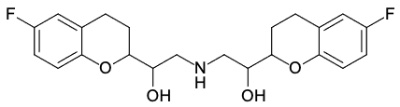
    The litigation arose over the generic drugmakers' ANDA filings involving Forest Laboratories' Bystolic (nebivolol hydrochloride) product, which is a beta blocker used for treating high blood pressure:

    Image 1
    The patent asserted in the litigation was U.S. Patent No. 6,545,040 (expired December 17, 2021), claim 1 thereof reciting:

    1.  A composition consisting of the compound [2R,αS,2′S,α′S]-α,α′-[iminobismethylene]bis[6-fluoro-3,4-dihydro-2H-1-benzopyran-2-methanol] having the formula:
    Image 2or a pharmaceutically acceptable acid addition salt thereof.

    The parties settled the ANDA litigations, with settlement terms including delayed generic entry (until 3 months before patent expiry) and payments to generics for "goods and services" "such as ingredient supply and product development" (which the antitrust plaintiffs alleged were pretextual).

    Plaintiffs, consisting of direct purchasers, retail purchasers, and end-payor purchasers alleged violation of Sherman Act Sections 1 and 2, Clayton Act Section 16, and state antitrust and unfair competition laws.  The District Court granted defendants' motion to dismiss under Fed. R. Civ. Proc. 12(b)(6), first without prejudice (permitting the complaint to be refiled) and then with prejudice when the procedural defects identified by the District Court under Bell Atlantic Corp. v. Twombly, 550 U.S. 544 (2007), Ashcroft v. Iqbal, 556 U.S. 662 (2009), were not rectified.  This appeal followed, wherein the Second Circuit affirmed dismissal with prejudice.  The opinion notes that the FTC filed an amicus brief but did not file an action against Forest and the generic defendants.

    The Court's basis for affirming dismissal of the complaint was that plaintiffs did not plausibly allege that "any of Forest's reverse payments were unjustified or unexplained, instead of constituting fair value for goods and services obtained as a result of arms-length dealings."  The opinion relies upon the Supreme Court's decision in FTC v. Actavis which mandates that courts apply the antitrust "rule of reason" to reverse payment settlement agreements that "depends upon its size, its scale in relation to the payor's anticipated future litigation costs, its independence from other services for which it might represent payment, and the lack of any other convincing justification," including "fair value for goods and services exchanged as part of a bona fide commercial relationship."  The reverse payments in the settlement agreements at issue ranged from $200,000 and $2,000,000, and each settling defendant was granted a "non-exclusive, royalty-free license to market its version of generic Bystolic beginning on September 17, 2021" (but with provisions that, if any of the seven entered the market earlier then the others were permitted to do so).  In addition, the settlements contained various supply agreements for goods and services (termed the "Commercial Transactions"), which plaintiffs argued were "side agreements" having large ($15 million) values.

    Appellate review was de novo, under Second Circuit law; as set forth in the opinion under Iqbal the facts alleged must support a "facially plausible claim" that would permit a court "to draw the reasonable inference that the defendant is liable for the misconduct alleged."  "Mere possibility" isn't enough, nor are allegations that are "merely consistent with" liability if they don't plausibly suggest liability under Twombly; further "labels and conclusions" are insufficient nor are "naked assertions" unsupported by "further factual enhancements."

    The Court focused on Twombly's plausibility requirement, the opinion noting that this standard does not permit a court to dismiss an antitrust complaint based on a "plausible version of the events merely because the court finds a different version more plausible" under Anderson News, L.L.C. v. Am. Media, Inc., 680 F.3d 162, 185 (2d Cir. 2012), because "plausibility" is a lower standard than "probability."

    The opinion provides a succinct synopsis of Supreme Court's Actavis decision:  "the Supreme Court made clear that reverse-payment settlements are not per se or presumptively illegal–rather, they may violate the antitrust laws only 'sometimes' . . . [requiring courts to] navigate the 'tension between the antitrust laws' objective of enhancing competition by preventing unlawful monopolies and patent laws' objective of incentivizing innovation by granting legal patent monopolies,'" citing New York ex rel. Schneiderman v. Actavis PLC, 787 F.3d 638, 659 (2d Cir. 2015).

    Here, the Second Circuit found parallels between the circumstances and provisions in Actavis and in this case — "an agreed-upon date [of market entry] earlier than the expiry of [the branded company's patents]" and payment to the generic companies ("millions of dollars") as compensation for services.  The Supreme Court calculus the Second Circuit considered particularly applicable in this case involved the rule of reason wherein:  (1) the plaintiff has the initial burden to show that the challenged restraint of trade has actual anticompetitive effects; (2) if the plaintiff makes out a prima facie case, the burden shifts to the defendant to demonstrate the restraint's procompetitive benefits or justifications; and (3) if the defendant does so, the burden shifts back to the plaintiff to establish that there were less restrictive means for obtaining the procompetitive benefits."  Further, the opinion sets forth the Court's analysis of the rubrics the Second Circuit relied upon from Actavis: first, that the rule of reason is applied because reverse payment agreements have the "potential for genuine adverse effects on competition" and second that these agreements only violate the antitrust laws "sometimes" and thus "[t]he 'relevant antitrust question' is why the reverse payment was made," i.e., to cause anticompetitive harm, which is assessed using the analytical framework set forth by the Supreme Court in Actavis ("large," based on absolute size and relationship to avoided litigation costs, and "unjustified" or unexplained reverse payments based on "traditional settlement considerations" such as "fair value"), in the context of a general preference for settling lawsuits.

    The Second Circuit agreed with the District Court that plaintiffs did not "plausibly allege" that the settlements were unjustified and raised an antitrust violation, and had "properly applied the general pleading principles established in Twombly [and] Iqbal."  Regarding the justification standard, the Court held that "[t]here is no allegation plausibly showing that any of the six Commercial Transactions reflected anything other than 'fair value' for goods and services obtained as a result of good-faith business dealings," the plaintiffs rather relying ("mostly") on "speculation and supposition," terming them "atmospheric allegations" (heretofore rather more often the province of the FTC's rhetoric).

    Importantly, the Court asserts that "Actavis does not stand for the proposition that parties must reach the most procompetitive settlements possible," citing King Drug Co. of Florence, Inc. v. Smithkline Beecham Corp., 791 F.3d 388, 408–09 (3d Cir. 2015), nor does the Court's decision "compel antitrust scrutiny of a settlement regardless of whether its terms could reasonably be interpreted as a large and unjustified reverse payment," citing In re Actos End Payor Antitrust Litig., No. 13-cv-9244, 2015 WL 5610752, at *15 (S.D.N.Y. Sept. 22, 2015).

    The opinion recites as "overarching" the following reasons supporting dismissal in the terms of the Commercial Transactions that the Court opines reflect bona fide business considerations:

    • The size of payments is not sufficiently contextualized or compared to enable [the Court] to infer that the payments are plausibly unjustified.

    • Forest's need for alternative supplies of active pharmaceutical ingredients ("API") or finished pharmaceutical products was consistent with what Forest previously disclosed to investors.

    • A lack of public disclosures about business plans or investments does not necessarily bear upon whether those ventures are truly legitimate or genuine.

    • It is sensible for counterparties to enter into condensed term sheets with the expectation of subsequently negotiating definitive agreements that are more detailed.

    • Payments for developmental or commercial milestones, or research-and-development expenses, bespeak rational commercial incentives.

    • Provisions in the Commercial Transactions that are designed to ensure price competition do not fit with Forest's alleged intention to funnel secret overpayments to the Generic Defendants.

    • Agreements between Forest and other counterparties need not be identical to Forest's agreements with the Generic Defendants, or even closely resemble them.

    • The agreements' provisions trump allegations of unsupported speculation about nefarious motives.

    The opinion then illustrates how each of the six Commercial Agreements satisfy a sufficient combination of these considerations for the Court to affirm the District Court's decision to dismiss plaintiff's complaint with prejudice (calling one set of plaintiff's allegations "at once complicated and threadbare").

    Despite active support by the FTC, plaintiffs here failed to establish sufficient likelihood of an antitrust violation arising from any of the ANDA settlements at issue illustrating the burden such plaintiffs face and the dependence of that burden on the factual underpinnings of the settlement agreements at issue.

    * Plaintiffs included CVS Pharmacy, Inc.; Rite Aid Corporation and affiliates; J M Smith Corporation and affiliates; KPH Healthcare Services, Inc. and Kinney Drugs, Inc., Mayor and City Council of Baltimore, UFCW local 1500 Welfare Fund, Teamsters Western Region & Localv177 Health Care Plan, Fraternal Order Of Police Miami Lodge 20, Insurance Trust Fund, Law Enforcement Health Benefits, Inc., Teamsters Local No. 1150 Prescription Drug Benefit Plan, Teamsters Local 237 Welfare Fund and Teamsters; Local 237 Retirees Benefit Fund, Albertsons Companies, Inc., H-E-B L.P., The Kroger Co., Walgreen Co.

    ** Defendants included Forest Laboratories Inc. (innovator) and Allergan, Inc. and affiliates; Abbvie Inc.; Watson Pharma, Inc. and affiliates; Actavis, Inc.; Teva Pharmaceuticals USA, Inc.; Torrent Pharmaceuticals Ltd. and affiliates; Amerigen Pharmaceuticals Ltd and affiliates; Glenmark Generics Inc., USA and affiliates; Hetero Labs Ltd. and affiliates; Andchemie Health Specialties Private Ltd.; Alkem Laboratories Ltd.; Ascend Laboratories, LLC; and ANI Pharmaceuticals, Inc. (generic drugmakers), wherein Alkem, Amerigen, Glenmark, Indchemie, Hetero, Torrent and Watson were all first-filers.

  • By Kevin E. Noonan –

    Federal Trade Commission (FTC) SealPolicy differences are endemic in politics, and the phrase "causing more heat than light" regarding federal drug policy comes readily to mind listening to the rhetoric coming from the Federal Trade Commission in this regard.  The FTC is infamous for its uncontrolled venom towards industries they believe with religious fervor to be charging consumers prices higher that the FTC thinks they should be.  This tendency was evident in the fight over reverse payment settlements in ANDA litigation, leading to a Supreme Court decision imposing a "rule of reason" standard rather than the draconian per se standard the Commission espoused in determining whether an antitrust violation had occurred (see FTC v. Actavis).  And it is with similar rhetorical excesses that the Commission has begun its latest crusade involving listing on the Food and Drug Administration's Orange Book for patents claiming medical devices relating to administering FDA-approved drugs.

    It will be recalled that the FTC spent the better part of a decade attacking the practice of innovator drug companies settling ANDA litigation by providing payments to generic applicants challenging the validity of Orange Book-listed patents (see "The FTC's Thinking Does Not Make It So Regarding Reverse Payment Agreements"; "Federal Trade Commission Issues Report on Reverse Settlement Agreements in FY2010"; "FTC Releases Another Report on Reverse Payment Settlement Agreements in ANDA Litigation"; "The FTC Is at It Again").  These agreements were termed "reverse payment" settlements because unlike in most patent suits, the defendant secured a payment from the patentee (as part of its campaign, the FTC termed these "pay-for-delay" agreements).  The Commission persisted in its efforts despite most Federal Courts of Appeal deciding that, rather than being anticompetitive, the agreements frequently resulted in generic drugs coming to market much earlier than would be expected (see "Valley Drug Co. v. Geneva Pharmaceuticals, Inc."; "Schering-Plough Corp. v. Federal Trade Commission"; "In re Tamoxifen Citrate Antitrust Litigation"; "In re Ciprofloxacin Hydrochloride Antitrust Litigation"; "Arkansas Carpenters Health & Welfare Fund v. Bayer AG"; and "Federal Trade Commission v. Watson Pharmaceuticals, Inc.").  One basis for the FTC's persistence was the belief that branded drug companies settled because they were aware that their patents were invalid and thus improperly tried to extend their "monopoly"; of course this position supposed not only that innovator drug companies were willing to contravene the antitrust laws but perhaps more importantly that the Commission's bureaucrats had a better understanding of the pharmaceutical industry than the executives making the decisions.  Persistence being what it is, the FTC finally prevailed in finding a Circuit Court (the Third) to accept its arguments (see "The Federal Trade Commission Finally Wins One"), leading to the Supreme Court deciding the issue in FTC v. Actavis.

    The FTC's latest foray into policing pharmaceutical companies and their patent behavior was set forth in a policy statement promulgated last fall, entitled "Statement Concerning Brand Drug Manufacturers' Improper Listing of Patents in the Orange Book," in a classic example of begging the question and one viewed through the Commission's prism of purported patent malfeasance by branded drug companies.

    As it did with the reverse settlement issue, the FTC's attitude seems to be that something might be happening and then to proceed as if it is.  This is evident from the first sentence of the policy statement, which asserts that "[b]rand drug manufacturers may be harming generic competition through the improper listing of patents in the Food and Drug Administration's ('FDA') Approved Drug Products with Therapeutic Equivalence Evaluations, known as the 'Orange Book'" (emphasis added).  The statement then extols the benefits of generic competition (which is fine as far as it goes, but of course there needs to be something to copy in the first place for the generics regime to be effective).  There is a general allegation in the midst of this rhetoric — the statement asserts that "certain manufacturers have submitted patents for listing in the Orange Book that claim neither the reference listed drug nor a method of using it," and if so, of course the Commission is empowered to and intends to pursue such manufacturers who are purportedly "abus[ing] the regulatory processes set up by Congress to promote generic drug competition" under the power to investigate unfair trade practices under 15 U.S.C. §§ 45(a), (n).

    The justification for the Commission's concerns stems apparently from the results of a 2002 study (FED. TRADE COMM'N., GENERIC DRUG ENTRY PRIOR TO PATENT EXPIRATION: AN FTC STUDY 39-52 (2022), that supposedly involved improper listing, further citing an enforcement action in that year against Biovail (In re Biovail Corp., FTC Dkt. No. C-4060 (Oct. 2, 2002)).  Also cited are a total of four instances where the Commission filed amicus briefs in cases where there may have been improper listing, such as patents for a system to implement a REMS (not a medical device).  The consequence of such listings, the statement asserts, is to invoke the 30-month stay in approval attendant upon the NDA holder (or her licensee) filing suit against an ANDA applicant, because "even small delays in generic competition can generate substantial additional profits for brand companies at the expense of patients."  Patients would be harmed because they would be "deprived of the ability to choose between competing products and may be forced to pay inflated prices."  Of course the 30-month stay while statutory is not mandatory; should the infringement action be dismissed (for example, on motion that the patent asserted were improperly listed in the Orange Book), the FDA would be able to expeditiously approve the ANDA and the generic company enter the marketplace (with its own 180-day exclusivity if a first filer; under these circumstances the extent to which patients would pay deflated prices would be itself delayed).

    Having established at least to its own satisfaction the basis for the Commission's attention to this issue, the statement then announced the FTC's intention to "enforce the law against those companies and individuals who continue to improperly list patents in the Orange Book" using "its full legal authority to protect patient and payors . . . from business practices that tend to negatively affect competitive conditions."  This threatened exercise of the Commission's legal authority finds its basis in "the FTC's historical use of Section 5 [of the Clayton Act]" based on improperly listing a patent in the Orange Book being an unfair method of competition.  The statement goes on to speculate that improperly listing a patent in the Orange Book "may . . . constitute illegal monopolization," perhaps evincing a recognition that agency overreach was not greeted warmly by the Supreme Court in Actavis with regard to the FTC's position that reverse settlement agreements were a per se antitrust violation.  Treading cautiously, the statement further warns that "improperly listing patents in the Orange Book may also be worthy of enforcement scrutiny from government and private enforcers under a monopolization theory" and calls out the possibility (or likelihood) that it "may also scrutinize a firm's history of improperly listing patents during merger review" (emphasis added).  Finally, the statement suggested that "individuals" (presumably corporate officers) who "submit or cause the submission" of patents improperly to the Orange Book may be held liable individually, and that a finding of a false certification under 21 C.F.R. § 314.53(c)(2)(ii)(R) could be sent to the Department of Justice for investigation of criminal liability.  Should all else fail, the Commission also states that it "may" dispute individual Orange Book listings through the FDA process set forth in 21 C.F.R. § 314.53(f)(1) that permits "any interested person" to request patent information in the Orange Book be corrected.

    Mostly in footnotes, the statement identified no more than 10 cases in support of the statement (and one of those, Fed. Trade Comm'n v. Shkreli, 581 F. Supp. 3d 579, 637 (S.D.N.Y. 2022), involved the infamous "Pharma Bro" whose shenanigans can hardly be held up as a standard under which ethical branded drug companies conduct their businesses).  In view of the powers the Commission can wield, the assertions, allegations, and promises of future activities set forth in the statement cannot be ignored, but it also cannot help but raise the question of whether this tempest should not have remained in the teapot from whence it sprung, at least without further evidence that improper listing occurs frequently enough to significantly impact drug prices paid by the patients and payors the FTC is attempting to serve and protect from (in the Commission's view, apparently) predatory branded drug companies.

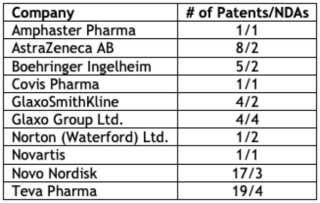
    Most recently, the FTC sent letters almost identical in substantive import to ten major drug companies (Amphaster Pharma, AstraZeneca, Boehringer Ingelheim, Covis Pharma, GlaxoSmithKline, Glaxo Group Ltd., Norton (Waterford) Ltd., Novartis, Novo Nordisk, and Teva Pharmaceuticals); the identical language of these letters indicates that presumption of wrongdoing rather than any individual, identified malfeasance prompted the campaign.  The letters were accompanied with the FTC's announcement and accompanying statements by Commission Chairwoman Lina Khan that:

    "By filing bogus patent listings, pharma companies block competition and inflate the cost of prescription drugs, forcing Americans to pay sky-high prices for medicines they rely on."

    "By challenging junk patent filings, the FTC is fighting these illegal tactics and making sure that Americans can get timely access to innovative and affordable versions of the medicines they need"

    (appropriate in tone for the former enfant terrible author of "Amazon's Antitrust Paradox" (Khan, Lina M. (January 2017), Yale Law Journal, 126 (3): 710–805).

    The current spate of threatening letters is similarly devoid of evidence and long on supposition, quoting from the earlier Policy Statement that:

    ". . . patents improperly listed in the Orange Book may delay lower-cost generic drug competition" [and]

    "In addition to delays resulting from such a stay of approval, the costs associated with litigating improperly listed patents may disincentivize investments in developing generic drugs, which risks delaying or thwarting competitive entry."

    The letters further warn that the FTC has chosen to use the statutory pathway under 21 C.F.R. § 314.53(f)(1)(i)(A) for disputing "the accuracy or relevance of patent information submitted" to FDA for Orange Book listing but that the Commission "retain[s] the right to take any further action the public interest may require, which may include investigating this conduct as an unfair method of competition under Section 5 of the FTC Act, 15 U.S.C. § 45."  These stratagems enable imposition of civil (monetary) penalties, but the earlier warning in the Policy Statement that "if the FTC encounters false certifications filed under 21 C.F.R. § 314.53(c)(2)(ii)(R) that may constitute a potential criminal violation for the submission of false statements, the Commission may refer such cases to the U.S. Department of Justice for further investigation" has not been abjured.

    This latest action raises the question of why these companies and what behavior prompted the Commission to act now?  Each letter contains a table of the patents whose listing the Commission calls into question, summarized as follows herein:

    Table
    A closer look shows that what these patents protect are, by and large, medical devices that provide either greater accuracy in administered dose or increased patient convenience and accompanying greater patient compliance; for example:

    U.S. Patent No. 7,654,986 (expiration expected July 12, 2024) (Novo Nordisk)

    Claim 1:  A needle mounting system for mounting and dismounting a needle assembly onto a needle mount of an injection device, comprising . . .

    Specification:
    Injection devices, also referred to as dosers, have greatly improved the lives of patients who must self-administer drugs and biological agents. Dosers may take many forms, including simple disposable devices that are little more than an ampoule with an injection means or they may be highly sophisticated instruments with numerous functions. Regardless of their form, they have proven to be great aids in assisting patients to self-administer injectable drugs and biological agents. They also greatly assist care givers in administering injectable medicines to those incapable of performing self-injections.

    U.S. Patent No. 8,161,968 (expiration expected February 5, 2028) (GSK)

    Claim 1:  A medicament dispenser for containing plural elongate form medicament carriers, each medicament carrier having multiple distinct medicament dose portions carried thereby,  . . .

    Specification:
    The Applicant has now found that in providing a medicament dispenser of this type a number of practical problems and design challenges are encountered.

    One problem is that of providing a dispenser device that is able to accommodate the plural medicament carriers, but is of sufficiently small overall size that it is conveniently portable (e.g. in the pocket or bag of a patient) and amenable to discrete use, by the patient.

    Another problem is that of providing a dispenser device, in which the distinct medicament dose portions of each of the plural medicament carriers may be indexed or accessed without the need for the user to apply undue indexing or accessing force. Particular challenges are faced when the plural medicament carriers are required to be moved through the dispenser device for indexing/accessing thereof, and where the indexing/accessing action is coupled (e.g. moving peelable blister strips through the dispenser device to both index a particular blister on each strip and peelably access that blister).

    U.S. Patent No. 8,182,838 (expiration expected October 20, 2028) (Novartis)

    Claim 19:  A pharmaceutical composition comprising composite active particles prepared in accordance with the method as claimed in claim 1, blended with carrier particles.

    Claim 36:  A dry powder inhaler containing a composition as claimed in claim 19.

    Specification:
    WO 00/74754 and many other publications over a period of more than twenty years have described how, particularly in powder inhalers, there is a considerable problem with moisture. Not only can moisture have a disadvantageous effect on the pharmaceutically active composition of the medicament, it can also impair in particular the interplay of physical and chemical parameters of the combination of active substance and auxiliaries. As a result, lumps may form, for example, or the breakdown of the inhaled powder into particles which can access the lungs may be impaired. All these circumstances can lead to problems affecting the metering and the efficacy of the administration of a powdered medicament.

    To minimize these disadvantages, various attempts have already been made in the past to reduce the penetration of moisture into a powder inhaler by using seals. Attempts have also been made to reduce the disadvantageous effects of penetrated moisture by providing desiccants to absorb the moisture, in particular to keep the air moisture in storage chambers to a minimum.

    And a close look at the frequency with which these patents have been asserted in an abbreviated new drug application (ANDA) litigation shows that most of them have not been so asserted.  Of the 61 patents identified in the FTC's letters (presumably indicating some level of differentiation to select somewhat- to particularly egregious-examples of bad behavior), 34 have never been asserted and eight others have been asserted in only five ANDA cases.  The anomaly are 19 patents asserted in 209 cases, with the majority of these being directed to Ozembic, Saxenda, and Victoza.  Whether this exemplifies over-exuberance, bad acting, or justifiable protection of devices providing patient-specific advantages remains to be determined.

    In at least one case, the FTC's crusade has proven to be persuasive to a district court, Teva Branded Pharmaceutical Products R&D, Inc. v. Amneal Pharmaceuticals of New York, LLC (Civil Action No. 23-20964 (SRC), U.S. District Court of New Jersey) (Opinion & Order).  The decision arose in ANDA litigation over Teva's ProAir® HFA (albuterol sulfate) Inhalation Aerosol product, wherein Teva asserted U.S. Patent Nos. 8,132,712; 9,463,289; 9,808,587; 10,561,808; and 11,395,889.  These patents claimed devices for administering the drug product, and Amneal moved (and the District Court held) that these patents should be delisted from the Orange Book.  The basis for the court's decision was that these patents did not claim the drug product and thus were improperly listed under the requirements of 21 U.S.C. § 355(b)(1)(A)(viii)(I).  (The FTC garners credit, or blame, for the decision by its filing of an amicus brief heavily relied upon and cited in the opinion, for which Commission Chair Kahn was quick to publicly claim responsibility.  In rendering its decision, the Court relied on the First Circuit's decision in Cesar Castillo, Inc. v. Sanofi-Aventis U.S., LLC (In re Lantus Direct Purchaser Antitrust Litig.), 950 F.3d 1, 3 (1st Cir. 2020), that a listed patent must be directed to the drug product and the Second Circuit's decision in United Food & Commer. Workers Local 1776 v. Takeda Pharm. Co., 11 F.4th 118, 134 (2d Cir. 2021), that the question of proper listing was based on what the patent claimed and not what would infringe those claims (to the extent, unexplicated in the District Court's decision, that these would be different).  It must be recognized that the District Court's decision was based, inter alia, on Teva's assertion that these patents were listed as reciting the drug rather than reciting methods for administering the drug.

    (Perhaps more troubling is that the District Court denied Teva's motion to strike Amneal's counterclaim that improper listing can amount to an antitrust violation under 21 U.S.C. § 355(j)(5)(c)(ii)(II) and particularly rejected Teva's claim that such listing does not raise antitrust liability under the Supreme Court's decision in Verizon Communs., Inc. v. Law Offices of Curtis V. Trinko, LLP, 540 U.S. 398, 398-99 (2004)).

    The circumstances surrounding this most recent FTC endeavor bring back to mind the circumstances in the reverse settlement situation, where the first case involved what apparently was in fact an abuse of the statute and could have been an antitrust violation (and in which private parties and "[t]he attorneys general of all 50 States, Puerto Rico and the District of Columbia (the 'attorneys general) eventually joined the litigation on behalf of their States and as parens patriae on behalf of the residents of their respective jurisdictions"; see "In re Cardizem CD Antitrust Litigation, 332 F.3d 896 (6th Cir. 2003)").  Thereafter, every such settlement was not just suspect but evidence of anticompetitive behavior merely by its existence, with the only motivation contemplated by FTC's philosophy being that patentees were aware of the invalidity of the patents at issue and were attempting to "buy off" challengers.  The counter-narrative (understood and explicated by the Chief Justice in his dissent in FTC v. Actavis), that the investment by innovative pharmaceutical companies and vagaries of any litigation mitigated against taking unnecessary business risks, was lost on the FTC and undoubtedly will be so again here.  How these ten pharmaceutical companies respond to the FTC's mandate will vary, no doubt (and asserting these patents in ANDA litigation is likely imprudent when routine avenues of recourse may suffice).  But these alternatives may involve a higher degree of disruption of markets and patient-availability of the medicines under NDA and also reduce investment into new and better ways of administering drugs known to be more difficult to administer than conventional drugs or that would provide real-world benefit for patients.  The Policy Statement and the FTC's actions in enforcing it being in their early stages it is impossible to predict the outcome.  But if earlier FTC ideology-based efforts are a guide it is likely to be a protracted struggle.

  • By Kevin E. Noonan –

    USPTO SealLast November, the U.S. Patent and Trademark Office issued Guidance to the Examiner Corps that was disclosed to the public at the March 19, 2024 Biotechnology, Chemical, and Pharmaceutical Partnership Meeting, on resources to be used by examiners to comply with the dictates of Executive Order 14036 from the Biden Administration related to drug patents and the purported abuse thereof that results in inflated drug prices.

    To recap, in one of its first acts, the Administration promulgated Executive Order 14036 (July 9, 2021), which contained the assertion that "Americans are paying too much for prescription drugs and healthcare services — far more than the prices paid in other countries" and the allegation that "too often, patent and other laws have been misused to inhibit or delay — for years and even decades — competition from generic drugs and biosimilars, denying Americans access to lower-cost drugs" (this despite 40 years of generic drugs being available under the Hatch-Waxman Act (1984) and biosimilar copies of biologic drugs for over a decade under the BPCIA, enacted as part of "Obamacare" in 2010).  The purported remedy was that "it is the policy of my Administration to enforce the antitrust laws to combat the excessive concentration of industry, the abuses of market power, and the harmful effects of monopoly and monopsony — especially as these issues arise in . . . prescription drug markets" and "to support aggressive legislative reforms that would lower prescription drug prices, including by allowing Medicare to negotiate drug prices, by imposing inflation caps, and through other related reforms."

    One aspect of this policy, under Sec. 5(p)(vi), intended "to help ensure that the patent system, while incentivizing innovation, does not also unjustifiably delay generic drug and biosimilar competition beyond that reasonably contemplated by applicable law," was to have, "not later than 45 days after the date of this order, . . . the Commissioner of Food and Drugs write a letter to the Under Secretary of Commerce for Intellectual Property and Director of the United States Patent and Trademark Office enumerating and describing any relevant concerns of the FDA."  There followed a series of letters between these officials that were directed to:

    • Enhancing collaboration with other agencies on key technology areas, including pharmaceuticals and biologics
    • Improving procedures for obtaining a patent to ensure that the USPTO issues robust and reliable patents
    • Improving the process for challenging issued patents before the Patent Trial and Appeal Board (America Invents Act proceedings)and improving public participation in the patent system
    • Considering new proposals for incentivizing and protecting innovation while minimizing unnecessary delays in getting more affordable drugs to market

    These aspirations were further voiced in a joint blog post almost a year later, on July 7, 2022, from Director of the USPTO Kathi Vidal and FDA commissioner Robert M. Califf that, while crediting the pharmaceutical industry for creating, testing, and bringing to market lifesaving drugs, and that 13 of the top 20 "most innovative and inventive pharmaceutical companies" in the U.S., and recognizing the "delicate balance" with generic companies in providing competition and "driving down prices," insisted that "while the issuance of robust and reliable patents to incentivize pharmaceutical innovations is critical, our patent system must not be used to unjustifiably delay generic drugs and biosimilar competition beyond that reasonably contemplated by law."  These efforts were directed to "striking [an] appropriate balance" by "encouraging meaningful innovation in drug development while not unduly delaying competition that provides relief from the high cost of medicines," a truly Goldilocks objective.

    These officials further enunciated their goal to "protect against the patenting of incremental, obvious changes to existing drugs that do not qualify for patents" so that "companies will not be able to unjustifiably delay generic competition based on trivial changes to a drug product."  This was to be done, inter alia, by the PTO giving examiners "time and resources" needed to thoroughly review applications for pharmaceutical inventions (raising the questions, of course of whether examiners had not been given the T&R for the job now and whether so doing would come at the expense of proper T&R for all other areas of technology, and not specifying the resources that would be provided).  The FDA information to be made available to examiners under this policy was to be only from unspecified "publicly available sources" (with updated information on these efforts being available on the USPTO-FDA Collaboration Initiatives webpage).

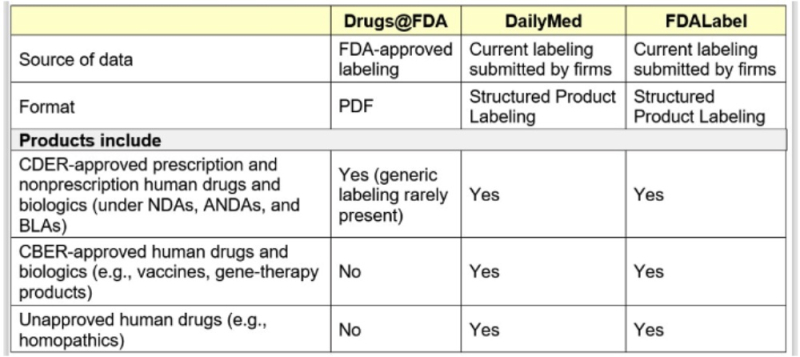
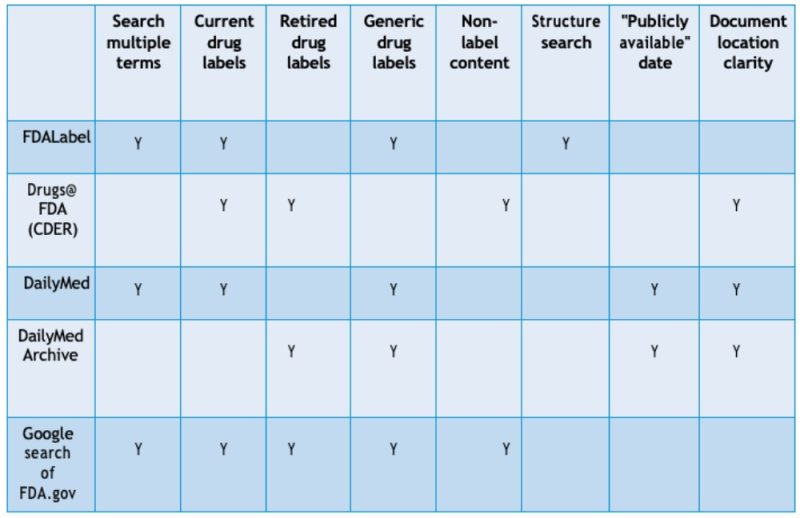
    The latest Guidance is specific to Technology Center 1600 for drugs, formulations, and methods of treatment/use, and concerns methods for searching NIH and FDA databases identifying which databases should be searched.  The Guidance also directs the Examiners to the searching requirements in M.P.E.P. § 904 (§ 904.02) as well as the importance of compliance for examiner review in performance and quality appraisals (i.e., involving their bonuses, raises, and opportunities for advancement).  The Guidance identifies the following "search resources," their properties and characteristics and what information can be gleaned from them:

    FDALabel: this database contains drug labeling information for 140,000 human drugs (including biologics and over-the-counter drugs) and a small number of animal drugs, disclosing prescribing information, patient labeling, and carton/container labeling for the drugs and biologics, as well as label documents for homeopathic remedies, medical devices, dietary supplements, cosmetics, and medical foods.  The Guidance directs that this database can be used to find information on indications, dosage and administration, contraindications (including warnings, adverse reactions, drug interactions, or information about use in particular populations of patients).  The Guidance also includes information on how to use the database and search capabilities, down to level of the interface and ways to use it including navigating the search results obtained (e.g., identifying the approval date for establishing prior art status).

    DailyMed & DailyMedArchive (NIH):  provides labels for FDA-approved products including prescription drug and biological products for human use; nonprescription (e.g., over-the-counter) drug and biological products for human use; certain medical devices for human use; medical gases for human and animal use; and prescription and nonprescription drugs for animal use.  These are labels submitted by drugmakers to FDA (not limited to labels for approved drugs) and the Guidance notes that there are almost 146,000 entries in the database.  The Guidance sets forth detailed search protocols and further cautions Examiners that prior art-relevant info might be in archives and not on the main page.

    Drugs@FDA:  this database contains more information that the DailyMed database according to the Guidance, including regulatory history, FDA reviews, and previously approved labeling.  Information regarding drug approval dates can be parsed by month, and the database includes most approved drug products since 1939, with more robust information on drugs approved since 1998, and is updated daily.  Further this database includes information about approval year and any revisions as well as therapeutic equivalents thereof.

    The Guidance includes comparisons between what is available in these databases to further aid Examiners in searches:

    Table 1
    The Guidance also recommends using Google to search FDA.gov domain(s), as a way to use the power of the Google search engine to search specific sites that can be used to "group drugs with like regulatory pathways or omit outliers."  The Guidance provides a tabular synopsis of how a combination of these resources can be used to identify specific information related to prior art searching for patents related to drug products:

    Table 2
    The Guidance concludes with the Office's intention to "provide additional examiner training and guidance this year to biotech and pharmaceutical patent examiners on examination of declaratory evidence of unexpected results."

    At the same time the Office announced that, as part of or ancillary to the duty of candor under 37 C.F.R. § 1.56 there would be applied a "duty of reasonable inquiry . . . to perform an inquiry that is reasonable under the circumstances, including reviewing documents to identify information that is material to the patentability of a claimed invention," falling within scope of 37 C.F.R. § 11.18(b) (part of the ethical duties regarding standards for submitting papers to the Office as part of patent prosecution.  The scope of parties having this duty imposed was the same as Rule 56 as well as individuals involved in re-examination and PGR/IPR proceedings, and included a duty to disclose Para IV positions from generic competitors in pending proceedings before PTO and PTAB.  Further, this policy expressly prohibited "ethical walls" that would prevent patent practitioners from being aware of inconsistencies in representations taken before the Office and the FDA or other agencies.  The impetus for the new duty came, at least in part, in response to a letter from Sens. Leahy (D-VT) and Tillis (R-NC) that USPTO should "take steps to reduce patent applicants' making inappropriate conflicting statements in submissions to the [USPTO] and other federal agencies," specifically in cases where "inconsistent statements submitted to the Food and Drug Administration (FDA) to secure approval of a product—asserting that the product is the same as a prior product that is already on the market— can then be directly contradicted by statements made to the [USPTO] to secure a patent on the product."  The scope of enforcement of this duty has not been further defined.

  • By Andrew Velzen and Joshua Rich

    As discussed previously on this blog (see "USPTO Proposed Rule Change to Terminal Disclaimer Practice" and "The USPTO's Proposed Terminal Disclaimer Rule: A Litigator's Perspective") and elsewhere, the U.S. Patent and Trademark Office has announced a proposed rule change to the required form for terminal disclaimers in an attempt to rein in abusive serial litigation practices.[1]  Since the proposal was announced, the public commentary about the proposed change has been overwhelmingly negative.[2]  Recently, several former high-ranking USPTO officials (including former directors) joined that chorus in a letter to Director Vidal.[3]  In their words, just the Notice of Proposed Rulemaking (NPRM) alone — let alone adoption of the proposed rule — "destabilizes the patent system and advances anti-innovation policies."

    The letter attacks both the proposed rule on numerous grounds, both substantive and procedural.  At the most fundamental level, the former officials echoed our previous doubts that the proposed rule is proper exercise of agency discretion in rulemaking, albeit from a slightly different angle.  Their letter argues that the proposed rule would constitute a "substantive" rule and that implementing such a rule is beyond the USPTO's statutory authority (i.e., illegal).  Under 35 U.S.C. § 2(b)(2)(A), the USPTO "may establish regulations, not inconsistent with law, which . . . shall govern the conduct of proceedings in the Office."[4]  This is frequently interpreted as giving the USPTO the authority to make procedural rules but not substantive rules.[5]

    According to the letter, because the proposed rule "impacts the scope of patent rights in one application based on validity determinations in another," it should be considered a "substantive," rather than a "procedural," rule.  In other words, because the proposed rule telescopes validity between patents after examination, it is beyond the USPTO's proper purview.

    The USPTO has, unsurprisingly, preemptively disagreed with this contention.  For example, in the Federal Register Notice regarding the proposed change, the USPTO cited to In re Van Ornum, 686 F.2d 937 (CCPA 1982), as authority for the assertion that a rule regarding enforcement conditions resulting from terminal disclaimers filed to obviate nonstatutory double patenting rejections is within the USPTO's rulemaking authority.[6]  In addition, some Federal Circuit cases have suggested that the USPTO's interpretation of what the phrase "in the Office" means in the context of rulemaking authority should be entitled to Chevron deference, which (if it still exists) would suggest deference to the USPTO's determination of the proper scope of rulemaking.[7]  Further, the USPTO might argue that even current nonstatutory double patenting practice inherently can affect validity after issuance (e.g., since terminal disclaimers filed to overcome nonstatutory double patenting rejections include a "common ownership" requirement).  If so, the change could be argued to be a practical distinction without a legality difference.

    In addition to arguing that the adoption of the proposed rule would be illegal because it exceeds the USPTO's statutory authority, though, the letter also uses the term "illegal" when discussing the way in which the proposed rule would render entire families of patents invalid or unenforceable whenever a single claim in an entirely different patent tied to it by a terminal disclaimer was found invalid or unenforceable.  That is, they are raising the same argument we did earlier (see "The USPTO's Proposed Terminal Disclaimer Rule: A Litigator's Perspective").  Using the term "illegal" here is not hyperbole, since the proposed rule likely runs afoul of the validity provisions of 35 U.S.C. § 282(a), which states:

    A patent shall be presumed valid.  Each claim of a patent (whether in independent, dependent, or multiple dependent form) shall be presumed valid independently of the validity of other claims; dependent or multiple dependent claims shall be presumed valid even though dependent upon an invalid claim.  The burden of establishing invalidity of a patent or any claim thereof shall rest on the party asserting such invalidity [emphasis added].

    The proposed rule turns that calculus on its head and links the validity of all members of a terminal disclaimer family together.  If one claim falls, it would pull all of the others down with it.

    In addition to criticizing the legality of the proposed rule, the letter also discusses the alleged justification (or lack thereof) for the proposed change.  In the authors' views, the USPTO did not conduct sufficient studies to justify this change.  Without any such studies, there is simply insufficient data to lend credence to any suggestion that present terminal disclaimer/nonstatutory double patenting practice is detrimental to innovation (let alone that the proposed change would remedy the alleged detriment).  In the authors' words, "[t]he proposal seeks to solve a problem that does not exist."

    The USPTO did provide some "Rulemaking Considerations" under § IV of the Federal Register notice. However, most of these sections appear to be boilerplate language to satisfy bureaucratic requirements for rulemaking.  For example, under § IV(K), the USPTO states, without citing any evidence, that "[t]he changes proposed in this rulemaking are not expected to result in . . . significant adverse effects on competition, employment, investment, productivity, innovation, or the ability of United States-based enterprises to compete with foreign-based enterprises in domestic and export markets."  If this were indeed the case, I think many opponents of the proposed change would be put somewhat at ease.  Yet, there is simply no evidence cited in support of this assertion.

    Importantly, some of the only data the USPTO did provide in the NPRM seems to highlight the substantial magnitude of the issue.  According to § IV(B) of the NPRM, roughly 14% of Office Actions include at least one nonstatutory double patenting rejection.  This number was provided only in the context of small entity applicants.  Thus, while 14% is not negligible in that context, the percentage would likely be even larger when considering all applicants (especially because non-discounted entities have larger patent budgets and may, on average, have larger patent portfolios with more overlapping patents, which are more susceptible to nonstatutory double patenting rejections).

    While the evidence cited in the NPRM may not go far enough, the authors of the letter go too far.  There are parties that have used extended families in combination with sequential litigation (or the threat thereof) to chill the entry of other parties into the market.  This has been seen most clearly in the biosimilar and generic drug fields, where branded companies have kept patent families alive — as is the best practice — and rolled patents out one after another to be fought over by the non-branded companies. The result has been a war of attrition in which the branded company has more to lose than the non-branded has to gain, and the non-branded generally leave the field of battle or yield ground simply because of the cost of litigation.  The result is a net loss to the public, even if the USPTO did not cite specific examples.

    Lastly, the letter highlights some of the unintended consequences that could result from the adoption of the proposed rule.  First, the letter asserts that the expected cost of obtaining and enforcing a patent will necessarily increase.  This is because, for example, applicants will be forced to amend claims in response to or argue against nonstatutory double patenting rejections instead of simply filing terminal disclaimers, given the risks involved with terminal disclaimers under the proposed rule.  According to the authors, this additional cost represents a greater burden to small companies and individual inventors (given their relative available resources).  But that assumes that applicants will be seeking more than one patent per family, or patents from continuations instead of divisionals (or otherwise prosecuting overlapping subject matter across a portfolio).

    Under the Regulatory Flexibility Act (RFA), the USPTO actually had to estimate the costs to small entities based on the proposed change in the NPRM.  According to the USPTO in § IV(B) of the NPRM, the changes "will . . . not affect a substantial number (approximately 20%) of small entities" and that these 20% of small entities will be impacted by, at most, ~$26 Million a year, in total.  There are numerous assumptions that go into the math of how the USPTO came up with that figure, but even if it is a reasonable estimate, whether or not it is acceptably de minimis is certainly not a given.  Further, that figure only includes obtaining a patent for small entities (i.e., does not include enforcement for small entities or obtaining and enforcing patents for non-discounted entities), so it may not be representative of the total cost to all innovators.

    As the former USPTO officials point out, one result related to enforcement may be a strong shift of the expense of enforcement from a relatively even split to strongly in favor of accused infringers.  In particular, under the proposed regime, an infringer can take an invalidity shortcut by attacking a single claim in the weakest patent in a grouping in order to render the strongest patents obsolete.  This means that, in order to assert one patent against an infringer, a patentee might need to successfully defend against two, three, five, ten, or more invalidity judgments depending on how many patents are tied together by terminal disclaimers.  Clearly, this would be a pricey endeavor for the patentee.

    In addition to all the substantive commentary provided by the five distinguished individuals, the letter asserts an underlying urgency for action.  The authors assert that their plea represents an "unusual step" as a result of their being "deeply concerned."  Further, the letter goes beyond merely arguing against the ultimate implementation of the rule change.  It also calls on the USPTO to "withdraw [the proposal] immediately" because the NPRM "creates uncertainty every day that it remains under consideration."  So they suggest the extremely unusual step of withdrawing the proposed rule before the comment period even closes to mitigate the harm — essentially an admission that the USPTO was wrong to even propose the rule.

    [1] Full text of the proposed rule change can be found at https://www.federalregister.gov/public-inspection/2024-10166/terminal-disclaimer-practice-to-obviate-nonstatutory-double-patenting.

    [2] As of writing, 22 public comments have been submitted at https://www.regulations.gov/, most of which oppose the change.

    [3] The letter was signed by former directors Andrei Iancu, David Kappos, and Drew Hirshfeld and former deputy directors Laura Peter and Russell Slifer.  A copy of the full letter can be found here.

    [4] https://www.law.cornell.edu/uscode/text/35/2.

    [5] See also Merck & Co. v. Kessler, 80 F.3d 1543 (Fed. Cir. 1996); Animal Legal Def. Fund v. Quigg, 932 F.2d 920 (Fed. Cir. 1991).

    [6] The USPTO also stated, in § IV(A) of the Federal Register Notice, that the proposed changes "involve rules of agency practice and procedure, and/or interpretative rules, and do not require notice-and-comment rulemaking" (citing to Perez v. Mortg. Bankers Ass'n, 575 U.S. 92 (2015); Cooper Techs. Co. v. Dudas, 536 F.3d 1330 (Fed. Cir. 2008)).

    [7] Response to "Request for Comments on Eliciting More Complete Patent Assignment Information," Arti K. Rai (citing Bender v. Dudas, 490 F.3d 1361 (Fed. Cir. 2007)).

  • By Michael Borella

    This Internet has gone through many revolutions, technical and otherwise.  Each time it has emerged stronger and more robust than before.  One can trace the origins of the Internet to the connection of four computers in 1969.  The advent of email a few years later, the standardization of TCP/IP as its communication protocol in the mid-1980s, commercial dialup service providers not long after that, the popularization of the World Wide Web in 1993, and the immediately-following rise of ecommerce gave us the main aspects of what we currently think of as the Internet.  Inexpensive broadband, the search engine, online gaming, social media, widespread mobile access, and videoconferencing bring us to today.

    The next Internet revolution is being driven by generative AI, and it is happening right now.  While we cannot say what is going to be in place on the other side of this inflection point, we do know that our online experience will be different in a few years.

    Consider just the web.  It relies on an economic model that has been largely static for over two decades.  But generative AI is already beginning to disrupt this model.  Today, publishers and search engines have a mostly symbiotic relationship.[1]  They need each other.  But what happens when AI is used to subsume publisher content?

    Publishers (including small and independent publishers, blogs, businesses, and so on) seek to be highly ranked in search engines, especially for search terms that are relevant to their content.  For example, an independent newsletter that reviews cars (as just one example) would want to appear as high as possible (preferably in the top ten) search results for queries involving the word "car", "automobile", "motor", and so on.  This will drive traffic to the publisher's newsletter, allowing the publisher to sell ads and/or subscriptions.  With the resulting revenue, the publisher can grow its newsletter by hiring more writers and editors, who in turn produce more content.  This content, if of sufficient quality, makes it more likely that the publisher will be highly ranked in search results — a virtuous cycle.

    Search engines (or more correctly, search engine providers) crawl the web and use sophisticated algorithms to rank publishers in terms of their sites' relevance to search terms.  A successful search engine may receive billions of search requests per day from users who want to be referred to relevant publishers.  Each page of search results may be an ordering of links to publishers and perhaps a short description or summary of the content that can be found by following each link.  Search engines make money by displaying advertisements as sponsored links.  They also allow publishers to bid on search terms in a form of auction.  The publisher who bids the highest for a given search term often ends up at the top of the search result as a sponsored link, assuming that their content is indeed relevant to the search term.

    While this symbiosis has not yet been broken, it is getting wobbly.  It is no coincidence that the largest investors in generative AI are the companies that own and operate the largest search engines.  OpenAI, which is nearly half-owned by Microsoft, has admitted to training its GPT series of models on content that it absorbed from publishers on the Internet, often without their permission.  Some would contend that the models that underlie the popular ChatGPT generative AI tool have been trained on the Internet as a whole.[2]  Indeed, The New York Times and other publishers have sued OpenAI and Microsoft for allegedly violating their copyrights and (at least in the case of the Times) allegedly producing near-verbatim copies therefore in response to large language model (LLM) prompts.[3]

    Search engine results recently changed from being a series of links to publisher sites (with ad-sponsored results on top and clearly flagged) to leading with a generated AI overview as the leading result.  This overview seeks to answer the searcher's question or address their need without requiring them to click on links and visit publisher web sites.  So far, AI overview sections have also been displaying what the underlying AI model infers to be the most relevant publisher links and/or those used a source material for the overview.

    In isolation, AI-generated search results are neither here nor there.  Users might appreciate having them summarize publisher content to provide results in a more convenient and readily-consumable form.  Of course, the generation and providing of these results is still clearly experimental and subject to the same incorrectness, hallucinations, and bias that plague LLMs.  But users may further appreciate not having to navigate to certain publisher sites that display annoying ads or are sophisticated clickbait.

    At this point it seems safe to assume that the quality of these AI summaries will continue to improve.  If so, at what point does this impact the publishers?  The news industry — one of the biggest and most important publishing sectors — has lost one-third of its newspapers and two-thirds of its news journalists in the last two decades, mostly in the area of local news.[4]  AI is likely to accelerate this decline, with search engines absorbing user traffic rather than directing it to publisher sites.  As a result, publishers are likely to have less ad revenue and fewer subscriptions, putting their businesses at risk.

    Given that a sea change toward AI-generated search results is playing out in real time, it is difficult to predict what the economic model the web will be based on five years from now.  However, we can game out a few possible scenarios.

    • Search engines use AI to subsume the publishing industry.  Publishers go out of business en masse, leaving only the LLMs that generate news-like search results.  Many view this possible future as dystopian and potentially dangerous for society without the fourth estate, as there would be fewer incentives to subsidize investigative journalism that seeks to root out corporate and governmental corruption.  In a world without news organizations, it would be extraordinarily difficult to determine "the truth" as we would rely mostly on second and third hand accounts and other forms of hearsay.  Ironically, this would also reduce the utility of search engines, likely resulting in a revenue drop for those companies as well.

    • In a slightly less dystopian future, publishing does not die but instead gets sorted into two camps.  The first are traditional publishers with large audiences, like the Times, who survive due to their name recognition and quality journalism.  The second consists of small independent publishers with niche audiences that survive on subscriptions.  Both have the ability to be a source of real-time "hot" news that is too fresh for the AI models to ingest.  They also can serve as destinations for users (e.g., the users check their apps or bookmarked links frequently), allowing the publishers to flourish even without referrals from search engines.  This has been referred to as the "barbell" strategy, where the sweet spots for publishers are at either end of the spectrum in terms of size (the very large media companies or the very small independents) with very little in between.

    • Another dark scenario is that the search engines buy up most or all major publishers, reorienting the publishing business from serving the public directly toward generating training data for AI models.  While the incentives here are complex, it is likely that the search engine companies would have at least some control over reporting.  This could lead to less reporting on any negative externalities associated with these companies or — even worse — different "facts" being used to train different search engines.  If this notion seems far-fetched, keep in mind that the Washington Post is owned by Amazon founder Jeff Bezos[5] and that Meta was considering the purchase of Simon & Schuster to train its models.[6]

    • A more likely path forward is that the search engine providers (and AI companies in general) sign licensing deals with major publishers in order to access and use their content.  This is already happening, as the Financial Times, News Corp., Axel Springer, Le Monde, Prisa Media, and The Associated Press have all agreed to license their content to OpenAI.

    • Another possibility is that search engine providers are legally prohibited from unauthorized ingestion of publisher content without permission, which makes the licensing discussed above even more appealing.  This might be a consequence of a victory for the Times in its dispute with OpenAI.

    Right now, it is too early to tell which of these scenarios may play out, or if a different one arises.  If anything, we can be certain that the business model of the Internet will be different in five years or less.  Search engines will return AI-generated answers with less emphasis of links to source material, publishers will need to engage more directly with their audience and supply a continuous stream of high-quality content, and search-engine optimization may become obsolete.

    Like all disruptions, AI search comes with opportunities as well. As the technological and legal landscape evolves we should not be surprised if new models of publishing emerge, adapted to this evolution.

    [1] This is an admittedly a simple overview of the relationship.  There is quite a bit more nuance, but this level of detail is sufficient for the discussion that follows.

    [2] https://futurism.com/the-byte/ai-training-data-shortage.

    [3] https://www.patentdocs.org/2024/02/the-new-york-times-case-against-openai-is-different-heres-why.html.

    [4] https://localnewsinitiative.northwestern.edu/posts/2024/05/08/ai-local-news-report/index.html.

    [5] https://www.theguardian.com/media/2023/jan/29/tech-moguls-media-jeff-bezos-washington-post.

    [6] https://www.theguardian.com/books/2024/apr/09/meta-discussed-buying-publisher-simon-schuster-to-train-ai.

  • By Michael Borella and Joshua Rich

    GPT-4oIt seems like every week brings a new dispute over artificial intelligence (AI), mostly focused around new features and uses of generative AI.  Last week was no exception, with OpenAI unveiling human-like voices soon being available in its GPT-4o multimodal language model.  In what would turn out to be one of the biggest tech executive self-owns this side of Elon Musk, OpenAI CEO Sam Altman tweeted (Xed?) the single word "her" on the same day that the new feature was announced.

    Almost immediately, the public put together the dots.  One of the GPT-4o voices, named Sky, was eerily similar to that of actress Scarlett Johansson, and Johansson had supplied the voice for an AI voice assistant in the 2013 Spike Jonze movie, Her.[1]  Johansson released a statement stating that Altman had been in contact with Johansson for months, seeking to use her voice in what would become GPT-4o.  Johansson had repeatedly refused.

    OpenAI responded to the controversy by "pausing" the use of Sky with its new model, then later stating that they used a voice actor to develop Sky and did not intentionally mimic Johansson's voice.[2]

    If she were to take OpenAI to court, Johansson would have a good case.  Despite copyright law not providing protection for one's voice, the common law may (at least in California).  There is clear precedent arising out of similar attempts to mimic a celebrity's voice when the celebrity chose not to participate.

    In 1985, the Ford Motor Company created an ad campaign for one of its cars.  Ford asked singer Bette Midler to sing one of her own songs in the commercials, but Midler's agent categorically refused on her behalf.[3]  Undeterred, Ford hired one of Midler's former backup singers to record Midler's song, Do You Want to Dance, for the commercial.  The backup singer was asked to sound as much as possible like Midler.  When the commercials aired, many people felt the voice in the commercial sounded exactly like Midler's; some believed that it was Midler singing.

    Midler filed suit claiming violation of the California common law right of publicity.  The District Court granted summary judgment to Ford, finding no legal principle protecting imitation of a famous voice, as opposed to using the famous person's own voice (which could amount to copyright infringement) or physical image (which was protected by both statute and common law in California).

    But Midler won a reversal on appeal to the 9th Circuit, the panel holding that "California will recognize an injury from an appropriation of the attributes of one's identity."[4]  The panel wrote:

    A voice is as distinctive and personal as a face.  The human voice is one of the most palpable ways identity is manifested.  We are all aware that a friend is at once known by a few words on the phone . . . .  A fortiori, these observations hold true of singing, especially singing by a singer of renown.  The singer manifests herself in the song.  To impersonate her voice is to pirate her identity.

    We need not and do not go so far as to hold that every imitation of a voice to advertise merchandise is actionable.  We hold only that when a distinctive voice of a professional singer is widely known and is deliberately imitated in order to sell a product, the sellers have appropriated what is not theirs and have committed a tort in California.[5]

    If the Midler case establishes that it would be illegal to deliberately imitate the distinctive voice of a professional singer who is widely known, a question remained as to who would be considered "widely known."  A few years later, some limits were added to that inquiry.

    Singer Tom Waits emerged from folk music in the 1970s with a signature gravelly voice and songs about the darker sides of society.  Though an inductee into the Rock and Roll Hall of Fame, Waits is nowhere near as famous as Midler, and has what could be described as "cult" following despite his songs being widely licensed.[6]

    Frito-Lay created a radio commercial for a new variation of its Doritos chips.  It asked Waits to provide his voice to the commercial, but he refused.[7]  So Frito-Lay hired a Waits imitator to provide the soundtrack for the commercial.

    Waits sued and was awarded $2.6 million at trial.  On appeal, the 9th Circuit affirmed the decision, stating that the trial court properly instructed the jury that a widely known voice "is known to a large number of people throughout a large geographic area."[8]

    Notably, Midler and Waits could not have prevailed on grounds of copyright infringement.  Ford had obtained a copyright license from the writers of Midler's song, and Waits did not own the copyright to his.  But their claims on grounds of right to publicity might not be available to any professional singer, only to those with distinctive and widely known voices.

    Although Johansson is a singer,[9] her speaking voice is at issue in her dispute with OpenAI.  Nonetheless, the Midler and Waits cases provide a persuasive foundation for concluding that OpenAI violated her publicity rights.  Like in those cases, she was asked for permission to use her voice, refused, and the other party hired someone with a remarkably similar voice.  Further, Johansson's voice is distinctive and widely known from her three decades as an actress.  And perhaps most importantly, her voice had been "Her"[10] voice — the paradigm of an AI voice.  Thus, OpenAI would have enjoyed the commercial benefit of Johansson's implicit endorsement of its technology even though it had failed to obtain her approval.

    As artists and creatives wrestle with how to deal with generative AI models being trained on their works and potentially spitting out substantially similar versions thereof, the Midler and Waits line of cases provides yet another arrow in the legal quiver to protect their life's work.  The difference is that an AI model could be trained to replicate a famous person's voice rather than a sound-alike human being found.[11]  Nonetheless, it remains unclear what level of celebrity is required to trigger a claim.  Less well known or regional singers or voice actors may not qualify, for example.

    Also, right to publicity laws overlap to some extent with emerging anti-deepfake legislation.  The latter may be more readily available to less famous individuals — for example, the proposed "No Fakes Act of 2023" provides a cause of action and remedies for a deepfake victim so long as they are "a human being, living or dead."[12]

    Thus, before long, you may not need to be an Avenger to take on Sam Altman.

    [1] Ironically, Her was dystopian and did not have a happy ending; it is not a good comparison for a company trying to sell the benefits of AI to the world.

    [2] A comparison of the two voices can be found here.  Sky does sound robotic, but the resemblance is clear.

    [3] According to the court records, "[t[he conversation went as follows:  'Hello, I am Craig Hazen from Young and Rubicam.  I am calling you to find out if Bette Midler would be interested in doing . . . ?' [Midler’s agent]:  'Is it a commercial?'  'Yes.'  'We are not interested.'"

    [4] Midler v. Ford Motor Co., 849 F.2d 460 (9th Cir. 1988).

    [5] Id., 849 F.2d at 463.

    [6] Ironically, Waits had an on-and-off romantic relationship with Midler.

    [7] Waits was very outspokenly against using his voice or music in commercials.

    [8] Waits v. Frito-Lay, Inc., 978 F.2d 1093, 1102 (9th Cir. 1992).

    [9] More irony:  Johansson is a fan of Waits and has covered his songs.

    [10] In the movie, the name behind the voice was Samantha.

    [11] There was just such a dispute one week earlier, when Drake used an AI replica of the voice of the deceased (or allegedly so) rapper Tupac Shakur, as well as an AI replica of the voice of the living rapper Snoop Dogg, in his diss track "Taylor Made Freestyle."  The Shakur estate threatened to sue Drake and he took the track down from social media immediately.

    [12] Tennessee has enacted the Ensuring Likeness, Voice, and Image Security (ELVIS) Act to protect the voices of singers and other musicians, both living and dead.

  • By Kevin E. Noonan –

    Judge Newman_1Suspended Federal Circuit Judge Pauline Newman's lawsuit (see "Judge Newman and the On-Going Attempts to Remove Her from the Federal Circuit") against Chief Judge Kimberly Moore, and Circuit Judges Sharon Prost and Richard Taranto (in their roles as members of the Special Committee of the Judicial Council of the Federal Circuit responsible for the Order suspending Judge Newman) soon may be reaching an important milestone:  the District Court overseeing Judge Newman's complaint will rule on Defendant Committee's motion to dismiss the remaining Counts (see "Judge Newman's Suit Continues"), now that the Committee recently filed its Reply brief to Judge Newman's opposition to its motion.

    Federal Circuit SealThe Committee begins its argument regarding Judge Newman's constitutional challenge in Counts VII and IX by asserting that orders issued under the statute are per se reasonable and do not implicate the Fourth Amendment:  "The statutory scheme ensures that orders issued in the ordinary course of investigations will be reasonable, the touchstone of the Fourth Amendment inquiry" they contend.  Further, the Reply asserts the standard that the statute must be unconstitutional in all its applications for Judge Newman to prevail, which suggests that the Committee's position is that the statute cannot be applied in a particular instance that contravenes a judge's Fourth Amendment rights, and because there are "multiple applications of 28 U.S.C. § 353(c)'s investigation provision that are undisputedly constitutional" Judge Newman's facial challenge cannot prevail.  Statutory support for the Committee's position includes that "the special committee is authorized to 'conduct an investigation as extensive as it considers necessary'" 28 U.S.C. § 353(c) which is not limited to the issues presented by Judge Newman relating to "medical examinations and private medical records," and that the "no set of circumstances" test for unconstitutionality in United States v. Salerno, 481 U.S. 739, 745 (1987), is controlling and supported by City of Los Angeles v. Patel, 576 U.S. 409 (2015), and Wash. State Grange v. Wash. State Republican Party, 552 U.S. 442, 449 (2008).  Another statutory basis on which the Committee relies is that "in the absence of § 353's authority" the Committee "cannot even exist."  The Committee's argument implies that Judge Newman had the burden to show that any action by the Committee would be unconstitutional ("certainly all coercive investigative steps"), thus apparently interpreting both the statute to authorize and the process to require investigative steps to be coercive.  Under this interpretation, the Committee argues that the statute expressly provides its authority to take such steps, even to the extent they would otherwise violate a judge's Fourth Amendment rights.

    The Committee rests its defense to Judge Newman's assertions of unconstitutionality on whether its actions are "reasonable," which it argues "depends on the context within which a search takes place," citing New Jersey v. T.L.O., 469 U.S. 325, 337 (1985), and cites authority "outside the 'crime control' context" in support (Indianapolis v. Edmond, 531 U.S. 32, 44 (2000)); see, e.g., National Treasury Employees Union v. Von Raab, 489 U.S. 656, 679 (1989)) (each of which involve employees).  This involves a "balancing test" between "the nature and quality of the intrusion on the individual's Fourth Amendment interests against the importance of the governmental interests alleged to justify the intrusion," the Committee argues, citing O'Connor v. Ortega, 480 U.S. 709, 719–20 (1987) (plurality op.) (quoting United States v. Place, 462 U.S. 696, 703 (1983)), spurred by the existence of governmental "special needs" wherein requiring the government to obtain a warrant would be "impracticable."  Regarding this requirement, the Committee argues that "finding a warrant requirement impracticable in a particular context is a possible result—not a necessary precondition—of an assertion of special needs."

    The Reply also asserts that Judge Newman was entitled to "precompliance review" of the order, stating that "[a] judge subject to a special committee's investigative order under § 353(c) thus has ample 'opportunity to obtain precompliance review' of that order by challenging it before the neutral decisionmaker[s]' of the judicial council prior to the imposition of any penalty for noncompliance" under Patel.  (While perhaps true, these assertions seem to ignore the imposition of the consequence of non-compliance — suspension — because Judge Newman exercised her right not to merely comply and does not address Judge Newman's assertions that the Special Committee of the Federal Circuit Judicial Council was not a "neutral decisionmaker" but instead "investigator, judge, and jury—and even, if necessary, witnesses.")

    The Reply also asserts that Judge Newman could have "availed herself of the opportunity for Judicial Conference review by the judges drawn from across the country" under 28 U.S.C. § 331; id. § 357(a) (permitting a "judge aggrieved by an action of the judicial council under section 354" to petition the Judicial Conference); Rule 21(b)(1) (permitting a subject judge to petition the Judicial Conference's Committee on Judicial Conduct and Disability to review judicial council actions such as censures or suspensions); see Memorandum of Decision at 40, In re: Complaint of Judicial Misconduct, C.C.D. 17-01 (Comm. on Jud. Conduct & Disability Aug. 14, 2017)" (but note a seeming contradiction in the Committee's position discussed below).  This factual disagreement is important because its existence is one of the bases for the Committee's argument that there is no Fourth Amendment violation by the Committee's actions ("These opportunities for precompliance review of a special committee's § 353(c)'s orders by neutral adjudicators render the statute consistent with the Fourth Amendment's requirements especially for § 353(c) orders that (as was true of the orders Plaintiff focuses on) are issued with individualized suspicion that the subject of the search had triggered the governmental need at issue.")  That factual disagreement encompasses Judge Newman's contentions that:

    Chief Judge Moore "unilaterally" removed Judge Newman from the bench, the suspension being "extended by an unprecedented, unrecorded and unpublished vote of the Defendant Judicial Council" in a meeting that was "neither noticed nor memorialized."  Only after this suspension, the brief asserts, did the Chief Judge "instigate[]" an investigation over alleged physical infirmities (a heart attack and a fainting episode) that "Defendants themselves now acknowledge were false."  [See "Judge Newman's Suit Continues".]

    by asserting that "no § 353(c) investigation can even begin absent a finding of "probable cause" that the subject judge suffered from a disability within the meaning of the Act" and "[t]he individualized suspicion accompanying the types of investigative orders under § 353(c) that Plaintiff challenges strongly reinforces the reasonableness of searches conducted per such orders."

    The Reply justifies the Committee's actions here based on the:

    "significance of the core interest Defendants advanced:  ensuring that judges entrusted with the power to render decisions profoundly affecting the public in both immediate and lasting ways—e.g., issuing bail decisions, depriving individuals of liberty or property, making factual findings subject only to deferential review—do not suffer from disabilities that render them "unable to discharge all the duties of office" (or that they have not "engaged in conduct prejudicial to the effective and expeditious administration of the business of the courts").  28 U.S.C. § 351(a)"

    (generalizing the issue to all judges rather than specifically to Judge Newman, i.e., in how these principles impact and were applied to the Judge in this instance).

    The Reply also seems to assert that there is "[an]other side of the ledger" between the distinctions Judge Newman raised between an Article III judge and a government employee ("as an Article III judge she is a 'constitutional officer of this Republic, and not merely a federal employee' who 'does not have a supervisor and does not need to meet any performance metrics to keep her job'") insofar as that status imposes a quid pro quo that a judges privacy interests are "qualified by the acceptance of a life-tenured judicial position" wherein their "lives and careers are routinely scrutinized during the confirmation process, and the same goes for their financial arrangements throughout their judicial tenure" and "investigations into misconduct or potential disability are fully authorized by the Act, and thus an established component of life tenure on the federal bench."  In this regard, the Committee casts the dispute as one in which while Judge Newman's privacy interests must be given "weight," "they do not categorically trump the legitimate and significant objectives advanced by the statute, as they would have to do for Plaintiff to prevail in her facial challenge."  In this regard, the Reply also notes that the provisions of § 353(c) are not "confined to investigations of Article III judges; it applies equally to magistrate judges and bankruptcy judges who do not enjoy life tenure or the constitutional status on which Plaintiff rests her argument."  And the Reply turns Judge Newman's argument on its head, wherein the special role of the judiciary "underscores the importance of having investigatory means like those in the Act—which were deliberately designed to respect the special independence of the Judicial Branch—to uncover and address disability or misconduct among Article III judges" because of "the absence of the usual mechanisms for terminating an employee who cannot fulfill their duties."

    The Reply attempts to rebut Judge Newman's argument that she was entitled "to resort to outside judicial officers to conduct even basic investigatory steps" by the need for expediency under the circumstances of purported judicial disability.  However, this argument also seems to implicate the issue of compliance and Judge Newman's ability for challenging such "basic investigatory steps" that the Reply earlier asserted the Act provided.  While it may be the case that "[r]equiring resort to judicial officers outside the congressionally defined judicial conduct and disability mechanism would functionally constitute the type of outside as-applied challenge that Congress has plainly and constitutionally deemed inconsistent with the Act's streamlined judicial "housekeeping" mechanisms," how else would Judge Newman have been about take advantage of the means provided for the Act (according to the Reply) to challenge the committee's requirements?

    Turning to Judge Newman's Count V challenge of the disability provisions of the statute for vagueness, the Reply renews its argument that Judge Newman fails the requirement of a facial challenge to show that "the law in question is impermissibly vague in all of its applications," citing Crooks v. Mabus, 845 F.3d 412, 417 (D.C. Cir. 2017).  On the merits, the Reply argues that the Act is not constitutionally vague because the Act permits a judicial council to "take action where a 'judge is unable to discharge all the duties of office by reason of mental or physical disability.'"  28 U.S.C. § 351(a).  According to the Reply, the basis for its constitutional clarity is that it ties the definition of "disability" to whether a judge is "unable [to perform] all the duties of office," where disability is a term used "since the Founding" and thus presumed to have meaning based on "historical usage in the law," citing Arnett v. Kennedy, 416 U.S. 134, 160 (1974).  This argument is bolstered by the constitutional clarity with which the misconduct provision of the Act has been acknowledged, which is a term is "arguably less precise than the relatively concrete assessment" of being unable to perform judicial duties according to the Reply.  The Committee contends that "a vagueness challenge cannot succeed where the statutory standard is 'imprecise but comprehensible,' that is, where a conclusion whether the standard has been met 'may vary depending upon whom you ask,'" citing United States v. Bronstein, 849 F.3d 1101, 1107 (D.C. Cir. 2017) (citations omitted)" and faults Judge Newman for "never grappl[ing] with the vagueness standard or explain[ing] how the statute fails to meet that standard."  According to the Reply, a law is not constitutionally vague when it "'call[s] for the application of a qualitative standard to real-world conduct'" under Bronstein nor because a statute must be drafted to be "both general enough to take into account a variety of human conduct and sufficiently specific to provide fair warning," citing Arnett.

    The remainder of the Reply in this regard consists of the Judicial Council's contentions that Judge Newman has not rebutted its arguments in favor of the statute's constitutionally sufficient clarity.

    Finally, turning to Count VII of Judge Newman's complaint that the investigation provision of the Act is unconstitutionally vague, the Reply brief contends that Judge Newman has not asserted any reason "to doubt the sufficiency of [the standard that] "an investigation [is] as extensive as [a Judicial Council] considers necessary" (other than the implication that this is no standard at all, being entirely discretionary to the whims of the Court's Judicial Council).  Nevertheless, the Reply asserts that the constitutional clarity is "settled law," relying on other, seemingly inapposite jurisprudence (particularly Kincaid v. District of Columbia, 854 F.3d 721, 729 (2017), discussing United States v. Batchelder, 442 U.S. 114 (1979)).  "If the broad discretion over criminal charges and sentences at issue in those cases did not raise a constitutional problem, it follows that a provision merely granting investigative discretion cannot offend the Due Process Clause," the Reply asserts.

    It is fair to say that to the extent Judge Newman's brief focused on the particulars of her circumstances and the justification vel non of the Judicial Council's actions in these proceedings, the Committee's Reply focuses more generally on how the statute is constructed to address the issue of judicial misconduct or inability of a judge to satisfy judicial responsibilities.  Whether the case is dismissed or the remaining Counts are permitted to proceed will likely depend on how the District Court considers these different perspectives and their impact on Judge Newman's rights and interests, and whether they have been abridged.

  • By Joshua Rich

    USPTO Building FacadeAs discussed at length in a previous post on this blog (see "USPTO Proposed Rule Change to Terminal Disclaimer Practice"), the U.S. Patent and Trademark Office has proposed amending the form of terminal disclaimer to be used by patent applicants.  Specifically, it proposes requiring terminal disclaimers filed to obviate nonstatutory (or obviousness-type) double patenting to include an agreement that the patent will be enforceable only if no claim of any patent to which it is tied by terminal disclaimers has been found by a final decision of a court or the USPTO to be invalid or unenforceable.  There is a real problem that the USPTO is trying to solve, but it is not directly linked to nonstatutory double patenting.  Given that incomplete overlap between the problem and the proposed solution, it seems pretty clear that the proposed amended form of terminal disclaimer is the wrong tool for the job.

    Generally speaking, double patenting is a problem that arises when an applicant seeks more than one patent from a given chain.  It comes in two types:  statutory and nonstatutory.  Statutory double patenting arises when the applicant seeks more than one patent that claims the same invention; it is the equivalent of an anticipation rejection that is based on the applicant's own claims in another patent in the same chain.  It is termed statutory because it is based on the Patent Act's indication that "[w]hoever invents or discovers any new and useful process, machine, manufacture, or composition of matter, or any new and useful improvement thereof, may obtain a patent therefor, subject to the conditions and requirements of this title."[1]  Unlike the interpretation of some patent claims, courts have found that "a" there really means only one.  There is no solution to statutory double patenting, other than amending the claims of the rejected application.  Nonstatutory double patenting is the equivalent of obviousness for a single applicant.  It is a judicially-created doctrine that prevents an applicant from obtaining two patents that claim different, but too closely related inventions.  There is a solution to nonstatutory double patenting — terminal disclaimers.

    Terminal disclaimers align the terms of two or more related patents in order to solve two distinct problems.  The first problem is unfair extension of the exclusivity period beyond what could be obtained if the claims issued in a single patent.  Given the possibility of delayed issuance due to USPTO delay (a greater problem with pre-AIA patents, but still an issue) or other term adjustment, the two or more patents could have different terms that would add up to more than twenty years.  The terminal disclaimer solves that problem by shortening the term of a second patent to match the expiration of an earlier-issued patent.  The second problem is that the sale of one or more of the patents could lead to competitors being liable to two different patent owners for basically the same invention.  The purchaser could not have directly obtained the patent it seeks to assert because the claims would have been rejected as obvious over the unsold patent (or vice versa); it is just due to the quirk of the applicant being the same entity that allowed them to issue.  So a terminal disclaimer prevents alienation of the two patents from one another, to avoid the unfair possibility of "double jeopardy."

    More recently, a different type of patent gamesmanship has developed:  parties obtaining a raft of closely-related patents to cover every aspect of a product or process.  Whether in the form of a "patent thicket" protecting the owner's product or a patent assertion entity's patent horde, the broad portfolio allows the patent owner to pick and choose which of the patents to assert against numerous defendants.  The extent of the portfolio allows the owner to keep some patents in reserve, asserting only a portion of the portfolio against each defendant (sometimes the same patents, sometimes a different group).  By doing so, the patent owner can bludgeon potential licensees into a favorable settlement on the entire portfolio or run the risk of serial litigation.[2]  In the end, most defendants end up taking the easier route of settling, even if they believe the assertion of each patent in the portfolio would be tenuous, at best.

    It is this more recent problem that the new terminal disclaimer rule seeks to avoid.  As the USPTO phrased it, "This action is being taken to prevent multiple patents directed to obvious variants of an invention from potentially deterring competition and to promote innovation and competition by allowing a competitor to avoid enforcement of patents tied by one or more terminal disclaimers to another patent having a claim finally held unpatentable or invalid over prior art."[3]  It is true that the ability of patent owners to evergreen their patent litigation strategy by picking and choosing which patents to assert tamps down innovation.  But the proposed solution has lots of problems of its own.

    First, it is more likely than not that demanding a patent owner yield other patents and claims upon the invalidation of one claim is not a proper exercise of agency discretion in rulemaking.  The Patent Act is very clear in establishing that every claim of every patent is independently presumed valid.[4]  The proposed new terminal disclaimer turns that presumption on its head if even a single claim has been found invalid, either through post-grant proceedings or litigation.  While the USPTO has said it has taken (and is taking) the presumption of validity into consideration in the rulemaking process, it is hard to reconcile the rule with the statute.  And it is especially questionable in an era when the Supreme Court is looking for a reason to overrule Chevron deference to agency interpretation of statutes.[5]  So this whole process may end up a frolic and detour, with compelled conditions of terminal disclaimers that cannot be enforced.

    Second, the remedy of inability to assert patents later may come too much later to have real teeth.  The rule would prohibit assertion of other patents only after another claim has been finally adjudicated invalid or unenforceable.[6]  That means not only that the USPTO proceedings or district court litigation must be completed, but also that the appeal must be resolved.  But most litigation never goes to trial, let alone through appeal.  Instead, most parties settle, especially the parties threatened by patent assertion entities, who may be offered a far less costly deal if they settle before litigation begins.  So it may be many years from the first assertion of a patent in a terminal disclaimer family before any assertion of other patents is estopped.  That is especially true because patent owners' behavior may be altered by the incentives dictated by the terminal disclaimer, including potentially settling with a payment to the defendant to remove an invalidation from the books.

    Third, there may be very substantial unintended consequences from the proposed changes in prosecution, post-grant proceedings, and litigation.  In prosecution, there will be more incentive for parties anticipating litigation of the family to avoid terminal disclaimers.  They may seek to fight against nonstatutory double patenting rejections much harder (including through appeal) to avoid the potential prejudice of a terminal disclaimer.  That shifts a burden from litigating parties to patent examiners.  In post-grant proceedings, there will be an incentive for accused parties to find the broadest claim of the weakest patent in the family to challenge, even if the patent has not be asserted against them (or anyone).  The accused parties can then fight the battle on a different front of their choosing as a proxy for litigation.  This would turn the process on its head, shifting power from patent owners to accused parties, without much benefit for innovation.  Finally, in litigation, the behavior of patent owners is more likely to be bimodal — either they will want to settle early more often (and avoid potential invalidation of any patents) or they will fight tooth and nail to make sure the asserted claims are not invalidated.  In short, the proposed rule may cause changes in behavior, but they may not be the changes the USPTO is searching for.

    [1] 35 U.S.C. § 101 (emphasis added).

    [2] The proposed terminal disclaimer would give accused parties a stronger position than they could get even if they had won in litigation against the first invalid patent.  The Federal Circuit has held that a terminal disclaimer alone is not sufficient evidence to support the application of collateral estoppel in litigation of a second patent after the first has been found invalid.  XY, LLC v. Trans Ova Genetics LC, 968 F.3d 1323, 1334 (Fed. Cir. 2020).

    [3] 89 Fed. Reg. 40439 (Mar. 10, 2024).

    [4] 35 U.S.C. § 282.

    [5] Chevron deference, named after the Supreme Court's Chevron v. Natural Resources Defense Council decision, involves courts deferring to administrative agencies' reasonable interpretation of statutes within their area of expertise.  The Supreme Court has been asked to overrule Chevron deference in this term's Loper Bright Enterprises v. Raimondo and Relentless, Inc. v. Department of Commerce cases.  Regulations that appear to be based on unreasonable statutory interpretations will provide more fuel to the fire burning down deference to the USPTO and other administrative agencies.

    [6] The proposed rule also suggests that a statutory disclaimer would give rise to the prohibition on assertion of other patents, but a party knowing that to be the case would be unlikely to disclaim the claims — it makes more sense to fight on, instead of giving up the portfolio of related patents all at once.

  • By Andrew Velzen

    USPTO SealOn May 10, 2024, the U.S. Patent and Trademark Office announced a proposed rule change to terminal disclaimer practice.[1]  Unfortunately, the proposed change appears to further weaken issued patents in which terminal disclaimers have been filed and make obtaining robust patent protection more difficult and uncertain in the future.

    Present Nonstatutory Double Patenting / Terminal Disclaimer Practice

    One type of rejection a patent examiner can issue during pendency of a patent application is a nonstatutory double patenting rejection (sometimes called an "obviousness-type double patent rejection" or a "judicially created double patenting rejection").[2]  These rejections are "based on a judicially created doctrine grounded in public policy and which is primarily intended to prevent prolongation of the patent term by prohibiting claims in a second patent not patentably distinct from claims in a first patent" and traditionally arise when a subsequent asset (e.g., a patent application) has claims that are, in the patent examiner's eyes, obvious over a prior asset (e.g., a prior patent).[3]  Further, nonstatutory double patenting can be used after the fact (e.g., in litigation) as a grounds on which to invalidate a patent.

    One way of overcoming nonstatutory double patenting rejections is by filing a terminal disclaimer.[4]  The terminal disclaimer must include "a provision that any patent granted on that application . . . shall be enforceable only for . . . such period that said patent is commonly owned with the application or patent which formed the basis for the judicially created double patenting."[5]  In other words, both the application in which the terminal disclaimer is being filed and the reference patent must permanently remain commonly owned.  If they do not, any patent that issues from the application will essentially be rendered worthless.  This is typically referred to as the "common ownership requirement" for terminal disclaimers.[6]

    Proposed Change

    In the proposed rule change to 37 C.F.R. § 1.321, the USPTO is considering adding another requirement for a terminal disclaimer to be used to overcome nonstatutory double patenting rejections (in addition to the common ownership requirement).  Namely, under the proposed rule, the terminal disclaimer would also need to "include an agreement . . . that the patent in which the terminal disclaimer is filed, or any patent granted on an application in which a terminal disclaimer is filed, will be enforceable only if the patent is not tied and has never been tied directly or indirectly to a patent by one or more terminal disclaimers filed to obviate nonstatutory double patenting rejections in which:  any claim has been finally held unpatentable or invalid as anticipated or obvious by a Federal court in a civil action or by the USPTO . . . or a statutory disclaimer of a claim is filed after any challenge based on anticipation or obviousness to that claim has been made."[7]  According to the USPTO, the proposed rule is being made to "promote innovation and competition by allowing a competitor to avoid enforcement of patents tied by one or more terminal disclaimers to another patent having a claim . . . held unpatentable."[8]

    Essentially, what this means is that, if a patentee has multiple patents tied together by terminal disclaimers, a competitor would only need to successfully invalidate one claim in one of those patents based on prior art in order to render all of the patents invalid.  To highlight what a dramatic shift this represents, let's take an example.  Assume the following (which represents a relatively common occurrence in a traditional patent family involving multiple assets):

    1.  Patentee owns Patent X, Patent Y, and Patent Z;
    2. 
    During prosecution of Application Y (now Patent Y), the examiner gave a nonstatutory double patenting rejection over Patent X, so the patentee filed a terminal disclaimer in Application Y (now Patent Y) over Patent X; and
    3. 
    Likewise, during prosecution of Application Z (now Patent Z), the examiner gave a nonstatutory double patenting rejection over Patent Y, so the patentee filed a terminal disclaimer in Application Z (now Patent Z) over Patent Y.

    Under the current regime, a challenger would need to separately successfully challenge each of Patent X, Patent Y, and Patent Z (e.g., in district court or in an inter partes review or post-grant review before the Patent Trial and Appeal Board (PTAB)) in order to render each of Patent X, Patent Y, and Patent Z invalid.  Under the proposed rule change, though, the challenger would only need to successfully demonstrate that just one claim of Patent X is invalid over the prior art in order to automatically render all claims of Patent Y and Patent Z unenforceable.[9]  This is true even if the invalidated claim in Patent X is broader in all aspects than every claim in Patents Y and Z.

    Commentary

    This proposed change would substantially weaken a patent in which a terminal disclaimer is filed, since the patent's enforceability would be predicated entirely on the enforceability over the prior art of a separate patent over which the terminal disclaimer is filed.  Such a fundamental change to the patent system would be problematic.

    i)  No Quid Pro Quo

    First, this change lacks sufficient quid pro quo to be justified.  One impetus provided from the USPTO for this proposed change is that, presently, "multiple patents tied by terminal disclaimers that are directed to obvious variants of an invention could deter competition due to prohibitive cost of challenging each patent separately in litigation or administrative proceedings."[10]  While it is certainly true that, under the current terminal disclaimer regime, patents tied together by terminal disclaimers need to be challenged separately to render each of them invalid, it is also true that they need to be asserted separately.  In other words, demonstrating that a defendant has infringed one patent does not automatically lead to a finding of infringement over a related patent simply because there is a terminal disclaimer in place between the two patents.  Instead, the elements of the claims in each respective patent much be proved up separately against the putative infringer.  Under this proposed change, the paradigm would shift to being imbalanced.  While the burden would still be on the patentee to prove infringement in each and every patent separately, a purported infringer may only need to invalidate a single patent to automatically render an entire swath of patents unenforceable.

    Likewise, an issued patent only confers protection against infringement of what is claimed, but notably does not confer protection against infringement of all obvious variations of the claims.[11]  Instead, to obtain protection of an obvious variation, a patentee must pay to file, prosecute, and have issued another patent with a different set of claims (not to mention paying maintenance fees on the subsequent patent).  Why, then, should an opponent be able to invalidate a patent without also having to address each patent on its own terms (rather than simply challenging the weakest link in the chain)?  As pointed out by some commentary previously provided to the USPTO, this raises some real concerns regarding the patentee's due process rights.[12]

    ii)  The Issues are Compounded by Recent Changes in Jurisprudence and Other Proposed Changes by the USPTO

    Obviously, this proposed change does not occur in a vacuum, but is accompanied by everything else swirling around in the world of patent law.  Two other recent issues are also worth noting here.  First is the recent Federal Circuit decision in In re Cellect and second is the recent fee changes proposed by the USPTO.

    This blog has recently provided some insight on (and discussed the issues with) the In re Cellect decision.[13]  I also recently wrote a piece about practice steps that patentees / applicants can take to protect themselves against the fallout of the decision.[14]  To briefly summarize the primary result of that case, post In re Cellect, patentees can be put in the situation where patents with the same effective filing date can be used as prior art against one another for nonstatutory double patenting purposes based on the amount of patent term adjustment (PTA) awarded.  To be as safe as possible, and as I proposed in my post referenced above, patentees may want to consider filing proactive and/or bespoke terminal disclaimers.  This already seemed unduly onerous on the patentee (especially given that later-issued patent may result in invalidation of a prior-issued patent based solely on PTA, meaning that the patentee may need to retroactively file a terminal disclaimer in the prior-issued patent).

    However, this situation gets even worse when compounded with this proposed rule change from the USPTO.  Now, assuming two patents are even arguably obvious variations over one another, the patentee will be given a "Sophie's choice."  On one hand, the patentee can choose to file a terminal disclaimer of the patent with additional PTA over the patent with less PTA, which will protect them against the In re Cellect issue but will expose them to the vulnerabilities resulting from this proposed new terminal disclaimer rule (should the patent with less PTA be deemed invalid).  On the other hand, the patentee can refrain from filing a terminal disclaimer in the patent with additional PTA so as not to risk the vagaries of this new terminal disclaimer rule, but the patentee then will then risk invalidation based on PTA differences under In re Cellect should the patent with additional PTA be determined to be an obvious variant of the patent with less PTA.  This is effectively a lose-lose decision.

    Additionally, the USPTO recently proposed a set of fee changes.[15]  There are many changes proposed by the PTO therein, but I merely wish to highlight the proposed changes to the terminal disclaimer fee structure.  The fees for filing a terminal disclaimer are proposedly increasing by anywhere from 18% (if an applicant files a terminal disclaimer prior to a first action on the merits) to 724% (if an applicant files a terminal disclaimer in an issued patent).  This quite clearly indicates the USPTO's desire to encourage applicants / patentees to file terminal disclaimers proactively and early in prosecution.  It presents an interesting dichotomy that the USPTO is simultaneously encourage applicants to file terminal disclaimers early and often (with the proposed fee changes) while also severely increasing the risk associated with filing terminal disclaimers (with this proposed change). Further, even if an applicant ultimately does decide to file a terminal disclaimer, the applicant is clearly paying more (in terms of raw fees) and getting less (in terms of the value of the terminally disclaimed patent in light of the new risks invited by this rule change).

    iii)  Practical Implications

    Lastly, I'd like to highlight some practical implications that are created as a result of this new rule change.  As a result of the risks posed by terminally disclaimed patents under the new rule, applicants are likely to seek other ways of addressing nonstatutory double patenting rejections (rather than filing terminal disclaimers almost as a matter of course for expediency, as many applicants do currently).  The USPTO even provides some ways applicants might do so.[16]  The suggestions provided by the USPTO range from self-evident ("cancel[] or amend[] any conflicting claims in the application or in the other application containing the conflicting claims that formed the basis of the nonstatutory double patenting") to unhelpfully thermonuclear ("fil[e] a reissue application of the patent whose claims formed the basis of the nonstatutory double patenting in order to add canceled conflicting claims from the application into the reissue application, provided that the added claims do not introduce new matter into the reissue application").

    I think that the most realistic course of action an applicant will take will be to either amend their claims in a fashion that gets around the nonstatutory double patenting rejections or argue the nonstatutory double patenting rejection on the merits.  The former option is, at the very least, undesirable.  The latter option, on the other hand, puts applicant in the unenviable position of being forced to characterize their own reference on the record.  Ideally, under the new rule, examiners would put more effort into determining whether or not a nonstatutory double patenting rejection should apply (so that applicants aren't unnecessarily forced to make such a touch decision).  However, I have not seen any evidence from the USPTO indicating that they will adjust how they instruct examiners to identify and issue nonstatutory double patenting rejections as a result of this proposed change.

    Conclusion

    This proposed rule change strikes me as counterproductive to the exact purposes the USPTO is purporting to advance with it (namely, to "promote innovation").  The Federal Circuit, itself, has said that a terminal disclaimer does not give rise to the presumption that two patents are patentably indistinct.[17]  Given all this, it seems like an incredibly bold and unnecessary step for the USPTO to promulgate this rule change.  Between the issues inherent with this proposed rule change and the result in In re Cellect, it may be time for Congress (rather than the judicial branch and the executive branch) to weigh-in substantively on nonstatutory double patenting rejections and terminal disclaimer practice.

    Comments on this proposed rule change are being accepted by the USPTO until July 9, 2024.[18]  It will certainly be interesting to see how the public responds and what the USPTO does about it.

    [1] Full text of the proposed rule change can be found at https://www.federalregister.gov/public-inspection/2024-10166/terminal-disclaimer-practice-to-obviate-nonstatutory-double-patenting.

    [2] See the following for a full discussion of nonstatutory double patenting rejections — https://www.uspto.gov/web/offices/pac/mpep/s804.html.

    [3] M.P.E.P. § 804

    [4] 37 C.F.R. § 1.321

    [5] 37 C.F.R. § 1.321(c)(3)

    [6] The "common ownership requirement" is obviously in addition to the inherent effect of a terminal disclaimer that limits any term of the disclaimed patent that would extend beyond the term of the patent over which it is disclaimed.

    [7] https://www.federalregister.gov/documents/2024/05/10/2024-10166/terminal-disclaimer-practice-to-obviate-nonstatutory-double-patenting.  In addition to the substantive changes, it might be of interest to some that the USPTO is also proposing changing the C.F.R.'s wording from the phrase "judicially created double patenting" to "nonstatutory double patenting."  This change, at least, is a positive in my view, as it brings the terminology of the C.F.R. into better conformance with the terminology of the M.P.E.P.

    [8] https://www.federalregister.gov/documents/2024/05/10/2024-10166/terminal-disclaimer-practice-to-obviate-nonstatutory-double-patenting

    [9] This example of cascading unenforceability is similar to Example 2 discussed in the proposed rule change.  It illustrates so-called "direct tying" under the proposed rule change between Patent X and Patent Y and "indirect tying" under the proposed rule change between Patent X and Patent Z.  Note, however, that the rendering of unenforceability remains unidirectional, even under the proposed new rule.  In other words, under this hypothetical, it wouldn't be sufficient to demonstrate that Patent Z is invalid in order to render Patent X or Patent Y unenforceable.  See, e.g., https://www.federalregister.gov/documents/2024/05/10/2024-10166/terminal-disclaimer-practice-to-obviate-nonstatutory-double-patenting ("As is the case under current practice, a terminal disclaimer under the proposed rule would be unidirectional, encumbering only the patent with the terminal disclaimer and not the conflicting patent.")

    [10] https://www.federalregister.gov/documents/2024/05/10/2024-10166/terminal-disclaimer-practice-to-obviate-nonstatutory-double-patenting

    [11] A patentee does ostensibly get protection of a slightly broader range of things than is literally described in the claims under the Doctrine of Equivalents.  See, e.g., Warner-Jenkinson Co. v. Hilton Davis Chemical Co. (1997).  However, the coverage under Doctrine of Equivalents is certainly not so broad as to cover all obvious variants (and, instead, only covers "insubstantial" differences relative to the claimed invention).

    [12] See Request for Comments on USPTO Initiatives To Ensure the Robustness and Reliability of Patent Rights, 87 FR 60130 (October 4, 2022); https://www.federalregister.gov/documents/2024/05/10/2024-10166/terminal-disclaimer-practice-to-obviate-nonstatutory-double-patenting.

    [13] https://www.patentdocs.org/2023/10/overcoming-the-consequences-of-in-re-cellect.html

    [14] https://www.mbhb.com/intelligence/snippets/living-with-cellect-three-best-practices/

    [15] https://www.federalregister.gov/documents/2024/04/03/2024-06250/setting-and-adjusting-patent-fees-during-fiscal-year-2025

    [16] https://www.federalregister.gov/documents/2024/05/10/2024-10166/terminal-disclaimer-practice-to-obviate-nonstatutory-double-patenting

    [17] SimpleAir, Inc. v. Google LLC (Fed. Cir. 2018).

    [18] Comments may be submitted at https://www.regulations.gov/.