• By Kevin E. Noonan —

    Supreme Court Building #2Today, in Thryv, Inc. v. Click-to-Call Technologies, LP, the Supreme Court ruled that the provisions of 35 U.S.C. § 315(b), which preclude a petitioner from filing an inter partes review petition more than one year after being served with a complaint alleging infringement, are barred from judicial review under 35 U.S.C. § 314(d).  The Court's decision reversed an en banc Federal Circuit opinion that the time bar was reviewable, Wi-Fi One, LLC v. Broadcom Corp., as well as the panel decision in the case at issue below.

    The case arose after a complicated history, involving U.S. Patent No. 5,818,836, directed to methods for anonymizing telephone calls.  The patent had been involved in litigation in 2001 involving a predecessor in interest to parties here, but that case had been dismissed without prejudice.  When Thryv filed its petition for inter partes review in 2013, Click-to-Call argued that this earlier suit precluded the Patent Trial and Appeal Board from instituting the IPR under the provisions of 35 U.S.C. § 315(b), which provides in relevant part:

    §315(b) Patent Owner's Action.— An inter partes review may not be instituted if the petition requesting the proceeding is filed more than 1 year after the date on which the petitioner, real party in interest, or privy of the petitioner is served with a complaint alleging infringement of the patent.

    The Board disagreed, instituted the IPR, and invalidated thirteen of the '836 patent claims under §§ 102 or 103.  Click-to-Call appealed, and the Federal Circuit dismissed the appeal for lack of jurisdiction under § 314(d):

    §314(d) No Appeal.— The determination by the Director whether to institute an inter partes review under this section shall be final and nonappealable.

    Click-to-Call petitioned for certiorari but in the interim the Supreme Court had decided Cuozzo Speed Technologies, LLC v. Lee and accordingly granted the petition, vacated the Federal Circuit's judgment and remanded for consideration in view of Cuozzo.

    Meanwhile, the Federal Circuit decided en banc in Wi-Fi One that the § 315(b) time bar was not "closely related" to the institution decision falling within the scope of § 314(a) and thus that the Board's determination of whether an IPR was reviewable was subject to the Court's review.  Accordingly, the Court granted a panel rehearing that decided that the 2001 infringement action started the one-year clock and the IPR was time-barred under § 315(b).  Today's majority opinion cited the Federal Circuit dissent in Wi-Fi One by Judges Hughes, Lourie, Bryson, and Dyk, that "§314(d) conveys Congress' 'clear and unmistakable' 'intent to prohibit judicial review of the Board's [inter partes review] institution decision.'"  The Court's opinion also notes in a footnote that the Federal Circuit in its now overruled en banc WiFi One opinion held that the time bar could be triggered by a compliant that was voluntarily dismissed without prejudice, but that the Court's opinion today does not reach this issue.

    The Supreme Court granted certiorari to consider the issue of whether § 314(d) precluded appellate review of the time bar determination by the PTAB under § 315(b).  In an opinion by Justice Ginsberg, joined by the remainder of the Court except for Justice Gorsuch who wrote a dissent in which Justice Sotomayor joined, the Court found that § 314(d) precluded appellate review of the § 315(b) time bar.

    Justice Ginsberg's opinion was succinct:

    The agency's application of § 315(b)'s time limit, we hold, is closely related to its decision whether to institute inter partes review and is therefore rendered nonappealable by § 314(d).

    The Court's basis for this decision was the statutory language, that § 314(d) renders "final and nonappealable" the Director's decision whether to institute an inter partes review, a holding the Court attests is consistent with Cuozzo:

    [O]ur interpretation applies where the grounds for attacking the decision to institute inter partes review consist of questions that are closely tied to the application and interpretation of statutes related to the Patent Office's decision to initiate inter partes review.

    According to the majority, the time bar question is "closely tied" to the statutory provisions precluding judicial review because § 315(b) sets forth a circumstance in which "[a]n inter partes review may not be instituted."  The opinion finds that "[w]e need not venture beyond Cuozzo's holding that §314(d) bars review at least of matters 'closely tied to the application and interpretation of statutes related to' the institution decision, for a §315(b) challenge easily meets that measurement."  The opinion calls the time bar "integral to, indeed a condition on, institution" in support of its holding that § 314(d) bars review of PTAB decisions under § 315(b).

    The majority voiced policy concerns that if a patent owner was allowed to appeal Board determinations under § 315(b), such appeals would "tug against that objective [providing an efficient mechanism for weeding out "bad patents," a term that is usually a signal on the philosophical leanings of the Court], wasting the resources spent resolving patentability and leaving bad patents enforceable."  The Court foresaw that a patent owner would appeal on § 315(b) untimeliness grounds "only if she could not prevail on patentability, [and consequently] §315(b) appeals would operate to save bad patent claims."  The Court also noted that its decision was consistent with the statutory scheme, which "so consistently elevat[es] resolution of patentability above a petitioner's compliance with §315(b)" because the Board's adjudication on the merits is thereby preserved.

    The opinion further notes that, if Congress had wished to limit the extent of § 314(d) as patent owner and the dissent contend, it could have easily drafted the legislation to recite that the appellate review bar of § 314(d) be limited to Board determinations under § 314(a).

    The opinion is also consistent with earlier decisions by the Court interpreting the statutory regime of inter partes review, including Cuozzo and SAS Institute Inc. v. Iancu.  These decisions taken together strongly suggest that if Congress wants an administrative agency to have authority that cannot be challenged by a reviewing Court it needs to expressly grant that unreviewability status to the agency by statute.  As a consequence of these decisions, the only challenge that may be available to a frank disregard of the § 315(b) time limit by the Board would be to raise such a challenge on due process grounds, an option that the Court left open explicitly in Oil States Energy Serv. LLC v. Greene's Energy Group LLC.

    The dissent by Justice Gorsuch provides a different interpretation of the statute and would limit the scope of the § 314(d) reviewability bar to the institution decision and not bar any other provisions of the statute relating to inter partes review.  In the views of the dissenting Justices:

    Today the Court takes a flawed premise—that the Constitution permits a politically guided agency to revoke an inventor's property right in an issued patent—and bends it further, allowing the agency's decision to stand immune from judicial review.  Worse, the Court closes the courthouse not in a case where the patent owner is merely unhappy with the merits of the agency's decision but where the owner claims the agency's proceedings were unlawful from the start.  Most remarkably, the Court denies judicial review even though the government now concedes that the patent owner is right and this entire exercise in property-taking-by-bureaucracy was forbidden by law.

    The dissent expresses a worry the majority's decision puts patentees as property holders at bureaucratic mercy without recourse to courts.  "No matter how wrong or even purposefully evasive, the Director's assessment of a petition's timeliness is always immune from review" is the consequence of the majority decision, according to the dissent, and even without any ill intention ("[t]he Board can err") such errors are beyond the scope of judicial review (at least with regard to any issue involving institution decisions).

    The dissent finds in the statutory language little textual support for the majority's construction, for example, there being nothing in § 315(b) regarding a determination by the Director such as is found in § 314.  "To pretend otherwise would invite a linguistic nonsense" and "practical nonsense as well" according to Justice Gorsuch.

    The dissent also reminds the majority (and us) that there is a presumption of judicial review that serves an important purpose under our law.  Relying on The Federalist No. 48, the dissent reminds us what the Founders considered to be important about separation of powers and checks and balances between the three branches and the particular importance of the judiciary in giving citizens a remedy when aggrieved by decisions from the other branches.  The Justices opine that it would be surprising "to think Congress might have imposed an express limit on an executive bureaucracy's authority to decide the rights of individuals, and then entrusted that agency with the sole power to enforce the limits of its own authority."  The Justices are less concerned about (or convinced that) Congress's intent in establishing inter partes review proceedings to be an efficient way of ferreting out "bad patents."  In their view, there is ample evidence that "Congress also included provisions to preserve the value of patents and protect the rights of patent owners."

    Justice Gorsuch writes alone in the final section of the dissent, where he reiterates his view that the majority's decision "takes us further down the road of handing over judicial powers involving the disposition of individual rights to executive agency officials" which he believes began with the Court's decision in Oil States (a decision from which he also dissented).  The Justice analogizes the consequences of that decision, (where the Court determined the patent right to be a public franchise and not a property right) to land grants.  For those rights, "[n]o one thinks we would allow a bureaucracy in Washington to 'cancel' a citizen's right to his farm," and plainly the Justice doesn't think the bureaucracy that is the Patent Office should be doing so for patents, citing Hovey v. Henry, 12 F. Cas. 603, 604 (No. 6,742) (CC Mass. 1846), in support of patent rights being property rights akin to land grants.  And the Justice is also concerned that:

    The abdication of our judicial duty comes with a price.  The Director of the Patent and Trademark Office is a political appointee.  The AIA vests him with unreviewable authority to institute (or not) inter partes review.  Nothing would prevent him, it seems, from insulating his favorite firms and industries from this process entirely.  Those who are not so fortunate proceed to an administrative "trial" before a panel of agency employees that the Director also has the means to control.  The AIA gives the Director the power to select which employees, and how many of them, will hear any particular inter partes challenge.  It also gives him the power to decide how much they are paid. And if a panel reaches a result he doesn't like, the Director claims he may order rehearing before a new panel, of any size, and including even himself.

    And moreover:

    No one can doubt that this regime favors those with political clout, the powerful and the popular. But what about those who lack the resources or means to influence and maybe even capture a politically guided agency?  Consider Mr. DuVal, who 25 years ago, came up with something the Patent Office agreed was novel and useful.  His patent survived not only that initial review but a subsequent administrative ex parte review, a lawsuit, and the initiation of another.  Yet, now, after the patent has expired, it is challenged in still another administrative proceeding and retroactively expunged by an agency that has, by its own admission, acted unlawfully.  That is what happens when power is not balanced against power and executive action goes unchecked by judicial review. Rather than securing incentives to invent, the regime creates incentives to curry favor with officials in Washington.

    And perhaps foreshadowing the issues the Court will grapple with in future, the Justice notes that Article III courts have abdicated their authority to the PTAB as an Article I court in cases like XY, LLC v. Trans Ova Genetics, L.C. and Fresenius USA, Inc. v. Baxter Int'l, Inc.

    The dissent concludes:

    Two years ago, this Court sanctioned a departure from the constitutional plan, one in which the Executive Branch assumed responsibilities long reserved to the Judiciary.  In so doing, we denied inventors the right to have their claims tried before independent judges and juries.  Today we compound that error, not only requiring patent owners to try their disputes before employees of a political branch, but limiting their ability to obtain judicial review when those same employees fail or refuse to comply with the law.  Nothing in the statue commands this result, and nothing in the Constitution permits it.

    The concerns expressed in the dissent are consistent with Justice Gorsuch's dissent in Oil States; what may be more interesting is Justice Sotomayor joining in expressing these concerns (although the Justice did not join the part of the dissenting opinion where these concerns were most strongly raised).

    Thryv, Inc. v. Click-to-Call Technologies, LP (2020)
    Opinion by Justice Ginsberg, joined by Chief Justice Roberts and Justices Breyer, Kagan, and Kavanaugh, joined by Justices Thomas and Alito except for Part III–C; dissenting opinion by Justice Gorsuch, joined by Justice Sotomayor as to parts I, II, III, and IV

  • By Kevin E. Noonan —

    Federal Circuit SealThere are (at least) two ways of looking at the course of the Federal Circuit's evolving interpretation of the Supreme Court's subject matter eligibility jurisprudence under Mayo Collaborative Services v. Prometheus Labs., Inc. and Alice Corp. v. CLS Bank Int'l.  One way is to consider the Court to be adrift, unable to come to a consensus on how the law should be interpreted and thus calling into question the wisdom of Congress's decision to establish a court with purportedly specialized expertise in patent law (see, e.g., "In Defense of the Federal Circuit").  Alternatively, the exercise can be analogized to sausage-making (more usually an analogy used for how legislation is crafted), in recognition that the Supreme Court's Mayo/Alice jurisprudence, while enunciated as a two-part test has been, in the practice, much less straightforward in application.  The understanding and interpretation of either analysis is influenced anew with every Federal Circuit decision, and the Court's recent decision in Cardionet, LLC v. Infobionic, Inc. illustrates anew the internal divisions, where one judge (Judge Dyk) agreed with the outcome but felt compelled to write in partial dissent on one aspect of the majority's reasoning.

    The case arose in litigation between the parties over cardiac monitoring technology protected under U.S. Patent No. 7,941,207.  The Court considered claims 1, 2, 3, 7, 10-12, and 22 to be relevant:

    1.  A device, comprising:
        a beat detector to identify a beat-to-beat timing of cardiac activity;
        a ventricular beat detector to identify ventricular beats in the cardiac activity;
        variability determination logic to determine a variability in the beat-to-beat timing of a collection of beats;
        relevance determination logic to identify a relevance of the variability in the beat-to-beat timing to at least one of atrial fibrillation and atrial flutter; and
        an event generator to generate an event when the variability in the beat-to-beat timing is identified as relevant to the at least one of atrial fibrillation
        and atrial flutter in light of the variability in the beat-to-beat timing caused by ventricular beats identified by the ventricular beat detector.

    2.  The device of claim 1, wherein the relevance determination logic is to accommodate variability in the beat-to-beat timing caused by ventricular beats by weighting ventricular beats as being negatively indicative of the one of atrial fibrillation and atrial flutter.

    3.  The device of claim 1, wherein the variability determination logic is to compare times between R-waves in three successive QRS complexes to determine the variability in the beat-to-beat timing.

    7.  The device of claim 1, wherein the event generator is to generate an event by performing operations comprising: collecting data associated with the collection of beats; and transmitting the data associated with the collection of beats to a remote receiver.

    10.  The device of claim 1, wherein the relevance determination logic comprises logic to identify the relevance of the variability using a non-linear function of a beat-to-beat interval.

    11.  The device of claim 1, wherein the beat detector comprises a QRS detector.

    12.  The device of claim 1, further comprising a sensor that includes two or more body surface electrodes subject to one or more potential differences related to cardiac activity.

    22.  An article comprising one or more machine-readable media storing instructions operable to cause one or more machines to perform operations, the operations comprising: determining a beat-to-beat variability in cardiac electrical activity; determining a relevance of the variability over a collection of beats to one of atrial fibrillation and atrial flutter using a non-linear function of a beat-to-beat interval; and identifying one of an atrial fibrillation event and an atrial flutter event based on the determined relevance, the event being a period in time when the information content of the cardiac electrical activity is of increased relevance to the one of atrial fibrillation and atrial flutter [wherein] determining the relevance comprises: identifying a beat of the collection as a ventricular beat, and weighting the beat as being negatively indicative of the one of atrial fibrillation and atrial flutter.

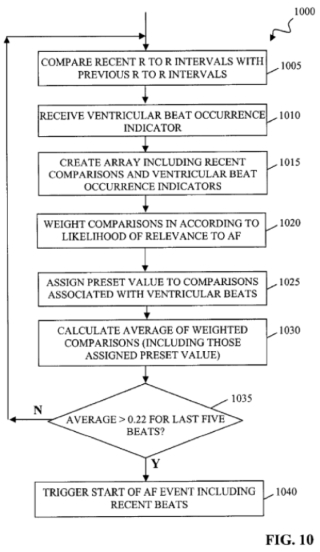
    (where the claim language in italics is recited in independent claim 20 from which claim 22 depends).  The opinion also illustrated the invention with a reproduction of Figure 10*:

    ImageAs the opinion sets forth, the invention permits a clinician to distinguish atrial fibrillation and atrial flutter from other forms of cardiac arrhythmias with regard to "beat-to-beat variability in heart rate over a series of successive heartbeats."  Importantly, the invention achieves its objectives "by analyzing the beat-to-beat timing for atrial fibrillation or atrial flutter while also taking into account the variability in the beat-to-beat timing caused by premature ventricular beats."  As a consequence, "the device can more accurately distinguish atrial fibrillation and atrial flutter from other types of arrythmias and has 'improved positive predictability of atrial fibrillation and atrial flutter," resulting (as set forth in the specification) in "a sensitivity to [these two arrhythmias] in excess of 90% and a positive predictivity in excess of 96%."

    CardioNet asserted claims 1, 2, 3, 7, 10-12, and 22 against Infobionic.  The District Court dismissed CardioNet's complaint under Fed. R. Civ. Proc. 12(b)(6), on the ground that the claims were ineligible for patenting under 35 U.S.C. § 101 as interpreted under the Supreme Court's Mayo/Alice test. The District Court determined that, under step 1 of the test the claims were directed to an abstract idea, that these arrhythmias "can be distinguished by focusing on the variability of the irregular heartbeat."  And under step 2 of the test, the District Court held that "CardioNet 'd[id] not identify improvements to any particular computerized technology'" related to detecting electrical signals relevant to cardiac function.  This appeal followed.

    The Federal Circuit reversed and remanded, in an opinion by Judge Stoll joined in full by Judge Plager and in part by Judge Dyk, who dissented over the terminal portion of the opinion as set forth in further detail below.  The opinion does not start promisingly, citing Athena Diagnostics, Inc. v. Mayo Collaborative Servs., LLC, 915 F.3d 743, 749 (Fed. Cir. 2019), for the standard of review (de novo, with factual issues construed in favor of the non-moving party).  After setting forth the details of the Mayo/Alice test, as well as citing Federal Circuit precedent on how that jurisprudence has been applied, the opinion turned to its assessment of how this jurisprudence should be applied to the claims before it.

    The panel renders its decision on step 1, holding that the claims are not merely directed to an abstract idea.  According to the opinion (which is unanimous on this point), the claims are directed to an improvement in cardiac monitoring technology.  The opinion states:

    [T]he language of claim 1 indicates that it is directed to a device that detects beat-to-beat timing of cardiac activity, detects premature ventricular beats, and determines the relevance of the beat-to-beat timing to atrial fibrillation or atrial flutter, taking into account the variability in the beat-to-beat timing caused by premature ventricular beats identified by the device's ventricular beat detector.

    In the Court's view, the claims "focus" on specific methods for improving this technology, and are not directed to an abstract idea itself or ones that "merely invoke generic processes and machinery."  These conclusions, the opinion maintains, are supported by the written description, the opinion citing portions of the specification directed to "multiple technological improvements" (citations to the specification omitted):

    First and foremost, the device more accurately detects the occurrence of atrial fibrillation and atrial flutter—as distinct from [ventricular tachycardia] V-TACH and other arrhythmias—and allows for more reliable and immediate treatment of these two medical conditions.  . . .  Indeed, the written description reports that when analyzing real-world arrhythmia data, the device demonstrated both high "positive predictivity" of, and high "sensitivity" to, atrial fibrillation and atrial flutter, meaning that it effectively avoids false positives and false negatives, respectively, in detecting these two conditions.  In addition, the device is able to identify sustained episodes of atrial fibrillation and atrial flutter that have "increased clinical significance."

    (The opinion recites additional aspects of the invention in support of its conclusion recited in dependent claims.)

    The opinion cites Federal Circuit precedent consistent with its opinion here, including Visual Memory LLC v. NVIDIA Corp. for the proposition that improvements to computer processing (in Visual Memory, computer memory) could be patent-eligible.  The opinion notes that it was "important to our determination" in favor of patent eligibility in Visual Memory that the specification set forth "advantages offered by" the claimed invention (supplying a seemingly bright-line practice tip to patent prosecutors, at least for now).  The panel found the same type of "advantages" recited in the '207 specification, with the same result regarding patent-eligibility.  The Court found similar support, based on similar analogies, in McRO, Inc. v. Bandai Namco Games Am. Inc. and support for the principle that "patent's written description[ can] inform[] our understanding of the claims" in Chamberlain Grp., Inc. v. Techtronic Indus. Co.

    The panel found the District Court's error in "the incorrect assumption that the claims are directed to automating known techniques" (as InfoBionic argued below and maintained in its arguments to the Federal Circuit).  But "nothing in the record" supports this view nor the fact-finding by the District Court, according to the opinion.  The lower court also erred, in the Federal Circuit's view, in its consideration of the disclosure in the '207 patent specification, where it disregarded CardioNet's attempts to point out the relevant differences between the invention and the prior art.  Part of this error was also procedural, because in considering a motion to dismiss, the District Court was obliged to "construe all facts and draw all reasonable inferences in favor of CardioNet, the non-moving party," which the District Court did not do here.  Finally, the Federal Circuit disagreed that the facts and issues before the court were comparable to the facts and legal determinations in Berkheimer v. HP Inc. and FairWarning IP, LLC v. Iatric Systems, Inc., relied upon by the District Court.

    The opinion then turns to a discussion of the question of whether the Court can decide patent eligibility or must remand to the District Court for factual assessments as to the state of the art and whether the claims are directed merely to automating practices long used by physicians (it is here that Judge Dyk parts company with his brethren).  The panel majority held that step 1 of the Mayo/Alice test is directed to the question of "whether the claims as a whole are 'directed to' an abstract idea, regardless of whether the prior art demonstrates that the idea or other aspects of the claim are known, unknown, conventional, unconventional, routine, or not routine," citing Diamond v. Diehr, 450 U.S. 175, 188–89 (1981) (a holding that puts Diehr and Mayo in direct opposition should the Supreme Court deign to decide the distinctions between the panel majority and Judge Dyk).  The majority opinion then distinguishes the purpose of Section 101 with the other provisions of the patent statute, sub silentio restoring the analysis to the state of the law pre-Mayo.  While acknowledging Judge Dyk's appreciation of statements in both Mayo and Bilski v. Kappos suggesting that the state of the prior art may be relevant, the majority notes that "in neither Bilski nor Alice did the Court rely on an examination of the prior art as part of its step one inquiry."  Instead, the majority cites the intrinsic evidence as the proper source of information for a court to arrive at the answer to step 1 of the Mayo/Alice test for determining patent eligibility.  For the majority, "[t]his court's decision in Enfish, LLC v. Microsoft Corp. . . . confirms this point":  "the Alice step one inquiry in Enfish and our other decisions began, and ended, with the patent itself," according to the majority.  To the extent that there is evidence that the claims recite "longstanding practice where there is no evidence of such practice in the intrinsic record," the majority believes a district court can take judicial notice thereof in appropriate circumstances.  For the majority the question, and its answer, is clear:

    Thus, we simply clarify that step one of the Alice frame-work does not require an evaluation of the prior art or facts outside of the intrinsic record regarding the state of the art at the time of the invention.  Neither Bilski, Alice, nor this court's precedent endorses such an analysis.  [O]ur analysis at Alice step one involves examining the patent claims in view of the plain claim language, statements in the written description, and the prosecution history, if relevant.  . . .  The analysis does not require a review of the prior art or facts outside of the intrinsic record regarding the state of the art at the time of the invention.

    Judge Dyk disagreed.  The Judge rejects the majority's contention that its decision is consistent with Supreme Court and Federal Circuit precedent, and disparages it as mere dicta, not being a basis for the Court's holding here (the dissent cites to the defendant's admission that there were no factual disputes to be resolved on remand).  For this Circuit Judge, the majority's error is "limiting the use of extrinsic evidence to establish that a practice is longstanding," a position that the dissent notes was not taken by either party.  Judge Dyk cites Bilski and Alice specifically for the principle that the Court considered extrinsic evidence concerning the conventionality of claimed methods in determining that claims in these cases were ineligible for being directed to an abstract idea.  The Judge also cites Federal Circuit precedent, including Intellectual Ventures I LLC v. Erie Indem. Co., Affinity Labs of Texas, LLC v. DIRECTV, LLC, 838 F.3d 1253 (Fed. Cir. 2016), Content Extraction & Transmission LLC v. Wells Fargo Bank, Berkheimer, and cases cited by the majority (BASCOM, FairWarning) in support of this position.  In Judge Dyk's view, the Federal Circuit "[has] persistently looked outside the intrinsic evidence" in deciding issues under step 1 of the Mayo/Alice test.  And the Judge finds no authority to support its conclusion that a district court is limited to intrinsic evidence in deciding the question of whether a claim is directed to an abstract ides under step 1 of the Supreme Court's Mayo/Alice test.

    Cardionet, LLC v. Infobionic, Inc. (Fed. Cir. 2020)
    Panel: Circuit Judges Dyk, Plager, and Stoll
    Opinion by Circuit Judge Stoll; opinion dissenting in part and concurring in the result by Circuit Judge Dyk

    * The opinion also contains an explication of some of the technical terms used in the claims; readers are directed to those explanations, which are outside the scope of this post.

  • CalendarApril 21, 2020 – "Dosage Patents in the UK, Europe and Beyond" (J A Kemp) – 15:30 to 16:30 pm GMT

    April 21, 2020 – "International Patent Cooperation Initiatives" (U.S. Patent and Trademark Office) – 12:00 to 1:00 pm (ET)

    April 23, 2020 – "Inequitable Conduct: A Refresher and Update" (Intellectual Property Owners Association) – 2:00 to 3:00 pm (ET)

    April 23, 2020 – "Patent Management: Uncovering Cost-Savings in your Portfolio" (LexisNexis® and IPWatchdog) – 12:00 pm (EDT)

    April 23, 2020 – "Recent PTAB Developments" (Federal Circuit Bar Association) – 3:00 pm to 4:00 pm (EST)

    April 23, 2020 – "Linking an Invention to the Evidence: Strategic Considerations from Prosecution to Litigation" (Fitch Even) – 12:00 pm to 1:00 pm (ET)

    April 28, 2020 – "Gender Diversity in Innovation Toolkit — Virtual Roadshow" (Intellectual Property Owners Association) – 2:00 to 3:00 pm (ET)

  • IPO #2The Intellectual Property Owners Association (IPO) will offer a one-hour webinar entitled "Gender Diversity in Innovation Toolkit — Virtual Roadshow" on April 28, 2020, from 2:00 to 3:00 pm (ET).  Sandra Nowak of 3M Company; Molly Kocialski, Director of the Rocky Mountain Regional Office, U.S. Patent and Trademark Office; Karen Maples of FutureForward; and Andrew Toole, Chief Economist, U.S. Patent and Trademark Office will discuss the USPTO's Progress and Potential Report and gender diversity statistics, the USPTO's new diversity in innovation toolkit, the IPO's Gender Diversity in Innovation Toolkit, and the AUTM University and Tech Transfer Toolkit.  The panel will also examine these various perspectives and discuss how you can use these tools to positively impact the diversity in innovation culture within your organization.

    There is no registration fee for this webinar, and pre-registration is not required.  Those interested in attending the webinar, should click here.

  • USPTO SealThe U.S. Patent and Trademark Office will be offering the next webinar in its Patent Quality Chat webinar series from 12:00 to 1:00 pm (ET) on April 21, 2020.  The latest webinar, entitled "International Patent Cooperation Initiatives," will address how the USPTO is engaged in a variety of worksharing programs and initiatives that bring multiple-office examination efforts together to improve patent examination quality and timeliness while reducing stakeholder costs, including the new Parallel Patent Grant (PPG) program with Mexico, the Collaborative Search Pilot Program (CSP), and Global Dossier.

    Additional information regarding this webinar, including instructions for viewing the webinar via Livestream, can be found here.

  • IPO #2The Intellectual Property Owners Association (IPO) will offer a one-hour webinar entitled "Inequitable Conduct: A Refresher and Update" on April 23, 2020, from 2:00 to 3:00 pm (ET).  William Covey, Deputy General Counsel and Director of the Office of Enrollment and Discipline for the U.S. patent and Trademark Office; David Hricik, Mercer University School of Law; and Warren Woessner of Schwegman Lundberg & Woessner will review the USPTO rules regarding inequitable conduct; discuss important decisions regarding inequitable conduct since Therasense, Inc. v. Becton, Dickinson & Co., including Regeneron, Gilead and GS CleanTech; and address the conflicting pressures patent prosecutors face from the USPTO and clients.

    The registration fee for the webinar is $135 (IPO member) or $150 (non-member) (government and academic rates are available upon request).  Those interested in registering for the webinar can do so here.

  • LexisNexisLexisNexis® and IPWatchdog will be offering a webinar on "Patent Management: Uncovering Cost-Savings in your Portfolio" on April 23, 2020 at 12:00 pm (EDT).  Gene Quinn of IPWatchdog.com and Williams Mansfield of LexisNexis® will discuss how to:

    • calculate the overall annuity fees for your patent portfolio,
    • quickly analyze your's or your competitors’ renewal fees,
    • view annuity fees per year and/or per country,
    • combine annuity fees with other PatentSight indicators, e.g., the Patent Asset Index™, to improve your decision on pruning candidates by analyzing the costs for low quality patents, and
    • forecast budget requirements for each year to maintain annuity fees for all patents.

    There is no registration fee for this webinar.  However, those interested in registering for the webinar, should do so here.

  • Federal Circuit Bar Association_2The Federal Circuit Bar Association (FCBA) will be offering a webcast entitled "Recent PTAB Developments" on April 23, 2020 from 3:00 pm to 4:00 pm (EST).  Christopher Geyer of Appian Corporation will moderate a panel consisting of David Cavanaugh of WilmerHale, Sharonmoyee Goswami of Cravath, Swaine & Moore LLP, and Jonathan Stroud of Unified Patents, Inc.  The panel will address the following topics:

    • Arthrex and what we have learned regarding remands
    • Pointers for remote oral arguments at the PTAB
    • Hulu and its impact

    The webinar is complimentary for FCBA members and students, $50 for government, academic, or retired practitioners, or $175 for private practitioners.  Those interested in registering for the webcast, can do so here.

  • Fitch EvenFitch Even will be offering a webinar entitled "Linking an Invention to the Evidence: Strategic Considerations from Prosecution to Litigation" on April 23, 2020 from 12:00 pm to 1:00 pm (ET).  Mark A. Borsos and Evan Kline-Wedeen of Fitch Even will discuss the following:

    • Establishing a nexus between evidence of commercial success of real-world products and the patented invention
    • Demonstrating a connection between patented features and lost profits
    • Proving there is a causal nexus between irreparable harm and the patented invention that justifies an injunction
    • Drafting claims with forethought to future evidentiary requirements

    While there is no cost to participate in the program, advance registration is required.  Those interested in attending the webinar can register here.

  • By Kevin E. Noonan —

    University of California-BerkleyThe latest installment in the cat-and-mouse game of deciding priority in Interference No 106,155 between Senior Party The Broad Institute, Harvard University, and the Massachusetts Institute of Technology (collectively, "Broad") and Junior Party the University of California/Berkeley, the University of Vienna, and Emmanuelle Charpentier (collectively, "CVC") is CVC's filing of its Miscellaneous Motion No. 2 to Exclude Evidence on April 2nd, and Broad's Opposition to this motion, filed on April 9th.

    The interference rules (41 C.F.R. § 42 et seq.) provide that a party can object to an opponent's evidence including testimony.  Admissibility of evidence is governed by the Federal Rules of Evidence under 41 C.F.R. § 42.152; expert testimony is governed by the Federal Rules and Daubert v. Merrell Dow Pharmaceuticals, 509 U.S. 579, 593-94 (1993).  Here, CVC argues in its brief in support of Miscellaneous Motion No. 2 that four prior art references should not be considered by the Board because they were not cited in any of Broad's papers; declarations from several individuals, including some of Broad's inventors, are inadmissible as hearsay because these individuals had not been made available for deposition; and certain expert testimony fails the Supreme Court's Daubert test for expert testimony admissibility.

    The brief deals summarily with the uncited references, relying on Fed. R. Evid. 403 and 41 C.F.R. § 42.152.2.1 as being irrelevant for being uncited.  Turning to hearsay under Fed. R. Evid. 804, the brief identifies two categories of such inadmissible evidence:  declarations from prior proceedings (significantly, prior Interference No 106,048) that should be excluded according to CVC because the declarants were not made available for cross-examination.  The other category comprises "two expert declarations that recite these hearsay declarations for the truth of the matters asserted therein, and serve as further conduits for presenting the inadmissible hearsay in these declarations."

    With regard to the first category, CVC argues that Broad submitted declarations of three fact witnesses (Drs. Sanjana, Lambowitz, and Zhang) for "the truth of the matter asserted" (specifically, timing and success of experiments by Broad inventors) that were submitted to the U.S. Patent and Trademark Office during prosecution of involved Broad patents (Sanjana, Zhang) or was a third-party declaration (Lambowitz).  CVC maintains that it objected to these declarations and Broad did not make these declarants available for cross-examination and thus their declarations constituted inadmissible hearsay, citing specifically Rose v. Frazer, Inf. No. 104,733 Paper 73 at 4 (B.P.A.I. Mar. 29, 2002), and 37 C.F.R. § 42.51(c).  The brief also cites Praxair Distrib., Inc. v. INO Therapeutics LLC, IPR2015-00529, Paper 33 at 2 (PTAB Dec. 22, 2015, and Mexichem Amanco Holdings S.A. de C.V. v. Honeywell Int'l, Inc., Case IPR2013-00576, Paper 36 at 3 (PTAB Sept. 5, 2014), for the proposition that declaration evidence not subject to cross-examination (or an offer for cross-examination) should not be considered by the PTAB in contested cases.  The brief makes the appropriate representations that CVC requested these declarants be made available for deposition and Broad failed to make them available.  In addition, CVC suggests that the accuracy, if not the veracity, of Dr. Sanjana's declaration testimony was uncertain.

    The second hearsay objection category involves expert testimony that CVC contends is merely a conduit for introducing (improperly) fact rather than opinion testimony.  CVC also argues that certain of the testimony (involving "state of mind" of inventors and others) violates "at least one of FRE 801, 802, and 804" as well as 41 C.F.R. § 42.152.2.1.  This type of testimony is particularly objectionable to CVC because it involved opinions on when Broad scientists possessed the invention and recognized that CRISPR could be performed using eukaryotic cells (certainly important if not dispositive factors involved in this interference).  Such testimony also violates Fed. R. Evid. 702 and 704 according to CVC's brief, which also cites In re Fosamax Prods. Liab. Litig., 645 F. Supp. 2d 164, 192 (S.D.N.Y. 2009); Lopez v. I-Flow Inc., No. CV 08-1063-PHX-SRB, 2011 WL 1897548 at *11 (E.D.N.Y. 2011); Fisher v. Halliburton, No. H-05-1731, 2009 WL 5216949 at *2 (S.D. Tex. Dec. 21, 2009); In re Heparin Prod. Liab. Litig., 803 F. Supp. 2d 712, at *8-9 (N.D. Ohio Mar. 21, 2011); and Hines v. Wyeth, No. 2:04-0690, 2011 WL 2680842 at *7 (S.D. W. Va. July 8, 2011).

    With regard to its "conduit" theory, CVC cites Rule 703 for this principle, that "an expert is permitted to disclose hearsay for the limited purpose of explaining the basis for his expert opinion, but not as general proof of the truth of the underlying matter," citing Fox v. Taylor Diving & Salvage Co., 694 F. 2d 1349, 1356 (5th Cir. 1983), and United States v. Garcia, 793 F. 3d 1194, 1212 (10th Cir. 2015).  CVC specifically alleges that Drs. Seeger, Breaker, and Mirkin merely "[p]arrot[] extrajudicial information for the truth of the matter asserted" in certain portions of their declarations.  Moreover, CVC asserts that permitting Broad to introduce these factual assertions would permit Broad's scientists to enter "unchallengable statements" into the record, and "bootstrap untested evidence as proof of the underlying subject matter."

    As it has in its Replies to Broad's Opposition to CVC's Motions No. 1 and No. 2 for benefit of priority, CVC takes particular issue with the testimony of Dr. Chad Mirkin.  As in those Replies, CVC argues that Dr. Mirkin is not an expert in genetic engineering (CVC asserts his expertise is in nanoparticles) and thus "his opinions are therefore irrelevant and unreliable" and the PTAB should discount his testimony under Daubert.  CVC states that it would be an abuse of discretion for the PTAB to permit Dr. Mirkin's testimony to be considered admissible in this interference, and that the status of an interference as being more in the nature of a bench trial instead of a jury trial does not change these considerations nor abrogate the Board's gatekeeping function.  CVC also contends that Dr. Mirkin's testimony is merely an "improper narrative based on no personal knowledge nor expertise" and hence inadmissible under FRE 602, 701-703, 801, and 802.  Nor should an expert be "an advocate or storyteller" without relevant expertise (which CVC argues Dr. Mirkin does not have), citing In re Rezulin Prods. Liab. Litig., 309 F. Supp. 2d 531, 551 (S.D.N.Y. 2004), and In re Prempro Prods. Liab. Litig., 554 F. Supp. 2d 871, 886 (E.D. Ark. 2008).  "In other words, an expert who merely reads or summarizes documents for the factfinder is not providing helpful testimony because the factfinder is capable of reading and reaching conclusions on its own," according to CVC's brief.  In this case and this witness, according to CVC, "Dr. Mirkin understands the relevant technology only well enough to serve as Broad's mouthpiece, and was unable to answer even the most basic questions about the technology or the evidence that was not part of his prepared statement."  For these reasons, CVC argues that the Board should rule the identified portions of Dr. Mirkin's testimony inadmissible.

    Broad InstituteBroad disagrees, and its brief in opposition makes two broad points.  First, Broad characterizes the evidence objected to as hearsay was submitted merely as a "proffer" to the Board that set forth Broad's arguments to be submitted during the Priority Phase, citing Byrn v. Aronhime, Patent Inf. 105,384 (McK), Paper 64 at 12:17-20 (PTAB Sept. 20, 2006).  Second, Broad asserts that CVC made similar proffers relying on purported hearsay during the '048 Interference; albeit not citing any precedent for such a "tit-for-tat" principle or evidentiary standard, but does use the argument to allege that CVC is being "disingenuous" (as well as being incorrect) for presumably trying to impose a stricter standard on Broad in this interference than was applied to CVC in the earlier '048 interference.

    With regard to the availability vel non of Broad's declarants as a basis for considering their testimony to be hearsay, Broad in its turn dismisses these objection summarily by asserting that CVC never requested depositions of these witnesses.

    Broad asserts it proffer exception to the hearsay rule for the Sanjana, Lambowitz, and Zhang declarations, as well as the Cong 2013 reference.  Broad argues that CVC's hearsay objections "are, at best, premature."  The brief asserts instances in the '048 Interference where CVC made a proffer based on the type of evidence that CVC now objects to as hearsay.  Broad also makes "policy" arguments, citing the impracticality of subjecting to cross-examination "the authors of any exhibit used in a proffer, and even the lawyer explaining the import of those exhibits" which supposedly would be occasioned by CVC's interpretation of admissibility of this evidence.  More persuasively, Broad's brief notes that in the cases CVC cited in support of its objections the PTAB admitted the objected-to evidence but retained the ability to take those objections into consideration when deciding the weight to give to the evidence.  With regard to the Cong reference, Broad makes a related argument, that as a reference the Board is capable of considering it for what it says, citing Rozbicki v. Chiang, Inf. 105,898, Paper 154 at 25 (PTAB June 26, 2013) 10 (explaining that a document is always "admissible as proof of what it says"), as well as falling within the hearsay rule exception set forth in FRE 807 (which, as a reminder, is the "residuary" rule permitting evidence to be considered if (1) the statement is supported by sufficient guarantees of trustworthiness—after considering the totality of circumstances under which it was made and evidence, if any, corroborating the statement; and (2) it is more probative on the point for which it is offered than any other evidence that the proponent can obtain through reasonable efforts).

    One drawback to the proffer argument, and its application to the Priority Phase, is that any such proffer is not being made in the Priority Phase but in the Motions Phase, and particularly with regard to Broad's Motions No. 2 (to substitute the Count), No. 3 (to designate certain claims as not corresponding to the Count), and No. 4 (for priority benefit of U.S. Provisional Application No. 61/736,527).

    Regarding CVC's "conduit for hearsay" argument, Broad relies on its "non-hearsay" distinction based on its proffer argument, and buttresses this argument by the general proposition that an expert can rely on hearsay "[i]f experts in the particular field would reasonably rely on those kinds of facts or data in forming an opinion on the subject" under Fed. R. Evid. 703, citing In re Biogen '755 Patent Litig., No. CV102734CCCJBC, 2018 WL 3613162, at *10 (D.N.J. 6 July 26, 2018).  Regarding CVC's objection to one expert's testimony, Broad asserts that these "ring hollow" because CVC purportedly relied on "similar expert testimony" in the '048 Interference (calling this "a double standard").  The brief also cites as "baseless" CVC's "storyteller" objection, because according to Broad their expert simply relied on "evidence going to key issues."

    Not surprisingly, Broad defends the competence of its expert Dr. Mirkin, noting that his expertise is relevant to eukaryotic applications of CRISPR technology, specifically having to do with technology for introducing proteins and nucleic acids into eukaryotic cells ("Dr. Mirkin is . . . one of the world's foremost experts in the chemistry and use of nanostructures for delivery of proteins and nucleic acids to eukaryotic cells") (although without establishing that such methods were methods used to introduce protein and nucleic acid components of CRISPR into eukaryotic cells).  And the brief reminds the Board of Dr. Mirkin's bona fides, including that "[h]e has published over 740 manuscripts, has been issued over 330 patents, and has been the recipient of over 100 national and international awards for his work in the above-mentioned areas" and that he "is one of very few scientists to be elected to all three US National Academies: the National Academy of Medicine, the National Academy of Sciences, and the National Academy of Engineering."  The brief then goes on to cite case law regarding the (relatively) permissive standards of expert testimony under FRE 702 ("a broad range of knowledge, skill, experience, training, and education [is sufficient] to qualify an expert as such), citing Pineda v. Ford Motor Co., 520 F.3d 237, 244 (3d Cir. 2008); Carnegie Mellon Univ. v. Marvell Tech. Grp., Ltd., 807 F.3d 1283, 1303 (Fed. Cir. 2015); and SEB S.A. v. Montgomery Ward & Co., 18 594 F.3d 1360, 1373 (Fed. Cir. 2010) ("Where an expert's testimony "establishe[s] an adequate relationship between his experience and the claimed invention," the expert will generally be qualified.).

    More specifically and relevant to the question of Dr. Mirkin's competency to testify as an expert in this interference, Broad argues that he was "exceedingly well-qualified" to speak to the question of the difficulties and challenges in adapting CRISPR to eukaryotic cells (a theme Broad developed successfully to convince the Board in the '048 Interference that there was no interference-in-fact).  Dr. Mirkin testified on this point expressly in his deposition, reproduced in the brief:

    I think ultimately the basis of my expertise is the work that I do generally in the development of nucleic acid and protein-based medicines and an understanding,  perhaps a unique understanding, of the challenges associated with taking those types of constructs into cells and getting them to function properly.

    (put more succinctly, testifying that his lab had developed over "decades" "a series of platforms . . . that are extremely good at moving nucleic acids and proteins into cells").  Because the ability to introduce the components of CRISPR-Cas 9 were "some of the greatest challenges with respect to [eukaryotic applications of] CRISPR" this expertise qualified him "to opine on whether a POSA would have understood CVC to have had possession in 2012 of a CRISPR-Cas9 system engineered to perform effectively in the complex environment of a eukaryotic cell."

    Broad addressed directly the "storytelling" argument regarding Dr. Mirkin asserted by CVC in its brief, contending that his "application of his experience to an extensive review of the relevant scientific facts and data" was permissible for expert testimony.  And as for the specific deficiencies CVC asserts Dr. Mirkin demonstrated on particular questions relating to CRISPR technology in his deposition, Broad argues that this is a mischaracterization of his testimony and/or takes his testimony out of context (issues the Board will be able to determine for itself).

    On balance, Broad set forth a robust defense of the qualifications of its expert witness, and it seems unlikely that the Board will rule his testimony inadmissible.  What remains unclear is the extent to which CVC's disparagements of Dr. Mirkin's general competence in CRISPR technology and deficiencies on specific points will cause the Board to diminish the weight it gives to his testimony.