• Morningside IPMorningside IP and IPWatchdog will be offering a webinar on "COVID-19's Impact on IP in 2020 & Beyond" on April 30, 2020 starting at 12:00 pm (EDT).  Carlo Cotrone of Techtronic Industries North America (TTI), Kirk Goodwin of Whirlpool, and Gene Quinn of IPWatchdog will discuss the ramifications of COVID-19 on IP moving forward, what the immediate future looks like for law firms and corporations, and the ways in which patent filing strategies will be impacted.  Additional information regarding the webinar can be found here.

    There is no registration fee for this webinar.  However, those interested in registering for the webinar, should do so here.

  • By Kevin E. Noonan —

    University of California-BerkleyOn April 17th, CVC filed its Reply to Broad's Opposition (filed on April 9th) to CVC's Miscellaneous Motion No. 2 to Exclude Evidence filed (on April 2nd), in Interference No 106,115 between Senior Party The Broad Institute, Harvard University, and the Massachusetts Institute of Technology (collectively, "Broad") and Junior Party the University of California/Berkeley, the University of Vienna, and Emmanuelle Charpentier (collectively, "CVC").

    In its brief in support of its Miscellaneous Motion No. 2, CVC argued that four prior art references should not be considered by the Board because they were not cited in any of Broad's papers; declarations from several individuals, including some of Broad's inventors, are inadmissible as hearsay because these individuals had not been made available for deposition; and certain expert testimony fails the Supreme Court's Daubert test for expert testimony admissibility.

    Broad opposed, and its brief made two broad points.  First, Broad characterized the evidence objected to as hearsay was submitted merely as a "proffer" to the Board that set forth Broad's arguments to be submitted during the Priority Phase, and that Broad asserted that CVC made similar proffers relying on purported hearsay during the '048 Interference.  Broad asserted it proffer exception to the hearsay rule for the Sanjana, Lambowitz, and Zhang declarations, as well as the Cong 2013 reference and that CVC's hearsay objections "are, at best, premature."  Not surprisingly Broad defended the competence of its expert Dr. Mirkin, noting that his expertise is relevant to eukaryotic applications of CRISPR technology, specifically having to do with technology for introducing proteins and nucleic acids into eukaryotic cells.

    In its Reply, CVC argues that Broad had not rebutted CVC's hearsay arguments and challenges the authority Broad cited, Byrn v. Aronhime, Patent Inf. 105,384 (McK), Paper 64 at 12:17-20 (PTAB Sept. 20, 2006), as being directed to the narrow context of a motion to change a count.  While not acquiescing that its hearsay arguments might not be persuasive regarding Broad's Motion No. 2, CVC maintained that hearsay precluded the Board from considering this evidence for Broad's Motion No. 3 and Motion No. 4, or Broad's Oppositions to CVC's Motion No. 1 and Motion No. 2 (for the benefit of priority).  CVC supports its arguments with citations from Broad's Motions No. 3 and 4 and how Broad asserted the evidence CVC objected to in its Miscellaneous Motion No. 2 in support of its Substantive Motions and Oppositions to CVC's Substantive Motions.  CVC argues that "[n]othing in the statutes, rules, or case law authorizes a movant to rely on inadmissible evidence to support Motions and Oppositions related to priority benefit or de-designating claims.  To the contrary, motions must be supported by evidence, and the admissibility of that evidence may be challenged in a motion to exclude," citing SO ¶¶ 121.4.1; 152.2.1; 155.2.2.  Moreover, CVC argues that the evidence it objects to was offered for the truth of the matter asserted and thus inadmissible hearsay and not, as Broad argues merely a proffer of the evidence Broad might prove.

    CVC also rebuts Broad's "tit-for-tat" argument that CVC itself had relied on similar evidence in the earlier Interference No. 106,048, by distinguishing that evidence as "a proffer of CVC's best proofs to support a motion to change the count," citing Univ. of S. Calif. v. DePuy Spine, Inc., Patent Interference 105,653, Paper 169 (PTAB 2013).  CVC also asserts that unlike its allegations against Broad in its brief in support of its Miscellaneous Motion to Exclude, its affiant was made available for deposition.

    With regard to Broad's expert, CVC characterizes Broad's statements in its Opposition brief as overstating Dr. Mirkin's expertise.  The brief reiterates the differences in Dr. Mirkin's area(s) of expertise ("Broad has failed to show that Dr. Mirkin's experience with gold and silver nanoparticles somehow makes him an expert on the technical issues relevant to CVC's priority benefit") and lack of specific expertise in CRISPR technology:

    Dr. Mirkin's CV and cross-examination testimony demonstrate he has no specialized expertise regarding CRISPR systems or gene editing.  Tellingly, he has never even published a single paper on CRISPR systems, or even used CRISPR himself.  At deposition, Dr. Mirkin could not answer basic questions about how CRISPR-Cas9 systems actually function in eukaryotic cells.

    For these reasons CVC reiterates its argument that Dr. Mirkin's testimony should be excluded.

  • Calendar

    April 28, 2020 – "Gender Diversity in Innovation Toolkit — Virtual Roadshow" (Intellectual Property Owners Association) – 2:00 to 3:00 pm (ET)

    April 28, 2020 – "Innovation Triage: Identifying What is Ripe to Pursue Today" (IP.com and IPWatchdog) – 12:00 pm (EDT)

    April 28, 2020 – "All You Need to Know About Functioning of Eurasian, Russian and Ukrainian Patent Offices and Judiciary Systems During Coronavirus Pandemic"(Gorodissky & Partners) – 09:00 to 09:30 (BST) (session 1) or 12:00 to 12:30 (EST) (session 2)

    April 28, 2020 – "Industry Ideas & Trends Roundtable Amidst COVID-19" (Intellectual Property Law Association of Chicago Trademark & Anti-Counterfeiting Committee) – 12:00 to 1:00 pm (CT)

    April 30, 2020 – "Using Patent Landscapes to Develop IP Rich Products and Valuable Patent Positions" (Schwegman Lundberg & Woessner) – 12:00 pm (CT)

  • IPcomIP.com and IPWatchdog will be offering a webinar on "Innovation Triage: Identifying What is Ripe to Pursue Today" on April 28, 2020 starting at 12:00 pm (EDT).  Arvin Patel of TiVo, Kirk Goodwin of Whirlpool, Gene Quinn of IPWatchdog, and Jim Durkin of IP.com will focus on identifying and pursuing innovations in a cost-effective manner.  Additional information regarding the webinar can be found here.

    There is no registration fee for this webinar.  However, those interested in registering for the webinar, should do so here.

  • GorodisskyGorodissky & Partners will be offering a webinar entitled "All You Need to Know About Functioning of Eurasian, Russian and Ukrainian Patent Offices and Judiciary Systems During Coronavirus Pandemic" on April 28, 2020 from 09:00 to 09:30 (BST) (session 1) or 12:00 to 12:30 (EST) (session 2).  Yury Kuznetsov and Maksym Bocharov of Gorodissky & Partners will provide an overview on the modes in which the Eurasian, Russian, and Ukrainian Patent Offices, as well as national judiciaries, continue to function despite the business shutdown due to the COVID-19 quarantine in Russia and Ukraine, including explaining the availabilities of term extensions and restoration, and providing practical advice to those seeking patent and trademark protection in these jurisdictions.

    While the webinar is free, attendees must register in advance.  Those wishing to register can do so here.

  • IPLACThe Intellectual Property Law Association of Chicago (IPLAC) Trademark & Anti-Counterfeiting Committee will be presenting an "Industry Ideas & Trends Roundtable Amidst COVID-19" on April 28, 2020 from 12:00 to 1:00 pm (CT).  Those interested in registering for the online Zoom meeting should e-mail Karen S. Hwang at khwang@kshlawgroup.com.

    Additional information regarding the online roundtable can be found here. 

  • Schwegman Lundberg Woessner_newSchwegman Lundberg & Woessner will be offering a webinar entitled "Using Patent Landscapes to Develop IP Rich Products and Valuable Patent Positions" on April 30, 2020 starting at 12:00 pm (CT).  Steve Lundberg of Schwegman Lundberg & Woessner will moderate a panel consisting of Micky Minhas of Marconi and Janal Kalis, Andre Marais, and Mark Stignani of Schwegman Lundberg & Woessner.  The panel will discuss the basic content of a patent landscape and the best practices for putting one together.

    While there is no cost to participate in the program, those interested in attending the webinar can register here.

  • By Kevin E. Noonan —

    Broad InstituteOn March 23rd Senior Party The Broad Institute, Harvard University, and the Massachusetts Institute of Technology (collectively, "Broad") filed its Reply to Junior Party the University of California/Berkeley, the University of Vienna, and Emmanuelle Charpentier (collectively, "CVC") Motion No. 4 in Opposition to Broad's Substantive Motion No. 4 for priority to U.S. Provisional Application No. 61/736,527.

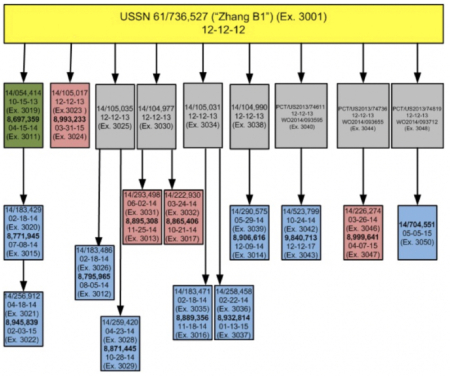
    Broad in its substantive Motion No. 4 argued that it had satisfied the standard for priority to USSN 61/736,527 to Zhang (termed "Zhang B1" in the motion).  The following diagram, showing the interrelatedness of the various Broad patents and applications in the interference, illustrates this:

    Image 1
    According to Broad, Zhang B1 "provides working examples and embodiments that meet each and every limitation of both halves of Count 1" and thus evinces to the skilled worker possession of an embodiment within the scope of the Count.

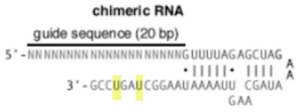
    In its Opposition, CVC argued that Broad's disclosure was not enabled because it relies exclusively on a 'chimeric guide RNA' that a [person of ordinary skill in the art or] POSA could not have made and used in a cell without undue experimentation."  This argument focuses (as the Broad did in its brief) on "Embodiment 17" (E17), wherein a chimeric guide RNA is expressed by a cell comprising both U and T bases:

    Image 2According to CVC, there is no evidence that a chimeric guide RNA could be made inside a cell wherein T bases are incorporated using an RNA polymerase at specific positions, and thus embodiments comprising such chimeric guide RNA would not have been enabled as of the December 12, 2012 filing date of the Zhang B1 provisional application.

    In its Reply, Broad argues that the skilled worker would have interpreted the "T's" in the sequence to be "U's" (a difficult argument to sustain, in view of the plethora of U bases in the diagram).  Broad argues that describing Figure 2A as an RNA would have supported that interpretation (despite the contra designation as a "Chimeric guide RNA") and further states that Figures 12B and 8 would support this interpretation.  The brief is on firmer ground in arguing that the skilled worker would recognize that the disclosed vector would naturally produce the guide RNA having U's instead of T's:

    Image 3
    And (backtracking a bit) Broad then argues that reciting these T's was a "typo" that no one ever complained about.

    Secondarily, the brief argues that even if Figure 2A did not enable the E17 example, the disclosure in Figure 12B (which contained U's instead of T's) did so:

    Image 4As a third line of argument, the brief states that the skilled worker would know how to make a chimeric guide RNA comprising T bases as shown in Figure 2A.  Finally, the brief argues that CVC's assertion that a Certificate of Correction would not be proper is not relevant to its Motion (but, of course, could be should Broad file such a Certificate) and that anything arising after 2012 is also not relevant to the issue before the Board but in any event is not contrary to its argument that Figure 2A contains a typo.

    Turning to the specific arguments asserted by Broad in its response, there are three.  First, Broad argues that Figure 2A consistently describes what is depicted as being an "RNA molecule" (emphasis in brief).  Thus, according to Broad, the skilled worker would recognize that the T's depicted in the Figure should be (or would be) U's, stating (somewhat disingenuously) "to the extent he or she even noticed there were two 'Ts' instead of "U" bases."  The brief cites CVC's understanding in the earlier interference (No. 106,048) as considering the T's in Figure 2A to be U's, but except for attempting to attack CVC's credibility (calling it "CVC's 180-degree shift") does not effectively rebut CVC's argument in this interference (although its argument that throughout all the other proceedings concerning these patents and the presence of this Figure in Broad's Cong 2013 Science publication this issue has not arisen does have some persuasive punch).  The brief also cites Microbiology for Dummies in support of its argument that the skilled worker would have appreciated the explicit disclosure in Figure 2A to be a "typo."

    Second, Broad argues that the disclosure of Figures 12B and 8 remedy any deficiencies in Figure 2A (under the principle of the totality of the disclosure), because those Figures do not recite T's instead of U's ("the typos" according to the brief) and are related to the same example of eukaryotic applications of CRISPR (termed E17).  The brief reproduces Paragraph [00176] of the Zhang B1 provisional application in illustration of this argument:

    Image 5
    And third, even these "typos" do not thwart enablement, because the skilled worker "would know" how to make a chimeric RNA comprising T's instead of U's (although that knowledge is not expressly disclosed in the Zhang B1 provisional but rather is in the prior art, presumably).

    Importantly, Broad sets forth an argument that it has not waived this issue by not raising it in its opening brief, which has some justice in light of Broad's argument that this issue has not arisen In any of the prior proceedings (before the Patent Office and elsewhere) nor in any scientific or academic contexts, saying "Broad was not required to respond in advance to every potential argument CVC may make for lack of benefit, no matter how far-fetched . . . ."

    Finally, while relying on these arguments, Broad contends that the continued prosecution post-2012 of applications containing Figure 2A reciting T's instead of U's is irrelevant to the issue before the Board, because these applications were not available to the skilled worker in 2012.  Broad gets more traction in pointing out that an example cited by CVC of the PTO requiring correction of a Figure in later application corresponding to Figure 2A in the Zhang B1 application was not related to the presence of T's in a purported RNA molecule but rather a formality regarding the presence of sequence ID numbers.  And the designation in the sequence listing that what was depicted in Figure 2A as a "Combined DNA/RNA molecule" as constituting a Broad admission was effectively countered by Broad noting that this designation was mandated by PTO sequence listing rules.

    Of all the papers filed so far in this interference, in some ways Broad Motion No.4, CVC's Opposition and Broad's Reply pose some of the more interesting questions for the Board to decide, particularly because of the effect that decision could have on which party is the Senior Party and entitled to all the benefits of Senior Party status.

  • By Kevin E. Noonan —

    Broad InstituteOn March 23rd, Senior Party The Broad Institute, Harvard University, and the Massachusetts Institute of Technology (collectively, "Broad") filed its Reply to Junior Party the University of California/Berkeley, the University of Vienna, and Emmanuelle Charpentier (collectively, "CVC") Motion No. 3 in Opposition to Broad's Substantive Motion No. 3 to de-designate claims as not corresponding to Count 1.

    In its Motion No. 3, the Broad reiterated the arguments made in Motion No. 2, that there are two embodiments of CRISPR, one involving single-molecule RNA guide RNA (which the Broad argues here is not recited in the claims it wants the Board to designate as not corresponding to the Count) and further that certain of the Broad's claims directed to "SaCas9" systems that require two or more NLSs do not correspond to the Count.

    The brief parsed the Broad's claims into three categories of claims that do not correspond to the Count, depending on how the Board rules on Substantive Motions Nos. 1 and 2:

    • USP 8,865,406 – Claims 1-30 (all); 8,871,445 – Claims 1-30 (all); USP 8,889,356 – Claims 1-30 (all); USP 8,932,814 – Claims 1-30 (all); USP 8,945,839 – Claims 1-28 (all); USP 8,993,233 – Claims 1-43 (all); USP 8,999,641 – Claims 1-28 (all); USP 8,697,359 – Claims 1-3, 5-10, 12-17, and 19-20; USP 8,771,945 – Claims 1-4 and 6-29; USP 8,895,308 – Claims 1-9 and 11-28; USP 8,906,616 – Claims 1, 3-4, 6-30; USP 9,840,713 – Claims 1-7, 10-15, 17-26, and 28-41; and U.S. Patent Application No. 14/704,551: in the event that the Board denies both Motions No. 1 and 2

    • USP 8,865,406 – Claims 1-30 (all) and USP 8,895,308 – Claims 1-30 (all): in any event, claims reciting Ca9 from Staphylococcus aureus

    • USP 8,871,445 – Claims 1-30 (all); USP 8,932,814 – Claims 1-30 (all); USP 8,993,233 – Claim 7; USSN 14/704,551 – Claims 9-11: clams reciting two or mote nuclear localization signal

    And what would remain, should the Board grant this motion:

    • U.S. Patent No. 8,697,359, claims 4, 11, and 18; U.S. Patent No. 8,795,965, claims 1-30 (all); U.S. Patent No. 8,771,945, claim 5; U.S. Patent No. 8,906,616, claims 2 and 5; and U.S. Patent No. 9,840,713, claims 8-9, 16, and 27

    Regarding the first set of claims the Broad asserted do not correspond to Count No. 1, the Broad argued that the Count of the interference as declared is directed to "single-molecule guide RNA molecule"-comprising embodiments and the claims it has asked the Board to designate as not corresponding to the Count do not encompass these embodiments.  The brief set forth the Broad's understanding that, should the Board deny the Broad's Substantive Motions Nos. 1 and 2, then the interference will involve priority to such single-molecule guide RNA embodiments as a separate, patentable invention over claims that encompass both single-molecule and dual molecule embodiments.  Under PTAB Rule 207(b), the Board provides relief to an inventor of a generic claim facing a specific count to move, as the Broad has done here, for their generic claims to be designated as not corresponding to the Count.  Thus, the Broad argued that its claims limited to dual-molecule embodiments do not correspond to the Count and the Board should so designate.

    The Broad also argued that its claims to SaCas9 embodiments and to claims requiring two or more nuclear localization sequences (NLS's) do not correspond to Count 1.  The Broad argued that these embodiments were not disclosed in the prior art and "provide[] a surprising combination of benefits not taught or suggested by the art" for both types of embodiments.

    In its Opposition, CVC argued that the Board should decide the issue under Rule 207(b)(2):

    A claim corresponds to a count if the subject matter of the count, treated as prior art to the claim, would have anticipated or rendered obvious the subject matter of the claim.  37 C.F.R. §41.207(b)(2).

    CVC argued that this Rule gave the Board ample reason to deny Broad's Motion No. 3; in addition CVC argued that Broad had not satisfied the burden set forth in 37 C.F.R. §§ 41.121(b) and 41.208(b) that it was entitled to the relief requested.  And CVC argued that the Broad will not be able to meet this burden because a claim to a species (single-molecule guide RNA CRISPR embodiments) anticipates a claim to a genus (generic-guide RNA CRISPR embodiments), citing In re Gostelli, 872 F.2d 1008 (Fed. Cir. 1989).

    CVC also argued that Broad could not rely on its experts' testimony because these experts did not review documentary evidence supporting the Broad's assertions that the Broad inventors practiced generic-guide RNA CRISPR in 2011 (prior to CVC's earliest priority date), as the Broad alleges in its motion.

    And with regard to the Broad's arguments concerning S. aureus Cas9 claims and claims reciting multiple nuclear localization signal (NLS), that the Broad argued should be de-designated as not corresponding to Count 1, CVC made its case that these proteins were known in the art and their smaller size and capacity to be introduced using adeno-associated virus (AAV) vectors would have motivated a person of ordinary skill in the art to use them for eukaryotic CRISPR and further that there would be a reasonable expectation of success in doing so.  CVC also made a detailed case with regard to why the SaCas9 species are not patentably distinct, as well as similar arguments regarding CRISPR embodiments comprising multiple NLS species.

    Broad in its Reply argues that CVC did not address the "unfairness" of maintaining designation of certain of its claims as identified in its Motion No. 3 as corresponding to Count 1.  Broad argues that designating generic claims to what it maintains is a "single-molecule" guide RNA-reciting Count is unfair and Broad should not be made to present a full priority showing. Broad argues that "CVC seeks to prevent the PTAB from making any priority determination as 3 to who invented the generic RNA eukaryotic CRISPR invention first" while at the same time opposing Broad Motion No. 3, which inter alia seeks to remove Broad's generic guide RNA claims from the Interference.  Broad argues that the Board denying Broad's Motion Nos. 2 and 3 "would be unjust, unfair, and illogical" and that "CVC's arguments to the contrary fail in every respect."  As a consequence, according to Broad, the Board could award priority for generic guide RNA claims to the party (in Broad's opinion, CVC) that was not (in Broad's opinion) the first to invent uses of CRISPR in eukaryotic cells.

    The brief further argues that whether Broad performed dual-molecule guide RNA experiments before CVC (which it asserts its inventors did) is not relevant to the fairness question.  The brief characterizes CVC's Opposition to require Broad to make a "full priority showing" to prevail in its Motion No. 3, which Broad argues is not the proper place and that, "if the Interference proceeds with Count 1 only, Broad will never be permitted to make such a showing during the priority phase as to the generic invention."  "Broad should not be at risk of losing those generic claims if it is not allowed to show priority as to the generic invention," according to the Reply brief.

    Procedurally, Broad argues that CVC did not address the contingent nature of Broad' Motion No. 3, which the Board will only consider if it determines that the generic guide RNA and single-molecule guide RNA embodiments are separately patentable.  And, reiterating its unfairness theme, the brief asserts that "[i]f there is no patentable distinction, but the interference still proceeds with Count 1, Broad would be precluded from relying on its dual-molecule proofs that fall within the scope of the single invention at issue."

    As it has done in other Replies, Broad asks the Board to reject what it terms "attorney argument" made by CVC regarding Broad's early single molecule work.  This includes CVC's argument (as Broad interprets it) that the early experiments performed by Broad inventors used single-molecule guide RNA, which Broad disputes based on Inventor Zhang's declaration and the factual allegations contained therein (as it did in its Reply to CVC's Opposition to Motion No. 2, the brief contains this illustration from Dr. Zhang's declaration, which Broad argues shows that its inventors' earliest experiments applying CRISPR to eukaryotic cells employed dual-molecule guide RNAs:

    Image
    Addressing the contingencies regarding the Board's consideration of Broad's Motion No. 2 to substitute the Count, by arguing that in any event Broad's generic guide molecule claims identified in its Motion should not correspond to either Count.

    Regarding CVC's invocation of Rule 207(b)(2), Broad argues that the Rule is not inflexible but raises a presumption (by the plain language of the Rule) that can be and has been rebutted in this case.  The brief disputes CVC's "rigid" interpretation of the Rule, rejects application of Executive Orders cited by CVC in its opposition, and accuses CVC of itself relying on the rebutability of the Rule 207 presumption on its own behalf.  The brief challenges CVC's assertions in this regard that CVC's own prior statements were made in the context of a two-count interference and that Broad's claims are all limited to single-molecule CRISPR systems.

    Finally, Broad argues that neither SaCas9 nor claims reciting two or more NLSs are obvious over the prior art.

  • By Kevin E. Noonan —

    Broad InstituteOn March 23rd Senior Party The Broad Institute, Harvard University, and the Massachusetts Institute of Technology (collectively, "Broad") filed its Reply to Junior Party the University of California/Berkeley, the University of Vienna, and Emmanuelle Charpentier (collectively, "CVC") Motion No. 2 in Opposition to Broad's Substantive Motion No. 2 to Substitute the Count.

    Broad's proposed Count 2 is:

    A method, in a eukaryotic cell, of cleaving or editing a target DNA molecule or modulating transcription of at least one gene encoded by the target DNA molecule, the method comprising:
        contacting, in a eukaryotic cell, a target DNA molecule having a target sequence with an engineered and/or non-naturally-occurring Type II Clustered Regularly lnterspaced Short Palindromic Repeats (CRISPR)-CRISPR associated Cas) (CRISPR-Cas) system comprising:
            a) a Cas9 protein, and
            b) RNA comprising
                i) a targeter-RNA that is capable of hybridizing with the target sequence of the DNA molecule or a first RNA comprising (A) a first sequence capable of hybridizing with the target sequence of the DNA molecule and (B) a second sequence; and
                ii) an activator-RNA that is capable of hybridizing to the targeter-RNA to form an RNA duplex in the eukaryotic cell or a second RNA comprising a tracr sequence that is capable of hybridizing to the second sequence to form an RNA duplex in the eukaryotic cell,
        wherein, in the eukaryotic cell, the targeter-RNA or the first sequence directs the Cas9 protein to the target sequence and the DNA molecule is cleaved or edited or at least one product of the DNA molecule is altered.

    The distinction Broad made was between embodiments of CRISPR methods that are limited to "single-molecule guide RNA" (aka "fused" or "covalently linked" species), versus embodiments that encompass single-molecule and "dual molecule" species (wherein in the latter versions, the "targeter-RNA" and "activator-RNA" as recited in the proposed Count are not covalently linked).  Broad argued that its Proposed Count 2 should be adopted by the Board because it "properly describes the full scope of the interfering subject matter between the parties because both parties have involved claims that are generic, non-limited RNA claims."  The brief also argued that Proposed Count 2 "sets the correct scope of admissible proofs [i.e., their own] for the breakthrough invention described by the generic claims at issue in these proceedings—the successful adaption of CRISPR-Cas9 systems for use in eukaryotic environments," which Broad contended current Court 1 (in either alternative) does not.

    Broad's argument in support of its motion was that Count 1 is too narrow for encompassing just a subset of the parties' involved claims.  In particular, the brief asserted that most of Broad's involved clams encompass "non-limited" RNA systems and methods.  Similarly, the brief argued that CVC itself has many claims directed to non-limited RNA systems and methods and has entire applications that do not recite claims to non-limited RNA systems and methods.  Broad asserted that Count 1 does not permit Broad to rely on its earliest and best proofs of invention, which the brief stated is "plainly unfair."  This unfairness would preclude Broad from establishing what the brief termed "the fundamental breakthrough – the invention of use of CRISPR in eukaryotic cells" (emphasis in brief).  Failing to substitute the Count would instead improperly focus the priority question on who invented the single molecule modification.  Colorfully, the brief declared that "[a]llowing the interference to proceed with Count 1 would permit the (single molecule RNA) tail to wag the (breakthrough use of CRISPR in eukaryotic cells) dog."

    CVC in its Opposition argued that Proposed Count 2 "goes far beyond converting Count 1 into a generic-guide count."  Instead, according to CVC, "it transforms Count 1 into a method so broad that it no longer requires formation of the DNA-targeting complex that includes crRNA, tracrRNA, and Cas9."  In addition, according to CVC, Proposed Count 2 does not require that the CRISPR-Cas9 complex even have an effect on the target DNA; rather, it recites that "'a product of the DNA' is altered in some unspecified way" (emphasis in brief), which could include (according to CVC) "alterations to RNA or protein caused by processes that are unrelated to the activity of CRISPR-Cas9" including contamination.  And the changes the Broad has effected in Proposed Count 2 "have nothing to do with whether the RNA limitation is single-molecule or generic, Broad's only purported reason for needing a new count" according to CVC.

    CVC further argued that the Broad's motion is contrary to the provisions of precedential Board decision, Louis v. Okada, 59 U.S.P.Q.2d 1073 (B.P.A.I. 2001).  Under Louis, a party must satisfy a three-prong test:  "'(1) should make a proffer of the party's best proofs, (2) show that such best proofs indeed lie outside of the scope of the current count, and (3) further show that the proposed new count is not excessively broad with respect to what the party needs for its best proofs.'"  CVC's position (explicated in the brief) is that the Broad failed to provide what Louis required for the "significant alterations" made to Count 1 resulting in Count 2.

    The brief summarizes these unnecessary changes as:

    • "first, Broad has inexplicably eliminated structural and functional limitations that specify the formation of the three-component DNA-targeting complex that includes crRNA, tracrRNA, and Cas9."

    • "Second, Broad has inexplicably eliminated the requirement that this complex have activity with effects at the DNA level (e.g., cleaving or editing or modulating transcription of DNA).  Rather, Proposed Count 2 encompasses merely altering a "productof the DNA molecule" in unspecified ways. Problematically, this breadth includes alterations to downstream products of DNA, such as RNA and protein, that have nothing to do with the activity of the CRISPR-Cas9 system."

    • "Third, Broad has inexplicably converted Count 1 from a 'cell' or 'system' to a 'method.'"

    • "Fourth, Broad has inexplicably eliminated the alternative language in CVC's part of Count 1 reciting 'ora nucleic acid comprising a nucleotide sequence comprising . . . .'"

    CVC further asserts that the Broad has not shown that Proposed Count 2 is patentable over the prior art.

    In its Reply, Broad asserts that CVC did not dispute that the "major advance" at issue is which party invented successful CRISPR in eukaryotic cells, and that this "breakthrough" was not limited to single RNA embodiments of the technology.  The brief asserts that current Count 1 "precludes reliance on dual-molecule proofs" (unfairly to Broad) but at the same time this Count "puts at risk all of Broad's claims," which might be considered paradoxical until it is realized that Broad submitted other Motions asking that many if not most of Broad's claims would not correspond to Proposed Count 2.

    The brief characterizes CVC's arguments as "nitpick[ing]" and alleges that in CVC's interpretation CRISPR as recited in Count 1 is "so broad it no longer requires a targeting complex that includes crRNA, tracrRNA, and Cas9" (an interpretation that CVC's expert allegedly does not share, which would be curious at least).  But even though Broad characterizes these nitpicks as "immaterial" it states that "addressing them would require only small adjustments that could easily be adopted sua sponte by the PTAB."  With regard to CVC's purported attempt to limit the scope of the interference to single-molecule embodiments, Broad also asserts that CVC argued that Broad's 2011 experiments were limited to such embodiments, again arguing that CVC's expert testified to the contrary and characterizing CVC's assertions as being "only attorney argument."  The basis for CVC's incorrect arguments in this regard Broad asserts to be an incorrect interpretation of the term "guide RNA" as being limited to single-molecule RNA species.

    Broad's synopsis of its reasons for its Motion No. 2 should be granted is:

    Broad requests the PTAB to adopt Proposed Count 2 to ensure that, should this interference go forward, claims directed to the broad invention of use of CRISPR-Cas9 in eukaryotic cells, as at issue here, are awarded to the party that first invented use of CRISPR-Cas9 in eukaryotic cells.  CVC seeks an interference where claims to use of CRISPR-Cas9 in eukaryotic cells (regardless of type of RNA used) are awarded not to the first inventor of that subject matter, but rather to the party that first created one specific embodiment for which CVC believes it has the best proofs (a single-molecule RNA embodiment).  Failing to substitute a generic count for Count 1 would be unjust to Broad and antithetical to the purpose of the Interference, to determine "which of the competing parties was the first to invent the duplicative subject matter."  Eli Lilly & Co. v. Bd. of 15 Regents of Univ. of Wash., 334 F. 3d 1264, 1267 (Fed. Cir. 2003) [all emphasis in brief].

    Turning to specific arguments against particular features of CVC's brief with which Broad takes issue, the brief (as it must) cites these particular arguments chapter and verse (or more accurately, page and line).  The first is that all Broad's claims are directed towards single-molecule embodiments, supported according to Broad solely by attorney argument.  Broad argues that both parties have involved claim "indisputably directed to generic RNA guides" (i.e., both single- and dual-molecule guide RNA embodiments).  Broad asserts that CVC's misinterpretation of "guide RNA" ignores the plain meaning and "misreads the intrinsic evidence," despite (according to Broad) the use of the term in the Jinik 2012 reference (which Broad states was "perhaps the most important CRISPR publication up to that point and widely read by skilled artisans") as referring to the naturally occurring guide RNA.  Broad also asserts that CVC misinterpreted disclosure in its involved patent, which disclosure "does not rise to an 'expression of manifest exclusion or restriction, representing a clear disavowal of claim scope,'" citing Thorner v. Sony Computer Entertainment America LLC, 669 F.3d 1362, 1366 (Fed. Cir. 2012).

    The brief also broadly characterizes CVC's criticisms of Proposed Count 2 as "baseless" regarding the four "alleged" differences that "have nothing to do with the single-molecule format of the RNA."  Broad says in response that its Proposed Count 2 is "materially the same" as current Count 1 with regard to these four aspects, enumerating the its differences with CVC's interpretation for each:

    • First, that Proposed Count 2 requires contacting a DNA target with all three components of the CRISPR system (Cas9, crRNA, and tracrRNA) (citing "specific language" of Proposed Count 2 in support);

    • Second, that Proposed Count 2 requires the occurrence of effects at the target DNA ("cleaving or editing or modulating transcription of DNA") (again relying heavily on CVC's expert's testimony purportedly contrary to CVC's arguments);

    • Third, that the change from "cell" or "system" in Count 1 to "method" is "immaterial":

    • Fourth, that eliminating language in Count 1 from Proposed Count 2, recited in the alternative, "a nucleic acid comprising a nucleotide sequence" does not narrow the Count.

    Broad also argues that CVC's allegation that Proposed Count 2 is broader than the claims in interference is "based on its erroneous interpretation" of the Proposed Count, which is that the Count does not require tracr RNA (which Broad asserts it does).

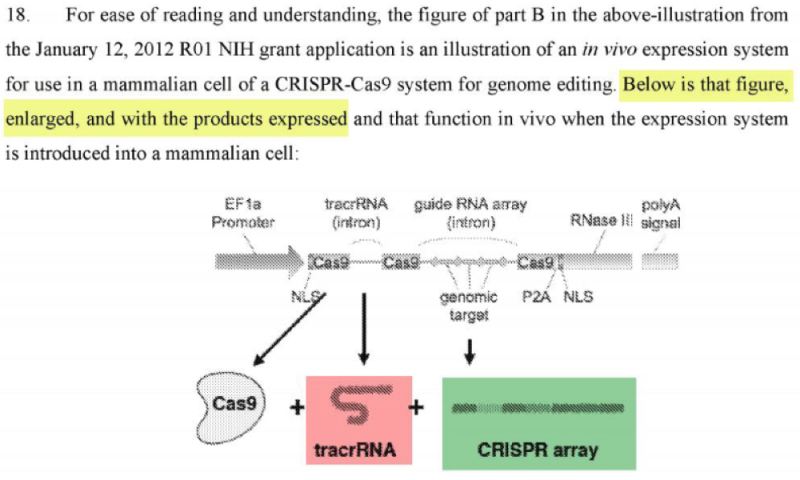
    With regard to Broad's burden in being granted the relief requested by the PTAB, Broad argues that CVC's challenge regarding Broad's "best proofs" corresponding better to Proposed Count 2 than the current Count are "legally and factually incorrect."  Broad supports this allegation by returning to its earlier argument that CVC was wrong in asserting that Broad's earliest eukaryotic application of CRISPR technology was performed with single-molecule guide RNA (calling it "meritless").  The brief sets forth a portion of Inventor Zhang's declaration to illustrate the point:

    2020-04-21 Image
    As Broad argues, this diagram shows three components of CRISPR:  Cas9, and separate tracr and crRNAs.

    The brief also challenges CVC's argument that Broad had not shown its best proofs are outside the scope of Count 1 (as it is required to do to obtain the requested relief) and that CVC is wrong to assert that Broad was obligated to prove its dual-molecule guide RNA experiments were performed before its single-molecule guide RNA experiments.

    The brief specifically addresses CVC's citation of Louis v. Okada, 59 U.S.P.Q.2d 1073 (B.P.A.I. 2001), by asserting that Louis explicitly was not adopted as part of the Board Rules despite a proposal to do so and even if CVC was correct Broad's proffer was sufficient under the rules the PTAB actually adopted.

    Finally, Broad argues that CVC did not establish that Broad had failed to show Proposed Count 2 to be patentable; that CVC had not even contested that Broad is not entitled to the benefit of the Zhang B1 reference (its earliest provisional application); and that contrary to CVC's argument a single-molecule Count would not be patentably distinct from a non-limited count.